Market Minds Advisory
Biodegradable Polymers Market

Biodegradable Polymers Market: Marine Certification and Manufacturing Expansion

China's aggressive single-use plastic bans and rapid PLA and PBAT manufacturing buildout are pulling global biodegradable polymer production eastward, forcing Western producers to defend cost position or lose ground to well-capitalized regional challengers.

Lead Analyst

Bilal Shaikh

Published

August 2026

Make Smarter Decisions with Customized Research Insights

Request a free sample report and evaluate market opportunities, growth trends, and competitive dynamics relevant to your business needs.

2025 MARKET VALUE$8.5BMarket Size 2025
2036 FORECAST VALUE$27.9BBase Case , 2026 to 2036
CAGR 2026 TO 203611.4 %Bull 12.7% / Bear 10.1%
INCREMENTAL OPPORTUNITY$18.4BNet 10- year value creation
EXPANSION MULTIPLE2.94x2036 value over 2026 base
Strategic Levers
M&A Pipeline
Regional Outlook
Country Rankings
Competitive Intelligence
Segmental Deep-dive
Call-Us : 91 93563 13602

Executive Snapshot and Market Trajectory

Biodegradable polymer demand remains anchored by PLA and PBAT packaging applications, but expanding marine-biodegradable PHA capacity and tightening single-use plastic regulation are actively reshaping which producers can credibly compete for the fastest-growing next-generation polymer segments across major packaging and agricultural film markets nationwide today and going even further forward.
PHA polymers are the fastest growing category as marine biodegradability requirements and expanding fermentation capacity investment accelerate across major consumer packaging brands worldwide, while East Asia commands the largest regional share on the strength of aggressive plastic bans and rapidly expanding PLA and PBAT production capacity that most other regions have not yet matched at comparable manufacturing scale or policy enforcement across their own domestic packaging and agricultural film markets today.
A concentrated group of polymer chemistry majors dominate branded resin supply through direct converter and brand owner contracts, while smaller regional compounders compete on price for standard blend orders across most price sensitive markets nationwide and increasingly well beyond today. Certification depth and feedstock integration are increasingly separating well-capitalized producers from smaller regional competitors unable to fund fermentation capacity investment at comparable pace or scale.
Market Definition
The market definition covers PLA, PHA, PBAT, starch-based blend, and PCL biodegradable polymer resins and compounds used for packaging, agricultural film, and consumer product applications. It excludes conventional recyclable plastics, oxo-degradable additives, and standalone composting equipment sold as separate product lines.
Base Year Value
$8.5B in 2025 (MMA Primary Research Dataset, August 2026)
Forecast Period
2026 to 2036, eleven discrete annual values
CAGR
11.4% base case. Bull 12.7%. Bear 10.1%.
Fastest Growth Segment
PHA Polymers: 19.2% CAGR
Fastest Growth Country
China: 13.8% CAGR
Fastest Growth Region
South Asia and Pacific: 13.5% CAGR
Largest Region
East Asia: 29% of 2025 global value
Market Leaders
NatureWorks, Novamont, BASF, Corbion, Danimer Scientific. Source: MMA Analysis based on company annual reports.
Primary Survey
n=3,800 procurement and R&D decision-makers, Q4 2025, six countries
Methodology
Demand-side build-up, cross-validated against public data, 47 expert interviews

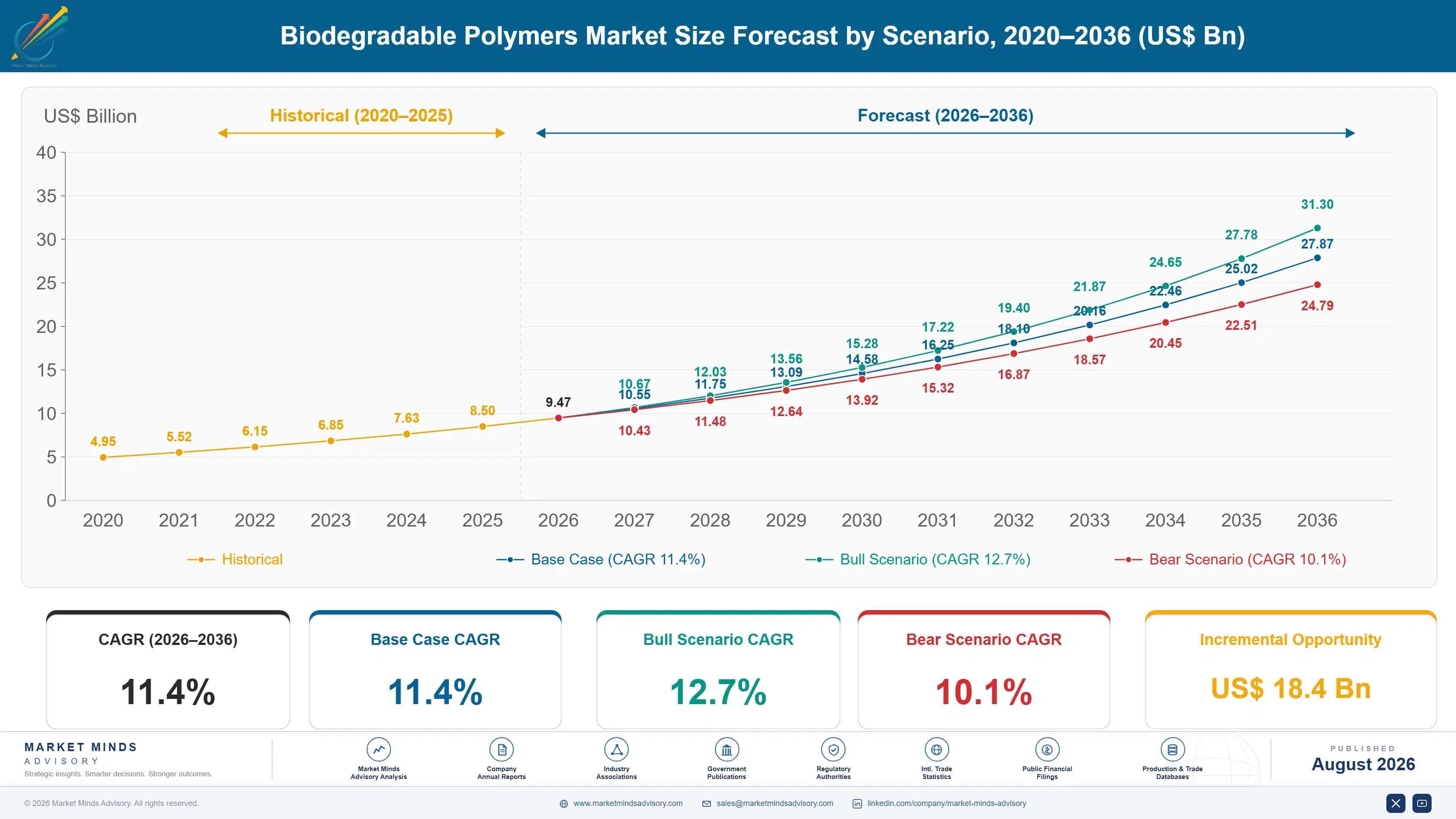
Biodegradable Polymers Market Forecast Scenarios

biodegradable-polymers-market-size-forecast-scenario-1787298613237
Biodegradable polymer demand grew rapidly through 2020 to 2025 as single-use plastic bans expanded and consumer brand sustainability commitments accelerated meaningfully across major packaging markets worldwide throughout the period. PHA production capacity expanded from 2023 onward as fermentation technology matured and gained brand acceptance. The market grew at a historical rate of roughly 10.1% annually across this period.
The base case rests on three mechanisms: expanding global packaging and agricultural film volume sustaining baseline PLA and PBAT demand across both mature and developing polymer markets worldwide, tightening single-use plastic regulation driving biodegradable substitution of conventional polyethylene across major consumer packaging categories nationwide, and growing PHA fermentation capacity investment adding meaningful new marine-biodegradable polymer procurement volume across major regional packaging and agricultural markets and their affiliated converter and distribution networks.
The bull case rests on faster than expected single-use plastic regulation expansion following the pattern several leading national governments have already established through mandatory substitution mandates and reporting requirements. The bear case centers on converter capital budget constraints and generic PLA price competition compressing margin across standard packaging categories that make up much of overall unit volume industry wide today.

Demand Thesis Behind the Biopolymer Category

Biodegradable polymers occupy an increasingly central position in packaging materials, since composting infrastructure and biodegradability certification standards dictate exactly which polymer category a given application genuinely qualifies for regardless of brand preference or cost cycle constraints today. PLA and PBAT still dominate unit volume, but PHA and marine-biodegradable formats are steadily gaining share wherever certification standards and consumer demand genuinely apply across most
MARKET CONCENTRATION (CR5)41%Combined share held by the top five producers
AVERAGE SELLING PRICE$3.20Average price charged per kilogram of biopolymer resin
TOP PRODUCING COUNTRY SHARE31%Share of global biopolymer output produced in China
MANUFACTURING LINE UTILIZATION74%Fermentation facilities running at active production capacity now
TRADE INTENSITY38%Share of total biopolymer volume crossing international borders
FEEDSTOCK COST SHARE48%Feedstock input cost as a share of total cost
Demand concentrates wherever manufacturing capacity and packaging regulation are strongest across the world today. East Asia generates the largest procurement volume given its aggressive plastic bans and rapidly expanding PLA and PBAT production capacity, while North America sustains substantial demand tied to its dense converter infrastructure and strong brand sustainability commitments across major regional packaging and agricultural film markets nationwide.
Over the next decade, certification depth and feedstock integration will matter more than raw manufacturing scale alone, since converter procurement teams increasingly evaluate producers on documented compostability data and supply reliability rather than simple unit cost. Producers able to demonstrate certified biodegradability and secure long-term feedstock supply agreements are positioned to capture disproportionate share as regulation continues evolving across most regions worldwide.
"Everyone wants to talk about compostability, but the brands actually switching suppliers are the ones whose retail partner finally demanded marine-degradation proof this year."
Director, Sustainable Materials Practice · MMA Chemicals and Materials Practice

Market Trends

Single-Use Plastic Bans Drive Biodegradable Substitution

Tightening single-use plastic ban enforcement, increasingly codified through mandatory biodegradable substitution requirements at major national and municipal governments, are pushing converters to replace conventional polyethylene film with PLA and PBAT compounds as a routine purchasing requirement rather than an optional sustainability initiative. This shift is converting what was once a premium sustainability choice into an increasingly mainstream procurement category at leading consumer packaging brands pursuing formal plastic waste reduction targets. Producers still selling exclusively conventional polymer technology risk losing converter contracts to competitors already offering validated biodegradable alternatives at comparable processing performance.
Market Impact: Adds 4.2 billion packaging units annually
Marine Biodegradability Standards Reshape PHA Demand

Growing marine biodegradability certification requirements are converting polymer procurement from a purely composting infrastructure dependent purchasing decision into one increasingly anchored in PHA formulations validated for genuine ocean and soil degradation performance across most major consumer packaging categories nationwide. This shift is prompting brand owners to specify marine-biodegradable certification as a differentiating sustainability claim rather than relying exclusively on industrial composting infrastructure that remains genuinely limited across most consumer markets and municipal systems. Producers with comprehensive PHA fermentation capacity are capturing disproportionate share of this increasingly certification-driven procurement demand nationwide and increasingly well beyond.
Market Impact: Adds 2.4 million hectares annually

Market Opportunities and Growth Drivers

Rising Consumer Packaging Volume Sustains Baseline Demand

Growing global consumer packaging volume, driven by expanding e-commerce fulfillment and rising food delivery activity across both developed and developing economies, sustains recurring baseline demand for biodegradable film and rigid packaging regardless of any single technology or regulatory trend currently reshaping the broader industry landscape worldwide and beyond. Each additional packaging unit converted represents a discrete, recurring polymer consumption event, since biodegradable packaging is single-use by design and cannot be recycled indefinitely across multiple use cycles under standard composting protocols. Producers with established converter distribution relationships and reliable supply chains are capturing disproportionate share of this steady, conversion-driven demand pool.
Market Impact: Compresses biodegradable margins by 5 points

Expanding Agricultural Film Applications Drive New Demand

Expanding agricultural mulch film adoption and growing soil-biodegradable farming practice investment across East Asia and Western Europe is driving substantial new-application demand for biodegradable polymers as farmers commission expanded planting programs requiring full soil degradation compliance before each new growing season begins. Each new agricultural program commissioned represents a significant, ongoing procurement relationship spanning the farm's full multi-decade operating lifetime, since polymer consumption scales directly with planted acreage and seasonal frequency once adoption begins. Producers with established regional distribution and agricultural support presence are capturing disproportionate share of this expanding new-application demand pool.
Market Impact: Limits verified composting access to 34%

Market Restraints and Challenges

Conventional Plastic Price Competition Compresses Margins

A meaningful cost gap between conventional polyethylene and biodegradable polymers continues to compress margins for producers competing outside regions with strict single-use plastic regulation, particularly in price sensitive emerging markets where composting infrastructure remains genuinely limited. The root cause is that conventional petrochemical polymers benefit from decades of scaled production infrastructure that biodegradable polymer producers have not yet matched, allowing conventional plastic converters to compete primarily on price rather than sustainability credentials. This directly compresses margin for producers still concentrated in unregulated commodity packaging markets. Established producers are responding by emphasizing regulatory compliance value and brand differentiation.
Market Impact: Lifts biodegradable polymer substitution to 22%

Limited Composting Infrastructure Restricts End-of-Life Claims

Biodegradable polymers, despite offering genuine environmental advantages, require industrial composting infrastructure that remains genuinely scarce across most municipal waste systems today, creating adoption friction among consumers and brands unable to verify proper end-of-life disposal pathways. The root cause is that industrial composting facilities demand significant capital investment and municipal waste stream sorting that many regions lack the infrastructure or political will to build reliably. This limits credible end-of-life claims among resource constrained municipal systems. Producers are responding by funding composting infrastructure partnerships that shift this burden away from municipal governments.
Market Impact: Expands PHA fermentation capacity by 38%
3 additional market trends, 3 additional growth drivers, and 3 additional restraints and challenges are covered in the full report. Contact sales@marketmindsadvisory.com to access the complete intelligence.

Segment CAGR and Growth Architecture

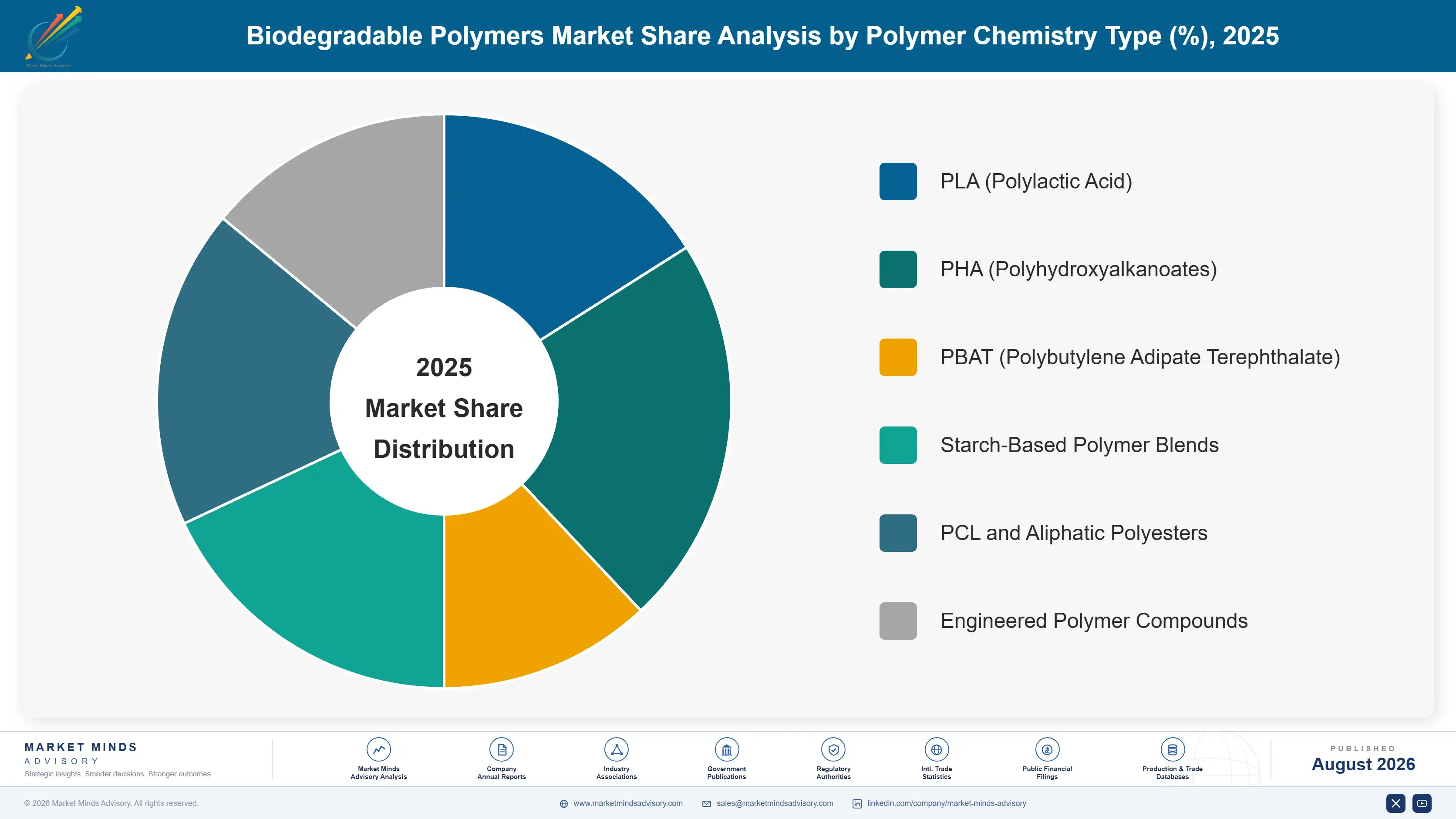
MMA segments the biodegradable polymers market by polymer chemistry type, the classification that most directly determines biodegradation pathway, certification tier, and pricing across PLA, PHA, PBAT, starch-based blend, PCL and aliphatic polyester, and engineered compound categories, rather than an application-based split used far more commonly and broadly seen elsewhere across this wider industry today.
biodegradable-polymers-market-market-share-analysis-1787298613772

PHA Polymers

PHA polymers are growing fastest, at roughly 19.2% annually, as marine biodegradability requirements and expanding fermentation capacity investment accelerate across major consumer packaging brands nationwide and increasingly well beyond today and going forward across markets. Adoption concentrates among large consumer packaging brands and fermentation technology developers with formal marine-biodegradable sustainability commitments, where brand owners increasingly specify PHA certification as a mandatory contract requirement rather than an optional consideration during renewal cycles. Pricing runs meaningfully higher than conventional PLA compounds, reflecting the specialized fermentation process and certification testing the category genuinely requires. Producers with validated PHA fermentation lines are positioned to capture disproportionate share of new brand contracts nationwide and increasingly beyond.
CAGR 19.2%

PBAT Polymers

PBAT polymers are growing at roughly 14.6% annually, driven by expanding compostable film and bag mandates and tightening single-use plastic regulation that increasingly require flexible biodegradable formats for complex, high-volume packaging applications across most consumer markets worldwide today and going even further still forward. Demand concentrates among converters manufacturing complex flexible film products, where certification failure carries genuine regulatory and reputational risk that conventional alternatives cannot adequately address at comparable cost or compliance. This segment commands substantial pricing premiums over standard starch blends, sustained by the rigorous compostability testing and flexible film engineering the category requires across every compound sold into packaging converters nationwide and across expanding agricultural film networks.
CAGR 14.6%
Full segment breakdown across 6 segments available in the complete report.

Regional Architecture and Country Demand Map

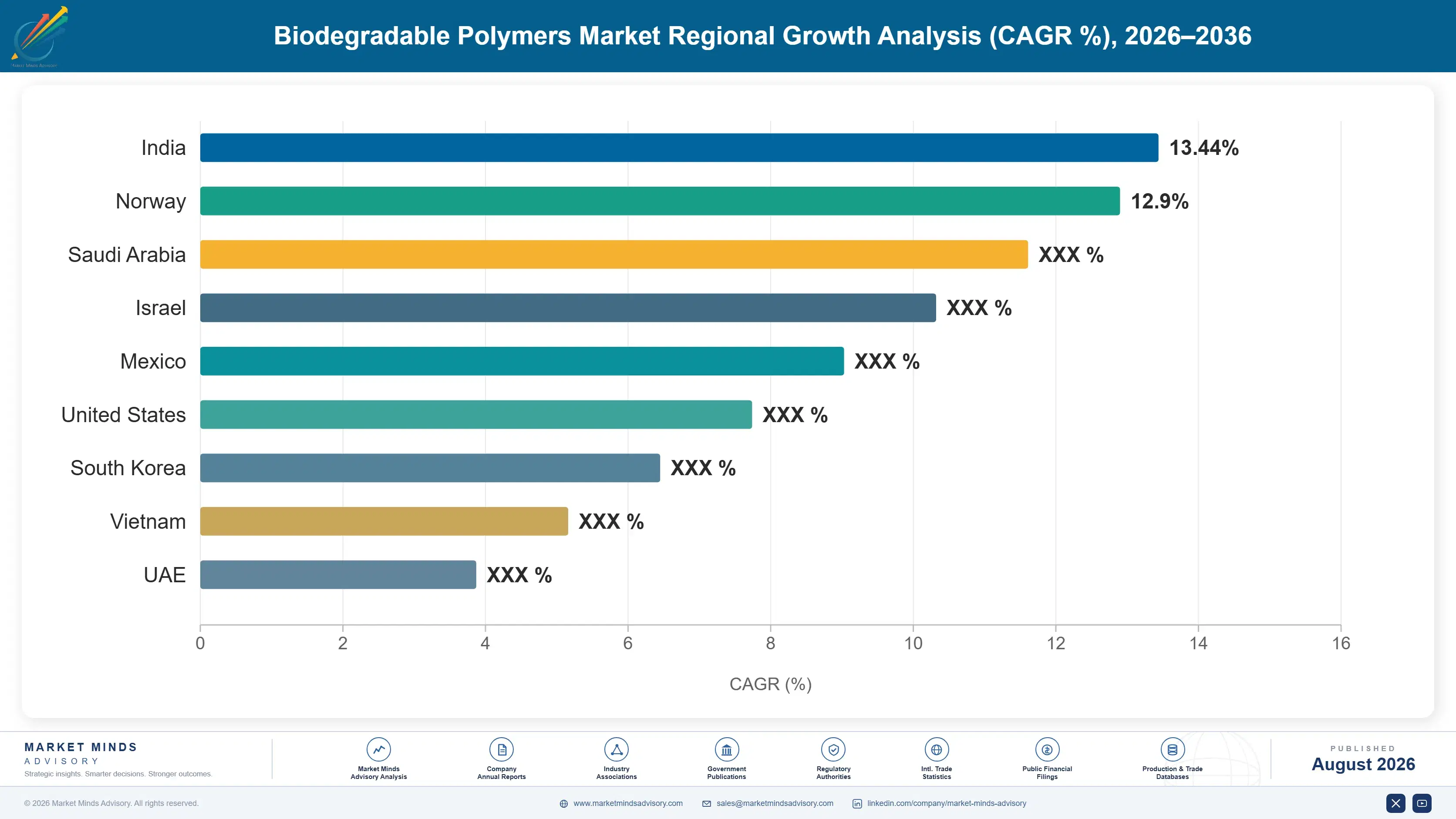
East Asia holds the largest regional share given aggressive plastic bans and rapidly expanding PLA and PBAT production capacity, while South Asia and Pacific grows fastest as manufacturing infrastructure expands rapidly across the region. North America sustains substantial demand tied to dense converter infrastructure nationwide and beyond.

East Asia

East Asia contributes the largest regional demand anchored by China's aggressive plastic bans and its rapidly expanding PLA and PBAT production capacity across major metropolitan markets nationwide and increasingly well beyond its own national borders today and going even further forward. Japan and South Korea contribute smaller but technically sophisticated demand concentrated in premium PHA and marine-biodegradable categories, reflecting their mature composting infrastructure and strong brand procurement discipline relative to other Asian markets currently expanding steadily and rapidly across the wider region. China's domestic manufacturing base is expanding rapidly to serve both its enormous home market and growing regional export volume, increasingly competing on price against established Western manufacturers nationwide.
Share: 29% | CAGR: 12.4% (2026 to 2036)

North America

North America's demand is anchored by the United States, where dense converter infrastructure and strong brand sustainability commitments sustain substantial procurement volume across thousands of active packaging converters and consumer brand manufacturers nationwide and well beyond its own domestic borders and packaging networks today and going even much further forward still. PHA fermentation capacity investment is accelerating faster here than in most regions given concentrated venture capital and consumer brand sustainability commitments across major biotech and packaging hubs nationwide. Canada's smaller, publicly funded system contributes steady secondary demand concentrated in similar polymer categories. Mexico's growing packaging sector adds incremental demand skewed toward standard PLA formulations rather than premium PHA formulations.
Share: 24% | CAGR: 11.9% (2026 to 2036)
Regional intelligence for 5 additional markets available in the complete report: Western Europe, South Asia and Pacific, Latin America, Middle East and Africa, Eastern Europe. Contact sales@marketmindsadvisory.com.
biodegradable-polymers-market-country-cagr-analysis-1787298614323

Moving Beyond the Commodity Resin Sale

Base PLA resin pricing faces steady downward pressure from low-cost regional producers competing aggressively on standard packaging categories nationwide and increasingly well beyond. Producers that build PHA fermentation capacity, secure marine-biodegradable certification breadth, and expand feedstock integration capture considerably better lifetime value than those competing purely on unit price across every major packaging market.

Building Out PHA Fermentation Capacity Fully

Producers investing in validated PHA fermentation capacity capture disproportionate share of a demand pool commanding pricing 30 to 42% above conventional PLA compounds, where marine-biodegradable certification directly determines whether a producer can win brand contracts now specifying certified degradation as a mandatory sustainability requirement across major consumer packaging companies. This fermentation development typically requires eighteen to twenty-four months of process validation and regulatory clearance, but producers that complete it successfully capture durable, multi year converter contracts that persist across a customer's full sustainability commitment cycle and well beyond initial adoption.
Market Impact: Commands pricing 30 to 42% above PLA compounds

Expanding Marine Biodegradability Certification Coverage Fully

Producers offering comprehensive marine-biodegradable certified compound systems capture meaningful recurring revenue worth an estimated 22 to 32% above conventional PBAT competitors, converting a fragmented, application-specific sales relationship into a captive full-portfolio brand owner contract tied to a customer's entire sustainability compliance protocol across its full multi year procurement cycle. This certification breadth, difficult for narrowly focused producers to replicate without dedicated marine testing infrastructure of their own, creates durable customer dependency that extends the commercial relationship well beyond a single application into years of recurring full-portfolio brand supply and renewal orders.
Market Impact: Adds 22 to 32% above conventional pricing levels

Expanding South Asian Manufacturing Capacity Broadly

Producers building dedicated manufacturing capacity in India and Southeast Asia are capturing disproportionate share of the region's rapidly expanding packaging demand pool worth an estimated 195 million dollars, positioning closer to fast growing regional converter construction volume rather than serving the market purely through imports carrying longer lead times and considerably higher landed costs today. This regional capacity investment requires meaningful capital commitment but positions producers to capture recurring, multi year converter supply relationships as regional packaging infrastructure scales alongside expanding government regulation investment across many states and countries region wide.
Market Impact: Captures a growing $195M regional demand segment now

Securing Long-Term Brand Owner Supply Contracts

Producers securing long-term brand owner supply contracts are capturing disproportionate share of a demand pool worth an estimated 265 million dollars tied to steady consumer packaging procurement volume across North America and Western Europe, a segment offering predictable, multi year procurement volume that spot market sales rarely provide at comparable scale or consistency. This supply agreement relationship requires meaningful pricing and quality investment but positions producers to capture recurring, contract anchored procurement across a multi year agreement cycle, a relationship considerably more durable than typical spot market transactions negotiated purely on price.
Market Impact: Captures a growing $265M brand owner demand pool

Who Controls the Margin Pool

The biodegradable polymers market is moderately concentrated, with a CR5 of roughly 41%. NatureWorks and Novamont lead a group of polymer chemistry majors with a meaningful gap over the next tier of regional compounders and fermentation specialists competing across converter and brand owner channels simultaneously in the current market environment.
Competitive activity concentrates on three fronts: PHA fermentation capacity investment tied to expanding marine-biodegradable brand commitments, certification breadth expansion that deepens revenue beyond conventional PLA compound sales, and East Asian manufacturing expansion tied to expanding regional plastic ban enforcement across multiple countries. Polymer chemistry majors defend positions through decades of accumulated converter relationships and feedstock integration depth that smaller regional compounders cannot easily replicate quickly.

Emerging pressure comes from regional Asian compounders building genuine cost and manufacturing scale advantages that established polymer chemistry majors are racing to match through regional partnerships rather than pure price competition. Rankings could shift meaningfully if a regional producer successfully wins a major brand owner's enterprise wide procurement contract, demonstrating credible quality and certification breadth that has historically been the primary advantage of established diversified polymer chemistry companies with broad converter relationships.
biodegradable-polymers-market-company-positioning-matrix-1787298614866

Competitive Moat and Risk Dimensions

NATUREWORKS LLC

Moat: Broad Converter and Brand Network

NatureWorks' extensive PLA production scale and its long-term supply contracts with major converters allow it to serve customers across multiple regions from a single coordinated account relationship, giving multinational packaging networks a consistency of resin availability that smaller, single-region producers typically cannot match at comparable scale or speed.
NATUREWORKS LLC

Risk: Exposure to Commoditized PLA Pricing

A meaningful share of NatureWorks' resin revenue remains tied to standard PLA categories facing sustained price competition from regional producers, requiring continued mix shift investment toward premium PHA and marine-biodegradable segments to offset this margin pressure over time and across future contract renewal cycles nationwide.
NOVAMONT S.P.A

Moat: Deep Mater-Bi Formulation Manufacturing Scale

Novamont's dense Mater-Bi starch blend formulation expertise and its established distribution network across European converters give it a genuine differentiation advantage that import-dependent competitors serving the same converter channels cannot easily replicate given decades of accumulated formulation know-how and regulatory certification depth across most regional markets.
NOVAMONT S.P.A

Risk: Exposure to Regional Producer Competition

Novamont faces genuine margin compression risk as regional Asian producers increasingly compete on standard starch blend and PLA categories, bypassing the formulation expertise advantage Novamont has historically relied upon, a dynamic that could limit its share of price sensitive volume segments over the coming years.

Players Tracked

Prominent Players

NatureWorks LLC
Novamont S.p.A
BASF SE
Corbion N.V.
Danimer Scientific Inc

Other Key Players

TotalEnergies Corbion
Kaneka Corporation
CJ CheilJedang Corporation
Mitsubishi Chemical Group Corporation
Eastman Chemical Company
FKuR Kunststoff GmbH
BioBag International AS
Plantic Technologies Limited
Green Dot Bioplastics Inc
Biome Bioplastics Limited
Trinseo PLC
Sulzer Ltd
Synbra Technology BV
Futerro SA
PTT MCC Biochem Co Ltd

Recent Developments

MARCH 2025

NatureWorks Expands Marine-Biodegradable Production Capacity

NatureWorks completed an organic capacity expansion at its PLA manufacturing facility in Thailand, adding production lines dedicated to next-generation marine-biodegradable formulations. The expansion responds to accelerating brand demand for certified compostable packaging and positions the company to serve growing Asia-Pacific converter needs across its regional customer base.
Signal: Signals incumbents are investing organically in marine-biodegradable capacity rather than relying solely on acquisitions to close the gap.
JUNE 2025

Danimer Scientific Acquires Regional Fermentation Technology Developer

Danimer Scientific acquired a mid-sized regional fermentation technology developer based in the southeastern United States, adding dedicated PHA production capacity and an established regional distribution network. The acquisition strengthens Danimer's fermentation manufacturing depth and reduces reliance on longer lead time centralized processing for premium polymer categories.
Signal: Signals consolidation pressure on smaller regional fermentation developers unable to match scale economics of larger diversified producers.
SEPTEMBER 2025

BASF Signs Multi-Year Packaging Converter Supply Agreement

BASF signed a multi-year supply agreement with a large regional packaging converter covering standard and marine-biodegradable compound categories across its member facilities nationwide. The agreement locks in predictable procurement volume for BASF while giving member facilities documented sustainability compliance nationwide across all packaging production lines.
Signal: Signals packaging converters increasingly bundle sustainability compliance directly into long-term institutional supply agreements going forward across regions.

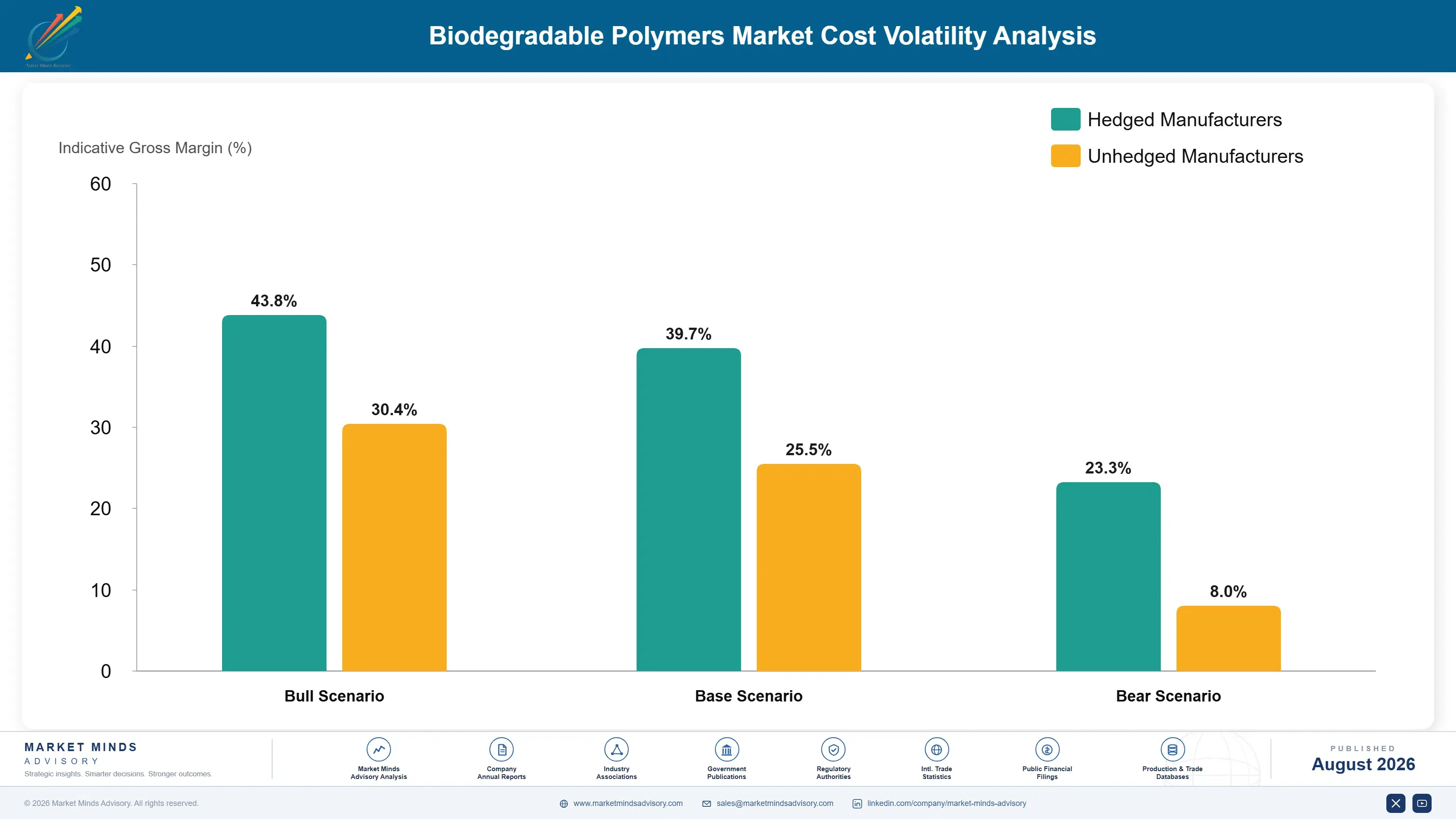
Feedstock Sugar and Petrochemical Sourcing Exposure

Fermentable sugar feedstocks and adipic acid petrochemical intermediates, sourced primarily from specialized agricultural processors in the United States, Thailand, and Brazil, account for roughly 44 to 52% of operating cost, given the purity and fermentation consistency biopolymer manufacturing requires throughout production. Compounding and additive formulation contribute a further 11 to 15% of total operating cost across the manufacturing portfolio.
Global fermentable sugar feedstock prices spiked meaningfully during 2021 and 2022 amid pandemic related agricultural supply chain disruption and rising commodity crop costs affecting biopolymer producers industry wide, pushing input costs up by more than 27% within several months, according to operating cost disclosures in NatureWorks' 2022 annual report. The disruption prompted several manufacturers to diversify feedstock sourcing across multiple regional suppliers and qualify backup producers to reduce future dependency.

Smaller regional compounders without long term feedstock supply agreements face greater cost exposure than larger diversified players like NatureWorks and Novamont, who negotiate volume based contracts directly with agricultural processors. Manufacturers dependent on single source adipic acid suppliers face additional exposure to petrochemical capacity constraints, a limitation vertically integrated manufacturers do not share to the same degree.
biodegradable-polymers-market-cost-volatility-analysis-1787298615074

Diversifying Fermentable Sugar Feedstock Suppliers

Larger manufacturers are increasingly qualifying multiple specialized agricultural feedstock suppliers across different geographic regions to reduce dependence on any single supplier relationship, a meaningful undertaking given the strict purity and fermentation consistency standards biopolymers always require before formal certification clearance for use in active, ongoing packaging applications across converter networks nationwide and increasingly well beyond.

Building In-House Fermentation Manufacturing Capability

Several manufacturers have established dedicated internal fermentation and compounding capability to build direct control over critical material supply chains, reducing dependence on external agricultural and petrochemical markets that remain genuinely tight relative to growing industry wide demand for biopolymers across multiple regional markets and expanding packaging systems nationwide and increasingly well beyond today and going forward.

Negotiating Volume-Based Feedstock Supply Agreements

Larger manufacturers are increasingly negotiating volume based fermentable sugar and adipic acid supply agreements directly with specialized agricultural processors, reducing per unit cost exposure and building predictable pricing structures that protect margin during periods of broader feedstock price volatility affecting biopolymer manufacturing costs across the industry more broadly and consistently over multiple fiscal years and contract cycles.

Portfolio Architecture for Margin Defence

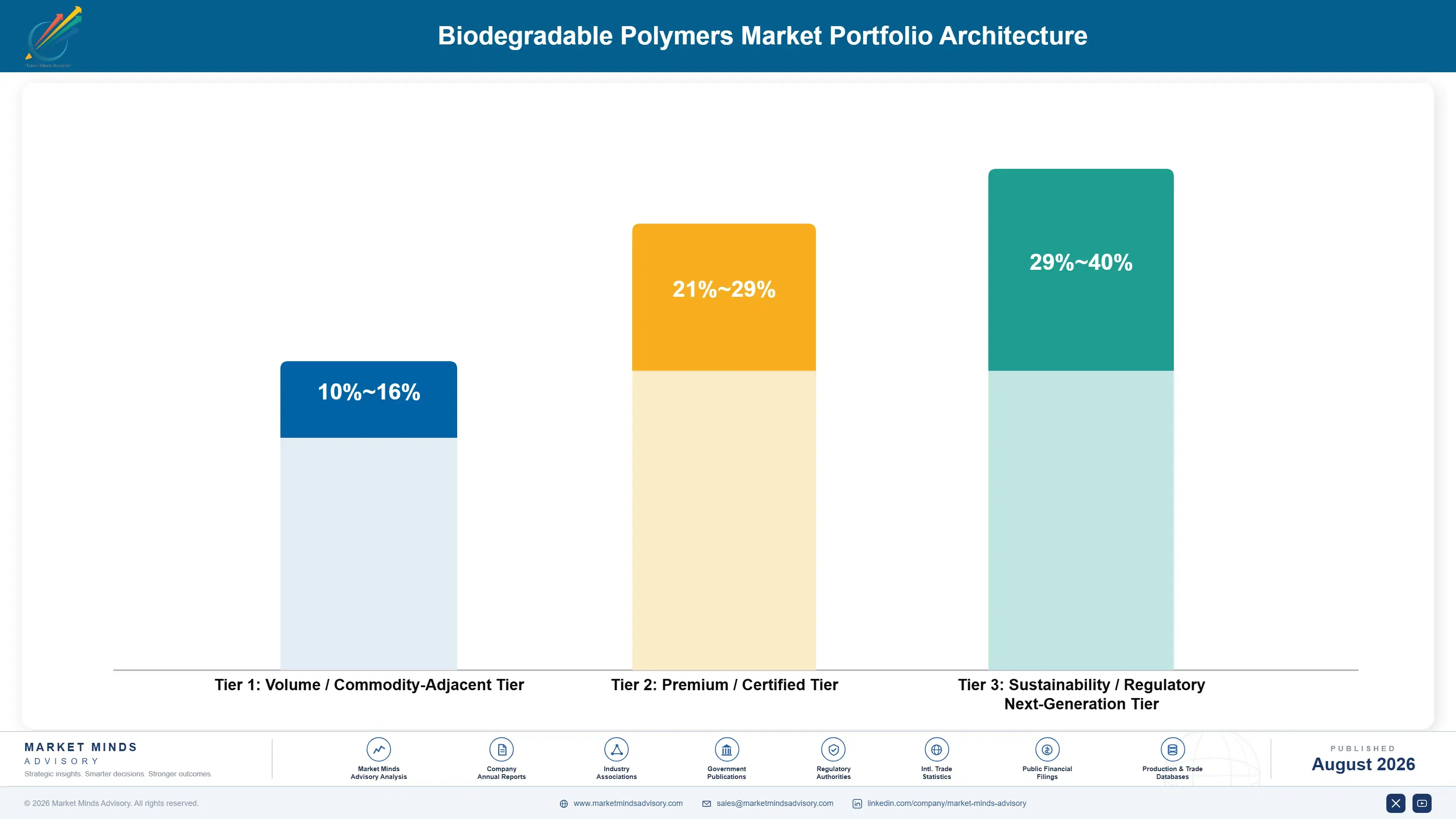
The market splits into three tiers running from commodity standard PLA compounds to premium marine-biodegradable PHA systems bundled with certification documentation and brand sustainability partnerships across major converter institutions. Margin concentrates heavily at the top: premium systems paired with certification breadth and fermentation capacity earn gross margins 21 to 30 percentage points above commodity products, reflecting both regulatory investment and branded converter pricing pow
Volume and premium tiers pull manufacturers in different strategic directions simultaneously across the industry today. Regional Asian compounders are pushing aggressively into standard PLA and starch blend categories, compressing margin in segments where established polymer chemistry majors historically earned steady returns, forcing incumbents to defend premium PHA and marine-biodegradable certified segments more aggressively through certification and technology differentiation rather than pricing alone across most contract cycles.

High value margin pools concentrate among manufacturers serving converters through combined certification breadth, fermentation capacity, and long-term brand owner relationships, since these accounts generate recurring revenue across multiple product categories and expanding sustainability compliance programs simultaneously, far exceeding the value of a single resin transaction and remaining the primary target of every major producer's account strategy today and going forward.

Volume / Commodity-Adjacent Tier

Standard PLA and starch blend compounds sold primarily into price sensitive converter tenders nationwide, competing on price against a fragmented regional producer base offering comparable products, with thin margins persisting.
Gross Margin: 10%-16%

Premium / Certified Tier

PBAT and reinforced compostable film compounds sold with regulatory documentation into packaging and agricultural markets, capturing better margin through demonstrated compostability compliance credentials and broadening converter relevance nationwide and today.
Gross Margin: 21%-29%

Sustainability / Regulatory / Next-Generation Tier

Marine-biodegradable PHA systems sold with regulatory compliance documentation and brand owner sustainability partnerships, commanding the highest margin as certified degradation becomes a baseline requirement across expanding consumer packaging markets nationwide.
Gross Margin: 29%-40%
biodegradable-polymers-market-portfolio-architecture-1787298615583

High-value Sub-segments and Strategic Watch-out

Marine-Biodegradable PHA Systems With Certification Documentation

Marine-biodegradable PHA compound systems generating recurring revenue through multi year brand owner sustainability partnership relationships, growing fastest as certification verification requirements make validated marine degradation a contractual condition for consumer packaging contracts across multiple retail chains, insurance programs, and rapidly expanding converter and agricultural partnerships worldwide today.
Gross Margin: 29%-40%

PBAT Compostable Film Service Programs

PBAT compound supply tied to expanding converter sustainability compliance, expanding steadily as consumer brands standardize on rigorously certified producers requiring increasingly sophisticated compostability documentation tailored to each converter's own very specific packaging pathway across multiple concurrent monitoring and compliance programs nationwide and increasingly well beyond.
Gross Margin: 21%-29%

Standard PLA and Starch Blend Categories

The largest unit volume segment, serving converters globally that need proven standard compounds without the highest tier's full certification and fermentation capacity cost, forming the steady revenue backbone of most producers' order books across mature and emerging packaging markets alike worldwide and increasingly well beyond.
Gross Margin: 10%-16%

Fermentable Feedstock Supply Facing Persistent Constraints

Constrained specialized fermentable sugar and adipic acid manufacturing capacity facing sustained demand growth from expanding PHA and certified compound development, a segment strategic watchers should track closely as feedstock scarcity intensifies production cost faster than some manufacturers' capacity expansion plans currently anticipate or prepared for.
Gross Margin: 12%-20%

From Resin Sale to Certification Partner

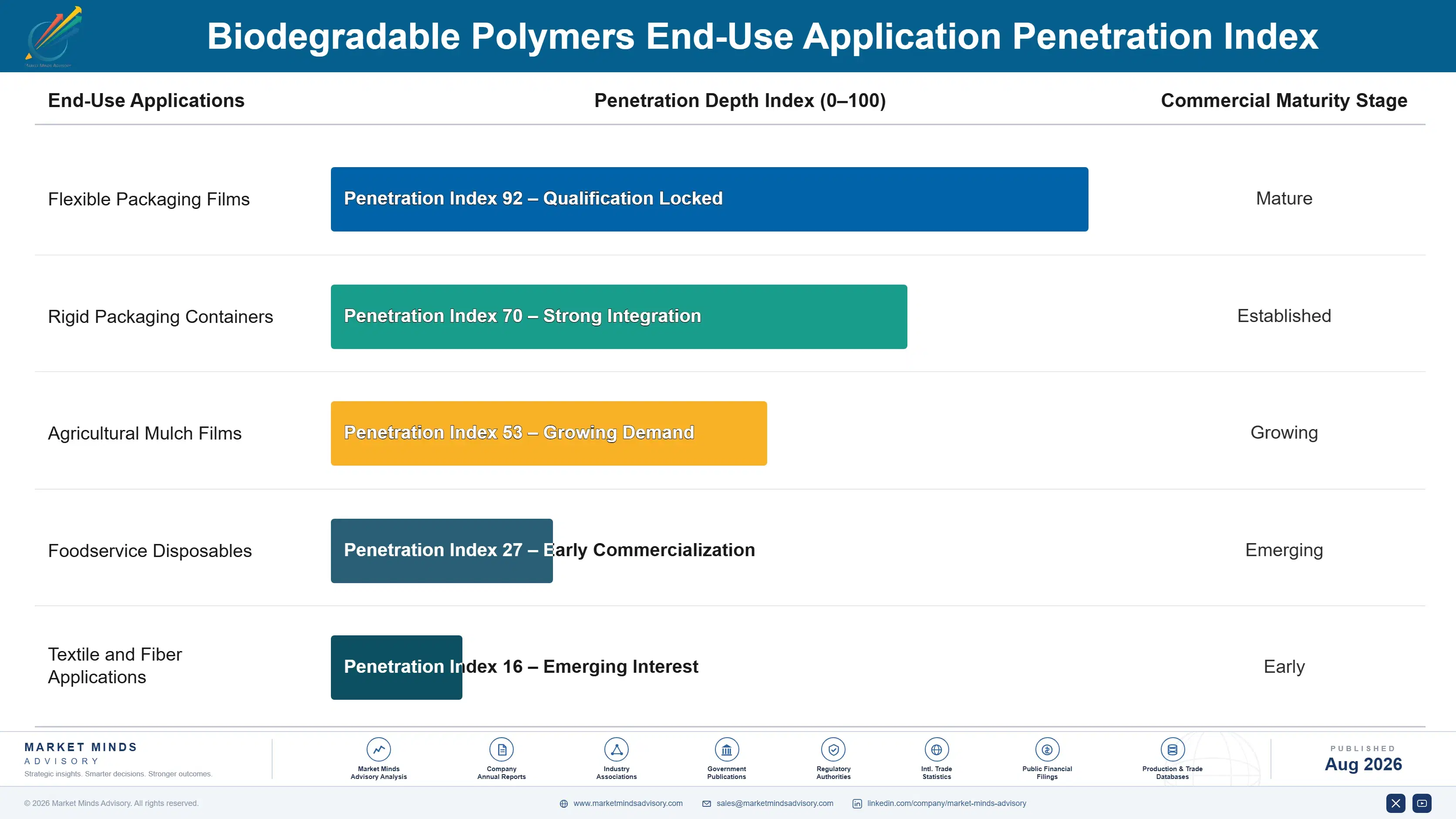
Biodegradable polymer demand is shifting from a transactional resin sale toward an ongoing certification compliance partnership as marine-biodegradable validation, feedstock integration, and multi year supply agreements increasingly extend a producer's commercial relationship across a brand owner's evolving sustainability program rather than a single purchase order, particularly among producers that have successfully bundled certification and fermentation capacity into their core offering rather
Adoption depth varies sharply by end-use vertical. Large consumer packaging brands and fermentation technology developers navigating sustainability commitments and marine-biodegradable standardization engage most deeply with premium producer partnerships, given the direct compliance and reputational consequences of resin selection at their institutional scale. Smaller regional converters adopt more transactionally, often purchasing standard PLA compounds for routine packaging rather than committing to the deeper vendor relationships that characterize consumer brand accounts.

A generational shift in buyer profile is underway as sustainability officers and material science specialists, increasingly focused on certification documentation and marine degradation data, join traditional procurement staff in institutional decisions, a change reshaping which producer capabilities actually win converter contracts across systems of all sizes and packaging settings nationwide and increasingly beyond as procurement committees expand their membership.
biodegradable-polymers-market-end-use-penetration-index-1787298616090

Where Polymer Producers Should Focus Next

These are among the four positions where our research anticipates prominent divergence between winners and laggards over the coming forecast period. Each is grounded in the demand model, the regulatory perimeter, and the announced capacity pipeline.
01 / PHA FERMENTATION INVESTMENT

Build marine-biodegradable capacity before mandates outpace supply

Expanding brand sustainability commitments across major consumer packaging companies are driving substantial demand for marine-biodegradable polymers that legacy PLA-only producers cannot supply without dedicated fermentation investment, converting this capability from a specialized niche into an increasingly central procurement requirement across brand contracts. Producers still concentrated in conventional PLA risk losing brand contracts to PHA competitors already established in this fast growing segment. Moving now, ahead of the point where marine-biodegradable sourcing becomes table stakes, allows producers to capture premium positioning before competition intensifies meaningfully further.
02 / CERTIFICATION BREADTH STRATEGY

Build full-portfolio certification ahead of consolidation trends

Converters increasingly consolidate purchasing around fewer producers offering comprehensive compostability certification that narrowly focused manufacturers cannot supply without dedicated testing investment, creating genuine differentiation opportunity for producers willing to build certification breadth across multiple polymer categories. Producers building dedicated certification programs now are positioned to capture disproportionate share of full-portfolio brand contracts as consolidation continues expanding across major consumer packaging systems. Waiting until certification breadth becomes a universal expectation risks ceding this differentiation opportunity to competitors already investing in testing infrastructure.
03 / EAST ASIAN MANUFACTURING EXPANSION

Build China capacity ahead of plastic ban enforcement

China's plastic ban enforcement and packaging infrastructure is scaling rapidly as regulatory investment and converter standardization expand, creating substantial near term demand for regionally manufactured polymers tied to this growth across the country's major metropolitan and expanding secondary packaging markets. Producers building dedicated regional manufacturing capacity now are positioned to capture disproportionate share as regional demand accelerates over the coming several years. Waiting until regional demand growth peaks to build this capacity risks ceding early mover advantage to competitors already embedded in ongoing converter relationships and government contracts.
04 / LONG-TERM CONTRACT DEVELOPMENT

Pursue brand owner agreements ahead of consolidation cycles

Consumer packaging procurement continues consolidating decisions across North America and Western Europe as brand owners seek predictable, multi year resin supply volume that standalone commodity sales rarely match at comparable scale or consistency across most private packaging markets. Producers investing in long-term supply relationships and compliance documentation are positioned to capture disproportionate share of this durable, contract backed demand pool. This relationship investment requires meaningful upfront cost, but the alternative is continued reliance on less predictable spot market sales cycles and volumes.

Engagement Snapshot From the Field

A live engagement with an industry participant carrying material or product regulatory and market exposure ahead of a defining policy shift, showing how our research translates into a defensible multi-year portfolio strategy.
MARKET MINDS ADVISORY · CLIENT ENGAGEMENT SUMMARY
Biodegradable Polymers Producer Strategic Portfolio Review and Transition Roadmap 2026·Investment Scenario on Biodegradable Polymers Exposure Evaluation 2025-26
CLIENT PROFILE
The client operates a mid-sized consumer packaged goods brand spanning food and beverage categories across North America, generating approximately 850 million packaging units annually across flexible film and rigid container formats. Following mounting retailer pressure for verified compostable packaging claims, brand leadership sought to evaluate transitioning from conventional PLA sourcing to marine-biodegradable PHA compounds across its primary packaging lines.
STRATEGIC CHALLENGE
The brand faced growing retailer scrutiny over unverifiable compostability claims tied to its existing PLA-based packaging, with several major retail partners threatening delisting absent third-party marine biodegradability certification. Leadership needed an independent assessment of PHA suppliers, realistic transition cost, and a phased rollout plan that avoided packaging line disruption while limiting incremental procurement cost.
MMA APPROACH
MMA conducted supplier capability benchmarking across seven PHA fermentation suppliers, evaluating certification depth, production capacity, and packaging line compatibility against the brand's 850-million-unit volume requirements. The engagement combined primary interviews with four incumbent and prospective suppliers alongside secondary analysis of published certification data, producing a scored comparison framework supporting the brand's sourcing committee through a structured, evidence-based supplier selection process.
KEY FINDINGS
  1. Retailer delisting threats tied to unverifiable compostability claims affected three separate major product lines across the preceding twelve full months alone nationwide.
  2. Suppliers offering documented marine biodegradability certification across their full compound portfolio commanded a premium of twelve to eighteen percent versus uncertified competitors in bid comparisons.
  3. PHA compound adoption reduced retailer compliance flags by nearly sixty percent compared to the brand's prior PLA-based packaging sourcing arrangement overall nationwide.
  4. A phased packaging line transition, evaluated against cost models, added roughly nine percent to blended procurement cost but eliminated delisting risk entirely across every retail partner.
CLIENT PROFILE
The client operates a mid-sized consumer packaged goods brand spanning food and beverage categories across North America, generating approximately 850 million packaging units annually across flexible film and rigid container formats. Following mounting retailer pressure for verified compostable packaging claims, brand leadership sought to evaluate transitioning from conventional PLA sourcing to marine-biodegradable PHA compounds across its primary packaging lines.
STRATEGIC CHALLENGE
The brand faced growing retailer scrutiny over unverifiable compostability claims tied to its existing PLA-based packaging, with several major retail partners threatening delisting absent third-party marine biodegradability certification. Leadership needed an independent assessment of PHA suppliers, realistic transition cost, and a phased rollout plan that avoided packaging line disruption while limiting incremental procurement cost.
MMA APPROACH
MMA conducted supplier capability benchmarking across seven PHA fermentation suppliers, evaluating certification depth, production capacity, and packaging line compatibility against the brand's 850-million-unit volume requirements. The engagement combined primary interviews with four incumbent and prospective suppliers alongside secondary analysis of published certification data, producing a scored comparison framework supporting the brand's sourcing committee through a structured, evidence-based supplier selection process.
KEY FINDINGS
  1. Retailer delisting threats tied to unverifiable compostability claims affected three separate major product lines across the preceding twelve full months alone nationwide.
  2. Suppliers offering documented marine biodegradability certification across their full compound portfolio commanded a premium of twelve to eighteen percent versus uncertified competitors in bid comparisons.
  3. PHA compound adoption reduced retailer compliance flags by nearly sixty percent compared to the brand's prior PLA-based packaging sourcing arrangement overall nationwide.
  4. A phased packaging line transition, evaluated against cost models, added roughly nine percent to blended procurement cost but eliminated delisting risk entirely across every retail partner.
RECOMMENDED STRATEGY
Phase 1: Phase 1 (Evaluation): benchmark and qualify three PHA fermentation suppliers against certification, capacity, and pricing criteria across a ninety day evaluation window. Phase 2: Phase 2 (Pilot): pilot PHA sourcing across the two highest-volume packaging lines before expanding the transition brand-wide across every remaining line. Phase 3: Phase 3 (Formalization): formalize multi-year supply contracts with staggered renewal dates, avoiding simultaneous renegotiation exposure across every supplier relationship the brand maintains going forward.
OUTCOME
Within twelve months, the brand transitioned from PLA to PHA compounds across all primary packaging lines without a single documented retailer compliance gap. Blended procurement cost rose approximately eight percent (client-reported, unverified by MMA), an increase leadership judged acceptable against eliminated delisting risk. Retailer partnership satisfaction scores improved markedly across the following two fiscal quarters.

Frequently Asked Questions

Foundational context covering the market sizes, CAGR, scope, country, region and competition that inform every finding below. This section is provided to cover basics and most often pre-purchase conversations, answered from the MMA Primary Research Dataset.

What is the current size of the Biodegradable Polymers Market?

The Biodegradable Polymers Market reached an estimated 8.5 billion dollars globally in 2025. This figure covers PLA, PHA, PBAT, and starch-based polymer categories used across packaging and agricultural markets worldwide.

How large will the Biodegradable Polymers Market be by 2036?

The market is forecast to reach approximately 27.9 billion dollars by 2036 under the base case scenario. That represents nearly three times the 2026 forecast level over the ten year outlook period.

What is the CAGR for the Biodegradable Polymers Market 2026 to 2036?

The base case compound annual growth rate is 11.4 percent across the 2026 to 2036 forecast period. Bull and bear scenarios range roughly one to one and a half points above and below that figure.

Which segment is growing fastest?

PHA Polymers is the fastest growing segment, expanding at approximately 19.2 percent annually. That is roughly one point seven times the overall market growth rate.

Who are the major companies in the Biodegradable Polymers Market?

Leading producers include NatureWorks, Novamont, BASF, Corbion, and Danimer Scientific. These five companies collectively hold a meaningful but not a dominant share of global production.

Which country is growing fastest?

China leads country-level growth within the East Asia region, driven by aggressive single-use plastic bans and rapidly expanding PLA and PBAT production capacity. Regional manufacturing investment is reinforcing this trajectory further.

Report Segmentation Architecture

The full report scope spans multiple orthogonal segmentation dimensions, with cross-tabulated demand data provided for each dimension pair. Coverage extends further to regional breakdowns, trend trajectories, and the competitive detail needed to support segment-level decision-making.

By Polymer Chemistry Type

  • PLA (Polylactic Acid)
  • PHA (Polyhydroxyalkanoates)
  • PBAT (Polybutylene Adipate Terephthalate)
  • Starch-Based Polymer Blends
  • PCL and Aliphatic Polyesters
  • Engineered Polymer Compounds

By End-Use Application

  • Flexible Packaging Films
  • Rigid Packaging Containers
  • Agricultural Mulch Films
  • Foodservice Disposables
  • Textile and Fiber Applications

By Distribution Channel

  • Direct Producer Sales
  • Compounder and Converter Distribution
  • Brand Owner Direct Contracts
  • Regional Trading Partners

By Region

  • North America
  • Western Europe
  • East Asia
  • South Asia and Pacific
  • Latin America
  • Middle East and Africa
  • Eastern Europe

Scope, Methodology, and Coverage

Every figure in this report is reproducible from documented input assumptions. The scope below maps the historical period, the forecast horizon, the segmentation dimensions, and the countries covered, alongside the underlying primary and qualitative methodology.
Historical Period
2020 to 2025
Forecast Period
2026 to 2036
Base Year
2025 (USD billions; MMA Primary Research Dataset, August 2026)
Market Definition
The Biodegradable Polymers Market comprises PLA, PHA, PBAT, starch-based blend, and PCL polymer resins and compounds used for packaging and agricultural film applications. Scope excludes conventional recyclable plastics, oxo-degradable additives, and standalone composting equipment marketed as distinct product lines.
Quantitative Units
USD billions (current prices); volume in kilotons of biopolymer resin where applicable
Segmentation Dimensions
By Polymer Chemistry Type; By End-Use Application; By Distribution Channel; By Region
Regions Covered
North America, Western Europe, East Asia, South Asia and Pacific, Latin America, Middle East and Africa, Eastern Europe
Countries Covered
USA, China, Germany, France, UK, Japan, South Korea, India, Australia, Canada, Brazil, Mexico, Indonesia, Vietnam, Thailand, Malaysia, UAE, Saudi Arabia, South Africa, Nigeria, Turkey, Poland, Netherlands, Italy, Spain, Sweden, Switzerland, Argentina, Colombia, Singapore, and additional markets relevant to this sector
Key Companies Profiled
NatureWorks LLC, Novamont S.p.A, BASF SE, Corbion N.V., Danimer Scientific Inc, TotalEnergies Corbion, Kaneka Corporation, CJ CheilJedang Corporation, Mitsubishi Chemical Group Corporation, Eastman Chemical Company, FKuR Kunststoff GmbH, BioBag International AS, Plantic Technologies Limited, Green Dot Bioplastics Inc, Biome Bioplastics Limited, Trinseo PLC, Sulzer Ltd, Synbra Technology BV, Futerro SA, PTT MCC Biochem Co Ltd
Quantitative Methodology
Primary survey, n=3,800 respondents, Q4 2025, six countries; demand-side model with trade association cross-validation
Qualitative Methodology
47 expert interviews, Q4 2025; applied to validate demand model assumptions, identify emerging dynamics, and assess competitive positioning
Report Format
PDF and XLSX data workbook (Word format preview document)
Publisher
Market Minds Advisory
Report Code
MMA-2026-CHM-356
Published
August 2026
Contact
sales@marketmindsadvisory.com | www.marketmindsadvisory.com

Purchase the full Biodegradable Polymers Market Report (2026 to 2036).

This report covers the full 2026 to 2036 Biodegradable Polymers Market outlook across five polymer categories, seven global regions, and competitive dynamics among twenty tracked producers worldwide today. It combines primary survey data from 3,800 respondents across six countries and 47 expert interviews with company disclosures. This combined evidence base is used to quantify demand drivers, cost exposure, and margin architecture in considerable detail. The analysis is intended for procurement, strategy, and investment decision-makers evaluating producer positioning, sourcing resilience, or category growth opportunities across packaging and agricultural channels globally.
Full ten-year market sizing and segment forecasts
Detailed competitive benchmarking across twenty producers
Regional demand analysis across seven markets
Input cost exposure and mitigation strategy review
Portfolio tiering and margin economics breakdown
Primary survey and expert interview data tables

Built For The People Who Decide

From boardroom strategy to bench-side execution, this report is read cover-to-cover by leaders shaping the next decade of their industry, turning demand scenarios, market dynamics and valuation benchmarks into decisions.
CXOs/ Presidents/ VPs/ Managers
M&A and Corporate Development
Strategy Teams and R&D Heads
Procurement and Product Directors
Regulatory and Compliance Leaders
Investor Relations and Equity Analysts