Market Minds Advisory
Lubricants / Slip Agents Market

Lubricants / Slip Agents Market: Lubricants and Slip Agents Market: Migration As Mechanism And Defect, Untimed Friction Specifications and Recyclate Accumulation, 2026 to 2036

The additive works by migrating out to the film surface, and that same migration is what ruins the print, contaminates the seal, and makes recycled polyolefin behave quite unpredictably afterwards.

Lead Analyst

Published

September 2026

Make Smarter Decisions with Customized Research Insights

Request a free sample report and evaluate market opportunities, growth trends, and competitive dynamics relevant to your business needs.

2025 MARKET VALUE$3.4BMarket Size 2025
2036 FORECAST VALUE$6.6BBase Case , 2026 to 2036
CAGR 2026 TO 20366.2 %Bull 7.4% / Bear 5.0%
INCREMENTAL OPPORTUNITY$3.0BNet 10- year value creation
EXPANSION MULTIPLE1.83x2036 value over 2026 base
Strategic Levers
M&A Pipeline
Regional Outlook
Country Rankings
Competitive Intelligence
Segmental Deep-dive
Call-Us : 91 93563 13602

Executive Snapshot and Market Trajectory.

Slip agents work by blooming to the surface of a film, and surface friction keeps changing for roughly 21 days after extrusion while that happens. Around 16% of specifications state when the measurement should be taken. Most friction requirements in this industry are therefore effectively undefined.
Non-migrating polymer slip systems grow at 9.3%, half again the market rate of 6.2%, because they deliver the friction reduction without the surface migration that causes print adhesion failure and seal contamination downstream. Silicone and siloxane systems follow at 8.1%. Fluoropolymer process aids decline as restriction on those chemistries approaches, with 64% of processors already seeking alternatives. Amide chemistry still holds the bulk of volume and grows at barely two thirds the category rate.
Recycled content is the newer problem and it has no clean answer. Recycled polyolefin carries roughly 2.7 times the accumulated slip additive of virgin resin from all its previous lives, which makes friction unpredictable in exactly the streams that recycled content mandates are expanding fastest. A converter adding a standard loading overshoots badly, and one adding nothing finds it unevenly distributed. Recycled content mandates are expanding this problem steadily.
Market Definition
This market covers lubricants and slip agents supplied as additives for polymer processing, including non-migrating polymer slip systems, silicone and siloxane slip additives, fatty acid ester and wax lubricants, fatty acid amide slip agents, metallic stearate lubricants, and fluoropolymer process aids. It excludes engine and automotive lubricating oils, metalworking and cutting fluids, greases and industrial machinery lubricants, food-grade release agents applied to equipment, and personal care emollients.
Base Year Value
$3.4B in 2025 (MMA Primary Research Dataset, September 2026)
Forecast Period
2026 to 2036, eleven discrete annual values
CAGR
6.2% base case. Bull 7.4%. Bear 5.0%.
Fastest Growth Segment
Non-Migrating Polymer Slip Systems: 9.3% CAGR
Fastest Growth Country
India: 10.2% CAGR
Fastest Growth Region
South Asia and Pacific: 8.2% CAGR
Largest Region
East Asia: 41% of 2025 global value
Market Leaders
Croda International, Emery Oleochemicals, PMC Biogenix, BASF, and Evonik Industries lead the field. Source: MMA Primary Research Dataset, July 2026.
Primary Survey
n=3,800 procurement and R&D decision-makers, Q4 2025, six countries
Methodology
Demand-side build-up, cross-validated against public data, 47 expert interviews

Lubricants / Slip Agents Market Forecast Scenarios

lubricants-slip-agents-market-size-forecast-scenario-1790015670548
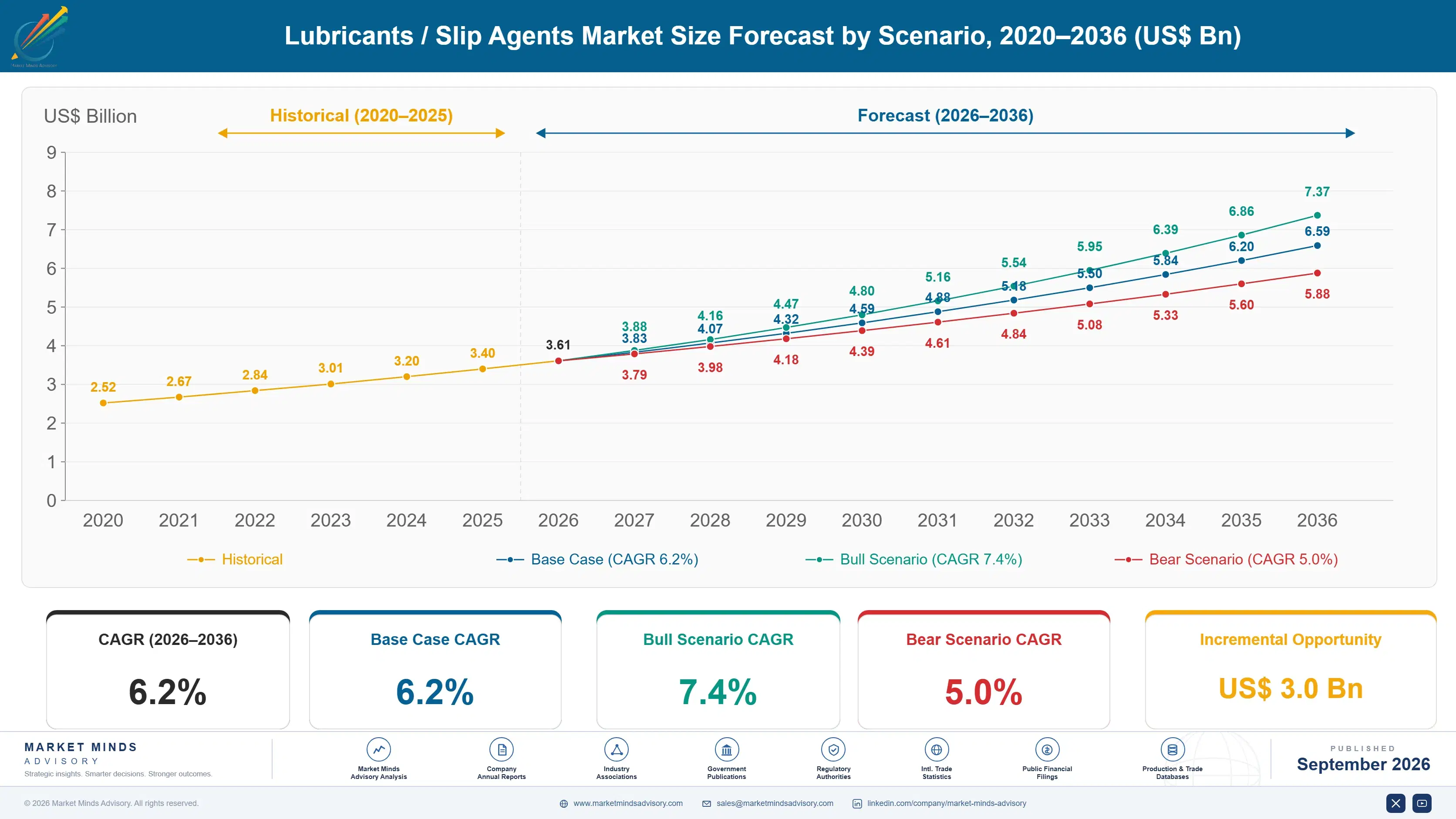
Between 2020 and 2025 the category grew at 5.1% alongside polyolefin film conversion, with amide slip agents holding the bulk of volume throughout. Two pressures arrived late in that period and neither has resolved: fluoropolymer aids came under restriction scrutiny, and recycled content put resin with unpredictable additive history into converters specified around virgin material.
The base case at 6.2% rests on three mechanisms. Non-migrating systems take share as converters count the cost of print and seal defects rather than the cost of the additive. Indian and Southeast Asian film conversion expands faster than any other region. And fluoropolymer process aid replacement pulls volume toward polymer and silicone alternatives that were previously too expensive to consider at scale. None of the three requires polymer conversion volumes to accelerate at all.
The bull case at 7.4% depends on timed friction specification becoming standard, since a converter measuring at a stated interval selects differently and generally selects upward. The bear case at 5.0% is recyclate: accumulated additive in recycled streams runs around 2.7 times virgin levels, and a converter who cannot predict friction adds less rather than more while they work out what they are dealing with.

The Mechanism And The Defect

A slip agent is compounded into the polymer melt, has almost no compatibility with the matrix once solidified, and therefore migrates outward to the film surface where it forms the low-friction layer the converter wanted. That migration is not a side effect. It is the entire mechanism, and it is also the reason the same additive contaminates seals, interferes with printing inks, and produces haze in stacked reels.
TOP FIVE CONCENTRATION43%Share of category revenue held by the leading suppliers
BLOOM EQUILIBRIUM PERIOD21 daysTime before surface friction stabilises after film extrusion
TIMED COF SPECIFICATION16%Specifications stating when friction should actually be measured
PRINT ADHESION FAILURES38%Converter defects traced to additive migration at the surface
RECYCLATE ADDITIVE LOAD2.7 timesAccumulated slip present in recycled polyolefin versus virgin
FLUOROPOLYMER AID REFORMULATION64%Processors seeking alternatives ahead of restriction on these chemistries
The timing matters more than the level and almost nobody specifies it. Surface concentration climbs for roughly 21 days after extrusion before reaching equilibrium, so a coefficient of friction measured at twenty-four hours bears little relation to what the film does three weeks later at a packing line. Around 16% of specifications state a measurement interval, which means most friction requirements in this industry are effectively undefined.
Recycled content has introduced a problem the category has no established answer for. Polyolefin that has been through one or more previous lives carries roughly 2.7 times the accumulated slip additive of virgin resin, and none of it is documented. A converter adding a standard loading to that resin overshoots badly, and one who compensates by adding nothing discovers the accumulated material was unevenly distributed.
"We sell a controlled defect. The additive has to migrate or it does nothing, and once it migrates it is on the surface where your ink and your seal want to be. Then we write a friction specification without saying when to measure it, and everybody argues about test results for a month."
Practice Director, Polymer Additives and Processing Chemistry · MMA Chemicals and Materials Practice · September 2026

Market Trends

Non-Migrating Systems Separate Mechanism From Defect

Polymer-based slip systems grow at 9.3%, the fastest rate here, by achieving friction reduction without depositing anything mobile on the film surface. Converters counting the cost of print adhesion failures and seal contamination rather than the cost per kilogram of additive reach a different conclusion than those comparing raw material prices. Around 38% of converter surface defects trace to migration, which is a considerably larger number than the price premium these systems carry. Performance in very thin film remains behind amide chemistry at equivalent loading, which is the honest limitation and the reason adoption is not faster still.
Market Impact: Country grows at 10.2%

Fluoropolymer Restriction Pulls Volume Toward Alternatives

Roughly 64% of processors are actively seeking alternatives to fluoropolymer process aids ahead of restrictions on those chemistries, which is a considerably faster response than most regulatory changes generate in polymer processing. Polymer and silicone alternatives that were dismissed as too expensive three years ago now get evaluated seriously. Performance in melt fracture elimination remains behind the incumbent chemistry, and processors are accepting that gap rather than waiting for parity. Qualification on a production line takes months that a restriction deadline will not provide, which is why processors are moving well ahead of any legal requirement to do so.
Market Impact: Explains 38% of defects

Market Opportunities and Growth Drivers

Indian Film Conversion Expands Faster Than Anywhere

Indian growth of 10.2% leads every country covered, driven by flexible packaging and agricultural film conversion expanding at rates no other market approaches alongside domestic additive manufacturing that has grown to serve it. Local suppliers compete directly against international producers on amide chemistry where the process is well established. Specification practice lags the volume considerably, with friction requirements frequently copied from international documents without any measurement protocol attached. Friction requirements are frequently copied from international documents without the measurement protocol that gave those numbers meaning in the first place. Volume has run well ahead of technical discipline.
Market Impact: Carries 2.7 times loading

Defect Costing Changes Which Additive Wins

About 38% of converter surface defects trace to additive migration, and a print adhesion failure discovered after a job has run costs far more than the additive premium that would have avoided it. Converters who cost defects properly select non-migrating systems and those comparing price per kilogram do not. That accounting difference decides more specification outcomes in this market than any technical argument a supplier can present. Very few suppliers construct that analysis for a customer, which leaves the argument unmade in most of the accounts where it would land hardest.
Market Impact: Only 16% state timing

Market Restraints and Challenges

Recyclate Now Carries Undocumented Additive History

Recycled polyolefin holds roughly 2.7 times the accumulated slip additive of virgin resin, distributed unevenly and documented nowhere, and the root cause is that every previous processing life added its own loading. Commercially it makes friction unpredictable exactly where recycled content mandates are expanding fastest. Suppliers respond with recyclate-specific grades, with incoming friction testing services, and with additive packages formulated to work across a wide starting range. None of that fully solves a problem where the incoming material varies lot to lot with no record of what produced it. Documentation of prior additive loadings does not exist.
Market Impact: Cuts 38% of surface defects

Friction Specifications Omit The Measurement Timing

Surface friction changes for around 21 days after extrusion and roughly 16% of specifications state when it should be measured, and the root cause is that specifications were copied between organisations without the protocol that gave the number meaning. Commercially it produces disputes between film producer and converter over material that meets both readings. Suppliers respond by publishing time-resolved friction curves rather than single values. Publishing a full curve costs a measurement series per grade and ends an argument that recurs on every disputed delivery. Disputes recur on every contested delivery.
Market Impact: Affects 64% of processors
4 additional market trends, 3 additional growth drivers, and 2 additional restraints and challenges are covered in the full report. Contact sales@marketmindsadvisory.com to access the complete intelligence.

Segment CAGR and Growth Architecture

Segmentation follows additive chemistry across six categories: non-migrating polymer slip systems, silicone and siloxane slip additives, fatty acid ester and wax lubricants, fatty acid amide slip agents, metallic stearate lubricants, and fluoropolymer process aids. Polymer type, processing method, and end-use application are treated as separate dimensions entirely. Carrier and masterbatch format are counted within the chemistry delivered.
lubricants-slip-agents-market-market-share-analysis-1790015671140

Non-Migrating Polymer Slip Systems

Non-migrating systems grow at 9.3%, half again the market rate of 6.2%, by separating the friction reduction from the surface migration that produces most of the trouble downstream. Polymeric slip chemistry remains anchored in the matrix rather than blooming outward, so print adhesion holds, seals stay clean, and friction does not drift for three weeks after extrusion. Cost per kilogram runs well above amide chemistry, which is why the argument only lands with converters who cost defects rather than raw materials. Performance in very thin film remains behind amides at equivalent loading. Converters costing defects reach a different answer from those costing kilograms. Raw material comparison always favours the amide.
CAGR 9.3%

Silicone And Siloxane Slip Additives

Silicone systems grow at 8.1% on friction performance that amides cannot match at any loading, particularly on filled and highly pigmented compounds. Ultra-high molecular weight siloxanes stay largely in the matrix and give durable surface slip without the bloom cycle. The trade-offs are genuine and permanent: silicone contamination is effectively impossible to remove from a recycling stream, and any surface it reaches will not accept print or adhesive afterwards. Converters running both printed and unprinted work therefore have to segregate material and equipment carefully. Recycled content requirements make that contamination question considerably sharper than it was five years ago, and some converters now exclude silicone entirely on those grounds. Segregation of material and equipment becomes essential.
CAGR 8.1%
Full segment breakdown across 6 segments available in the complete report.

Regional Architecture and Country Demand Map

Regional shares here track where polymer conversion actually consumes these additives, rather than where the chemistry itself simply happens to have been manufactured for them. Five regions sit outside the standard bands, for reasons named in their own paragraphs and summarised below for operator review.

East Asia

At 41% this sits far above the standard band, and the justification is that China converts more polyolefin film than the rest of the world combined and manufactures a substantial share of the additives consumed doing it. Growth of 7.2% exceeds the world rate. Japanese and Korean converters specify considerably more rigorously than Chinese volume producers, and time-resolved friction data is expected there as standard. Domestic Chinese additive producers compete on amide chemistry where the process is entirely mature. Chinese producers now export competitively into Western markets on price, and the remaining quality gap sits in purity consistency rather than in the chemistry itself. Purity consistency remains the gap. Chemistry itself is fully mature.
Share: 41% | CAGR: 7.2% (2026 to 2036)

North America

At 18% this sits below the standard band, reflecting a converting base that is substantial but far smaller than Asian film production despite comparable packaging consumption. Growth of 5.6% tracks close to the world rate. Fluoropolymer process aid replacement is proceeding faster here than elsewhere, driven by state-level restrictions arriving ahead of federal action. Defect costing practice is more developed among larger converters, which favours non-migrating systems in exactly those accounts. Recycled content requirements are arriving more slowly than in Europe, which delays rather than avoids the accumulated additive problem that European converters are already managing. State-level restrictions are arriving ahead of any federal action on fluoropolymer process aids. Processors face an earlier deadline than the federal position implies.
Share: 18% | CAGR: 5.6% (2026 to 2036)
Regional intelligence for 5 additional markets available in the complete report: Western Europe, South Asia and Pacific, Latin America, Middle East and Africa, Eastern Europe. Contact sales@marketmindsadvisory.com.
lubricants-slip-agents-market-country-cagr-analysis-1790015671667

Where Suppliers Actually Win Specification

Four commercial moves separate suppliers winning specification from those quoting amide chemistry against a coefficient of friction number with no protocol attached. Each addresses something this industry knows and works around: migration, timing, recyclate history, and a restriction that is coming regardless. Three of the four are technical service rather than product development. Only one requires new chemistry.

Publish Time-Resolved Friction Rather Than Values

Surface friction changes for roughly 21 days after extrusion and about 16% of specifications state a measurement interval, which leaves most friction requirements effectively undefined. Suppliers publishing full friction curves rather than single values report specification win rates 2.4 times higher with technical converters. It costs a measurement series per grade, and it ends the disputes between film producer and converter over material that satisfies both readings taken at different times. Most suppliers still publish a single number with no protocol attached. Technical converters reward the disclosure immediately. It ends a recurring commercial dispute.
Market Impact: Raises specification win rates to 2.4 times higher

Sell Against Defect Cost Not Kilogram Price

Around 38% of converter surface defects trace to additive migration, and a print failure found after a job has run costs many times the additive premium that would have prevented it. Suppliers presenting defect cost analysis alongside quotations report non-migrating system conversion 3.1 times higher than those comparing price per kilogram. The arithmetic is straightforward and converters accept it readily, and very few suppliers bother to construct it at all. Purchasing compares kilograms and technical teams compare rejects. A print failure found after a run costs many multiples of the premium avoided.
Market Impact: Raises system conversion rates to 3.1 times higher

Build Recyclate-Specific Grades And Testing Services

Recycled polyolefin carries roughly 2.7 times the accumulated slip of virgin resin, unevenly distributed and documented nowhere, which makes standard loadings unusable. Suppliers offering incoming friction testing alongside recyclate-tolerant grades report account values 2.8 times greater in converters running recycled content. Recycled mandates are expanding and nobody has an established answer, which makes this the clearest unclaimed technical position in the whole category. Being first with a working grade sets the specification that everybody else then has to work against, which is worth considerably more than the development cost involved.
Market Impact: Raises average account values to 2.8 times greater

Qualify Fluoropolymer Replacements Well Before Deadlines

About 64% of processors are already seeking alternatives to fluoropolymer process aids, and qualification on a production line takes months that a restriction deadline will not allow. Suppliers with qualified alternatives report new account wins 2.2 times higher than those still developing them. Performance in melt fracture elimination remains behind the incumbent chemistry, and processors are accepting that gap rather than waiting for a parity that may never arrive. Waiting for performance parity means missing the qualification window entirely. Restriction timing is already visible to everybody. Melt fracture performance still trails the incumbent.
Market Impact: Raises new account wins to 2.2 times higher

Who Controls the Margin Pool

Concentration is moderate. Five suppliers hold 43% of category revenue, measured consistently on that basis across all participants, and the remainder spreads across oleochemical processors, silicone producers, regional compounders, and Indian and Chinese manufacturers competing hard on established amide chemistry at considerably lower prices. Barriers to entry in amide chemistry are low and in non-migrating and recyclate-tolerant systems considerably higher, which is where the field is separating.
Competition currently turns on three dimensions: non-migrating chemistry depth, where the technical argument is genuinely strong and rarely made properly; recyclate-tolerant formulation, which is the newest and least contested problem; and fluoropolymer replacement readiness ahead of restriction deadlines that are already visible. Time-resolved data publication has become a fourth dimension, and technical converters increasingly treat a single friction value as evidence that the supplier has not measured properly.

Pressure builds from two directions. Indian and Chinese producers match amide performance at prices Western suppliers cannot approach. Meanwhile recycled content requirements destabilise the specifications everything was built around. Rankings will shift toward suppliers holding recyclate answers, since nobody currently has one. Technical service capability rather than chemistry breadth is becoming the deciding dimension.
lubricants-slip-agents-market-company-positioning-matrix-1790015672201

Competitive Moat and Risk Dimensions

CRODA INTERNATIONAL

Moat: Oleochemical Integration Depth

Control over erucic and oleic feedstock through to finished amide gives purity and consistency that compounders buying intermediate material cannot match, and purity determines how cleanly an additive blooms rather than depositing unevenly. That integration also insulates the business from the feedstock volatility that periodically disrupts smaller producers.
CRODA INTERNATIONAL

Risk: Amide Chemistry Portfolio Weight

Depth in migrating amide chemistry sits precisely where non-migrating and silicone alternatives are taking share, and where recyclate accumulation makes the mechanism itself problematic. Building polymer slip capability means competing in chemistry the business has less heritage in against specialists who started there. Specialists started in that chemistry rather than arriving at it.
EVONIK INDUSTRIES

Moat: Silicone And Polymer Breadth

Positions across siloxane and polymeric slip chemistry cover both of the fastest growing segments, which lets the business serve converters moving away from amides without losing them to a specialist. That breadth also allows honest recommendation between chemistries, since the outcome does not determine which product line benefits.
EVONIK INDUSTRIES

Risk: Silicone Recycling Stream Liability

Silicone contamination cannot be removed from a recycling stream and permanently prevents printing or adhesive bonding on any surface it reaches. As recycled content requirements broaden, converters may exclude silicone chemistry entirely on contamination grounds regardless of its friction performance advantages. That exclusion would apply regardless of friction performance.

Players Tracked

Prominent Players

Croda International
Emery Oleochemicals
PMC Biogenix
BASF
Evonik Industries

Other Key Players

Dow
Clariant
Fine Organics
Baerlocher
Struktol
Lonza
Nouryon
Peter Greven
Faci Group
Kao Corporation
Shin-Etsu Chemical
Wacker Chemie
Adeka Corporation
Sun Ace Kakoh
Italmatch Chemicals

Recent Developments

FEBRUARY 2026

Croda Publishes Time-Resolved Friction Curves Across Slip Range

Croda International began publishing coefficient of friction development over the full bloom period across its slip additive range, replacing the single values that leave converters and film producers arguing over readings taken at different times. Curves cover each grade at several loadings. Reference conditions are stated alongside.
Signal: Measurement timing moves from an unstated assumption to published data. Competitors quoting single values must now explain themselves.
SEPTEMBER 2025

Fine Organics Expands Amide Slip Agent Capacity In India

Fine Organics completed an organic capacity expansion for fatty acid amide slip agent production, funded internally with no partner involved, after domestic film conversion growth and export demand together outran available amidation throughput. Amidation capacity rather than feedstock availability had been the binding constraint on output.
Signal: Indian capacity now serves domestic growth and export volume simultaneously. Indian supply now competes directly in third markets.
MAY 2025

Evonik Acquires Silicone Slip Additive Business

Evonik Industries completed an acquisition of a silicone slip additive business, adding ultra-high molecular weight siloxane capability to a polymer additive portfolio positioned for converters moving away from migrating amide chemistry. The acquired business brings production capability the buyer would have needed years to develop from nothing.
Signal: Non-migrating capability is being bought as amide share erodes steadily. Amide incumbents are buying their way out of migration.

What Slip Chemistry Costs

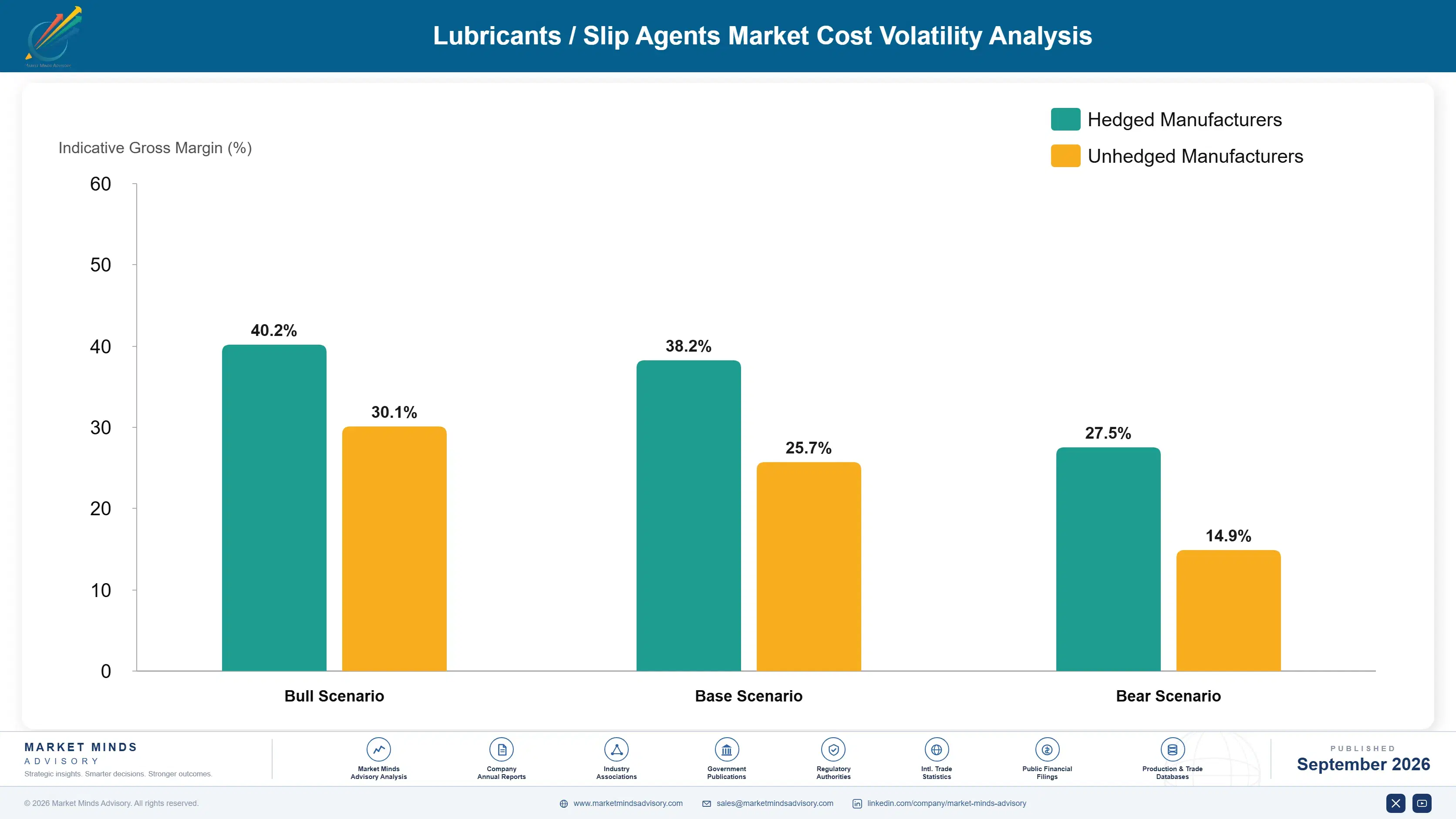
Three input groups dominate cost. Oleochemical feedstock including erucic acid, oleic acid, and stearic acid runs 36% to 44% of cost of goods sold, and the eight-point range separates commodity tallow-derived material from high-purity vegetable grades. Amidation and esterification processing takes 22% to 30%. Silicone and polymer intermediates add 20% to 28% across the non-migrating and siloxane segments.
Erucic acid pricing moved through 2024 and 2025 as high erucic rapeseed acreage shifted against competing crop economics, with United States Department of Agriculture oilseed data documenting the underlying movement across both seasons. Several producers described the resulting margin pressure in their annual reports. Siloxane intermediate pricing followed silicon metal and energy costs on an entirely separate industrial path. Polymer intermediates followed olefin markets separately again.

The competitive disadvantage mechanism runs through feedstock purity rather than through processing cost. Amide purity determines whether an additive blooms evenly or deposits in patches, and patchy bloom produces exactly the print and seal defects converters are trying to avoid. Exposure varies sharply by integration: producers controlling feedstock hold purity consistently, while those buying intermediate material inherit whatever variability arrived with it.
lubricants-slip-agents-market-cost-volatility-analysis-1790015672397

Control Feedstock Purity Rather Than Processing Cost

Amide purity determines whether bloom is even or patchy, and patchy bloom produces precisely the print adhesion and seal defects that converters change suppliers over. Integration back into feedstock costs capital and delivers consistency that no amount of downstream processing discipline can recover once variable material has entered the reactor. Converters change suppliers over exactly those defects.

Contract Erucic Feedstock Against Crop Economics

High erucic rapeseed acreage shifts against competing crop returns on cycles entirely unrelated to polymer processing demand, and this category is far too small to influence planting decisions. Contracting across seasons rather than reacting to spot availability removes most of the exposure and secures supply when acreage contracts unexpectedly. Acreage decisions are made without reference to this industry.

Develop Recyclate Grades Before Competitors Do

Recycled polyolefin carries accumulated additive that makes standard loadings unusable, and no supplier currently holds an established answer to it. The development cost is modest against a problem that recycled content mandates guarantee will expand, and being first with a working grade sets the specification everybody else then works against. Recycled content mandates guarantee the problem expands.

Portfolio Architecture for Margin Defence

Margin follows whether the supplier solves a downstream problem or supplies a commodity chemical. Metallic stearates and standard amides compete close to commodity terms against Indian and Chinese producers with equivalent quality. Ester and wax lubricants earn moderately. Silicone systems earn better on performance amides cannot match, and non-migrating and recyclate-tolerant grades earn most, because both address defects rather than friction alone. The margin spread across those four groups is wide for an additive category.
The tension between volume and premium runs through how the converter accounts. A purchasing team comparing price per kilogram selects amide chemistry every time and absorbs the defect cost somewhere else in the business. A technical team costing print failures and seal rejects reaches the opposite conclusion, and the supplier's whole task is reaching the second team rather than the first.

High-value pools concentrate where downstream consequences are expensive: printed flexible packaging where adhesion failure scraps a run, medical and food film where seal integrity is verified, and any converter running recycled content without documented additive history. Where the application is unprinted industrial film, price decides and standard amide chemistry is entirely adequate. That divide follows downstream consequence rather than volume.

Volume / Commodity-Adjacent

Metallic stearates and standard amide slip agents sold against specification into unprinted and industrial film applications. The ten-point range reflects feedstock purchasing and processing scale rather than any performance property a converter would pay extra for.
Gross Margin: 18% to 28%

Premium / Certified

High-purity amides, ester and wax lubricants, and silicone systems supplied with technical support into printed and demanding applications. The twelve-point range separates producers with integrated feedstock control from those compounding bought-in intermediate material.
Gross Margin: 32% to 44%

Sustainability / Regulatory / Next-Generation

Non-migrating polymer systems, recyclate-tolerant grades, and qualified fluoropolymer replacements sold with time-resolved friction data. The fourteen-point range reflects whether the supplier solves a documented downstream defect or supplies an alternative chemistry.
Gross Margin: 48% to 62%
lubricants-slip-agents-market-portfolio-architecture-1790015672900

High-value Sub-segments and Strategic Watch-out

Recyclate-Tolerant Slip Grades

Highest value in the category, addressing accumulated additive running 2.7 times virgin levels that nobody currently has an established answer for. The sixteen-point range reflects whether incoming testing accompanies supply or the converter is left measuring alone. Nobody currently holds an established answer. Mandates guarantee it expands.
Gross Margin: 50% to 66%

Non-Migrating Polymer Systems

High value growing at 9.3% by removing the surface migration behind most converter print and seal defects. The twelve-point range reflects thin film performance, which still trails amide chemistry at equivalent loading in demanding gauges. Defect costing decides the conversion. Thin film performance still trails.
Gross Margin: 44% to 56%

High-Purity Amide Chemistry

Volume core where feedstock integration produces even bloom rather than the patchy deposition that causes defects. The twelve-point range reflects purity consistency, which converters running printed work will pay for and unprinted work will not. Patchy bloom causes the defects converters notice. Unprinted work will not pay for it.
Gross Margin: 30% to 42%

Commodity Stearates And Amides

The strategic watch-out. Indian and Chinese producers match the chemistry at prices Western suppliers cannot approach, and unprinted applications ask nothing that purity would improve. The ten-point range reflects feedstock buying and scale alone. Price is the entire basis of comparison. Nothing defends the position at all.
Gross Margin: 16% to 26%

How This Demand Recurs

Consumption follows converted polymer tonnage almost exactly, which makes volume predictable and entirely dependent on film and moulding output rather than on anything a supplier does. What varies is which chemistry and at what loading, and both are locked at qualification. A converter who has validated a slip package against a printing process does not revisit it while the process runs unchanged. Qualification is where the commercial decision genuinely happens.
Attachment depth follows qualification difficulty. Printed flexible packaging and medical film build deep relationships, since requalifying a slip system means revalidating print adhesion and seal integrity across a product range. Unprinted industrial film attaches barely at all, and purchasing teams there switch between amide suppliers on price at every contract review without any technical conversation. Qualification difficulty predicts retention almost exactly.

The buyer is shifting from purchasing toward technical as recycled content forces requalification. A converter who has always bought amide by specification now has resin with unpredictable additive history and needs help rather than a price. That shift favours suppliers who can test incoming material and recommend a loading over those who quote against a coefficient of friction number. That shift is only beginning to register with suppliers.
lubricants-slip-agents-market-end-use-penetration-index-1790015673393

Where This Market Rewards

These are among the four positions where our research anticipates prominent divergence between winners and laggards over the coming forecast period. Each is grounded in the demand model, the regulatory perimeter, and the announced capacity pipeline.
01 / TIMED FRICTION PUBLICATION

A friction number without a time

Surface friction keeps changing for roughly 21 days after extrusion, and around 16% of specifications state when the measurement should actually be taken. Suppliers publishing full friction development curves rather than single values report specification win rates 2.4 times higher among technical converters who already understand the problem. It costs one measurement series per grade and ends the disputes over material that satisfies both readings taken at different moments, and most suppliers still publish a single figure with no protocol attached to it.
02 / DEFECT COST SELLING

The additive is not the expense

About 38% of converter surface defects trace to additive migration, and a print adhesion failure found after a job has run costs many times the premium that would have prevented it. Suppliers presenting a defect cost analysis alongside their quotations report non-migrating system conversion 3.1 times higher than competitors simply comparing price per kilogram. The arithmetic is straightforward and very few suppliers bother to construct it at all, which leaves the argument unmade in exactly the accounts where it would land hardest.
03 / RECYCLATE GRADE DEVELOPMENT

Nobody has an answer yet

Recycled polyolefin carries roughly 2.7 times the accumulated slip additive of virgin resin, distributed unevenly and documented absolutely nowhere by anybody. Suppliers who offer incoming friction testing alongside recyclate-tolerant grades now report average account values 2.8 times greater among the converters already running recycled content. Recycled mandates keep expanding while no established answer exists, which makes this the clearest unclaimed technical position in the category, and being first with a working grade sets the specification everybody else then works against.
04 / RESTRICTION READINESS TIMING

Qualification takes longer than deadlines

Around 64% of processors are already actively seeking alternatives to fluoropolymer process aids, and qualifying a replacement on a production line takes months that a restriction deadline will not provide. Suppliers who already hold qualified alternatives now report new account wins 2.2 times higher than competitors still developing them internally today. Processors are accepting a performance gap on melt fracture rather than waiting for a parity that may never actually arrive, and waiting for parity means missing the qualification window entirely.

Engagement Snapshot From the Field

A live engagement with an industry participant carrying material or product regulatory and market exposure ahead of a defining policy shift, showing how our research translates into a defensible multi-year portfolio strategy.
MARKET MINDS ADVISORY · CLIENT ENGAGEMENT SUMMARY
Lubricants / Slip Agents Producer Strategic Portfolio Review and Transition Roadmap 2026·Investment Scenario on Lubricants / Slip Agents Exposure Evaluation 2025-26
CLIENT PROFILE
A flexible packaging converter operating eleven extrusion and printing lines with annual revenue near EUR 290 million (client-reported, unverified by MMA). Print adhesion rejects had risen for two consecutive years while no printing process parameter had changed, and the technical team could not identify a cause. The board wanted the cause established before any further supplier qualification work was commissioned anywhere.
STRATEGIC CHALLENGE
Production management attributed the rejects to ink supplier variability and had begun qualifying an alternative ink system. Nobody had examined whether the slip additive loading or the recycled content proportion in the incoming resin had shifted over the same period. An ink problem and a resin problem imply entirely different remedies at very different costs to the business.
MMA APPROACH
MMA measured surface friction development over the full bloom period across incoming resin lots, compared additive loading in virgin and recycled material, correlated reject records against resin source and film age at printing, and modelled outcomes under ink change, additive change, and resin segregation. Incoming resin was tested lot by lot rather than sampled.
KEY FINDINGS
  1. Recycled content in the incoming blend had risen from a tenth to nearly a third across the two years, carrying accumulated slip additive nobody had measured or accounted for.
  2. Surface additive concentration at printing was roughly 2.6 times the level the process had been validated against, and it varied considerably between lots.
  3. Rejects correlated closely with the interval between extrusion and printing rather than with any ink batch, which the existing quality system did not record at all.
  4. The alternative ink system would have been qualified against a surface condition that continues changing, and the rejects would have returned within months.
CLIENT PROFILE
A flexible packaging converter operating eleven extrusion and printing lines with annual revenue near EUR 290 million (client-reported, unverified by MMA). Print adhesion rejects had risen for two consecutive years while no printing process parameter had changed, and the technical team could not identify a cause. The board wanted the cause established before any further supplier qualification work was commissioned anywhere.
STRATEGIC CHALLENGE
Production management attributed the rejects to ink supplier variability and had begun qualifying an alternative ink system. Nobody had examined whether the slip additive loading or the recycled content proportion in the incoming resin had shifted over the same period. An ink problem and a resin problem imply entirely different remedies at very different costs to the business.
MMA APPROACH
MMA measured surface friction development over the full bloom period across incoming resin lots, compared additive loading in virgin and recycled material, correlated reject records against resin source and film age at printing, and modelled outcomes under ink change, additive change, and resin segregation. Incoming resin was tested lot by lot rather than sampled.
KEY FINDINGS
  1. Recycled content in the incoming blend had risen from a tenth to nearly a third across the two years, carrying accumulated slip additive nobody had measured or accounted for.
  2. Surface additive concentration at printing was roughly 2.6 times the level the process had been validated against, and it varied considerably between lots.
  3. Rejects correlated closely with the interval between extrusion and printing rather than with any ink batch, which the existing quality system did not record at all.
  4. The alternative ink system would have been qualified against a surface condition that continues changing, and the rejects would have returned within months.
RECOMMENDED STRATEGY
Phase 1: Phase one: halt the ink qualification and measure incoming resin surface friction as a routine receiving check before any further change. Phase 2: Phase two: move to a recyclate-tolerant slip package formulated to work across a wide starting additive range rather than a fixed loading. Phase 3: Phase three: record time between extrusion and printing as a controlled process variable rather than leaving it to scheduling. Surface condition changes throughout that interval.
OUTCOME
Print adhesion rejects fell 61% within two quarters of the resin testing and additive change (client-reported, unverified by MMA). The ink qualification programme was cancelled entirely. Extrusion to print interval is now scheduled rather than incidental. Incoming friction testing is now a standing receiving check across every resin grade purchased.

Frequently Asked Questions

Foundational context covering the market sizes, CAGR, scope, country, region and competition that inform every finding below. This section is provided to cover basics and most often pre-purchase conversations, answered from the MMA Primary Research Dataset.

What is the current size of the Lubricants / Slip Agents Market?

The market was worth USD 3.4 billion in 2025 and reaches USD 3.6 billion in 2026. Value covers lubricant and slip additives supplied for polymer processing.

How large will the Lubricants / Slip Agents Market be by 2036?

MMA forecasts USD 6.6 billion by 2036, an increase of USD 3.0 billion across the forecast period. That represents 1.83 times the 2026 base of USD 3.6 billion.

What is the CAGR for the Lubricants / Slip Agents Market 2026 to 2036?

The base case compound annual growth rate is 6.2%, with a bull case at 7.4% and a bear case at 5.0%. Historical growth from 2020 to 2025 ran at 5.1%.

Which segment is growing fastest?

Non-migrating polymer slip systems grow at 9.3%, half again the market rate of 6.2%. They deliver friction reduction without the surface migration that causes downstream defects.

Who are the major companies in the Lubricants / Slip Agents Market?

Croda International, Emery Oleochemicals, PMC Biogenix, BASF, and Evonik Industries lead. Together they hold 43% of revenue, with Indian and Chinese producers competing hard on amide chemistry.

Which country is growing fastest?

India grows at 10.2%, the fastest of any country covered here. Flexible packaging and agricultural film conversion are expanding at rates no other market approaches, alongside domestic additive manufacturing.

Report Segmentation Architecture

The full report scope spans multiple orthogonal segmentation dimensions, with cross-tabulated demand data provided for each dimension pair. Coverage extends further to regional breakdowns, trend trajectories, and the competitive detail needed to support segment-level decision-making.

By Additive Chemistry

  • Non-Migrating Polymer Slip Systems
  • Silicone and Siloxane Slip Additives
  • Fatty Acid Ester and Wax Lubricants
  • Fatty Acid Amide Slip Agents
  • Metallic Stearate Lubricants
  • Fluoropolymer Process Aids

By End-Use Industry

  • Flexible Packaging Film
  • Rigid Packaging and Containers
  • Agricultural and Construction Film
  • Automotive and Technical Compounds
  • Wire, Cable and Profile Extrusion
  • Medical and Pharmaceutical Film

By Commercial Dimension

  • Direct Supply To Converters
  • Masterbatch Producer Supply
  • Compounder and Formulator Supply
  • Specialty Chemical Distribution
  • Resin Producer Additive Packages
  • Technical Service and Testing Contracts

By Region

  • East Asia
  • North America
  • Western Europe
  • South Asia and Pacific
  • Latin America
  • Middle East and Africa
  • Eastern Europe

Scope, Methodology, and Coverage

Every figure in this report is reproducible from documented input assumptions. The scope below maps the historical period, the forecast horizon, the segmentation dimensions, and the countries covered, alongside the underlying primary and qualitative methodology.
Historical Period
2020 to 2025
Forecast Period
2026 to 2036
Base Year
2025 (USD billions; MMA Primary Research Dataset, September 2026)
Market Definition
This market covers lubricants and slip agents supplied as additives for polymer processing, across non-migrating polymer slip systems, silicone and siloxane slip additives, fatty acid ester and wax lubricants, fatty acid amide slip agents, metallic stearate lubricants, and fluoropolymer process aids. It excludes engine and automotive lubricating oils, metalworking and cutting fluids, greases and machinery lubricants, equipment release agents, and personal care emollients.
Quantitative Units
USD billions, revenue at supplier selling price
Segmentation Dimensions
Additive chemistry, end-use industry, commercial dimension, region
Regions Covered
East Asia, North America, Western Europe, South Asia and Pacific, Latin America, Middle East and Africa, Eastern Europe
Countries Covered
China, Japan, South Korea, Taiwan, India, Vietnam, Thailand, Indonesia, Malaysia, Australia, United States, Canada, Mexico, Germany, Netherlands, Belgium, Italy, France, Spain, Poland, Czechia, Brazil, Colombia, Chile, Argentina, Saudi Arabia, United Arab Emirates, Egypt, Nigeria, South Africa
Key Companies Profiled
Croda International, Emery Oleochemicals, PMC Biogenix, BASF, Evonik Industries, Dow, Clariant, Fine Organics, Baerlocher, Struktol, Lonza, Nouryon, Peter Greven, Faci Group, Kao Corporation, Shin-Etsu Chemical, Wacker Chemie, Adeka Corporation, Sun Ace Kakoh, Italmatch Chemicals
Quantitative Methodology
Primary survey, n=3,800 respondents, Q4 2025, six countries; demand-side model with trade association cross-validation
Qualitative Methodology
47 expert interviews, Q4 2025; applied to validate demand model assumptions, identify emerging dynamics, and assess competitive positioning
Report Format
PDF and XLSX data workbook (Word format preview document)
Publisher
Market Minds Advisory
Report Code
MMA-2026-CHM-381
Published
September 2026
Contact
sales@marketmindsadvisory.com | www.marketmindsadvisory.com

Purchase the full Lubricants / Slip Agents Market Report (2026 to 2036).

The full report sizes the lubricants and slip agents market across six additive chemistries, seven regions, and thirty countries, with forecasts to 2036 under base, bull, and bear cases. It sets out why migration is simultaneously the working mechanism and the source of most downstream defects, measures how rarely friction specifications state a measurement interval, and quantifies accumulated additive in recycled polyolefin streams. Competitive analysis covers twenty participants evaluated consistently on category revenue, with detailed treatment of feedstock integration and purity control. Cost structure, defect economics, and fluoropolymer replacement readiness are analysed throughout. Primary research includes 3,800 survey responses and 47 expert interviews.
Six additive chemistries sized and forecast separately
Twenty participants evaluated on category revenue consistently
Friction development measured across the full bloom period
Converter defect rates attributed to additive migration mechanisms
Recyclate additive accumulation quantified against virgin resin
Fluoropolymer replacement qualification progress tracked by processor

Built For The People Who Decide

From boardroom strategy to bench-side execution, this report is read cover-to-cover by leaders shaping the next decade of their industry, turning demand scenarios, market dynamics and valuation benchmarks into decisions.
CXOs/ Presidents/ VPs/ Managers
M&A and Corporate Development
Strategy Teams and R&D Heads
Procurement and Product Directors
Regulatory and Compliance Leaders
Investor Relations and Equity Analysts