Market Minds Advisory
Metallic Stearates Market

Metallic Stearates Market: Feedstock, Purity Grade, and Regional Demand to 2036

PVC and rubber processors are shifting from lead-based to calcium and zinc stearate stabilizer systems as regulation tightens, while palm-derived stearic acid price swings push makers toward tightly controlled feedstock sourcing and purity.

Lead Analyst

Bilal Shaikh

Published

September 2026

Make Smarter Decisions with Customized Research Insights

Request a free sample report and evaluate market opportunities, growth trends, and competitive dynamics relevant to your business needs.

2025 MARKET VALUE$2.6BMarket Size 2025
2036 FORECAST VALUE$4.8BBase Case , 2026 to 2036
CAGR 2026 TO 20365.7 %Bull 6.9% / Bear 4.4%
INCREMENTAL OPPORTUNITY$2.0BNet 10- year value creation
EXPANSION MULTIPLE1.74x2036 value over 2026 base
Strategic Levers
M&A Pipeline
Regional Outlook
Country Rankings
Competitive Intelligence
Segmental Deep-dive
Call-Us : 91 93563 13602

Executive Snapshot and Market Trajectory

Metallic stearate selection has moved from a routine additive purchase into a compliance-driven specification decision, as PVC compounders, rubber processors, and pharmaceutical formulators increasingly favor calcium, zinc, and magnesium grades over legacy lead and cadmium-based stabilizers now restricted across most major regulatory jurisdictions. That shift reshapes supplier qualification broadly.
Magnesium stearate is growing fastest as pharmaceutical and nutraceutical tablet manufacturers expand production to meet rising generic drug demand, pulling volume toward pharmaceutical-grade purity specifications far stricter than industrial applications require. China's expanding plastics and rubber processing base, alongside its position as a leading palm-derived stearic acid consumer, absorbs a growing share of global demand, even as European and North American specialty makers retain the deepest expertise in pharmaceutical and food-grade purification.
Competition sits between diversified oleochemical majors integrated back into stearic acid feedstock and specialty formulators competing on purity grade and application-specific technical service. Tightening restrictions on lead and cadmium-based stabilizers in packaging and toy-contact applications are accelerating the shift toward calcium and zinc alternatives, while pharmaceutical customers increasingly demand documented, audited supply chains that smaller regional producers without established quality certification struggle to provide reliably.
Market Definition
Metallic stearates are metal salts of stearic and related long-chain fatty acids, including calcium, zinc, magnesium, aluminum, and lithium stearate, used as lubricants, mold release agents, stabilizers, and pharmaceutical excipients. The market excludes free stearic acid itself and unrelated metallic soaps used purely as industrial greases.
Base Year Value
$2.6B in 2025 (MMA Primary Research Dataset, August 2026)
Forecast Period
2026 to 2036, eleven discrete annual values
CAGR
5.7% base case. Bull 6.9%. Bear 4.4%.
Fastest Growth Segment
Magnesium Stearate: 7.8% CAGR
Fastest Growth Country
India: 8.1% CAGR
Fastest Growth Region
South Asia and Pacific: 7.7% CAGR
Largest Region
East Asia: 30% of 2025 global value
Market Leaders
Baerlocher GmbH, PMC Biogenix, Faci S.p.A., Valtris Specialty Chemicals, and Peter Greven Fett-Chemie lead the field. Source: MMA Analysis based on company annual reports.
Primary Survey
n=3,800 procurement and R&D decision-makers, Q4 2025, six countries
Methodology
Demand-side build-up, cross-validated against public data, 47 expert interviews

Metallic Stearates Market Forecast Scenarios

metallic-stearates-market-trends-size-forecast-scenario-1787556222386
Between 2020 and 2025 metallic stearate demand grew at roughly 4.7 percent a year, held back early by pandemic-era plastics processing disruption before accelerating as generic pharmaceutical manufacturing capacity expanded and PVC compounders across Asia continued replacing legacy lead-based stabilizer systems. Palm oil price volatility during 2021 and 2022 pushed stearic acid feedstock costs sharply higher, temporarily compressing margins across the industry without changing underlying volume growth.
The base case assumes continued growth as three mechanisms compound: pharmaceutical and nutraceutical tablet production expanding on rising generic drug volume that requires magnesium stearate as a standard tableting lubricant; continued regulatory-driven replacement of lead and cadmium stabilizers in PVC compounding across regions still completing that transition; and expanding rubber and plastics processing capacity across South and Southeast Asia, where new facilities specify calcium and zinc stearate systems from startup.
The bull case turns on faster-than-expected generic pharmaceutical capacity expansion in India and China, which would pull magnesium stearate demand well ahead of current industrial-grade volume forecasts. The bear case centers on a sustained palm oil price spike, which has historically compressed stearate producer margins and slowed capacity investment, a pattern last seen during the 2022 vegetable oil price surge.

Feedstock Economics and Regulatory Substitution Dynamics

Metallic stearates sit at the intersection of oleochemical feedstock economics, regulatory substitution pressure, and rising purity requirements across pharmaceutical and food applications. As regulators restrict legacy lead and cadmium-based stabilizers, compounders increasingly specify calcium, zinc, and magnesium grades from producers with documented, audited quality systems, even where certified supply carries a meaningful price premium over uncertified regional production. That premium is becoming standard.
MARKET CONCENTRATIONCR5: 32%Ownership stays fragmented across many regional producers today
AVERAGE SELLING PRICE$2,850 per tonnePricing tracks stearic acid feedstock cost closely today
CAPACITY UTILISATION73%Production plants run moderately below full rated capacity
TOP PRODUCER SHARETop 3 countries: 58%Manufacturing concentrates near major global oleochemical processing hubs
TRADE INTENSITY41% cross-borderFinished stearates ship globally from concentrated production centers
FEEDSTOCK COST SHARE52% of COGSStearic acid pricing drives most manufacturing cost swings
Commercially the category splits between integrated oleochemical majors producing stearic acid feedstock in-house and specialty formulators purchasing feedstock externally while competing on purity grade and technical service. Integrated producers compete on cost stability through feedstock control, while specialty formulators win on application-specific grades and faster technical support, since pharmaceutical and cosmetic customers often require formulation adjustments unique to each product. Neither model dominates outright.
The next decade will be shaped by continued lead and cadmium stabilizer replacement in regions still completing that transition, rising pharmaceutical-grade demand tied to generic drug manufacturing growth, and stearic acid feedstock sourced increasingly from traceable, sustainability-certified palm sources. Producers that can pair documented purity with stable feedstock sourcing stand to capture share from smaller uncertified regional makers. Laggards risk losing share on the highest-margin pharmaceutical-grade contracts available.
"Magnesium stearate used to be an afterthought line item for most producers; now it's the highest-margin product in the portfolio because pharmaceutical customers will pay for a certificate of analysis, not just a bag of powder."
Director, Specialty Chemicals and Industrial Additives Practice · MMA Chemicals and Materials Practice · August 2026

Market Trends

Pharmaceutical-Grade Magnesium Stearate Demand Accelerates With Generics

Generic pharmaceutical manufacturers across India, China, and the United States are expanding tablet production capacity to meet rising global demand for affordable medicines, and magnesium stearate remains the standard tableting lubricant specified in the large majority of solid oral dosage formulations submitted for regulatory approval. Pharmaceutical-grade material requires documented purity, heavy metal testing, and traceable sourcing exceeding industrial specifications, commanding a premium that makes this the fastest-growing, highest-margin segment for compliant producers. Several producers have invested in dedicated pharmaceutical-grade lines segregated from industrial manufacturing to avoid cross-contamination risk and satisfy rigorous customer audits.
Market Impact: Adds 4 percent volume from generics

Regulatory Phase-Out Of Lead And Cadmium Stabilizers Continues

Regulators across the European Union, several Southeast Asian markets, and increasingly China are restricting lead and cadmium-based metallic stearate stabilizers in PVC compounding, particularly in packaging, toy-contact, and potable water pipe applications, pushing compounders toward calcium and zinc-based alternatives. Reformulation has required PVC compounders to requalify entire formulation systems, a process that can take twelve to eighteen months per product line given extensive mechanical and thermal stability testing requirements. Producers of calcium and zinc stearate systems with established compliance documentation are capturing share from smaller regional lead stabilizer producers unable to invest in the reformulation infrastructure the transition requires.
Market Impact: Sustains 3 percent baseline growth

Market Opportunities and Growth Drivers

Generic Drug Manufacturing Growth Drives Tableting Lubricant Demand

Global generic pharmaceutical production continues expanding as patent expirations and government cost-containment policy push healthcare systems toward lower-cost medicines, and every solid oral dosage tablet manufactured requires a lubricant, almost universally magnesium stearate, to prevent powder sticking during high-speed compression. India's pharmaceutical manufacturing sector, among the largest global suppliers of generic medicines, has expanded tableting capacity steadily, directly driving magnesium stearate consumption growth that tracks tablet production volume closely. Producers serving this segment increasingly invest in pharmacopeia-compliant quality systems, since pharmaceutical customers audit suppliers rigorously before qualifying them for regulatory drug filings.
Market Impact: Adds up to 18 percent cost

PVC Pipe And Profile Demand Sustains Calcium Stearate Volume

Calcium stearate remains the largest-volume metallic stearate by weight, used extensively as a lubricant and acid scavenger in rigid PVC pipe, profile, and siding compounding, and continued construction and infrastructure investment across Asia and parts of Latin America sustains steady baseline demand independent of pharmaceutical or specialty growth trends. PVC pipe manufacturing capacity continues expanding to serve infrastructure and construction demand across developing regions, and calcium stearate's role as a cost-effective processing aid keeps it the default choice for most PVC formulations. Producers benefit from long-term supply relationships that rarely change once qualified.
Market Impact: Requires 12 to 24 months qualification

Market Restraints and Challenges

Palm-Derived Stearic Acid Price Volatility Squeezes Margins

Stearic acid, the primary feedstock for most metallic stearates, derives largely from palm oil and tallow, tying production costs to volatile vegetable oil and animal fat markets rather than metallic stearate demand directly. Root causes include weather-driven palm harvest swings in Indonesia and Malaysia and periodic export policy changes affecting cross-border palm oil flows. When stearic acid prices spike, producers either absorb margin compression or attempt to pass costs through, which downstream compounders often resist given their own fixed-price contracts with customers. Larger producers are mitigating exposure through multi-origin feedstock sourcing and partial backward integration into stearic acid refining capacity.
Market Impact: Commands 2x pharmaceutical-grade price premium

Pharmaceutical Qualification Barriers Limit New Supplier Entry

Pharmaceutical customers require extensive supplier qualification, including facility audits, documented quality systems, and multi-batch validation testing, before approving a magnesium stearate supplier for use in a regulatory drug filing, a process that can take twelve to twenty-four months and substantial upfront investment with no guaranteed contract at the end. The root cause is that pharmaceutical manufacturers bear significant regulatory risk if an excipient supplier changes without proper revalidation, making them extremely reluctant to qualify new or smaller suppliers lacking an established compliance track record. Smaller producers address the barrier by partnering with established distributors who already hold customer relationships.
Market Impact: Shifts 15 percent volume from lead
3 additional market trends, 4 additional growth drivers, and 3 additional restraints and challenges are covered in the full report. Contact sales@marketmindsadvisory.com to access the complete intelligence.

Segment CAGR and Growth Architecture

Metallic stearates segment most usefully by metal type, since calcium, zinc, magnesium, aluminum, and lithium stearate carry distinct application profiles, purity requirements, and pricing tiers. This framework mirrors how producers organise manufacturing lines and quality systems, separating industrial-grade commodity products from pharmaceutical and food-grade specialty formulations across the category. Producers organise manufacturing lines around these same distinctions.
metallic-stearates-market-trends-market-share-analysis-1787556222930

Magnesium Stearate

Magnesium stearate is the fastest-growing segment as generic pharmaceutical and nutraceutical tablet manufacturers expand production to meet rising global demand for affordable medicines and dietary supplements. Pharmaceutical-grade material commands a substantial price premium over industrial-grade equivalents, driven by documented purity, heavy metal testing, and traceable sourcing requirements that pharmacopeia compliance demands. Growth concentrates among producers who have invested in dedicated pharmaceutical-grade production lines segregated from industrial manufacturing, since cross-contamination risk disqualifies a facility from pharmaceutical supply entirely regardless of underlying chemistry. India and China's expanding generic pharmaceutical sectors are the fastest-growing demand centers, absorbing rising volume as tablet production scales across both countries. Producers with established regulatory relationships hold an advantage here.
CAGR 7.8%

Zinc Stearate

Zinc stearate is the second-fastest-growing segment, benefiting from its position as the leading replacement for legacy lead-based PVC stabilizers across markets completing regulatory transition away from heavy metal stabilizer systems. Zinc stearate also serves broad demand across cosmetics, where it functions as a texture-enhancing and anti-caking agent in powder formulations, and rubber processing, where it acts as a release agent and vulcanization activator. Growth is fastest in Southeast Asia and China, where PVC compounders completing lead stabilizer phase-outs are qualifying zinc-based systems at scale, and in cosmetics manufacturing hubs responding to rising formulation demand for talc-free, mineral oil-free powder products across personal care categories. Established chemical safety documentation increasingly determines which suppliers qualify for large compounder contracts.
CAGR 6.9%
Full segment breakdown across 6 segments available in the complete report.

Regional Architecture and Country Demand Map

Metallic stearate demand concentrates where plastics processing and pharmaceutical manufacturing capacity are most developed. East Asia's dominant plastics compounding base and expanding pharmaceutical sector account for the largest share of global demand, while South Asia's fast-growing generic pharmaceutical industry represents the fastest-growing but still smaller demand base.

East Asia

China's vast plastics compounding and rubber processing base makes it the single largest consumer of industrial-grade metallic stearates globally, and its own oleochemical industry, drawing on domestic and imported palm feedstock, supplies a growing share of that demand from expanding domestic production capacity. China's pharmaceutical manufacturing sector is also scaling rapidly, adding magnesium stearate demand on top of already-substantial industrial volume. South Korea and Japan contribute stable demand from established plastics, cosmetics, and pharmaceutical manufacturing sectors with strict quality documentation requirements. Domestic Chinese producers are increasingly competing directly with established European and American specialty makers on pharmaceutical-grade purity, narrowing what was once a clear quality gap between regions. Regulatory documentation increasingly determines which domestic suppliers qualify for pharmaceutical supply contracts.
Share: 30% | CAGR: 6.8% (2026 to 2036)

North America

The United States pharmaceutical manufacturing sector, among the largest global consumers of pharmaceutical-grade magnesium stearate, drives a disproportionate share of regional demand relative to the region's plastics processing volume, reflecting the concentration of generic and branded drug manufacturing capacity domestically. PVC pipe and profile compounding for construction and infrastructure applications provides steady baseline calcium and zinc stearate demand across the region. Regulatory restrictions on lead-based stabilizers, already largely complete in most PVC applications, mean regional producers compete primarily on pharmaceutical-grade purity and technical service rather than stabilizer substitution volume. Growth trails the fastest-growing regions because much of the region's substitution transition already occurred over the past two decades. Cosmetic manufacturers add steady demand across the region's consumer goods sector.
Share: 24% | CAGR: 6.3% (2026 to 2036)
Regional intelligence for 5 additional markets available in the complete report: Western Europe, South Asia and Pacific, Latin America, Middle East and Africa, Eastern Europe. Contact sales@marketmindsadvisory.com.
metallic-stearates-market-trends-country-cagr-analysis-1787556223443

Pharmaceutical-Grade Premiumisation and Feedstock Integration

Producers can grow revenue per tonne even where industrial-grade volume growth is modest by shifting customers toward pharmaceutical and food-grade purity tiers, integrating backward into stearic acid feedstock production, and building dedicated quality documentation infrastructure that smaller competitors cannot easily replicate. The most durable gains come from capturing regulatory-driven premium demand rather than competing purely on commodity volume.

Building Dedicated Pharmaceutical-Grade Production Line Capacity

Producers investing in dedicated pharmaceutical-grade production lines segregated entirely from industrial manufacturing capture a price premium of roughly 80 to 120 percent over standard industrial-grade material, reflecting the documented purity, heavy metal testing, and traceability that pharmacopeia compliance requires. This segregation requires substantial upfront capital investment in dedicated equipment, cleanroom-adjacent facilities, and quality documentation systems, but the investment pays back quickly given the durability of pharmaceutical supplier qualification once achieved, since customers rarely switch suppliers after completing lengthy validation processes. The approach works best for producers already serving adjacent food or personal care markets with comparable purity infrastructure.
Market Impact: Commands 80 to 120 percent price premium overall

Bundling Regulatory Documentation With Stabilizer Substitution Sales

Producers selling calcium and zinc stearate systems to compounders completing lead stabilizer phase-outs are bundling extensive regulatory compliance documentation and formulation support directly into hardware sales, capturing value that simplifies the 12 to 18 month requalification process compounders must complete for each product line. This bundled technical support commands meaningfully higher margins than commodity stearate sales alone, and compounders increasingly prefer suppliers who can guarantee smooth requalification over the lowest delivered price given the substantial internal cost of a failed formulation transition. The approach works best in markets still mid-transition away from lead-based systems.
Market Impact: Lifts contract margin roughly 15 percent higher overall

Backward Integration Into Stearic Acid Feedstock Refining

Larger producers are increasingly integrating backward into stearic acid refining capacity, securing feedstock supply ahead of the open market and capturing margin that would otherwise go to independent oleochemical refiners, while also gaining better control over feedstock traceability increasingly demanded by pharmaceutical and food-grade customers. This integration requires substantial capital investment most smaller producers cannot commit, but it meaningfully reduces exposure to the palm oil price volatility that periodically compresses margins across the industry, providing roughly 20 to 30 percent more stable input costs than open-market feedstock purchasing. Producers pursuing integration report meaningfully steadier quarterly margins across multi-year periods.
Market Impact: Cuts feedstock cost volatility roughly 25 percent yearly

Expanding Certified Sustainable Feedstock Sourcing Programs

Producers offering stearic acid sourced from certified sustainable palm supply chains are capturing premium pricing from cosmetic, pharmaceutical, and consumer-facing customers increasingly required by their own downstream customers to document supply chain sustainability credentials. Certified sustainable sourcing typically commands a price premium of 10 to 15 percent over conventional stearic acid feedstock, and producers who established certified supply relationships early are securing long-term contracts with major consumer goods companies before certified supply capacity becomes more broadly available across the industry. The lever works best for producers serving cosmetic and personal care end markets specifically.
Market Impact: Adds 10 to 15 percent sustained premium pricing

Who Controls the Margin Pool

The metallic stearate market is moderately fragmented, with an estimated CR5 near 32 percent, reflecting a category where regional feedstock access and application-specific technical service matter as much as manufacturing scale. Baerlocher and PMC Biogenix lead on combined product breadth and pharmaceutical-grade capability, but the gap to specialty regional producers is narrower on industrial-grade commodity products than on pharmaceutical-grade material.
Competitive activity centers on three fronts: pharmaceutical-grade capacity expansion aimed at capturing generic drug manufacturing growth, backward integration into stearic acid feedstock to stabilize costs and improve traceability, and bundling of regulatory documentation with lead stabilizer substitution sales across markets still mid-transition. Acquisitions of regional producers with established local feedstock relationships have picked up as global players seek manufacturing presence closer to concentrated Asian demand.

Emerging pressure comes from Chinese and Indian producers rapidly closing the pharmaceutical-grade quality gap, threatening established European and American specialty makers on price in the fastest-growing generic drug manufacturing markets. Integrated oleochemical majors are also pushing further downstream into finished stearate production, threatening to disintermediate specialty formulators who purchase feedstock externally. Rankings could shift meaningfully if a major Asian producer achieves pharmacopeia certification parity with established Western suppliers.
metallic-stearates-market-trends-company-positioning-matrix-1787556223975

Competitive Moat and Risk Dimensions

BAERLOCHER GMBH

Moat: Integrated Feedstock And Global Reach

Baerlocher's backward integration into stearic acid production and its global manufacturing footprint give it cost stability and delivery reliability that smaller regional producers cannot easily match, particularly during feedstock price spikes when open-market stearic acid becomes scarce or expensive. That integrated position supports Baerlocher's ability to serve large multinational compounders requiring consistent global supply across multiple manufacturing regions simultaneously.
BAERLOCHER GMBH

Risk: Slower Pharmaceutical-Grade Expansion Pace

Baerlocher's core strength in industrial-grade PVC stabilizer chemistry has made it comparatively slower to build dedicated pharmaceutical-grade production capacity than specialty competitors who identified the pharmaceutical opportunity earlier. This has cost Baerlocher share in the fastest-growing, highest-margin pharmaceutical-grade segment, where established specialty producers hold a meaningful head start on customer qualification relationships built over many years.
PMC BIOGENIX

Moat: Established Pharmaceutical Customer Qualifications

PMC Biogenix's long-standing focus on pharmaceutical and food-grade metallic stearates gives it deep, established customer qualification relationships that are difficult and costly for new entrants to replicate, since pharmaceutical customers rarely requalify a supplier once approved for a regulatory drug filing. That qualification depth supports durable, high-margin revenue from customers unlikely to switch suppliers absent a serious quality failure.
PMC BIOGENIX

Risk: Limited Scale In Industrial-Grade Volume

PMC Biogenix's specialty pharmaceutical focus leaves it comparatively less competitive on price for large-volume industrial-grade PVC and rubber applications, where scale producers with lower-cost manufacturing can win purely on delivered price. Customers seeking a single supplier across both pharmaceutical and industrial-grade requirements sometimes choose broader competitors over PMC Biogenix's more narrowly focused, if deeply qualified, pharmaceutical-grade offering.

Players Tracked

Prominent Players

Baerlocher GmbH
PMC Biogenix
Faci S.p.A.
Valtris Specialty Chemicals
Peter Greven Fett-Chemie

Other Key Players

American International Chemical
Dover Chemical Corporation
Emery Oleochemicals
Croda International
Akrochem Corporation
Norac Additives
Kao Corporation
Godrej Industries
KLK Oleo
IOI Oleochemical
Musim Mas
VVF Limited
Sun Ace Kakoh
Hallstar Company
Wilmar International

Recent Developments

MARCH 2026

Baerlocher Expands Pharmaceutical-Grade Magnesium Stearate Capacity In India

Baerlocher announced expanded pharmaceutical-grade magnesium stearate production capacity at a facility in India, aimed at serving the country's rapidly expanding generic pharmaceutical manufacturing sector directly from local production rather than importing finished material from European facilities, reducing lead times for Indian tablet manufacturers substantially. Local supply shortens delivery timelines.
Signal: Signals established Western producers prioritising local Asian pharmaceutical-grade manufacturing presence over exporting finished product from Europe.
SEPTEMBER 2025

PMC Biogenix Achieves Expanded Pharmacopeia Certification Across Product Line

PMC Biogenix received expanded pharmacopeia certification covering additional magnesium stearate grades across multiple major regulatory jurisdictions, positioning the company to compete for supply contracts previously limited to suppliers with narrower certification scope. The expanded scope covers both solid and liquid dosage grades. across the company's expanding product range.
Signal: Confirms pharmaceutical-grade certification breadth is becoming a key competitive differentiator among specialty stearate producers. ahead of smaller specialty rivals.
JANUARY 2026

Faci S.p.A. Announces Backward Integration Into Stearic Acid Refining

Faci S.p.A. announced a new stearic acid refining facility integrated with its existing metallic stearate production, securing feedstock supply ahead of the open market and reducing exposure to palm oil price volatility that has periodically compressed margins across the specialty stearate industry in recent years.
Signal: Marks growing producer interest in feedstock integration as a hedge against sustained palm oil price volatility.

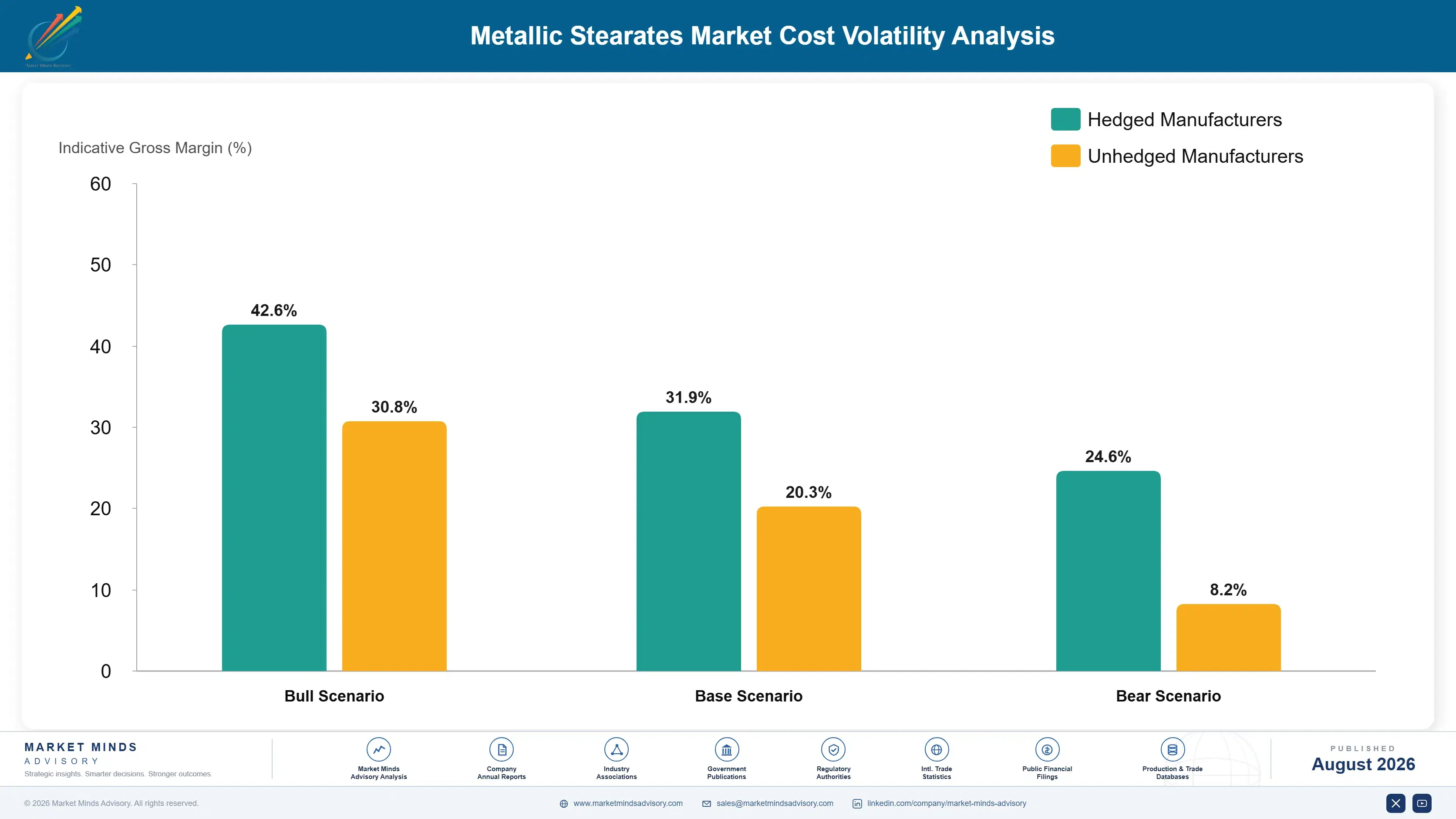
Palm-Derived Stearic Acid Feedstock Exposure

Stearic acid derived from palm oil and tallow accounts for roughly 52 percent of cost of goods sold across most metallic stearate manufacturing, with metal oxide reactants and processing costs making up most of the remainder. Feedstock sourcing concentrates heavily in Indonesia, Malaysia, and to a lesser extent domestic tallow rendering capacity, tying production costs directly to global vegetable oil market dynamics.
Indonesian export policy shifts and weather-driven harvest shortfalls during 2021 and 2022 pushed palm oil and derivative stearic acid prices up by more than 35 percent within several months, according to USDA reporting on global vegetable oil markets, forcing producers with fixed-price customer contracts signed before the spike to absorb significant margin compression. Producers without diversified sourcing agreements faced the sharpest impact, and several smaller regional makers reported delayed shipments.

Exposure varies sharply by player type: larger integrated producers like Baerlocher, with backward integration into stearic acid refining, weather price spikes with meaningfully less margin disruption than smaller formulators reliant on open-market feedstock purchases. Geographic exposure also differs, since producers sourcing primarily from Indonesian palm supply chains face different risk timing than those dependent on Malaysian or tallow-based feedstock, meaning cost impact varies considerably across the industry.
metallic-stearates-market-trends-cost-volatility-analysis-1787556224179

Diversifying Feedstock Sourcing Across Palm And Tallow Origins

Producers are increasingly qualifying both palm-derived and tallow-derived stearic acid suppliers simultaneously rather than relying on a single feedstock type, so a disruption or price spike in one market does not halt production entirely. This diversification raises formulation qualification complexity modestly but significantly reduces the risk of the sharp, single-origin price spikes that hit under-diversified producers hardest during recent volatility.

Backward Integration Into Stearic Acid Refining Capacity

Larger producers are pursuing backward integration into stearic acid refining, securing feedstock supply ahead of the open market and capturing margin that would otherwise go to independent oleochemical refiners. This approach requires capital most smaller producers lack, reinforcing a durable cost advantage for scale players during periods of feedstock price volatility and supply disruption.

Securing Multi-Year Feedstock Supply Agreements With Refiners

Producers are signing multi-year supply agreements directly with palm oil refiners, securing guaranteed allocation and pricing stability ahead of the market that smaller producers cannot access. This approach requires committed volume most smaller formulators cannot guarantee, reinforcing a cost and availability advantage for larger, established producers. Smaller producers pool purchasing through distributor networks for comparable terms.

Portfolio Architecture for Margin Defence

Metallic stearates organise into three commercial tiers running from standard industrial-grade commodity products through certified food and cosmetic-grade formulations to next-generation pharmaceutical-grade and sustainability-certified specialty products. Gross margins widen sharply moving up the tiers, since industrial-grade material competes largely on feedstock cost and delivery price, while pharmaceutical-grade and certified sustainable products capture value from documented purity, traceability, and regulatory compliance rather than raw feedstock cost alone. That margin gap continues widening as documentation requirements grow more demanding.
The tension between industrial volume and pharmaceutical premium shapes producer strategy: industrial-grade commodity products generate the manufacturing scale that supports feedstock purchasing power, but pharmaceutical and specialty-grade products generate the margin that justifies continued quality infrastructure investment. Producers overweighted toward industrial-only sales face intensifying price competition from lower-cost regional makers, while pharmaceutical-forward producers carry steadier, higher-margin profitability less exposed to commodity feedstock cycles.

High-value pools concentrate among pharmaceutical-grade magnesium stearate sold to generic drug manufacturers with rigorous qualification requirements, and among sustainability-certified feedstock products sold to consumer-facing cosmetic and personal care brands. Both pools reward producers who can pair documented purity and traceability with reliable feedstock sourcing rather than competing purely on industrial-grade commodity price. Producers without either capability compete on price.

Volume / Commodity-Adjacent Tier

Standard industrial-grade calcium and zinc stearate sold largely on feedstock cost and delivery price, competing on proximity to plastics and rubber compounding facilities, serving cost-sensitive commodity applications broadly. Buyers here rarely pay for documentation beyond basic safety data sheets.
Gross Margin: 12-18%

Premium / Certified Tier

Certified food and cosmetic-grade formulations backed by documented purity testing, sold at a meaningful premium to personal care and food packaging customers requiring formal regulatory compliance documentation. These customers typically require annual requalification audits and batch testing.
Gross Margin: 24-32%

Sustainability / Regulatory / Next-Generation Tier

Pharmaceutical-grade and sustainability-certified specialty products sold to generic drug manufacturers and consumer brands requiring documented traceability, priced on purity and compliance rather than raw feedstock cost. Adoption concentrates among producers already serving adjacent food-grade markets.
Gross Margin: 38-48%
metallic-stearates-market-trends-portfolio-architecture-1787556224690

High-value Sub-segments and Strategic Watch-out

Pharmaceutical-Grade Magnesium Stearate

Pharmaceutical-grade material sold to generic drug manufacturers commands the category's highest margins and fastest growth, concentrated among producers with dedicated segregated production lines and pharmacopeia certification supporting rigorous customer qualification requirements across major regulatory jurisdictions. Producers compete primarily on certification breadth and documented purity track records.
Gross Margin: 42-50%

Sustainability-Certified Cosmetic-Grade Stearates

Certified sustainable stearates sold to cosmetic and personal care brands carry strong margins tied to traceability documentation, though growth is more moderate than pharmaceutical-grade material since adoption depends on individual brand sustainability commitment timelines. Adoption is strongest among brands already reporting sustainability metrics publicly. today.
Gross Margin: 28-36%

Standard Industrial-Grade Calcium And Zinc Stearate

Industrial-grade material remains the largest volume category by far, generating steady manufacturing revenue across cost-sensitive PVC and rubber compounding applications, even as growth increasingly shifts toward pharmaceutical and cosmetic-grade products elsewhere. Price competition here is intensifying fastest among smaller Asian producers. Volume stays large even as unit economics erode gradually.
Gross Margin: 12-17%

Asian Producer Pharmaceutical-Grade Certification Parity Risk

Rapidly improving Chinese and Indian producer pharmaceutical-grade certification capability threatens to compress margins for established Western specialty makers, representing a meaningful competitive pressure point that established producers must monitor closely as certification gaps continue narrowing. Established Western makers must close the gap or cede volume.
Gross Margin: n/a

Qualification-Locked Customer Economics

Metallic stearate demand behaves like an annuity once a pharmaceutical or cosmetic customer completes supplier qualification, since switching suppliers requires costly revalidation testing and, for pharmaceutical customers, formal regulatory filing amendments that most customers strongly prefer to avoid absent a serious quality failure. That qualification lock-in shapes how producers price and structure long-term supply relationships. That lock-in effect compounds over successive years of qualified supply.
Adoption depth varies sharply by end use: pharmaceutical and food-grade customers penetrate deepest into documented, audited supply relationships, often single-sourcing a qualified supplier for years at a time, while industrial-grade PVC and rubber compounders adopt more transactionally, switching suppliers more readily based on price and delivery reliability. Cosmetic customers sit between the two, balancing formulation consistency against periodic competitive sourcing reviews. Distribution partners increasingly bridge the gap for smaller cosmetic accounts.

A generational shift in buyer profiles is underway as younger procurement and quality assurance professionals, increasingly focused on documented sustainability and traceability credentials, demand certified feedstock sourcing before qualifying a supplier, replacing an older generation that selected suppliers primarily on price and existing relationships. Producers slow to adapt risk losing share to certification-forward competitors. Suppliers slow to adapt risk losing share to certification-forward rivals.
metallic-stearates-market-trends-end-use-penetration-index-1787556225215

Where To Focus Capital Next

These are among the four positions where our research anticipates prominent divergence between winners and laggards over the coming forecast period. Each is grounded in the demand model, the regulatory perimeter, and the announced capacity pipeline.
01 / PHARMACEUTICAL-GRADE CAPACITY INVESTMENT

Prioritise Pharmaceutical-Grade Capacity Over Industrial-Grade Volume

Pharmaceutical-grade magnesium stearate is growing fastest and carries the category's widest margins, driven by generic drug manufacturers expanding production to meet rising global demand for affordable medicines across most major markets. Producers that invest in dedicated, segregated pharmaceutical-grade production lines are capturing this premium demand at a faster rate than competitors still manufacturing pharmaceutical and industrial-grade material on shared equipment. Capital allocated toward pharmacopeia certification and dedicated production infrastructure will likely generate better returns than industrial-grade capacity expansion over the next several years.
02 / FEEDSTOCK INTEGRATION STRATEGY

Integrate Backward Into Stearic Acid Refining For Cost Stability

Palm oil price volatility periodically compresses margins across the industry, and producers who integrate backward into stearic acid refining capacity gain meaningfully more stable input costs than competitors reliant entirely on open-market feedstock purchases during price spikes. This integration requires substantial upfront capital investment that smaller producers cannot easily commit, favoring larger, established players with access to patient capital. Producers that delay this integration risk continued margin volatility that better-capitalised competitors have already substantially reduced through direct, ongoing feedstock control efforts.
03 / REGULATORY SUBSTITUTION CAPTURE

Bundle Documentation With Lead Stabilizer Substitution Sales

Compounders completing lead and cadmium stabilizer phase-outs face a lengthy, costly requalification process, and producers who bundle regulatory documentation and formulation support directly into hardware sales capture meaningfully higher margins while simplifying compliance for customers under regulatory pressure. This bundled approach is already commanding premium pricing among producers serving markets still mid-transition away from legacy stabilizer systems. Producers that delay building this bundled capability risk ceding substitution-driven volume entirely to more prepared competitors already well established with major compounders across several regional markets.
04 / SUSTAINABILITY CERTIFICATION INVESTMENT

Build Certified Sustainable Feedstock Sourcing Ahead Of Brand Demand

Consumer-facing cosmetic and personal care brands are increasingly requiring documented sustainable feedstock sourcing from their suppliers, and producers who establish certified supply relationships early are securing long-term contracts before certified capacity becomes more broadly available industry-wide. Building certified sourcing infrastructure requires meaningful upfront investment in supply chain traceability and verification systems. Producers that delay this investment risk losing premium cosmetic-grade contracts entirely to competitors already positioned with certified, traceable palm supply chains and direct relationships with certified refiners built over several years.

Engagement Snapshot From the Field

A live engagement with an industry participant carrying material or product regulatory and market exposure ahead of a defining policy shift, showing how our research translates into a defensible multi-year portfolio strategy.
MARKET MINDS ADVISORY · CLIENT ENGAGEMENT SUMMARY
Metallic Stearates Producer Strategic Portfolio Review and Transition Roadmap 2026·Investment Scenario on Metallic Stearates Exposure Evaluation 2025-26
CLIENT PROFILE
The client is a mid-sized generic pharmaceutical manufacturer operating three tablet production facilities across India, producing solid oral dosage formulations for both domestic and export markets, representing approximately 2.8 billion tablets annually (client-reported, unverified by MMA). The manufacturer relied on a single magnesium stearate supplier for over a decade and faced growing pressure to diversify supply given rising feedstock volatility risk affecting that sole supplier.
STRATEGIC CHALLENGE
Quality leadership needed to qualify a second magnesium stearate supplier as a risk mitigation measure but faced a lengthy, costly requalification process for each regulatory drug filing affected, and lacked data comparing the total cost and timeline of qualifying different candidate suppliers against the risk of continued single-sourcing. Leadership also needed board-level sign-off given the scale of the affected revenue base.
MMA APPROACH
MMA analysts benchmarked candidate suppliers against documented qualification outcomes from comparable pharmaceutical manufacturers, modeling expected qualification timeline and cost against single-sourcing risk exposure across the manufacturer's regulatory filing portfolio. The engagement combined primary interviews with quality assurance staff, supplier capability comparison, and analysis against MMA's broader dataset of pharmaceutical excipient qualification outcomes.
KEY FINDINGS
  1. Qualification timeline for the recommended second supplier averaged fourteen months across comparable regulatory filings, faster than the manufacturer's internal estimate (client-reported, unverified by MMA).
  2. The existing sole supplier's feedstock sourcing lacked geographic diversification, exposing the manufacturer to a documented 35 percent cost spike during the prior palm oil shortage.
  3. Filings for lower-complexity generic formulations showed meaningfully shorter qualification timelines, suggesting a phased qualification sequence would outperform simultaneous full-portfolio requalification. across the manufacturer's regulatory filing portfolio.
  4. Two of three benchmarked suppliers offered dedicated pharmaceutical-grade production lines that reduced cross-contamination audit findings compared with the manufacturer's original supplier assessment.
CLIENT PROFILE
The client is a mid-sized generic pharmaceutical manufacturer operating three tablet production facilities across India, producing solid oral dosage formulations for both domestic and export markets, representing approximately 2.8 billion tablets annually (client-reported, unverified by MMA). The manufacturer relied on a single magnesium stearate supplier for over a decade and faced growing pressure to diversify supply given rising feedstock volatility risk affecting that sole supplier.
STRATEGIC CHALLENGE
Quality leadership needed to qualify a second magnesium stearate supplier as a risk mitigation measure but faced a lengthy, costly requalification process for each regulatory drug filing affected, and lacked data comparing the total cost and timeline of qualifying different candidate suppliers against the risk of continued single-sourcing. Leadership also needed board-level sign-off given the scale of the affected revenue base.
MMA APPROACH
MMA analysts benchmarked candidate suppliers against documented qualification outcomes from comparable pharmaceutical manufacturers, modeling expected qualification timeline and cost against single-sourcing risk exposure across the manufacturer's regulatory filing portfolio. The engagement combined primary interviews with quality assurance staff, supplier capability comparison, and analysis against MMA's broader dataset of pharmaceutical excipient qualification outcomes.
KEY FINDINGS
  1. Qualification timeline for the recommended second supplier averaged fourteen months across comparable regulatory filings, faster than the manufacturer's internal estimate (client-reported, unverified by MMA).
  2. The existing sole supplier's feedstock sourcing lacked geographic diversification, exposing the manufacturer to a documented 35 percent cost spike during the prior palm oil shortage.
  3. Filings for lower-complexity generic formulations showed meaningfully shorter qualification timelines, suggesting a phased qualification sequence would outperform simultaneous full-portfolio requalification. across the manufacturer's regulatory filing portfolio.
  4. Two of three benchmarked suppliers offered dedicated pharmaceutical-grade production lines that reduced cross-contamination audit findings compared with the manufacturer's original supplier assessment.
RECOMMENDED STRATEGY
Phase 1: Phase 1 (Months 1 to 6): Qualify the second supplier against the five lowest-complexity regulatory filings to validate qualification timeline estimates. Phase 2: Phase 2 (Months 7 to 14): Extend qualification to remaining filings, sequencing by regulatory complexity and renewal timing across the portfolio. Phase 3: Phase 3 (Months 15 to 18): Formalise a dual-sourcing supply agreement allocating volume between both qualified suppliers going forward permanently.
OUTCOME
The manufacturer completed phased qualification of a second supplier across its full filing portfolio within eighteen months. The dual-sourcing arrangement reduced feedstock risk exposure meaningfully within the first year (client-reported, unverified by MMA), and quality leadership credited the phased sequencing with avoiding production disruption during the transition.

Frequently Asked Questions

Foundational context covering the market sizes, CAGR, scope, country, region and competition that inform every finding below. This section is provided to cover basics and most often pre-purchase conversations, answered from the MMA Primary Research Dataset.

What is the current size of the Metallic Stearates Market?

The global metallic stearates market was valued at approximately $2.6 billion in 2025. Demand is driven by pharmaceutical tableting, PVC stabilizer substitution, and rubber processing applications worldwide.

How large will the Metallic Stearates Market be by 2036?

MMA forecasts the market will reach approximately $4.79 billion by 2036, roughly 1.74 times its 2026 value. Growth is driven by generic pharmaceutical expansion and regulatory-driven stabilizer substitution.

What is the CAGR for the Metallic Stearates Market 2026 to 2036?

The market is projected to grow at a compound annual growth rate of 5.7 percent between 2026 and 2036. Bull and bear scenarios range from roughly 4.4 to 6.9 percent depending on palm oil feedstock costs.

Which segment is growing fastest?

Magnesium stearate is the fastest-growing segment, expanding at approximately 7.8 percent annually, driven by generic pharmaceutical and nutraceutical tablet manufacturers expanding global production capacity steadily.

Who are the major companies in the Metallic Stearates Market?

Leading producers include Baerlocher GmbH, PMC Biogenix, Faci S.p.A., Valtris Specialty Chemicals, and Peter Greven Fett-Chemie. Competition centers on pharmaceutical-grade purity, feedstock integration, and regulatory documentation.

Which country is growing fastest?

India is the fastest-growing major market, driven by its rapidly expanding generic pharmaceutical manufacturing sector and rising magnesium stearate demand tied directly to tablet production capacity.

Report Segmentation Architecture

The full report scope spans multiple orthogonal segmentation dimensions, with cross-tabulated demand data provided for each dimension pair. Coverage extends further to regional breakdowns, trend trajectories, and the competitive detail needed to support segment-level decision-making.

By Metal Type

  • Calcium Stearate
  • Zinc Stearate
  • Magnesium Stearate
  • Aluminum Stearate
  • Lithium Stearate
  • Other Specialty Stearates

By End-Use Industry

  • Plastics and PVC Compounding
  • Rubber Processing
  • Pharmaceuticals
  • Cosmetics and Personal Care
  • Food and Packaging

By Commercial Dimension

  • Industrial-Grade Bulk Supply
  • Pharmaceutical-Grade Certified Supply
  • Cosmetic-Grade Certified Supply
  • Sustainability-Certified Feedstock Programs

By Region

  • North America
  • Western Europe
  • East Asia
  • South Asia and Pacific
  • Latin America
  • Middle East and Africa
  • Eastern Europe

Scope, Methodology, and Coverage

Every figure in this report is reproducible from documented input assumptions. The scope below maps the historical period, the forecast horizon, the segmentation dimensions, and the countries covered, alongside the underlying primary and qualitative methodology.
Historical Period
2020 to 2025
Forecast Period
2026 to 2036
Base Year
2025 (USD billions; MMA Primary Research Dataset, August 2026)
Market Definition
The metallic stearates market covers metal salts of stearic and related long-chain fatty acids, including calcium, zinc, magnesium, aluminum, and lithium stearate, used as lubricants, mold release agents, stabilizers, and pharmaceutical excipients. It excludes free stearic acid itself and unrelated metallic soaps used purely as industrial greases.
Quantitative Units
USD billions (current prices); volume in metric tonnes where cited
Segmentation Dimensions
By Metal Type; By End-Use Industry; By Commercial Dimension; By Region
Regions Covered
North America, Western Europe, East Asia, South Asia and Pacific, Latin America, Middle East and Africa, Eastern Europe
Countries Covered
USA, China, Germany, France, UK, Japan, South Korea, India, Australia, Canada, Brazil, Mexico, Indonesia, Vietnam, Thailand, Malaysia, UAE, Saudi Arabia, South Africa, Nigeria, Turkey, Poland, Netherlands, Italy, Spain, Sweden, Switzerland, Argentina, Colombia, Singapore, and additional markets relevant to this sector
Key Companies Profiled
Baerlocher GmbH, PMC Biogenix, Faci S.p.A., Valtris Specialty Chemicals, Peter Greven Fett-Chemie, American International Chemical, Dover Chemical Corporation, Emery Oleochemicals, Croda International, Akrochem Corporation, Norac Additives, Kao Corporation, Godrej Industries, KLK Oleo, IOI Oleochemical, Musim Mas, VVF Limited, Sun Ace Kakoh, Hallstar Company, Wilmar International
Quantitative Methodology
Primary survey, n=3,800 respondents, Q4 2025, six countries; demand-side model with trade association cross-validation
Qualitative Methodology
47 expert interviews, Q4 2025; applied to validate demand model assumptions, identify emerging dynamics, and assess competitive positioning
Report Format
PDF and XLSX data workbook (Word format preview document)
Publisher
Market Minds Advisory
Report Code
MMA-2026-CHM-104
Published
August 2026
Contact
sales@marketmindsadvisory.com | www.marketmindsadvisory.com

Purchase the full Metallic Stearates Market Report (2026 to 2036).

The full report provides a complete quantitative and qualitative assessment of the global metallic stearates market through 2036, including detailed regional sizing across all seven MMA-tracked geographies and metal-type segmentation covering calcium, zinc, magnesium, aluminum, and lithium stearate categories. It profiles twenty leading and emerging producers, benchmarking feedstock integration, pharmaceutical-grade capability, and regulatory compliance infrastructure across the competitive landscape. The report includes primary survey findings from 3,800 respondents and 47 expert interviews conducted in the fourth quarter of 2025, alongside detailed feedstock cost and palm oil supply chain risk analysis. Buyers receive segment-level revenue models, editable data tables, and a structured framework for evaluating producer and market entry decisions.
Seven-region market sizing with metal-type revenue breakdowns
Twenty-company competitive profiles with moat and risk analysis
Primary survey data from 3,800 respondents across six countries
Forty-seven expert interviews on regulatory and pharmaceutical trends
Editable data tables for custom scenario and sensitivity modeling
Palm oil feedstock cost and supply chain risk assessment

Built For The People Who Decide

From boardroom strategy to bench-side execution, this report is read cover-to-cover by leaders shaping the next decade of their industry, turning demand scenarios, market dynamics and valuation benchmarks into decisions.
CXOs/ Presidents/ VPs/ Managers
M&A and Corporate Development
Strategy Teams and R&D Heads
Procurement and Product Directors
Regulatory and Compliance Leaders
Investor Relations and Equity Analysts