Market Minds Advisory
Kids Shampoo Market

Kids Shampoo Market: Kids Shampoo Market: The Undefined Claim, The Missing Formulation and The Exit At Nine

Tear-free has no regulatory definition anywhere, the shelf was formulated for straight hair, and the customer leaves at nine, which together explain more about this category than any brand strategy does.

Lead Analyst

Published

September 2026

Make Smarter Decisions with Customized Research Insights

Request a free sample report and evaluate market opportunities, growth trends, and competitive dynamics relevant to your business needs.

2025 MARKET VALUE$4.6BMarket Size 2025
2036 FORECAST VALUE$9.3BBase Case , 2026 to 2036
CAGR 2026 TO 20366.6 %Bull 7.8% / Bear 5.4%
INCREMENTAL OPPORTUNITY$4.4BNet 10- year value creation
EXPANSION MULTIPLE1.89x2036 value over 2026 base
Strategic Levers
M&A Pipeline
Regional Outlook
Country Rankings
Competitive Intelligence
Segmental Deep-dive
Call-Us : 91 93563 13602

Executive Snapshot and Market Trajectory.

Three facts govern this category and none of them appears in a marketing plan. Tear-free is not a defined term anywhere in regulation. The shelf was built for straight and wavy hair. And the customer leaves at around nine, whatever anybody in the industry does about it.
Textured and coily hair formulations grow at 9.9%, half again the market rate of 6.6%, from 6% of shelf space, which is the clearest unmet need in children's personal care and the one mainstream brands arrived at latest. East Asia holds 27% of demand and South Asia takes 16%, above its usual band, because branded children's shampoo reaches genuinely mainstream penetration across India rather than remaining a premium purchase there. That is a real distinction.
Concentration is high at 38% for a personal care category, held by a handful of names that mothers recognise from their own childhoods, which is a moat nobody can buy. The pressure arriving is chemical rather than competitive: contamination limits on ethoxylated surfactants have forced reformulation across the shelf, and the brands that moved early hold a documentation position the rest are still busy assembling. Nobody saw that coming.
Market Definition
The kids shampoo market covers hair cleansing products formulated and marketed for children from infancy to early adolescence, spanning tear-free classic shampoos, two-in-one shampoo and conditioner products, dermatologist-tested sensitive formulations, scalp health and cradle cap treatments, textured and coily hair formulations, and transition products for older children. Scope includes retailer own-label children's ranges. Excluded are adult shampoos used by children, conditioners and detanglers sold separately, body washes without a hair claim, medicated antifungal treatments, and styling products of every kind.
Base Year Value
$4.6B in 2025 (MMA Primary Research Dataset, August 2026)
Forecast Period
2026 to 2036, eleven discrete annual values
CAGR
6.6% base case. Bull 7.8%. Bear 5.4%.
Fastest Growth Segment
Textured and Coily Hair Formulations: 9.9% CAGR
Fastest Growth Country
India: 8.8% CAGR
Fastest Growth Region
South Asia and Pacific: 8.8% CAGR
Largest Region
East Asia: 27% of 2025 global value
Market Leaders
Kenvue, Unilever, Procter and Gamble, Beiersdorf and Pigeon Corporation. Source: MMA Analysis, July 2026.
Primary Survey
n=3,800 procurement and R&D decision-makers, Q4 2025, six countries
Methodology
Demand-side build-up, cross-validated against public data, 47 expert interviews

Kids Shampoo Market Forecast Scenarios

kids-shampoo-market-size-forecast-scenario-1788171245028
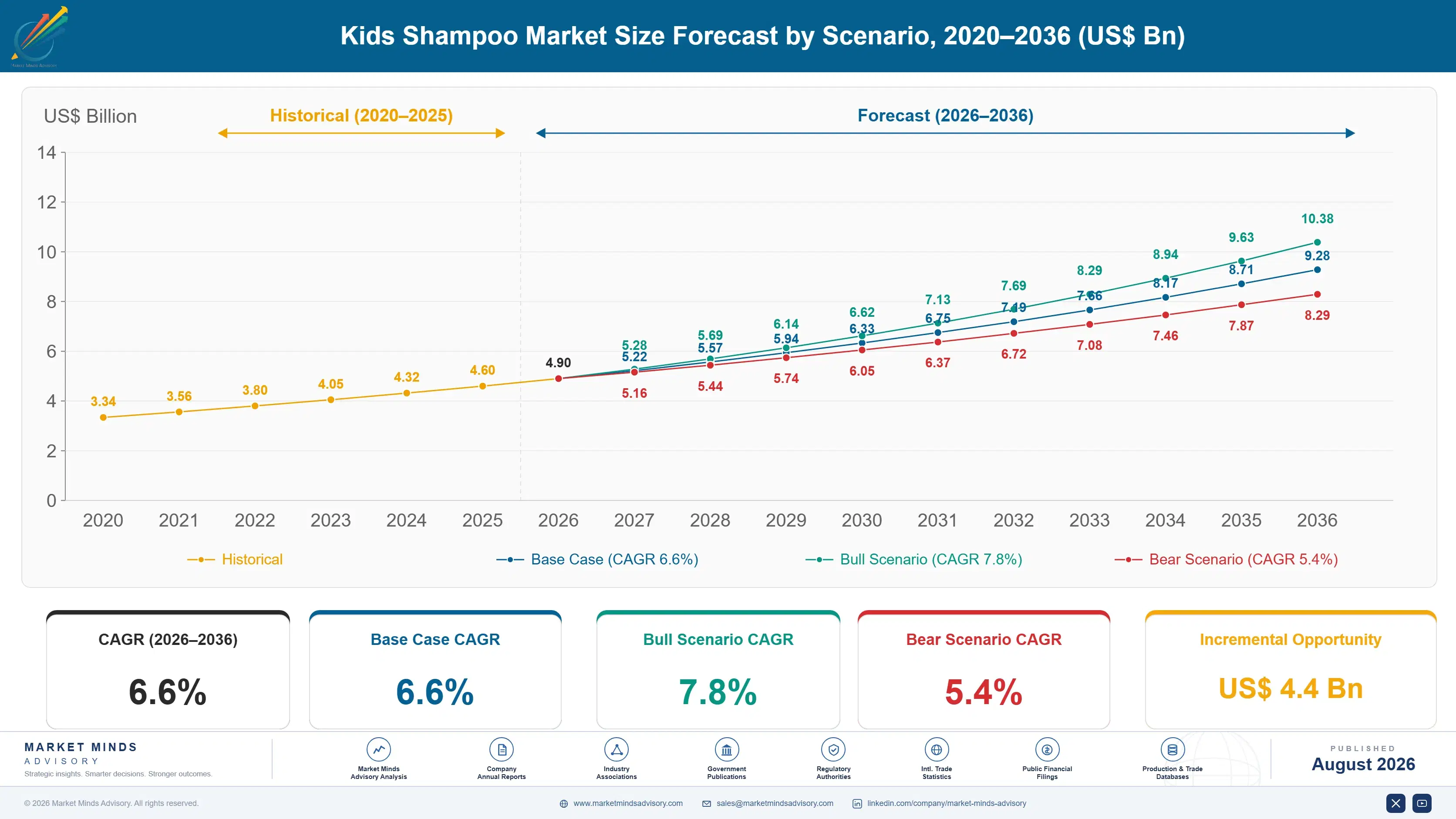
Between 2020 and 2025 the category compounded at 5.6%, and the composition shifted more than the total. Classic tear-free formulations flattened as households moved toward sensitive-skin and scalp-specific products at higher price points, and textured hair ranges appeared on mainstream shelves for the first time. Volume was broadly flat across most Western markets, with growth coming from mix and from Asian penetration instead.
The 6.6% base case rests on three mechanisms. Textured hair formulations are converting households that previously bought adult product because nothing on the children's shelf worked for them. Scalp health positioning is moving parents from a commodity purchase to a treatment purchase at considerably higher prices. And South Asian penetration continues as branded product reaches price points that general trade households can afford. None of the three depends on more children being born anywhere in the world.
The bull case at 7.8% turns on the category holding children past nine through credible transition ranges, which would extend the customer relationship by several years at higher price points. The bear case at 5.4% is contamination regulation spreading: tighter limits on ethoxylated surfactant by-products across more jurisdictions would force reformulation faster than smaller participants can fund it.

Three Facts Nobody Markets

Tear-free is a marketing term with no regulatory definition anywhere in the world. What it describes in practice is a formulation using mild amphoteric and non-ionic surfactants at a pH close to tears, rather than the sulfates that dominate adult shampoo. That is a genuine formulation difference and it costs more. It is also unverifiable by any standard test that a regulator recognises, which nobody mentions.
TOP FIVE CONCENTRATION38%Share held by the five largest children's shampoo sellers
AVERAGE SELLING PRICEUSD 5.20Mean retail price per bottle across major consumer channels
SURFACTANT COST SHARE26% of COGSMild surfactant system as proportion of production cost
CATEGORY EXIT AGE9 yearsMedian age at which children move to adult product
TEXTURED FORMULATION SHARE6%Portion of shelf built for coily and textured hair
REPEAT PURCHASE INTERVAL7 weeksMedian time between bottle purchases in a household
The textured hair gap is the largest unmet need in children's personal care and it took mainstream brands decades to notice. Coily and tightly curled hair needs lower surfactant strength, higher conditioning and a different pH than the straight-hair formulations that filled the shelf, and families with textured-haired children bought adult product instead because nothing else worked. That segment is 6% of shelf and grows at 9.9%.
The customer leaves at nine and that is the ceiling on everything. A child who decides the bottle looks babyish moves to adult product and does not come back, which caps the household relationship at roughly eight years from first purchase. Repeat purchase inside that window is reliable at seven week intervals. Brands that built credible transition ranges for older children hold the customer longer.
"Everybody in this category optimises the first purchase and nobody defends the last one. The child decides to leave at nine, in a single conversation with a mirror, and there is a whole business sitting in the years after that which almost nobody has built."
Director, Personal Care and Family Brands Practice · MMA Chemicals and Materials Practice · August 2026

Market Trends

Textured hair formulations reached the mainstream shelf

Coily and tightly curled children's hair needs a fundamentally different formulation from the straight-hair products that filled this shelf for decades: lower surfactant strength, higher conditioning load and a different pH. Families with textured-haired children bought adult product for years because the children's aisle offered nothing that worked, which is a demand pool the category had been actively refusing. Mainstream brands entered late and specialist brands built the segment first. It now grows at 9.9% against a market rate of 6.6% from just 6% of the total available shelf space.
Market Impact: Grows 8.4% on treatment framing

Contamination limits forced reformulation across the shelf

State-level limits on 1,4-dioxane in personal care products, a by-product of the ethoxylation used to make the mild surfactants this category depends on, forced measurable reformulation across children's washing products specifically. The root chemistry is unavoidable: ethoxylated surfactants are what makes a shampoo mild, and the process generates the by-product. Manufacturers responded with vacuum stripping, alternative surfactant chemistries and tighter incoming specification. Brands that moved early hold documentation that retail buyers now request routinely, and the ones that waited are assembling it under a great deal of time pressure right now instead.
Market Impact: Holds 16% on 12% band

Market Opportunities and Growth Drivers

Scalp positioning moved a commodity into treatment

Cradle cap, dryness and scalp sensitivity are genuine paediatric concerns with genuine parental anxiety attached, and a shampoo positioned against them sells at considerably higher prices than the same bottle positioned as a wash. The mechanism is not clinical superiority but framing: a parent buying a treatment behaves completely differently from a parent buying a commodity, and asks about ingredients rather than about price. The segment grows at 8.4% against a market rate of 6.6%, and it converts the most price-sensitive category in personal care into something considerably better than that.
Market Impact: Ends the relationship at 9

South Asian penetration reached genuinely mainstream levels

Branded children's shampoo has moved from a metropolitan premium purchase to an ordinary general trade product across India, which is why the region takes 16% of world demand against a band that would normally cap it lower. The largest child population in the world is now buying branded product at price points domestic manufacturers reached before importers did. Indian growth at 8.8% is the fastest of any country covered and it comes from penetration rather than from trading up. Western participants planning entry consistently price for entirely the wrong household.
Market Impact: Rests on 0 recognised standards

Market Restraints and Challenges

The customer leaves the category at nine

Children abandon the category at a median age of nine, at the point where a bottle designed to look reassuring to a parent starts looking babyish to the child, and the decision is made by the child rather than the buyer. The root cause is design and positioning rather than performance, since the formulation is often better suited to a young scalp than the adult product replacing it. Commercial impact is a hard ceiling on lifetime value at roughly eight years. Participants are responding with transition ranges, older-child packaging, scent and format changes, and character licensing aimed at holding attention.
Market Impact: Grows 9.9% from 6% shelf

Tear-free carries no verifiable standard behind it

No regulator anywhere defines tear-free, and no validated ocular irritation test is universally applied to substantiate it, which leaves the category's central claim resting on formulation convention rather than on measurement. The root cause is that the historic animal test the claim was built on has been abandoned on welfare grounds without a single agreed replacement being adopted across markets. Commercial impact is a claim that could not survive a substantiation request if a regulator made one. Participants are responding with published pH and surfactant specification, ophthalmologist-tested language, and in-vitro corneal model data that only the larger manufacturers can fund.
Market Impact: Limits contamination to 1 ppm
3 additional market trends, 4 additional growth drivers, and 2 additional restraints and challenges are covered in the full report. Contact sales@marketmindsadvisory.com to access the complete intelligence.

Segment CAGR and Growth Architecture

Segmentation follows formulation need, the dimension on which surfactant system, price point and shelf position all operate together. Classic tear-free and two-in-one formats carry the volume at commodity prices. Textured hair and scalp treatment formulations carry the growth, because both address something a parent will pay considerably more to solve properly for their own child.
kids-shampoo-market-market-share-analysis-1788171245573

Textured and Coily Hair Formulations

Textured and coily hair formulations grow at 9.9%, half again the market rate of 6.6%, from 6% of shelf space, which makes this the clearest unmet need anywhere in children's personal care. Coily hair needs lower surfactant strength, considerably higher conditioning load and a different pH than the straight-hair products this shelf was built around, and families whose children have it bought adult product for years because the children's aisle had nothing. Specialist brands built the segment and mainstream brands arrived late, which means shelf position is still being decided. The households involved are loyal in a way this category has never seen elsewhere. That loyalty is worth considerably more than the segment size suggests.
CAGR 9.9%

Scalp Health and Cradle Cap Treatments

Scalp health and cradle cap treatments at 8.4% take the same bottle and reposition it from a wash into a treatment, which changes everything about how it is bought. A parent addressing a visible scalp condition on an infant asks about ingredients rather than price, buys on pharmacist or paediatric recommendation, and repurchases without comparing. Unit prices run two to three times the classic tear-free tier on a formulation cost difference considerably smaller than that. The segment also holds the customer earlier, since cradle cap arrives in the first months and establishes a brand relationship before any competitor is in the conversation at all. That first-mover position lasts for years afterwards.
CAGR 8.4%
Full segment breakdown across 6 segments available in the complete report.

Regional Architecture and Country Demand Map

East Asia takes 27% on child population and spend per child together. South Asia takes 16%, above its usual band, because branded children's shampoo is genuinely mainstream across India rather than a premium purchase. Western demand grows on mix rather than on any volume now.

East Asia

Child population and spend per child both work in this region's favour, which is unusual because they normally trade off against each other. Chinese volume remains enormous despite falling birth numbers, and Japanese and Korean households buy children's personal care at price points Western markets reach only in pharmacy. Scalp health positioning is more developed here than anywhere else, with cradle cap and sensitivity treatments occupying mainstream shelf rather than specialist channels. The contract manufacturing base for children's washing products is also concentrated in the region. Falling births are the constraint that will eventually bite, though not for several years yet. The scalp treatment positioning is the exportable idea here.
Share: 27% | CAGR: 7.6% (2026 to 2036)

North America

The textured hair gap was largest here and it is closing fastest here too. American households with textured-haired children bought adult product for decades because the children's aisle offered nothing suitable, and specialist brands built the segment before any mainstream manufacturer entered it. Retailers have since given the category dedicated shelf. Contamination regulation is the other force, with state-level limits on ethoxylation by-products in personal care forcing reformulation across children's washing products specifically. Brands that reformulated early hold documentation retail buyers now ask for routinely, and the ones that waited are assembling it under pressure. Both forces reward the same behaviour, which is unusual and convenient. Nobody planned it that way.
Share: 24% | CAGR: 6.0% (2026 to 2036)
Regional intelligence for 5 additional markets available in the complete report: Western Europe, South Asia and Pacific, Latin America, Middle East and Africa, Eastern Europe. Contact sales@marketmindsadvisory.com.
kids-shampoo-market-country-cagr-analysis-1788171246089

Four Moves The Shelf Missed

None of these four requires a better shampoo, which is fortunate, because the formulations on this shelf are broadly adequate and have been for years. Each addresses something the category has simply not done: serve the hair it never formulated for, hold the child past nine, or document a claim that nobody has ever actually verified.

Formulate properly for textured children's hair

Textured formulations occupy 6% of shelf and grow at 9.9% against a market rate of 6.6%, which is the widest gap between demand and supply anywhere in children's personal care. Coily hair needs lower surfactant strength, higher conditioning load and a different pH, all of which are ordinary formulation work rather than research. The households involved bought adult product for years because nothing suitable existed, and they are markedly more loyal than the rest of this whole category once somebody in this industry finally serves them properly at long last.
Market Impact: Serves a 9.9% segment from 6% of shelf

Build a transition range for older children

Children leave this category at a median age of 9 because the packaging starts looking babyish, and the decision belongs to the child rather than to the parent buying. A transition range with older-child design, different scent and adult-adjacent format holds the household several years longer at higher price points, and the formulation work required is minimal because a nine-year-old scalp is not an adult one. Almost nobody has built this properly, which leaves several years of lifetime value sitting there entirely unclaimed on every single shelf in the aisle.
Market Impact: Extends the relationship beyond age 9 by years

Reposition the bottle as a scalp treatment

The same formulation sells at two to three times the price when it addresses cradle cap, dryness or scalp sensitivity rather than simply washing hair, because a parent buying a treatment stops comparing prices and starts asking about ingredients. The segment grows at 8.4% against a market rate of 6.6%. It also establishes the brand relationship in the first months of a child's life, before any competitor is in the conversation, which is worth considerably more than the price premium the repositioning itself is actually able to earn back anyway.
Market Impact: Prices 3x above the classic wash tier itself

Document the tear-free claim before somebody asks

No regulator defines tear-free and no validated ocular test is universally applied, which leaves the category's central claim resting on convention rather than on evidence. Publishing pH, surfactant specification and data from 3 in-vitro corneal models converts an unsupported adjective into a documented position, and it costs a testing programme rather than a reformulation. Retail buyers already ask for the contamination documentation. The tear-free file is the next thing they will ask for, and the brands that prepared it in advance will be the ones still listed when that finally does happen.
Market Impact: Documents the 1 claim before any regulator asks

Who Controls the Margin Pool

CR5 stands at 38%, measured on retail unit shipment volume, since no participant discloses children's shampoo separately from wider baby care. That is high for personal care and the reason is generational: parents buy the brand they were washed with, which is a position that cannot be purchased at any price. The gap between the leader and the field is wide and has been stable for years.
Competition runs on trust, shelf position and documentation. Trust is generational and almost impossible to shift, which is why challenger brands entered through segments the incumbents ignored rather than attacking them directly. Shelf position decides the volume tier, and retailers allocate it on category growth rather than on brand size. Documentation now decides who stays listed, because contamination and claims files are becoming a buying requirement.

Rankings will move in the segments the incumbents were slowest to enter. Textured hair formulations grow at 9.9% from 6% of shelf, and the specialist brands that built it hold positions that mainstream manufacturers are paying to acquire rather than compete with. Transition ranges for older children are the next gap and nobody occupies it. The pressure comes from unserved demand rather than from price competition.
kids-shampoo-market-company-positioning-matrix-1788171246607

Competitive Moat and Risk Dimensions

KENVUE

Moat: Generational brand recognition

Parents buy the brand they were themselves washed with, and no competitor can manufacture forty years of maternity ward familiarity at any price. That recognition operates below conscious brand preference, which is why the position has survived competitive attacks, ingredient controversies and price competition without materially moving. Building an equivalent requires a generation rather than a campaign.
KENVUE

Risk: Ingredient scrutiny reaches heritage names

The same recognition that protects the position also concentrates scrutiny on it, because a contamination story or a claims challenge attaches to the most familiar name rather than to the category. Historical ingredient controversies demonstrated exactly that. The group therefore has to reformulate and document ahead of a market where smaller competitors continue unexamined until somebody looks at them.
UNILEVER

Moat: Textured hair capability acquired early

The group holds textured hair brands with genuine formulation heritage and community credibility, acquired before mainstream competitors recognised the segment existed. That gives it a position in the fastest-growing part of this category that a conventional brand extension cannot replicate, because credibility with those households was earned rather than purchased. Competitors are now paying to acquire what it already holds.
UNILEVER

Risk: Corporate ownership tests community credibility

Credibility with textured hair households was built by founder-led brands and does not automatically survive corporate ownership, where those households watch ownership questions closely. Managing that requires operating restraint that large groups find difficult, and any perceived reformulation or dilution reaches the community faster than marketing response can. The asset is fragile in a way a conventional brand is not.

Players Tracked

Prominent Players

Kenvue
Unilever
Procter and Gamble
Beiersdorf
Pigeon Corporation

Other Key Players

Artsana Group
Laboratoires Expanscience
Sebapharma
Himalaya Wellness
Dabur India
Marico
Honasa Consumer
The Honest Company
Galderma
Weleda
The Clorox Company
Kao Corporation
LION Corporation
Church and Dwight
Strength of Nature

Recent Developments

FEBRUARY 2025

State contamination limits reached full enforcement in personal care

State-level limits on 1,4-dioxane content in personal care products reached full enforcement, applying directly to the ethoxylated surfactants that make children's shampoo mild. Manufacturers had reformulated or installed vacuum stripping ahead of the date, and several smaller importers withdrew children's ranges rather than fund the testing programme required.
Signal: Contamination documentation has become a listing requirement rather than any point of real differentiation at all.
JUNE 2025

Mainstream retailers expanded textured children's hair shelf space

Major North American retailers expanded dedicated shelf allocation for textured and coily children's hair products, moving the segment out of specialist sections into the main children's aisle. Specialist brands that had built the category held the positions, and mainstream manufacturers entered with ranges assembled later than the demand appeared.
Signal: Retailers moved on the demand before the manufacturers who had ignored it for decades finally did.
OCTOBER 2025

Kenvue expanded scalp treatment production capacity for children

Kenvue brought additional production capacity for children's scalp and cradle cap treatments into operation, an organic capacity expansion rather than any acquisition or joint venture. The investment weights output toward the treatment positioning that commands higher prices and establishes the brand relationship in a child's first months rather than later.
Signal: The first months of a child's life are where this category's relationships are actually decided for good.

Mild Costs More Than Harsh

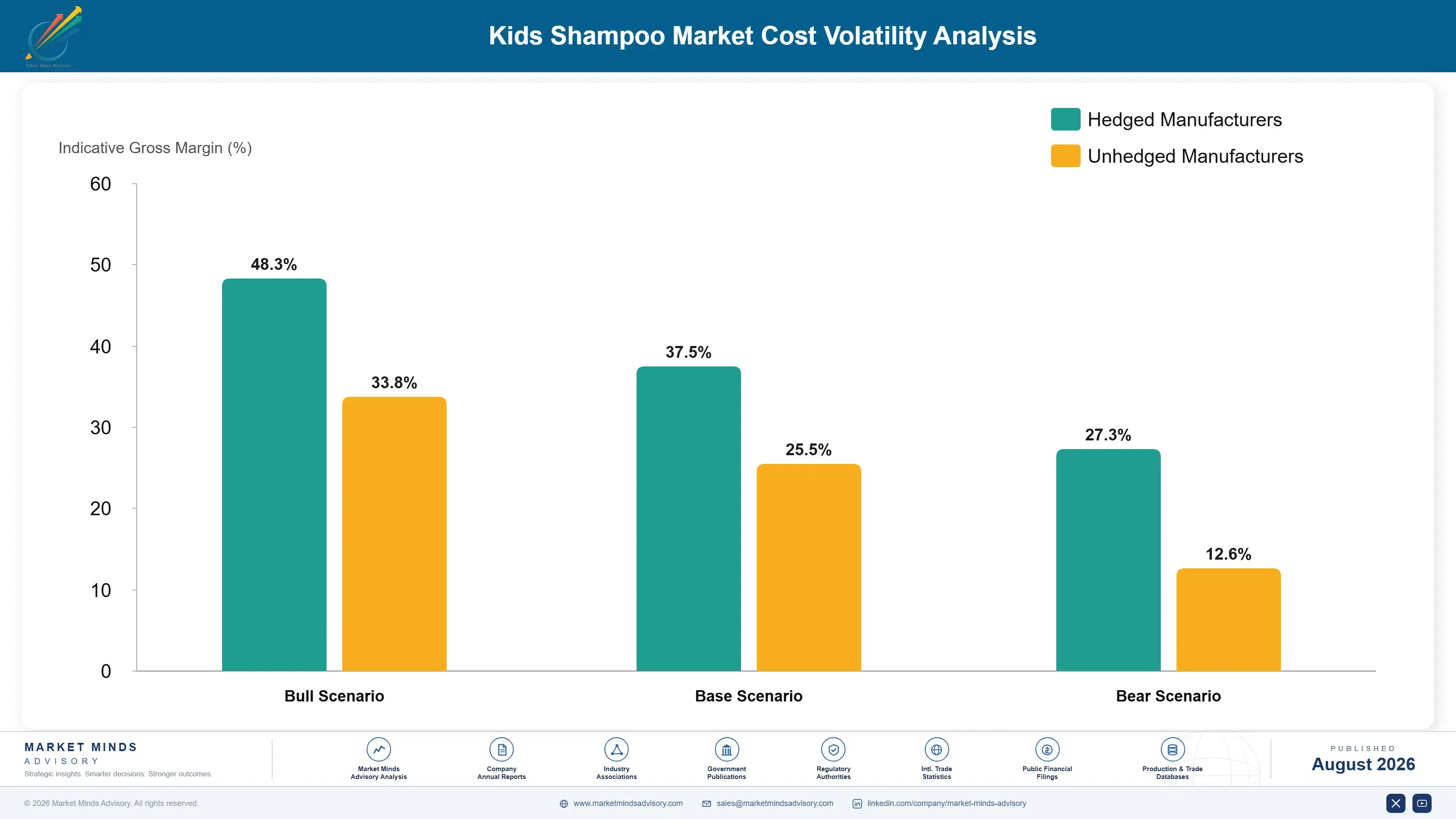
Mild surfactant systems account for roughly 26% of cost of goods, considerably more than the sulfates in adult shampoo, because amphoteric and non-ionic chemistries cost more per active unit. Packaging adds 21% and fragrance systems 9%. Surfactants come from a small number of ethoxylation plants across Europe, North America and East Asia, and the same plants supply every participant here.
Surfactant supply gave this category its clearest lesson. Ethylene oxide and the ethoxylation capacity that depends on it tightened through 2021 and 2022 on plant outages, and mild surfactant grades moved further than sulfates because the qualified supply base was narrower. Unilever noted raw material cost pressure across its personal care businesses in its Annual Report 2022. Brands holding annual contracts came through it; spot buyers absorbed the whole move and repriced into a resistant one.

The disadvantage falls on scale rather than on geography. A large group contracts mild surfactant annually across a whole personal care portfolio and barely notices a grade move. A specialist children's brand buys small volumes against a retail price list agreed months earlier and has nowhere to put an increase. Contamination testing compounds it, since the cost falls the same at any volume.
kids-shampoo-market-cost-volatility-analysis-1788171246801

Contract mild surfactant on annual volume terms

Mild surfactant systems are a quarter of cost of goods and the qualified supply base is narrower than for commodity sulfates, which is why these grades move further in a tight market. Annual contracts with an ethoxylation supplier cost a premium over spot in a soft market and remove the largest uncontrolled line in a category that resists price increases.

Specify incoming contamination limits below the legal threshold

Contamination limits on ethoxylation by-products vary by jurisdiction and are tightening rather than loosening, which makes compliance to the current legal figure a temporary position. Specifying incoming surfactant well below the applicable limit costs a modest premium and removes the need to reformulate every time a state moves. Retail buyers now request the documentation before listing.

Share testing costs across a product family

Contamination and claims testing costs fall largely on the surfactant system rather than on the individual product, so a common formulation platform extended across sizes, variants and adjacent formats spreads the same overhead across considerably more volume. Brands testing each product separately pay repeatedly for the same evidence. Very few have organised their ranges around a common platform at all.

Portfolio Architecture for Margin Defence

Margin here follows positioning rather than formulation, which is unusual even in personal care. The same surfactant system sells at three times the price when the label addresses cradle cap instead of hair washing, on a cost difference of almost nothing. Brands costing on delivered margin by positioning rather than by product run a completely different portfolio from those organising around bottle size.
Volume and premium pull against each other through the shelf rather than the factory. The classic tear-free tier holds the shelf position and the generational familiarity that everything else depends on, and losing it would cost the brand its place entirely. But it earns least and grows slowest at 4.2%. The answer holds the volume tier as a shelf-holding cost and takes the margin in treatment and textured formulations.

High-value pools sit in scalp treatment, in textured hair formulations and in the transition range almost nobody has built. The third is the largest and the least contested: children leave at nine and the years between nine and fourteen are entirely unserved by anybody in this category. A brand that holds the household through that period roughly doubles the relationship, at price points closer to adult product.

Volume / Commodity-Adjacent

Classic tear-free and two-in-one formulations sold through grocery and mass retail at accessible price points. Competes on price and shelf presence against own-label and near-identical branded product. The 9 point spread reflects whether manufacturing is held in house or contracted out.
Gross Margin: 34 to 43%

Premium / Certified

Dermatologist-tested sensitive formulations and scalp treatments sold through pharmacy and specialist retail. Treatment positioning rather than formulation cost supports the price, and buyers ask about ingredients rather than price. The 9 point spread reflects channel mix between pharmacy and grocery distribution.
Gross Margin: 48 to 57%

Sustainability / Regulatory / Next-Generation

Textured hair formulations, transition ranges for older children and documented low-contamination platforms supplied to other brands. Margins are high because capability is scarce rather than because volume is large. The 12 point spread separates finished product from platform supply arrangements.
Gross Margin: 52 to 64%
kids-shampoo-market-portfolio-architecture-1788171247302

High-value Sub-segments and Strategic Watch-out

Textured and Coily Hair Formulations

High value and high growth at 9.9% from 6% of shelf. The households involved bought adult product for years because nothing suitable existed, and they are markedly more loyal once served. The 8 point spread reflects whether the brand holds community credibility or acquired it.
Gross Margin: 54 to 62%

Scalp Health and Cradle Cap Treatments

High value with strong growth at 8.4%. The same formulation sells at three times the wash price and establishes the brand relationship in a child's first months, before any competitor arrives. The 8 point spread reflects whether distribution runs through pharmacy or grocery channels instead.
Gross Margin: 50 to 58%

Tear-Free Classic Shampoos

The volume core. It grows at only 4.2% and earns least, but it holds the shelf position and generational familiarity that every profitable part of the range depends on entirely. The 9 point spread reflects whether manufacturing is in house or contracted to a third party.
Gross Margin: 32 to 41%

Undocumented Tear-Free Claims

The strategic watch-out. No regulator defines tear-free and no validated ocular test is universally applied, which leaves the category's central claim unsupported if anybody formally asks. The 30 point spread reflects how much still sells on that claim without any documentation at all behind it.
Gross Margin: 30 to 60%

Eight Years And Then Gone

The annuity here is strong, predictable and strictly time-limited. A household buys a bottle every seven weeks from the first months of a child's life until the child leaves at around nine, which is a reliable revenue stream with a hard end date visible from the beginning. Acquisition cost amortises comfortably across that window, and almost every brand optimises for its opening rather than its closing.
Stickiness inside the window is high and depends on nothing the brand controls after the first purchase. A parent who found something that does not sting eyes or irritate a scalp does not experiment again, and the switching risk is a distressed child rather than a wasted purchase. Textured hair households are the stickiest, because their alternatives have been so poor. Nobody switches out of curiosity.

The decision-maker changes partway through and almost nobody designs for it. For the first years the parent chooses entirely, on gentleness and trust. Somewhere around six the child starts having opinions, and by nine the child decides, on whether the bottle looks babyish rather than on anything the formulation does. Brands merchandising only to the parent lose the customer to a child they never addressed.
kids-shampoo-market-end-use-penetration-index-1788171247793

What This Shelf Missed

These are among the four positions where our research anticipates prominent divergence between winners and laggards over the coming forecast period. Each is grounded in the demand model, the regulatory perimeter, and the announced capacity pipeline.
01 / TEXTURED HAIR FORMULATION

Formulate for the hair the shelf ignored

Textured and coily formulations occupy 6% of shelf space and grow at 9.9% against a market rate of 6.6%, which is the widest gap between demand and supply anywhere in children's personal care. Coily hair needs lower surfactant strength, higher conditioning load and a different pH, all of which is ordinary formulation work rather than research. The households involved bought adult product for years because nothing suitable existed, and they are markedly more loyal once somebody finally serves them properly.
02 / OLDER CHILD TRANSITION

Build the range that holds them past nine

Children leave this category at a median age of 9 because the packaging starts looking babyish to them, and the decision belongs to the child rather than to the parent doing the buying. A transition range with older-child design and adult-adjacent format holds the household several years longer at higher price points, and the formulation work involved is minimal. Almost nobody has built one properly, which leaves several years of lifetime value entirely unclaimed on every shelf in the aisle.
03 / SCALP TREATMENT REPOSITIONING

Sell the treatment, not the wash

The same surfactant system sells at two to three times the price when the label addresses cradle cap, dryness or scalp sensitivity rather than simply washing hair, because a parent buying a treatment stops comparing prices entirely. The segment grows at 8.4% against a market rate of 6.6%. It also establishes the brand relationship in the first months of a child's life, before any competitor is in the conversation, which is worth considerably more than the price premium is itself.
04 / CLAIM DOCUMENTATION READINESS

Document tear-free before somebody asks for it

No regulator anywhere defines tear-free and no validated ocular irritation test is universally applied, which leaves the central claim of this entire category resting on convention rather than on evidence. Publishing pH, surfactant specification and in-vitro corneal model data converts an unsupported adjective into a documented position at the cost of a testing programme. Retail buyers already request the contamination file, and the tear-free file is the obvious next thing they will ask every single one of their suppliers about next.

Engagement Snapshot From the Field

A live engagement with an industry participant carrying material or product regulatory and market exposure ahead of a defining policy shift, showing how our research translates into a defensible multi-year portfolio strategy.
MARKET MINDS ADVISORY · CLIENT ENGAGEMENT SUMMARY
Kids Shampoo Producer Strategic Portfolio Review and Transition Roadmap 2026·Investment Scenario on Kids Shampoo Exposure Evaluation 2025-26
CLIENT PROFILE
A global baby care manufacturer with children's shampoo ranges sold through grocery, pharmacy and mass retail across twenty-two countries, with annual children's hair care revenue in the mid hundreds of millions of dollars (client-reported, unverified by MMA). The range was built around classic tear-free formulations, with no textured hair product and no offer for children above about eight.
STRATEGIC CHALLENGE
Volume had been flat for four years while two specialist competitors grew rapidly in segments the client did not serve at all. Management assumed the problem was advertising weight and had increased it twice without effect. They wanted to know whether the decline was competitive, demographic, or a consequence of what the range simply did not contain.
MMA APPROACH
MMA rebuilt four years of category volume by formulation need rather than by brand, separating classic, sensitive, scalp treatment, textured and transition demand across all twenty-two markets. Forty-seven expert interviews with retail buyers, paediatric dermatologists, salon professionals serving textured hair and parents of older children established what was being bought instead and why.
KEY FINDINGS
  1. Classic tear-free volume had declined while total category volume held, meaning the client was losing share inside the only segment it actually served.
  2. Households with textured-haired children were buying adult product at a rate of 71%, because the client's range contained nothing that suited their hair.
  3. Children left the client's range at a median age of eight, a year earlier than the category norm, and the packaging design was cited repeatedly.
  4. Advertising recall was already among the highest in the category, which explained why two increases in spend had produced no measurable volume response.
CLIENT PROFILE
A global baby care manufacturer with children's shampoo ranges sold through grocery, pharmacy and mass retail across twenty-two countries, with annual children's hair care revenue in the mid hundreds of millions of dollars (client-reported, unverified by MMA). The range was built around classic tear-free formulations, with no textured hair product and no offer for children above about eight.
STRATEGIC CHALLENGE
Volume had been flat for four years while two specialist competitors grew rapidly in segments the client did not serve at all. Management assumed the problem was advertising weight and had increased it twice without effect. They wanted to know whether the decline was competitive, demographic, or a consequence of what the range simply did not contain.
MMA APPROACH
MMA rebuilt four years of category volume by formulation need rather than by brand, separating classic, sensitive, scalp treatment, textured and transition demand across all twenty-two markets. Forty-seven expert interviews with retail buyers, paediatric dermatologists, salon professionals serving textured hair and parents of older children established what was being bought instead and why.
KEY FINDINGS
  1. Classic tear-free volume had declined while total category volume held, meaning the client was losing share inside the only segment it actually served.
  2. Households with textured-haired children were buying adult product at a rate of 71%, because the client's range contained nothing that suited their hair.
  3. Children left the client's range at a median age of eight, a year earlier than the category norm, and the packaging design was cited repeatedly.
  4. Advertising recall was already among the highest in the category, which explained why two increases in spend had produced no measurable volume response.
RECOMMENDED STRATEGY
Phase 1: Phase one: develop a textured hair formulation properly rather than extending the existing base, and secure dedicated shelf before competitors consolidate. Phase 2: Phase two: launch an older-child transition range with redesigned packaging, holding the household several years past the point it currently leaves. Phase 3: Phase three: cut advertising spend back to prior levels and redirect the difference into the two new ranges and their shelf negotiations.
OUTCOME
Within six quarters the textured range held dedicated shelf in four major retailers and the transition range extended the median exit age by more than a year (client-reported, unverified by MMA). Total category volume grew for the first time in five years, on a marketing budget lower than the one that had produced nothing at all.

Frequently Asked Questions

Foundational context covering the market sizes, CAGR, scope, country, region and competition that inform every finding below. This section is provided to cover basics and most often pre-purchase conversations, answered from the MMA Primary Research Dataset.

What is the current size of the Kids Shampoo Market?

The global kids shampoo market was valued at USD 4.6 billion in 2025, covering hair cleansing products formulated for children from infancy to early adolescence. The 2026 figure reaches USD 4.90 billion.

How large will the Kids Shampoo Market be by 2036?

MMA forecasts USD 9.28 billion by 2036, an increase of USD 4.38 billion over the 2026 base. That represents an expansion multiple of 1.89 times across the forecast period.

What is the CAGR for the Kids Shampoo Market 2026 to 2036?

The base case compound annual growth rate is 6.6%, with a bull case at 7.8% and a bear case at 5.4%. Historical growth between 2020 and 2025 ran at 5.6%.

Which segment is growing fastest?

Textured and coily hair formulations grow at 9.9%, half again the market rate of 6.6%, from only 6% of shelf space. Scalp health treatments follow at 8.4%.

Who are the major companies in the Kids Shampoo Market?

Kenvue, Unilever, Procter and Gamble, Beiersdorf and Pigeon Corporation lead on retail unit shipment volume, with combined CR5 of 38%. Concentration is unusually high for personal care.

Which country is growing fastest?

India grows fastest at 8.8%, as branded children's shampoo moves from a metropolitan premium purchase to an ordinary general trade product. South Asia and Pacific leads regionally at 8.8%.

Report Segmentation Architecture

The full report scope spans multiple orthogonal segmentation dimensions, with cross-tabulated demand data provided for each dimension pair. Coverage extends further to regional breakdowns, trend trajectories, and the competitive detail needed to support segment-level decision-making.

By Formulation Need

  • Tear-Free Classic Shampoos
  • Two-in-One Shampoo and Conditioner
  • Dermatologist-Tested Sensitive Formulations
  • Scalp Health and Cradle Cap Treatments
  • Textured and Coily Hair Formulations
  • Older Child Transition Shampoos

By End-Use Industry

  • Household Consumer Use
  • Pharmacy and Dermatology Retail
  • Nursery and Childcare Settings
  • Hospital and Maternity Supply
  • Salon and Professional Use
  • Private Label Manufacturing

By Commercial Dimension

  • Grocery and Mass Retail
  • Pharmacy Chains
  • Online Marketplaces
  • Brand Direct Channels
  • General Trade Distribution
  • Retailer Own-Label Supply

By Region

  • North America
  • Western Europe
  • East Asia
  • South Asia and Pacific
  • Latin America
  • Middle East and Africa
  • Eastern Europe

Scope, Methodology, and Coverage

Every figure in this report is reproducible from documented input assumptions. The scope below maps the historical period, the forecast horizon, the segmentation dimensions, and the countries covered, alongside the underlying primary and qualitative methodology.
Historical Period
2020 to 2025
Forecast Period
2026 to 2036
Base Year
2025 (USD billions; MMA Primary Research Dataset, August 2026)
Market Definition
The kids shampoo market covers hair cleansing products formulated and marketed for children from infancy to early adolescence, spanning tear-free classic shampoos, two-in-one shampoo and conditioner products, dermatologist-tested sensitive formulations, scalp health and cradle cap treatments, textured and coily hair formulations, and transition products for older children. Scope includes retailer own-label children's ranges. Excluded are adult shampoos used by children, conditioners and detanglers sold separately, body washes without a hair claim, medicated antifungal treatments, and styling products of every kind.
Quantitative Units
USD billion, 2025 base year, 2026 to 2036 forecast period
Segmentation Dimensions
Formulation need, end-use setting, commercial channel, region
Regions Covered
North America, Western Europe, East Asia, South Asia and Pacific, Latin America, Middle East and Africa, Eastern Europe
Countries Covered
United States, Canada, Germany, France, United Kingdom, Italy, Spain, Poland, China, Japan, South Korea, India, Australia, Brazil, Mexico, Saudi Arabia, United Arab Emirates, South Africa
Key Companies Profiled
20 companies across baby care groups, specialist brands and contract manufacturers
Quantitative Methodology
Primary survey, n=3,800 respondents, Q4 2025, six countries; demand-side model with trade association cross-validation
Qualitative Methodology
47 expert interviews, Q4 2025; applied to validate demand model assumptions, identify emerging dynamics, and assess competitive positioning
Report Format
PDF and XLSX data workbook (Word format preview document)
Publisher
Market Minds Advisory
Report Code
MMA-2026-CHM-231
Published
August 2026
Contact
sales@marketmindsadvisory.com | www.marketmindsadvisory.com

Purchase the full Kids Shampoo Market Report (2026 to 2036).

The full MMA report on the kids shampoo market runs to detailed formulation and regional models across the 2026 to 2036 forecast period, with surfactant cost benchmarks separated by system type. It profiles 20 companies on a consistent retail unit shipment basis, covering baby care groups, specialist brands and the contract manufacturers supplying both. Contamination limits and claims substantiation requirements are mapped market by market. Regional chapters cover the seven MMA regions with country-level detail on the eighteen markets surveyed. Primary research draws on a quantitative survey of 3,800 respondents across six countries and 47 expert interviews conducted in Q4 2025.
Surfactant cost benchmarks separated by system type
Textured hair demand sizing across every regional market
Contamination limits mapped by regulated jurisdiction
Twenty company profiles on consistent shipment volume basis
Category exit age analysis by brand and market
Seven regional chapters with eighteen country detail tables

Built For The People Who Decide

From boardroom strategy to bench-side execution, this report is read cover-to-cover by leaders shaping the next decade of their industry, turning demand scenarios, market dynamics and valuation benchmarks into decisions.
CXOs/ Presidents/ VPs/ Managers
M&A and Corporate Development
Strategy Teams and R&D Heads
Procurement and Product Directors
Regulatory and Compliance Leaders
Investor Relations and Equity Analysts