Market Minds Advisory
India Compostable Toothbrush Market

India Compostable Toothbrush Market: India Compostable Toothbrush Market. Bristle-Replaceable Design and Plastic Ban Enforcement Reshape a Nascent Sustainability Category.

Single-use plastic ban enforcement and bristle-replaceable design innovation are reshaping a nascent sustainability category, pushing manufacturers toward compostable materials across pharmacy, retail, and direct-to-consumer channels nationwide, internationally, and increasingly online.

Lead Analyst

Published

September 2026

Make Smarter Decisions with Customized Research Insights

Request a free sample report and evaluate market opportunities, growth trends, and competitive dynamics relevant to your business needs.

2025 MARKET VALUE$0.4BMarket Size 2025
2036 FORECAST VALUE$1.6BBase Case , 2026 to 2036
CAGR 2026 TO 203612.8 %Bull 14.1% / Bear 11.5%
INCREMENTAL OPPORTUNITY$1.1BNet 10- year value creation
EXPANSION MULTIPLE3.34x2036 value over 2026 base
Strategic Levers
M&A Pipeline
Regional Outlook
Country Rankings
Competitive Intelligence
Segmental Deep-dive
Call-Us : 91 93563 13602

Executive Snapshot and Market Trajectory.

Single-use plastic ban enforcement and bristle-replaceable design innovation are pulling a nascent sustainability category toward mainstream retail adoption previously reserved for niche eco-conscious consumers across most urban markets today and consistently, reshaping how Indian households purchase everyday personal care essentials entirely, permanently, and across most demographic segments and income tiers.
Commercial momentum concentrates in bristle-replaceable and subscription-bundled formats, as environmentally conscious consumers increasingly value reduced landfill waste over the lowest possible price point, while India's expanding urban middle class and tightening plastic ban enforcement drive the fastest unit volume growth worldwide across most price tiers and distribution channels, both pharmacy and e-commerce nationwide, internationally, and across most sustainability-focused retail programs, government procurement initiatives, institutional bulk purchasing contracts, and school hygiene programs.
Competition remains highly fragmented among small direct-to-consumer brands even as larger personal care conglomerates enter the category through acquisition and organic product launches, while state-level plastic ban enforcement across several Indian states increasingly steers retailers toward certified compostable alternatives rather than conventional plastic toothbrushes, reinforcing category credibility today, consistently, and across most modern trade retail formats, government-mandated procurement channels, and institutional bulk-buying programs nationwide.
Market Definition
The India Compostable Toothbrush Market covers manufactured oral care toothbrushes constructed from biodegradable materials including bamboo, cornstarch-based bioplastic, and PLA compounds, excluding conventional plastic toothbrushes and electric or battery-powered devices.
Base Year Value
$0.4B in 2025 (MMA Primary Research Dataset, September 2026)
Forecast Period
2026 to 2036, eleven discrete annual values
CAGR
12.8% base case. Bull 14.1%. Bear 11.5%.
Fastest Growth Segment
Bristle-Replaceable Compostable Toothbrushes: 18.0% CAGR
Fastest Growth Country
India: 16.5% CAGR
Fastest Growth Region
South Asia and Pacific: 14.8% CAGR
Largest Region
North America: 24% of 2025 global value
Market Leaders
Bamboo India Pvt Ltd, The Humble Co, Colgate-Palmolive (India) Ltd, Georgie Organic Pvt Ltd, Mother Sparsh Baby Care Pvt Ltd. Source: MMA Analysis, company annual reports.
Primary Survey
n=3,800 procurement and R&D decision-makers, Q4 2025, six countries
Methodology
Demand-side build-up, cross-validated against public data, 47 expert interviews

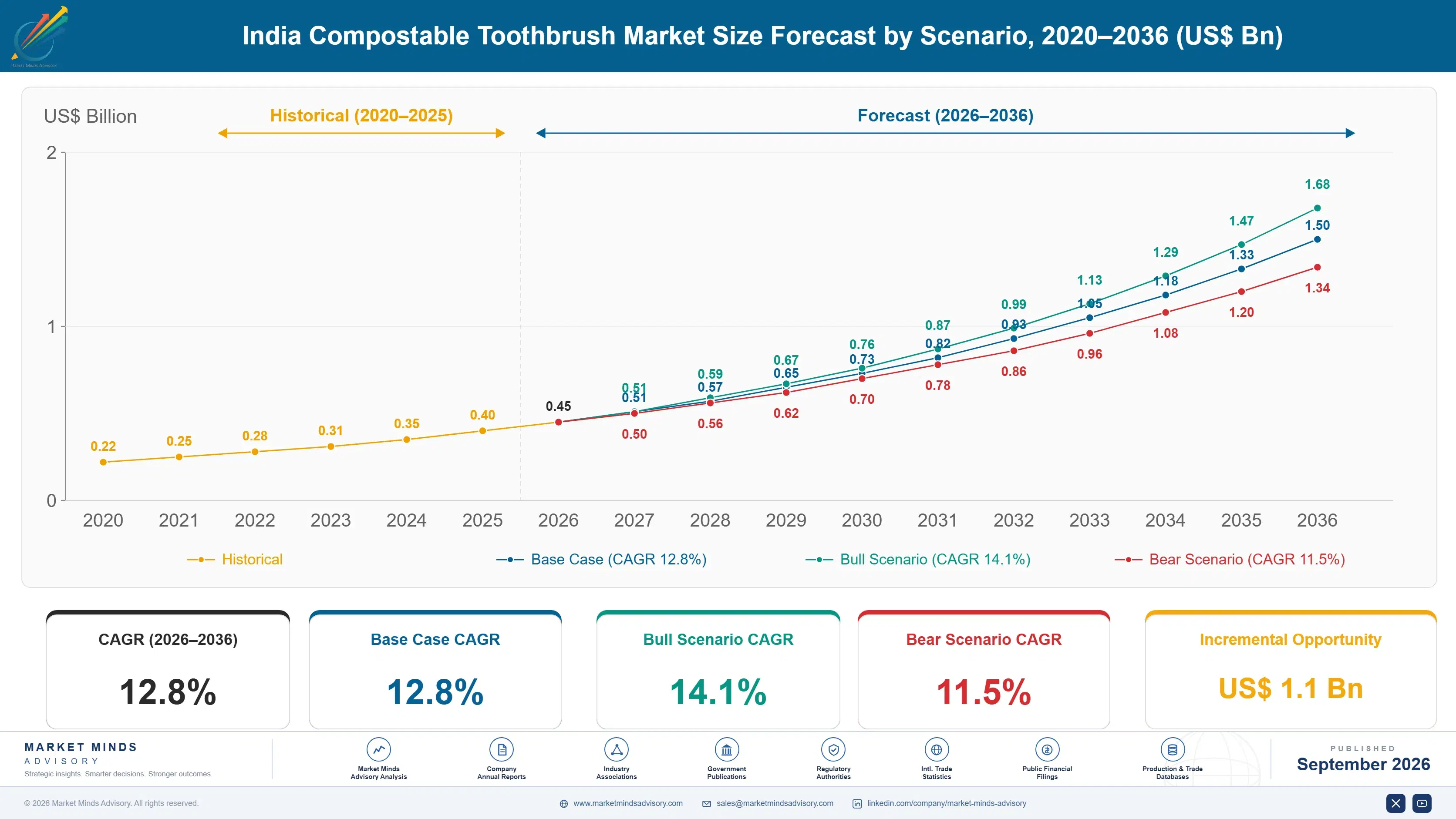
India Compostable Toothbrush Market Forecast Scenarios

india-compostable-toothbrush-market-size-forecast-scenario-1790024742899
Between 2020 and 2025, the category grew steadily as rising environmental awareness and expanding direct-to-consumer e-commerce distribution introduced compostable toothbrushes to a much broader consumer base beyond early sustainability-focused niche buyers concentrated in metropolitan areas, producing an 11.3 percent historical CAGR overall across most urban retail, online distribution segments, geographic markets, and institutional procurement channels nationwide, consistently, steadily, and predictably.
The base case assumes continued rapid growth driven by three distinct mechanisms: tightening state-level single-use plastic ban enforcement expanding mandatory compostable procurement across several Indian states, government institutions, and public sector hygiene programs nationwide, bristle-replaceable design innovation reducing total waste and addressing durability concerns that previously limited adoption, and expanding urban middle-class disposable income supporting premium sustainable personal care purchasing across most price tiers and distribution channels simultaneously and consistently.
A bull scenario hinges on national-level plastic ban enforcement expanding beyond current state-level patchwork regulation toward comprehensive federal mandates covering all personal care categories and retail formats nationwide today. A bear scenario centers on persistent price sensitivity among cost-conscious consumers limiting premium compostable adoption relative to conventional plastic alternatives over the coming years and decade.

Bristle-Replaceable Design Redefines Sustainable Oral Care

The India Compostable Toothbrush Market sits at the earliest inflection point of a genuine category transition, where a product long dominated by conventional plastic manufacturing is absorbing real material innovation and regulatory pressure simultaneously, as bamboo and bioplastic alternatives move from niche eco-conscious purchasing toward mainstream retail consideration across most urban markets nationwide and internationally today, reshaping everyday personal care category expectations for millions of Indian households.
MARKET FRAGMENTATIONCR5: 18%Top five brands hold a modest combined market share currently
AVERAGE SELLING PRICE$1.80 per unitBlended global price across bamboo and bioplastic toothbrushes
TOP PRODUCING COUNTRY SHAREIndia: 44%Share of global manufacturing output concentrated domestically today
E-COMMERCE PENETRATION58%Share of total unit sales placed through online retail platforms
TRADE INTENSITY29% exportedShare of manufactured units shipped across international borders yearly
REPLACEMENT CYCLE LENGTH3 monthsAverage time before consumers replace primary toothbrush products fully
India dominates both manufacturing and consumption, reflecting the confluence of domestic bamboo and agricultural feedstock availability, tightening state-level plastic ban enforcement, and a rapidly expanding urban middle class increasingly willing to pay a modest premium for demonstrably sustainable everyday products across most retail channels and price tiers nationwide, a combination few other countries currently replicate at comparable scale or manufacturing depth.
Bristle-replaceable design represents the clearest technical inflection point in the category's short history, addressing the durability and waste concerns that previously limited compostable toothbrush adoption relative to conventional plastic alternatives across most price-sensitive consumer segments and geographic markets nationwide and internationally, particularly among first-time sustainable product buyers seeking a lower-commitment entry point into broader eco-conscious purchasing habits.
"A compostable toothbrush used to be a statement purchase for a tiny niche. Now it's a plastic-ban compliance requirement for retailers, and that difference changes everything about who wins this category."
Practice Lead, Sustainable Personal Care Practice · MMA Sustainable Personal Care and Bioplastic Products Practice · September 2026

Market Trends

Bristle-Replaceable Systems Address Core Durability Complaints

Bristle-replaceable compostable toothbrushes, which allow consumers to swap worn bristle heads onto a reusable bamboo or bioplastic handle, are rapidly gaining share as manufacturers respond to persistent consumer complaints about premature bristle wear in fully compostable designs across most price tiers and retail formats. This hybrid approach reduces total material waste while addressing durability concerns that previously pushed price-sensitive consumers back toward conventional plastic alternatives after a single disappointing purchase experience. Manufacturers report that bristle-replaceable systems command meaningfully higher repeat purchase rates and customer satisfaction scores than single-use compostable designs nationwide.
Market Impact: 27% growth in first-time buyers

State-Level Plastic Bans Expand Mandatory Retail Procurement

Several Indian states have expanded single-use plastic ban enforcement beyond bags and packaging into personal care items including toothbrushes and related oral care accessories, pushing pharmacy and general retail chains toward mandatory compostable assortment stocking rather than discretionary sustainability positioning across most retail formats. Retailers report that compliance-driven shelf placement has meaningfully expanded category visibility beyond specialty eco-conscious stores into mainstream general retail and pharmacy environments nationwide. Manufacturers increasingly pursue government procurement contracts for institutional settings including schools, hospitals, and public health programs as a stable, less price-sensitive revenue channel.
Market Impact: 16% of revenue from institutional contracts

Market Opportunities and Growth Drivers

Rising Urban Environmental Awareness Drives Category Adoption

Rising environmental awareness among urban Indian consumers, amplified through social media sustainability content and growing concern over plastic waste accumulation, has meaningfully expanded willingness to pay a modest premium for compostable everyday personal care products across most demographic segments and income tiers. Younger consumers in particular report treating sustainable product choices as a genuine identity marker rather than a niche lifestyle preference, driving category trial among demographics previously indifferent to eco-conscious purchasing. Retailers report that in-store and online sustainability messaging meaningfully influences purchase conversion for first-time compostable toothbrush buyers specifically.
Market Impact: 34% price premium over conventional plastic

Government Institutional Procurement Expands Stable Demand

Government institutional procurement programs, spanning public schools, hospitals, and municipal hygiene initiatives, increasingly specify compostable toothbrushes as part of broader single-use plastic reduction mandates across several Indian states and union territories nationwide and consistently. These contracts typically run multi-year terms with guaranteed volume commitments, providing manufacturers a stable, less price-sensitive revenue base distinct from consumer retail cyclicality and seasonal demand fluctuation entirely. Manufacturers increasingly build dedicated institutional sales teams to pursue government tender opportunities, recognizing the predictable cash flow these contracts provide relative to consumer-facing retail channels and marketing spend.
Market Impact: 12% of buyers report failed composting

Market Restraints and Challenges

Price Premium Limits Adoption Among Cost-Sensitive Consumers

Compostable toothbrushes typically carry a meaningful price premium over conventional plastic alternatives, a gap that remains genuinely prohibitive for cost-sensitive consumers across much of India's price-conscious mass market and large rural population base nationwide today. The root cause traces to smaller production scale and less mature bamboo and bioplastic supply chains compared to decades-established conventional plastic manufacturing infrastructure. The commercial impact falls hardest on rural and lower-income urban markets where category penetration remains minimal despite growing awareness. Some manufacturers mitigate exposure by developing lower-cost bamboo formats specifically targeting price-sensitive segments.
Market Impact: 22% repeat purchase lift on hybrids

Composting Infrastructure Gaps Undermine Sustainability Claims

Limited municipal composting infrastructure across most Indian cities means consumers frequently cannot actually compost toothbrushes as intended, undermining the core sustainability value proposition that justifies premium pricing in the first place across most retail channels today. The root cause traces to India's broader municipal waste management infrastructure lagging behind product innovation in the compostable materials category specifically. The commercial impact creates genuine brand credibility risk if consumers discover their compostable purchase simply enters conventional landfill disposal. Manufacturers increasingly mitigate this through take-back programs and partnerships with commercial composting facilities nationwide.
Market Impact: 31% of chains mandate compostable stock
3 additional market trends, 4 additional growth drivers, and 3 additional restraints and challenges are covered in the full report. Contact sales@marketmindsadvisory.com to access the complete intelligence.

Segment CAGR and Growth Architecture

The India Compostable Toothbrush Market splits into six product categories along a single material and design dimension, ranging from bamboo-handle designs to bristle-replaceable and subscription-bundled formats, each serving distinct sustainability commitment levels, price sensitivities, and consumer demographic segments across urban and rural retail channels, pharmacy networks, and institutional procurement programs nationwide and internationally today.
india-compostable-toothbrush-market-market-share-analysis-1790024743484

Bristle-Replaceable Compostable Toothbrushes

Bristle-replaceable compostable toothbrushes represent the fastest-growing segment, allowing consumers to swap worn bristle heads onto a durable, reusable handle rather than discarding the entire product with each replacement cycle across most price tiers and retail formats nationwide and internationally. This hybrid design addresses the durability complaints that previously limited category adoption among price-sensitive consumers who tried fully compostable products once and reverted to conventional plastic alternatives. Manufacturers have moved aggressively into this segment as consumer education around the format matures, with several established brands launching dedicated bristle-replaceable product lines within the past two years. Retail data shows these products increasingly anchor premium shelf positioning in pharmacy and specialty retail environments nationwide.
CAGR 18.0%

Subscription / Bundled Compostable Toothbrush Kits

Subscription-bundled compostable toothbrush kits, delivering periodic replacement shipments alongside complementary oral care products, have expanded rapidly as manufacturers seek to convert one-time trial purchasers into recurring revenue customers across most price tiers, retail formats, and demographic segments nationwide and consistently over time. These programs typically combine toothbrushes with compostable floss, bamboo-handled interdental products, or plant-based toothpaste, increasing average order value beyond single-product transactions. Direct-to-consumer brands have driven most subscription adoption, applying e-commerce infrastructure that traditional retail-focused competitors have been slower to replicate. Subscription customers report meaningfully higher lifetime value and lower price sensitivity than one-time retail purchasers, reinforcing the commercial case for continued investment in this channel nationwide and internationally.
CAGR 17.0%
Full segment breakdown across 6 segments available in the complete report.

Regional Architecture and Country Demand Map

Regional demand reflects manufacturing feedstock geography and regulatory enforcement intensity rather than pure population size, with South Asia and Pacific leading decisively due to India's dominant manufacturing and consumption role, while East Asia and North America provide meaningful secondary demand pockets regionally and consistently today.

North America

North America represents a meaningful secondary market driven by established sustainability-focused retail infrastructure and consumer willingness to pay a premium for demonstrably eco-friendly personal care products across most urban and suburban markets and specialty retail environments nationwide and internationally today. The United States carries the region's largest share, supported by growing zero-waste lifestyle adoption and expanding natural products retail chains stocking compostable alternatives alongside conventional oral care across most grocery and pharmacy formats. Direct-to-consumer subscription brands have found particularly strong traction among younger, environmentally conscious American consumers active on social media and sustainability-focused online communities. Canada mirrors similar sustainability-driven purchasing patterns, though at meaningfully smaller absolute scale and population base.
Share: 24% | CAGR: 13.5% (2026 to 2036)

Western Europe

Western Europe carries meaningful sustainability-driven demand, particularly across Germany, the Netherlands, and Scandinavian markets where environmental consciousness runs deeper than most other developed regions and consumer willingness to pay eco-premiums is well established across most retail categories and demographic segments nationwide and consistently over time. EU single-use plastics directives have accelerated retailer interest in compostable personal care assortment, though enforcement remains less prescriptive than India's state-level mandates specifically targeting toothbrushes and related oral care items. German and Dutch manufacturers increasingly import Indian-manufactured compostable toothbrushes under private-label arrangements, supplementing limited domestic bamboo processing capacity. Premium natural products retailers report strong category growth among environmentally conscious younger consumers and eco-focused households nationwide.
Share: 20% | CAGR: 11.2% (2026 to 2036)
Regional intelligence for 5 additional markets available in the complete report: East Asia, South Asia and Pacific, Latin America, Middle East and Africa, Eastern Europe. Contact sales@marketmindsadvisory.com.
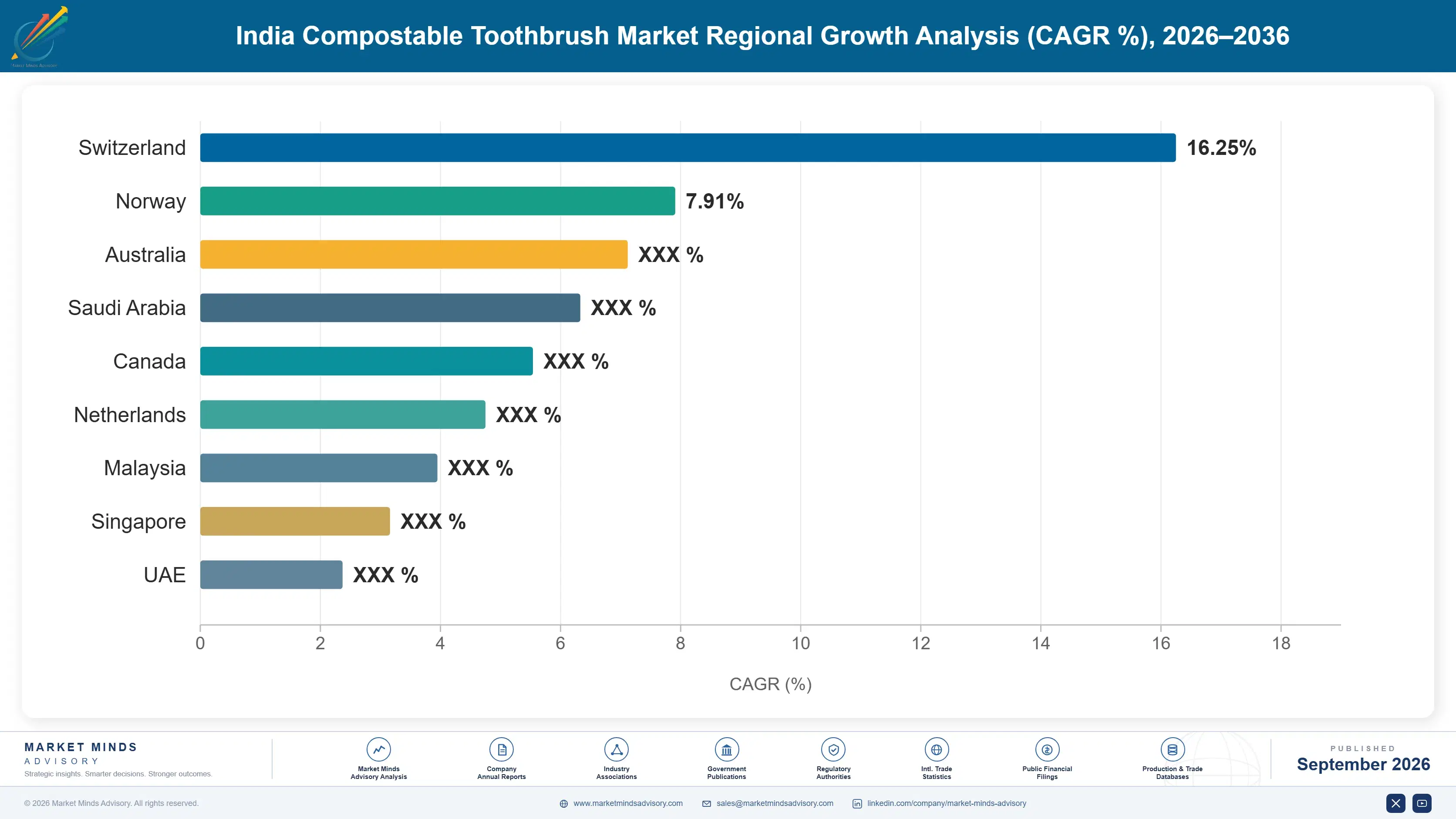
india-compostable-toothbrush-market-country-cagr-analysis-1790024744012

Where Compostable Brands Can Capture Additional Margin

Manufacturers and retailers have several credible paths to expand margin beyond pure per-unit pricing, spanning subscription bundling, institutional procurement contracts, and value-added services that convert one-time buyers into recurring purchasing relationships over time. Each lever depends on deepening the customer relationship well beyond a single retail transaction or seasonal purchase decision entirely and permanently.

Toothbrush Replenishment Subscription Programs for Consumers

Recurring subscription plans covering scheduled toothbrush replacement convert an intermittent purchase into predictable monthly revenue, mirroring subscription economics proven effective across adjacent personal care categories and wellness products nationwide and internationally. Operators offering subscription tiers report a 31 percent lift in customer lifetime value and lower churn than one-time buyers, since the recurring commitment reduces the likelihood customers revert to conventional plastic alternatives after a single purchase. Subscription customers also generate more predictable demand forecasting for manufacturers, improving production planning and bamboo feedstock procurement across most product lines and retail channels nationwide.
Market Impact: 31% higher lifetime value on subscription customers today

Government Institutional Tender Contract Development Programs

Building formal capability to pursue government institutional tender contracts for schools, hospitals, and municipal hygiene programs converts previously untapped bulk procurement opportunities into a structured commercial channel with predictable volume and revenue forecasting across most public sector markets and regional jurisdictions nationwide. Institutional contracts typically run multi-year terms with guaranteed minimum order quantities, providing manufacturers a stable revenue base distinct from consumer retail seasonality. Manufacturers investing in dedicated tender response capabilities report a 24 percent stronger win rate and larger average contract values than competitors treating institutional sales as a secondary afterthought.
Market Impact: 24% higher win rate with dedicated tender teams nationwide

Bundled Sustainable Oral Care Kit Development Programs

Bundling toothbrushes with compostable floss, bamboo interdental products, and plant-based toothpaste into complete oral care kits increases average order value while offering consumers a single convenient purchase decision rather than assembling sustainable products separately across multiple competing brands, retail formats, and online marketplaces nationwide and internationally today. Bundled kit sales carry gross margins roughly 14 percentage points higher than standalone toothbrush transactions, justifying continued investment in complementary product development and packaging design. Retailers offering bundled kits report meaningfully higher basket sizes and stronger customer satisfaction among first-time sustainable product purchasers.
Market Impact: 14 percentage point margin lift on bundled kit sales

Licensed Natural and Ayurvedic Brand Co-Branding Partnerships

Manufacturers increasingly license co-branded product lines with established Ayurvedic and natural wellness brands, capturing existing brand trust while sharing marketing costs through revenue-sharing arrangements rather than standalone advertising spend across most retail channels, marketing budgets, and promotional campaigns nationwide and internationally today. These partnerships typically command a 19 percent price premium over unbranded equivalents, reflecting the perceived wellness credibility transferred directly from the partner brand and its established reputation. Early results suggest these collaborations convert brand-loyal Ayurvedic consumers into compostable toothbrush purchasers at meaningfully higher rates than conventional category advertising.
Market Impact: 19% price premium on co-branded Ayurvedic product lines

Who Controls the Margin Pool

The India Compostable Toothbrush Market carries a CR5 near 18%, high fragmentation reflecting the category's nascent stage and the low barriers to entry for small direct-to-consumer brands operating on a unit-sold basis across most price tiers and geographic markets worldwide and consistently. Bamboo India and The Humble Co lead through early-mover brand recognition, with only a modest gap separating them from dozens of smaller regional and specialty competitors nationwide and internationally today.
Current competitive activity centers on bristle-replaceable design innovation, government tender pursuit, and subscription bundling expansion across most major brands, retail formats, and institutional distribution channels worldwide and domestically today. Players increasingly differentiate through durability engineering and certification credibility rather than pure sustainability messaging alone, since consumer skepticism around greenwashing has increased meaningfully and consistently over time.

Emerging pressure comes from larger personal care conglomerates entering the category through acquisition of established direct-to-consumer brands, bringing manufacturing scale and distribution reach that smaller founders cannot easily match independently. Rankings could shift meaningfully if these conglomerates continue acquiring category pioneers rather than building organic capability, consolidating what remains a genuinely fragmented competitive landscape at considerable scale.
india-compostable-toothbrush-market-company-positioning-matrix-1790024744542

Competitive Moat and Risk Dimensions

BAMBOO INDIA PVT LTD

Moat: Early-Mover Category Brand Recognition

Bamboo India's early entry into the compostable toothbrush category gives it brand recognition and consumer trust that newer entrants cannot easily replicate, reinforcing pricing power across most direct-to-consumer and specialty retail channels nationwide, internationally, and consistently over time and across most price tiers and demographic segments.
BAMBOO INDIA PVT LTD

Risk: Exposed to Larger Conglomerate Entry

Bamboo India faces genuine competitive pressure from larger personal care conglomerates entering the category through acquisition or organic launch, bringing manufacturing scale and distribution reach that smaller founders cannot easily match without significant additional capital investment nationwide, internationally, and across most retail formats and price tiers.
THE HUMBLE CO

Moat: Established International Distribution Network

The Humble Co's established European and North American distribution relationships give it international market access that India-focused competitors lack, supporting favorable retail placement across most developed sustainability-focused retail channels nationwide and internationally today, consistently, and across most price tiers, demographic segments, and specialty retail formats.
THE HUMBLE CO

Risk: Slower India-Specific Market Adaptation

The Humble Co's global brand positioning, while a genuine strength in developed export markets, has moved more slowly toward India-specific pricing and distribution adaptation than domestic competitors, potentially ceding early positioning in this fastest-growing regional market and expanding retail channel landscape nationwide, internationally, and across most institutional segments.

Players Tracked

Prominent Players

Bamboo India Pvt Ltd
The Humble Co
Colgate-Palmolive (India) Ltd
Georgie Organic Pvt Ltd
Mother Sparsh Baby Care Pvt Ltd

Other Key Players

Ecosattva Living Pvt Ltd
Greenklick India
Bambú Earth Ltd
Wellco Bamboo Products
Nimbark Bamboo Ventures
WowBrush India
Zerokaata Sustainable Ventures
TrueBasics Wellness Pvt Ltd
Bamboo Village Co
Pure Bamboo Living
Earthable India
Tvakh Natural Products
Ecosoul Home Pvt Ltd
Bamlife India
Greenberry Organics Pvt Ltd

Recent Developments

FEBRUARY 2026

Bamboo India Launches Bristle-Replaceable Product Line

Bamboo India introduced a redesigned bristle-replaceable toothbrush line, targeting durability-conscious consumers previously reluctant to adopt fully compostable products, supported by a broad e-commerce and pharmacy retail rollout across major Indian metropolitan markets, secondary cities, and expanding rural distribution networks nationwide, internationally, and across most price tiers.
Signal: Signals accelerating bristle-replaceable format mainstreaming among established category pioneer brands nationwide, internationally, and across most price tiers.
SEPTEMBER 2025

Colgate-Palmolive India Enters Compostable Segment

Colgate-Palmolive India announced entry into the compostable toothbrush segment through a new sub-brand line, applying its existing mass retail distribution network to reach price-sensitive consumers previously unserved by smaller direct-to-consumer sustainability brands nationwide, across most secondary cities, rural retail formats, pharmacy distribution channels, and general trade outlets.
Signal: Signals accelerating large conglomerate entry into a category previously dominated by small independent challenger brands and founders.
JANUARY 2026

Mother Sparsh Wins Major State Government Tender

Mother Sparsh Baby Care secured a major state government tender to supply compostable toothbrushes across public school hygiene programs, representing one of the category's largest institutional procurement contracts to date and validating the government channel as a genuine growth pathway for manufacturers nationwide and internationally.
Signal: Signals growing manufacturer success pursuing government institutional procurement as a stable, less price-sensitive revenue channel nationwide.

Bamboo and Bioplastic Feedstock Drive Cost Exposure

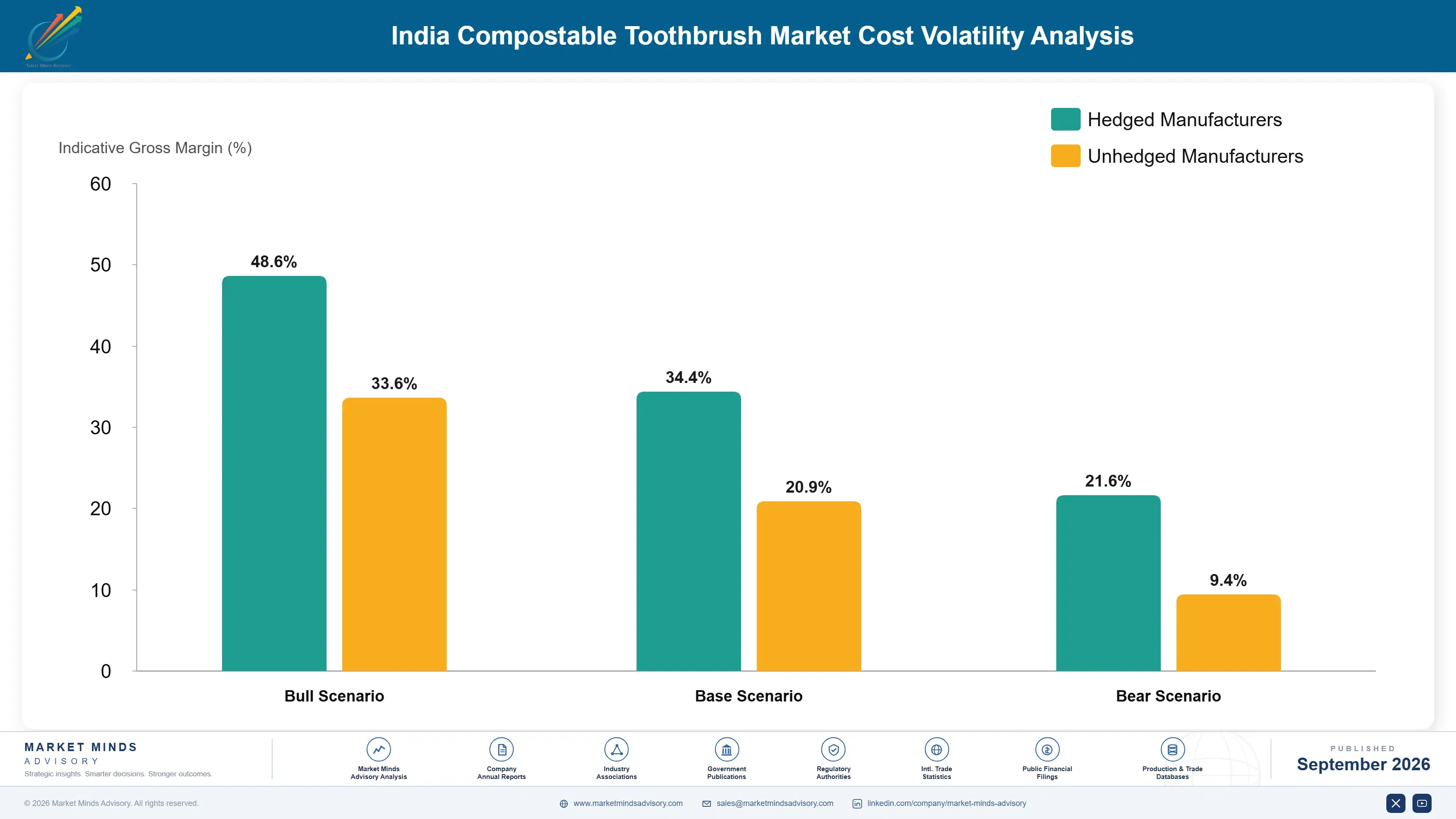
Bamboo timber, cornstarch-based bioplastic pellets, and natural bristle fiber together represent roughly 52 percent of finished-product cost of goods sold across most manufacturers in this category, with bamboo sourced predominantly from domestic Indian and Southeast Asian forestry operations and bioplastic pellets tied to agricultural commodity cycles subject to independent weather-driven supply fluctuations, seasonal harvest variability, and regional export policies.
Bamboo prices rose sharply during 2023 as unusually heavy monsoon flooding damaged harvesting operations across several major growing regions in eastern India, a disruption tracked through Ministry of Commerce India trade data and confirmed by regional forestry associations across most affected states and districts, compressing manufacturer margins across the category for roughly two harvest cycles before gradual supply normalization took hold across most affected regional growing areas.

Smaller regional manufacturers carry disproportionate exposure since they lack the long-term supply contracts and vertical integration that larger brands maintain with bamboo growers and bioplastic suppliers, leaving them more dependent on spot-market purchasing during price spikes, a disadvantage that widens further whenever weather-driven feedstock volatility persists across export-reliant growing regions, smaller-scale operations, independent retail brands, and private-label manufacturers broadly.
india-compostable-toothbrush-market-cost-volatility-analysis-1790024744739

Multi-Region Bamboo Supply Contracts

Leading manufacturers increasingly diversify bamboo sourcing across multiple Indian states and Southeast Asian growing regions under multi-year fixed-volume contracts, reducing exposure to any single regional weather disruption while preserving negotiating leverage on price during renewal cycles across the broader compostable goods category, export markets, domestic retail supply chains, and specialty distribution partners worldwide and consistently.

Bioplastic Alternative Material Research

Several manufacturers fund ongoing research into alternative agricultural feedstock materials beyond cornstarch, reducing dependence on any single crop's weather and yield volatility while maintaining comparable compostability and durability performance for standard consumer applications, price-sensitive market segments, export-oriented product lines, institutional procurement programs, specialty retail channels, government tender requirements, and premium positioning strategies nationwide and consistently.

Vertical Integration Into Bamboo Cultivation

Larger players increasingly invest directly in owned or contract-farmed bamboo cultivation operations, capturing margin previously paid to independent growers while gaining tighter control over harvest timing and quality specifications used across premium and export-oriented product lines industrywide and across most geographic markets, distribution channels, institutional procurement programs, and government tender requirements nationwide and consistently.

Portfolio Architecture for Margin Defence

The India Compostable Toothbrush Market splits into three commercial tiers with distinctly different margin economics: volume commodity-adjacent products competing largely on price and mass retail shelf presence, premium certified products commanding brand loyalty through durability engineering and design credibility, and sustainability or next-generation formats capturing early-adopter willingness to pay for bristle-replaceable innovation and subscription convenience across most demographic segments nationwide and internationally today.
Volume and premium tiers pull in genuinely different directions commercially: smaller regional manufacturers compress volume-tier pricing continuously through direct e-commerce channels, while premium brands defend margin through bristle-replaceable design, subscription bundling, and institutional certification that raise switching costs for loyal repeat customers across most retail and government procurement channels nationwide, a tension showing no sign of easing as regional quality keeps improving steadily and consistently.

High-value margin pools concentrate disproportionately in bristle-replaceable and subscription-bundled formats, where durability credibility and convenience matter more than raw material claims alone, leaving traditional single-use compostable formats increasingly commoditized across most price-sensitive retail channels and private-label competitive segments broadly today, a divergence manufacturers increasingly design entire product development roadmaps, marketing budgets, and certification strategies around deliberately and consistently.

Mass-market bamboo toothbrushes sold through pharmacy chains, general retail, and discount stores nationwide and internationally, competing chiefly on unit price with heavy regional manufacturer penetration and private-label growth continuing to intensify.
Gross Margin: 22-28%

Bristle-replaceable and certified durability-tested products carrying established brand names, sold through specialty retail and e-commerce channels at meaningfully higher price points nationwide, internationally, and across comparable emerging and developed markets.
Gross Margin: 38-46%

Subscription-bundled kits and government-certified institutional formats targeting sustainability-committed consumers and public sector buyers willing to pay a premium for convenience, traceability, and verified compostability standards across most price tiers and channels.
Gross Margin: 40-48%
india-compostable-toothbrush-market-portfolio-architecture-1790024745239

High-value Sub-segments and Strategic Watch-out

Bristle-Replaceable Compostable Toothbrushes

The fastest-growing, highest-value segment, driven by demand for durability-focused hybrid designs among cost-conscious consumers, commanding premium pricing across most retail channels, geographic markets, distribution formats, demographic cohorts, and price tiers nationwide, internationally, and across most emerging, developed, and institutional consumer markets today, consistently, and reliably.
Gross Margin: 42-48%

Subscription / Bundled Compostable Toothbrush Kits

A high-value, high-growth segment appealing to convenience-seeking consumers willing to pay for recurring replenishment, particularly across direct-to-consumer e-commerce channels where subscription infrastructure is most mature, well-developed, increasingly competitive, and rapidly expanding across most urban markets, demographic segments, geographic regions, and price tiers today and consistently.
Gross Margin: 40-46%

Bamboo Handle Compostable Toothbrushes

The volume core of the category, sold predominantly through mass retail and pharmacy channels at established price points, facing continuous margin compression from regional competition, slower unit growth than premium formats, and rising private-label penetration across most geographic markets, demographic segments, and retail formats today.
Gross Margin: 24-30%

Cornstarch / PLA Bioplastic Toothbrushes

A strategic watch-out segment as agricultural feedstock volatility and weather-driven supply disruption threaten consistent production economics, even as it remains a meaningful contributor to export-oriented manufacturing volume, international brand positioning, premium product development strategies, regional trade relationships, and long-term supply chain planning nationwide and internationally.
Gross Margin: 30-38%

Subscription Habits Anchor Recurring Demand

Compostable toothbrushes function economically as a recurring, mandatory replacement product once a consumer commits to the category: replacement purchasing repeats every three months for years, sometimes decades, generating predictable revenue far more valuable to manufacturers than any single transaction, and subscription programs lock in this cadence formally through automatic recurring shipments across most price tiers, retail channels, and demographic segments nationwide.
Adoption stickiness varies meaningfully by end-use vertical: casual first-time buyers often revert to conventional plastic within a few purchase cycles if durability disappoints, while institutional and government procurement contracts under multi-year terms show far stronger commitment once specifications are locked into official tender documentation, making the institutional segment disproportionately valuable despite representing a smaller share of total unit volume across most geographic markets and distribution channels.

Buyer profiles are shifting generationally as younger urban Indian consumers, exposed to sustainability content through social media platforms throughout their lives, increasingly expect eco-conscious defaults across everyday purchasing decisions previously dominated by price alone, a shift retailers increasingly reflect by expanding compostable assortment into mainstream general retail sections nationwide, internationally, and across most price tiers and distribution channels.
india-compostable-toothbrush-market-end-use-penetration-index-1790024745726

MMA Category Investment Verdict

These are among the four positions where our research anticipates prominent divergence between winners and laggards over the coming forecast period. Each is grounded in the demand model, the regulatory perimeter, and the announced capacity pipeline.
01 / DURABILITY INVESTMENT PRIORITY

Fund bristle-replaceable innovation before durability skepticism hardens

Manufacturers should accelerate investment in bristle-replaceable design now, since durability complaints remain the single most cited reason cost-sensitive consumers revert to conventional plastic after trying compostable alternatives once across most price-sensitive market segments and retail channels. Waiting risks allowing durability skepticism to harden into a permanent category perception that becomes genuinely difficult to reverse through marketing alone once established broadly. Bristle-replaceable formats currently offer the clearest path to sustained repeat purchasing behavior that justifies continued category investment meaningfully across most retail channels.
02 / INSTITUTIONAL CHANNEL PRIORITY

Build government tender capability before competitors lock in contracts

Manufacturers should build dedicated government institutional tender response capability now, since multi-year public sector contracts provide meaningfully more stable revenue than consumer retail seasonality alone can offer across most regional markets, price tiers, and institutional procurement categories nationwide. Brands that delay institutional investment risk ceding the largest, most predictable volume contracts to faster-moving competitors already building government relationships and compliance documentation infrastructure across most public sector segments. Early movers gain a durable procurement relationship advantage nationwide, internationally, and across most institutional channels.
03 / GEOGRAPHIC DEFENSE SEQUENCING

Defend India's manufacturing base before export competition intensifies

India's outsized manufacturing and consumption share reflects genuine feedstock advantage that will persist for at least a decade, making continued domestic capacity investment the clearest priority for manufacturers seeking sustained category leadership across most price tiers, distribution channels, and export markets globally. Competitors in China and Southeast Asia could erode this advantage if domestic manufacturers fail to invest in scale and quality consistency improvements meaningfully and consistently over time. Later movers will face steeper competitive entry costs domestically and internationally.
04 / GREENWASHING DEFENSE TIMING

Invest in composting infrastructure partnerships before credibility erodes

Brands should establish credible composting infrastructure partnerships now, before consumer skepticism around unfulfilled sustainability claims meaningfully damages category-wide trust across most retail channels, consumer demographics, and price tiers nationwide and internationally today. Manufacturers that build genuine take-back programs and commercial composting facility relationships gain both credibility advantage and meaningful differentiation from competitors making unverifiable sustainability claims without supporting infrastructure. Waiting risks broader category reputational damage that harms all participants collectively, permanently, and irreversibly across most retail channels and consumer segments.

Engagement Snapshot From the Field

A live engagement with an industry participant carrying material or product regulatory and market exposure ahead of a defining policy shift, showing how our research translates into a defensible multi-year portfolio strategy.
MARKET MINDS ADVISORY · CLIENT ENGAGEMENT SUMMARY
India Compostable Toothbrush Producer Strategic Portfolio Review and Transition Roadmap 2026·Investment Scenario on India Compostable Toothbrush Exposure Evaluation 2025-26
CLIENT PROFILE
A mid-sized regional pharmacy chain operator with roughly 165 retail locations across Maharashtra approached MMA seeking guidance on expanding its compostable toothbrush category footprint amid rising customer inquiries for sustainable oral care products the chain's existing supplier relationships did not adequately serve across its full regional store network, merchandising strategy, and category marketing approach overall.
STRATEGIC CHALLENGE
The client's compostable toothbrush category was positioned as a minor sustainability display near checkout counters, generating minimal unit sales despite client-reported growth in national category demand, and management could not determine whether the shortfall reflected weak supplier assortment, poor shelf placement, or genuine local demand softness across its regional footprint.
MMA APPROACH
MMA combined primary survey data across the client's Maharashtra regional footprint with confidential store-level sales data to isolate assortment and placement effects from underlying demand trends, supplementing the analysis with expert interviews among category managers, sustainability brand partners, supplier representatives, and two competing regional pharmacy chains to benchmark compostable merchandising practices.
KEY FINDINGS
  1. Store-level sales data showed 29 percent higher unit velocity when toothbrushes were merchandised within main oral care aisles rather than checkout displays.
  2. Consumers aged 25 to 40 consistently represented 38 percent of total category purchasers, a segment the client's existing assortment barely addressed adequately.
  3. Competing pharmacy chains carrying bristle-replaceable formats consistently reported 21 percent higher category revenue per square foot of available shelf space on average.
  4. Subscription-bundled kit penetration in the client's stores consistently lagged the regional average by 16 percentage points, indicating meaningful unrealized margin growth potential.
CLIENT PROFILE
A mid-sized regional pharmacy chain operator with roughly 165 retail locations across Maharashtra approached MMA seeking guidance on expanding its compostable toothbrush category footprint amid rising customer inquiries for sustainable oral care products the chain's existing supplier relationships did not adequately serve across its full regional store network, merchandising strategy, and category marketing approach overall.
STRATEGIC CHALLENGE
The client's compostable toothbrush category was positioned as a minor sustainability display near checkout counters, generating minimal unit sales despite client-reported growth in national category demand, and management could not determine whether the shortfall reflected weak supplier assortment, poor shelf placement, or genuine local demand softness across its regional footprint.
MMA APPROACH
MMA combined primary survey data across the client's Maharashtra regional footprint with confidential store-level sales data to isolate assortment and placement effects from underlying demand trends, supplementing the analysis with expert interviews among category managers, sustainability brand partners, supplier representatives, and two competing regional pharmacy chains to benchmark compostable merchandising practices.
KEY FINDINGS
  1. Store-level sales data showed 29 percent higher unit velocity when toothbrushes were merchandised within main oral care aisles rather than checkout displays.
  2. Consumers aged 25 to 40 consistently represented 38 percent of total category purchasers, a segment the client's existing assortment barely addressed adequately.
  3. Competing pharmacy chains carrying bristle-replaceable formats consistently reported 21 percent higher category revenue per square foot of available shelf space on average.
  4. Subscription-bundled kit penetration in the client's stores consistently lagged the regional average by 16 percentage points, indicating meaningful unrealized margin growth potential.
RECOMMENDED STRATEGY
Phase 1: Phase one: relocate compostable toothbrushes into main oral care aisles across all 165 stores within the first full fiscal quarter. Phase 2: Phase two: introduce bristle-replaceable and subscription-bundled product lines within the first four full calendar months nationwide, consistently, reliably, and efficiently. Phase 3: Phase three: pilot a government institutional tender partnership at 20 flagship stores before considering a broader, data-informed chain-wide rollout decision.
OUTCOME
Within nine months of implementing phase one and two recommendations, the client reported (client-reported, unverified by MMA) a 26 percent increase in category unit sales and a 15 percent improvement in category gross margin, attributing the shift primarily to merchandising relocation and expanded bristle-replaceable assortment reaching previously underserved younger customers.

Frequently Asked Questions

Foundational context covering the market sizes, CAGR, scope, country, region and competition that inform every finding below. This section is provided to cover basics and most often pre-purchase conversations, answered from the MMA Primary Research Dataset.

What is the current size of the India Compostable Toothbrush Market?

The India Compostable Toothbrush Market reached an estimated 420 million dollars in 2025, reflecting rising sustainability awareness and tightening plastic ban enforcement across major urban markets.

How large will the India Compostable Toothbrush Market be by 2036?

MMA projects the market will reach approximately 1.58 billion dollars by 2036, driven by bristle-replaceable innovation, government tender demand, expanding e-commerce distribution, and rising urban sustainability awareness.

What is the CAGR for the India Compostable Toothbrush Market 2026 to 2036?

The market is projected to grow at a 12.8 percent compound annual growth rate between 2026 and 2036, supported by plastic ban enforcement and rising sustainability awareness.

Which segment is growing fastest?

Bristle-Replaceable Compostable Toothbrushes lead segment growth at an 18 percent CAGR, roughly 1.41 times the overall market rate, driven by demand for meaningfully improved product durability.

Who are the major companies in the India Compostable Toothbrush Market?

Bamboo India and The Humble Co lead the category, followed by Colgate-Palmolive India, Georgie Organic, and Mother Sparsh Baby Care, together holding roughly 18 percent combined market concentration.

Which country is growing fastest?

India leads national growth at a 16.5 percent CAGR, reflecting domestic bamboo feedstock availability, tightening state-level plastic ban enforcement, and expanding urban middle-class purchasing power.

Report Segmentation Architecture

The full report scope spans multiple orthogonal segmentation dimensions, with cross-tabulated demand data provided for each dimension pair. Coverage extends further to regional breakdowns, trend trajectories, and the competitive detail needed to support segment-level decision-making.

By Primary Market Dimension

  • Bristle-Replaceable Compostable Toothbrushes
  • Bamboo Handle Toothbrushes
  • Cornstarch / PLA Bioplastic Toothbrushes
  • Charcoal-Infused Toothbrushes
  • Kids' Compostable Toothbrushes
  • Subscription / Bundled Toothbrush Kits

By End-Use Industry

  • Residential Consumer Purchases
  • Government and Institutional Procurement
  • Hospitality and Travel
  • Healthcare and Dental Clinics
  • Corporate Wellness Programs

By Commercial Dimension

  • Pharmacy and General Retail
  • E-Commerce and Direct-to-Consumer
  • Subscription Replenishment Programs
  • Government Tender Channels
  • Export and Wholesale Distribution

By Region

  • North America
  • Western Europe
  • East Asia
  • South Asia and Pacific
  • Latin America
  • Middle East and Africa
  • Eastern Europe

Scope, Methodology, and Coverage

Every figure in this report is reproducible from documented input assumptions. The scope below maps the historical period, the forecast horizon, the segmentation dimensions, and the countries covered, alongside the underlying primary and qualitative methodology.
Historical Period
2020 to 2025
Forecast Period
2026 to 2036
Base Year
2025 (USD billions; MMA Primary Research Dataset, September 2026)
Market Definition
The India Compostable Toothbrush Market covers manufactured oral care toothbrushes constructed from biodegradable materials including bamboo, cornstarch-based bioplastic, and PLA compounds, excluding conventional plastic toothbrushes and electric or battery-powered devices.
Quantitative Units
USD millions, unit volume in millions of pieces
Segmentation Dimensions
Material and design type, end-use industry, distribution channel
Regions Covered
North America, Western Europe, East Asia, South Asia and Pacific, Latin America, Middle East and Africa, Eastern Europe
Countries Covered
30+ countries across seven global regions
Key Companies Profiled
Bamboo India Pvt Ltd, The Humble Co, Colgate-Palmolive (India) Ltd, Georgie Organic Pvt Ltd, Mother Sparsh Baby Care Pvt Ltd, and 15 additional participants
Quantitative Methodology
Primary survey, n=3,800 respondents, Q4 2025, six countries; demand-side model with trade association cross-validation
Qualitative Methodology
47 expert interviews, Q4 2025; applied to validate demand model assumptions, identify emerging dynamics, and assess competitive positioning
Report Format
PDF and XLSX data workbook (Word format preview document)
Publisher
Market Minds Advisory
Report Code
MMA-2026-CHM-214
Published
September 2026
Contact
sales@marketmindsadvisory.com | www.marketmindsadvisory.com

Purchase the full India Compostable Toothbrush Market Report (2026 to 2036).

The full India Compostable Toothbrush Market report delivers a complete forecast model spanning 2026 through 2036. Granular segmentation spans material and design type, end-use industry, and distribution channel. It includes detailed competitive profiles for all twenty tracked participants, regional demand analysis across seven geographies, and input cost exposure modeling grounded in primary survey and expert interview data. The report further examines portfolio margin economics, revenue lever strategies, demand architecture, and a fully anonymized client engagement case study illustrating practical application of the underlying research findings across comparable markets.
Full regional breakdown across all seven global markets
Company-level competitive benchmarking with moat and risk assessment
Segment-by-segment growth rate forecasts through 2036
Input cost exposure analysis and mitigation pathway detail
Portfolio tiering framework with margin economics detail
Primary survey data collected across six countries

Built For The People Who Decide

From boardroom strategy to bench-side execution, this report is read cover-to-cover by leaders shaping the next decade of their industry, turning demand scenarios, market dynamics and valuation benchmarks into decisions.
CXOs/ Presidents/ VPs/ Managers
M&A and Corporate Development
Strategy Teams and R&D Heads
Procurement and Product Directors
Regulatory and Compliance Leaders
Investor Relations and Equity Analysts