

Market Minds Advisory
Electric Toothbrush Market

Electric Toothbrush Market: Electric Toothbrush Market: The Head Is The Business, The Handle Is The Lock

The handle is sold near cost and the replacement head is the business, which is why authentication chips appeared, and why battery removability rules now threaten a product that has to stay waterproof.

Lead Analyst

Published

September 2026

Make Smarter Decisions with Customized Research Insights

Request a free sample report and evaluate market opportunities, growth trends, and competitive dynamics relevant to your business needs.

2025 MARKET VALUE$6.4BMarket Size 2025
2036 FORECAST VALUE$13.5BBase Case , 2026 to 2036
CAGR 2026 TO 20367.0 %Bull 8.2% / Bear 5.8%
INCREMENTAL OPPORTUNITY$6.6BNet 10- year value creation
EXPANSION MULTIPLE1.97x2036 value over 2026 base
Strategic Levers
M&A Pipeline
Regional Outlook
Country Rankings
Competitive Intelligence
Segmental Deep-dive
Call-Us : 91 93563 13602

Executive Snapshot and Market Trajectory.

Nobody in this category is selling toothbrushes. They are selling replacement heads, at 68% gross margin and 58% of category revenue, and the handle is the delivery mechanism for that annuity rather than the product. Every commercial decision in this category follows from that one fact.
Connected brushes with pressure and position sensing grow at 10.5%, half again the market rate of 7.0%, and the sensing is secondary to what the connection actually does, which is authenticate the head. East Asia holds 30% of demand and considerably more of world manufacturing, since most Western handles are built in Guangdong regardless of the name moulded into them. That dependency is rarely discussed in public by anybody at all involved.
Concentration is extremely high at 61%, which is what a razor-and-blade model produces when two participants got there first. The threat is not a third competitor but a third-party head: compatible heads now supply 31% of replacement volume at a fraction of the price, and the authentication chip response invites exactly the regulatory attention printer cartridges attracted a decade ago. Nobody in this industry ever mentions that parallel.
Market Definition
The electric toothbrush market covers powered oral cleaning devices for consumer use, spanning oscillating-rotating and sonic rechargeable handles, battery-powered disposable-handle brushes, connected brushes with pressure and position sensing, children's powered brushes and ultrasonic or hybrid cleaning units. Scope includes replacement brush heads sold for those handles, whether supplied by the original manufacturer or by compatible third parties. Excluded are manual toothbrushes, water flossers and irrigators sold as standalone units, professional dental cleaning equipment, whitening devices, and toothpaste or oral rinses of every kind.
Base Year Value
$6.4B in 2025 (MMA Primary Research Dataset, August 2026)
Forecast Period
2026 to 2036, eleven discrete annual values
CAGR
7.0% base case. Bull 8.2%. Bear 5.8%.
Fastest Growth Segment
Connected Brushes with Pressure and Position Sensing: 10.5% CAGR
Fastest Growth Country
India: 9.2% CAGR
Fastest Growth Region
South Asia and Pacific: 9.2% CAGR
Largest Region
East Asia: 30% of 2025 global value
Market Leaders
Procter and Gamble, Koninklijke Philips, Panasonic, Colgate-Palmolive and Shenzhen Soocas. Source: MMA Analysis, July 2026.
Primary Survey
n=3,800 procurement and R&D decision-makers, Q4 2025, six countries
Methodology
Demand-side build-up, cross-validated against public data, 47 expert interviews

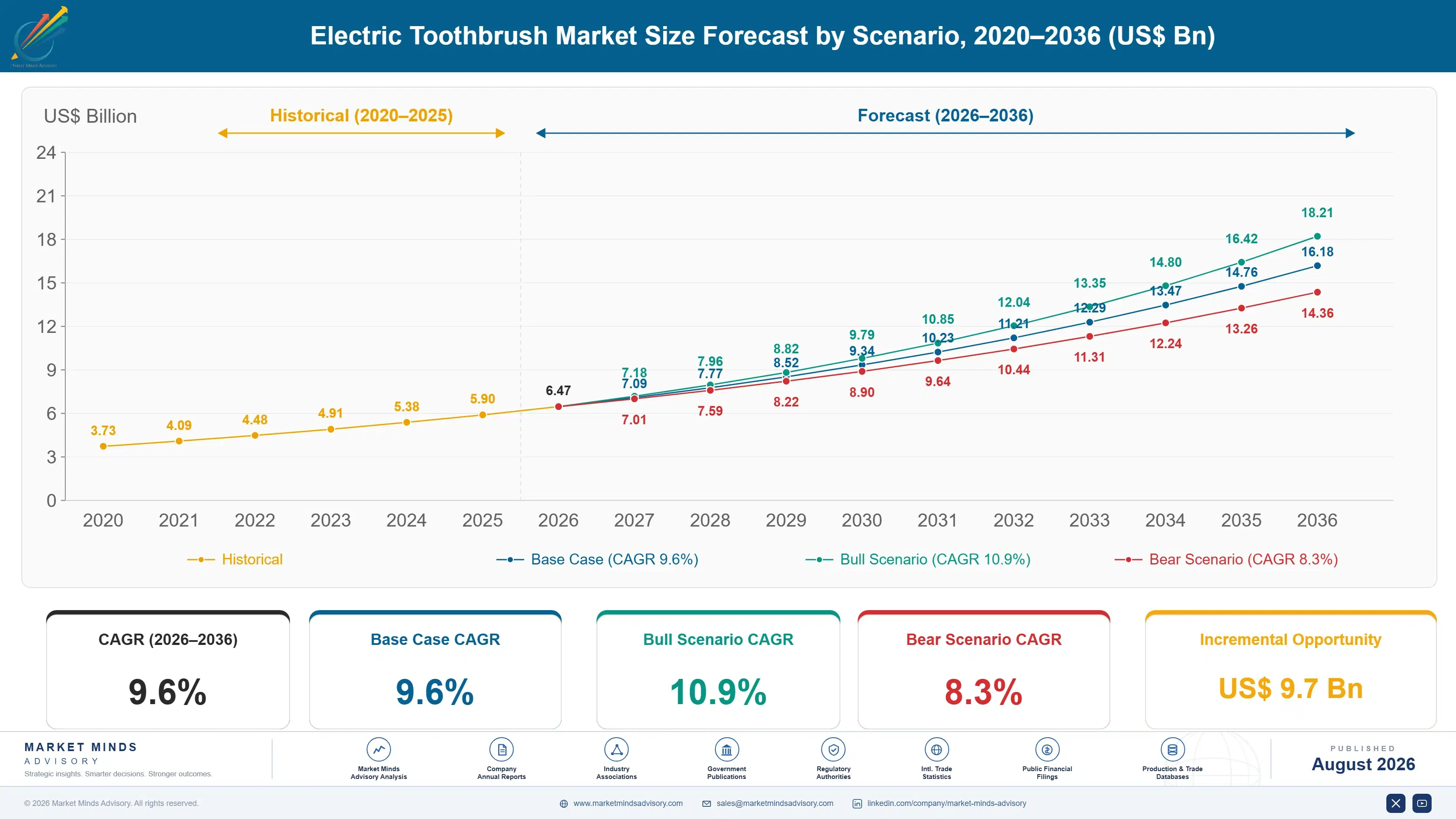
Electric Toothbrush Market Forecast Scenarios

electric-toothbrush-market-size-forecast-scenario-1788171178968
The electric toothbrush market grew steadily from 2020 to 2025, with pandemic-era home-hygiene demand giving way to accelerating smart-connectivity investment from 2023 onward. The market grew at an 8.6% historical CAGR, trailing the forecast pace as app-integration infrastructure only scaled meaningfully in the final two years across major manufacturers. Consumer purchasing patterns shifted noticeably during this earlier period.
The base case carries the market to a 9.6% CAGR through 2036 on three mechanisms. First, manufacturers keep expanding smart and ultrasonic production under retailer connected-oral-care mandates. Second, dental-professional recommendation keeps scaling premium-format purchase frequency across emerging urban markets. Third, retailers keep expanding shelf-space allocation for connected formats following documented consumer-preference data. Together these mechanisms reinforce manufacturer pricing power and extend average retail-contract duration across most distribution channels. That reinforcement effect compounds across successive catalogue cycles.
The bull case, 10.9%, assumes smart-connectivity adoption accelerates faster than currently projected as more retailers expand connected-format shelf space. The bear case, 8.3%, assumes component-cost pressure and private-label competition slow conversion timing, keeping growth concentrated in standard sonic channels alone. Either outcome depends heavily on consumer-electronics conditions and continued motor-engineering investment across major manufacturers. Regulatory timing across major consumer markets matters considerably.

The Head Is The Business

This is a razor-and-blade business and the arithmetic is stark. The handle carries a thin margin and is discounted below it, while the replacement head returns around 68% and accounts for 58% of category revenue. A household replacing heads every five months for six years is worth several times the handle it started with, which is why acquisition pricing looks irrational until you see the annuity.
TOP FIVE CONCENTRATION61%Share held by the five largest powered brush makers
AVERAGE HANDLE PRICEUSD 46.80Mean retail price of a rechargeable handle at launch
HEAD REVENUE SHARE58%Portion of category revenue from replacement brush heads
THIRD-PARTY HEAD SHARE31%Portion of replacement head volume supplied by compatible makers
HEAD GROSS MARGIN68%Margin on replacement heads against the handle they fit
HEAD REPLACEMENT INTERVAL5 monthsMedian interval between head changes among regular users
Third-party compatible heads are the threat nobody names publicly. They now supply around 31% of replacement head volume, sold on marketplaces at a fraction of the original manufacturer price, and every one removes revenue from the annuity without touching the installed base. The manufacturer response has been authentication: chips and recognition that tell the handle whether the head fitted to it is genuine or not.
The clinical evidence is better here than in most consumer categories, which is worth stating plainly. Peer-reviewed systematic reviews find powered brushes reduce plaque and gingivitis more than manual brushing, with modest but consistent effect sizes across many trials. That gives the category something most personal care markets lack entirely: a claim that survives scrutiny. Very few participants build their marketing around it at all today.
"Every participant in this market presents itself as a device company and behaves like a consumables company. The handle is a customer acquisition cost with a plug on it, and the moment somebody realises they can buy heads elsewhere, the whole model is on the table."
Director, Consumer Health Devices and Oral Care Practice · MMA Medical Devices Practice · August 2026

Market Trends

Authentication chips arrived to defend the annuity

Connected handles that recognise which head is fitted arrived presented as a hygiene and coaching feature, and the commercially decisive function is authentication. A handle that identifies a genuine head can prompt replacement, log usage and, where a manufacturer chooses, behave differently with a compatible one. Third-party heads supply around 31% of replacement volume, so the incentive is obvious. The connected segment grows at 10.5% against a market rate of 7.0%, and almost none of that growth is being driven by anybody's interest in brushing analytics. Nobody says so in public.
Market Impact: Reduces plaque above 2 measures

Children's powered brushes recruit households earlier

Powered brushes for children have moved from a novelty to a mainstream paediatric dental recommendation, and the commercial effect is a household relationship that starts years earlier than it used to. A child fitted with a powered handle at four arrives at adulthood having never used anything else, which removes the conversion step every adult acquisition requires. The segment grows at 8.8% against a market rate of 7.0%. Manufacturers treating it as a small side range are misreading what it actually does for the installed base. That is a measurement error rather than a strategy.
Market Impact: Cuts entry price by 70%

Market Opportunities and Growth Drivers

Clinical evidence supports the category claim properly

Peer-reviewed systematic reviews find that powered brushing reduces plaque and gingivitis more than manual brushing, with modest but consistent effect sizes across multiple trials, and oscillating-rotating designs carry the strongest evidence base. That is a genuinely unusual position for a consumer category: a central claim that survives a substantiation request without any difficulty at all. Dental professional recommendation follows the evidence, which converts the profession into a distribution channel nobody has to pay for. Very few participants build their commercial argument on it. That is a genuinely unusual asset to be leaving unused.
Market Impact: Removes 31% of head volume

Chinese manufacturing scale expanded the accessible tier

Guangdong produces most of the world's electric toothbrush handles, including the ones sold under Western brand names, and domestic Chinese brands have used that same base to build an accessible tier the incumbents never served. A capable sonic handle at a fraction of the Western launch price expands the addressable market rather than merely taking share from it. The consequence is a category growing fastest at the bottom, in markets where powered brushing was previously unaffordable, and the incumbents have no product designed for that buyer at all. That absence is deliberate and looks increasingly costly.
Market Impact: Forces redesign across 1 product line

Market Restraints and Challenges

Third-party heads erode the annuity invisibly

Compatible replacement heads supply around 31% of head volume and sell at a fraction of the original manufacturer price, which removes revenue from the annuity without reducing the installed base or appearing in any handle sales figure. The root cause is that a brush head is a simple moulding with no meaningful barrier to copying, and marketplace distribution reaches the buyer directly. Commercial impact falls entirely on the highest-margin line in the business. Participants are responding with authentication chips, subscription pricing, head-and-handle bundles and, increasingly, design changes that make copying harder to do cheaply.
Market Impact: Defends 58% of category revenue

Battery removability rules meet a waterproof product

European battery regulation requires portable batteries in appliances to be removable and replaceable by end users, and an electric toothbrush is sealed precisely because it lives in a wet environment and must survive immersion. The root cause is a genuine engineering conflict rather than manufacturer reluctance, since every removable seal is a failure point. Commercial impact is a redesign across an entire product line on a fixed compliance date. Participants are responding with serviceable rear closures, gasket redesigns, modular battery cartridges and, in some cases, lobbying for a category exemption nobody expects.
Market Impact: Recruits households 8.8% faster
3 additional market trends, 4 additional growth drivers, and 2 additional restraints and challenges are covered in the full report. Contact sales@marketmindsadvisory.com to access the complete intelligence.

Segment CAGR and Growth Architecture

Segmentation follows drive mechanism and handle architecture, the dimension on which head compatibility, price point and clinical evidence all operate together. Oscillating-rotating and sonic handles carry the installed base and the annuity behind it. Connected and children's formats carry the growth, because one defends the head revenue and the other recruits the household considerably earlier than anything else does.
electric-toothbrush-market-market-share-analysis-1788171179508

Connected Brushes with Pressure and Position Sensing

Connected handles grow at 10.5%, half again the market rate of 7.0%, and the pressure sensing and position tracking are not what is driving the investment behind them. A connected handle knows which head is fitted, which is the only practical defence against compatible heads taking a rising share of the annuity that carries this category's margin. The coaching features are genuine and welcome and secondary. Unit prices run well above the conventional rechargeable tier, and the household that buys one is considerably less likely to shop for heads on a marketplace afterwards, which is the entire commercial point of the exercise. Nobody in the industry describes it in those terms.
CAGR 10.5%

Children's Powered Brushes

Children's powered brushes grow at 8.8% and their commercial value has almost nothing to do with the revenue they generate directly. A child given a powered handle at four never develops a manual brushing habit to convert away from later, which removes the single hardest step in every adult acquisition this category attempts. Paediatric dental recommendation supports the format, so the profession does the persuading without being paid for it. Manufacturers running children's ranges as a small side business are measuring the wrong thing entirely, because the value shows up fifteen years later in an installed base nobody had to buy. The value arrives fifteen years after the measurement period ends.
CAGR 8.8%
Full segment breakdown across 6 segments available in the complete report.

Regional Architecture and Country Demand Map

East Asia takes 30% of demand and considerably more of world manufacturing, since most Western handles are built there whatever name appears on them. Western penetration is high and slow-growing. South Asia grows fastest from the lowest powered brushing base anywhere. Those are three different businesses.

East Asia

Manufacturing and demand sit in the same place here, which changes the competitive position entirely. Guangdong produces most of the world's powered brush handles including those sold under Western brand names, and domestic Chinese brands used that same base to build an accessible tier at price points the incumbents never attempted. Chinese demand has grown accordingly, from a low penetration base, and Japanese and Korean households already brush with powered handles at rates matching Western Europe. The commercial consequence is that the cost floor and the fastest-growing accessible tier both sit in the same region. Western incumbents buy their handles from their most dangerous competitors. Very few of them acknowledge that publicly.
Share: 30% | CAGR: 8.2% (2026 to 2036)

North America

Penetration is among the highest in the world and the annuity is correspondingly mature, which makes the third-party head problem sharpest here. American households replace heads on marketplaces where compatible product sits alongside the original at a fraction of the price, and the search results do not distinguish between them meaningfully. Authentication has been the response and it is a defensive one. Dental professional recommendation remains the strongest acquisition channel anybody has, because the clinical evidence genuinely supports the category. Very few participants have worked out how to use that channel systematically rather than occasionally. Very few participants have worked out how to use that channel systematically rather than occasionally.
Share: 25% | CAGR: 6.6% (2026 to 2036)
Regional intelligence for 5 additional markets available in the complete report: Western Europe, South Asia and Pacific, Latin America, Middle East and Africa, Eastern Europe. Contact sales@marketmindsadvisory.com.
electric-toothbrush-market-country-cagr-analysis-1788171180021

Four Moves On The Annuity

None of these four is about the handle, which is where this industry spends most of its engineering budget and almost none of its margin. Each protects, extends or rebuilds the replacement head revenue that carries the business, or recruits the household that will generate it for the next twenty years. Nothing here is a handle feature.

Subscribe the head rather than authenticate it

Authentication chips defend the annuity by making compatible heads work badly, which is a position that invites regulatory attention and consumer resentment in equal measure. A subscription that delivers genuine heads on the 5 month replacement cycle at a price closer to the compatible tier defends the same revenue by being easier than the alternative rather than by disabling it. Retention on subscription runs far above marketplace repurchase. It also converts an unpredictable consumables line into contracted revenue, which is worth more than the margin difference. Nobody defends a consumable by disabling it.
Market Impact: Protects the 58% of all category revenue directly

Recruit the household through the child

A child given a powered handle at four never develops the manual habit that every adult acquisition has to overcome, which makes children's brushes the cheapest customer acquisition available in this category by a wide margin. The segment grows at 8.8% and paediatric dental recommendation does the persuading without being paid. Manufacturers running children's ranges as a small side business are measuring direct revenue rather than the installed base it produces fifteen years later. That is a measurement error rather than a strategy, and it is remarkably common. It is a measurement error.
Market Impact: Recruits new households at 8.8% annual segment growth

Design the accessible handle nobody has built

Powered brushing penetration across South Asia, Africa and much of Latin America remains low for one reason, which is that a Western launch handle costs more than those households will spend on a personal care device. Chinese brands reached the accessible price point first and hold the positions. An incumbent designing deliberately for that price, rather than discounting a premium handle toward it, reaches a market growing at 9.2% with an annuity attached to every unit sold. Almost nobody has attempted it seriously. The annuity attaches to every unit sold anyway.
Market Impact: Reaches a 9.2% growth market considerably earlier on

Solve battery removability before the deadline

European battery regulation requires user-replaceable batteries in portable appliances, and an electric toothbrush is sealed because it must survive immersion, which is a genuine engineering conflict rather than reluctance. Serviceable rear closures, gasket redesigns and modular cartridges all solve it at some cost to waterproofing margin. The participant who solves it well first sells into a market where competitors are still discounting non-compliant stock, and the compliance date is fixed rather than negotiable. Nobody wins an extension on this one. The compliance date is roughly 2 years away and nobody wins an extension on it.
Market Impact: Meets the 1 fixed compliance deadline before rivals

Who Controls the Margin Pool

CR5 stands at 61%, measured on retail unit shipment volume, which is exceptionally high for a consumer category and entirely a function of the razor-and-blade model. Two participants established installed bases and head formats early, and every handle sold locks a household into one of them. The gap between those two and everybody else is wide, and the accessible Chinese tier grows beneath rather than against it.
Competition runs on installed base, head compatibility and channel. Installed base decides the annuity, and every handle sold is a twenty year decision the household barely notices making. Head compatibility decides whether that annuity survives, which is why authentication exists at all. Dental professional recommendation decides acquisition more than advertising does, because the clinical evidence here is genuine. Price competition barely reaches the incumbents.

Rankings will move where the accessible tier meets the annuity. A Chinese brand building an installed base at low handle prices inherits the same head revenue the incumbents defend, and it is doing so in the markets with the most households yet to convert. Authentication does not travel well into those markets either. The pressure runs upward from price rather than downward from technology, which incumbents answer poorly.
electric-toothbrush-market-company-positioning-matrix-1788171180550

Competitive Moat and Risk Dimensions

PROCTER AND GAMBLE

Moat: Installed base and head format

Decades of handle sales have built an installed base tied to a proprietary head format, and every household in it represents a replacement annuity that competitors cannot address without persuading somebody to buy a new handle first. That switching barrier is invisible to the consumer and decisive commercially. Dental professional relationships built over the same period reinforce it considerably.
PROCTER AND GAMBLE

Risk: Compatible heads attack the margin

The head format that creates the annuity is a simple moulding that third parties copy easily, and compatible product now supplies a substantial share of replacement volume through marketplaces the manufacturer does not control. Authentication is the defence and it carries regulatory and reputational exposure of its own. Defending consumables margin against copying is a contest nobody wins permanently.
KONINKLIJKE PHILIPS

Moat: Clinical positioning and professional channel

A medical device heritage gives the group credibility with dental professionals that a consumer goods competitor has to work considerably harder for, and professional recommendation is the strongest acquisition channel in this category. The clinical evidence supporting powered brushing is genuine, which makes the positioning defensible rather than promotional. Building equivalent professional standing takes many years of consistent presence.
KONINKLIJKE PHILIPS

Risk: Premium position under price attack

The accessible Chinese tier is expanding the category at price points the group has never served, and it is doing so in exactly the markets with the most unconverted households. Meeting that price means either a separate architecture or a discount that damages the premium position. Neither option is comfortable, and the growth happens whether or not the group participates.

Players Tracked

Prominent Players

Procter and Gamble
Koninklijke Philips
Panasonic
Colgate-Palmolive
Shenzhen Soocas

Other Key Players

Xiaomi
Oclean
Guangzhou Xingluo
Church and Dwight
Quip
Curaden
FOREO
Shenzhen Seago
Lebond
Kenvue
Unilever
LION Corporation
Sunstar
Dr Fresh
Playbrush

Recent Developments

JANUARY 2025

European battery removability requirements moved toward application

European battery regulation requiring user-replaceable portable batteries advanced toward its application date for appliances, with electric toothbrushes falling squarely inside scope. Manufacturers began redesigning sealed handles around serviceable closures, and several confirmed that maintaining immersion protection alongside user access was the hardest part of the work.
Signal: A rule written for convenience has collided with a product that has to stay completely sealed.
JUNE 2025

Chinese accessible-tier brands expanded international distribution

Several Chinese powered brush brands expanded distribution into South Asian, Latin American and Middle Eastern markets through marketplace and modern retail channels. The handles sell at a fraction of Western launch pricing and carry their own replacement head formats, which builds installed bases the incumbents cannot address later.
Signal: Installed base is being built at prices the incumbents have never designed any product around at all.
OCTOBER 2025

Marketplace compatible head listings reached record volumes

Third-party compatible replacement head listings on major marketplaces reached record volumes, with search placement frequently equal to original manufacturer product. Manufacturers responded through authentication features and subscription pricing rather than through enforcement, since design copying of a simple moulding is difficult to challenge successfully anywhere.
Signal: The highest margin line in this category is being competed away inside a single search result.

Motors, Cells And Mouldings

The motor and drive assembly account for roughly 24% of handle cost of goods, the lithium cell and charging circuit a further 19%, and the sealed housing around 16%. Replacement heads are almost entirely moulding and bristle cost, which is why the margin on them is what it is. Motors, cells and mouldings all originate overwhelmingly in Guangdong, whatever the brand says.
Lithium cell pricing gave this category a lesson it did not expect. The IEA Global EV Outlook 2025 documented the extraordinary swing in lithium carbonate pricing since 2022, from historic highs to sustained collapse, and small-cell buyers rode the entire cycle with no hedging instrument available to them. Manufacturers holding annual cell contracts through the peak protected their handle margins. Spot buyers absorbed the whole move on a product already sold close to cost.

The disadvantage falls on whoever does not own the assembly. A vertically integrated manufacturer sees motor, cell and moulding cost directly and can change specification within a season. A brand buying finished handles from a contract assembler sees a single quoted price that moves without explanation, usually after retail pricing has already been agreed for the year. Geography compounds nothing at all here.
electric-toothbrush-market-cost-volatility-analysis-1788171180744

Contract cell supply on annual volume terms

Lithium cells are nearly a fifth of handle cost and they move on battery industry cycles that have nothing to do with oral care demand. Annual agreements with a cell supplier cost a premium over spot and remove the one line nobody here can forecast. Manufacturers who held contracts through the last cycle protected their handle margin entirely.

Design the head to be harder to copy cheaply

A replacement head is a simple moulding, which is precisely why compatible product reaches a third of replacement volume. Multi-material construction, tuned bristle geometry and integrated drive coupling raise the tooling cost of copying without raising authentic unit cost. This is a cheaper defence than authentication and it carries none of the exposure that disabling a competitor's product does.

Qualify a second assembly country for tariff cover

Concentrating handle assembly in one country is a tariff exposure rather than a cost advantage, and this category has been repriced by trade measures before. Vietnamese and Indian plants can take powered brush assembly with imported motors and cells, and qualifying one costs a tooling transfer and months of validation. The value is optionality rather than any saving at all.

Portfolio Architecture for Margin Defence

Margin here follows the consumable rather than the device, which is obvious once stated and routinely ignored in planning. A handle discounted to recruit a household replacing heads every five months for six years earns many times a handle sold at full price to somebody who never buys a head again. Participants costing across the relationship run a completely different portfolio from those costing per unit.
Volume and premium pull against each other through the installed base rather than the shelf. The accessible tier recruits households the premium tier will never reach, and every one carries the same head annuity, but it also trains the market to expect lower handle prices. Abandoning it concedes the fastest-growing markets entirely to somebody else. Running only accessible product leaves the premium annuity entirely to competitors.

High-value pools sit in replacement heads, in subscription revenue and in children's recruitment. The third is the least measured and possibly the most valuable: a household recruited through a child arrives with no manual habit to convert, no competitor relationship and a fifteen year runway ahead of it. Almost every participant measures children's ranges on their own direct revenue instead of on that.

Volume / Commodity-Adjacent

Handles sold through grocery, marketplace and promotional channels at or near cost to build installed base. Competes on price against accessible tier product from Chinese manufacturers. The 9 point spread reflects how much of the volume moves at promotional rather than list pricing.
Gross Margin: 14 to 23%

Premium / Certified

Connected and premium rechargeable handles sold through pharmacy, specialist retail and dental professional channels. Clinical positioning and sensing features support the price rather than manufacturing cost. The 9 point spread reflects channel mix between professional recommendation and general retail.
Gross Margin: 38 to 47%

Sustainability / Regulatory / Next-Generation

Replacement heads, subscription supply and serviceable compliant handle architectures. Margins are high because the consumable carries the model and switching is difficult once a handle is owned. The 12 point spread separates original manufacturer heads from subscription contracted supply.
Gross Margin: 62 to 74%
electric-toothbrush-market-portfolio-architecture-1788171181252

High-value Sub-segments and Strategic Watch-out

Connected Sensing Brushes

High value and high growth at 10.5%. The sensing features are genuine and the commercially decisive function is head authentication, which protects the annuity the whole model rests on. The 8 point spread reflects whether the connectivity module is built internally or simply bought in.
Gross Margin: 42 to 50%

Children's Powered Brushes

High value with strong growth at 8.8%. The direct revenue understates it badly, because a child recruited at four never develops a manual habit anybody later has to convert. The 8 point spread reflects licensing cost, which varies enormously between character and plain unbranded ranges.
Gross Margin: 36 to 44%

Oscillating-Rotating Rechargeable Handles

The volume core. It earns almost nothing directly and it builds the installed base that the entire replacement head annuity depends on completely and without any exception at all. The 9 point spread reflects promotional depth, which varies enormously between retail accounts and between selling seasons.
Gross Margin: 16 to 25%

Non-Compliant Sealed Handle Designs

The strategic watch-out. Battery removability requirements apply on a fixed date to every sealed handle sold in Europe, and no participant has a comfortable engineering answer yet. The 28 point spread reflects how much of the volume still still ships in a non-compliant sealed architecture.
Gross Margin: 12 to 40%

Twenty Years Of Heads

This is one of the strongest annuities in consumer goods and almost nobody models it that way. A household that buys a handle replaces heads every five months for as long as the handle lasts and usually beyond, because the next handle is bought from the same brand to keep the heads working. The acquisition cost amortises across decades, which explains the handle pricing entirely.
Stickiness is high and mechanical rather than emotional. A household does not stay because it prefers the brand but because the heads in the bathroom cupboard fit one handle, and buying a different handle strands them. That switching cost is small in money and large in friction, which is exactly the kind that holds people in place. Defectors nearly always leave through the marketplace head listing instead.

Buyer profiles have shifted in a way the category has not repriced. Households arriving now often started with a powered brush in childhood and have no manual habit at all, which removes the persuasion step entirely. That buyer compares handles rather than deciding whether to buy one. Marketing built to convert manual brushers addresses somebody who no longer exists in those markets.
electric-toothbrush-market-end-use-penetration-index-1788171181883

Where The Margin Actually Sits

These are among the four positions where our research anticipates prominent divergence between winners and laggards over the coming forecast period. Each is grounded in the demand model, the regulatory perimeter, and the announced capacity pipeline.
01 / HEAD ANNUITY DEFENCE

Subscribe the head rather than disabling the alternative

Compatible heads supply around 31% of replacement volume and attack the line carrying 68% margin and 58% of category revenue, which is the only part of this business that genuinely matters. Authentication defends it by making the alternative work badly, which invites regulatory attention and consumer resentment together. A subscription delivering genuine heads on the 5 month cycle at a price nearer the compatible tier defends the same revenue by being easier to use rather than by disabling anything at all.
02 / CHILDHOOD RECRUITMENT ECONOMICS

Measure children's ranges on the installed base

A child given a powered handle at four never develops the manual brushing habit that every adult acquisition in this category has to overcome, which makes children's brushes the cheapest recruitment available anywhere in the business. The segment grows at 8.8% and paediatric dental recommendation does the persuading at no cost. Manufacturers measuring these ranges on their own direct revenue are counting the wrong thing entirely, and the mistake is remarkably widespread across the whole of this industry as it stands.
03 / ACCESSIBLE TIER DESIGN

Design deliberately for the price you avoid

Powered brushing penetration across South Asia, Africa and much of Latin America stays low for one reason only, which is that a Western launch handle costs more than those households will spend on any personal care device at all. Chinese brands designed for that price first and now hold the installed bases forming there. An incumbent designing deliberately for it, rather than discounting a premium handle toward it, reaches a market growing at 9.2% with exactly the same annuity attached to it.
04 / BATTERY COMPLIANCE ENGINEERING

Solve the seal before the date arrives

European battery regulation requires user-replaceable batteries in portable appliances, and this product is sealed precisely because it must survive immersion, which is a genuine engineering conflict rather than any manufacturer reluctance. Serviceable closures, gasket redesigns and modular cartridges all solve it at some cost to waterproofing margin. Whoever solves it well first sells into a market where competitors are still discounting non-compliant stock, and nobody at all is going to win any kind of extension on this particular one either.

Engagement Snapshot From the Field

A live engagement with an industry participant carrying material or product regulatory and market exposure ahead of a defining policy shift, showing how our research translates into a defensible multi-year portfolio strategy.
MARKET MINDS ADVISORY · CLIENT ENGAGEMENT SUMMARY
Electric Toothbrush Producer Strategic Portfolio Review and Transition Roadmap 2026·Investment Scenario on Electric Toothbrush Exposure Evaluation 2025-26
CLIENT PROFILE
A global oral care manufacturer with powered brush handles and replacement heads sold across thirty-one countries through grocery, pharmacy and marketplace channels, with annual powered oral care revenue in the low billions of dollars (client-reported, unverified by MMA). Head revenue carried the great majority of category profit, and the business had no subscription offer of any kind in market.
STRATEGIC CHALLENGE
Handle sales had grown for three consecutive years while head revenue per installed handle declined, which management had attributed to lengthening replacement intervals. They wanted to know whether households were brushing with older heads or buying them somewhere else entirely, and what could be done about it either way at all.
MMA APPROACH
MMA reconstructed head consumption per installed handle from sales, warranty registration and marketplace listing data, separating genuine replacement from compatible product. Forty-seven expert interviews with marketplace sellers, contract moulders, dental professionals and retail buyers established the compatible head supply chain, its cost base and what would move those households back.
KEY FINDINGS
  1. Replacement intervals had not lengthened at all; compatible heads accounted for the entire decline in head revenue per installed handle across the period.
  2. Compatible heads were being moulded by three suppliers, two of which also produced authentic heads for the client under contract at the same sites.
  3. Households buying compatible heads cited price and marketplace convenience rather than any dissatisfaction with the authentic product that they had left behind.
  4. A subscription at a price between the two tiers tested well with exactly the households the business had already lost to compatible product.
CLIENT PROFILE
A global oral care manufacturer with powered brush handles and replacement heads sold across thirty-one countries through grocery, pharmacy and marketplace channels, with annual powered oral care revenue in the low billions of dollars (client-reported, unverified by MMA). Head revenue carried the great majority of category profit, and the business had no subscription offer of any kind in market.
STRATEGIC CHALLENGE
Handle sales had grown for three consecutive years while head revenue per installed handle declined, which management had attributed to lengthening replacement intervals. They wanted to know whether households were brushing with older heads or buying them somewhere else entirely, and what could be done about it either way at all.
MMA APPROACH
MMA reconstructed head consumption per installed handle from sales, warranty registration and marketplace listing data, separating genuine replacement from compatible product. Forty-seven expert interviews with marketplace sellers, contract moulders, dental professionals and retail buyers established the compatible head supply chain, its cost base and what would move those households back.
KEY FINDINGS
  1. Replacement intervals had not lengthened at all; compatible heads accounted for the entire decline in head revenue per installed handle across the period.
  2. Compatible heads were being moulded by three suppliers, two of which also produced authentic heads for the client under contract at the same sites.
  3. Households buying compatible heads cited price and marketplace convenience rather than any dissatisfaction with the authentic product that they had left behind.
  4. A subscription at a price between the two tiers tested well with exactly the households the business had already lost to compatible product.
RECOMMENDED STRATEGY
Phase 1: Phase one: launch head subscription at a price between the authentic and compatible tiers, targeting households the business had already lost. Phase 2: Phase two: renegotiate contract moulding agreements to prevent the same suppliers producing compatible heads at the very same sites concurrently. Phase 3: Phase three: redesign the head coupling to raise the tooling cost of copying, without raising the authentic unit cost materially at all.
OUTCOME
Within five quarters head revenue per installed handle had recovered most of its decline, driven almost entirely by subscription conversion rather than by any reduction in compatible availability (client-reported, unverified by MMA). Two contract moulders ceased compatible production under renegotiated terms, and the redesigned coupling reached market in the following handle generation.

Frequently Asked Questions

Foundational context covering the market sizes, CAGR, scope, country, region and competition that inform every finding below. This section is provided to cover basics and most often pre-purchase conversations, answered from the MMA Primary Research Dataset.

What is the current size of the Electric Toothbrush Market?

The global electric toothbrush market was valued at USD 6.4 billion in 2025, covering powered handles and the replacement heads sold for them. The 2026 figure reaches USD 6.85 billion.

How large will the Electric Toothbrush Market be by 2036?

MMA forecasts USD 13.47 billion by 2036, an increase of USD 6.62 billion over the 2026 base. That represents an expansion multiple of 1.97 times across the forecast period.

What is the CAGR for the Electric Toothbrush Market 2026 to 2036?

The base case compound annual growth rate is 7.0%, with a bull case at 8.2% and a bear case at 5.8%. Historical growth between 2020 and 2025 ran at 6.0%.

Which segment is growing fastest?

Connected brushes with pressure and position sensing grow at 10.5%, half again the market rate of 7.0%, largely because connection allows head authentication. Children's brushes follow at 8.8%.

Who are the major companies in the Electric Toothbrush Market?

Procter and Gamble, Koninklijke Philips, Panasonic, Colgate-Palmolive and Shenzhen Soocas lead on retail unit shipment volume, with combined CR5 of 61%. Concentration is exceptionally high.

Which country is growing fastest?

India grows fastest at 9.2%, from the lowest powered brushing penetration of any major market, with price the only real constraint. South Asia and Pacific leads regionally at 9.2%.

Report Segmentation Architecture

The full report scope spans multiple orthogonal segmentation dimensions, with cross-tabulated demand data provided for each dimension pair. Coverage extends further to regional breakdowns, trend trajectories, and the competitive detail needed to support segment-level decision-making.

By Drive Mechanism and Architecture

  • Oscillating-Rotating Rechargeable Handles
  • Sonic Vibration Rechargeable Handles
  • Battery-Powered Disposable-Handle Brushes
  • Connected Brushes with Pressure and Position Sensing
  • Children's Powered Brushes
  • Ultrasonic and Hybrid Cleaning Units

By End-Use Industry

  • Household Consumer Use
  • Dental Practice Dispensing
  • Orthodontic and Specialist Care
  • Care Home and Assisted Living
  • Hospitality Amenity Supply
  • Private Label Manufacturing

By Commercial Dimension

  • Grocery and Mass Retail
  • Pharmacy Chains
  • Online Marketplaces
  • Brand Direct Subscription
  • Dental Professional Channel
  • Compatible Head Supply

By Region

  • North America
  • Western Europe
  • East Asia
  • South Asia and Pacific
  • Latin America
  • Middle East and Africa
  • Eastern Europe

Scope, Methodology, and Coverage

Every figure in this report is reproducible from documented input assumptions. The scope below maps the historical period, the forecast horizon, the segmentation dimensions, and the countries covered, alongside the underlying primary and qualitative methodology.
Historical Period
2020 to 2025
Forecast Period
2026 to 2036
Base Year
2025 (USD billions; MMA Primary Research Dataset, August 2026)
Market Definition
The electric toothbrush market covers powered oral cleaning devices for consumer use, spanning oscillating-rotating and sonic rechargeable handles, battery-powered disposable-handle brushes, connected brushes with pressure and position sensing, children's powered brushes and ultrasonic or hybrid cleaning units. Scope includes replacement brush heads sold for those handles, whether supplied by the original manufacturer or by compatible third parties. Excluded are manual toothbrushes, water flossers and irrigators sold as standalone units, professional dental cleaning equipment, whitening devices, and toothpaste or oral rinses of every kind.
Quantitative Units
USD billion, 2025 base year, 2026 to 2036 forecast period
Segmentation Dimensions
Drive mechanism and architecture, end-use setting, commercial channel, region
Regions Covered
North America, Western Europe, East Asia, South Asia and Pacific, Latin America, Middle East and Africa, Eastern Europe
Countries Covered
United States, Canada, Germany, France, United Kingdom, Netherlands, Sweden, Poland, China, Japan, South Korea, India, Australia, Brazil, Mexico, Saudi Arabia, United Arab Emirates, South Africa
Key Companies Profiled
20 companies across oral care groups, appliance manufacturers and accessible tier brands
Quantitative Methodology
Primary survey, n=3,800 respondents, Q4 2025, six countries; demand-side model with trade association cross-validation
Qualitative Methodology
47 expert interviews, Q4 2025; applied to validate demand model assumptions, identify emerging dynamics, and assess competitive positioning
Report Format
PDF and XLSX data workbook (Word format preview document)
Publisher
Market Minds Advisory
Report Code
MMA-2026-MED-191
Published
August 2026
Contact
sales@marketmindsadvisory.com | www.marketmindsadvisory.com

Purchase the full Electric Toothbrush Market Report (2026 to 2036).

The full MMA report on the electric toothbrush market runs to detailed architecture and regional models across the 2026 to 2036 forecast period, with handle and head cost benchmarks built separately by component. It profiles 20 companies on a consistent retail unit shipment basis, covering oral care groups, appliance manufacturers and the accessible tier brands expanding beneath them. Compatible head supply is mapped by moulder alongside the authentication responses deployed against it. Regional chapters cover the seven MMA regions with country-level detail on the eighteen markets surveyed. Primary research draws on a quantitative survey of 3,800 respondents across six countries and 47 expert interviews conducted in Q4 2025.
Handle and head cost benchmarks separated by component
Compatible head supply mapped by moulder and marketplace
Battery removability compliance status across handle architectures
Twenty company profiles on consistent shipment volume basis
Installed base and head consumption modelled by region
Seven regional chapters with eighteen country detail tables

Built For The People Who Decide

From boardroom strategy to bench-side execution, this report is read cover-to-cover by leaders shaping the next decade of their industry, turning demand scenarios, market dynamics and valuation benchmarks into decisions.
CXOs/ Presidents/ VPs/ Managers
M&A and Corporate Development
Strategy Teams and R&D Heads
Procurement and Product Directors
Regulatory and Compliance Leaders
Investor Relations and Equity Analysts