Market Minds Advisory
Heating Agents Market

Heating Agents Market: Heating Agents Market: Sensation Versus Genuine Exotherm, A Narrow Dose Window and Actives Under Concentration Limits, 2026 to 2036

Most of this category does not warm anything at all. It activates a receptor so that skin reports heat which is not physically present, and formulators confuse the two constantly.

Lead Analyst

Published

September 2026

Make Smarter Decisions with Customized Research Insights

Request a free sample report and evaluate market opportunities, growth trends, and competitive dynamics relevant to your business needs.

2025 MARKET VALUE$0.5BMarket Size 2025
2036 FORECAST VALUE$1.0BBase Case , 2026 to 2036
CAGR 2026 TO 20367.2 %Bull 8.4% / Bear 6.0%
INCREMENTAL OPPORTUNITY$0.5BNet 10- year value creation
EXPANSION MULTIPLE2.00x2036 value over 2026 base
Strategic Levers
M&A Pipeline
Regional Outlook
Country Rankings
Competitive Intelligence
Segmental Deep-dive
Call-Us : 91 93563 13602

Executive Snapshot and Market Trajectory.

Only about 23% of volume in this market produces an actual temperature rise. The rest activates receptors so that skin reports warmth that is not physically there, and the two mechanisms are marketed under one word. Formulators specify the wrong one with a regularity nobody in the trade enjoys discussing.
Vanillyl alkyl ether sensates grow at 10.8%, half again the market rate of 7.2%, because they deliver a controllable warm sensation without the flushing that nicotinate esters produce or the regulatory attention capsaicinoids attract. Exothermic hydration systems follow at 9.2%. Capsaicinoid derivatives grow slowest of anything covered. East Asia holds 42% of demand, because warming cleansers, scalp treatments, and massage formats are Korean and Japanese inventions copied elsewhere later.
The dose window is the category's defining constraint. Roughly 0.4 percentage points of concentration separate pleasant warmth from unpleasant burning, individual sensitivity varies enormously, and 14% of users report stinging rather than warmth. No other sensate class carries a complaint rate anywhere close to that. Concentration limits meanwhile tighten on roughly 31% of volume, and encapsulated onset control is the only supplier response that addresses the sensitivity spread rather than working around it.
Market Definition
This market covers ingredients producing a warming sensation or genuine exothermic effect in cosmetic, personal care, oral care, and topical consumer formulations, including vanillyl alkyl ether sensates, exothermic hydration systems, glycerin-based exothermic systems, spice-derived warming extracts, nicotinate ester warming agents, and capsaicinoid and capsicum derivatives. It excludes cooling and refreshing sensates, heated devices and appliances, self-heating food packaging, industrial heat transfer fluids, and pharmaceutical counter-irritant drug products.
Base Year Value
$0.5B in 2025 (MMA Primary Research Dataset, September 2026)
Forecast Period
2026 to 2036, eleven discrete annual values
CAGR
7.2% base case. Bull 8.4%. Bear 6.0%.
Fastest Growth Segment
Vanillyl Alkyl Ether Sensates: 10.8% CAGR
Fastest Growth Country
South Korea: 13.2% CAGR
Fastest Growth Region
South Asia and Pacific: 9.2% CAGR
Largest Region
East Asia: 42% of 2025 global value
Market Leaders
Symrise, Givaudan, Takasago International, DSM-Firmenich, and Sensient Technologies lead the field. Source: MMA Primary Research Dataset, July 2026.
Primary Survey
n=3,800 procurement and R&D decision-makers, Q4 2025, six countries
Methodology
Demand-side build-up, cross-validated against public data, 47 expert interviews

Heating Agents Market Forecast Scenarios

heating-agents-market-size-forecast-scenario-1790016801865
Between 2020 and 2025 the category grew at 6.1% on Korean and Japanese formulation taking warming cleansers, scalp treatments, and massage products into mainstream ranges that Western brands then copied. Nicotinate and capsaicinoid volumes declined across the same period as concentration limits tightened in several markets, and vanillyl ether chemistry absorbed most of the demand those actives lost.
The base case at 7.2% rests on three mechanisms. Vanillyl ether sensates keep taking share from restricted chemistries on regulatory grounds rather than performance ones. Korean and Chinese warming product formats continue spreading into Western ranges through social channels faster than Western development responds. And exothermic cleansing systems grow as brands discover that genuine heat performs differently from a reported sensation. Encapsulated onset control widens the addressable dose range and pulls sensitive users back into the category.
The bull case at 8.4% depends on suppliers separating the two mechanisms clearly enough that formulators specify correctly, since a great deal of dissatisfaction traces to using a sensate where an exotherm was needed. The bear case at 6.0% is regulation: roughly 31% of volume already uses chemistries facing concentration limits, and further restriction would remove actives rather than reformulate them.

Warmth That Is Not There

Two entirely different things are sold under the same word. A genuine exotherm releases heat through a chemical process, so zeolite hydrating or glycerin diluting in water actually raises the temperature of the product measurably. A sensate does nothing of the kind: vanillyl butyl ether activates a receptor and the nervous system reports warmth that a thermometer would not detect at all. Around 23% of volume is the first kind.
TOP FIVE CONCENTRATION51%Share of category revenue held by the leading suppliers
TRUE EXOTHERM SHARE23%Volume producing an actual temperature rise rather than sensation
SENSITIVITY COMPLAINT RATE14%Users reporting stinging rather than pleasant warmth in use
EFFECTIVE DOSE WINDOW0.4%Concentration range between pleasant warmth and unpleasant burning
WET ACTIVATION REQUIREMENT68%Warming volume needing water contact to produce any effect
RESTRICTED ACTIVES SHARE31%Volume using chemistries facing concentration limits in major markets
Formulators confuse the two more often than anybody in this trade likes to admit. A warming cleansing balm needs a sensate because it is used on dry skin and no exotherm would activate. A self-heating hair mask needs genuine exotherm because the objective is opening the cuticle, which a receptor signal cannot achieve. Specifying the wrong mechanism produces a product that behaves nothing like the brief described.
Then the dose window, which is unforgiving in a way cooling sensates are not. Roughly 0.4 percentage points separate pleasant warmth from stinging, individual receptor sensitivity varies enormously between users, and about 14% report an unpleasant burning sensation rather than warmth. Nicotinate esters produce visible flushing alongside, which is why they carry concentration limits in several major markets.
"A brief arrives asking for warming and nobody in the conversation establishes whether they want heat or the feeling of heat. Those are completely different molecules doing completely different things, and half the reformulation work in this category exists because that question was never asked."
Practice Director, Sensory Actives and Personal Care Ingredients · MMA Chemicals and Materials Practice · September 2026

Market Trends

Regulation Reshapes Which Warming Chemistry Survives

About 31% of category volume uses chemistries facing concentration limits in major markets, and nicotinate esters and capsaicinoid derivatives carry most of that exposure. Both produce strong effects and both attract regulatory attention for exactly that reason, since vasodilation and flushing are visible physiological responses rather than subjective sensations. Vanillyl ether chemistry absorbs the demand those actives lose, growing at 10.8% on a regulatory advantage rather than any performance superiority over what it replaces. Formulators reformulating under a restriction deadline rarely have time to evaluate anything unfamiliar, so the incumbent alternative wins by availability.
Market Impact: Country grows at 13.2%
Genuine Exotherm Grows Where Sensation Cannot Work

Exothermic hydration systems grow at 9.2% because certain applications need an actual temperature rise that no receptor signal can deliver. Opening a hair cuticle, softening a mask, or accelerating an active's penetration all depend on real heat. Around 68% of warming volume needs water contact to activate, which limits where these systems can be used and makes formulators reach for sensates in dry-application products whether or not the brief actually calls for one. Korean cleansing formats drove most of the recent growth in genuine exotherm, because a balm melting on contact needs measurable heat rather than a receptor signal.
Market Impact: Covers 23% true exotherm

Market Opportunities and Growth Drivers

Korean Formats Define What Warming Products Become

South Korean growth of 13.2% leads every country covered, and warming cleansing balms, scalp treatments, and massage products are Korean formats that Western brands subsequently copy rather than originate. Development cycles there run short enough that new warming applications reach shelves years before Western product development responds. Social channels carry those formats to Western consumers directly, which creates demand for ingredients before any local brand has formulated with them. Ingredient suppliers with technical service presence in Seoul therefore see the next format eighteen months before their Western competitors do, which is a considerable head start on qualification.
Market Impact: Window spans 0.4 points

Sensory Differentiation Sells Where Function Cannot

Warming provides an immediate, unmistakable signal that a product is doing something, in categories where the actual benefit is slow, invisible, or genuinely marginal. That perceptual value is real commercially and honest formulators acknowledge it directly. Cleansers, scalp treatments, and massage products all use warmth to make an ordinary formulation feel active, and consumers reward the sensation considerably more consistently than they reward measured efficacy. That is a defensible commercial position provided nobody pretends the sensation is doing the work of the active. Roughly 23% of volume delivers genuine thermal effect and the rest sells conviction.
Market Impact: Limits 68% of volume

Market Restraints and Challenges

The Dose Window Is Unforgiving And Individual

Roughly 0.4 percentage points of concentration separate pleasant warmth from stinging, and the root cause is that receptor density and sensitivity vary enormously between individuals with no way to formulate around that spread. Commercially it produces a 14% complaint rate that no other sensate class approaches. Suppliers respond with encapsulated release systems, with blended actives that flatten the response curve, and with dose guidance calibrated to application rather than to product type. None of those approaches eliminates the spread, and a formulator targeting the median user still loses the tails at both ends of the sensitivity distribution.
Market Impact: Affects 31% of volume

Exotherm Needs Water That Applications Often Lack

About 68% of warming volume requires water contact to produce any effect, and the root cause is that genuine exotherm depends on a hydration or dilution reaction rather than on anything the formulation carries alone. Commercially it rules out dry-application products entirely and pushes formulators toward sensates by default. Suppliers respond with moisture-triggered encapsulation, with anhydrous exothermic systems, and with clearer application guidance at specification stage. Both cost considerably more than a conventional exothermic package and neither has reached the reliability where a brand will commit a whole range to it yet.
Market Impact: Requires 68% wet activation
4 additional market trends, 3 additional growth drivers, and 2 additional restraints and challenges are covered in the full report. Contact sales@marketmindsadvisory.com to access the complete intelligence.

Segment CAGR and Growth Architecture

Segmentation follows warming mechanism across six categories: vanillyl alkyl ether sensates, exothermic hydration systems, glycerin-based exothermic systems, spice-derived warming extracts, nicotinate ester warming agents, and capsaicinoid and capsicum derivatives. Application format, delivery system, and regional regulatory status are treated as separate dimensions entirely. Regulatory status shapes availability rather than defining a segment, and is carried through separately.
heating-agents-market-market-share-analysis-1790016802844

Vanillyl Alkyl Ether Sensates

Vanillyl ether sensates grow at 10.8%, half again the market rate of 7.2%, largely because the alternatives are constrained rather than because this chemistry outperforms them. Vanillyl butyl ether activates warmth receptors without the visible vasodilation nicotinate esters produce and without the regulatory attention capsaicinoids attract, which makes it the default where a warming claim is required and a clean label is expected. The dose window remains narrow and individual sensitivity varies considerably, so complaint rates stay above any cooling sensate. Encapsulation to flatten the onset curve is where the useful formulation work now sits. Cost position against Chinese producers of identical chemistry is where the volume end of this segment is decided, and it is decided on price alone.
CAGR 10.8%

Exothermic Hydration Systems

Exothermic hydration systems grow at 9.2% by doing what sensates physically cannot, which is raising the temperature of the product and the surface it contacts. Zeolite, magnesium sulfate, and calcium oxide systems release measurable heat on wetting, and applications depending on real thermal effect rather than perception need exactly that. The constraint is water: around 68% of warming volume needs contact with moisture to activate at all, which rules out dry-application formats entirely. Anhydrous and moisture-triggered encapsulated systems address that, at considerably higher formulation complexity and cost per application. Mineral input cost follows industrial markets rather than the flavour and fragrance intermediates that drive sensate pricing, which gives the segment an entirely separate cost cycle.
CAGR 9.2%
Full segment breakdown across 6 segments available in the complete report.

Regional Architecture and Country Demand Map

Regional shares reflect where warming actives are formulated into finished products rather than where the chemistry is synthesised. Five regions sit outside the standard bands, for reasons named in their own paragraphs and summarised below for operator review. Mechanism mix varies sharply by region and is described in each paragraph.

East Asia

At 42% this sits far above the standard band, and the justification is that warming cleansers, scalp treatments, and massage formats are Korean and Japanese inventions that the rest of the world adopted afterwards. Korean growth of 13.2% leads every country covered. Japanese suppliers hold particular depth in encapsulated release systems that flatten the sensory onset curve. Chinese formulation is expanding quickly and follows Korean direction rather than Western practice on warming applications generally. Regional formulators specify by desired sensory outcome rather than by named percentage, which favours suppliers offering mechanism advice over those quoting an active against a written line item. Local sensory panel practice differs from Western norms and drives that.
Share: 42% | CAGR: 8.2% (2026 to 2036)

Western Europe

Regulatory scrutiny of nicotinate esters and capsaicinoid derivatives is applied more consistently here than anywhere, which pushes formulation toward vanillyl ether chemistry and away from the stronger-acting alternatives. Growth of 5.7% is the slowest of the seven regions. German and French suppliers hold established positions in sensate synthesis and in the safety dossier work that concentration limits now require of anybody selling into the region. Massage and topical comfort products carry most warming volume here, with cleansing formats adopted slowly and mostly by brands following Korean concepts. Dossier readiness rather than price decides most specification contests in this region. Salon channels remain the fastest route to adoption for anything new.
Share: 19% | CAGR: 5.7% (2026 to 2036)
Regional intelligence for 5 additional markets available in the complete report: North America, South Asia and Pacific, Latin America, Middle East and Africa, Eastern Europe. Contact sales@marketmindsadvisory.com.
heating-agents-market-country-cagr-analysis-1790016803750

Where Suppliers Win Formulation Work

Four commercial moves separate suppliers winning specification from those quoting a warming active against a brief nobody interrogated. Each addresses something this category understands and rarely says: two mechanisms share one word, the dose window is brutal, water is required, and the strongest actives are restricted. Each is a conversation held before quotation rather than a capability bought afterwards.

Establish Whether They Want Heat Or Sensation

Around 23% of category volume produces genuine temperature rise and the rest produces a receptor signal, and briefs asking for warming rarely distinguish between them. Suppliers running a mechanism selection step before quoting report reformulation requests 3.1 times lower and specification retention considerably higher. It takes one question at the start of a project and prevents a formulation that behaves nothing like what the brand actually described. The cost is a single technical service call. The benefit is avoiding two development cycles spent raising concentration on an active that was never going to deliver the effect requested.
Market Impact: Cuts reformulation requests to 3.1 times lower overall

Encapsulate To Widen The Dose Window

Roughly 0.4 percentage points separate pleasant warmth from stinging, and individual receptor sensitivity varies far beyond anything a single concentration can accommodate. Suppliers offering encapsulated release that flattens the onset curve report complaint rates of 4% to 7% against a category baseline near 14%. It costs formulation complexity and it addresses the failure mode that generates more dissatisfaction than every other issue in this market combined. Onset rate and peak intensity are different technical problems, and only the first can be controlled by delivery system rather than by dose. That is a delivery problem.
Market Impact: Cuts user complaint rates to between 4 and 7%

Solve Dry Application Rather Than Avoid It

About 68% of warming volume needs water contact to activate, which rules genuine exotherm out of every dry-application format and pushes formulators toward sensates by default. Suppliers offering moisture-triggered encapsulation and anhydrous exothermic systems report project values 2.6 times greater, because the brief can be met properly rather than compromised. Dry-application warming is an unsolved problem that most of this industry has simply stopped attempting. Moisture-triggered systems that stay inert in the pack and activate on skin remain difficult to make reliable, which is precisely why the capability commands what it does.
Market Impact: Raises average project values to 2.6 times greater

Build Dossiers Ahead Of Concentration Limits

Roughly 31% of volume uses chemistries facing concentration limits in major markets, and further restriction removes actives rather than reducing them. Suppliers holding completed safety dossiers on alternative chemistries report specification wins 2.3 times higher when a limit tightens, because reformulation happens on a deadline nobody can extend. The dossier work costs far less than the volume it protects and takes considerably longer than any restriction timetable allows. Limits tighten at different times in different jurisdictions, so dossier breadth across markets matters as much as depth on any single chemistry.
Market Impact: Raises specification win rates to 2.3 times higher

Who Controls the Margin Pool

Concentration is moderate. Five suppliers hold 51% of category revenue, measured consistently on that basis across all participants, and the remainder spreads across flavour and fragrance houses with sensate portfolios, botanical extract producers, and Chinese and Indian manufacturers competing on established vanillyl ether chemistry at lower prices. The gap between the leaders and the challenger group is narrower than in most specialty ingredient categories, because the core chemistries are long off patent and synthesis is not difficult.
Competition currently turns on three dimensions: encapsulation and delivery capability, which decides whether the dose window can be widened at all; mechanism advisory depth, since briefs routinely conflate heat with the sensation of heat; and regulatory dossier readiness as concentration limits tighten on the stronger actives. Price matters only where a specification names a percentage of a known active, which describes a diminishing but still substantial share of enquiries.

Pressure builds from two directions. Asian manufacturers supply established sensate chemistry at prices Western houses cannot match. Meanwhile regulation keeps narrowing which actives remain available. Rankings will shift toward suppliers holding encapsulation capability, since that addresses the dominant complaint in this category. Unencapsulated single-active suppliers hold the weakest position of anyone here.
heating-agents-market-company-positioning-matrix-1790016804621

Competitive Moat and Risk Dimensions

SYMRISE

Moat: Sensate Portfolio And Synthesis

Depth across warming and cooling sensate chemistry with in-house synthesis produces both cost position and the ability to blend actives to flatten a response curve that any single molecule delivers too sharply. That blending competence is where dose window problems are actually solved, and it cannot be assembled from bought-in single actives.
SYMRISE

Risk: Restricted Chemistry Portfolio Weight

Established positions include nicotinate and capsaicinoid chemistries carrying concentration limits that tighten periodically without warning. Migrating customers toward vanillyl ether alternatives protects the account and surrenders the differentiation those stronger actives provided, which is a weaker commercial position than the one being defended. Timing the migration ahead of restriction rather than after it is the whole difficulty.
TAKASAGO INTERNATIONAL

Moat: Encapsulation And Release Control

Japanese depth in encapsulated release systems addresses the narrow dose window more directly than blending alone can, by controlling onset rate rather than only peak intensity. That capability sits precisely where the category's dominant complaint originates and is genuinely difficult for a competitor to replicate on any short timescale.
TAKASAGO INTERNATIONAL

Risk: Western Formulation Channel Distance

Strength in Asian formulation houses does not automatically translate into the Western brand relationships where warming formats are now being adopted from copied Korean concepts. Building those relationships takes technical service presence that Asian competitors have historically underweighted relative to their formulation capability. The formats being copied are Japanese and Korean, which should make this straightforward and has not.

Players Tracked

Prominent Players

Symrise
Givaudan
Takasago International
DSM-Firmenich
Sensient Technologies

Other Key Players

International Flavors and Fragrances
Mane
Robertet
T Hasegawa
Ogawa and Company
Kao Corporation
Nikko Chemicals
Ajinomoto
Sino Lion
Hangzhou Fuchun
Vantage Specialty Chemicals
Clariant
BASF
Croda International
Lipoid Kosmetik

Recent Developments

MARCH 2026

Symrise Publishes Dose Response Data Separating Sensate From Exotherm

Symrise began publishing measured temperature change alongside sensory intensity across its warming range, distinguishing actives producing genuine thermal effect from those producing only a receptor signal that no thermometer detects. The publication follows repeated formulator confusion over which mechanism a given active actually provides in use.
Signal: The two mechanisms are finally being separated in supplier documentation. Measured data replaces a single ambiguous marketing word.
OCTOBER 2025

Takasago Expands Encapsulated Warming Active Production Capacity

Takasago International completed an organic capacity expansion for encapsulated warming active manufacture, funded internally with no partner involved, after Korean and Chinese formulation demand for controlled onset systems outran available encapsulation throughput. The expansion adds controlled onset capacity rather than the active synthesis capability that had stopped being limiting.
Signal: Encapsulation rather than synthesis capacity is now the binding constraint. Delivery capability now determines who can supply Asian demand.
MAY 2025

Givaudan Acquires Warming Sensate Specialist Business

Givaudan completed an acquisition of a warming sensate specialist holding completed safety dossiers on alternative chemistries, adding regulatory readiness to a portfolio exposed to concentration limits on its stronger acting actives. The transaction was an outright acquisition rather than a joint venture, and the documentation was the stated rationale.
Signal: Dossier readiness is being bought ahead of tightening concentration limits. Regulatory documentation is now valued as a standalone asset.

What Warming Actives Cost

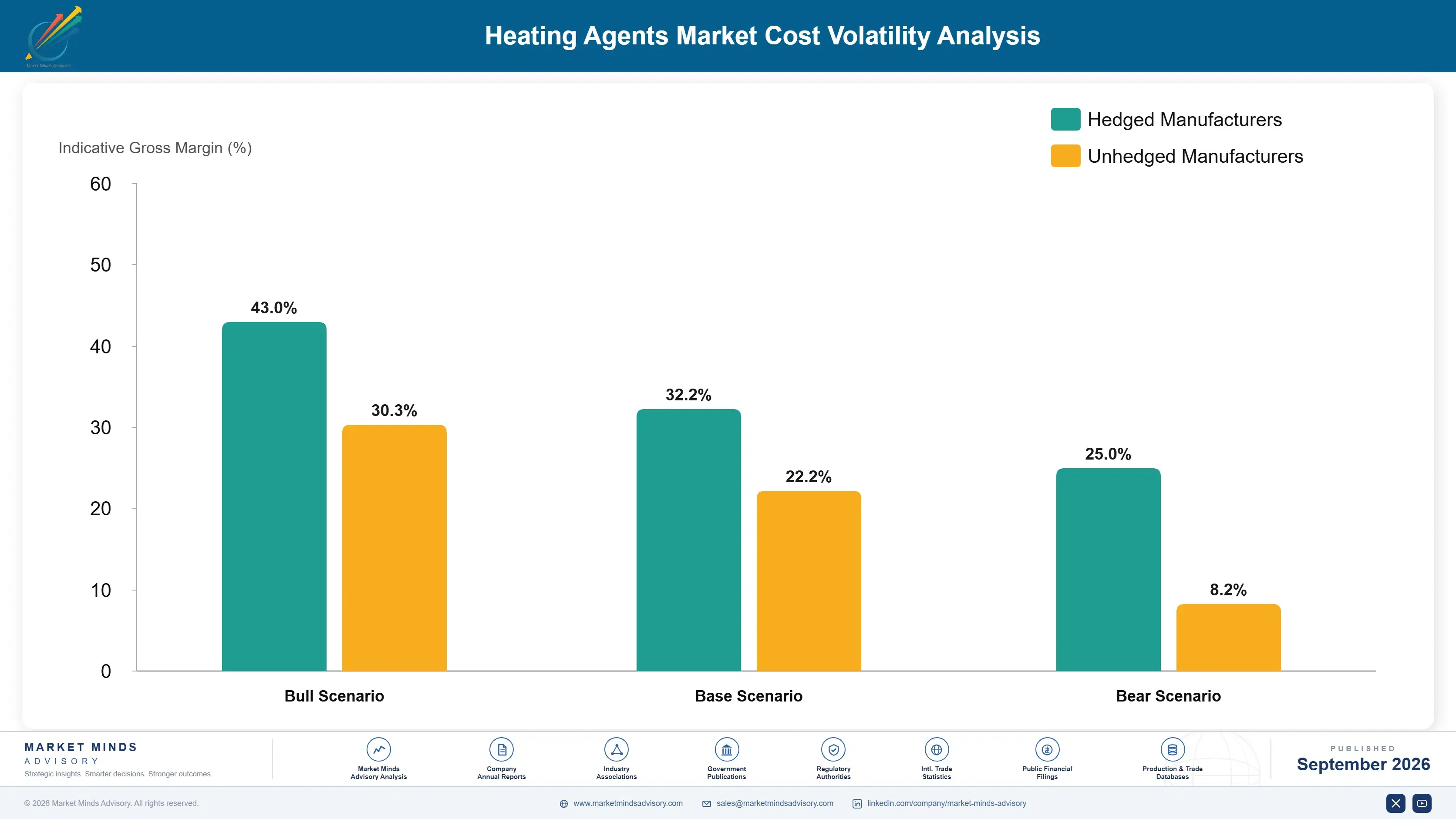
Three input groups dominate cost. Guaiacol and vanillin derivative feedstock runs 32% to 40% of cost of goods sold across the sensate segment, and the eight-point range separates petrochemical from bio-derived routes. Synthesis, purification, and encapsulation take 28% to 36%. Safety dossier work, stability testing, and regulatory maintenance add 24% to 32%, which is heavy for an ingredient used at fractions of a percent.
Guaiacol and vanillin pricing moved through 2024 and 2025 as flavour, fragrance, and pharmaceutical demand competed for the same intermediate streams, and American Chemistry Council statistics documented the underlying movements. Several producers described the resulting margin pressure in their annual reports. Zeolite and mineral exothermic inputs followed industrial mineral markets on an entirely separate and considerably slower path. Encapsulation materials moved less than either input group across the same period.

The competitive disadvantage mechanism runs through regulatory dossier maintenance rather than through synthesis cost. Concentration limits tighten periodically and a supplier without completed dossiers on alternative chemistries loses the account to whoever has one when a reformulation deadline arrives. Exposure varies by portfolio breadth rather than by manufacturing efficiency, and dossier work takes far longer than any restriction timetable allows.
heating-agents-market-cost-volatility-analysis-1790016804993

Complete Alternative Dossiers Before Limits Tighten

Concentration restrictions arrive with timetables considerably shorter than safety dossier work requires, so a supplier beginning the process at announcement has already lost the reformulation. Holding completed dossiers on alternative chemistries costs modestly against the volume it protects and is the only response that works on the available timescale. Breadth across jurisdictions matters more than depth.

Invest In Encapsulation Before Synthesis Capacity

The narrow dose window generates more dissatisfaction than every other issue in this category combined, and it is solved through onset control rather than through cheaper active. Encapsulation capability addresses the dominant complaint and produces a differentiation that additional synthesis volume simply cannot deliver at any price. Onset control cannot be replicated by buying the same active.

Contract Guaiacol Against Flavour Sector Demand

Guaiacol and vanillin intermediates are consumed by flavour, fragrance, and pharmaceutical manufacture at volumes this category cannot influence in any direction. Contracting against those cycles rather than reacting to them removes most of the exposure and secures allocation when the larger sectors compete for the same streams. Bio-derived routes carry a separate cost cycle worth holding alongside the petrochemical one.

Portfolio Architecture for Margin Defence

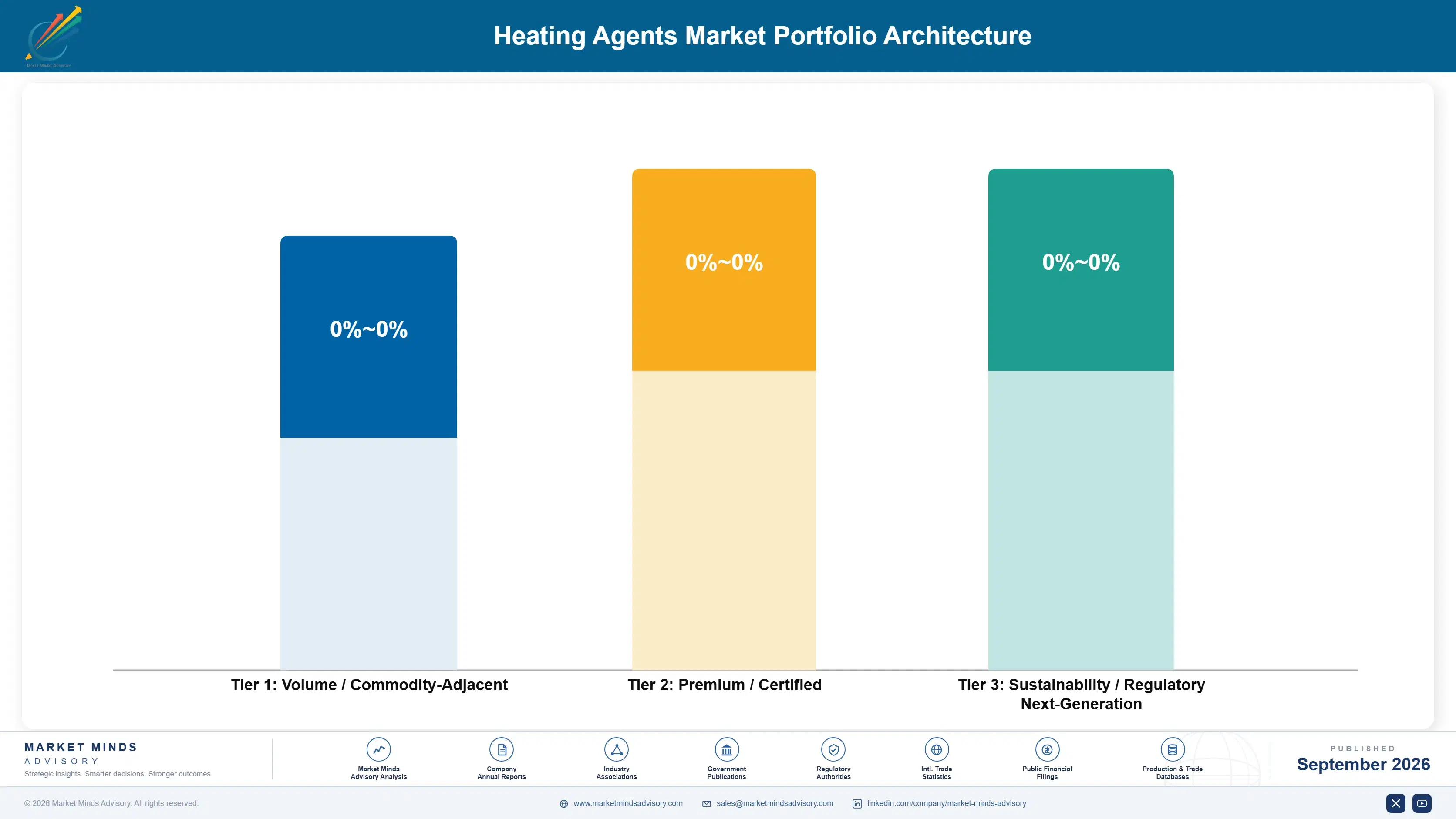
Margin follows delivery control rather than the molecule itself. Basic vanillyl butyl ether competes close to commodity terms against Asian producers of identical chemistry. Botanical warming extracts earn moderately on natural positioning. Exothermic mineral systems earn better on genuine thermal function, and encapsulated controlled-onset systems earn most, because they solve the complaint that no unencapsulated active can address. The spread between the bottom and top tier is wider than the underlying chemistry cost difference would suggest.
The tension between volume and premium runs through how the brief arrives. A specification naming a percentage of a known active is a purchasing exercise won on price. A brief describing a desired sensory experience is a development project where mechanism selection, dose calibration, and onset control all matter, and the supplier who ran that conversation holds the formulation.

High-value pools concentrate where the sensory experience is the product: warming cleansing balms, scalp treatments where heat supports a penetration claim, and massage products bought entirely for how they feel. Where warming is a minor secondary claim on an otherwise conventional formulation, price decides and any adequate sensate will serve the purpose. Oral care sits awkwardly between the two, with regulated concentration and considerable volume.

Volume / Commodity-Adjacent

Unencapsulated vanillyl butyl ether and basic spice extracts supplied against a named percentage in a written specification. The ten-point range reflects synthesis scale and feedstock position rather than any capability a formulator would pay a premium to obtain.
Gross Margin: 28% to 38%

Premium / Certified

Blended sensate systems and mineral exothermic packages supplied with dose guidance and application-specific formulation support. The twelve-point range separates suppliers with genuine blending competence from those reselling single actives with a technical data sheet attached.
Gross Margin: 42% to 54%

Sustainability / Regulatory / Next-Generation

Encapsulated controlled-onset systems, anhydrous exothermics, and chemistries carrying completed safety dossiers ahead of restriction. The fourteen-point range reflects delivery system depth and regulatory readiness, neither of which can be assembled quickly.
Gross Margin: 58% to 72%
heating-agents-market-portfolio-architecture-1790016805972

High-value Sub-segments and Strategic Watch-out

Encapsulated Controlled Onset Systems

Highest value in the category, addressing the narrow dose window that produces more dissatisfaction than every other issue combined. The fourteen-point range reflects encapsulation depth, since onset control and peak intensity control are genuinely different technical problems. Demand is growing faster than encapsulation throughput can currently be added.
Gross Margin: 60% to 74%

Anhydrous Exothermic Systems

High value solving dry-application warming that most of this industry has stopped attempting to address at all. The twelve-point range reflects moisture-trigger reliability, since a system activating in the pack rather than on skin is worthless. Reliability rather than thermal output is the barrier holding this segment back.
Gross Margin: 50% to 62%

Dossier Ready Alternative Chemistries

Volume core where completed safety documentation wins the reformulation that a concentration limit forces on a fixed timetable. The twelve-point range reflects dossier breadth across markets, since limits tighten at different times in different jurisdictions. Restriction timetables run shorter than the documentation work they require completing.
Gross Margin: 44% to 56%

Unencapsulated Sensate Actives

The strategic watch-out. Asian producers supply identical chemistry at lower prices, the dose window problem remains unsolved, and specifications name a percentage. The ten-point range reflects synthesis scale and feedstock position alone. Nothing about this commercial position improves at all without adding a genuine delivery capability alongside it.
Gross Margin: 26% to 36%

How This Demand Repeats

Revenue locks in at formulation approval and then follows the finished product's own life, which in personal care runs three to five years and considerably less in Korean and Chinese ranges. Requalifying a warming active means repeating sensory panel work and stability testing, which costs far more than any price difference on an ingredient used at fractions of a percent. Incumbency is therefore unusually durable once established.
Attachment depth follows how the specification was written. A formulation naming a supplier's encapsulated system by trade name is effectively locked, since no generic equivalent exists. One naming a percentage of vanillyl butyl ether can be filled by any of a dozen producers, and purchasing teams switch on price at every review without involving the formulation team at all. That distinction is worth more than any margin point in the price.

The buyer is shifting from purchasing back toward formulation as regulation forces reformulation and as briefs increasingly describe experiences rather than ingredients. A team asked to deliver a specific warming sensation needs mechanism advice, dose calibration, and onset control, and a supplier arriving with a price list is answering a question that person is not asking.
heating-agents-market-end-use-penetration-index-1790016806869

Where This Market Rewards

These are among the four positions where our research anticipates prominent divergence between winners and laggards over the coming forecast period. Each is grounded in the demand model, the regulatory perimeter, and the announced capacity pipeline.
01 / MECHANISM SELECTION ADVISORY

Heat and feeling hot are different

Roughly 23% of category volume produces a genuine temperature rise while the remainder produces only a receptor signal, and briefs asking for warming almost never distinguish between the two. Suppliers running a mechanism selection step before quoting report reformulation requests 3.1 times lower alongside considerably better specification retention. It takes one question at the start and prevents delivering a formulation that behaves nothing like the brand described, and the alternative is discovering the mismatch after two development cycles spent raising concentration pointlessly.
02 / ONSET CONTROL ENGINEERING

Four tenths of a point decides

Around 0.4 percentage points of concentration separate pleasant warmth from stinging, and individual receptor sensitivity varies far beyond what any single dose can accommodate. Suppliers offering encapsulated release that flattens the onset curve report complaint rates of 4% to 7% against a category baseline near 14%. It addresses the failure mode generating more dissatisfaction than every other issue in this market combined, and onset rate is controllable by delivery system where peak intensity is not, which is why encapsulation rather than reformulation is the answer that works here.
03 / DRY APPLICATION SOLVING

Two thirds need water to work

About 68% of warming volume requires water contact to activate at all, which rules genuine exotherm out of every dry-application format and pushes formulators toward sensates by default. Suppliers offering moisture-triggered encapsulation and anhydrous exothermic systems report project values 2.6 times greater than active supply alone. Dry-application warming remains an unsolved problem that most of this industry has quietly stopped attempting, and the technical barrier is reliability rather than thermal output, since a system activating in the pack instead of on the skin is worth nothing at all.
04 / DOSSIER READINESS TIMING

Restriction arrives faster than paperwork

Roughly 31% of volume uses chemistries already facing concentration limits, and further restriction removes actives outright rather than merely reducing their permitted level. Suppliers holding completed safety dossiers on alternative chemistries report specification wins 2.3 times higher when a limit tightens somewhere. Dossier work takes considerably longer than any restriction timetable allows, so beginning at announcement means the reformulation is already lost, and breadth across jurisdictions matters as much as depth, because limits tighten at different moments in different markets and each one forces its own reformulation.

Engagement Snapshot From the Field

A live engagement with an industry participant carrying material or product regulatory and market exposure ahead of a defining policy shift, showing how our research translates into a defensible multi-year portfolio strategy.
MARKET MINDS ADVISORY · CLIENT ENGAGEMENT SUMMARY
Heating Agents Producer Strategic Portfolio Review and Transition Roadmap 2026·Investment Scenario on Heating Agents Exposure Evaluation 2025-26
CLIENT PROFILE
A global personal care brand with warming product revenue near USD 120 million (client-reported, unverified by MMA), selling cleansing balms, scalp treatments, and massage products across eighteen markets. A warming hair mask launched two years earlier had underperformed badly against its Korean inspiration, and two reformulation attempts had not closed the gap. Internal debate had settled on dosage as the cause.
STRATEGIC CHALLENGE
The development team attributed the shortfall to active concentration and had proposed raising the sensate loading further. Nobody had established whether the Korean product being benchmarked used the same warming mechanism, or whether the application even permitted the mechanism the client had specified. Complaint rates had risen through both attempts while measured performance stayed flat.
MMA APPROACH
MMA measured actual temperature change and sensory intensity across the client product and four benchmarks, identified the warming mechanism in each, tested consumer response across sensitivity ranges, and modelled outcomes under concentration increase, mechanism change, and encapsulated delivery. Sensory panel work was run across three sensitivity cohorts rather than a single median group, and application conditions matched real use rather than laboratory standard.
KEY FINDINGS
  1. The Korean benchmark used an exothermic hydration system producing measurable temperature rise, while the client product used a sensate producing no thermal change whatsoever.
  2. The hair mask objective depended on genuine heat to open the cuticle, which a receptor signal cannot achieve at any concentration the formulation could carry.
  3. Raising sensate loading in earlier attempts had pushed complaint rates from 11% to 19% without improving the measured performance the product was sold on.
  4. Nobody in the original brief had specified whether heat or the sensation of heat was required, and the supplier had not asked at any point.
CLIENT PROFILE
A global personal care brand with warming product revenue near USD 120 million (client-reported, unverified by MMA), selling cleansing balms, scalp treatments, and massage products across eighteen markets. A warming hair mask launched two years earlier had underperformed badly against its Korean inspiration, and two reformulation attempts had not closed the gap. Internal debate had settled on dosage as the cause.
STRATEGIC CHALLENGE
The development team attributed the shortfall to active concentration and had proposed raising the sensate loading further. Nobody had established whether the Korean product being benchmarked used the same warming mechanism, or whether the application even permitted the mechanism the client had specified. Complaint rates had risen through both attempts while measured performance stayed flat.
MMA APPROACH
MMA measured actual temperature change and sensory intensity across the client product and four benchmarks, identified the warming mechanism in each, tested consumer response across sensitivity ranges, and modelled outcomes under concentration increase, mechanism change, and encapsulated delivery. Sensory panel work was run across three sensitivity cohorts rather than a single median group, and application conditions matched real use rather than laboratory standard.
KEY FINDINGS
  1. The Korean benchmark used an exothermic hydration system producing measurable temperature rise, while the client product used a sensate producing no thermal change whatsoever.
  2. The hair mask objective depended on genuine heat to open the cuticle, which a receptor signal cannot achieve at any concentration the formulation could carry.
  3. Raising sensate loading in earlier attempts had pushed complaint rates from 11% to 19% without improving the measured performance the product was sold on.
  4. Nobody in the original brief had specified whether heat or the sensation of heat was required, and the supplier had not asked at any point.
RECOMMENDED STRATEGY
Phase 1: Phase one: halt the concentration increase and reformulate the hair mask onto an exothermic hydration system that produces genuine thermal effect. Phase 2: Phase two: retain sensate chemistry for the cleansing balm, where dry application makes exotherm impossible and perception is the whole objective. Phase 3: Phase three: write mechanism selection into every warming brief before any supplier quotation is requested. Require the supplier to answer it in writing before any quotation.
OUTCOME
The reformulated hair mask matched benchmark performance in blind testing within two development cycles (client-reported, unverified by MMA). Complaint rates fell back below category norms. Mechanism selection is now a standing first question on every sensory brief the business issues. Two further warming launches used the same discipline and neither required reformulation.

Frequently Asked Questions

Foundational context covering the market sizes, CAGR, scope, country, region and competition that inform every finding below. This section is provided to cover basics and most often pre-purchase conversations, answered from the MMA Primary Research Dataset.

What is the current size of the Heating Agents Market?

The market was worth USD 0.5 billion in 2025 and stands at USD 0.5 billion in 2026. Value covers warming and exothermic actives for cosmetic and personal care formulation.

How large will the Heating Agents Market be by 2036?

MMA forecasts USD 1.0 billion by 2036, an increase of USD 0.5 billion across the forecast period. That represents 2.00 times the 2026 base of USD 0.5 billion.

What is the CAGR for the Heating Agents Market 2026 to 2036?

The base case compound annual growth rate is 7.2%, with a bull case at 8.4% and a bear case at 6.0%. Historical growth from 2020 to 2025 ran at 6.1%.

Which segment is growing fastest?

Vanillyl alkyl ether sensates grow at 10.8%, half again the market rate of 7.2%. They avoid the flushing and regulatory attention that stronger warming chemistries attract.

Who are the major companies in the Heating Agents Market?

Symrise, Givaudan, Takasago International, DSM-Firmenich, and Sensient Technologies lead the category. Together they hold 51% of revenue, with Chinese and Indian producers competing hard on established chemistry at considerably lower prices.

Which country is growing fastest?

South Korea grows at 13.2%, and warming cleansing balms, scalp treatments, and massage formats are Korean inventions that Western brands subsequently copy rather than originate.

Report Segmentation Architecture

The full report scope spans multiple orthogonal segmentation dimensions, with cross-tabulated demand data provided for each dimension pair. Coverage extends further to regional breakdowns, trend trajectories, and the competitive detail needed to support segment-level decision-making.

By Warming Mechanism

  • Vanillyl Alkyl Ether Sensates
  • Exothermic Hydration Systems
  • Glycerin-Based Exothermic Systems
  • Spice-Derived Warming Extracts
  • Nicotinate Ester Warming Agents
  • Capsaicinoid and Capsicum Derivatives

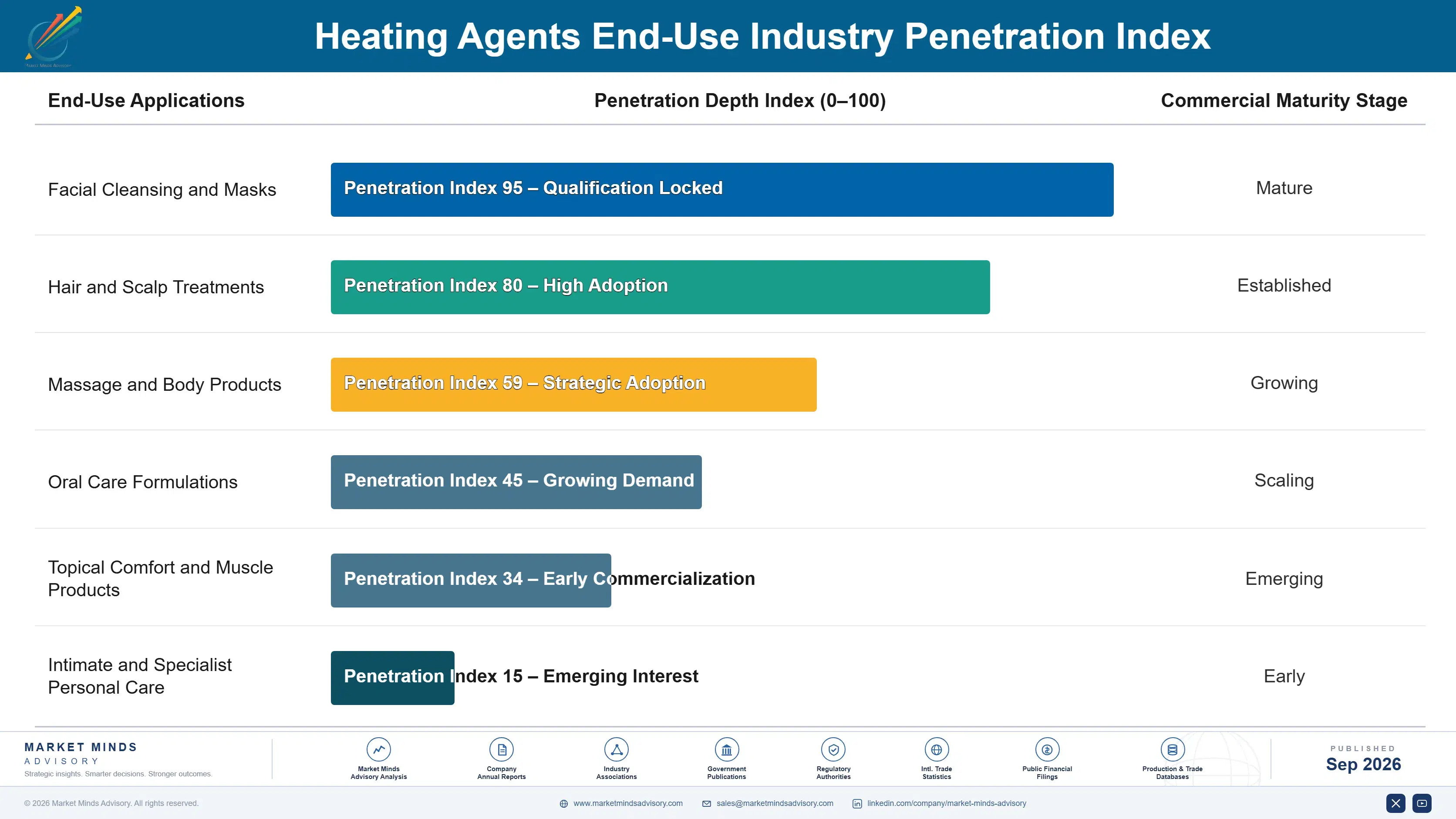
By End-Use Industry

  • Facial Cleansing and Masks
  • Hair and Scalp Treatments
  • Massage and Body Products
  • Oral Care Formulations
  • Topical Comfort and Muscle Products
  • Intimate and Specialist Personal Care

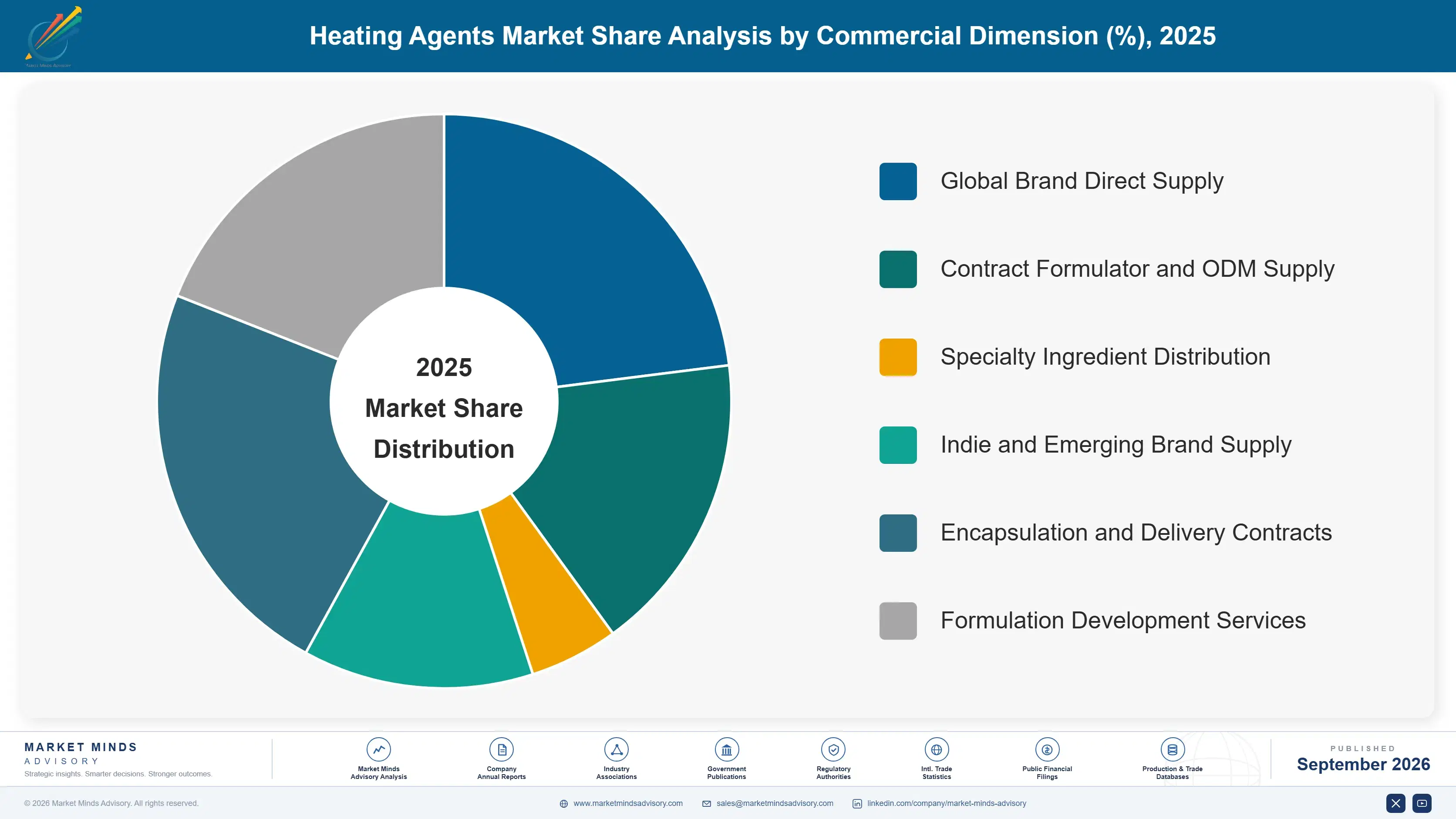
By Commercial Dimension

  • Global Brand Direct Supply
  • Contract Formulator and ODM Supply
  • Specialty Ingredient Distribution
  • Indie and Emerging Brand Supply
  • Encapsulation and Delivery Contracts
  • Formulation Development Services

By Region

  • East Asia
  • Western Europe
  • North America
  • South Asia and Pacific
  • Latin America
  • Middle East and Africa
  • Eastern Europe

Scope, Methodology, and Coverage

Every figure in this report is reproducible from documented input assumptions. The scope below maps the historical period, the forecast horizon, the segmentation dimensions, and the countries covered, alongside the underlying primary and qualitative methodology.
Historical Period
2020 to 2025
Forecast Period
2026 to 2036
Base Year
2025 (USD billions; MMA Primary Research Dataset, September 2026)
Market Definition
This market covers ingredients producing a warming sensation or genuine exothermic effect in cosmetic, personal care, oral care, and topical consumer formulations, across vanillyl alkyl ether sensates, exothermic hydration systems, glycerin-based exothermic systems, spice-derived warming extracts, nicotinate ester warming agents, and capsaicinoid and capsicum derivatives. It excludes cooling and refreshing sensates, heated devices, self-heating food packaging, industrial heat transfer fluids, and pharmaceutical counter-irritant drug products.
Quantitative Units
USD billions, revenue at supplier selling price
Segmentation Dimensions
Warming mechanism, end-use application, commercial dimension, region
Regions Covered
East Asia, Western Europe, North America, South Asia and Pacific, Latin America, Middle East and Africa, Eastern Europe
Countries Covered
South Korea, Japan, China, Taiwan, Germany, France, United Kingdom, Italy, Spain, Netherlands, Switzerland, Poland, Czechia, United States, Canada, Mexico, India, Indonesia, Thailand, Vietnam, Australia, Brazil, Colombia, Chile, Argentina, Saudi Arabia, United Arab Emirates, Turkey, Egypt, South Africa
Key Companies Profiled
Symrise, Givaudan, Takasago International, DSM-Firmenich, Sensient Technologies, International Flavors and Fragrances, Mane, Robertet, T Hasegawa, Ogawa and Company, Kao Corporation, Nikko Chemicals, Ajinomoto, Sino Lion, Hangzhou Fuchun, Vantage Specialty Chemicals, Clariant, BASF, Croda International, Lipoid Kosmetik
Quantitative Methodology
Primary survey, n=3,800 respondents, Q4 2025, six countries; demand-side model with trade association cross-validation
Qualitative Methodology
47 expert interviews, Q4 2025; applied to validate demand model assumptions, identify emerging dynamics, and assess competitive positioning
Report Format
PDF and XLSX data workbook (Word format preview document)
Publisher
Market Minds Advisory
Report Code
MMA-2026-CHM-451
Published
September 2026
Contact
sales@marketmindsadvisory.com | www.marketmindsadvisory.com

Purchase the full Heating Agents Market Report (2026 to 2036).

The full report sizes the heating agents market across six warming mechanisms, seven regions, and thirty countries, with forecasts to 2036 under base, bull, and bear cases. It separates actives producing genuine thermal effect from those producing only a receptor signal, quantifies the concentration window between pleasant warmth and stinging, and maps concentration limits across the chemistries facing them. Competitive analysis covers twenty participants evaluated consistently on category revenue, with detailed treatment of encapsulation and onset control capability. Cost structure, dossier readiness, and application constraints are analysed throughout. Primary research includes 3,800 survey responses and 47 expert interviews.
Six warming mechanisms sized and forecast separately
Twenty participants evaluated on category revenue consistently
Measured temperature change compared against reported sensory intensity
Dose response windows quantified across sensitivity ranges
Concentration limits mapped by chemistry and jurisdiction
Encapsulation and onset control capability assessed by supplier

Built For The People Who Decide

From boardroom strategy to bench-side execution, this report is read cover-to-cover by leaders shaping the next decade of their industry, turning demand scenarios, market dynamics and valuation benchmarks into decisions.
CXOs/ Presidents/ VPs/ Managers
M&A and Corporate Development
Strategy Teams and R&D Heads
Procurement and Product Directors
Regulatory and Compliance Leaders
Investor Relations and Equity Analysts