Market Minds Advisory
Tobacco Heating Sticks Market

Tobacco Heating Sticks Market: Tobacco Heating Sticks: Device Lock-In, Excise Classification And The Consumable That Follows The Hardware

The device is sold at or below cost because it is not the product, and every stick a consumer buys for the next decade fits only that one particular heater and nothing else.

Lead Analyst

Published

September 2026

Make Smarter Decisions with Customized Research Insights

Request a free sample report and evaluate market opportunities, growth trends, and competitive dynamics relevant to your business needs.

2025 MARKET VALUE$38.0BMarket Size 2025
2036 FORECAST VALUE$94.2BBase Case , 2026 to 2036
CAGR 2026 TO 20368.6 %Bull 9.9% / Bear 7.3%
INCREMENTAL OPPORTUNITY$52.9BNet 10- year value creation
EXPANSION MULTIPLE2.28x2036 value over 2026 base
Strategic Levers
M&A Pipeline
Regional Outlook
Country Rankings
Competitive Intelligence
Segmental Deep-dive
Call-Us : 91 93563 13602

Executive Snapshot and Market Trajectory.

The stick is the business and the device is the entry fee. Heaters are sold at or below cost precisely because a consumer who buys one is committing to a consumable that fits nothing else for as long as they keep using it. Nothing else fits.
Induction and bladeless heating consumables grow fastest at 12.9%, driven by device generations that removed the heating blade and the cleaning it demanded. Each new heater architecture creates an incompatible consumable range, which is a product improvement and a lock-in reset at the same time. Consumers migrating to a new device migrate their entire future consumable spending with it. Manufacturers time those transitions with considerable care, and for entirely obvious commercial reasons.
Concentration is extraordinary at 88%, higher than almost any consumer category. Excise classification is why: heated products are taxed differently from cigarettes in most jurisdictions, and the rate is set by governments who can change it without notice. That is the largest single variable in this market and no participant controls any part of it. Nothing a manufacturer does influences a decision taken in a budget statement anywhere.
Market Definition
Revenue from consumable tobacco sticks and inserts designed for use in electrically heated tobacco devices, covering blade-heated stick consumables, induction and bladeless heating consumables, carbon-tip heated products, capsule and flavour-release variants, reduced-tobacco and hybrid inserts, and the heating devices sold to enable their use. Excludes conventional combustible cigarettes, electronic cigarettes and vaping liquids containing no tobacco leaf, oral nicotine pouches, and pharmaceutical nicotine replacement products.
Base Year Value
$38.0B in 2025 (MMA Primary Research Dataset, August 2026)
Forecast Period
2026 to 2036, eleven discrete annual values
CAGR
8.6% base case. Bull 9.9%. Bear 7.3%.
Fastest Growth Segment
Induction and Bladeless Heating Consumables: 12.9% CAGR
Fastest Growth Country
India: 10.8% CAGR
Fastest Growth Region
South Asia and Pacific: 10.8% CAGR
Largest Region
East Asia: 38% of 2025 global value
Market Leaders
Philip Morris International, British American Tobacco, Japan Tobacco International, KT&G and Imperial Brands lead on heated tobacco consumable revenue. Source: company annual reports and MMA Primary Research Dataset, July 2026.
Primary Survey
n=3,800 procurement and R&D decision-makers, Q4 2025, six countries
Methodology
Demand-side build-up, cross-validated against public data, 47 expert interviews

Tobacco Heating Sticks Market Forecast Scenarios

tobacco-heating-sticks-market-size-forecast-scenario-1788165842127
The 2020 to 2025 period moved this category from a Japanese and Korean phenomenon into a genuinely international one. Device generations advanced quickly, with induction heating displacing blade architectures across premium ranges, and each transition reset compatibility for the consumables underneath. Excise treatment diverged sharply between jurisdictions. Revenue compounded near 7.2%, with consumable volume growing considerably faster than the device installed base did.
Three mechanisms carry the base case. Device installed base continues expanding, and every heater placed commits its owner to a consumable range for years afterwards. Excise differentials favouring heated products over cigarettes persist in most major markets, though not all of them. And conversion from combustible cigarettes continues among consumers who want a ritual closer to smoking than vaping offers them. None of the three depends on any new device technology arriving at all.
The bull catalyst is excise parity being ruled out explicitly in a major market, which would remove the single largest uncertainty hanging over pricing and volume assumptions. The bear risk is the reverse: a large jurisdiction taxing heated sticks at cigarette rates would compress the price advantage that drives conversion, and several finance ministries have been examining exactly that possibility.

The Device Is Not The Product

Look at the pricing and the model explains itself. Heaters retail at or below manufacturing cost, frequently with promotional discounting on top, because the device is an entry fee rather than a product. A consumer buying one commits to a consumable that fits nothing else, and 94% of users buy only sticks compatible with their heater. The margin sits at 72% on the stick and nowhere on the hardware.
MARKET CONCENTRATION CR588%Share of consumable revenue held by the leading manufacturers
DEVICE INSTALLED BASE41 millionHeaters in active use across all commercial markets globally
CONSUMABLE ATTACHMENT RATE94%Users buying only sticks compatible with their own device
EXCISE RATE DIFFERENTIAL38%Typical tax gap against combustible cigarettes in major markets
DEVICE REPLACEMENT INTERVAL2.4 yearsTypical period before a user acquires a newer heating device
CONSUMABLE GROSS MARGIN72%Typical margin on sticks against a heavily subsidised device
That structure explains why device generations matter so much commercially. Induction and bladeless architectures removed the heating blade and the cleaning it required, which is a genuine improvement and also a compatibility reset. A consumer migrating to the new heater migrates their entire future consumable spending along with it, and a competitor has to overcome a switching decision the consumer just made in somebody else's favour.
What nobody in this market controls is the tax. Heated products currently carry excise around 38% below combustible cigarettes across major markets, and that differential is what makes the conversion argument work at the till. Finance ministries set it, revise it and occasionally remove it entirely, and no amount of commercial planning influences a decision taken in a budget statement nobody was consulted about.
"Everybody talks about this category as though it were a technology business. It is a razor and blade business with a tax policy sitting on top of it, and the tax policy is the part that actually decides who wins."
Director, Tobacco and Nicotine Practice · MMA Tobacco and Nicotine Products Practice · August 2026

Market Trends

Each Device Generation Resets Consumable Compatibility

Induction and bladeless heating removed the blade and its cleaning burden, and simultaneously created a consumable range incompatible with everything that came before it. Every architecture change is therefore a product improvement and a lock-in reset arriving together. Manufacturers time these transitions carefully, because a consumer moving to a new heater carries years of future consumable spending with them and a competitor gets one narrow opportunity to intercept that decision. A consumer who has just committed to a new heater is unreachable again for years afterwards, which is exactly the point of the exercise.
Market Impact: Commits 41 million device owners

Excise Divergence Is Widening Rather Than Settling

Jurisdictions have taken increasingly different positions on how heated products should be taxed relative to cigarettes, with differentials around 38% in some major markets and near parity in others. That divergence makes pricing, portfolio and launch decisions genuinely market-specific in a category that manufacturers would prefer to run globally. Several finance ministries have opened reviews, and the outcomes will matter more to volume than any product development currently underway anywhere. A category that manufacturers would run globally is being forced into market by market decision making by tax codes nobody can standardise.
Market Impact: Prices 38% below cigarettes

Market Opportunities and Growth Drivers

Installed Device Base Commits Future Consumable Spending

Around 41 million heaters are in active use, and each one commits its owner to a compatible consumable range for as long as they continue using it. Attachment runs at 94%, which is close to absolute. That converts a device placement into years of predictable consumable revenue, and it is why manufacturers subsidise hardware so heavily at the point of acquisition. The economics resemble printers and cartridges considerably more than they resemble anything else in tobacco. Nobody in tobacco has previously had a customer locked to a piece of hardware.
Market Impact: Removes 38% price advantage instantly

Excise Differential Makes The Conversion Argument At The Till

Heated products carry excise around 38% below combustible cigarettes in major markets, which produces a retail price advantage that does the conversion work far more effectively than any health or convenience argument has managed. Consumers switching are responding to price alongside everything else. That advantage exists entirely at the discretion of finance ministries and persists only while they choose to maintain it, which most participants prefer not to discuss too loudly. Conversion arguments built on anything other than price have consistently underperformed the arguments built on the number printed at the till.
Market Impact: Bans enacted in 3 jurisdictions

Market Restraints and Challenges

Excise Policy Sits Entirely Outside Anybody's Control

The differential around 38% that makes conversion work at retail is set by finance ministries, revised in budget statements and removable without consultation or notice. The root cause is that governments treat tobacco taxation as revenue policy rather than as public health policy, whatever they say publicly about it. Commercially it makes the largest variable in this market entirely exogenous. Mitigation runs through scenario planning, market diversification, engagement with taxation consultations, and portfolio pricing that survives parity if it arrives. A category built on a tax differential is a category built on somebody else's decision.
Market Impact: Resets compatibility every 2.4 years

Regulatory Restriction Advances Faster Than Category Growth

Flavour bans, display restrictions, advertising prohibitions and outright category bans have all been enacted somewhere, and the direction of travel is consistently toward more restriction rather than less. The root cause is that heated products are treated as tobacco by most regulators regardless of any comparative risk argument. Commercially it removes markets without warning. Mitigation runs through portfolio breadth across nicotine formats, regulatory engagement, evidence submission and geographic spread that no single decision can undermine. A parliament removing an entire market gives nobody any route back into it ever afterwards.
Market Impact: Ranges from 38% to parity
4 additional market trends, 3 additional growth drivers, and 2 additional restraints and challenges are covered in the full report. Contact sales@marketmindsadvisory.com to access the complete intelligence.

Segment CAGR and Growth Architecture

Segmentation follows consumable architecture, because each is tied to a device generation and defines which heater a consumer must own to use it. Six architectures describe the market completely, from carbon-tip products requiring no electronics at all through to induction consumables where the current device transition and most of the growth are both happening together.
tobacco-heating-sticks-market-market-share-analysis-1788165842762

Induction and Bladeless Heating Consumables

The fastest architecture grows at 12.9%, half again the market rate of 8.6%, and it does so for two reasons that arrive together. Removing the heating blade eliminated the cleaning that users disliked most, which is a genuine product improvement, and the new architecture is incompatible with every consumable that preceded it, which resets the lock-in entirely. A consumer moving to an induction heater carries years of future consumable spending across with them. Manufacturers time these transitions deliberately, because they are the only moments when a competitor gets any realistic opportunity to intercept a committed consumer. Everything else in this category is simply a period during which nobody can reach anybody.
CAGR 12.9%

Capsule and Flavour-Release Variants

Capsule variants grow at 10.4% and occupy an unusually exposed position within this market. A crushable capsule releasing flavour on demand differentiates a consumable within an installed device base at very little manufacturing cost, which makes it the cheapest available way to defend share against a competitor's product. It is also precisely the format that flavour restrictions target first wherever regulators act. Growth here is therefore genuine and geographically fragile in equal measure, and manufacturers building portfolio around it in one market frequently cannot sell any of it in the next one. Cheap differentiation that a regulator can remove entirely is a peculiar thing to build a portfolio around, and several participants have done exactly that.
CAGR 10.4%
Full segment breakdown across 6 segments available in the complete report.

Regional Architecture and Country Demand Map

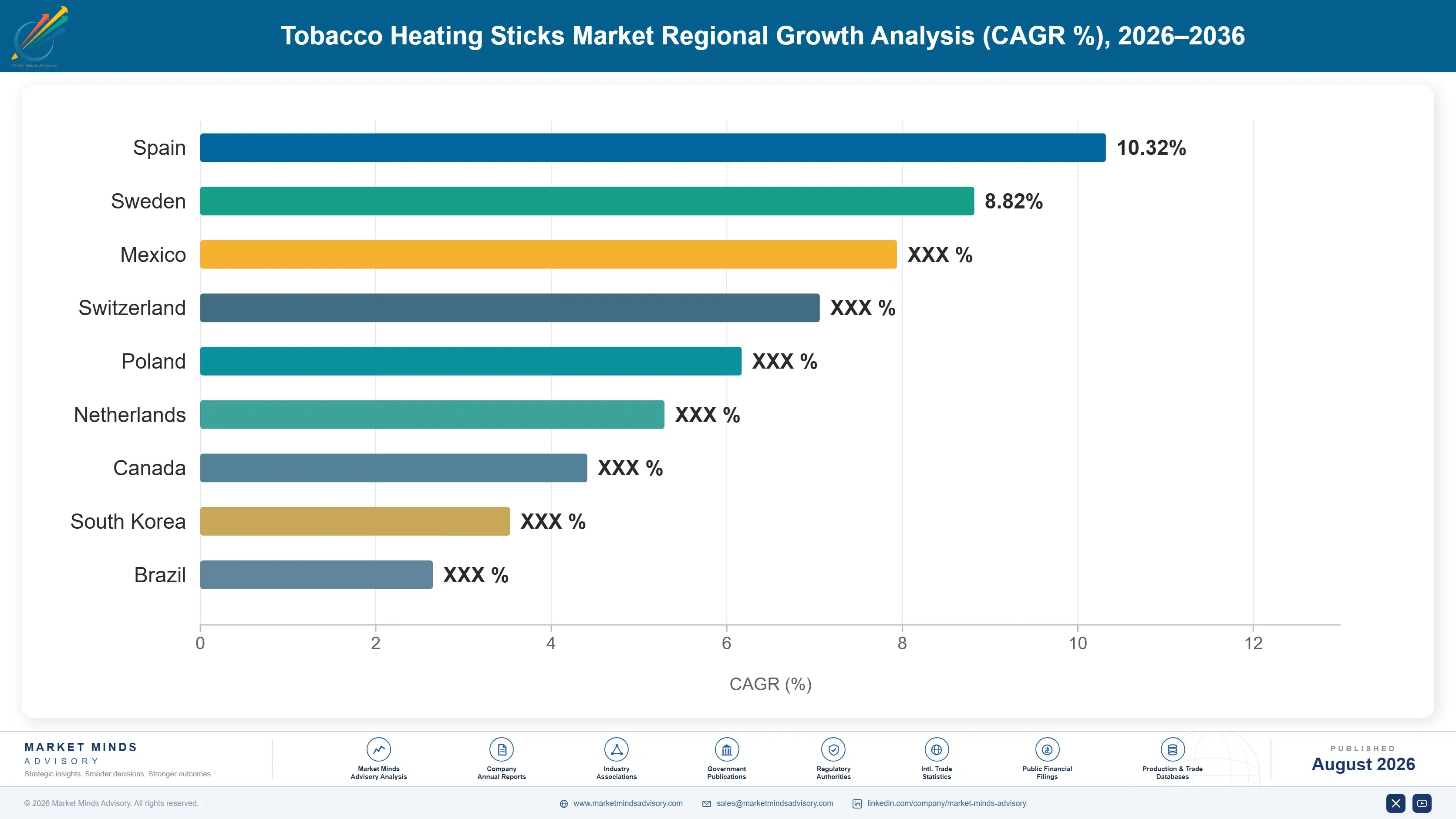
Adoption follows excise treatment, regulatory permission and the strength of an existing cigarette culture. East Asia leads by a wide margin on both installed base and consumable volume, with South Asia and Pacific growing fastest from a restricted and much smaller base. Tax codes explain the geography.

East Asia

Out-of-band note: this region holds 38% against a band of 22 to 30% because heated tobacco was commercialised here first and adoption reached levels no other region approaches, which no segmentation reasonably distributes away. Japanese conversion from cigarettes has been the deepest anywhere, supported by excise treatment that made the arithmetic obvious at retail. Korean manufacturers built domestic device and consumable capability rather than importing it. Device generation transitions are launched here first and the consumer response tested before any international rollout begins. Testing a device generation in a deep and sophisticated home market before international launch is a genuine advantage, since the consumer response arrives before the global commitment has to be made.
Share: 38% | CAGR: 9.6% (2026 to 2036)

Western Europe

Adoption is substantial and highly uneven between markets, driven far more by national excise decisions than by any difference in consumer preference across borders. Italy and several central markets converted quickly where the tax differential was generous, while others barely moved at all. Flavour restrictions have removed capsule variants from several markets entirely, which manufacturers absorbed without much public comment. Regulatory direction across the region is consistently toward more restriction, and category bans have been debated in more than one parliament. Adoption tracking excise decisions rather than consumer preference across borders is the clearest demonstration anywhere that this category is a tax product with a device attached to it, frankly enough.
Share: 24% | CAGR: 7.2% (2026 to 2036)
Regional intelligence for 5 additional markets available in the complete report: Eastern Europe, South Asia and Pacific, Middle East and Africa, North America, Latin America. Contact sales@marketmindsadvisory.com.
tobacco-heating-sticks-market-country-cagr-analysis-1788165843390

Where Heated Tobacco Margin Sits

Four levers work on device placement, transition timing, tax engagement and portfolio breadth rather than on consumable formulation, which competitors match quickly. Subsidised placement, generation timing, excise engagement and format diversification each address something a manufacturer can act on now. None of the four requires a better stick than any competitor already manufactures today.

Subsidise Device Placement More Aggressively Than Competitors

A heater placed commits its owner to a compatible consumable range at 94% attachment for years afterwards, which makes device acquisition cost an investment in future consumable revenue rather than a loss on hardware. Manufacturers pricing devices to recover cost are optimising the wrong line entirely. Aggressive subsidy typically recovers within 7 months of consumable purchase. The constraint is balance sheet appetite rather than commercial logic, and competitors with less patience concede installed base steadily. Every single device a competitor places is a consumer nobody else reaches for several years.
Market Impact: Recovers the full device cost within 7 months

Time Device Generations To Intercept Competitor Bases

An architecture transition is the only moment a committed consumer genuinely reconsiders, since their existing consumables become obsolete anyway and the switching cost briefly disappears. Launching a new generation while a competitor's base is mid-cycle intercepts consumers who would otherwise never have looked. Transitions occur roughly every 2.4 years and the timing is a commercial decision rather than an engineering one. Manufacturers treating generation launches as product milestones are missing the only competitive opening this category offers. Nobody ever gets a second chance at an installed base between those transitions.
Market Impact: Intercepts consumers on every 2.4 year device cycle

Engage Finance Ministries Rather Than Health Regulators

The excise differential around 38% is set by taxation authorities as revenue policy, and manufacturers who direct their entire regulatory effort at health departments are addressing the wrong ministry entirely. Tax consultations are public, scheduled and attended by remarkably few participants from this industry. A differential preserved in one budget cycle is worth more than any product launch. The engagement is unglamorous and it protects the single largest commercial variable anybody in this category has. Very few participants in this whole industry send anybody at all to a tax consultation.
Market Impact: Protects the entire 38% retail price differential outright

Diversify Format Before Restrictions Remove One

Flavour bans, capsule prohibitions and outright category bans have all been enacted, and a manufacturer concentrated in a single format loses a market entirely rather than partially when one arrives. Portfolio breadth across nicotine formats costs development spending and protects revenue that would otherwise disappear on a legislative timetable. At least 3 jurisdictions have banned the category outright already. Concentration looks efficient until the day a parliament votes, and then it looks like nothing of the sort. Nobody anywhere schedules a prohibition vote around a manufacturer's portfolio plans at all.
Market Impact: Spreads risk beyond the 3 prohibiting jurisdictions already

Who Controls the Margin Pool

Concentration is extraordinary at around 88% across the five largest participants measured on heated tobacco consumable revenue, which is higher than almost any consumer category anywhere. The reason is that this business requires cigarette-scale manufacturing, distribution into tobacco retail, device engineering and regulatory capability simultaneously, and essentially nobody outside the established tobacco industry holds all four. That is a formidable barrier to entry.
Competition runs on installed device base, generation timing and excise position. Installed base decides consumable volume for years ahead and is close to unassailable between transitions. Generation timing decides who intercepts whom during the brief windows when consumers reconsider. Excise position decides retail price, and it is set by governments rather than by anybody competing here. Only one of the three is contestable.

Pressure is arriving from adjacent nicotine formats rather than from new heated tobacco entrants. Oral pouches and vaping products compete for the same converting smoker without requiring any device commitment at all. Regulators meanwhile treat all of it as tobacco. Rankings will shift toward participants holding installed base alongside format breadth, since one protects current revenue and the other survives a restriction.
tobacco-heating-sticks-market-company-positioning-matrix-1788165843995

Competitive Moat and Risk Dimensions

PHILIP MORRIS INTERNATIONAL

Moat: Installed base and generation leadership

Philip Morris International holds the largest heated tobacco installed device base anywhere, which commits an enormous population of consumers to compatible consumables at attachment rates approaching absolute. Leading successive device generations lets it time transitions rather than react to them. Manufacturing scale and regulatory capability across many jurisdictions together support launches that smaller participants cannot execute simultaneously.
PHILIP MORRIS INTERNATIONAL

Risk: Concentration in one category outcome

Heavy strategic commitment to heated tobacco concentrates exposure to excise decisions and regulatory restriction affecting exactly this format rather than nicotine generally. A major market moving to tax parity or prohibiting the category removes volume that other formats would not replace. Adjacent formats compete for the same converting smoker without any device commitment at all.
KT&G

Moat: Domestic capability and manufacturing depth

KT&G built device and consumable capability domestically rather than licensing it, which gives it engineering control over generation transitions and manufacturing cost that importers cannot match. Its home market adopted heated tobacco earlier and more deeply than almost anywhere, providing a base for testing device generations before international launch. Partnership arrangements extend reach without requiring distribution capability everywhere.
KT&G

Risk: International reach through partners

Reaching markets through partnership arrangements rather than owned distribution limits control over pricing, launch timing and consumer relationship in exactly the markets where growth is fastest. Partner priorities may not align with generation transition timing. Building owned distribution into tobacco retail across many jurisdictions is expensive and slow for anybody starting now.

Players Tracked

Prominent Players

Philip Morris International
British American Tobacco
Japan Tobacco International
KT&G
Imperial Brands

Other Key Players

Altria Group
China Tobacco
Turning Point Brands
Smoore International
Ispire Technology
Shenzhen Innokin
Kaival Brands
Greentank Technologies
Aspire Global
Joyetech
Vaporesso
SMOK Technology
Boyd Industries
Essentra Filter Products
Ecoflow Tobacco Technology

Recent Developments

JUNE 2024

Manufacturer launched an induction heating device generation internationally

A leading manufacturer launched a bladeless induction heating device generation across international markets, removing the cleaning requirement users disliked and simultaneously introducing a consumable range incompatible with every preceding device. This was a product launch rather than any acquisition, merger or joint venture between participants in the category.
Signal: Every architecture transition is a product improvement and a compatibility reset arriving together quite deliberately indeed.
OCTOBER 2024

Finance ministry opened review of heated tobacco excise treatment

A national finance ministry opened a review of excise rates applied to heated tobacco products relative to combustible cigarettes, examining whether the existing differential remains justified on revenue and policy grounds. This was a taxation review rather than any commercial arrangement between manufacturers operating in that market.
Signal: Excise reviews decide category volume more directly than any amount of product development ever manages to.
FEBRUARY 2025

Jurisdiction prohibited heated tobacco product sales entirely

A national regulator prohibited the sale of heated tobacco products outright, removing an entire market from the addressable population for every manufacturer operating there and providing no transitional arrangement for existing device owners. This was regulatory prohibition rather than any commercial development between the companies involved.
Signal: Outright prohibition removes a market completely and gives manufacturers no route at all back into it.

What A Heated Stick Costs

Cost divides four ways before any tax is applied, and tobacco leaf is smaller than most observers expect. Excise and duty absorb the largest share of retail price by far, while within the manufacturer's own cost base tobacco leaf and reconstituted material account for roughly 31%, stick assembly and materials near 29%, device subsidy amortisation near 24%, and distribution with regulatory compliance the remaining 16%.
Tobacco leaf pricing moved sharply across recent seasons on weather and acreage shifts in the principal growing regions, and reconstituted material and aerosol former inputs moved with it. Philip Morris International and Imperial Brands have both discussed leaf and input cost across recent reporting periods. Device subsidy has been the more significant swing, since aggressive placement during a market entry carries cost long before any consumable revenue arrives to offset it.

Exposure varies by installed base position rather than by geography. Manufacturers with large established bases amortise device subsidy across years of consumable purchase. Those entering a market carry subsidy against no consumable revenue at all until placement builds. Participants in markets where excise moved toward parity carry the full input cost against retail prices that can no longer support the conversion argument at all.
tobacco-heating-sticks-market-cost-volatility-analysis-1788165844207

Device subsidy modelled against consumable lifetime value

Device placement is an investment in consumable revenue at 94% attachment rather than a hardware loss, and manufacturers pricing heaters to recover cost are optimising the wrong line entirely. Subsidy recovers within months of consumable purchase in most markets. Treating hardware as a profit centre concedes installed base to competitors who understand the arithmetic properly.

Leaf contracting across multiple growing regions

Tobacco leaf and reconstituted material absorb roughly a third of manufacturing cost and price on weather and acreage in a small number of growing regions. Contracting across several origins costs a modest premium and removes exposure to a single poor season. Manufacturers sourcing narrowly have absorbed price movement they could have avoided at very little cost.

Portfolio pricing designed to survive excise parity

The differential around a third below cigarettes is set by finance ministries and removable in any budget statement without consultation. Pricing architecture that only works at the current differential leaves a manufacturer with nothing when it changes. Modelling portfolio economics at parity before it arrives costs nothing and prevents an entirely avoidable scramble afterwards.

Portfolio Architecture for Margin Defence

The portfolio separates by whether an item earns or acquires. Heating devices are the acquisition instrument: sold at or below cost, promoted heavily, and generating no margin whatsoever by design. They are not a business line and treating them as one is the most common commercial error participants make when entering this category from outside it. Devices acquire and sticks earn, in that order.
Margin concentrates entirely in the consumable, at around 72% gross on sticks that fit only one device family. Induction consumables grow at 12.9% on the current architecture transition. Capsule variants defend share within an installed base at minimal manufacturing cost. Both depend on an installed device base that somebody paid to build and that competitors cannot readily reach. Nothing else in the portfolio earns anything.

The overlooked exposure is format concentration. Flavour bans, capsule prohibitions and outright category bans have all been enacted somewhere, and a manufacturer concentrated in one format loses a market entirely rather than partially. Breadth across nicotine formats costs development spending and protects revenue against a legislative timetable nobody controls. Nobody controls that timetable and everybody is exposed to it.

Volume / Commodity-Adjacent

Heating devices, chargers and accessories sold at or below manufacturing cost to acquire consumable commitment. Range spans six points because subsidy intensity varies enormously between market entry and established position.
Gross Margin: 0-6%

Premium / Certified

Standard blade-heated and carbon-tip stick consumables sold into an established installed device base. Range spans twelve points because excise treatment and retail pricing differ sharply across the markets involved. Excise decides the outcome.
Gross Margin: 58-70%

Sustainability / Regulatory / Next-Generation

Induction consumables, capsule and flavour-release variants and reduced-tobacco hybrid inserts. Range spans fourteen points because premium positioning and regulatory exposure vary considerably within this tier. Regulatory exposure separates these products more than anything else.
Gross Margin: 68-82%
tobacco-heating-sticks-market-portfolio-architecture-1788165844719

High-value Sub-segments and Strategic Watch-out

Induction and Bladeless Heating Consumables

High value and high growth at 12.9%, carried by an architecture transition that resets compatibility across the entire installed base. The twelve point range separates manufacturers leading device generations from those following a competitor's transition several years afterwards. Transitions are the only competitive openings available.
Gross Margin: 70-82%

Capsule and Flavour-Release Variants

High value with moderate growth at 10.4%, defending share within an installed base at very little additional manufacturing cost. The twelve point range reflects regulatory exposure, since flavour restrictions target this format first wherever regulators decide to act. Cheap to make and easy for anybody to ban.
Gross Margin: 66-78%

Heating Devices and Accessories

The acquisition instrument rather than a business line, sold at or below cost and promoted heavily to commit consumers. Treating devices as a profit centre is the most common error participants entering this category from outside it make. Nobody should be defending a hardware margin here.
Gross Margin: 0-6%

Excise Classification Exposure

The strategic watch-out rather than a growth pool. The differential below cigarettes is set by finance ministries, revised in budget statements without consultation, and no participant in this market influences any part of it. No commercial plan here survives a budget statement that removes it.
Gross Margin: Variable

Why Device Owners Stay

Consumable revenue produces annuity economics of an unusually complete kind. A device commits its owner to a compatible stick range at 94% attachment, and that commitment persists until the consumer either leaves the category or moves to a new heater. Around 41 million devices are in active use, each representing a stream of consumable purchases that no competitor can address without first persuading the owner to buy different hardware entirely.
Stickiness varies almost entirely by where a consumer sits in the device cycle. A recent device buyer is effectively unreachable, since their heater works and their consumables are readily available. A consumer approaching a generation transition is briefly reachable, because their existing sticks are becoming obsolete anyway and the switching cost temporarily collapses. Those windows arrive roughly every 2.4 years and they are the only competitive openings this category provides.

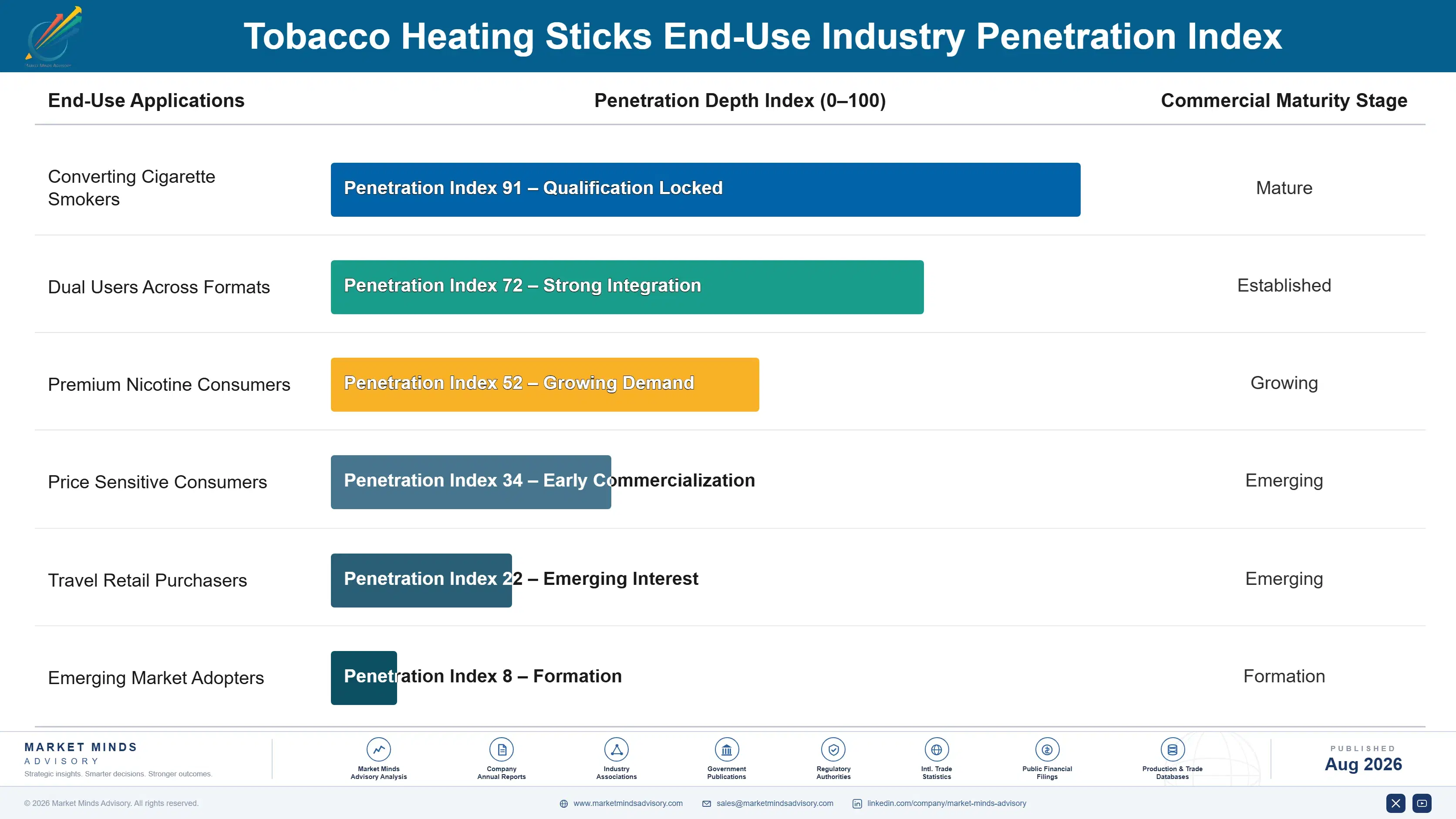
The buyer profile has shifted with geography rather than with time. Early adopters were converting cigarette smokers in permissive high-price markets who ran the arithmetic and switched. Growth now comes from markets where excise treatment makes the same arithmetic work, and stalls entirely wherever it does not. The consumer has barely changed and the tax code decides where they appear.
tobacco-heating-sticks-market-end-use-penetration-index-1788165845226

Where Manufacturers Should Commit

These are among the four positions where our research anticipates prominent divergence between winners and laggards over the coming forecast period. Each is grounded in the demand model, the regulatory perimeter, and the announced capacity pipeline.
01 / DEVICE PLACEMENT AGGRESSION

Hardware is an acquisition cost, not a product

A heater placed commits its owner to a compatible consumable range at 94% attachment for several years afterwards, which makes device acquisition cost an investment in future consumable revenue rather than any kind of loss on the hardware itself. Manufacturers pricing devices to recover their cost are optimising entirely the wrong line of the business entirely. Aggressive subsidy typically recovers within about seven months of consumable purchase, and the real constraint is balance sheet appetite rather than any commercial logic.
02 / GENERATION TRANSITION TIMING

The only moment a committed consumer looks around

An architecture transition is the single moment when a committed consumer genuinely reconsiders their choice, because their existing consumables all become obsolete anyway and the switching cost briefly disappears altogether for a while. Launching a new generation while a competitor's installed base sits mid-cycle intercepts consumers who would otherwise never once have looked at anything else. Transitions occur roughly every two and a half years, and the timing of them is a commercial decision rather than an engineering one entirely.
03 / TAXATION AUTHORITY ENGAGEMENT

You are lobbying the wrong government department

The excise differential of roughly 38% below cigarettes is set by national taxation authorities as revenue policy, and manufacturers who direct their entire regulatory effort at health departments are addressing quite the wrong government ministry entirely. Tax consultations are entirely public, scheduled and attended by remarkably few participants indeed from this particular industry at all. A differential preserved through a single budget cycle is worth considerably more to volume than any product launch this category has ever managed to produce.
04 / FORMAT BREADTH PROTECTION

Concentration looks efficient until a parliament votes

Flavour bans, capsule prohibitions and outright category prohibitions have all been enacted somewhere in the world already, and a manufacturer that is concentrated in one single format loses an entire market rather than merely part of one when any one of them finally arrives. Portfolio breadth across several nicotine formats costs real development spending and protects revenue that would otherwise disappear overnight on a legislative timetable nobody controls. At least three separate jurisdictions have already prohibited this whole category outright.

Engagement Snapshot From the Field

A live engagement with an industry participant carrying material or product regulatory and market exposure ahead of a defining policy shift, showing how our research translates into a defensible multi-year portfolio strategy.
MARKET MINDS ADVISORY · CLIENT ENGAGEMENT SUMMARY
Tobacco Heating Sticks Producer Strategic Portfolio Review and Transition Roadmap 2026·Investment Scenario on Tobacco Heating Sticks Exposure Evaluation 2025-26
CLIENT PROFILE
A tobacco manufacturer entering heated products in three markets, pricing devices to recover manufacturing cost and concentrating its consumable portfolio in capsule variants that performed strongly in consumer testing. Device placement was running well below plan while consumable trial rates among those who did buy a heater were excellent, and management could not reconcile the two findings.
STRATEGIC CHALLENGE
The board needed to establish whether device pricing was suppressing placement enough to matter, and whether concentrating in capsule variants created exposure it had not assessed. It also had to decide how to allocate regulatory affairs resource, which was directed almost entirely at health authorities while excise reviews in two of its three markets were proceeding without any input from the company.
MMA APPROACH
MMA modelled device subsidy against consumable lifetime value at observed attachment rates, and tested placement sensitivity to hardware price across the three markets. It mapped the client's portfolio against enacted and proposed flavour restrictions in every market it operates in. Expert interviews with retailers, distributors, taxation advisers and competing manufacturers established what actually drives placement and what regulators are considering next.
KEY FINDINGS
  1. Device price was the dominant barrier to placement in all three markets, and consumable lifetime value exceeded the full subsidy cost within roughly seven months of purchase.
  2. Competitors were subsidising hardware to roughly half the client's retail price and taking installed base steadily while the client protected a hardware margin worth very little.
  3. Capsule variants represented most of the client's consumable portfolio and were already prohibited or under active review in two of its three markets.
  4. Regulatory affairs resource was almost entirely allocated to health authorities, and neither excise review underway had received any submission from the company at all.
CLIENT PROFILE
A tobacco manufacturer entering heated products in three markets, pricing devices to recover manufacturing cost and concentrating its consumable portfolio in capsule variants that performed strongly in consumer testing. Device placement was running well below plan while consumable trial rates among those who did buy a heater were excellent, and management could not reconcile the two findings.
STRATEGIC CHALLENGE
The board needed to establish whether device pricing was suppressing placement enough to matter, and whether concentrating in capsule variants created exposure it had not assessed. It also had to decide how to allocate regulatory affairs resource, which was directed almost entirely at health authorities while excise reviews in two of its three markets were proceeding without any input from the company.
MMA APPROACH
MMA modelled device subsidy against consumable lifetime value at observed attachment rates, and tested placement sensitivity to hardware price across the three markets. It mapped the client's portfolio against enacted and proposed flavour restrictions in every market it operates in. Expert interviews with retailers, distributors, taxation advisers and competing manufacturers established what actually drives placement and what regulators are considering next.
KEY FINDINGS
  1. Device price was the dominant barrier to placement in all three markets, and consumable lifetime value exceeded the full subsidy cost within roughly seven months of purchase.
  2. Competitors were subsidising hardware to roughly half the client's retail price and taking installed base steadily while the client protected a hardware margin worth very little.
  3. Capsule variants represented most of the client's consumable portfolio and were already prohibited or under active review in two of its three markets.
  4. Regulatory affairs resource was almost entirely allocated to health authorities, and neither excise review underway had received any submission from the company at all.
RECOMMENDED STRATEGY
Phase 1: Phase one: cut device pricing below manufacturing cost and fund the subsidy against modelled consumable lifetime value rather than hardware margin. Phase 2: Phase two: broaden the consumable portfolio away from capsule concentration before restrictions under active review come to be actually enacted. Phase 3: Phase three: reallocate regulatory affairs resource toward taxation authorities and submit evidence to both of the excise reviews now currently underway.
OUTCOME
The client reported device placement roughly tripling within four quarters after the pricing change was made (client-reported, unverified by MMA). Consumable revenue followed the placement growth closely. Portfolio breadth increased well ahead of one restriction taking effect, and submissions were filed to both of the excise reviews underway.

Frequently Asked Questions

Foundational context covering the market sizes, CAGR, scope, country, region and competition that inform every finding below. This section is provided to cover basics and most often pre-purchase conversations, answered from the MMA Primary Research Dataset.

What is the current size of the Tobacco Heating Sticks Market?

The market is valued at USD 38.0 billion in 2025, measured as revenue from consumable tobacco sticks and the heating devices sold to enable their use.

How large will the Tobacco Heating Sticks Market be by 2036?

MMA forecasts USD 94.17 billion by 2036, up from USD 41.27 billion in 2026. That represents incremental revenue of USD 52.90 billion and an expansion multiple of 2.28 times.

What is the CAGR for the Tobacco Heating Sticks Market 2026 to 2036?

The base case CAGR is 8.6%, with a bull case of 9.9% and a bear case of 7.3%. Installed device base growth supplies the largest part of that growth.

Which segment is growing fastest?

Induction and bladeless heating consumables grow at 12.9%, half again the market rate of 8.6%, because a new device architecture resets consumable compatibility across the installed base.

Who are the major companies in the Tobacco Heating Sticks Market?

Philip Morris International, British American Tobacco, Japan Tobacco International, KT&G and Imperial Brands lead on consumable revenue, holding around 88% between them across global consumable revenue.

Which country is growing fastest?

India grows fastest at 10.8% in percentage terms, though from a base heavily restricted by prohibition, with genuine volume growth concentrated in Southeast Asian markets instead.

Report Segmentation Architecture

The full report scope spans multiple orthogonal segmentation dimensions, with cross-tabulated demand data provided for each dimension pair. Coverage extends further to regional breakdowns, trend trajectories, and the competitive detail needed to support segment-level decision-making.

By Consumable Architecture

  • Blade-Heated Stick Consumables
  • Induction and Bladeless Heating Consumables
  • Carbon-Tip Heated Products
  • Capsule and Flavour-Release Variants
  • Reduced-Tobacco and Hybrid Inserts
  • Heating Devices and Accessories

By End-Use Industry

  • Converting Cigarette Smokers
  • Dual Users Across Formats
  • Premium Nicotine Consumers
  • Price Sensitive Consumers
  • Travel Retail Purchasers
  • Emerging Market Adopters

By Commercial Dimension

  • Tobacco Retail Distribution
  • Branded Specialist Stores
  • Online Direct Sales
  • Travel Retail Channels
  • Convenience And Grocery
  • Contract Manufacture Supply

By Region

  • East Asia
  • Western Europe
  • Eastern Europe
  • South Asia and Pacific
  • Middle East and Africa
  • North America
  • Latin America

Scope, Methodology, and Coverage

Every figure in this report is reproducible from documented input assumptions. The scope below maps the historical period, the forecast horizon, the segmentation dimensions, and the countries covered, alongside the underlying primary and qualitative methodology.
Historical Period
2020 to 2025
Forecast Period
2026 to 2036
Base Year
2025 (USD billions; MMA Primary Research Dataset, August 2026)
Market Definition
Revenue from consumable tobacco sticks and inserts designed for use in electrically heated tobacco devices, spanning blade-heated stick consumables, induction and bladeless heating consumables, carbon-tip heated products, capsule and flavour-release variants, reduced-tobacco and hybrid inserts, and the heating devices sold to enable their use. Tobacco retail distribution, branded specialist stores, online direct sales, travel retail, convenience and grocery channels and contract manufacture supply are all included. Conventional combustible cigarettes, electronic cigarettes and vaping liquids containing no tobacco leaf, oral nicotine pouches, and pharmaceutical nicotine replacement products are excluded.
Quantitative Units
USD billions, consumable and device revenue at manufacturer level
Segmentation Dimensions
Consumable architecture, consumer type, distribution channel, region
Regions Covered
East Asia, Western Europe, Eastern Europe, South Asia and Pacific, Middle East and Africa, North America, Latin America
Countries Covered
Japan, South Korea, China, Italy, Germany, United Kingdom, Poland, Romania, Russia, Philippines, Indonesia, United Arab Emirates, United States, Mexico
Key Companies Profiled
Philip Morris International, British American Tobacco, Japan Tobacco International, KT&G, Imperial Brands, Altria Group, Smoore International, Ispire Technology, Turning Point Brands, China Tobacco
Quantitative Methodology
Primary survey, n=3,800 respondents, Q4 2025, six countries; demand-side model with trade association cross-validation
Qualitative Methodology
47 expert interviews, Q4 2025; applied to validate demand model assumptions, identify emerging dynamics, and assess competitive positioning
Report Format
PDF and XLSX data workbook (Word format preview document)
Publisher
Market Minds Advisory
Report Code
MMA-2026-AGR-131
Published
August 2026
Contact
sales@marketmindsadvisory.com | www.marketmindsadvisory.com

Purchase the full Tobacco Heating Sticks Market Report (2026 to 2036).

The full report treats this as the razor and blade business it actually is, with a tax policy sitting on top that decides most of the outcome. It quantifies device subsidy against consumable lifetime value at observed attachment rates, maps excise differentials across every commercially significant market, and assesses architecture transitions as the only competitive openings the category provides. Segment analysis covers all six consumable architectures, with particular attention to induction products where the current transition and the growth both sit. Competitive assessment ranks twenty participants on heated tobacco consumable revenue.
Six consumable architecture segmentation with growth rates
Device subsidy modelled against consumable lifetime value
Twenty participant assessment on heated consumable revenue
Excise differentials mapped across commercially significant markets
Architecture transition windows identified by device generation
Regulatory restriction exposure assessed by portfolio format

Built For The People Who Decide

From boardroom strategy to bench-side execution, this report is read cover-to-cover by leaders shaping the next decade of their industry, turning demand scenarios, market dynamics and valuation benchmarks into decisions.
CXOs/ Presidents/ VPs/ Managers
M&A and Corporate Development
Strategy Teams and R&D Heads
Procurement and Product Directors
Regulatory and Compliance Leaders
Investor Relations and Equity Analysts