Market Minds Advisory
Hand Geometry Biometrics Market

Hand Geometry Biometrics Market: Hand Geometry Biometrics Market. Contactless Access Control Renews Demand for Physical Traits

Facility security managers wary of fingerprint hygiene concerns and biased facial recognition outcomes are turning back to hand geometry scanners fast enough to revive a technology many vendors had quietly written off years earlier.

Lead Analyst

Published

September 2026

Make Smarter Decisions with Customized Research Insights

Request a free sample report and evaluate market opportunities, growth trends, and competitive dynamics relevant to your business needs.

2025 MARKET VALUE$0.7BMarket Size 2025
2036 FORECAST VALUE$1.7BBase Case , 2026 to 2036
CAGR 2026 TO 20368.5 %Bull 9.8% / Bear 7.2%
INCREMENTAL OPPORTUNITY$1.0BNet 10- year value creation
EXPANSION MULTIPLE2.26x2036 value over 2026 base
Strategic Levers
M&A Pipeline
Regional Outlook
Country Rankings
Competitive Intelligence
Segmental Deep-dive
Call-Us : 91 93563 13602

Executive Snapshot and Market Trajectory.

Facility security managers are reconsidering hand geometry scanners as fingerprint hygiene concerns and facial recognition bias controversies push organizations toward a physical trait that avoids both problems entirely at the access control point. This shift is reshaping procurement criteria across government and industrial facilities alike.
Government facilities and border control checkpoints are pulling procurement budget toward hand geometry systems as agencies seek contactless alternatives that sidestep facial recognition's regulatory scrutiny, and South Asian government deployments are adopting the technology fastest as national identity programs expand enrollment infrastructure. Time and attendance applications in manufacturing and logistics facilities are separately driving demand as employers seek a durable, low-maintenance alternative to fingerprint readers that struggle with dirty or gloved hands on factory floors.
A small number of legacy vendors still dominate hand geometry hardware contracts given the niche nature of the technology, but newer entrants are combining hand geometry with vein pattern recognition to differentiate from pure fingerprint and facial alternatives, changing who counts as a credible competitor. Data privacy regulations governing biometric enrollment are forcing vendors to navigate a genuinely more complex compliance landscape than the technology faced during its original adoption wave.
Market Definition
This report covers hardware and software systems that authenticate individuals using the geometric measurements of the hand, including palm and finger dimensions, for physical access control and time and attendance applications, measured on a global unit and revenue basis. It excludes fingerprint, facial, and vein pattern recognition systems that do not rely on overall hand geometry measurement.
Base Year Value
$0.7B in 2025 (MMA Primary Research Dataset, September 2026)
Forecast Period
2026 to 2036, eleven discrete annual values
CAGR
8.5% base case. Bull 9.8%. Bear 7.2%.
Fastest Growth Segment
Contactless Hand Geometry Scanners: 11.5% CAGR
Fastest Growth Country
India: 12.0% CAGR
Fastest Growth Region
South Asia and Pacific: 10.8% CAGR
Largest Region
North America: 32% of 2025 global value
Market Leaders
Schlage (Allegion), Ingersoll Rand, Suprema, ZKTeco, Identiv
Primary Survey
n=3,800 procurement and R&D decision-makers, Q4 2025, six countries
Methodology
Demand-side build-up, cross-validated against public data, 47 expert interviews

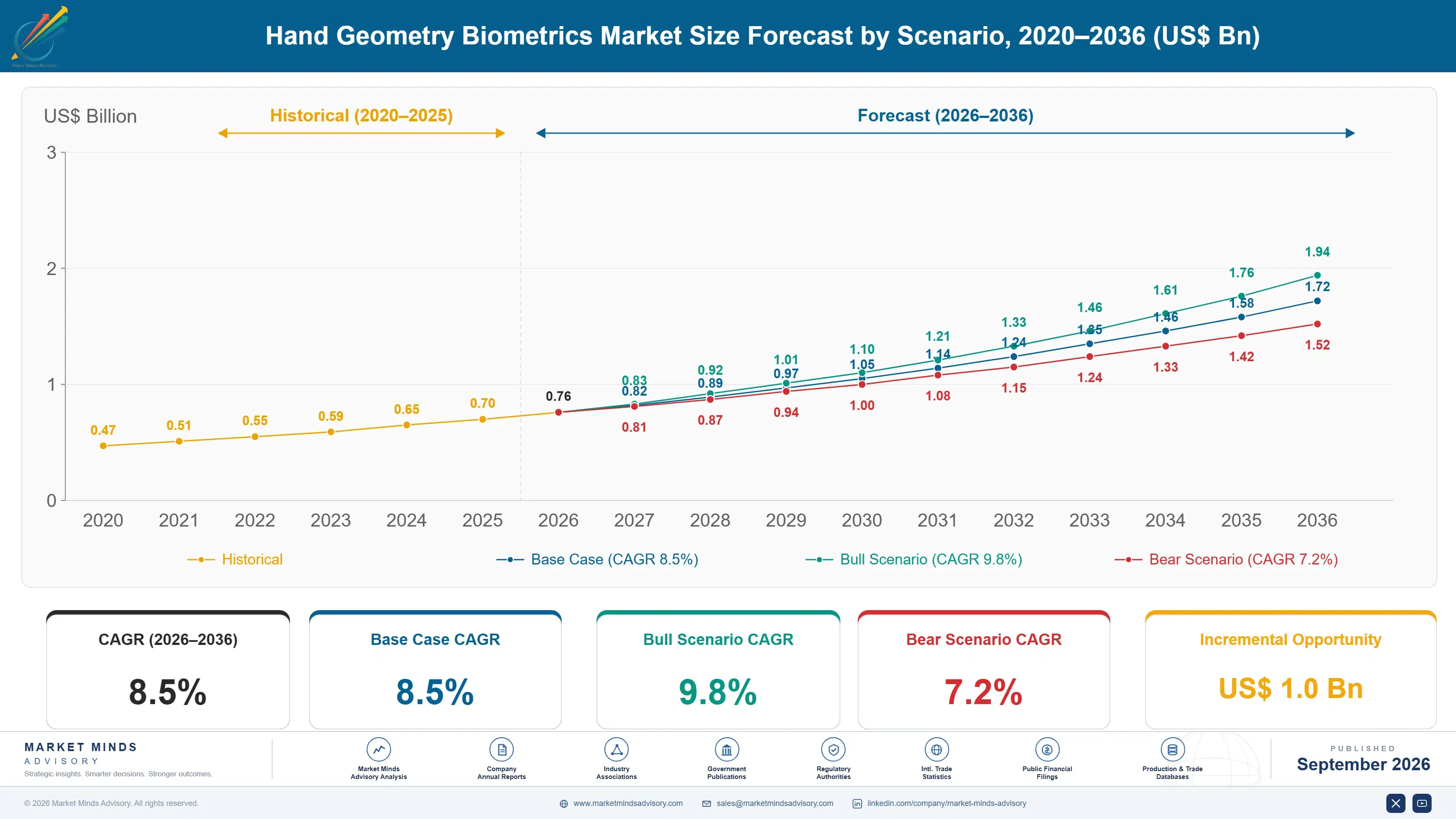
Hand Geometry Biometrics Market Forecast Scenarios

hand-geometry-biometrics-market-size-forecast-scenario-1788419050304
Between 2020 and 2025 the hand geometry biometrics market grew at roughly 7.5 percent annually as pandemic-era hygiene concerns pushed some facilities away from touch-based fingerprint readers toward alternatives, though hand geometry itself still requires hand placement on a reader surface. Growth accelerated once vendors introduced contactless variants that eliminated the direct surface contact concern entirely.
The base case assumes continued steady expansion as three commercial mechanisms compound: government identity and border control programs extend hand geometry enrollment to a wider tier of facilities beyond initial pilot deployments, manufacturing and logistics employers replace fingerprint-based time and attendance systems that struggle with dirty or gloved hands, and vendors bundle contactless scanning capability into standard product lines rather than offering it as a premium option. Manufacturers respond by consolidating around contactless designs as the new baseline product configuration.
The bull case centers on facial recognition regulatory restrictions in multiple jurisdictions accelerating a shift back toward hand geometry as a less controversial biometric modality. The bear case centers on vein pattern and iris recognition technologies continuing to erode hand geometry's niche, capturing budget that might otherwise have gone toward hand geometry hardware upgrades and replacements.

Hand Geometry Repositions as Bias-Resistant, Not Legacy

Hand geometry vendors are no longer selling a niche legacy access control device, they are selling a contactless, bias-resistant authentication alternative, and that shift is rewriting who counts as a credible supplier to government and industrial buyers. A vendor without a redesigned contactless product line cannot win a contract that now requires demonstrating hygiene-conscious sensing technology.
MARKET CONCENTRATION58% CR5Top five vendors hold most global hardware revenue share
AVERAGE UNIT PRICE$1,800 per contactless scannerPrice varies widely between legacy and contactless unit designs
TOP DEPLOYMENT COUNTRY SHAREUnited States, 28% of installed baseSingle country accounts for largest share of installed scanner units
CONTACTLESS PENETRATION35% of new unit shipmentsShare of new scanners shipped using contactless design
GOVERNMENT SECTOR REVENUE SHARE42% of total market revenuePortion of revenue derived from government and border control deployments
AVERAGE UNIT SERVICE LIFEEight years per hardware generationTypical interval between major scanner hardware replacement cycles industry-wide
Vendors that historically sold touch-based scanners are being squeezed out unless they redesign around contactless sensing, since buyers increasingly demand hygiene-conscious hardware rather than accepting legacy touch-surface designs that dominated the technology for decades. Several smaller vendors have already exited direct enterprise sales entirely, choosing instead to sell licensing rights to their sensor technology to larger integrators who already own the customer relationship.
Vein pattern and iris recognition vendors are competing directly for the same bias-resistant, contactless positioning that hand geometry occupies, creating a market where hand geometry's traditional niche is no longer uncontested by adjacent biometric modalities. Buyers increasingly evaluate vendors on enrollment speed and false rejection rate almost as closely as unit cost, a criterion that barely mattered in procurement decisions a decade ago when hand geometry's main competition was fingerprint readers alone.
"This technology never actually left, it just stopped being anyone's first choice. Now the reasons everyone moved away from it are the reasons some buyers are coming back."
Practice Lead, Physical Security and Access Control · MMA Biometric Authentication Hardware and Access Control Technology Practice · September 2026

Market Trends

Facial Recognition Restrictions Drive Renewed Hand Geometry Interest

Multiple jurisdictions have enacted restrictions or outright bans on facial recognition in public and workplace settings following concerns over demographic bias and consent, pushing security buyers toward alternative biometric modalities that avoid similar regulatory scrutiny. Over 15 major cities and several states have restricted facial recognition use in government facilities, creating a direct procurement opening for hand geometry vendors who can position their technology as a lower-controversy alternative. This regulatory dynamic is reshaping vendor sales pitches toward compliance positioning rather than pure technical performance comparisons. Vendors emphasizing this angle in marketing materials report stronger conversion rates among government prospects.
Market Impact: Over 1.3 billion enrollments processed
Contactless Redesign Becomes Standard Product Configuration

Vendors across the hand geometry category have redesigned flagship products around contactless three-dimensional scanning rather than the traditional touch-surface pin placement design that defined the technology for decades. Contactless units now represent 35 percent of new shipments, up sharply from a negligible share just five years ago, and vendors increasingly discontinue touch-based product lines entirely rather than maintaining both designs in parallel. This redesign has effectively reset the competitive landscape, rewarding vendors who invested early in contactless sensing research. Vendors slow to complete this transition risk losing shelf space with major systems integrators entirely.
Market Impact: Saves up to 3 percent cost

Market Opportunities and Growth Drivers

National Identity Programs Expand Enrollment Infrastructure

Government national identity programs, particularly in South Asia, are extending biometric enrollment infrastructure to hundreds of millions of citizens, with hand geometry serving as one of several accepted modalities alongside fingerprint and iris scanning. India's Aadhaar-linked enrollment infrastructure alone has processed over 1.3 billion registrations, creating a massive base installation opportunity for biometric hardware vendors across all accepted modalities including hand geometry. This scale of government deployment provides a durable revenue base distinct from the more cyclical commercial access control market. Vendors positioning hardware for large-scale government programs increasingly design for rapid, low-cost mass deployment.
Market Impact: Greenfield deployments fell over 40 percent

Manufacturing Labor Shortages Drive Time and Attendance Upgrades

Manufacturing and logistics employers facing persistent labor shortages are upgrading time and attendance systems to reduce buddy punching fraud and improve payroll accuracy, since even small per-employee time theft compounds meaningfully across large hourly workforces. Hand geometry systems tolerate dirty, gloved, or worn hands better than fingerprint readers common in these environments, giving it a durable niche in industrial settings. Employers report payroll accuracy improvements worth several percentage points of total labor cost after switching from manual or fingerprint-based systems. Employers report these gains translate into a payback period of under two years for the hardware investment.
Market Impact: Lead times can extend 6 months

Market Restraints and Challenges

Declining Enrollment Base Limits Vendor Investment Incentive

New facility deployments increasingly default to facial or mobile-based authentication rather than dedicated hand geometry hardware, shrinking the pool of greenfield opportunities that justify continued vendor research and development investment in the technology. The root cause is that newer biometric modalities require no dedicated hardware at all when built into existing smartphones or cameras already present in most facilities. This forces hand geometry vendors to compete primarily for replacement and niche industrial deployments rather than new greenfield contracts. Vendors are mitigating this by focusing research investment narrowly on the contactless and hygiene-conscious positioning where hand geometry retains a genuine advantage.
Market Impact: Over 15 cities restrict facial recognition

Component Supply Concentration Limits Manufacturing Flexibility

Three-dimensional imaging sensors used in contactless hand geometry scanners depend on a small number of specialized component suppliers, a concentration that limits manufacturing flexibility during periods of component shortage. The underlying cause is that the hand geometry market is too small to support multiple competing sensor supply chains the way larger biometric categories like fingerprint sensors can. This forces vendors to accept longer lead times during shortage periods without the leverage to negotiate priority allocation. Vendors are mitigating this by qualifying adjacent-industry sensor suppliers originally designed for other three-dimensional scanning applications.
Market Impact: 35 percent of shipments now contactless
3 additional market trends, 4 additional growth drivers, and 3 additional restraints and challenges are covered in the full report. Contact sales@marketmindsadvisory.com to access the complete intelligence.

Segment CAGR and Growth Architecture

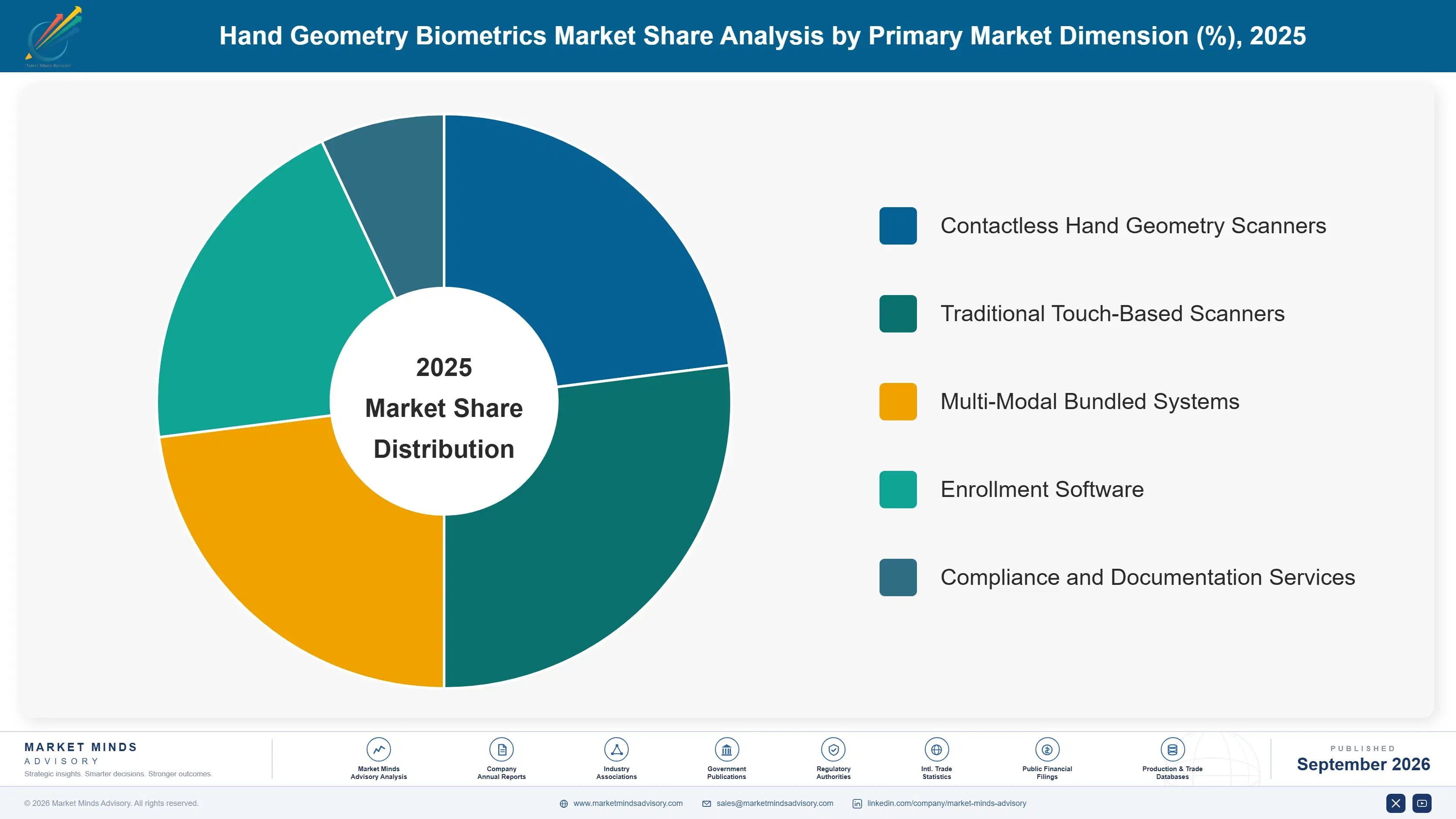
The hand geometry biometrics market splits across five technology-defined segments spanning sensing method, application, and enrollment channel used across government and industrial deployments. Contactless hand geometry scanners lead growth as hygiene concerns reshape procurement decisions worldwide, while traditional touch-based scanners still represent the largest installed base by unit count across older facility deployments globally.
hand-geometry-biometrics-market-market-share-analysis-1788419050833

Contactless Hand Geometry Scanners

Contactless hand geometry scanners use three-dimensional imaging to measure hand shape without requiring the user to touch a surface or pin placement guide, addressing hygiene concerns that emerged prominently following widespread public health awareness of surface contact transmission. This format has become the default choice for new deployments across government and healthcare facilities where hygiene considerations carry particular weight in procurement decisions. Growth here outpaces every other segment because virtually every vendor has redirected new product development toward this format, effectively phasing out meaningful investment in touch-based alternatives. Vendors that completed this transition earliest are now capturing the largest share of new government and healthcare facility contracts available anywhere today.
CAGR 11.5%

Traditional Touch-Based Scanners

Traditional touch-based scanners remain the largest segment by installed unit count, covering the pin-guided hand placement design that has defined the technology since its commercial introduction decades ago. This hardware base predates the current contactless transition and continues operating reliably across industrial and older government facilities that have not yet reached scheduled replacement cycles. Growth here is essentially flat to declining since virtually no new deployments choose this format, with remaining revenue tied almost entirely to maintenance, spare parts, and replacement of failed units within existing installed systems. Vendors serving this segment increasingly operate as maintenance and support specialists rather than active product developers pursuing genuinely new hardware sales opportunities.
CAGR 2.0%
Full segment breakdown across 6 segments available in the complete report.

Regional Architecture and Country Demand Map

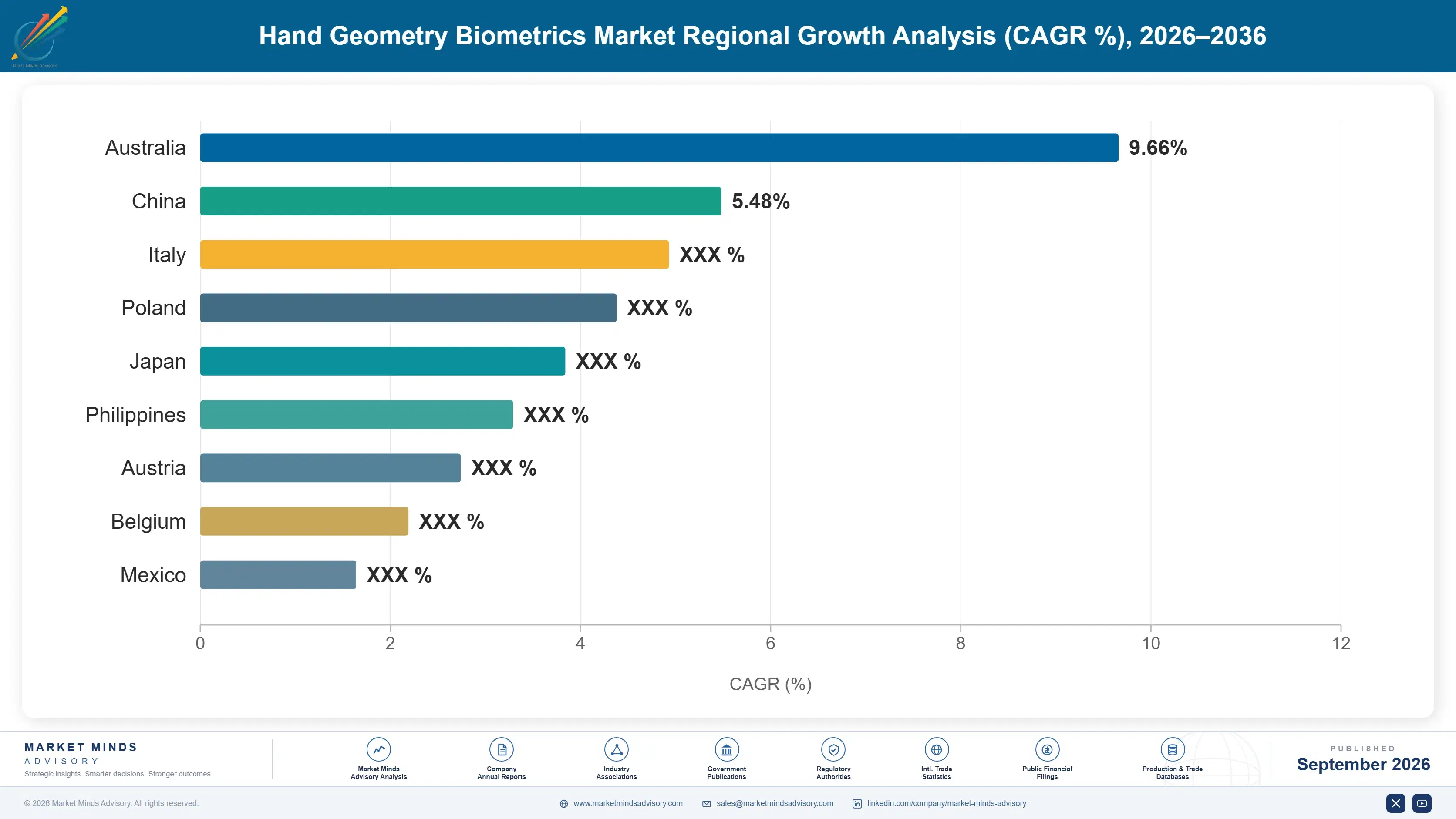
North America leads global hardware revenue on the strength of its large existing installed base and key vendor headquarters concentration, while East Asia holds a strong secondary share tied to regional manufacturing and government deployment. South Asia and Pacific grows fastest as India expands biometric enrollment infrastructure.

North America

Vendor headquarters concentration defines North America's share more than raw new deployment volume alone. Allegion, Ingersoll Rand, and Identiv all book the majority of their global hand geometry revenue through United States entities, reinforced by the largest existing installed base of government and industrial facilities deployed over several prior decades. Federal government facilities continue representing a meaningful replacement and upgrade market as older touch-based units reach end of service life. Canada's smaller facility base follows a similar adoption pattern, though concentrated among a handful of major government and industrial operators. Insurance and liability considerations at large industrial employers also continue favoring biometric time tracking over manual paper-based systems entirely. reliably.
Share: 32% | CAGR: 9.0% (2026 to 2036)

Western Europe

Western Europe's growth trails the global rate mainly because the region's facial recognition regulatory restrictions, while creating some tailwind for hand geometry, are offset by a broader industry preference for fingerprint and card-based systems already deeply embedded in existing facility infrastructure. Germany's manufacturing sector continues using hand geometry time and attendance systems at older industrial facilities that have not prioritized full system replacement. The United Kingdom's data protection framework continues shaping vendor compliance requirements for biometric enrollment data handling across all deployed modalities. France and the Nordic countries are following a more gradual adoption path, tied to their smaller overall industrial facility base relative to Germany. Spain follows a similar gradual path.
Share: 19% | CAGR: 7.0% (2026 to 2036)
Regional intelligence for 5 additional markets available in the complete report: East Asia, South Asia and Pacific, Latin America, Middle East and Africa, Eastern Europe. Contact sales@marketmindsadvisory.com.
hand-geometry-biometrics-market-country-cagr-analysis-1788419051353

Where Hand Geometry Vendors Can Still Add Margin

Commoditizing hardware and a shrinking greenfield pipeline are pushing vendors toward adjacent revenue lines that ride on top of the same facility relationship rather than the scanner unit sale itself. Four levers stand out as genuinely additive to core revenue rather than cannibalistic of it, each drawing on capability the vendor already has in-house.

Offering Multi-Modal Biometric Bundling With Vein Recognition

Vendors that combine hand geometry with vein pattern recognition in a single unit can charge a premium for the added assurance layer, capturing customers who want stronger anti-spoofing protection without switching to an entirely different biometric modality. This bundling extends the useful life of hand geometry hardware by pairing it with a complementary technology rather than facing outright replacement pressure. Vendors offering this capability command price premiums running roughly 20 to 30 percent above standard single-modality unit pricing. Building this dual-sensor integration requires engineering investment most single-modality manufacturers historically never developed internally.
Market Impact: Adds 20 to 30 percent price premium overall

Providing Compliance Documentation Services for Biometric Data

Vendors with expertise navigating biometric data privacy regulations can offer compliance documentation services to facility operators who must demonstrate proper enrollment data handling under increasingly strict regulatory frameworks. This service converts a growing compliance burden into an integrated revenue line rather than leaving facility operators to manage a separate legal consulting relationship. Vendors offering this capability report service fees reaching 6 to 10 percent of the total hardware contract value annually. Regulatory complexity varies significantly by jurisdiction, adding overhead that smaller compliance-only consultancies rarely absorb easily. each time. each time routinely.
Market Impact: Service fees reach 6 to 10 percent share

Selling Extended Maintenance Contracts for Legacy Installations

Vendors that maintain spare parts inventory and technical support for legacy touch-based scanners can charge premium maintenance fees to facility operators unwilling to replace still-functioning older hardware, capturing recurring revenue from an installed base that otherwise generates no further unit sales. This service has proven especially valuable to government facilities with lengthy budget approval cycles that make hardware replacement genuinely difficult to schedule quickly. Vendors offering this report maintenance fees adding roughly 15 to 20 percent of original hardware value annually. Vendors that build this maintenance-first business line increasingly outlast competitors focused purely on new unit sales.
Market Impact: Maintenance fees add 15 to 20 percent yearly

Offering Enrollment-as-a-Service for Large-Scale Government Programs

Vendors that build dedicated mobile enrollment teams can serve large government identity programs needing to process enrollment across dispersed rural and urban populations rapidly, capturing service revenue beyond the pure hardware sale itself. This capability has proven especially valuable to government programs facing tight enrollment deadlines tied to national identity rollout schedules. Subscription-style enrollment service contracts running multiple years are now achievable for vendors with sufficient mobile deployment capacity and trained enrollment staff. Building this mobile enrollment capability requires logistics expertise most hardware-only manufacturers historically never developed. Vendors report throughput exceeding 500 registrations daily per mobile team at scale.
Market Impact: Contracts typically span 3 to 5 full years

Who Controls the Margin Pool

Global hardware revenue concentrates heavily, with the top five vendors together holding roughly 58 percent share on a unit revenue basis, the consistent yardstick applied throughout this assessment. Allegion and Ingersoll Rand sit well ahead of the next tier, backed by decades of access control integrator relationships that newer entrants cannot easily replicate. The gap between these leaders and mid-tier challengers remains wide enough that near-term ranking changes at the top look unlikely.
Current activity centers on contactless redesign and multi-modal bundling rather than pure price competition on legacy touch-based hardware. Vendors are racing to complete contactless product transitions across their full catalogs simultaneously, since facility operators increasingly refuse to purchase touch-surface designs regardless of price. Several mid-tier players have pursued vein pattern recognition partnerships specifically to differentiate from pure hand geometry competitors.

Emerging pressure comes from vein pattern and iris recognition vendors competing directly for hand geometry's bias-resistant, contactless positioning. Ranking shifts are most likely in the mid-tier, where vendors lacking contactless product lines risk losing contracts to faster-moving specialists. The very top of the market remains comparatively stable, protected by scale and integrator relationships built over decades.
hand-geometry-biometrics-market-company-positioning-matrix-1788419051881

Competitive Moat and Risk Dimensions

ALLEGION

Moat: Broad Access Control Integrator Network

Allegion's Schlage brand holds deep relationships across security integrators and installers who specify hand geometry alongside its broader access control product catalog, letting it bundle sales rather than compete on hardware alone. This breadth reduces sales cycle length considerably for large facility contracts. Facility operators rarely rip out an integrator relationship this extensive once it is running smoothly.
ALLEGION

Risk: Limited Contactless Innovation Pace

Allegion's broad access control portfolio means hand geometry receives less dedicated research investment than specialist competitors focused purely on biometric hardware, risking share loss on the most technically demanding contactless contracts requiring the newest sensing technology. Closing this gap would require Allegion to dedicate more resources specifically to hand geometry rather than the broader catalog.
SUPREMA

Moat: Deep Multi-Modal Biometric Expertise

Suprema's origins in fingerprint and facial recognition give it multi-modal engineering depth that pure hand geometry specialists struggle to match, letting it bundle complementary biometric modalities into a single integrated product line. This cross-modality engineering capability becomes more valuable as customers increasingly demand bundled biometric solutions.
SUPREMA

Risk: Narrower North American Market Presence

Suprema's revenue concentration in Asian markets leaves it less established in North America than Allegion and Ingersoll Rand, limiting its ability to compete for the region's largest government and enterprise facility contracts currently. Building this presence would require years of new integrator relationship development that Suprema has only recently begun.

Players Tracked

Prominent Players

Schlage (Allegion)
Ingersoll Rand
Suprema
ZKTeco
Identiv

Other Key Players

HID Global
Bosch Security Systems
Honeywell Security
Bio-key International
Fulcrum Biometrics
Anviz Global
Invixium
Idemia Public Security
Nedap Security
Aware Inc.
Iris ID Systems
Cognitec Systems
Gunnebo Security
Kaba Group
Assa Abloy

Recent Developments

JANUARY 2026

Allegion Launches Multi-Modal Hand and Vein Scanner

Allegion launched a new combined hand geometry and vein pattern recognition scanner targeting government and healthcare facilities seeking stronger anti-spoofing assurance beyond single-modality biometric authentication currently available in the market. The product entered commercial availability first for existing enterprise customers before a broader market rollout.
Signal: Multi-modal bundling is becoming a standard product strategy rather than a premium niche differentiator industry-wide. broadly.
SEPTEMBER 2025

Suprema Wins Government Enrollment Contract in India

Suprema secured a large-scale enrollment hardware contract tied to a government identity program in India, expanding its presence in a market central to the region's fastest-growing biometric hardware demand and enrollment infrastructure buildout. Financial terms of the multi-year contract were not disclosed by either party involved.
Signal: Government identity programs are becoming a primary channel for winning meaningful biometric hardware volume overall today.
APRIL 2025

Identiv Acquires Compliance Consulting Firm

Identiv completed the acquisition of a smaller biometric data compliance consulting firm, adding regulatory documentation capability to its existing hardware portfolio rather than referring compliance-focused customers to third-party consulting partners. The acquisition closed for an undisclosed sum earlier this year according to public regulatory filings.
Signal: Vertical integration into compliance services is becoming a competitive necessity for biometric hardware vendors broadly. today.

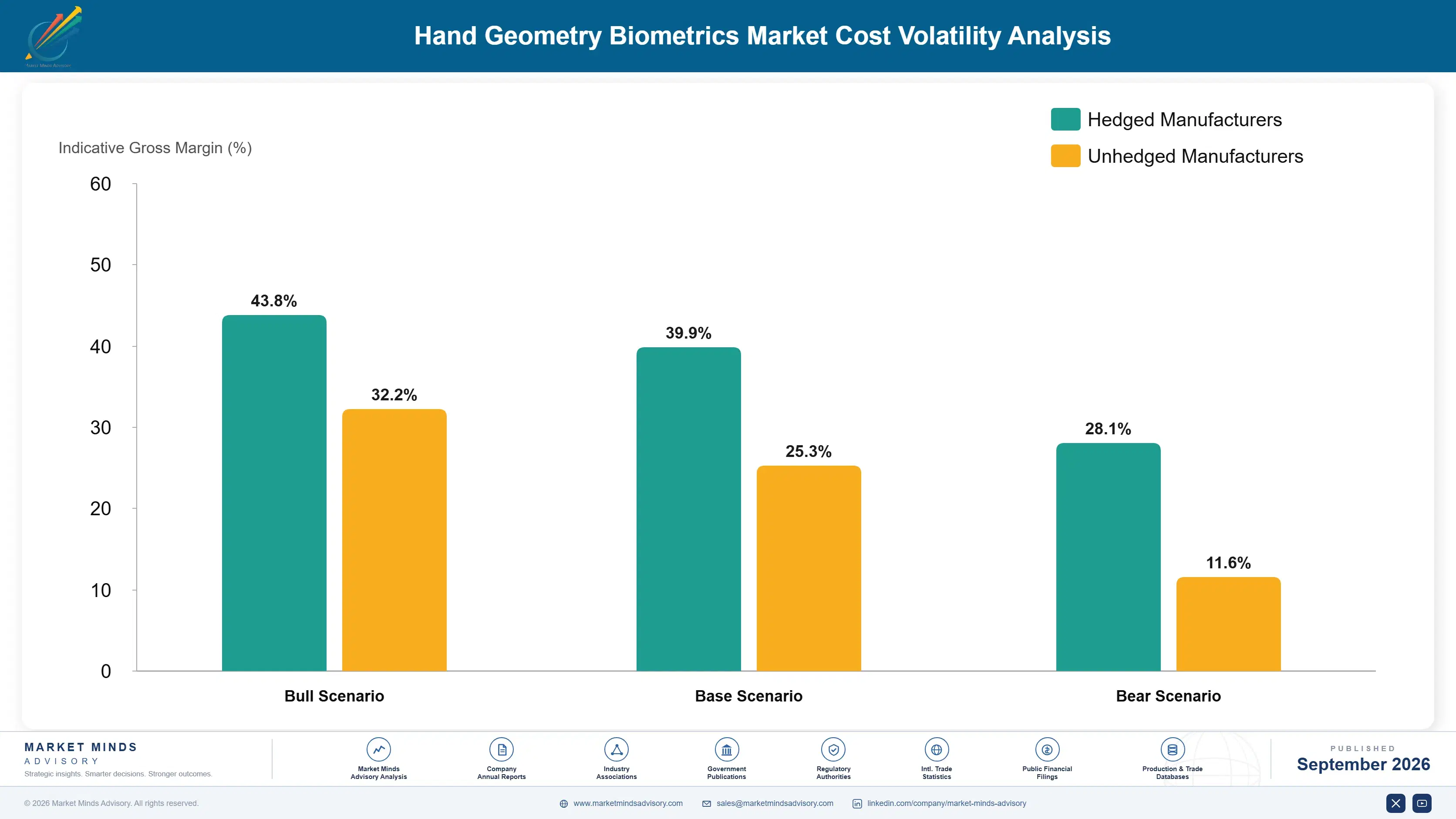
Sensor Component and Compliance Cost Exposure

Three-dimensional imaging sensors and specialized optics account for roughly 30 to 38 percent of a typical hand geometry scanner's cost of goods sold, sourced primarily from specialized component suppliers in South Korea, Japan, and the United States. Enclosure materials and processing electronics add a further 18 to 22 percent, sourced from a mix of established hardware manufacturing supply chains.
A 2022 optical sensor component shortage, documented in Allegion's 2022 annual report as a material supply constraint, delayed contactless scanner production for several government customers across multiple quarters. Identiv's 2023 annual report similarly cited component sourcing challenges as a driver behind its decision to qualify additional optical component suppliers rather than depending on a single source. These renegotiations became a recurring supply chain planning exercise across the broader hand geometry manufacturing category.

Smaller vendors face a genuine disadvantage here because they lack the purchasing volume to secure priority component allocation during shortage periods, unlike larger competitors with long-term supply agreements. Vendors based in regions without domestic optical component fabrication face additional exposure, since they must compete globally for the same limited specialized sensor supply. This dynamic particularly affects vendors headquartered outside major optical component manufacturing hubs.
hand-geometry-biometrics-market-cost-volatility-analysis-1788419052077

Dual-Sourcing Optical Sensor Components

Vendors are increasingly qualifying two or more optical component suppliers for critical scanner elements so a single-source shortage cannot halt production. This adds validation cost but has become close to standard practice among vendors shipping meaningful volume. Vendors serving government contracts increasingly treat dual-sourcing as a contractual requirement rather than an optional engineering choice made independently.

Long-Term Component Purchase Agreements

Locking in multi-year purchase commitments with optical component suppliers secures priority allocation during shortage periods and more predictable unit pricing, trading flexibility for supply security that smaller vendors without scale often cannot negotiate. This approach requires substantial upfront capital commitment years ahead of actual production need, a tradeoff favoring well-capitalized vendors over smaller rivals.

Modular Sensor Design for Component Substitution

Designing scanners with modular sensor slots lets vendors substitute an alternate optical component without a full hardware redesign when a shortage hits, reducing the lead time needed to requalify a new component under supply pressure. This design approach adds modest upfront engineering cost but pays back quickly the first time a shortage forces a rapid supplier switch.

Portfolio Architecture for Margin Defence

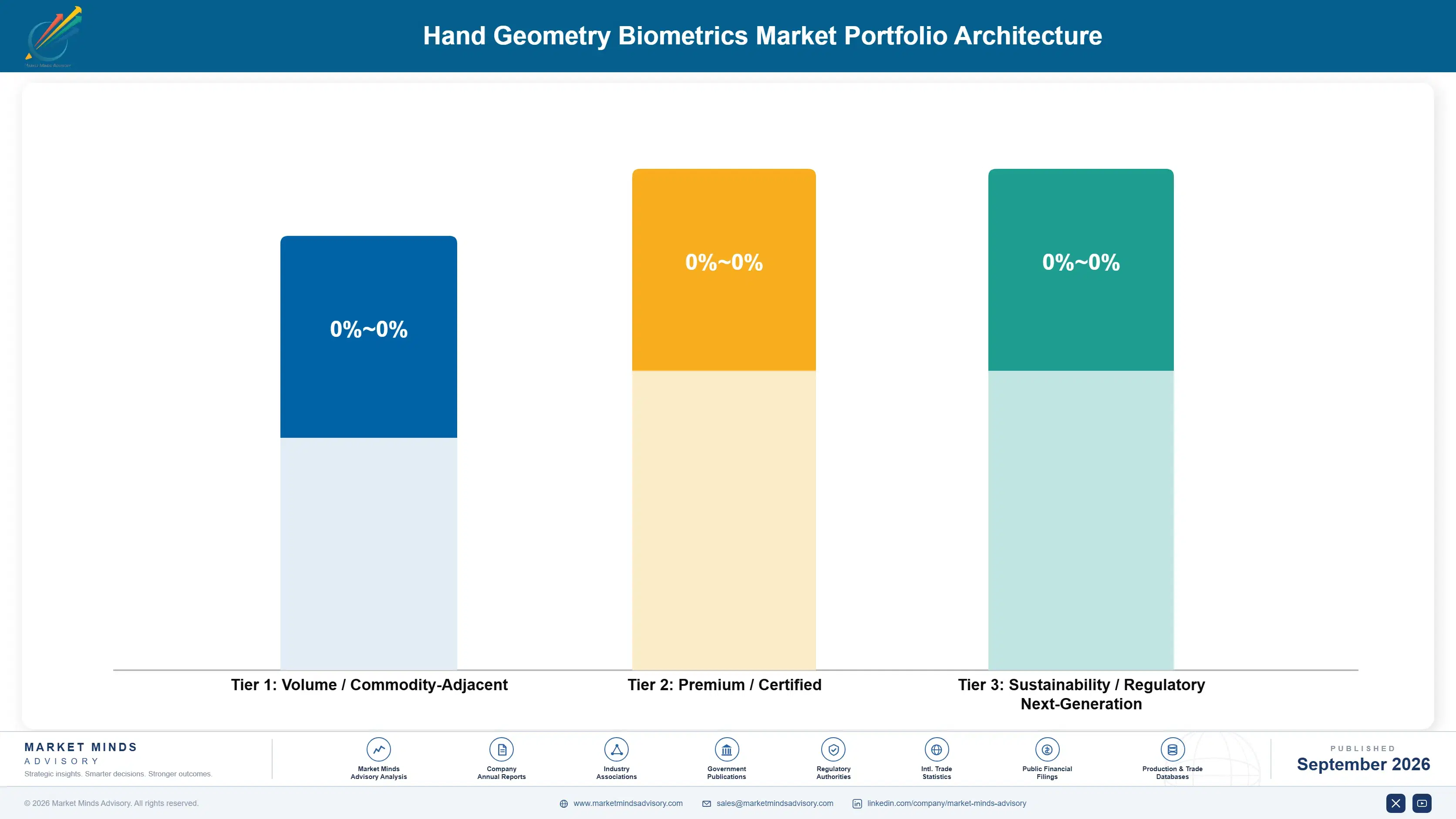
Hand geometry vendors operate across a widening tier structure as legacy touch-based hardware commoditizes and higher-margin multi-modal and compliance services concentrate pricing power elsewhere in the stack. Volume-tier legacy scanners now carry gross margins compressed by shrinking demand, while premium contactless and multi-modal platforms retain meaningfully stronger pricing. Portfolio strategy increasingly determines profitability more than raw unit shipment volume across the vendor landscape.
The tension between chasing legacy replacement volume and defending premium multi-modal positioning defines strategic choice across the industry. Vendors competing purely on legacy unit price find margin eroding faster than their cost base can adjust, while vendors segmenting customers by multi-modal and compliance service uptake are protecting margin even as commodity pricing compresses. This divergence is reshaping how vendors allocate engineering and sales investment across their facility customer base.

High-value margin pools concentrate in multi-modal bundling, compliance documentation, and enrollment-as-a-service programs sold as standalone offerings rather than bundled features. These pools grow faster than core hardware revenue because they scale with expertise a vendor already owns rather than requiring incremental unit shipments, making them the most defensible source of margin expansion available today. Vendors without such a plan risk the commodity tier over time.

Volume / Commodity-Adjacent

Legacy touch-based scanners sold to price-sensitive industrial facilities where unit cost is the primary purchase driver and switching cost remains modest across existing installations. Facilities in this tier churn readily toward whichever vendor offers the lowest visible unit price.
Gross Margin: 8 to 14%

Premium / Certified

Contactless scanners bundled with compliance documentation and dedicated account management for government facilities that value regulatory assurance over marginal cost savings. These facilities typically sign multi-year contracts, reducing acquisition cost per dollar of recurring revenue.
Gross Margin: 22 to 32%

Sustainability / Regulatory / Next-Generation

Multi-modal biometric bundles, compliance consulting services, and enrollment-as-a-service programs built to meet emerging privacy mandates ahead of competitors, commanding premium pricing while scarce. Vendors here often price on a subscription basis tied to compliance scope rather than pure unit count.
Gross Margin: 26 to 38%
hand-geometry-biometrics-market-portfolio-architecture-1788419052570

High-value Sub-segments and Strategic Watch-out

Multi-Modal Biometric Bundling Services

High-value, high-growth pool as facilities pay premium pricing for stronger anti-spoofing assurance, rewarding vendors who build effective multi-modal products earliest with durable multi-year contracts locked in ahead of rivals. Vendors absent from this capability risk losing the largest government contracts entirely to faster-moving specialists. early.

Compliance Documentation Consulting Services

High-value, moderate-growth pool constrained by the limited number of specialists with genuine biometric privacy expertise, but delivering strong margin once a vendor has built a credible consulting practice and reputation. Expansion here depends heavily on how quickly a vendor can build a credible consulting reputation in a competitive field.

Legacy Touch-Based Scanner Maintenance

Volume core segment carrying the bulk of the existing installed base but facing steady margin compression as contactless adoption and commoditized pricing erode differentiation across most legacy offerings. Consolidation among smaller legacy hardware makers is likely as scale becomes the primary way to defend margin.

Government National Identity Enrollment Programs

Strategic watch-out segment where shifting government funding priorities and program timelines could rapidly change the competitive map, rewarding vendors with flexible mobile enrollment infrastructure already established. A sudden shift in government funding priorities in any single major program could reroute meaningful volume quickly. quite suddenly.

Recurring Revenue Across the Installed Base

Vendor revenue behaves like an annuity once a facility standardizes on a hand geometry platform, since switching vendors requires re-enrolling every authorized user and retraining facility staff, a cost most facilities avoid unless service quality genuinely deteriorates. This stickiness means vendors earn recurring maintenance revenue for years after the initial installation, with almost no incremental sales cost after onboarding.
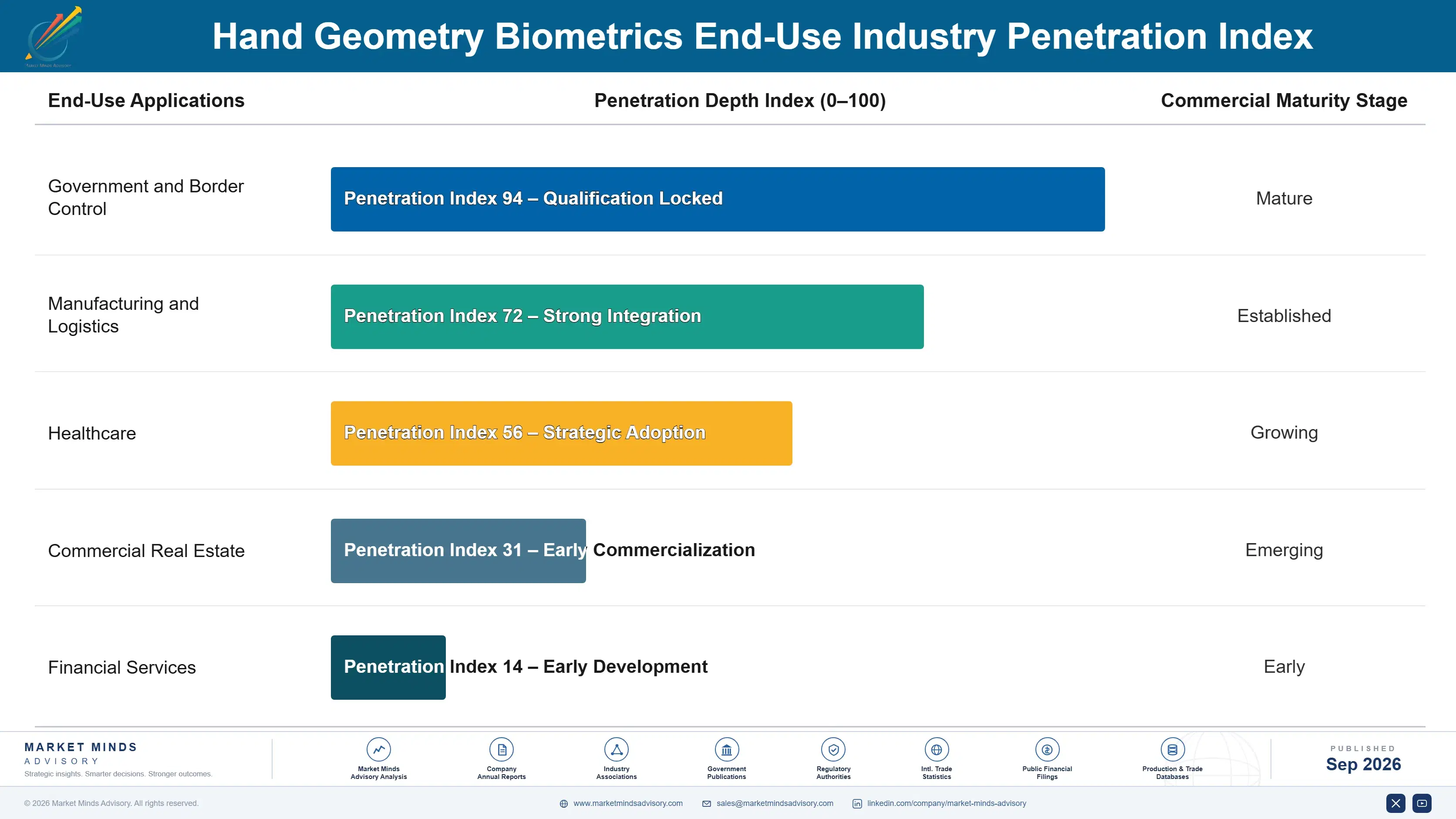
Adoption depth varies sharply by end-use vertical. Government and border control facilities adopt next-generation contactless systems quickly since regulatory compliance and public perception directly affect procurement priorities, while general industrial facilities integrate more slowly due to cost sensitivity that can stretch replacement timelines past a decade. Healthcare facilities sit at a different pace entirely, since hygiene considerations create urgency that other verticals do not share to the same degree.

Buyer profiles are shifting generationally as newer facility security managers, trained on data-driven and privacy-conscious security principles, replace an older generation focused primarily on meeting minimum access control requirements. Younger security leaders expect biometric hardware to integrate directly with broader identity management platforms from day one, treating a standalone scanner as an outdated concept. This generational turnover is accelerating adoption of connected, platform-integrated hardware faster than pricing alone would predict.
hand-geometry-biometrics-market-end-use-penetration-index-1788419053060

Where MMA Sees the Real Bets

These are among the four positions where our research anticipates prominent divergence between winners and laggards over the coming forecast period. Each is grounded in the demand model, the regulatory perimeter, and the announced capacity pipeline.
01 / CONTACTLESS TRANSITION PRIORITY

Complete contactless product transition before greenfield opportunities shrink further

Vendors still selling touch-based hardware are already losing meaningful contracts to rivals who completed the contactless transition early and thoroughly. This gap widens noticeably every single quarter a vendor delays this investment, since facility buyers increasingly treat contactless sensing as a baseline procurement requirement rather than a premium feature reserved for the largest projects. MMA firmly views contactless completion as the clearest predictor of which vendors defend market share over the next several years, more so than raw enrollment accuracy alone.
02 / MULTI-MODAL BUNDLING STRATEGY

Pair hand geometry with vein recognition for stronger positioning

Facilities increasingly evaluate vendors on anti-spoofing assurance nearly as closely as they evaluate raw enrollment speed, making a credible multi-modal roadmap a genuine procurement advantage rather than merely a nice-to-have product addition. Vendors without this capability are steadily ceding contracts to rivals who can demonstrate meaningfully stronger security assurance across live production deployments already running successfully today. MMA firmly expects the multi-modal gap to widen further still as more and more facilities gain more experience comparing vendor security performance across live deployments.
03 / COMPLIANCE SERVICE EXPANSION

Build compliance documentation capability ahead of regulatory tightening

Biometric data privacy regulations are spreading faster and wider than most vendors' current service offerings actually address, creating a genuinely quite substantial large near-term revenue opportunity for whichever vendor commits early to moving decisively first. Vendors that build genuinely auditor-grade documentation methodology now can charge a meaningful premium before the capability becomes commoditized across the broader market entirely. MMA strongly advises treating this as a standing product priority rather than a reactive feature bolted on once regulators already require it.
04 / GOVERNMENT PROGRAM POSITIONING

Pursue national identity enrollment contracts ahead of broader competition

Government identity programs clearly represent a genuinely large-volume customer category that rewards vendors who can demonstrate proven, reliable mobile enrollment capability at full national scale rather than smaller, single-facility deployments handled one at a time. Vendors building dedicated enrollment service capability now are positioning well ahead of the broader industry shift toward comprehensive large-scale government contracts. MMA very firmly regards early positioning here as a meaningfully lower risk than simply waiting for the segment to fully mature and competition to intensify.

Engagement Snapshot From the Field

A live engagement with an industry participant carrying material or product regulatory and market exposure ahead of a defining policy shift, showing how our research translates into a defensible multi-year portfolio strategy.
MARKET MINDS ADVISORY · CLIENT ENGAGEMENT SUMMARY
Hand Geometry Biometrics Producer Strategic Portfolio Review and Transition Roadmap 2026·Investment Scenario on Hand Geometry Biometrics Exposure Evaluation 2025-26
CLIENT PROFILE
The client is a regional government agency operating access control across twelve secure facilities, managing enrollment for roughly 8,000 authorized personnel using legacy touch-based hand geometry scanners installed over fifteen years ago. Its existing hardware met original certification standards but faced growing hygiene complaints and increasing maintenance costs as spare parts availability declined. Budget approval required demonstrating measurable improvement in both hygiene and operational efficiency.
STRATEGIC CHALLENGE
The agency faced mounting pressure to modernize access control following public health guidance discouraging shared touch surfaces, while budget constraints limited the pace of full facility-wide hardware replacement. Leadership needed a phased upgrade strategy deployable within one fiscal year, without disrupting ongoing facility security operations during the transition. Facility security operations could not be interrupted for extended periods during any transition.
MMA APPROACH
MMA conducted a facility-by-facility risk and usage assessment alongside interviews with the agency's security and facilities management leadership, then benchmarked three contactless vendors against total cost of ownership and integration complexity with existing systems. The engagement produced a phased rollout plan prioritizing the highest-traffic facilities first, sequenced to demonstrate benefits before facility-wide expansion.
KEY FINDINGS
  1. The agency's three highest-traffic facilities accounted for over 60 percent of total daily enrollment transactions across the network. across the entire network overall.
  2. A contactless retrofit approach reusing existing wiring infrastructure could cut projected installation cost by roughly 35 percent overall. combined across the twelve facilities.
  3. Two of three vendors evaluated offered trade-in credit programs for legacy hardware that meaningfully offset new unit acquisition cost. quite meaningfully overall.
  4. Staff feedback indicated strong preference for contactless systems, citing both hygiene concerns and faster average enrollment transaction times. noticeably faster than before overall.
CLIENT PROFILE
The client is a regional government agency operating access control across twelve secure facilities, managing enrollment for roughly 8,000 authorized personnel using legacy touch-based hand geometry scanners installed over fifteen years ago. Its existing hardware met original certification standards but faced growing hygiene complaints and increasing maintenance costs as spare parts availability declined. Budget approval required demonstrating measurable improvement in both hygiene and operational efficiency.
STRATEGIC CHALLENGE
The agency faced mounting pressure to modernize access control following public health guidance discouraging shared touch surfaces, while budget constraints limited the pace of full facility-wide hardware replacement. Leadership needed a phased upgrade strategy deployable within one fiscal year, without disrupting ongoing facility security operations during the transition. Facility security operations could not be interrupted for extended periods during any transition.
MMA APPROACH
MMA conducted a facility-by-facility risk and usage assessment alongside interviews with the agency's security and facilities management leadership, then benchmarked three contactless vendors against total cost of ownership and integration complexity with existing systems. The engagement produced a phased rollout plan prioritizing the highest-traffic facilities first, sequenced to demonstrate benefits before facility-wide expansion.
KEY FINDINGS
  1. The agency's three highest-traffic facilities accounted for over 60 percent of total daily enrollment transactions across the network. across the entire network overall.
  2. A contactless retrofit approach reusing existing wiring infrastructure could cut projected installation cost by roughly 35 percent overall. combined across the twelve facilities.
  3. Two of three vendors evaluated offered trade-in credit programs for legacy hardware that meaningfully offset new unit acquisition cost. quite meaningfully overall.
  4. Staff feedback indicated strong preference for contactless systems, citing both hygiene concerns and faster average enrollment transaction times. noticeably faster than before overall.
RECOMMENDED STRATEGY
Phase 1: Phase 1 (Months 1-4): deploy contactless scanners at the three highest-traffic facilities using existing wiring infrastructure. immediately upon full approval. Phase 2: Phase 2 (Months 5-9): extend deployment to the remaining nine facilities based on lessons learned from the initial phase. systematically. Phase 3: Phase 3 (Months 10-12): retire legacy touch-based hardware entirely and finalize unified maintenance contracts across all facilities. formally and completely.
OUTCOME
The agency completed priority facility deployment within thirteen weeks, ahead of the sixteen-week target (client-reported, unverified by MMA). Staff hygiene complaints declined significantly within two months of the priority facility rollout completion (client-reported, unverified by MMA). The agency has since referenced this phased approach when advising peer agencies on similar modernization efforts (client-reported, unverified by MMA).

Frequently Asked Questions

Foundational context covering the market sizes, CAGR, scope, country, region and competition that inform every finding below. This section is provided to cover basics and most often pre-purchase conversations, answered from the MMA Primary Research Dataset.

What is the current size of the Hand Geometry Biometrics Market?

The Hand Geometry Biometrics Market reached 0.7 billion dollars in 2025, the report's base year for all forecast calculations. This figure covers contactless and touch-based hand geometry hardware globally.

How large will the Hand Geometry Biometrics Market be by 2036?

The market is projected to reach 1.72 billion dollars by 2036, roughly 2.26 times its 2026 starting value. That growth reflects facial recognition restrictions and expanding government enrollment programs.

What is the CAGR for the Hand Geometry Biometrics Market 2026 to 2036?

The market is forecast to grow at an 8.5 percent compound annual rate between 2026 and 2036. Bull and bear scenarios range from 9.8 percent to 7.2 percent respectively.

Which segment is growing fastest?

Contactless hand geometry scanners lead growth at 11.5 percent CAGR, roughly 1.35 times the overall market rate. Hygiene concerns and facial recognition restrictions are driving this expansion.

Who are the major companies in the Hand Geometry Biometrics Market?

Schlage, Ingersoll Rand, Suprema, ZKTeco, and Identiv lead the market on a unit revenue basis. Together these five vendors hold roughly 58 percent combined share.

Which country is growing fastest?

India leads country-level growth at 12.0 percent CAGR, driven by its expanding national identity enrollment infrastructure and government incentive programs. Domestic integrators are increasingly winning enrollment contracts.

Report Segmentation Architecture

The full report scope spans multiple orthogonal segmentation dimensions, with cross-tabulated demand data provided for each dimension pair. Coverage extends further to regional breakdowns, trend trajectories, and the competitive detail needed to support segment-level decision-making.

By Primary Market Dimension

  • Contactless Hand Geometry Scanners
  • Traditional Touch-Based Scanners
  • Multi-Modal Bundled Systems
  • Enrollment Software
  • Compliance and Documentation Services

By End-Use Industry

  • Government and Border Control
  • Manufacturing and Logistics
  • Healthcare
  • Commercial Real Estate
  • Financial Services

By Commercial Dimension

  • Government Agencies
  • Large Enterprise Facility Operators
  • Small and Medium Businesses
  • System Integrators

By Region

  • North America
  • Western Europe
  • East Asia
  • South Asia and Pacific
  • Latin America
  • Middle East and Africa
  • Eastern Europe

Scope, Methodology, and Coverage

Every figure in this report is reproducible from documented input assumptions. The scope below maps the historical period, the forecast horizon, the segmentation dimensions, and the countries covered, alongside the underlying primary and qualitative methodology.
Historical Period
2020 to 2025
Forecast Period
2026 to 2036
Base Year
2025 (USD billions; MMA Primary Research Dataset, September 2026)
Market Definition
This report covers hardware and software systems that authenticate individuals using the geometric measurements of the hand, including palm and finger dimensions, for physical access control and time and attendance applications, measured on a global unit and revenue basis. It excludes fingerprint, facial, and vein pattern recognition systems that do not rely on overall hand geometry measurement.
Quantitative Units
USD billions, global market size and forecast
Segmentation Dimensions
Product/technology type, end-use industry, commercial/customer dimension, region
Regions Covered
North America, Western Europe, East Asia, South Asia and Pacific, Latin America, Middle East and Africa, Eastern Europe
Countries Covered
United States, China, Germany, France, United Kingdom, Japan, South Korea, India, Canada, Brazil, Mexico, Indonesia, Vietnam, Thailand, Malaysia, United Arab Emirates, Saudi Arabia, South Africa, Nigeria, Turkey, Poland, Netherlands, Italy, Spain, Sweden, Switzerland, Argentina, Colombia, Australia, Singapore, and additional markets relevant to this sector
Key Companies Profiled
Schlage (Allegion), Ingersoll Rand, Suprema, ZKTeco, Identiv, HID Global, Bosch Security Systems, Honeywell Security, Bio-key International, Fulcrum Biometrics, Anviz Global, Invixium, Idemia Public Security, Nedap Security, Aware Inc., Iris ID Systems, Cognitec Systems, Gunnebo Security, Kaba Group, Assa Abloy
Quantitative Methodology
Primary survey, n=3,800 respondents, Q4 2025, six countries; demand-side model with trade association cross-validation
Qualitative Methodology
47 expert interviews, Q4 2025; applied to validate demand model assumptions, identify emerging dynamics, and assess competitive positioning
Report Format
PDF and XLSX data workbook (Word format preview document)
Publisher
Market Minds Advisory
Report Code
MMA-2026-TEC-135
Published
September 2026
Contact
sales@marketmindsadvisory.com | www.marketmindsadvisory.com

Purchase the full Hand Geometry Biometrics Market Report (2026 to 2036).

This report delivers a comprehensive analysis of the global Hand Geometry Biometrics Market, covering market sizing, segmentation, and regional dynamics through 2036. It profiles the competitive landscape across twenty leading vendors, benchmarked on a consistent unit revenue basis. Regional analysis spans all seven major world regions, quantifying share and growth rate differences driven by regulatory, hygiene, and government adoption factors. The report also examines revenue diversification strategies, input cost exposure, and portfolio economics shaping vendor profitability. A dedicated case study illustrates practical implementation lessons for government agencies pursuing contactless upgrades.
Ten-year market size and CAGR forecast through 2036
Five-segment MECE market breakdown with growth rates
Seven-region share and growth rate analysis
Twenty-company competitive benchmarking on unit revenue basis
Revenue diversification strategy analysis across four commercial levers
Anonymized client implementation case study with outcomes

Built For The People Who Decide

From boardroom strategy to bench-side execution, this report is read cover-to-cover by leaders shaping the next decade of their industry, turning demand scenarios, market dynamics and valuation benchmarks into decisions.
CXOs/ Presidents/ VPs/ Managers
M&A and Corporate Development
Strategy Teams and R&D Heads
Procurement and Product Directors
Regulatory and Compliance Leaders
Investor Relations and Equity Analysts