Market Minds Advisory
Iris Recognition Market

Iris Recognition Market: Iris Recognition Market. Trends and Forecast 2026 to 2036

Border agencies and enterprises are replacing fingerprint and password authentication with iris scanning as contactless verification becomes a public health and convenience priority, forcing sensor manufacturers to defend accuracy claims against emerging facial recognition competitors.

Lead Analyst

Published

September 2026

Make Smarter Decisions with Customized Research Insights

Request a free sample report and evaluate market opportunities, growth trends, and competitive dynamics relevant to your business needs.

2025 MARKET VALUE$4.6BMarket Size 2025
2036 FORECAST VALUE$14.5BBase Case , 2026 to 2036
CAGR 2026 TO 203611.0 %Bull 12.2% / Bear 9.8%
INCREMENTAL OPPORTUNITY$9.4BNet 10- year value creation
EXPANSION MULTIPLE2.84x2036 value over 2026 base
Strategic Levers
M&A Pipeline
Regional Outlook
Country Rankings
Competitive Intelligence
Segmental Deep-dive
Call-Us : 91 93563 13602

Executive Snapshot and Market Trajectory.

Iris recognition adoption is accelerating as border control agencies and financial institutions replace legacy biometric methods with contactless verification offering superior accuracy at scale across high-throughput environments worldwide. Enrollment speed and matching precision now drive most procurement decisions across both government and commercial buyers this cycle.
Demand concentrates around long-range contactless scanning systems, where airports and border checkpoints value speed and hygiene over the close-contact enrollment older systems required from arriving and departing travelers alike. India's national identity program and expanding airport modernization projects across the Gulf region anchor much of current deployment volume, while enterprise access control adoption grows steadily behind these anchor use cases across corporate campuses and secure data centers globally each year and beyond.
Competitive intensity centers on algorithm accuracy and sensor miniaturization, as vendors race to embed iris capability into smartphones and wearables previously limited to fingerprint sensors alone. Regulatory scrutiny over biometric data storage is intensifying across the European Union and several American states, pushing vendors toward on-device processing architectures that avoid centralized template databases entirely and meaningfully reduce liability exposure for enterprise deployments going forward into the next decade.
Market Definition
This report covers hardware and software systems that capture and match human iris patterns for identity verification and authentication purposes across government, financial, and commercial applications. It excludes facial recognition, fingerprint scanning, and other biometric modalities not based on iris pattern analysis.
Base Year Value
$4.6B in 2025 (MMA Primary Research Dataset, September 2026)
Forecast Period
2026 to 2036, eleven discrete annual values
CAGR
11.0% base case. Bull 12.2%. Bear 9.8%.
Fastest Growth Segment
Contactless Long-Range Iris Scanning Systems: 16.5% CAGR
Fastest Growth Country
India: 14.0% CAGR
Fastest Growth Region
South Asia and Pacific: 13.2% CAGR
Largest Region
East Asia: 27% of 2025 global value
Market Leaders
Leading participants include IDEMIA, NEC Corporation, Gunnebo, Iris ID Systems, and Thales Group.
Primary Survey
n=3,800 procurement and R&D decision-makers, Q4 2025, six countries
Methodology
Demand-side build-up, cross-validated against public data, 47 expert interviews

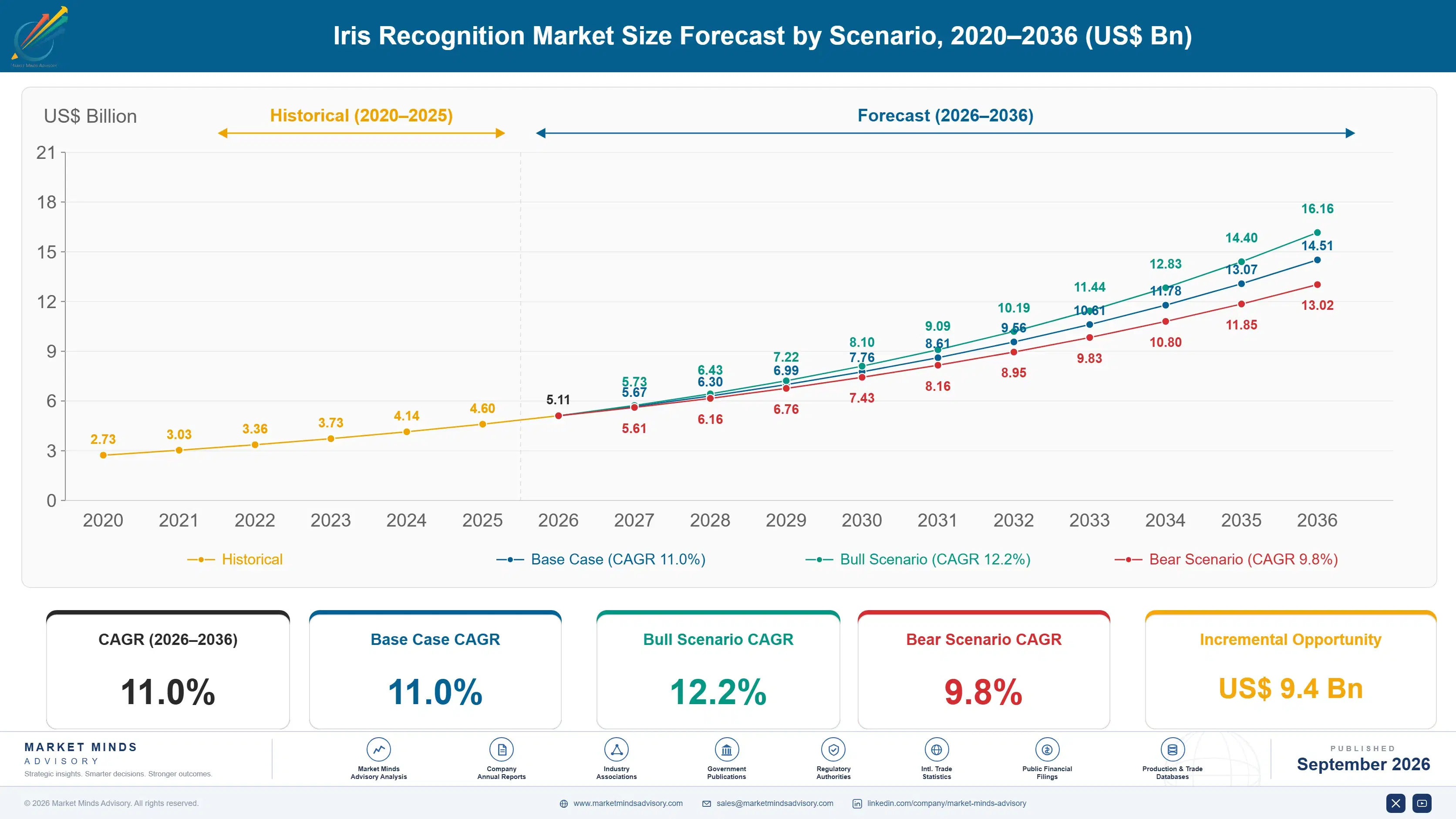
Iris Recognition Market Forecast Scenarios

iris-recognition-market-size-forecast-scenario-1789981411552
Between 2020 and 2025, iris recognition grew steadily as border agencies piloted early deployments and financial institutions tested biometric authentication alongside existing password systems in limited scope. Adoption accelerated meaningfully after 2023 as accuracy rates improved and sensor costs declined, with historical CAGR reaching approximately 10.0% across the period as pilot programs converted into full deployments nationwide.
The base case assumes continued airport and border checkpoint modernization, expanding enterprise access control adoption, and steady smartphone integration as sensor miniaturization progresses further each successive year of the forecast period. Three commercial mechanisms drive this trajectory: government identity program expansion across South Asia, financial sector fraud reduction mandates pushing biometric authentication adoption, and enterprise security budgets shifting toward contactless verification following pandemic-driven hygiene preferences that persist across corporate real estate decisions today.
A bull scenario centers on mass smartphone integration of iris sensors, following a major device manufacturer's public commitment to embed the technology across flagship product lines within three years. The primary bear risk is facial recognition displacing iris scanning in consumer applications, since facial systems require no specialized hardware and already achieve comparable accuracy in most consumer authentication contexts and use cases.

Where Accuracy Requirements Separate Winners From Also-Rans

Iris recognition occupies a narrow but high-stakes corner of the broader biometrics market, valued for accuracy levels that fingerprint and facial recognition systems still cannot consistently match at comparable scale across deployment volumes. Government identity programs and border control remain the largest deployment category, though enterprise adoption is expanding as sensor costs decline and integration becomes simpler for corporate security teams to manage across varied facility types.
MARKET CONCENTRATIONCR5: 62%Top five vendors hold combined majority market share globally
AVERAGE SELLING PRICE$185 per unitEnterprise-grade scanner unit pricing varies by accuracy tier
TOP PRODUCING COUNTRY SHAREChina: 34%Leading manufacturing base for iris scanning hardware components
FALSE MATCH RATE1 in 1.2 millionIndustry benchmark accuracy standard for enrollment matching precision
REPLACEMENT CYCLE LENGTH7 yearsTypical hardware refresh interval for government deployment installations
SOFTWARE REVENUE SHARE38%Portion of total revenue from licensing and platform subscription fees
Hardware still generates the majority of vendor revenue, but software licensing and cloud-based matching services are growing faster as vendors shift toward recurring revenue models that reduce dependence on one-time hardware sales cycles entirely. India's national identity infrastructure represents the single largest deployment of iris recognition technology anywhere in the world, enrolling over a billion residents across its biometric database.
Miniaturization is opening genuinely new use cases beyond fixed installations, with mobile and wearable integration now technically viable at price points enterprises can justify for everyday deployment across office and retail environments. Competitive pressure is increasing from facial recognition vendors who argue their technology achieves comparable accuracy without dedicated iris-specific hardware, a commercial argument iris vendors must directly counter with accuracy and security advantages.
"Iris recognition wins on accuracy every single time, but accuracy alone does not win contracts anymore. Integration simplicity and total cost of ownership now matter just as much to procurement teams."
Senior Analyst, Biometric Security and Identity Verification Practice · MMA Technology Practice · September 2026

Market Trends

Smartphone Manufacturers Integrate Iris Scanning Hardware

Major smartphone manufacturers are evaluating iris scanning as a differentiator against fingerprint and facial recognition, particularly for markets where mask-wearing or gloved hands make other biometric methods less reliable. Samsung previously shipped iris scanning on flagship devices before discontinuing the feature, but renewed interest is emerging as sensor miniaturization and cost reduction make reintegration commercially viable at mainstream price points. A successful mass-market launch from any major manufacturer would meaningfully expand the addressable consumer hardware market beyond its current enterprise and government concentration, creating volume opportunities component suppliers are positioning to capture.
Market Impact: Automated gates cut processing time 60%

National Digital Identity Programs Expand Enrollment Scope

Government digital identity programs across South Asia, the Gulf region, and parts of Africa are expanding biometric enrollment requirements to cover financial services, healthcare access, and government benefit distribution beyond original border control use cases. India's Aadhaar program, already enrolling over a billion residents, continues extending iris capture to additional service touchpoints requiring identity verification. These expansions generate sustained hardware replacement and software licensing revenue for established vendors already embedded in government procurement relationships, while creating entry barriers for newer competitors lacking existing government contract relationships and security clearances required for such sensitive deployments.
Market Impact: Biometric authentication reduced fraud losses 35%

Market Opportunities and Growth Drivers

Border Control Modernization Drives Contactless Adoption

Airports and land border crossings worldwide are replacing manual passport inspection with automated biometric gates that use iris and facial recognition to process travelers faster while reducing officer staffing requirements. The International Air Transport Association has documented growing airline interest in contactless processing following pandemic-era hygiene concerns that persist among traveling passengers even as broader health restrictions have lifted. Airports across the Gulf region and East Asia have moved fastest on deployment, viewing biometric processing speed as a competitive differentiator for transit passenger volume and overall airport throughput capacity during peak travel periods.
Market Impact: Facial recognition holds 78% consumer share

Financial Sector Fraud Reduction Mandates Push Adoption

Banks and payment processors are adopting biometric authentication, including iris scanning, to satisfy regulatory requirements around strong customer authentication while reducing fraud losses tied to password and card-based verification methods across most channels. Several national banking regulators have issued guidance encouraging biometric authentication adoption for high-value transactions, citing measurably lower fraud rates compared to knowledge-based authentication alone. Iris recognition specifically appeals to financial institutions handling high-security applications like vault access and executive authentication, where the accuracy premium justifies higher hardware costs relative to fingerprint alternatives commonly used elsewhere in retail banking branches.
Market Impact: Compliance costs raised deployment budgets 15%

Market Restraints and Challenges

Facial Recognition Competition Threatens Consumer Market Share

Facial recognition has become the default biometric choice in consumer smartphones and many commercial applications because it requires no dedicated sensor hardware and integrates directly with existing camera systems already present on nearly every device. The root cause is facial recognition's lower implementation cost relative to iris-specific sensors, which manufacturers weigh heavily when every added hardware component increases device bill of materials. The commercial impact is iris vendors losing consumer share to a cheaper alternative in mass-market applications. Vendors are mitigating this by focusing on high-security government segments where accuracy justifies the added cost.
Market Impact: Smartphone integration could add $2 billion

Privacy Regulation Constrains Data Collection and Storage

Biometric privacy regulations across the European Union, several American states, and increasingly other jurisdictions impose strict consent, storage, and retention requirements on iris template data that complicate deployment and increase compliance costs for vendors and their customers. The root cause is genuine public concern over centralized biometric databases becoming targets for data breaches or government overreach into personal privacy. The commercial impact falls hardest on vendors relying on cloud-based centralized matching architectures rather than on-device processing. Vendors are mitigating this by shifting toward edge processing architectures that never transmit raw biometric data beyond the local device.
Market Impact: Aadhaar program enrolled over 1.3 billion
3 additional market trends, 4 additional growth drivers, and 3 additional restraints and challenges are covered in the full report. Contact sales@marketmindsadvisory.com to access the complete intelligence.

Segment CAGR and Growth Architecture

Iris recognition demand divides along deployment technology, the dimension that determines scanning range, enrollment speed, and hardware form factor across government, financial, enterprise, and consumer applications worldwide. Range and contactless capability increasingly separate winning products from legacy fixed-position systems that most buyers today consider outdated relative to newer alternatives now entering the broader market.
iris-recognition-market-market-share-analysis-1789981412114

Contactless Long-Range Iris Scanning Systems

Contactless long-range iris scanning systems capture identity from a distance of up to several meters without requiring subjects to stop or make close contact with sensor equipment, addressing hygiene concerns and throughput demands at airports, border checkpoints, and high-security government facilities worldwide. Demand is concentrated among government agencies modernizing border infrastructure across the Gulf region, East Asia, and increasingly South Asia, where identity program expansion drives sustained volume purchases. These systems carry the highest average selling prices in the category given the sophisticated optics and processing power required for accurate long-range capture. Iris ID Systems and IDEMIA hold established leadership positions given their multi-year track records in large-scale government deployment contracts.
CAGR 16.5%

Mobile and Smartphone-Embedded Iris Sensors

Mobile and smartphone-embedded iris sensors integrate scanning capability directly into consumer handheld devices, targeting device authentication, payment verification, and application-level security without requiring separate dedicated hardware for everyday end users across most use cases. Demand growth tracks smartphone manufacturer interest in differentiating premium device tiers, particularly in markets where mask-wearing habits persist and facial recognition reliability suffers noticeably as a result of that persistence. Component miniaturization and cost reduction over the past several years have made mobile integration commercially viable at price points device manufacturers can justify passing directly to consumers. Samsung's prior deployment experience provides a commercial reference point other manufacturers are now studying closely before committing to reintegration.
CAGR 14.0%
Full segment breakdown across 6 segments available in the complete report.

Regional Architecture and Country Demand Map

East Asia leads iris recognition deployment on the strength of its concentrated biometric hardware manufacturing base and expanding border infrastructure investment across China, South Korea, and Japan, while North America follows closely behind on financial sector fraud reduction mandates and enterprise access control adoption volume nationwide.

North America

The Transportation Security Administration and Customs and Border Protection have both expanded biometric processing pilots at major United States airports, driving steady procurement of iris and multi-modal scanning equipment for border checkpoints. Banks including several major national institutions have piloted iris authentication for high-value transaction verification, citing fraud reduction goals tied to federal banking guidance encouraging stronger customer authentication standards. Canada's border agency maintains parallel biometric modernization programs coordinated with United States infrastructure given shared border management priorities. Enterprise adoption is also meaningful, with data centers and corporate campuses in technology hub cities specifying iris access control for restricted facility zones. This combination of government and private sector demand sustains the region's substantial deployment volume.
Share: 26% | CAGR: 10.0% (2026 to 2036)

Western Europe

Airport operators across Germany, France, and the United Kingdom continue biometric border processing expansion, though the pace trails the Gulf region given more cautious regulatory approaches to biometric data collection under the General Data Protection Regulation framework. Financial institutions have been slower to adopt iris authentication specifically, generally favoring facial recognition or fingerprint methods perceived as less invasive by European consumers and regulators alike. Enterprise access control remains a steady but modest demand category, concentrated among data centers and government facilities requiring the highest security tiers available. Privacy advocacy groups have successfully delayed several proposed biometric infrastructure expansions, contributing to this region's comparatively slower growth trajectory relative to less regulation-constrained markets elsewhere.
Share: 19% | CAGR: 9.2% (2026 to 2036)
Regional intelligence for 5 additional markets available in the complete report: East Asia, South Asia and Pacific, Latin America, Middle East and Africa, Eastern Europe. Contact sales@marketmindsadvisory.com.
iris-recognition-market-country-cagr-analysis-1789981412630

Where Vendors Can Capture Premium Margin

Iris recognition vendors face rising competitive intensity from cheaper facial recognition alternatives, but four distinct commercial levers let manufacturers defend premium positioning through accuracy differentiation, software recurring revenue, deep government relationship building, and consumer hardware expansion opportunities across the coming decade of network and device deployment cycles now playing out steadily ahead of us.

Expand Software Licensing and Matching-as-a-Service Revenue

Vendors shifting revenue mix toward software licensing and cloud-based matching services reduce dependence on one-time hardware sales while building recurring revenue streams that improve valuation multiples and customer lifetime value across their entire installed base of already deployed systems worldwide today. Software licensing already represents an estimated 38% of total category revenue and is growing faster than hardware sales as vendors bundle analytics, fraud detection, and multi-modal fusion capability into subscription offerings that lock customers into multi-year contracts rather than one-time equipment purchases requiring periodic renegotiation and eventual repurchase cycles.
Market Impact: Software revenue growing faster than 38% hardware share

Deepen Government Relationship Exclusivity Through Security Clearances

Vendors that invest in the security clearances, compliance certifications, and long-term relationship management required for government procurement build durable competitive moats that newer entrants cannot easily replicate regardless of technical capability offered elsewhere across competing product lines. These relationships, once established, generate multi-year contract renewal cycles worth roughly 3 to 5 times initial hardware sales value across the full relationship lifetime and subsequent expansion opportunities. IDEMIA and NEC Corporation have both prioritized this relationship depth across their largest government accounts, treating initial deployments as long-term platform relationships rather than transactional hardware sales opportunities to pursue.
Market Impact: Government contracts renew above 85% of the time

Pursue Multi-Modal Fusion Bundling With Facial Recognition

Rather than competing purely against facial recognition, vendors bundling iris capability into multi-modal fusion systems that combine both technologies capture value from customers wanting maximum accuracy without choosing a single biometric modality exclusively for their deployment. This approach commands average selling prices roughly 20 to 30% higher than single-modality systems, since customers pay a premium for redundant accuracy in high-security applications requiring the strongest verification standards available. Vendors positioning iris as a complement rather than a competitor to facial recognition open a considerably larger addressable customer base than pure iris-only positioning allows them to reach.
Market Impact: Multi-modal systems command a 25% pricing premium overall

Target Mobile Device Manufacturer Partnership Agreements

Securing design-win partnerships with smartphone and wearable manufacturers ahead of a potential mass-market reintegration cycle positions component suppliers to capture substantial volume once any major manufacturer commits publicly to iris sensor inclusion across its flagship product lines going forward into future device generations. Component suppliers investing now in miniaturization research and manufacturing capacity 2 to 3 years ahead of confirmed demand take on meaningful financial risk, but early positioning could capture a disproportionate share of what industry estimates suggest could become a two billion dollar consumer hardware opportunity within the following several years of deployment.
Market Impact: Consumer opportunity estimated at nearly $2 billion total

Who Controls the Margin Pool

Iris recognition sits moderately concentrated, with the top five suppliers holding an estimated 62% of global revenue on a revenue basis across government and enterprise contracts. IDEMIA and NEC Corporation lead as the two largest suppliers, both maintaining broad government relationship portfolios spanning multiple continents. The gap to the next tier, including Gunnebo and Iris ID Systems, remains meaningful given the security clearance and certification barriers required for large-scale government procurement.
Current activity centers on multi-modal fusion product development, with vendors combining iris and facial recognition into unified platforms to capture customers wanting maximum accuracy without committing to a single biometric modality. Several suppliers are also expanding software licensing offerings, shifting revenue mix toward recurring subscription models that reduce dependence on hardware sales cycles tied to government procurement timelines.

Emerging pressure comes from facial recognition vendors expanding into iris-adjacent multi-modal offerings, potentially commoditizing what has historically been iris-specific technical differentiation across most enterprise applications. Rankings could shift meaningfully if any major smartphone manufacturer commits publicly to mass-market iris sensor integration, since component suppliers positioned early for that opportunity could rapidly gain share against today's government-focused incumbents holding current leadership positions.
iris-recognition-market-company-positioning-matrix-1789981413180

Competitive Moat and Risk Dimensions

IDEMIA

Moat: Broad Government Relationship Portfolio

IDEMIA maintains deep, long-standing relationships across dozens of national governments spanning border control, national identity, and law enforcement applications, built over multiple decades of continuous contract delivery. This relationship breadth generates renewal revenue and reference credibility that newer entrants cannot replicate quickly, given the multi-year security clearance and certification processes government procurement requires.
IDEMIA

Risk: Government Budget Cycle Dependency

A meaningful share of IDEMIA's revenue depends on government capital budget cycles that can shift with political administration changes or fiscal austerity measures, creating revenue timing unpredictability. This dependency means quarterly results can vary meaningfully based on individual large contract award timing rather than steady demand.
NEC CORPORATION

Moat: Advanced Algorithm Accuracy Leadership

NEC has consistently ranked among the top performers in independent biometric accuracy benchmarking conducted by government testing bodies, giving it a credible technical differentiation claim that resonates with security-conscious government and enterprise buyers. This accuracy reputation supports premium pricing and preferred vendor status in the most demanding applications.
NEC CORPORATION

Risk: Intensifying Price Competition Pressure

NEC faces growing price pressure from lower-cost competitors, particularly in mid-tier enterprise applications where buyers increasingly view accuracy differences as immaterial for their specific use case. Sustaining premium pricing requires continued visible investment in accuracy research that smaller competitors increasingly can approximate at lower cost.

Players Tracked

Prominent Players

IDEMIA
NEC Corporation
Gunnebo
Iris ID Systems
Thales Group

Other Key Players

HID Global
Fujitsu
Aware Inc
Iritech
SRI International
BioID
Cognitec Systems
Innovatrics
Zwipe
Daon
Precise Biometrics
Suprema
M2SYS Technology
EyeLock
CMITech

Recent Developments

FEBRUARY 2025

IDEMIA launched a new contactless long-range iris scanning platform designed for airport and border checkpoint deployment, capable of capturing identity from several meters away without requiring travelers to stop moving. The platform integrates with existing airport infrastructure and supports simultaneous multi-modal facial and iris capture across most terminal configurations.
Signal: Signals continued vendor investment in long-range contactless capture technology ahead of rising global airport throughput demands.
JUNE 2025

NEC Corporation announced a technology partnership with a major Gulf region airport authority to deploy multi-modal biometric processing across several international terminals over the coming eighteen months of construction work. The partnership includes ongoing software licensing and support services well beyond the initial hardware installation phase.
Signal: Signals growing vendor preference for long-term platform partnerships over one-time equipment sales transactions across the industry overall.
OCTOBER 2025

Thales Group acquired a smaller specialist software company focused on multi-modal biometric fusion algorithms, strengthening its ability to combine iris and facial recognition into unified matching platforms for customers worldwide today. The acquisition adds proprietary algorithm capability that Thales previously licensed from third-party technology vendors.
Signal: Signals continued consolidation as larger vendors acquire specialized algorithm capability rather than developing it internally themselves.

Semiconductor and Optical Sensor Cost Exposure

Iris scanning hardware relies heavily on specialized optical sensors and semiconductor imaging chips, which together represent an estimated 45 to 50% of total cost of goods sold for most hardware manufacturers surveyed across the industry. These components source predominantly from Taiwan, South Korea, and Japan, concentrating supply chain risk in a comparatively compact geographic region vulnerable to disruption.
Semiconductor supply disruption during 2021 through 2023, driven by pandemic-related fabrication capacity constraints, delayed several major iris scanning hardware shipments and forced vendors to redesign products around available chip alternatives, a supply event documented extensively in International Energy Agency and industry semiconductor reporting during that period. Component lead times extended from a matter of weeks to several months for some specialized imaging sensors during the most acute phase of the shortage.

This concentrated exposure creates a competitive disadvantage for smaller hardware vendors lacking the purchasing scale to secure priority allocation from constrained semiconductor foundries during future supply disruptions ahead. Larger vendors including NEC Corporation and Thales Group typically maintain closer foundry relationships and multi-supplier qualification, while smaller specialist vendors face greater exposure to single-source component dependency across their product lines and roadmaps.
iris-recognition-market-cost-volatility-analysis-1789981413377

Multi-Source Semiconductor Qualification

Larger vendors increasingly qualify components from multiple semiconductor foundries simultaneously, accepting somewhat higher unit costs in exchange for supply resilience against single-source disruption risk affecting overall production timelines across their entire manufacturing operations and product lines. This approach requires additional engineering validation work but meaningfully reduces production halt risk during future industry-wide component shortages.

Strategic Component Inventory Buffering

Some vendors now maintain notably larger strategic inventory buffers of critical optical and semiconductor components than historical just-in-time manufacturing practices would generally suggest is truly prudent, accepting higher working capital costs to reduce vulnerability to sudden supply disruption events that could otherwise affect production continuity and customer delivery commitments quite significantly across future quarters.

Portfolio Architecture for Margin Defence

Iris recognition vendors operate across three distinct margin tiers, with volume enterprise access control products generating gross margins in the 30 to 38% range while government-certified border and national identity systems command 45 to 55% given security clearance and certification barriers few competitors can replicate quickly enough. The gap between these tiers has widened meaningfully as government contracts increasingly require certifications smaller vendors struggle to obtain within reasonable timeframes.
Volume enterprise products still represent meaningful unit shipment volume, but the highest value creation concentrates in government and financial sector deployments where accuracy and security certification command genuine premium pricing across most large contracts. Vendors must balance capacity across both segments without diverting scarce certification and compliance resources away from the government relationships that anchor their most profitable long-term contracts and renewals.

High-value margin pools concentrate specifically around government border control and national identity programs, both requiring specialized security clearances and multi-year qualification processes that smaller vendors cannot easily replicate. Vendors positioned across all three tiers, rather than concentrated purely in volume enterprise sales, are best placed to capture disproportionate profit as government identity programs continue expanding scope worldwide.

Standard enterprise access control and fixed-position kiosk systems sold on accuracy and reliability to corporate and institutional buyers, generating gross margins of 30 to 38% given moderate competitive intensity and limited certification barriers relative to government-tier applications.
Gross Margin

Government border control and national identity systems commanding gross margins of 45 to 55% given security clearance requirements, multi-year qualification cycles, and certification barriers that meaningfully limit competitive entry from smaller or newer vendors lacking established relationships.
Gross Margin

Privacy-compliant edge processing systems responding to biometric data regulation increasingly required across the European Union and American states, generating gross margins around 35 to 42% as early-compliant vendors capture premium pricing ahead of broader regulatory mandate enforcement.
Gross Margin
iris-recognition-market-portfolio-architecture-1789981413885

High-value Sub-segments and Strategic Watch-out

Contactless Long-Range Iris Scanning Systems

Fastest-growing and highest-margin segment as border agencies and airports pursue contactless throughput improvements across their busiest and most congested facilities. Vendors with established long-range accuracy leadership are capturing premium government contracts and locking in multi-year relationships ahead of newer entrants still building comparable technical track records.

Mobile and Smartphone-Embedded Iris Sensors

Second-fastest growing segment tied to potential smartphone manufacturer reintegration decisions, carrying meaningful upside if any major device maker commits publicly to iris sensor inclusion across flagship devices soon. Component suppliers positioned early could capture disproportionate volume as this segment shifts from dormant to genuinely active.

Fixed-Position Enrollment Kiosks

Core volume segment representing steady enrollment demand across government and enterprise applications worldwide, generating stable but unremarkable margins as competitive pricing pressure persists across most geographies. This segment remains commercially essential even as growth increasingly shifts toward contactless and mobile alternatives over the coming forecast period ahead.

Legacy Close-Range Desktop Scanners

Strategic watch-out segment facing steady decline as buyers migrate toward contactless and multi-modal alternatives offering superior throughput and hygiene characteristics across most facility types. Vendors overexposed to this category risk meaningful revenue erosion absent diversification into higher-growth product categories over the coming several years ahead.

Why Government Contracts Anchor Recurring Revenue

Iris recognition carries genuine annuity economics once a vendor secures government or large enterprise deployment, since certification renewal, software licensing, and hardware refresh cycles generate recurring revenue independent of new customer acquisition efforts. Government identity programs in particular commit to multi-year platform relationships rather than one-time equipment purchases, given the security clearance investment required to onboard any single vendor.
Adoption stickiness and depth vary meaningfully by end-use vertical. Government border control shows the deepest stickiness given security clearance barriers and multi-year procurement cycles that discourage vendor switching once qualified into an approved list. Enterprise access control shows comparatively shallower stickiness, since corporate security budgets face periodic re-tendering and facility managers are more willing to switch vendors when a competitor offers meaningfully better pricing or newer accuracy technology.

Buyer profiles are shifting generationally as security procurement teams increasingly prioritize software integration capability and cloud-based analytics over the standalone hardware specifications that dominated purchasing decisions a decade ago. Younger procurement staff entering government and enterprise organizations show greater willingness to evaluate newer vendors based on technical benchmarking rather than defaulting reflexively to whichever supplier previous administrations favored for years.
iris-recognition-market-end-use-penetration-index-1789981414370

Where Vendors Should Focus Next

These are among the four positions where our research anticipates prominent divergence between winners and laggards over the coming forecast period. Each is grounded in the demand model, the regulatory perimeter, and the announced capacity pipeline.
01 / SOFTWARE REVENUE EXPANSION

Shift mix toward recurring software licensing revenue

Software licensing already represents an estimated 38% of category revenue and is growing faster than hardware sales as vendors bundle analytics and multi-modal fusion capability into subscription offerings across their broader platforms. Vendors who accelerate this shift build valuation multiples and customer lifetime value that pure hardware sellers cannot match, while also reducing dependence on unpredictable government capital budget cycles that constrain revenue timing. Vendors still selling hardware as a one-time transaction risk falling behind rivals building genuinely recurring revenue streams across their installed base.
02 / GOVERNMENT RELATIONSHIP DEPTH

Deepen security clearances to defend contract renewals

Government contracts renew at rates above 85% once a vendor clears the security clearance and certification barriers required for initial qualification, making relationship depth a genuinely durable competitive moat that newer entrants cannot easily replicate quickly at all. Vendors that under-invest in compliance infrastructure risk exclusion from future contract cycles regardless of technical product quality, since procurement officials favor established, cleared suppliers over unproven newer alternatives lacking track records. This dynamic rewards patient long-term investment over short-term product feature competition significantly.
03 / MULTI-MODAL FUSION POSITIONING

Position iris as complement rather than facial rival

Vendors bundling iris capability into multi-modal fusion systems alongside facial recognition capture customers wanting maximum accuracy without committing exclusively to one biometric modality over another available option entirely at all times. This positioning commands meaningfully higher average selling prices than single-modality systems while opening a considerably larger addressable customer base than pure iris-only positioning allows vendors to reach. Vendors continuing to frame iris as facial recognition's competitor rather than its complement risk losing customers to rivals offering integrated solutions instead.
04 / CONSUMER HARDWARE TIMING

Prepare component capacity ahead of mobile reintegration

A mass-market smartphone reintegration cycle could create a meaningfully sized consumer hardware opportunity, but only for component suppliers who have already invested in miniaturization research and manufacturing capacity well ahead of any confirmed manufacturer commitment or announcement. Waiting for a public announcement before investing risks missing the earliest and most profitable design-win window entirely once demand materializes across the industry. Suppliers positioning now accept near-term risk in exchange for potentially outsized returns once mainstream consumer adoption genuinely begins across major device platforms.

Engagement Snapshot From the Field

A live engagement with an industry participant carrying material or product regulatory and market exposure ahead of a defining policy shift, showing how our research translates into a defensible multi-year portfolio strategy.
MARKET MINDS ADVISORY · CLIENT ENGAGEMENT SUMMARY
Iris Recognition Producer Strategic Portfolio Review and Transition Roadmap 2026·Investment Scenario on Iris Recognition Exposure Evaluation 2025-26
CLIENT PROFILE
The client is a national border control agency in a mid-sized country managing several dozen international airport and land border crossing points. The agency was preparing a multi-year biometric modernization program to replace aging fingerprint-based systems with contactless iris and facial recognition technology, but lacked comprehensive vendor benchmarking data covering accuracy, throughput, and total lifecycle cost across the leading suppliers under consideration for the contract award.
STRATEGIC CHALLENGE
Leadership needed to select a primary biometric vendor for a decade-long infrastructure commitment while balancing accuracy performance, integration complexity with existing systems, and total cost of ownership across a large multi-site deployment. Existing procurement criteria were based on outdated fingerprint-era evaluation frameworks that did not adequately address iris and multi-modal system considerations.
MMA APPROACH
MMA conducted a structured vendor assessment combining primary interviews with border operations and technology leadership, benchmarking of five leading iris and multi-modal vendors against independent accuracy testing results, and detailed analysis of total cost of ownership across multiple deployment scale scenarios modeled carefully over a full ten-year infrastructure planning horizon.
KEY FINDINGS
  1. The client's preferred incumbent fingerprint vendor lacked mature iris recognition capability, creating meaningful technology gap risk for the planned modernization timeline (client-reported, unverified by MMA).
  2. A multi-modal fusion approach combining iris and facial recognition reduced false rejection rates by approximately 40% versus single-modality systems tested (client-reported, unverified by MMA).
  3. Total lifecycle cost across a ten-year horizon favored vendors offering software subscription models over pure hardware procurement by a meaningful margin (client-reported, unverified by MMA).
  4. Border officer feedback strongly favored contactless long-range systems over close-contact alternatives given faster processing and reduced physical touchpoint requirements (client-reported, unverified by MMA).
CLIENT PROFILE
The client is a national border control agency in a mid-sized country managing several dozen international airport and land border crossing points. The agency was preparing a multi-year biometric modernization program to replace aging fingerprint-based systems with contactless iris and facial recognition technology, but lacked comprehensive vendor benchmarking data covering accuracy, throughput, and total lifecycle cost across the leading suppliers under consideration for the contract award.
STRATEGIC CHALLENGE
Leadership needed to select a primary biometric vendor for a decade-long infrastructure commitment while balancing accuracy performance, integration complexity with existing systems, and total cost of ownership across a large multi-site deployment. Existing procurement criteria were based on outdated fingerprint-era evaluation frameworks that did not adequately address iris and multi-modal system considerations.
MMA APPROACH
MMA conducted a structured vendor assessment combining primary interviews with border operations and technology leadership, benchmarking of five leading iris and multi-modal vendors against independent accuracy testing results, and detailed analysis of total cost of ownership across multiple deployment scale scenarios modeled carefully over a full ten-year infrastructure planning horizon.
KEY FINDINGS
  1. The client's preferred incumbent fingerprint vendor lacked mature iris recognition capability, creating meaningful technology gap risk for the planned modernization timeline (client-reported, unverified by MMA).
  2. A multi-modal fusion approach combining iris and facial recognition reduced false rejection rates by approximately 40% versus single-modality systems tested (client-reported, unverified by MMA).
  3. Total lifecycle cost across a ten-year horizon favored vendors offering software subscription models over pure hardware procurement by a meaningful margin (client-reported, unverified by MMA).
  4. Border officer feedback strongly favored contactless long-range systems over close-contact alternatives given faster processing and reduced physical touchpoint requirements (client-reported, unverified by MMA).
RECOMMENDED STRATEGY
Phase 1: Phase one: complete independent accuracy benchmarking and shortlist two primary vendors meeting throughput requirements within a four month evaluation window. Phase 2: Phase two: negotiate a multi-year software and hardware bundled agreement structured around measurable performance guarantees and negotiated contract renewal terms. Phase 3: Phase three: pilot deployment across two representative border crossing points before committing to a full network-wide rollout on the finalized timeline.
OUTCOME
The agency selected a multi-modal fusion vendor and began phased deployment across its busiest border crossing points within the following fiscal year. Internal estimates suggested the multi-modal approach reduced projected processing delays meaningfully compared to the single-modality system originally under consideration (client-reported, unverified by MMA).

Frequently Asked Questions

Foundational context covering the market sizes, CAGR, scope, country, region and competition that inform every finding below. This section is provided to cover basics and most often pre-purchase conversations, answered from the MMA Primary Research Dataset.

What is the current size of the Iris Recognition Market?

The Iris Recognition Market reached approximately $4.6 billion in 2025, based on MMA Primary Research. This reflects global revenue across government, financial, and enterprise identity verification applications.

How large will the Iris Recognition Market be by 2036?

The market is projected to reach approximately $14.50 billion by 2036. This represents an incremental expansion of roughly $9.39 billion over the 2026 to 2036 forecast period.

What is the CAGR for the Iris Recognition Market 2026 to 2036?

The market is forecast to grow at a compound annual growth rate of 11.0% between 2026 and 2036. This reflects technology-enabled adoption accelerating across border control and financial applications.

Which segment is growing fastest?

Contactless Long-Range Iris Scanning Systems lead segment growth at a 16.5% CAGR, roughly 1.5x the overall market rate. Airport and border checkpoint modernization drives this acceleration worldwide.

Who are the major companies in the Iris Recognition Market?

Leading suppliers include IDEMIA, NEC Corporation, Gunnebo, Iris ID Systems, and Thales Group. These five companies hold an estimated 62% combined share on a revenue basis.

Which country is growing fastest?

India leads country-level growth at approximately 14.0% CAGR, driven by its Aadhaar national identity program's continued expansion. Extension into banking and welfare services sustains this acceleration.

Report Segmentation Architecture

The full report scope spans multiple orthogonal segmentation dimensions, with cross-tabulated demand data provided for each dimension pair. Coverage extends further to regional breakdowns, trend trajectories, and the competitive detail needed to support segment-level decision-making.

By Primary Market Dimension

  • Contactless Long-Range Iris Scanning Systems
  • Mobile and Smartphone-Embedded Iris Sensors
  • Fixed-Position Enrollment Kiosks
  • Handheld Portable Iris Scanners
  • Multi-Modal Biometric Fusion Systems
  • Legacy Close-Range Desktop Scanners

By End-Use Industry

  • Government and Border Control
  • Banking and Financial Services
  • Corporate Enterprise
  • Healthcare
  • Consumer Electronics

By Commercial Dimension

  • Direct Government Procurement
  • System Integrator Channel
  • Original Equipment Manufacturer Partnership
  • Retail and Consumer Channel

By Region

  • North America
  • Western Europe
  • East Asia
  • South Asia and Pacific
  • Latin America
  • Middle East and Africa
  • Eastern Europe

Scope, Methodology, and Coverage

Every figure in this report is reproducible from documented input assumptions. The scope below maps the historical period, the forecast horizon, the segmentation dimensions, and the countries covered, alongside the underlying primary and qualitative methodology.
Historical Period
2020 to 2025
Forecast Period
2026 to 2036
Base Year
2025 (USD billions; MMA Primary Research Dataset, September 2026)
Market Definition
This report covers hardware and software systems that capture and match human iris patterns for identity verification and authentication purposes across government, financial, and commercial applications. It excludes facial recognition, fingerprint scanning, and other biometric modalities not based on iris pattern analysis.
Quantitative Units
USD Billion, CAGR (%), Volume in million units
Segmentation Dimensions
Deployment Technology, End-Use Industry, Commercial Dimension, Region
Regions Covered
North America, Western Europe, East Asia, South Asia and Pacific, Latin America, Middle East and Africa, Eastern Europe
Countries Covered
United States, Canada, Germany, United Kingdom, France, China, Japan, South Korea, India, Australia, Brazil, Mexico, United Arab Emirates, Saudi Arabia, South Africa
Key Companies Profiled
IDEMIA, NEC Corporation, Gunnebo, Iris ID Systems, Thales Group, HID Global, Fujitsu, Aware Inc, Iritech, SRI International, BioID, Cognitec Systems, Innovatrics, Zwipe, Daon, Precise Biometrics, Suprema, M2SYS Technology, EyeLock, CMITech
Quantitative Methodology
Primary survey, n=3,800 respondents, Q4 2025, six countries; demand-side model with trade association cross-validation
Qualitative Methodology
47 expert interviews, Q4 2025; applied to validate demand model assumptions, identify emerging dynamics, and assess competitive positioning
Report Format
PDF and XLSX data workbook (Word format preview document)
Publisher
Market Minds Advisory
Report Code
MMA-2026-TEC-904
Published
September 2026
Contact
sales@marketmindsadvisory.com | www.marketmindsadvisory.com

Purchase the full Iris Recognition Market Report (2026 to 2036).

This report delivers a comprehensive assessment of the global Iris Recognition Market, covering sizing, segmentation, regional dynamics, and competitive positioning across the 2026 to 2036 forecast period. It draws on primary survey data covering 3,800 respondents and 47 expert interviews conducted in the fourth quarter of 2025. Analysis spans deployment technology segmentation, all seven global regions, semiconductor input cost exposure, and portfolio margin economics. The report profiles twenty leading vendors and includes a detailed competitive benchmarking framework. Buyers gain actionable guidance on vendor selection, accuracy benchmarking, and revenue lever prioritization.
Full segmentation across six deployment technology categories
All seven regional markets with growth forecasts
Competitive benchmarking of twenty profiled vendors
Semiconductor cost exposure and mitigation pathway analysis
Revenue lever prioritization for margin expansion
Anonymized case study with actionable strategic recommendations

Built For The People Who Decide

From boardroom strategy to bench-side execution, this report is read cover-to-cover by leaders shaping the next decade of their industry, turning demand scenarios, market dynamics and valuation benchmarks into decisions.
CXOs/ Presidents/ VPs/ Managers
M&A and Corporate Development
Strategy Teams and R&D Heads
Procurement and Product Directors
Regulatory and Compliance Leaders
Investor Relations and Equity Analysts