

Market Minds Advisory
Hair Brush Market

Hair Brush Market: Hair Brush Market. Scalp-Care Technology and Premiumization Redraw a Commodity Category.

Scalp-care and detangling technology brushes increasingly win premium beauty budgets away from basic commodity brushes, pushing manufacturers toward material and bristle innovation investment or ceding shelf space to specialty haircare-tech challengers entering mass retail.

Lead Analyst

Published

September 2026

Make Smarter Decisions with Customized Research Insights

Request a free sample report and evaluate market opportunities, growth trends, and competitive dynamics relevant to your business needs.

2025 MARKET VALUE$4.2BMarket Size 2025
2036 FORECAST VALUE$7.0BBase Case , 2026 to 2036
CAGR 2026 TO 20364.8 %Bull 5.9% / Bear 3.6%
INCREMENTAL OPPORTUNITY$2.6BNet 10- year value creation
EXPANSION MULTIPLE1.60x2036 value over 2026 base
Strategic Levers
M&A Pipeline
Regional Outlook
Country Rankings
Competitive Intelligence
Segmental Deep-dive
Call-Us : 91 93563 13602

Executive Snapshot and Market Trajectory.

Scalp-care technology is converting a commodity personal-care category into a genuinely premiumizing beauty segment nationwide, as consumers increasingly treat brush selection as part of a broader hair-health routine rather than a purely functional purchase decision this year, particularly among younger social-media-active shoppers researching product reviews online before buying.
Social-media-driven demonstrations of detangling and scalp-massage brushes, rising interest in hair-health routines, and celebrity-backed brand launches are pulling demand toward premium price points across nearly every retail channel and demographic segment, with scalp-care and detangling brushes expanding fastest of any product category tracked in this report. East Asian manufacturing and consumption both concentrate the largest share of category value given the region's dominant production base and rapidly growing domestic beauty-tech demand.
Competitive intensity is rising as established brush manufacturers add proprietary bristle technology and ergonomic redesigns to defend premium pricing against new entrants across every major retail channel and price tier available. Direct-to-consumer beauty-tech brands use social media marketing to bypass traditional retail gatekeepers entirely, pushing legacy manufacturers toward considerably faster product-development cycles than the category has historically required of them, particularly in the fast-moving scalp-care niche.
Market Definition
The hair brush market covers manual and electric brushes for detangling, styling, and scalp care sold through retail and direct-to-consumer channels. It excludes combs, hair dryers, and other electric styling tools such as straighteners and curling irons not classified as brushes.
Base Year Value
$4.2B in 2025 (MMA Primary Research Dataset, September 2026)
Forecast Period
2026 to 2036, eleven discrete annual values
CAGR
4.8% base case. Bull 5.9%. Bear 3.6%.
Fastest Growth Segment
Scalp-Care and Detangling Technology Brushes: 9.0% CAGR
Fastest Growth Country
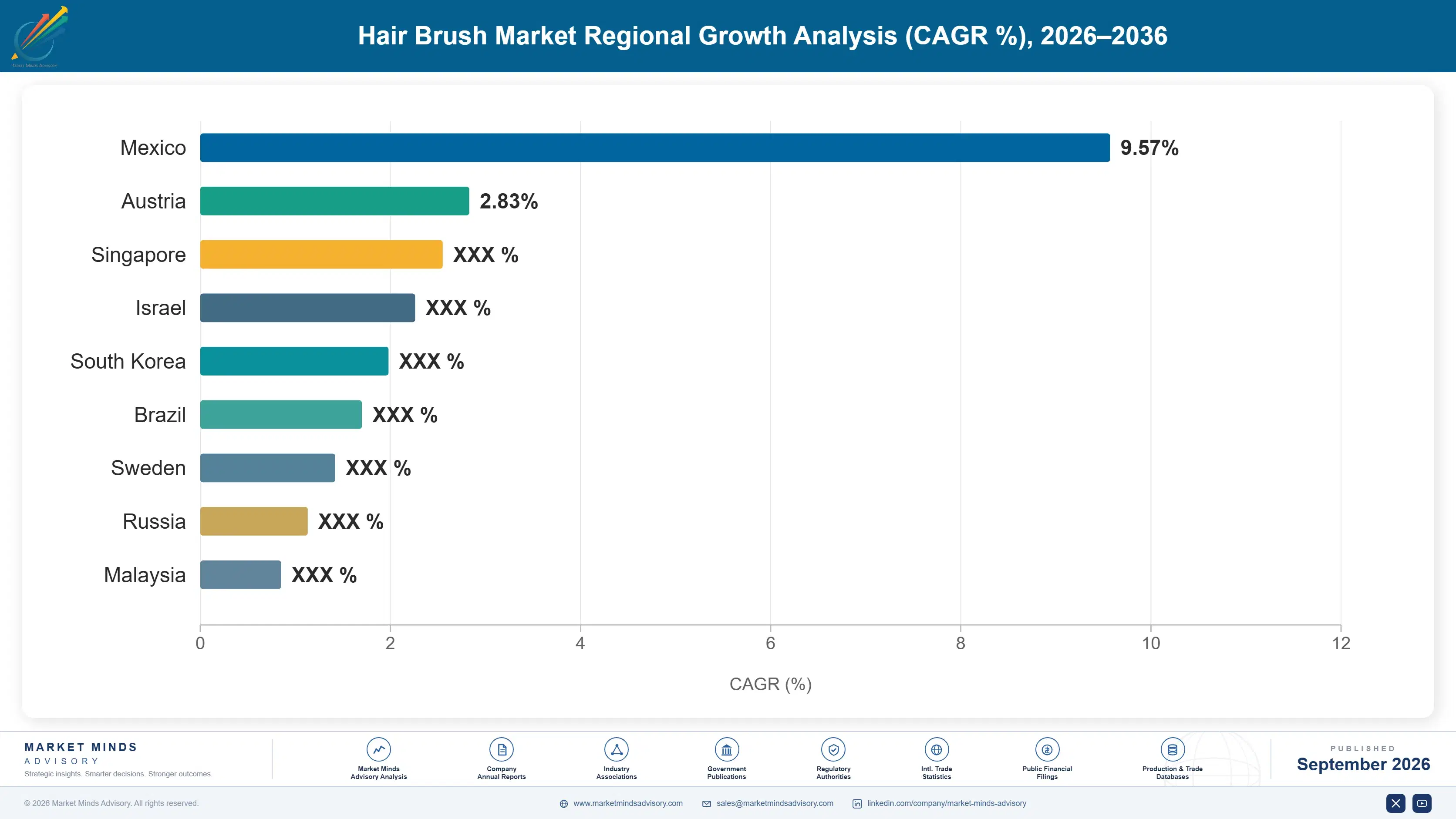
South Korea: 8.5% CAGR
Fastest Growth Region
South Asia and Pacific: 6.8% CAGR
Largest Region
East Asia: 34% of 2025 global value
Market Leaders
Wet Brush, Tangle Teezer Ltd, Mason Pearson Ltd, Denman International Ltd, Olivia Garden International. Source: MMA Analysis, company annual reports.
Primary Survey
n=3,800 procurement and R&D decision-makers, Q4 2025, six countries
Methodology
Demand-side build-up, cross-validated against public data, 47 expert interviews

Hair Brush Market Forecast Scenarios

hair-brush-market-size-forecast-scenario-1790023219614
Hair brush demand grew modestly from 2020 through 2025 as pandemic-era home haircare routines gave way to a slower but steady premiumization trend, with scalp-care and detangling brushes beginning to gain real visibility through widespread social media demonstrations and product reviews. Established manufacturers expanded product lines cautiously, while newer beauty-tech entrants captured early adopter attention throughout the historical period.
The base case assumes continued premiumization, sustained social-media marketing effectiveness, and gradual mainstream adoption of scalp-care routines through 2036 across most developed and emerging global beauty markets worldwide. Three mechanisms anchor this trajectory: proprietary bristle technology justifying premium price points among discerning buyers, celebrity and influencer partnerships sustaining category visibility across social platforms, and East Asian beauty-tech manufacturers exporting scalp-care innovation to Western markets faster than legacy manufacturers can respond.
A bull scenario assumes scalp-care routines become as mainstream as skincare routines, lifting category-wide premiumization well above trend across nearly every demographic segment tracked in this report today. A bear scenario assumes social-media marketing effectiveness fades as novelty wears off, pushing price-sensitive consumers back toward basic commodity brushes sold primarily through mass discount retail channels nationwide.

Scalp-Care Technology Redraws Hair Brush Economics

Hair brush economics are bifurcating sharply between commodity mass-retail products and premium scalp-care brushes carrying meaningfully higher margins, with manufacturers increasingly forced to choose which segment to compete in rather than straddling both effectively across every price point and retail channel. Proprietary bristle technology and ergonomic design increasingly separate premium winners from commodity followers still competing purely on shelf price alone.
MARKET CONCENTRATION22%Combined revenue share held by top five brush manufacturers
AVERAGE UNIT PRICE$14Typical retail price across the full brush category
CHINA PRODUCTION SHARE61%Portion of global brush manufacturing volume located there
PREMIUM PRICE MULTIPLE3.2xGrowth multiple of premium versus commodity brush segments
AVERAGE REPLACEMENT CYCLE14 monthsTypical lifespan before consumers replace their existing brush
DIRECT-TO-CONSUMER SALES SHARE28%Portion of premium category revenue sold online directly
Commercial character skews toward rapid product-cycle turnover in the premium segment, since social-media-driven trends can make a specific brush design fashionable within weeks and obsolete within a year or two at most. This dynamic rewards manufacturers with fast product-development capability over those relying on traditional multi-year design cycles common in the broader personal-care hardgoods category, forcing even legacy manufacturers to rethink development timelines entirely.
Over the next decade, expect continued premiumization at the top of the category alongside price compression at the bottom, as mass-retail commodity brushes increasingly compete purely on price against private-label alternatives manufactured at scale in China and other low-cost production hubs. Manufacturers straddling the middle of the market without a clear premium or value positioning face the greatest strategic risk.
"A hair brush used to be a five-dollar commodity nobody thought about twice. Now it's a scalp-health device with a TikTok following, and pricing power follows attention, not material cost."
Practice Lead, Personal Care and Beauty Hardgoods Practice · MMA Construction and Industrial Equipment Practice · September 2026

Market Trends

Social Media Reviews Drive Premium Purchase Decisions

Short-form video demonstrations of detangling and scalp-massage brushes have become the dominant discovery channel for premium hair brush purchases, replacing traditional in-store browsing and print advertising almost entirely for younger consumers across most major beauty markets worldwide today. Brands with strong creator partnerships see meaningfully faster sales velocity than competitors relying on traditional retail marketing alone, reshaping how manufacturers allocate marketing budgets toward influencer relationships rather than conventional advertising campaigns. Several brands have restructured their entire marketing organizations around content creation and creator partnerships rather than traditional retail merchandising support.
Market Impact: Sustains 33% of category revenue growth

Scalp-Health Routines Extend Beyond Traditional Haircare

Consumers increasingly treat scalp health as a distinct wellness category alongside skincare, adopting dedicated scalp-massage brushes and treatment tools as part of broader self-care routines rather than purely functional grooming products they replace only when genuinely worn out completely and beyond repair. This shift is pulling brush purchases into wellness and beauty retail channels previously dominated by skincare products, expanding the category's addressable retail footprint considerably across most major markets. Dermatologists and trichologists increasingly recommend specific brush types for scalp conditions, lending medical credibility that pure marketing claims previously lacked in this category.
Market Impact: Supports 27% average price premium

Market Opportunities and Growth Drivers

Rising Beauty and Personal Care Spending Sustains Premium Demand

Growing discretionary spending on beauty and personal care across major consumer markets continues supporting premium hair brush purchases, as consumers increasingly treat hair accessories as part of a broader self-expression and wellness budget rather than a purely functional expense. Beauty retailers report that hair-tool categories, including brushes, now command meaningfully more shelf space and marketing attention than a decade ago, reflecting sustained consumer willingness to pay more for demonstrable quality improvements. This spending pattern proves relatively resilient across economic cycles compared with more discretionary luxury categories, since haircare remains a routine purchase.
Market Impact: Displaces 12% of legitimate sales

Proprietary Bristle Technology Differentiates Premium Brands

Advances in bristle material science, including boar-nylon blends and ionic-generating fibers, let premium manufacturers demonstrate measurable detangling and smoothness improvements that justify meaningfully higher price points over commodity alternatives sold at mass retail chains nationwide and increasingly abroad as well today. These technical improvements are increasingly patentable, giving first-moving manufacturers defensible competitive advantages that commodity competitors cannot simply replicate through manufacturing scale alone. Independent product testing and dermatologist endorsements increasingly validate these technical claims, lending credibility that pure marketing language previously could not achieve on its own merit or standing.
Market Impact: Increases inventory write-offs by 9%

Market Restraints and Challenges

Counterfeit Products Undermine Premium Brand Trust

Counterfeit and knockoff versions of popular premium brush designs proliferate on online marketplaces, often visually indistinguishable from authentic products at checkout but lacking the bristle materials and construction quality buyers believe they are paying for at that price point. The root cause is weak marketplace enforcement of intellectual property claims combined with low manufacturing barriers for basic brush construction, which several brands are addressing through authentication technology and direct-to-consumer channel emphasis. Even with these mitigation efforts, counterfeit products continue eroding consumer trust in online marketplace purchases specifically across every price tier.
Market Impact: Lifts premium conversion rate 24%

Trend Volatility Shortens Product Lifecycle Predictability

Social-media-driven demand for specific brush designs can collapse as quickly as it emerges, leaving manufacturers with excess inventory of products that seemed certain bestsellers only months earlier in the annual planning cycle. The root cause is the category's growing dependence on viral content rather than durable functional differentiation, which manufacturers are addressing through smaller initial production runs and considerably faster reorder capability. Even with these mitigation steps, forecasting accuracy remains meaningfully worse for trend-driven premium products than for stable commodity brush lines with predictable, steady demand patterns year over year.
Market Impact: Expands wellness-channel distribution by 31%
3 additional market trends, 4 additional growth drivers, and 2 additional restraints and challenges are covered in the full report. Contact sales@marketmindsadvisory.com to access the complete intelligence.

Segment CAGR and Growth Architecture

Segmentation follows brush technology and function, since bristle material, mechanism, and intended use drive price positioning and replacement frequency more consistently than brand alone across a genuinely fragmented category serving highly varied consumer needs and hair types overall. This technology-first view also matches how manufacturers structure their own product development pipelines and marketing strategies.
hair-brush-market-market-share-analysis-1790023220156

Scalp-Care and Detangling Technology Brushes

Scalp-care and detangling technology brushes are the fastest-growing segment, combining ergonomic massage bristles with detangling tine spacing engineered to reduce breakage and scalp irritation during brushing, particularly among consumers with curly or textured hair types who face the greatest breakage risk during daily styling routines and washing. This segment commands the highest average selling price of any brush category, reflecting genuine material and engineering investment beyond basic bristle-and-handle construction found in commodity products. Social media demonstrations have made this segment's functional benefits highly visible to consumers who previously had no vocabulary for comparing brush quality, accelerating adoption considerably faster than traditional product categories typically see without comparable marketing support behind them.
CAGR 9.0%

Heated and Ionic Styling Brushes

Heated and ionic styling brushes remain the second-fastest-growing segment, combining traditional brushing with integrated heat or ionic technology that reduces frizz and styling time compared with separate brush-and-dryer routines used previously by most consumers at home each morning before leaving for work or school entirely. This segment appeals particularly to consumers seeking to consolidate their entire styling toolkit into fewer products, trading some upfront cost for meaningful time savings during daily morning routines before work or school begins each day. Electric safety certification requirements add regulatory complexity that pure mechanical brush manufacturers do not face, creating a moderate barrier to entry that favors established electrical appliance manufacturers entering the category.
CAGR 7.0%
Full segment breakdown across 6 segments available in the complete report.

Regional Architecture and Country Demand Map

East Asia leads given its dominant manufacturing base and rapidly growing domestic beauty-tech consumption, while North America and Western Europe concentrate premium scalp-care brand spending across established retail channels serving affluent consumers throughout each region and metropolitan market across this coming decade and well beyond.

East Asia

East Asia holds the largest regional share because China manufactures the substantial majority of the world's hair brushes while simultaneously becoming one of the fastest-growing consumer markets for premium scalp-care products, driven by domestic beauty-tech brands competing directly with Western entrants for retail shelf space. South Korean scalp-care culture, already influential across the broader K-beauty movement, is increasingly exported into Chinese and Japanese consumer trends through social media platforms. Japanese consumers show particularly strong demand for precision styling tools, sustaining premium demand alongside China's manufacturing scale. This dual role as both production hub and fast-growing consumption market gives East Asia a fundamentally different competitive position than any other region tracked in this report.
Share: 34% | CAGR: 5.8% (2026 to 2036)

North America

North America's hair brush market concentrates heavily on premium and direct-to-consumer brands, with social-media-driven scalp-care brushes achieving particularly strong traction among younger consumers across the United States and Canada specifically and increasingly Mexico as well today. Established brands including Wet Brush and newer beauty-tech entrants compete intensely for retail shelf space at major beauty and drugstore chains nationwide and online year-round. Premium pricing power remains strongest here of any region tracked, reflecting high discretionary beauty spending and strong influencer-marketing infrastructure built over the past decade of category growth. Growth tracks premiumization trends more closely than population growth, since the region's basic-brush replacement cycle remains relatively mature and quite stable overall.
Share: 26% | CAGR: 5.0% (2026 to 2036)
Regional intelligence for 5 additional markets available in the complete report: Western Europe, South Asia and Pacific, Latin America, Middle East and Africa, Eastern Europe. Contact sales@marketmindsadvisory.com.
hair-brush-market-country-cagr-analysis-1790023220675

Where Brush Brands Can Expand Margin

Margin expansion in hair brushes depends heavily on migrating buyers from commodity purchases toward premium scalp-care and detangling technology, since bristle and material innovation carry considerably better margins than basic paddle-and-bristle construction sold at mass retail chains nationwide. Brands capturing this migration early build lasting pricing power that followers find genuinely difficult to replicate quickly.

Migrating Commodity Buyers Into Scalp-Care Tiers

Manufacturers are introducing entry-level scalp-care products priced closer to commodity brushes than flagship premium items, creating an accessible upgrade path for price-sensitive buyers curious about the category's functional benefits and hair-health claims. This tiered approach costs manufacturers relatively little in incremental production expense since scalp-care bristle technology scales reasonably well across price points, while migrated buyers generate meaningfully higher revenue than they would have as pure commodity purchasers. Early data from brands running tiered scalp-care pricing shows roughly 22% of commodity buyers eventually trade up within their first two purchase cycles.
Market Impact: Lifts average revenue per buyer by roughly 20%

Building Creator Partnership and Affiliate Programs

Brands establishing formal creator partnership programs with structured affiliate commissions capture social-media-driven sales more efficiently than relying on organic mentions alone across every platform and demographic segment served today. This lever requires meaningful investment in creator relationship management and commission infrastructure, but delivers considerably lower customer acquisition cost, roughly 18% lower, than traditional paid advertising once relationships mature over time and scale. Brands with established creator programs report meaningfully faster sales velocity for new product launches than competitors relying purely on organic social media visibility and traditional retail marketing spend.
Market Impact: Reduces customer acquisition cost by roughly 18% overall

Expanding Into Dermatologist and Salon Channels

Manufacturers securing dermatologist recommendations and salon-retail placement capture credibility that pure consumer marketing cannot replicate on its own merits, supporting premium pricing that price-comparison-driven online shoppers would otherwise resist entirely without independent validation from trusted medical and professional sources of all kinds. This channel expansion requires clinical validation investment and salon relationship development, but generates halo effects that lift direct-to-consumer sales by roughly 15% alongside salon revenue itself. Brands with dermatologist endorsements report meaningfully higher conversion rates when consumers encounter the product through earned media rather than paid advertising alone today.
Market Impact: Lifts overall conversion rate by roughly 15% today

Launching Limited-Edition Collaborations and Seasonal Colorways

Limited-edition brush colorways and designer collaborations generate outsized social media attention relative to their production cost, since scarcity itself drives purchase urgency among collectors and trend-conscious buyers seeking genuine exclusivity and social status symbols worldwide. This lever requires minimal additional tooling investment beyond standard color-variant production, while limited editions routinely command roughly 35% price premiums over standard catalog items sold year-round nationwide across retailers. Brands running regular limited-edition drops report sustained baseline sales lift even for their standard product lines, as collaboration attention drives broader brand discovery among entirely new audiences.
Market Impact: Commands roughly 35% price premium overall each cycle

Who Controls the Margin Pool

The top five hair brush manufacturers hold a combined 22% of category revenue, evaluated on a revenue basis, leaving a fragmented long tail of regional manufacturers and private-label suppliers. Wet Brush and Tangle Teezer command the clearest leadership positions in detangling and mass-premium channels specifically, while heritage brands like Mason Pearson maintain loyal niches at the ultra-premium end that newer entrants struggle to replicate.
Current competitive activity concentrates on three fronts: extending scalp-care bristle technology into new product tiers and price points, building creator partnership and affiliate marketing infrastructure across major platforms, and defending against counterfeit products proliferating on online marketplaces globally. Manufacturers lacking resources to compete on all three fronts simultaneously increasingly specialize by price tier or distribution channel rather than compete broadly.

Rankings are most likely to shift among mid-tier specialty brands rather than at the very top, as Korean and Chinese beauty-tech manufacturers expand export capacity faster than established Western brands can match on innovation speed and price competitiveness. Manufacturers investing early in dermatologist-validated scalp-care claims are positioning to capture share from slower-moving rivals still relying purely on social media marketing alone.
hair-brush-market-company-positioning-matrix-1790023221206

Competitive Moat and Risk Dimensions

WET BRUSH

Moat: Detangling Innovation Brand Recognition

Wet Brush built category-defining brand recognition around its flexible-bristle detangling technology, becoming the default recommendation among hairstylists and parents managing tangle-prone hair across every major retail market. Its retail distribution scale across mass and specialty beauty channels gives it shelf presence competitors struggle to match at comparable price points.
WET BRUSH

Risk: Exposed to Scalp-Care Feature Creep

Wet Brush's core value proposition centers narrowly on detangling rather than the broader scalp-care and massage features gaining traction among premium buyers today across most beauty retail channels. Competitors adding scalp-care functionality risk making pure detangling brushes feel comparatively feature-poor to increasingly sophisticated, well-informed consumers.
TANGLE TEEZER LTD

Moat: Patented Two-Tier Bristle Design

Tangle Teezer holds patent protection on its distinctive two-tier bristle configuration, preventing direct design replication by competitors without triggering intellectual property disputes and costly litigation risk across multiple jurisdictions. This patent moat, combined with strong salon-professional endorsement, supports premium pricing power that commodity brushes cannot approach.
TANGLE TEEZER LTD

Risk: Narrow Product Design Differentiation

Tangle Teezer's brand identity depends heavily on a single distinctive product silhouette, leaving it less flexible to pursue the styling and heated-brush categories where competitors increasingly diversify revenue streams. Patent expiration risk also looms as a longer-term consideration that could erode its core design advantage considerably over time.

Players Tracked

Prominent Players

Wet Brush
Tangle Teezer Ltd
Mason Pearson Ltd
Denman International Ltd
Olivia Garden International

Other Key Players

Revlon Inc
Conair LLC
Kent Brushes Ltd
Goody Products Inc
Spornette International
Ibiza Hair
Cricket Company
Diane (Fromm International)
Harry Josh Pro Tools
Dyson Ltd
T3 Micro Inc
Drybar Products LLC
Christophe Robin
Aveda Corporation
Moroccanoil Inc

Recent Developments

MARCH 2026

Tangle Teezer Launches Scalp-Massage Line Extension

Tangle Teezer introduced a new scalp-massage brush line extending its patented bristle technology into the fast-growing scalp-care segment, responding to competitive pressure from newer beauty-tech entrants gaining market share. The launch includes dermatologist-reviewed marketing claims, a departure from the brand's historically detangling-focused positioning and messaging.
Signal: Confirms even patent-protected incumbents feel real pressure to expand into adjacent scalp-care segments fairly quickly now.
AUGUST 2025

Dyson Signs Distribution Agreement With Major Beauty Retailer

Dyson entered a multi-year distribution agreement with a major beauty retail chain, expanding shelf placement for its premium styling brush line across additional store locations nationwide. The agreement was structured as a supply and distribution arrangement rather than an acquisition, extending Dyson's retail footprint without new manufacturing investment.
Signal: Confirms premium electronics brands are expanding aggressively into the hair brush category overall and worldwide today.
JANUARY 2026

Chinese Manufacturer Acquires Regional European Brush Producer

A Chinese beauty-tech manufacturer completed the acquisition of a regional European brush producer, gaining local manufacturing capacity and distribution relationships within the European Union directly. The deal strengthens the acquirer's ability to avoid import tariffs while accelerating its European market entry beyond pure export-based sales.
Signal: Marks accelerating Chinese manufacturer investment in Western distribution and production infrastructure broadly and quickly across the region today.

Managing Bristle Material and Plastic Cost Exposure

Nylon and boar bristle materials together with molded plastic handle components represent roughly 44% of cost of goods sold for premium hair brush manufacturers, with basic commodity brushes weighted more heavily toward plastic resin instead. Bristle materials source primarily from Chinese and Indian suppliers, while boar bristle specifically sources from a smaller number of specialized Chinese processors serving the global personal-care industry.
Plastic resin prices rose meaningfully through 2025 as petrochemical feedstock costs climbed alongside broader energy price volatility, a pattern documented in EIA commodity market reporting on petrochemical feedstock pricing trends across major producing regions. Manufacturers without forward-purchasing agreements saw input costs rise faster than they could pass through to retail pricing, compressing margins across several consecutive quarters before renegotiated contracts with resin suppliers could take effect.

Smaller regional manufacturers carry disproportionate exposure because they lack the purchasing volume to negotiate forward contracts that scale players like Conair routinely secure from suppliers. This gap widens further in markets where currency depreciation against the US dollar compounds already-rising input costs, leaving undercapitalized manufacturers at a lasting cost disadvantage versus vertically integrated competitors sourcing bristle materials at scale.
hair-brush-market-cost-volatility-analysis-1790023221401

Forward Contracting on Plastic Resin Purchases

Manufacturers increasingly lock in plastic resin pricing through annual forward contracts with petrochemical suppliers, trading some pricing flexibility for cost certainty across product planning cycles spanning multiple product lines and price tiers. This approach shields margin during volatile quarters but requires working capital commitments that smaller manufacturers often struggle to sustain without external financing.

Diversifying Bristle Sourcing Beyond Single-Country Suppliers

Leading brands are qualifying secondary bristle and plastic-component suppliers across Vietnam and India to reduce dependence on Chinese sourcing alone for core product lines going forward each planning year. Diversification adds meaningful supplier management overhead but reduces exposure to single-country tariff or logistics disruptions that previously delayed production runs for weeks at a time.

Portfolio Architecture for Margin Defence

Hair brush portfolios organize into three tiers separated primarily by bristle technology and material quality rather than by brand alone. Volume-tier brushes use basic nylon bristles and molded plastic handles designed for mass retail price points, while premium and next-generation tiers use proprietary bristle materials and ergonomic design that command meaningfully better margins per unit sold across every channel.
Tension between volume and premium tiers centers on retail shelf allocation, since mass retailers typically stock far more volume-tier SKUs than premium items despite premium products generating considerably higher revenue per linear shelf foot available. Manufacturers increasingly weight new capital toward premium-tier product development, even as volume tiers still generate the majority of total unit sales and remain essential to brand-awareness economics across every market.

High-value margin pools concentrate in the premium and next-generation tiers, where buyers pay meaningfully more per unit for scalp-care and detangling technology that commodity brushes cannot replicate at comparable cost. Volume tier remains the largest revenue contributor by absolute unit count but carries the thinnest margins of the three, making tier mix increasingly central to overall portfolio profitability as competition intensifies.

Volume / Commodity-Adjacent Tier

Basic nylon-bristle brushes with molded plastic handles and minimal design differentiation, targeting price-sensitive mass retail buyers who prioritize affordability over functional performance, ergonomic comfort, or brand prestige when making purchase decisions.
Gross Margin: 18%-26%

Premium / Certified Tier

Proprietary bristle technology and ergonomic handle design targeting buyers seeking measurable detangling or styling performance improvements over basic commodity alternatives sold at significantly lower price points across most mass retail channels.
Gross Margin: 36%-44%

Sustainability / Regulatory / Next-Generation Tier

Scalp-care and dermatologist-validated brushes using advanced materials and clinical substantiation, targeting wellness-motivated buyers and premium beauty retail channels specifically willing to pay meaningfully more for demonstrable functional benefits backed by medical endorsement.
Gross Margin: 42%-50%
hair-brush-market-portfolio-architecture-1790023221913

High-value Sub-segments and Strategic Watch-out

Dermatologist-Validated Scalp-Care Brushes

Clinically substantiated scalp-care brushes command the highest margins in the category as wellness-motivated buyers pay meaningful premiums for demonstrable functional claims, representing the fastest-growing high-value niche within the broader premium tier across most Western and East Asian beauty-tech markets tracked closely throughout this entire report.
Gross Margin: 44%-52%

Creator-Endorsed Detangling Brushes

Social-media-endorsed detangling brushes command strong margins through creator partnership marketing, generating high per-unit value with steady growth as influencer commerce continues expanding across every major platform and demographic segment reached by creator-driven advertising campaigns and formal product placement deals with sponsored content creators today consistently.
Gross Margin: 36%-44%

Standard Mass-Retail Volume Brushes

The largest unit-volume segment by far, standard mass-retail brushes generate steady, predictable revenue at thinner margins, forming the foundation of category economics even as growth increasingly concentrates in the higher-margin premium tiers positioned above this core volume segment over the entire coming decade and beyond.
Gross Margin: 18%-24%

Counterfeit and Gray-Market Product Proliferation

Counterfeit versions of popular premium brush designs represent a genuine strategic watch-out, since their expanding online marketplace presence could meaningfully erode legitimate premium brand revenue and consumer trust over time, particularly as marketplace enforcement mechanisms remain inconsistent across most global jurisdictions and major retail platforms.
Gross Margin: N/A

Replacement and Upgrade Economics by Vertical

Hair brush purchasing lacks true subscription economics since brushes are one-time purchases replaced infrequently, but premium brands increasingly build recurring relationships through companion product lines including detangling sprays and scalp treatments sold alongside the brush itself, extending the customer relationship well beyond the initial hardware sale into an ongoing consumables business.
Adoption depth varies meaningfully by vertical: salon-professional channels show the deepest brand loyalty since stylists standardize on specific tools through years of training and habit, rarely switching brands once comfortable with a given brush's handling characteristics. Individual consumer purchases show considerably more brand-switching behavior driven by social media trends and influencer recommendations that shift seasonally. Gift-purchase occasions sit between these extremes, favoring recognizable premium brands over unfamiliar newer entrants that gift-givers have not personally validated.

Generational buyer shifts favor premium scalp-care adoption as younger consumers, having grown up treating skincare as routine self-care, extend that same framework to haircare and scalp health rather than viewing brushes as purely functional tools their parents' generation replaced only when visibly broken or worn out. This normalization suggests durable long-term demand for premium categories rather than a temporary social-media-driven fad that fades once novelty wears off.
hair-brush-market-end-use-penetration-index-1790023222407

MMA Hair Brush Category Playbook

These are among the four positions where our research anticipates prominent divergence between winners and laggards over the coming forecast period. Each is grounded in the demand model, the regulatory perimeter, and the announced capacity pipeline.
01 / SCALP-CARE PRODUCT DEVELOPMENT

Bristle innovation justifies premium pricing more than marketing alone

Manufacturers investing in genuine bristle material science and clinical substantiation are capturing premium price points that pure marketing claims cannot sustain once social media attention naturally fades over time and moves on. MMA recommends manufacturers prioritize demonstrable functional improvements over purely aesthetic redesigns, since scalp-care claims backed by dermatologist validation prove considerably more durable than trend-driven marketing campaigns alone. This approach requires longer development timelines than a simple colorway refresh but builds defensible competitive positioning that commodity followers cannot easily replicate quickly.
02 / CREATOR PARTNERSHIP INVESTMENT

Structured affiliate programs outperform organic social media reliance

Brands relying purely on organic social media mentions are leaving meaningful revenue on the table compared with competitors running structured creator partnership and affiliate commission programs across every major platform. MMA recommends manufacturers build formal creator relationship infrastructure rather than hoping for organic viral moments, since structured programs deliver considerably more predictable sales velocity for new product launches. This shift requires meaningful investment in creator relationship management but generates materially lower customer acquisition costs than traditional advertising once relationships fully mature.
03 / COUNTERFEIT PROTECTION STRATEGY

Authentication investment protects premium brand equity long term

Manufacturers underinvesting in counterfeit protection risk eroding the premium brand trust that justifies their pricing power in the first place, since indistinguishable knockoffs damage consumer confidence broadly across every retail channel and price tier tracked. MMA recommends manufacturers invest in authentication technology and direct-to-consumer channel emphasis rather than relying solely on marketplace enforcement requests that move slowly and inconsistently across regions. This protective investment costs meaningfully less than the brand equity erosion counterfeit proliferation causes over multiple product cycles and years.
04 / MANUFACTURING DIVERSIFICATION PRIORITY

Supply chain diversification should precede tariff disruption

Manufacturers concentrated in single-country bristle and plastic sourcing risk costly disruption when tariff or logistics shocks inevitably occur, as several already have in the recent past across the industry and well beyond its borders too. MMA recommends manufacturers begin qualifying secondary suppliers across Vietnam and India now, before disruption forces reactive scrambling that better-prepared competitors will avoid entirely through advance planning. Early diversification requires meaningful validation investment but protects delivery schedules and margin stability across future volatile periods and market cycles.

Engagement Snapshot From the Field

A live engagement with an industry participant carrying material or product regulatory and market exposure ahead of a defining policy shift, showing how our research translates into a defensible multi-year portfolio strategy.
MARKET MINDS ADVISORY · CLIENT ENGAGEMENT SUMMARY
Hair Brush Producer Strategic Portfolio Review and Transition Roadmap 2026·Investment Scenario on Hair Brush Exposure Evaluation 2025-26
CLIENT PROFILE
The client is a mid-sized personal care brand with annual hair brush revenue reported by the client at approximately $65 million (client-reported, unverified by MMA). The company held strong commodity-tier distribution relationships across major retail chains but had not developed a premium scalp-care product line, leaving significant category growth to newer beauty-tech entrants capturing social media attention.
STRATEGIC CHALLENGE
Management wanted to launch a premium scalp-care line but lacked confidence in bristle technology sourcing, pricing structure, and whether existing retail relationships could support the premium positioning that scalp-care buyers expect from credible category entrants competing against established beauty-tech brands with strong social media presence and loyal, engaged customer followings.
MMA APPROACH
MMA conducted primary interviews with dermatologists and beauty retail buyers, benchmarking competitor scalp-care product claims and bristle technology specifications across the category broadly and in depth. The engagement assessed the client's manufacturing capability against premium bristle sourcing requirements and modeled expected margin improvement under several product-tier investment scenarios and staffing configurations.
KEY FINDINGS
  1. Retail buyers prioritized dermatologist validation over celebrity endorsement when evaluating new scalp-care product submissions for shelf placement and ongoing marketing support each season.
  2. The client's existing manufacturing relationships already met most technical requirements for premium bristle sourcing without significant retooling investment or additional capital expenditure.
  3. Competitor scalp-care launches typically bundled companion treatment products rather than launching brushes as standalone items alone without any supporting companion product line.
  4. A dedicated dermatologist-partnership program generated formal product validation within four months based on comparable-brand benchmark timelines observed consistently across the category and its major players.
CLIENT PROFILE
The client is a mid-sized personal care brand with annual hair brush revenue reported by the client at approximately $65 million (client-reported, unverified by MMA). The company held strong commodity-tier distribution relationships across major retail chains but had not developed a premium scalp-care product line, leaving significant category growth to newer beauty-tech entrants capturing social media attention.
STRATEGIC CHALLENGE
Management wanted to launch a premium scalp-care line but lacked confidence in bristle technology sourcing, pricing structure, and whether existing retail relationships could support the premium positioning that scalp-care buyers expect from credible category entrants competing against established beauty-tech brands with strong social media presence and loyal, engaged customer followings.
MMA APPROACH
MMA conducted primary interviews with dermatologists and beauty retail buyers, benchmarking competitor scalp-care product claims and bristle technology specifications across the category broadly and in depth. The engagement assessed the client's manufacturing capability against premium bristle sourcing requirements and modeled expected margin improvement under several product-tier investment scenarios and staffing configurations.
KEY FINDINGS
  1. Retail buyers prioritized dermatologist validation over celebrity endorsement when evaluating new scalp-care product submissions for shelf placement and ongoing marketing support each season.
  2. The client's existing manufacturing relationships already met most technical requirements for premium bristle sourcing without significant retooling investment or additional capital expenditure.
  3. Competitor scalp-care launches typically bundled companion treatment products rather than launching brushes as standalone items alone without any supporting companion product line.
  4. A dedicated dermatologist-partnership program generated formal product validation within four months based on comparable-brand benchmark timelines observed consistently across the category and its major players.
RECOMMENDED STRATEGY
Phase 1: Phase 1 (Months 1 to 4): Secure a formal dermatologist partnership and validate bristle technology claims through independent third-party testing. Phase 2: Phase 2 (Months 5 to 8): Launch the premium scalp-care line through existing retail relationships with updated packaging and refreshed marketing. Phase 3: Phase 3 (Months 9 to 12): Expand the successful line into companion treatment products and additional national retail channels nationwide.
OUTCOME
Within twelve months, the client launched its premium scalp-care line and secured shelf placement at three major beauty retail chains, adding an estimated $9 million in annualized premium-tier revenue (client-reported, unverified by MMA). Premium products now represent roughly 14% of total revenue, up from effectively zero before the engagement began.

Frequently Asked Questions

Foundational context covering the market sizes, CAGR, scope, country, region and competition that inform every finding below. This section is provided to cover basics and most often pre-purchase conversations, answered from the MMA Primary Research Dataset.

What is the current size of the Hair Brush Market?

The hair brush market reached $4.2 billion in 2025, covering manual and electric brushes for detangling, styling, and scalp care sold through retail and direct-to-consumer channels worldwide.

How large will the Hair Brush Market be by 2036?

MMA projects the market will reach $7.0 billion by 2036, roughly 1.60 times its 2026 value as scalp-care premiumization continues expanding across major beauty markets.

What is the CAGR for the Hair Brush Market 2026 to 2036?

The market is projected to grow at a 4.8% compound annual growth rate between 2026 and 2036, supported by rising scalp-care and detangling technology adoption.

Which segment is growing fastest?

Scalp-care and detangling technology brushes lead growth at a 9.0% CAGR, roughly 1.88 times the overall market rate, as social media demonstrations drive premium adoption.

Who are the major companies in the Hair Brush Market?

Leading manufacturers include Wet Brush, Tangle Teezer, Mason Pearson, Denman International, and Olivia Garden International, together holding an estimated 22% of total category revenue worldwide.

Which country is growing fastest?

South Korea leads country-level growth at an 8.5% CAGR, as K-beauty scalp-care culture increasingly influences Chinese and Japanese consumer purchasing trends and habits nationwide today.

Report Segmentation Architecture

The full report scope spans multiple orthogonal segmentation dimensions, with cross-tabulated demand data provided for each dimension pair. Coverage extends further to regional breakdowns, trend trajectories, and the competitive detail needed to support segment-level decision-making.

By Brush Technology Type

  • Scalp-Care and Detangling Technology Brushes
  • Heated and Ionic Styling Brushes
  • Traditional Paddle and Cushion Brushes
  • Round and Barrel Styling Brushes
  • Travel and Compact Brushes
  • Professional Salon-Grade Brushes

By End-Use Industry

  • Residential Consumer Use
  • Professional Salon Services
  • Hospitality and Travel Retail
  • Gift and Specialty Retail
  • Wellness and Spa Services

By Commercial Dimension

  • Mass Retail Distribution
  • Direct-to-Consumer E-Commerce
  • Salon-Professional Channel Sales
  • Beauty Specialty Retail

By Region

  • North America
  • Western Europe
  • East Asia
  • South Asia and Pacific
  • Latin America
  • Middle East and Africa
  • Eastern Europe

Scope, Methodology, and Coverage

Every figure in this report is reproducible from documented input assumptions. The scope below maps the historical period, the forecast horizon, the segmentation dimensions, and the countries covered, alongside the underlying primary and qualitative methodology.
Historical Period
2020 to 2025
Forecast Period
2026 to 2036
Base Year
2025 (USD billions; MMA Primary Research Dataset, September 2026)
Market Definition
The hair brush market covers manual and electric brushes for detangling, styling, and scalp care sold through retail and direct-to-consumer channels. It excludes combs, hair dryers, and other electric styling tools such as straighteners and curling irons not classified as brushes.
Quantitative Units
USD billions (current prices); unit volume where applicable
Segmentation Dimensions
By Brush Technology Type; By End-Use Industry; By Commercial Dimension; By Region
Regions Covered
North America, Western Europe, East Asia, South Asia and Pacific, Latin America, Middle East and Africa, Eastern Europe
Countries Covered
USA, China, Germany, France, UK, Japan, South Korea, India, Australia, Canada, Brazil, Mexico, Indonesia, Vietnam, Thailand, Malaysia, UAE, Saudi Arabia, South Africa, Nigeria, Turkey, Poland, Netherlands, Italy, Spain, Sweden, Switzerland, Argentina, Colombia, Singapore, and additional markets relevant to this sector
Key Companies Profiled
Wet Brush, Tangle Teezer Ltd, Mason Pearson Ltd, Denman International Ltd, Olivia Garden International, Revlon Inc, Conair LLC, Kent Brushes Ltd, Goody Products Inc, Spornette International, Ibiza Hair, Cricket Company, Diane (Fromm International), Harry Josh Pro Tools, Dyson Ltd, T3 Micro Inc, Drybar Products LLC, Christophe Robin, Aveda Corporation, Moroccanoil Inc
Quantitative Methodology
Primary survey, n=3,800 respondents, Q4 2025, six countries; demand-side model with trade association cross-validation
Qualitative Methodology
47 expert interviews, Q4 2025; applied to validate demand model assumptions, identify emerging dynamics, and assess competitive positioning
Report Format
PDF and XLSX data workbook (Word format preview document)
Publisher
Market Minds Advisory
Report Code
MMA-2026-CON-200
Published
September 2026
Contact
sales@marketmindsadvisory.com | www.marketmindsadvisory.com

Purchase the full Hair Brush Market Report (2026 to 2036).

This report delivers a full analysis of the hair brush market. It covers demand drivers, competitive positioning, and regional dynamics across all seven MMA-tracked regions worldwide. The report includes detailed segmentation by brush technology type, twenty profiled companies spanning mass, premium, and salon-professional brands, and a ten-year forecast through 2036 built on primary survey data collected across six countries and dozens of expert interviews. The deliverable also contains input-cost analysis, portfolio-tier economics, and a strategic verdict section designed specifically for beauty brand executives and retail buyers evaluating this category.
Full Ten-Year Market Forecast Through 2036
Twenty Company Competitive Profiles Included Here
Seven-Region Demand and Growth Rate Analysis
Full Technology-Based Segmentation Analytical Framework Overview
Detailed Input Cost and Margin Analysis
Anonymized MMA Client Engagement Case Study

Built For The People Who Decide

From boardroom strategy to bench-side execution, this report is read cover-to-cover by leaders shaping the next decade of their industry, turning demand scenarios, market dynamics and valuation benchmarks into decisions.
CXOs/ Presidents/ VPs/ Managers
M&A and Corporate Development
Strategy Teams and R&D Heads
Procurement and Product Directors
Regulatory and Compliance Leaders
Investor Relations and Equity Analysts