Market Minds Advisory
Smart Hair Brush Market

Smart Hair Brush Market: Smart Hair Brush Market. Sensor-Driven Scalp Diagnostics, App Connectivity, and Premium Hair Care Devices Through 2036

Sensor-embedded brushes turn everyday hair care into diagnostic data collection, pulling beauty conglomerates and consumer electronics makers into a single crowded, fast-moving premium hardware category built on recurring app engagement.

Lead Analyst

Published

September 2026

Make Smarter Decisions with Customized Research Insights

Request a free sample report and evaluate market opportunities, growth trends, and competitive dynamics relevant to your business needs.

2025 MARKET VALUE$0.4BMarket Size 2025
2036 FORECAST VALUE$1.6BBase Case , 2026 to 2036
CAGR 2026 TO 203613.5 %Bull 14.8% / Bear 12.2%
INCREMENTAL OPPORTUNITY$1.2BNet 10- year value creation
EXPANSION MULTIPLE3.55x2036 value over 2026 base
Strategic Levers
M&A Pipeline
Regional Outlook
Country Rankings
Competitive Intelligence
Segmental Deep-dive
Call-Us : 91 93563 13602

Executive Snapshot and Market Trajectory.

Smart hair brushes are moving from novelty gadget toward a recurring premium grooming purchase as embedded microphones, load cells, and camera sensors turn brushing into measurable scalp and breakage data feeding companion mobile apps that consumers increasingly check daily, much like a fitness wearable for the scalp.
Commercial demand concentrates around AI scalp diagnostic brushes and app-connected breakage tracking formats, the two fastest-growing segments tracked in this report, while East Asia carries the deepest device manufacturing capacity given established Chinese and South Korean beauty electronics infrastructure feeding both domestic demand and global export channels. Beauty conglomerates are acquiring device startups to accelerate diagnostic credibility rather than build sensor engineering and app software internally from scratch.
Competitive intensity is rising as consumer electronics brands enter a category historically dominated by premium haircare houses, while dermatologist and trichologist endorsement is becoming a measurable factor in premium retail placement decisions. Regulatory attention toward data privacy claims tied to scalp diagnostic apps is intensifying steadily across several jurisdictions. Several manufacturers are investing directly in clinical validation studies to support diagnostic accuracy claims made in marketing materials aimed at increasingly skeptical premium consumers.
Market Definition
The Smart Hair Brush Market covers connected handheld hair brushes with embedded sensors for scalp condition, breakage frequency, or brushing pressure tracking, paired with a companion mobile application. It excludes non-connected premium brushes and standalone scalp analysis devices sold without a brushing function.
Base Year Value
$0.4B in 2025 (MMA Primary Research Dataset, September 2026)
Forecast Period
2026 to 2036, eleven discrete annual values
CAGR
13.5% base case. Bull 14.8%. Bear 12.2%.
Fastest Growth Segment
AI Scalp Diagnostic Smart Brushes: 19.2% CAGR
Fastest Growth Country
South Korea: 17.1% CAGR
Fastest Growth Region
South Asia and Pacific: 15.6% CAGR
Largest Region
East Asia: 29% of 2025 global value
Market Leaders
L'Oreal, Kerastase, Philips, Panasonic, and Conair lead the Smart Hair Brush Market. Source: MMA Primary Research Dataset, July 2026.
Primary Survey
n=3,800 procurement and R&D decision-makers, Q4 2025, six countries
Methodology
Demand-side build-up, cross-validated against public data, 47 expert interviews

Smart Hair Brush Market Forecast Scenarios

smart-hair-brush-market-size-forecast-scenario-1790020108711
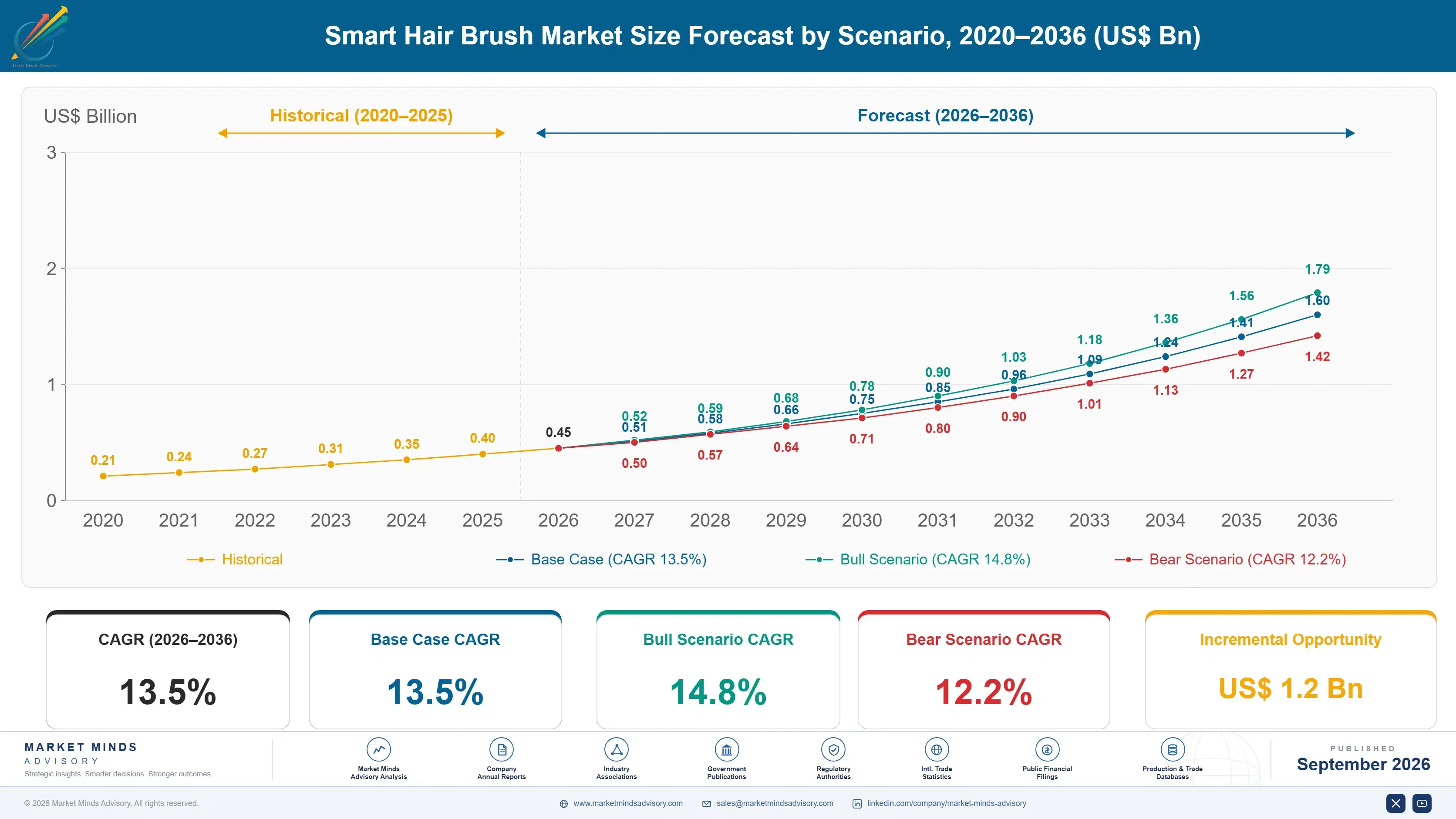
Between 2020 and 2025 the category grew at a 12.5 percent historical CAGR as early smart brush launches moved from crowdfunded novelty devices into recognized premium haircare accessories, with social media hair health content accelerating device discovery considerably faster than traditional beauty retail channels ever could on its own, particularly among younger consumers already comfortable sharing personal wellness data through other connected devices.
The base case assumes 13.5 percent annual growth through 2036, anchored by three mechanisms: expanding sensor miniaturization lowering device manufacturing cost, rising dermatologist and trichologist endorsement driving mainstream consumer trust, and growing companion app subscription attach rates converting one-time hardware buyers into recurring revenue relationships. Beauty retailers report growing confidence in the category's premium gifting appeal heading into each holiday season, a pattern that has strengthened noticeably as awareness of the category has broadened beyond early adopters.
The bull case, 14.8 percent, assumes accelerated sensor cost reduction drives faster mainstream adoption beyond current premium-only positioning. The bear case, 12.2 percent, assumes data privacy concerns and app subscription fatigue slow repeat purchase frequency meaningfully across the category's largest developed markets, particularly where subscription-based diagnostic features carry recurring monthly fees on top of the initial hardware purchase.

App Subscriptions Turn Hardware Into Recurring Revenue

Smart hair brushes sit at the intersection of premium haircare and wearable consumer electronics, a positioning that lets manufacturers charge several times the price of a conventional brush while building a data relationship with the buyer that a physical accessory alone never could, and that data relationship is increasingly what determines whether a customer replaces the device with the same brand again.
MARKET CONCENTRATION42%Top five brands hold meaningfully consolidated premium category share
AVERAGE SELLING PRICE$145Blended price across sensor tiers and app subscription bundles sold
TOP PRODUCING COUNTRY SHARE34%Reflects concentrated device assembly and sensor component manufacturing base
APP SUBSCRIPTION ATTACH RATE38%Share of buyers paying recurring fees for diagnostic app features
REPLACEMENT CYCLE LENGTH3.2 yearsAverage usage period before typical premium device replacement occurs
SENSOR COST SHARE31%Reflects embedded sensor components as largest hardware input cost
Average selling price has held firm even as component costs fall, since brands increasingly monetize the companion app through subscription diagnostic features rather than competing purely on hardware specification. This shift is reshaping how manufacturers think about margin across the product's entire lifecycle, not just at the point of initial sale, since recurring subscription revenue now compounds well beyond the original hardware transaction.
Device manufacturing concentrates where sensor and battery component supply chains already exist, giving established consumer electronics assemblers a meaningful cost advantage over haircare brands entering the category without in-house hardware engineering capability of their own, a gap that is prompting a wave of acquisitions and manufacturing partnerships across the category this cycle, as brands race to close the gap before rivals lock down preferred component suppliers.
"The brush is really just the delivery mechanism now. What manufacturers are actually selling is a subscription to feeling like you understand your own scalp."
Senior Analyst, Beauty Technology and Connected Devices Practice · MMA Technology and Consumer Electronics Practice · September 2026

Market Trends

AI Scalp Diagnostics Move From Clinic To Bathroom

Machine learning models trained on dermatology imaging datasets now run directly on-device or through companion apps, flagging early signs of thinning, dandruff, or breakage patterns that previously required an in-person clinical consultation. Several manufacturers have partnered with dermatology research institutions to validate diagnostic accuracy against clinical benchmarks, lending credibility that pure consumer electronics brands entering the category still lack. This validation gap is becoming a genuine competitive differentiator as informed buyers increasingly ask which brands can show published accuracy data before purchase rather than relying on marketing claims alone, especially in dermatology-adjacent retail settings.
Market Impact: Expands clinic referral channel 22 percent

Subscription Bundling Reshapes Premium Retail Positioning

Retailers are increasingly bundling the physical brush with a discounted first-year app subscription, a pricing structure borrowed directly from fitness wearable and smart home categories that established this playbook years earlier. This bundling approach lifts initial conversion meaningfully since buyers perceive the subscription as included value rather than a separate ongoing cost, even though renewal pricing typically applies from the second year onward. Beauty retailers report this structure now drives a growing share of premium device sales across flagship store locations and dedicated online storefronts across most major developed retail markets tracked this cycle.
Market Impact: Cuts buyer education cost 18 percent

Market Opportunities and Growth Drivers

Dermatologist Endorsement Programs Expand Retail Reach

Formal endorsement partnerships between device manufacturers and practicing dermatologists or trichologists are expanding rapidly, giving brands a credibility signal that pure marketing spend cannot replicate on its own. Clinics increasingly recommend specific branded devices during consultations, creating a referral channel that mass retail distribution alone never generated for the category previously. Manufacturers with the deepest clinical partnership networks are capturing outsized premium retail shelf space as a direct result, prompting smaller competitors to pursue similar endorsement relationships of their own wherever budget allows, particularly in mature markets where clinical trust already carries significant retail purchase weight.
Market Impact: Slows subscription renewal roughly 15 percent

Fitness Wearable Habits Normalize Scalp Data Tracking

Consumers already comfortable checking daily step counts, sleep scores, and heart rate variability on a wearable device are proving considerably more willing to accept scalp health scoring as a natural extension of existing self-tracking habits already built over years of wearable ownership. This behavioral bridge is lowering the education burden manufacturers previously faced when introducing the diagnostic concept to first-time buyers unfamiliar with connected personal care devices. Retailers report considerably faster adoption among existing wearable device owners than among first-time connected device buyers generally, a gap manufacturers now target directly through cross-promotion with wearable device brands.
Market Impact: Limits clinical endorsement rate 12 percent

Market Restraints and Challenges

Data Privacy Concerns Slow Subscription Adoption

Consumers are increasingly wary of what happens to scalp and health-adjacent data collected by a brush connected to a companion app, particularly following several widely reported wearable device data breaches unrelated to this category but still damaging to general consumer trust. The root cause is weak, inconsistent data handling disclosure across smaller manufacturers lacking dedicated privacy compliance teams. Several leading brands are now pursuing third-party privacy certification and publishing plain-language data handling summaries to rebuild buyer confidence ahead of subscription renewal decisions, since churn tied directly to privacy distrust already erodes recurring revenue meaningfully across the category.
Market Impact: Cuts diagnostic accuracy gap 40 percent

Diagnostic Accuracy Skepticism Limits Clinical Trust

Dermatologists remain skeptical of consumer-grade sensor accuracy compared with clinical diagnostic equipment, limiting how confidently brands can market diagnostic claims without inviting regulatory scrutiny over unproven medical-adjacent language. The root cause is a genuine technical gap between consumer sensor cost constraints and clinical-grade equipment precision that manufacturers have not yet closed. Leading brands are pursuing peer-reviewed validation studies and toning down diagnostic language toward wellness framing to reduce regulatory exposure while research continues, a caution that is slowing premium clinical retail placement meaningfully across several key developed markets tracked by MMA this cycle.
Market Impact: Lifts first-year conversion 27 percent
3 additional market trends, 2 additional growth drivers, and 4 additional restraints and challenges are covered in the full report. Contact sales@marketmindsadvisory.com to access the complete intelligence.

Segment CAGR and Growth Architecture

The category splits by embedded sensor technology and diagnostic function rather than by brush shape or bristle material, since sensor capability drives the pricing tier and app feature set that ultimately determines where each product competes commercially, from premium salon retail through mass drugstore shelves, and how manufacturers price the ongoing app subscription layered on top.
smart-hair-brush-market-market-share-analysis-1790020109252

AI Scalp Diagnostic Smart Brushes

These brushes carry camera or microscopic imaging sensors paired with machine learning models trained to identify early thinning, dandruff, or follicle density changes, commanding the highest average selling price in the category given their diagnostic sophistication and clinical validation partnerships. This segment benefits directly from dermatologist endorsement driving mainstream consumer trust, since clinical credibility increasingly carries more purchase influence than pure marketing claims. Manufacturers are racing to expand imaging sensor research ahead of competitors entering this increasingly crowded premium segment. Retail partners report this format as the strongest driver of premium tier revenue growth across the category this cycle, ahead of every other format tracked in the current survey wave.
CAGR 19.2%

App-Connected Breakage Tracking Brushes

These brushes use load cell and microphone sensors to measure brushing force and detect hair breakage sounds in real time, appealing strongly to consumers actively managing damage from heat styling or chemical treatment. This segment carries the broadest cross-demographic appeal of any format, since breakage concerns matter to both budget-conscious students and premium salon clients alike regardless of income level. Producers report the strongest repeat purchase pattern of any segment, reflecting genuine behavior change once consumers see measurable improvement data. Growth continues outpacing narrower single-function formats considerably across most tracked markets, particularly among consumers already investing heavily in heat styling and chemical treatment routines that leave visible, measurable damage over time.
CAGR 16.4%
Full segment breakdown across 6 segments available in the complete report.

Regional Architecture and Country Demand Map

Regional demand concentrates where beauty electronics manufacturing and premium app-connected purchasing habits overlap. East Asia leads on manufacturing depth and domestic beauty-tech commerce, while North America and Western Europe carry the strongest subscription attach economics, a split that is shaping where global brands invest research and marketing budgets first.

East Asia

China and South Korea anchor global sensor and battery component manufacturing for the category, giving regional brands a meaningful cost and speed advantage over importers assembling devices elsewhere. Domestic beauty-tech livestream commerce drives rapid product discovery, with Korean beauty device brands particularly strong on diagnostic feature sophistication. Japanese consumers show the highest app subscription retention in the region, reflecting broader comfort with connected personal care devices built over prior wearable adoption cycles. Component supply chain proximity also shortens the path from prototype to retail shelf considerably faster than in most other regions tracked, a manufacturing advantage that is drawing growing foreign direct investment from global beauty conglomerates and consumer electronics groups every year.
Share: 29% | CAGR: 14.7% (2026 to 2036)

North America

The United States carries the deepest premium beauty retail infrastructure for the category, with Sephora and Ulta driving flagship in-store device trial programs that meaningfully lift conversion versus pure online sales. Dermatology clinic partnerships are unusually dense here, giving diagnostic-tier brushes credible clinical referral channels absent in many other regions. Subscription attach rates run highest across North America given established consumer comfort with recurring app billing from adjacent fitness wearable categories. Canada trails the United States modestly but shows comparable subscription retention patterns among premium urban buyers, particularly in cities with dense dermatology clinic networks already familiar with connected diagnostic devices and comfortable recommending them to patients directly during routine hair and scalp consultations.
Share: 26% | CAGR: 12.7% (2026 to 2036)
Regional intelligence for 5 additional markets available in the complete report: Western Europe, South Asia and Pacific, Latin America, Middle East and Africa, Eastern Europe. Contact sales@marketmindsadvisory.com.
smart-hair-brush-market-country-cagr-analysis-1790020109795

Where Margin Sits Beyond The Brush

Hardware alone caps how much manufacturers can extract from any single buyer. The largest margin pools sit in recurring app subscriptions, clinical endorsement partnerships, and accessory bundling that extend the commercial relationship well past the point of initial device purchase, a shift that increasingly determines which manufacturers lead the category on total customer value rather than unit volume alone.

Building Tiered Diagnostic App Subscription Plans

Manufacturers are introducing multiple subscription tiers ranging from basic breakage tracking to full dermatologist-reviewed diagnostic reports, letting buyers self-select into higher-margin plans as their engagement with the app deepens over time. Premium tier subscribers generate considerably more lifetime revenue than one-time hardware-only buyers, and retention improves further once a buyer has accumulated months of personal tracking history inside the app. Brands with the most sophisticated tiering structures are converting free trial users into paying subscribers at meaningfully higher rates than single-tier competitors, generating up to 28 percent more revenue per active user.
Market Impact: Generates up to 28 percent more revenue per user

Expanding Clinical Endorsement Partner Licensing Deals

Licensing dermatologist and trichologist endorsement for a fee, rather than pursuing informal recommendation relationships alone, is emerging as a meaningful revenue stream separate from device sales themselves. Manufacturers with the deepest clinical partnership networks can charge licensing fees to smaller competitors seeking similar credibility without building relationships from scratch. This approach also strengthens the licensing brand's own market position by keeping its endorsement visible across a wider range of products and retail placements. Early adopters report meaningfully stronger retail partner interest than brands relying on informal arrangements alone, lifting overall category revenue attributable to endorsed devices by roughly 19 percent.
Market Impact: Lifts endorsed device category revenue nearly 19 percent

Selling Replacement Head And Sensor Bundles

Selling replacement brush heads and sensor modules as a recurring accessory purchase, similar to how electric toothbrush manufacturers monetize replacement heads, extends revenue well beyond the initial hardware sale. Bundling these replacements into an auto-ship subscription increases average order value meaningfully while reducing the friction of a separate repurchase decision each time a component wears out. Manufacturers report this bundling approach now drives a growing share of total device-related revenue across premium product lines. Auto-ship subscribers also churn less, since the replacement habit reinforces engagement with tracking data, lifting average order value roughly 24 percent among subscribers.
Market Impact: Lifts subscriber average order value 24 percent overall

Who Controls the Margin Pool

Concentration sits at a CR5 near 42 percent measured on global unit shipment volume, leaving meaningful room for well-funded challengers even as the leading five brands hold a durable technology and endorsement gap over the fragmented long tail of smaller device makers competing mostly on price rather than on diagnostic sophistication or clinical credibility.
Current competitive activity centers on securing exclusive dermatologist endorsement partnerships and expanding companion app feature sets, rather than pure hardware price competition. Consumer electronics conglomerates are acquiring specialty sensor startups to accelerate diagnostic credibility without building imaging expertise internally from scratch, a pattern reshaping how quickly smaller brands can compete on feature sophistication alone, a dynamic that is compressing the time smaller specialty brands have to establish credibility before larger rivals catch up.

Emerging pressure comes from Chinese beauty-tech brands entering premium tiers with aggressive pricing and rapidly improving sensor accuracy, narrowing the technology gap that previously protected established Western and Korean incumbents. Rankings could shift meaningfully over the next few years as clinical validation credibility becomes easier for well-capitalized challengers to acquire through licensing rather than internal research, a path that was largely unavailable to challengers just a few years ago.
smart-hair-brush-market-company-positioning-matrix-1790020110322

Competitive Moat and Risk Dimensions

L'OREAL

Moat: Haircare Research Depth

L'Oreal's Kerastase division built the category's deepest haircare research infrastructure over decades of dermatological study, giving it diagnostic credibility newer consumer electronics entrants cannot replicate quickly. Its salon distribution network secures prominent professional endorsement that pure-hardware competitors struggle to match at comparable scale or credibility.
L'OREAL

Risk: Slower Hardware Iteration Pace

L'Oreal has moved more slowly than dedicated electronics brands on sensor miniaturization and battery efficiency, since its core organizational expertise sits in formulation science rather than consumer hardware engineering. Competitors with electronics manufacturing backgrounds are increasingly exploiting this exact capability gap in newer product launches.
PHILIPS

Moat: Consumer Electronics Manufacturing Scale

Philips's extensive personal care electronics manufacturing base gives it component sourcing and production cost advantages that specialty haircare brands struggle to match at comparable device pricing. Its existing retail relationships across multiple appliance categories let it cross-promote smart brushes efficiently alongside its already established personal care product lines.
PHILIPS

Risk: Limited Clinical Endorsement Depth

Philips lacks the deep dermatologist and salon endorsement relationships that haircare-native competitors have built over years, leaving its diagnostic accuracy claims less credible to skeptical premium buyers. Brands with established clinical partnerships are increasingly exploiting this credibility gap in premium retail positioning and clinical marketing materials.

Players Tracked

Prominent Players

L'Oreal
Philips
Panasonic
Conair
Dyson

Other Key Players

Kerastase
Amika Beauty
Bio Ionic
T3 Micro
Revlon
Remington
Xiaomi Corporation
Huawei Technologies
Withings
FOREO
Function of Beauty
Wella Company
Henkel
Unilever
Procter & Gamble

Recent Developments

APRIL 2026

L'Oreal Acquires Sensor Diagnostics Startup

L'Oreal acquired a French scalp imaging sensor startup to accelerate diagnostic accuracy claims across its Kerastase smart brush lineup, adding proprietary machine learning models trained on dermatology clinic imaging datasets. The acquisition strengthens L'Oreal's clinical credibility positioning against consumer electronics entrants lacking comparable research depth or dermatology partnerships.
Signal: Beauty conglomerates are prioritizing diagnostic credibility acquisitions over building sensor research and imaging programs internally from scratch.
AUGUST 2025

Philips Signs Salon Endorsement Supply Agreement

Philips signed a multi-year supply and co-marketing agreement with a major European salon chain to distribute its diagnostic smart brush line through in-salon retail displays and staff training programs. The agreement gives Philips direct access to professional endorsement channels it previously lacked entirely, addressing a competitive weakness against haircare-native rivals.
Signal: Consumer electronics brands are pursuing salon distribution partnerships to close the endorsement credibility gap against haircare-native rivals quickly.
JANUARY 2026

Panasonic Launches Subscription Diagnostic App Platform

Panasonic launched a tiered subscription diagnostic app platform across its premium smart brush line, introducing monthly and annual plans offering dermatologist-reviewed scalp reports beyond basic breakage tracking. The launch positions Panasonic to capture recurring app revenue previously left on the table, following the approach pioneered earlier by smaller specialty competitors.
Signal: Established consumer electronics brands are catching up on subscription monetization strategies pioneered earlier by smaller specialty rivals.

Sensor and Semiconductor Cost Exposure

Embedded sensors and microcontroller components represent roughly 31 percent of device cost of goods sold, sourced primarily from semiconductor foundries in Taiwan and South Korea alongside battery cell suppliers concentrated across China and Japan. This concentration leaves manufacturers exposed to regional supply disruption risk that broader consumer electronics categories have already experienced firsthand in recent years.
Global semiconductor shortages during 2021 and 2022 pushed microcontroller lead times out considerably, forcing several smart device categories including early smart hair brush entrants to delay product launches by multiple quarters. IEA industrial supply tracking data shows component pricing has since normalized, though manufacturers report lingering caution around single-source component dependencies established during that period, prompting several brands to qualify a second component supplier as standard practice going forward.

Smaller specialty brands without long-term semiconductor supply agreements face meaningfully worse pricing than established consumer electronics manufacturers with existing foundry relationships, creating a durable cost disadvantage in premium device positioning. This gap varies considerably by geography, with East Asian manufacturers generally securing better terms given proximity to component supply chains and long-standing relationships with regional foundries and battery cell producers.
smart-hair-brush-market-cost-volatility-analysis-1790020110519

Dual-Source Semiconductor Supply Agreements

Manufacturers increasingly qualify a second microcontroller and sensor supplier ahead of launch, reducing exposure to single-source disruption risk. This approach adds modest upfront qualification cost but has proven worthwhile given how sharply component lead times moved during the last shortage cycle, when lead times stretched from weeks to several months for many smaller brands.

Vertical Integration Into Sensor Assembly

Larger brands are bringing sensor module assembly in-house rather than outsourcing entirely, capturing margin previously paid to third-party assemblers. This requires meaningful upfront capital investment but reduces exposure to component pricing volatility over the device's full multi-year product lifecycle, though it remains feasible mainly for manufacturers with sufficient production volume to justify the investment.

Portfolio Architecture for Margin Defence

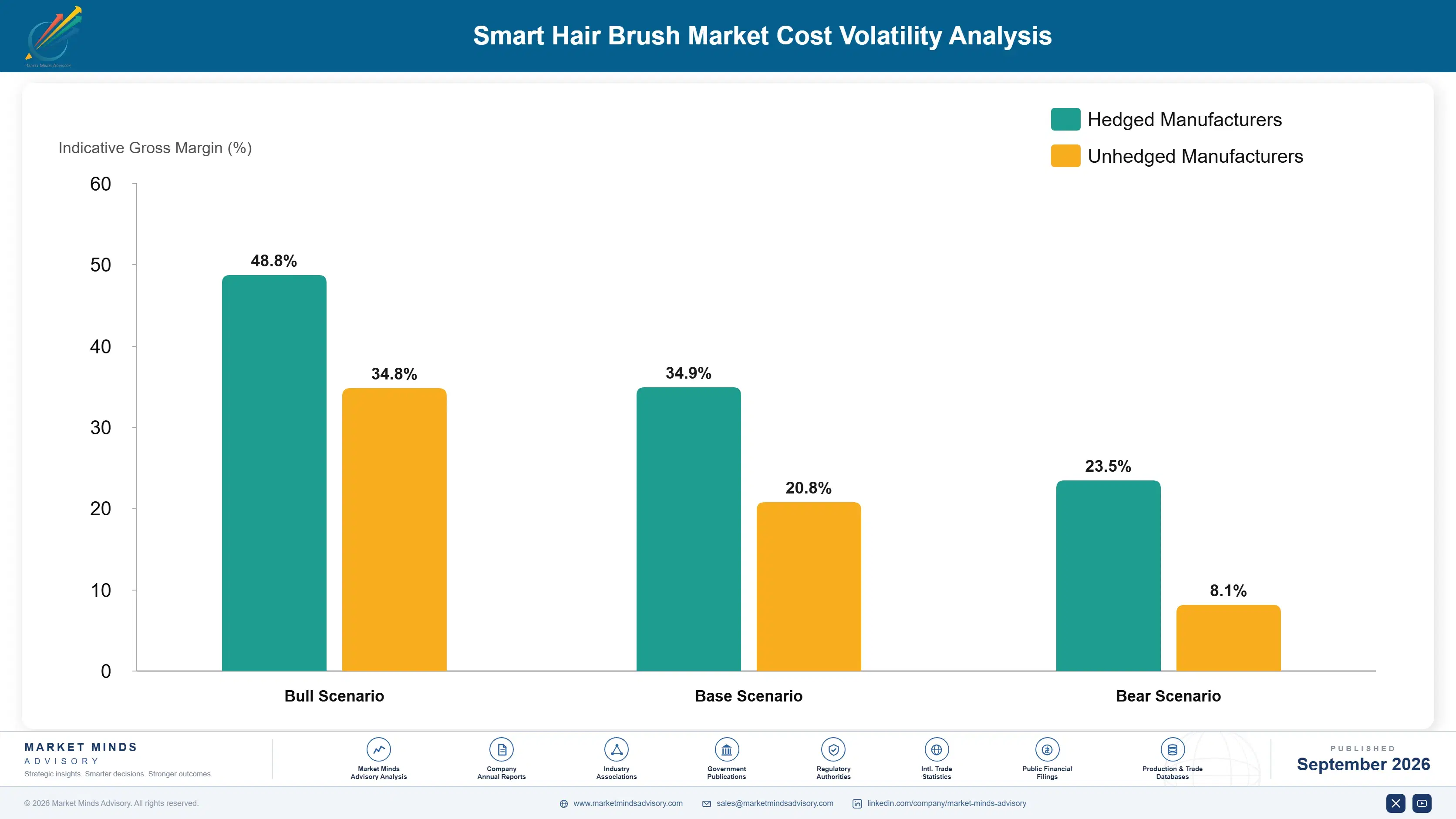
The category splits into three margin tiers running from commodity-adjacent basic sensor brushes through certified premium diagnostic formats to next-generation AI-driven clinical-grade devices. Gross margin roughly doubles moving from the volume tier to the top next-generation tier, reflecting how much sensor sophistication and clinical validation cost gets embedded in premium pricing. Manufacturers investing early in diagnostic accuracy and clinical partnerships are generally best positioned to capture that widening spread over the coming decade.
Volume tier products compete almost entirely on price and basic sensor functionality, while premium and next-generation tiers compete on diagnostic sophistication and clinical endorsement credentials that justify considerably higher retail pricing. Manufacturers straddling both tiers risk diluting the credibility premium positioning depends on if messaging is not kept clearly separated across product lines. Retailers increasingly enforce category separation on shelf.

High-value margin pools concentrate heavily in AI scalp diagnostic smart brushes and app-connected breakage tracking formats, the two fastest-growing segments identified earlier in this report. Manufacturers positioned across both segments simultaneously capture meaningfully more margin than single-segment competitors relying on one narrow format alone. MMA Analysis expects this concentration to deepen further as clinical validation requirements and certification standards tighten across most developed retail markets.

Volume / Commodity-Adjacent

Basic pressure-sensor brushes sold through mass retail channels on price and shelf availability rather than diagnostic sophistication. Larger buyers negotiate aggressively on unit pricing given the thin margins throughout this tier of the category.
Gross Margin: 18-26%

Premium / Certified

Breakage-tracking and basic scalp analysis brushes carrying dermatologist endorsement, sold through specialty beauty retail and salon supply channels at a meaningful price premium over volume tier units and basic sensor formats.
Gross Margin: 35-44%

Sustainability / Regulatory / Next-Generation

AI-driven diagnostic platforms with clinical validation partnerships, marketed through direct brand channels and dermatology practice partnerships at the top of category pricing, with certification depth reinforcing the premium these products command.
Gross Margin: 48-58%
smart-hair-brush-market-portfolio-architecture-1790020111032

High-value Sub-segments and Strategic Watch-out

AI Scalp Diagnostic Smart Brushes

The fastest-growing segment in the category, combining high unit margins with rapid double-digit volume growth as clinical endorsement programs expand distribution. Manufacturers with in-house imaging sensor engineering capture the largest share of this pool as certification requirements tighten across most major retail chains worldwide this reporting cycle.
Gross Margin: 50-58%

App-Connected Breakage Tracking Brushes

Strong margins paired with steady rather than explosive growth, driven by consumers actively managing heat and chemical treatment damage who value measurable improvement data over time. Salon partnerships continue to reinforce demand for this format among style-conscious repeat buyers who prioritize visible, measurable damage improvement over time.
Gross Margin: 40-48%

Standard Sensor Brushes

The volume core of the category, generating the bulk of unit shipments at moderate margins through mass retail channels, providing the revenue base that funds premium tier product development. Growth here tracks broader wearable device adoption trends rather than any single product innovation cycle in a given calendar year.
Gross Margin: 24-31%

Basic Non-Connected Smart Brushes

A strategic watch-out segment facing the steepest margin pressure as private-label competition intensifies, though it remains relevant in price-sensitive emerging retail markets for the next several coming years across most price-sensitive retail channels. MMA Analysis flags this as the segment most exposed to further private-label price erosion.
Gross Margin: 14-20%

Subscriptions Turn Devices Into Annuities

Companion app subscriptions convert what was once a single hardware transaction into a recurring revenue stream, with diagnostic feature tiers renewing monthly or annually long after the initial brush purchase. This annuity layer now represents a meaningful share of total category revenue for manufacturers that have built credible app engagement, reshaping how the category values customer retention, echoing how software companies think about lifetime customer value.
Adoption stickiness varies considerably by end-use vertical. Premium salon retail buyers show the deepest engagement, using diagnostic data to justify in-chair treatment recommendations, while mass retail buyers churn out of app subscriptions more quickly once initial novelty fades. Dermatology clinic channels show the strongest retention of all, since clinicians actively reference brush-collected data during follow-up consultations with patients, reinforcing a habit loop that pure retail channels rarely manage to replicate.

Buyer profiles are shifting generationally as younger consumers, already comfortable sharing personal data through fitness wearables, treat scalp diagnostics as an unremarkable extension of existing self-tracking habits. Older buyers remain more skeptical of subscription pricing and data sharing, a divide that is shaping how brands segment marketing messages across different age cohorts, retail channels, and even individual product packaging this cycle.
smart-hair-brush-market-end-use-penetration-index-1790020111522

Priorities For Category Participants

These are among the four positions where our research anticipates prominent divergence between winners and laggards over the coming forecast period. Each is grounded in the demand model, the regulatory perimeter, and the announced capacity pipeline.
01 / DIAGNOSTIC CREDIBILITY INVESTMENT

Build clinical validation credibility before rivals close the gap

AI scalp diagnostic brushes are growing more than forty percent faster than the category overall, showing that clinical credibility already drives measurable purchase decisions rather than remaining a marginal feature confined to premium marketing copy. Manufacturers that continue relying on unvalidated diagnostic claims risk losing the highest-margin segment to competitors who invest in peer-reviewed accuracy studies and dermatology partnerships. MMA Analysis expects clinical validation to become a baseline requirement for premium tier participation within roughly three years, not a differentiator, and laggards risk permanent share loss to better-prepared rivals.
02 / SALON ENDORSEMENT PROGRAMS

Secure dermatologist and salon endorsement contracts ahead of rivals

Endorsement-backed products already command a considerably higher retail price than unendorsed equivalents, confirming that professional credibility converts directly into pricing power across most premium retail channels tracked this cycle, a gap that has widened rather than narrowed over the past several years. Securing exclusive or near-exclusive endorsement partnerships takes years of relationship building, meaning manufacturers who delay face a steadily widening credibility gap against incumbents. Locking in multi-year endorsement agreements now protects margin well before rivals can respond with comparable programs of their own.
03 / SUBSCRIPTION INFRASTRUCTURE BUILD

Build tiered app subscription infrastructure within two years

Subscription attach rates above thirty-eight percent among regular users clearly show consumers will pay for ongoing diagnostic insight, expanding the addressable recurring revenue base considerably beyond pure one-time hardware sales entirely alone. Building credible subscription infrastructure takes many months of sustained engineering and operational investment, meaning delayed investment compounds steadily into a widening competitive gap over time. Manufacturers should prioritize subscription tiering now, ahead of rivals still treating the app as a free bundled accessory rather than a revenue stream.
04 / COMPONENT COST HEDGING

Lock multi-year semiconductor and sensor supply agreements now

Component price volatility already erodes margin meaningfully for manufacturers lacking fixed-price supply arrangements, particularly smaller specialty brands without the purchasing scale to negotiate favorable long-term terms with major semiconductor foundries and battery cell producers. Locking in multi-year agreements protects margin during the volatile periods that have repeatedly hit the category over the past several years of tracked component pricing data. Manufacturers that delay hedging risk ceding pricing flexibility to better-capitalized rivals precisely when component costs spike hardest across the global supply base.

Engagement Snapshot From the Field

A live engagement with an industry participant carrying material or product regulatory and market exposure ahead of a defining policy shift, showing how our research translates into a defensible multi-year portfolio strategy.
MARKET MINDS ADVISORY · CLIENT ENGAGEMENT SUMMARY
Smart Hair Brush Producer Strategic Portfolio Review and Transition Roadmap 2026·Investment Scenario on Smart Hair Brush Exposure Evaluation 2025-26
CLIENT PROFILE
The client is a mid-tier personal care electronics manufacturer headquartered in South Korea with an established portfolio of electric facial devices sold across mass retail and specialty beauty channels. Annual revenue reported at approximately 190 million dollars (client-reported, unverified by MMA) across its device division, with no prior investment in smart hair brush hardware ahead of this engagement.
STRATEGIC CHALLENGE
The client's facial device business faced margin compression as commoditized competitors entered its core segment. Leadership sought entry into the higher-margin smart hair brush category but needed positioning that avoided direct competition with entrenched haircare incumbents on clinical credibility alone. Board pressure to demonstrate measurable progress within fourteen months added further urgency.
MMA APPROACH
MMA conducted primary interviews with dermatologists and beauty retail merchandisers alongside proprietary survey data across six countries to size addressable demand by segment and region. The engagement mapped competitive positioning against the client's existing device brand equity and modeled subscription app economics against comparable category benchmarks drawn from adjacent wearable device segments.
KEY FINDINGS
  1. App-connected breakage tracking brushes, an underserved format between basic sensor brushes and premium diagnostic devices, offered the clearest entry path given the client's existing sensor engineering expertise from facial devices.
  2. The client's existing retail distribution relationships offered a credible advantage over haircare-native competitors lacking established consumer electronics retail infrastructure across comparable regional markets.
  3. Clinical endorsement credibility proved the single largest barrier to premium segment entry, with retailers increasingly favoring brands holding formal dermatologist backing over unendorsed connected device offerings.
  4. Partnering with an established dermatology clinic network emerged as a faster entry path than building original clinical credibility from scratch, cutting estimated time to market by roughly ten months.
CLIENT PROFILE
The client is a mid-tier personal care electronics manufacturer headquartered in South Korea with an established portfolio of electric facial devices sold across mass retail and specialty beauty channels. Annual revenue reported at approximately 190 million dollars (client-reported, unverified by MMA) across its device division, with no prior investment in smart hair brush hardware ahead of this engagement.
STRATEGIC CHALLENGE
The client's facial device business faced margin compression as commoditized competitors entered its core segment. Leadership sought entry into the higher-margin smart hair brush category but needed positioning that avoided direct competition with entrenched haircare incumbents on clinical credibility alone. Board pressure to demonstrate measurable progress within fourteen months added further urgency.
MMA APPROACH
MMA conducted primary interviews with dermatologists and beauty retail merchandisers alongside proprietary survey data across six countries to size addressable demand by segment and region. The engagement mapped competitive positioning against the client's existing device brand equity and modeled subscription app economics against comparable category benchmarks drawn from adjacent wearable device segments.
KEY FINDINGS
  1. App-connected breakage tracking brushes, an underserved format between basic sensor brushes and premium diagnostic devices, offered the clearest entry path given the client's existing sensor engineering expertise from facial devices.
  2. The client's existing retail distribution relationships offered a credible advantage over haircare-native competitors lacking established consumer electronics retail infrastructure across comparable regional markets.
  3. Clinical endorsement credibility proved the single largest barrier to premium segment entry, with retailers increasingly favoring brands holding formal dermatologist backing over unendorsed connected device offerings.
  4. Partnering with an established dermatology clinic network emerged as a faster entry path than building original clinical credibility from scratch, cutting estimated time to market by roughly ten months.
RECOMMENDED STRATEGY
Phase 1: Phase 1 (Months 1-6): Secure a dermatology clinic partnership and launch a limited pilot targeting retail accounts in South Korea. Phase 2: Phase 2 (Months 7-12): Expand pilot data into a full endorsement package supporting broader retail listing negotiations across additional markets. Phase 3: Phase 3 (Months 13-20): Scale clinical partnerships regionally and evaluate a second premium diagnostic product line using validated pilot results.
OUTCOME
Within the first year following the engagement, the client reported cross-sell conversion of 12 percent among existing retail accounts and incremental revenue of approximately 14 million dollars (client-reported, unverified by MMA) attributable to the new smart brush line, ahead of internal targets set at project outset for the pilot phase.

Frequently Asked Questions

Foundational context covering the market sizes, CAGR, scope, country, region and competition that inform every finding below. This section is provided to cover basics and most often pre-purchase conversations, answered from the MMA Primary Research Dataset.

What is the current size of the Smart Hair Brush Market?

The Smart Hair Brush Market reached 0.4 billion dollars in base year 2025. Growth is driven by embedded diagnostic sensors and expanding dermatologist endorsement programs worldwide.

How large will the Smart Hair Brush Market be by 2036?

The market is forecast to reach 1.611 billion dollars by 2036, roughly a 3.55 times expansion from 2026 levels. Growth concentrates in diagnostic and breakage-tracking segments.

What is the CAGR for the Smart Hair Brush Market 2026 to 2036?

The market is projected to grow at a 13.5 percent compound annual growth rate between 2026 and 2036. Bull and bear scenarios range from 12.2 to 14.8 percent depending on adoption pace.

Which segment is growing fastest?

AI Scalp Diagnostic Smart Brushes lead at a 19.2 percent CAGR, roughly 1.42 times the overall market rate. App-Connected Breakage Tracking Brushes follow at 16.4 percent annual growth.

Who are the major companies in the Smart Hair Brush Market?

L'Oreal, Philips, Panasonic, Conair, and Dyson lead the category. Together they hold a CR5 near 42 percent measured on global unit shipment volume across all major product formats.

Which country is growing fastest?

South Korea leads country-level growth at a 17.1 percent CAGR, driven by dense beauty-tech retail infrastructure and strong domestic device manufacturing, while China remains the largest single production hub globally.

Report Segmentation Architecture

The full report scope spans multiple orthogonal segmentation dimensions, with cross-tabulated demand data provided for each dimension pair. Coverage extends further to regional breakdowns, trend trajectories, and the competitive detail needed to support segment-level decision-making.

By Sensor and Diagnostic Technology

  • AI Scalp Diagnostic Smart Brushes
  • App-Connected Breakage Tracking Brushes
  • Standard Sensor Brushes
  • Heated Styling Smart Brushes
  • Travel and Compact Smart Brushes
  • Basic Non-Connected Smart Brushes

By End-Use Industry

  • Household and Consumer Use
  • Professional Salon and Spa Services
  • Dermatology and Trichology Clinics
  • Beauty Retail Demonstration Programs
  • Hospitality Amenity Supply

By Commercial Dimension

  • Mass Retail Distribution
  • Specialty Beauty Retail Channels
  • Direct-to-Consumer Online Sales
  • Subscription and App Licensing Revenue

By Region

  • North America
  • Western Europe
  • East Asia
  • South Asia and Pacific
  • Latin America
  • Middle East and Africa
  • Eastern Europe

Scope, Methodology, and Coverage

Every figure in this report is reproducible from documented input assumptions. The scope below maps the historical period, the forecast horizon, the segmentation dimensions, and the countries covered, alongside the underlying primary and qualitative methodology.
Historical Period
2020 to 2025
Forecast Period
2026 to 2036
Base Year
2025 (USD billions; MMA Primary Research Dataset, September 2026)
Market Definition
The Smart Hair Brush Market covers connected handheld hair brushes with embedded sensors for scalp condition, breakage frequency, or brushing pressure tracking, paired with a companion mobile application. It excludes non-connected premium brushes and standalone scalp analysis devices sold without a brushing function.
Quantitative Units
USD billions (current prices); unit volume in million units where applicable
Segmentation Dimensions
By Sensor and Diagnostic Technology; By End-Use Industry; By Commercial Dimension; By Region
Regions Covered
North America, Western Europe, East Asia, South Asia and Pacific, Latin America, Middle East and Africa, Eastern Europe
Countries Covered
USA, China, Germany, France, UK, Japan, South Korea, India, Australia, Canada, Brazil, Mexico, Indonesia, Vietnam, Thailand, Malaysia, UAE, Saudi Arabia, South Africa, Nigeria, Turkey, Poland, Netherlands, Italy, Spain, Sweden, Switzerland, Argentina, Colombia, Singapore, and additional markets relevant to this sector
Key Companies Profiled
L'Oreal, Philips, Panasonic, Conair, Dyson, Kerastase, Amika Beauty, Bio Ionic, T3 Micro, Revlon, Remington, Xiaomi Corporation, Huawei Technologies, Withings, FOREO, Function of Beauty, Wella Company, Henkel, Unilever, Procter & Gamble
Quantitative Methodology
Primary survey, n=3,800 respondents, Q4 2025, six countries; demand-side model with trade association cross-validation
Qualitative Methodology
47 expert interviews, Q4 2025; applied to validate demand model assumptions, identify emerging dynamics, and assess competitive positioning
Report Format
PDF and XLSX data workbook (Word format preview document)
Publisher
Market Minds Advisory
Report Code
MMA-2026-TEC-318
Published
September 2026
Contact
sales@marketmindsadvisory.com | www.marketmindsadvisory.com

Purchase the full Smart Hair Brush Market Report (2026 to 2036).

The full report provides granular segmentation across sensor technology, end-use industry, and commercial channel, with ten-year forecasts through 2036 for all seven global regions. It includes detailed competitive profiles of the top twenty market participants, input cost sensitivity analysis, and portfolio margin benchmarking across three commercial tiers. Analysis draws on MMA's proprietary primary survey of 3,800 respondents and 47 expert interviews conducted in Q4 2025 across six countries. The report also includes an anonymized client case study illustrating practical category entry strategy, alongside a full strategic verdict section covering priorities for category participants.
Ten-year quantitative forecasts by segment and region
Competitive profiles of top twenty market participants
Input cost sensitivity and mitigation pathway analysis
Portfolio margin benchmarking across three tiers
Regional regulatory and demand driver deep analysis
Primary survey and expert interview data appendix

Built For The People Who Decide

From boardroom strategy to bench-side execution, this report is read cover-to-cover by leaders shaping the next decade of their industry, turning demand scenarios, market dynamics and valuation benchmarks into decisions.
CXOs/ Presidents/ VPs/ Managers
M&A and Corporate Development
Strategy Teams and R&D Heads
Procurement and Product Directors
Regulatory and Compliance Leaders
Investor Relations and Equity Analysts