Coatings and Application Technologies Robotics Market

Coatings and Application Technologies Robotics Market

Coatings and Application Technologies Robotics Market Outlook from 2026-2033

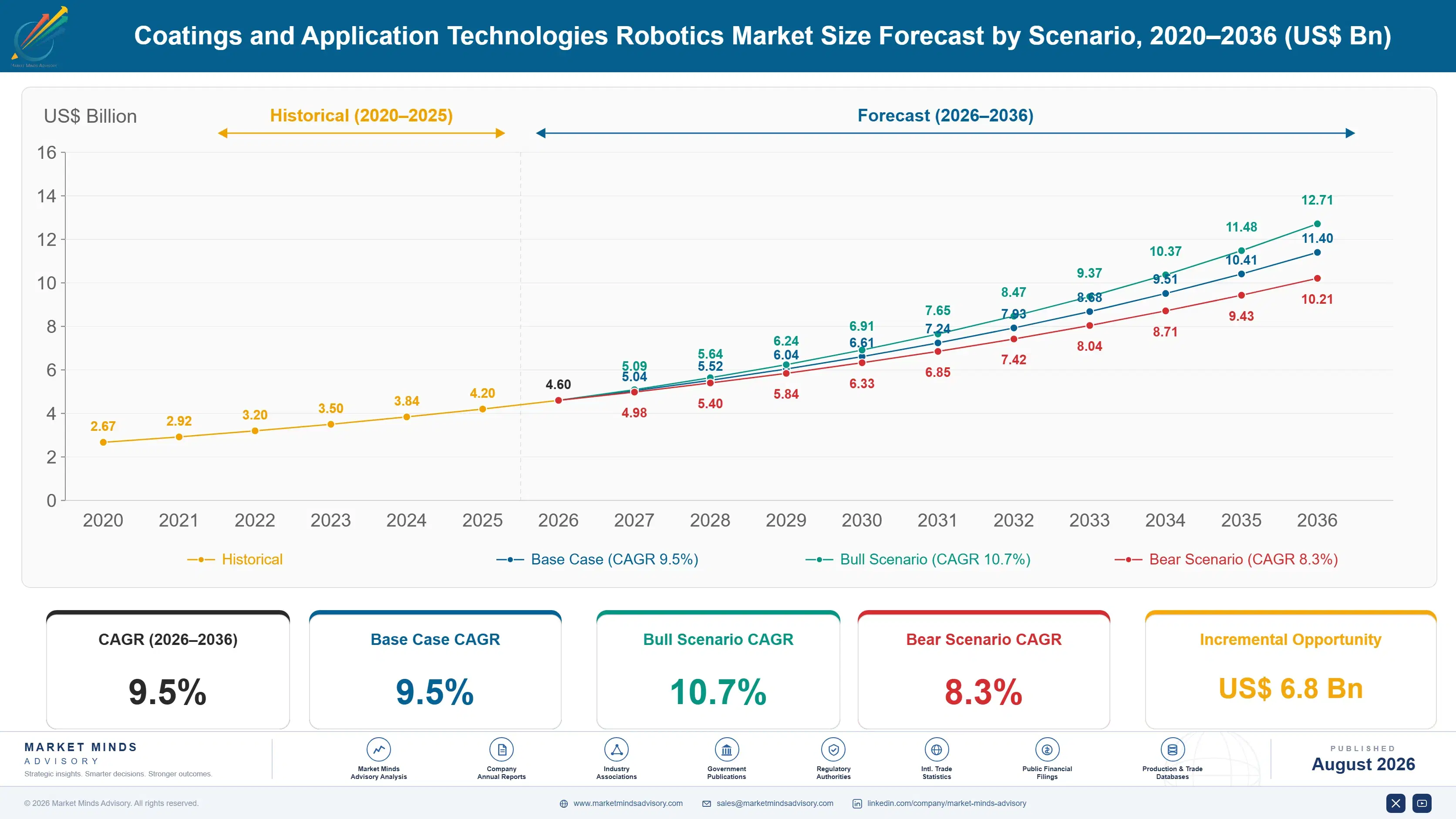
The coatings and application technologies robotics market is poised for significant expansion, driven by the increasing demand for automation in industrial painting and coating processes. In 2026, the market is projected to be valued at USD 2.85 billion, with expectations to reach USD 5.19 billion by 2033, reflecting a robust CAGR of 8.9% during the forecast period. This growth is underpinned by the need for precision, efficiency, and consistency in coating applications across automotive, aerospace, electronics, and general manufacturing sectors. Robotics solutions are increasingly favored for their ability to reduce material waste, enhance worker safety, and deliver superior surface finishes.

The market’s trajectory is further influenced by advancements in robotics technology, including the integration of artificial intelligence, machine learning, and IoT-enabled monitoring systems. These innovations are enabling more adaptive, flexible, and intelligent coating systems, which are essential for meeting the evolving requirements of high-performance coatings and complex geometries. As industries pursue greater operational efficiency and sustainability, the adoption of robotic coating solutions is expected to accelerate, making this market a focal point for investment and technological development.


Carbon Fiber Composites Prosthetics Market

Coatings and Application Technologies Robotics Market Scenario & Strategic Insights

The coatings and application technologies robotics market is experiencing a paradigm shift as manufacturers across industries seek to optimize their production lines. The integration of robotics into coating processes is not only enhancing throughput but also ensuring uniformity and repeatability, which are critical for maintaining product quality. The automotive sector, in particular, has been a frontrunner in deploying robotic coating systems, leveraging their ability to handle high volumes and intricate designs with minimal human intervention. This trend is now permeating other sectors such as aerospace, electronics, and heavy machinery, where precision and reliability are paramount.

Strategically, companies are investing in research and development to create more versatile and user-friendly robotic systems. The focus is on developing robots that can adapt to various coating materials, substrates, and environmental conditions. Additionally, there is a growing emphasis on sustainability, with robotic systems being designed to minimize overspray, reduce volatile organic compound (VOC) emissions, and optimize energy consumption. These strategic initiatives are positioning robotics as an indispensable component of modern coating operations.

The competitive landscape is characterized by collaborations between robotics manufacturers and coating technology providers, aiming to deliver integrated solutions tailored to specific industry needs. As regulatory standards for workplace safety and environmental compliance become more stringent, the adoption of robotic coating technologies is expected to become a standard practice, further propelling market growth.

Attribute2026 (USD Billion)2033 (USD Billion)CAGR (2026 – 2033)
Market Size2.855.198.9%

Coatings and Application Technologies Robotics Market Trends

  • Integration of Artificial Intelligence and Machine Learning

The adoption of artificial intelligence (AI) and machine learning (ML) in coatings and application technologies robotics is transforming the industry. AI-driven robots can analyze surface conditions in real-time, adjust spray patterns, and optimize coating thickness, resulting in improved quality and reduced material usage. Machine learning algorithms enable robots to learn from previous applications, continuously enhancing their performance and adaptability. This trend is particularly significant in industries where product customization and rapid changeovers are common, as it allows for greater flexibility and efficiency in coating operations.

  • Growth in Demand for Eco-Friendly and Sustainable Solutions

Environmental sustainability is becoming a central focus in the coatings and application technologies robotics market. Manufacturers are increasingly seeking robotic systems that minimize waste, reduce VOC emissions, and support the use of water-based or low-solvent coatings. Advanced robotics can precisely control the amount of coating applied, significantly reducing overspray and material consumption. This not only helps companies comply with environmental regulations but also lowers operational costs. The push for greener manufacturing processes is expected to drive further innovation in robotic coating technologies.

  • Expansion into New Industrial Verticals

While automotive and aerospace have traditionally dominated the adoption of robotic coating technologies, there is a notable expansion into new verticals such as electronics, construction equipment, and consumer goods. These industries are recognizing the benefits of robotics in achieving high-quality finishes, improving production speed, and enhancing worker safety. The versatility of modern robotic systems, which can handle a wide range of coating materials and complex part geometries, is facilitating this expansion. As a result, the market is witnessing a broader application base and increased demand across diverse sectors.

Segment & Category Analysis for Coatings and Application Technologies Robotics Market

By Robot Type

The robot type segment is crucial in determining the suitability of robotic systems for various coating applications. Articulated robots, with their multiple axes of movement, are widely used for complex and large-scale coating tasks, particularly in automotive and aerospace industries. SCARA and Cartesian robots are preferred for high-speed, repetitive operations, often found in electronics and consumer goods manufacturing. Collaborative robots, or cobots, are gaining traction for their ability to work alongside human operators, enhancing flexibility and safety in smaller-scale or customized coating processes. The diversity in robot types allows manufacturers to select solutions that best fit their operational requirements and production volumes.

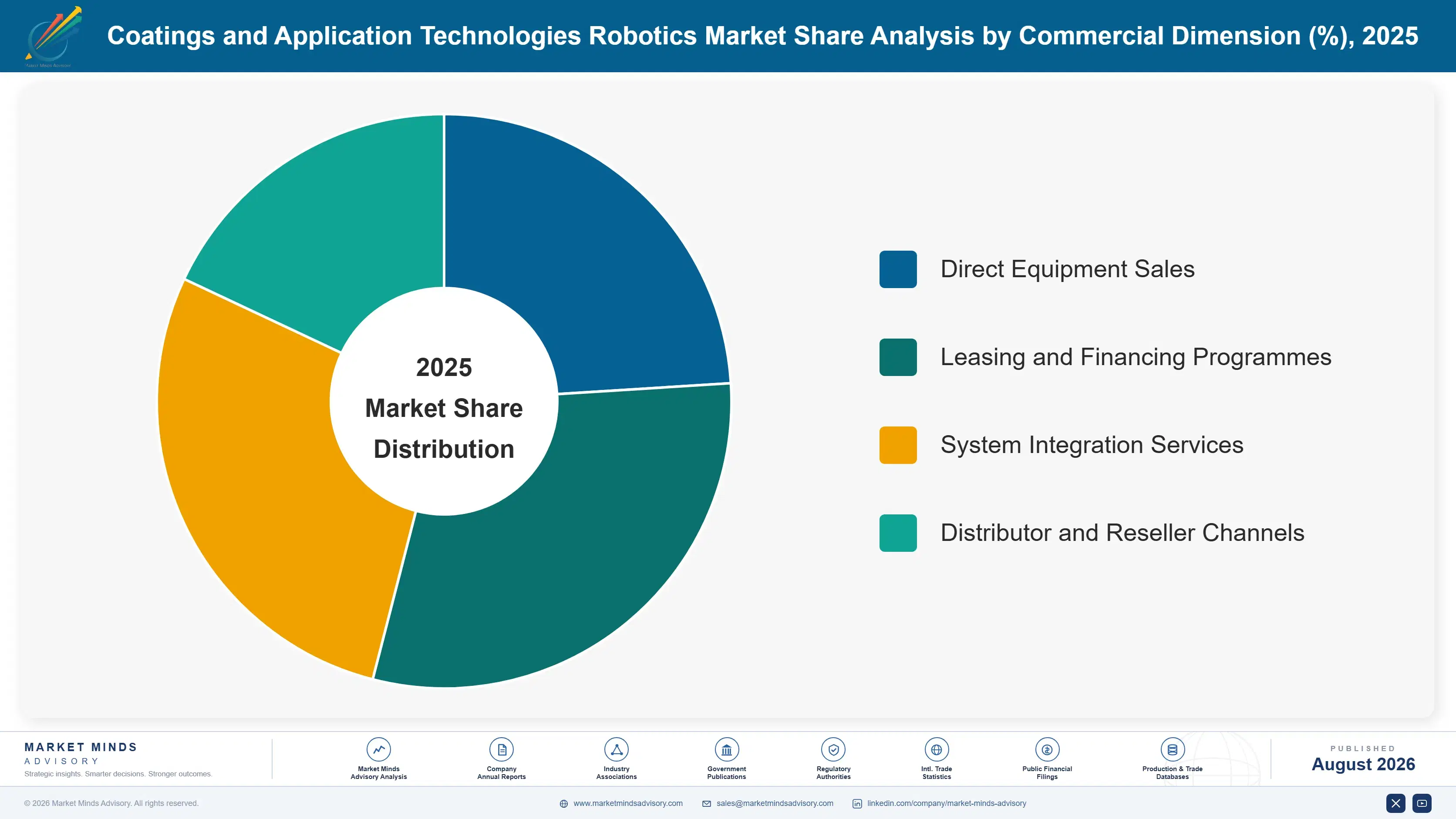
Coatings and Application Technologies Robotics Market Robot Type

By Application

  • Painting
    • Powder Coating Thermal Spraying Dispensing & Sealing
    • Surface Preparation

Application segmentation highlights the varied uses of robotics in coatings and surface treatment processes. Painting remains the dominant application, driven by the automotive and industrial equipment sectors. Powder coating is gaining popularity due to its environmental benefits and durability, while thermal spraying is essential for high-performance coatings in aerospace and energy industries. Dispensing and sealing applications are critical in electronics and automotive assembly, ensuring precise application of adhesives and sealants. Surface preparation, including cleaning and sandblasting, is increasingly automated to improve consistency and reduce labor costs.

By End-Use Industry

  • Automotive
    • Aerospace Electronics Heavy Machinery Consumer Goods
    • Construction Equipment

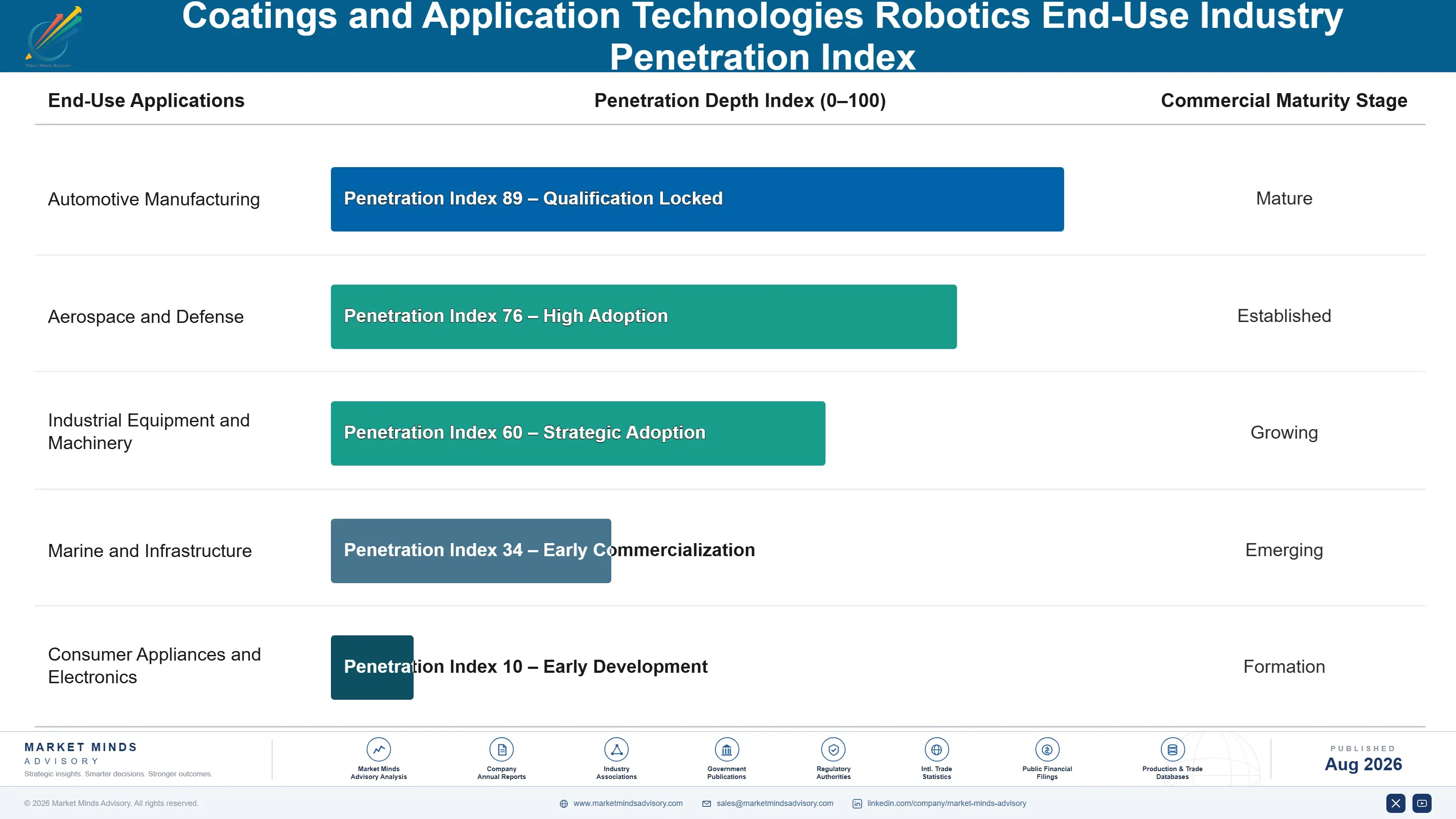
The end-use industry segment reflects the broad adoption of robotic coating technologies across multiple sectors. The automotive industry leads in terms of volume and innovation, with robotics integral to mass production and quality assurance. Aerospace applications demand high precision and reliability, driving the adoption of advanced robotic systems. Electronics manufacturing benefits from robotics in miniaturized and delicate coating tasks, while heavy machinery and construction equipment sectors utilize robotics for durability and corrosion resistance. Consumer goods manufacturers are increasingly adopting robotics to enhance product aesthetics and consistency.

By Coating Material

  • Solvent-Based Coatings
    • Water-Based Coatings Powder Coatings UV-Curable Coatings
    • High-Solid Coatings

The choice of coating material significantly influences the selection and configuration of robotic systems. Solvent-based coatings, while still prevalent, are being gradually replaced by water-based and powder coatings due to environmental regulations. Powder coatings offer superior durability and minimal VOC emissions, making them attractive for sustainable manufacturing. UV-curable and high-solid coatings are gaining traction in electronics and specialized industrial applications, requiring precise and controlled application methods that robotics can provide.

By Deployment Mode

  • In-House/On-Premise
    • Outsourced/Contract Coating Services

Deployment mode segmentation distinguishes between companies that invest in their own robotic coating systems and those that outsource to specialized service providers. In-house deployment is favored by large manufacturers seeking full control over quality and process optimization. Outsourced services are popular among small and medium enterprises (SMEs) and industries with fluctuating production volumes, offering flexibility and access to advanced technologies without significant capital investment. The trend towards outsourcing is expected to grow, particularly in emerging markets and among industries with diverse coating requirements.

Coatings and Application Technologies Robotics Market Deployment Mode

Growth Drivers and Opportunities in Coatings and Application Technologies Robotics Market

  • Rising Demand for Automation and Operational Efficiency

The increasing need for automation in manufacturing processes is a primary growth driver for the coatings and application technologies robotics market. Robotics solutions offer significant advantages in terms of speed, precision, and repeatability, enabling manufacturers to achieve higher throughput and consistent product quality. The reduction in labor costs, coupled with enhanced worker safety by minimizing exposure to hazardous materials, further incentivizes the adoption of robotic systems. As industries strive to remain competitive in a global market, the integration of robotics into coating applications is becoming a strategic imperative.

  • Technological Advancements and Customization Capabilities

Continuous advancements in robotics technology, including the integration of AI, machine vision, and IoT connectivity, are creating new opportunities for market growth. These technologies enable robots to adapt to complex geometries, variable substrates, and diverse coating materials, meeting the specific needs of different industries. Customization capabilities allow manufacturers to tailor robotic systems for unique applications, such as intricate automotive parts or sensitive electronic components. The ability to deliver high-quality finishes with minimal waste and downtime is driving the adoption of advanced robotic coating solutions.

Emerging Opportunities for Coatings and Application Technologies Robotics Market

  • Expansion into Emerging Markets

The coatings and application technologies robotics market is witnessing significant opportunities in emerging economies, particularly in Asia-Pacific and Latin America. Rapid industrialization, increasing investments in manufacturing infrastructure, and the adoption of advanced technologies are fueling demand for robotic coating solutions. Local manufacturers are seeking to enhance their competitiveness by upgrading to automated systems, creating a fertile ground for market expansion and technology transfer.

  • Development of Eco-Friendly Coating Processes

The growing emphasis on sustainability and environmental compliance is opening new avenues for innovation in robotic coating technologies. Manufacturers are investing in the development of systems that support eco-friendly coatings, such as water-based and powder coatings, and minimize VOC emissions. The ability of robotics to precisely control material usage and reduce waste aligns with global sustainability goals, positioning the market for long-term growth as regulatory pressures intensify.

Growth Restrain factors and Challenges in Coatings and Application Technologies Robotics Market

  • High Initial Investment and Integration Complexity

The adoption of coatings and application technologies robotics often requires substantial upfront capital investment, which can be a significant barrier for small and medium-sized enterprises. The costs associated with purchasing, installing, and integrating robotic systems into existing production lines can be prohibitive, particularly for companies with limited financial resources. Additionally, the complexity of integrating robotics with legacy equipment and processes may necessitate extensive customization and technical expertise, further increasing implementation challenges.

Beyond the financial considerations, the transition to automated coating systems may disrupt established workflows and require retraining of personnel. Companies must carefully assess the return on investment and develop comprehensive change management strategies to ensure a smooth transition. The perceived risks and uncertainties associated with automation can slow down adoption rates, especially in industries with conservative operational cultures.

  • Technical Limitations and Maintenance Challenges

Despite significant advancements, robotic coating systems may face technical limitations when dealing with highly complex or irregularly shaped parts. Achieving uniform coating thickness and quality on intricate geometries can be challenging, requiring sophisticated programming and sensor integration. Maintenance and calibration of robotic systems are also critical to ensuring consistent performance, and any downtime can disrupt production schedules and impact profitability.

The need for specialized technical skills to operate and maintain robotic coating systems presents an additional challenge, particularly in regions with limited access to trained personnel. Manufacturers must invest in ongoing training and support to maximize the benefits of automation. Addressing these technical and operational challenges is essential for sustaining long-term growth in the coatings and application technologies robotics market.

Vehicle Market Regional Analysis

RegionMarket Share (2025)Key Market Highlight
Asia-Pacific38%Rapid industrialization and strong automotive sector driving adoption of robotics.
North America27%Advanced manufacturing infrastructure and early adoption of automation technologies.
Europe22%Stringent environmental regulations and focus on sustainability boosting demand.
South America7%Growing investments in manufacturing and automotive sectors.
Middle East & Africa6%Gradual adoption, with focus on industrial diversification and modernization.

Regional Analysis for Coatings and Application Technologies Robotics Market

Asia-Pacific remains the dominant region in the coatings and application technologies robotics market, accounting for the largest share due to rapid industrialization, robust automotive manufacturing, and increasing investments in automation. China, Japan, South Korea, and India are key contributors, with local manufacturers adopting robotics to enhance productivity and meet global quality standards. The region’s expanding electronics and consumer goods sectors further drive demand for advanced coating solutions.

North America is characterized by its advanced manufacturing infrastructure and early adoption of robotics and automation technologies. The United States and Canada are leading markets, with strong presence in automotive, aerospace, and electronics industries. The focus on operational efficiency, worker safety, and environmental compliance is propelling the adoption of robotic coating systems.

Europe is witnessing steady growth, driven by stringent environmental regulations and a strong emphasis on sustainability. Germany, France, and Italy are at the forefront, leveraging robotics to minimize VOC emissions and optimize resource utilization. The region’s commitment to green manufacturing practices is fostering innovation in eco-friendly coating technologies.

South America is emerging as a promising market, with Brazil and Mexico leading investments in manufacturing and automotive sectors. The adoption of robotics is gradually increasing as companies seek to improve competitiveness and product quality. Middle East & Africa, while still in the nascent stage, is showing potential as industrial diversification and modernization efforts gain momentum, particularly in the Gulf Cooperation Council (GCC) countries and South Africa.

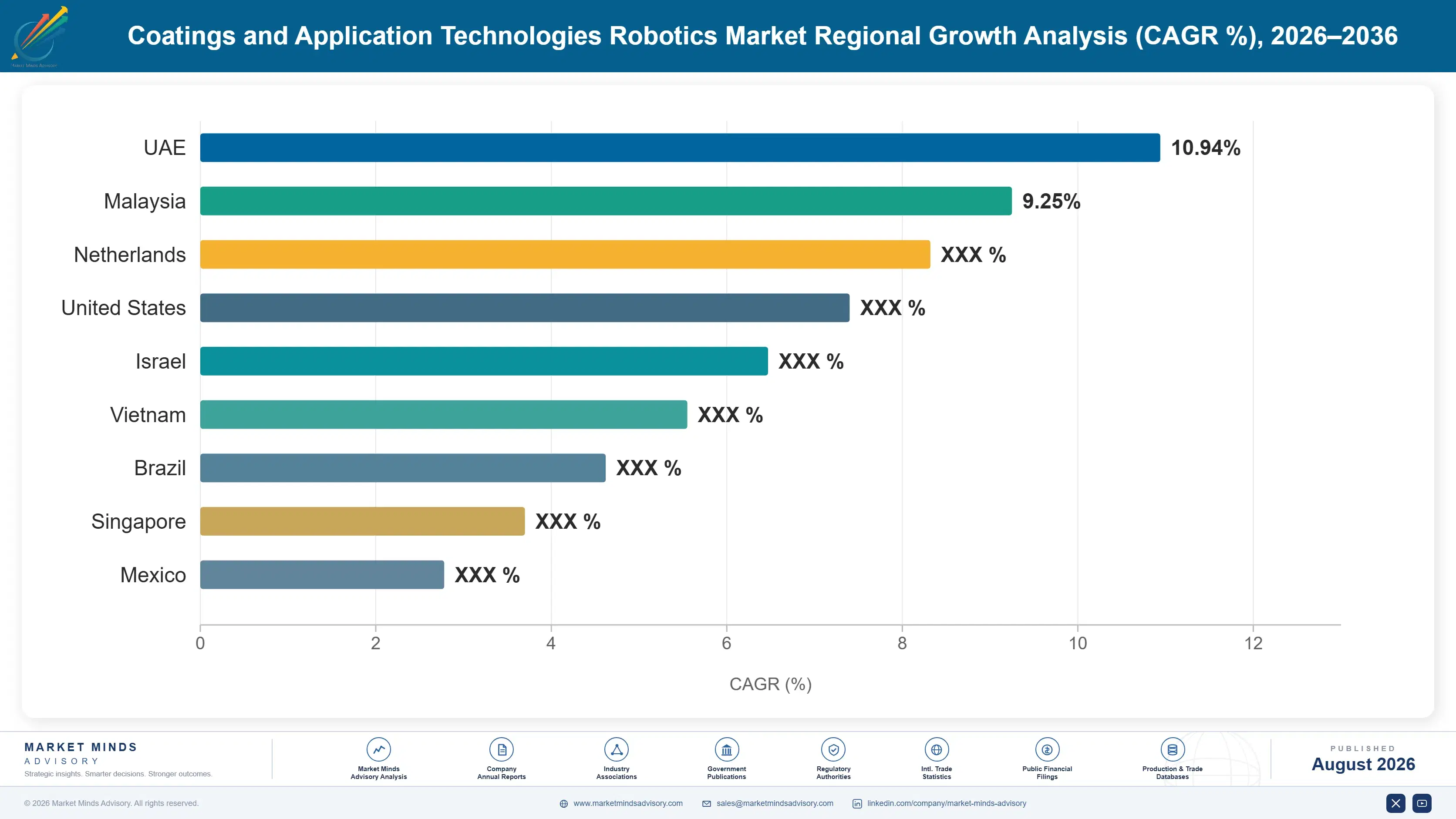
Coatings and Application Technologies Robotics Market Regional

Competition Landscape in Coatings and Application Technologies Robotics Market

The coatings and application technologies robotics market is highly competitive, with a mix of global robotics manufacturers, specialized coating technology providers, and system integrators. Companies are focusing on innovation, strategic partnerships, and geographic expansion to strengthen their market position. The competitive landscape is characterized by continuous product development, integration of advanced technologies such as AI and IoT, and a strong emphasis on sustainability and customization. Leading players are investing in R&D to enhance the versatility and efficiency of their robotic systems, catering to the evolving needs of diverse industries.

Major Players in Coatings and Application Technologies Robotics Market

  • ABB Ltd.
  • FANUC Corporation
  • KUKA AG
  • Yaskawa Electric Corporation
  • Dürr AG
  • Kawasaki Heavy Industries, Ltd.
  • Mitsubishi Electric Corporation
  • Nordson Corporation
  • Staubli International AG
  • Epson Robotics
  • Comau S.p.A.
  • Universal Robots A/S
  • CMA Robotics S.p.A.
  • Graco Inc.
  • SAMES KREMLIN
  • FANUC Robotics America, Inc.
  • IHI Corporation
  • Krautzberger GmbH
  • Eisenmann SE
  • Yaskawa Motoman Robotics

Recent Developments in Coatings and Application Technologies Robotics Market

  • In February 2024, ABB Ltd. launched a new AI-powered robotic painting system designed for automotive and industrial applications, enhancing precision and reducing material waste.
  • In November 2023, FANUC Corporation introduced a collaborative robot (cobot) specifically engineered for powder coating applications, targeting electronics and consumer goods manufacturers.
  • In September 2023, Dürr AG announced a partnership with a leading automotive OEM to deploy next-generation robotic coating lines in Europe, focusing on sustainability and energy efficiency.
  • In July 2023, KUKA AG expanded its product portfolio with a new line of articulated robots optimized for thermal spraying and surface preparation in aerospace manufacturing.
  • In May 2023, Nordson Corporation unveiled an IoT-enabled monitoring platform for its robotic coating systems, allowing real-time performance tracking and predictive maintenance.
  • In March 2023, Mitsubishi Electric Corporation launched a compact robotic painting solution for small and medium-sized enterprises, aiming to democratize access to advanced coating technologies.

FAQ for Coatings and Application Technologies Robotics Market

  1. What is the projected market size of the coatings and application technologies robotics market by 2033?

By 2033, the coatings and application technologies robotics market is expected to reach USD 5.19 billion, growing from USD 2.85 billion in 2026, at a CAGR of 8.9% during the forecast period.

  1. Which industries are the primary adopters of robotic coating technologies?

The primary adopters include the automotive, aerospace, electronics, heavy machinery, and consumer goods industries, with automotive leading in terms of volume and innovation.

  1. What are the key growth drivers for the coatings and application technologies robotics market?

Key growth drivers include the rising demand for automation and operational efficiency, technological advancements in robotics, and the increasing focus on sustainability and environmental compliance.

  1. Which regions are expected to witness the fastest growth in this market?

Asia-Pacific is expected to witness the fastest growth due to rapid industrialization, expanding manufacturing sectors, and increasing investments in automation technologies.

  1. What are the main challenges faced by companies adopting robotic coating systems?

The main challenges include high initial investment costs, integration complexity with existing systems, technical limitations in handling complex geometries, and the need for specialized maintenance and skilled personnel.

Take action now! Contact us today to access the full report and propel your business forward.