Market Minds Advisory
Collaborative Robots (Cobots) Market

Collaborative Robots (Cobots) Market: The Small Manufacturer Finally Gets a Robot

A commercial reading of collaborative robots, where labour shortages pull small manufacturers into automation, artificial intelligence vision turns arms into inspection platforms, and payload limits keep cobots out of the heaviest tasks.

Lead Analyst

David Horsley

Published

September 2026

Make Smarter Decisions with Customized Research Insights

Request a free sample report and evaluate market opportunities, growth trends, and competitive dynamics relevant to your business needs.

2025 MARKET VALUE$6.8BMarket Size 2025
2036 FORECAST VALUE$30.2BBase Case , 2026 to 2036
CAGR 2026 TO 203614.5 %Bull 15.8% / Bear 13.2%
INCREMENTAL OPPORTUNITY$22.4BNet 10- year value creation
EXPANSION MULTIPLE3.87x2036 value over 2026 base
Strategic Levers
M&A Pipeline
Regional Outlook
Country Rankings
Competitive Intelligence
Segmental Deep-dive
Call-Us : 91 93563 13602

Executive Snapshot and Market Trajectory

Small manufacturers who could never justify a caged industrial robot are now buying cobots instead, and steadily shrinking payback periods are pulling that entire segment into automation faster than most vendors planned for even eighteen months ago, well before the underlying technology fully matured.
The market stands at USD 6.8 billion in 2025 and reaches USD 30.16 billion by 2036 at a 14.5% CAGR. Quality inspection and testing grows fastest at 19.0%, about 1.31 times the overall rate, as artificial intelligence vision systems turn a bonding arm into a genuine inspection platform. East Asia holds 28% of value on manufacturing density, while China posts the quickest national growth at 17.8% on small and mid-sized factory automation subsidy programmes.
Concentration is high, with the top five holding roughly 50% of unit shipment volume against a rapidly growing field of Chinese and Korean challengers. Two forces reshape the field now. Artificial intelligence vision integration is turning cobots from simple pick-and-place arms into genuine inspection and quality platforms, and labour shortages across manufacturing are pulling small and mid-sized producers into automation for the first time in their history.
Market Definition
The collaborative robots market covers robotic arms engineered to operate safely alongside human workers without full safety caging, sold across assembly, machine tending, inspection, packaging, and welding applications in manufacturing and light industrial settings. Traditional caged industrial robots, autonomous mobile robots sold without a manipulator arm, and robotic software or integration services sold separately from the hardware are excluded.
Base Year Value
$6.8B in 2025 (MMA Primary Research Dataset, August 2026)
Forecast Period
2026 to 2036, eleven discrete annual values
CAGR
14.5% base case. Bull 15.8%. Bear 13.2%.
Fastest Growth Segment
Quality Inspection and Testing: 19.0% CAGR
Fastest Growth Country
China: 17.8% CAGR
Fastest Growth Region
South Asia and Pacific: 16.6% CAGR
Largest Region
East Asia: 28% of 2025 global value
Market Leaders
Universal Robots, Fanuc, ABB, Techman Robot, Doosan Robotics. Source: MMA Analysis based on company annual reports and industry association data.
Primary Survey
n=3,800 procurement and R&D decision-makers, Q4 2025, six countries
Methodology
Demand-side build-up, cross-validated against public data, 47 expert interviews

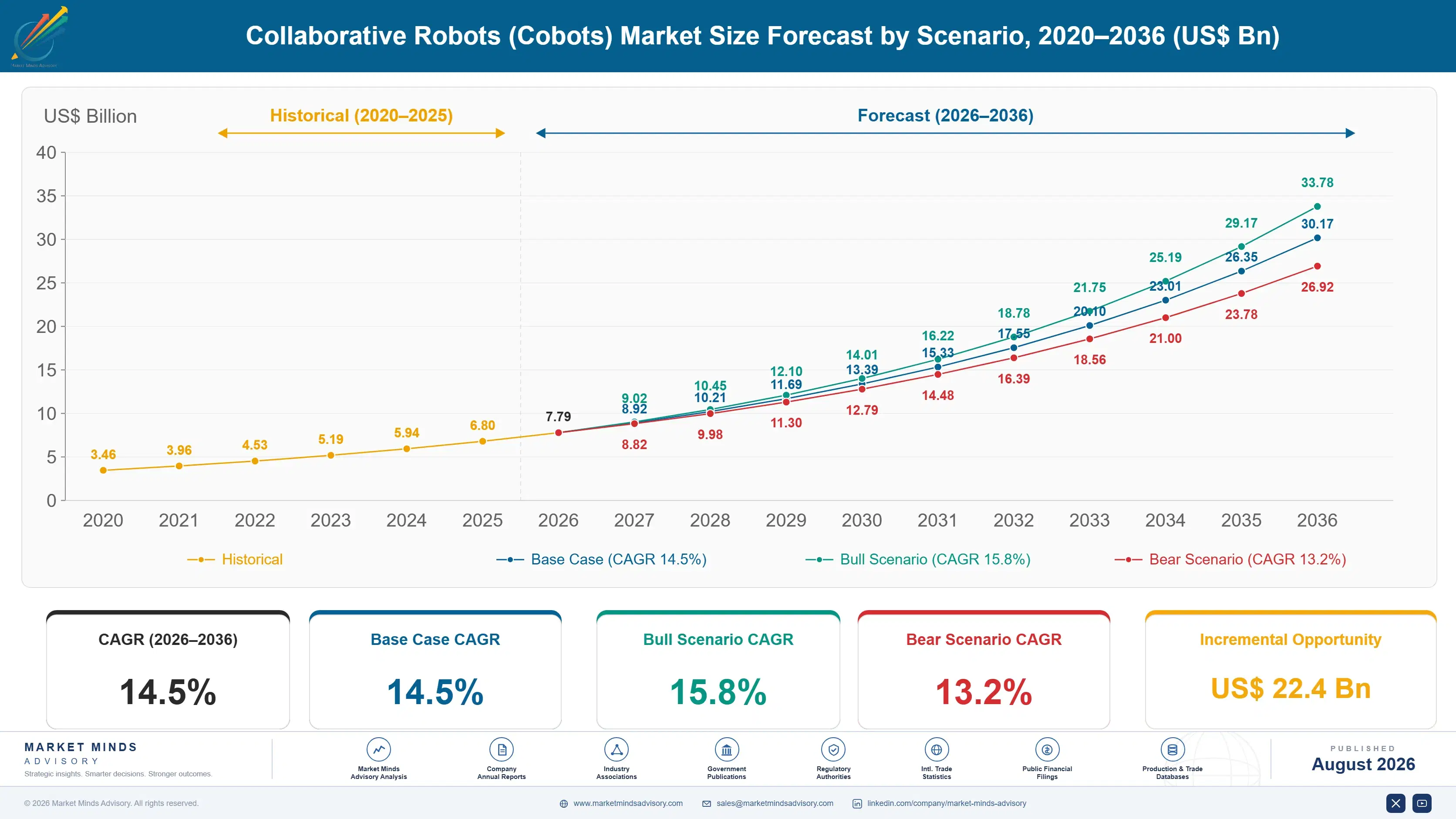
Collaborative Robots (Cobots) Market Forecast Scenarios

collaborative-robots-market-size-forecast-scenario-1787324130382
Growth from 2020 to 2025 compounded near 13.5%, disrupted early by pandemic factory shutdowns and broader supply chain disruption before accelerating sharply from 2022 onward as labour shortages made automation genuinely urgent for producers who had previously dismissed it entirely as unaffordable or unnecessary given their smaller scale of operation and typically quite modest capital budgets available.
Three mechanisms carry the base case to 14.5%. First, labour shortages across manufacturing, which push small and mid-sized producers toward automation for tasks they could never previously staff reliably. Second, artificial intelligence vision integration, which expands cobot use into inspection and quality applications well beyond simple pick-and-place work. Third, falling hardware cost and shortening payback periods, which bring cobots within reach of manufacturers who could never justify a traditional caged robot.
The bull case at 15.8% assumes artificial intelligence vision capability matures considerably faster than expected and small manufacturer adoption accelerates broadly across more industries than currently penetrated at all. The bear case at 13.2% assumes integration complexity and skilled programming scarcity continue limiting deployment speed among smaller manufacturers lacking dedicated automation engineering staff of their own entirely.

Why the Smallest Factories Are Finally Buying Robots

Three forces set demand. Labour shortages provide the newest and most urgent layer, as manufacturers across developed and emerging markets struggle to staff repetitive tasks reliably at any wage they can offer. Falling hardware cost and shortening payback periods provide a second layer, bringing cobots within reach of small manufacturers who could never justify a caged robot's capital cost and floor space. Artificial intelligence vision integration provides a third layer, expanding cobot use int
MARKET CONCENTRATIONCR5: 50%Consolidated among a handful of global cobot arm manufacturers
AVERAGE SELLING PRICEUSD 18,000 to 65,000Varies considerably by payload capacity and reach configuration
TOP PRODUCING COUNTRYChina: 34% of global unit outputReflects domestic manufacturer scale and dense component supply
TYPICAL PAYBACK PERIOD9 to 18 monthsShortening steadily as unit prices and integration costs fall
SME ADOPTION SHAREAbout 42% of new installationsSmall manufacturers now buy cobots at meaningful volume
PROGRAMMING SKILL REQUIREMENT2 to 5 days typical trainingFar shorter than traditional caged industrial robot programming
The commercial character rewards ease of deployment over raw capability almost entirely. A cobot a production line worker can reprogram in days rather than weeks captures small manufacturer budgets a traditional industrial robot, however capable, never could. Payload and speed remain genuinely limited by safety standards governing human proximity, which keeps cobots out of the heaviest industrial tasks.
The next decade turns on two things. Whether artificial intelligence vision capability matures fast enough to make inspection and quality applications the default rather than the exception across most deployments. And whether integration complexity falls enough that small manufacturers without dedicated automation engineering staff can deploy cobots as readily as the vendors' marketing already promises them they can.
"The cobot story everyone tells is about safety, and the real story is about who gets to buy a robot at all. A five-person machine shop was never a customer for a caged industrial arm. It is absolutely a customer for something it can plug in and reprogram itself."
Director, Industrial Automation and Robotics Practice · MMA Technology / Industr

Market Trends

Artificial Intelligence Vision Turns Cobots Into Inspection Platforms

Machine vision systems powered by artificial intelligence now let cobots identify defects, verify assembly completeness, and measure dimensional tolerance at speeds and consistency human inspectors cannot sustain across a full shift. This has expanded cobot deployment well beyond the pick-and-place and machine tending tasks that defined the category's first decade, into quality functions that previously required dedicated inspection stations or manual sampling. Universal Robots and Techman Robot have both integrated vision directly into their platforms rather than as a third-party add-on. Vendors without credible vision integration increasingly lose evaluations to those that have it.
Market Impact: SME buyers reach 42% of volume
Shortening Payback Periods Pull Small Manufacturers Into Automation

Typical payback periods have fallen to nine to eighteen months as hardware prices decline and integration tooling simplifies considerably, bringing cobots within reach of manufacturers who employ a few dozen workers rather than several hundred. This segment now accounts for roughly 42 percent of new installations, a share that barely existed a decade ago when cobots remained priced mainly for larger manufacturers already running automation programmes. Financing options including leasing and robots-as-a-service arrangements have further lowered the adoption barrier for smaller buyers. Competition increasingly centres on total cost of ownership rather than raw specification.
Market Impact: Packaging deployments grow at 16.5%

Market Opportunities and Growth Drivers

Manufacturing Labour Shortages Force Automation at Small Producers

Manufacturers across North America, Western Europe, and increasingly East Asia report persistent difficulty staffing repetitive assembly, machine tending, and packaging roles at any wage they can reasonably offer, a shortage that worsened following pandemic-era workforce disruption and has not meaningfully eased. Small and mid-sized producers, who previously relied entirely on manual labour for these tasks, are now the fastest-growing cobot buyer segment as a direct result. The shortage looks durable rather than temporary, since demographic trends in most developed economies point toward a shrinking working-age population over the coming decade. Vendors have adjusted marketing and financing toward these first-time buyers.
Market Impact: Deployment adds 2 to 5 days

E-Commerce Fulfilment Growth Expands Packaging Demand

Parcel volume per capita has continued rising across developed and emerging markets alike, and fulfilment centre operators increasingly deploy cobots for packaging, palletizing, and case-picking tasks that scale with order volume far more flexibly than fixed conveyor automation ever could. Cobots suit this application well because seasonal demand spikes require redeployable capacity rather than permanently installed infrastructure sized for peak volume alone. Several major logistics operators have disclosed cobot deployment timed specifically around peak shopping seasons each year. This driver operates largely independent of the broader manufacturing labour shortage entirely.
Market Impact: Payload caps sit near 25 kilograms

Market Restraints and Challenges

Integration Complexity Still Requires Skilled Programming Support

Despite vendor marketing emphasising ease of use, deploying a cobot into an existing production line still requires programming, safety validation, and often custom tooling that many small manufacturers lack in-house expertise to complete independently. The root cause is that a genuinely turnkey deployment across varied production environments remains harder to achieve than marketing demonstrations suggest, since every line differs in layout and equipment integration requirements. Commercially this slows adoption among exactly the segment vendors most want to reach, since these buyers cannot absorb a delayed deployment as easily as larger customers. Vendors respond with no-code interfaces and regional integrator networks.
Market Impact: Inspection segment grows at 19.0%

Payload and Speed Limits Restrict Heavy Industrial Use

Safety standards governing human proximity cap cobot payload and operating speed well below what a caged industrial robot can achieve, keeping cobots out of heavy material handling and high-speed assembly where raw throughput matters more than flexibility. The root cause is a genuine safety engineering constraint rather than a solvable technology gap, since force and power limiting requirements exist to protect nearby workers from injury. Commercially this caps the addressable market below what optimistic forecasts sometimes suggest. Manufacturers respond with hybrid cells combining caged robots for heavy tasks and cobots for lighter work.
Market Impact: SME installations reach 42% of unit
3 additional market trends, 4 additional growth drivers, and 3 additional restraints and challenges are covered in the full report. Contact sales@marketmindsadvisory.com to access the complete intelligence.

Segment CAGR and Growth Architecture

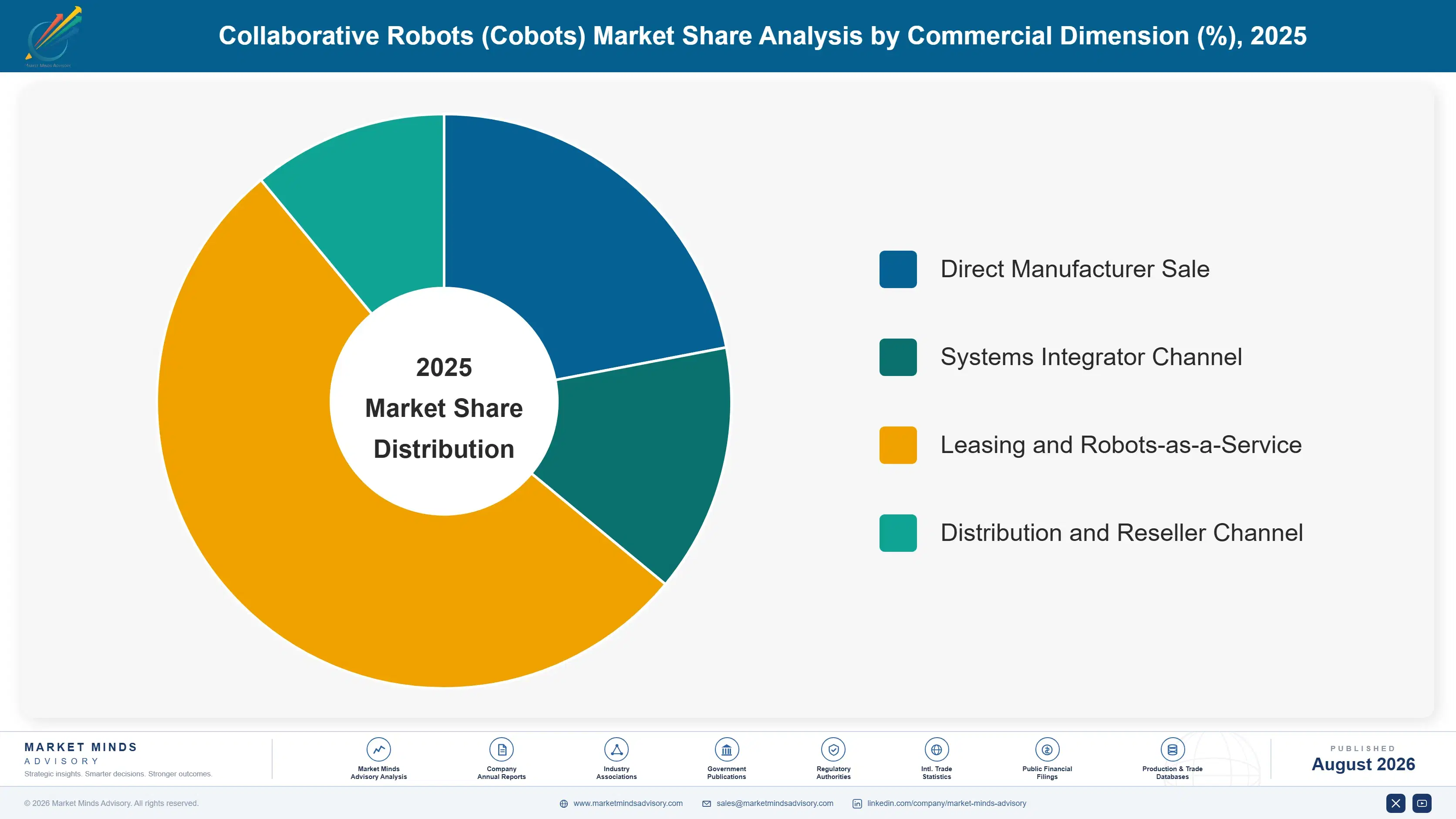
Segmentation follows end-use application, a single functional logic describing the specific task a cobot actually performs on the production line rather than its physical or underlying technical configuration alone. Each application carries distinct payload, speed, and precision requirements, so commercial position tracks application rather than payload class, which appears separately within the framework below.
collaborative-robots-market-market-share-analysis-1787324130915

Quality Inspection and Testing

Quality inspection and testing grows fastest at 19.0%, about 1.31 times the overall 14.5% rate, as artificial intelligence vision systems let cobots identify defects and verify assembly completeness at speeds manual inspection cannot sustain across a full shift. This application barely existed as a distinct cobot use case before vision technology matured enough to run reliably on arm-mounted cameras rather than requiring separate dedicated inspection stations. Universal Robots and Techman Robot have both integrated vision directly into their platforms rather than treating it as a third-party add-on. Automotive and electronics manufacturers have adopted this application fastest, given tight tolerance requirements and high defect cost. Vendors without credible vision increasingly lose evaluations to those that have it.
CAGR 19.0%

Packaging and Palletizing

Packaging and palletizing grows at 16.5%, the second-fastest application, driven by e-commerce fulfilment volume that scales unpredictably and rewards redeployable cobot capacity over fixed conveyor automation sized for a single peak demand level. Fulfilment centre operators favour cobots specifically for their ability to be redeployed between tasks as seasonal demand shifts, which fixed automation infrastructure cannot easily replicate without significant reconfiguration cost. Doosan Robotics and Techman Robot both hold strong positions in this application given payload configurations suited to typical parcel and case weights. Several major logistics operators have disclosed cobot deployment specifically timed around peak shopping seasons, reinforcing the application's connection to consumer demand cycles rather than steady industrial production alone.
CAGR 16.5%
Full segment breakdown across 5 segments available in the complete report.

Regional Architecture and Country Demand Map

Manufacturing density and labour cost pressure together set this distribution, since cobot adoption tracks where staffing shortages meet production scale most acutely. East Asia leads on manufacturing volume, while South Asia and Pacific posts the fastest growth as small manufacturer automation programmes expand across the region rapidly.

North America

Labour shortages across manufacturing anchor North American demand more directly than any other single factor. North America holds 24% of value, with small and mid-sized manufacturers driving a growing share of new installations as staffing repetitive tasks becomes genuinely difficult at any wage employers can offer competitively. Universal Robots and Fanuc both maintain deep integrator networks supporting exactly these smaller, less automation-experienced buyers directly. Reshoring investment tied to supply chain security concerns has added incremental demand beyond pure labour shortage economics alone. Growth of 14.0% reflects steady small manufacturer adoption alongside continued deployment at larger automotive and electronics producers. Financing programmes tailored to first-time automation buyers have expanded meaningfully across the region recently.
Share: 24% | CAGR: 14.0% (2026 to 2036)

Western Europe

Skilled labour scarcity and high wage levels together make automation economics unusually favourable here relative to most other regions globally. Western Europe holds 23% of value, with German, Italian, and Nordic manufacturers deploying cobots extensively across automotive supply chains and precision manufacturing applications specifically. Universal Robots, based in Denmark, maintains particularly strong domestic market position and integrator relationships built over more than a decade of regional presence. Regulatory support for small manufacturer automation investment exists in several countries specifically targeting productivity improvement. Growth of 13.0%, the slowest of the seven, reflects market maturity rather than weakening demand fundamentals. Adoption among the smallest manufacturers still lags larger firms considerably across the region.
Share: 23% | CAGR: 13.0% (2026 to 2036)
Regional intelligence for 5 additional markets available in the complete report: East Asia, South Asia and Pacific, Latin America, Middle East and Africa, Eastern Europe. Contact sales@marketmindsadvisory.com.
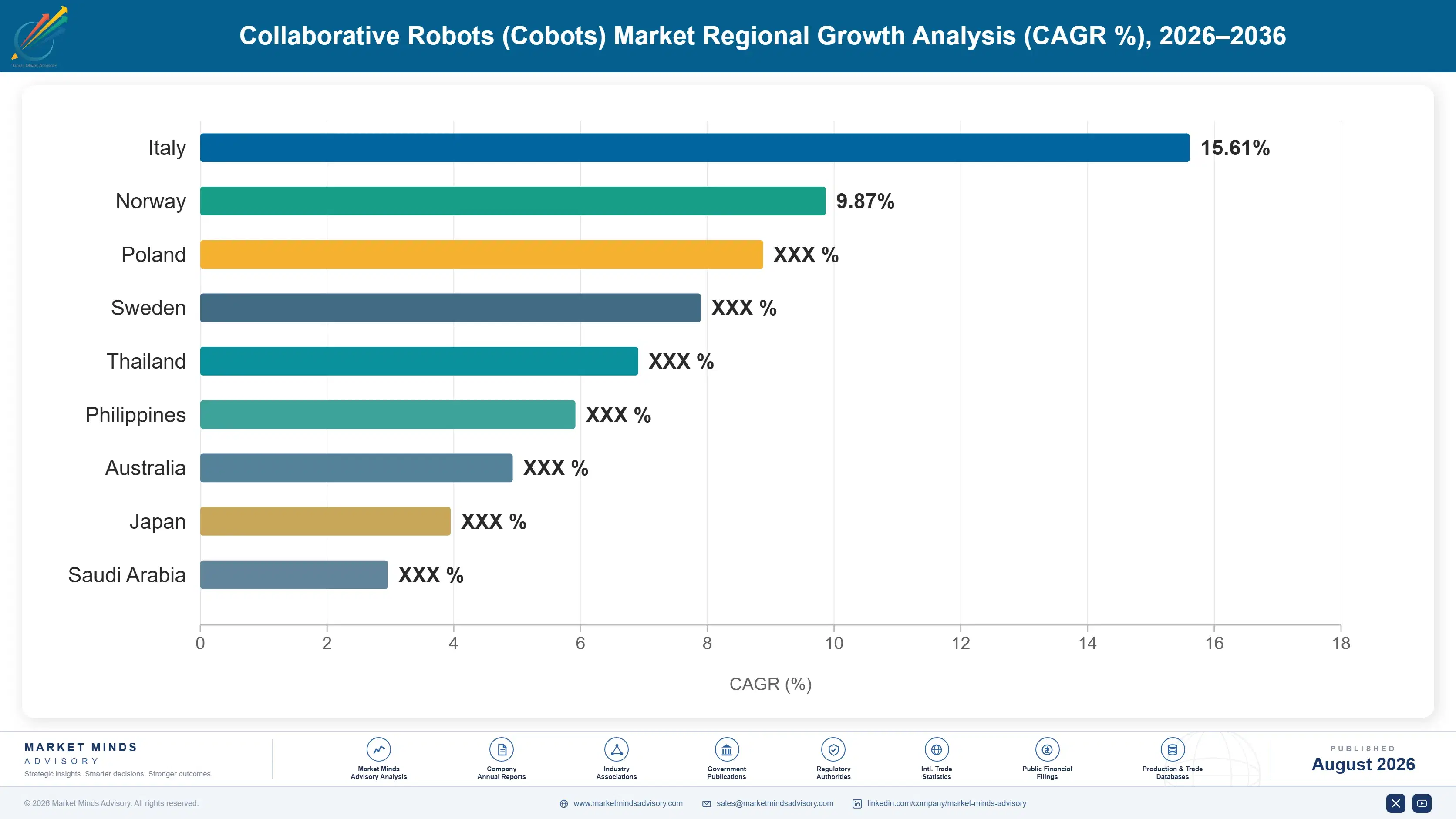
collaborative-robots-market-country-cagr-analysis-1787324131425

Where Cobot Vendor Margin Actually Concentrates

Competing purely on arm price concentrates margin in exactly the segment Chinese and Korean challengers are pricing most aggressively right now across nearly every product category. The four moves below shift value toward positions ease of deployment and application depth genuinely protect: vision-enabled inspection, small manufacturer financing, integrator network depth, and application-specific tooling packages.

Build Vision-Enabled Inspection Into the Core Platform

Inspection and quality applications grow at 19.0% against a 14.5% overall market because artificial intelligence vision integration lets a cobot identify defects and verify assembly completeness at speeds manual inspection cannot sustain across a full shift consistently. Vendors treating vision as a native platform capability rather than a third-party add-on win competitive evaluations that vendors without it increasingly lose entirely. Building this capability requires sustained software investment beyond the arm hardware itself, which favours vendors with genuine research and development scale over smaller hardware-only competitors lacking comparable resources and depth.
Market Impact: Inspection segment growth reaches 1

Finance Small Manufacturer Adoption Directly Now

Small manufacturers now account for roughly 42 percent of new installations, a segment that barely existed a decade ago when cobots remained priced mainly for larger, already-automated producers with dedicated capital budgets available. Leasing and robots-as-a-service financing structures lower the adoption barrier for exactly these buyers, who often lack the capital budget process larger manufacturers use to approve equipment purchases outright. Vendors building financing capability directly, rather than leaving it entirely to third-party lenders, capture the customer relationship and recurring revenue that a one-time hardware sale alone never generates at all.
Market Impact: SME buyers now reach 42% of all new

Deepen Regional Integrator Networks for Faster Deployment

Integration complexity remains the most commonly cited barrier among small manufacturers lacking dedicated automation engineering staff, and vendors with deep regional integrator networks deploy cobots roughly 30 percent faster than those relying on direct sales alone without local support. Universal Robots and Fanuc have both invested heavily in integrator training and certification programmes specifically to extend reach into smaller accounts that a direct sales force cannot economically serve. This network effect compounds over time, since trained integrators generate repeat business and referrals that a competitor entering later must rebuild from scratch entirely.
Market Impact: Deployment time falls by roughly 30

Package Application-Specific Tooling Rather Than Bare Arms

Buyers increasingly purchase a complete application solution, including end-effector tooling, vision integration, and safety validation, rather than a bare robotic arm requiring separate integration work from multiple different vendors simultaneously and independently. Vendors offering packaged solutions for specific applications such as machine tending or palletizing capture margin that would otherwise flow to third-party integrators assembling the same components independently. This approach also shortens the sales cycle by roughly 25 percent, since a buyer evaluating a complete packaged solution needs less internal technical expertise to make a confident purchase decision quickly.
Market Impact: Packaged deals cut sales cycles by

Who Controls the Margin Pool

Concentration is high: the top five hold roughly 50% of unit shipment volume, though Chinese and Korean challengers are gaining share rapidly against established incumbents. The gap between leaders and challengers is integrator network depth and software capability rather than hardware quality, which has converged considerably. All participants here are assessed on global unit shipment volume as disclosed in company reporting and industry data, held consistently.
Competition runs along four lines. First, artificial intelligence vision integration depth, which increasingly separates platforms in competitive evaluations. Second, integrator network reach into small manufacturer accounts direct sales cannot economically serve. Third, financing capability that lowers the adoption barrier for first-time automation buyers specifically. Fourth, application-specific packaged solutions that shorten sales cycles considerably against bare-arm competitors.

Pressure is building from two directions. Chinese manufacturers including Techman Robot, AUBO Robotics, and JAKA Robotics have built genuine technical capability and now compete internationally on price and capability alike. Meanwhile vision specialists are partnering with or acquiring cobot hardware capability to capture the fastest-growing inspection application directly. Rankings should favour vendors combining vision with deep integrator networks over those competing on specification alone.
collaborative-robots-market-company-positioning-matrix-1787324131954

Competitive Moat and Risk Dimensions

UNIVERSAL ROBOTS

Moat: Integrator network and brand trust

Universal Robots built the category and maintains the deepest integrator and reseller network of any competitor, supporting reach into small manufacturer accounts direct sales cannot economically serve. Brand recognition built over more than a decade gives it a default consideration position in most buyer evaluations. Its open platform approach has attracted a broad base of third-party tooling and software partners.
UNIVERSAL ROBOTS

Risk: Chinese price competition intensifying

Chinese manufacturers now offer comparable hardware specifications at meaningfully lower prices, eroding the price premium Universal Robots has historically commanded in cost-sensitive segments specifically. Its parent company Teradyne's broader semiconductor test equipment exposure introduces earnings volatility unrelated to cobot demand fundamentals themselves. Vision integration, while improving, has not always led competing platforms on pure technical capability.
FANUC

Moat: Industrial robotics scale and reputation

Fanuc draws on decades of traditional industrial robotics manufacturing scale and reputation, giving its cobot line credibility among large manufacturers already running Fanuc equipment elsewhere on the factory floor. Its integrator network, built originally for caged industrial robots, extends naturally into cobot deployment support as well. Manufacturing scale supports competitive pricing that smaller pure-play cobot vendors struggle to match consistently.
FANUC

Risk: Smaller manufacturer reach gap

Fanuc's sales and support model, built around larger industrial accounts, reaches small manufacturer buyers less effectively than vendors purpose-built for that segment. Its cobot line entered the market later than Universal Robots, ceding early brand association with the category to that competitor. Vision and software capability, while improving, remains an area of active investment rather than settled strength.

Players Tracked

Prominent Players

Universal Robots
Fanuc
ABB
Techman Robot
Doosan Robotics

Other Key Players

KUKA
Yaskawa Electric
Omron
Kawasaki Heavy Industries
Franka Emika
AUBO Robotics
Elite Robot
JAKA Robotics
Hanwha Robotics
Rethink Robotics
Productive Robotics
Dobot
Kassow Robots
Neura Robotics
Yuanda Robotics

Recent Developments

MARCH 2025

Universal Robots launches new vision-integrated cobot platform

Universal Robots launched a new cobot platform with artificial intelligence vision integrated natively rather than as a third-party add-on, targeting inspection and quality applications specifically. This was a product launch rather than any acquisition or joint venture, aimed squarely at capturing the fastest-growing application category directly.
Signal: Native vision integration is becoming tabl
NOVEMBER 2024

Doosan Robotics signs distribution agreement with regional integrator network

Doosan Robotics signed a distribution and training agreement with a regional systems integrator network to expand reach into small and mid-sized manufacturer accounts across multiple countries simultaneously. This was a distribution and training agreement rather than an acquisition, extending Doosan's reach without direct sales investment.
Signal: Smaller vendors increasingly borrow integr
JULY 2025

Techman Robot completes acquisition of machine vision software developer

Techman Robot completed the acquisition of a machine vision software developer to strengthen its inspection and quality application capability directly rather than through continued third-party partnership. This was a genuine acquisition of software assets and engineering talent rather than a joint venture, integrating vision development in-house.
Signal: Owning vision software rather than partner

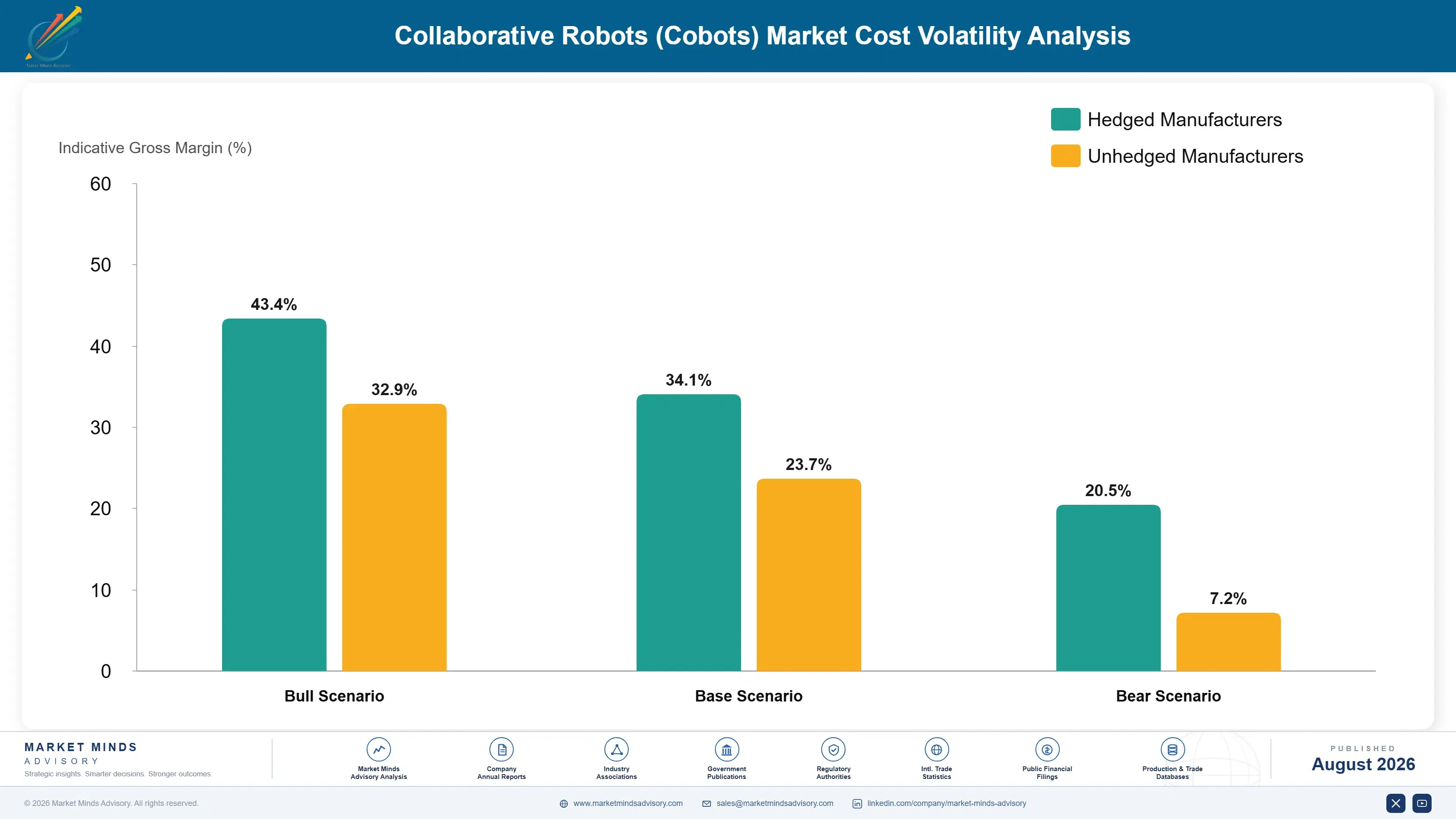
Precision Components, Sensors, and Software Development

Precision mechanical components including harmonic drives, servo motors, and force-torque sensors account for 48% to 60% of cost of goods sold, reflecting tight tolerances collaborative operation safety demands. Software development amortised across the product line adds a further 15% to 22%, while final assembly and quality testing make up the remainder. This cost structure differs from caged industrial robots, where safety sensing adds meaningfully less to component cost.
Harmonic drive and precision component supply tightened considerably through 2021 and 2022 as robotics and electric vehicle programmes competed for the same specialist manufacturing capacity, per industry component supplier disclosures. Several cobot manufacturers disclosed extended lead times and, in some cases, delayed product launches as a direct result of that scarcity. Supply has since eased, though lead times remain longer than pre-2021 norms for certain components.

Exposure separates clearly by manufacturing integration and component sourcing strategy. Vendors with long-term harmonic drive and servo motor supply agreements absorbed less disruption than smaller competitors buying on shorter-term contracts during the tightest supply periods. Chinese manufacturers increasingly source precision components domestically, which has reduced their exposure to the international supply constraints that affected Western and Japanese competitors more heavily during recent shortages.
collaborative-robots-market-cost-volatility-analysis-1787324132148

Secure long-term precision component supply agreements

Component scarcity through 2021 and 2022 delayed product launches for manufacturers lacking long-term supply agreements with harmonic drive and servo motor producers specifically across the industry. Multi-year agreements with guaranteed allocation smooth this exposure across future supply cycles considerably. The trade-off is reduced flexibility to switch suppliers opportunistically, which most vendors accept for planning certainty.

Localise precision component manufacturing where feasible

Chinese manufacturers sourcing precision components domestically faced meaningfully less disruption than competitors dependent on international supply during recent global shortages and sharp price spikes. Localising harmonic drive and servo motor production reduces exposure to cross-border supply disruption considerably. This requires manufacturing investment that only larger vendors can typically justify at current volume levels today.

Invest in software capability to offset hardware margin pressure

Hardware component cost pressure compresses margin regardless of vendor scale, while software capability, once developed, carries meaningfully higher margin and genuine differentiation value over time. Vision and application software investment shifts vendor economics away from pure hardware competition entirely. Vendors treating software as a licensing afterthought consistently underperform those building it as a core differentiator.

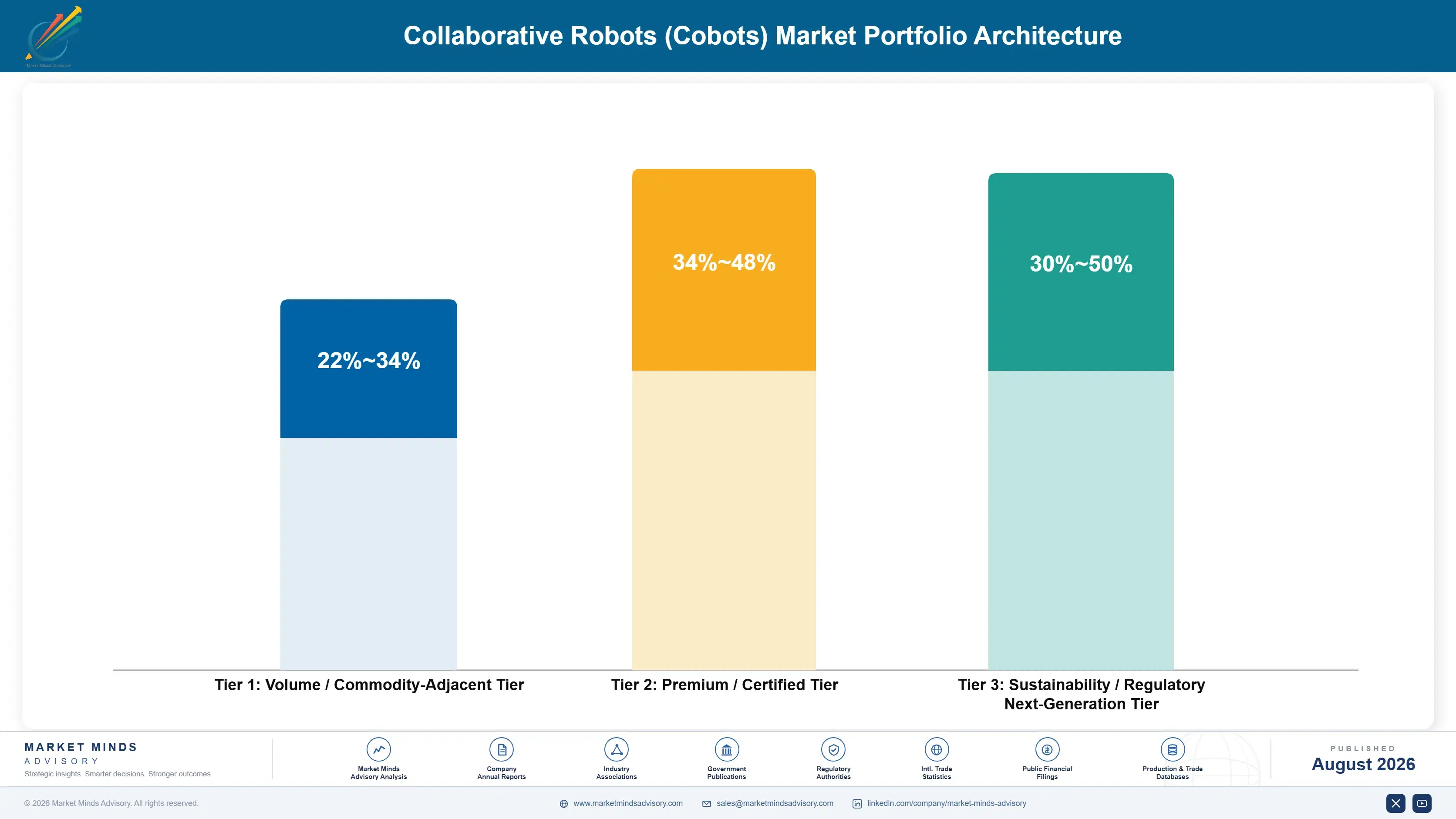
Portfolio Architecture for Margin Defence

The portfolio splits into three tiers with distinct economics. Bare-arm hardware competing mainly on price and payload specification forms the volume tier, with margin set largely by component cost and scale. Application-specific packaged solutions including tooling, vision, and safety validation earn considerably more since they capture value that would otherwise flow to third-party integrators. Vision-enabled inspection platforms sit differently again, priced against application value rather t
The tension runs between hardware volume that funds the business today and software investment that positions it for the next decade. A vendor competing purely on arm price against Chinese and Korean challengers cedes the software differentiation race to competitors investing in vision and application depth instead. Companies managing this well use hardware volume to fund software development rather than treating the two as separate lines competing for capital.

High-value pools concentrate where application depth, integrator reach, or financing capability limit competition: vision-enabled inspection platforms, packaged application solutions for specific tasks, and financed deployments reaching small manufacturers direct sales cannot serve economically. Bare-arm hardware sold without integration support sits at the other end, competing almost entirely on price against every credible Chinese and Korean manufacturer now in the market.

Volume / Commodity-Adjacent Tier

Bare-arm hardware competing primarily on price and payload specification, increasingly commoditised as Chinese and Korean manufacturers match established technical capability at meaningfully lower cost across most product categories worldwide today.
Gross Margin: 22-34%

Premium / Certified Tier

Application-specific packaged solutions including end-effector tooling, safety validation, and integration support bundled together for machine tending, assembly, and palletizing applications sold directly through certified regional integrator and reseller networks worldwide.
Gross Margin: 34-48%

Sustainability / Regulatory / Next-Generation Tier

Vision-enabled inspection platforms, financing-attached deployments reaching small manufacturers directly, and emerging mobile manipulator configurations combining cobots with autonomous mobile bases for genuinely flexible factory-wide deployment use cases today across industries.
Gross Margin: 30-50%
collaborative-robots-market-portfolio-architecture-1787324132644

High-value Sub-segments and Strategic Watch-out

Quality Inspection and Testing

High value and high growth at 19.0%, the fastest application in the category, driven by artificial intelligence vision integration that turns cobots into genuine inspection and quality platforms. Vendors without credible vision capability increasingly lose competitive evaluations to those that have already built it in.
Gross Margin: 34-48%

Packaging and Palletizing

High value with strong growth at 16.5%, second-fastest application, driven by e-commerce fulfilment volume that rewards redeployable cobot capacity over fixed conveyor automation sized for a single peak demand level always. Seasonal demand spikes particularly favour this flexible deployment model considerably across most logistics operators.
Gross Margin: 30-50%

Machine Tending

The volume core by revenue, growing near 12.5% as this remains the most established and widely deployed cobot application across manufacturing worldwide, spanning automotive, electronics, and consumer goods production lines everywhere today already. Mature use case with well-proven return on investment across most industries currently.
Gross Margin: 22-34%

Welding and Surface Finishing

The strategic watch-out, growing near 10.8% and constrained by payload and precision requirements that still favour traditional caged robots for many higher-force welding applications specifically across most heavy industry segments worldwide today. Adoption concentrates in lighter-duty finishing tasks currently, where flexibility matters more than raw force.
Gross Margin: 22-34%

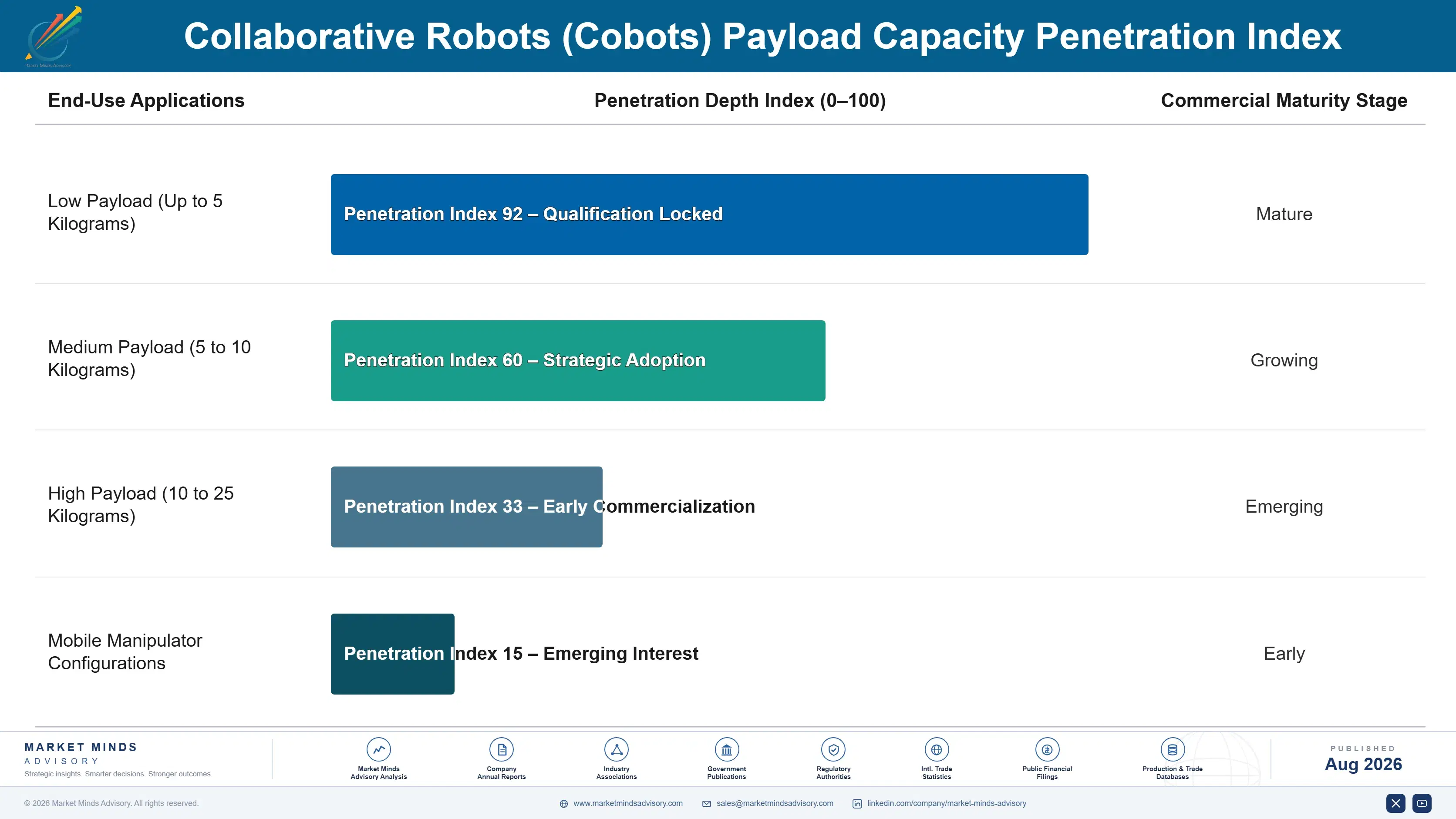
How Deployment Ease Locks Revenue

Revenue depends on integrator and reseller relationships rather than direct sales alone in most small manufacturer accounts, and a vendor's installed base generates years of tooling, software licensing, and service revenue well beyond the initial arm sale. Trained integrators generate repeat business and referrals that a competitor entering later must rebuild from scratch, making network depth the most durable commercial asset a vendor holds. Losing integrator loyalty costs more than losing any
Adoption depth varies sharply by end-use vertical. Automotive and electronics manufacturers commit hardest, given tight tolerance requirements that reward continued investment in vision and precision capability once a platform proves itself. Fulfilment operators sit in the middle, valuing redeployment flexibility over long-term platform loyalty as demand shifts seasonally. First-time small manufacturer buyers remain the most tentative, since a single poor experience can delay further investment for years.

Buyer profiles have shifted from dedicated automation engineers at large manufacturers toward small business owners and production supervisors evaluating their first robot purchase without specialist background. Financing structures increasingly resemble software subscriptions rather than traditional capital purchasing. Younger managers also weigh ease of reprogramming more heavily than predecessors did, favouring intuitive interfaces over the highest raw specification.
collaborative-robots-market-end-use-penetration-index-1787324133133

Our Call on Collaborative Robots

These are among the four positions where our research anticipates prominent divergence between winners and laggards over the coming forecast period. Each is grounded in the demand model, the regulatory perimeter, and the announced capacity pipeline.
01 / VISION REDEFINES THE CATEGORY

Inspection capability now decides competitive evaluations

Inspection and quality applications grow at 19.0% against a 14.5% overall market because artificial intelligence vision integration lets a cobot identify defects and verify assembly completeness at speeds manual inspection cannot sustain across a full shift. Vendors treating vision as a native platform capability rather than a third-party add-on increasingly win evaluations that hardware-only competitors lose entirely. Companies should prioritise vision software investment as a core platform capability, since it is becoming table stakes rather than a genuine differentiator within a few product cycles.
02 / SMALL MANUFACTURERS DRIVE GROWTH

First-time buyers now drive the fastest volume expansion

Small manufacturers now account for roughly 42 percent of new installations, a segment that barely existed a decade ago when cobots remained priced mainly for larger, already-automated producers with dedicated capital budgets available. Financing structures resembling software subscriptions rather than traditional capital purchasing have lowered the adoption barrier for exactly these buyers considerably. Vendors should build financing and integrator support capability directly rather than leaving it to third parties, since that relationship captures recurring revenue a one-time hardware sale never generates.
03 / INTEGRATION REMAINS THE BOTTLENECK

Deployment ease matters more than raw specification

Despite marketing emphasising simplicity, deploying a cobot into an existing line still requires programming, safety validation, and often custom tooling that many small manufacturers cannot complete independently without meaningful outside support and expertise. Vendors with deep regional integrator networks deploy meaningfully faster than those relying on direct sales alone, since trained integrators generate referrals a later entrant must rebuild from scratch entirely. Companies should invest in integrator training and certification as seriously as they invest in the hardware roadmap itself.
04 / CHINESE COMPETITION IS DURABLE

Price parity has arrived faster than expected

Chinese manufacturers including Techman Robot, AUBO Robotics, and JAKA Robotics now offer comparable hardware specifications at meaningfully lower prices, eroding the premium Western and Japanese vendors have historically commanded in cost-sensitive segments specifically across most regions. That capability gap closed considerably faster than most incumbents' strategic plans assumed only a few years ago. Incumbents should compete on vision, integrator depth, and financing rather than on hardware price alone, since that is a contest Chinese manufacturers are increasingly positioned to win outright.

Engagement Snapshot From the Field

A live engagement with an industry participant carrying material or product regulatory and market exposure ahead of a defining policy shift, showing how our research translates into a defensible multi-year portfolio strategy.
MARKET MINDS ADVISORY · CLIENT ENGAGEMENT SUMMARY
Collaborative Robots (Cobots) Producer Strategic Portfolio Review and Transition Roadmap 2026·Investment Scenario on Collaborative Robots (Cobots) Exposure Evaluation 2025-26
CLIENT PROFILE
A regional contract manufacturer employing roughly 85 production workers across two facilities engaged MMA ahead of its first cobot investment decision and planned budget approval. The client reported persistent difficulty filling assembly and packaging roles for over a year, with overtime cost rising considerably as a direct consequence of that ongoing staffing shortfall (client-reported, unverified by MMA).
STRATEGIC CHALLENGE
Leadership had received competing proposals from three cobot vendors with meaningfully different pricing, financing, and integration support structures, and lacked internal automation expertise to evaluate the trade-offs confidently. The board worried that a poor first deployment would sour the organisation on automation broadly for years afterward. Speed mattered too, since the labour shortage was already affecting delivery commitments to key customers.
MMA APPROACH
MMA benchmarked the three vendor proposals against comparable small manufacturer deployments across similar production environments and part variability profiles. We assessed each vendor's regional integrator support capability and typical deployment timeline specifically for accounts of this size and complexity. We then modelled payback period and deployment risk under each proposed financing structure.
KEY FINDINGS
  1. One vendor's proposal relied on a distant integrator with limited regional presence, creating meaningful deployment delay risk the client's competing quotes had not flagged clearly.
  2. The financing structure offered by a second vendor reduced upfront capital requirement by roughly 70% while payback period extended only marginally beyond the cash purchase alternative (client-reported, unverified by MMA).
  3. Vision-enabled inspection capability, available from only one of the three vendors, addressed a quality issue costing the client an estimated 3% of packaging line output monthly.
  4. Selecting the vendor with strongest regional integrator presence reduced projected deployment timeline by roughly eight weeks against the two alternative proposals submitted.
CLIENT PROFILE
A regional contract manufacturer employing roughly 85 production workers across two facilities engaged MMA ahead of its first cobot investment decision and planned budget approval. The client reported persistent difficulty filling assembly and packaging roles for over a year, with overtime cost rising considerably as a direct consequence of that ongoing staffing shortfall (client-reported, unverified by MMA).
STRATEGIC CHALLENGE
Leadership had received competing proposals from three cobot vendors with meaningfully different pricing, financing, and integration support structures, and lacked internal automation expertise to evaluate the trade-offs confidently. The board worried that a poor first deployment would sour the organisation on automation broadly for years afterward. Speed mattered too, since the labour shortage was already affecting delivery commitments to key customers.
MMA APPROACH
MMA benchmarked the three vendor proposals against comparable small manufacturer deployments across similar production environments and part variability profiles. We assessed each vendor's regional integrator support capability and typical deployment timeline specifically for accounts of this size and complexity. We then modelled payback period and deployment risk under each proposed financing structure.
KEY FINDINGS
  1. One vendor's proposal relied on a distant integrator with limited regional presence, creating meaningful deployment delay risk the client's competing quotes had not flagged clearly.
  2. The financing structure offered by a second vendor reduced upfront capital requirement by roughly 70% while payback period extended only marginally beyond the cash purchase alternative (client-reported, unverified by MMA).
  3. Vision-enabled inspection capability, available from only one of the three vendors, addressed a quality issue costing the client an estimated 3% of packaging line output monthly.
  4. Selecting the vendor with strongest regional integrator presence reduced projected deployment timeline by roughly eight weeks against the two alternative proposals submitted.
RECOMMENDED STRATEGY
Phase 1: Phase 1 (0 to 2 months): Select the vendor combining strongest regional integrator support with genuinely proven vision-enabled inspection capability. Phase 2: Phase 2 (2 to 5 months): Complete deployment on the packaging line first, targeting the single highest-cost quality issue identified. Phase 3: Phase 3 (5 to 12 months): Expand deployment to assembly tasks using lessons and integrator relationship from the first installation.
OUTCOME
The client selected the recommended vendor and completed packaging line deployment within the projected timeline, resolving the quality issue that had been costing meaningful monthly output. Leadership approved the assembly line expansion ahead of the original twelve-month schedule based on early results (client-reported, unverified by MMA).

Frequently Asked Questions

Foundational context covering the market sizes, CAGR, scope, country, region and competition that inform every finding below. This section is provided to cover basics and most often pre-purchase conversations, answered from the MMA Primary Research Dataset.

What is the current size of the Collaborative Robots (Cobots) Market?

The global collaborative robots market is valued at USD 6.8 billion in 2025, covering robotic arms for assembly, machine tending, inspection, packaging, and welding applications. Traditional caged industrial robots are excluded.

How large will the Collaborative Robots (Cobots) Market be by 2036?

The market is forecast to reach USD 30.16 billion by 2036 in the base case, about 3.87 times the 2026 level. That represents incremental value of roughly USD 22.37 billion across the decade.

What is the CAGR for the Collaborative Robots (Cobots) Market 2026 to 2036?

The market grows at a 14.5% CAGR in the base case, with bull and bear scenarios at 15.8% and 13.2%. The spread turns mainly on vision technology maturity and small manufacturer adoption speed.

Which segment is growing fastest?

Quality inspection and testing grows fastest at 19.0%, about 1.31 times the overall rate, as artificial intelligence vision expands cobot use. Packaging and palletizing follows at 16.5%.

Who are the major companies in the Collaborative Robots (Cobots) Market?

Leading companies include Universal Robots, Fanuc, ABB, Techman Robot, and Doosan Robotics. Concentration is high, with the top five holding roughly 50% of unit shipment volume.

Which country is growing fastest?

China grows fastest at a 17.8% CAGR, driven by government subsidy programmes targeting small and mid-sized manufacturer automation. India follows on broader industrial policy support.

Report Segmentation Architecture

The full report scope spans multiple orthogonal segmentation dimensions, with cross-tabulated demand data provided for each dimension pair. Coverage extends further to regional breakdowns, trend trajectories, and the competitive detail needed to support segment-level decision-making.

By End-Use Application

  • Assembly and Handling
  • Machine Tending
  • Quality Inspection and Testing
  • Packaging and Palletizing
  • Welding and Surface Finishing

By Payload Capacity

  • Low Payload (Up to 5 Kilograms)
  • Medium Payload (5 to 10 Kilograms)
  • High Payload (10 to 25 Kilograms)
  • Mobile Manipulator Configurations

By Commercial Dimension

  • Direct Manufacturer Sale
  • Systems Integrator Channel
  • Leasing and Robots-as-a-Service
  • Distribution and Reseller Channel

By Region

  • North America
  • Western Europe
  • East Asia
  • South Asia and Pacific
  • Latin America
  • Middle East and Africa
  • Eastern Europe

Scope, Methodology, and Coverage

Every figure in this report is reproducible from documented input assumptions. The scope below maps the historical period, the forecast horizon, the segmentation dimensions, and the countries covered, alongside the underlying primary and qualitative methodology.
Historical Period
2020 to 2025
Forecast Period
2026 to 2036
Base Year
2025 (USD billions; MMA Primary Research Dataset, August 2026)
Market Definition
The collaborative robots market comprises robotic arms engineered with force and power limiting capability to operate safely alongside human workers without full safety caging, valued at manufacturer revenue for hardware units sold across assembly, machine tending, inspection, packaging, and welding applications. Traditional caged industrial robots requiring full safety enclosure, autonomous mobile robots sold without an integrated manipulator arm, and robotic software, integration services, or end-effector tooling sold separately from the arm unit are excluded.
Quantitative Units
USD billions (current prices); unit shipment volume where applicable
Segmentation Dimensions
By End-Use Application; By Payload Capacity; By Commercial Dimension; By Region
Regions Covered
North America, Western Europe, East Asia, South Asia and Pacific, Latin America, Middle East and Africa, Eastern Europe
Countries Covered
USA, China, Germany, France, UK, Japan, South Korea, India, Australia, Canada, Brazil, Mexico, Indonesia, Vietnam, Thailand, Malaysia, UAE, Saudi Arabia, South Africa, Nigeria, Turkey, Poland, Netherlands, Italy, Spain, Sweden, Switzerland, Argentina, Colombia, Singapore, and additional markets relevant to this sector
Key Companies Profiled
Universal Robots, Fanuc, ABB, Techman Robot, Doosan Robotics, KUKA, Yaskawa Electric, Omron, Kawasaki Heavy Industries, Franka Emika, AUBO Robotics, Elite Robot, JAKA Robotics, Hanwha Robotics, Rethink Robotics, Productive Robotics, Dobot, Kassow Robots, Neura Robotics, Yuanda Robotics
Quantitative Methodology
Primary survey, n=3,800 respondents, Q4 2025, six countries; demand-side model with trade association cross-validation
Qualitative Methodology
47 expert interviews, Q4 2025; applied to validate demand model assumptions, identify emerging dynamics, and assess competitive positioning
Report Format
PDF and XLSX data workbook (Word format preview document)
Publisher
Market Minds Advisory
Report Code
MMA-2026-TEC-104
Published
August 2026
Contact
sales@marketmindsadvisory.com | www.marketmindsadvisory.com

Purchase the full Collaborative Robots (Cobots) Market Report (2026 to 2036).

The full MMA Collaborative Robots report sizes the market across five end-use applications, four payload classes, four commercial channels, and seven regions through 2036. It profiles 20 companies on a consistent unit shipment volume basis, scoring each on vision integration depth, integrator network reach, financing capability, and application-specific packaging strength. Scenario models quantify how artificial intelligence vision maturity, small manufacturer adoption, and Chinese competitive entry move both unit demand and achievable margin by application. The report also includes payback period benchmarking, integrator network mapping, and vision technology competitive tracking for vendor and investor strategy teams.
Five-application and four-channel market sizing to 2036
Twenty-company benchmark on unit shipment volume basis
Artificial intelligence vision integration competitive tracking
Small manufacturer adoption and financing structure analysis
Regional integrator network depth and reach mapping
Chinese and Korean challenger competitive positioning benchmarking

Built For The People Who Decide

From boardroom strategy to bench-side execution, this report is read cover-to-cover by leaders shaping the next decade of their industry, turning demand scenarios, market dynamics and valuation benchmarks into decisions.
CXOs/ Presidents/ VPs/ Managers
M&A and Corporate Development
Strategy Teams and R&D Heads
Procurement and Product Directors
Regulatory and Compliance Leaders
Investor Relations and Equity Analysts