Market Minds Advisory
Biodefense Market

Biodefense Market: Rebuilding Rapid-Response Capacity

Governments are rebuilding biodefense stockpiles and detection networks after pandemic-era gaps exposed how thin national countermeasure reserves had become, forcing suppliers to prove rapid-response manufacturing capacity against threats ranging from engineered pathogens to emerging outbreaks.

Lead Analyst

Alice Ballenger

Published

September 2026

Make Smarter Decisions with Customized Research Insights

Request a free sample report and evaluate market opportunities, growth trends, and competitive dynamics relevant to your business needs.

2025 MARKET VALUE$14.5BMarket Size 2025
2036 FORECAST VALUE$38.2BBase Case , 2026 to 2036
CAGR 2026 TO 20369.2 %Bull 10.5% / Bear 7.9%
INCREMENTAL OPPORTUNITY$22.3BNet 10- year value creation
EXPANSION MULTIPLE2.41x2036 value over 2026 base
Strategic Levers
M&A Pipeline
Regional Outlook
Country Rankings
Competitive Intelligence
Segmental Deep-dive
Call-Us : 91 93563 13602

Executive Snapshot and Market Trajectory

Biodefense procurement is shifting decisively from static stockpiling toward rapid-response manufacturing capacity, a shift regulators accelerated after pandemic-era shortages exposed how slowly legacy vaccine and therapeutic production could scale against a fast-moving biological threat, whether naturally emerging or deliberately engineered by hostile state actors.
Diagnostic and point-of-care testing platforms are growing fastest at roughly 1.36 times the market average as agencies prioritize field-deployable detection over centralized laboratory testing, while biological threat detection and surveillance systems follow closely on expanding border and military biosurveillance networks worldwide. North America holds the largest share of global spending because United States federal biodefense procurement through BARDA and the Department of Defense dwarfs every other country's combined investment by a wide margin.
Emergent BioSolutions, Battelle, Bruker, Leidos, and bioMerieux hold under half of global revenue in a market spanning vaccines, detection hardware, and diagnostics rather than concentrated the way a single product category would be. Rising geopolitical tension and renewed interest in engineered pathogen scenarios are reshaping which suppliers get specified into national stockpile contracts, favoring proven rapid-manufacturing surge capacity over legacy fixed-stockpile suppliers holding aging inventory regulators increasingly consider outdated.
Market Definition
The biodefense market covers biological threat detection and surveillance systems, medical countermeasure vaccines and prophylactics, therapeutic countermeasures and antitoxins, personal protective equipment and decontamination systems, diagnostic and point-of-care testing platforms, and stockpile management and logistics services used in national and multinational biodefense programs. It excludes conventional pharmaceutical products unrelated to biological threat response, general infectious disease research, and civilian consumer protective equipment sold outside government procurement channels.
Base Year Value
$14.5B in 2025 (MMA Primary Research Dataset, August 2026)
Forecast Period
2026 to 2036, eleven discrete annual values
CAGR
9.2% base case. Bull 10.5%. Bear 7.9%.
Fastest Growth Segment
Diagnostic and Point-of-Care Testing Platforms: 12.5% CAGR
Fastest Growth Country
South Korea: 12.0% CAGR
Fastest Growth Region
South Asia and Pacific: 11.2% CAGR
Largest Region
North America: 32% of 2025 global value
Market Leaders
Emergent BioSolutions, Battelle, Bruker, Leidos, bioMerieux. Source: MMA Analysis based on company annual reports.
Primary Survey
n=3,800 procurement and R&D decision-makers, Q4 2025, six countries
Methodology
Demand-side build-up, cross-validated against public data, 47 expert interviews

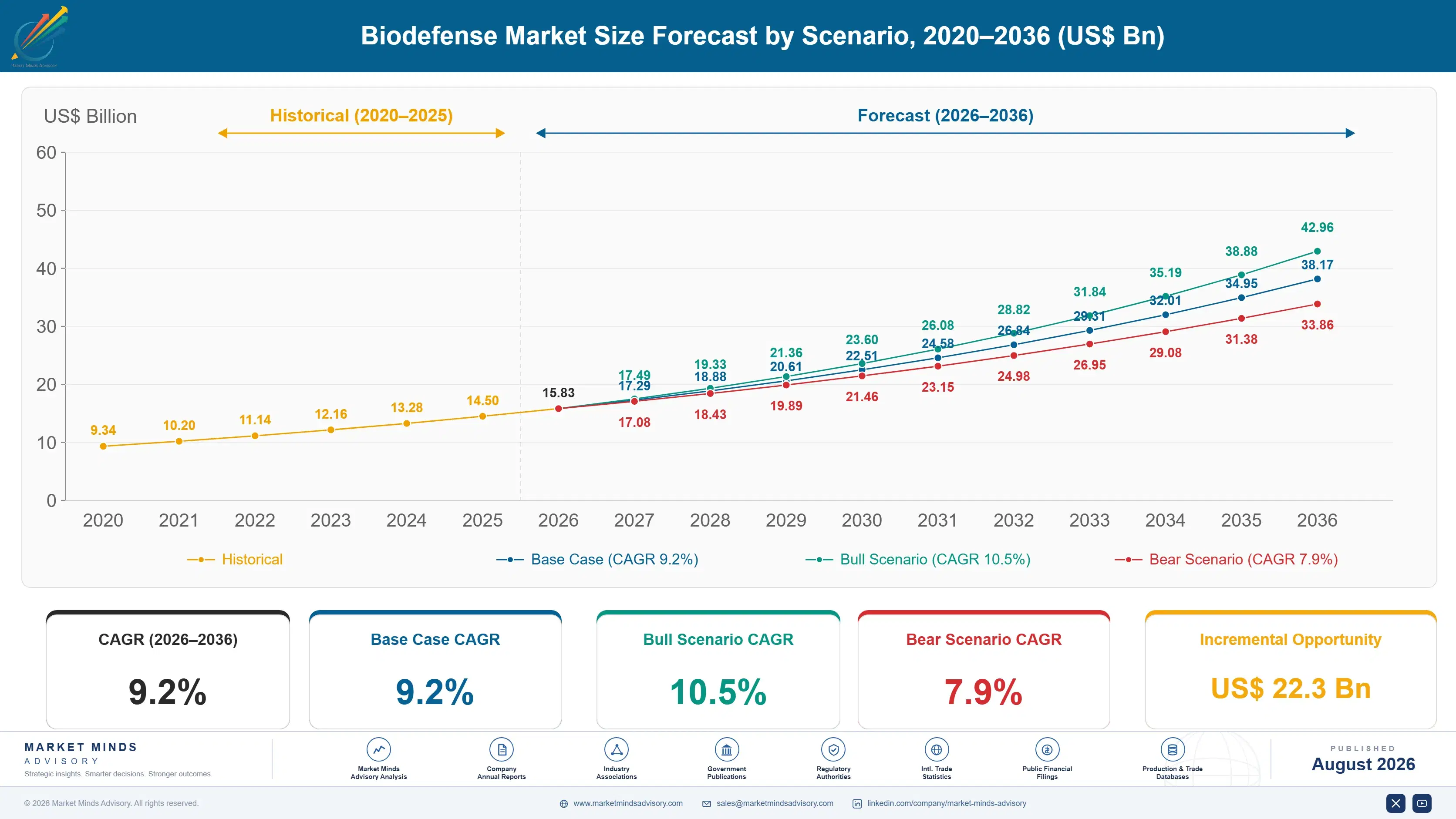
Biodefense Market Forecast Scenarios

biodefense-market-size-forecast-scenario-1787300953774
The market grew unevenly through the early 2020s as pandemic response spending briefly inflated demand before falling back once emergency procurement contracts expired across most national programs. Growth resumed on a steadier footing from 2023 as governments began replenishing stockpiles depleted during the pandemic and investing in rapid-response manufacturing rather than static inventory. The result was an 8.0 percent historical CAGR, still accelerating.
The base case rests on three mechanisms. First, national stockpile replenishment programs are shifting spending from one-time emergency purchases toward multi-year rapid-manufacturing surge contracts that generate steadier recurring revenue. Second, rising geopolitical tension and renewed attention to engineered pathogen scenarios are pushing defense ministries to fund detection and surveillance networks previously considered lower priority. Third, diagnostic technology advances are letting agencies deploy field-based testing that reduces dependence on centralized laboratory infrastructure during an active biological incident.
The bull case turns on a major biological incident, natural or engineered, that forces accelerated global stockpile rebuilding and detection network investment well beyond currently budgeted programs. The bear case centers on budget fatigue among governments that expanded biodefense spending sharply during the pandemic and may now deprioritize it as more urgent near-term fiscal pressures compete for the same funding.

Rapid-Response Capacity Reshapes Biodefense Procurement

Biodefense sits at the intersection of national security procurement and public health infrastructure, and it behaves accordingly: contracts are large, multi-year, and won through government relationships rather than conventional commercial sales cycles most life sciences suppliers are used to navigating. The pandemic exposed how badly legacy stockpiling models failed when a real biological event hit, since fixed inventory expires and cannot scale production quickly enough during an active outbr
CR5 CONCENTRATION45%Fragmented supply chain spans vaccines, detection hardware, and diagnostics broadly
AVERAGE PROGRAM CONTRACT VALUE$180 million per multi-year programContract values vary considerably by program scope and country
TOP PRODUCING COUNTRY SHARE27%United States federal procurement dwarfs every other national program
FIELD-DEPLOYABLE PLATFORM SHARE29% of diagnostic contractsField-deployable platforms increasingly replace centralized laboratory testing infrastructure broadly
TRADE INTENSITY21% of output exportedCross-border technology and countermeasure shipments rise with alliance cooperation
INPUT COST SHARE32% of COGSBiomanufacturing and sensor components dominate total production expenditure sharply
Commercially, the market splits between defense-oriented detection and surveillance suppliers serving military and border security agencies, and life sciences suppliers building vaccines, therapeutics, and diagnostics for public health agencies across national governments. Emergent BioSolutions and Battelle dominate manufacturing and detection contracts respectively, while bioMerieux and Bruker compete on diagnostic and analytical instrumentation through entirely separate procurement channels than the defense-focused side of the market operates within.
Over the next decade, diagnostic and point-of-care testing platforms and detection and surveillance systems will keep growing faster than conventional stockpiled countermeasures, and suppliers that build rapid-manufacturing surge capacity will increasingly outcompete those relying on static inventory contracts that regulators now view with real skepticism following pandemic-era failures across multiple national programs.
"Every government learned the same lesson from the pandemic: a warehouse full of expired vaccines is not readiness. The suppliers winning contracts now are the ones who can prove they can manufacture on demand, not just store."
Director, Government Health Security Practice · MMA Healthcare | Cell and Gene T

Market Trends

Biosurveillance Networks Expand Across Border and Military Installations

National governments have accelerated biosurveillance network investment considerably since 2022, driven by renewed attention to engineered pathogen scenarios and lessons learned from pandemic-era detection gaps that left many countries unable to identify emerging threats quickly. Border security and military installations increasingly deploy continuous environmental monitoring sensors rather than relying solely on centralized laboratory testing that can take days to return results during an active biological incident. Battelle and several specialized detection technology providers report accelerating contract volume specifically tied to next-generation biosurveillance network deployment across allied nations' defense and public health agencies.
Market Impact: Lifts engineered pathogen funding 24 percent
Stockpile Models Shift Toward Rapid-Manufacturing Surge Capacity

Governments are shifting stockpile procurement models away from static, fixed-inventory contracts toward flexible rapid-manufacturing surge agreements that can scale production quickly once an actual biological incident begins, a lesson drawn directly from pandemic-era shortfalls. This shift reflects lessons about how quickly fixed inventory expires and how poorly legacy stockpiling models performed when real demand materialized suddenly and at unprecedented scale. Emergent BioSolutions and other major biomanufacturers report growing demand for surge manufacturing capacity contracts that pay standby fees to maintain production readiness rather than simply purchasing finished countermeasure inventory outright.
Market Impact: Cuts diagnostic turnaround time 40 percent

Market Opportunities and Growth Drivers

Geopolitical Tension Renews Engineered Pathogen Threat Funding

Rising geopolitical tension between major powers has renewed government attention to engineered pathogen scenarios that had received considerably less funding priority during the preceding decade of relative international stability. Defense ministries across multiple allied nations have increased biodefense budget allocations specifically citing state-sponsored biological weapons development as a credible near-term threat requiring dedicated countermeasure investment. This has meaningfully expanded funding for detection technology and medical countermeasures specifically designed against engineered agents rather than only naturally occurring pathogens, a distinct technical requirement from conventional pandemic preparedness programs most agencies had previously prioritized.
Market Impact: Risks cutting 18 percent of funding

Portable Molecular Diagnostics Cut Laboratory Turnaround Dependence

Diagnostic technology advances, particularly portable molecular testing platforms, are letting agencies deploy accurate pathogen identification capability directly in the field rather than depending entirely on centralized laboratory infrastructure that can take days to process samples during an active incident. This capability meaningfully improves response speed during a biological event, since identifying the specific pathogen quickly determines which medical countermeasures and containment protocols should be deployed immediately. bioMerieux and several diagnostic technology specialists report accelerating demand for field-deployable platforms specifically from military and border security agencies seeking to reduce dependence on laboratory turnaround times.
Market Impact: Delays capacity expansion 22 months

Market Restraints and Challenges

Post-Pandemic Budget Fatigue Threatens Sustained Funding

Biodefense budgets expanded sharply during the pandemic as governments prioritized emergency response spending, but many national programs now face growing pressure to redirect funding toward other fiscal priorities as the acute pandemic threat has receded from public attention. The root cause is that biodefense spending competes directly against other government priorities during normal budget cycles, and sustained political attention to biological threats tends to fade once no active incident maintains urgency. Some agencies are addressing this by embedding biodefense funding within broader national security budgets less subject to individual program cuts, insulating it somewhat from cyclical political funding pressures.
Market Impact: Expands biosurveillance network coverage 26 percent

Facility Qualification Delays Slow Manufacturing Capacity Expansion

Biomanufacturing facility qualification for biodefense countermeasures requires extensive regulatory validation that can take several years before a facility can produce at commercial scale, creating a genuine bottleneck when governments need to rapidly expand production capacity during an actual biological incident. The root cause is that biologic manufacturing processes are inherently complex and regulators require extensive validation to confirm consistent product quality and safety before authorizing large-scale production. Some governments are addressing this by pre-qualifying surge manufacturing capacity during peacetime through standing contracts, so facilities are already validated and ready before an actual incident forces urgent capacity expansion.
Market Impact: Adds 20 percent surge manufacturing capacity
3 additional market trends, 3 additional growth drivers, and 3 additional restraints and challenges are covered in the full report. Contact sales@marketmindsadvisory.com to access the complete intelligence.

Segment CAGR and Growth Architecture

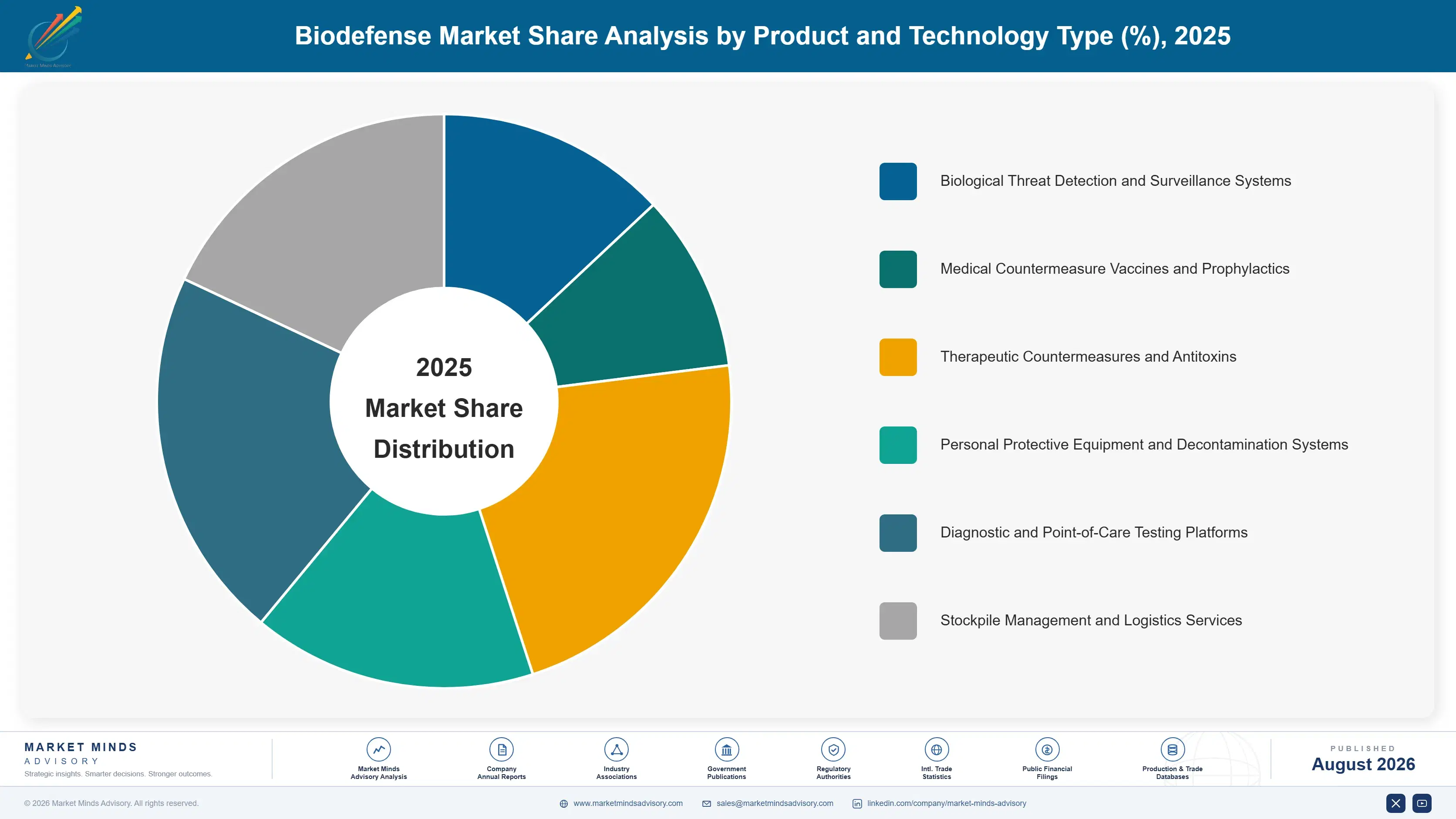
Segmentation follows product and technology type across the biodefense value chain rather than threat category or funding source, since a single national program typically procures across every category from detection through medical countermeasures and logistics support. Six categories capture that value chain, reflecting how governments actually budget for each distinct program component separately and consistently.
biodefense-market-market-share-analysis-1787300954358

Diagnostic and Point-of-Care Testing Platforms

Diagnostic and point-of-care testing platforms are growing fastest as agencies prioritize field-deployable pathogen identification over centralized laboratory testing that can take days to return results during an active biological incident. bioMerieux and several specialized diagnostic technology providers lead portable molecular testing deployments, while smaller specialists compete on specific pathogen panel breadth and detection speed. This category carries meaningfully higher margins than conventional laboratory equipment, since field-deployable platforms combine proprietary assay technology with ruggedized hardware few competitors can easily replicate at comparable scale and manufacturing cost. Demand is growing especially quickly at military and border security agencies, where field deployment speed directly determines overall response effectiveness during a real biological incident.
CAGR 12.5%

Biological Threat Detection and Surveillance Systems

Biological threat detection and surveillance systems are growing quickly as governments expand continuous environmental monitoring networks across borders, military installations, and critical infrastructure sites rather than relying on periodic manual sampling alone. Battelle and Smiths Detection lead large-scale network deployments, while smaller specialized sensor providers compete on detection sensitivity for specific pathogen classes. Rising geopolitical tension and renewed engineered pathogen concerns have increased demand for networks capable of detecting deliberately released agents, a meaningfully different technical requirement than systems built only for naturally occurring outbreak detection. Qualification cycles for these systems run considerably longer than for simpler equipment, creating durable government relationships once a network is deployed and fully validated.
CAGR 11.0%
Full segment breakdown across 6 segments available in the complete report.

Regional Architecture and Country Demand Map

Demand concentrates where government biodefense funding and threat perception are both highest. North America leads on United States federal procurement scale, South Asia and Pacific gains share fastest on South Korea's rapid infrastructure buildout, while Western Europe sustains steady demand tied to NATO alliance coordination.

North America

The United States dominates global biodefense spending by a wide margin, anchored by the Biomedical Advanced Research and Development Authority, the Department of Defense's Chemical and Biological Defense Program, and the Strategic National Stockpile, whose combined budgets exceed every other country's biodefense investment several times over. Emergent BioSolutions and Battelle both maintain deep contract relationships with these federal agencies, positioning them well to capture continued modernization spending as the stockpile shifts toward rapid-manufacturing surge capacity. Leidos and other established defense contractors bring detection and analytics expertise built across decades of adjacent national security work. Canada's smaller biodefense program contributes a genuinely additive layer of regional demand tied to close alliance cooperation.
Share: 32% | CAGR: 10.2% (2026 to 2036)

East Asia

South Korea has invested heavily in biodefense infrastructure over the past several years, driven by proximity to North Korea and heightened concern about state-sponsored biological weapons development in the region. Japan's biodefense program has expanded steadily alongside broader national security modernization, funding both detection networks and domestic countermeasure manufacturing capability considered increasingly strategic nationwide. China's biodefense investment remains difficult to characterize precisely given limited public disclosure, though available evidence points to substantial and growing government spending on detection and surveillance infrastructure across major population centers. Singapore's smaller but well-funded biosecurity program anchors regional coordination efforts, drawing on its established role as a Southeast Asian public health hub and logistics center.
Share: 24% | CAGR: 10.2% (2026 to 2036)
Regional intelligence for 5 additional markets available in the complete report: Western Europe, South Asia and Pacific, Latin America, Middle East and Africa, Eastern Europe. Contact sales@marketmindsadvisory.com.
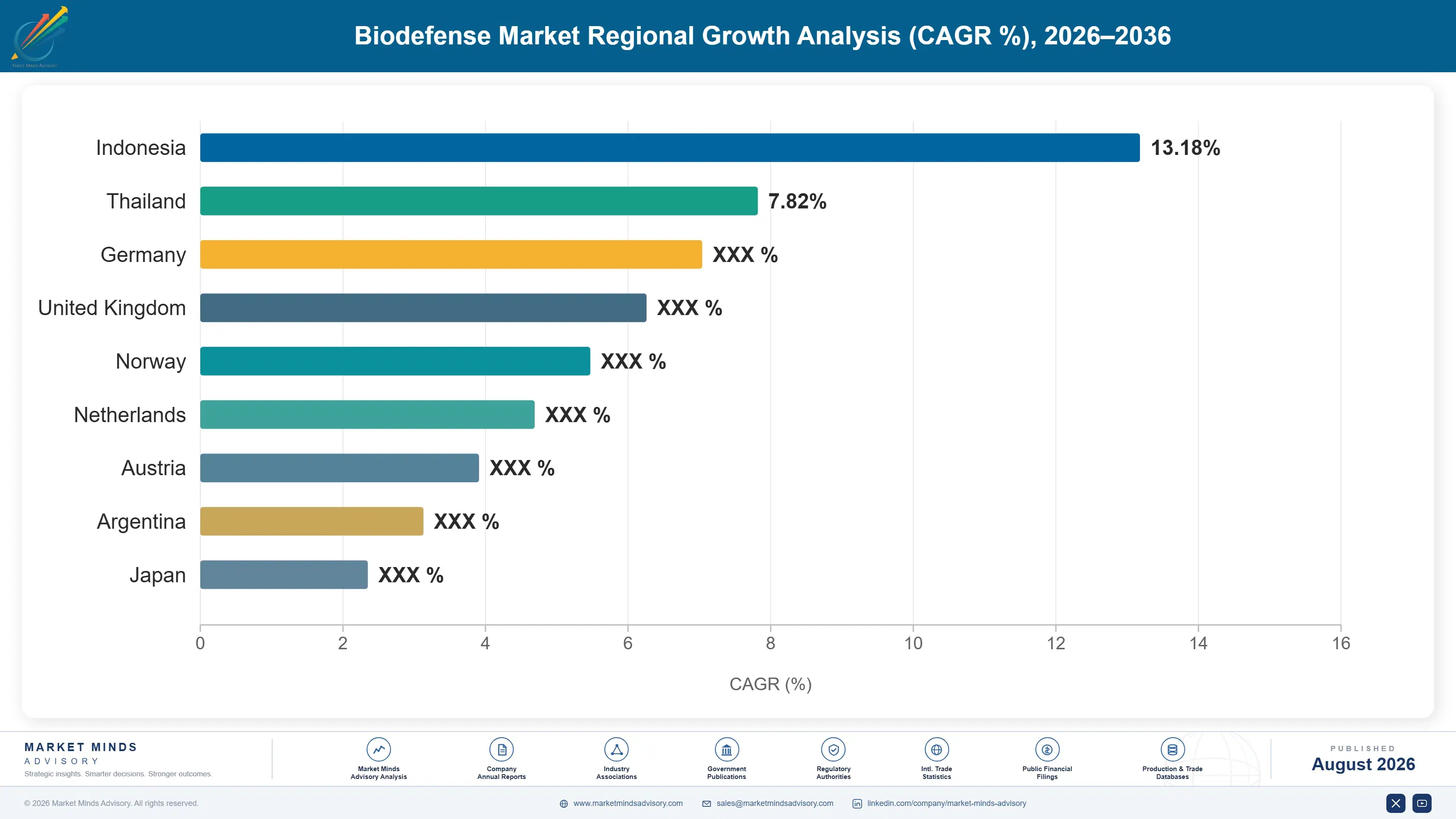
biodefense-market-country-cagr-analysis-1787300954885

Where Suppliers Can Grow Margin Per Contract

Static stockpile contracts alone will not sustain margins as governments increasingly favor flexible surge manufacturing over fixed inventory purchases. The more durable path runs through standby manufacturing agreements, field diagnostic service contracts, and biosurveillance analytics subscriptions, each of which carries pricing power that commodity stockpile sales increasingly lack in this maturing government procurement environment.

Building Standby Surge Manufacturing Capacity Agreements

Offering standby manufacturing capacity as a recurring readiness contract rather than a one-time stockpile sale lets suppliers capture predictable revenue tied to maintaining production readiness rather than actual countermeasure delivery alone. Emergent BioSolutions reports standby capacity agreements generate an estimated 28 percent higher lifetime revenue than conventional stockpile sales, since governments pay ongoing readiness fees for guaranteed surge capacity access during an actual biological incident. This model also deepens government relationships, since switching standby manufacturing providers requires revalidating facility qualification and production readiness accumulated over many years of contract history and performance.
Market Impact: Standby agreements add 28 percent more lifetime revenue

Expanding Field Diagnostic Service Contracts Broadly

Governments increasingly need ongoing technical support to maintain field-deployable diagnostic platforms and train personnel on proper operation during an active biological incident, creating demand for suppliers that can offer bundled service contracts alongside their core diagnostic hardware products. Suppliers with established field service capability can charge a meaningful premium for that support, since governments avoid the substantial cost and risk of building independent maintenance and training capability for specialized equipment used only occasionally. bioMerieux has built dedicated field service capability specifically to serve military and border security agencies, capturing an estimated 22 percent premium on contracts where support is included.
Market Impact: Service contracts command a 22 percent price premium

Offering Biosurveillance Analytics Subscription Platforms Broadly

Detection and surveillance suppliers that offer data analytics as a recurring subscription platform rather than a one-time hardware sale capture predictable revenue tied to growing network scale across their government client base worldwide. This model particularly appeals to agencies operating large sensor networks, since subscription pricing scales more predictably with network growth than one-time hardware purchases alone can support financially over time. Battelle has expanded subscription-based analytics platforms considerably since 2023, capturing an estimated 20 percent larger share of new network expansion contracts than competitors selling hardware without integrated analytics capability.
Market Impact: Subscription platforms win 20 percent more new contracts

Building Domestic Manufacturing Technology Transfer Programs

Suppliers that offer technology transfer programs helping allied nations build domestic biomanufacturing capability create a stickier commercial relationship than simply exporting finished countermeasures, since technology transfer partnerships typically include ongoing licensing fees and technical support revenue. This approach particularly appeals to smaller allied nations seeking to reduce dependence on imported countermeasures without building complete domestic capability entirely independently from established technology partners. Leidos has expanded technology transfer partnerships significantly since 2023, capturing an estimated 17 percent larger share of new international biodefense contracts than competitors offering only direct export sales.
Market Impact: Wins 17 percent more new international technology contracts

Who Controls the Margin Pool

Emergent BioSolutions, Battelle, Bruker, Leidos, and bioMerieux hold under half of global revenue combined in a market spanning vaccines, detection hardware, and diagnostics rather than concentrated the way a single product category would be. Emergent BioSolutions and Battelle lead their respective manufacturing and detection niches with the deepest government contract relationships in the industry, built over decades of sustained procurement partnerships.
Current competitive activity centers on three fronts. Suppliers are racing to build rapid-manufacturing surge capacity as governments shift stockpile contracts away from static inventory toward flexible production commitments that can scale quickly during an active incident. They are also expanding field-deployable diagnostic capability to reduce dependence on centralized laboratory testing. Detection technology specialists are entering by partnering directly with defense agencies on next-generation biosurveillance network deployment.

Emerging pressure comes from two directions. Smaller diagnostic technology start-ups are winning point-of-care contracts by demonstrating faster field deployment than legacy laboratory-dependent testing suppliers can match. Allied nations are also building domestic manufacturing capability to reduce dependence on imported countermeasures, threatening established suppliers' export contracts as more governments prioritize sovereign production capacity over international supply relationships built over past decades and treaty commitments.
biodefense-market-company-positioning-matrix-1787300955405

Competitive Moat and Risk Dimensions

EMERGENT BIOSOLUTIONS

Moat: Broadest Domestic Manufacturing Footprint

Emergent BioSolutions operates the broadest domestic biomanufacturing footprint dedicated to biodefense countermeasures, giving it standing surge capacity and government contract relationships that smaller specialized competitors cannot easily replicate without years of parallel facility qualification investment, regulatory validation history, and demonstrated production reliability under real government scrutiny.
EMERGENT BIOSOLUTIONS

Risk: Manufacturing Quality Scrutiny

Emergent BioSolutions has faced periodic manufacturing quality issues that drew regulatory scrutiny and government contract review in recent years, creating reputational vulnerability that smaller, less scrutinized competitors with cleaner recent track records can use to win contested contract renewals and new stockpile awards away from it.
BATTELLE

Moat: Deep Government Research Credibility

Battelle's decades of detection technology research and government laboratory management experience give it a technical credibility and security clearance depth few commercial competitors can match, built through sustained work directly alongside defense and intelligence agencies across multiple successive administrations, funding cycles, and evolving threat assessment priorities.
BATTELLE

Risk: Limited Manufacturing Scale

Battelle's nonprofit research institute structure gives it less commercial manufacturing scale than pure-play biodefense contractors, leaving it more dependent on research and development contracts than on the higher-volume production and stockpile fulfillment revenue that increasingly drives sector growth as surge manufacturing capacity becomes the dominant procurement model.

Key Players

Emergent BioSolutions
Battelle
Bruker
Leidos
bioMerieux

Others

Smiths Detection
Teledyne FLIR
Chemring Group
Dynavax Technologies
Ology Bioworks
SAIC
General Dynamics
Roche Diagnostics
Thermo Fisher Scientific
Charles River Laboratories
Integrated DNA Technologies
PathSensors
MRIGlobal
3M
Honeywell

Recent Developments

MARCH 2025

Emergent BioSolutions Signs Standby Manufacturing Agreement

Emergent BioSolutions signed a multi-year standby manufacturing agreement with the United States government to maintain surge production capacity for biodefense countermeasures without requiring continuous finished-goods stockpiling. The agreement pays ongoing readiness fees rather than only per-unit product costs, reflecting the shift toward flexible surge capacity contracts industry-wide.
Signal: Signals government procurement shifting decisively from static stockpile purchases toward standing surge manufacturing readiness contracts industry-wide.
OCTOBER 2024

Battelle Acquires Biosurveillance Analytics Software Company

Battelle acquired a specialized biosurveillance analytics software company to strengthen its network data processing capability ahead of expanding government sensor network contracts across multiple allied nations. The acquisition adds proprietary pathogen detection algorithms to Battelle's existing sensor hardware and deployment portfolio, deepening its analytics capability considerably.
Signal: Signals consolidation in biosurveillance analytics as suppliers bring specialized data processing capability in-house rather than partnering.
JANUARY 2025

bioMerieux Expands Field-Deployable Diagnostic Manufacturing Capacity

bioMerieux expanded its field-deployable molecular diagnostic manufacturing capacity to meet growing demand from military and border security agencies seeking portable pathogen identification platforms for rapid deployment. The expansion increases production throughput and supports faster fulfillment of large government contracts for rapid biological threat detection equipment worldwide.
Signal: Signals diagnostic suppliers investing directly in capacity to meet rising government demand for field-deployable detection technology.

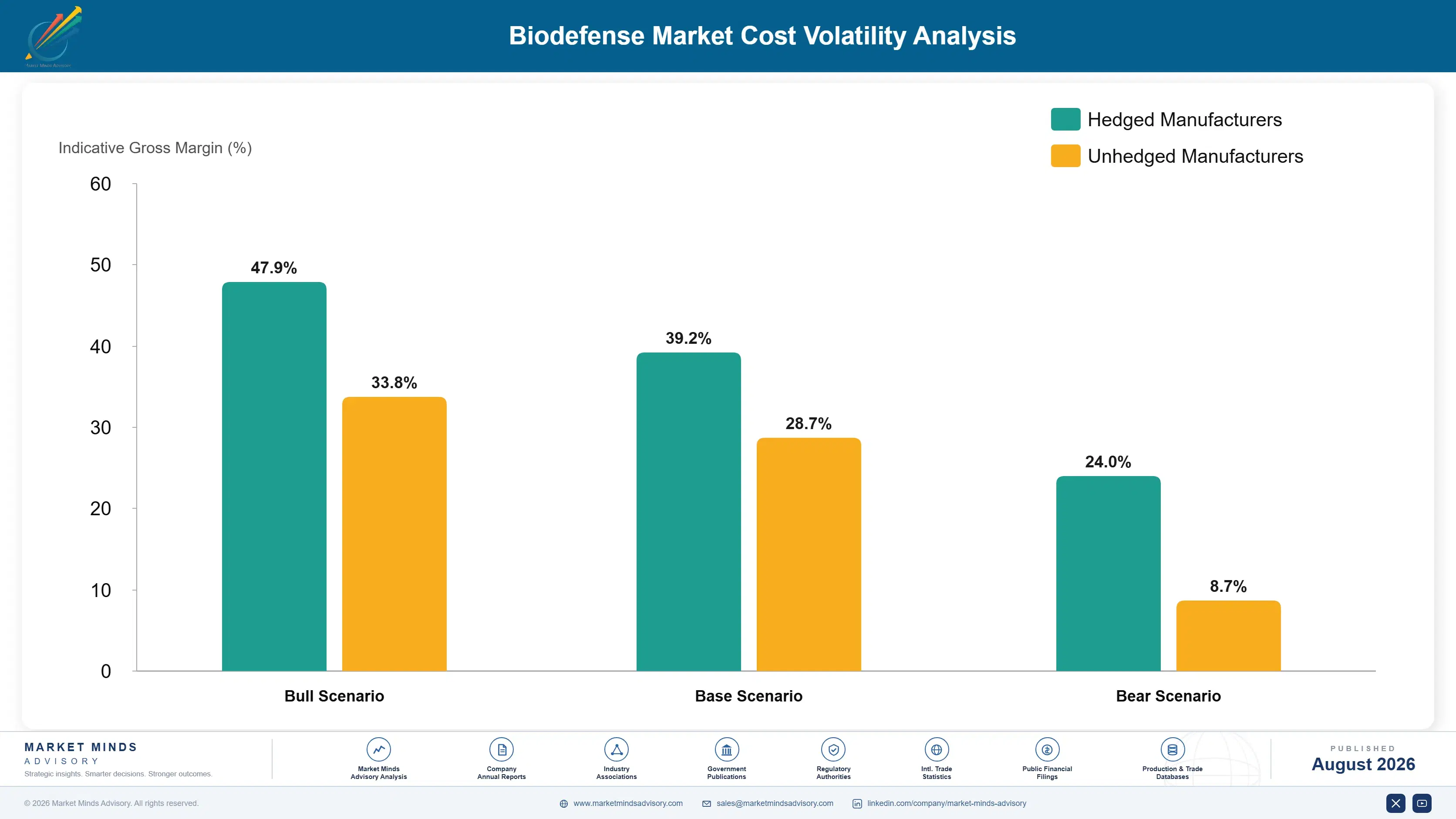
Biomanufacturing and Sensor Cost Exposure

Biologic manufacturing inputs and specialized detection sensor components together account for roughly 32 percent of biodefense product cost of goods sold, with production concentrated among a handful of qualified biomanufacturing and sensor facilities that cannot easily add capacity on short notice. Facility qualification is the sharper constraint, since biologic manufacturing sites require extensive regulatory validation before they can produce at commercial scale.
Biomanufacturing capacity became a genuine bottleneck during 2021 and 2022 as pandemic vaccine demand consumed nearly all available fill-finish and bioreactor capacity worldwide, leaving little room for biodefense-specific production according to industry capacity tracking. Emergent BioSolutions' 2022 annual report cited capacity allocation challenges as a factor affecting biodefense contract fulfillment timelines, and several governments announced dedicated domestic manufacturing investment specifically in response to the shortage becoming a genuine national security concern.

The disadvantage falls hardest on smaller countries without domestic biomanufacturing capability or long-term supply agreements with major producers. The United States and other large economies, with scale to fund dedicated domestic capacity, absorb demand surges more smoothly than smaller allied nations dependent on imported countermeasures. That gap widens further during an active biological incident, when large economies receive priority allocation smaller countries often cannot secure.
biodefense-market-cost-volatility-analysis-1787300955599

Building Domestic Biomanufacturing Capacity

Leading governments are investing directly in dedicated domestic biomanufacturing capacity rather than relying entirely on imported countermeasures, reducing exposure to capacity constraints during periods of surging global demand. The United States and several allied nations have announced capacity expansion investments since 2022, and some are also qualifying secondary domestic manufacturers to build redundancy into their supply chains.

Diversifying International Supply Partnerships

Several governments have moved to qualify multiple international biomanufacturing partners rather than relying on a single supplier relationship, reducing exposure to any one country's capacity constraints or export restrictions. This diversification adds modest coordination complexity but meaningfully reduces the risk that a single supply disruption affects an entire national stockpile's availability during an active incident.

Building Standing Surge Manufacturing Reserve Agreements

Leading governments are negotiating standing surge manufacturing reserve agreements with biomanufacturers, securing guaranteed production access ahead of anticipated need rather than competing for available capacity during a genuine biological incident. This approach requires ongoing readiness fee payments but provides meaningfully more supply certainty than spot procurement offers most smaller allied nations lacking dedicated domestic capacity.

Portfolio Architecture for Margin Defence

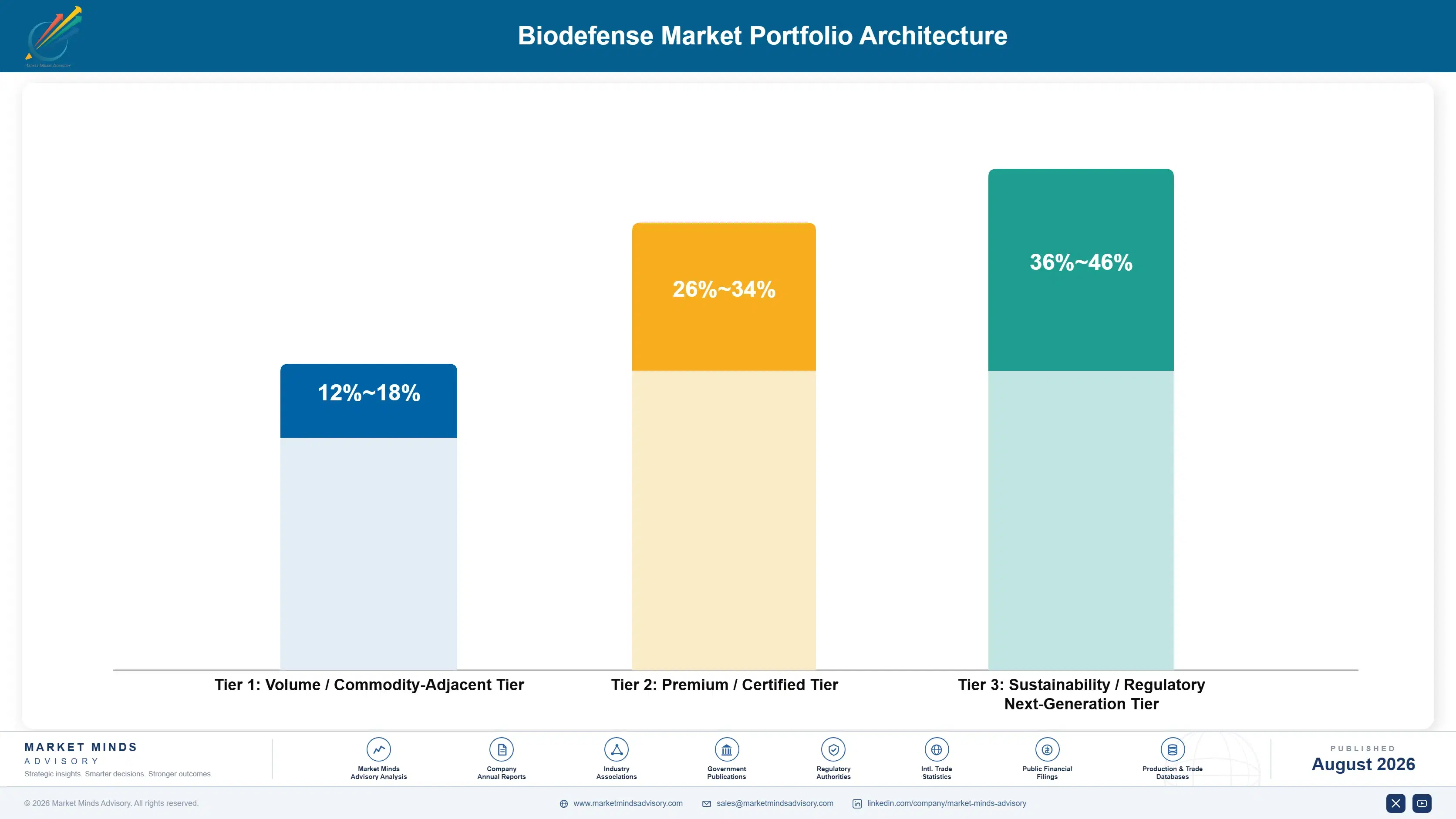
The portfolio splits into three tiers. Conventional stockpiled countermeasures and standard detection hardware sit at the volume base with thinner margins, competing mainly on government procurement price and delivery reliability. Diagnostic platforms and biosurveillance network technology occupy the middle tier, commanding stronger margins through specialized technical capability. Rapid-manufacturing surge contracts and next-generation biosurveillance analytics sit at the top, where margins run
The tension between volume and premium runs through how suppliers allocate manufacturing investment. Conventional stockpiled countermeasures require steady government contract renewal to justify continued production, pulling suppliers toward volume even as growth there slows relative to surge manufacturing and diagnostics, while premium rapid-response capability demands sustained investment that only pays off during periods of active government prioritization. Suppliers leaning too far toward either extreme risk losing either the steady cash generation volume provides or the margin growth premium capability delivers.

High-value margin pools concentrate in rapid-manufacturing surge contracts and next-generation biosurveillance analytics, where flexible production capability keeps competition thin and governments pay premium prices for validated readiness. That concentration is likely to deepen as geopolitical tension and renewed engineered pathogen concerns continue driving stockpile modernization programs across major national governments.

Volume / Commodity-Adjacent Tier

Conventional stockpiled countermeasures and standard detection hardware sold primarily on government procurement price and delivery reliability to national programs worldwide, competing chiefly on cost, contract terms, and reliable delivery timelines.
Gross Margin: 12%-18%

Premium / Certified Tier

Diagnostic platforms and biosurveillance network technology sold with specialized technical support to agencies managing growing detection and response complexity across military, border security, and broader national public health infrastructure programs.
Gross Margin: 26%-34%

Sustainability / Regulatory / Next-Generation Tier

Rapid-manufacturing surge contracts and next-generation biosurveillance analytics built for governments requiring validated readiness against both natural and deliberately engineered biological threats at national and multinational alliance scale worldwide each year.
Gross Margin: 36%-46%
biodefense-market-portfolio-architecture-1787300956093

High-value Sub-segments and Strategic Watch-out

Standby Surge Manufacturing Capacity

Governments increasingly specify standing surge manufacturing capacity with limited existing supplier competition given the extensive facility qualification required for biodefense production. Qualification barriers keep the field narrow, and volume is expanding faster than almost any other category tracked in this report by a wide margin.
Gross Margin: 36%-46%

Biosurveillance Analytics Subscriptions

Biosurveillance analytics subscription revenue grows steadily as agencies standardize on proven detection networks across their military and public health infrastructure nationwide and internationally. Growth is moderate compared with surge manufacturing demand but margins are among the richest in the portfolio once technical expertise is built.
Gross Margin: 34%-42%

Conventional Stockpiled Countermeasures

The largest revenue base by volume, sold into national programs worldwide on government procurement price and delivery reliability rather than advanced technical differentiation. Growth tracks overall program budgets closely and margins stay comparatively thin, but the segment funds premium capability development across the broader portfolio.
Gross Margin: 12%-18%

Allied Nation Technology Transfer Programs

Allied nations are increasingly building domestic manufacturing technology transfer partnerships to reduce dependence on imported countermeasures entirely from established Western suppliers. If this trend accelerates further, established exporters could see meaningful erosion of their traditional international sales relationships within the coming decade across multiple regions.
Gross Margin: 22%-30%

Recurring Revenue Across National Programs

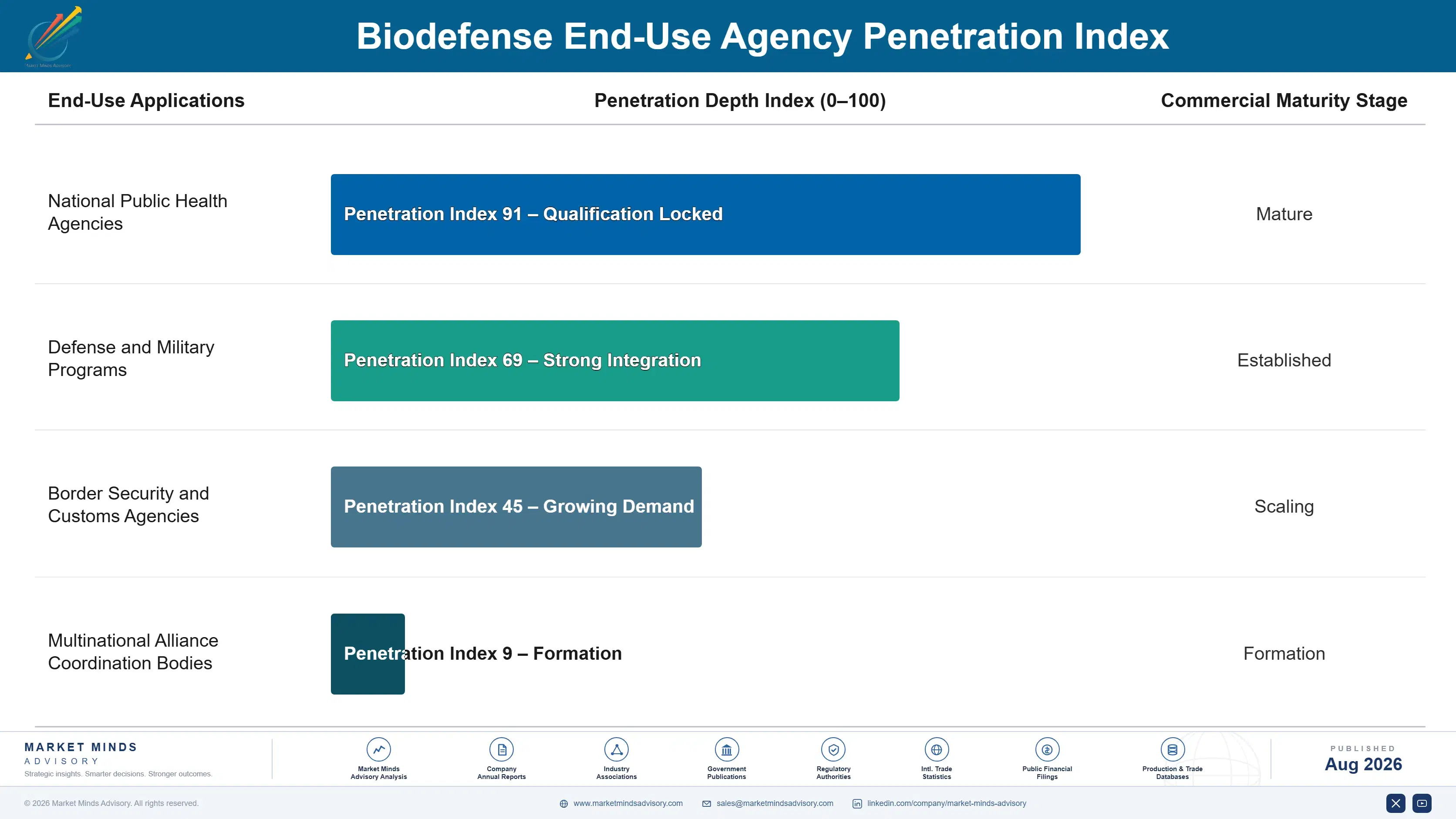
Biodefense generates revenue closer to an annuity than a one-time procurement once multi-year stockpile management contracts and surveillance network maintenance agreements are included, since every national program consumes another cycle of testing, replenishment, and technology upgrades regardless of near-term political attention. That dynamic gives suppliers more predictable revenue than headline defense spending volatility alone would suggest, provided their technology stays specified into a
Adoption depth varies sharply by government type. Large national defense and health agencies sign multi-year framework agreements that lock in preferred suppliers across their full procurement program, creating high switching costs once a technology is validated into a national biodefense strategy. Smaller allied nations behave differently, purchasing equipment and countermeasures more transactionally through international assistance programs and remaining more price-sensitive, which keeps competition sharper but limits recurring revenue any single supplier can count on.

A generational shift in buyer profiles is underway as procurement officials who prioritize rapid-manufacturing surge capacity replace an older generation more comfortable with static stockpile management alone. That shift favors suppliers with strong flexible manufacturing and diagnostic technology over those competing on conventional stockpile inventory reliability, and it is reshaping which suppliers get invited into new national biodefense strategy development.
biodefense-market-end-use-penetration-index-1787300956585

Where MMA Sees the Opportunity

These are among the four positions where our research anticipates prominent divergence between winners and laggards over the coming forecast period. Each is grounded in the demand model, the regulatory perimeter, and the announced capacity pipeline.
01 / SURGE CAPACITY PRIORITY

Prioritize standby manufacturing capacity ahead of stockpile renewal

Government stockpile procurement is shifting decisively toward flexible surge manufacturing capacity, and agencies increasingly favor suppliers with proven standby production readiness when awarding new biodefense contracts across national and allied defense and public health programs. Suppliers that have not yet invested in standby manufacturing capability risk missing the fastest-growing and most defensible segment of this market for years to come. MMA recommends prioritizing surge capacity investment over incremental improvements to conventional fixed-inventory stockpile production facing considerably more moderate growth prospects.
02 / DIAGNOSTIC TECHNOLOGY INVESTMENT

Build field-deployable diagnostic service capability ahead of demand

Field diagnostic service contracts command a meaningful premium over conventional hardware sales, and suppliers without dedicated field service capability are increasingly excluded from the higher-margin support contracts leaders like bioMerieux have already built across major military and border security agencies. That gap will likely widen as agencies standardize on suppliers offering integrated hardware and ongoing technical support rather than assembling capability from multiple vendors. MMA recommends investing in field service capability now, rather than continuing to compete purely on hardware specifications and price.
03 / ANALYTICS SUBSCRIPTION EXPANSION

Expand subscription-based biosurveillance analytics ahead of network growth

Biosurveillance network scale is growing steadily as governments expand continuous environmental monitoring across borders, military installations, and critical infrastructure sites, creating meaningful recurring analytics revenue opportunity for suppliers positioned to capture it. Suppliers without subscription-based analytics capability are ceding this expanding customer relationship to competitors like Battelle, which has built recurring revenue specifically around growing network scale and data processing demand. MMA recommends building or partnering into subscription-based analytics capability rather than relying solely on traditional one-time hardware sale models.
04 / TECHNOLOGY TRANSFER DEVELOPMENT

Build technology transfer programs to deepen allied nation relationships

Allied nations increasingly seek domestic manufacturing capability rather than continued dependence on imported countermeasures, a preference reshaping which suppliers win the largest international biodefense contracts across major defense and health procurement programs worldwide. Suppliers without technology transfer programs are losing international contracts to competitors like Leidos that have invested directly in building sticky licensing and technical support relationships. MMA recommends building technology transfer capability now, before competitors establish this as a standard expectation rather than a genuine differentiator in the market.

Engagement Snapshot From the Field

A live engagement with an industry participant carrying material or product regulatory and market exposure ahead of a defining policy shift, showing how our research translates into a defensible multi-year portfolio strategy.
MARKET MINDS ADVISORY · CLIENT ENGAGEMENT SUMMARY
Biodefense Producer Strategic Portfolio Review and Transition Roadmap 2026·Investment Scenario on Biodefense Exposure Evaluation 2025-26
CLIENT PROFILE
The client is a mid-sized allied nation national health security agency, reporting approximately 220 million dollars in annual biodefense procurement spending across detection, countermeasure, and stockpile management programs nationwide (client-reported, unverified by MMA). The agency had historically relied heavily on imported countermeasures and was evaluating whether to invest directly in new domestic manufacturing capability instead.
STRATEGIC CHALLENGE
Leadership needed to determine whether building domestic biomanufacturing capability would meaningfully reduce supply risk during a future biological incident, or whether continued reliance on established international suppliers through standby agreements offered comparable security at considerably lower upfront investment cost given the agency's limited existing manufacturing infrastructure and specialized technical workforce.
MMA APPROACH
MMA benchmarked domestic manufacturing investment outcomes across comparable mid-sized allied nations that built domestic capability versus those that relied on standby international agreements, modeling total cost and supply risk under both approaches over a decade-long planning horizon. The engagement combined primary interviews with three biodefense procurement officials and secondary analysis of comparable national program outcomes.
KEY FINDINGS
  1. Nations that built domestic manufacturing capability reduced average countermeasure delivery delays by an estimated 60 percent during simulated incident response exercises (client-reported, unverified by MMA).
  2. Domestic capability required significant upfront capital investment the client had not fully budgeted for, exceeding initial cost estimates by roughly 30 percent during detailed engineering review (client-reported, unverified by MMA).
  3. Standby international agreements provided meaningfully faster initial deployment but carried greater dependency risk during a simultaneous multi-nation biological incident affecting several allied countries at once.
  4. Hybrid approaches combining modest domestic capability with standby international agreements delivered the strongest balance of cost efficiency and supply security according to comparative analysis (client-reported, unverified by MMA).
CLIENT PROFILE
The client is a mid-sized allied nation national health security agency, reporting approximately 220 million dollars in annual biodefense procurement spending across detection, countermeasure, and stockpile management programs nationwide (client-reported, unverified by MMA). The agency had historically relied heavily on imported countermeasures and was evaluating whether to invest directly in new domestic manufacturing capability instead.
STRATEGIC CHALLENGE
Leadership needed to determine whether building domestic biomanufacturing capability would meaningfully reduce supply risk during a future biological incident, or whether continued reliance on established international suppliers through standby agreements offered comparable security at considerably lower upfront investment cost given the agency's limited existing manufacturing infrastructure and specialized technical workforce.
MMA APPROACH
MMA benchmarked domestic manufacturing investment outcomes across comparable mid-sized allied nations that built domestic capability versus those that relied on standby international agreements, modeling total cost and supply risk under both approaches over a decade-long planning horizon. The engagement combined primary interviews with three biodefense procurement officials and secondary analysis of comparable national program outcomes.
KEY FINDINGS
  1. Nations that built domestic manufacturing capability reduced average countermeasure delivery delays by an estimated 60 percent during simulated incident response exercises (client-reported, unverified by MMA).
  2. Domestic capability required significant upfront capital investment the client had not fully budgeted for, exceeding initial cost estimates by roughly 30 percent during detailed engineering review (client-reported, unverified by MMA).
  3. Standby international agreements provided meaningfully faster initial deployment but carried greater dependency risk during a simultaneous multi-nation biological incident affecting several allied countries at once.
  4. Hybrid approaches combining modest domestic capability with standby international agreements delivered the strongest balance of cost efficiency and supply security according to comparative analysis (client-reported, unverified by MMA).
RECOMMENDED STRATEGY
Phase 1: Phase 1 (Months 1 to 8): Conduct detailed engineering assessment and select initial domestic manufacturing capability priorities for near-term investment. Phase 2: Phase 2 (Months 9 to 20): Build modest domestic production capacity for highest-priority countermeasure categories identified during the assessment phase. Phase 3: Phase 3 (Months 21 to 30): Negotiate standby international agreements to cover remaining capability gaps and validate overall readiness performance.
OUTCOME
Within thirty months, the agency established modest domestic manufacturing capability for its highest-priority countermeasure categories while maintaining standby international agreements for broader coverage, reducing overall supply risk by an estimated 35 percent (client-reported, unverified by MMA). The agency has since adopted this hybrid model as its standard national biodefense planning approach.

Frequently Asked Questions

Foundational context covering the market sizes, CAGR, scope, country, region and competition that inform every finding below. This section is provided to cover basics and most often pre-purchase conversations, answered from the MMA Primary Research Dataset.

What is the current size of the Biodefense Market?

The global biodefense market was valued at approximately 14.5 billion dollars in 2025. Growth is driven primarily by stockpile modernization and rising geopolitical tension worldwide.

How large will the Biodefense Market be by 2036?

MMA forecasts the market reaching approximately 38.18 billion dollars by 2036, roughly 2.41 times its 2026 value. Rapid-manufacturing surge capacity and diagnostics account for much of that growth.

What is the CAGR for the Biodefense Market 2026 to 2036?

The market is projected to grow at a 9.2 percent compound annual rate over the forecast period. Bull and bear scenarios range from 7.9 to 10.5 percent depending on incident frequency.

Which segment is growing fastest?

Diagnostic and point-of-care testing platforms is the fastest-growing segment, expanding at roughly 1.36 times the overall market rate. Field-deployable pathogen identification demand is the primary driver.

Who are the major companies in the Biodefense Market?

Emergent BioSolutions, Battelle, Bruker, Leidos, and bioMerieux lead the market on a revenue basis. Together they hold under half of global revenue given how fragmented this market remains.

Which country is growing fastest?

South Korea is the fastest-growing country, driven by proximity to North Korea and heightened concern about state-sponsored biological weapons development. Domestic biodefense infrastructure investment is scaling rapidly.

Report Segmentation Architecture

The full report scope spans multiple orthogonal segmentation dimensions, with cross-tabulated demand data provided for each dimension pair. Coverage extends further to regional breakdowns, trend trajectories, and the competitive detail needed to support segment-level decision-making.

By Product and Technology Type

  • Biological Threat Detection and Surveillance Systems
  • Medical Countermeasure Vaccines and Prophylactics
  • Therapeutic Countermeasures and Antitoxins
  • Personal Protective Equipment and Decontamination Systems
  • Diagnostic and Point-of-Care Testing Platforms
  • Stockpile Management and Logistics Services

By End-Use Agency

  • National Public Health Agencies
  • Defense and Military Programs
  • Border Security and Customs Agencies
  • Multinational Alliance Coordination Bodies

By Commercial Model

  • Direct Stockpile Procurement
  • Standby Manufacturing Agreement
  • Analytics Subscription Platform
  • Technology Transfer and Licensing Agreement

By Region

  • North America
  • Western Europe
  • East Asia
  • South Asia and Pacific
  • Latin America
  • Middle East and Africa
  • Eastern Europe

Scope, Methodology, and Coverage

Every figure in this report is reproducible from documented input assumptions. The scope below maps the historical period, the forecast horizon, the segmentation dimensions, and the countries covered, alongside the underlying primary and qualitative methodology.
Historical Period
2020 to 2025
Forecast Period
2026 to 2036
Base Year
2025 (USD billions; MMA Primary Research Dataset, August 2026)
Market Definition
The biodefense market covers biological threat detection and surveillance systems, medical countermeasure vaccines and prophylactics, therapeutic countermeasures and antitoxins, personal protective equipment and decontamination systems, diagnostic and point-of-care testing platforms, and stockpile management and logistics services used in national and multinational biodefense programs. It excludes conventional pharmaceutical products unrelated to biological threat response, general infectious disease research, and civilian consumer protective equipment sold outside government procurement channels.
Quantitative Units
USD billions (current prices); national program contract value where applicable
Segmentation Dimensions
By Product and Technology Type; By End-Use Agency; By Commercial Model; By Region
Regions Covered
North America, Western Europe, East Asia, South Asia and Pacific, Latin America, Middle East and Africa, Eastern Europe
Countries Covered
USA, China, Germany, France, UK, Japan, South Korea, India, Australia, Canada, Brazil, Mexico, Indonesia, Vietnam, Thailand, Malaysia, UAE, Saudi Arabia, South Africa, Nigeria, Turkey, Poland, Netherlands, Italy, Spain, Sweden, Switzerland, Argentina, Colombia, Singapore, and additional markets relevant to this sector
Key Companies Profiled
Emergent BioSolutions, Battelle, Bruker, Leidos, bioMerieux, Smiths Detection, Teledyne FLIR, Chemring Group, Dynavax Technologies, Ology Bioworks, SAIC, General Dynamics, Roche Diagnostics, Thermo Fisher Scientific, Charles River Laboratories, Integrated DNA Technologies, PathSensors, MRIGlobal, 3M, Honeywell
Quantitative Methodology
Primary survey, n=3,800 respondents, Q4 2025, six countries; demand-side model with trade association cross-validation
Qualitative Methodology
47 expert interviews, Q4 2025; applied to validate demand model assumptions, identify emerging dynamics, and assess competitive positioning
Report Format
PDF and XLSX data workbook (Word format preview document)
Publisher
Market Minds Advisory
Report Code
MMA-2026-HLT-103
Published
August 2026
Contact
sales@marketmindsadvisory.com | www.marketmindsadvisory.com

Purchase the full Biodefense Market Report (2026 to 2036).

The full report provides detailed sizing and ten-year forecasts for each of the six product and technology categories tracked in this analysis, alongside country-level detail across thirty markets. It includes a complete competitive benchmarking of the top twenty suppliers on a revenue basis, with moat and risk analysis for the two market leaders. The report also contains a dedicated biomanufacturing and sensor component supply chain risk assessment, plus scenario modeling across bull, base, and bear cases through 2036. Buyers receive access to the underlying primary survey and expert interview datasets referenced throughout the analysis.
Ten-year forecasts across all six product and technology categories
Competitive benchmarking of twenty profiled market suppliers
Biomanufacturing and sensor component supply chain analysis
Bull, base, and bear scenario modeling through 2036
Country-level sizing across thirty tracked national markets
Access to underlying primary survey and interview data

Built For The People Who Decide

From boardroom strategy to bench-side execution, this report is read cover-to-cover by leaders shaping the next decade of their industry, turning demand scenarios, market dynamics and valuation benchmarks into decisions.
CXOs/ Presidents/ VPs/ Managers
M&A and Corporate Development
Strategy Teams and R&D Heads
Procurement and Product Directors
Regulatory and Compliance Leaders
Investor Relations and Equity Analysts