Market Minds Advisory
Zoned Flash Market

Zoned Flash Market: Zoned Namespace Flash Storage for Hyperscale and Enterprise Infrastructure.

Hyperscale data centers chasing write amplification reduction and flash endurance gains are pulling zoned namespace storage out of pilot deployments into production procurement, rewarding controller vendors who can prove application-level integration at scale.

Lead Analyst

Published

September 2026

Make Smarter Decisions with Customized Research Insights

Request a free sample report and evaluate market opportunities, growth trends, and competitive dynamics relevant to your business needs.

2025 MARKET VALUE$0.9BMarket Size 2025
2036 FORECAST VALUE$4.4BBase Case , 2026 to 2036
CAGR 2026 TO 203615.5 %Bull 16.8% / Bear 14.2%
INCREMENTAL OPPORTUNITY$3.4BNet 10- year value creation
EXPANSION MULTIPLE4.22x2036 value over 2026 base
Strategic Levers
M&A Pipeline
Regional Outlook
Country Rankings
Competitive Intelligence
Segmental Deep-dive
Call-Us : 91 93563 13602

Executive Snapshot and Market Trajectory.

Zoned namespace flash has moved past the standards-definition stage into genuine hyperscale procurement, as cloud operators seek to cut write amplification and extend drive endurance in write-heavy workloads like object storage and log-structured databases at meaningful production scale across live fleets worldwide, not just internal pilot programs.
Hyperscale cloud operators are the primary commercial force here, concentrating early volume in the United States and China, where the largest data center buildouts justify the firmware and application rework that zoned storage demands before a single drive ships in volume. Object storage, video repositories, and log-structured database backends absorb the fastest-growing share of zoned drive shipments, since their naturally sequential write patterns map cleanly onto zoned architecture without extensive application redesign work.
Competitive intensity concentrates among a handful of NAND flash manufacturers and SSD controller vendors capable of shipping qualified zoned drives at hyperscale volume and reliability standards, a considerably shorter list than the broader enterprise SSD market maintains today. Standardization through open specification bodies and Linux kernel zoned block device support is steadily lowering integration cost, even as proprietary firmware differences fragment application-level tooling across vendors.
Market Definition
The Zoned Flash Market covers solid-state drives and NAND flash modules implementing zoned namespace architecture, where the drive exposes fixed-size sequential-write zones directly to the host operating system or application rather than abstracting physical media layout through a traditional flash translation layer. It excludes conventional block-interface SSDs, shingled magnetic recording hard drives, and object storage software that runs atop non-zoned media.
Base Year Value
$0.9B in 2025 (MMA Primary Research Dataset, September 2026)
Forecast Period
2026 to 2036, eleven discrete annual values
CAGR
15.5% base case. Bull 16.8%. Bear 14.2%.
Fastest Growth Segment
ZNS SSDs for Hyperscale Cloud Storage Infrastructure: 22.0% CAGR
Fastest Growth Country
United States: 17.0% CAGR
Fastest Growth Region
South Asia and Pacific: 17.5% CAGR
Largest Region
North America: 32% of 2025 global value
Market Leaders
Samsung, SK hynix, Western Digital, Kioxia, and Solidigm lead the global Zoned Flash Market. Source: MMA Primary Research Dataset, July 2026, and company disclosures.
Primary Survey
n=3,800 procurement and R&D decision-makers, Q4 2025, six countries
Methodology
Demand-side build-up, cross-validated against public data, 47 expert interviews

Zoned Flash Market Forecast Scenarios

zoned-flash-market-size-forecast-scenario-1790002655638
Zoned namespace flash existed mainly as a standards effort and hyperscaler pilot program between 2020 and 2023, with the NVMe ZNS specification finalizing only in 2020 and Linux kernel support maturing gradually afterward. Genuine production shipment volume began accumulating only in the final two years of the historical window, reflected in a historical growth rate of 14.5%.
The base case rests on three commercial mechanisms: hyperscale cloud operators expanding zoned deployments from pilot fleets to majority production volume as application rework amortizes across more workloads, NAND flash manufacturers prioritizing zoned-capable controller development as differentiated enterprise product lines rather than niche variants, and open-source community tooling maturing enough that mid-tier cloud providers can adopt zoned storage without hyperscaler-scale engineering teams. Together these push adoption well beyond the current hyperscaler-only base through 2036.
A bull scenario centers on broader database and file system vendors shipping native zoned storage support out of the box, removing the custom engineering burden that today limits adoption to the largest operators. The principal bear risk is that computational storage and in-drive processing advances reduce the write amplification problem zoned storage solves, weakening the core justification for the additional application complexity zoned adoption requires.

Zoned Flash Adoption Gated by Integration, Not Hardware Cost

Zoned flash sits at the intersection of NAND manufacturing scale and host software engineering, since a drive's raw endurance advantage only materializes once an operator rewrites its storage stack to write sequentially within fixed zones rather than relying on the flash translation layer to hide physical media complexity from applications. That integration burden, not drive cost, remains the primary adoption gate today across the market.
MARKET CONCENTRATION (CR5)68%share held by the five largest qualified suppliers
AVERAGE SELLING PRICE PREMIUM18%premium charged over equivalent conventional enterprise SSD capacity
HYPERSCALE DEPLOYMENT SHARE74%shipment volume flowing to hyperscale cloud operators directly
ENDURANCE IMPROVEMENT FACTOR2.5xadditional drive write endurance versus conventional flash translation
TOP PRODUCING COUNTRY SHARE71%qualified NAND wafer output concentrated among leading suppliers
APPLICATION REWORK COST SHARE40%total deployment cost attributable to host software integration effort
Pricing carries a premium over conventional enterprise SSDs of similar raw capacity, justified by lower over-provisioning requirements and materially longer usable drive life in write-heavy workloads common across modern cloud infrastructure deployments. Hyperscale buyers negotiate this premium down through direct, large-volume purchase agreements that smaller buyers cannot access, widening the effective cost gap between hyperscale and mid-tier adoption paths.
Supply concentrates among NAND manufacturers with mature 3D NAND process nodes and controller firmware teams capable of hyperscale-grade qualification testing, a considerably narrower group than the broader enterprise SSD supplier base maintains. Qualification cycles with major cloud operators routinely stretch beyond a year, creating a durable moat for incumbents already through that process against newer entrants still working through early qualification stages.
"The real bottleneck in zoned storage was never the drive. It was convincing a database team to rewrite years of storage engine assumptions for an endurance number that only shows up after eighteen months in production."
Director, Data Center Storage and Semiconductor Practice · MMA Technology Practice · September 2026

Market Trends

NVMe ZNS Specification Maturity Drives Kernel-Level Support

The NVMe Zoned Namespace specification, finalized in 2020 and refined through subsequent revisions, has matured into a stable target that Linux kernel maintainers now support natively rather than through vendor-specific patches. Kernel version 5.9 introduced mainline zoned block device support, and every major distribution since has shipped it by default, removing what was previously the single largest technical barrier to adoption outside the largest hyperscalers with dedicated kernel engineering teams. This standardization is pulling zoned storage evaluation into mid-tier cloud providers and large enterprises that lack hyperscaler-scale engineering resources for custom kernel work.
Market Impact: 2.5x drive endurance versus conventional designs
RocksDB and Database Engine Native Zoned Storage Support

Popular storage engines including RocksDB and a growing set of log-structured merge-tree databases have added native zoned namespace backends, letting application teams adopt zoned drives without writing custom storage layer code from scratch. This removes a substantial engineering cost that previously limited zoned adoption to organizations willing to fund multi-year internal storage engine rework projects. Roughly 15 widely used open-source storage projects now carry zoned storage support branches or production-ready integrations, up from essentially zero five years ago, meaningfully lowering the barrier for smaller operators to evaluate and adopt the technology.
Market Impact: 35% annual growth in flash demand

Market Opportunities and Growth Drivers

Hyperscale Data Center Capacity Expansion Demands Better Endurance

Hyperscale operators are adding exabytes of storage capacity annually to support cloud services and AI training data pipelines, and every additional exabyte carries a real replacement cost tied directly to drive endurance. Zoned drives reduce write amplification enough to extend usable drive life by roughly 2.5 times versus conventional flash translation layer designs in write-heavy workloads, translating directly into fewer drive replacements across a fleet of hundreds of thousands of units. At hyperscale, even modest per-drive endurance gains compound into meaningful capital expenditure savings across a data center's operating life.
Market Impact: 40% of deployment cost is rework

AI Training Data Pipelines Require Sequential Write Optimization

Large language model training pipelines generate enormous sequential write volumes as they checkpoint model state and stream training data, a workload pattern that maps almost perfectly onto zoned storage's fixed-zone sequential write model rather than a conventional general-purpose block interface design. AI infrastructure buildouts have driven enterprise flash capacity demand up by roughly 35% year over year at leading cloud providers, and a meaningful share of that new capacity is being provisioned as zoned storage specifically for training data and checkpoint workloads rather than general-purpose block storage volumes used elsewhere.
Market Impact: Adds 6 months to sourcing timelines

Market Restraints and Challenges

Application Rework Cost Deters Mid-Tier Cloud Adoption

Adopting zoned storage requires rewriting the host storage stack to write sequentially within fixed zones, an engineering investment hyperscalers can amortize across enormous fleets but that mid-tier cloud providers struggle to justify. The root cause is that zoned drives expose physical media constraints directly to software rather than hiding them behind a flash translation layer, shifting engineering burden from vendor to customer. Application rework represents roughly 40% of total deployment cost for a first-time adopter. Vendors mitigate this by shipping reference integrations for popular storage engines, cutting the custom engineering work smaller operators must complete.
Market Impact: Kernel 5.9 enables mainline support

Proprietary Firmware Fragmentation Complicates Multi-Vendor Sourcing

Despite a common NVMe ZNS specification, vendor-specific firmware behavior around zone reset timing and write ordering still differs enough that application code tuned for one manufacturer's drives does not always perform identically on another's. The root cause is that the specification defines a command interface but leaves substantial implementation latitude to individual controller vendors. This forces large buyers to qualify and tune separately for each supplier, adding roughly 6 months to a multi-vendor sourcing timeline. Buyers are mitigating this by concentrating early procurement with a single qualified vendor before expanding to a second source.
Market Impact: 15 open-source storage projects now integrated
3 additional market trends, 4 additional growth drivers, and 2 additional restraints and challenges are covered in the full report. Contact sales@marketmindsadvisory.com to access the complete intelligence.

Segment CAGR and Growth Architecture

The Zoned Flash Market segments by product and interface type across six categories spanning drive form factor, interface, and target application, reflecting how buyers actually specify zoned storage purchases against their infrastructure requirements. Two segments outpace the market average, driven respectively by hyperscale cloud storage expansion and rapidly growing AI training infrastructure procurement worldwide.
zoned-flash-market-market-share-analysis-1790002656176

ZNS SSDs for Hyperscale Cloud Storage Infrastructure

ZNS SSDs for hyperscale cloud storage infrastructure are the fastest-growing segment, expanding as the largest cloud operators move zoned deployments from pilot fleets covering a small fraction of capacity into majority production volume across object storage and log-structured database backends. These buyers negotiate directly with NAND manufacturers on multi-year supply agreements, bypassing traditional enterprise storage distribution channels entirely and capturing volume pricing unavailable to smaller purchasers elsewhere in the market. Their engineering teams also maintain the in-house kernel and storage engine expertise needed to extract the full endurance benefit, a capability that remains scarce outside the largest operators and continues to concentrate this segment's growth among a handful of buyers globally.
CAGR 22.0%

Zoned Flash for AI Training Data and Checkpoint Storage

Zoned flash for AI training data and checkpoint storage forms the second-fastest segment, growing as large language model training runs generate sequential write volumes that map naturally onto fixed-zone architecture rather than a conventional block interface design. Training clusters checkpoint model state at regular intervals, creating predictable, large sequential writes that zoned drives handle with substantially less write amplification than general-purpose storage under comparable load conditions. AI infrastructure operators are increasingly specifying zoned storage explicitly in new cluster procurement rather than defaulting to conventional enterprise SSDs by default, a shift that accelerated sharply as training cluster scale and associated storage costs both grew rapidly over the past two years of buildout.
CAGR 19.5%
Full segment breakdown across 6 segments available in the complete report.

Regional Architecture and Country Demand Map

Zoned flash demand concentrates wherever hyperscale cloud capital expenditure and AI infrastructure buildout are heaviest, with North America leading on hyperscaler procurement scale while East Asia anchors both NAND manufacturing capacity and a rapidly growing domestic hyperscaler base of its own across multiple countries and industries.

North America

North America hosts the majority of global hyperscale cloud capital expenditure, and Amazon, Microsoft, Google, and Meta together account for the largest share of zoned flash procurement worldwide through direct supplier negotiations that bypass conventional enterprise storage channels. The region's dominance in large language model training infrastructure buildout adds a second, rapidly growing demand channel beyond traditional cloud storage, as AI clusters checkpoint and stream training data at volumes that justify the engineering investment zoned adoption requires. Storage engineering talent concentrated around these hyperscalers gives North American operators a first-mover advantage in extracting the full endurance benefit zoned drives offer, reinforcing the region's leading position rather than eroding it over time.
Share: 32% | CAGR: 16.5% (2026 to 2036)

Western Europe

European cloud infrastructure spending trails North America and East Asia by a wide margin, but sovereign cloud initiatives backed by the European Union are funding new hyperscale-adjacent data center capacity that increasingly specifies zoned storage from initial deployment rather than retrofitting later in the buildout cycle. Germany and France's financial services and telecommunications sectors are early adopters of zoned storage for regulatory data retention workloads, where sequential write patterns and long retention periods suit the technology particularly well. The region's storage engineering talent pool remains smaller than North America's hyperscaler-adjacent workforce, slowing the pace at which mid-tier European cloud providers can adopt zoned architecture independently at the pace hyperscalers have.
Share: 18% | CAGR: 14.0% (2026 to 2036)
Regional intelligence for 5 additional markets available in the complete report: East Asia, South Asia and Pacific, Latin America, Middle East and Africa, Eastern Europe. Contact sales@marketmindsadvisory.com.
zoned-flash-market-country-cagr-analysis-1790002656697

Where Zoned Storage Vendors Actually Capture Value

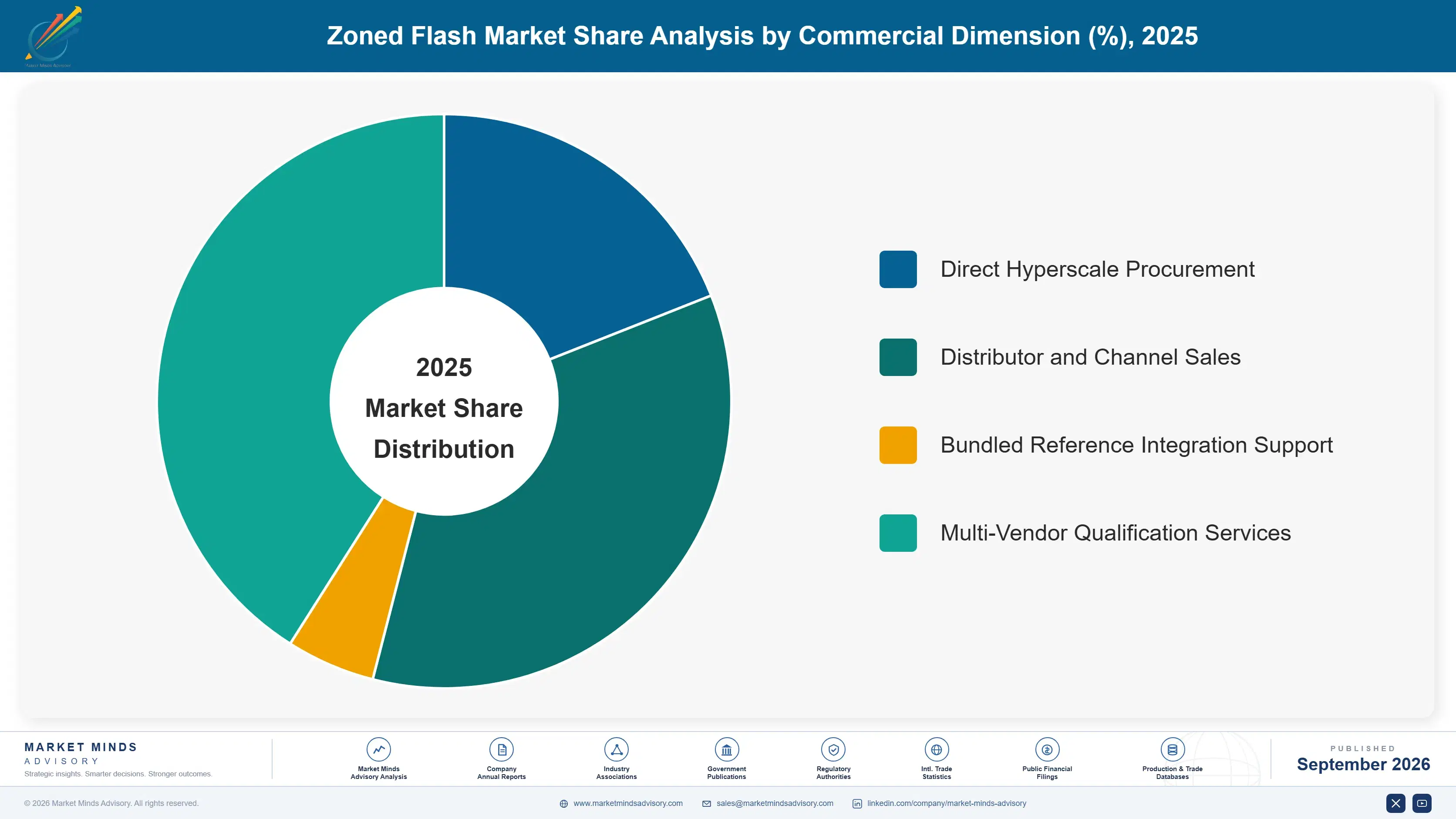
Zoned flash vendors capture value beyond raw drive shipment through four commercial mechanisms tied directly to the integration burden that differentiates this technology from conventional storage architectures entirely. Reference integration support, direct hyperscale supply agreements, capacity endurance premiums, and multi-vendor qualification services all reward vendors who reduce customer engineering effort and deployment risk substantially.

Charging Premium Pricing for Endurance and Reliability

Zoned drives command a meaningful price premium over conventional enterprise SSDs of equivalent raw capacity, justified by the roughly 2.5 times endurance improvement they deliver in write-heavy workloads common across hyperscale fleets. Hyperscale buyers accept this premium because the total cost of ownership calculation, including fewer drive replacements over a multi-year deployment window, favors zoned drives despite the higher upfront unit price at point of purchase. Vendors that can demonstrate this total cost advantage with real fleet performance data capture materially more value than those competing purely on sticker price alone.
Market Impact: 18% premium justified by 2.5x endurance improvement gain

Providing Reference Storage Engine Integration Support

Vendors that ship reference integrations for popular storage engines and databases reduce the customer engineering burden that today limits adoption to organizations with hyperscaler-scale technical teams and deep in-house kernel expertise built over years. This support currently accounts for roughly 40% of what customers otherwise spend on application rework, making it a meaningful differentiator in competitive evaluations between similarly priced drives from different suppliers. Vendors investing in dedicated integration engineering teams are winning evaluation slots with mid-tier cloud providers that lack the resources to build custom storage layer code themselves from scratch.
Market Impact: Cuts customer rework cost by roughly 40% overall

Securing Direct Multi-Year Hyperscale Supply Agreements

NAND manufacturers that negotiate multi-year supply agreements directly with hyperscale operators bypass traditional enterprise storage distribution entirely, capturing both volume certainty and pricing power that spot-market sales cannot match under normal market conditions today. These agreements typically span 3 to 5 years and lock in committed volume well ahead of the operator's actual deployment schedule, giving the manufacturer production planning visibility that smaller, transactional customers simply cannot provide at comparable scale or reliability. This direct relationship model increasingly defines how the largest share of zoned flash revenue changes hands across the industry.
Market Impact: Locks in 3 to 5 years of volume

Offering Paid Multi-Vendor Qualification and Tuning Services

Large buyers sourcing from multiple zoned flash vendors pay for dedicated qualification and firmware tuning services to ensure consistent application performance across suppliers, since proprietary firmware behavior still varies enough to require separate tuning work per vendor relationship and product generation over time. This qualification service, priced separately from ongoing drive shipments, has become a genuine revenue line worth 2 to 4 million dollars annually for vendors with dedicated hyperscale technical account teams already established. It also deepens the underlying customer relationship ahead of the buyer's next major procurement cycle.
Market Impact: 2 to 4 million dollars in annual revenue

Who Controls the Margin Pool

Revenue concentration in the Zoned Flash Market sits at a CR5 of 68%, evaluated on zoned drive shipment revenue across NAND manufacturers and SSD vendors with qualified hyperscale deployments. Samsung and SK hynix lead by a wide margin given their combined NAND fabrication scale and early hyperscale qualification wins, well ahead of the next tier of vendors still building comparable production volume.
Current competitive activity centers on qualification races with the largest hyperscale operators, where vendors publicize kernel and storage engine integration partnerships to shorten customer evaluation timelines. Several vendors have opened dedicated engineering teams embedded with major cloud customers, treating integration support as a genuine differentiator rather than a bundled afterthought. Controller specialists without in-house NAND fabrication compete primarily on firmware sophistication and reference integration quality.

Emerging pressure comes from computational storage and in-drive processing vendors positioning alternative architectures that could reduce the specific write amplification problem zoned storage solves, potentially slowing adoption at the margin. Rankings could shift meaningfully if a controller specialist without owned fabrication wins a marquee hyperscale design win, since qualification wins carry multi-year exclusivity that reorders standing for years. Vendors lacking mature reference integrations risk losing evaluation slots to better-supported competitors.
zoned-flash-market-company-positioning-matrix-1790002657224

Competitive Moat and Risk Dimensions

SAMSUNG ELECTRONICS

Moat: NAND Fabrication Scale

Samsung's combined leadership in NAND process technology and drive controller design lets it offer end-to-end zoned solutions without relying on external partners for either component, a rare capability among competitors. This vertical integration shortens development cycles for new zoned product generations and lets the company price competitively while maintaining margin that fabless controller vendors cannot match.
SAMSUNG ELECTRONICS

Risk: Slower Software Integration Investment

Samsung's hardware-centric organizational culture has historically under-invested in the open-source storage engine integration work that increasingly determines evaluation outcomes with mid-tier cloud buyers. Competitors with dedicated software integration teams are winning evaluation slots on integration quality even when Samsung's underlying hardware specifications are comparable or superior on paper.
SK HYNIX

Moat: Early Hyperscale Qualification Wins

SK hynix secured early qualification with several major North American hyperscalers before competitors had comparable zoned products ready for volume shipment, giving it incumbent status in renewal negotiations that new entrants must now displace. This first-mover position compounds as hyperscalers expand existing qualified relationships rather than requalifying new suppliers for additional volume.
SK HYNIX

Risk: Geographic Concentration in Korea

SK hynix's fabrication capacity remains concentrated in South Korea, exposing the company to geopolitical and trade policy risk that more geographically diversified competitors like Western Digital and Kioxia, with joint venture facilities spanning multiple countries, do not carry to the same degree across their supply chains.

Players Tracked

Prominent Players

Samsung Electronics
SK hynix
Western Digital
Kioxia
Solidigm

Other Key Players

Micron Technology
YMTC
Seagate Technology
Marvell Technology
Silicon Motion Technology
Phison Electronics
Kingston Technology
Innodisk
ScaleFlux
Pliops
Intel
Toshiba Electronic Devices
Netlist
Burlywood
Radian Memory Systems

Recent Developments

APRIL 2025

Pyeongtaek Fab Adds Zoned SSD Lines

Samsung Electronics expanded zoned namespace SSD production capacity at its Pyeongtaek fabrication campus, adding dedicated lines for hyperscale-qualified drives following rising order commitments from North American cloud operators. The expansion supports anticipated volume growth as customers move zoned deployments from pilot fleets into broader production infrastructure.
Signal: Signals sustained hyperscale demand pull for dedicated zoned drive production ahead of the platform's broader rollout
SEPTEMBER 2025

Joint Venture Expanded for Zoned Production

Western Digital and Kioxia expanded their existing joint venture fabrication agreement to include dedicated zoned namespace product lines at their shared Yokkaichi and Kitakami facilities in Japan. Both companies contribute engineering resources and share process technology, structuring it as a genuine joint venture rather than a supply agreement.
Signal: Extends the existing joint venture structure into dedicated zoned namespace production lines at meaningful new scale
JANUARY 2026

Acquisition Adds Zoned Integration Software

ScaleFlux acquired a smaller storage engine software startup specializing in RocksDB integration for zoned namespace drives, adding reference integration intellectual property to its existing computational storage portfolio. The acquisition strengthens ScaleFlux's position in the fastest-growing integration services segment without requiring years of internal software development from a standing start position.
Signal: Adds zoned storage integration software capability without years of costly internal development effort required elsewhere entirely

NAND Wafer Supply and Fab Investment Exposure

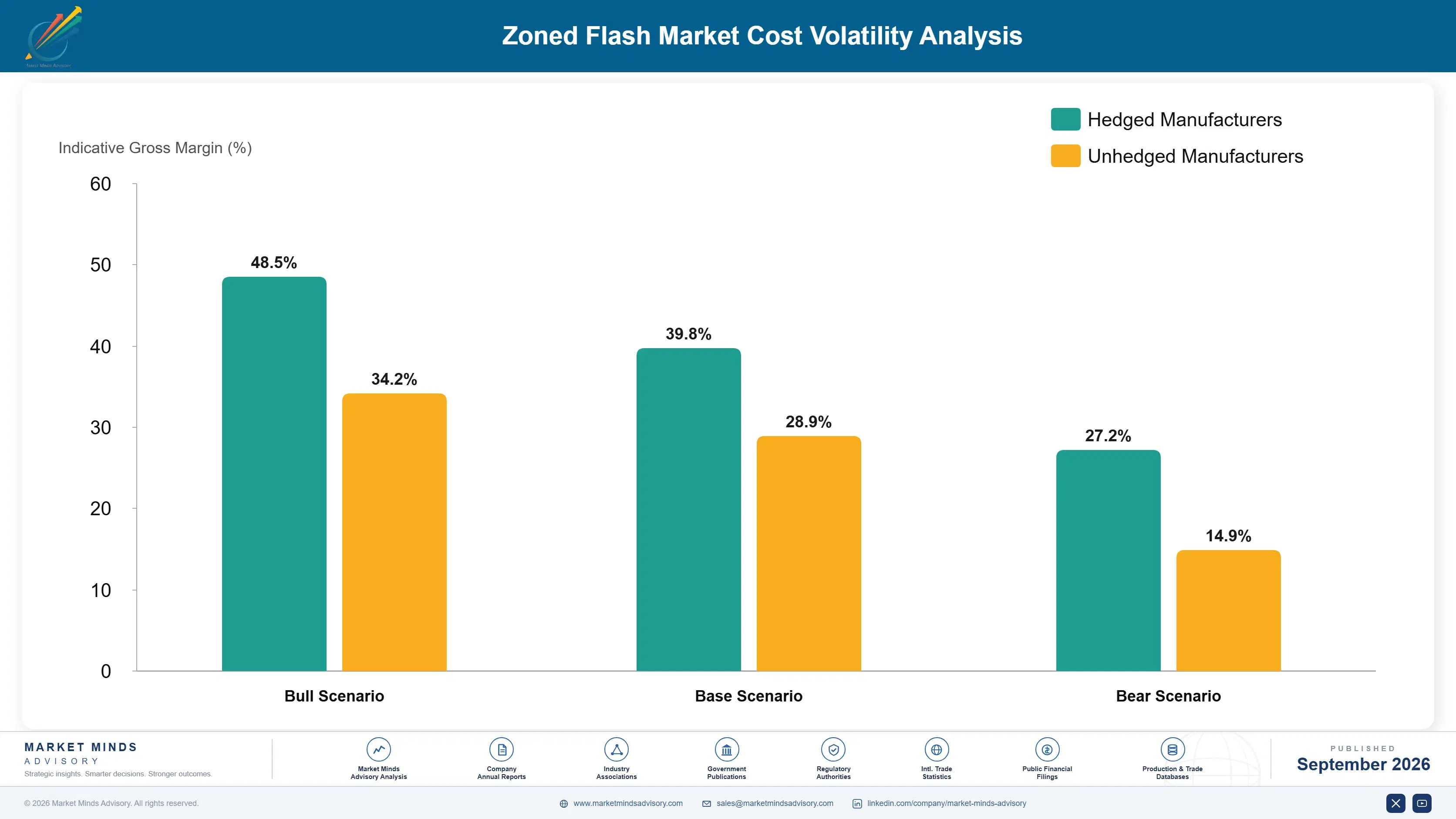
3D NAND wafers account for roughly 55% of zoned drive production cost, produced across a concentrated set of mega-fabs in South Korea, Japan, and China that require multi-billion dollar capital investment per facility. Controller silicon and DRAM cache represent a further 20% of cost, with controller design concentrated among a smaller group of fabless specialists.
NAND pricing swung sharply during the 2023 industry downturn, when oversupply drove contract prices down more than 30% year over year before manufacturers coordinated production cuts, according to Samsung and SK hynix's respective annual reports covering the period. The subsequent 2024-2025 recovery saw prices rise again as AI-driven demand absorbed excess capacity faster than manufacturers had planned, catching several buyers without adequate supply contracts exposed to spot-market volatility.

Vendors without owned NAND fabrication, including most controller specialists and reference design firms, face a durable cost disadvantage during upcycles, since they purchase wafers at spot or contract prices set by the integrated manufacturers who are also, in many cases, their direct competitors. Hyperscale buyers with direct supply agreements largely avoid this exposure, while smaller cloud providers sourcing through distribution absorb the full brunt of price volatility.
zoned-flash-market-cost-volatility-analysis-1790002657422

Securing Multi-Year NAND Wafer Supply Agreements

Large buyers are increasingly negotiating multi-year NAND wafer supply agreements directly with manufacturers, trading committed volume for insulation against spot-market price swings. This approach worked well for hyperscalers already under long-term contract during the 2023 downturn and the subsequent 2024 recovery, avoiding the worst price volatility that spot-market buyers experienced across both pricing cycles.

Dual-Sourcing NAND Supply Across Two Fabrication Regions

Buyers are qualifying zoned drives from manufacturers with fabrication capacity in more than one country, reducing exposure to any single region's trade policy or natural disaster risk. This raises qualification cost modestly but protects continuity when geopolitical tension or export restrictions affect any single fabrication hub, a scenario buyers now weigh explicitly in sourcing decisions.

Investing in Computational Storage as a Cost Hedge

Some operators are hedging NAND cost exposure by investing directly in computational storage architectures that reduce total flash capacity requirements per workload, lowering exposure to wafer price cycles overall across their fleets. This approach works best for compute-adjacent storage workloads and has grown alongside broader interest in reducing total data center storage footprint industry-wide.

Portfolio Architecture for Margin Defence

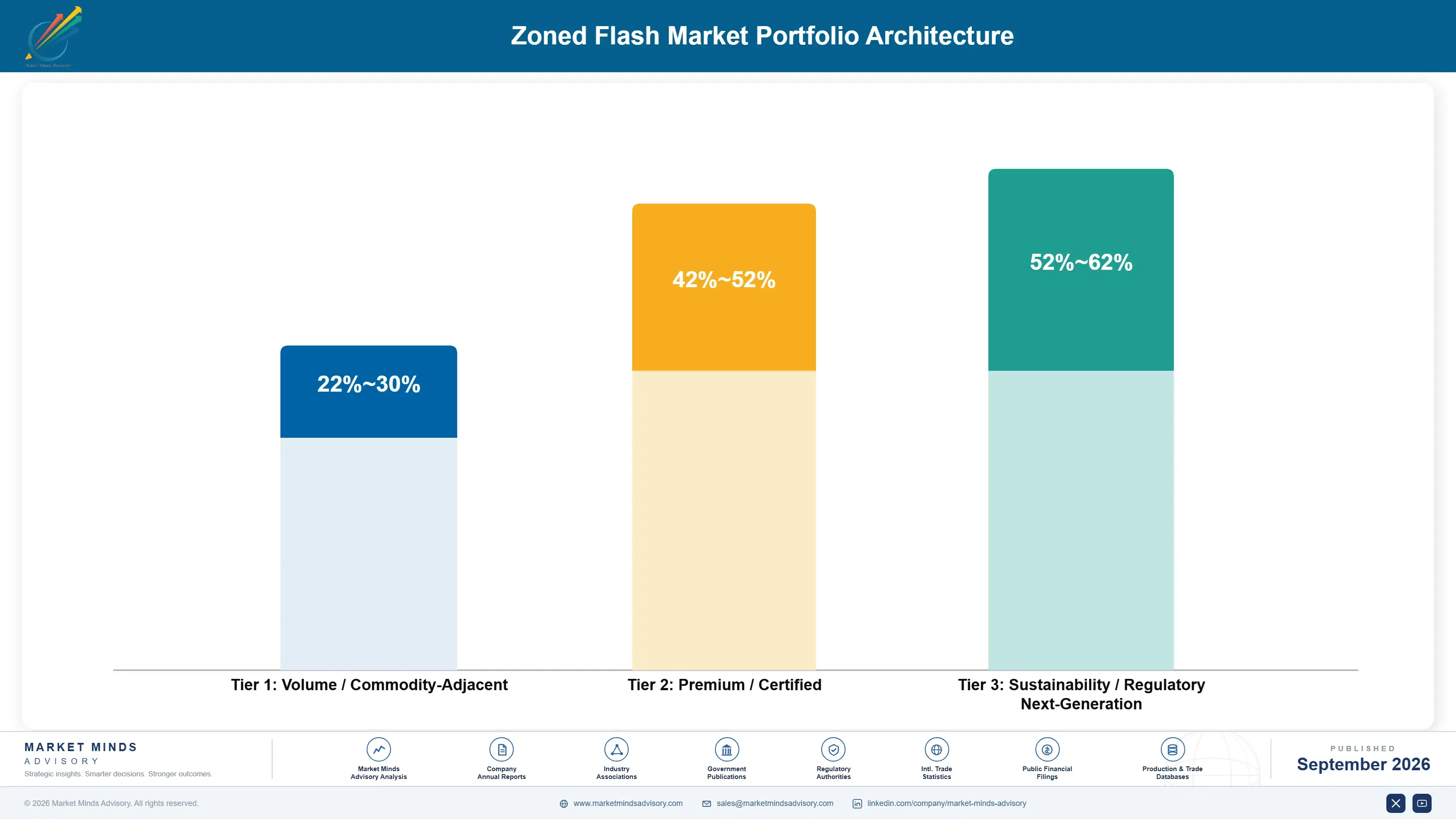
Zoned flash vendors organize their portfolios across three margin tiers reflecting genuinely different commercial relationships, from commodity-adjacent conventional SSDs sold alongside zoned variants up through certified hyperscale-qualified drives to next-generation computational storage integrations. Gross margin varies substantially across tiers, concentrating at the top where integration depth and qualification barriers keep competition thin and durable.
Volume tier products compete on raw capacity and price against conventional enterprise SSDs that customers have not yet decided to migrate away from, offering limited differentiation and correspondingly thin margin across the board. Premium tier zoned products earn their margin through demonstrated hyperscale qualification history and reference integration depth that customers value well beyond the marginal cost of the drive itself, creating durable pricing power that commodity vendors simply cannot access.

The tension between conventional and zoned product lines shapes fabrication capacity allocation decisions, since wafer capacity committed to legacy conventional SSDs cannot easily flex toward higher-margin zoned production during a sudden demand surge from hyperscale customers. Vendors maintaining strength in both categories use conventional SSD revenue to fund the multi-year hyperscale qualification investment needed to win zoned sockets at meaningful scale.

Volume / Commodity-Adjacent

Conventional enterprise SSDs sold alongside zoned variants, competing on raw capacity and price against a broad field of established suppliers with limited technical differentiation across the product line and buyer base.
Gross Margin: 22-30%

Premium / Certified

Hyperscale-qualified zoned drives with demonstrated production deployment history, priced for proven reliability and reference integration depth rather than raw capacity or unit cost alone across the product portfolio and buyer set.
Gross Margin: 42-52%

Sustainability / Regulatory / Next-Generation

Computational storage and advanced zoned integrations that reduce total flash footprint per workload, commanding the widest margin given limited qualified supplier counts and deep technical differentiation across the category and buyer base.
Gross Margin: 52-62%
zoned-flash-market-portfolio-architecture-1790002657932

High-value Sub-segments and Strategic Watch-out

ZNS SSDs for Hyperscale Cloud Storage

This segment combines the fastest unit growth in the category with strong gross margin, as hyperscale buyers pay directly for demonstrated qualification history and drive endurance benefits. Vendors with proven multi-year hyperscale deployment track records are positioned to capture disproportionate value through the next decade.
Gross Margin: 55-62%

Zoned Flash for AI Training Infrastructure

AI training clusters drive strong growth alongside healthy margin, since checkpoint and streaming write patterns justify a meaningful price premium over conventional storage architectures overall. This combination of solid growth and above-average margin makes it a priority investment area for portfolio expansion across leading vendors.
Gross Margin: 50-58%

Enterprise Zoned SSDs for General Data Center Use

This segment remains the volume core outside hyperscale deployments, generating steady unit shipments even as growth trails the market average and margin stays compressed by conventional SSD price competition industry-wide. It funds operating scale but contributes proportionally less to profit than its shipment volume suggests.
Gross Margin: 30-38%

Zoned Flash Modules for Edge and Embedded Storage

Growth here trails the market average today, but rising edge computing deployment and embedded systems adopting sequential write patterns could accelerate demand faster than currently modeled by most vendors. Vendors should watch qualification activity in this adjacent segment closely over the next two to three years.
Gross Margin: 35-42%

Qualification Lock-In Across Deployment Generations

Zoned flash revenue behaves like an annuity once a vendor clears hyperscale qualification, since operators rarely requalify a working storage supplier mid-fleet given the engineering cost of validating a new vendor's firmware behavior. A single hyperscale qualification win generates recurring shipment revenue across successive fleet generations without renewed sales effort, provided the vendor keeps production capacity and firmware quality consistent.
Stickiness varies meaningfully by end-use vertical: hyperscale cloud storage carries the deepest lock-in given multi-year qualification cycles and the sheer engineering cost of switching suppliers mid-fleet, while AI training infrastructure adoption is newer and less entrenched, with buyers still actively evaluating multiple vendors. Enterprise data center adoption sits between these extremes, moving cautiously as mid-tier operators watch hyperscaler outcomes before committing engineering resources themselves.

Buyer profiles are shifting generationally as storage engineering authority moves from generalist infrastructure teams toward specialized platform engineers who understand zoned architecture's sequential write model directly. These buyers prioritize demonstrated fleet-scale endurance data and reference integration quality over vendor relationships built around conventional storage purchasing, favoring vendors who invest in dedicated technical account teams over those relying on traditional distributor channels.
zoned-flash-market-end-use-penetration-index-1790002658454

Where Zoned Storage Strategy Focuses Next

These are among the four positions where our research anticipates prominent divergence between winners and laggards over the coming forecast period. Each is grounded in the demand model, the regulatory perimeter, and the announced capacity pipeline.
01 / HYPERSCALE QUALIFICATION INVESTMENT

Prioritize Hyperscale Qualification Over Broad Enterprise Distribution

Hyperscale qualification is the single highest-value investment available to zoned flash vendors today, since a won qualification generates recurring shipment revenue across successive fleet generations with minimal renewed sales effort required afterward. Vendors chasing broad enterprise distribution instead compete on price in a segment with thinner margin and no qualification moat protecting share at all against new entrants. The engineering investment required to clear hyperscale qualification pays back many times over across a multi-year supplier relationship spanning several fleet generations.
02 / REFERENCE INTEGRATION DEVELOPMENT

Build Reference Integrations to Lower Customer Adoption Barriers

Application rework represents roughly 40% of total deployment cost for a first-time adopter, and vendors that reduce this burden through reference storage engine integrations win evaluation slots that hardware specifications alone cannot secure on their own. Building integrations for the most widely used open-source storage engines now positions a vendor ahead of mid-tier cloud providers who lack hyperscaler-scale engineering teams for custom integration work. Waiting risks ceding this differentiated capability permanently to the small set of vendors already investing there today.
03 / NAND SUPPLY CHAIN DIVERSIFICATION

Diversify Fabrication Footprint Against Trade Policy Risk

NAND fabrication remains concentrated in a small number of countries, exposing vendors to trade policy and geopolitical risk that a single-region footprint cannot hedge against effectively over the long run and across market cycles. Vendors with fabrication capacity spanning multiple countries, like Western Digital and Kioxia's joint venture structure, offer buyers continuity assurances that single-region competitors cannot match during periods of elevated trade tension. This diversification increasingly factors into hyperscale buyer qualification decisions alongside price and technical specification requirements today.
04 / AI INFRASTRUCTURE SEGMENT FOCUS

Target AI Training Infrastructure as the Next Growth Wave

AI training infrastructure is the second-fastest-growing segment in the category, and buyers there are still actively evaluating multiple vendors rather than defaulting to incumbent hyperscale cloud storage suppliers by default choice today. Vendors that build dedicated reference integrations for checkpoint and streaming training workloads now can establish qualification relationships before the segment matures into the same lock-in pattern already seen in cloud storage. This window for establishing new vendor relationships will not stay open indefinitely for anyone in the broader market.

Engagement Snapshot From the Field

A live engagement with an industry participant carrying material or product regulatory and market exposure ahead of a defining policy shift, showing how our research translates into a defensible multi-year portfolio strategy.
MARKET MINDS ADVISORY · CLIENT ENGAGEMENT SUMMARY
Zoned Flash Producer Strategic Portfolio Review and Transition Roadmap 2026·Investment Scenario on Zoned Flash Exposure Evaluation 2025-26
CLIENT PROFILE
The client is a mid-tier cloud infrastructure provider operating object storage and database-as-a-service offerings for enterprise customers across North America, with annual infrastructure spend exceeding $400 million (client-reported, unverified by MMA). The company was evaluating zoned namespace storage to reduce drive replacement costs across its rapidly growing object storage fleet but lacked the in-house kernel and storage engine expertise that hyperscalers use to adopt the technology independently.
STRATEGIC CHALLENGE
The client's engineering team estimated that adopting zoned storage without external support would require an eighteen-month internal storage engine rework project, a timeline that conflicted directly with planned fleet expansion. Leadership was uncertain whether the endurance benefits justified diverting scarce engineering resources away from customer-facing product development during this critical growth period.
MMA APPROACH
MMA conducted structured interviews with the client's infrastructure and engineering leadership alongside primary survey benchmarking data on zoned adoption timelines and total cost of ownership across comparable mid-tier cloud providers. The analysis mapped available reference integration options against the client's specific object storage architecture and fleet replacement cycle assumptions carefully.
KEY FINDINGS
  1. Vendors offering pre-built reference integrations for the client's existing object storage engine could cut the internal rework timeline from eighteen months to roughly five months.
  2. Total cost of ownership modeling showed a payback period of approximately fourteen months once reduced drive replacement costs were factored against the higher unit price.
  3. Two of five evaluated vendors had reference integrations mature enough for production deployment without requiring any custom firmware tuning work at all.
  4. Dual-sourcing across two qualified vendors added a modest cost premium but eliminated single-supplier dependency risk across the expanding fleet (client-reported, unverified by MMA).
CLIENT PROFILE
The client is a mid-tier cloud infrastructure provider operating object storage and database-as-a-service offerings for enterprise customers across North America, with annual infrastructure spend exceeding $400 million (client-reported, unverified by MMA). The company was evaluating zoned namespace storage to reduce drive replacement costs across its rapidly growing object storage fleet but lacked the in-house kernel and storage engine expertise that hyperscalers use to adopt the technology independently.
STRATEGIC CHALLENGE
The client's engineering team estimated that adopting zoned storage without external support would require an eighteen-month internal storage engine rework project, a timeline that conflicted directly with planned fleet expansion. Leadership was uncertain whether the endurance benefits justified diverting scarce engineering resources away from customer-facing product development during this critical growth period.
MMA APPROACH
MMA conducted structured interviews with the client's infrastructure and engineering leadership alongside primary survey benchmarking data on zoned adoption timelines and total cost of ownership across comparable mid-tier cloud providers. The analysis mapped available reference integration options against the client's specific object storage architecture and fleet replacement cycle assumptions carefully.
KEY FINDINGS
  1. Vendors offering pre-built reference integrations for the client's existing object storage engine could cut the internal rework timeline from eighteen months to roughly five months.
  2. Total cost of ownership modeling showed a payback period of approximately fourteen months once reduced drive replacement costs were factored against the higher unit price.
  3. Two of five evaluated vendors had reference integrations mature enough for production deployment without requiring any custom firmware tuning work at all.
  4. Dual-sourcing across two qualified vendors added a modest cost premium but eliminated single-supplier dependency risk across the expanding fleet (client-reported, unverified by MMA).
RECOMMENDED STRATEGY
Phase 1: Phase 1 (Vendor and Integration Evaluation): Assess reference integration maturity across five candidate zoned storage vendors and their product roadmaps. Phase 2: Phase 2 (Pilot Deployment): Run a limited production pilot with the two most integration-ready vendors before any fleet-wide rollout commitment. Phase 3: Phase 3 (Phased Fleet Migration): Roll out zoned storage across the object storage fleet in stages tied to hardware refresh cycles.
OUTCOME
The client selected a vendor with a mature reference integration for its object storage engine, cutting its internal engineering timeline from an estimated eighteen months to five months. The pilot deployment demonstrated drive endurance improvements consistent with vendor claims, supporting a phased fleet-wide migration decision (client-reported, unverified by MMA).

Frequently Asked Questions

Foundational context covering the market sizes, CAGR, scope, country, region and competition that inform every finding below. This section is provided to cover basics and most often pre-purchase conversations, answered from the MMA Primary Research Dataset.

What is the current size of the Zoned Flash Market?

The Zoned Flash Market is valued at $0.9 billion in 2025. This reflects global shipment revenue for zoned namespace SSDs and flash modules across hyperscale and enterprise infrastructure.

How large will the Zoned Flash Market be by 2036?

The market is projected to reach $4.39 billion by 2036, up from $1.04 billion in 2026. That expansion represents a 4.22 times multiple over the eleven-year forecast period.

What is the CAGR for the Zoned Flash Market 2026 to 2036?

The market is forecast to grow at a 15.5% compound annual growth rate between 2026 and 2036. Bull and bear scenarios range from 16.8% to 14.2%, reflecting hyperscale adoption pace uncertainty.

Which segment is growing fastest?

ZNS SSDs for hyperscale cloud storage infrastructure lead growth at 22.0% CAGR, roughly 1.42 times the overall market rate. Demand comes from object storage and log-structured database deployments.

Who are the major companies in the Zoned Flash Market?

Samsung Electronics, SK hynix, Western Digital, Kioxia, and Solidigm lead the market. Together they hold a CR5 of 68% based on zoned drive shipment revenue.

Which country is growing fastest?

The United States leads country-level growth at a 17.0% CAGR, driven by concentrated hyperscale capital expenditure and rapidly expanding AI training infrastructure buildout. This outpaces the broader North America regional average.

Report Segmentation Architecture

The full report scope spans multiple orthogonal segmentation dimensions, with cross-tabulated demand data provided for each dimension pair. Coverage extends further to regional breakdowns, trend trajectories, and the competitive detail needed to support segment-level decision-making.

By Primary Market Dimension

  • ZNS SSDs
  • Zoned Flash Modules
  • Enterprise NVMe Zoned SSDs
  • Reference Design and Integration Services
  • Legacy Migration Tooling and Middleware
  • Zoned Flash for AI Training Storage

By End-Use Industry

  • Hyperscale Cloud Computing
  • AI and Machine Learning Infrastructure
  • Enterprise Data Centers
  • Edge Computing and Embedded Systems
  • Telecommunications Infrastructure

By Commercial Dimension

  • Direct Hyperscale Procurement
  • Distributor and Channel Sales
  • Bundled Reference Integration Support
  • Multi-Vendor Qualification Services

By Region

  • North America
  • Western Europe
  • East Asia
  • South Asia and Pacific
  • Latin America
  • Middle East and Africa
  • Eastern Europe

Scope, Methodology, and Coverage

Every figure in this report is reproducible from documented input assumptions. The scope below maps the historical period, the forecast horizon, the segmentation dimensions, and the countries covered, alongside the underlying primary and qualitative methodology.
Historical Period
2020 to 2025
Forecast Period
2026 to 2036
Base Year
2025 (USD billions; MMA Primary Research Dataset, September 2026)
Market Definition
The Zoned Flash Market covers solid-state drives and NAND flash modules implementing zoned namespace architecture, where the drive exposes fixed-size sequential-write zones directly to the host operating system or application rather than abstracting physical media layout through a traditional flash translation layer. It excludes conventional block-interface SSDs, shingled magnetic recording hard drives, and object storage software that runs atop non-zoned media.
Quantitative Units
USD billions (current prices); unit shipment volume where applicable
Segmentation Dimensions
By Primary Market Dimension; By End-Use Industry; By Commercial Dimension; By Region
Regions Covered
North America, Western Europe, East Asia, South Asia and Pacific, Latin America, Middle East and Africa, Eastern Europe
Countries Covered
USA, China, Germany, France, UK, Japan, South Korea, India, Australia, Canada, Brazil, Mexico, Indonesia, Vietnam, Thailand, Malaysia, UAE, Saudi Arabia, South Africa, Nigeria, Turkey, Poland, Netherlands, Italy, Spain, Sweden, Switzerland, Argentina, Colombia, Singapore, and additional markets relevant to this sector
Key Companies Profiled
Samsung Electronics, SK hynix, Western Digital, Kioxia, Solidigm, Micron Technology, YMTC, Seagate Technology, Marvell Technology, Silicon Motion Technology, Phison Electronics, Kingston Technology, Innodisk, ScaleFlux, Pliops, Intel, Toshiba Electronic Devices, Netlist, Burlywood, Radian Memory Systems
Quantitative Methodology
Primary survey, n=3,800 respondents, Q4 2025, six countries; demand-side model with trade association cross-validation
Qualitative Methodology
47 expert interviews, Q4 2025; applied to validate demand model assumptions, identify emerging dynamics, and assess competitive positioning
Report Format
PDF and XLSX data workbook (Word format preview document)
Publisher
Market Minds Advisory
Report Code
MMA-2026-TEC-969
Published
September 2026
Contact
sales@marketmindsadvisory.com | www.marketmindsadvisory.com

Purchase the full Zoned Flash Market Report (2026 to 2036).

This report delivers a comprehensive assessment of the global Zoned Flash Market, covering sizing, segmentation, competitive dynamics, and regional demand patterns through 2036. It profiles twenty leading vendors across NAND manufacturers, controller specialists, and integration software providers, examining how hyperscale and AI infrastructure demand is reshaping adoption economics. The analysis draws on primary survey data from 3,800 respondents and 47 expert interviews conducted in the fourth quarter of 2025. Readers gain a structured view of where qualification value concentrates and how sourcing strategy should evolve.
Detailed twenty-vendor competitive profiles and positioning
Full seven-region demand share and CAGR breakdown
Six-segment product growth and margin tier analysis
In-depth NAND wafer supply chain risk assessment
Hyperscale qualification and adoption strategy guidance
Anonymized client integration engagement case study

Built For The People Who Decide

From boardroom strategy to bench-side execution, this report is read cover-to-cover by leaders shaping the next decade of their industry, turning demand scenarios, market dynamics and valuation benchmarks into decisions.
CXOs/ Presidents/ VPs/ Managers
M&A and Corporate Development
Strategy Teams and R&D Heads
Procurement and Product Directors
Regulatory and Compliance Leaders
Investor Relations and Equity Analysts