Market Minds Advisory
Zinc Sulphate Market

Zinc Sulphate Market: Selling A Cure For A Deficiency Nobody Can See

Roughly half the world's cropped land is zinc deficient and the crops do not look ill, they simply yield less than they could, which makes this an agronomy argument wearing a chemical label.

Lead Analyst

Published

September 2026

Make Smarter Decisions with Customized Research Insights

Request a free sample report and evaluate market opportunities, growth trends, and competitive dynamics relevant to your business needs.

2025 MARKET VALUE$1.1BMarket Size 2025
2036 FORECAST VALUE$1.8BBase Case , 2026 to 2036
CAGR 2026 TO 20364.8 %Bull 6.0% / Bear 3.6%
INCREMENTAL OPPORTUNITY$0.7BNet 10- year value creation
EXPANSION MULTIPLE1.60x2036 value over 2026 base
Strategic Levers
M&A Pipeline
Regional Outlook
Country Rankings
Competitive Intelligence
Segmental Deep-dive
Call-Us : 91 93563 13602

Executive Snapshot and Market Trajectory

The commercial problem is invisibility. Around 49% of cropped land is zinc deficient and the yield penalty runs near 18%, yet the crop looks healthy rather than sick. Nobody buys a correction for a problem they cannot see, which makes this an agronomy business rather than a chemical one.
Supply behaves independently of all that. Around 71% of output derives from smelter residues, secondary zinc and pickling liquor rather than from purpose made metal, so availability follows zinc smelting and galvanising activity rather than anything happening in fertiliser or feed. That decoupling produces regional gluts and shortages nobody in this market controls or predicts. Nobody in this market ever sees it coming.
Feed grows fastest at 7.2%, half again the market rate, because therapeutic zinc oxide was removed from piglet diets and lower dose soluble zinc replaced it. Grade separates the economics entirely, with pharmaceutical material costing around 4.6 times fertiliser grade. East Asia holds 32% of demand and India grows fastest at 8.4%. Purification capability rather than tonnage is what separates producers here from each other. Most never built it at all. The gap is permanent.
Market Definition
Zinc sulphate in monohydrate and heptahydrate forms supplied across micronutrient fertiliser, animal feed additive, mineral flotation reagent, electroplating electrolyte, viscose rayon production, and pharmaceutical and supplement grade applications. Measured at producer selling value. Zinc oxide, zinc chloride, zinc metal and other zinc compounds, chelated zinc micronutrients and formulated fertiliser blends sold under their own identity are excluded from scope.
Base Year Value
$1.1B in 2025 (MMA Primary Research Dataset, August 2026)
Forecast Period
2026 to 2036, eleven discrete annual values
CAGR
4.8% base case. Bull 6.0%. Bear 3.6%.
Fastest Growth Segment
Animal Feed Additive: 7.2% CAGR
Fastest Growth Country
India: 8.4% CAGR
Fastest Growth Region
South Asia and Pacific: 7.0% CAGR
Largest Region
East Asia: 32% of 2025 global value
Market Leaders
Old Bridge Chemicals, Zinc Nacional, Grillo-Werke, Rech Chemical, Zochem. Source: MMA Primary Research Dataset, July 2026.
Primary Survey
n=3,800 procurement and R&D decision-makers, Q4 2025, six countries
Methodology
Demand-side build-up, cross-validated against public data, 47 expert interviews

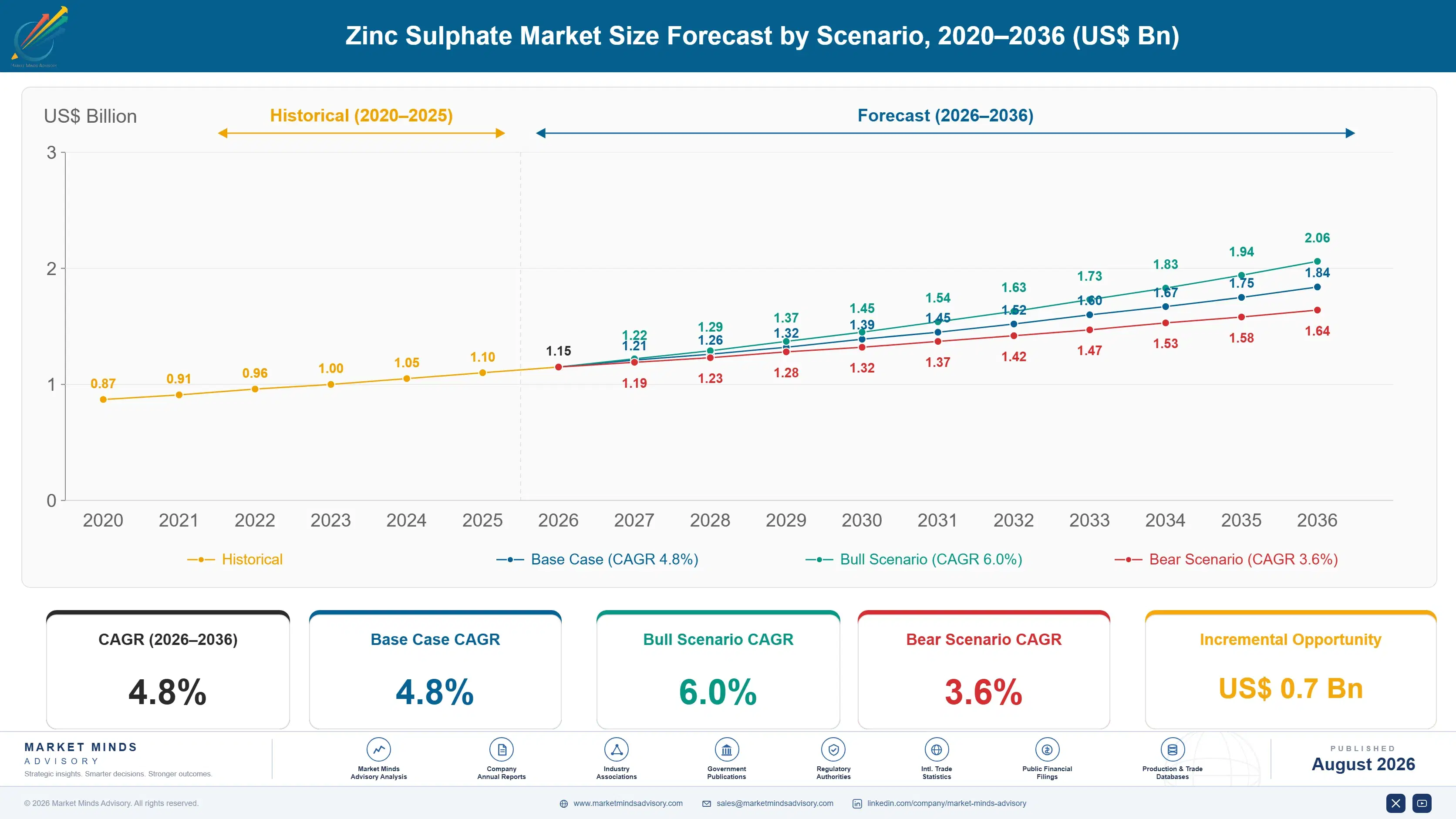
Zinc Sulphate Market Forecast Scenarios

zinc-sulphate-market-trends-size-forecast-scenario-1787665299022
The five years to 2025 were shaped by a feed regulation change and by zinc pricing that moved on reasons unrelated to this market. Therapeutic zinc oxide left piglet diets and lower dose soluble zinc replaced it, while residue availability followed galvanising demand rather than sulphate requirements. The 3.8% historical rate combines steady agricultural volume with a regulatory shift in feed and considerable supply side noise.
The 4.8% base case rests on three mechanisms. Feed grows at 7.2% as lower dose soluble zinc continues replacing what regulation removed from piglet diets. Pharmaceutical and supplement grade grows at 6.4% on zinc supplementation programmes and immune positioning. And Indian micronutrient demand grows at 8.4%, faster than any market covered, on soil deficiency across large cropped areas and improving agronomic testing. Feed regulation, supplementation demand and soil testing together.
The 6.0% bull case turns on soil testing programmes expanding across deficient regions, since correction only happens where deficiency is demonstrated and roughly half of cropped land carries it unmeasured. The 3.6% bear case is supply side: around 71% of output derives from residues whose availability follows smelting activity, and a downturn there creates shortages that raise prices without benefiting anybody selling the product.

A Deficiency That Does Not Look Like One

Zinc deficiency is among the most widespread nutritional problems in agriculture and among the least visible. Around 49% of cropped land carries measurable deficiency, particularly on calcareous and high pH soils across South Asia, China, Turkey and parts of Australia, and the yield penalty runs near 18% where nothing is done. The crop does not look sick. It produces less than it could, which nobody notices without a comparison.
TOP FIVE CONCENTRATION32%Combined production capacity held by the leading suppliers
ZINC DEFICIENT ARABLE LAND49%Cropped area worldwide showing measurable zinc soil deficiency
UNTREATED YIELD PENALTY18%Output lost on deficient soils without any correction
BY-PRODUCT SUPPLY SHARE71%Output derived from smelter residues rather than metal
GRADE PRICE MULTIPLE4.6xPharmaceutical grade cost against fertiliser grade material cost
APPLICATION COST SHARE0.7%Product cost against the crop input budget total
That leaves suppliers selling a correction costing around 0.7% of the crop input budget to farmers who first have to be persuaded a problem exists. Soil and tissue testing is what converts the argument, and where testing programmes operate, adoption follows quickly and durably. Where they do not, the product competes against a farmer's entirely reasonable belief that the crop looks fine and the money is better spent elsewhere.
Supply is decoupled from all of it. Roughly 71% of production derives from zinc smelter residues, secondary zinc recovery and steel pickling liquor rather than from metal bought for the purpose, which means availability follows smelting and galvanising activity. Regional gluts and shortages therefore arise from decisions taken in entirely different industries, and nobody in this market can influence or anticipate them.
"Every other crop input solves a problem the farmer can point at. This one solves a problem that looks exactly like a normal field, and the entire commercial challenge follows from that single fact."
Director, Crop Nutrition and Inorganic Chemicals Practice · MMA Chemicals and Materials Practice · August 2026

Market Trends

Feed Regulation Replaced Zinc Oxide With Soluble Sources

Therapeutic zinc oxide was removed from piglet diets over environmental accumulation and resistance selection concerns, which eliminated a high dose application and created demand for lower dose, more bioavailable zinc sources in its place. Zinc sulphate monohydrate is among the cheapest soluble options available for that substitution. Animal feed grows at 7.2% against a market rate of 4.8%, the fastest application in the category, and a regulatory decision rather than any nutritional development produced it entirely. Feed grade purification is required, which excludes converters who never built that capability. Regulation chose the winners.
Market Impact: India grows at 8.4% annually
Soil Testing Converts Deficiency Into Purchasing Decisions

Around 49% of cropped land carries measurable zinc deficiency and the yield penalty runs near 18%, yet the crop appears healthy and the farmer sees no problem to solve. Soil and tissue testing is what converts an invisible agronomic fact into a purchasing decision, and adoption follows testing programmes closely across every region where they operate. Suppliers funding or supporting testing are addressing the actual constraint, while those promoting product features are answering a question the farmer has not yet asked. Adoption tracks testing coverage rather than any commercial effort at all.
Market Impact: Grade commands 4.6 times fertiliser cost

Market Opportunities and Growth Drivers

Indian Soil Deficiency Meets Improving Agronomic Testing

Indian soils carry zinc deficiency across very large cropped areas, particularly in rice and wheat systems on calcareous soils where availability is poor regardless of total zinc content. India grows at 8.4%, faster than any market covered, as soil health card programmes and private agronomy services expand testing coverage. Domestic producers supply most volume at prices imported material cannot approach. Where testing demonstrates deficiency, adoption follows quickly, and where it does not the product remains an argument nobody has won. Testing coverage rather than product availability is what determines demand across the country.
Market Impact: Costs only 0.7% of input budget

Supplement Demand Follows Public Health And Immune Positioning

Zinc supplementation carries public health backing for childhood diarrhoea management and holds a durable position in immune focused consumer supplements following heightened attention to that category. Pharmaceutical and supplement grade grows at 6.4%, second fastest in the category, and the grade commands around 4.6 times fertiliser grade material cost. Purification to that specification requires removing cadmium, lead and other residues that the by-product supply stream carries, which is a genuine capability rather than a processing formality. Most fertiliser grade producers have never needed to build that capability and therefore cannot enter.
Market Impact: Residues supply 71% of output

Market Restraints and Challenges

Invisible Deficiency Defeats Straightforward Commercial Argument

A zinc deficient crop looks broadly normal rather than sick, which means a farmer sees no problem and a supplier is arguing for a correction costing around 0.7% of the input budget against nothing visible at all. The root cause is agronomic rather than commercial, since the deficiency limits yield without producing recognisable symptoms in most crops. Commercially this makes adoption dependent on testing rather than on selling. Suppliers respond by supporting testing programmes, which works and takes years. Nothing about the crop tells the farmer anything is wrong with it.
Market Impact: Fastest application growing at 7.2%

By-Product Supply Follows Industries With Unrelated Cycles

Around 71% of output derives from smelter residues, secondary zinc recovery and steel pickling liquor, so availability follows zinc smelting and galvanising activity rather than any demand signal from fertiliser or feed. The root cause is that purpose made zinc sulphate from metal costs considerably more than residue derived material. Commercially this produces regional gluts and shortages nobody in this market causes or controls. Producers respond by securing residue supply agreements, which manages exposure without removing it. Purpose made material from bought metal costs considerably more, which is why nobody uses it.
Market Impact: Deficiency covers 49% of cropped land
3 additional market trends, 4 additional growth drivers, and 2 additional restraints and challenges are covered in the full report. Contact sales@marketmindsadvisory.com to access the complete intelligence.

Segment CAGR and Growth Architecture

Segmentation follows application, since the application determines the purity grade required, which regulation applies, who makes the buying decision and whether the product competes against alternatives. Six applications cover the category as supplied. Growth tracks regulatory change and testing coverage rather than any change in what the compound actually does. Purification separates the economics entirely.
zinc-sulphate-market-trends-market-share-analysis-1787665299611

Animal Feed Additive

Zinc sulphate monohydrate supplied into feed premixes as a soluble zinc source across poultry, swine, ruminant and aquaculture nutrition. At 7.2% this is the fastest growing application, half again the market rate of 4.8%, and regulation rather than nutrition explains it. Therapeutic zinc oxide left piglet diets over environmental accumulation and resistance concerns, which removed a high dose application and created demand for lower dose bioavailable sources instead. Feed grade requires purification beyond fertiliser specification, since heavy metal limits in feed are considerably tighter than agricultural material typically needs. A regulatory decision taken about environmental accumulation created the fastest growing application in this entire category. Nobody in this industry asked for it.
CAGR 7.2%

Pharmaceutical and Supplement Grade

High purity zinc sulphate for oral supplements, zinc replacement therapy and childhood diarrhoea management programmes carrying public health backing. Growth of 6.4% is second fastest in the category, supported by immune focused consumer supplement demand alongside established clinical use. This grade commands around 4.6 times fertiliser grade material cost, and the difference reflects genuine purification capability rather than positioning. Removing cadmium, lead and other residues carried by the by-product supply stream requires process capability that most fertiliser grade producers have never needed to build at all. The feedstock stream starts identically to fertiliser grade material and finishes worth several times more, which is entirely a processing decision. Very few producers made it.
CAGR 6.4%
Full segment breakdown across 6 segments available in the complete report.

Regional Architecture and Country Demand Map

East Asia holds 32%, above the standard band, on Chinese zinc smelting, fertiliser consumption and feed production together. South Asia sits at 14% on soil deficiency, while North America falls to 20%. India grows fastest at 8.4%. Soil deficiency geography rather than agricultural spending decides these.

North America

A 20% share sits below the standard regional band, justified because zinc deficiency is less widespread across North American soils than in calcareous regions elsewhere and the category follows deficiency geography rather than agricultural spending. Feed and mineral flotation applications carry substantial volume, with mining operations using zinc sulphate as a flotation depressant at scale. Soil testing is routine and where deficiency is identified correction follows without argument. Growth of 3.8% reflects mature agricultural practice rather than any expansion in application. Deficiency geography rather than agricultural spending is what determines this regional position entirely. Mining and feed applications carry more weight here than crops do. That is unusual for the category.
Share: 20% | CAGR: 3.8% (2026 to 2036)

Western Europe

An 18% share reflects moderate soil deficiency alongside the strictest regulatory environment for heavy metals in fertiliser anywhere, with cadmium limits tightening across the region. That regulation disadvantages residue derived material carrying contaminants and favours purified grades at higher cost. Feed applications changed substantially when therapeutic zinc oxide was withdrawn from piglet diets, which created the soluble zinc demand now driving that segment. Agricultural volumes are constrained by environmental limits on nutrient application generally. Growth of 3.2% is the lowest of the seven regions. Contaminant regulation rather than agronomic need is what shapes supply into this region. Residue derived material faces limits that purified grades simply do not. Purification decides access.
Share: 18% | CAGR: 3.2% (2026 to 2036)
Regional intelligence for 5 additional markets available in the complete report: East Asia, South Asia and Pacific, Latin America, Middle East and Africa, Eastern Europe. Contact sales@marketmindsadvisory.com.
zinc-sulphate-market-trends-country-cagr-analysis-1787665300172

Where This Compound Actually Earns

Nothing here is won on product specification, because zinc sulphate is zinc sulphate and buyers verify that easily. Value accrues to whoever demonstrates the deficiency, whoever purifies to the grades that pay, whoever secures residue supply, and whoever followed regulation into feed. Four routes carry weight and none is a chemistry argument. Testing and purification decide it.

Prove The Deficiency Before Selling The Cure

Around 49% of cropped land carries zinc deficiency costing near 18% of yield, and the crop looks entirely normal, which means the farmer sees nothing requiring correction. Soil and tissue testing converts an invisible agronomic fact into a purchasing decision, and adoption follows testing coverage closely everywhere it has been measured. Suppliers funding or supporting testing address the actual constraint, while those promoting product specifications are answering a question the farmer has not asked and may never ask. Around 0.7% of the input budget is not the obstacle, and visibility entirely is.
Market Impact: Addresses the 49% of cropped land now affected

Purify Where The Grade Gap Pays

Pharmaceutical grade material commands around 4.6 times fertiliser grade cost, and the difference reflects removing cadmium, lead and other residues that the by-product supply stream carries into the process. That is genuine capability rather than positioning, and most fertiliser grade producers have never needed to build it. Feed grade sits between the two with heavy metal limits considerably tighter than agricultural material requires, which makes purification the single decision separating commodity producers from everybody else. Around 4.6 times the price from identical feedstock is the clearest capital argument available in this category.
Market Impact: The grade gap reaches 4.6 times fertiliser cost

Secure Residue Supply Ahead Of Smelting Cycles

Around 71% of output derives from smelter residues, secondary zinc and pickling liquor, so availability follows zinc smelting and galvanising activity rather than any signal from this market. Producers holding residue supply agreements continue operating through periods when spot buyers cannot source material at all. That security costs commitment and removes an exposure entirely outside anybody's influence, which is worth considerably more than the commitment costs across any full cycle. Around 71% of supply arriving from decisions taken elsewhere is an exposure worth contracting against. Spot buyers simply stop when it tightens.
Market Impact: Secures the 71% of supply from residue streams

Follow The Zinc Oxide Ban Into Feed

Therapeutic zinc oxide left piglet diets over environmental accumulation and resistance concerns, removing a high dose application and creating demand for lower dose bioavailable sources. Zinc sulphate monohydrate is among the cheapest soluble options for that substitution, and feed grows at 7.2% against a market rate of 4.8% as a direct result. Feed grade purification is required, which excludes fertiliser grade producers who never built the capability from the fastest growing application available. Around 7.2% growth arrived from a regulatory decision about environmental accumulation nobody here influenced. Capability rather than positioning captures it.
Market Impact: The feed application now grows at 7.2% annually

Who Controls the Margin Pool

Concentration is low for an inorganic chemical. The top five hold 32% of production capacity, the basis applied consistently throughout this section, across zinc chemical specialists, smelter integrated producers and numerous regional operators converting local residue streams into fertiliser grade material for their own local agricultural markets. Old Bridge Chemicals leads on North American position and grade breadth, and the gap reflects purification capability rather than any advantage of scale in tonnage terms.
Competition runs on three fronts. Grade capable producers compete for feed and pharmaceutical volume where purification requirements exclude most participants entirely. Residue converting regional producers compete on cost for fertiliser grade material in their own immediate geographies. And Chinese producers compete on export pricing built from smelter residue positions that international operators simply cannot approach anywhere at all.

Rankings will move with purification capability rather than with capacity, since the applications growing fastest require grades that fertiliser producers cannot supply at all. The other pressure point is residue availability, which follows zinc smelting cycles nobody in this market influences and which periodically determines who can actually deliver against a contract they have already signed.
zinc-sulphate-market-trends-company-positioning-matrix-1787665300695

Competitive Moat and Risk Dimensions

OLD BRIDGE CHEMICALS

Moat: Purification Grade Capability Breadth

Capability across fertiliser, feed and pharmaceutical grades from residue derived feedstock requires purification process control that most producers converting local residue streams have never built. That capability opens the applications growing fastest and commands the price differential that separates specification grades from commodity material entirely.
OLD BRIDGE CHEMICALS

Risk: Residue Feedstock Dependence

Around 71% of category output derives from smelter residues and secondary streams whose availability follows zinc smelting and galvanising cycles entirely outside this market's influence. A regional smelting downturn removes feedstock regardless of demand, and purification capability provides no protection against having nothing to purify in the first place.
ZINC NACIONAL

Moat: Integrated Recycling And Chemical Production

Integration from zinc bearing waste recycling through to chemical production secures feedstock in a category where 71% of output depends on residue availability that most producers buy on open markets. That integration also positions the business inside steel and galvanising supply chains generating the residue in the first place.
ZINC NACIONAL

Risk: Regional Concentration Exposure

Production concentrated in one geography carries exposure to regional agricultural cycles, currency movement and industrial activity that more distributed competitors partially avoid. Serving distant markets from a single production base also adds freight cost on a product where fertiliser grade material competes largely on delivered price.

Players Tracked

Prominent Players

Old Bridge Chemicals
Zinc Nacional
Grillo-Werke
Rech Chemical
Zochem

Other Key Players

Hindustan Zinc
Nyrstar
Korea Zinc
Votorantim
Umicore
Bohigh Zinc Group
Hebei Yuanda
Kayasa Industries
Balaji Industrial Products
Sulphur Mills
Aries Agro
Yara International
Nouryon
ICL Group
Mitsui Mining and Smelting

Recent Developments

FEBRUARY 2025

Soil testing programme expands micronutrient correction across cropped districts

A national soil testing programme expanded coverage across cropped districts, identifying zinc deficiency in areas where farmers had reported no visible crop problem at all. Around 49% of cropped land carries measurable deficiency and the yield penalty runs near 18% where nothing is applied. Nobody had looked before.
Signal: Testing rather than selling is what converts this deficiency into actual demand in almost every region measured
MAY 2025

Feed premix producers shift toward soluble zinc after oxide withdrawal

Feed premix producers continued shifting toward soluble zinc sources following the withdrawal of therapeutic zinc oxide from piglet diets on environmental and resistance grounds. Feed grade requires purification beyond fertiliser specification, since heavy metal limits in feed are considerably tighter throughout. Converters without it are excluded.
Signal: A regulatory decision created the fastest growing application in this entire category without anybody here requesting it
SEPTEMBER 2025

Cadmium limits tighten for fertiliser grade micronutrient material

Regulatory cadmium limits tightened for fertiliser grade micronutrient material, affecting residue derived product carrying contaminants from the zinc smelting stream. Purification to lower contaminant levels costs money that fertiliser grade pricing at around 0.7% of input budget supports poorly. Contaminants arrive with the residue stream itself.
Signal: Contaminant regulation quietly separates producers who purify from producers who convert from those who merely convert it

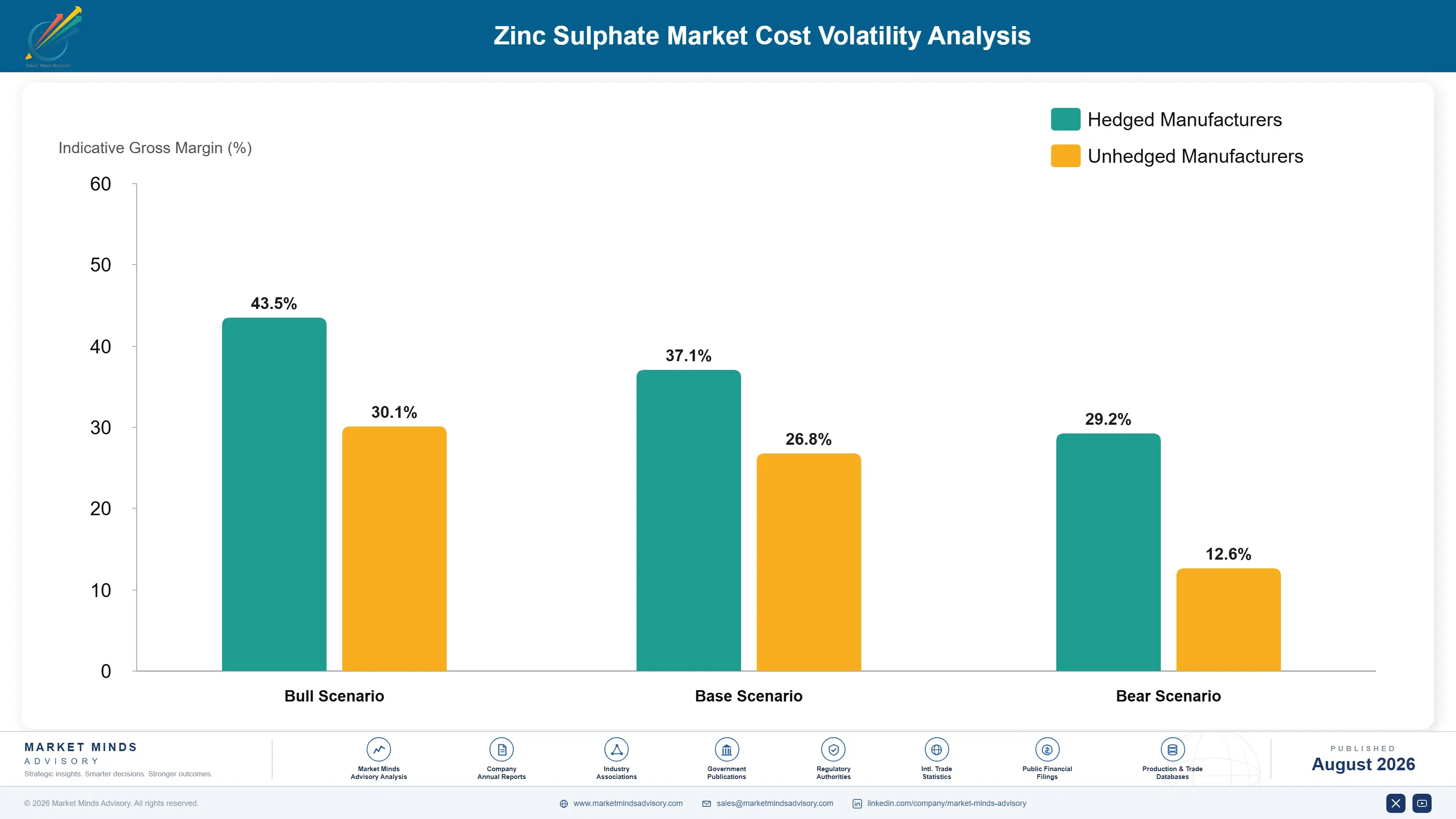
What Zinc Sulphate Costs

Zinc bearing feedstock accounts for 47% of production cost and sulphuric acid for 14%, with energy for crystallisation and drying, purification chemicals and packaging carrying the remainder. Residue and secondary zinc feedstock costs considerably less than purpose bought metal, which is why 71% of output derives from it. Sulphuric acid is frequently a smelting by-product, which ties two of the three inputs to the same industrial activity.
Zinc pricing moved substantially during the last industrial cycle and residue values followed it directly, since residue is priced against contained metal regardless of its origin. Chemical producer annual reports documented margin compression through the period, while IEA and EIA data recorded the energy costs that simultaneously raised crystallisation and drying expense. Producers holding fixed residue supply agreements were considerably better placed than those buying on spot markets.

Exposure divides by feedstock security and grade capability rather than by scale. Producers with residue supply agreements continue operating through availability disruptions, while spot buyers stop. Grade capability then determines what that feedstock is worth, since pharmaceutical material commands around 4.6 times fertiliser grade from a stream that started in the same place. Both decisions compound rather than substituting.
zinc-sulphate-market-trends-cost-volatility-analysis-1787665300895

Contract residue feedstock rather than buying spot volumes

Around 71% of output derives from smelter residues and secondary streams whose availability follows zinc smelting cycles nobody here influences at all. Producers holding supply agreements continued operating through the last availability disruption while spot buyers stopped entirely. The commitment costs flexibility and secures an input that no amount of commercial capability substitutes for when it is simply unavailable.

Build purification capability before regulation demands it

Cadmium and heavy metal limits in fertiliser have been tightening while feed and pharmaceutical grades already require purification most converters never built. Pharmaceutical material commands around 4.6 times fertiliser grade cost from feedstock that started identically. Building that capability opens the fastest growing applications and answers a regulatory direction that has been consistent for years across every developed market.

Support soil testing rather than promoting product features

Around 49% of cropped land carries deficiency costing near 18% of yield, and the crop looks entirely normal to the farmer looking at it. Testing converts that invisible fact into a purchase, and adoption tracks testing coverage closely everywhere. Funding or supporting testing programmes addresses the actual constraint and takes years, which is why so few suppliers attempt it.

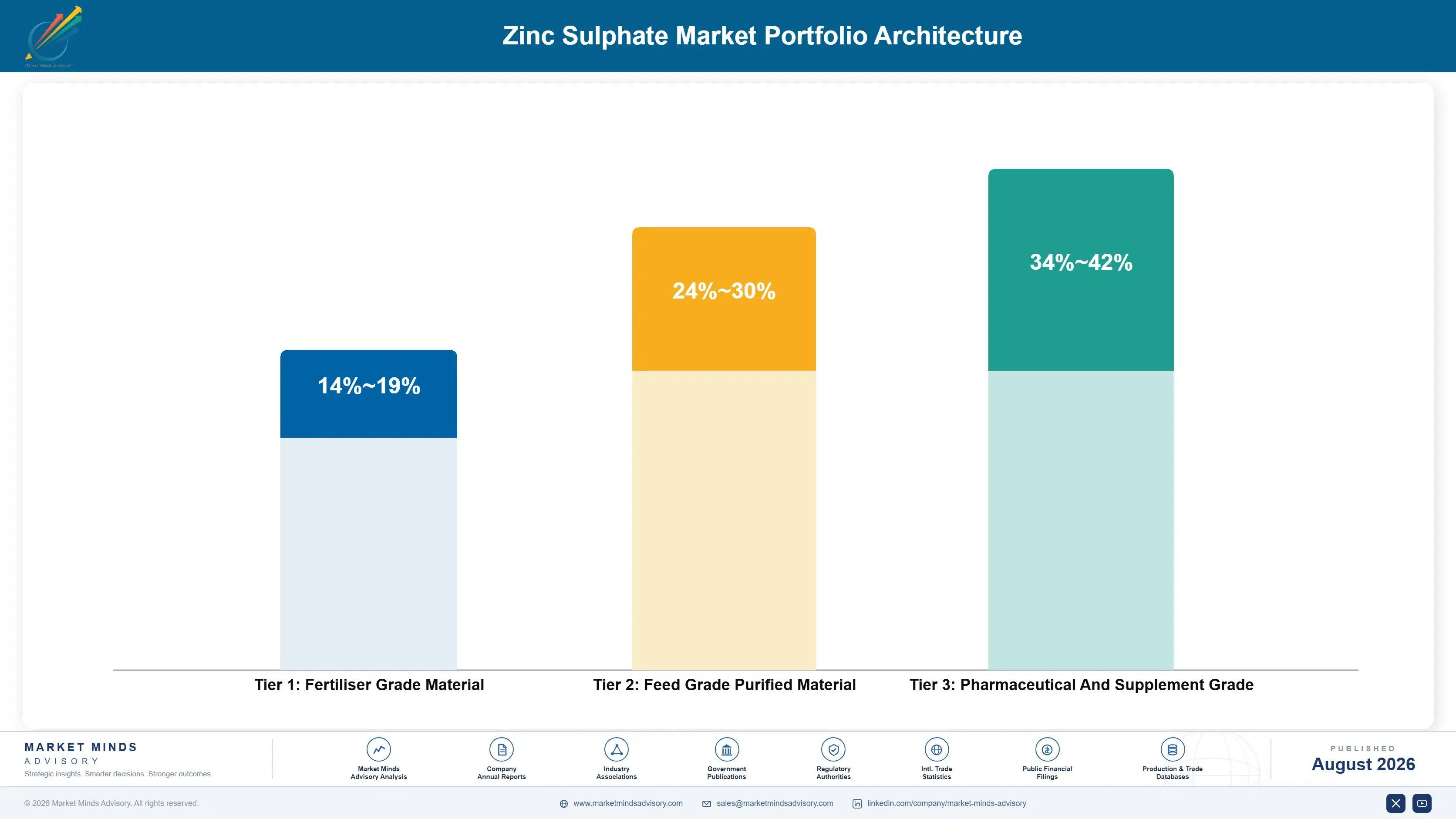
Portfolio Architecture for Margin Defence

Margin architecture divides on purification rather than on chemistry. Fertiliser grade material earns least, converted from local residue streams and sold on delivered price into a market where the product costs around 0.7% of the input budget and buyers compare on zinc content alone. Feed grade earns considerably better, since heavy metal limits exclude most converters. Pharmaceutical grade earns best, commanding around 4.6 times fertiliser grade from identical starting material.
The tension runs between feedstock volume and grade capability. Residue streams arrive with whatever contaminant profile the smelting operation produced, and purifying them to feed or pharmaceutical specification costs capital and process capability that fertiliser volumes alone would never justify. Producers building it can serve every grade, and producers who did not are permanently confined to the tier competing on delivered price.

High value pools concentrate in purified grades and in secured feedstock, neither of which is a tonnage position. Everything sold as fertiliser grade competes on delivered price against regional converters and Chinese export material. The businesses worth building are those where purification capability and feedstock security compound together, because either one alone leaves a producer exposed to something the other would have covered.

Fertiliser Grade Material

Residue converted material sold on delivered price into agricultural blending and direct application. Buyers compare on zinc content alone and regional converters compete effectively wherever local residue streams exist. Zinc content is the only comparison.
Gross Margin: 14-19%

Feed Grade Purified Material

Purified material meeting heavy metal limits considerably tighter than agricultural specification, supplied into premix and compound feed production. Purification capability excludes most fertiliser grade converters from this application entirely. Purification is the barrier.
Gross Margin: 24-30%

Pharmaceutical And Supplement Grade

High purity material for oral supplements, therapeutic use and public health supplementation programmes carrying documented specifications. The range is wide because pharmacopoeia grade requirements and customer audit expectations differ substantially between markets.
Gross Margin: 34-42%
zinc-sulphate-market-trends-portfolio-architecture-1787665301393

High-value Sub-segments and Strategic Watch-out

Animal Feed Additive

Fastest growing application at 7.2% because regulation removed therapeutic zinc oxide from piglet diets and soluble sources replaced it. Feed grade purification requirements exclude fertiliser converters from the fastest growing part of this market. A single regulatory decision taken elsewhere created this entire growth curve.
Gross Margin: 24-30%

Pharmaceutical and Supplement Grade

Second fastest at 6.4% and commanding around 4.6 times fertiliser grade cost from identical starting feedstock material. Removing cadmium and lead carried by residue streams is a genuine capability rather than any processing formality. The feedstock starts identically and finishes worth several times as much.
Gross Margin: 34-42%

Micronutrient Fertiliser

Growing at 5.6% and carrying the largest volume in the category, which makes it the tonnage core rather than the growth story. Adoption depends entirely on soil testing converting an invisible deficiency into a purchase decision. Testing rather than any selling effort generates this demand.
Gross Margin: 14-19%

Viscose Rayon Production

Growing at only 1.8% as viscose production capacity has been declining across developed markets for environmental and cost reasons. Demand persists in Asian production and nothing suggests any recovery in the application anywhere. Environmental and cost pressure both point in the same direction here entirely.
Gross Margin: 12-17%

How Testing Creates Repeat Purchase

Agricultural demand here is created by a soil test rather than by a sales conversation, which is unusual among crop inputs. A farmer who has never tested sees a normal looking crop and no reason to spend anything, while a farmer holding a report showing deficiency and a yield penalty near 18% buys and continues buying season after season. The test rather than the product is what generates the demand.
Feed and industrial demand behave completely differently and more predictably. A feed premix formulation specifying zinc sulphate consumes it on every batch until the formulation changes, and a plating or flotation operation uses it continuously as a process input nobody revisits. Those applications require purification grades that fertiliser producers cannot supply, which makes them both more durable and considerably harder to enter.

The decision maker in agriculture sits with whoever runs the testing rather than whoever sells the product. Extension services, agronomy advisers and soil health programmes determine whether deficiency is identified at all, and their coverage decides how much correction happens in any region. Suppliers reaching farmers directly are addressing people who mostly do not yet know they have a problem worth solving.
zinc-sulphate-market-trends-end-use-penetration-index-1787665301893

Where This Compound Rewards Focus

These are among the four positions where our research anticipates prominent divergence between winners and laggards over the coming forecast period. Each is grounded in the demand model, the regulatory perimeter, and the announced capacity pipeline.
01 / DEFICIENCY EVIDENCE SELLING

The field looks completely fine either way

Around 49% of cropped land carries measurable zinc deficiency costing near 18% of achievable yield, and the crop looks broadly normal rather than sick to anybody standing in it. That makes this the only major crop input solving a problem the farmer cannot point at, and it explains why adoption tracks soil testing coverage far more closely than it tracks any commercial effort. Suppliers funding testing address the actual constraint while those promoting specifications answer a question nobody has asked yet.
02 / PURIFICATION GRADE ECONOMICS

The same feedstock is worth four times more

Pharmaceutical grade material commands around 4.6 times fertiliser grade cost from a residue stream that started in precisely the same place, and the difference is entirely down to purification capability rather than to any positioning. Feed grade sits between the two with heavy metal limits considerably tighter than agricultural material ever requires. Most producers converting purely local residue streams never built that capability, which permanently confines them to the tier that competes on delivered price against everybody else in this category.
03 / BY-PRODUCT SUPPLY SECURITY

Somebody else's smelter decides your supply

Around 71% of category output derives from smelter residues, secondary zinc recovery and steel pickling liquor, so availability follows zinc smelting and galvanising activity rather than any signal originating in this market at all in any given year. Producers who held residue supply agreements continued operating through the last availability disruption while spot buyers of the same material simply stopped. That commitment costs flexibility and secures an input that no commercial capability whatsoever substitutes for at the moment when it is simply unavailable.
04 / FEED REGULATION CAPTURE

A ban somewhere else created the growth

Therapeutic zinc oxide left piglet diets over environmental accumulation and antimicrobial resistance concerns, which removed an entire high dose application and created demand for lower dose bioavailable zinc sources to replace it. Zinc sulphate monohydrate is among the cheapest soluble options available anywhere for that substitution, and feed grows at 7.2% against a market rate of 4.8% as a direct result of that. Feed grade purification is required, which excludes producers who simply never built that purification capability at all.

Engagement Snapshot From the Field

A live engagement with an industry participant carrying material or product regulatory and market exposure ahead of a defining policy shift, showing how our research translates into a defensible multi-year portfolio strategy.
MARKET MINDS ADVISORY · CLIENT ENGAGEMENT SUMMARY
Zinc Sulphate Producer Strategic Portfolio Review and Transition Roadmap 2026·Investment Scenario on Zinc Sulphate Exposure Evaluation 2025-26
CLIENT PROFILE
An inorganic chemical producer converting local zinc residue streams into fertiliser grade zinc sulphate for agricultural blenders and distributors across Western Europe and Latin America. Annual revenue was approximately 84 million dollars (client-reported, unverified by MMA), almost entirely fertiliser grade. Residue feedstock was purchased on spot markets and no purification capability beyond agricultural specification existed.
STRATEGIC CHALLENGE
A smelter maintenance period had interrupted feedstock supply and stopped production for several weeks, while tightening cadmium limits threatened the client's existing agricultural grade in its principal market. Management was weighing purification investment against feedstock security, treating them as competing capital demands. Nobody had modelled what either decision was actually worth.
MMA APPROACH
MMA modelled the revenue consequences of the feedstock interruption alongside the exposure of existing grades to tightening contaminant limits by market. Purification investment and feedstock contracting were costed independently and together. Forty-seven expert interviews with feed premix producers, agricultural blenders, pharmaceutical buyers and smelter residue traders established how supply and grade decisions are actually made, alongside survey work across six countries.
KEY FINDINGS
  1. The feedstock interruption had cost roughly 9% of annual revenue in a single quarter, and contracted supply would have prevented the whole loss entirely.
  2. Tightening cadmium limits placed around 40% of existing agricultural volume at risk in the client's principal market within about 3 years of implementation.
  3. Feed grade purification was costed at roughly 2 years to qualification and returned about 1.8 times fertiliser gross margin per tonne on the same feedstock.
  4. Feedstock contracting and purification investment together cost less than the client had assumed either would individually, having never once costed them jointly before.
CLIENT PROFILE
An inorganic chemical producer converting local zinc residue streams into fertiliser grade zinc sulphate for agricultural blenders and distributors across Western Europe and Latin America. Annual revenue was approximately 84 million dollars (client-reported, unverified by MMA), almost entirely fertiliser grade. Residue feedstock was purchased on spot markets and no purification capability beyond agricultural specification existed.
STRATEGIC CHALLENGE
A smelter maintenance period had interrupted feedstock supply and stopped production for several weeks, while tightening cadmium limits threatened the client's existing agricultural grade in its principal market. Management was weighing purification investment against feedstock security, treating them as competing capital demands. Nobody had modelled what either decision was actually worth.
MMA APPROACH
MMA modelled the revenue consequences of the feedstock interruption alongside the exposure of existing grades to tightening contaminant limits by market. Purification investment and feedstock contracting were costed independently and together. Forty-seven expert interviews with feed premix producers, agricultural blenders, pharmaceutical buyers and smelter residue traders established how supply and grade decisions are actually made, alongside survey work across six countries.
KEY FINDINGS
  1. The feedstock interruption had cost roughly 9% of annual revenue in a single quarter, and contracted supply would have prevented the whole loss entirely.
  2. Tightening cadmium limits placed around 40% of existing agricultural volume at risk in the client's principal market within about 3 years of implementation.
  3. Feed grade purification was costed at roughly 2 years to qualification and returned about 1.8 times fertiliser gross margin per tonne on the same feedstock.
  4. Feedstock contracting and purification investment together cost less than the client had assumed either would individually, having never once costed them jointly before.
RECOMMENDED STRATEGY
Phase 1: Phase one: contract residue feedstock supply, since the last interruption cost roughly 9% of annual revenue in one quarter alone. Phase 2: Phase two: build feed grade purification over about 2 years, returning around 1.8 times fertiliser margin per tonne of feedstock. Phase 3: Phase three: plan for pharmaceutical grade qualification, protecting the 40% of agricultural volume that tightening contaminant limits now threaten directly.
OUTCOME
The client contracted residue supply and production continued through the following regional smelter interruption without any stoppage. Feed grade purification reached qualification within the projected window and improved margin per tonne on identical feedstock, while agricultural volume at risk from contaminant limits was progressively reallocated toward purified grades (client-reported, unverified by MMA).

Frequently Asked Questions

Foundational context covering the market sizes, CAGR, scope, country, region and competition that inform every finding below. This section is provided to cover basics and most often pre-purchase conversations, answered from the MMA Primary Research Dataset.

What is the current size of the Zinc Sulphate Market?

The market was valued at 1.1 billion dollars in 2025, covering monohydrate and heptahydrate zinc sulphate across agricultural, feed, industrial and pharmaceutical applications worldwide. It reaches an estimated 1.15 billion dollars during 2026.

How large will the Zinc Sulphate Market be by 2036?

MMA forecasts 1.84 billion dollars by 2036, an increase of 0.69 billion dollars over the 2026 base. That represents an expansion multiple of 1.60 times across the forecast period.

What is the CAGR for the Zinc Sulphate Market 2026 to 2036?

The base case compound annual growth rate is 4.8%, with a bull case of 6.0% and a bear case of 3.6%. Soil testing expansion and residue feedstock availability separate those two scenarios.

Which segment is growing fastest?

Animal feed additive use grows at 7.2%, half again the market rate of 4.8%, because regulation removed therapeutic zinc oxide from piglet diets. Pharmaceutical grade follows at 6.4%.

Who are the major companies in the Zinc Sulphate Market?

Old Bridge Chemicals, Zinc Nacional, Grillo-Werke, Rech Chemical and Zochem lead on production capacity across grades. Together they account for 32% of the global market.

Which country is growing fastest?

India grows fastest at 8.4%, because zinc deficient soils cover very large cropped areas and soil testing programmes keep expanding the coverage that converts deficiency into demand.

Report Segmentation Architecture

The full report scope spans multiple orthogonal segmentation dimensions, with cross-tabulated demand data provided for each dimension pair. Coverage extends further to regional breakdowns, trend trajectories, and the competitive detail needed to support segment-level decision-making.

By Application

  • Micronutrient Fertiliser
  • Animal Feed Additive
  • Mineral Flotation Reagent
  • Electroplating Electrolyte
  • Viscose Rayon Production
  • Pharmaceutical and Supplement Grade

By End-Use Industry

  • Crop Nutrition
  • Animal Feed and Premix
  • Mining and Mineral Processing
  • Metal Finishing
  • Textile and Fibre Production
  • Pharmaceutical and Nutraceutical

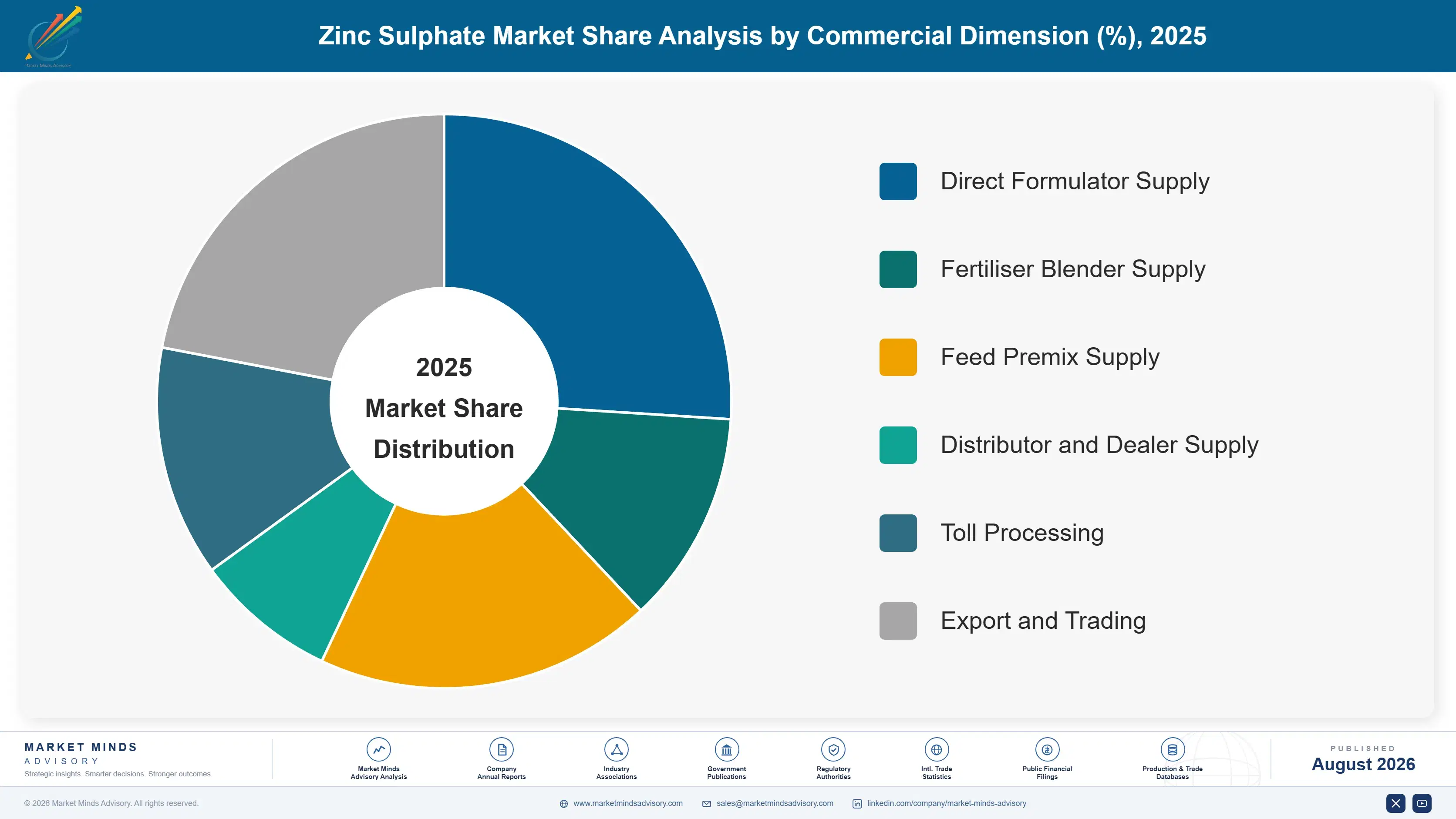
By Commercial Dimension

  • Direct Formulator Supply
  • Fertiliser Blender Supply
  • Feed Premix Supply
  • Distributor and Dealer Supply
  • Toll Processing
  • Export and Trading

By Region

  • North America
  • Western Europe
  • East Asia
  • South Asia and Pacific
  • Latin America
  • Middle East and Africa
  • Eastern Europe

Scope, Methodology, and Coverage

Every figure in this report is reproducible from documented input assumptions. The scope below maps the historical period, the forecast horizon, the segmentation dimensions, and the countries covered, alongside the underlying primary and qualitative methodology.
Historical Period
2020 to 2025
Forecast Period
2026 to 2036
Base Year
2025 (USD billions; MMA Primary Research Dataset, August 2026)
Market Definition
Zinc sulphate in monohydrate and heptahydrate crystalline forms supplied worldwide across micronutrient fertiliser, animal feed additive, mineral flotation reagent, electroplating electrolyte, viscose rayon production, and pharmaceutical and supplement grade applications, spanning fertiliser, feed and pharmacopoeia purity grades, measured at producer selling value. Zinc oxide, zinc chloride, zinc metal and other zinc compounds, chelated and complexed zinc micronutrients, and formulated fertiliser blends or feed premixes sold under their own product identity are excluded from scope.
Quantitative Units
USD billions (producer selling value); tonnes; USD per tonne by grade and application
Segmentation Dimensions
Application; end-use industry; commercial dimension; region
Regions Covered
North America, Western Europe, East Asia, South Asia and Pacific, Latin America, Middle East and Africa, Eastern Europe
Countries Covered
United States, Canada, Mexico, Germany, France, Spain, Netherlands, Italy, United Kingdom, China, Japan, South Korea, India, Pakistan, Bangladesh, Australia, Indonesia, Brazil, Chile, Peru, Turkey, Poland
Key Companies Profiled
Old Bridge Chemicals, Zinc Nacional, Grillo-Werke, Rech Chemical, Zochem, Hindustan Zinc, Nyrstar, Korea Zinc, Votorantim, Umicore, Bohigh Zinc Group, Hebei Yuanda, Kayasa Industries, Balaji Industrial Products, Sulphur Mills, Aries Agro, Yara International, Nouryon, ICL Group, Mitsui Mining and Smelting
Quantitative Methodology
Primary survey, n=3,800 respondents, Q4 2025, six countries; demand-side model with trade association cross-validation
Qualitative Methodology
47 expert interviews, Q4 2025; applied to validate demand model assumptions, identify emerging dynamics, and assess competitive positioning
Report Format
PDF and XLSX data workbook (Word format preview document)
Publisher
Market Minds Advisory
Report Code
MMA-2026-CHM-157
Published
August 2026
Contact
sales@marketmindsadvisory.com | www.marketmindsadvisory.com

Purchase the full Zinc Sulphate Market Report (2026 to 2036).

The full report treats zinc sulphate as a correction for a deficiency that looks like nothing at all, and follows the commercial consequences of selling into that condition. It sizes all six applications independently through 2036, models soil testing coverage against agricultural adoption by country, and quantifies the purification grade gap that separates commodity converters from everybody else. Regional chapters cover all seven regions, with soil deficiency geography and zinc smelting location assessed separately from agricultural spending. Competitive profiling covers 20 participants on one consistent capacity measure.
Six applications sized independently through 2036
Soil testing coverage modelled against agricultural adoption by country
Purification grade gap quantified across fertiliser, feed and pharmaceutical
Residue feedstock availability tracked against zinc smelting activity
Contaminant regulation assessed against residue derived material exposure
Twenty participants profiled on one consistent capacity measure

Built For The People Who Decide

From boardroom strategy to bench-side execution, this report is read cover-to-cover by leaders shaping the next decade of their industry, turning demand scenarios, market dynamics and valuation benchmarks into decisions.
CXOs/ Presidents/ VPs/ Managers
M&A and Corporate Development
Strategy Teams and R&D Heads
Procurement and Product Directors
Regulatory and Compliance Leaders
Investor Relations and Equity Analysts