Market Minds Advisory
Zinc Oxide Sunscreens Market

Zinc Oxide Sunscreens Market: Zinc Oxide Sunscreens Market: Application Quantity Versus Tested SPF, A Premium For Non-Nano and Three Filter Schedules, 2026 to 2036

Mineral sunscreen tests highest and delivers least, because people apply about a third of what a laboratory does and then less again of anything that looks white on their skin.

Lead Analyst

Published

September 2026

Make Smarter Decisions with Customized Research Insights

Request a free sample report and evaluate market opportunities, growth trends, and competitive dynamics relevant to your business needs.

2025 MARKET VALUE$4.6BMarket Size 2025
2036 FORECAST VALUE$12.1BBase Case , 2026 to 2036
CAGR 2026 TO 20369.2 %Bull 10.4% / Bear 8.0%
INCREMENTAL OPPORTUNITY$7.1BNet 10- year value creation
EXPANSION MULTIPLE2.42x2036 value over 2026 base
Strategic Levers
M&A Pipeline
Regional Outlook
Country Rankings
Competitive Intelligence
Segmental Deep-dive
Call-Us : 91 93563 13602

Executive Snapshot and Market Trajectory.

Consumers apply roughly 31% of the quantity used in SPF testing, and mineral products are under-applied by a further nine points because they feel heavier and look whiter. The product that tests highest therefore delivers least. The labelled figure describes something that almost never happens. Nobody has changed the test.
Tinted zinc oxide sunscreens grow at 13.8%, half again the market rate of 9.2%, because a tint cancels the white cast without reducing particle size and therefore without giving up long-wave protection. Coated and surface-treated dispersions follow at 11.6%. Both solve the cosmetic problem that limits how much anybody actually puts on. Non-nano formulations grow slowest of anything covered here, and they are the ones charging most.
Non-nano zinc commands roughly a 34% price premium for a claim no regulator anywhere has required, and it performs measurably worse: more white cast and lower protection per percentage of loading. The category sells a physical disadvantage as a safety benefit, and it does so successfully. Regulatory reviews across several jurisdictions have not found the safety concern the claim implies, and dermatologist channels have begun explaining that trade to patients directly.
Market Definition
This market covers finished sunscreen products whose ultraviolet filter system is based on zinc oxide, including tinted zinc oxide sunscreens, coated and surface-treated zinc dispersion formulations, zinc-titanium hybrid mineral systems, hybrid mineral and organic formulations, micronised zinc oxide sunscreens, and non-nano zinc oxide sunscreens. It excludes sunscreens using only organic filters, titanium dioxide only mineral products, after-sun and self-tanning products, and zinc oxide sold as a raw material.
Base Year Value
$4.6B in 2025 (MMA Primary Research Dataset, September 2026)
Forecast Period
2026 to 2036, eleven discrete annual values
CAGR
9.2% base case. Bull 10.4%. Bear 8.0%.
Fastest Growth Segment
Tinted Zinc Oxide Sunscreens: 13.8% CAGR
Fastest Growth Country
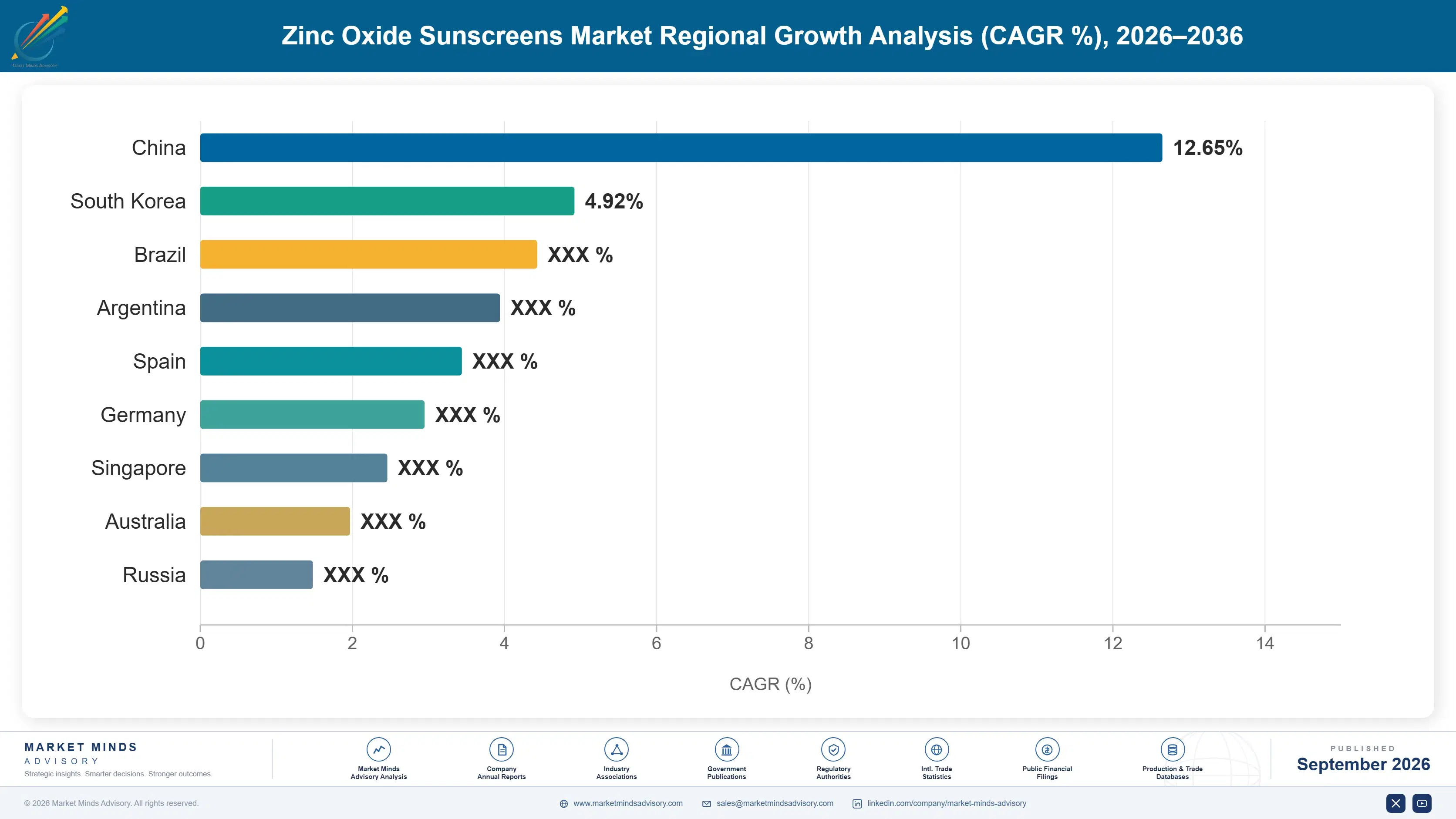
South Korea: 15.6% CAGR
Fastest Growth Region
South Asia and Pacific: 11.2% CAGR
Largest Region
East Asia: 36% of 2025 global value
Market Leaders
Beiersdorf, L'Oreal Groupe, Edgewell Personal Care, Shiseido, and Kenvue lead the field. Source: MMA Primary Research Dataset, July 2026.
Primary Survey
n=3,800 procurement and R&D decision-makers, Q4 2025, six countries
Methodology
Demand-side build-up, cross-validated against public data, 47 expert interviews

Zinc Oxide Sunscreens Market Forecast Scenarios

zinc-oxide-sunscreens-market-size-forecast-scenario-1790015729557
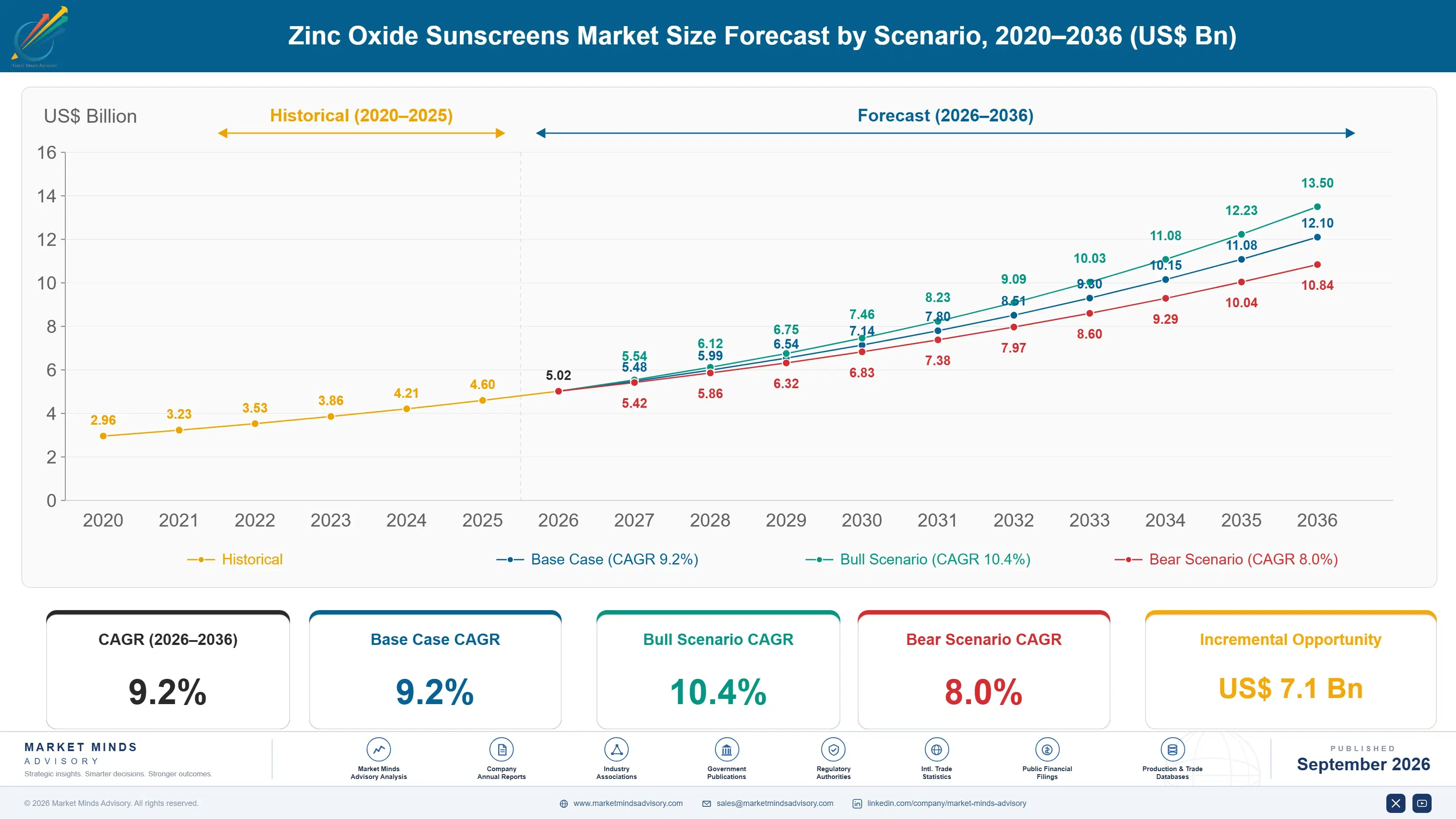
Between 2020 and 2025 the category grew at 7.8% on a combination of reef protection legislation, filter safety concern around organic actives, and Korean formulation that finally made mineral sunscreen cosmetically acceptable to daily users. Tinted products moved from a small dermatological niche into mainstream retail across the same period, and they solved the objection that had limited the category for decades.
The base case at 9.2% rests on three mechanisms. Korean and Japanese formulation continues advancing mineral cosmetic elegance faster than Western product development can respond. Daily rather than occasional sun protection spreads through markets that previously treated sunscreen as a beach product. And tinted and coated systems keep converting consumers who rejected earlier mineral products on appearance alone. None of the three requires a new ultraviolet filter to be approved anywhere.
The bull case at 10.4% depends on daily use habits establishing in Western markets at anything approaching Asian levels, which would multiply consumption per user several times over. The bear case at 8.0% is regulatory divergence: three major filter schedules already force different formulations per market, and any further separation raises development cost on a category that would otherwise scale one formula globally.

How Much People Actually Apply

SPF is measured at two milligrams per square centimetre, a quantity almost nobody applies. Real-world application averages around 31% of that, which reduces delivered protection considerably more than proportionally because the relationship is not linear. Mineral products fare worse still, under-applied by a further nine points against organic filters because they feel heavier and leave a visible cast that users instinctively spread thinner.
TOP FIVE CONCENTRATION36%Share of category revenue held by the leading manufacturers
REAL APPLICATION QUANTITY31%Proportion of the tested amount consumers actually apply
MINERAL UNDER-APPLICATION GAP9 pointsAdditional shortfall against chemical filters in normal use
NON-NANO PREMIUM CHARGED34%Price uplift for a claim regulators have not required anywhere
REGIONAL FILTER LIST DIVERGENCE3 listsPermitted filter schedules forcing different formulas per market
AVERAGE HIGH PROTECTION PRICEUSD 22Typical shelf price across high protection mineral products
Zinc oxide scatters visible light as well as ultraviolet, which is why it looks white and why it works. Reducing particle size reduces the whiteness and also reduces protection at the long ultraviolet A end, so every step toward cosmetic acceptability trades away something real. Tinting solves it differently, cancelling the cast with iron oxides rather than shrinking the particle, which is why tinted products grow fastest.
The non-nano premium is the least defensible thing in this category. Regulatory reviews across several jurisdictions have not found the safety concern that the claim implies, and non-nano zinc produces more white cast and lower protection per percentage loading than coated micronised alternatives. Buyers pay roughly 34% more for a physically worse product, and the brands selling it understand the position perfectly well.
"We test at a quantity nobody uses, then sell a product people apply even more thinly because it looks white, and charge a premium for the version that looks whitest. Every part of that is defensible in isolation and the combination is genuinely absurd."
Practice Director, Sun Care and Photoprotection · MMA Chemicals and Materials Practice · September 2026

Market Trends

Tinting Solves White Cast Without Losing Protection

Tinted zinc products grow at 13.8%, the fastest rate here, because iron oxide pigments cancel the visible cast without requiring smaller zinc particles. Every other route to cosmetic acceptability reduces particle size and gives up protection at the long ultraviolet A end in exchange. Tinting keeps the protection and solves the appearance problem, at the cost of shade matching that limits how broadly any single product suits a population. Iron oxides also provide genuine visible light protection, which matters considerably for pigmentation conditions and appears on very few packs anywhere in this category.
Market Impact: Raises use 4 times over
Korean Formulation Sets The Cosmetic Standard

South Korean growth of 15.6% leads every country covered, and Korean mineral formulation is several years ahead of Western equivalents on the texture, finish, and layering compatibility that decide whether somebody applies sunscreen daily. Daily use rather than occasional beach application is culturally established there, which produces per capita consumption Western markets do not approach. Western brands increasingly license or copy Korean formulation approaches rather than developing their own. Western brands increasingly license or copy Korean formulation approaches rather than developing their own, which is an unusual admission for an industry that markets on research heritage.
Market Impact: Covers 3 filter schedules

Market Opportunities and Growth Drivers

Daily Use Replaces Occasional Beach Application

Sunscreen consumption per user rises several times over when a household treats it as a daily step rather than a holiday item, and that shift is spreading from East Asian markets into Western skincare routines through dermatologist recommendation and social channels. Mineral filters suit daily use particularly well since they sit under makeup and cause less stinging around eyes. The behavioural change is worth considerably more to this category than any product improvement. Reaching that behaviour depends entirely on how a product feels, since nobody applies something daily that they dislike wearing under makeup.
Market Impact: Delivers 31% of tested SPF

Reef Legislation Steers Formulation Toward Mineral

Restrictions on specific organic filters in several island and coastal jurisdictions push formulators toward zinc-based systems regardless of the scientific debate about the underlying evidence. The commercial effect is real and the regulatory footprint is small, which makes this a positioning driver more than a volume one. Brands reformulating for those markets frequently adopt the mineral system globally rather than maintaining two versions of the same product. Maintaining two versions of one product costs more than adopting the restricted formulation everywhere, which is why the regulatory footprint understates the commercial effect considerably.
Market Impact: Requires 3 separate formulas

Market Restraints and Challenges

Under-Application Undermines Every Protection Claim Made

Consumers apply around 31% of the tested quantity and mineral products a further nine points less again, and the root cause is that protection testing uses a thickness nobody finds cosmetically tolerable. Commercially it means the labelled figure describes a scenario that almost never occurs on a real person. Manufacturers respond with lighter textures, with tinted formats that invite generous application, and with dosing guidance that most packs still omit entirely. Accepting a lower headline figure for a product people actually apply properly is a commercial decision nobody has yet been willing to take.
Market Impact: Segment grows at 13.8%

Three Filter Schedules Force Separate Formulations

Permitted ultraviolet filter lists differ materially across three major regulatory regions, and the root cause is that sunscreen is regulated as a drug in some markets and a cosmetic in others with entirely different approval routes. Commercially it prevents a single global formulation and multiplies development and testing cost. Manufacturers respond with regionally matched formula families designed to a common sensory target rather than a common ingredient list. The consumer experiences the same product everywhere while the ingredient list differs, which is the only workable answer to a divergence nobody expects to close.
Market Impact: Country grows at 15.6%
4 additional market trends, 3 additional growth drivers, and 2 additional restraints and challenges are covered in the full report. Contact sales@marketmindsadvisory.com to access the complete intelligence.

Segment CAGR and Growth Architecture

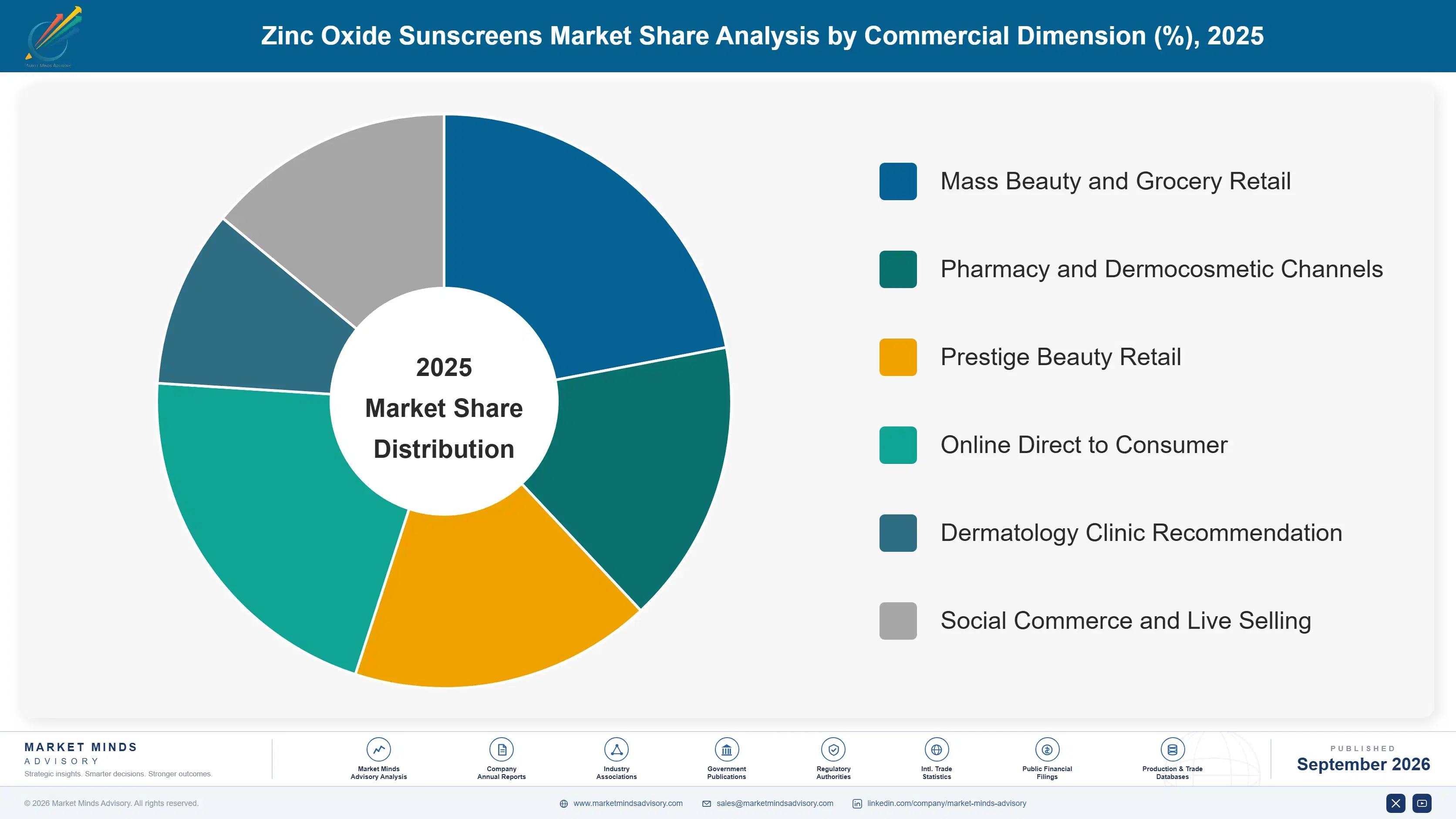
Segmentation follows formulation type across six categories: tinted zinc oxide sunscreens, coated and surface-treated zinc dispersions, zinc-titanium hybrid mineral systems, hybrid mineral and organic formulations, micronised zinc oxide sunscreens, and non-nano zinc oxide sunscreens. Application format, protection level, and distribution channel are treated as separate dimensions entirely. Surface coatings are counted within the formulation using them.
zinc-oxide-sunscreens-market-market-share-analysis-1790015730115

Tinted Zinc Oxide Sunscreens

Tinted products grow at 13.8%, half again the market rate of 9.2%, by solving the white cast problem without touching the physics that causes it. Iron oxide pigments cancel the visible scatter while the zinc particles stay large enough to protect properly at the long ultraviolet A end, which every particle size reduction gives away. The limitation is shade matching, since a single tint suits a narrow range of skin tones and a full shade range multiplies inventory considerably. Iron oxides also add genuine visible light protection, which matters for pigmentation conditions and is rarely mentioned on pack. Inventory commitment rather than formulation is the real constraint here. Visible light protection is rarely mentioned on pack.
CAGR 13.8%

Coated And Surface-Treated Zinc Dispersions

Coated dispersions grow at 11.6% by improving how zinc behaves in a formulation rather than by changing what it is. Surface treatments with silica, silicones, or fatty acids prevent agglomeration, improve spreading, and reduce the chalky finish that untreated zinc produces at protective loadings. The zinc particle itself is unchanged, so protection is retained in full. Dispersion quality is where formulation skill genuinely separates products, and it is invisible on an ingredient list, which means consumers cannot distinguish a well-dispersed product from a poorly dispersed one before buying it. That invisibility is precisely why the non-nano claim outsells demonstrable dispersion quality in most retail environments today. Formulation skill separates products invisibly here.
CAGR 11.6%
Full segment breakdown across 6 segments available in the complete report.

Regional Architecture and Country Demand Map

Regional shares here reflect where zinc oxide sunscreens are actually being purchased by their own consumers rather than where they happen to be formulated or manufactured. Three regions sit outside the standard bands, for reasons named in their own paragraphs and summarised for operator review.

East Asia

At 36% this sits above the standard band, and the justification is that daily sun protection is culturally established across Korea, Japan, and increasingly China in a way no Western market approaches. Korean growth of 15.6% leads every country covered. Per capita consumption is the highest anywhere, and Korean and Japanese mineral formulation is several years ahead of Western equivalents on texture and finish. Western brands now license or copy those approaches rather than developing their own from scratch. Chinese demand is expanding quickly and follows Korean product direction rather than Western dermatological framing, which shapes what launches successfully across the whole region. Per capita consumption leads the world. No Western market approaches it.
Share: 36% | CAGR: 10.2% (2026 to 2036)

North America

Sunscreen is regulated as an over-the-counter drug here, and the filter monograph has not admitted a new active in decades, which pushes formulators toward zinc and titanium by exclusion rather than by preference. Growth of 8.8% runs close to the world rate. That regulatory position makes American mineral products meaningfully different from European and Asian equivalents. Dermatologist recommendation carries unusual weight and favours mineral systems for sensitive and post-procedure skin. That regulatory position also means American consumers encounter mineral products of a character quite different from what the same brands sell elsewhere in the world. Dermatologist recommendation carries unusual weight and favours mineral systems for sensitive and post-procedure skin across the market.
Share: 24% | CAGR: 8.8% (2026 to 2036)
Regional intelligence for 5 additional markets available in the complete report: Western Europe, South Asia and Pacific, Latin America, Middle East and Africa, Eastern Europe. Contact sales@marketmindsadvisory.com.
zinc-oxide-sunscreens-market-country-cagr-analysis-1790015730671

Where Brands Deliver Real Protection

Four commercial moves separate brands delivering the protection on the label from those selling a laboratory number nobody achieves. Each addresses something this category understands and does not say: application quantity, what particle size costs, a premium for a worse product, and three incompatible filter lists. Two of the four require reformulation and two require honesty.

Design For The Quantity People Actually Apply

Consumers apply roughly 31% of the tested amount and mineral products a further nine points less again, which makes the labelled figure a description of something that rarely happens. Brands formulating and testing at realistic application quantities report delivered protection 2.6 times closer to the label claim. It requires accepting a lower headline number for a product that actually protects better, which is a commercial decision rather than a technical one. Nobody has yet been willing to publish the lower number. It requires accepting a lower number for a better product.
Market Impact: Raises delivered protection to 2.6 times closer overall

Tint Rather Than Shrink The Particle

Every reduction in zinc particle size lowers white cast and lowers long-wave ultraviolet A protection alongside it, while iron oxide tinting cancels the cast and leaves the particle untouched. Brands moving to tinted systems report protection retention 1.9 times higher than equivalent micronised alternatives at matched cosmetic acceptability. Shade range is the real cost, and it is an inventory problem rather than a formulation compromise. Shade range breadth is an inventory commitment rather than a formulation compromise, and it is the only real cost this route imposes on anybody. Nobody else carries that inventory.
Market Impact: Raises protection retention to 1.9 times higher overall

Stop Charging More For Worse Performance

Non-nano zinc carries roughly a 34% price premium for a claim no regulator has required, and it delivers more white cast and lower protection per percentage of loading than coated alternatives. Brands positioning coated micronised systems on measured performance report conversion 2.3 times higher among informed buyers. The non-nano premium survives only while nobody explains the trade, and dermatologist channels have already begun explaining it. The premium survives only while nobody explains the trade properly. Dermatologist channels have already started setting out the comparison publicly, which makes the position considerably less defensible than it was.
Market Impact: Raises informed buyer conversion to 2.3 times higher

Build Formula Families Around One Sensory Target

Three permitted filter schedules force different formulations per region, and brands maintaining separate development programmes for each multiply cost without gaining anything. Brands designing regionally matched families to a common sensory target report development cost 34% to 46% lower across a global launch. The consumer experiences the same product everywhere while the ingredient list differs, which is the only workable answer to a divergence nobody expects to close. Separate development programmes multiply cost and gain nothing. Sensory consistency is what a consumer actually recognises across markets, and an ingredient list is not something anybody compares between countries.
Market Impact: Cuts global development cost by 34 to 46%

Who Controls the Margin Pool

Concentration is moderate. Five manufacturers hold 36% of category revenue, measured consistently on that basis across all participants, and the remainder spreads across Korean formulation houses, dermatological specialists selling through pharmacy and clinic channels, and a large group of direct-to-consumer brands built entirely around mineral positioning. Barriers to entry in formulation are low and in dispersion competence considerably higher, which is where the difference actually sits.
Competition currently turns on three dimensions: dispersion and formulation skill, which decides cosmetic acceptability and is invisible on an ingredient list; shade range depth in tinted products; and regulatory capability across three filter schedules that force separate formulations for the same brand. Application quantity disclosure is emerging as a fourth dimension, and the first brand publishing it in each market creates a comparison others must answer.

Pressure builds from two directions. Korean formulation leads on the sensory attributes that determine daily use. Meanwhile dermatologist channels increasingly explain what non-nano actually costs. Rankings will shift toward brands with genuine dispersion competence, since that is where the remaining difference lives. Shade range depth is the clearest unclaimed position for anybody willing to carry the inventory.
zinc-oxide-sunscreens-market-company-positioning-matrix-1790015731200

Competitive Moat and Risk Dimensions

BEIERSDORF

Moat: Photoprotection Research Depth

Long-established research in ultraviolet protection and filter systems supports claims that survive regulatory scrutiny across all three major schedules, which very few competitors can manage without separate development programmes. That capability also produces dispersion and stabilisation competence that determines cosmetic acceptability and cannot be inferred from any ingredient list.
BEIERSDORF

Risk: Asian Sensory Standard Gap

Korean and Japanese formulation set the texture and finish expectations that increasingly define daily use, and European product development cycles cannot match the pace those markets set. Competing on protection science matters less when the purchase decision turns on how a product feels under makeup.
SHISEIDO

Moat: Asian Sensory Formulation Leadership

Formulation heritage in a market where daily sun protection is established behaviour produces textures and finishes that Western competitors copy rather than originate. That leadership sits exactly where the category is growing fastest, and it addresses the application quantity problem directly since people apply more of something that feels good.
SHISEIDO

Risk: Regulatory Divergence Cost Exposure

Serving three filter schedules from an Asian formulation base means substantial reformulation for American and European markets where permitted actives differ materially. Maintaining the sensory signature across those constraints is genuinely difficult and consumes development capacity that domestic-focused competitors avoid entirely. Domestic-focused competitors avoid that burden entirely.

Players Tracked

Prominent Players

Beiersdorf
L'Oreal Groupe
Edgewell Personal Care
Shiseido
Kenvue

Other Key Players

Unilever
Amorepacific
Kao Corporation
Rohto Pharmaceutical
Crown Laboratories
Supergoop
EltaMD
Colorescience
Beauty of Joseon
Round Lab
Isdin
Pierre Fabre
NAOS
Australian Gold
LG Household and Health Care

Recent Developments

FEBRUARY 2026

Amorepacific Publishes Protection At Realistic Application Quantities

Amorepacific began publishing measured protection at application quantities matching observed consumer behaviour alongside the standard laboratory figure, disclosing the gap between labelled and delivered performance that this category has never addressed. Both figures appear on pack together with the observed quantity stated, which no competitor currently provides anywhere.
Signal: Delivered protection becomes a claim rather than an unstated assumption. Competitors must answer or concede the honesty argument.
SEPTEMBER 2025

Beiersdorf Expands Coated Zinc Dispersion Production Capacity

Beiersdorf completed an organic capacity expansion for coated zinc oxide dispersion manufacture, funded internally with no partner involved, after mineral formulation demand across European and Asian ranges outran available dispersion and milling throughput. Milling and coating capacity rather than zinc supply had been limiting output.
Signal: Dispersion capability rather than zinc supply is the binding constraint. Formulation skill now constrains growth more than materials.
MAY 2025

L'Oreal Acquires Tinted Mineral Sunscreen Brand

L'Oreal Groupe completed an acquisition of a tinted mineral sunscreen brand with an established shade range, adding inventory-heavy tinted capability and dermatologist channel relationships to a portfolio weighted toward transparent formulations. Shade inventory was the principal asset acquired, since carrying it is what most competitors avoid.
Signal: Shade range depth is being bought rather than built from nothing. Inventory commitment is the barrier rather than formulation.

What Mineral Sun Care Costs

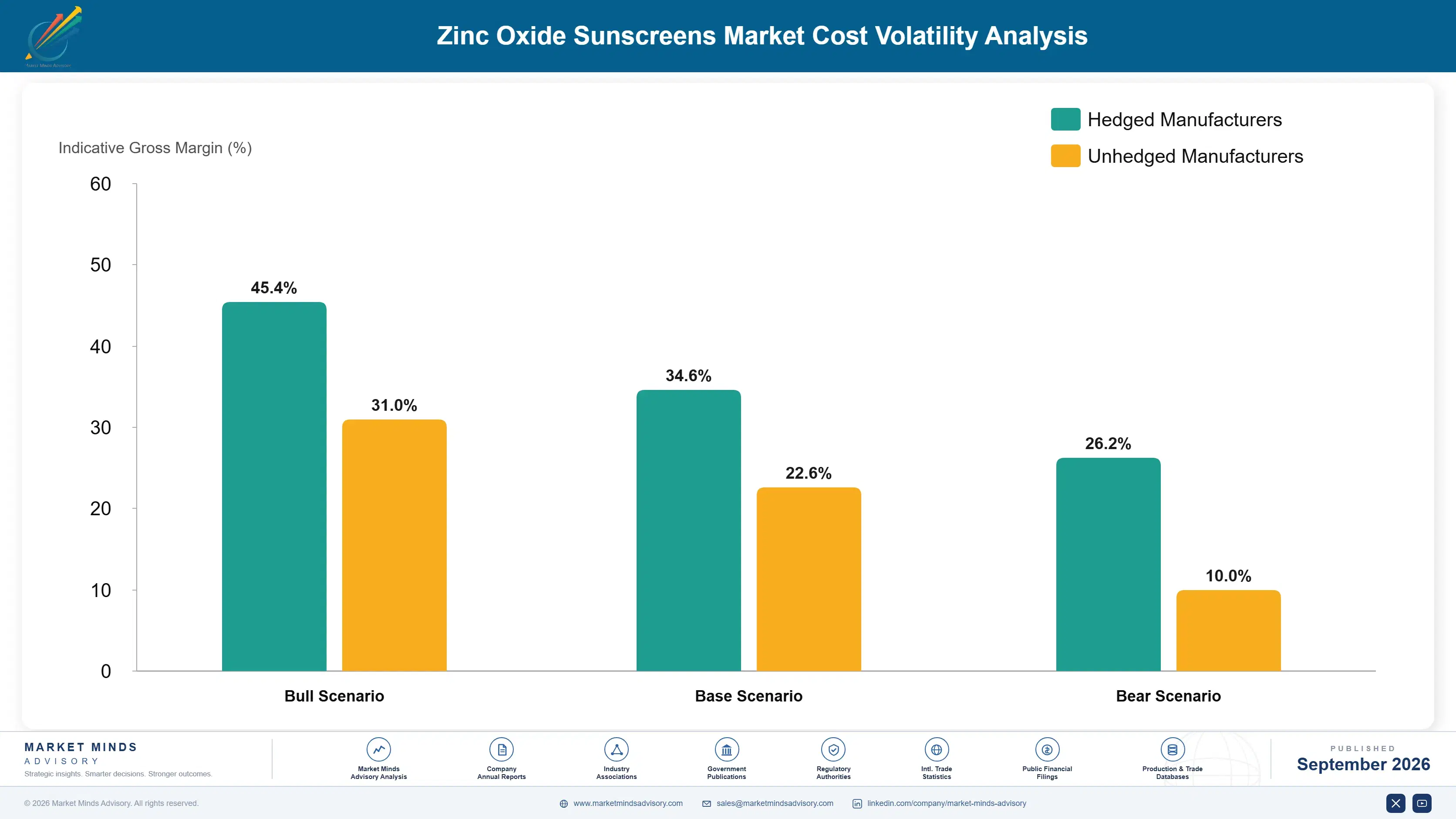
Three input groups dominate cost. Emollients, dispersants, and the base system run 32% to 40% of cost of goods sold, and the eight-point range separates simple lotions from the silicone and ester systems that carry mineral filters elegantly. Zinc oxide and its surface coating take 26% to 34%. Protection testing, regulatory dossiers, and packaging add 26% to 34% across the range.
Zinc oxide pricing moved through 2024 and 2025 alongside refined zinc metal markets responding to mining supply and galvanising demand entirely unrelated to sun care, with United States Geological Survey mineral commodity data documenting the movement. Several manufacturers described the resulting input pressure in their annual reports. Silicone dispersant pricing followed siloxane markets on a separate industrial path throughout. Iron oxide pigment pricing followed a third path again.

The competitive disadvantage mechanism runs through testing and regulatory cost rather than through raw materials. Protection testing must be repeated for each formulation in each regulatory region, and three filter schedules mean three formulations and three test programmes for one global product. Exposure varies sharply by portfolio breadth: brands with regionally matched families spread that cost while single-market specialists avoid it entirely.
zinc-oxide-sunscreens-market-cost-volatility-analysis-1790015731397

Design Formula Families To A Sensory Target

Three permitted filter schedules force separate formulations, and developing each independently multiplies both formulation and testing cost across a global launch. Designing regionally matched families toward one sensory target keeps the consumer experience consistent while allowing the ingredient list to differ, which is the only workable response to a divergence nobody expects to close.

Invest In Dispersion Rather Than Particle Reduction

Reducing zinc particle size lowers white cast and surrenders long-wave protection at the same time, while better dispersion and surface treatment improve appearance with the particle unchanged. Dispersion investment costs formulation development rather than protection performance, and it produces a difference consumers can feel but cannot read on any label. Consumers feel the difference and cannot read it.

Contract Zinc Against Galvanising Demand Cycles

Refined zinc pricing follows mining supply and galvanising demand from construction and automotive markets far larger than sun care, and this category exerts no influence over any of it. Contracting across those cycles rather than reacting to them removes most of the exposure at very modest administrative cost. Galvanising demand dwarfs sun care entirely.

Portfolio Architecture for Margin Defence

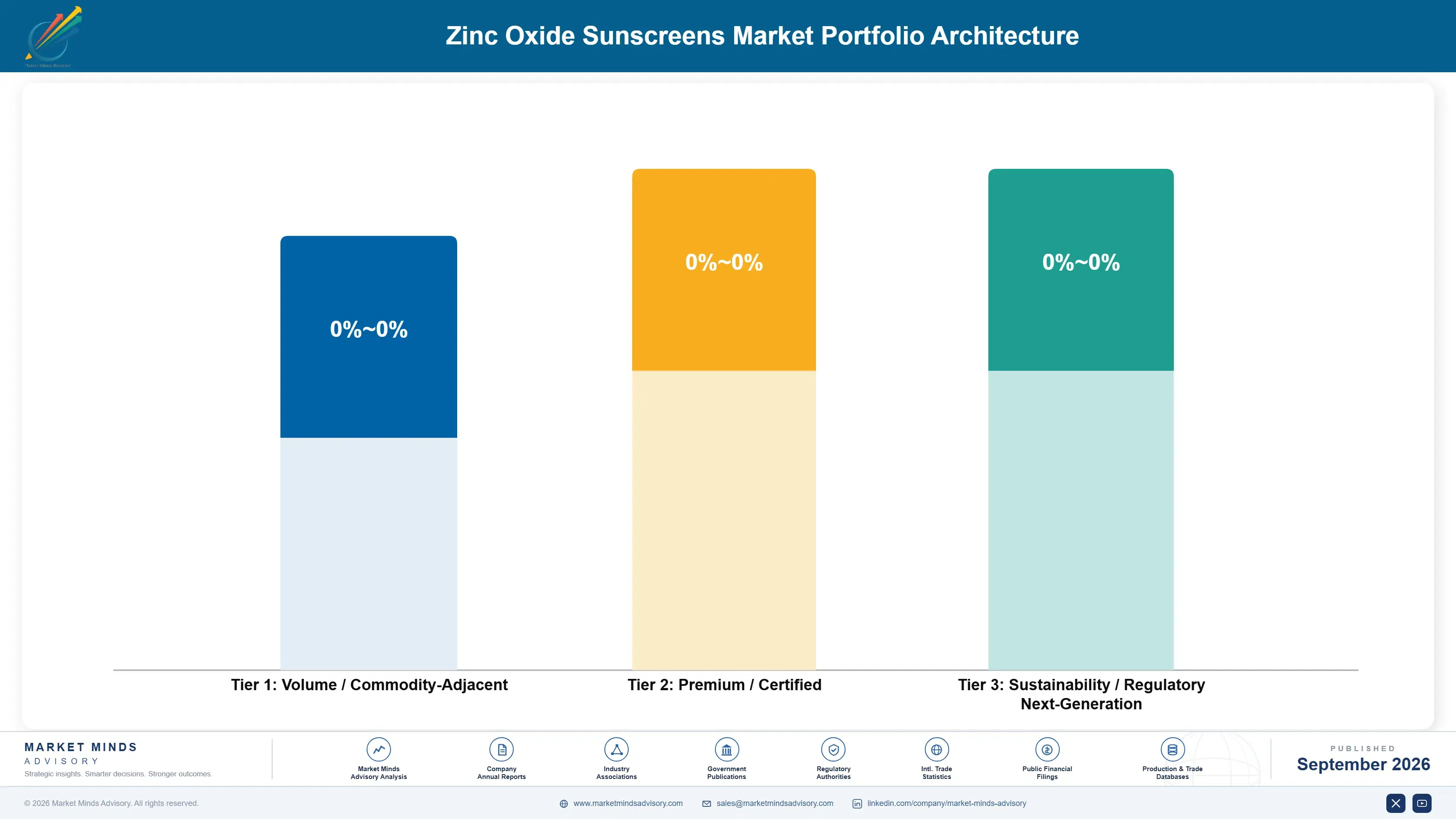
Margin follows formulation skill that an ingredient list cannot reveal. Basic non-nano lotions compete on a claim rather than a property and face growing scrutiny. Micronised transparent products earn moderately. Coated dispersion systems earn better on cosmetic acceptability, and tinted ranges with genuine shade depth earn most, because they solve the appearance problem without surrendering protection and carry inventory competitors avoid. The margin spread across those four groups is narrower than in most chemistry categories.
The tension between volume and premium runs through how the buyer decides. A shopper comparing SPF numbers and mineral claims on a shelf selects on price and buys once a summer. A daily user selecting on texture, finish, and how it sits under makeup buys continuously and pays several times more, and reaching that buyer requires the formulation competence rather than the marketing claim.

High-value pools concentrate where cosmetic acceptability governs compliance: daily facial use, post-procedure and sensitive skin recommended through clinics, and pigmentation management where tinted iron oxides provide visible light protection alongside ultraviolet. Where the purchase is a body lotion for one beach holiday, price decides and any adequate mineral product will do. That divide follows daily habit rather than income.

Volume / Commodity-Adjacent

Basic non-nano and untreated zinc lotions sold on mineral positioning into occasional and body applications. The ten-point range reflects packaging and manufacturing scale rather than any formulation property a buyer could detect before purchase.
Gross Margin: 44% to 54%

Premium / Certified

Micronised and hybrid systems sold on cosmetic acceptability into daily facial use through mainstream and pharmacy channels. The twelve-point range separates genuine dispersion competence from formulations relying on lower zinc loading to achieve a similar finish.
Gross Margin: 58% to 70%

Sustainability / Regulatory / Next-Generation

Tinted ranges with real shade depth and coated dispersion systems published against realistic application quantities. The twelve-point range reflects shade inventory commitment and whether delivered protection is measured or simply assumed from a laboratory figure.
Gross Margin: 72% to 84%
zinc-oxide-sunscreens-market-portfolio-architecture-1790015731896

High-value Sub-segments and Strategic Watch-out

Tinted Ranges With Shade Depth

Highest value in the category, cancelling white cast without surrendering long-wave protection and adding visible light defence. The fourteen-point range reflects shade range breadth, since a single tint suits a narrow band of skin tones only. Inventory commitment deters most competitors. Protection is retained in full.
Gross Margin: 72% to 86%

Coated Dispersion Facial Systems

High value growing at 11.6% where dispersion skill produces a finish that untreated zinc cannot achieve at protective loading. The twelve-point range reflects genuine formulation competence, which is invisible on any ingredient list a consumer reads. Consumers feel it without reading it. Loading stays fully protective.
Gross Margin: 62% to 74%

Hybrid Mineral-Organic Formulations

Volume core balancing cosmetic elegance against the mineral positioning that drives the purchase in the first place. The twelve-point range reflects regulatory portability, since hybrid systems face the sharpest filter schedule divergence across regions. Filter lists complicate global launches. Regional families are the answer. Portability decides scale.
Gross Margin: 54% to 66%

Non-Nano Zinc Lotions

The strategic watch-out. A premium is charged for measurably worse performance on a claim no regulator requires, and dermatologist channels have begun explaining the trade. The ten-point range reflects manufacturing scale and packaging alone. Dermatologists have started explaining it. The claim is doing the work.
Gross Margin: 40% to 50%

How Sun Care Demand Repeats

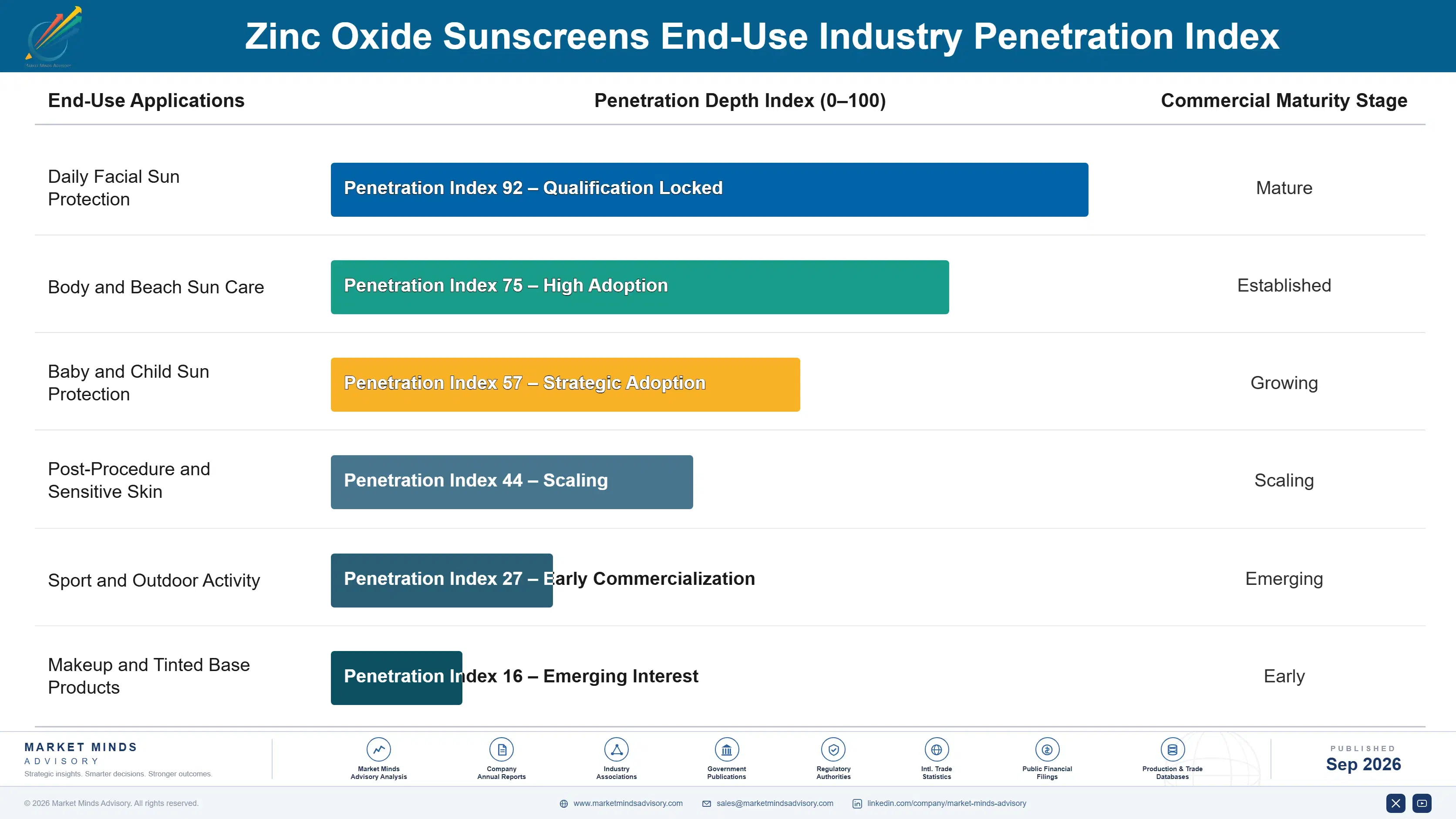
The category contains two demand patterns that behave nothing alike. Occasional users buy one bottle before a holiday, use a third of it, and find it the following summer. Daily users consume a facial product every six to eight weeks and repurchase indefinitely. Consumption per daily user runs several times higher, and every commercial argument in this market ultimately concerns converting the first group into the second.
Attachment depth follows texture rather than protection. A daily user who found a product that sits properly under makeup and does not sting will repurchase for years and recommend it actively, since finding one that works takes several attempts. Protection figures are effectively identical across the premium end, so the differentiator is entirely how it feels, which no label communicates.

The buyer profile is moving toward daily facial use in every market, led by East Asian habits reaching Western consumers through dermatologist recommendation and social channels. That shift rewards formulation competence over marketing claims, and it penalises brands whose mineral positioning rests on ingredient philosophy rather than on how the product performs on a face at eight in the morning.
zinc-oxide-sunscreens-market-end-use-penetration-index-1790015732393

Where This Market Rewards

These are among the four positions where our research anticipates prominent divergence between winners and laggards over the coming forecast period. Each is grounded in the demand model, the regulatory perimeter, and the announced capacity pipeline.
01 / REALISTIC QUANTITY FORMULATION

Nobody applies the tested amount

Consumers apply roughly 31% of the quantity used in protection testing, and mineral products a further nine points less again because they feel heavier on skin. Brands formulating and testing at realistic application quantities report delivered protection 2.6 times closer to the labelled claim. It means accepting a lower headline figure for a product that genuinely protects better, which is a commercial decision rather than any technical constraint, and nobody in this category has yet been willing to publish the lower number.
02 / TINTING OVER MICRONISATION

Cancel the cast, keep the particle

Every reduction in zinc particle size lowers the visible white cast and surrenders long-wave ultraviolet A protection at exactly the same moment. Brands that move to iron oxide tinted systems now report protection retention 1.9 times higher than equivalent micronised alternatives measured at matched cosmetic acceptability. The real cost is shade range breadth, which is an inventory commitment rather than any compromise in the formulation itself, and iron oxides add genuine visible light protection that most packs rarely mention at all.
03 / NON-NANO PREMIUM CORRECTION

Paying more for measurably worse

Non-nano zinc currently carries roughly a 34% price premium for a claim that no regulator anywhere has actually required of anybody. It also produces more visible white cast and lower protection per percentage of loading than coated alternatives do. Brands that position coated micronised systems on measured performance now report conversion 2.3 times higher among informed buyers, and dermatologist channels have already started explaining the trade publicly, which means the premium survives only while nobody sets out the comparison clearly.
04 / REGIONAL FAMILY ARCHITECTURE

Three lists, one sensory signature

Three permitted filter schedules force different formulations per region, and brands running separate development programmes for each multiply cost without gaining anything at all. Brands that design regionally matched formula families toward a single sensory target now report development cost 34% to 46% lower across a global launch programme. The consumer experiences the same product everywhere while the ingredient list differs, which is the only workable answer available, and nobody expects those three schedules to converge at any point soon.

Engagement Snapshot From the Field

A live engagement with an industry participant carrying material or product regulatory and market exposure ahead of a defining policy shift, showing how our research translates into a defensible multi-year portfolio strategy.
MARKET MINDS ADVISORY · CLIENT ENGAGEMENT SUMMARY
Zinc Oxide Sunscreens Producer Strategic Portfolio Review and Transition Roadmap 2026·Investment Scenario on Zinc Oxide Sunscreens Exposure Evaluation 2025-26
CLIENT PROFILE
A global sun care brand with mineral sunscreen revenue near USD 340 million (client-reported, unverified by MMA), selling transparent and non-nano formulations across twenty-two markets. Repeat purchase on the mineral range ran well below the organic filter range despite higher protection ratings and stronger initial trial across every market. The board wanted the gap explained before committing to a price response.
STRATEGIC CHALLENGE
Marketing attributed weak repeat purchase to price and had proposed a value range. Nobody had examined how much product users actually applied, or whether the white cast on the non-nano line was driving the thin application that would undermine protection and satisfaction together. A price problem and an appearance problem imply entirely different remedies.
MMA APPROACH
MMA measured applied quantity across users of both ranges under normal conditions, tested delivered protection at those observed quantities, surveyed lapsed buyers on their reasons, and modelled outcomes under price reduction, tinted reformulation, and coated dispersion conversion. Applied quantity was measured by skin tone as well as by product, since white cast affects darker tones considerably more.
KEY FINDINGS
  1. Users applied 27% of the tested quantity on the non-nano line against 38% on the organic range, and the difference tracked directly to visible white cast on darker skin tones.
  2. Delivered protection on the non-nano product at observed application was materially below the organic range despite carrying a higher labelled rating on the pack.
  3. Lapsed buyers cited appearance rather than price in the large majority of responses, and most had not considered the product expensive at all.
  4. A value range would have reduced margin on a product whose actual problem was that people would not put enough of it on their skin.
CLIENT PROFILE
A global sun care brand with mineral sunscreen revenue near USD 340 million (client-reported, unverified by MMA), selling transparent and non-nano formulations across twenty-two markets. Repeat purchase on the mineral range ran well below the organic filter range despite higher protection ratings and stronger initial trial across every market. The board wanted the gap explained before committing to a price response.
STRATEGIC CHALLENGE
Marketing attributed weak repeat purchase to price and had proposed a value range. Nobody had examined how much product users actually applied, or whether the white cast on the non-nano line was driving the thin application that would undermine protection and satisfaction together. A price problem and an appearance problem imply entirely different remedies.
MMA APPROACH
MMA measured applied quantity across users of both ranges under normal conditions, tested delivered protection at those observed quantities, surveyed lapsed buyers on their reasons, and modelled outcomes under price reduction, tinted reformulation, and coated dispersion conversion. Applied quantity was measured by skin tone as well as by product, since white cast affects darker tones considerably more.
KEY FINDINGS
  1. Users applied 27% of the tested quantity on the non-nano line against 38% on the organic range, and the difference tracked directly to visible white cast on darker skin tones.
  2. Delivered protection on the non-nano product at observed application was materially below the organic range despite carrying a higher labelled rating on the pack.
  3. Lapsed buyers cited appearance rather than price in the large majority of responses, and most had not considered the product expensive at all.
  4. A value range would have reduced margin on a product whose actual problem was that people would not put enough of it on their skin.
RECOMMENDED STRATEGY
Phase 1: Phase one: halt the value range and convert the non-nano line to coated micronised zinc with a tinted variant at launch. Phase 2: Phase two: publish delivered protection at realistic application quantities alongside the standard laboratory figure on all packs. No competitor currently publishes either figure. Phase 3: Phase three: build shade range depth on the tinted line rather than offering a single universal tint. A universal tint suits almost nobody properly.
OUTCOME
Repeat purchase on the reformulated range matched the organic filter line within four quarters (client-reported, unverified by MMA). Measured application quantity rose sharply on the tinted variants. The value range was cancelled before any development spend. Delivered protection is now measured routinely alongside standard laboratory testing.

Frequently Asked Questions

Foundational context covering the market sizes, CAGR, scope, country, region and competition that inform every finding below. This section is provided to cover basics and most often pre-purchase conversations, answered from the MMA Primary Research Dataset.

What is the current size of the Zinc Oxide Sunscreens Market?

The market was worth USD 4.6 billion in 2025 and reaches USD 5.0 billion in 2026. Value covers finished sunscreens whose filter system is based on zinc oxide.

How large will the Zinc Oxide Sunscreens Market be by 2036?

MMA forecasts USD 12.1 billion by 2036, an increase of USD 7.1 billion across the forecast period. That represents 2.42 times the 2026 base of USD 5.0 billion.

What is the CAGR for the Zinc Oxide Sunscreens Market 2026 to 2036?

The base case compound annual growth rate is 9.2%, with a bull case at 10.4% and a bear case at 8.0%. Historical growth from 2020 to 2025 ran at 7.8%.

Which segment is growing fastest?

Tinted zinc oxide sunscreens grow at 13.8%, half again the market rate of 9.2%. Iron oxide tinting cancels white cast without reducing particle size or protection.

Who are the major companies in the Zinc Oxide Sunscreens Market?

Beiersdorf, L'Oreal Groupe, Edgewell Personal Care, Shiseido, and Kenvue lead the category. Together they hold 36% of revenue, with Korean formulation houses setting the sensory standard.

Which country is growing fastest?

South Korea grows at 15.6%, where daily sun protection is culturally established and mineral formulation runs several years ahead of Western equivalents on texture and finish.

Report Segmentation Architecture

The full report scope spans multiple orthogonal segmentation dimensions, with cross-tabulated demand data provided for each dimension pair. Coverage extends further to regional breakdowns, trend trajectories, and the competitive detail needed to support segment-level decision-making.

By Formulation Type

  • Tinted Zinc Oxide Sunscreens
  • Coated and Surface-Treated Zinc Dispersions
  • Zinc-Titanium Hybrid Mineral Systems
  • Hybrid Mineral and Organic Formulations
  • Micronised Zinc Oxide Sunscreens
  • Non-Nano Zinc Oxide Sunscreens

By End-Use Industry

  • Daily Facial Sun Protection
  • Body and Beach Sun Care
  • Baby and Child Sun Protection
  • Post-Procedure and Sensitive Skin
  • Sport and Outdoor Activity
  • Makeup and Tinted Base Products

By Commercial Dimension

  • Mass Beauty and Grocery Retail
  • Pharmacy and Dermocosmetic Channels
  • Prestige Beauty Retail
  • Online Direct to Consumer
  • Dermatology Clinic Recommendation
  • Social Commerce and Live Selling

By Region

  • East Asia
  • North America
  • Western Europe
  • South Asia and Pacific
  • Latin America
  • Middle East and Africa
  • Eastern Europe

Scope, Methodology, and Coverage

Every figure in this report is reproducible from documented input assumptions. The scope below maps the historical period, the forecast horizon, the segmentation dimensions, and the countries covered, alongside the underlying primary and qualitative methodology.
Historical Period
2020 to 2025
Forecast Period
2026 to 2036
Base Year
2025 (USD billions; MMA Primary Research Dataset, September 2026)
Market Definition
This market covers finished sunscreen products whose ultraviolet filter system is based on zinc oxide, across tinted zinc oxide sunscreens, coated and surface-treated zinc dispersions, zinc-titanium hybrid mineral systems, hybrid mineral and organic formulations, micronised zinc oxide sunscreens, and non-nano zinc oxide sunscreens. It excludes sunscreens using only organic filters, titanium dioxide only products, after-sun and self-tanning products, and zinc oxide sold as a raw material.
Quantitative Units
USD billions, retail value at manufacturer selling price
Segmentation Dimensions
Formulation type, end-use application, commercial dimension, region
Regions Covered
East Asia, North America, Western Europe, South Asia and Pacific, Latin America, Middle East and Africa, Eastern Europe
Countries Covered
South Korea, Japan, China, Taiwan, United States, Canada, Mexico, France, Spain, Germany, United Kingdom, Italy, Netherlands, Poland, Czechia, India, Australia, Indonesia, Thailand, Vietnam, Brazil, Colombia, Chile, Argentina, Saudi Arabia, United Arab Emirates, Turkey, Egypt, Nigeria, South Africa
Key Companies Profiled
Beiersdorf, L'Oreal Groupe, Edgewell Personal Care, Shiseido, Kenvue, Unilever, Amorepacific, Kao Corporation, Rohto Pharmaceutical, Crown Laboratories, Supergoop, EltaMD, Colorescience, Beauty of Joseon, Round Lab, Isdin, Pierre Fabre, NAOS, Australian Gold, LG Household and Health Care
Quantitative Methodology
Primary survey, n=3,800 respondents, Q4 2025, six countries; demand-side model with trade association cross-validation
Qualitative Methodology
47 expert interviews, Q4 2025; applied to validate demand model assumptions, identify emerging dynamics, and assess competitive positioning
Report Format
PDF and XLSX data workbook (Word format preview document)
Publisher
Market Minds Advisory
Report Code
MMA-2026-CHM-411
Published
September 2026
Contact
sales@marketmindsadvisory.com | www.marketmindsadvisory.com

Purchase the full Zinc Oxide Sunscreens Market Report (2026 to 2036).

The full report sizes the zinc oxide sunscreen market across six formulation types, seven regions, and thirty countries, with forecasts to 2036 under base, bull, and bear cases. It measures the gap between tested and delivered protection at real application quantities, sets out what every step toward cosmetic acceptability costs in long-wave protection, and examines the premium charged for non-nano formulations that perform measurably worse. Competitive analysis covers twenty participants evaluated consistently on category revenue, with detailed treatment of dispersion and formulation competence. Cost structure, regulatory divergence, and daily versus occasional consumption are analysed throughout. Primary research includes 3,800 survey responses and 47 expert interviews.
Six formulation types sized and forecast separately
Twenty participants evaluated on category revenue consistently
Applied quantity measured against protection testing standards
Particle size trade-offs quantified against long-wave protection
Non-nano premium compared with measured performance differences
Filter schedule divergence mapped across three regulatory regions

Built For The People Who Decide

From boardroom strategy to bench-side execution, this report is read cover-to-cover by leaders shaping the next decade of their industry, turning demand scenarios, market dynamics and valuation benchmarks into decisions.
CXOs/ Presidents/ VPs/ Managers
M&A and Corporate Development
Strategy Teams and R&D Heads
Procurement and Product Directors
Regulatory and Compliance Leaders
Investor Relations and Equity Analysts