Market Minds Advisory
Zinc Oxide Market

Zinc Oxide Market: Mineral Sunscreen Demand Reshapes a Tire-Industry Commodity

Cosmetics formulators seeking mineral UV filters are pulling premium-grade zinc oxide away from a supply base built primarily around tire vulcanization, forcing producers to qualify cosmetic-grade purity lines rather than shipping one uniform product.

Lead Analyst

Bilal Shaikh

Published

September 2026

Make Smarter Decisions with Customized Research Insights

Request a free sample report and evaluate market opportunities, growth trends, and competitive dynamics relevant to your business needs.

2025 MARKET VALUE$6.8BMarket Size 2025
2036 FORECAST VALUE$12.1BBase Case , 2026 to 2036
CAGR 2026 TO 20365.4 %Bull 6.6% / Bear 4.2%
INCREMENTAL OPPORTUNITY$5.0BNet 10- year value creation
EXPANSION MULTIPLE1.69x2036 value over 2026 base
Strategic Levers
M&A Pipeline
Regional Outlook
Country Rankings
Competitive Intelligence
Segmental Deep-dive
Call-Us : 91 93563 13602

Executive Snapshot and Market Trajectory

Cosmetics formulators seeking mineral ultraviolet filters are pulling premium cosmetic-grade zinc oxide demand away from a supply base historically built around tire vulcanization and ceramics applications entirely. Producers are scrambling to requalify purity lines to serve both markets profitably. Few saw this shift coming so quickly.
Rising regulatory scrutiny of organic sunscreen filters in several markets is accelerating formulator adoption of zinc oxide as a mineral alternative, even as tire vulcanization remains the largest single application by volume. East Asia accounts for the largest share of global production and consumption, reflecting the region's dominant rubber and tire manufacturing base relative to other tracked regions this cycle. Early movers are capturing disproportionate new formulator qualification share.
Competition remains fragmented across a long tail of regional producers serving commodity rubber and ceramics applications, while a smaller number of specialized producers increasingly capture premium cosmetic and electronics-grade volume. Rising purity certification requirements and growing electronics-grade demand are the two forces most likely to reshape which producers retain pricing power over the next several years. Slower-moving commodity-only producers risk losing ground to better-diversified rivals. Purity certification investment will increasingly separate category winners from laggards.
Market Definition
This report covers zinc oxide used across rubber and tire vulcanization, ceramics and glass, agriculture and animal feed, cosmetics and personal care, pharmaceuticals, and electronics and battery materials applications. It excludes zinc metal, zinc sulfate, and other zinc compounds not chemically processed into zinc oxide.
Base Year Value
$6.8B in 2025 (MMA Primary Research Dataset, August 2026)
Forecast Period
2026 to 2036, eleven discrete annual values
CAGR
5.4% base case. Bull 6.6%. Bear 4.2%.
Fastest Growth Segment
Cosmetics and Personal Care: 9.5% CAGR
Fastest Growth Country
China: 6.8% CAGR
Fastest Growth Region
South Asia and Pacific: 7.4% CAGR
Largest Region
East Asia: 30% of 2025 global value
Market Leaders
Zochem Inc, US Zinc Corporation, Grillo-Werke AG, Numinor Chemical Company Inc, EverZinc. Source: MMA Analysis based on company annual reports.
Primary Survey
n=3,800 procurement and R&D decision-makers, Q4 2025, six countries
Methodology
Demand-side build-up, cross-validated against public data, 47 expert interviews

Zinc Oxide Market Forecast Scenarios

zinc-oxide-market-trends-size-forecast-scenario-1787664669965
Zinc oxide demand grew at an estimated 4.8 percent historical CAGR between 2020 and 2025, as recovering global tire production and steady ceramics demand combined with early cosmetic-grade adoption growth that accelerated meaningfully only in the back half of this historical window across most developed consumer markets. Producers with early cosmetic-grade capability captured disproportionate share during this transition.
MMA's base case assumes 5.4 percent compound annual growth through 2036, anchored to three commercial mechanisms: continued global tire production growth tracking vehicle fleet expansion, accelerating cosmetic-grade adoption as mineral sunscreen filters gain regulatory and consumer favor, and rising electronics-grade demand tied to gas sensor and battery material applications. Agricultural feed additive demand provides a smaller but stable secondary base reinforcing this trajectory. Producers positioned across all three mechanisms are best placed to sustain growth through the full forecast horizon.
A bull scenario of 6.6 percent growth assumes faster regulatory restriction of organic sunscreen filters alongside accelerated electronics-grade demand growth. A bear scenario of 4.2 percent reflects slower tire production growth and delayed cosmetic reformulation, keeping legacy commodity volume the dominant demand driver longer than the base case assumes. Producers should monitor both regulatory developments and tire production data closely.

Commodity Rubber Chemistry Meets Cosmetic-Grade Purity Demands

Zinc oxide demand sits at the intersection of a large, mature commodity rubber chemical business and a smaller but rapidly expanding specialty business serving cosmetics, electronics, and pharmaceutical customers. Producers historically optimized around uniform industrial-grade product lines, but rising demand for certified cosmetic and electronics-grade purity is forcing investment in dedicated purification lines that commodity-only competitors lack. This bifurcation is reshaping capital allocation priorities across nearly every major producer.
MARKET CONCENTRATION (CR5)30%Top five producers hold roughly a third combined
AVERAGE SELLING PRICE$2,450/tonne blendedBlended price varies considerably by purity grade between grades
TOP PRODUCING COUNTRY SHAREChina, leading outputChina hosts the largest zinc oxide production base
CAPACITY UTILISATION76% averageUtilisation tracks closely with tire production cycles globally
FEEDSTOCK SHARE OF COGS40-50% rangeZinc metal and ore feedstock dominate variable expense
TRADE INTENSITYModerate, regional supplyMost commodity grades ship regionally within trading blocs
Commercial character varies sharply by end market. Tire and rubber manufacturers operate on multi-year procurement cycles with limited appetite for premium pricing, while cosmetics formulators and electronics manufacturers pay considerably more for verified purity and particle size consistency that commodity-grade material cannot reliably deliver. Producers unable to serve both dynamics profitably risk losing share to more focused specialists. Cosmetics formulators show considerably less price sensitivity than tire manufacturers historically assume.
Over the next decade, expect continued consolidation among mid-tier regional producers unable to match the purification investment of larger specialized producers, alongside rising cosmetic-grade capacity additions as regulatory pressure on organic sunscreen filters continues building across several major consumer markets. This consolidation trend will likely accelerate as purification investment costs continue rising.
"The rubber companies that have bought zinc oxide the same way for forty years are suddenly competing for feedstock with sunscreen brands willing to pay triple the price for a purity grade most tire plants have never needed to specify."
Director, Specialty Minerals and Additives Practice · MMA Chemicals and Materials Practice · August 2026

Market Trends

Mineral Sunscreen Demand Accelerates Cosmetic-Grade Qualification

Regulatory scrutiny of organic sunscreen filters in several markets, combined with growing consumer preference for mineral-based formulations, is accelerating cosmetics brand adoption of zinc oxide as a primary ultraviolet filter ingredient. This shift requires producers to qualify ultrafine, uncoated and surface-coated cosmetic-grade material meeting stringent purity and particle size specifications well beyond what commodity rubber-grade material requires. Producers who invested early in cosmetic-grade purification capability are capturing disproportionate share of new formulator qualification, since cosmetic brands generally avoid switching suppliers once a specific particle size distribution has been validated in a finished product formulation.
Market Impact: Adds 4% base demand growth

Electronics and Battery Applications Expand Specialty Demand

Zinc oxide's semiconducting and varistor properties are driving growing specialty demand from electronics manufacturers producing gas sensors, surge protection devices, and emerging zinc-based battery chemistries positioned as safer alternatives to lithium-ion technology in certain stationary storage applications. This electronics-grade demand requires considerably higher purity specifications than commodity applications, creating a premium market segment growing faster than legacy rubber and ceramics demand. Producers with dedicated electronics-grade purification capability are securing long-term supply relationships with battery material developers ahead of anticipated commercial scale-up. This positioning is particularly valuable given how few producers currently offer verified electronics-grade purity.
Market Impact: Commands 12% mineral filter price premium

Market Opportunities and Growth Drivers

Global Tire Production Growth Sustains Base Volume Demand

Global tire production continues expanding steadily alongside vehicle fleet growth across most regions, and zinc oxide remains an essential vulcanization accelerator activator in nearly all rubber tire formulations regardless of vehicle type or tire category. Emerging market vehicle fleet expansion, particularly across South Asia and Southeast Asia, is adding incremental tire production capacity that directly drives commodity-grade zinc oxide consumption growth. This base volume demand provides a steady floor for the category even as specialty applications grow considerably faster on a percentage basis. Producers well positioned across multiple regions capture this base demand most consistently.
Market Impact: Cuts 5% commodity segment gross margin

Sunscreen Regulatory Pressure Favors Mineral Filter Adoption

Regulators and retailers in several major cosmetics markets are increasingly restricting or discouraging certain organic sunscreen filter chemicals over environmental and safety concerns, prompting formulators to reformulate toward zinc oxide and titanium dioxide mineral alternatives. This regulatory pressure is accelerating cosmetic-grade zinc oxide adoption considerably faster than would occur from consumer preference shifts alone. Producers with established cosmetic-grade purity certification are best positioned to capture this accelerating reformulation wave across multiple major consumer markets simultaneously. Formulators increasingly view early mineral filter reformulation as a competitive necessity rather than a discretionary choice.
Market Impact: Adds 6% qualification cost

Market Restraints and Challenges

Zinc Metal Feedstock Volatility Squeezes Producer Margins

Zinc metal, refined primarily from zinc concentrate mined at a concentrated number of global mining operations, accounts for a substantial share of zinc oxide cost of goods sold, and pricing tracks the broader zinc metal commodity market subject to considerable cyclical volatility. This friction stems from zinc oxide producers' limited ability to pass feedstock cost increases through to commodity rubber customers operating on fixed annual procurement budgets. The commercial impact falls hardest on smaller producers lacking scale to negotiate favorable zinc metal supply contracts. Larger producers are mitigating this by securing multi-year zinc metal supply agreements with price protections.
Market Impact: Adds 8% cosmetic-grade volume growth

Cosmetic-Grade Certification Requirements Raise Entry Barriers

Cosmetic-grade zinc oxide requires extensive purity testing, heavy metal contaminant screening, and particle size certification before formulators will qualify a new supplier, and the root cause is the direct skin contact and regulatory scrutiny cosmetic ingredients face relative to industrial rubber additives. This creates meaningful friction for commodity producers seeking to enter the higher-margin cosmetic segment without dedicated purification investment. Qualification processes routinely take twelve months or longer. Producers are mitigating this by partnering with established cosmetic ingredient distributors who already hold formulator relationships and regulatory expertise. Some producers now maintain dedicated regulatory affairs staff solely for cosmetic qualification.
Market Impact: Adds 7% electronics-grade demand growth
4 additional market trends, 3 additional growth drivers, and 3 additional restraints and challenges are covered in the full report. Contact sales@marketmindsadvisory.com to access the complete intelligence.

Segment CAGR and Growth Architecture

Zinc oxide segments most usefully by end-use application, since purity requirements, particle size specifications, and customer purchasing behavior all differ considerably between commodity rubber and specialty cosmetic or electronics applications. This report segments the market into six categories reflecting distinct purity grades and commercial dynamics across the value chain. Purity requirements alone justify treating each category separately.
zinc-oxide-market-trends-market-share-analysis-1787664670532

Cosmetics and Personal Care

Cosmetics and personal care applications represent the fastest-growing zinc oxide segment as mineral sunscreen formulations gain regulatory and consumer favor over organic ultraviolet filter alternatives facing growing scrutiny in several major markets. Unlike commodity rubber-grade material, cosmetic-grade zinc oxide requires ultrafine particle size and surface coating treatments that improve dispersion and reduce the whitening effect historically associated with mineral sunscreens. Growth is concentrated among formulators in North America, Western Europe, and East Asia, where regulatory pressure on organic filters is most pronounced and consumer willingness to pay for mineral formulations runs highest. Producers with established cosmetic-grade purification and surface coating capability are capturing disproportionate share of new formulator qualification across this rapidly expanding category.
CAGR 9.5%

Electronics and Battery Materials

Electronics and battery materials applications represent the second-fastest growing zinc oxide segment, driven by the compound's semiconducting and varistor properties that make it valuable for gas sensors, surge protection devices, and emerging zinc-based battery chemistries. This segment requires considerably higher purity specifications than commodity applications, since electronic performance depends heavily on minimizing contaminant concentrations that would degrade device function. Demand growth is closely tied to broader electronics manufacturing expansion across East Asia, alongside emerging interest in zinc-based batteries as a safer stationary storage alternative to lithium-ion chemistries. Producers with dedicated electronics-grade purification capability are securing long-term supply relationships with component manufacturers ahead of anticipated commercial scale-up. This dynamic favors producers who commit early to dedicated electronics-grade production lines.
CAGR 8.5%
Full segment breakdown across 6 segments available in the complete report.

Regional Architecture and Country Demand Map

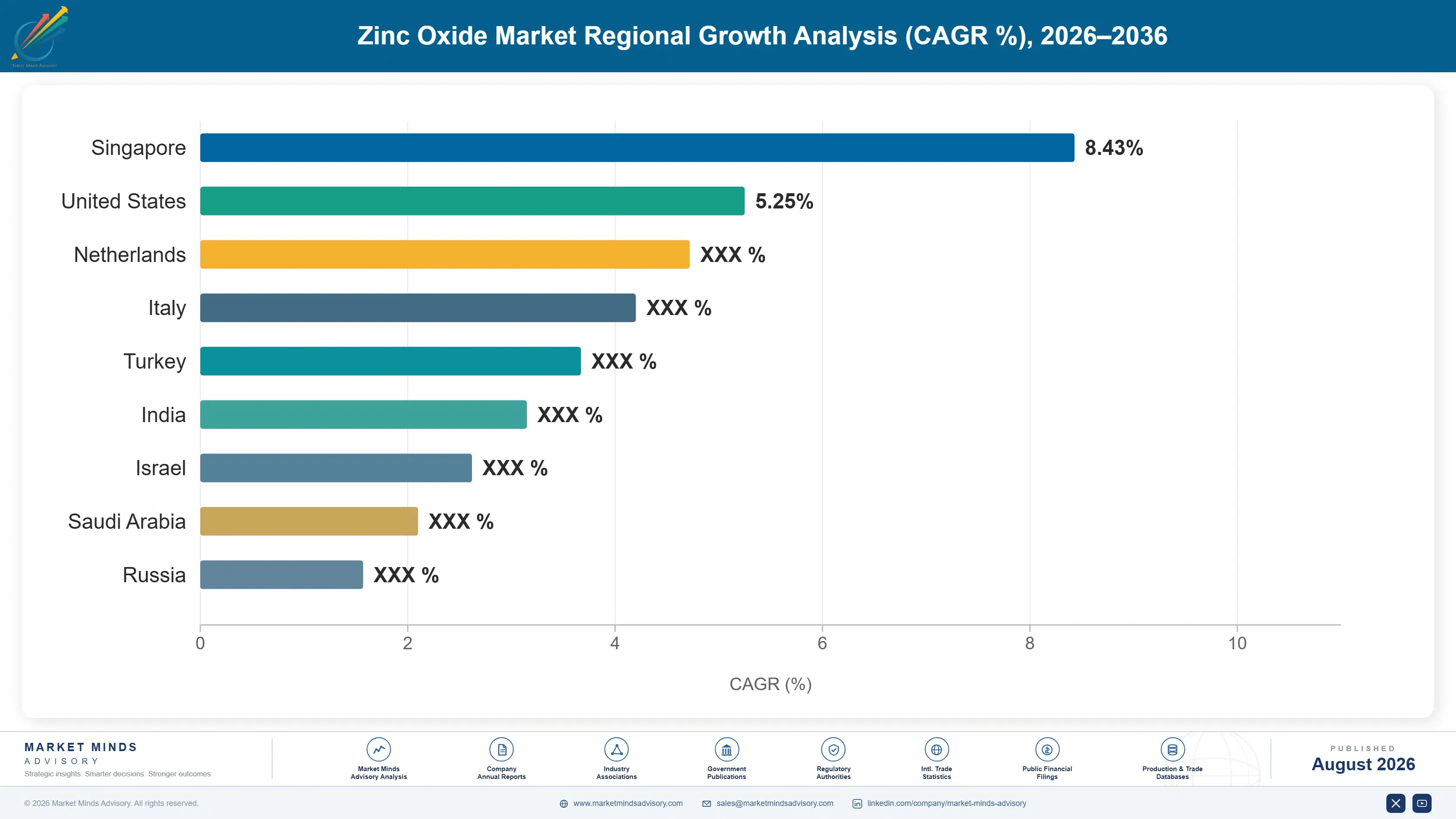
East Asia leads zinc oxide demand, anchored by the region's dominant tire and rubber manufacturing base, while North America and Western Europe show disproportionately specialty-weighted demand tied to cosmetics and electronics applications relative to overall volume. South Asia and Pacific is expanding fastest given rising vehicle fleet and feed demand.

North America

Cosmetics and electronics demand give North America a disproportionately specialty-weighted zinc oxide profile relative to its overall regional volume share, with the United States hosting the largest concentration of cosmetic-grade formulator qualification activity globally. Domestic tire manufacturing provides a steady commodity volume base, though production growth has moderated relative to faster-growing Asian tire manufacturing hubs. Canada contributes modest demand tied to its own tire and rubber manufacturing base, while Mexico's growing automotive manufacturing sector adds incremental commodity-grade volume tied to manufacturing nearshoring investment. Regulatory scrutiny of organic sunscreen filters across the United States is accelerating cosmetic-grade adoption considerably faster than commodity segment growth across the region. This specialty concentration should deepen further as regulatory scrutiny of organic filters intensifies.
Share: 24% | CAGR: 5.6% (2026 to 2036)

Western Europe

Western Europe's zinc oxide demand reflects a mature, slower-growing commodity base combined with meaningful cosmetic-grade specialty demand tied to the region's large cosmetics and personal care manufacturing industry. Germany, France, and Italy host established tire manufacturing and cosmetics formulation industries driving most regional demand. European Union regulatory scrutiny of certain organic sunscreen filter chemicals is accelerating cosmetic-grade zinc oxide adoption across the region's substantial personal care manufacturing base. The United Kingdom and Nordic countries show particularly strong cosmetic-grade adoption relative to population size, reflecting sophisticated consumer demand for mineral-based sun protection formulations. Continued formulator investment in mineral filters should sustain specialty demand growth through most of the forecast period ahead.
Share: 19% | CAGR: 3.9% (2026 to 2036)
Regional intelligence for 5 additional markets available in the complete report: East Asia, South Asia and Pacific, Latin America, Middle East and Africa, Eastern Europe. Contact sales@marketmindsadvisory.com.
zinc-oxide-market-trends-country-cagr-analysis-1787664671060

Capturing Margin Beyond Commodity Rubber Grade

Revenue growth in zinc oxide depends heavily on shifting portfolio mix toward cosmetic and electronics-grade material rather than pure commodity volume expansion, since rubber-grade pricing remains tightly linked to cyclical zinc metal costs. The levers below identify where producers are building durable margin advantage as specialty applications expand faster than legacy demand. across every application category.

Qualifying Cosmetic-Grade Purity and Coating Capability

Producers who invest in ultrafine particle size processing and surface coating capability for cosmetic-grade zinc oxide command 2 to 3 times the price of commodity rubber-grade material, since cosmetics formulators value verified purity and dispersion performance considerably more than delivered cost alone. This qualification process takes considerably longer than commodity grade certification but generates durable customer relationships, since cosmetics brands rarely switch suppliers once a specific particle size distribution has been validated in a finished formulation. Producers pursuing this capability are increasingly partnering directly with major formulators during product development.
Market Impact: Commands 2 to 3 times price premium over commodity

Securing Long-Term Electronics-Grade Customer Supply Contracts

Producers who achieve electronics-grade purity certification and secure multi-year supply agreements with component manufacturers capture premium pricing considerably above commodity rates, since electronic device performance depends heavily on contaminant concentrations that only dedicated purification processes can reliably control. These agreements typically run 3 to 5 years and lock in customer relationships that competitors cannot easily displace once manufacturers have validated a specific supplier's purity consistency across production runs. This segment rewards producers who invest ahead of anticipated battery material commercial scale-up. This segment rewards patience and technical relationship investment over pure production scale.
Market Impact: Commands 40 percent premium over commodity segment grades

Locking Multi-Year Zinc Metal Supply Contracts

Producers who secure multi-year zinc metal supply agreements with price protections smooth feedstock cost volatility considerably relative to producers reliant on spot market purchasing, protecting margin during periods of zinc metal price spikes that can move landed cost by 20 percent or more within a single quarter. These contracts require meaningful purchasing scale to negotiate favorable terms, an advantage smaller regional producers generally cannot access given limited annual purchase volumes. Producers pursuing this approach report considerably more stable quarter-to-quarter margin performance. Producers pursuing this approach report considerably more predictable quarterly earnings performance overall.
Market Impact: Reduces feedstock cost volatility by 20 points annually

Bundling Technical Formulation Support With Supply

Producers who bundle technical formulation support, helping cosmetics and electronics customers optimize dispersion and particle loading, are winning larger volume commitments than pure commodity suppliers, typically increasing account revenue by 15 to 25 percent through improved customer retention. This service layer also raises switching costs meaningfully, since customers who have optimized formulations around a specific producer's particle characteristics face real reformulation cost when switching suppliers. This approach favors larger producers with dedicated technical service teams. This service layer is becoming a standard expectation among the largest specialty customers. Larger producers with dedicated technical teams capture this advantage most consistently.
Market Impact: Lifts account revenue by 15 to 25 percent

Who Controls the Margin Pool

Zinc oxide remains a moderately fragmented industry, with the five largest producers holding an estimated 30 percent combined share on a revenue basis. Zochem and US Zinc lead with the broadest specialty grade portfolios and strongest North American distribution, while the gap to challengers like Grillo-Werke and EverZinc remains meaningful given how fragmented the remaining commodity rubber-grade supply base is across smaller regional producers.
Current competitive activity centers on three dimensions: qualifying cosmetic-grade purity and surface coating capability to capture premium sunscreen formulation demand, securing long-term electronics-grade supply agreements ahead of battery material commercial scale-up, and locking multi-year zinc metal feedstock contracts that smooth margin volatility. Producers lacking scale in any of these three areas increasingly struggle to defend share against both larger multinationals and nimble regional specialists.

Emerging pressure comes from Chinese commodity-grade producers expanding export volume into price-sensitive tire manufacturing markets previously served by regional Western producers. Rankings are most likely to shift in the cosmetic and electronics-grade categories, where purity certification barriers are real but not permanent, and in commodity rubber-grade supply, where Chinese producers already compete effectively on price across most developing markets.
zinc-oxide-market-trends-company-positioning-matrix-1787664671595

Competitive Moat and Risk Dimensions

ZOCHEM INC

Moat: Established North American Distribution

Zochem operates extensive North American production and distribution infrastructure serving both commodity rubber and specialty customers, giving it logistics advantages that smaller regional competitors cannot easily replicate. This established customer base supports faster qualification of new specialty product lines than competitors building distribution relationships from scratch.
ZOCHEM INC

Risk: Commodity Segment Margin Pressure

Zochem's substantial commodity rubber-grade volume faces continuous pricing pressure from lower-cost Chinese producers expanding export volume into North American markets. Sustaining blended margins increasingly requires shifting mix toward specialty grades faster than commodity segment erosion, a transition competing for capital against other investment priorities. Progress here will determine long-term blended margin trajectory.
US ZINC CORPORATION

Moat: Vertically Integrated Zinc Recovery

US Zinc operates zinc recovery and recycling operations feeding its own zinc oxide production, giving it feedstock cost advantages that non-integrated competitors reliant entirely on purchased zinc metal cannot match. This integration provides meaningful margin stability during periods of zinc metal price volatility affecting non-integrated competitors.
US ZINC CORPORATION

Risk: Limited Cosmetic-Grade Scale

US Zinc's cosmetic-grade production capacity remains smaller than specialized competitors who invested earlier in ultrafine particle processing and surface coating capability. Expanding this capability requires meaningful capital investment that competes with maintaining the company's core commodity and recycling operations. Closing this gap will require sustained multi-year investment commitment.

Players Tracked

Prominent Players

Zochem Inc
US Zinc Corporation
Grillo-Werke AG
Numinor Chemical Company Inc
EverZinc

Other Key Players

Weifang Longwei Chemical Co Ltd
Hindustan Zinc Limited
Rubamin Private Limited
Zinc Nacional S.A. de C.V.
Pan Asia Chemical Corporation
American Elements
Zinc Oxide LLC
Sakai Chemical Industry Co Ltd
Hakusui Tech Co Ltd
Jiangsu Jinji Zinc Industry Co Ltd
Yuguang Gold and Lead Co Ltd
Toho Zinc Co Ltd
Votorantim Metais
Nyrstar NV
Hebei Xinji Chemical Co Ltd

Recent Developments

MARCH 2026

Zochem Expands Cosmetic-Grade Purification Capacity

Zochem announced expansion of its ultrafine cosmetic-grade zinc oxide purification and surface coating capacity at an existing North American facility, adding output to serve growing mineral sunscreen formulation demand across the region. The expansion follows several years of growing formulator demand for verified mineral filter ingredients.
Signal: Signals continued cosmetic-grade capacity investment ahead of mineral sunscreen adoption growth. across the broader personal care ingredient industry
OCTOBER 2025

US Zinc Acquires Regional Recycling Operation

US Zinc completed the acquisition of a regional zinc recycling operation to expand its feedstock recovery capability and strengthen vertical integration, adding recycled zinc processing capacity that complements US Zinc's existing production infrastructure. The deal expands US Zinc's feedstock recovery footprint into a region it previously served only indirectly.
Signal: Signals continued vertical integration investment to secure feedstock cost stability. as producers seek greater feedstock cost predictability
JUNE 2025

Grillo-Werke Commissions Electronics-Grade Production Line

Grillo-Werke commissioned a new electronics-grade zinc oxide production line to expand capacity serving gas sensor and battery material manufacturers, supporting growing demand from customers requiring higher purity specifications than commodity applications. The expansion follows years of steady electronics manufacturer interest in higher-purity zinc oxide inputs.
Signal: Signals expanding electronics-grade capacity ahead of battery material commercial scale-up. as battery material developers scale toward commercial production

Zinc Metal Feedstock Exposure and Volatility

Zinc metal, refined from zinc concentrate mined at a relatively concentrated number of global mining operations, accounts for an estimated 40 to 50 percent of cost of goods sold across most zinc oxide production, with prices tracking the broader zinc metal commodity market traded on major metals exchanges. Energy costs for the French process or American process production methods add a second meaningful cost category.
Zinc metal pricing spiked considerably during 2021 and 2022, according to company annual reports citing constrained mine supply and strong industrial demand recovery, forcing several mid-sized zinc oxide producers to pass costs through to commodity rubber customers or accept meaningful margin compression. The disruption illustrated how directly zinc oxide producer profitability tracks underlying zinc metal commodity cycles that producers themselves have little ability to influence.

Smaller regional producers carry disproportionately higher feedstock cost exposure than larger, vertically integrated producers who recycle zinc from secondary sources or hold long-term metal supply contracts. This competitive disadvantage becomes particularly acute during zinc metal price spikes, when smaller producers must either absorb margin compression or pass costs through to price-sensitive commodity customers who resist mid-contract price increases.
zinc-oxide-market-trends-cost-volatility-analysis-1787664671796

Investing in Zinc Recycling and Recovery Capability

Leading producers are investing in zinc recycling operations that recover zinc from galvanizing dross and other secondary sources, reducing dependence on purchased zinc metal and providing a partially insulated feedstock cost base. This approach requires meaningful capital investment in recycling infrastructure but meaningfully reduces exposure to primary zinc metal commodity price volatility over time.

Locking Multi-Year Zinc Metal Supply Agreements

Larger producers increasingly negotiate multi-year zinc metal supply agreements with price collars that limit exposure to short-term commodity market volatility, trading some upside flexibility for greater cost predictability. This approach requires meaningful purchasing scale to negotiate favorable terms that smaller regional producers generally cannot access given limited volumes. Smaller producers often lack this negotiating position.

Passing Costs Through Indexed Commodity Contracts

Producers are increasingly embedding zinc metal price indices directly into commodity rubber-grade supply contracts, allowing periodic price adjustments tied to published metals exchange pricing rather than absorbing volatility entirely. Customers generally accept indexed pricing in exchange for supply security, though negotiating acceptable index formulas remains a recurring point of contract friction. Larger contracts increasingly favor this indexed approach.

Portfolio Architecture for Margin Defence

Zinc oxide portfolios span three distinct tiers, from commodity-adjacent rubber-grade material sold largely on price, through premium and certified cosmetic and pharmaceutical-grade material that commands meaningful price premiums for verified purity, to next-generation electronics and battery-grade formulations designed for the strictest emerging performance requirements. Gross margins vary considerably across these tiers, reflecting differences in purification complexity and certification burden. This tiered structure tracks purity requirements and pricing power across the category.
The volume versus premium tension is stark: commodity rubber-grade material accounts for the majority of category volume shipped globally but a comparatively modest share of industry gross profit, while premium cosmetic and electronics-grade tiers represent a smaller volume share but disproportionate profitability. Producers face continuous pressure to expand specialty capacity without abandoning the commodity volume base that funds much of their manufacturing scale. Investment decisions increasingly hinge on which tier a producer chooses to anchor.

High-value margin pools concentrate most heavily in cosmetic-grade material serving mineral sunscreen formulation and electronics-grade material serving battery and sensor applications, categories where purity certification barriers protect established producers from pure price competition. Producers investing early in these categories are best placed to capture disproportionate share of industry profit growth over the coming decade.

Volume / Commodity-Adjacent Tier

Rubber and ceramics-grade zinc oxide sold primarily to tire manufacturers and general industrial customers, competing mainly on delivered cost and reliable supply availability. Margins remain thin given intense price competition among numerous regional producers.
Gross Margin: 10-16%

Premium / Certified Tier

Cosmetic and pharmaceutical-grade zinc oxide meeting stringent purity and particle size certification requirements, commanding meaningful price premiums for verified formulation performance. These grades require ongoing purity testing to maintain formulator qualification status.
Gross Margin: 22-30%

Sustainability / Regulatory / Next-Generation Tier

Electronics and battery-grade formulations designed for the strictest emerging performance requirements, commanding the highest per-unit price premiums across the category. Adoption is accelerating as battery material developers move toward commercial scale-up.
Gross Margin: 30-40%
zinc-oxide-market-trends-portfolio-architecture-1787664672317

High-value Sub-segments and Strategic Watch-out

Cosmetic-Grade Mineral Sunscreen Zinc Oxide

Cosmetic-grade zinc oxide serving mineral sunscreen formulation combines high per-unit pricing with rapid volume growth, driven by regulatory pressure on organic ultraviolet filters across major consumer markets. Producers with proven purification capability are capturing outsized share of this high-margin, fast-growing segment. Suppliers are extending research investment to defend this position.
Gross Margin: 24-32%

Electronics and Battery-Grade Zinc Oxide

Electronics-grade zinc oxide commands premium pricing and long contract durations tied to component manufacturer relationships, though growth remains more variable than cosmetic-grade demand given its dependence on emerging battery technology commercial scale-up timing. Suppliers are extending qualification efforts to defend this position further. across multiple component manufacturer relationships.
Gross Margin: 28-38%

Commodity Rubber-Grade Zinc Oxide

Commodity rubber-grade zinc oxide remains the volume core of the industry, generating steady but cyclically volatile revenue from tire manufacturers who prioritize reliable supply and competitive pricing over purity differentiation across most markets. Producers compete mainly on reliability and delivered price rather than purity. over the long run.
Gross Margin: 8-14%

Rising Chinese Commodity-Grade Exports

Chinese commodity-grade zinc oxide exports are expanding into markets previously served by regional Western producers, pressuring rubber-grade segment pricing further and forcing established producers to accelerate their shift toward specialty grades to protect margin. This threat merits close ongoing monitoring by established regional producers. and clarify their own purity positioning.
Gross Margin: 6-12%

Dual-Speed Recurring Purchase Behavior

Zinc oxide demand carries meaningful annuity characteristics because both commodity rubber manufacturers and specialty cosmetics or electronics customers consume the material continuously as a non-discretionary formulation input. Once a customer qualifies a specific producer's grade and particle characteristics, switching requires requalification testing that most customers avoid absent a compelling cost or performance reason, giving incumbent producers durable, recurring revenue.
Adoption depth varies considerably by end-use vertical. Tire and rubber manufacturers show relatively high price sensitivity and willingness to switch suppliers for modest cost savings, while cosmetics formulators and electronics manufacturers show much deeper switching resistance given the reformulation risk involved in changing suppliers mid-product-cycle. Battery material developers, in particular, often co-develop purity specifications directly with producers rather than purchasing from a standard catalog.

A generational shift in buyer profile is underway as cosmetics and electronics procurement teams increasingly include technical specialists rather than purely cost-focused purchasing staff. These buyers are more receptive to long-term supply agreements and premium specialty grades than the purchasing generation they are replacing, gradually easing the path for producers pursuing higher-margin specialty categories across both commodity and premium segments. This shift is gradually reshaping which producers win long-term specialty contracts.
zinc-oxide-market-trends-end-use-penetration-index-1787664672817

Where Zinc Oxide Producers Should Focus

These are among the four positions where our research anticipates prominent divergence between winners and laggards over the coming forecast period. Each is grounded in the demand model, the regulatory perimeter, and the announced capacity pipeline.
01 / SPECIALTY GRADE INVESTMENT

Prioritize cosmetic and electronics-grade capacity over commodity expansion

Producers still expanding commodity rubber-grade capacity are chasing the slowest-growing and lowest-margin segment of this industry, while cosmetic and electronics-grade material are growing nearly twice as fast and command considerably higher margins. Capital allocated toward commodity expansion today will likely underperform relative to capital directed at specialty purification qualification for cosmetics and electronics customers. The producers best positioned five years from now will be those redirecting capacity investment toward specialty grades now, before commodity margin compression forces the same decision on slower-moving competitors.
02 / FEEDSTOCK COST MANAGEMENT

Invest in zinc recycling to reduce primary metal price exposure

Producers dependent entirely on purchased zinc metal remain exposed to the same commodity cycle volatility that compressed margins during 2021 and 2022, and this exposure will only matter more as zinc metal demand continues expanding across multiple end-use industries through 2036. Investing in zinc recycling and recovery capability reduces this risk meaningfully, even though it requires substantial capital investment in dedicated recycling infrastructure. Producers who invest now will be considerably better positioned than competitors who remain fully exposed to primary zinc metal commodity swings.
03 / COSMETIC CERTIFICATION TIMING

Pursue cosmetic-grade certification ahead of mineral sunscreen adoption acceleration

Regulatory pressure on organic sunscreen filters is accelerating faster than most producers anticipated only a few years ago, and cosmetic-grade certification takes considerably longer to achieve than commodity grade qualification. Producers who begin this certification process now will be positioned to capture premium formulation contracts as mineral sunscreen adoption accelerates, while competitors who delay certification risk finding themselves locked out of formulator relationships that, once validated, rarely change hands quickly. This window will not stay open indefinitely as more producers recognize the same commercial opportunity.
04 / ELECTRONICS PARTNERSHIP DEVELOPMENT

Build early relationships with battery material developers before scale-up

Zinc-based battery chemistries remain earlier in commercial development than cosmetic-grade demand, but producers who build technical relationships with battery material developers now will be positioned to capture outsized share once commercial scale-up accelerates. Waiting until battery demand materializes at scale risks losing these relationships to competitors who invested in electronics-grade purification and technical partnership development earlier, during the period when patience mattered more than existing purchase volume history. Producers should treat this partnership development as a standing priority rather than a reactive response to demand signals.

Engagement Snapshot From the Field

A live engagement with an industry participant carrying material or product regulatory and market exposure ahead of a defining policy shift, showing how our research translates into a defensible multi-year portfolio strategy.
MARKET MINDS ADVISORY · CLIENT ENGAGEMENT SUMMARY
Zinc Oxide Producer Strategic Portfolio Review and Transition Roadmap 2026·Investment Scenario on Zinc Oxide Exposure Evaluation 2025-26
CLIENT PROFILE
A regional cosmetics ingredient distributor serving mid-sized personal care brands across North America approached MMA seeking guidance on qualifying a new cosmetic-grade zinc oxide supplier ahead of expanding its mineral sunscreen ingredient portfolio. The distributor had historically sourced from a single supplier and had limited internal expertise evaluating alternative producers' purity and particle size consistency across multiple production batches.
STRATEGIC CHALLENGE
Distributor leadership needed to determine which of three candidate suppliers offered the most consistent particle size distribution and lowest heavy metal contaminant levels across production runs, without disrupting existing customer relationships built around the incumbent supplier's specific product characteristics. Leadership was also concerned about supply concentration risk given how few producers offer verified cosmetic-grade certification.
MMA APPROACH
MMA benchmarked the three candidate suppliers' historical batch consistency data against the distributor's existing formulation requirements, drawing on proprietary survey data examining how comparable cosmetics ingredient distributors structured supplier qualification programs. The engagement team modeled switching costs and requalification timelines before presenting recommendations to distributor leadership. Findings were validated against comparable dual-sourcing arrangements tracked across the industry.
KEY FINDINGS
  1. One candidate supplier demonstrated meaningfully more consistent particle size distribution across production batches than the incumbent. This finding held even after accounting for seasonal production variability across facilities.
  2. Switching entirely to a new supplier would require an estimated six-month customer requalification process across the distributor's brand accounts. This timeline was longer than the distributor's leadership had originally anticipated internally.
  3. Maintaining dual-sourcing across both the incumbent and the new candidate reduced concentration risk without disrupting existing customer relationships. This approach also strengthened the distributor's negotiating position with both suppliers.
  4. The new candidate supplier offered meaningfully more favorable pricing terms once volume commitments reached a moderate threshold. Leadership viewed this pricing improvement as a meaningful factor favoring diversification.
CLIENT PROFILE
A regional cosmetics ingredient distributor serving mid-sized personal care brands across North America approached MMA seeking guidance on qualifying a new cosmetic-grade zinc oxide supplier ahead of expanding its mineral sunscreen ingredient portfolio. The distributor had historically sourced from a single supplier and had limited internal expertise evaluating alternative producers' purity and particle size consistency across multiple production batches.
STRATEGIC CHALLENGE
Distributor leadership needed to determine which of three candidate suppliers offered the most consistent particle size distribution and lowest heavy metal contaminant levels across production runs, without disrupting existing customer relationships built around the incumbent supplier's specific product characteristics. Leadership was also concerned about supply concentration risk given how few producers offer verified cosmetic-grade certification.
MMA APPROACH
MMA benchmarked the three candidate suppliers' historical batch consistency data against the distributor's existing formulation requirements, drawing on proprietary survey data examining how comparable cosmetics ingredient distributors structured supplier qualification programs. The engagement team modeled switching costs and requalification timelines before presenting recommendations to distributor leadership. Findings were validated against comparable dual-sourcing arrangements tracked across the industry.
KEY FINDINGS
  1. One candidate supplier demonstrated meaningfully more consistent particle size distribution across production batches than the incumbent. This finding held even after accounting for seasonal production variability across facilities.
  2. Switching entirely to a new supplier would require an estimated six-month customer requalification process across the distributor's brand accounts. This timeline was longer than the distributor's leadership had originally anticipated internally.
  3. Maintaining dual-sourcing across both the incumbent and the new candidate reduced concentration risk without disrupting existing customer relationships. This approach also strengthened the distributor's negotiating position with both suppliers.
  4. The new candidate supplier offered meaningfully more favorable pricing terms once volume commitments reached a moderate threshold. Leadership viewed this pricing improvement as a meaningful factor favoring diversification.
RECOMMENDED STRATEGY
Phase 1: Phase one qualified the new candidate supplier for a limited pilot product line before broader adoption. to validate consistency before broader adoption across the portfolio. Phase 2: Phase two expanded dual-sourcing across additional product lines once pilot batch consistency was confirmed. while maintaining the incumbent relationship intact throughout the process. Phase 3: Phase three renegotiated volume-based pricing terms with both suppliers reflecting the distributor's diversified sourcing. to reflect the distributor's now-diversified total purchase volume.
OUTCOME
The distributor completed its supplier diversification within seven months and reported (client-reported, unverified by MMA) an estimated 8 percent reduction in blended ingredient cost following the dual-sourcing arrangement. Leadership credited the phased qualification approach with maintaining supply continuity throughout the transition period. The arrangement also improved the distributor's negotiating position ahead of future contract renewals.

Frequently Asked Questions

Foundational context covering the market sizes, CAGR, scope, country, region and competition that inform every finding below. This section is provided to cover basics and most often pre-purchase conversations, answered from the MMA Primary Research Dataset.

What is the current size of the Zinc Oxide Market?

The global zinc oxide market reached an estimated 6.8 billion US dollars in 2025. Growth is driven by rising mineral sunscreen adoption alongside steady tire and rubber production demand.

How large will the Zinc Oxide Market be by 2036?

MMA projects the market will reach approximately 12.1 billion US dollars by 2036. This reflects sustained cosmetic-grade adoption and growing electronics and battery material demand.

What is the CAGR for the Zinc Oxide Market 2026 to 2036?

The market is forecast to grow at a compound annual growth rate of 5.4 percent between 2026 and 2036. Bull and bear scenarios range from 6.6 percent to 4.2 percent depending on regulatory pace.

Which segment is growing fastest?

Cosmetics and personal care applications are growing fastest, at an estimated 9.5 percent CAGR through 2036. Regulatory pressure on organic sunscreen filters is driving this mineral filter shift.

Who are the major companies in the Zinc Oxide Market?

Leading participants include Zochem Inc, US Zinc Corporation, Grillo-Werke AG, Numinor Chemical Company Inc, and EverZinc. These five companies collectively hold an estimated 30 percent combined market share.

Which country is growing fastest?

China is the fastest-growing country market, expanding at an estimated 6.8 percent CAGR through 2036. Continued tire manufacturing capacity expansion is driving this acceleration domestically.

Report Segmentation Architecture

The full report scope spans multiple orthogonal segmentation dimensions, with cross-tabulated demand data provided for each dimension pair. Coverage extends further to regional breakdowns, trend trajectories, and the competitive detail needed to support segment-level decision-making.

By End-Use Application

  • Rubber and Tire Vulcanization
  • Ceramics and Glass
  • Agriculture and Animal Feed Additives
  • Cosmetics and Personal Care
  • Pharmaceuticals and Healthcare
  • Electronics and Battery Materials

By End-Use Industry

  • Automotive and Tire Manufacturing
  • Personal Care and Cosmetics
  • Agriculture and Animal Health
  • Electronics and Semiconductors
  • Pharmaceuticals

By Commercial Dimension

  • Direct Manufacturer Supply
  • Distributor and Trading Channel
  • Long-Term Offtake Agreements
  • Spot Market Transactions

By Region

  • North America
  • Western Europe
  • East Asia
  • South Asia and Pacific
  • Latin America
  • Middle East and Africa
  • Eastern Europe

Scope, Methodology, and Coverage

Every figure in this report is reproducible from documented input assumptions. The scope below maps the historical period, the forecast horizon, the segmentation dimensions, and the countries covered, alongside the underlying primary and qualitative methodology.
Historical Period
2020 to 2025
Forecast Period
2026 to 2036
Base Year
2025 (USD billions; MMA Primary Research Dataset, August 2026)
Market Definition
This report covers zinc oxide used across rubber and tire vulcanization, ceramics and glass, agriculture and animal feed, cosmetics and personal care, pharmaceuticals, and electronics and battery materials applications. It excludes zinc metal, zinc sulfate, and other zinc compounds not chemically processed into zinc oxide.
Quantitative Units
USD billions (current prices); metric tons (volume, where cited)
Segmentation Dimensions
End-Use Application; End-Use Industry; Commercial Dimension; By Region
Regions Covered
North America, Western Europe, East Asia, South Asia and Pacific, Latin America, Middle East and Africa, Eastern Europe
Countries Covered
USA, China, Germany, France, UK, Japan, South Korea, India, Australia, Canada, Brazil, Mexico, Indonesia, Vietnam, Thailand, Malaysia, UAE, Saudi Arabia, South Africa, Nigeria, Turkey, Poland, Netherlands, Italy, Spain, Sweden, Switzerland, Argentina, Colombia, Singapore, and additional markets relevant to this sector
Key Companies Profiled
Zochem Inc, US Zinc Corporation, Grillo-Werke AG, Numinor Chemical Company Inc, EverZinc, Weifang Longwei Chemical Co Ltd, Hindustan Zinc Limited, Rubamin Private Limited, Zinc Nacional S.A. de C.V., Pan Asia Chemical Corporation, American Elements, Zinc Oxide LLC, Sakai Chemical Industry Co Ltd, Hakusui Tech Co Ltd, Jiangsu Jinji Zinc Industry Co Ltd, Yuguang Gold and Lead Co Ltd, Toho Zinc Co Ltd, Votorantim Metais, Nyrstar NV, Hebei Xinji Chemical Co Ltd
Quantitative Methodology
Primary survey, n=3,800 respondents, Q4 2025, six countries; demand-side model with trade association cross-validation
Qualitative Methodology
47 expert interviews, Q4 2025; applied to validate demand model assumptions, identify emerging dynamics, and assess competitive positioning
Report Format
PDF and XLSX data workbook (Word format preview document)
Publisher
Market Minds Advisory
Report Code
MMA-2026-CHM-104
Published
August 2026
Contact
sales@marketmindsadvisory.com | www.marketmindsadvisory.com

Purchase the full Zinc Oxide Market Report (2026 to 2036).

This report delivers a complete strategic assessment of the global zinc oxide market, covering sizing, segmentation, regional dynamics, and competitive positioning through 2036. It draws on MMA's proprietary primary survey of 3,800 respondents and 47 expert interviews conducted in the fourth quarter of 2025 across six countries. Analysts translate these findings into actionable guidance on specialty grade investment, feedstock cost management, and certification timing for participants across the value chain. The report is designed for executives evaluating capital allocation decisions across the zinc oxide category.
Detailed six-segment MECE application-based market segmentation
Full seven-region demand architecture with growth drivers
Competitive benchmarking across twenty tracked global producers
Feedstock cost exposure and mitigation pathway analysis
Portfolio tiering and margin economics by purity tier
Anonymized client case study with strategic recommendations

Built For The People Who Decide

From boardroom strategy to bench-side execution, this report is read cover-to-cover by leaders shaping the next decade of their industry, turning demand scenarios, market dynamics and valuation benchmarks into decisions.
CXOs/ Presidents/ VPs/ Managers
M&A and Corporate Development
Strategy Teams and R&D Heads
Procurement and Product Directors
Regulatory and Compliance Leaders
Investor Relations and Equity Analysts