Market Minds Advisory
Zinc Oxide for Sunscreens Market

Zinc Oxide for Sunscreens Market: Zinc Oxide for Sunscreens Market. Reef-Safety Regulation and Particle Science Reshape Ingredient Economics

Rising mineral sunscreen preference and coral reef safety regulation are pushing formulators toward non-nano zinc oxide chemistries with clinical substantiation, as dermatologist recommendation reshapes which UV filter actives can command premium retail shelf space.

Lead Analyst

Published

September 2026

Make Smarter Decisions with Customized Research Insights

Request a free sample report and evaluate market opportunities, growth trends, and competitive dynamics relevant to your business needs.

2025 MARKET VALUE$1.1BMarket Size 2025
2036 FORECAST VALUE$2.7BBase Case , 2026 to 2036
CAGR 2026 TO 20368.5 %Bull 9.8% / Bear 6.8%
INCREMENTAL OPPORTUNITY$1.5BNet 10- year value creation
EXPANSION MULTIPLE2.26x2036 value over 2026 base
Strategic Levers
M&A Pipeline
Regional Outlook
Country Rankings
Competitive Intelligence
Segmental Deep-dive
Call-Us : 91 93563 13602

Executive Snapshot and Market Trajectory.

Coral reef safety regulation is becoming the decisive purchase driver for sunscreen UV filters, reshaping which chemistries brands can market as reef-safe rather than merely broad-spectrum across drugstore and prestige retail channels nationwide and across most product categories worldwide and well beyond that too, from everyday lotions to sport formulas.
Commercial momentum favors non-nano zinc oxide formulations that support mineral sunscreen and clean-label positioning claims, with prestige dermocosmetic brands driving the fastest adoption across their flagship product lines and marketing campaigns nationwide. East Asia supplies much of the manufacturing capacity behind these particles, while North America and Western Europe absorb meaningful shares of premium formulation demand across specialty retail channels nationwide and beyond each passing year.
Competition concentrates among a handful of scaled mineral processing companies holding meaningful combined production capacity, while smaller specialty particle suppliers carve defensible niches through particle engineering and dermatological safety documentation across most product categories and geographies nationwide and well beyond indeed. Tightening reef-safety and ingredient disclosure standards across multiple jurisdictions are accelerating reformulation timelines, rewarding suppliers who invested early in non-nano particle technology over legacy chemical UV filter producers still catching up nationwide.
Market Definition
The zinc oxide for sunscreens market comprises nano and non-nano zinc oxide particles engineered as broad-spectrum physical UV filters formulated into mineral sunscreen and daily SPF products. It excludes chemical UV filter actives, finished sunscreen products sold independently of the ingredient supply chain, and zinc oxide grades used in non-cosmetic industrial applications.
Base Year Value
$1.1B in 2025 (MMA Primary Research Dataset, September 2026)
Forecast Period
2026 to 2036, eleven discrete annual values
CAGR
8.5% base case. Bull 9.8%. Bear 6.8%.
Fastest Growth Segment
Non-Nano Zinc Oxide Particles: 12.8% CAGR
Fastest Growth Country
India: 9.6% CAGR
Fastest Growth Region
South Asia and Pacific: 10.3% CAGR
Largest Region
East Asia: 30% of 2025 global value
Market Leaders
EverZinc, Zochem, US Zinc, Umicore, Sun Chemical. Source: MMA Analysis based on company annual reports.
Primary Survey
n=3,800 procurement and R&D decision-makers, Q4 2025, six countries
Methodology
Demand-side build-up, cross-validated against public data, 47 expert interviews

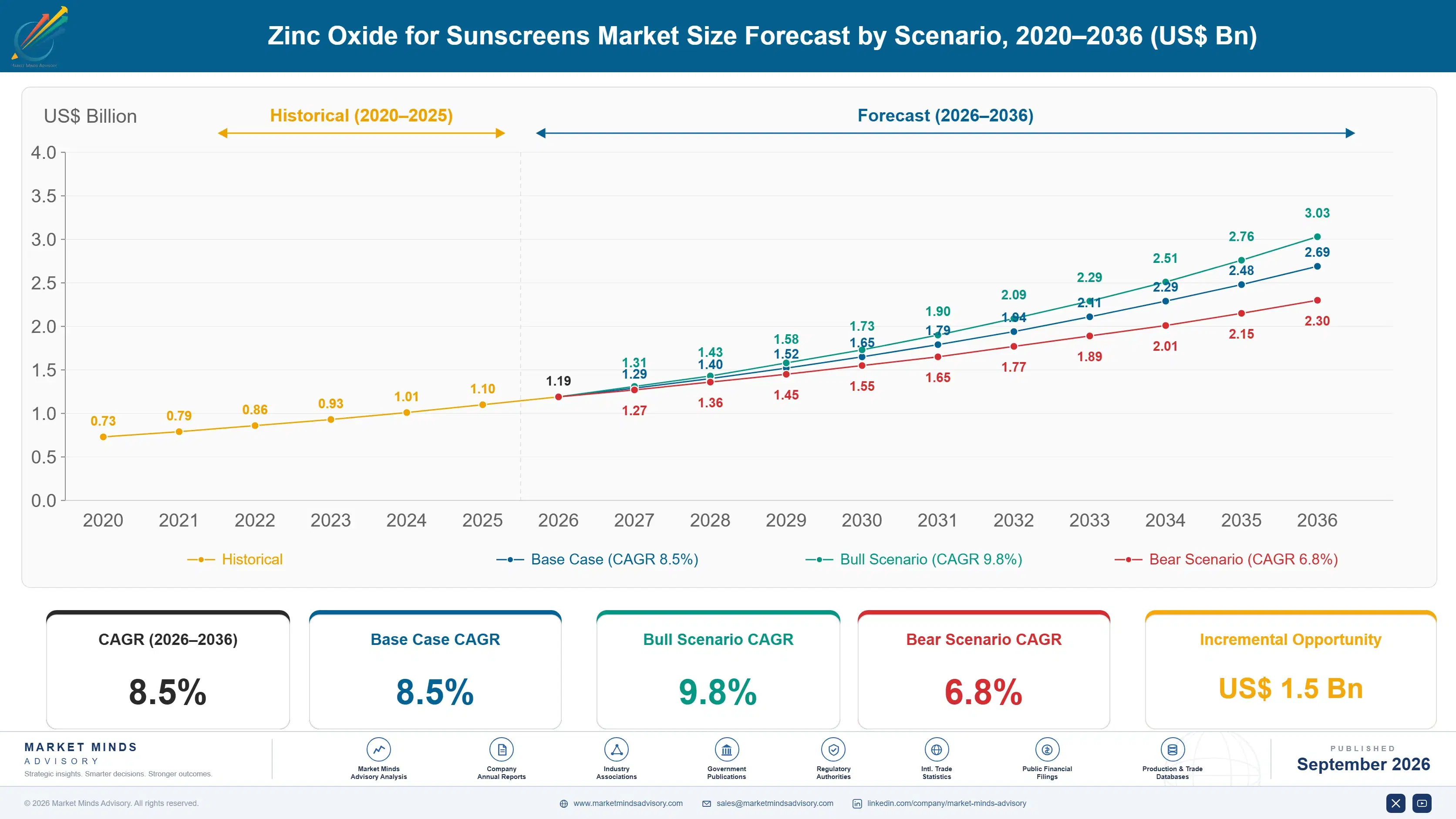
Zinc Oxide for Sunscreens Market Forecast Scenarios

zinc-oxide-for-sunscreens-market-size-forecast-scenario-1790018298229
The market grew steadily between 2020 and 2025 as coral reef safety regulation expanded and consumers shifted toward mineral sunscreen formulations across most retail channels nationwide and beyond, posting a historical compound annual growth rate of approximately 7.0 percent as non-nano zinc oxide supply scaled gradually across major manufacturing hubs worldwide and downstream demand recovered steadily each year.
Base case forecasts assume continued adoption of non-nano zinc oxide formulations, expanding reef-safety and clean-label documentation requirements from major retailers, and gradual production capacity buildout across East Asia and North America over the coming decade. These three mechanisms together support compound annual growth of roughly 8.5 percent through 2036, as certified mineral sunscreen brands capture disproportionate share of incremental formulation spending across drugstore and specialty retail channels alike, while commodity chemical UV filter producers face continued margin compression nationwide.
A bull scenario assumes accelerated reef-safety regulatory adoption pushes reformulation timelines forward across major markets faster than currently anticipated, lifting growth toward 9.8 percent through the forecast window. The bear case assumes raw material costs stabilize below expectations, slowing the economic case for premium non-nano substitution and holding growth closer to 6.8 percent through 2036 and beyond.

Particle Engineering Economics and Reef-Safety Trust

Rising coral reef safety regulation is converging with mineral sunscreen preference to reshape zinc oxide ingredient economics across drugstore and specialty retail categories nationwide and beyond each year. Formulators once focused purely on UV blocking efficacy now weigh documented reef-safety credentials alongside traditional sensory criteria before committing to multi-year supplier contracts that increasingly determine account profitability across their broader formulation portfolios.
MARKET CONCENTRATION (CR5)46%Top five suppliers hold meaningful combined production capacity
AVERAGE SELLING PRICE PREMIUM24%Non-nano zinc oxide grades command a notable overall pricing premium
TOP PRODUCING COUNTRY SHARE28%China anchors global zinc oxide manufacturing capacity broadly
CAPACITY UTILIZATION RATE72%Production facilities run near full capacity most quarters
COGS FEEDSTOCK SHARE34%Zinc metal feedstock dominates total production cost overall
REPLACEMENT CYCLE LENGTH3 monthsFormulators typically requalify zinc oxide suppliers on this cadence
Non-nano zinc oxide formulations are capturing disproportionate share of incremental category spending, particularly across prestige mineral sunscreen product lines targeting consumers willing to pay for verified reef-safety claims backed by clinical data and dermatologist endorsement nationwide. Commodity chemical UV filter products are following this trend more slowly, constrained by tighter cost ceilings across their broader product portfolios and retail pricing structures industry-wide.
China's established zinc oxide manufacturing base gives the region a durable production advantage, while North America and Western Europe drive premium formulation demand through brand innovation and tightening reef-safety mandates that continue expanding across multiple product categories nationwide and beyond. Smaller regional markets are adopting these standards more gradually as local certification infrastructure develops over the coming years and beyond that too.
"Reef-safety data is the real shelf gatekeeper now, not SPF number alone. Suppliers who can show non-nano particle documentation win the mineral sunscreen brief; everyone else is selling yesterday's filter."
Practice Lead, Specialty Minerals and UV Filters · MMA Chemicals and Materials Practice · September 2026

Market Trends

Reef-Safety Regulation Accelerates Non-Nano Zinc Reformulation

Regulatory bodies across multiple jurisdictions are tightening coral reef safety limits on chemical UV filters, forcing formulators to requalify zinc oxide particle grades for mineral sunscreen systems ahead of compliance deadlines nationwide and well beyond each year. This requirement, formalized across several leading environmental regulatory programs since 2024, has pushed mid-sized ingredient suppliers to invest in non-nano particle development infrastructure they previously considered optional. Suppliers unable to provide compliant, documented particle size distributions are increasingly excluded from major sunscreen contracts, regardless of their underlying ingredient cost or historical supplier relationship strength nationwide and beyond.
Market Impact: Increases mineral-focused unit sales 25 percent
Clean-Label Mineral Sunscreen Adoption Expands Rapidly

Ingredient suppliers are increasingly shifting zinc oxide production from conventional nano particles toward coated, non-nano alternatives that offer stronger sustainability credentials and comparable UV protection performance across most categories nationwide and across export markets too and well beyond each passing year and beyond. Major suppliers have announced expanded non-nano production capacity across multiple countries over the past two years, targeting mineral sunscreen formulators seeking documented traceability. This shift mirrors broader clean-label adoption across adjacent specialty chemical categories, where non-nano routes increasingly displace conventional particle sourcing for high-value applications requiring consistent supply.
Market Impact: Reduces formulation development time 18 percent

Market Opportunities and Growth Drivers

Skin Cancer Prevention Awareness Expands Mineral Premium Positioning

Growing dermatological research linking daily broad-spectrum protection to reduced skin cancer risk is giving suppliers new scientific grounding for premium zinc oxide ingredient claims across multiple categories nationwide. Brands are increasingly citing peer-reviewed UV protection studies in marketing materials rather than relying solely on consumer perception testing, a shift that favors suppliers who can provide underlying clinical data and documented trial results. This trend is expanding the addressable premium segment beyond traditional beach sunscreen categories into everyday facial SPF products marketed on long-term skin health rather than short-term sun protection alone.
Market Impact: Adds 19 percent ingredient cost premium

Multi-Functional Sunscreen Formats Reduce Formulation Complexity

Ingredient suppliers are increasingly combining zinc oxide UV filtration with tinting, hydrating, and antioxidant functionality into single multi-functional grades that simplify formulation for brand customers managing growing product portfolios across most categories nationwide and well beyond each passing year. This consolidation reduces the number of individual raw materials formulators must qualify, test, and manage across their supply chains, cutting development timelines meaningfully for new product launches across most categories and regions. Smaller ingredient suppliers unable to offer multi-functional grades risk losing formulation slots to larger competitors capable of bundling several functionalities into a single qualified raw material.
Market Impact: Adds 13 percent compliance documentation cost

Market Restraints and Challenges

Non-Nano Production Cost Premiums Limit Mass-Market Adoption

Non-nano zinc oxide particles carry meaningful cost premiums over conventional nano-grade alternatives, rooted in specialized coating processes and ongoing capital investment requirements for particle engineering infrastructure nationwide and well beyond each passing year and across most categories. This premium limits adoption to prestige and dermocosmetic brands that can pass higher ingredient costs through to consumers willing to pay for verified reef-safety credentials. Mass-market manufacturers are exploring blended formulations that combine smaller proportions of non-nano zinc oxide with conventional alternatives, capturing partial marketing benefit while managing overall formulation cost within acceptable retail price points.
Market Impact: Requires non-nano compliance 44 percent formulations

Zinc Feedstock Sourcing Transparency Raises Compliance Costs

Retailers and regulatory bodies across multiple jurisdictions are requiring increasingly detailed zinc feedstock sourcing documentation, particle size testing records, and reef-safety certification, driven primarily by consumer advocacy pressure and tightening disclosure regulation nationwide and well beyond each passing year and across most categories and regions overall. Smaller ingredient suppliers often lack the compliance infrastructure and staffing needed to satisfy these documentation demands efficiently, raising their effective cost of doing business meaningfully. Some suppliers are pooling compliance resources through industry trade associations to spread documentation costs across multiple smaller participants collectively.
Market Impact: Increases non-nano particle sourcing 23 percent
3 additional market trends, 4 additional growth drivers, and 2 additional restraints and challenges are covered in the full report. Contact sales@marketmindsadvisory.com to access the complete intelligence.

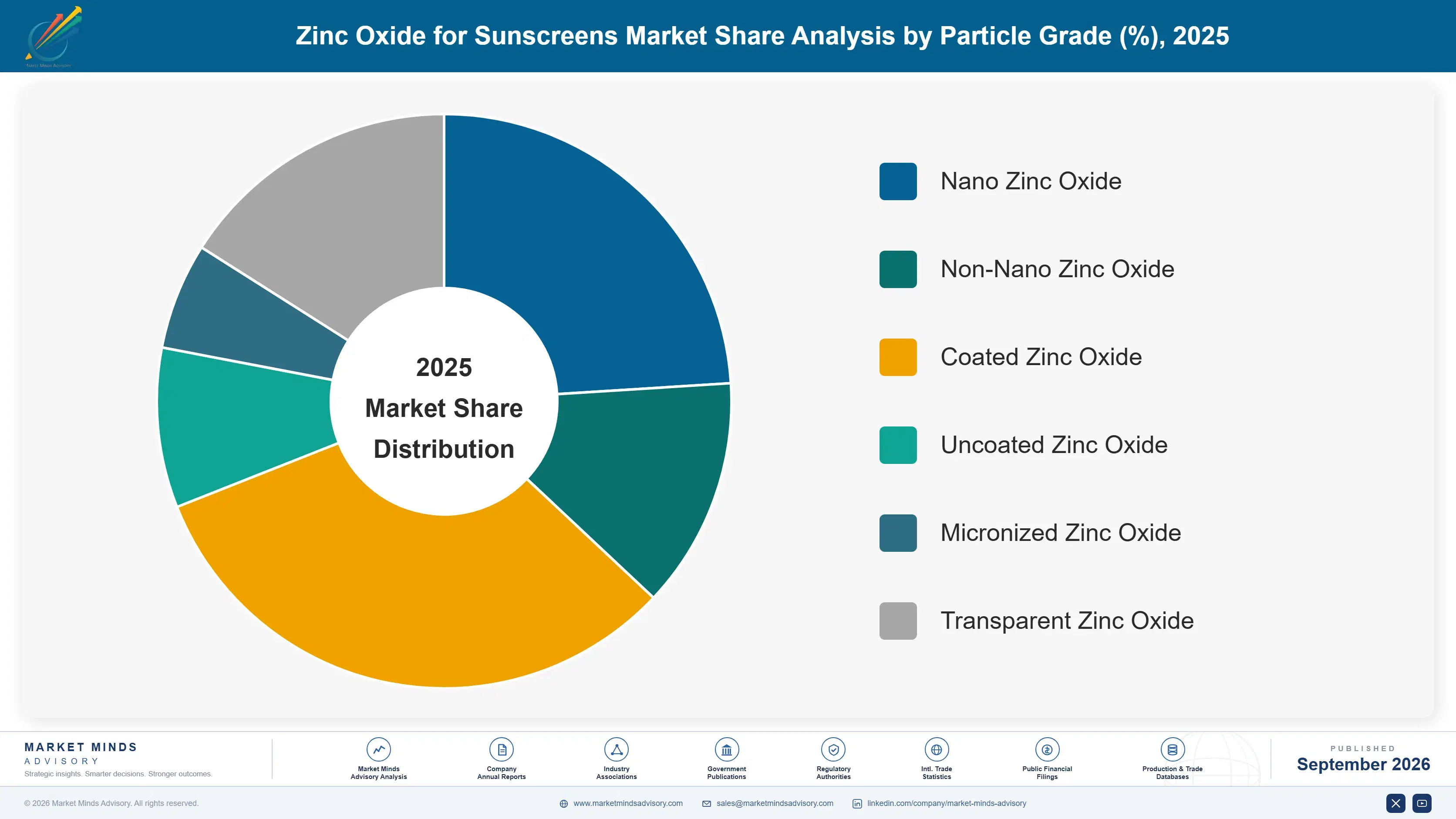
Segment CAGR and Growth Architecture

Segmentation follows particle grade, the classification formulators themselves use when qualifying UV filters, since nano, non-nano, and coated zinc oxide grades serve distinct formulation roles with materially different sourcing economics, verification requirements, and margin structures across drugstore and specialty retail channels nationwide and across export markets throughout the broader industry each passing year and well beyond.
zinc-oxide-for-sunscreens-market-market-share-analysis-1790018299080

Non-Nano Zinc Oxide Particles

Non-nano zinc oxide particles, engineered above 100 nanometers to satisfy reef-safety and regulatory particle size thresholds, are the fastest-growing segment as formulators increasingly prioritize documented environmental safety alongside UV protection performance. Coated variants lead this category, with specialty processing routes now supplying a growing share of global volume as manufacturing capacity scales across China, the United States, and increasingly Australia. Formulators value these ingredients for combining strong measurable broad-spectrum performance with reef-safety documentation that supports premium marketing claims across multiple product lines. Growth is concentrated among suppliers who invested early in particle engineering infrastructure, since capacity constraints and multi-year qualification timelines make rapid entry difficult for competitors starting from conventional nano production backgrounds.
CAGR 12.8%

Coated Zinc Oxide Grades

Coated zinc oxide grades are growing rapidly as formulators increasingly seek surface-treated particles that improve dispersion and reduce whitening effects across most consumer product categories and geographies worldwide and well beyond indeed. These ingredients command strong pricing power because reliable surface coating remains technically demanding and few suppliers have achieved consistent particle uniformity and stability at scale. Prestige and clean-label brands are building entire product lines around coated zinc oxide claims, citing improved cosmetic elegance rather than relying solely on cost comparisons. Demand is expanding beyond traditional beach sunscreen categories into everyday facial SPF products, broadening the addressable customer base for suppliers with proven coating capability and established quality control systems.
CAGR 11.0%
Full segment breakdown across 6 segments available in the complete report.

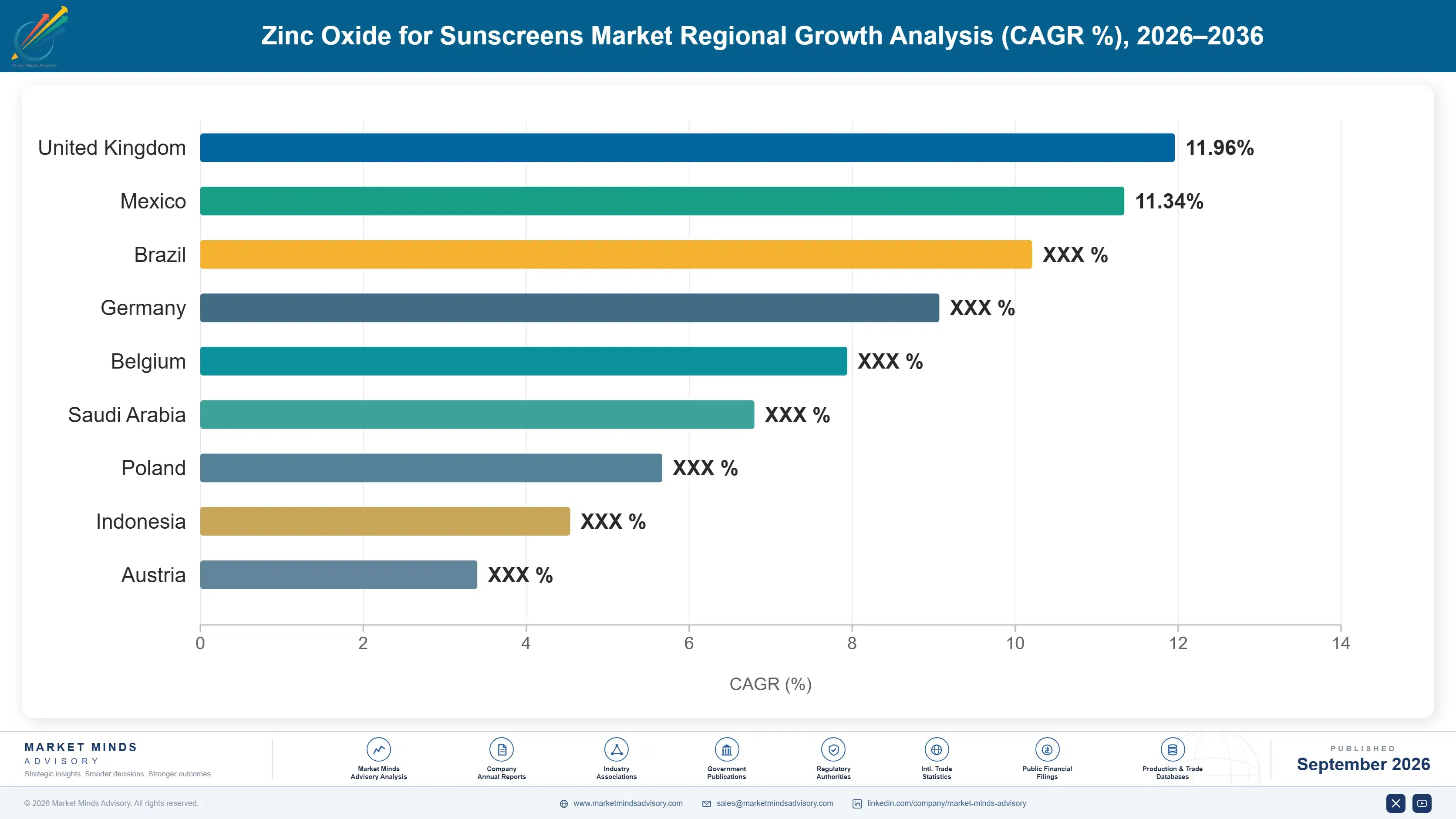
Regional Architecture and Country Demand Map

Demand concentrates in China's zinc oxide manufacturing base and North America's premium mineral sunscreen formulation activity, while South Asia and the Pacific post the fastest regional growth as rising sun protection awareness expands the addressable consumer base each passing year and well beyond that too.

East Asia

East Asia hosts the largest production base of zinc oxide ingredients worldwide, with China hosting established zinc processing infrastructure that supplies both nano and non-nano grades to sunscreen formulators across export markets throughout the region and well beyond steadily and reliably and consistently indeed and thoroughly. China's zinc smelting and processing industry additionally serves as a cost anchor, with large-scale production facilities supplying particle grades at prices few other regions can match nationwide. Japan and South Korea's cosmetic industries additionally serve as innovation testing grounds, with new coating formats frequently launching there before wider international adoption across other manufacturing and consumer markets throughout the region each year and well beyond.
Share: 30% | CAGR: 9.0% (2026 to 2036)

North America

North America's zinc oxide for sunscreens market is anchored by dermatologist recommendation culture, where formulators pay premiums for documented non-nano and reef-safety compliant grades that support mineral sunscreen claims across drugstore and specialty retail channels nationwide and beyond. The United States dominates regional demand, supported by a dense concentration of prestige skincare brand headquarters and a mature regulatory testing infrastructure that ingredient suppliers rely on for compliance substantiation. Canada contributes a smaller but steadily growing share, particularly in natural and reef-safe formulation positioning across its domestic retail channels and export relationships. Retailer disclosure requirements are tightening across the region, pushing formulators toward certified non-nano alternatives faster than in many other markets worldwide.
Share: 25% | CAGR: 9.9% (2026 to 2036)
Regional intelligence for 5 additional markets available in the complete report: Western Europe, South Asia and Pacific, Latin America, Middle East and Africa, Eastern Europe. Contact sales@marketmindsadvisory.com.
zinc-oxide-for-sunscreens-market-country-cagr-analysis-1790018300212

Monetizing Reef-Safety Trust and Particle Science

Revenue growth in this category increasingly depends on monetizing reef-safety verification rather than volume alone, as formulators pay meaningful premiums for documented particle size compliance, sustainability credentials, and licensing access to proprietary coating technology across drugstore and specialty retail channels nationwide and beyond each passing year and across most categories, regions, and formulation segments overall.

Non-Nano Compliance Premium Pricing Strategy Across Channels

Suppliers with third-party non-nano particle certification and documented reef-safety data can command meaningful price premiums over uncertified competitors selling functionally similar zinc oxide grades across most product categories and geographies worldwide and beyond. Formulators increasingly budget separately for verified ingredients, treating certification as a distinct line item rather than a marketing nicety across their sourcing decisions and supplier evaluations. Building this certification pipeline requires upfront investment in third-party testing, but suppliers who complete it report premiums averaging 19 percent above unverified equivalents, sustained across multiple contract renewal cycles with existing formulation customers nationwide.
Market Impact: Supports premiums averaging 19 percent above unverified claims

Custom Coating Development Service Revenue Stream

Beyond selling raw particles, suppliers are increasingly offering custom coating development services that help brand customers build finished cosmetic-elegant formulations around their zinc oxide platforms efficiently and cost-effectively across most product categories and geographies. This shifts the commercial relationship from transactional ingredient sales toward embedded technical partnership, increasing switching costs and average account value simultaneously across most accounts and product categories. Suppliers offering these services report they now generate roughly 14 percent of total account value, a meaningful revenue stream layered on top of core ingredient sales and recurring orders.
Market Impact: Generates roughly 14 percent of total account value

Particle Coating Technology Licensing Partnership Model Expansion

Suppliers holding proprietary surface coating processes are increasingly licensing this technology to regional manufacturers rather than exporting finished particles across long supply chains and multiple customs jurisdictions worldwide and well beyond. This model generates royalty income while reducing capital exposure and shipping costs, and it positions licensors closer to fast-growing regional demand centers without requiring direct capital investment upfront. Early licensing agreements are structured around a roughly 5 percent wholesale price royalty overall, providing a scalable revenue stream tied to regional production volume growth over time and beyond that too.
Market Impact: Generates roughly 5 percent wholesale price royalty overall

Reef-Safety Certification Retail Placement Advantage Strategy

Retailers are increasingly favoring formulations built from reef-safety certified, non-nano zinc oxide when allocating premium shelf placement and marketing support, giving certified suppliers indirect commercial advantage over formulation decisions across most retail categories and channels nationwide and well beyond each year. Brand customers using certified ingredients report stronger retail negotiating positions and faster new product listing approval timelines nationwide and well beyond. Suppliers report that formulations built around reef-safety certified zinc oxide increase formulation win rates by 21 percent overall relative to comparable uncertified proposals submitted to the same brand customers each year.
Market Impact: Increases formulation win rates by 21 percent overall

Who Controls the Margin Pool

The zinc oxide for sunscreens market shows meaningful concentration, with the top five suppliers holding roughly 46 percent combined participation on a production capacity basis nationwide. The gap between leading suppliers and mid-tier challengers has widened over the past several years as non-nano particle engineering investment increasingly separates capable participants from those still reliant on conventional nano production routes across most regional markets and geographies.
Current competitive activity centers on three dimensions: expanding non-nano particle engineering and coating capacity, securing third-party reef-safety certification, and building direct formulation partnership relationships with mineral sunscreen brands nationwide. Several leading suppliers have announced new production facilities over the past two years, while smaller specialty producers are differentiating through faster customization and technical support rather than competing on scale alone across most product categories.

Emerging pressure comes from mineral processing companies entering from adjacent industrial materials and pharmaceutical categories, bringing particle engineering expertise developed for other applications and industries. Rankings could shift meaningfully over the next several years as reef-safety requirements tighten further, favoring suppliers who invested early in non-nano verification infrastructure over legacy nano producers slower to adapt their production and quality systems accordingly and consistently.
zinc-oxide-for-sunscreens-market-company-positioning-matrix-1790018301220

Competitive Moat and Risk Dimensions

EVERZINC

Moat: Established Zinc Processing Scale

EverZinc's decades of zinc processing expertise and existing manufacturing infrastructure across multiple countries give it meaningful cost and speed advantages when qualifying new non-nano particle grades, letting the company move faster than smaller competitors still building comparable capacity from scratch across most product categories and geographies worldwide and well beyond.
EVERZINC

Risk: Slower Niche Innovation Pace

Larger organizational scale makes EverZinc comparatively slower to commercialize narrow, highly specialized particle innovations than smaller focused competitors, who can move faster from laboratory discovery to market launch without navigating multiple internal approval layers and portfolio prioritization processes across the broader organization and its various business units.
ZOCHEM

Moat: Proprietary Non-Nano Coating Technology

Zochem holds patented non-nano surface coating processes that achieve dispersion and cosmetic elegance levels few competitors can reliably match at commercial scale, giving the company differentiated positioning in the fastest-growing premium mineral sunscreen segment of the category across most major markets and regions worldwide and well beyond.
ZOCHEM

Risk: Limited Geographic Production Scale

Compared to competitors with broader global production infrastructure, Zochem's North America-concentrated manufacturing footprint is more concentrated, leaving the company more exposed to single-facility disruption risk and less able to flexibly reallocate capacity across multiple regional markets during demand shifts and unexpected market disruptions nationwide and beyond.

Players Tracked

Prominent Players

EverZinc
Zochem
US Zinc
Umicore
Sun Chemical

Other Key Players

BASF
Symrise
Croda International
DSM-Firmenich
Kobo Products
Sensient Technologies
Ashland
Clariant
Evonik Industries
Grillo-Werke
Pan Asia Chemical
Nanophase Technologies
Antaria Limited
Nanogap
Advanced Nano Products

Recent Developments

MARCH 2025

EverZinc Expands Non-Nano Production Facility

EverZinc announced an expansion of its non-nano zinc oxide production facility in North America, adding capacity dedicated to reef-safety compliant particle grades for mineral sunscreen applications across multiple regions. The expansion responds to accelerating demand from formulators seeking documented environmental compliance across their ingredient supply chains worldwide.
Signal: Signals continued non-nano particle capacity investment ahead of accelerating reef-safety compliance demand growth across major regional markets.
JULY 2025

Zochem Launches Certified Coated Zinc Platform

Zochem launched a new certified coated zinc oxide platform targeting mineral sunscreen formulators, backed by peer-reviewed dispersion performance data and third-party reef-safety certification documentation. The launch positions the company to capture disproportionate share of premium formulation demand across major markets worldwide and beyond each year.
Signal: Signals accelerating premiumization as suppliers increasingly pair particle performance data with reef-safety certification across product lines.
NOVEMBER 2025

Specialty Mineral Company Enters Non-Nano Segment

A leading specialty mineral company announced entry into non-nano zinc oxide production, committing capital toward new particle engineering capacity in Asia. The move reflects broader industry recognition that non-nano production routes are becoming a competitive necessity rather than a differentiator across the category and its adjacent segments worldwide.
Signal: Signals non-nano particle engineering technology diffusing beyond specialist zinc suppliers into the broader specialty minerals industry overall.

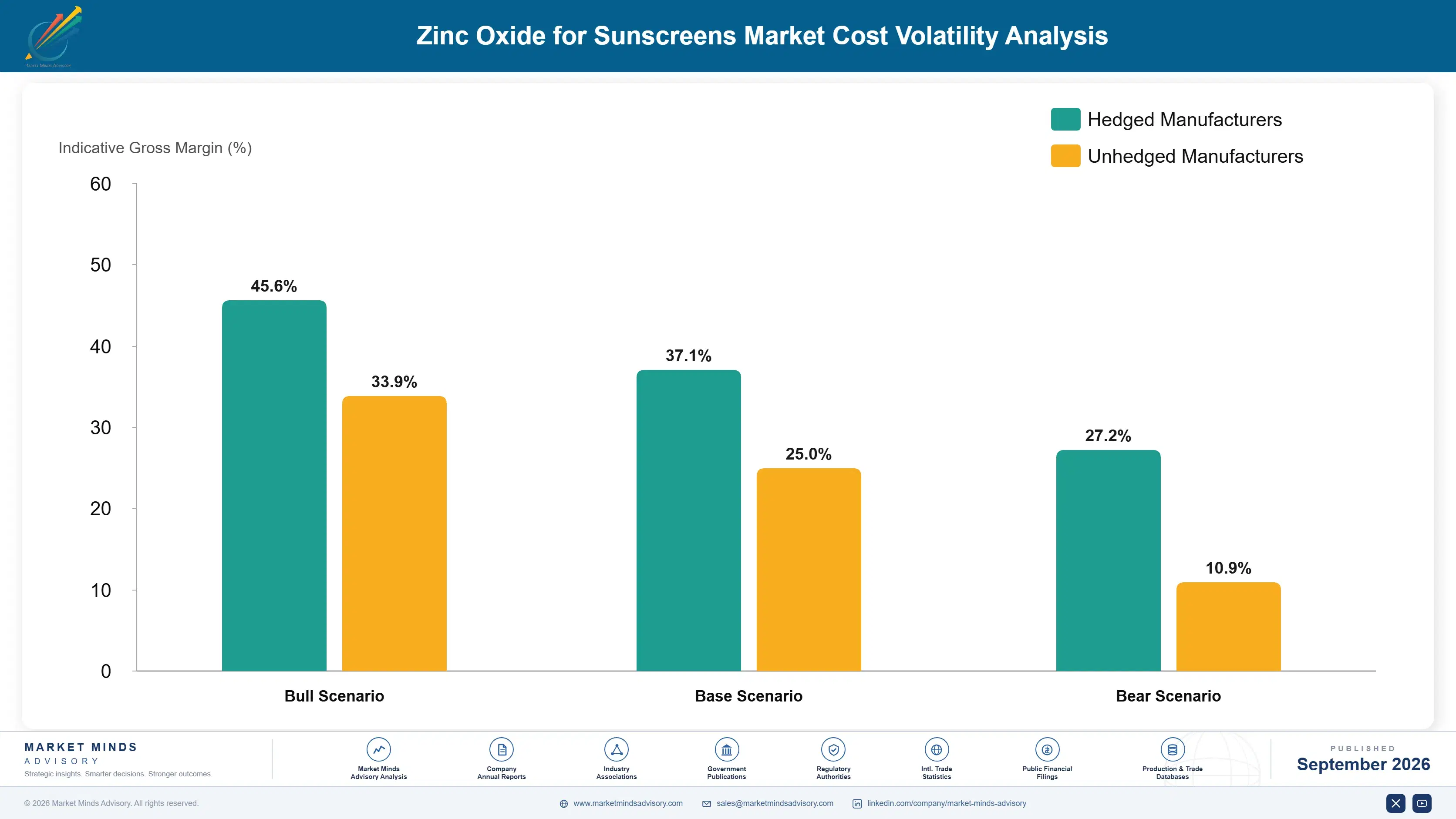
Zinc Metal Feedstock Exposure and Volatility

Zinc metal, the primary feedstock for zinc oxide production, accounts for roughly 34 percent of cost of goods sold across the category, sourced primarily from mining and smelting operations in China, Peru, and Australia nationwide and across most producing regions worldwide and beyond. Coating and surface treatment inputs add further exposure through specialty chemical pricing volatility.
Zinc metal prices spiked roughly 23 percent during 2022 following reduced mining output linked to energy shortages in major producing regions, based on EIA commodity reporting and company annual report commentary, forcing several ingredient suppliers to temporarily delay new product launches while managing near-term margin pressure across their production operations nationwide. Prices partially stabilized through 2023 and 2024 as mining output normalized across major producing regions and their broader supply networks.

Smaller ingredient suppliers without vertically integrated zinc smelting capacity face disproportionate exposure to metal price volatility, since they lack the scale to negotiate multi-year supply contracts that larger competitors secure routinely. This creates a persistent competitive disadvantage for regional producers in Latin America and Southeast Asia, who must pass volatility through to formulation customers faster than scaled competitors with diversified sourcing and stronger balance sheets.
zinc-oxide-for-sunscreens-market-cost-volatility-analysis-1790018301639

Diversifying Zinc Metal Feedstock Sourcing Regions

Manufacturers are qualifying zinc metal suppliers across China, Peru, Australia, and North America rather than relying on a single sourcing region, reducing exposure to any single country's price volatility or supply disruption nationwide and beyond. This multi-region approach adds modest qualification costs upfront but meaningfully shortens recovery time when disruption affects any single supplier base nationwide.

Locking Multi-Year Pricing Agreements With Zinc Suppliers

Larger manufacturers are negotiating three-year fixed pricing contracts directly with zinc metal suppliers, trading some flexibility for protection against spot market price swings during supply disruptions. This approach favors scale manufacturers with reliable order volumes, leaving smaller producers more exposed to spot pricing during future feedstock shortages across the wider industry and its broader supplier base.

Expanding Domestic Zinc Smelting Capacity

Some manufacturers are investing directly in domestic zinc smelting and processing capacity, trading upfront capital for longer-term supply certainty that reduces dependence on imported zinc metal pricing entirely and consistently nationwide and beyond steadily. This approach requires significant capital commitment but reduces exposure to both feedstock price volatility and international supply chain disruption simultaneously.

Portfolio Architecture for Margin Defence

Zinc oxide portfolios separate into three distinct margin bands depending on particle grade sophistication. Commodity nano-grade particles compete almost entirely on price, with gross margins compressed by zinc feedstock costs and limited differentiation between suppliers across most regional markets and their broader distribution networks nationwide. Volume in this tier remains substantial, but pricing power keeps eroding as regional producers enter aggressively.
Certified non-nano zinc oxide grades occupy the middle tier, where formulators pay a premium for documented reef-safety compliance and particle size testing that supports marketing claims to brand customers seeking defensible product positioning nationwide. This tier carries meaningfully stronger margins than commodity ingredients because verification barriers limit which suppliers can credibly compete for premium formulation contracts and long-term accounts across multiple product categories.

Coated, next-generation zinc oxide grades sit at the top, where surface treatment technology and cosmetic elegance formulations command the strongest pricing power industry-wide. Most manufacturers hold positions across at least two tiers simultaneously, using commodity volume to fund margin-accretive investment in premium particle development pipelines each passing year and across their broader innovation portfolios, where the highest-value pools continue concentrating steadily.

Volume / Commodity-Adjacent Tier

Basic nano-grade zinc oxide particles sold on price with minimal differentiation, competing primarily through cost efficiency and reliable large-volume supply to mass-market sunscreen and personal care formulators across most product categories nationwide.
Gross Margin: 14-20%

Premium / Certified Tier

Certified non-nano zinc oxide grades carrying documented reef-safety compliance, particle size testing, and traceable sourcing that supports premium brand marketing claims and retail positioning across mineral sunscreen and dermocosmetic product lines targeting discerning formulators.
Gross Margin: 30-40%

Sustainability / Regulatory / Next-Generation Tier

Coated, next-generation zinc oxide grades with patented surface treatment technology, commanding the strongest pricing power through demonstrable dispersion advantages and cosmetic elegance credentials that resonate with regulatory bodies and formulators alike.
Gross Margin: 42-54%
zinc-oxide-for-sunscreens-market-portfolio-architecture-1790018302596

High-value Sub-segments and Strategic Watch-out

Non-Nano Zinc Oxide Grades

Non-nano zinc oxide grades combine premium pricing with the fastest unit growth in the category, driven by brand demand for reef-safety compliant particles with verified environmental credentials and superior mineral sunscreen performance data that supports defensible premium claims across drugstore and specialty retail channels alike, nationwide and increasingly overseas.
Gross Margin: 42-54%

Coated Zinc Oxide Grades

Coated zinc oxide grades carry strong margins and steady double-digit growth, supported by formulator preference for improved dispersion and cosmetic elegance that brands increasingly feature in premium product marketing claims across both prestige and expanding mass-market retail channels nationwide and across export markets and their broader distribution networks.
Gross Margin: 28-38%

Conventional Nano-Grade Particles

Conventional nano-grade zinc oxide particles remain the largest volume base for the category, generating reliable revenue despite thinner margins, and continue anchoring mass-market formulations across most price-sensitive retail channels and private-label programs that depend on consistent, large-scale ingredient supply relationships built over many years of steady partnership.
Gross Margin: 14-20%

Uncoated Conventional Formulations

Uncoated conventional formulations face rising regulatory scrutiny across multiple jurisdictions, and manufacturers slow to reformulate toward accepted alternatives risk losing shelf placement as retailers tighten ingredient disclosure requirements and consumer advocacy groups push for faster reformulation timelines industry-wide over the next several years and beyond.
Gross Margin: 12-18%

Formulation Loyalty and Adoption Depth

Zinc oxide ingredient relationships function on annuity economics once a formulator qualifies a supplier into an approved sunscreen product line. Reformulation costs, stability retesting, and regulatory resubmission make switching expensive, so qualified suppliers retain accounts for multiple product generations rather than competing for each purchase order individually, generating predictable revenue streams that extend well beyond the initial qualification period and often across several years of steady reordering.
Adoption depth varies sharply by end-use vertical. Prestige mineral sunscreen brands embed non-nano zinc oxide deeply into hero product formulations and rarely substitute once reef-safety claims are built around a specific particle grade, while mass-market personal care manufacturers treat commodity nano-grade particles as more interchangeable, switching suppliers opportunistically when pricing shifts materially across their broader sourcing base and procurement relationships nationwide.

Buyer profiles are shifting generationally as formulation chemists increasingly prioritize reef-safety documentation and particle traceability alongside traditional performance and cost criteria. Younger procurement teams entering brand organizations expect digital certificates of analysis and third-party verification as standard practice rather than optional supplier accommodation, reshaping how long-standing ingredient relationships are renewed and evaluated each contract cycle across the wider supplier base.
zinc-oxide-for-sunscreens-market-end-use-penetration-index-1790018303499

Where Zinc Oxide Ingredient Value Concentrates

These are among the four positions where our research anticipates prominent divergence between winners and laggards over the coming forecast period. Each is grounded in the demand model, the regulatory perimeter, and the announced capacity pipeline.
01 / REEF-SAFETY CERTIFICATION INVESTMENT

Prioritize documented particle size compliance over marketing claims alone

Formulators increasingly demand reef-safety certification before committing to long-term ingredient contracts, and suppliers without documented particle size compliance are losing shelf placement to competitors with verified environmental claims across prestige and mass-market channels alike. Building a certified testing pipeline now costs less than retrofitting credibility after losing a major brand account to a better-documented competitor with a longer verification track record. Manufacturers that delay this investment risk permanent exclusion from premium formulation programs as verification becomes a baseline requirement rather than a differentiator industry-wide.
02 / NON-NANO PARTICLE CAPACITY EXPANSION

Build non-nano particle capacity before demand outpaces supply

Non-nano zinc oxide grades are growing meaningfully faster than the overall category, and suppliers without dedicated particle engineering infrastructure will struggle to participate in this margin-accretive segment as demand accelerates across mineral sunscreen and dermocosmetic channels. Capital committed today secures capacity before competitors lock in contract manufacturing slots, which are already tightening across major production hubs in China and North America. Waiting until demand signals become unambiguous means entering the segment years behind established particle-capable competitors with deeper customer relationships.
03 / REGIONAL MANUFACTURING DIVERSIFICATION

Diversify production footprint across multiple manufacturing regions

Concentrating production in a single region exposes manufacturers to feedstock price shocks and trade policy shifts that can erase margin within a single quarter of unfavorable pricing movement industry-wide and beyond. Establishing secondary production capacity across at least two regions reduces this exposure while positioning suppliers closer to fast-growing demand centers in South Asia and the Pacific and other emerging markets. This diversification carries upfront cost but meaningfully shortens recovery time whenever disruption affects any single sourcing region or supplier base.
04 / COATING TECHNOLOGY DEVELOPMENT

Secure proprietary coating technology ahead of formulation win rate escalation

Cosmetic elegance and dispersion performance are rapidly becoming the primary battleground for premium positioning, and suppliers without proprietary coating capability will struggle to substantiate next-generation claims as competitors accelerate investment nationwide and across most categories. Establishing dedicated coating research capacity today secures technical credibility before rivals lock in exclusive formulation partnerships and patent pipelines that are already tightening across major production hubs. This diversification carries meaningful upfront cost but positions early movers to define the next decade of category claims.

Engagement Snapshot From the Field

A live engagement with an industry participant carrying material or product regulatory and market exposure ahead of a defining policy shift, showing how our research translates into a defensible multi-year portfolio strategy.
MARKET MINDS ADVISORY · CLIENT ENGAGEMENT SUMMARY
Zinc Oxide for Sunscreens Producer Strategic Portfolio Review and Transition Roadmap 2026·Investment Scenario on Zinc Oxide for Sunscreens Exposure Evaluation 2025-26
CLIENT PROFILE
The client is a mid-sized mineral sunscreen brand generating approximately 90 million dollars in annual revenue (client-reported, unverified by MMA), with a growing portfolio of reef-safety certified SPF products distributed primarily through specialty retail and direct-to-consumer digital channels across North America and Western Europe. The brand had built its reputation on dermatologist-endorsed formulations and sought to extend that positioning into new international markets.
STRATEGIC CHALLENGE
The client's flagship sunscreen relied on a single-source zinc oxide supplier facing rising cost pressure and tightening reef-safety disclosure requirements from key retail partners. Leadership needed an independent assessment of alternative ingredient options before committing to a reformulation timeline, given the flagship product represented roughly a third of total company revenue.
MMA APPROACH
MMA conducted supplier capability mapping across five candidate ingredient providers, benchmarking documented particle size data, reef-safety certification status, and production capacity against the client's volume and cost requirements. The engagement combined primary supplier interviews with formulation stability review and a comparative cost analysis spanning a twelve-month sourcing horizon across two candidate manufacturing regions.
KEY FINDINGS
  1. Two of five candidate suppliers offered non-nano alternatives with comparable performance data and stronger reef-safety documentation than the incumbent ingredient supplier overall.
  2. Switching costs were lower than anticipated because both alternative suppliers already held relevant regulatory registrations across the client's primary retail markets and distribution regions.
  3. The incumbent supplier's pricing included a premium of roughly 15 percent (client-reported, unverified by MMA) relative to comparable non-nano alternatives available in the market.
  4. Retail partners indicated stronger shelf support for products carrying third-party reef-safety certification, a factor absent from the client's original sourcing evaluation criteria and scoring model.
CLIENT PROFILE
The client is a mid-sized mineral sunscreen brand generating approximately 90 million dollars in annual revenue (client-reported, unverified by MMA), with a growing portfolio of reef-safety certified SPF products distributed primarily through specialty retail and direct-to-consumer digital channels across North America and Western Europe. The brand had built its reputation on dermatologist-endorsed formulations and sought to extend that positioning into new international markets.
STRATEGIC CHALLENGE
The client's flagship sunscreen relied on a single-source zinc oxide supplier facing rising cost pressure and tightening reef-safety disclosure requirements from key retail partners. Leadership needed an independent assessment of alternative ingredient options before committing to a reformulation timeline, given the flagship product represented roughly a third of total company revenue.
MMA APPROACH
MMA conducted supplier capability mapping across five candidate ingredient providers, benchmarking documented particle size data, reef-safety certification status, and production capacity against the client's volume and cost requirements. The engagement combined primary supplier interviews with formulation stability review and a comparative cost analysis spanning a twelve-month sourcing horizon across two candidate manufacturing regions.
KEY FINDINGS
  1. Two of five candidate suppliers offered non-nano alternatives with comparable performance data and stronger reef-safety documentation than the incumbent ingredient supplier overall.
  2. Switching costs were lower than anticipated because both alternative suppliers already held relevant regulatory registrations across the client's primary retail markets and distribution regions.
  3. The incumbent supplier's pricing included a premium of roughly 15 percent (client-reported, unverified by MMA) relative to comparable non-nano alternatives available in the market.
  4. Retail partners indicated stronger shelf support for products carrying third-party reef-safety certification, a factor absent from the client's original sourcing evaluation criteria and scoring model.
RECOMMENDED STRATEGY
Phase 1: Phase 1 (Assessment): Complete supplier qualification testing and stability trials with the two leading alternative non-nano ingredient candidates identified overall. Phase 2: Phase 2 (Transition): Reformulate the flagship sunscreen line and secure third-party reef-safety certification ahead of the next retail buying cycle. Phase 3: Phase 3 (Expansion): Extend the certified ingredient platform across adjacent product lines to consolidate supplier relationships and strengthen overall margin.
OUTCOME
The client completed reformulation within nine months and secured expanded shelf placement with two major retail partners citing the new reef-safety certification. Ingredient costs declined approximately 11 percent (client-reported, unverified by MMA) following the supplier transition, funding further reformulation investment across the broader product portfolio going forward.

Frequently Asked Questions

Foundational context covering the market sizes, CAGR, scope, country, region and competition that inform every finding below. This section is provided to cover basics and most often pre-purchase conversations, answered from the MMA Primary Research Dataset.

What is the current size of the Zinc Oxide for Sunscreens Market?

The global zinc oxide for sunscreens market was valued at approximately 1.1 billion dollars in 2025, spanning nano, non-nano, and coated particle grades used across mineral sunscreen and daily SPF formulations worldwide.

How large will the Zinc Oxide for Sunscreens Market be by 2036?

MMA projects the market will reach approximately 2.7 billion dollars by 2036, driven by rising coral reef safety regulation and demand for clinically substantiated non-nano zinc oxide formulations globally.

What is the CAGR for the Zinc Oxide for Sunscreens Market 2026 to 2036?

The market is forecast to grow at a compound annual rate of 8.5 percent between 2026 and 2036, reflecting steady demand expansion across both established and emerging mineral sunscreen markets.

Which segment is growing fastest?

Non-nano zinc oxide particles are the fastest-growing segment, expanding at roughly 1.51 times the overall market rate as formulators increasingly prioritize documented reef-safety compliance alongside UV protection performance.

Who are the major companies in the Zinc Oxide for Sunscreens Market?

Leading participants include EverZinc, Zochem, US Zinc, Umicore, and Sun Chemical, alongside numerous specialty mineral suppliers competing on documented particle compliance and overall production capacity.

Which country is growing fastest?

India is growing fastest among major markets, supported by its expanding personal care manufacturing base and government incentives that reduce dependence on imported zinc oxide grades from overseas suppliers.

Report Segmentation Architecture

The full report scope spans multiple orthogonal segmentation dimensions, with cross-tabulated demand data provided for each dimension pair. Coverage extends further to regional breakdowns, trend trajectories, and the competitive detail needed to support segment-level decision-making.

By Particle Grade

  • Nano Zinc Oxide
  • Non-Nano Zinc Oxide
  • Coated Zinc Oxide
  • Uncoated Zinc Oxide
  • Micronized Zinc Oxide
  • Transparent Zinc Oxide

By End-Use Application

  • Facial SPF Products
  • Body Sunscreen Products
  • Daily Moisturizer SPF
  • Sport and Water-Resistant Formulas
  • Baby and Sensitive Skin SPF

By Commercial Dimension

  • Prestige Dermocosmetic Brands
  • Mass-Market Personal Care
  • Private Label Manufacturers
  • Contract Formulation Services

By Region

  • North America
  • Western Europe
  • East Asia
  • South Asia and Pacific
  • Latin America
  • Middle East and Africa
  • Eastern Europe

Scope, Methodology, and Coverage

Every figure in this report is reproducible from documented input assumptions. The scope below maps the historical period, the forecast horizon, the segmentation dimensions, and the countries covered, alongside the underlying primary and qualitative methodology.
Historical Period
2020 to 2025
Forecast Period
2026 to 2036
Base Year
2025 (USD billions; MMA Primary Research Dataset, September 2026)
Market Definition
The zinc oxide for sunscreens market comprises nano and non-nano zinc oxide particles engineered as broad-spectrum physical UV filters formulated into mineral sunscreen and daily SPF products. It excludes chemical UV filter actives, finished sunscreen products sold independently of the ingredient supply chain, and zinc oxide grades used in non-cosmetic industrial applications.
Quantitative Units
USD billions (current prices); metric tons where applicable
Segmentation Dimensions
By Particle Grade; By End-Use Application; By Commercial Dimension; By Region
Regions Covered
North America, Western Europe, East Asia, South Asia and Pacific, Latin America, Middle East and Africa, Eastern Europe
Countries Covered
USA, China, Germany, France, UK, Japan, South Korea, India, Australia, Canada, Brazil, Mexico, Indonesia, Vietnam, Thailand, Malaysia, UAE, Saudi Arabia, South Africa, Nigeria, Turkey, Poland, Netherlands, Italy, Spain, Sweden, Switzerland, Argentina, Colombia, Singapore, and additional markets relevant to this sector
Key Companies Profiled
EverZinc, Zochem, US Zinc, Umicore, Sun Chemical, BASF, Symrise, Croda International, DSM-Firmenich, Kobo Products, Sensient Technologies, Ashland, Clariant, Evonik Industries, Grillo-Werke, Pan Asia Chemical, Nanophase Technologies, Antaria Limited, Nanogap, Advanced Nano Products
Quantitative Methodology
Primary survey, n=3,800 respondents, Q4 2025, six countries; demand-side model with trade association cross-validation
Qualitative Methodology
47 expert interviews, Q4 2025; applied to validate demand model assumptions, identify emerging dynamics, and assess competitive positioning
Report Format
PDF and XLSX data workbook (Word format preview document)
Publisher
Market Minds Advisory
Report Code
MMA-2026-CHM-714
Published
September 2026
Contact
sales@marketmindsadvisory.com | www.marketmindsadvisory.com

Purchase the full Zinc Oxide for Sunscreens Market Report (2026 to 2036).

The full report delivers a complete assessment of the zinc oxide for sunscreens market, covering ten-year forecasts, detailed segmentation analysis, and regional demand mapping across seven geographies. It profiles twenty companies with competitive positioning, moat and risk analysis, and recent strategic developments across the ingredient supply base. The report includes input cost exposure, portfolio margin architecture, and actionable revenue lever recommendations for formulators and ingredient suppliers navigating shifting regulatory and reef-safety requirements. Buyers also receive access to primary survey findings and expert interview transcripts underpinning every quantitative estimate in the analysis.
Ten-year quantitative forecast model, 2026 to 2036
Seven-region demand mapping and pricing breakdown
Twenty-company competitive profiles with moat analysis
Segment-level growth rate and margin benchmarking
Input cost exposure and mitigation strategy guide
Primary survey and expert interview data appendix

Built For The People Who Decide

From boardroom strategy to bench-side execution, this report is read cover-to-cover by leaders shaping the next decade of their industry, turning demand scenarios, market dynamics and valuation benchmarks into decisions.
CXOs/ Presidents/ VPs/ Managers
M&A and Corporate Development
Strategy Teams and R&D Heads
Procurement and Product Directors
Regulatory and Compliance Leaders
Investor Relations and Equity Analysts