Market Minds Advisory
Zinc Chloride Market

Zinc Chloride Market: metal cost pass-through, freight economics and grade qualification

Half of every tonne shipped is water, zinc metal sets nearly sixty percent of the cost, and the only producers earning real margin are those who solved one of those two problems properly.

Lead Analyst

Bilal Shaikh

Published

September 2026

Make Smarter Decisions with Customized Research Insights

Request a free sample report and evaluate market opportunities, growth trends, and competitive dynamics relevant to your business needs.

2025 MARKET VALUE$0.6BMarket Size 2025
2036 FORECAST VALUE$1.1BBase Case , 2026 to 2036
CAGR 2026 TO 20365.2 %Bull 6.4% / Bear 4.0%
INCREMENTAL OPPORTUNITY$0.4BNet 10- year value creation
EXPANSION MULTIPLE1.67x2036 value over 2026 base
Strategic Levers
M&A Pipeline
Regional Outlook
Country Rankings
Competitive Intelligence
Segmental Deep-dive
Call-Us : 91 93563 13602

Executive Snapshot and Market Trajectory

Zinc chloride is a freight business wearing a chemistry business as a disguise. Most of it ships as a 50% aqueous solution, which means half of every tanker is water, and the delivered cost of that water decides regional supply contracts far more often than product quality ever does.
Growth concentrates in catalyst and activation grade material, expanding at 7.8%, where high-purity zinc chloride activates carbon for water treatment, gas purification and battery electrode applications that barely existed as demand pools a decade ago. East Asia holds 36% of value, the largest regional share, because Chinese galvanising throughput, activated carbon manufacture and dry cell battery production all sit in the same industrial regions and consume the same product from the same producers.
The supplier base is moderately fragmented, with the top five holding 38% of production capacity, and it divides between integrated zinc processors, independent inorganic chemical houses and regional blenders serving galvanising customers locally. Competition runs on delivered cost and grade qualification rather than on chemistry. Secondary zinc feedstock access is the input position now separating the cost leaders from everybody else in this business.
Market Definition
Zinc chloride comprises the inorganic salt supplied as aqueous solution, anhydrous solid, and formulated blends with ammonium chloride for metal treatment, across technical, battery, pharmaceutical and high-purity activation grades. Sizing covers zinc chloride sold to industrial users and formulators at realised delivered price. Zinc oxide, zinc sulphate, zinc stearate and other zinc compounds, zinc metal itself, galvanising services performed on customer material, and activated carbon or finished batteries containing zinc chloride all fall outside scope.
Base Year Value
$0.6B in 2025 (MMA Primary Research Dataset, August 2026)
Forecast Period
2026 to 2036, eleven discrete annual values
CAGR
5.2% base case. Bull 6.4%. Bear 4.0%.
Fastest Growth Segment
Catalyst and Activation Grade: 7.8% CAGR
Fastest Growth Country
India: 8.0% CAGR
Fastest Growth Region
South Asia and Pacific: 7.5% CAGR
Largest Region
East Asia: 36% of 2025 global value
Market Leaders
Zinc Nacional, Zaclon, Weifang Menjie Chemical, Shandong Chuangying Chemical and Merck lead on zinc chloride production capacity across technical and specialty grades. Source: MMA Primary Research Dataset, July 2026.
Primary Survey
n=3,800 procurement and R&D decision-makers, Q4 2025, six countries
Methodology
Demand-side build-up, cross-validated against public data, 47 expert interviews

Zinc Chloride Market Forecast Scenarios

zinc-chloride-market-trends-size-forecast-scenario-1787310670350
Growth of 4.2% across 2020 to 2025 tracked zinc metal and galvanising activity far more closely than anything in chemistry. Construction and infrastructure demand for galvanised steel fell through 2020, recovered strongly from 2021, and pulled flux consumption behind it both ways. Zinc prices then moved violently through 2022, compressing margins for every producer who had priced contracts without an indexed pass-through clause.
The base case at 5.2% rests on three mechanisms. Activated carbon production keeps expanding for water treatment and gas purification, and chemical activation using zinc chloride remains the preferred route for the high surface area grades those duties need. Galvanising throughput grows with infrastructure spending across South Asia, Southeast Asia and the Gulf states. And pharmaceutical and food grade demand keeps rising as oral care, dental and veterinary applications expand across emerging healthcare systems.
The bull case at 6.4% turns on water treatment investment accelerating faster than modelled, since activated carbon consumption for per- and polyfluoroalkyl substance removal would raise activation grade demand beyond present projections. The bear case at 4.0% turns on substitution instead. Phosphoric acid and steam activation routes continue improving, and a meaningful shift would remove the fastest growing demand pool this market has.

Zinc chloride: metal cost against freight economics

Two numbers govern this market and neither has much to do with chemistry. Zinc metal accounts for roughly 58% of delivered cost, so the product is really a repriced commodity metal, and freight adds another 14% because most material ships as a 50% aqueous solution. Shipping water any real distance is what kills margin in this business, quietly and repeatedly, and it does so on contracts nobody examines closely enough.
TOP FIVE CONCENTRATION38%Share of global zinc chloride production capacity held collectively
ZINC INPUT COST SHARE58% of COGSPortion of delivered cost tied to the metal
GALVANISING FLUX SHARE31% of volumeLargest single application by consumed product tonnage globally
STANDARD SOLUTION STRENGTH50% w/wTypical concentration shipped for bulk industrial flux applications
FREIGHT COST SHARE14% of deliveredPortion of cost incurred shipping water in solution
SECONDARY FEEDSTOCK SHARE42%Portion of zinc input sourced from recycled streams
That structure explains why regional blenders survive against far larger producers. A blender within 300 kilometres of a galvanising cluster beats a national producer on delivered cost without doing anything clever, provided it can secure zinc units at a competitive price. Scale advantages that would be decisive in most chemical markets simply do not travel well in road tankers over any distance worth mentioning.
Value separates by grade rather than by geography. Galvanising flux is the largest volume application at 31% of tonnage and much the most price-driven of them all. Pharmaceutical, food and high-purity activation grades are where impurity control, documentation and qualification genuinely limit the field, and where realised pricing reflects that limitation properly rather than tracking the zinc price alone.
"Producers in this market keep benchmarking themselves on plant scale, which is the wrong measure entirely. The relevant question is how many tonnes of water you are paying to move, and the answer for most of them is far too many."
Director, Inorganic and Specialty Chemicals Practice · MMA Chemicals and Materia

Market Trends

Chemical activation demand rising with water treatment investment

Zinc chloride activation produces activated carbon with higher surface area and better microporosity than steam routes achieve, which matters where the duty is trace contaminant removal rather than bulk adsorption. Municipal and industrial water treatment investment aimed at per- and polyfluoroalkyl substances has raised demand for exactly those high-performance grades, and gas purification duty adds further volume behind it. Activation grade material requires impurity control that technical grade production does not deliver, so the supplier field narrows considerably. Producers holding that capability capture the fastest growing demand pool this market has developed in decades.
Market Impact: Consumes 31% of global product volu

Secondary zinc feedstock displacing prime metal in production

Roughly 42% of zinc units entering zinc chloride production now come from secondary sources: galvanising residues, electric arc furnace dust, brass ash and process drosses rather than from refined metal cathode. Secondary feedstock costs materially less than prime zinc while requiring purification steps that technical grade duty tolerates comfortably. Producers with established collection relationships and purification capability run a cost position that prime metal buyers simply cannot match at current spreads. The constraint here is feedstock access rather than processing technology, and the good collection relationships are being contracted right now.
Market Impact: Commands 3 times technical grade pr

Market Opportunities and Growth Drivers

Galvanising throughput expanding with infrastructure investment across emerging markets

Hot dip galvanising consumes zinc chloride and ammonium chloride flux at a fairly fixed ratio to steel surface area processed, so flux demand tracks galvanising throughput almost mechanically. Infrastructure programmes across India, Southeast Asia and the Gulf keep adding galvanising line capacity, and corrosion protection requirements in those climates are more demanding than in temperate regions. Galvanising flux already accounts for 31% of global zinc chloride volume, and the incremental tonnes are appearing overwhelmingly in regions where new line capacity is being commissioned rather than where the existing lines happen to run today.
Market Impact: Adds 14% to delivered product cost

Pharmaceutical and oral care demand rising across emerging healthcare

Zinc chloride serves as an astringent and antimicrobial agent in mouthwash, dental cements, veterinary preparations and topical formulations, and demand for those products keeps rising as healthcare access broadens across South Asia, Southeast Asia and Latin America. Pharmacopoeial grade material requires heavy metal control, documented manufacturing practice and stability data that technical grade production cannot supply, which restricts the qualified supplier field sharply. Realised pricing runs at several times technical grade levels as a direct result. Very few producers have bothered to build the quality systems that pharmacopoeial qualification actually requires.
Market Impact: Exposes 58% of delivered cost

Market Restraints and Challenges

Freight economics limiting the addressable radius for producers

Most zinc chloride ships as a 50% aqueous solution, so roughly half of every tanker load is water that costs the same per kilometre as the product does. The root cause is application practice rather than chemistry: galvanising and textile users want solution they can meter directly, and handling anhydrous solid requires equipment and dust control most of them decline to install. Commercially this caps the radius any producer can serve profitably. Participants are responding with higher concentration solutions, regional blending arrangements and anhydrous supply into customers willing to invest in handling.
Market Impact: Grows 7.8% annually through 2036

Zinc price volatility eroding margin on contracted supply agreements

Zinc metal accounts for roughly 58% of delivered cost, and the metal has moved by more than a third within single years on several occasions. The root cause is that zinc pricing responds to mine supply, smelter treatment charges and Chinese refining economics, none of which bear any relationship to zinc chloride demand. Commercially this destroys margin on annual contracts priced before any such move. Producers are responding with indexed metal pass-through clauses, forward purchasing against contracted volumes and greater reliance on secondary feedstock priced away from the exchange entirely.
Market Impact: Supplies 42% of zinc input units
4 additional market trends, 2 additional growth drivers, and 3 additional restraints and challenges are covered in the full report. Contact sales@marketmindsadvisory.com to access the complete intelligence.

Segment CAGR and Growth Architecture

Segmentation follows product grade and physical form, because purity specification and the decision between solution and solid govern production route, qualification burden, freight economics and achievable pricing all at the same time. Six grades and forms cover the whole market, running from bulk technical solution through battery and pharmacopoeial material to the high-purity activation grade at the demanding end.
zinc-chloride-market-trends-market-share-analysis-1787310670883

Catalyst and Activation Grade

Expanding at 7.8%, a full 1.50 times the market rate, on high-purity material used to chemically activate carbon and to serve as a Lewis acid catalyst in organic synthesis. Chemical activation with zinc chloride produces carbon with higher surface area and better developed microporosity than steam routes achieve, which is precisely what trace contaminant removal duties require. Water treatment investment aimed at per- and polyfluoroalkyl substances has pulled that demand forward considerably, and gas purification duty adds substantial further volume behind it. Impurity control here is far tighter than technical grade production delivers, so the qualified supplier field is genuinely narrow and looks likely to remain that way for some years.
CAGR 7.8%

Pharmaceutical and Food Grade

Growing at 6.6% annually on pharmacopoeial and food contact grade material used in mouthwash, dental cements, veterinary preparations, topical formulations and as a processing aid where residue limits are enforced. Heavy metal control, documented good manufacturing practice and stability data all sit behind the specification, and assembling that whole package takes years rather than months of work. Realised pricing runs several times technical grade levels, which reflects the qualification barrier itself rather than any difference at all in the underlying chemistry involved. Demand rises steadily with broadening healthcare access across South Asia, Southeast Asia and Latin America, and remarkably few producers anywhere have built the quality systems that qualification genuinely requires.
CAGR 6.6%
Full segment breakdown across 6 segments available in the complete report.

Regional Architecture and Country Demand Map

Zinc chloride production sits close to both its zinc units and its consuming industries, because freight economics punish long hauls of aqueous solution unusually severely, which is what makes the geographic picture unusually local for what is otherwise a perfectly ordinary and globally traded commodity chemistry.

East Asia

Thirty-six percent of global value, comfortably the largest regional share, because Chinese galvanising throughput, activated carbon manufacture and dry cell battery production sit in the same industrial regions and they draw on the same producers for supply. Note: this exceeds the standard regional band because zinc chloride consumption follows galvanising and activated carbon capacity, both of which are concentrated in China to a degree no other measure captures. Japanese and Korean producers hold high-purity and pharmacopoeial grade positions serving electronics and healthcare customers across the wider region. Growth of 6.1% runs above the global rate, supported by activated carbon capacity additions and by continued galvanising line commissioning across the region.
Share: 36% | CAGR: 6.1% (2026 to 2036)

North America

Twenty-two percent of global value, anchored by Zinc Nacional in Mexico and Zaclon in the United States, both of them operating from secondary zinc feedstock positions built around galvanising residues, furnace dust and process drosses. Galvanising flux and oil field applications together consume the bulk of regional volume, with pharmaceutical and activation grades adding smaller but considerably better-paying tonnes on top of that base. Water treatment investment aimed at per- and polyfluoroalkyl substance removal is pulling activation grade demand forward considerably faster here than anywhere else in the world. Growth of 4.6% reflects mature galvanising throughput alongside activation grade demand that is genuinely accelerating away from a relatively small base.
Share: 22% | CAGR: 4.6% (2026 to 2036)
Regional intelligence for 5 additional markets available in the complete report: Western Europe, South Asia and Pacific, Latin America, Middle East and Africa, Eastern Europe. Contact sales@marketmindsadvisory.com.
zinc-chloride-market-trends-country-cagr-analysis-1787310671413

Where zinc chloride margin actually sits

Four commercial positions separate the producers earning genuine specialty economics from those simply repricing zinc metal and then shipping water around a region. Each one of them rests on something that plant scale alone cannot deliver: freight discipline, grade qualification, secondary feedstock access, or else genuine formulation capability sitting right at the customer interface.

Ship concentration rather than tonnes of water

Most material moves as a 50% aqueous solution, so roughly half of every tanker is water costing the same per kilometre as product. Producers supplying higher concentration solutions or anhydrous solid to customers willing to handle it cut delivered cost by roughly 22% on long hauls, which converts freight disadvantage into a genuine competitive weapon. The barrier is customer handling equipment rather than any production constraint. Very few producers have ever offered to fund that equipment for a customer, which is a remarkably cheap way of extending an addressable radius.
Market Impact: Cuts delivered cost by roughly 22%

Qualify pharmacopoeial and food contact grade capability

Pharmaceutical grade material requires tight heavy metal control, documented good manufacturing practice and full stability data, and assembling that package takes years rather than months. Producers holding it realise roughly 3 times technical grade pricing on the same underlying chemistry, because the qualification barrier rather than the molecule itself sets the achievable price. Demand keeps rising steadily with broadening healthcare access across emerging markets everywhere. Remarkably few producers have built the quality systems required, which leaves the position wide open to anybody prepared to invest patiently in documentation and testing.
Market Impact: Realises roughly 3 times technical

Secure secondary zinc feedstock collection relationships

Around 42% of zinc units entering production already come from galvanising residues, furnace dust, brass ash and process drosses rather than refined cathode, and that secondary feedstock runs roughly 18% below prime refined metal cost. Producers with established collection relationships and purification capability hold a cost position that prime metal buyers cannot match at current spreads. The binding constraint is feedstock access rather than any processing technology at all. Good collection relationships are being contracted right now across most regions, and they are not at all easily displaced once established.
Market Impact: Runs roughly 18% below prime metal

Formulate finished flux instead of supplying components

Galvanising customers buy zinc chloride and ammonium chloride separately and blend them on site, which is work they would generally rather not do at all and rarely perform consistently across shifts. Producers supplying formulated flux to specification, with bath monitoring and periodic adjustment service attached, earn roughly 14 percentage points more margin than component suppliers on the same zinc units. The formulation work itself is entirely straightforward for any competent producer. The commercial position comes from being the party who understands the customer's bath chemistry better than the customer does.
Market Impact: Earns roughly 14 percentage points

Who Controls the Margin Pool

Concentration is moderate, with the top five holding 38% of zinc chloride production capacity, the basis on which every participant here is assessed. Zinc Nacional and Zaclon lead through secondary feedstock positions and long-established galvanising relationships, while the challenger group divides between Chinese producers operating at considerable scale, European specialty houses holding pharmacopoeial qualification and regional blenders serving local clusters.
Competition currently runs on delivered cost, feedstock access and grade qualification rather than on production technology, which has been settled for many decades. Regional blenders compete successfully against far larger producers purely on freight, provided they can secure zinc units competitively. Pharmaceutical and activation grade positions are where realised pricing genuinely separates, and those positions take years rather than months to establish properly.

Emerging pressure comes from two directions at once. Activation grade demand is growing fastest and rewards impurity control that most technical grade producers do not possess, which favours specialty houses over volume suppliers. And secondary feedstock access is tightening as more producers pursue it, meaning rankings may shift toward those who contracted collection relationships early rather than those with the largest reactors.
zinc-chloride-market-trends-company-positioning-matrix-1787310671933

Competitive Moat and Risk Dimensions

ZINC NACIONAL

Moat: Secondary feedstock and integration

An integrated position running from zinc recycling through to chemical production gives Zinc Nacional feedstock at a cost that producers buying refined cathode cannot approach. Collection relationships across galvanising and steel operations took decades to build and are not easily displaced, which insulates the cost position from the exchange price movements that damage competitors repeatedly.
ZINC NACIONAL

Risk: Regional freight radius constraint

Shipping 50% aqueous solution any real distance carries freight costs that erode the feedstock advantage quickly, which limits how far the company's cost position actually travels. Regional blenders closer to distant galvanising clusters win on delivered price without needing any comparable feedstock advantage, and no amount of production efficiency changes that arithmetic.
ZACLON

Moat: Galvanising relationships and formulation

Deep formulation knowledge of galvanising flux chemistry, combined with bath monitoring and adjustment service, positions Zaclon as a technical partner rather than a component supplier. Customers who rely on that service for bath performance change suppliers reluctantly, because the switching cost is measured in line downtime and rejected work rather than in price per tonne.
ZACLON

Risk: Narrow application concentration exposure

A position concentrated in galvanising flux leaves the company exposed to steel processing cycles and to any technology change in surface preparation, while the fastest growing demand pools sit in activation and pharmacopoeial grades requiring quite different impurity control. Building that capability means quality systems and documentation rather than incremental extensions of what already exists.

Players Tracked

Prominent Players

Zinc Nacional
Zaclon
Weifang Menjie Chemical
Shandong Chuangying Chemical
Merck KGaA

Other Key Players

Kanto Chemical
American Elements
Nihon Kagaku Sangyo
EverZinc
US Zinc
Grillo-Werke
Hindustan Zinc
Numinor Chemical Industries
Rech Chemical
Shepherd Chemical Company
Tib Chemicals
Weifang Huaxing Chemical
Zinchem
Alpha Chemika
Sichuan Xinju Mineral Resources Development

Recent Developments

FEBRUARY 2025

Producer expands secondary zinc recovery feedstock capacity

A zinc chemicals producer expanded its secondary zinc recovery capacity aimed at galvanising residues and electric arc furnace dust, extending a feedstock cost position that prime metal purchasers cannot match while sharply reducing exposure to exchange pricing that has moved repeatedly against contracted supply agreements.
Signal: Secondary feedstock access is now becoming
JUNE 2025

Water treatment programme lifts activation grade demand sharply

Municipal water treatment investment targeting per- and polyfluoroalkyl substance removal drove activated carbon procurement volumes well above prior forecasts across several major markets, tightening supply of exactly the chemically activated high surface area grades that require zinc chloride activation rather than conventional steam processing routes.
Signal: Activation grade demand is now outgrowing
OCTOBER 2025

Galvanising operator awards flux supply on performance terms

A galvanising operator awarded its formulated flux supply on contract terms tied directly to bath performance and rejected work rates rather than to delivered price per tonne, following detailed internal analysis of the coating defects attributable to inconsistent on-site blending right across its several processing lines.
Signal: Formulated flux supplied with monitoring s

Zinc metal and acid cost exposure

Zinc units account for roughly 58% of delivered zinc chloride cost, sourced as refined cathode from smelters and increasingly as secondary material from galvanising residues, furnace dust and process drosses. Hydrochloric acid contributes about 11%, reaction and evaporation energy around 8%, purification and filtration 5%, quality testing and documentation 4%, with freight, packaging and working capital carrying the remaining 14% for most producers.
Zinc moved sharply through the forecast history. Prices rose steeply through 2021 and into 2022 as European smelters curtailed output against industrial power costs the IEA documented as unprecedented for the sector, and producers holding annual contracts priced before the move absorbed the difference. USGS Mineral Commodity Summaries recorded the resulting supply tightness directly, while Boliden Annual Report 2022 and Hindustan Zinc Annual Report 2023 both noted energy and metal cost pressure across zinc operations.

The competitive disadvantage mechanism runs through feedstock sourcing rather than through processing efficiency. Producers buying refined cathode pay exchange-linked prices with no protection, while those running secondary streams sit roughly 18% below that cost. Those without indexed pass-through clauses absorb every move in full. Regional blenders buying solution rather than making it carry both disadvantages, which confines them to short-haul galvanising supply.
zinc-chloride-market-trends-cost-volatility-analysis-1787310672129

Index metal pass-through clauses across annual supply contracts

Zinc sets nearly sixty percent of delivered cost and moves by more than a third within single years, yet a great many supply agreements are still priced flat for twelve months at a time. Indexed pass-through tied to a published exchange reference removes the exposure completely, and industrial customers accept it once the arithmetic is set out plainly.

Contract secondary zinc collection relationships before competitors do

Galvanising residues, furnace dust, brass ash and process drosses supply roughly two fifths of zinc units entering production, at materially lower cost than refined cathode. Collection relationships take years to build and are not easily displaced once established, which makes contracting them early one of the few genuinely durable cost positions available in this business.

Reduce shipped water through concentration and anhydrous supply

Freight carries roughly a seventh of delivered cost because half of every tanker load is water, and that burden falls entirely on producers serving customers at any distance. Offering higher concentration solutions, or funding customer handling equipment for anhydrous material, extends the profitable supply radius considerably in return for a very modest capital outlay indeed.

Portfolio Architecture for Margin Defence

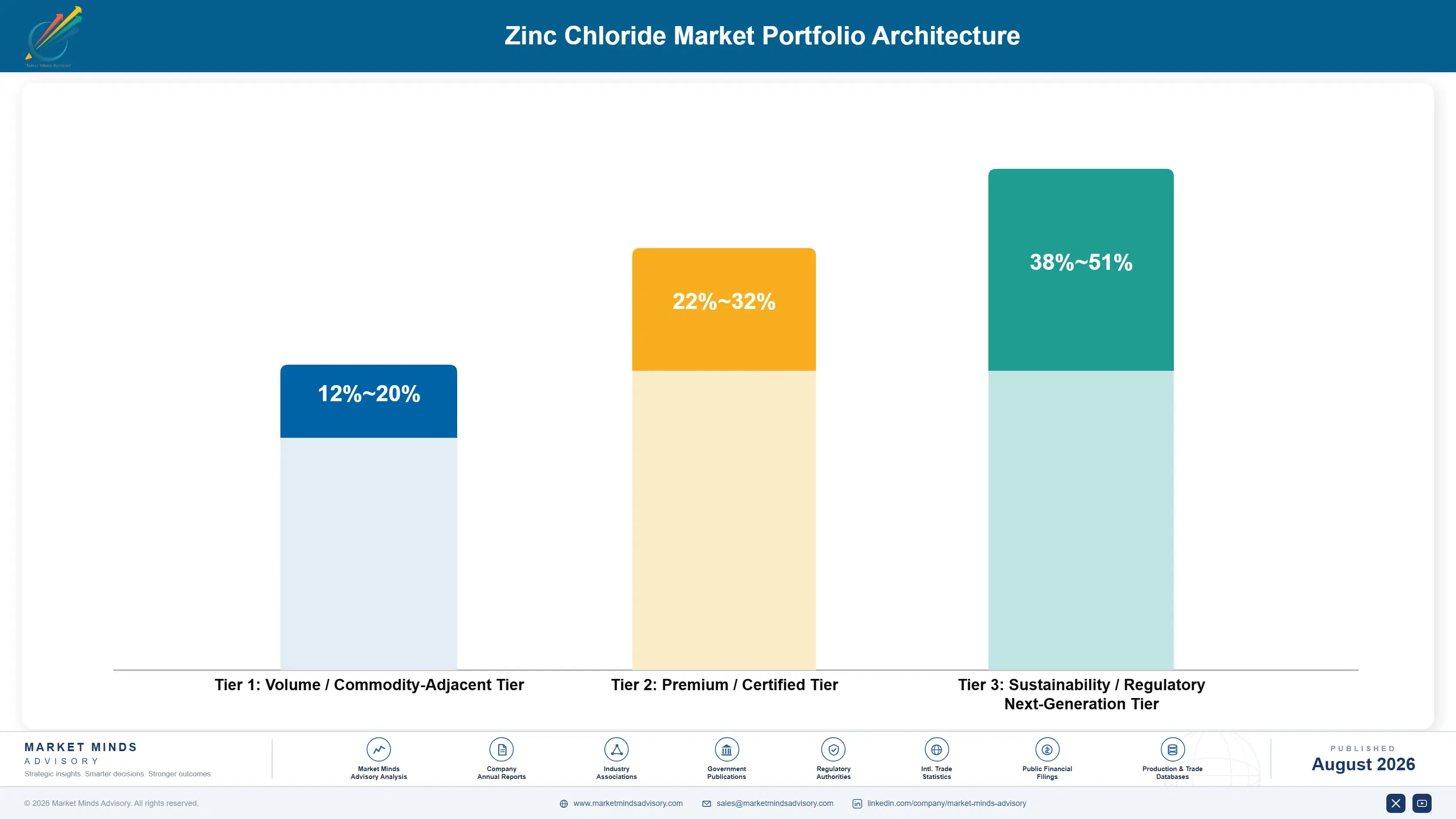
Margin architecture separates by qualification burden and freight position rather than by production scale, which is not what most producers' capital plans assume. Technical grade solution sold into galvanising and textile processing earns whatever the nearest competing producer allows, because the chemistry is identical everywhere and delivered cost decides the outcome nearly every time. Plant scale barely enters the calculation at all.
Value climbs where impurity control, documentation or formulation capability limits the qualified field. Battery grade and higher purity technical material defend modest premiums through demonstrated consistency rather than through anything a competitor could not eventually match. Pharmacopoeial, food contact and activation grades sit far higher, since assembling the quality systems and stability documentation behind them takes years that a competitor cannot compress.

The highest value pools concentrate where activation grade purity and pharmaceutical qualification overlap with applications that are themselves growing quickly. Those pools are small measured in tonnage and quite disproportionate in realised margin terms. The commercial tension is that galvanising flux volume keeps reactors and tankers loaded while funding almost none of the quality system investment that opens anything above it.

Volume / Commodity-Adjacent Tier

Technical grade solution supplied into galvanising flux, textile processing and general industrial duty, where the chemistry is identical between producers and delivered cost within a regional radius decides nearly every award.
Gross Margin: 12-20%

Premium / Certified Tier

Battery grade, higher purity technical material and formulated galvanising flux supplied with bath monitoring service. Consistency and formulation knowledge defend pricing here. The ten-point range reflects component supply against formulated service positions.
Gross Margin: 22-32%

Sustainability / Regulatory / Next-Generation Tier

Pharmacopoeial, food contact and high-purity activation grades carrying impurity control and documented manufacturing practice. Qualification barriers and narrow supplier fields defend pricing strongly. The thirteen-point range reflects established pharmaceutical against emerging activation grade economics.
Gross Margin: 38-51%
zinc-chloride-market-trends-portfolio-architecture-1787310672636

High-value Sub-segments and Strategic Watch-out

High-purity carbon activation grade material

High value and genuinely high growth together here, because water treatment duty aimed at persistent contaminants specifically requires chemically activated carbon, and impurity control at that level narrows the qualified supplier field very sharply indeed. Realised pricing here reflects that narrowness very directly indeed today.
Gross Margin: 38-51%

Pharmacopoeial and food contact grades

Strong realised value on steady growth, because heavy metal control, documented manufacturing practice and stability data take years to assemble, and remarkably few producers anywhere have bothered to build those quality systems properly. The position stays open for anybody prepared to be patient about it.
Gross Margin: 36-48%

Technical grade galvanising flux solution

The volume core of this whole market, keeping reactors and road tankers loaded while earning whatever the nearest competing producer happens to permit on chemistry that is identical everywhere. Necessary for basic operating scale, but this tier funds nothing whatsoever above itself and never will.
Gross Margin: 12-20%

Zinc metal exposure across the portfolio

The strategic watch-out across this whole business, given that the zinc units alone carry fully 58% of delivered cost and that the metal itself responds only to mine supply and smelter treatment economics that bear no relationship whatsoever to chemical demand in any given period.
Gross Margin: 8-38%

How zinc chloride demand behaves

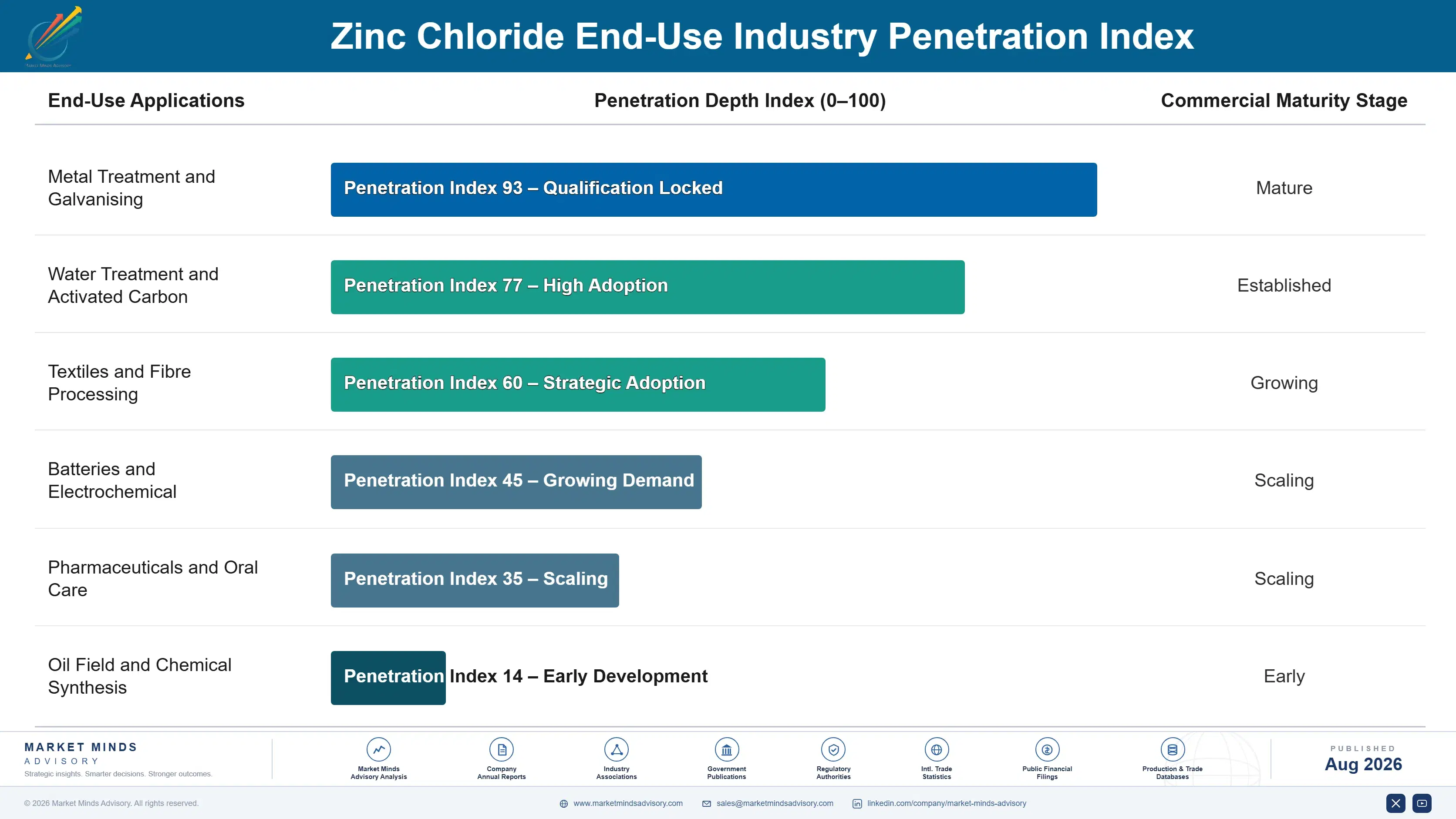
Demand is continuous, local and contractually thin, which is an awkward combination for anybody building a defensible position. Galvanising lines and textile mills consume steadily and reorder monthly, but the material is chemically identical between producers, so supply relationships survive on delivered cost and reliability rather than anything a competitor cannot copy. The annuity that does exist sits in qualified grades where documentation rather than chemistry limits the field.
Stickiness varies enormously with what the qualification covers. Technical grade galvanising supply is loosest, bought against a concentration specification, with substitution requiring nothing more than a purchase order. Formulated flux with bath monitoring sits tighter, because the switching cost is measured in coating defects rather than price. Pharmacopoeial and activation grades are stickiest of all, since changing supplier touches a regulatory filing or a carbon qualification nobody reopens lightly.

The buyer profile splits by application in ways that defeat any single commercial model. Galvanising and textile customers buy through procurement against delivered price and availability, usually from whoever is nearest. Pharmaceutical, food and activation customers buy against documentation packages evaluated by quality and technical functions long before commercial discussion begins, and reaching them needs people who discuss impurity profiles, not tonnage.
zinc-chloride-market-trends-end-use-penetration-index-1787310673127

What we would actually do here

These are among the four positions where our research anticipates prominent divergence between winners and laggards over the coming forecast period. Each is grounded in the demand model, the regulatory perimeter, and the announced capacity pipeline.
01 / DELIVERED CONCENTRATION ECONOMICS

Stop paying to ship water across the region

Most zinc chloride moves as a 50% aqueous solution, so roughly half of every tanker load is water costing exactly what the product costs per kilometre travelled. Producers supplying higher concentration solutions, or anhydrous solid to customers able to handle it, cut delivered cost by roughly 22% on longer hauls, which turns a freight handicap into a competitive weapon. The barrier is customer handling equipment rather than production capability, and funding that equipment is a remarkably cheap way of extending an addressable radius considerably.
02 / PHARMACEUTICAL GRADE QUALIFICATION

Build the documentation nobody else has bothered with

Pharmacopoeial material requires tight heavy metal control, documented good manufacturing practice and full stability data, all of which take years rather than months to assemble properly. Producers holding that whole package realise roughly 3 times technical grade pricing on chemistry that is otherwise entirely identical, because the qualification barrier rather than the molecule sets the price achieved. Demand keeps rising steadily with broadening healthcare access across emerging markets, and the qualified supplier field remains remarkably thin in almost every region.
03 / SECONDARY FEEDSTOCK SOURCING

Contract the collection relationships while they remain available

Around 42% of the zinc units entering production already come from galvanising residues, electric arc furnace dust and process drosses rather than from refined cathode, and they arrive at roughly 18% below prime refined metal cost. Producers with established collection relationships hold a cost position that prime metal buyers simply cannot match anywhere near current spreads. The binding constraint is access rather than processing technology, and good collection relationships take years to build and are not at all easily displaced afterwards.
04 / FLUX FORMULATION INTEGRATION

Sell bath performance rather than two separate components

Galvanising customers buy zinc chloride and ammonium chloride as separate components and blend them on site, which is work they would generally rather avoid entirely and in practice rarely perform consistently across shifts. Producers supplying formulated flux together with bath monitoring service earn roughly 14 percentage points more margin than plain component suppliers on identical zinc units. The formulation work is entirely straightforward, and the commercial position comes instead from understanding the customer's bath chemistry rather better than the customer does.

Engagement Snapshot From the Field

A live engagement with an industry participant carrying material or product regulatory and market exposure ahead of a defining policy shift, showing how our research translates into a defensible multi-year portfolio strategy.
MARKET MINDS ADVISORY · CLIENT ENGAGEMENT SUMMARY
Zinc Chloride Producer Strategic Portfolio Review and Transition Roadmap 2026·Investment Scenario on Zinc Chloride Exposure Evaluation 2025-26
CLIENT PROFILE
An inorganic chemicals producer operating zinc chloride and related zinc salt capacity at two sites, supplying galvanising, textile and general industrial customers across its home region alongside a small export business. Zinc chloride revenue approached USD 74 million annually (client-reported, unverified by MMA), roughly three quarters of it in technical grade solution sold on delivered price within a limited geographic radius.
STRATEGIC CHALLENGE
Margins had been eroding for three years and management attributed the decline entirely to imported Chinese material, responding with a proposed reactor expansion at the larger site. Pharmaceutical and activation grade opportunities were being lost without anybody establishing why they were lost. Zinc price exposure across the annual contract book had never been quantified against realistic metal movements.
MMA APPROACH
We rebuilt delivered cost by customer location rather than by plant, quantified zinc exposure across the contract book under historical price movements, and reconstructed eleven lost pharmaceutical and activation grade opportunities through interviews with customer quality and technical functions rather than the purchasing contacts the client normally dealt with. Impurity profiles were benchmarked independently against four competitor products.
KEY FINDINGS
  1. Margin erosion traced principally to freight on distant technical grade accounts, not to imported pricing, which had barely moved across the period under review.
  2. Nine of eleven lost opportunities failed on absent impurity documentation rather than on price, availability or product quality in any measurable respect.
  3. Unhedged zinc exposure across the annual contract book exceeded a full year of operating profit under the 2022 price movement simply repeated.
  4. The proposed reactor expansion would have added technical grade capacity in exactly the tier where freight already made half the customer base unprofitable.
CLIENT PROFILE
An inorganic chemicals producer operating zinc chloride and related zinc salt capacity at two sites, supplying galvanising, textile and general industrial customers across its home region alongside a small export business. Zinc chloride revenue approached USD 74 million annually (client-reported, unverified by MMA), roughly three quarters of it in technical grade solution sold on delivered price within a limited geographic radius.
STRATEGIC CHALLENGE
Margins had been eroding for three years and management attributed the decline entirely to imported Chinese material, responding with a proposed reactor expansion at the larger site. Pharmaceutical and activation grade opportunities were being lost without anybody establishing why they were lost. Zinc price exposure across the annual contract book had never been quantified against realistic metal movements.
MMA APPROACH
We rebuilt delivered cost by customer location rather than by plant, quantified zinc exposure across the contract book under historical price movements, and reconstructed eleven lost pharmaceutical and activation grade opportunities through interviews with customer quality and technical functions rather than the purchasing contacts the client normally dealt with. Impurity profiles were benchmarked independently against four competitor products.
KEY FINDINGS
  1. Margin erosion traced principally to freight on distant technical grade accounts, not to imported pricing, which had barely moved across the period under review.
  2. Nine of eleven lost opportunities failed on absent impurity documentation rather than on price, availability or product quality in any measurable respect.
  3. Unhedged zinc exposure across the annual contract book exceeded a full year of operating profit under the 2022 price movement simply repeated.
  4. The proposed reactor expansion would have added technical grade capacity in exactly the tier where freight already made half the customer base unprofitable.
RECOMMENDED STRATEGY
Phase 1: Phase one: index zinc pass-through across every annual supply agreement and withdraw from technical grade accounts beyond the profitable freight radius. Phase 2: Phase two: defer the reactor expansion and redirect that capital toward impurity control, documentation and pharmacopoeial grade qualification at the smaller site. Phase 3: Phase three: contract secondary zinc collection relationships with regional galvanising operators and steel processors before competitors secure the available volume.
OUTCOME
The client deferred the expansion and committed the capital to purification and documentation capability instead. Two pharmacopoeial qualifications were underway within ten months, and realised margin improved by 19% (client-reported, unverified by MMA) against the prior year on a slightly smaller shipped tonnage than before.

Frequently Asked Questions

Foundational context covering the market sizes, CAGR, scope, country, region and competition that inform every finding below. This section is provided to cover basics and most often pre-purchase conversations, answered from the MMA Primary Research Dataset.

What is the current size of the Zinc Chloride Market?

The market is valued at USD 0.6 billion in 2025, rising to USD 0.63 billion in 2026. Sizing covers zinc chloride sold to industrial users and formulators at realised delivered price.

How large will the Zinc Chloride Market be by 2036?

The market reaches USD 1.05 billion by 2036, an increase of USD 0.42 billion across the forecast period. That represents an expansion multiple of 1.67 times the 2026 base.

What is the CAGR for the Zinc Chloride Market 2026 to 2036?

The base case CAGR is 5.2% across 2026 to 2036. The bull case reaches 6.4% on faster water treatment investment, while the bear case sits at 4.0% under activation route substitution.

Which segment is growing fastest?

Catalyst and activation grade grows fastest at 7.8%, a full 1.50 times the market rate. Chemical activation produces carbon with higher surface area than steam routes achieve, which trace contaminant removal requires.

Who are the major companies in the Zinc Chloride Market?

Zinc Nacional, Zaclon, Weifang Menjie Chemical, Shandong Chuangying Chemical and Merck lead on production capacity, holding 38% collectively. The remaining field includes specialty houses and regional blenders.

Which country is growing fastest?

India grows fastest at 8.0%, driven by galvanising line commissioning running ahead of anywhere else alongside textile processing demand and an expanding activated carbon industry.

Report Segmentation Architecture

The full report scope spans multiple orthogonal segmentation dimensions, with cross-tabulated demand data provided for each dimension pair. Coverage extends further to regional breakdowns, trend trajectories, and the competitive detail needed to support segment-level decision-making.

By Product Grade and Form

  • Technical Grade Solution
  • Technical Grade Anhydrous Solid
  • Battery Grade
  • Pharmaceutical and Food Grade
  • Catalyst and Activation Grade
  • Formulated Galvanising Flux Blends

By End-Use Industry

  • Metal Treatment and Galvanising
  • Water Treatment and Activated Carbon
  • Textiles and Fibre Processing
  • Batteries and Electrochemical
  • Pharmaceuticals and Oral Care
  • Oil Field and Chemical Synthesis

By Customer Type and Channel

  • Galvanising Line Operators
  • Activated Carbon Manufacturers
  • Pharmaceutical Formulators
  • Textile Processing Mills
  • Chemical Distribution and Blending
  • Oil Field Service Companies

By Region

  • North America
  • Western Europe
  • East Asia
  • South Asia and Pacific
  • Latin America
  • Middle East and Africa
  • Eastern Europe

Scope, Methodology, and Coverage

Every figure in this report is reproducible from documented input assumptions. The scope below maps the historical period, the forecast horizon, the segmentation dimensions, and the countries covered, alongside the underlying primary and qualitative methodology.
Historical Period
2020 to 2025
Forecast Period
2026 to 2036
Base Year
2025 (USD billions; MMA Primary Research Dataset, August 2026)
Market Definition
The market comprises zinc chloride supplied as aqueous solution, anhydrous solid and formulated blends with ammonium chloride, spanning technical grade solution, technical grade anhydrous solid, battery grade, pharmaceutical and food grade, catalyst and activation grade, and formulated galvanising flux blends. Sizing captures product revenue at realised delivered price across metal treatment and galvanising, water treatment and activated carbon manufacture, textile and fibre processing, batteries and electrochemical applications, pharmaceuticals and oral care, and oil field and chemical synthesis uses. Zinc oxide, zinc sulphate, zinc stearate and other zinc compounds, zinc metal itself, galvanising services performed on customer material, and finished activated carbon or batteries containing zinc chloride all fall outside scope.
Quantitative Units
USD billions (current prices); zinc chloride shipped annually in thousands of tonnes on a hundred percent basis; USD per tonne at realised delivered price
Segmentation Dimensions
By Product Grade and Form; By End-Use Industry; By Customer Type and Channel; By Region
Regions Covered
North America, Western Europe, East Asia, South Asia and Pacific, Latin America, Middle East and Africa, Eastern Europe
Countries Covered
USA, Canada, Mexico, UK, Germany, Belgium, France, Italy, Spain, Netherlands, Poland, Czech Republic, Romania, Turkey, China, Japan, South Korea, Taiwan, India, Singapore, Malaysia, Thailand, Vietnam, Indonesia, Australia, Brazil, Argentina, Colombia, Saudi Arabia, UAE, Qatar, Egypt, South Africa, and additional markets relevant to this sector
Key Companies Profiled
Zinc Nacional, Zaclon, Weifang Menjie Chemical, Shandong Chuangying Chemical, Merck KGaA, Kanto Chemical, American Elements, Nihon Kagaku Sangyo, EverZinc, US Zinc, Grillo-Werke, Hindustan Zinc, Numinor Chemical Industries, Rech Chemical, Shepherd Chemical Company, Tib Chemicals, Weifang Huaxing Chemical, Zinchem, Alpha Chemika, Sichuan Xinju Mineral Resources Development.
Quantitative Methodology
Primary survey, n=3,800 respondents, Q4 2025, six countries; demand-side model with trade association cross-validation
Qualitative Methodology
47 expert interviews, Q4 2025; applied to validate demand model assumptions, identify emerging dynamics, and assess competitive positioning
Report Format
PDF and XLSX data workbook (Word format preview document)
Publisher
Market Minds Advisory
Report Code
MMA-2026-CHM-557
Published
August 2026
Contact
sales@marketmindsadvisory.com | www.marketmindsadvisory.com

Purchase the full Zinc Chloride Market Report (2026 to 2036).

The full report sizes the zinc chloride market across six product grades and forms, six end-use industries, six customer channels and seven regions, with annual forecasts to 2036 in revenue and tonnage shipped. It rebuilds delivered cost by customer distance rather than by plant gate, which is the analysis establishing where each producer's profitable supply radius genuinely ends. Twenty participants are assessed on a consistent production capacity basis, with secondary feedstock access mapped separately from installed reactor capability. Zinc price exposure is quantified across each producer's contracted order book.
Six product grades and forms sized and forecast annually
Delivered cost rebuilt by customer distance not plant
Twenty participants assessed on consistent production capacity basis
Secondary feedstock access mapped separately from reactor capability
Zinc price exposure quantified across contracted order books
Activation and pharmacopoeial qualification tracked producer by producer

Built For The People Who Decide

From boardroom strategy to bench-side execution, this report is read cover-to-cover by leaders shaping the next decade of their industry, turning demand scenarios, market dynamics and valuation benchmarks into decisions.
CXOs/ Presidents/ VPs/ Managers
M&A and Corporate Development
Strategy Teams and R&D Heads
Procurement and Product Directors
Regulatory and Compliance Leaders
Investor Relations and Equity Analysts