Market Minds Advisory
Zika Virus Testing Market

Zika Virus Testing Market: A Line Item On Somebody Else's Panel

The clinical question is never whether a patient has Zika, it is what is causing a fever in a place where three indistinguishable viruses all share exactly the same mosquito.

Lead Analyst

Published

September 2026

Make Smarter Decisions with Customized Research Insights

Request a free sample report and evaluate market opportunities, growth trends, and competitive dynamics relevant to your business needs.

2025 MARKET VALUE$0.1BMarket Size 2025
2036 FORECAST VALUE$0.3BBase Case , 2026 to 2036
CAGR 2026 TO 20368.6 %Bull 9.8% / Bear 7.4%
INCREMENTAL OPPORTUNITY$0.2BNet 10- year value creation
EXPANSION MULTIPLE2.27x2036 value over 2026 base
Strategic Levers
M&A Pipeline
Regional Outlook
Country Rankings
Competitive Intelligence
Segmental Deep-dive
Call-Us : 91 93563 13602

Executive Snapshot and Market Trajectory

Nobody presents with suspected Zika. A patient presents with fever where dengue, chikungunya and Zika share a mosquito and look identical, and the question is which one. Nobody asks about Zika. That is why around 47% of testing now runs as a combined arbovirus panel rather than anything Zika specific.
Serology barely functions as a standalone answer and the field knows it. Flavivirus antibodies cross react extensively, so roughly 63% of positive results need confirmation after prior dengue exposure or yellow fever vaccination, and only about 4% of endemic country laboratories can perform the neutralisation assay that provides it. The confirmatory test is unavailable where the disease is. Geography rather than chemistry defeats it.
Demand concentrates in pregnancy because that is where a result changes anything. Around 58% of volume is antenatal rather than symptomatic, since congenital infection carries consequences and no treatment exists for anybody else. Volumes sit roughly 82% below outbreak peak, which makes this a surveillance and panel business rather than an outbreak one. Panel adoption matters more to a supplier here than transmission does in most years. Nobody plans around outbreaks any more.
Market Definition
Diagnostic tests for Zika virus infection, covering multiplex arbovirus panels, Zika specific molecular assays, immunoglobulin M and G serology, plaque reduction neutralisation testing, rapid and point-of-care tests, and blood and tissue donor screening. Measured at test revenue. Zika vaccines, vector control products, general febrile illness testing without arbovirus targets, and dengue or chikungunya testing performed without a Zika component are excluded.
Base Year Value
$0.1B in 2025 (MMA Primary Research Dataset, August 2026)
Forecast Period
2026 to 2036, eleven discrete annual values
CAGR
8.6% base case. Bull 9.8%. Bear 7.4%.
Fastest Growth Segment
Multiplex Arbovirus Panels: 12.9% CAGR
Fastest Growth Country
India: 11.6% CAGR
Fastest Growth Region
South Asia and Pacific: 10.8% CAGR
Largest Region
Latin America: 30% of 2025 global value
Market Leaders
Roche Diagnostics, Bio-Rad Laboratories, Hologic, Abbott, Thermo Fisher Scientific. Source: MMA Primary Research Dataset, July 2026.
Primary Survey
n=3,800 procurement and R&D decision-makers, Q4 2025, six countries
Methodology
Demand-side build-up, cross-validated against public data, 47 expert interviews

Zika Virus Testing Market Forecast Scenarios

zika-virus-testing-market-size-forecast-scenario-1787665279944
The five years to 2025 rebuilt a market from a post epidemic trough rather than growing an established one. Testing volumes had fallen roughly 82% from outbreak peak, and what returned came through multiplex panels and antenatal screening rather than through any resurgence in Zika specific demand. The 7.4% historical rate describes recovery from a very low base and says almost nothing about underlying disease incidence.
The 8.6% base case rests on three mechanisms. Multiplex arbovirus panels grow at 12.9% as laboratories consolidate three indistinguishable diseases into one test. Rapid and point-of-care formats grow at 10.6% where reference laboratory access is limited. And Indian testing volumes grow at 11.6%, faster than any market covered, on dengue burden pulling panel adoption forward across public and private laboratories. Panel consolidation, access constraints and dengue burden, all at once.
The 9.8% bull case turns on antenatal arbovirus screening becoming routine in endemic countries rather than symptom triggered, which would convert episodic testing into programme volume across a very large population. The 7.4% bear case is attention: this is a small market with no outbreak driving it, and surveillance capability funded during an emergency erodes quietly when nobody is watching for the next one.

Three Diseases, One Mosquito, One Test

Zika specific testing stopped being a viable standalone proposition years ago and the clinical reason is straightforward. Dengue, chikungunya and Zika circulate in the same mosquito, present with the same fever, rash and joint pain, and require different management, so the useful question at presentation is which of the three it is rather than whether it is one particular virus. Around 47% of testing now runs as a combined panel.
TOP FIVE CONCENTRATION56%Combined test volume held by the leading suppliers
SEROLOGY CROSS REACTION RATE63%Positive results requiring confirmation after prior flavivirus exposure
CONFIRMATORY LABORATORY AVAILABILITY4%Endemic country laboratories able to perform neutralisation testing
MULTIPLEX PANEL SHARE47%Testing now performed as combined arbovirus panel assays
ANTENATAL TESTING PROPORTION58%Volume performed in pregnancy rather than symptomatic presentation
POST EPIDEMIC VOLUME DECLINE82%Reduction from peak outbreak testing to current levels
Serology carries a problem the field discusses openly and cannot resolve. Flavivirus antibodies cross react extensively, so prior dengue infection or yellow fever vaccination produces positive Zika results that mean nothing without confirmation, which affects roughly 63% of positives. Confirmation requires a live virus neutralisation assay taking days and containment facilities that only about 4% of endemic country laboratories actually hold.
What sustains demand is pregnancy rather than acute illness. Congenital infection carries real consequences while symptomatic infection in anybody else has no treatment and a test that changes no management, which is why around 58% of volume is antenatal. Testing sits roughly 82% below outbreak peak, and a market at that level is a surveillance and panel business rather than an outbreak response one.
"The confirmatory test for this infection exists mainly in countries that do not have the infection. That is not a technical gap anybody is going to close with a better assay."
Director, Infectious Disease Diagnostics Practice · MMA Medical Devices and Diagnostics Practice · August 2026

Market Trends

Panel Consolidation Replaces Single Pathogen Testing Entirely

Dengue, chikungunya and Zika share a vector, a geography and a clinical presentation that no clinician can separate at the bedside, which makes single pathogen testing an answer to a question nobody asked. Around 47% of testing now runs as a combined arbovirus panel, and multiplex formats grow at 12.9% against a market rate of 8.6%, the fastest segment in the category. Suppliers positioning a Zika specific assay are selling into a workflow decision laboratories made some years ago and have no reason to revisit. Nobody revisits a workflow decision already settled.
Market Impact: India grows at 11.6% annually
Point Of Care Formats Answer Reference Laboratory Absence

Arbovirus disease concentrates in regions where reference laboratory access is limited and sample transport takes days, which delays a result past the point where it would change anything clinically. Rapid and point-of-care formats grow at 10.6%, second fastest in the category, on that access gap rather than on any performance advantage. Sensitivity is lower than laboratory molecular testing and a result available today is worth considerably more than a better result available next week to most clinicians. Laboratory capability has always been thinnest exactly where arbovirus disease concentrates most heavily of all.
Market Impact: Antenatal covers 58% of volume

Market Opportunities and Growth Drivers

Indian Dengue Burden Pulls Arbovirus Panels Into Routine Use

India carries one of the largest dengue burdens anywhere and laboratory capacity has expanded across public and private networks to address it, which brings multiplex arbovirus panels including Zika into routine use as a consequence rather than as an objective. India grows at 11.6%, faster than any market covered. Domestic manufacturers supply much of that volume at prices international suppliers cannot approach, while reference laboratories buy validated panels for confirmatory and surveillance work instead. Zika capability arrives inside a panel purchased entirely for dengue reasons, which is the only economics available.
Market Impact: Only 4% of laboratories can confirm

Antenatal Screening Sustains Demand Between Outbreak Periods

Congenital Zika infection carries consequences that symptomatic infection in adults does not, and no treatment exists for either, which means a test only changes management during pregnancy. Around 58% of volume is antenatal as a direct result. That demand persists between outbreak periods where symptomatic testing collapses, making it the stable half of a market that would otherwise disappear entirely between epidemics. Programme rather than clinical decisions govern how much of it happens in any given country. Symptomatic testing collapses between epidemics and this volume simply does not, which is the whole point.
Market Impact: Volumes sit 82% below peak

Market Restraints and Challenges

Confirmatory Testing Is Unavailable Where Disease Occurs

Flavivirus antibody cross reaction means roughly 63% of positive serology results require neutralisation testing to interpret, and only about 4% of endemic country laboratories hold the containment facilities and live virus capability to perform it. The root cause is infrastructure rather than assay design, since the confirmatory method has not changed materially in decades. Commercially this limits what serology can deliver in the regions that need it. Participants are developing improved specificity assays, which narrows the gap without closing it. A confirmatory method sitting in countries without the disease is not an assay problem.
Market Impact: Panels already cover 47% of testing

Market Size Cannot Sustain Dedicated Development Investment

Testing volumes sit around 82% below outbreak peak, which leaves a market too small to justify dedicated assay development, regulatory submission and clinical validation for Zika alone. The root cause is that the disease is clinically important in a narrow population and commercially small everywhere. Commercially this means Zika capability arrives as a channel on panels developed for dengue and chikungunya. Participants respond by building it into broader arbovirus platforms, which is the only economics that works. Nobody is going to fund a dedicated development programme for a market of this size.
Market Impact: Rapid formats grow at 10.6%
3 additional market trends, 4 additional growth drivers, and 2 additional restraints and challenges are covered in the full report. Contact sales@marketmindsadvisory.com to access the complete intelligence.

Segment CAGR and Growth Architecture

Segmentation follows test type, since type determines whether Zika is tested alone or alongside related viruses, what confirmation it needs and which setting can actually perform it. Six types cover testing as practised. Growth concentrates where Zika arrives as part of something else rather than where anybody sought it specifically. Consolidation rather than demand drives it.
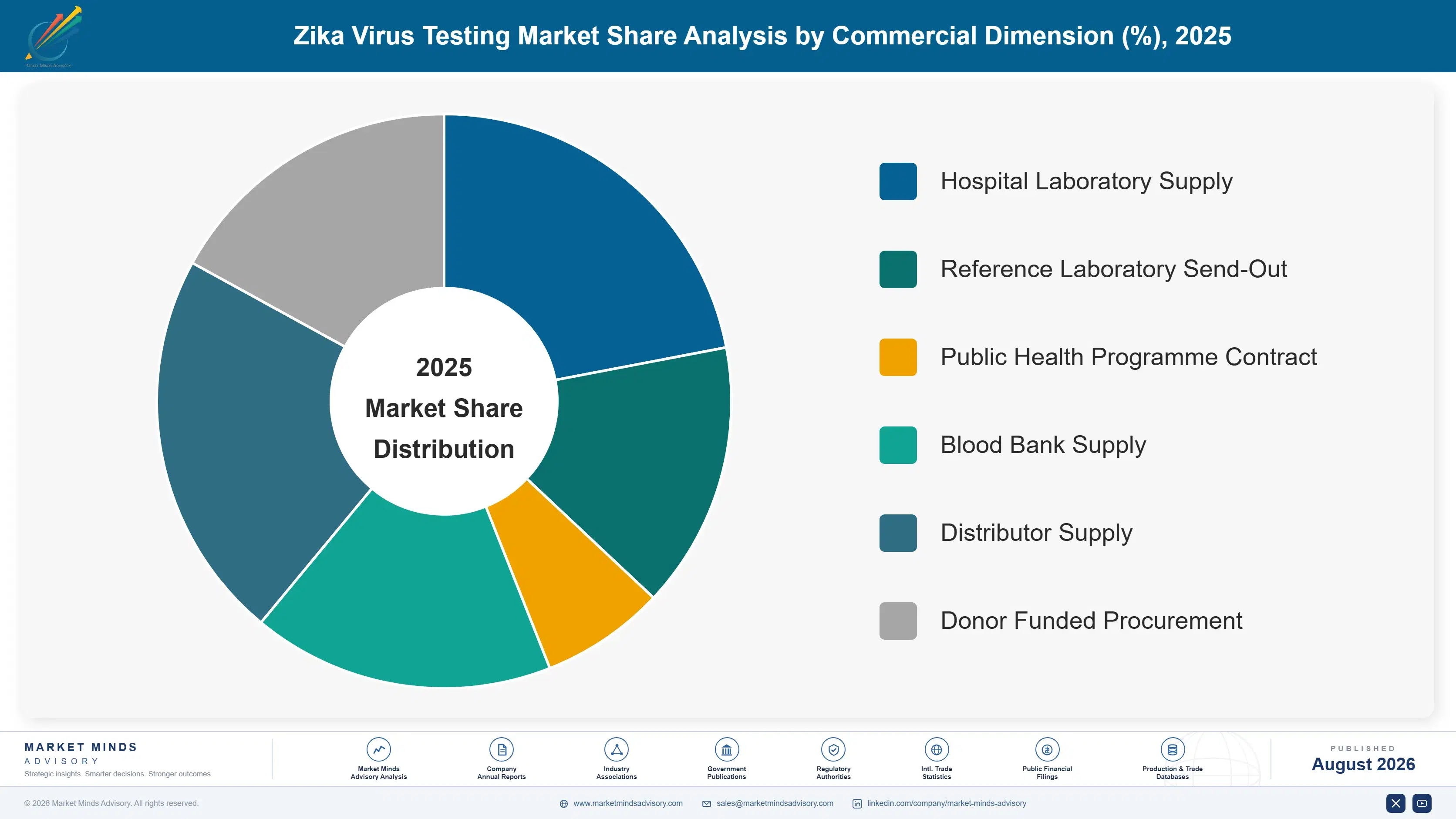
zika-virus-testing-market-market-share-analysis-1787665280492

Multiplex Arbovirus Panels

Combined molecular assays detecting dengue, chikungunya and Zika from one sample, addressing the clinical question that actually presents rather than testing for one virus in isolation. At 12.9% this is the fastest growing type, half again the market rate of 8.6%, and it now carries around 47% of all testing in the category. The three diseases share a vector, a geography and a presentation that clinicians cannot separate without laboratory input, which makes the panel the natural product and Zika a channel within it rather than a market in its own right. Suppliers positioning a Zika specific assay are competing against a decision laboratories already took some years ago now.
CAGR 12.9%

Rapid and Point-of-Care Tests

Lateral flow and compact molecular formats performed near the patient in settings where reference laboratory access requires days of sample transport. Growth of 10.6% is second fastest in the category and infrastructure rather than analytical performance drives it entirely. Sensitivity sits below laboratory molecular testing and a result available during the consultation is worth more clinically than a better result arriving after the illness has resolved. These formats reach populations where arbovirus disease concentrates and where laboratory capability has always been thinnest. Reference laboratory access requiring days of sample transport delays a result past the point where it would change any clinical decision at all. Speed is the entire proposition.
CAGR 10.6%
Full segment breakdown across 6 segments available in the complete report.

Regional Architecture and Country Demand Map

Latin America holds 30%, far above the standard band, because the region carries the arbovirus burden and the antenatal population where testing changes management. North America follows at 22%. India grows fastest at 11.6% on dengue driven panel adoption. Disease geography rather than health spending decides.

North America

A 22% share reflects testing pricing and reference laboratory capability rather than disease burden, since local transmission is limited and most testing addresses travel exposure and pregnancy in returning travellers. Confirmatory neutralisation testing capability is concentrated here and in Europe, which is precisely the wrong geography relative to where the disease occurs. Blood supply screening adds meaningful volume through nucleic acid testing programmes. Reference laboratories perform confirmatory work for other regions. Growth of 7.6% reflects travel testing and blood screening rather than any clinical demand. Capability and disease sitting in different countries is the defining feature of this whole category. This region holds the capability and very little of the disease.
Share: 22% | CAGR: 7.6% (2026 to 2036)

Western Europe

A 12% share sits below the standard regional band, justified because transmission does not occur locally and testing addresses travellers, pregnancy in returning travellers and blood donation screening rather than any endemic clinical need. Reference laboratory and neutralisation testing capability is strong and serves confirmatory requests originating elsewhere entirely. Regulatory requirements for assay validation are the most demanding anywhere. Blood service screening operates under precautionary policies that vary between countries. Growth of 7.0% is the lowest of the seven regions and reflects travel volumes rather than disease. Travel medicine rather than any endemic requirement is what generates demand across this region. Confirmatory capability here mostly serves requests originating far away.
Share: 12% | CAGR: 7.0% (2026 to 2036)
Regional intelligence for 5 additional markets available in the complete report: East Asia, South Asia and Pacific, Latin America, Middle East and Africa, Eastern Europe. Contact sales@marketmindsadvisory.com.
zika-virus-testing-market-country-cagr-analysis-1787665281019

Where This Testing Actually Earns

Nothing here is won on Zika specificity, because no clinician asks that question and the market is far too small to fund a dedicated product. Value accrues to whoever sells the panel, whoever serves antenatal demand, whoever addresses confirmation, and whoever holds surveillance capability between outbreaks. Four routes carry weight. Panels and public programmes decide everything.

Sell The Panel Not The Pathogen

Dengue, chikungunya and Zika share a vector, a geography and a clinical presentation no clinician separates at the bedside, which makes single pathogen testing an answer to a question nobody asked. Around 47% of testing already runs as a combined panel and multiplex formats grow at 12.9% against a market rate of 8.6%. Suppliers positioning Zika specific assays are selling against a workflow decision laboratories made years ago and have no reason whatsoever to revisit now. Around 12.9% growth belongs to the panel rather than to any pathogen sitting inside it.
Market Impact: Panels already carry 47% of all category testing

Serve Pregnancy Where Testing Changes Management

Congenital infection carries consequences that adult symptomatic infection does not, and no treatment exists for either, which means testing only changes management during pregnancy. Around 58% of volume is antenatal as a direct consequence of that clinical reality. This is also the demand that persists between outbreak periods, when symptomatic testing collapses almost entirely. Programme decisions rather than clinical judgement govern how much antenatal testing happens, which makes public health engagement the commercial route into it. Around 58% of volume follows programme policy rather than any individual clinical judgement. That changes who to reach.
Market Impact: Antenatal testing carries 58% of all category volume

Solve Confirmation Where The Disease Is

Flavivirus cross reaction means roughly 63% of positive serology needs neutralisation confirmation, and only about 4% of endemic country laboratories can perform it, which puts the confirmatory test in the countries without the disease. Improved specificity assays narrow that gap without closing it, and anybody who genuinely closes it changes what serology can deliver in the regions that need it most. That is a harder development problem and a considerably more valuable one. Around 63% of positives needing a test that 4% of laboratories can run is not a small gap.
Market Impact: Only 4% of endemic laboratories can confirm results

Hold Surveillance Capability Between The Outbreaks

Testing volumes sit around 82% below outbreak peak, and capability funded during an emergency erodes quietly when nobody is watching for the next one. Suppliers maintaining validated assays, regulatory registrations and laboratory relationships through quiet periods are positioned when activity returns, and those who exit have to rebuild everything under time pressure. That is an unglamorous commercial position and it has been rewarded repeatedly across arbovirus and respiratory pathogens alike. Around 82% below peak is a quiet period rather than a permanent condition, and quiet periods end. Nobody predicts when they do.
Market Impact: Volumes still sit 82% below the outbreak peak

Who Controls the Margin Pool

Concentration is high in a market too small to attract many participants. The top five hold 56% of test volume, the basis applied consistently throughout this section, across large diagnostics companies carrying Zika as a channel on broader platforms and specialist developers who built their capability during the epidemic period. Roche Diagnostics leads on molecular platform installed base, which reflects positions built for entirely other reasons rather than any Zika specific investment at all.
Competition runs on three fronts. Platform companies compete by adding arbovirus panels to installed molecular systems, where the placement was decided by entirely other assays. Specialist developers compete on serology and rapid formats in markets where platform access is limited. And domestic manufacturers in endemic countries compete on price for public health and routine laboratory volume locally.

Rankings will move with panel content and platform placement rather than with Zika capability, since laboratories buy an arbovirus answer and Zika arrives inside it. The other pressure point is surveillance funding, which determines whether public health laboratories maintain capability between outbreak periods or rebuild it under pressure when transmission returns somewhere nobody was expecting it.
zika-virus-testing-market-company-positioning-matrix-1787665281548

Competitive Moat and Risk Dimensions

ROCHE DIAGNOSTICS

Moat: Molecular Platform Installed Base

Molecular systems installed across reference and hospital laboratories for entirely other testing provide a route for arbovirus panels that a standalone assay developer cannot match at any price. Placement decisions were made on high volume assays, and additional panels run on that base at incremental cost rather than requiring their own commercial case.
ROCHE DIAGNOSTICS

Risk: Endemic Market Price Competition

Domestic manufacturers in endemic countries supply arbovirus testing at prices international platforms cannot approach, in precisely the geographies where disease burden and testing volume concentrate. Platform economics work well in reference laboratories and reach very little of the routine volume performed where these diseases actually occur.
INBIOS INTERNATIONAL

Moat: Arbovirus Serology Specialisation

Focused capability in arbovirus serology and rapid formats built through outbreak response provides validated assays and regulatory registrations that larger companies deprioritised once the emergency ended. That continuity matters commercially when transmission returns, since rebuilding registrations and validation under time pressure is considerably harder to manage.
INBIOS INTERNATIONAL

Risk: Small Market Scale Constraint

Testing volumes sitting around 82% below outbreak peak leave a market too small to sustain substantial development investment, and specialist focus offers no diversification when activity is quiet. Panel consolidation onto molecular platforms also moves volume toward companies whose commercial case does not depend on this pathogen at all.

Players Tracked

Prominent Players

Roche Diagnostics
Bio-Rad Laboratories
Hologic
Abbott
Thermo Fisher Scientific

Other Key Players

QIAGEN
bioMerieux
DiaSorin
InBios International
Euroimmun
Chembio Diagnostics
OraSure Technologies
Grifols
Siemens Healthineers
Quest Diagnostics
LabCorp
Cepheid
Meridian Bioscience
Altona Diagnostics
CTK Biotech

Recent Developments

MARCH 2025

Reference laboratory consolidates arbovirus testing onto single panel

A national reference laboratory consolidated dengue, chikungunya and Zika testing onto a single multiplex panel, replacing separate assays run in sequence on suspicion. Around 47% of testing already runs as combined panels, since the three diseases cannot be separated clinically at presentation by anybody. Suspicion no longer triggers it.
Signal: Laboratories buy an answer about a fever, not a test for one particular virus in an endemic setting
JUNE 2025

Antenatal screening programme extends arbovirus testing in pregnancy

A public health programme extended arbovirus screening in pregnancy across endemic districts, recognising that testing changes management during pregnancy and rarely elsewhere. Around 58% of category volume is already antenatal, and programme decisions rather than clinical judgement govern how much of it occurs. Policy rather than clinicians decides.
Signal: Public health programmes rather than clinicians decide most of this volume in every endemic country covered
SEPTEMBER 2025

Improved specificity serology assay reduces confirmation requirement

A supplier launched a serology assay with improved flavivirus specificity, reducing but not eliminating the proportion of positives requiring neutralisation confirmation. Roughly 63% of positives currently need confirmation, and only about 4% of endemic country laboratories can perform the confirmatory assay at all. Specificity improved without resolving it.
Signal: Narrowing the confirmation gap matters most in countries that cannot confirm anything at all in the first place

What Arbovirus Testing Costs

Enzymes, primers and probes account for 39% of molecular assay cost, with plastics, controls, packaging and quality control carrying the remainder across production volumes that are small by diagnostics standards. Serology assays depend on recombinant antigens and antibodies whose specificity determines whether the test works at all, and producing flavivirus antigens with adequate specificity is genuinely difficult rather than merely expensive.
Enzyme and oligonucleotide capacity was diverted into pandemic diagnostic testing at scale, and smaller assay categories waited behind much larger customers regardless of what they were willing to pay. Diagnostics company annual reports documented allocation and lead time extension through that period, while FDA emergency authorisations shaped where manufacturing capacity actually went. Small volume assays were affected disproportionately because they had no leverage with any supplier.

Exposure divides by portfolio breadth rather than by scale. Companies running arbovirus panels alongside large respiratory and other menus hold supply relationships that a single category specialist cannot match during any allocation event. Specialists carry the opposite position, with focused capability and no leverage whatsoever, which is uncomfortable in a category where volumes are already small and rebuilding after a gap takes considerable time.
zika-virus-testing-market-cost-volatility-analysis-1787665281745

Build Zika capability inside broader arbovirus platforms

Testing volumes sit around 82% below outbreak peak, which leaves this market too small to fund dedicated assay development, regulatory submission and validation for one pathogen. Building the capability as a channel on panels developed for dengue and chikungunya is the only economics that works. Suppliers attempting a standalone commercial case are solving a problem the market size cannot support.

Maintain registrations through quiet periods deliberately

Capability funded during an emergency erodes when attention moves elsewhere, and rebuilding validated assays, regulatory registrations and laboratory relationships under time pressure is considerably harder than maintaining them. Suppliers who held position through previous quiet periods were ready when activity returned. The cost of maintenance is modest against the cost of re-entry during an outbreak.

Secure enzyme supply alongside larger assay categories

Enzymes and oligonucleotides are 39% of molecular assay cost and small volume categories wait behind much larger customers whenever capacity tightens anywhere. A supplier running arbovirus panels alongside a broad menu holds leverage that a specialist never will. Partnership or supply agreements aggregating volume across categories is the practical answer for anybody operating at this scale.

Portfolio Architecture for Margin Defence

Margin architecture divides on whether the test answers a question anybody asked. Zika specific serology earns least, since results frequently need confirmation that is unavailable and the clinical question was never about Zika alone. Multiplex panels earn considerably better, because they answer the presenting question and run on installed platforms at incremental cost. Blood screening and surveillance contracts earn best, being programme funded and specified rather than clinically discretionary.
The tension runs between clinical need and commercial scale. The population where testing changes management is narrow and concentrated in countries with limited testing budgets, while the countries able to pay for sophisticated assays have very little disease. That mismatch is permanent and inherent to arbovirus diagnostics generally, and no commercial strategy resolves it rather than merely working around it.

High value pools concentrate in panel content and in programme funded surveillance and screening, neither of which is a Zika position. Everything sold as a Zika specific product competes for a clinical decision nobody makes that way. The businesses worth building are those where the pathogen arrives inside something a laboratory already wanted, which is the only structure a market this size can actually support.

Zika Specific Serology Assays

Standalone immunoglobulin assays whose positives frequently require confirmation that endemic laboratories cannot perform anyway. Clinical utility is limited and the question they answer is rarely the one being asked. Nobody asks that question anyway.
Gross Margin: 28-34%

Multiplex Arbovirus Panels

Combined molecular panels answering the presenting clinical question across three indistinguishable diseases at once. Running on installed platforms at incremental cost makes the economics work where standalone assays never could.
Gross Margin: 44-52%

Screening And Surveillance Contracts

Blood and tissue donor screening alongside programme funded public health surveillance, specified rather than clinically discretionary. The range is wide because programme contract terms and blood service volumes differ substantially between countries.
Gross Margin: 50-58%
zika-virus-testing-market-portfolio-architecture-1787665282254

High-value Sub-segments and Strategic Watch-out

Multiplex Arbovirus Panels

Fastest growing type at 12.9% and already carrying 47% of testing, because three indistinguishable diseases share one vector and one presentation. Zika arrives as a channel within something laboratories bought for entirely different reasons. Panel adoption rather than any Zika transmission determines this volume entirely.
Gross Margin: 44-52%

Rapid and Point-of-Care Tests

Second fastest at 10.6% on reference laboratory absence rather than on any analytical advantage over molecular testing. A result available during the consultation outweighs a better result arriving after the illness resolves. Reference laboratory absence rather than any performance edge creates this entire whole opportunity.
Gross Margin: 38-44%

IgM and IgG Serology

Growing at only 4.2% because flavivirus cross reaction leaves roughly 63% of positives needing confirmation that endemic laboratories cannot perform. Improved specificity assays narrow that problem without ever fully resolving it. A test whose confirmation is unavailable delivers considerably less than it might appear to.
Gross Margin: 28-34%

Plaque Reduction Neutralisation Testing

Growing at 3.0% and available in only about 4% of endemic country laboratories, since it requires live virus handling and containment facilities. It is the confirmatory method and it sits in the wrong countries entirely. Infrastructure rather than any assay design placed it there originally.
Gross Margin: 20-26%

How Demand Survives Between Epidemics

This market has two demand mechanisms with completely different behaviour. Symptomatic testing appears during transmission and disappears when it stops, which is why volumes sit roughly 82% below outbreak peak and could rise sharply again without warning. Antenatal and screening testing continues regardless, funded by programme decisions rather than clinical presentation, and it accounts for around 58% of what happens in any quiet year.
Panel consolidation changed how the first mechanism reaches suppliers. A laboratory running a multiplex arbovirus assay tests for Zika on every febrile sample whether or not anybody suspects it, which converts episodic suspicion driven testing into steady volume attached to dengue incidence instead. That is why panel adoption matters more to a Zika testing supplier than Zika transmission does in most years.

The purchaser is a public health programme more often than a clinician. Antenatal screening policy, blood service precautionary requirements and surveillance funding all determine testing volume through decisions taken well above the point of care. Suppliers selling clinical utility to physicians are addressing a party that orders relatively little of this testing, while programme engagement reaches whoever actually sets the volume.
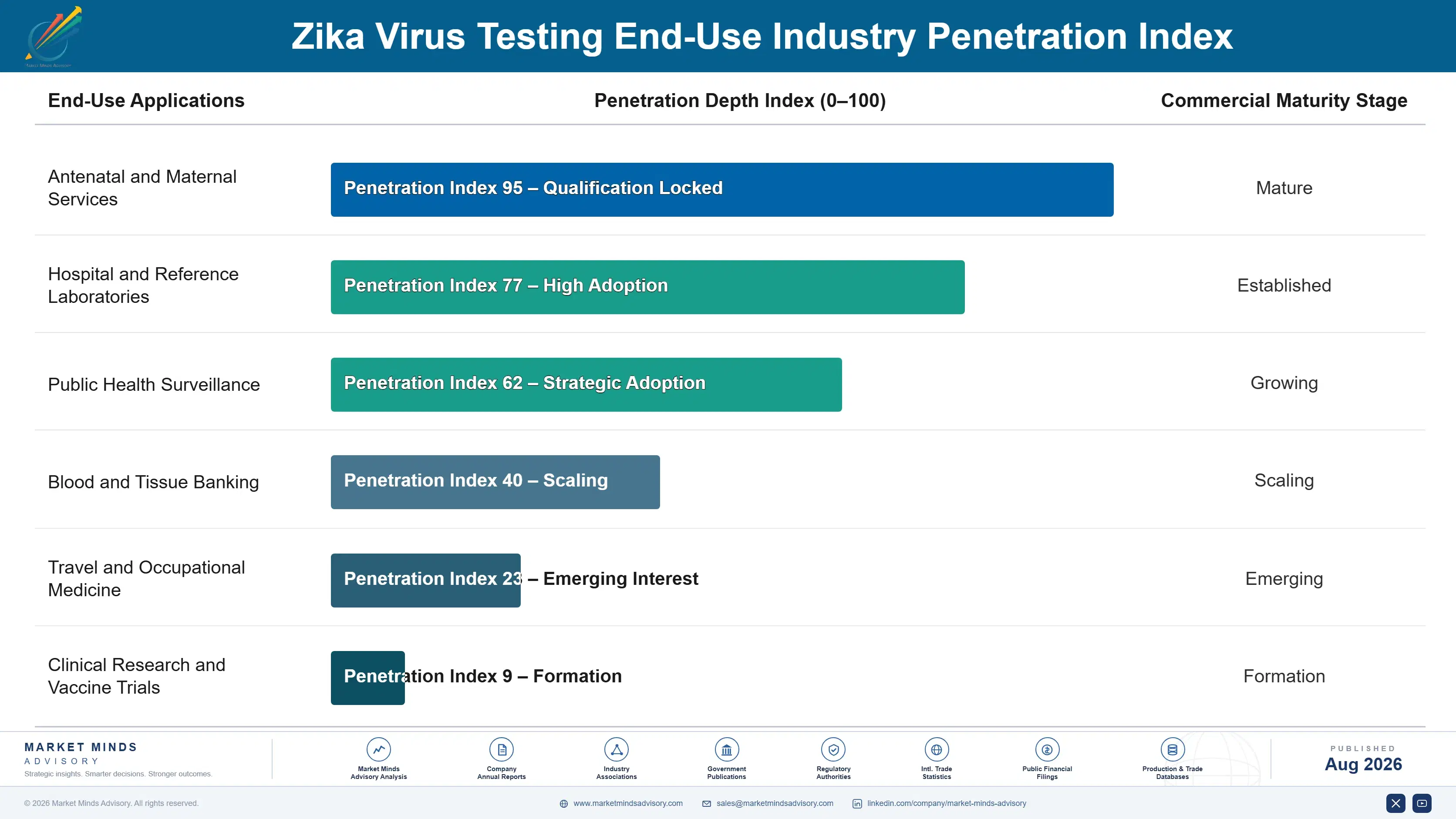
zika-virus-testing-market-end-use-penetration-index-1787665282753

Where This Testing Rewards Focus

These are among the four positions where our research anticipates prominent divergence between winners and laggards over the coming forecast period. Each is grounded in the demand model, the regulatory perimeter, and the announced capacity pipeline.
01 / PANEL CHANNEL STRATEGY

Nobody asks whether it is Zika

Dengue, chikungunya and Zika share a vector, a geography and a clinical presentation that no clinician can separate at the bedside without some form of laboratory input to help. That makes single pathogen testing an answer to a question that nobody actually asked, and around 47% of testing already runs as a combined arbovirus panel accordingly. Suppliers positioning Zika specific assays are selling against a workflow decision laboratories took years ago and have no reason whatsoever to revisit it now.
02 / ANTENATAL DEMAND FOCUS

Testing only changes anything in pregnancy

Congenital infection carries consequences that symptomatic adult infection does not, and no treatment exists for either presentation, which means a test changes clinical management during pregnancy and essentially nowhere else at all. Around 58% of category volume is antenatal as a direct consequence of that underlying clinical reality rather than any commercial choice. This is also the demand that persists between outbreak periods when symptomatic testing collapses entirely, which makes it the stable half of an otherwise entirely episodic market.
03 / CONFIRMATION GAP OWNERSHIP

The confirmatory test is in the wrong countries

Flavivirus antibody cross reaction means roughly 63% of positive serology results require neutralisation testing before they can be interpreted at all by anybody. Only about 4% of endemic country laboratories hold the containment facilities and live virus capability that confirmation requires, which places the confirmatory method largely in countries without the disease. Improved specificity assays narrow that particular gap without closing it, and anybody genuinely closing it would change what serology delivers in the places where it actually matters most.
04 / INTEREPIDEMIC CAPABILITY RETENTION

Staying ready is the whole commercial position

Testing volumes sit around 82% below outbreak peak, and capability funded during an emergency erodes quietly once attention moves somewhere else entirely and nobody notices it happening. Suppliers maintaining validated assays, regulatory registrations and laboratory relationships through quiet periods are positioned when transmission returns, while those who exited rebuild everything under time pressure that they cannot control at all. It is an unglamorous position and it has been rewarded repeatedly across arbovirus and respiratory pathogens alike over the past two decades.

Engagement Snapshot From the Field

A live engagement with an industry participant carrying material or product regulatory and market exposure ahead of a defining policy shift, showing how our research translates into a defensible multi-year portfolio strategy.
MARKET MINDS ADVISORY · CLIENT ENGAGEMENT SUMMARY
Zika Virus Testing Producer Strategic Portfolio Review and Transition Roadmap 2026·Investment Scenario on Zika Virus Testing Exposure Evaluation 2025-26
CLIENT PROFILE
A diagnostics company holding Zika serology and molecular assays developed during the epidemic period, selling into public health and reference laboratories across Latin America and North America. Annual revenue from these products was approximately 11 million dollars (client-reported, unverified by MMA), well below the level the products had reached during the outbreak. No multiplex arbovirus panel existed in the portfolio.
STRATEGIC CHALLENGE
Revenue had declined for six consecutive years as outbreak testing subsided, and management was weighing whether to withdraw the products or invest further in a category showing no obvious recovery. Laboratories were consolidating onto panels the company did not offer. Nobody had separated the collapsing symptomatic demand from the antenatal volume that was holding steady.
MMA APPROACH
MMA separated the client's volumes into symptomatic, antenatal and screening components and projected each independently rather than as one declining line. Multiplex panel development was costed against withdrawal and against continued single assay supply. Forty-seven expert interviews with laboratory directors, public health officials, obstetricians and blood service managers established how testing decisions are made, alongside survey work across six countries.
KEY FINDINGS
  1. Antenatal and screening volume had been stable across the whole decline period and accounted for roughly 60% of remaining revenue, which the aggregate figure had concealed completely.
  2. Laboratories in 7 of 9 accounts reviewed had consolidated or planned to consolidate onto multiplex panels, and the client would lose the remaining symptomatic volume regardless.
  3. Multiplex panel development was costed at around 2 years, against a competitor set already established in that format across the client's own accounts.
  4. Public health programme officials rather than clinicians determined testing volume in 5 of the 6 markets reviewed, and the client's selling reached clinicians almost exclusively.
CLIENT PROFILE
A diagnostics company holding Zika serology and molecular assays developed during the epidemic period, selling into public health and reference laboratories across Latin America and North America. Annual revenue from these products was approximately 11 million dollars (client-reported, unverified by MMA), well below the level the products had reached during the outbreak. No multiplex arbovirus panel existed in the portfolio.
STRATEGIC CHALLENGE
Revenue had declined for six consecutive years as outbreak testing subsided, and management was weighing whether to withdraw the products or invest further in a category showing no obvious recovery. Laboratories were consolidating onto panels the company did not offer. Nobody had separated the collapsing symptomatic demand from the antenatal volume that was holding steady.
MMA APPROACH
MMA separated the client's volumes into symptomatic, antenatal and screening components and projected each independently rather than as one declining line. Multiplex panel development was costed against withdrawal and against continued single assay supply. Forty-seven expert interviews with laboratory directors, public health officials, obstetricians and blood service managers established how testing decisions are made, alongside survey work across six countries.
KEY FINDINGS
  1. Antenatal and screening volume had been stable across the whole decline period and accounted for roughly 60% of remaining revenue, which the aggregate figure had concealed completely.
  2. Laboratories in 7 of 9 accounts reviewed had consolidated or planned to consolidate onto multiplex panels, and the client would lose the remaining symptomatic volume regardless.
  3. Multiplex panel development was costed at around 2 years, against a competitor set already established in that format across the client's own accounts.
  4. Public health programme officials rather than clinicians determined testing volume in 5 of the 6 markets reviewed, and the client's selling reached clinicians almost exclusively.
RECOMMENDED STRATEGY
Phase 1: Phase one: protect antenatal and screening volume, which was stable and accounted for roughly 60% of remaining revenue throughout the decline. Phase 2: Phase two: partner rather than build for multiplex panel access, given 7 of 9 accounts had consolidated and development would take 2 years. Phase 3: Phase three: redirect selling toward programme officials, who determined volume in 5 of the 6 markets the client actually served.
OUTCOME
The client stopped treating the business as a single declining line and protected the antenatal and screening volume that had always been stable underneath. A panel partnership provided multiplex access without the development timeline, and selling to programme officials reached the parties who actually set testing volume (client-reported, unverified by MMA).

Frequently Asked Questions

Foundational context covering the market sizes, CAGR, scope, country, region and competition that inform every finding below. This section is provided to cover basics and most often pre-purchase conversations, answered from the MMA Primary Research Dataset.

What is the current size of the Zika Virus Testing Market?

The market was valued at 0.14 billion dollars in 2025, covering molecular, serological, rapid and screening tests for Zika virus infection worldwide. It reaches an estimated 0.15 billion dollars during 2026.

How large will the Zika Virus Testing Market be by 2036?

MMA forecasts 0.34 billion dollars by 2036, an increase of 0.19 billion dollars over the 2026 base. That represents an expansion multiple of 2.27 times across the forecast period.

What is the CAGR for the Zika Virus Testing Market 2026 to 2036?

The base case compound annual growth rate is 8.6%, with a bull case of 9.8% and a bear case of 7.4%. Antenatal programme adoption and surveillance funding separate those two scenarios.

Which segment is growing fastest?

Multiplex arbovirus panels grow at 12.9%, half again the market rate of 8.6%, because three indistinguishable diseases are tested together. Rapid formats follow at 10.6%.

Who are the major companies in the Zika Virus Testing Market?

Roche Diagnostics, Bio-Rad Laboratories, Hologic, Abbott and Thermo Fisher Scientific lead on test volume across molecular and serological platforms. Together they hold 56% of the market.

Which country is growing fastest?

India grows fastest at 11.6%, because dengue burden is pulling multiplex arbovirus panel adoption forward across public and private laboratory networks right across the country.

Report Segmentation Architecture

The full report scope spans multiple orthogonal segmentation dimensions, with cross-tabulated demand data provided for each dimension pair. Coverage extends further to regional breakdowns, trend trajectories, and the competitive detail needed to support segment-level decision-making.

By Test Type

  • Multiplex Arbovirus Panels
  • Zika Specific Molecular Assays
  • IgM and IgG Serology
  • Plaque Reduction Neutralisation Testing
  • Rapid and Point-of-Care Tests
  • Blood and Tissue Donor Screening

By End-Use Industry

  • Antenatal and Maternal Services
  • Hospital and Reference Laboratories
  • Public Health Surveillance
  • Blood and Tissue Banking
  • Travel and Occupational Medicine
  • Clinical Research and Vaccine Trials

By Commercial Dimension

  • Hospital Laboratory Supply
  • Reference Laboratory Send-Out
  • Public Health Programme Contract
  • Blood Bank Supply
  • Distributor Supply
  • Donor Funded Procurement

By Region

  • North America
  • Western Europe
  • East Asia
  • South Asia and Pacific
  • Latin America
  • Middle East and Africa
  • Eastern Europe

Scope, Methodology, and Coverage

Every figure in this report is reproducible from documented input assumptions. The scope below maps the historical period, the forecast horizon, the segmentation dimensions, and the countries covered, alongside the underlying primary and qualitative methodology.
Historical Period
2020 to 2025
Forecast Period
2026 to 2036
Base Year
2025 (USD billions; MMA Primary Research Dataset, August 2026)
Market Definition
Diagnostic tests for Zika virus infection worldwide, covering multiplex arbovirus panels including a Zika target, Zika specific molecular assays, immunoglobulin M and G serology, plaque reduction neutralisation confirmatory testing, rapid and point-of-care formats, and blood and tissue donor screening assays, measured at test revenue. Zika vaccines and therapeutics, mosquito vector control products, general febrile illness testing without any arbovirus target, and dengue or chikungunya testing performed without a Zika component are excluded from scope.
Quantitative Units
USD billions (test revenue); tests performed; USD per test by type
Segmentation Dimensions
Test type; end-use industry; commercial dimension; region
Regions Covered
North America, Western Europe, East Asia, South Asia and Pacific, Latin America, Middle East and Africa, Eastern Europe
Countries Covered
Brazil, Colombia, Mexico, Argentina, Peru, United States, Canada, United Kingdom, France, Spain, Italy, Germany, China, Japan, Singapore, India, Bangladesh, Indonesia, Philippines, Australia, Nigeria, Poland
Key Companies Profiled
Roche Diagnostics, Bio-Rad Laboratories, Hologic, Abbott, Thermo Fisher Scientific, QIAGEN, bioMerieux, DiaSorin, InBios International, Euroimmun, Chembio Diagnostics, OraSure Technologies, Grifols, Siemens Healthineers, Quest Diagnostics, LabCorp, Cepheid, Meridian Bioscience, Altona Diagnostics, CTK Biotech
Quantitative Methodology
Primary survey, n=3,800 respondents, Q4 2025, six countries; demand-side model with trade association cross-validation
Qualitative Methodology
47 expert interviews, Q4 2025; applied to validate demand model assumptions, identify emerging dynamics, and assess competitive positioning
Report Format
PDF and XLSX data workbook (Word format preview document)
Publisher
Market Minds Advisory
Report Code
MMA-2026-MED-142
Published
August 2026
Contact
sales@marketmindsadvisory.com | www.marketmindsadvisory.com

Purchase the full Zika Virus Testing Market Report (2026 to 2036).

The full report explains why Zika specific testing stopped being a viable standalone market and what survives inside multiplex arbovirus panels instead. It sizes all six test types independently through 2036, separates antenatal and screening demand from episodic symptomatic testing, and quantifies the confirmatory testing gap between where the disease occurs and where it can be confirmed. Regional chapters cover all seven regions, with arbovirus burden geography assessed separately from testing capability and spending. Competitive profiling covers 20 participants on one consistent test volume measure.
Six test types sized independently through 2036
Antenatal and screening demand separated from episodic symptomatic testing
Confirmatory capability mapped against endemic disease geography
Panel consolidation tracked across reference and routine laboratories
Interepidemic capability retention assessed across profiled suppliers
Twenty participants profiled on one consistent test measure

Built For The People Who Decide

From boardroom strategy to bench-side execution, this report is read cover-to-cover by leaders shaping the next decade of their industry, turning demand scenarios, market dynamics and valuation benchmarks into decisions.
CXOs/ Presidents/ VPs/ Managers
M&A and Corporate Development
Strategy Teams and R&D Heads
Procurement and Product Directors
Regulatory and Compliance Leaders
Investor Relations and Equity Analysts