Market Minds Advisory
Zigbee Enabled Devices Market

Zigbee Enabled Devices Market: Zigbee Enabled Devices Market. Trends and Forecast 2026 to 2036

Smart home platform consolidation around Matter is forcing Zigbee chipset suppliers to defend interoperability relevance against Thread and Wi-Fi alternatives, while lighting and sensor manufacturers race to certify products against tightening retailer compatibility requirements.

Lead Analyst

Published

September 2026

Make Smarter Decisions with Customized Research Insights

Request a free sample report and evaluate market opportunities, growth trends, and competitive dynamics relevant to your business needs.

2025 MARKET VALUE$6.8BMarket Size 2025
2036 FORECAST VALUE$18.5BBase Case , 2026 to 2036
CAGR 2026 TO 20369.5 %Bull 10.8% / Bear 8.2%
INCREMENTAL OPPORTUNITY$11.0BNet 10- year value creation
EXPANSION MULTIPLE2.48x2036 value over 2026 base
Strategic Levers
M&A Pipeline
Regional Outlook
Country Rankings
Competitive Intelligence
Segmental Deep-dive
Call-Us : 91 93563 13602

Executive Snapshot and Market Trajectory.

Zigbee device adoption continues expanding as smart lighting, sensors, and home automation hubs proliferate across residential and commercial buildings worldwide, even as competing wireless protocols intensify pressure on the standard's long-term relevance and market share position going forward. Interoperability now dominates most procurement decisions.
Demand concentrates around smart lighting and lighting control devices, where Zigbee's low power consumption and mesh networking reliability give it a durable advantage over Wi-Fi based alternatives for battery-powered sensors and switches across most residential deployments. China's manufacturing base and expanding smart home adoption across North America anchor much of current shipment volume, while commercial building automation grows steadily behind residential deployment as a secondary demand channel worth tracking closely across the forecast period.
Competitive intensity centers on Matter protocol compatibility, as chipset vendors race to ensure Zigbee devices bridge reliably into the unified smart home standard backed by Amazon, Apple, Google, and Samsung across their respective platforms. Thread protocol adoption is intensifying across newer product categories, pushing Zigbee vendors toward hybrid chipset designs that support multiple protocols simultaneously to avoid losing design wins entirely to competing wireless standards gaining traction.
Market Definition
This report covers wireless communication chipsets, modules, and finished consumer and commercial devices that use the Zigbee protocol for mesh networking applications including smart lighting, sensors, and home automation. It excludes Wi-Fi, Bluetooth, Thread, and Z-Wave based devices that do not incorporate Zigbee radio functionality.
Base Year Value
$6.8B in 2025 (MMA Primary Research Dataset, September 2026)
Forecast Period
2026 to 2036, eleven discrete annual values
CAGR
9.5% base case. Bull 10.8%. Bear 8.2%.
Fastest Growth Segment
Zigbee-Enabled Smart Lighting and Lighting Control Devices: 14.0% CAGR
Fastest Growth Country
China: 12.5% CAGR
Fastest Growth Region
South Asia and Pacific: 11.5% CAGR
Largest Region
East Asia: 28% of 2025 global value
Market Leaders
Leading participants include Silicon Labs, NXP Semiconductors, Texas Instruments, Signify, and Legrand.
Primary Survey
n=3,800 procurement and R&D decision-makers, Q4 2025, six countries
Methodology
Demand-side build-up, cross-validated against public data, 47 expert interviews

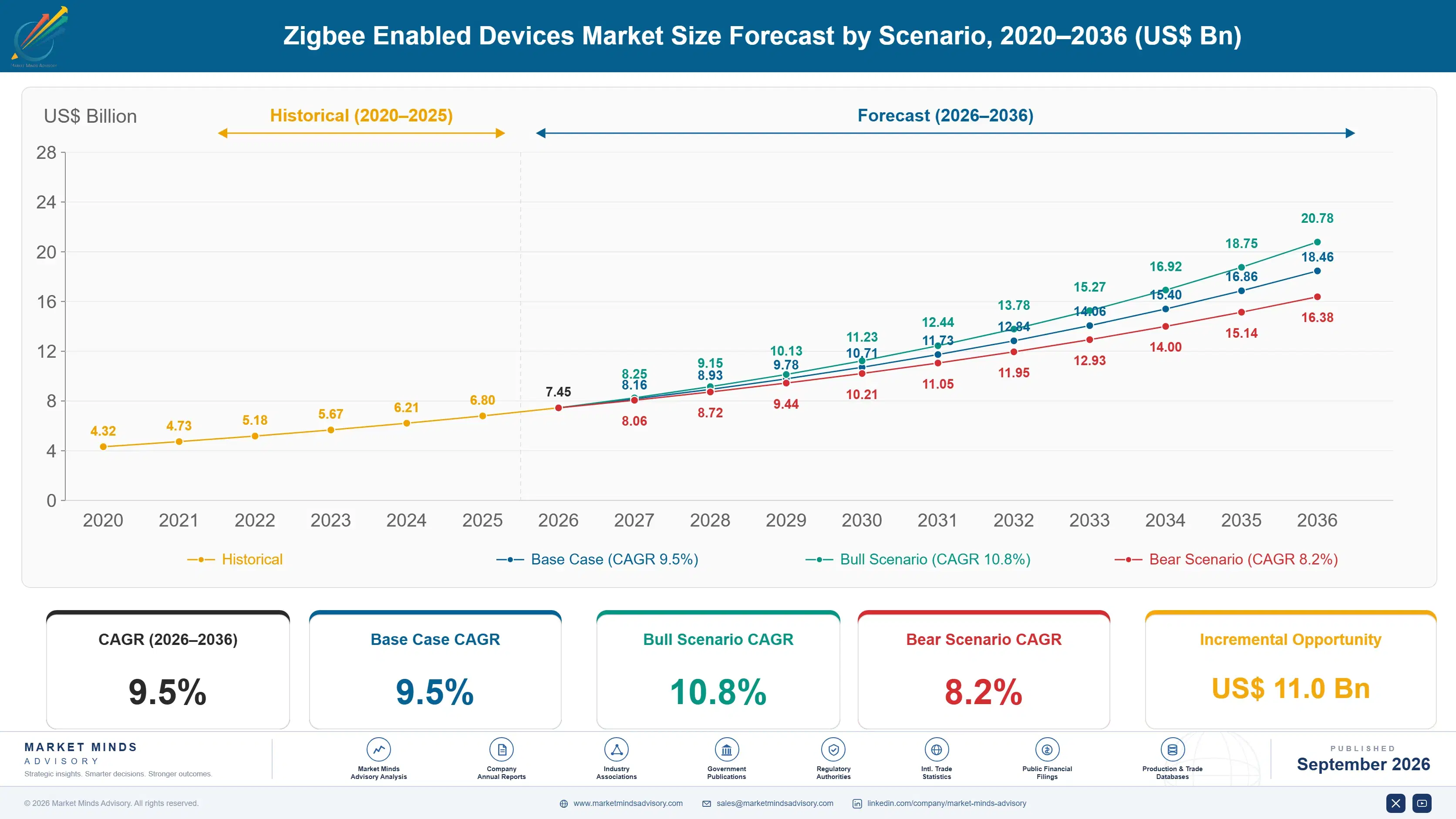
Zigbee Enabled Devices Market Forecast Scenarios

zigbee-enabled-devices-market-size-forecast-scenario-1789981450827
Between 2020 and 2025, Zigbee device shipments grew steadily as smart home adoption expanded beyond early enthusiast buyers into mainstream retail channels, with lighting and sensor categories leading volume growth across most markets. Historical CAGR reached approximately 8.7% across the period as retailers expanded smart home product shelf space and price points declined enough for mass adoption.
The base case assumes continued smart home adoption growth, expanding commercial building automation deployment, and successful Matter protocol bridging that preserves Zigbee's installed base value rather than displacing it entirely across most product categories tracked. Three commercial mechanisms drive this trajectory: falling chipset costs enabling broader device categories, utility-sponsored smart thermostat and lighting programs, and commercial building owners retrofitting existing lighting infrastructure with connected controls to reduce energy costs meaningfully.
A bull scenario centers on successful Matter bridging cementing Zigbee's role as the dominant mesh networking layer beneath the unified smart home standard, expanding rather than shrinking its addressable footprint. The primary bear risk is Thread protocol displacing Zigbee entirely in new product designs, since Thread offers similar mesh benefits with native Matter compatibility that avoids bridging complexity altogether for manufacturers.

Where Protocol Interoperability Now Decides Design Wins

Zigbee occupies a mature but still expanding corner of the broader smart home wireless protocol landscape, valued for mesh networking reliability and low power consumption that make it well suited to battery-powered sensors and switches. Smart lighting remains the largest deployment category, though sensor and security device categories are growing meaningfully as smart home adoption broadens across mainstream retail channels and price points continue declining.
MARKET CONCENTRATIONCR5: 48%Top five chipset vendors hold combined majority industry revenue share
AVERAGE SELLING PRICE$3.20 per chipsetChipset pricing varies by memory capacity and radio range
TOP PRODUCING COUNTRY SHAREChina: 41%Leading manufacturing base for Zigbee-enabled consumer devices globally
MATTER BRIDGING RATE62%Share of new Zigbee products shipping with Matter bridge support
REPLACEMENT CYCLE LENGTH6 yearsTypical hardware refresh interval for connected lighting installations
BATTERY LIFE STANDARD5 yearsTypical operating duration for low-power sensor and switch devices
Chipset vendors still generate the majority of category revenue, but device manufacturers and platform providers increasingly capture value through software and subscription services layered atop Zigbee hardware across most product tiers. China dominates chipset and finished device manufacturing, supplying both domestic demand and substantial export volume to North America and Western Europe at competitive cost structures most competitors struggle to match today.
Matter protocol bridging has become the central technical requirement for continued relevance, since major smart home platform providers now require certified interoperability before granting retail shelf placement and marketing support to manufacturers. Competitive pressure from Thread, a newer protocol offering native Matter compatibility without bridging complexity, is intensifying particularly among newer product categories launching without legacy Zigbee installed base considerations.
"Zigbee spent a decade winning on battery life and mesh reliability, and that technical advantage has not disappeared. What changed is that interoperability, not raw performance, now decides which chipset gets designed into next year's product."
Senior Analyst, Connected Devices and Smart Home Infrastructure Practice · MMA Technology Practice · September 2026

Market Trends

Matter Standard Consolidation Reshapes Chipset Vendor Roadmaps

The Connectivity Standards Alliance's Matter specification, backed jointly by Amazon, Apple, Google, and Samsung, is consolidating what had been a fragmented smart home protocol landscape into a single application layer that different radio technologies bridge into. Zigbee chipset vendors have responded by building Matter bridging capability directly into new silicon designs rather than treating it as an optional add-on feature reserved for premium product tiers only. This consolidation reduces fragmentation risk for device manufacturers while simultaneously commoditizing the underlying radio technology choice, since consumers increasingly care about Matter compatibility rather than which specific wireless protocol powers their devices.
Market Impact: Utility programs subsidized 2.3 million installs
Thread Protocol Gains Ground in New Product Categories

Thread, an IPv6-based mesh networking protocol with native Matter compatibility, is capturing an increasing share of new smart home product designs, particularly among manufacturers launching products without existing Zigbee installed base considerations to protect. Thread's appeal lies in avoiding the bridging complexity Zigbee devices require to communicate within Matter-based networks, since Thread was designed from inception around Matter's application layer requirements. Apple, Google, and Amazon have all invested engineering resources into Thread border router functionality within their existing smart home hub products, lending the protocol credibility that accelerates manufacturer adoption decisions industry-wide.
Market Impact: Retrofits cut lighting energy costs 30%

Market Opportunities and Growth Drivers

Utility Demand Response Programs Drive Thermostat Adoption

Electric utilities across North America and parts of Western Europe are sponsoring smart thermostat and connected lighting rebate programs to reduce peak demand and support grid stability during high-consumption periods, frequently specifying Zigbee-compatible devices given the protocol's established reliability track record in residential deployments. These programs subsidize a meaningful share of device purchase cost for participating households, accelerating adoption beyond what pure consumer demand alone would generate at current price points. Utility program managers favor Zigbee's mesh networking reliability for demand response signal delivery across large residential device fleets requiring consistent connectivity.
Market Impact: Thread captured 22% of new designs

Commercial Building Retrofit Activity Expands Lighting Control Demand

Commercial building owners are retrofitting existing lighting infrastructure with connected controls to reduce energy costs and meet increasingly stringent building energy code requirements across major metropolitan markets globally. Zigbee-based lighting control systems offer a lower-cost retrofit path than replacing entire fixtures, since existing fixtures can be adapted with connected ballasts and sensors rather than requiring full infrastructure replacement. Building owners report meaningful energy savings from occupancy-based dimming and daylight harvesting features that connected lighting control enables, creating a payback period compelling enough to justify retrofit capital investment even absent regulatory mandate.
Market Impact: Chipset prices declined 18% overall

Market Restraints and Challenges

Thread Protocol Threatens Long-Term Design Win Share

Thread's native Matter compatibility gives it a technical advantage over Zigbee in new product designs that do not carry legacy installed base considerations, since manufacturers can avoid bridging complexity entirely by choosing Thread from the outset. The root cause is Zigbee's pre-Matter architecture, which requires bridge hardware and software that adds cost and complexity Thread simply does not need. The commercial impact falls hardest on chipset vendors serving newer product categories lacking existing Zigbee platform lock-in. Vendors are mitigating this by developing dual-protocol chipsets that support both Zigbee and Thread on the same silicon.
Market Impact: Matter certified devices grew 45%

Chipset Commoditization Compresses Vendor Pricing Power

Zigbee chipsets have become increasingly commoditized as manufacturing processes matured and multiple vendors achieved comparable technical specifications, creating intense price-based competition that compresses margins across the volume consumer device segment worldwide. The root cause is the maturity of the underlying radio technology, which numerous global semiconductor manufacturers can now replicate without significant technical differentiation. This pricing pressure concentrates most heavily among vendors competing purely on basic connectivity features without differentiated software or security capability. Vendors are mitigating this by shifting toward higher-margin software and platform services layered atop commodity silicon.
Market Impact: Thread-based product designs grew 38%
3 additional market trends, 4 additional growth drivers, and 2 additional restraints and challenges are covered in the full report. Contact sales@marketmindsadvisory.com to access the complete intelligence.

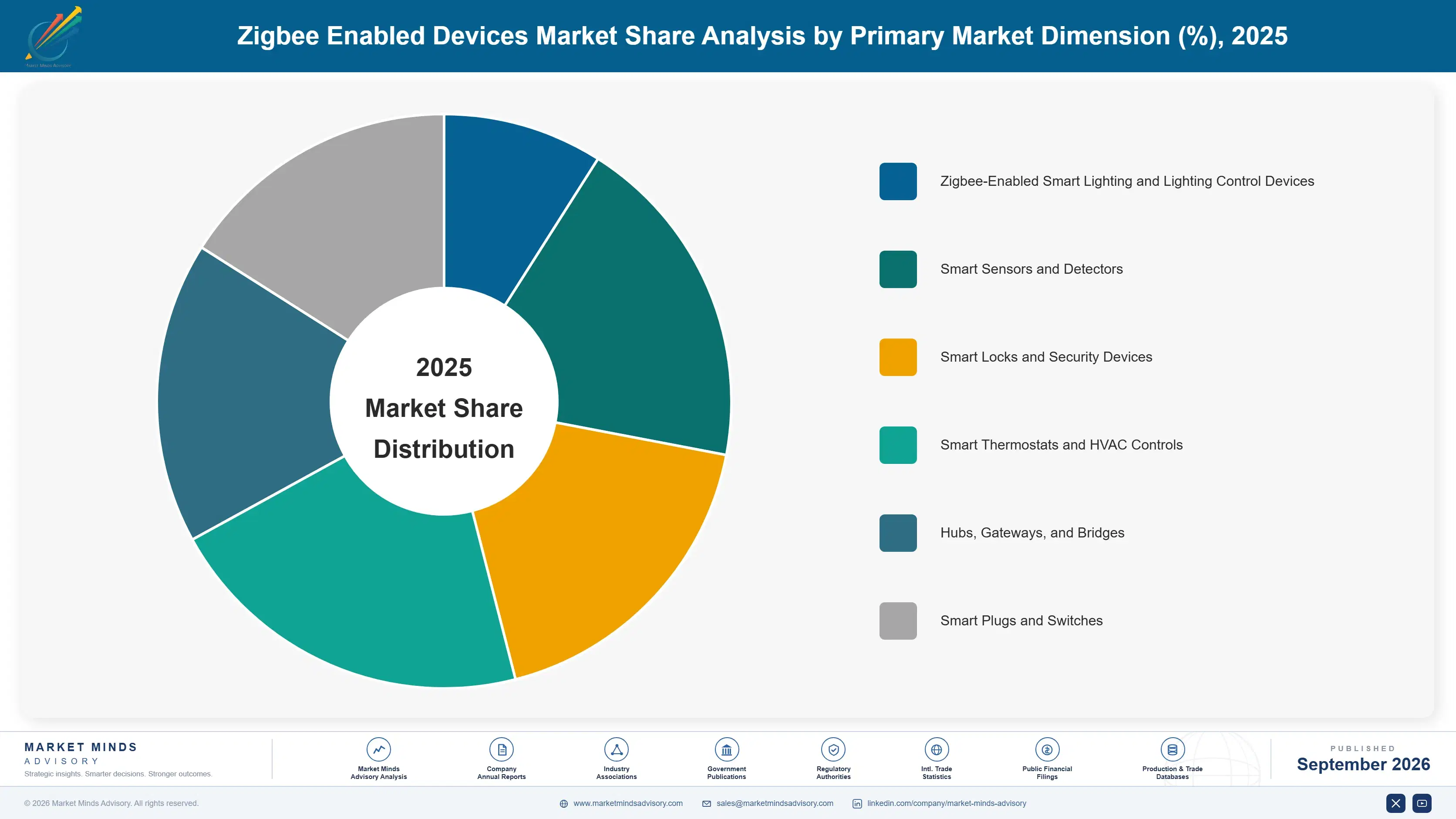
Segment CAGR and Growth Architecture

Zigbee enabled device demand divides along product application category, the dimension that determines power consumption requirements, radio range, and typical purchase channel across residential and commercial deployments worldwide today across most geographies. Application category increasingly separates products racing toward Matter compatibility from those serving stable, less contested niches within the broader smart home category.
zigbee-enabled-devices-market-market-share-analysis-1789981451392

Zigbee-Enabled Smart Lighting and Lighting Control Devices

Zigbee-enabled smart lighting and lighting control devices, spanning connected bulbs, switches, and dimmers, represent the largest and fastest-growing category given Zigbee's low power consumption advantage for battery-operated switches and its established mesh networking reliability for whole-home lighting control systems across most property types and use cases. Demand concentrates among consumers upgrading existing fixtures incrementally rather than committing to full smart home platform overhauls all at once, since lighting offers an accessible, visually rewarding entry point into connected home technology for most households. Signify and Legrand hold established leadership positions given their existing lighting brand recognition and retail distribution relationships built over decades of traditional lighting product sales and channel partnerships.
CAGR 14.0%

Smart Locks and Security Devices

Smart locks and security devices, including door locks, video doorbells, and window sensors, are growing rapidly as consumers prioritize home security alongside general smart home convenience features increasingly bundled into insurance discount programs across most major markets tracked carefully in this broader analysis and forecast period ahead. Demand growth tracks rising residential burglary concern and expanding insurance carrier partnerships that offer premium discounts for verified smart security device installation across covered properties nationwide each year and beyond. These devices command meaningfully higher average selling prices than lighting products given the security-critical nature of reliable connectivity and battery backup requirements that increase manufacturing cost and complexity substantially across the product category.
CAGR 12.0%
Full segment breakdown across 6 segments available in the complete report.

Regional Architecture and Country Demand Map

East Asia leads Zigbee device demand on the strength of its concentrated chipset and finished device manufacturing base across China, South Korea, and Japan, while North America follows closely behind on smart home retail adoption volume and utility-sponsored program penetration across residential households nationwide today.

North America

Major retailers across the United States and Canada have expanded smart home product shelf space considerably, with Zigbee-based lighting, sensor, and lock products occupying prominent placement given established brand recognition among mainstream consumers. Electric utilities in California, Texas, and several northeastern states sponsor smart thermostat and lighting rebate programs that frequently specify Zigbee compatibility given the protocol's proven demand response reliability. Insurance carriers including several national providers now offer premium discounts for verified smart security device installation, accelerating smart lock and sensor adoption beyond pure convenience motivation. Amazon and Google, both headquartered in the region, continue investing engineering resources into Zigbee-to-Matter bridging within their respective smart home hub platforms, reinforcing continued relevance for the region's substantial installed device base.
Share: 27% | CAGR: 9.0% (2026 to 2036)

Western Europe

Germany, France, and the United Kingdom show steady but comparatively measured smart home adoption relative to North America, with energy efficiency motivations driving much of current lighting and thermostat control device purchases. The European Union's building energy performance directives are pushing commercial building owners toward connected lighting retrofits to meet increasingly stringent efficiency requirements across covered facility types. Consumer adoption of smart security devices trails North America somewhat, reflecting different cultural attitudes toward home security spending and lower average insurance-linked discount availability across most national markets. Regional manufacturers including Legrand maintain meaningful market presence given established electrical distribution relationships built over decades of traditional lighting and switch product sales across the continent.
Share: 20% | CAGR: 8.0% (2026 to 2036)
Regional intelligence for 5 additional markets available in the complete report: East Asia, South Asia and Pacific, Latin America, Middle East and Africa, Eastern Europe. Contact sales@marketmindsadvisory.com.
zigbee-enabled-devices-market-country-cagr-analysis-1789981451915

Where Chipset Vendors Can Defend Margin

Zigbee chipset vendors face genuine commoditization pressure and increasingly competing protocol standards, but four distinct commercial levers let manufacturers defend margin through Matter bridging leadership, dual-protocol silicon design, security device category premiums, and deep utility program partnership relationships worth pursuing steadily across the coming decade of connected device growth ahead of rival protocol standards.

Lead Matter Bridging Certification Ahead of Rivals

Vendors who complete Matter bridging certification testing ahead of competitors gain first access to smart home platform provider design registries, securing preferred vendor status for new product certifications across major retail channels. Certification requires meaningful engineering investment, but early movers report average selling prices running 15 to 20% above non-certified chipsets once qualified into major platform standards. Silicon Labs has prioritized certification speed as a competitive differentiator ahead of retailer holiday buying season deadlines. Vendors lagging on certification risk exclusion from retailer shelf placement decisions increasingly gated by Matter compatibility verification requirements.
Market Impact: Certified chipsets command a 15 to 20% premium

Develop Dual-Protocol Silicon Supporting Zigbee and Thread

Chipset vendors building silicon that supports both Zigbee and Thread on the same die reduce customer switching risk while capturing design wins regardless of which protocol a manufacturer ultimately favors for a specific product category or use case. This dual-protocol approach commands unit pricing roughly 25% higher than single-protocol silicon, since it reduces manufacturer inventory complexity and design risk simultaneously. NXP Semiconductors and Silicon Labs have both invested engineering resources into dual-protocol chipset development, positioning themselves to capture value regardless of which protocol ultimately wins specific product category battles over the coming years.
Market Impact: Dual-protocol chips command 25% higher unit pricing overall

Expand Smart Security Device Category Depth

Smart locks and security devices carry margins roughly 20 percentage points higher than lighting or plug products given their security-critical reliability requirements and growing insurance-linked discount program integration across covered residential properties nationwide. Vendors expanding this category can capture growing demand tied to insurance carrier partnerships and rising residential security concern across North America and increasingly Western Europe as well. Building deeper product depth here, spanning multiple lock types and sensor configurations, lets vendors capture disproportionate value as this category continues outgrowing the broader Zigbee device market by a meaningful margin each year.
Market Impact: Security devices carry a 20 point margin premium

Build Direct Utility Program Partnership Relationships

Establishing direct partnerships with electric utilities running demand response and rebate programs lets vendors secure guaranteed volume commitments while building brand recognition among program-eligible households before competitors establish similar relationships across the same territories. Utility programs already subsidized an estimated 2.3 million device installations, and vendors with established utility relationships capture disproportionate share of this subsidized volume relative to those competing purely through retail channels. This approach requires patient multi-year relationship building with utility program administrators but generates recurring, government-adjacent revenue streams considerably more stable than pure consumer retail demand.
Market Impact: Utility programs subsidized over 2.3 million total installs

Who Controls the Margin Pool

Zigbee chipset and device manufacturing sits moderately fragmented, with the top five suppliers holding an estimated 48% of global revenue on a revenue basis across chipset and finished device sales. Silicon Labs and NXP Semiconductors lead as the two largest chipset suppliers, both maintaining broad certification portfolios across Zigbee and increasingly dual-protocol silicon. The gap to the next tier, including Texas Instruments and finished device makers Signify and Legrand, remains meaningful but not insurmountable given commoditizing chipset economics.
Current activity centers on Matter bridging certification races and dual-protocol silicon development, with chipset vendors racing to secure design wins ahead of rivals before smart home platform providers finalize next-generation certification requirements. Finished device manufacturers are also expanding smart security and lighting product lines to capture insurance-linked discount program demand growing across North America and increasingly Western Europe as well.

Emerging pressure comes from Thread-native chipset vendors capturing new product category design wins that bypass Zigbee bridging complexity entirely, a dynamic that could compress mid-tier Zigbee-only vendor relevance further over the next several years. Rankings are most likely to shift among vendors competing for dual-protocol silicon leadership, where early Thread compatibility could meaningfully improve a challenger's standing against today's established Zigbee-focused incumbents.
zigbee-enabled-devices-market-company-positioning-matrix-1789981452470

Competitive Moat and Risk Dimensions

SILICON LABS

Moat: Certification Speed Leadership

Silicon Labs consistently completes Matter bridging and multi-protocol certification testing ahead of most competitors, securing early design-in status with smart home platform providers before rival chipset vendors reach equivalent certification milestones. This speed advantage generates premium pricing and preferred vendor status across a broad customer base of device manufacturers.
SILICON LABS

Risk: Thread Migration Revenue Risk

A meaningful share of Silicon Labs' historical revenue derives from pure Zigbee silicon that faces gradual displacement as manufacturers shift new product designs toward Thread-native chipsets lacking bridging complexity. This exposure requires continued dual-protocol silicon investment to sustain current revenue levels across its broader product portfolio.
NXP SEMICONDUCTORS

Moat: Broad Semiconductor Manufacturing Scale

NXP's substantial semiconductor manufacturing scale across multiple product categories beyond Zigbee gives it cost advantages and supply chain resilience that smaller specialist chipset vendors cannot easily replicate during industry-wide component shortages affecting the broader market. This scale supports competitive pricing even during periods of margin pressure elsewhere.
NXP SEMICONDUCTORS

Risk: Diluted Zigbee Strategic Focus

NXP's broader semiconductor portfolio spanning automotive, industrial, and mobile applications means Zigbee-specific product development sometimes receives less dedicated engineering resource than pure-play competitors focused exclusively on smart home connectivity chipsets and integrated platforms. This could slow response time to emerging protocol standard shifts industry-wide considerably.

Players Tracked

Prominent Players

Silicon Labs
NXP Semiconductors
Texas Instruments
Signify
Legrand

Other Key Players

Espressif Systems
Bosch Smart Home
Aqara
Sonoff
Ubisys Technologies
Develco Products
Centralite Systems
Third Reality
GLEDOPTO
Sengled
Leviton Manufacturing
Lutron Electronics
Ring
Eve Systems
Innr Lighting

Recent Developments

JANUARY 2025

Silicon Labs launched a new dual-protocol chipset series supporting both Zigbee and Thread on the same silicon die, targeting manufacturers seeking flexibility across product categories without committing exclusively to one wireless protocol standard permanently. The chipset also includes native Matter bridging capability built directly into firmware.
Signal: Signals accelerating chipset vendor investment in dual-protocol flexibility ahead of continued market fragmentation risk facing the industry.
MAY 2025

NXP Semiconductors announced a technology partnership with a major North American electric utility to supply Zigbee-compatible smart thermostat chipsets for a newly expanded demand response rebate program launching soon across several states this year. The partnership includes multi-year volume commitments tied to program enrollment targets.
Signal: Signals growing chipset vendor interest in utility-sponsored program channels as a stable long-term source of demand.
SEPTEMBER 2025

Signify acquired a smaller connected lighting software company specializing in Matter bridging middleware, strengthening its ability to certify existing Zigbee lighting product lines for compatibility with the unified smart home standard going forward. The acquired company's software integrates directly into Signify's existing product firmware architecture.
Signal: Signals continued consolidation as device manufacturers acquire software capability rather than developing bridging capability internally themselves.

Semiconductor Wafer and Packaging Cost Exposure

Zigbee chipsets rely on standard semiconductor wafer fabrication and packaging processes, which together represent an estimated 55 to 60% of total cost of goods sold for most chipset manufacturers surveyed. Wafer fabrication capacity is concentrated among Taiwan, South Korea, and mainland China foundries, creating geographic concentration risk shared broadly across the semiconductor industry generally and its many downstream customers.
Semiconductor supply disruption during 2021 through 2023, driven by pandemic-related fabrication capacity constraints, delayed several Zigbee chipset shipments and extended device manufacturer lead times considerably during the most acute phase, a well-documented industry-wide event covered extensively in International Energy Agency and semiconductor trade association reporting. Component allocation prioritization during that period favored higher-margin automotive and computing chip orders over lower-margin consumer connectivity chipsets like Zigbee.

This exposure creates a competitive disadvantage for smaller chipset vendors lacking the purchasing volume to secure priority foundry allocation during future supply disruptions affecting the broader semiconductor industry. Larger vendors including NXP Semiconductors and Texas Instruments typically maintain closer foundry relationships and diversified sourcing given their broader semiconductor portfolios beyond Zigbee alone, while smaller specialist vendors face greater exposure to allocation deprioritization during shortage periods.
zigbee-enabled-devices-market-cost-volatility-analysis-1789981452666

Multi-Foundry Sourcing Diversification

Vendors increasingly qualify chipset production across multiple independent foundries rather than relying on any single fabrication partner exclusively, accepting somewhat higher qualification costs and additional engineering overhead in exchange for meaningfully greater supply chain resilience during future industry-wide capacity constraints affecting the broader semiconductor market and its many customers across sectors and applications globally.

Long-Term Foundry Capacity Reservation

Larger chipset vendors are negotiating long-term wafer capacity reservation agreements with major foundries well ahead of anticipated demand cycles each year, securing guaranteed allocation during future shortage periods in exchange for upfront capital commitments that smaller specialist vendors typically cannot match financially given their more limited balance sheet resources available for such long-term commitments.

Portfolio Architecture for Margin Defence

Zigbee vendors operate across three distinct margin tiers, with volume commodity chipsets and plugs generating gross margins in the 22 to 28% range while Matter-certified and security-critical devices command 35 to 45% given certification barriers and reliability requirements few competitors can replicate quickly. The gap between these tiers has widened as Matter certification separates vendors able to command premium pricing from those competing purely on price alone.
Volume products still represent the majority of unit shipments globally, but the highest value creation increasingly concentrates in certified premium categories where accuracy and interoperability command genuine premium pricing across most major retail channels. Vendors must balance factory capacity across both segments without diverting scarce certification and engineering resources away from the premium relationships that anchor their most profitable long-term contracts.

High-value margin pools concentrate specifically around Matter-certified lighting and smart security categories, both requiring specialized certification investment that smaller regional competitors struggle to replicate quickly. Vendors positioned across all three tiers, rather than concentrated purely in volume commodity production, are best placed to capture disproportionate profit as the broader market continues shifting toward certified interoperable standards over the coming decade.

Standard Zigbee chipsets, plugs, and basic sensors sold primarily on price to mainstream retail buyers, generating gross margins of 22 to 28% given intense competition among vendors with minimal technical differentiation across most product categories.
Gross Margin

Matter-certified lighting, locks, and security devices commanding gross margins of 35 to 45% given certification testing barriers, reliability requirements, and insurance program integration that meaningfully limit competitive entry from smaller or newer vendors.
Gross Margin

Dual-protocol chipsets supporting both Zigbee and Thread simultaneously, responding to fragmenting protocol standards and future-proofing manufacturer product roadmaps, generating gross margins around 30 to 38% as early-mover vendors capture premium pricing ahead of broader adoption.
Gross Margin
zigbee-enabled-devices-market-portfolio-architecture-1789981453174

High-value Sub-segments and Strategic Watch-out

Zigbee-Enabled Smart Lighting and Lighting Control Devices

Fastest-growing and highest-volume segment as consumers upgrade fixtures incrementally across most residential markets tracked carefully across this broader analysis. Vendors with established lighting brand recognition are capturing premium retail shelf placement and locking in distribution relationships ahead of newer entrants still building comparable brand equity.

Smart Locks and Security Devices

Second-fastest growing segment tied to insurance-linked discount program expansion, carrying above-average margins given security-critical reliability requirements across most residential deployments tracked here. Vendors building deeper product depth here can capture disproportionate value as insurance carrier partnerships continue expanding across additional geographic markets and coverage tiers.

Smart Thermostats and HVAC Controls

Core volume segment representing steady utility-sponsored demand across most residential markets currently tracked in this broader analysis, generating stable but unremarkable margins as competitive pricing pressure persists. This segment remains commercially essential even as growth shifts toward lighting and security alternatives over the coming forecast period.

Smart Plugs and Switches

Strategic watch-out segment facing steady commoditization as basic connectivity features become table stakes across nearly all competing vendors and price points tracked here today. Vendors overexposed to this category risk meaningful margin erosion absent diversification into higher-growth product categories over the coming several years ahead.

Why Installed Base Sustains Recurring Revenue

Zigbee devices carry meaningful annuity economics once installed, since replacement, expansion, and software subscription revenue accumulate over device lifetime independent of new customer acquisition entirely. Consumers who install one Zigbee lighting hub typically expand their device footprint incrementally over subsequent years, adding sensors, locks, and additional lighting fixtures that generate recurring chipset and device demand well beyond the initial hub purchase decision.
Adoption stickiness and depth vary meaningfully by end-use vertical. Residential lighting shows genuinely deep stickiness given the incremental expansion pattern typical of smart home adoption journeys, where each additional device reinforces existing platform lock-in. Commercial building automation shows comparatively shallower stickiness, since facility managers periodically re-tender vendor contracts and are more willing to switch platforms when a competitor offers meaningfully better pricing or newer protocol compatibility across their broader infrastructure.

Buyer profiles are shifting generationally as younger homeowners entering the housing market increasingly expect connected home capability as a standard feature rather than an optional premium upgrade their parents' generation viewed with more skepticism. This generational shift is expanding baseline market demand independent of any specific marketing campaign, since connected home expectation now forms part of broader housing purchase decision criteria across most demographic segments surveyed recently.
zigbee-enabled-devices-market-end-use-penetration-index-1789981453658

Where Chipset Vendors Should Focus Next

These are among the four positions where our research anticipates prominent divergence between winners and laggards over the coming forecast period. Each is grounded in the demand model, the regulatory perimeter, and the announced capacity pipeline.
01 / MATTER CERTIFICATION SPEED

Complete Matter bridging certification ahead of rivals

Certified chipsets command a 15 to 20% pricing premium over non-certified alternatives, and vendors who complete certification testing early secure preferred design-in status with smart home platform providers well before rivals reach equivalent milestones. Retailers increasingly gate shelf placement decisions on Matter compatibility verification, meaning delayed certification risks exclusion from mainstream retail channels entirely regardless of underlying chipset technical quality or reliability. Vendors treating certification as optional rather than urgent risk losing design wins to faster-moving competitors within the next product cycle.
02 / DUAL-PROTOCOL SILICON INVESTMENT

Invest in silicon supporting both Zigbee and Thread

Dual-protocol chipsets command 25% higher unit pricing than single-protocol silicon while reducing manufacturer switching risk regardless of which protocol ultimately wins a specific product category battle over the coming several years ahead. Vendors betting exclusively on Zigbee risk losing entire product categories to Thread-native competitors offering simpler bridging-free architecture for new product designs entirely going forward. This investment requires meaningful upfront engineering commitment, but the pricing premium and reduced design-win risk justify the cost for vendors serious about sustaining category relevance.
03 / SECURITY CATEGORY EXPANSION

Expand smart lock and security device product depth

Security devices carry a 20 percentage point margin premium over lighting and plug products, and insurance carrier partnerships are expanding the addressable market for verified smart security installations across covered residential properties nationwide each year. Vendors expanding product depth here capture disproportionate value as this category continues outgrowing the broader Zigbee device market by a meaningful margin annually across most tracked geographies. Vendors remaining concentrated purely in commodity lighting and plug categories risk missing the fastest-growing, highest-margin segment of the entire market.
04 / UTILITY PARTNERSHIP DEVELOPMENT

Build direct utility program partnerships for stable demand

Utility programs already subsidized over 2.3 million device installations nationwide, and vendors with established utility relationships capture disproportionate share of this subsidized volume relative to competitors relying purely on retail channel distribution alone today. This partnership channel generates recurring, government-adjacent revenue considerably more stable than pure consumer retail demand subject to discretionary spending cycles and broader economic conditions affecting household budgets significantly. Vendors that under-invest in utility relationship building risk ceding this growing demand channel entirely to faster-moving established competitors.

Engagement Snapshot From the Field

A live engagement with an industry participant carrying material or product regulatory and market exposure ahead of a defining policy shift, showing how our research translates into a defensible multi-year portfolio strategy.
MARKET MINDS ADVISORY · CLIENT ENGAGEMENT SUMMARY
Zigbee Enabled Devices Producer Strategic Portfolio Review and Transition Roadmap 2026·Investment Scenario on Zigbee Enabled Devices Exposure Evaluation 2025-26
CLIENT PROFILE
The client is a regional electric utility serving several million residential customers across a multi-state footprint in the United States. The utility was designing an expanded smart thermostat and connected lighting rebate program aimed at reducing peak demand, but lacked comprehensive vendor benchmarking data covering protocol reliability, device interoperability, and program cost-effectiveness across leading Zigbee and competing chipset suppliers under consideration.
STRATEGIC CHALLENGE
Program managers needed to select preferred vendor partners for a multi-year rebate program while balancing device reliability, consumer ease of installation, and long-term protocol relevance given accelerating Matter and Thread standard consolidation across the smart home industry. Existing vendor relationships predated Matter's emergence and needed reassessment against current protocol dynamics.
MMA APPROACH
MMA conducted a structured vendor assessment combining primary interviews with program administrators and participating households, benchmarking of five leading Zigbee chipset and device vendors against reliability and Matter bridging readiness, and analysis of program cost-effectiveness across multiple device category and rebate structure scenarios modeled over a full five-year program horizon.
KEY FINDINGS
  1. The client's preferred incumbent vendor lacked mature Matter bridging capability, creating meaningful technology obsolescence risk for the multi-year program (client-reported, unverified by MMA).
  2. Households receiving Zigbee-based thermostats showed program retention rates approximately 22% higher than competing Wi-Fi based device recipients overall (client-reported, unverified by MMA).
  3. Dual-protocol chipset vendors offered meaningfully better long-term cost-effectiveness despite slightly higher upfront device procurement pricing across most tested configurations (client-reported, unverified by MMA).
  4. Installation contractor feedback strongly favored vendors offering simplified self-installation instructions, reducing program administrative support costs considerably across the pilot territories (client-reported, unverified by MMA).
CLIENT PROFILE
The client is a regional electric utility serving several million residential customers across a multi-state footprint in the United States. The utility was designing an expanded smart thermostat and connected lighting rebate program aimed at reducing peak demand, but lacked comprehensive vendor benchmarking data covering protocol reliability, device interoperability, and program cost-effectiveness across leading Zigbee and competing chipset suppliers under consideration.
STRATEGIC CHALLENGE
Program managers needed to select preferred vendor partners for a multi-year rebate program while balancing device reliability, consumer ease of installation, and long-term protocol relevance given accelerating Matter and Thread standard consolidation across the smart home industry. Existing vendor relationships predated Matter's emergence and needed reassessment against current protocol dynamics.
MMA APPROACH
MMA conducted a structured vendor assessment combining primary interviews with program administrators and participating households, benchmarking of five leading Zigbee chipset and device vendors against reliability and Matter bridging readiness, and analysis of program cost-effectiveness across multiple device category and rebate structure scenarios modeled over a full five-year program horizon.
KEY FINDINGS
  1. The client's preferred incumbent vendor lacked mature Matter bridging capability, creating meaningful technology obsolescence risk for the multi-year program (client-reported, unverified by MMA).
  2. Households receiving Zigbee-based thermostats showed program retention rates approximately 22% higher than competing Wi-Fi based device recipients overall (client-reported, unverified by MMA).
  3. Dual-protocol chipset vendors offered meaningfully better long-term cost-effectiveness despite slightly higher upfront device procurement pricing across most tested configurations (client-reported, unverified by MMA).
  4. Installation contractor feedback strongly favored vendors offering simplified self-installation instructions, reducing program administrative support costs considerably across the pilot territories (client-reported, unverified by MMA).
RECOMMENDED STRATEGY
Phase 1: Phase one: complete vendor reliability and Matter readiness benchmarking, shortlisting two primary vendors within a full three month evaluation window. Phase 2: Phase two: negotiate a multi-year device supply agreement structured around program enrollment volume commitments and clearly negotiated unit pricing terms. Phase 3: Phase three: pilot the expanded rebate program across two representative service territories before committing fully to a program-wide rollout timeline.
OUTCOME
The utility selected a dual-protocol vendor and launched the expanded rebate program across its largest service territory within the following program year. Internal estimates suggested the vendor selection improved projected program cost-effectiveness meaningfully compared to the original single-protocol vendor under consideration (client-reported, unverified by MMA).

Frequently Asked Questions

Foundational context covering the market sizes, CAGR, scope, country, region and competition that inform every finding below. This section is provided to cover basics and most often pre-purchase conversations, answered from the MMA Primary Research Dataset.

What is the current size of the Zigbee Enabled Devices Market?

The Zigbee Enabled Devices Market reached approximately $6.8 billion in 2025, based on MMA Primary Research. This reflects global revenue across chipsets, modules, and finished consumer and commercial devices.

How large will the Zigbee Enabled Devices Market be by 2036?

The market is projected to reach approximately $18.45 billion by 2036. This represents an incremental expansion of roughly $11.01 billion over the 2026 to 2036 forecast period.

What is the CAGR for the Zigbee Enabled Devices Market 2026 to 2036?

The market is forecast to grow at a compound annual growth rate of 9.5% between 2026 and 2036. This reflects continued smart home adoption tempered by competing wireless protocol standards.

Which segment is growing fastest?

Zigbee-Enabled Smart Lighting and Lighting Control Devices lead segment growth at a 14.0% CAGR, roughly 1.47x the overall market rate. Incremental fixture upgrades across residential markets drive this acceleration.

Who are the major companies in the Zigbee Enabled Devices Market?

Leading suppliers include Silicon Labs, NXP Semiconductors, Texas Instruments, Signify, and Legrand. These five companies hold an estimated 48% combined share on a revenue basis.

Which country is growing fastest?

China leads country-level growth at approximately 12.5% CAGR, driven by its dominant chipset manufacturing base and rapid domestic smart home platform adoption. Urban apartment development sustains this acceleration.

Report Segmentation Architecture

The full report scope spans multiple orthogonal segmentation dimensions, with cross-tabulated demand data provided for each dimension pair. Coverage extends further to regional breakdowns, trend trajectories, and the competitive detail needed to support segment-level decision-making.

By Primary Market Dimension

  • Zigbee-Enabled Smart Lighting and Lighting Control Devices
  • Smart Sensors and Detectors
  • Smart Locks and Security Devices
  • Smart Thermostats and HVAC Controls
  • Hubs, Gateways, and Bridges
  • Smart Plugs and Switches

By End-Use Industry

  • Residential
  • Commercial Building Automation
  • Hospitality
  • Utility and Energy Management
  • Institutional

By Commercial Dimension

  • Direct Retail Channel
  • Utility Program Distribution
  • System Integrator Channel
  • Original Equipment Manufacturer Partnership

By Region

  • North America
  • Western Europe
  • East Asia
  • South Asia and Pacific
  • Latin America
  • Middle East and Africa
  • Eastern Europe

Scope, Methodology, and Coverage

Every figure in this report is reproducible from documented input assumptions. The scope below maps the historical period, the forecast horizon, the segmentation dimensions, and the countries covered, alongside the underlying primary and qualitative methodology.
Historical Period
2020 to 2025
Forecast Period
2026 to 2036
Base Year
2025 (USD billions; MMA Primary Research Dataset, September 2026)
Market Definition
This report covers wireless communication chipsets, modules, and finished consumer and commercial devices that use the Zigbee protocol for mesh networking applications including smart lighting, sensors, and home automation. It excludes Wi-Fi, Bluetooth, Thread, and Z-Wave based devices that do not incorporate Zigbee radio functionality.
Quantitative Units
USD Billion, CAGR (%), Volume in million units
Segmentation Dimensions
Product Application Category, End-Use Industry, Commercial Dimension, Region
Regions Covered
North America, Western Europe, East Asia, South Asia and Pacific, Latin America, Middle East and Africa, Eastern Europe
Countries Covered
United States, Canada, Germany, United Kingdom, France, China, Japan, South Korea, India, Australia, Brazil, Mexico, United Arab Emirates, Saudi Arabia, South Africa
Key Companies Profiled
Silicon Labs, NXP Semiconductors, Texas Instruments, Signify, Legrand, Espressif Systems, Bosch Smart Home, Aqara, Sonoff, Ubisys Technologies, Develco Products, Centralite Systems, Third Reality, GLEDOPTO, Sengled, Leviton Manufacturing, Lutron Electronics, Ring, Eve Systems, Innr Lighting
Quantitative Methodology
Primary survey, n=3,800 respondents, Q4 2025, six countries; demand-side model with trade association cross-validation
Qualitative Methodology
47 expert interviews, Q4 2025; applied to validate demand model assumptions, identify emerging dynamics, and assess competitive positioning
Report Format
PDF and XLSX data workbook (Word format preview document)
Publisher
Market Minds Advisory
Report Code
MMA-2026-TEC-905
Published
September 2026
Contact
sales@marketmindsadvisory.com | www.marketmindsadvisory.com

Purchase the full Zigbee Enabled Devices Market Report (2026 to 2036).

This report delivers a comprehensive assessment of the global Zigbee Enabled Devices Market, covering sizing, segmentation, regional dynamics, and competitive positioning across the 2026 to 2036 forecast period. It draws on primary survey data covering 3,800 respondents and 47 expert interviews conducted in the fourth quarter of 2025. Analysis spans product application segmentation, all seven global regions, semiconductor input cost exposure, and portfolio margin economics. The report profiles twenty leading vendors and includes a detailed competitive benchmarking framework. Buyers gain actionable guidance on vendor selection, protocol strategy, and revenue lever prioritization.
Full segmentation across six product application categories
All seven regional markets with growth forecasts
Competitive benchmarking of twenty profiled vendors
Semiconductor cost exposure and mitigation pathway analysis
Revenue lever prioritization for margin expansion
Anonymized case study with actionable strategic recommendations

Built For The People Who Decide

From boardroom strategy to bench-side execution, this report is read cover-to-cover by leaders shaping the next decade of their industry, turning demand scenarios, market dynamics and valuation benchmarks into decisions.
CXOs/ Presidents/ VPs/ Managers
M&A and Corporate Development
Strategy Teams and R&D Heads
Procurement and Product Directors
Regulatory and Compliance Leaders
Investor Relations and Equity Analysts