Market Minds Advisory
Yeastless Dough Market

Yeastless Dough Market: Yeastless Dough: Three Unrelated Markets Sharing One Negative Definition

A staple flatbread category, a shelf life technology and a small health belief share a name that describes what they lack rather than anything at all that they have in common.

Lead Analyst

Published

August 2026

Make Smarter Decisions with Customized Research Insights

Request a free sample report and evaluate market opportunities, growth trends, and competitive dynamics relevant to your business needs.

2025 MARKET VALUE$12.4BMarket Size 2025
2036 FORECAST VALUE$22.6BBase Case , 2026 to 2036
CAGR 2026 TO 20365.6 %Bull 6.8% / Bear 4.4%
INCREMENTAL OPPORTUNITY$9.5BNet 10- year value creation
EXPANSION MULTIPLE1.72x2036 value over 2026 base
Strategic Levers
M&A Pipeline
Regional Outlook
Country Rankings
Competitive Intelligence
Segmental Deep-dive
Call-Us : 91 93563 13602

Executive Snapshot and Market Trajectory.

Grouping these products together makes little sense and the grouping persists anyway. Unleavened flatbread is a staple carrying 58% of category tonnage, chemically leavened dough is a shelf life technology, and yeast avoidance as a health belief accounts for 7% of purchases. Nothing connects them except an absence.
The technical reason chemical leavening dominates convenience formats is rarely stated plainly. Yeast is alive and keeps fermenting, losing around 34% of viability across a frozen storage period, while chemical leavening stays dormant until heat and moisture arrive. That is why refrigerated and frozen chemically leavened dough grows fastest at 8.4%, half again the market rate. Nobody buys any of them for the absence.
Flatbread volume follows demography rather than food trends, which makes it the most predictable half of this market and the least discussed. Around 62% of flatbread consumption is still made at home rather than bought, which is where the commercial opportunity actually sits. India grows fastest at 8.6% and the top five hold only 26%. Trend positioning has never moved volume in this half of the category. Demography does all of the work instead.
Market Definition
Doughs and dough based products leavened without baker's yeast, covering unleavened flatbreads, chemically leavened quick breads and biscuits, refrigerated and frozen chemically leavened dough, laminated and steam leavened pastry, yeast free pizza and base products, and gluten free and specialty yeastless dough. Measured at manufacturer selling value. Sourdough and wild yeast fermented products, conventional yeasted bread and pastry, and home prepared flatbread are excluded.
Base Year Value
$12.4B in 2025 (MMA Primary Research Dataset, August 2026)
Forecast Period
2026 to 2036, eleven discrete annual values
CAGR
5.6% base case. Bull 6.8%. Bear 4.4%.
Fastest Growth Segment
Refrigerated and Frozen Chemically Leavened Dough: 8.4% CAGR
Fastest Growth Country
India: 8.6% CAGR
Fastest Growth Region
South Asia and Pacific: 7.8% CAGR
Largest Region
North America: 28% of 2025 global value
Market Leaders
Grupo Bimbo, General Mills, Aryzta, Kerry Group, Gruma. Source: MMA Primary Research Dataset, July 2026.
Primary Survey
n=3,800 procurement and R&D decision-makers, Q4 2025, six countries
Methodology
Demand-side build-up, cross-validated against public data, 47 expert interviews

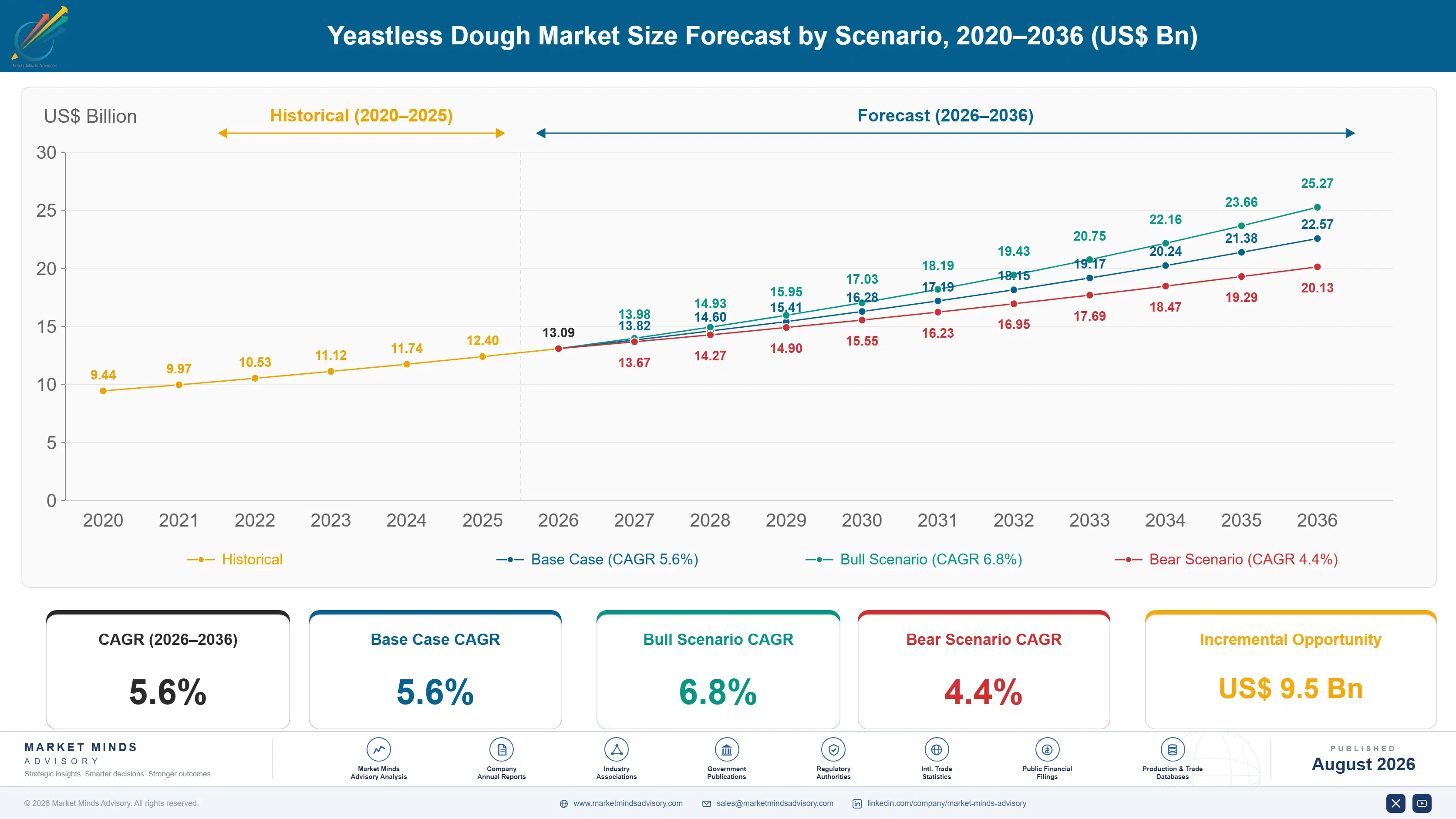
Yeastless Dough Market Forecast Scenarios

yeastless-dough-market-trends-size-forecast-scenario-1787665261515
The five years to 2025 saw the three components of this category move independently, as they always do. Flatbread volumes followed population and migration, refrigerated dough grew with convenience demand, and yeast avoidance positioning stayed small and largely static. The 4.6% historical rate averages movements with no common driver behind them, which is a limitation of the definition rather than of the underlying businesses.
The 5.6% base case rests on three mechanisms. Refrigerated and frozen chemically leavened dough grows at 8.4% on shelf life properties yeast cannot match. Laminated and steam leavened pastry grows at 7.4% through foodservice and bakery premiumisation. And Indian packaged flatbread grows at 8.6%, faster than any market covered, as commercial production converts consumption currently prepared at home. Shelf life technology, foodservice premiumisation and demographic conversion, all working at once.
The 6.8% bull case turns on packaged flatbread converting home production faster than expected in South Asian and Middle Eastern markets, where around 62% of consumption is still domestically made and any shift moves large volumes. The 4.4% bear case is wheat pricing, since flour dominates the cost structure and price movements pass through to a staple category with limited pricing tolerance.

One Name, Three Different Businesses

Defining a market by what it lacks produces exactly the confusion visible here. Unleavened flatbread is a staple food eaten daily across South Asia, the Middle East and Latin America, carrying around 58% of category tonnage and following population rather than preference. Chemically leavened dough is a convenience technology. Yeast avoidance as a health belief accounts for roughly 7% of purchases and rests on claims with limited support.
TOP FIVE CONCENTRATION26%Combined production volume held by the leading manufacturers
CHEMICAL LEAVENING SHELF LIFE18 monthsStorage achievable before any baking performance degrades noticeably
FROZEN YEAST ACTIVITY LOSS34%Viability lost across a typical frozen storage period
FLATBREAD VOLUME SHARE58%Category tonnage produced as unleavened flatbread type formats
HEALTH CLAIM PURCHASE SHARE7%Buyers choosing these products for yeast avoidance reasons
HOME PRODUCTION PROPORTION62%Flatbread consumption made domestically rather than bought commercially
The technical property doing the commercial work is shelf life rather than absence. Yeast is a living organism that continues fermenting, which gives yeasted dough a short and unforgiving handling window and loses around 34% of viability across frozen storage. Chemical leavening sits dormant until heat and moisture activate it, permitting around eighteen months of storage before baking performance degrades noticeably at all.
The volume half of this market is also the half nobody discusses commercially. Flatbread demand moves with demography and migration rather than with food trends, which makes it unusually predictable, and around 62% of that consumption is still prepared at home rather than purchased. Converting a fraction of that domestic production into packaged product moves considerably more volume than any trend led positioning ever will.
"Somebody once put staple flatbread, canned biscuit dough and a wellness belief about candida into a single category, and the industry has been reporting it that way ever since. The three have nothing whatsoever to do with each other."
Director, Bakery and Grain Based Foods Practice · MMA Food and Beverage Practice · August 2026

Market Trends

Shelf Life Rather Than Absence Drives Convenience Formats

Yeast is alive and keeps fermenting, which gives yeasted dough a short handling window and costs around 34% of viability across a frozen storage period, requiring specialised strains and higher loading to compensate. Chemical leavening stays dormant until heat and moisture arrive, permitting around eighteen months of storage before performance degrades. Refrigerated and frozen chemically leavened dough grows at 8.4% against a market rate of 5.6% for that reason alone. Nobody buys these products because they lack yeast; they buy them because they keep. Storage rather than dietary preference is the whole argument.
Market Impact: India grows at 8.6% annually
Packaged Flatbread Converts Domestic Production Slowly

Around 62% of flatbread consumption is still prepared at home across South Asian, Middle Eastern and Latin American markets, which represents a volume pool no trend driven category can approach. Conversion happens through urbanisation, household time constraints and improving product quality rather than through any marketing argument, and it moves slowly and steadily rather than in waves. Manufacturers who treat that conversion as their principal growth mechanism plan considerably better than those chasing consumer positioning instead. Around 58% of category tonnage sits in that half, and nobody markets toward it seriously.
Market Impact: Laminated pastry grows at 7.4%

Market Opportunities and Growth Drivers

Indian Packaged Flatbread Displaces Home Preparation Gradually

Indian urban households buy packaged roti, paratha and chapati in rising volumes as time pressure increases and product quality improves toward what home preparation delivers. India grows at 8.6%, faster than any market covered. The volume available is enormous, since domestic preparation still accounts for the majority of consumption, and conversion of even a small proportion moves substantial tonnage. Domestic manufacturers including ITC and Britannia hold strong positions, and cold chain reach determines which formats are viable in which cities. Nothing about that conversion depends on marketing, and everything depends on quality.
Market Impact: Health positioning drives only 7%

Foodservice Premiumisation Lifts Laminated Pastry Demand

Laminated and steam leavened pastry grows at 7.4%, second fastest in the category, as foodservice and in-store bakery formats premiumise across developed and increasingly emerging markets. These products leaven through steam and lamination rather than fermentation, which places them in this category by definition rather than by any shared commercial logic. Frozen supply into bake-off locations suits the format particularly well, since the dough performs consistently after storage in a way yeasted equivalents require more care to match. Operators who have had yeasted dough behave unpredictably after freezing rarely go back to it.
Market Impact: Home preparation covers 62% already

Market Restraints and Challenges

Category Definition Obscures Three Unrelated Businesses

Staple flatbread, convenience dough technology and a small health belief share only the absence of baker's yeast, and reporting them together produces analysis nobody can act on. The root cause is a definition built on a negative rather than on any shared property, driver or customer. Commercially this leads companies to allocate resources across a category that does not behave as one thing. Participants respond by managing the components separately internally while reporting them together externally. Reporting three unrelated businesses as one produces analysis that nobody can act sensibly upon.
Market Impact: Storage reaches 18 months reliably

Flour Cost Passes Through A Staple Price Position

Flour dominates the cost structure across every format here, and flatbread in particular occupies a staple price position where consumers notice increases immediately and switch to home preparation. The root cause is that the category competes against a domestic alternative costing only ingredients and time. Commercially this limits pricing flexibility precisely when input costs rise. Manufacturers respond with pack size adjustment and promotional management, which protects volume more successfully than it protects margin. Losing a household back to home preparation is considerably harder to reverse than losing one purchase. Nobody models that properly.
Market Impact: Home production covers 62% of consumption
3 additional market trends, 4 additional growth drivers, and 2 additional restraints and challenges are covered in the full report. Contact sales@marketmindsadvisory.com to access the complete intelligence.

Segment CAGR and Growth Architecture

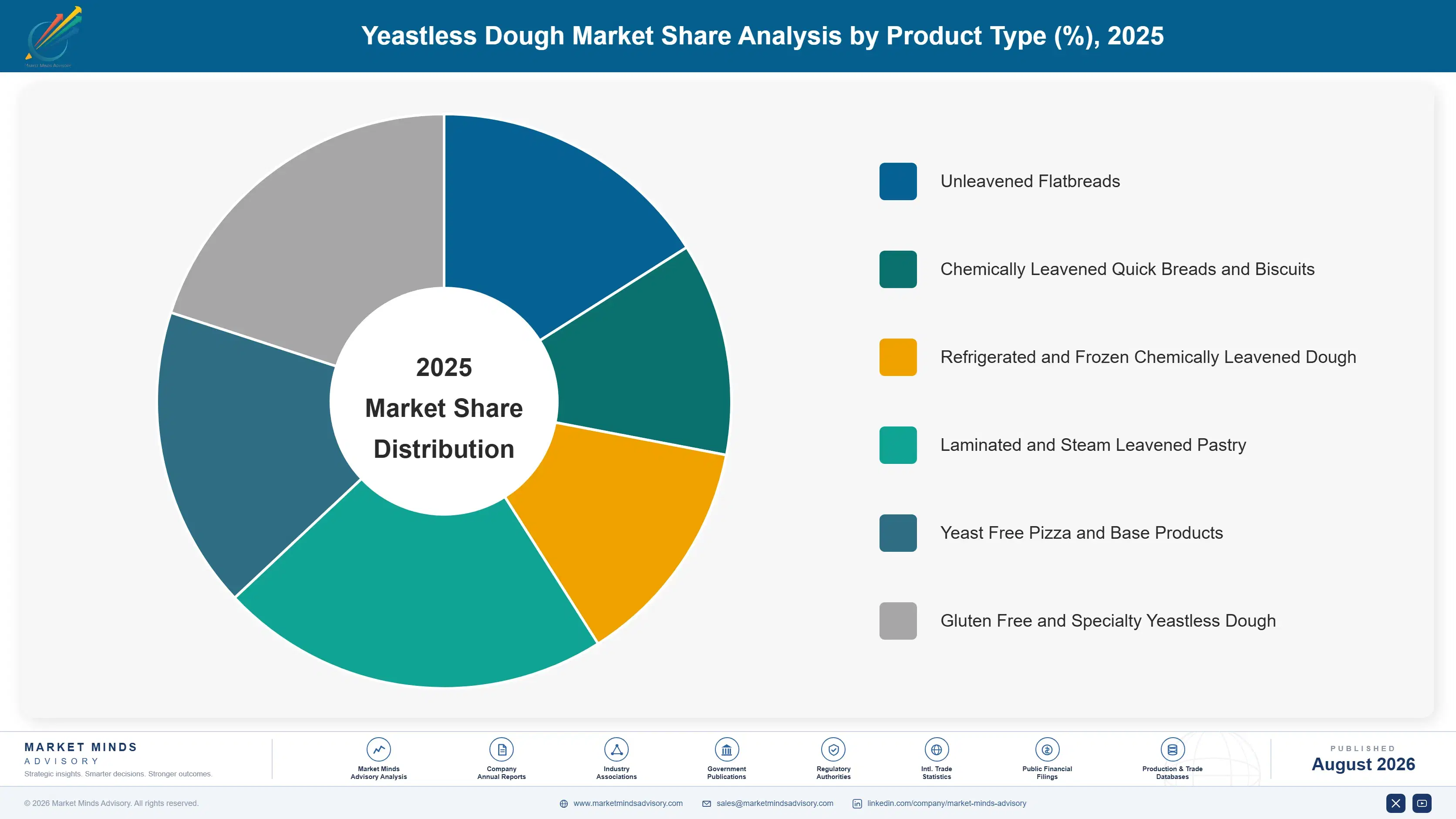
Segmentation follows product type, since type determines whether the product is a staple food, a convenience format or a specialty position, and each behaves entirely differently. Six types cover the category as traded. Growth tracks shelf life technology and demographic conversion rather than any consumer preference about yeast itself. Absence of yeast explains none of it.
yeastless-dough-market-trends-market-share-analysis-1787665262167

Refrigerated and Frozen Chemically Leavened Dough

Canned, chilled and frozen doughs using chemical leavening systems with encapsulated acidulants that remain dormant until baking, spanning biscuits, rolls, cookie dough and pastry bases. At 8.4% this is the fastest growing type, half again the market rate of 5.6%, and shelf life rather than yeast avoidance explains it completely. Yeast loses around 34% of viability through frozen storage and requires specialised strains and higher loading to compensate. Chemical systems permit around eighteen months of storage with predictable baking performance, which is what built the entire convenience category. Encapsulated acidulants cost considerably more than standard leavening grades, which is a cost customers pay willingly for the storage life it buys them.
CAGR 8.4%

Laminated and Steam Leavened Pastry

Puff pastry, choux and related products that rise through steam generation and lamination rather than through any fermentation, supplied largely frozen into foodservice and bake-off locations. Growth of 7.4% is second fastest in the category, driven by foodservice and in-store bakery premiumisation rather than by anything about leavening. These products sit in this category by technical definition rather than by shared commercial logic, which illustrates the classification problem neatly. Frozen supply suits them because performance after storage is consistent without the handling care yeasted equivalents demand. Operators who have watched yeasted dough behave unpredictably after freezing specify these products afterwards and rarely reconsider that decision. Reliability rather than flavour decides it.
CAGR 7.4%
Full segment breakdown across 6 segments available in the complete report.

Regional Architecture and Country Demand Map

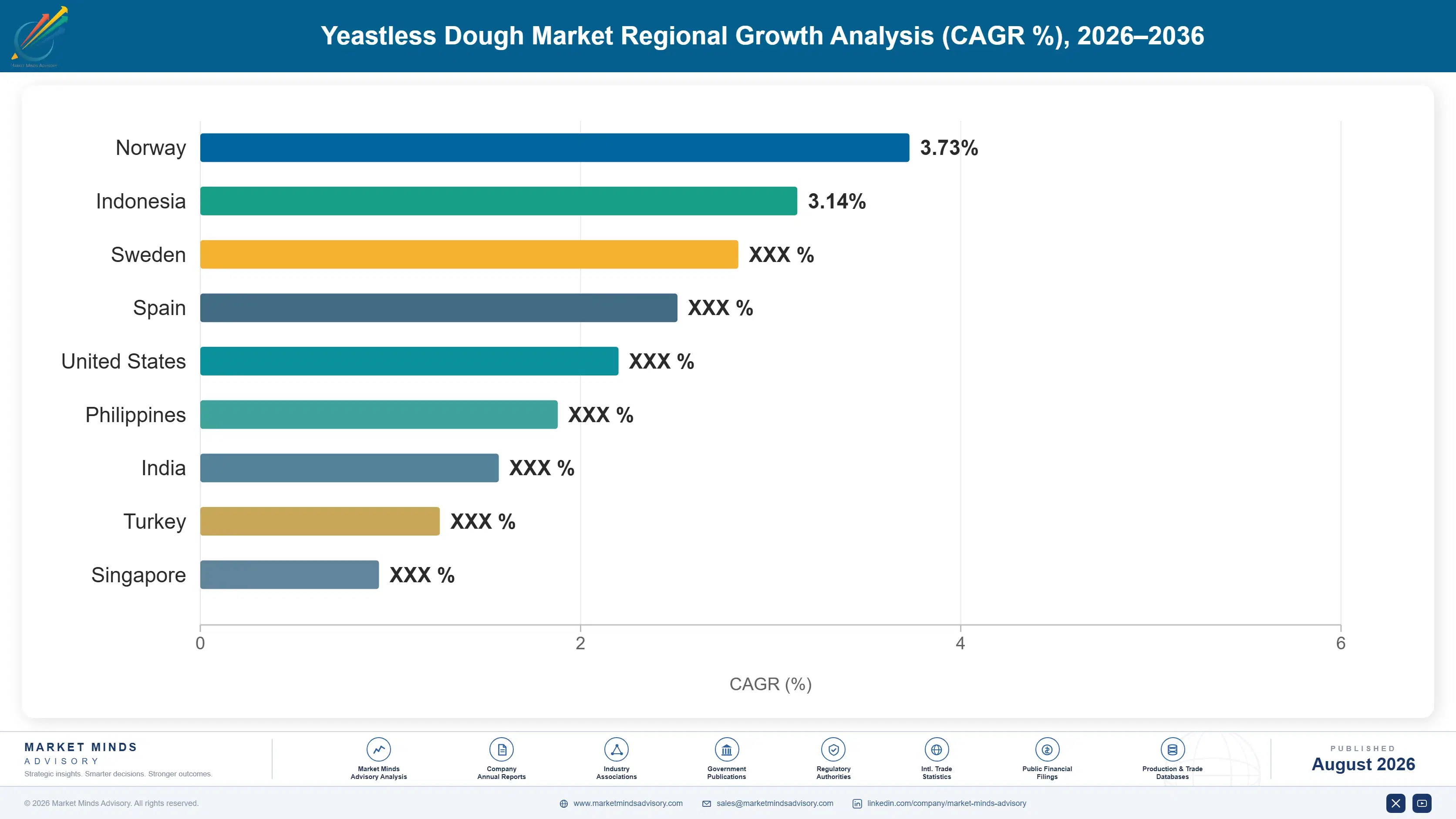
North America holds 28% on refrigerated dough and tortilla volumes at commercial scale. South Asia and Pacific at 16% and Latin America at 13% sit above band on flatbread staple consumption. India grows fastest at 8.6%. Staple consumption geography rather than economic weight explains all these.

North America

A 28% share reflects two large commercial categories that barely exist elsewhere at this scale. Refrigerated chemically leavened dough is a mainstream grocery format here and almost nowhere else, and tortilla production supplies both Mexican-influenced consumption and a wrap format that spread well beyond it. Biscuit and quick bread mixes remain substantial. Yeast avoidance positioning appears more often in retail here than in any other region, though it still accounts for a small share of purchases. Growth of 4.6% reflects mature convenience categories rather than any conversion opportunity. Two commercial categories that barely exist elsewhere carry this share between them. Neither has any equivalent in most other regions at this scale.
Share: 28% | CAGR: 4.6% (2026 to 2036)

Western Europe

A 20% share reflects laminated and steam leavened pastry supplied into foodservice and in-store bakery at considerable scale, alongside flatbread consumption driven by migration patterns across several decades. Frozen bake-off supply is well established and technically sophisticated, with pastry quality expectations among the highest anywhere. Refrigerated chemically leavened dough has never established the retail position it holds in North America. Clean label pressure affects chemical leavening agents in ways it does not affect yeast. Growth of 4.0% is the lowest of the seven regions. Foodservice rather than retail is where this category matters commercially across the region. Clean label pressure affects chemical leavening in ways it never touches yeast. That is awkward.
Share: 20% | CAGR: 4.0% (2026 to 2036)
Regional intelligence for 5 additional markets available in the complete report: East Asia, South Asia and Pacific, Latin America, Middle East and Africa, Eastern Europe. Contact sales@marketmindsadvisory.com.
yeastless-dough-market-trends-country-cagr-analysis-1787665262711

Where This Category Actually Earns

Nothing here is won on yeast avoidance, because only about 7% of purchases involve that consideration and the belief behind it has limited support. Value accrues to whoever sells shelf life, whoever follows flatbread demography, whoever converts home production, and whoever exploits frozen performance. Four routes carry weight and none is a health claim.

Sell Shelf Life Not Yeast Absence

Chemical leavening stays dormant until heat and moisture arrive, permitting around 18 months of storage with predictable baking performance, while yeast loses roughly 34% of viability through frozen storage and needs specialised strains to compensate. That property built the entire convenience dough category, and it is a technical argument rather than a dietary one. Around 7% of purchases involve yeast avoidance as a consideration, which makes health positioning a distraction from what actually sells these products. Around 18 months of predictable performance is the property that actually built this whole category.
Market Impact: Delivers around 18 months of entirely reliable storage

Follow Flatbread Demography Rather Than Trends

Unleavened flatbread carries around 58% of category tonnage and follows population, urbanisation and migration rather than any food trend, which makes it the most predictable demand in the whole category. Manufacturers treating it as a staple business plan considerably better than those treating it as a category needing consumer positioning. Demographic projection is available to anybody and rarely used, while trend forecasting in this category has been consistently unhelpful to everybody who attempted it. Around 58% of tonnage moving with demography is the most forecastable demand anybody has. Very few companies use it.
Market Impact: Flatbread carries 58% of all the category tonnage

Convert Home Production Into Purchased Product

Around 62% of flatbread consumption is still prepared domestically across South Asian, Middle Eastern and Latin American markets, which is a volume pool no consumer trend can rival. Conversion happens through urbanisation, household time constraints and product quality approaching what home preparation delivers, and it proceeds steadily rather than in waves. Capturing even a small proportion of that consumption moves more tonnage than winning share in any packaged category, and it requires quality rather than marketing. Around 62% of consumption sitting outside the commercial market is unusual at that kind of scale.
Market Impact: Targets the 62% of consumption still made at home

Serve Frozen Where Yeast Cannot Survive

Yeast loses around 34% of viability through frozen storage, requiring specialised strains, higher loading and careful handling that add cost and reduce reliability. Chemically leavened and steam leavened products perform consistently after storage without any of that, which is why frozen bake-off and refrigerated retail formats skew heavily toward them. Refrigerated and frozen chemically leavened dough grows at 8.4% and laminated pastry at 7.4% for exactly the same underlying reason, which few suppliers state directly. Around 34% viability loss is a technical fact rather than a marketing position. Operators understand it immediately.
Market Impact: Avoids the 34% viability loss during frozen storage

Who Controls the Margin Pool

Concentration is very low, which is what happens when a category definition covers three unrelated businesses. The top five hold 26% of production volume, the basis applied consistently throughout this section, across global bakery groups, regional flatbread specialists, frozen pastry manufacturers and enormous numbers of small local producers. Grupo Bimbo leads on combined bakery scale, and the gap reflects breadth across formats rather than any dominance in a single one of them.
Competition runs on three fronts that share no customers. Global bakery groups compete on distribution and manufacturing scale across retail and foodservice. Regional flatbread producers compete on freshness, price and cultural authenticity against home preparation more than against each other. And frozen pastry specialists compete on bake-off performance in a foodservice channel with entirely different operational requirements altogether.

Rankings will move with flatbread commercialisation rather than with product development, since converting domestic preparation moves volumes no packaged innovation can approach. The other pressure point is flour cost pass through, which affects a staple price position more severely than a convenience one and determines who can hold volume through any input cost cycle at all.
yeastless-dough-market-trends-company-positioning-matrix-1787665263248

Competitive Moat and Risk Dimensions

GRUPO BIMBO

Moat: Bakery Distribution Scale Breadth

Direct store delivery infrastructure across multiple continents reaches retail formats daily in a way regional producers cannot replicate at any speed, and it serves flatbread, packaged bakery and convenience formats through the same routes. That scale also spreads flour purchasing and manufacturing cost across volumes few competitors approach anywhere.
GRUPO BIMBO

Risk: Home Preparation Competition

In flatbread markets the principal competitor is domestic preparation costing only ingredients and time, which accounts for around 62% of consumption and becomes more attractive whenever packaged prices rise. Distribution scale provides no advantage against that alternative, and flour cost pass through makes the comparison worse precisely when margins need protecting.
GRUMA

Moat: Tortilla Manufacturing Specialisation

Deep specialisation in corn and wheat tortilla production, including proprietary milling and processing capability, gives cost position and quality consistency that generalist bakery manufacturers cannot match in the format. That focus also supports geographic expansion of a product category well beyond its original consumption base.
GRUMA

Risk: Single Format Concentration

Revenue concentrated in one flatbread format carries exposure to maize and wheat pricing, to consumption patterns in specific geographies and to any shift in the wrap format's popularity beyond traditional markets. Diversification into other yeastless formats means competing against specialists in categories that share no manufacturing or commercial logic.

Players Tracked

Prominent Players

Grupo Bimbo
General Mills
Aryzta
Kerry Group
Gruma

Other Key Players

Associated British Foods
Lantmannen Unibake
Conagra Brands
Flowers Foods
TreeHouse Foods
Dawn Foods
Vandemoortele
Rich Products
Puratos
Britannia Industries
ITC Limited
Almarai
La Tortilla Factory
Barilla
Nestle

Recent Developments

FEBRUARY 2025

Indian manufacturer expands packaged flatbread cold chain distribution

An Indian manufacturer expanded chilled distribution for packaged roti and paratha into additional cities, targeting urban households where time pressure has been displacing home preparation. Around 62% of regional flatbread consumption is still made domestically, which is the volume commercial producers are steadily converting. Time pressure drives it.
Signal: Cold chain reach rather than product quality decides which cities are viable in that particular market
JUNE 2025

Frozen bake-off supplier extends laminated pastry range for foodservice

A frozen bakery supplier extended its laminated pastry range for foodservice bake-off locations, citing consistent performance after frozen storage as the operational advantage. Yeasted equivalents lose around 34% of viability through frozen storage and require specialised handling that operators frequently find unreliable. Consistency matters more than flavour.
Signal: Frozen performance rather than fermentation flavour decides these foodservice formats once operators have been burned before
SEPTEMBER 2025

Wheat price movement pressures packaged flatbread retail pricing

Wheat price movement pressured packaged flatbread retail pricing in import dependent markets, where flour dominates the cost structure and consumers compare directly against home preparation. Around 62% of consumption is already domestic, and price increases make that alternative more attractive rather than less. Pricing headroom is essentially absent.
Signal: A staple category competing against home cooking has almost no pricing headroom in any import dependent market

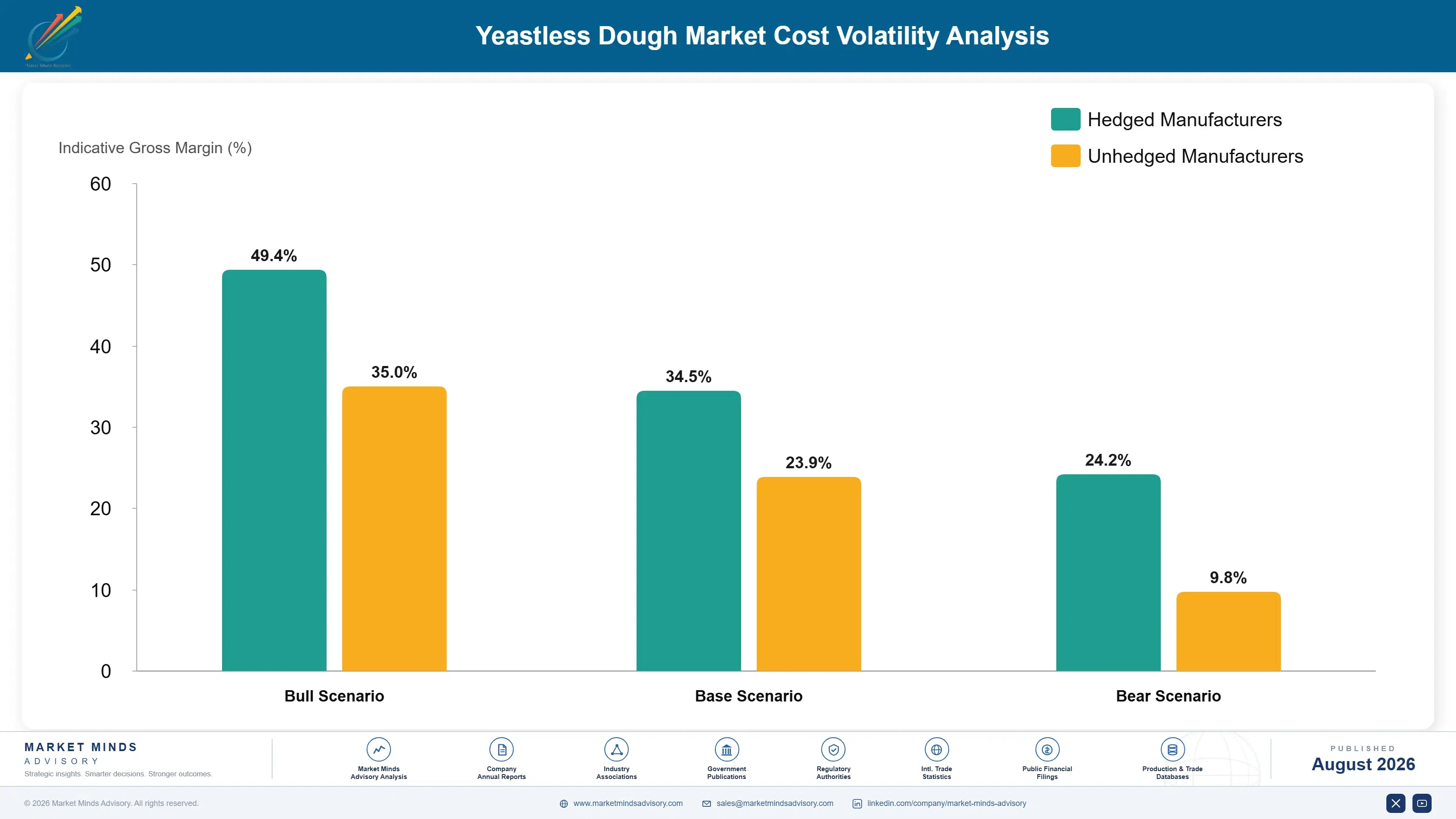
What Yeastless Dough Costs

Flour accounts for 38% of production cost across most formats, with fats and oils at 17% and chemical leavening agents, packaging, energy and labour carrying the remainder. Chemical leavening agents themselves are inexpensive, though encapsulated acidulants for long shelf life formats cost considerably more than standard grades. Maize rather than wheat dominates tortilla production in Latin America, which creates an entirely different input exposure within the same category.
Wheat price movement passes through this category more directly than through most food products. USDA production and trade data recorded the supply disruptions behind recent movements, and bakery company annual reports documented pass through difficulty in staple formats where consumers compare against home preparation. IEA data recorded the European energy costs that simultaneously raised baking and freezing expense for manufacturers operating in that region. Nobody escaped it.

Exposure divides by format and by grain rather than by scale. Flatbread producers face staple price positions with minimal pricing headroom and a domestic alternative costing only ingredients. Frozen and refrigerated convenience formats carry better pricing tolerance and higher energy exposure through cold chain. Tortilla producers using maize sit on a different commodity cycle entirely, which is a diversification benefit few participants describe as one.
yeastless-dough-market-trends-cost-volatility-analysis-1787665263447

Manage pack size rather than price in staple formats

Flatbread occupies a staple price position where consumers notice increases immediately and revert to home preparation that costs only ingredients and time. Around 62% of consumption already happens that way. Pack size and format adjustment protect volume more successfully than price increases protect margin, and losing a household to home preparation is considerably harder to reverse than losing one purchase.

Hold grain exposure across wheat and maize where possible

Maize and wheat move on separate cycles, and tortilla production using maize sits on an entirely different commodity exposure from wheat based flatbread and pastry. Participants operating across both carry a genuine diversification benefit that very few of them describe as one. Building that spread deliberately rather than acquiring it accidentally is worth considering during any capacity decision.

Specify encapsulated acidulants only where shelf life requires

Encapsulated acidulants enable around eighteen months of storage with predictable baking performance and cost considerably more than standard leavening grades. Applying them across formats that never need that shelf life adds cost customers do not pay for. Matching the leavening system to actual distribution requirements is straightforward and frequently overlooked when formulations are copied between product lines.

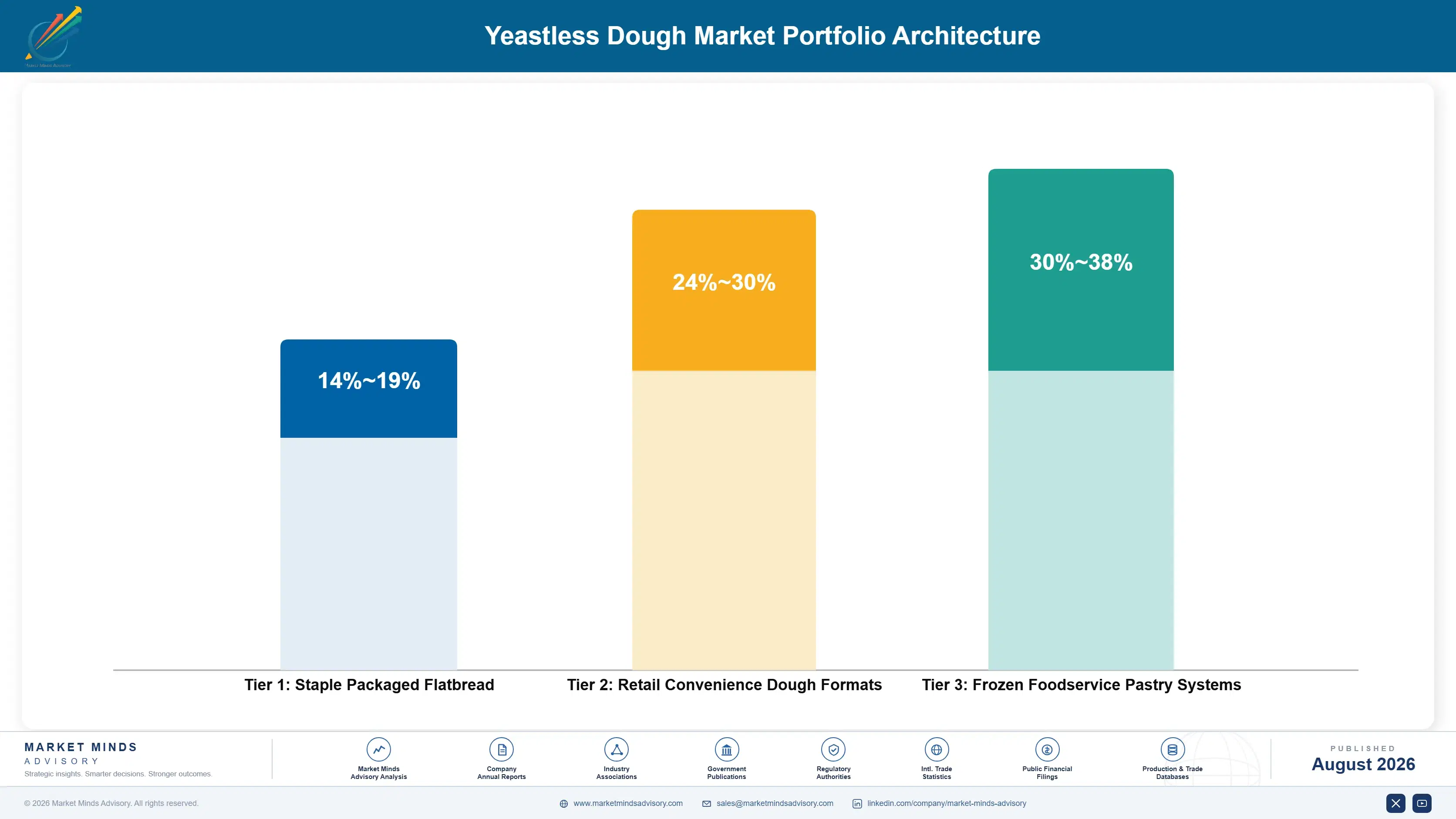
Portfolio Architecture for Margin Defence

Margin architecture divides on whether the product competes against home preparation. Staple flatbread earns least, since a household can make the same thing for the cost of ingredients and the packaged version has to justify a premium against that every single time. Convenience formats earn considerably better, because shelf life and preparation time are things nobody can replicate domestically. Frozen foodservice pastry earns best, on operational reliability that bake-off locations pay for.
The tension runs between volume and margin, and they sit in different halves of the category. Flatbread carries around 58% of tonnage at thin margins against a domestic alternative, while convenience and foodservice formats carry margin on considerably less volume. A manufacturer holding both is running businesses with different customers, different competitors and different cost exposures under one reporting line.

High value pools concentrate in shelf life dependent formats and in frozen foodservice supply, neither of which is a flatbread position. Everything competing against home preparation has a ceiling set by what ingredients cost a household. The businesses worth building are those delivering something a domestic kitchen genuinely cannot, which is storage life, consistency after freezing and preparation time rather than anything about the leavening itself.

Staple Packaged Flatbread

Packaged roti, tortilla, pita and comparable formats competing directly against home preparation costing only ingredients and time. Volume is enormous and pricing headroom is minimal in every market where the format is a daily staple.
Gross Margin: 14-19%

Retail Convenience Dough Formats

Refrigerated and frozen chemically leavened doughs sold on shelf life and preparation time, properties no domestic kitchen can replicate at all. Brand position and distribution rather than product distinction decide most purchases here.
Gross Margin: 24-30%

Frozen Foodservice Pastry Systems

Laminated and steam leavened pastry supplied frozen into bake-off locations on consistent performance after storage. The range is wide because premium pastry specification and commodity bake-off product realise materially different margins.
Gross Margin: 30-38%
yeastless-dough-market-trends-portfolio-architecture-1787665263944

High-value Sub-segments and Strategic Watch-out

Refrigerated and Frozen Chemically Leavened Dough

Fastest growing type at 8.4% on shelf life properties yeast cannot match, permitting around eighteen months of storage. Nobody buys these because they lack yeast; they buy them because the dough keeps and performs predictably afterwards. Storage life alone is what actually sells these formats.
Gross Margin: 24-30%

Laminated and Steam Leavened Pastry

Second fastest at 7.4% on foodservice and in-store bakery premiumisation rather than anything about leavening at all. It sits in this category by technical definition alone, which illustrates the classification problem in this market neatly. Nothing about the leavening explains this application's growth at all.
Gross Margin: 30-38%

Unleavened Flatbreads

Growing at 6.2% while carrying 58% of category tonnage, which makes it the volume core and the thinnest margin simultaneously. It competes against home preparation costing only ingredients, which caps pricing permanently in every market. Volume and margin sit in precisely opposite halves of this category.
Gross Margin: 14-19%

Chemically Leavened Quick Breads and Biscuits

Growing at only 4.4% in mature retail categories where mixes and prepared products compete against each other and against scratch baking. Nothing in development is likely to change that trajectory in any meaningful way. Scratch baking and prepared mixes both compete for the same occasion.
Gross Margin: 18-24%

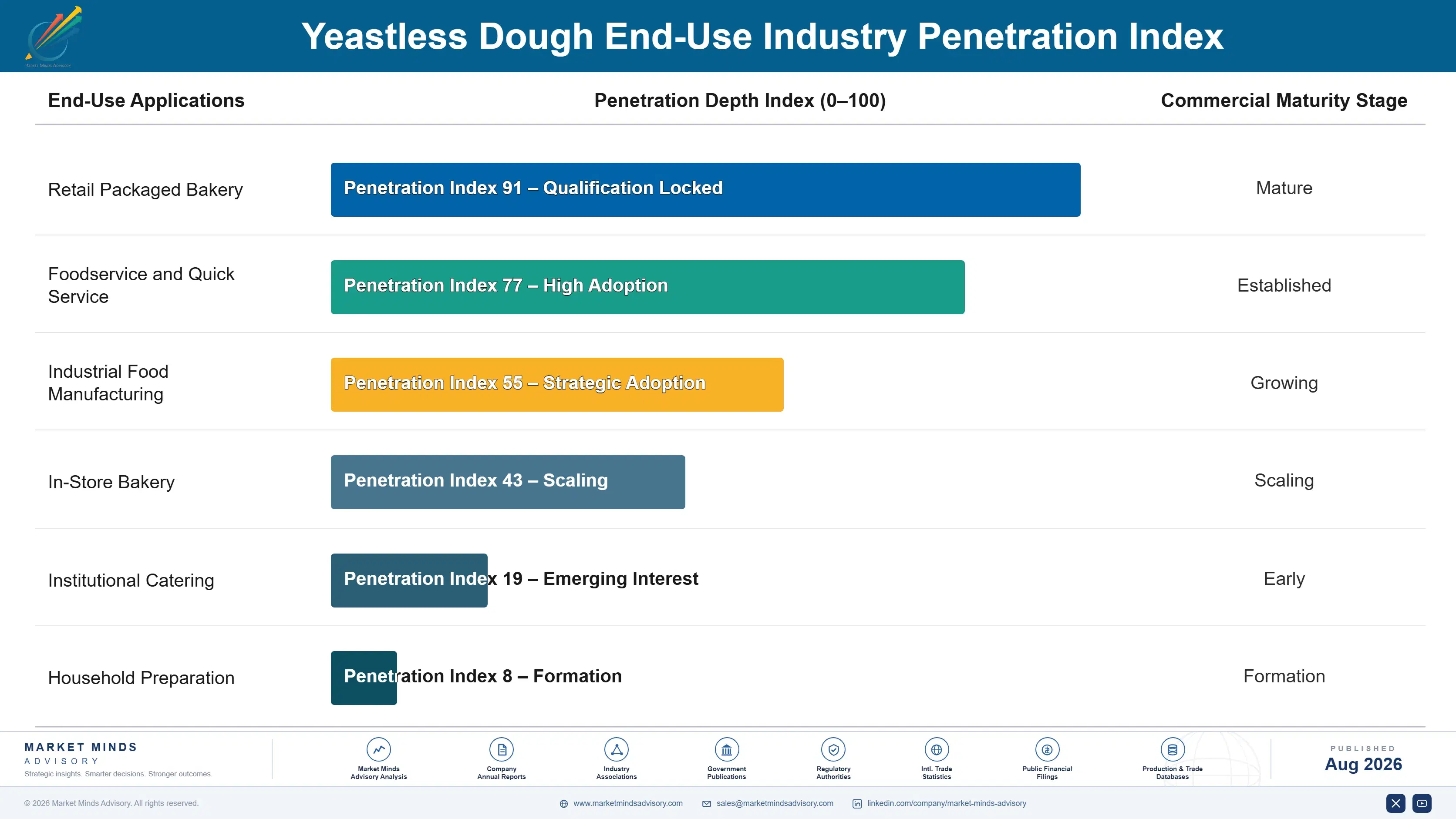
How Staple And Convenience Demand Differ

The two halves of this category generate demand through mechanisms with nothing in common. Flatbread demand arises from daily eating patterns established over generations, moves with population and urbanisation, and competes against a household making the same product from ingredients. Convenience dough demand arises from a shopping decision about time and storage, competes against other packaged options, and depends entirely on distribution and brand familiarity.
Repeat behaviour follows the same division. A household buying packaged flatbread does so several times a week and switches back to home preparation whenever price or quality disappoints, which makes the relationship high frequency and genuinely fragile. A household buying refrigerated dough does so occasionally for a specific occasion and rarely reconsiders the format, which makes that relationship infrequent and considerably more stable than it appears.

Foodservice demand behaves differently again and more predictably than either. A bake-off location specifying a frozen pastry uses it continuously until the menu changes, and consistency after storage rather than price governs that choice. Operators who have experienced yeasted dough performing unpredictably after freezing rarely return to it, which makes those specifications unusually durable once they are established at all.
yeastless-dough-market-trends-end-use-penetration-index-1787665264457

Where This Category Rewards Focus

These are among the four positions where our research anticipates prominent divergence between winners and laggards over the coming forecast period. Each is grounded in the demand model, the regulatory perimeter, and the announced capacity pipeline.
01 / SHELF LIFE POSITIONING

Nobody buys dough for lacking yeast

Chemical leavening stays dormant until heat and moisture arrive, permitting around eighteen months of storage with predictable baking performance, while yeast loses roughly 34% of viability through frozen storage and needs specialised strains to compensate for it. That single property built the entire convenience dough category and it is a technical argument rather than a dietary one. Around 7% of purchases involve yeast avoidance, which makes health positioning a distraction from whatever is actually selling these products in the first place.
02 / DEMOGRAPHIC VOLUME FOCUS

The predictable half is the ignored half

Unleavened flatbread carries around 58% of category tonnage and follows population, urbanisation and migration patterns rather than any food trend anybody has ever managed to identify. That makes it the most predictable demand in the entire category and the half that receives least commercial attention from anybody actually reporting on this market. Demographic projection is freely available and rarely applied, while trend forecasting in this category has been consistently unhelpful to everyone who has attempted to rely upon it commercially.
03 / HOME PRODUCTION CONVERSION

The competitor is a kitchen, not a brand

Around 62% of flatbread consumption is still prepared domestically across South Asian, Middle Eastern and Latin American markets, which is a volume pool that no consumer trend in this category could ever rival. Conversion proceeds through urbanisation, household time constraints and product quality approaching what home preparation delivers, steadily rather than in waves anybody can market toward. Capturing a small proportion of that consumption moves more tonnage than winning share in any packaged category currently available to anybody at all.
04 / FROZEN FORMAT ADVANTAGE

Freezing is where the real difference shows

Yeast loses around 34% of its viability through frozen storage and requires specialised strains, higher loading and careful handling that add cost while reducing reliability for the operator using it. Chemically leavened and steam leavened products perform consistently after storage without any of that complication at all. Refrigerated and frozen chemically leavened dough grows at 8.4% and laminated pastry at 7.4% for precisely the same single underlying reason, which remarkably few suppliers ever state directly to the customers buying them.

Engagement Snapshot From the Field

A live engagement with an industry participant carrying material or product regulatory and market exposure ahead of a defining policy shift, showing how our research translates into a defensible multi-year portfolio strategy.
MARKET MINDS ADVISORY · CLIENT ENGAGEMENT SUMMARY
Yeastless Dough Producer Strategic Portfolio Review and Transition Roadmap 2026·Investment Scenario on Yeastless Dough Exposure Evaluation 2025-26
CLIENT PROFILE
A bakery manufacturer producing packaged flatbread and refrigerated chemically leavened dough for retail across North America and Western Europe. Annual revenue was approximately 380 million dollars (client-reported, unverified by MMA), split roughly evenly between the two formats. Marketing for both had been built around yeast free positioning following a category review conducted several years earlier.
STRATEGIC CHALLENGE
Yeast free positioning was performing poorly in consumer testing while both formats grew for reasons the marketing never mentioned, and management could not reconcile the two observations. Flatbread margins were compressing under flour cost pressure with no pricing headroom available. Nobody had examined why customers were actually buying either product.
MMA APPROACH
MMA surveyed purchasers of both formats on stated and revealed purchase reasons, separating yeast avoidance from shelf life, convenience and staple consumption. Positioning alternatives were tested against each. Forty-seven expert interviews with retailers, category managers, foodservice operators and consumers established what drives selection in each half of the portfolio, alongside survey work across six countries.
KEY FINDINGS
  1. Yeast avoidance was a stated purchase reason for around 7% of buyers, while shelf life and convenience accounted for the majority in the refrigerated format entirely.
  2. Flatbread buyers compared the product against home preparation rather than against competing brands in 8 of every 10 responses collected during the survey.
  3. Repeat purchase in flatbread ran 4 times more frequently than in refrigerated dough and proved far more sensitive to any price increase applied.
  4. Foodservice enquiries for frozen product had risen substantially over two years without the client having any foodservice commercial capability in place to answer them.
CLIENT PROFILE
A bakery manufacturer producing packaged flatbread and refrigerated chemically leavened dough for retail across North America and Western Europe. Annual revenue was approximately 380 million dollars (client-reported, unverified by MMA), split roughly evenly between the two formats. Marketing for both had been built around yeast free positioning following a category review conducted several years earlier.
STRATEGIC CHALLENGE
Yeast free positioning was performing poorly in consumer testing while both formats grew for reasons the marketing never mentioned, and management could not reconcile the two observations. Flatbread margins were compressing under flour cost pressure with no pricing headroom available. Nobody had examined why customers were actually buying either product.
MMA APPROACH
MMA surveyed purchasers of both formats on stated and revealed purchase reasons, separating yeast avoidance from shelf life, convenience and staple consumption. Positioning alternatives were tested against each. Forty-seven expert interviews with retailers, category managers, foodservice operators and consumers established what drives selection in each half of the portfolio, alongside survey work across six countries.
KEY FINDINGS
  1. Yeast avoidance was a stated purchase reason for around 7% of buyers, while shelf life and convenience accounted for the majority in the refrigerated format entirely.
  2. Flatbread buyers compared the product against home preparation rather than against competing brands in 8 of every 10 responses collected during the survey.
  3. Repeat purchase in flatbread ran 4 times more frequently than in refrigerated dough and proved far more sensitive to any price increase applied.
  4. Foodservice enquiries for frozen product had risen substantially over two years without the client having any foodservice commercial capability in place to answer them.
RECOMMENDED STRATEGY
Phase 1: Phase one: abandon yeast free positioning, since it drove around 7% of purchases while shelf life drove the majority in convenience formats. Phase 2: Phase two: manage flatbread through pack size rather than price, given buyers compare against home preparation in 8 of 10 cases. Phase 3: Phase three: build foodservice capability, since frozen enquiries had risen with nobody at the company able to answer any of them.
OUTCOME
The client repositioned convenience formats around shelf life and preparation time, and consumer response improved measurably against the previous yeast free messaging. Flatbread volume held through the following flour cost cycle under pack size management rather than price increases, and a foodservice capability was established to answer enquiries the company had been ignoring (client-reported, unverified by MMA).

Frequently Asked Questions

Foundational context covering the market sizes, CAGR, scope, country, region and competition that inform every finding below. This section is provided to cover basics and most often pre-purchase conversations, answered from the MMA Primary Research Dataset.

What is the current size of the Yeastless Dough Market?

The market was valued at 12.4 billion dollars in 2025, covering doughs and dough based products leavened without baker's yeast worldwide. It reaches an estimated 13.09 billion dollars during 2026.

How large will the Yeastless Dough Market be by 2036?

MMA forecasts 22.57 billion dollars by 2036, an increase of 9.48 billion dollars over the 2026 base. That represents an expansion multiple of 1.72 times across the forecast period.

What is the CAGR for the Yeastless Dough Market 2026 to 2036?

The base case compound annual growth rate is 5.6%, with a bull case of 6.8% and a bear case of 4.4%. Home production conversion and wheat pricing separate those two scenarios.

Which segment is growing fastest?

Refrigerated and frozen chemically leavened dough grows at 8.4%, half again the market rate of 5.6%, on shelf life properties yeast cannot match. Laminated pastry follows at 7.4%.

Who are the major companies in the Yeastless Dough Market?

Grupo Bimbo, General Mills, Aryzta, Kerry Group and Gruma lead on production volume across flatbread, convenience and pastry formats. Together they hold 26% of the global market.

Which country is growing fastest?

India grows fastest at 8.6%, as packaged roti, paratha and chapati displace home preparation among urban households facing rising time pressure across all of the major cities.

Report Segmentation Architecture

The full report scope spans multiple orthogonal segmentation dimensions, with cross-tabulated demand data provided for each dimension pair. Coverage extends further to regional breakdowns, trend trajectories, and the competitive detail needed to support segment-level decision-making.

By Product Type

  • Unleavened Flatbreads
  • Chemically Leavened Quick Breads and Biscuits
  • Refrigerated and Frozen Chemically Leavened Dough
  • Laminated and Steam Leavened Pastry
  • Yeast Free Pizza and Base Products
  • Gluten Free and Specialty Yeastless Dough

By End-Use Industry

  • Retail Packaged Bakery
  • Foodservice and Quick Service
  • Industrial Food Manufacturing
  • In-Store Bakery
  • Institutional Catering
  • Household Preparation

By Commercial Dimension

  • Retail Grocery Supply
  • Foodservice Distributor Supply
  • Private Label Manufacturing
  • In-Store Bakery Supply
  • Ecommerce and Delivery
  • Export and Trading

By Region

  • North America
  • Western Europe
  • East Asia
  • South Asia and Pacific
  • Latin America
  • Middle East and Africa
  • Eastern Europe

Scope, Methodology, and Coverage

Every figure in this report is reproducible from documented input assumptions. The scope below maps the historical period, the forecast horizon, the segmentation dimensions, and the countries covered, alongside the underlying primary and qualitative methodology.
Historical Period
2020 to 2025
Forecast Period
2026 to 2036
Base Year
2025 (USD billions; MMA Primary Research Dataset, August 2026)
Market Definition
Doughs and dough based products leavened without baker's yeast worldwide, covering unleavened flatbreads, chemically leavened quick breads and biscuits, refrigerated and frozen chemically leavened dough, laminated and steam leavened pastry, yeast free pizza and base products, and gluten free and specialty yeastless dough, measured at manufacturer selling value across retail, foodservice and industrial channels. Sourdough and other wild yeast fermented products, conventional yeasted breads and pastries, flatbread prepared in the home, and baking mixes sold for domestic preparation are excluded from scope.
Quantitative Units
USD billions (manufacturer selling value); tonnes; USD per tonne by product type
Segmentation Dimensions
Product type; end-use industry; commercial dimension; region
Regions Covered
North America, Western Europe, East Asia, South Asia and Pacific, Latin America, Middle East and Africa, Eastern Europe
Countries Covered
United States, Canada, Mexico, United Kingdom, France, Germany, Netherlands, Italy, Spain, Poland, China, Japan, South Korea, India, Pakistan, Bangladesh, Australia, Indonesia, Brazil, Argentina, Saudi Arabia, Egypt
Key Companies Profiled
Grupo Bimbo, General Mills, Aryzta, Kerry Group, Gruma, Associated British Foods, Lantmannen Unibake, Conagra Brands, Flowers Foods, TreeHouse Foods, Dawn Foods, Vandemoortele, Rich Products, Puratos, Britannia Industries, ITC Limited, Almarai, La Tortilla Factory, Barilla, Nestle
Quantitative Methodology
Primary survey, n=3,800 respondents, Q4 2025, six countries; demand-side model with trade association cross-validation
Qualitative Methodology
47 expert interviews, Q4 2025; applied to validate demand model assumptions, identify emerging dynamics, and assess competitive positioning
Report Format
PDF and XLSX data workbook (Word format preview document)
Publisher
Market Minds Advisory
Report Code
MMA-2026-AGR-209
Published
August 2026
Contact
sales@marketmindsadvisory.com | www.marketmindsadvisory.com

Purchase the full Yeastless Dough Market Report (2026 to 2036).

The full report separates three unrelated businesses that a negative category definition has been reporting as one, and identifies which of them actually generates value. It sizes all six product types independently through 2036, models home preparation conversion against packaged flatbread demand by country, and quantifies the shelf life properties that built the convenience dough category. Regional chapters cover all seven regions, with staple flatbread consumption assessed separately from convenience format development throughout. Competitive profiling covers 20 participants on one single consistent production volume measure.
Six product types sized independently through 2036
Home preparation conversion modelled against packaged flatbread demand
Shelf life properties quantified against yeasted equivalent performance
Staple and convenience economics separated across every region
Grain exposure analysed across wheat and maize based formats
Twenty participants profiled on one consistent volume measure

Built For The People Who Decide

From boardroom strategy to bench-side execution, this report is read cover-to-cover by leaders shaping the next decade of their industry, turning demand scenarios, market dynamics and valuation benchmarks into decisions.
CXOs/ Presidents/ VPs/ Managers
M&A and Corporate Development
Strategy Teams and R&D Heads
Procurement and Product Directors
Regulatory and Compliance Leaders
Investor Relations and Equity Analysts