Market Minds Advisory
Xylooligosaccharide Market

Xylooligosaccharide Market: Dose Advantage, Purification Economics and Chinese Supply Concentration, 2026 to 2036

Every other prebiotic fibre needs five to ten grams a day and produces bloating at that level, while this one works at under two, which changes what a formulator can put it in.

Lead Analyst

Lisa Gevelber

Published

September 2026

Make Smarter Decisions with Customized Research Insights

Request a free sample report and evaluate market opportunities, growth trends, and competitive dynamics relevant to your business needs.

2025 MARKET VALUE$0.1BMarket Size 2025
2036 FORECAST VALUE$0.4BBase Case , 2026 to 2036
CAGR 2026 TO 203612.6 %Bull 13.9% / Bear 11.3%
INCREMENTAL OPPORTUNITY$0.2BNet 10- year value creation
EXPANSION MULTIPLE3.28x2036 value over 2026 base
Strategic Levers
M&A Pipeline
Regional Outlook
Country Rankings
Competitive Intelligence
Segmental Deep-dive
Call-Us : 91 93563 13602

Executive Snapshot and Market Trajectory

Dose is the whole argument. Inulin and fructooligosaccharides need five to ten grams daily to shift gut microbiota and produce bloating at that intake, while xylooligosaccharide delivers a measurable effect at around 1.4 grams, which lets a formulator put the ingredient into a beverage or a bar without either problem.
High-purity enzymatic grade grows at 18.9%, a full 1.50 times the market rate, because chromatographic purification removes the residual xylose, colour and lignin-derived phenolics that crude material otherwise carries straight into a finished product. East Asia holds 44% of global value, far outside the standard regional band, because Chinese producers hold roughly 79% of world capacity and Japanese functional food regulation gave the ingredient its first credible market.
Concentration is high at 68% for the top five, which reflects how few companies operate the hydrolysis and separation trains this product requires. Supply concentration, rather than technology or demand, is now the standing commercial risk in this market. Almost four fifths of world capacity sits inside a single country, mostly running on corncob feedstock, and buyers outside Asia have started asking questions about that dependence which they were simply not asking three years ago.
Market Definition
The market covers xylooligosaccharides produced by enzymatic or hydrothermal hydrolysis of xylan-rich lignocellulosic biomass and supplied as powder, syrup or blended format for food, beverage, supplement and animal nutrition use. It spans high-purity enzymatic, standard enzymatic, alternative biomass derived, hydrothermal and blended grades. It excludes fructooligosaccharides, galactooligosaccharides, inulin and other prebiotic fibres, xylitol and xylose, unhydrolysed xylan or hemicellulose, and finished supplement or food products containing the ingredient.
Base Year Value
$0.1B in 2025 (MMA Primary Research Dataset, August 2026)
Forecast Period
2026 to 2036, eleven discrete annual values
CAGR
12.6% base case. Bull 13.9%. Bear 11.3%.
Fastest Growth Segment
High-Purity Enzymatic Xylooligosaccharide: 18.9% CAGR
Fastest Growth Country
India: 16.8% CAGR
Fastest Growth Region
South Asia and Pacific: 14.9% CAGR
Largest Region
East Asia: 44% of 2025 global value
Market Leaders
Shandong Longlive Bio-technology, Suntory Holdings, Henan Shengtai, Hangzhou Focus Corporation, Prenexus Health. Source: MMA Primary Research Dataset, July 2026.
Primary Survey
n=3,800 procurement and R&D decision-makers, Q4 2025, six countries
Methodology
Demand-side build-up, cross-validated against public data, 47 expert interviews

Xylooligosaccharide Market Forecast Scenarios

xylooligosaccharide-market-trends-size-forecast-scenario-1787313562642
The market compounded at 11.0% between 2020 and 2025 from a genuinely small base, and regulatory approval did more for it than any commercial campaign. European novel food authorisation opened a market that had been closed, and gut health interest accelerated across every developed economy through the period. Chinese capacity expanded steadily throughout and pricing softened as it arrived.
The 12.6% base case rests on three mechanisms. First, the low effective dose keeps opening formats that other prebiotic fibres cannot enter, particularly beverages and confectionery where five grams of inulin is simply impossible. Second, purification capability is improving, which reduces the off-taste and colour issues that limited early adoption. Third, animal nutrition adoption keeps growing as antibiotic replacement in poultry and swine production continues across every major producing region.
The bull case at 13.9% assumes clinical evidence continues accumulating while non-Chinese capacity arrives to reassure buyers concerned about concentration. The bear case at 11.3% turns on competition among prebiotics: resistant dextrin and other low-dose fibres are improving, and if a cheaper alternative reaches comparable efficacy at similar dosing, the specific advantage that justifies this ingredient's pricing narrows considerably.

Why Effective Dose Decides Format Access

Prebiotic fibres compete on a variable most consumers never think about, which is how much you have to eat. Inulin and fructooligosaccharides require five to ten grams daily for any measurable microbiome effect, and at that intake a meaningful proportion of people experience genuine bloating and discomfort.
TOP FIVE CONCENTRATION68%Combined position of the five largest xylooligosaccharide producing companies
AVERAGE SELLING PRICE$16 per kilogramTypical realised price across standard and high-purity grades
TOP PRODUCING COUNTRY SHARE79%Chinese share of total global production capacity installed
EFFECTIVE DAILY DOSE1.4 gramsIntake required for measurable prebiotic effect in adults
BIOMASS FEEDSTOCK SHARE29% of COGSXylan-rich biomass share of total delivered production cost
CONVERSION YIELD31%Share of xylan converted into saleable oligosaccharide product
Xylooligosaccharide works at roughly 1.4 grams. That difference is not marginal, it changes what a formulator can build. Five grams of inulin adds bulk, viscosity and sweetness a clear beverage cannot accommodate, and it brings a tolerance warning with it. Under two grams disappears into almost any matrix without altering taste, texture or the label in ways a brand must explain. That single property is why this ingredient grows faster than the prebiotic category around it does.
The technical difficulty sits in purification rather than in hydrolysis. Breaking xylan into oligosaccharides is straightforward enough with the right enzyme or hot water. Separating the product from residual xylose, phenolics and the colour bodies biomass carries requires chromatographic capability that costs real money, and crude material tastes like what it was made from. High-purity grades sell at multiples of standard, because formulators can actually use them in white or clear products.
"The prebiotic industry spent twenty years telling people to eat more fibre and then acted surprised when they stopped because it made them uncomfortable. This ingredient sidesteps the whole argument by needing so little that nobody notices it is there. That is a formulation advantage, not a nutritional one, and it is worth considerably more commercially."
Senior Analyst, Gut Health and Functional Ingredients Practice · MMA Chemicals a

Market Trends

Low Dose Opens Beverage And Confectionery Formats

Prebiotic fibres have historically been confined to powders, bars and yoghurts that could absorb five to ten grams of bulk without visible consequence. An effective dose around 1.4 grams removes that constraint entirely, and clear beverages, chewing gum, chocolate and even coffee formats have all adopted the ingredient as a result. Roughly 38% of new xylooligosaccharide applications launched during 2025 were in formats that no other prebiotic fibre could physically enter at all. That format access rather than any efficacy advantage is what genuinely drives current growth across the whole category.
Market Impact: Serves 2,400 annual product launche

Chromatographic Purification Now Separates The Grades

Crude hydrothermal material carries residual xylose, lignin-derived phenolics and colour bodies that make it visibly and organoleptically obvious in a finished product. Chromatographic separation to 95% purity removes all three and produces a white, neutral powder that formulators can use in clear beverages and white confectionery. High-purity grades realise roughly 2.8 times standard grade pricing. Separation capital rather than the enzymology is the genuine barrier here, and it explains why so much installed Chinese capacity produces standard rather than premium material today. Colour is the hardest of the three to remove.
Market Impact: Takes 23% of total volume

Market Opportunities and Growth Drivers

Gut Health Positioning Moves Into Mainstream Retail

Microbiome science has moved from specialist supplement retail into mainstream grocery, with gut health claims appearing across yoghurts, beverages, snacks and even baked goods in every developed market. Consumer awareness now runs well ahead of what most formulations can actually deliver, which creates real demand for ingredients that work at doses a mainstream product can actually carry. Roughly 2,400 gut health positioned products were launched across the major markets during 2025 alone. Xylooligosaccharide fits that particular brief better than any bulk fibre can, which is precisely where its commercial opportunity sits.
Market Impact: Concentrates 79% in one country

Antibiotic Replacement Drives Animal Nutrition Adoption

Restrictions on antibiotic growth promoters across the European Union, China and increasingly the United States have pushed poultry and swine producers toward gut health interventions that improve feed conversion without pharmaceutical intervention. Prebiotic oligosaccharides now feature in a steadily growing share of those programmes, and the very low inclusion rate suits feed economics closely, where every single gram of additive is scrutinised. Animal nutrition now takes roughly 23% of xylooligosaccharide volume, and it proves considerably less price-sensitive than commodity feed additives normally are, because demonstrated performance rather than cost decides purchasing here.
Market Impact: Faces 3 competing low-dose fibres

Market Restraints and Challenges

Chinese Supply Concentration Worries Western Buyers

Roughly 79% of world production capacity sits in China, mostly running on corncob feedstock from the northern provinces, and no alternative of comparable scale exists anywhere. The root cause is that early commercial development happened there and no Western producer saw a market large enough to justify entry. Commercially this exposes formulators to a supply position they cannot diversify, and several have begun requiring dual sourcing they cannot actually obtain. Participants are responding with capacity outside China, bamboo and bagasse feedstock routes, and through extended inventory arrangements with existing suppliers.
Market Impact: Opens 38% of launches

Prebiotic Competition Narrows The Dose Advantage

Resistant dextrin, partially hydrolysed guar gum and newer low-dose fibres are all improving, and several of them now claim genuine efficacy at intakes considerably below traditional inulin levels. The root cause is that microbiome research has made the whole category considerably more competitive rather than settling it. Commercially this threatens the one specific advantage that currently justifies this ingredient's pricing premium. Participants are responding by funding clinical work on strain-specific effects, by pursuing regulatory health claim approvals in the major jurisdictions, and by positioning increasingly on documented evidence rather than on dose alone.
Market Impact: Realises 2.8 times standard grade p
4 additional market trends, 2 additional growth drivers, and 3 additional restraints and challenges are covered in the full report. Contact sales@marketmindsadvisory.com to access the complete intelligence.

Segment CAGR and Growth Architecture

Segmentation here follows production route and the purity achieved, meaning the feedstock hydrolysed and how thoroughly the product is separated afterwards. That single dimension determines the colour, the taste, the achievable purity, which formats a formulator can actually use the material in, and consequently the entire realised price range currently visible across this market.
xylooligosaccharide-market-trends-market-share-analysis-1787313563170

High-Purity Enzymatic Xylooligosaccharide

The fastest segment at 18.9%, a full 1.50 times the market rate, covering material chromatographically purified to 95% or above, free of residual xylose, lignin-derived phenolics and the colour bodies that biomass inevitably carries through hydrolysis. That degree of purity is what permits use in clear beverages, white confectionery and any application at all where appearance and neutral taste genuinely matter. Realised pricing runs at roughly 2.8 times standard grade material, and holds there. Separation capital rather than enzymology is the barrier here, which is precisely why so much installed Chinese capacity produces only standard material, and why a mere handful of producers reach the premium end of this market at all.
CAGR 18.9%

Bamboo and Alternative Biomass Derived

Growing at 16.4% on xylooligosaccharide produced from bamboo, sugarcane bagasse, birch and other xylan-rich biomass rather than the corncob that dominates Chinese production. Two quite separate forces are driving that rate of growth here. Buyers concerned about single-country supply concentration want feedstock and geography that differ from the incumbent route, and bamboo in particular yields material with a cleaner colour profile that reduces downstream purification burden. Feedstock availability is genuinely good, since all three of those sources are abundant agricultural or forestry residues. What limits the segment is that hydrolysis conditions must be retuned for each biomass, which takes considerably more development time than most producers initially estimate when they begin.
CAGR 16.4%
Full segment breakdown across 5 segments available in the complete report.

Regional Architecture and Country Demand Map

East Asia dominates both production and early consumption, holding a share far outside any normal regional band. South Asia and Pacific grows fastest as Indian functional food demand expands. North America and Western Europe both consume disproportionately at the high-purity end while producing almost nothing themselves.

East Asia

Forty-four percent of global value sits here. Note: this sits far outside the standard regional band because Chinese producers hold roughly 79% of world capacity while Japanese functional food regulation gave the ingredient its first credible commercial market. Chinese production concentrates in Shandong and Henan running on corncob feedstock from surrounding agriculture, and capacity has expanded steadily enough to soften pricing. Japanese demand is smaller but far more specification-driven, with Foods for Specified Health Uses approvals supporting genuine health claims. Growth of 13.8% reflects Chinese domestic functional food expansion alongside continued export volume. Purification capability rather than hydrolysis capacity is the regional constraint on serving Western premium demand. Export volumes remain substantial.
Share: 44% | CAGR: 13.8% (2026 to 2036)

North America

Eighteen percent of global value. Note: this sits below the standard regional band because the region consumes considerably more than these figures suggest relative to its supplement market size, while producing almost nothing domestically. Demand concentrates in gut health supplements, functional beverages and increasingly in mainstream grocery products carrying microbiome claims. Growth of 12.0% reflects that mainstream migration. Buyers here have become notably more concerned about Chinese supply concentration since 2022, and several formulators now require dual sourcing arrangements that the current production base genuinely cannot provide them. Domestic production remains almost entirely absent. High-purity grades dominate what is actually specified here, since clear beverages and white confectionery cannot use anything else at all.
Share: 18% | CAGR: 12.0% (2026 to 2036)
Regional intelligence for 5 additional markets available in the complete report: Western Europe, South Asia and Pacific, Latin America, Middle East and Africa, Eastern Europe. Contact sales@marketmindsadvisory.com.
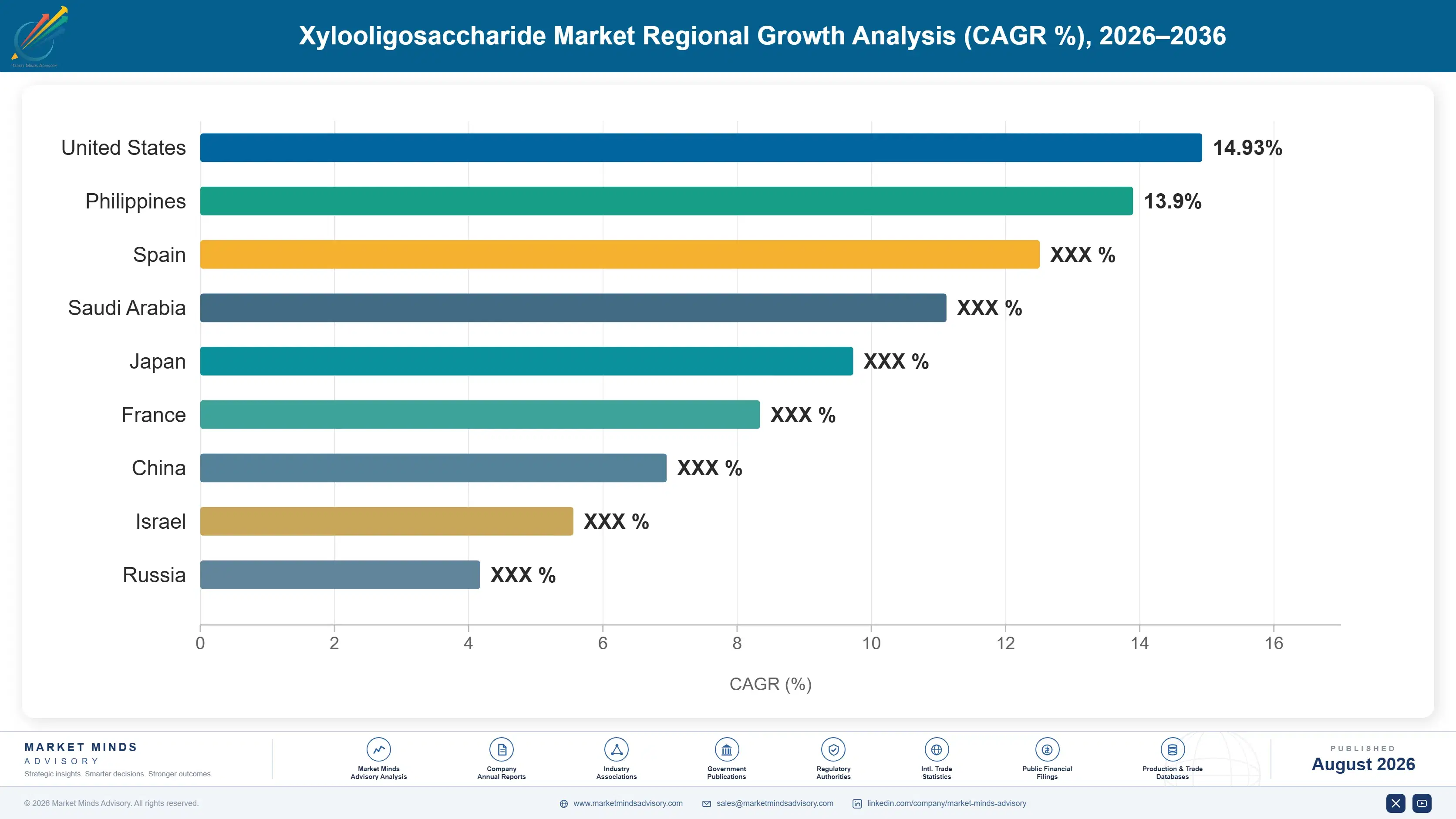
xylooligosaccharide-market-trends-country-cagr-analysis-1787313563689

Where Prebiotic Margin Actually Accumulates

Four commercial moves separate the producers earning genuine ingredient margins from those merely selling hydrolysate at commodity spread. Each depends on holding something a formulator cannot obtain from the next Chinese quote: chromatographic purity, documented clinical evidence, feedstock and geographic diversity, or the completed regulatory dossier that opens a market to them at all.

Install Chromatographic Separation To Reach Purity

Crude material carries residual xylose, phenolics and colour that make it obvious in any clear or white product, which confines it entirely to opaque food formats and animal feed applications. Chromatographic separation to 95% purity realises roughly 2.8 times standard grade pricing and opens beverage and confectionery applications entirely closed to crude output. Capital runs between $8 million and $18 million per line depending on the throughput required. That capital cost is exactly why so much installed Chinese capacity produces only standard material and why the premium competitive field stays so small.
Market Impact: Realises about 2.8 times standard g

Fund Clinical Work On Documented Dose Response

The whole commercial case rests on efficacy at around 1.4 grams, and competing low-dose fibres are steadily narrowing that gap with efficacy claims of their own. Producers funding controlled human studies that establish dose response and strain-specific effects hold their pricing 20% to 30% above suppliers selling on general prebiotic positioning alone. A properly designed human study costs between $600,000 and $1.5 million and takes about eighteen months to complete. It also directly supports regulatory health claim applications, which compound the commercial value of that spending considerably over the following years.
Market Impact: Holds pricing up to 30% above gener

Build Capacity Outside The Chinese Supply Base

Roughly 79% of world capacity sits in one country, and Western formulators have begun requiring dual sourcing that they cannot currently obtain from anybody at all. A producer offering non-Chinese origin wins specifications on supply security rather than on price or product quality, and holds realised pricing 15% to 25% higher for doing so. Capacity costs between $20 million and $45 million at meaningful scale using bagasse, bamboo or birch feedstock instead. The commercial argument for building that capacity is already considerably stronger than most producers outside China appear willing to assume.
Market Impact: Holds pricing up to 25% above Chine

Complete Regulatory Dossiers Ahead Of Customers

Novel food and equivalent authorisations gate market access entirely, and a formulator will not begin development work on an ingredient it cannot legally sell. Producers holding completed dossiers across the European Union, United States and major Asian markets can be specified immediately, while competitors send those customers away to undertake the regulatory work themselves first. Dossier preparation costs between $400,000 and $900,000 for each separate jurisdiction covered. Being the one supplier that a formulator can actually use today is worth considerably more commercially than offering a slightly better delivered price.
Market Impact: Opens jurisdictions costing $900,00

Who Controls the Margin Pool

Concentration is high at 68% for the five largest producers, measured on xylooligosaccharide revenue across all participants, and it reflects how few companies operate the enzymatic hydrolysis and separation trains this product requires. Shandong Longlive leads on installed capacity and feedstock proximity, and the gap to the second tier is widest in purification capability rather than in hydrolysis volume.
Competition runs on three dimensions. Purity decides which formats a producer can serve, and chromatographic capability rather than enzymology separates the field. Regulatory dossier coverage decides which markets a producer can be specified in at all. Price competition is fiercest in standard grade material sold into opaque food formats and animal nutrition, where colour and taste matter little and Chinese producers compete hard against one another.

Two pressures are building. Western formulators are pushing for non-Chinese supply they cannot currently obtain, which creates an opening for any producer willing to build capacity elsewhere. Meanwhile competing low-dose prebiotic fibres are improving and narrowing the specific dose advantage this ingredient trades on. Rankings shift where purification capability meets documented clinical evidence, since dose alone will not defend the position much longer.
xylooligosaccharide-market-trends-company-positioning-matrix-1787313564215

Competitive Moat and Risk Dimensions

SHANDONG LONGLIVE BIO-TECHNOLOGY

Moat: Largest capacity beside corncob feedstock

Scale built alongside the corncob supply of the northern Chinese provinces gives the company a delivered cost position that no producer working imported or alternative biomass can match. Feedstock is an agricultural residue collected within short haulage distance, which matters considerably on a product where biomass is nearly a third of production cost.
SHANDONG LONGLIVE BIO-TECHNOLOGY

Risk: Concentration exposure buyers now question

The company embodies exactly the single-country supply concentration that Western formulators have begun raising as a procurement concern since 2022. Its cost advantage is genuine but it cannot offer the geographic diversity buyers increasingly ask for. Any producer building credible capacity elsewhere competes on a dimension where scale and cost provide no defence whatsoever.
SUNTORY HOLDINGS

Moat: Deepest clinical evidence position

Long-running research and Foods for Specified Health Uses approvals in Japan give the company documented efficacy evidence that competitors selling on general prebiotic positioning simply cannot match. Where a formulator needs a substantiated health claim rather than a fibre declaration, that evidence base is the product and the powder is incidental.
SUNTORY HOLDINGS

Risk: Limited merchant market participation

Capability developed largely to support the company's own beverage products rather than to supply the merchant ingredient market, which limits external volume and commercial focus. Competitors building dedicated ingredient businesses pursue formulator relationships the company has never prioritised. The evidence advantage is real but underexploited commercially outside its own portfolio.

Players Tracked

Prominent Players

Shandong Longlive Bio-technology
Suntory Holdings
Henan Shengtai
Hangzhou Focus Corporation
Prenexus Health

Other Key Players

Shandong Jianyuan Group
Yibin Yatai Biochemical
Kangwei Biotech
Zhejiang Huakang Pharmaceutical
Hangzhou Sanhe Biotech
Cargill
Beneo
Tate and Lyle
Ingredion
Roquette
Baolingbao Biology
TianGuan Group
ACS Biotech
Shandong Bailong Chuangyuan
Jiangsu Kolod Food Ingredients

Recent Developments

JANUARY 2025

Prenexus Health expands non-Chinese production capability

Additional xylooligosaccharide production capacity located outside China entered commercial service during the year, directly targeting the North American and European formulators who had begun requiring supply origin diversity which the highly concentrated existing production base simply could not offer them at all. Commissioning is scheduled for 2027.
Signal: Supply geography rather than cost or purit
MAY 2025

Shandong Longlive commissions chromatographic purification capacity

Chromatographic separation capacity producing high-purity grades entered commercial service at the company's Shandong site, which directly addresses the residual xylose, phenolic and colour issues which had confined standard Chinese material entirely to opaque food formats and animal nutrition applications. Beverage grade output follows during the year.
Signal: Chinese producers are now moving into puri
SEPTEMBER 2025

Beneo completes European regulatory dossier for prebiotic range

Regulatory documentation covering xylooligosaccharide across the full range of European food applications was completed, letting formulators specify the ingredient immediately rather than first undertaking their own novel food authorisation work before development work could begin on any new product at all. Several formulators specified immediately.
Signal: Completed regulatory dossiers are now wort

What Drives Delivered Ingredient Cost

Xylan-rich biomass accounts for roughly 29% of cost of goods, and corncob collected within short haulage of the Chinese producing provinces sets the benchmark everyone else is measured against. Enzymes contribute 17%, energy for hydrolysis and evaporation 19%, chromatographic separation media and operation 14% on high-purity grades, and waste stream handling a further 8% of the delivered total.
The 2022 energy episode hit purification hardest. Hydrolysis and evaporation are both thermally intensive, and European and Japanese producers faced industrial energy at several times historical levels through that winter, as IEA data across the period records. Chinese producers with cheaper provincial power gained relative position without any operational improvement of their own. Corncob pricing also rose as competing uses for agricultural residue expanded across northern China.

The competitive disadvantage mechanism runs through feedstock proximity and purification together. A producer working imported biomass carries haulage on a low-density agricultural residue that transports terribly relative to its value. One without chromatographic capability cannot reach the grades where pricing actually sits. Producers carrying both disadvantages are confined to standard grade competition against Chinese capacity holding an inherited cost advantage they cannot close by any means available.
xylooligosaccharide-market-trends-cost-volatility-analysis-1787313564409

Site hydrolysis within short haulage of biomass

Xylan-rich residues are bulky, low in density and transport very badly relative to their value, so haulage distance matters more than biomass price does. Locating hydrolysis within short haulage of corncob, bagasse or bamboo supply cuts delivered feedstock cost by five to nine percentage points and is effectively irreversible once the site is built.

Recover and reuse enzyme through immobilisation

Enzymes represent 17% of cost of goods and are largely consumed in conventional batch hydrolysis. Immobilised enzyme systems recover and reuse the catalyst across multiple cycles, cutting enzyme cost of goods by roughly a third at retrofit cost near $2 million per line, with payback landing inside three years at current enzyme pricing levels.

Valorise the lignin and residue side streams

Hydrolysis leaves a substantial lignin-rich residue which most producers treat purely as a disposal problem or simply burn for process heat. Selling that residue into lignin-based binder, dispersant or biofuel applications converts what is a disposal cost into modest additional revenue and it improves overall project economics by two to four percentage points across the operation.

Portfolio Architecture for Margin Defence

Margin architecture tracks purity and documentation rather than the oligosaccharide itself. Standard grade material sold into animal nutrition and opaque food formats runs at gross margins in the low twenties, because colour and taste do not matter there and Chinese producers compete hard against one another on delivered cost alone.
The volume-versus-premium tension is genuine because hydrolysis capacity needs loading. Standard grade volume fills a plant and absorbs the fractions that fail premium specification, yet it is precisely where the Chinese cost position is unassailable for anyone else. A producer serving only high-purity demand runs its hydrolysis train below economic loading, while one relying on standard grade competes in a race it cannot win outside China. Both halves are necessary and neither is comfortable.

Value concentrates where the formulator cannot use anything else. High-purity grades in clear beverages and white confectionery sit at the top, because crude material is visibly and organoleptically impossible in those formats regardless of price. Clinically substantiated material sits alongside on evidence logic. Standard grade sits at the other extreme, where a purity figure settles the discussion and pricing compresses toward Chinese production cost.

Volume / Commodity-Adjacent

Standard grade material supplied into animal nutrition and opaque food formats where colour and residual taste do not matter commercially. Chinese producers compete hard on delivered cost and no supplier holds a defensible position. This volume loads hydrolysis capacity and absorbs off-specification fractions.
Gross Margin: 20-28%

Premium / Certified

Purified grades supplied into supplements, dairy and functional food where moderate colour and taste tolerance still applies. Purification capability and consistency support pricing well above standard material. Range reflects the spread between supplement powder and mainstream food applications.
Gross Margin: 32-44%

Sustainability / Regulatory / Next-Generation

High-purity chromatographically separated grades with completed regulatory dossiers and clinical evidence, supplied into clear beverages and white confectionery. Purification capital, documented efficacy and regulatory access rather than the molecule itself justify the pricing here.
Gross Margin: 46-62%
xylooligosaccharide-market-trends-portfolio-architecture-1787313564906

High-value Sub-segments and Strategic Watch-out

High-Purity Beverage Grade

High value on genuinely high growth at 18.9%, and formulators building clear beverages genuinely have no alternative available at any price. Chromatographic separation capital keeps the competitive field very small, and most of the installed Chinese capacity simply cannot reach this specification at all today.
Gross Margin: 48-62%

Non-Chinese Origin Supply

Strong margins on genuinely rapid growth, driven entirely by Western formulators requiring supply geography diversity they currently cannot obtain from anybody. The premium rests on procurement policy rather than product difference, which makes the premium durable for as long as concentration concern persists among buyers.
Gross Margin: 42-54%

Standard Grade Volume

The loading that keeps hydrolysis trains economic and absorbs whatever fractions fail premium specification, earning gross margins that sit in the low twenties throughout the cycle. Chinese producers hold a delivered cost position on this material that nobody outside the country can realistically close at all.
Gross Margin: 20-28%

Animal Nutrition Applications

The strategic watch-out sitting squarely in this portfolio. Antibiotic replacement demand is growing here and proves less price-sensitive than commodity feed additives, but competing prebiotics and postbiotics now target exactly the same performance brief and feed formulators switch freely between them on demonstrated trial performance alone.
Gross Margin: 24-34%

How This Demand Actually Repeats

Demand behaves as an annuity attached to a formulation and a regulatory position together. Once the ingredient is designed into a product and the health claim documentation is built around it, it ships against every production run for years, because changing supplier means revisiting both the formulation and the substantiation.
Stickiness varies sharply by application. Products carrying substantiated health claims are the tightest, since the claim references documented evidence tied to a specific material and origin. Clear beverage and white confectionery formulations sit close behind, because no crude alternative works at any price. Supplement formulations are moderately sticky through specification and consistency. Animal nutrition is barely sticky at all, with feed formulators reoptimising additive packages on demonstrated performance and cost every season.

Buyer profiles have changed considerably. Purchasing once sat with formulators comparing prebiotic fibres on price per kilogram and fibre declaration. It now frequently involves regulatory affairs, clinical and procurement risk functions asking about health claim substantiation, novel food authorisation status and supply origin concentration. Producers whose commercial approach still leads with a specification sheet find themselves answering questions about geography and evidence before price is discussed at all.
xylooligosaccharide-market-trends-end-use-penetration-index-1787313565391

Where To Place Capital

These are among the four positions where our research anticipates prominent divergence between winners and laggards over the coming forecast period. Each is grounded in the demand model, the regulatory perimeter, and the announced capacity pipeline.
01 / PURIFICATION CAPABILITY BUILD

Purity decides which formats you can enter

Crude material carries residual xylose, phenolics and colour that make it visibly obvious in clear or white products, confining it entirely to opaque formats and animal feed regardless of price. Chromatographic separation to 95% purity realises roughly 2.8 times standard grade pricing and opens applications entirely closed to crude output. Capital runs $8 million to $18 million per line, which is exactly why so much installed capacity produces only standard material and why the premium competitive field stays genuinely small.
02 / CLINICAL EVIDENCE INVESTMENT

Dose advantage alone will not hold much longer

The entire commercial case rests on efficacy at around 1.4 grams, and resistant dextrin along with other low-dose fibres are narrowing that gap with efficacy claims of their own every year. Producers funding controlled human studies on dose response and strain-specific effects hold pricing 20% to 30% above general prebiotic positioning. A properly designed human study costs between $600,000 and $1.5 million across eighteen months, and it directly supports the regulatory health claim work that compounds that value considerably further.
03 / SUPPLY GEOGRAPHY DIVERSIFICATION

Non-Chinese origin is worth more than better pricing

Roughly 79% of world capacity sits in one country and Western formulators have begun requiring dual sourcing they simply cannot obtain from anybody today. A producer offering non-Chinese origin wins specifications purely on supply security rather than on price or product quality, and holds pricing 15% to 25% higher for doing so. Capacity costs between $20 million and $45 million at any meaningful scale, and the commercial argument for building it is already stronger than most producers appear to assume.
04 / REGULATORY DOSSIER COVERAGE

Formulators cannot use what they cannot legally sell

Novel food and equivalent authorisations gate market access completely, and no formulator begins development on an ingredient it cannot legally place in a product. Producers holding completed dossiers across the European Union, the United States and the major Asian markets get specified immediately, while competitors send those customers away to do that work themselves. Dossier preparation costs between $400,000 and $900,000 for every single jurisdiction covered, which is close to trivial when set against being entirely unusable in a market.

Engagement Snapshot From the Field

A live engagement with an industry participant carrying material or product regulatory and market exposure ahead of a defining policy shift, showing how our research translates into a defensible multi-year portfolio strategy.
MARKET MINDS ADVISORY · CLIENT ENGAGEMENT SUMMARY
Xylooligosaccharide Producer Strategic Portfolio Review and Transition Roadmap 2026·Investment Scenario on Xylooligosaccharide Exposure Evaluation 2025-26
CLIENT PROFILE
A European functional ingredient supplier with annual revenue near $58 million (client-reported, unverified by MMA), distributing prebiotic fibres including xylooligosaccharide sourced entirely from two Chinese producers. All material was standard grade, no chromatographic purification existed anywhere in the supply chain, and the company held no clinical evidence or regulatory dossier of its own for the ingredient.
STRATEGIC CHALLENGE
Two beverage customers had rejected the material on colour and taste grounds after formulation trials, and a third had introduced a procurement policy requiring non-Chinese origin the company could not satisfy. Management needed to decide between securing purified supply, investing in clinical substantiation, or finding alternative-origin production, with capital sufficient for roughly one path.
MMA APPROACH
MMA quantified the pricing and application gap between standard and high-purity grades, mapped non-Chinese production capacity available or under development globally, and assessed what clinical substantiation would cost against the pricing premium it supports. Findings were tested against 47 expert interviews covering beverage formulator specification practice, prebiotic competitive positioning and novel food regulatory requirements.
KEY FINDINGS
  1. High-purity material commanded roughly 2.7 times the standard grade pricing the client was selling, and was the only grade the rejected beverage applications could physically use.
  2. Non-Chinese capacity available for contract was extremely limited, and securing an allocation would require a multi-year commitment at a premium of roughly 22% (client-reported, unverified by MMA).
  3. The client held no clinical evidence of its own and was competing purely on price against producers who did, which explained its position in every specification contest it had lost.
  4. Purchasing purified material from an existing producer required no capital at all and addressed the immediate application failures that had cost two customers within a year.
CLIENT PROFILE
A European functional ingredient supplier with annual revenue near $58 million (client-reported, unverified by MMA), distributing prebiotic fibres including xylooligosaccharide sourced entirely from two Chinese producers. All material was standard grade, no chromatographic purification existed anywhere in the supply chain, and the company held no clinical evidence or regulatory dossier of its own for the ingredient.
STRATEGIC CHALLENGE
Two beverage customers had rejected the material on colour and taste grounds after formulation trials, and a third had introduced a procurement policy requiring non-Chinese origin the company could not satisfy. Management needed to decide between securing purified supply, investing in clinical substantiation, or finding alternative-origin production, with capital sufficient for roughly one path.
MMA APPROACH
MMA quantified the pricing and application gap between standard and high-purity grades, mapped non-Chinese production capacity available or under development globally, and assessed what clinical substantiation would cost against the pricing premium it supports. Findings were tested against 47 expert interviews covering beverage formulator specification practice, prebiotic competitive positioning and novel food regulatory requirements.
KEY FINDINGS
  1. High-purity material commanded roughly 2.7 times the standard grade pricing the client was selling, and was the only grade the rejected beverage applications could physically use.
  2. Non-Chinese capacity available for contract was extremely limited, and securing an allocation would require a multi-year commitment at a premium of roughly 22% (client-reported, unverified by MMA).
  3. The client held no clinical evidence of its own and was competing purely on price against producers who did, which explained its position in every specification contest it had lost.
  4. Purchasing purified material from an existing producer required no capital at all and addressed the immediate application failures that had cost two customers within a year.
RECOMMENDED STRATEGY
Phase 1: Phase one: contract purified high-purity supply from an existing producer immediately, since it needs no capital and directly addresses the applications already lost. Phase 2: Phase two: secure a non-Chinese origin allocation on multi-year terms, accepting the premium in exchange for satisfying the procurement policies now appearing. Phase 3: Phase three: fund clinical substantiation once the grade and origin problems are resolved, building the evidence position competitors already hold.
OUTCOME
The client contracted high-purity supply within four months and recovered one of the two lost beverage customers, reporting realised pricing on that material roughly 2.4 times its standard grade (client-reported, unverified by MMA). A non-Chinese allocation was secured the following year, and clinical work has been commissioned on the strength of the improved margin.

Frequently Asked Questions

Foundational context covering the market sizes, CAGR, scope, country, region and competition that inform every finding below. This section is provided to cover basics and most often pre-purchase conversations, answered from the MMA Primary Research Dataset.

What is the current size of the Xylooligosaccharide Market?

The market was worth $0.1 billion in 2025 and is forecast to reach $0.11 billion in 2026. Animal nutrition accounts for 23% of that volume alongside human food and supplements.

How large will the Xylooligosaccharide Market be by 2036?

MMA forecasts $0.36 billion by 2036, an expansion multiple of 3.28 times the 2026 base. That represents $0.25 billion of incremental value across the forecast period.

What is the CAGR for the Xylooligosaccharide Market 2026 to 2036?

The base case compound annual growth rate is 12.6%, with a bull case of 13.9% and a bear case of 11.3%. Historical growth from 2020 to 2025 ran at 11.0%.

Which segment is growing fastest?

High-purity enzymatic grade at 18.9%, a full 1.50 times the market rate. Chromatographic purification opens clear beverage and white confectionery formats that crude material cannot enter.

Who are the major companies in the Xylooligosaccharide Market?

Shandong Longlive Bio-technology, Suntory Holdings, Henan Shengtai, Hangzhou Focus Corporation and Prenexus Health lead with 68% between them. Fifteen further producers and ingredient houses hold smaller positions.

Which country is growing fastest?

India at 16.8% annually, as digestive health positioning moves out of Ayurvedic and supplement retail and into mainstream food and beverage right across urban markets.

Report Segmentation Architecture

The full report scope spans multiple orthogonal segmentation dimensions, with cross-tabulated demand data provided for each dimension pair. Coverage extends further to regional breakdowns, trend trajectories, and the competitive detail needed to support segment-level decision-making.

By Production Route and Purity

  • High-Purity Enzymatic Xylooligosaccharide
  • Bamboo and Alternative Biomass Derived
  • Standard Enzymatic Xylooligosaccharide
  • Hydrothermal and Autohydrolysis Grade
  • Syrup and Blended Format Grades

By End-Use Industry

  • Dietary Supplements and Nutraceuticals
  • Functional Beverages
  • Dairy and Fermented Products
  • Bakery, Confectionery and Snacks
  • Poultry and Swine Nutrition
  • Companion Animal Nutrition

By Commercial Dimension

  • Direct Supply to Food Manufacturers
  • Ingredient Distributor Channel
  • Supplement Contract Manufacturer Supply
  • Feed Additive Formulator Supply
  • Private Label and Blended Systems Supply

By Region

  • North America
  • Western Europe
  • East Asia
  • South Asia and Pacific
  • Latin America
  • Middle East and Africa
  • Eastern Europe

Scope, Methodology, and Coverage

Every figure in this report is reproducible from documented input assumptions. The scope below maps the historical period, the forecast horizon, the segmentation dimensions, and the countries covered, alongside the underlying primary and qualitative methodology.
Historical Period
2020 to 2025
Forecast Period
2026 to 2036
Base Year
2025 (USD billions; MMA Primary Research Dataset, August 2026)
Market Definition
This report covers xylooligosaccharides produced by enzymatic or hydrothermal hydrolysis of xylan-rich lignocellulosic biomass including corncob, bagasse, bamboo and birch, supplied as powder, syrup or blended format for food, beverage, supplement and animal nutrition applications. Coverage spans high-purity enzymatic, standard enzymatic, alternative biomass derived, hydrothermal and blended grades together with the regulatory dossiers and clinical evidence supplied alongside them. Fructooligosaccharides, galactooligosaccharides, inulin and other prebiotic fibres, xylitol and xylose, unhydrolysed xylan, and finished supplement or food products are excluded from scope.
Quantitative Units
USD billions at producer realised prices; volume in thousand tonnes; gross margin percentages and conversion yields by production route.
Segmentation Dimensions
Production route and purity, end-use industry, commercial dimension, region.
Regions Covered
North America, Western Europe, East Asia, South Asia and Pacific, Latin America, Middle East and Africa, Eastern Europe
Countries Covered
China, Japan, South Korea, India, Australia, Thailand, Indonesia, United States, Canada, Mexico, Germany, Netherlands, United Kingdom, France, Brazil, Argentina, Poland, Turkey, Saudi Arabia, South Africa.
Key Companies Profiled
Shandong Longlive Bio-technology, Suntory Holdings, Henan Shengtai, Hangzhou Focus Corporation, Prenexus Health, Beneo, Tate and Lyle, Cargill, Baolingbao Biology, Shandong Jianyuan Group, and ten further producers.
Quantitative Methodology
Primary survey, n=3,800 respondents, Q4 2025, six countries; demand-side model with trade association cross-validation
Qualitative Methodology
47 expert interviews, Q4 2025; applied to validate demand model assumptions, identify emerging dynamics, and assess competitive positioning
Report Format
PDF and XLSX data workbook (Word format preview document)
Publisher
Market Minds Advisory
Report Code
MMA-2026-CHM-858
Published
August 2026
Contact
sales@marketmindsadvisory.com | www.marketmindsadvisory.com

Purchase the full Xylooligosaccharide Market Report (2026 to 2036).

The full report sets out ten-year forecasts for xylooligosaccharide by production route and purity, end-use industry and commercial model across seven regions. It quantifies the format access the low effective dose creates, application by application, against competing prebiotic fibres. Competitive assessment covers twenty producers on a consistent revenue basis, mapping chromatographic purification capability and regulatory dossier coverage separately from installed hydrolysis capacity. Supply concentration is analysed by feedstock and geography with alternative-origin capacity tracked project by project. Findings draw on a quantitative survey of 3,800 respondents across six countries and 47 expert interviews conducted during the fourth quarter of 2025.
Ten-year forecasts by production route and region
Format access quantified against competing prebiotic fibres
Purification capability mapped across twenty named producers
Alternative-origin capacity tracked project by project
Regulatory dossier coverage compared across major jurisdictions
Margin architecture across three commercial portfolio tiers

Built For The People Who Decide

From boardroom strategy to bench-side execution, this report is read cover-to-cover by leaders shaping the next decade of their industry, turning demand scenarios, market dynamics and valuation benchmarks into decisions.
CXOs/ Presidents/ VPs/ Managers
M&A and Corporate Development
Strategy Teams and R&D Heads
Procurement and Product Directors
Regulatory and Compliance Leaders
Investor Relations and Equity Analysts