Market Minds Advisory
Xylanase Market

Xylanase Market: Nobody Buys An Enzyme, They Buy A Number For The Spreadsheet

A feed formulator does not purchase an enzyme; they purchase a nutritional credit that lets them remove expensive energy from a diet, and the enzyme itself arrives some time afterwards.

Lead Analyst

Published

September 2026

Make Smarter Decisions with Customized Research Insights

Request a free sample report and evaluate market opportunities, growth trends, and competitive dynamics relevant to your business needs.

2025 MARKET VALUE$0.4BMarket Size 2025
2036 FORECAST VALUE$0.9BBase Case , 2026 to 2036
CAGR 2026 TO 20366.8 %Bull 8.0% / Bear 5.6%
INCREMENTAL OPPORTUNITY$0.4BNet 10- year value creation
EXPANSION MULTIPLE1.93x2036 value over 2026 base
Strategic Levers
M&A Pipeline
Regional Outlook
Country Rankings
Competitive Intelligence
Segmental Deep-dive
Call-Us : 91 93563 13602

Executive Snapshot and Market Trajectory

The commercial mechanism in feed is a spreadsheet rather than a bag. A formulator assigns a matrix credit, typically around 85 kilocalories per kilogram, and least cost software removes that much oil or grain. The enzyme costs 0.4% of the feed and is bought for that arithmetic.
The technical problem is the substrate rather than the enzyme. Arabinoxylan content varies up to 2.8 times between wheat harvests entering the same mill, so an identical dose produces different results depending on the crop. That is why 71% of sales need on-site application support to close, and why substrate data matters more than any molecular improvement. A better molecule does not help at all.
Baking grows fastest at 10.2%, half again the market rate, on clean label reformulation removing chemical dough improvers. Enzymes replace them and, in around 82% of jurisdictions, need no declaration on the finished loaf because they are processing aids. Invisibility on a label is doing commercial work nobody advertises. East Asia holds 30% and India grows at 10.6%. Nobody in the industry says that part out loud, which leaves the argument available. Somebody will.
Market Definition
Xylanase enzymes hydrolysing arabinoxylan and related hemicellulose, supplied for animal feed, baking and cereal processing, fruit juice and beverage processing, biofuel and lignocellulosic processing, pulp and paper bleaching, and textile and detergent applications. Measured at enzyme selling value. Other carbohydrase and protease enzymes, complete enzyme blends sold under separate identity, feed premixes and formulated bakery improvers are excluded from scope.
Base Year Value
$0.4B in 2025 (MMA Primary Research Dataset, August 2026)
Forecast Period
2026 to 2036, eleven discrete annual values
CAGR
6.8% base case. Bull 8.0%. Bear 5.6%.
Fastest Growth Segment
Baking and Cereal Processing: 10.2% CAGR
Fastest Growth Country
India: 10.6% CAGR
Fastest Growth Region
South Asia and Pacific: 9.0% CAGR
Largest Region
East Asia: 30% of 2025 global value
Market Leaders
Novonesis, IFF, DSM-Firmenich, AB Enzymes, BASF. Source: MMA Primary Research Dataset, July 2026.
Primary Survey
n=3,800 procurement and R&D decision-makers, Q4 2025, six countries
Methodology
Demand-side build-up, cross-validated against public data, 47 expert interviews

Xylanase Market Forecast Scenarios

xylanase-market-trends-size-forecast-scenario-1787665203222
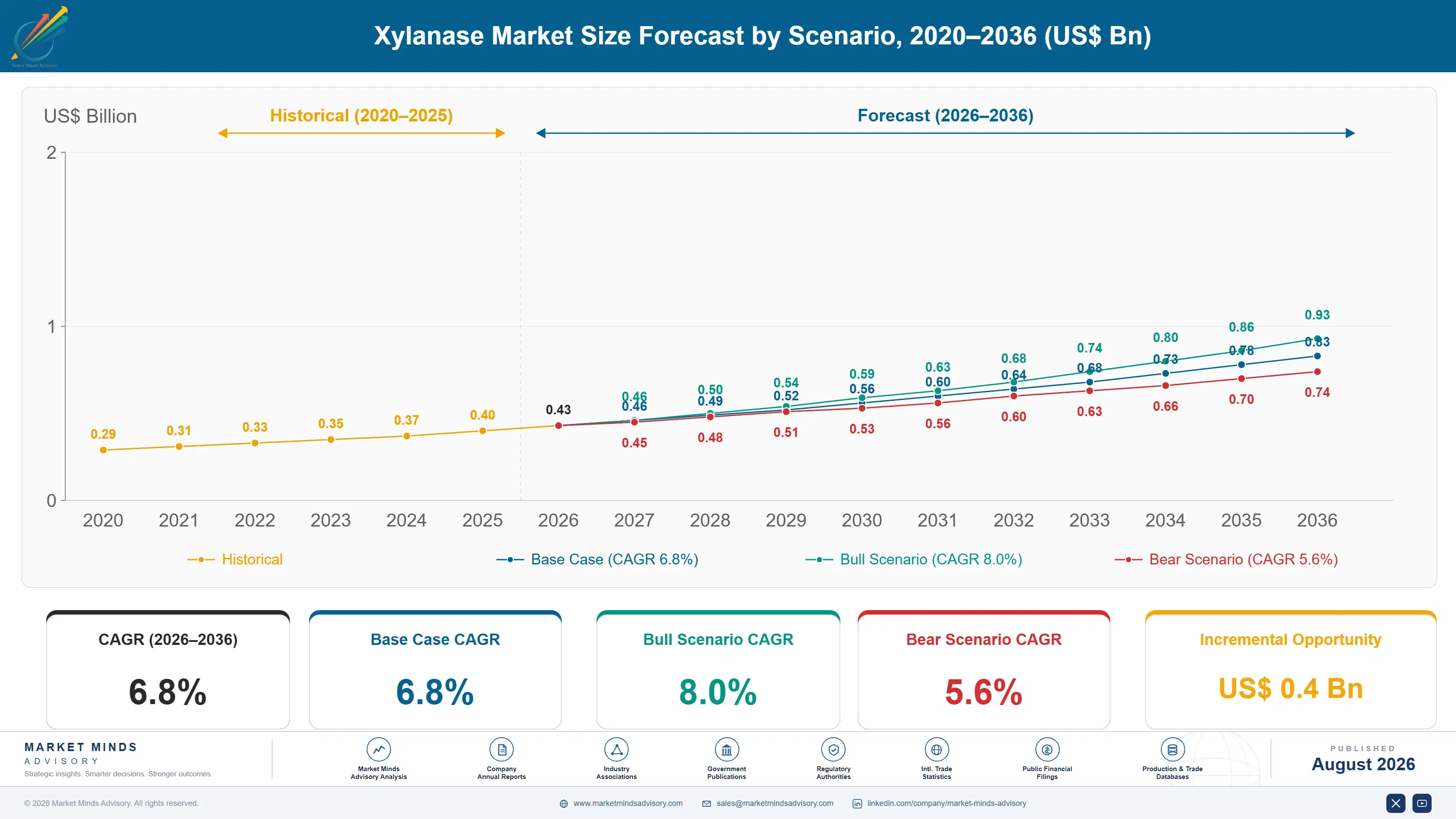
The five years to 2025 were shaped by feed volumes and by clean label reformulation moving at different speeds. Feed enzyme demand tracked poultry and swine production, which fluctuated with disease outbreaks and grain pricing, while baking applications grew steadily as chemical improvers left formulations. The 5.8% historical rate averages a large cyclical application with a smaller one advancing on regulation rather than on economics.
The 6.8% base case rests on three mechanisms. Baking grows at 10.2% as clean label reformulation continues removing chemical dough improvers that enzymes replace without appearing on a label. Beverage processing grows at 8.4% on yield and clarity economics. And Indian feed and baking volumes grow at 10.6%, faster than any market covered, on poultry expansion and organised bakery development together. Clean label reformulation, yield economics and geography, all together.
The 8.0% bull case turns on grain pricing rising enough that matrix credits become materially more valuable, since the enzyme is bought to remove expensive energy from a diet and expensive energy makes the arithmetic considerably better. The 5.6% bear case is the opposite condition combined with disease disruption in poultry, which reduces feed volumes directly and immediately across whole regions.

The Number In The Formulation Software

The largest application in this market does not buy an enzyme at all. A feed formulator assigns xylanase a matrix value, typically around 85 kilocalories of metabolisable energy per kilogram of feed, and least cost formulation software then removes that much oil or cereal from the diet to hit the same nutritional specification more cheaply. The enzyme costs roughly 0.4% of the feed and exists to make that substitution possible.
TOP FIVE CONCENTRATION66%Combined production capacity held by the leading suppliers
ARABINOXYLAN CONTENT VARIATION2.8xSpread across wheat harvests entering the same mill
FEED MATRIX ENERGY CREDIT85 kcalMetabolisable energy a formulator may remove per kilogram
ENZYME COST SHARE0.4%Product cost against the finished feed it improves
PROCESSING AID LABEL STATUS82%Jurisdictions where declaration on finished bread is unnecessary
TECHNICAL SERVICE ATTACHMENT71%Sales requiring on-site application support before they close
Everything technically difficult about this product concerns the substrate rather than the molecule. Arabinoxylan content and the ratio of soluble to insoluble fractions vary by up to 2.8 times between wheat harvests arriving at the same mill, which means an identical dose produces measurably different responses depending on the crop. That is why around 71% of sales require on-site application work before they close.
Baking is where growth actually sits, and the reason is regulatory rather than functional. Chemical dough improvers have been leaving formulations under clean label pressure, and enzymes replace them while requiring no declaration on the finished loaf in around 82% of jurisdictions because they count as processing aids. That invisibility is doing substantial commercial work, and nobody in the industry advertises it.
"Every technical conversation in feed enzymes is about beta-1,4 linkages and every commercial one is about how many kilocalories the formulator can take out. Only the second conversation has ever sold anything."
Director, Industrial Enzymes and Animal Nutrition Practice · MMA Industrial Enzymes Practice · August 2026

Market Trends

Clean Label Reformulation Replaces Chemistry With Invisible Enzymes

Potassium bromate is prohibited across most of the world, azodicarbonamide has been removed by major bakers, and emulsifier systems face continuing clean label pressure from retailers and consumers alike. Enzymes replace those functions and, in around 82% of jurisdictions, require no declaration on the finished loaf because they are treated as processing aids rather than ingredients. Baking grows at 10.2% against a market rate of 6.8% as a direct consequence. The label advantage is genuine, commercially substantial and something the industry discusses only privately. Regulation rather than function opened this application.
Market Impact: India grows at 10.6% annually
Substrate Variation Makes Application Service The Product

Arabinoxylan content and soluble fraction ratios vary up to 2.8 times between wheat harvests entering the same mill, which means an identical enzyme dose produces measurably different responses across a season. No molecular improvement addresses that, since the variation sits in the crop rather than in the catalyst. Around 71% of sales require on-site application work before closing, and suppliers holding substrate response data across regions and harvests hold something competitors cannot replicate by making a better enzyme. Application service is therefore the product and the enzyme is what gets delivered.
Market Impact: Credit worth 85 kilocalories per kilogram

Market Opportunities and Growth Drivers

Indian Poultry And Organised Bakery Expand Simultaneously

Indian poultry production has grown steadily and organised bakery has expanded from a low base at the same time, which places both major applications on the same upward path. India grows at 10.6%, faster than any market covered. Domestic enzyme producers including Advanced Enzyme Technologies compete effectively on price while international suppliers hold positions where matrix documentation and application service carry weight. Feed mills there vary considerably in sophistication, which makes technical support the deciding factor more often than product specification does. Both applications rising together is unusual and will not persist indefinitely.
Market Impact: Enzyme is 0.4% of feed cost

Grain Pricing Determines How Valuable A Matrix Credit Is

The enzyme exists to let a formulator remove expensive energy from a diet, so the value of a matrix credit worth around 85 kilocalories per kilogram moves directly with what that energy costs. Expensive grain and oil make the substitution obviously worthwhile, while cheap grain makes it marginal and enzyme inclusion becomes a habit rather than a calculation. Suppliers who present matrix value against current ingredient pricing rather than as a fixed claim reach formulators considerably more effectively. Presenting a fixed claim against a moving cost base misses the decision entirely.
Market Impact: Application grows at only 3.4%

Market Restraints and Challenges

Enzyme Value Depends Entirely On Grain Price Movement

A matrix credit is only worth what the energy it replaces costs, so falling grain and oil prices reduce the value of the same enzyme without anything changing in the product. The root cause is that this is a substitution product rather than a performance one, which nobody in the industry describes that way. Commercially this makes demand sensitive to commodity cycles that have nothing to do with enzymes. Suppliers respond by broadening matrix claims to include gut health and litter quality, which are harder to quantify. Nobody controls the grain market.
Market Impact: No declaration in 82% of jurisdictions

Pulp And Paper Application Declines With Graphic Paper

Enzymatic prebleaching reduces chlorine dioxide consumption in pulp mills, an application optimised decades ago and now growing at only 3.4% as graphic paper volumes decline across every developed market. The root cause is end market rather than technical, since the enzyme works exactly as intended in a shrinking industry. Commercially this leaves a legacy position in run-off requiring service capability that generates little new revenue. Suppliers respond by concentrating technical resource on feed and baking instead, which accelerates the decline. Graphic paper volumes are not returning anywhere, and nobody expects them to.
Market Impact: Content varies up to 2.8 times
3 additional market trends, 4 additional growth drivers, and 2 additional restraints and challenges are covered in the full report. Contact sales@marketmindsadvisory.com to access the complete intelligence.

Segment CAGR and Growth Architecture

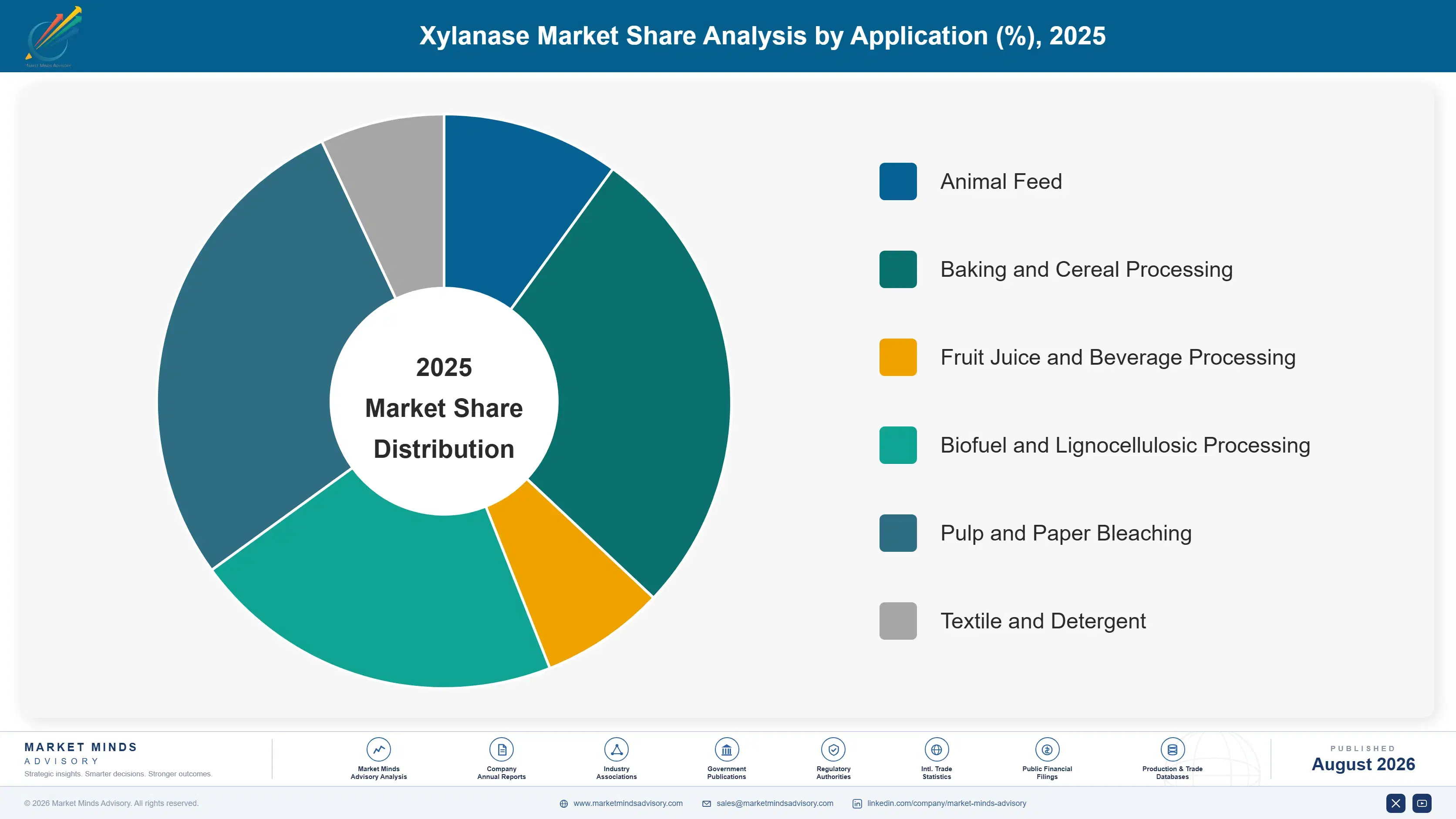
Segmentation follows application, since the application determines what the enzyme is actually purchased to achieve, who assigns its value, what documentation it requires and whether it appears on a label. Six applications cover the category as supplied. Growth tracks regulatory reformulation and animal production volumes rather than any change in enzyme performance. Reformulation drives the growth.
xylanase-market-trends-market-share-analysis-1787665203819

Baking and Cereal Processing

Dough conditioning, volume improvement, crumb structure and shelf life extension in industrial and craft baking, replacing chemical improvers that clean label reformulation has been removing. At 10.2% this is the fastest growing application, half again the market rate of 6.8%, and regulation rather than functional advantage explains most of it. Potassium bromate is prohibited across most jurisdictions and azodicarbonamide has left major bakery formulations. Enzymes perform the same functions and require no declaration on the finished loaf in around 82% of jurisdictions, because they are treated as processing aids rather than ingredients. That invisibility is doing substantial commercial work, and the industry discusses it only privately. Somebody should say it openly.
CAGR 10.2%

Fruit Juice and Beverage Processing

Yield improvement, viscosity reduction and clarification in fruit juice, wine and other beverage processing where hemicellulose interferes with extraction and filtration. Growth of 8.4% is second fastest in the category, driven by yield economics that are straightforward to demonstrate and straightforward for a processor to verify independently. Substrate variation matters here as much as in cereals, since fruit composition changes with variety, ripeness and season. Application support is correspondingly important, though the processing scale is smaller and the technical relationships are considerably more concentrated among fewer customers. The technical argument here is shorter than in feed, because a processor can verify yield improvement in a single run. Verification changes the conversation.
CAGR 8.4%
Full segment breakdown across 6 segments available in the complete report.

Regional Architecture and Country Demand Map

East Asia holds 30% on the largest feed production base in the world and substantial domestic enzyme manufacturing. North America follows at 22% and Western Europe at 20%. India grows fastest at 10.6% across feed and bakery together. Diet composition rather than herd size alone decides.

North America

A 22% share reflects large poultry and swine production combined with sophisticated feed formulation practice where matrix values are used routinely and documented carefully. Corn based diets contain less arabinoxylan than wheat based ones, which changes the enzyme case and makes combination products more common than xylanase alone. Industrial baking is highly consolidated and has moved through clean label reformulation earlier than most regions. Technical service expectations are high and application data is scrutinised. Growth of 5.8% reflects mature feed volumes and completed bakery reformulation rather than expansion. Diet composition rather than herd size is what limits the enzyme case across this region. Corn simply contains less of the substrate.
Share: 22% | CAGR: 5.8% (2026 to 2036)

Western Europe

A 20% share reflects wheat and barley based diets that make xylanase more valuable than in corn based systems, alongside the most demanding regulatory and documentation environment for feed additives anywhere. European authorisation requirements are substantial and create a barrier that also protects incumbents holding approvals. Clean label pressure in baking originated here and has progressed furthest. Feed volumes are constrained by environmental regulation and herd size limits in several countries. Growth of 5.2% is the lowest of the seven regions and reflects those production constraints directly. Cereal composition rather than herd size is what makes this region unusually favourable technically. Authorisation requirements quietly protect whoever already holds them. Entry is slow.
Share: 20% | CAGR: 5.2% (2026 to 2036)
Regional intelligence for 5 additional markets available in the complete report: East Asia, South Asia and Pacific, Latin America, Middle East and Africa, Eastern Europe. Contact sales@marketmindsadvisory.com.
xylanase-market-trends-country-cagr-analysis-1787665204372

Where This Enzyme Actually Earns

Nothing here is won on specific activity, because customers cannot verify it and would not act on it if they could. Value accrues to whoever sells the matrix credit, whoever holds substrate response data, whoever follows clean label reformulation, and whoever reaches the herds. Four routes carry weight and none concerns molecular performance. The arithmetic decides everything.

Sell The Matrix Value Not The Enzyme

A feed formulator assigns xylanase a matrix credit worth around 85 kilocalories of metabolisable energy per kilogram, and least cost software then removes that much oil or cereal from the diet. The enzyme costs about 0.4% of the feed and exists entirely to permit that substitution. Suppliers presenting activity units and specific activity are describing something no formulator can enter into their software, while those presenting a defensible matrix value are selling the thing that is actually being bought. Around 0.4% of feed cost buys a number worth considerably more than that.
Market Impact: The credit removes 85 kilocalories from every kilogram

Own The Substrate Data Not The Molecule

Arabinoxylan content varies up to 2.8 times between wheat harvests entering the same mill, so an identical dose produces measurably different responses through a season. No molecular improvement addresses variation sitting in the crop rather than the catalyst. Around 71% of sales require on-site application work to close, and suppliers holding substrate response data across regions and harvests own something a competitor cannot replicate by engineering a better enzyme, however much they spend attempting it. Around 71% of sales close on application work rather than on any product comparison. That is the whole business.
Market Impact: Data covers the 2.8 times substrate variation problem

Follow Clean Label Reformulation Into Baking

Chemical dough improvers have been leaving formulations under regulatory and retailer pressure, and enzymes replace them while requiring no declaration on the finished loaf in around 82% of jurisdictions because they count as processing aids. Baking grows at 10.2% against a market rate of 6.8% substantially for that reason. The label advantage is real and commercially significant, and the industry discusses it only privately, which means suppliers positioning openly around reformulation support reach bakers considerably faster than technical selling does. Around 10.2% growth in an application driven by regulation is rare enough to notice.
Market Impact: Remains invisible on labels in 82% of jurisdictions

Serve Feed Volume Where The Herds Are

East Asia holds 30% of category demand on feed production volumes no other region approaches, and India grows at 10.6% as poultry and organised bakery expand together. Domestic producers compete aggressively on price in both markets, so competing on cost is not a viable route in for anybody arriving now. Matrix documentation, application service and authorisation status are where international suppliers hold defensible positions, particularly where feed mill sophistication varies considerably within a single market. Around 30% of demand concentrated in one region makes the competitive question a geographic one first.
Market Impact: East Asia alone carries 30% of category demand

Who Controls the Margin Pool

Concentration is high and fermentation capacity is why. The top five hold 66% of production capacity, the basis applied consistently throughout this section, since submerged fermentation at commercial scale requires capital and process capability that limits how many participants exist at all. Novonesis leads on capacity breadth and application service reach, and the gap reflects accumulated substrate data and regulatory authorisations more than fermentation cost.
Competition runs on three fronts. Global producers compete on matrix documentation, authorisation portfolios and application service into sophisticated feed and bakery customers. Chinese producers compete on price with adequate performance across the largest feed market and increasingly on export. And formulators and premix companies compete by blending enzymes into products sold under their own identity, which obscures the enzyme supplier entirely.

Rankings will move with substrate data and application capability rather than with enzyme engineering, since the variation that governs performance sits in the crop and no molecule addresses it. The other pressure point is grain pricing, which determines how valuable a matrix credit is and therefore how urgently formulators pursue enzyme inclusion at all in any given production season.
xylanase-market-trends-company-positioning-matrix-1787665204908

Competitive Moat and Risk Dimensions

NOVONESIS

Moat: Substrate Data And Authorisations

Accumulated application response data across crops, regions and harvest years addresses the variation that governs actual performance, and no competitor replicates it by improving an enzyme. Regulatory authorisations across major feed jurisdictions add a second barrier, since each requires dossier work that takes years and protects positions once granted.
NOVONESIS

Risk: Commodity Price Exposure

Enzyme value depends on what the energy it replaces costs, so falling grain and oil prices reduce the value of an unchanged product without any competitive event occurring. That exposure is entirely outside supplier control and affects the largest application in the category directly, which makes revenue considerably more cyclical than an enzyme business appears.
IFF

Moat: Combined Enzyme And Culture Portfolio

Holding enzymes alongside cultures and other bioscience ingredients allows bakery and beverage customers to source multiple functional inputs through one technical relationship, which suits reformulation projects touching several ingredients at once. That breadth also spreads application service cost across products serving overlapping customer bases entirely.
IFF

Risk: Chinese Price Competition

Domestic Chinese producers supply adequate xylanase at prices international suppliers cannot approach, in the largest feed market and increasingly in export markets alongside. Defending price on documentation and service works in sophisticated accounts and reaches very little of the volume growth occurring in price led segments elsewhere.

Players Tracked

Prominent Players

Novonesis
IFF
DSM-Firmenich
AB Enzymes
BASF

Other Key Players

Kerry Group
Amano Enzyme
Advanced Enzyme Technologies
Dyadic International
Biocatalysts
Sunson Industry Group
Vland Biotech
Longda Bio-products
Shandong Sukahan Bio-technology
Creative Enzymes
Lesaffre
Puratos
Adisseo
Alltech
Huvepharma

Recent Developments

FEBRUARY 2025

Integrator revises matrix values against current ingredient pricing

A poultry integrator revised enzyme matrix values in its least cost formulation against current ingredient pricing rather than treating them as fixed assumptions. A matrix credit around 85 kilocalories per kilogram is only worth what the energy it replaces costs, which changes with every grain market movement.
Signal: The enzyme is a substitution product and its value moves with what it substitutes every single season
MAY 2025

Bakery group completes chemical improver removal across product range

An industrial bakery group completed removal of chemical dough improvers across its product range, replacing them with enzyme systems requiring no declaration on the finished loaf. Around 82% of jurisdictions treat these enzymes as processing aids rather than as ingredients requiring listing on packaging. Nothing appears on the pack.
Signal: The enzyme wins partly because it disappears from a list consumers actually read before deciding what to buy
SEPTEMBER 2025

Supplier publishes harvest response data across wheat growing regions

An enzyme supplier published application response data across wheat growing regions and harvest years, addressing the substrate variation that determines performance in practice. Arabinoxylan content varies up to 2.8 times between harvests entering the same mill, which no enzyme improvement can compensate for. No molecule addresses that.
Signal: Substrate data is the asset here and nobody builds it by improving the molecule however much anybody spends

What Fermented Enzyme Costs

Fermentation substrate accounts for 26% of production cost and energy for 31%, with downstream recovery, formulation, granulation, packaging and quality control carrying the remainder. Glucose and corn steep liquor feed the fungal fermentation, which ties input cost to agricultural markets that also drive enzyme demand through grain pricing. Fermentation and downstream recovery are both energy intensive, which makes production location an important cost variable.
European energy pricing demonstrated how directly that transmits. IEA data recorded gas prices reaching several times historical norms, and enzyme producer annual reports documented margin compression and production reallocation toward facilities with more favourable energy positions. Chinese producers with domestic energy and substrate cost advantages gained ground during the same period, which accelerated a pricing shift that was already underway across several applications. Nobody escaped it.

Exposure divides by production location and energy contracting rather than by scale. Producers with fermentation capacity in low energy cost regions or holding fixed positions passed the last movement through, while those concentrated in European facilities absorbed it. Feedstock exposure runs the same direction as demand exposure, since expensive grain raises production cost while simultaneously making the matrix credit more valuable, which is an unusual and mildly helpful correlation.
xylanase-market-trends-cost-volatility-analysis-1787665205113

Locate fermentation where energy cost supports the economics

Energy is 31% of production cost and fermentation with downstream recovery cannot be made significantly less energy intensive within existing process technology. European facilities absorbed the last disruption while producers elsewhere passed it through and gained share. Production location is therefore a competitive decision rather than a logistics one, and it takes years to change once capacity has been committed.

Build substrate response data as a defensible commercial asset

Arabinoxylan variation up to 2.8 times between harvests governs actual performance, and no enzyme improvement addresses variation sitting in the crop. Application response data across regions and harvest years is expensive to accumulate and impossible to acquire. Suppliers treating it as a technical service cost rather than a commercial asset are undervaluing the only durable position available in this category.

Present matrix value against live ingredient pricing

A matrix credit worth around 85 kilocalories per kilogram is only worth what that energy currently costs, and formulators recalculate constantly while suppliers frequently quote fixed claims. Presenting value against live pricing reaches the formulator inside their own decision process. It also makes the supplier useful when grain is expensive, which is exactly when inclusion decisions are being reviewed.

Portfolio Architecture for Margin Defence

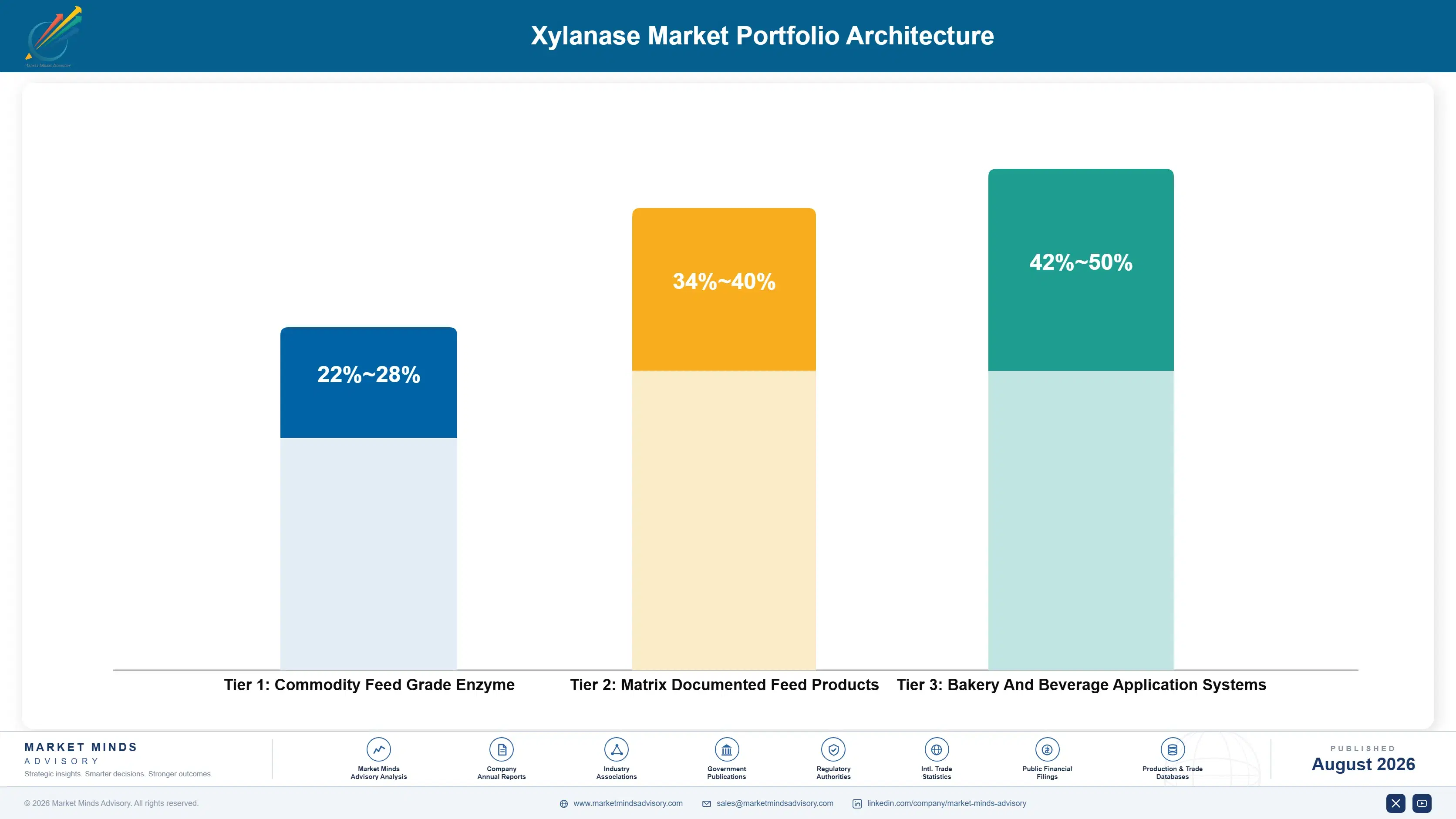
Margin architecture divides on documentation rather than on enzyme quality. Commodity feed grades earn least, competing against Chinese producers on price in accounts where matrix documentation is not scrutinised closely. Matrix documented and authorised feed products earn considerably better, since authorisation dossiers and response data create barriers that fermentation capacity alone does not. Bakery and beverage application products earn best, where reformulation support and processing aid status carry value beyond the enzyme.
The tension runs between volume and defensibility. Feed carries the tonnage that loads fermentation capacity and keeps unit cost competitive, and it is the application most exposed to price competition and to grain cycles nobody controls. Baking and beverage carry margin on smaller volumes with technical relationships that hold. Producers need the feed volume to justify the plant and earn their return somewhere else entirely.

High value pools concentrate in substrate data, authorisation portfolios and reformulation support, none of which is a fermentation position. Everything sold on activity units competes against producers with energy and substrate cost advantages that international suppliers cannot match. The businesses worth building are those where a matrix value, a dossier or a harvest dataset makes the customer's alternative worse rather than merely different.

Commodity Feed Grade Enzyme

Standard feed xylanase competing on price where matrix documentation receives little scrutiny and activity units are compared directly. Chinese producers with energy and substrate cost advantages set pricing across this whole tier.
Gross Margin: 22-28%

Matrix Documented Feed Products

Authorised products supplied with defensible matrix values and application response data for sophisticated integrators using least cost formulation rigorously. Authorisation dossiers create a barrier that fermentation capacity alone never does.
Gross Margin: 34-40%

Bakery And Beverage Application Systems

Application supported enzyme systems for clean label bakery reformulation and beverage processing, where processing aid status and technical support carry the value. The range is wide because reformulation project scope varies substantially between customers.
Gross Margin: 42-50%
xylanase-market-trends-portfolio-architecture-1787665205641

High-value Sub-segments and Strategic Watch-out

Baking and Cereal Processing

Fastest growing application at 10.2% on clean label reformulation rather than functional advantage, with no declaration required in around 82% of jurisdictions. The label invisibility is doing commercial work the industry discusses only privately. Regulation rather than any function opened this whole application up here.
Gross Margin: 42-50%

Fruit Juice and Beverage Processing

Second fastest at 8.4% on yield economics processors can verify independently, which shortens the technical argument considerably. Substrate variation matters as much here as in cereals, since fruit composition changes with variety and season. A processor can verify the yield improvement in a single run.
Gross Margin: 40-46%

Animal Feed

Growing at 6.2% and carrying the largest volume in the category, which makes it the tonnage core rather than the growth story. The range is wide because commodity and matrix documented products earn very differently within the same application. Grain pricing decides how valuable it is.
Gross Margin: 22-32%

Pulp and Paper Bleaching

Growing at only 3.4% as graphic paper volumes decline across every developed market and the application itself was optimised decades ago. It requires service capability while generating very little new revenue anywhere. The enzyme still works exactly as intended within a steadily shrinking end industry.
Gross Margin: 18-24%

How Formulation Software Creates Demand

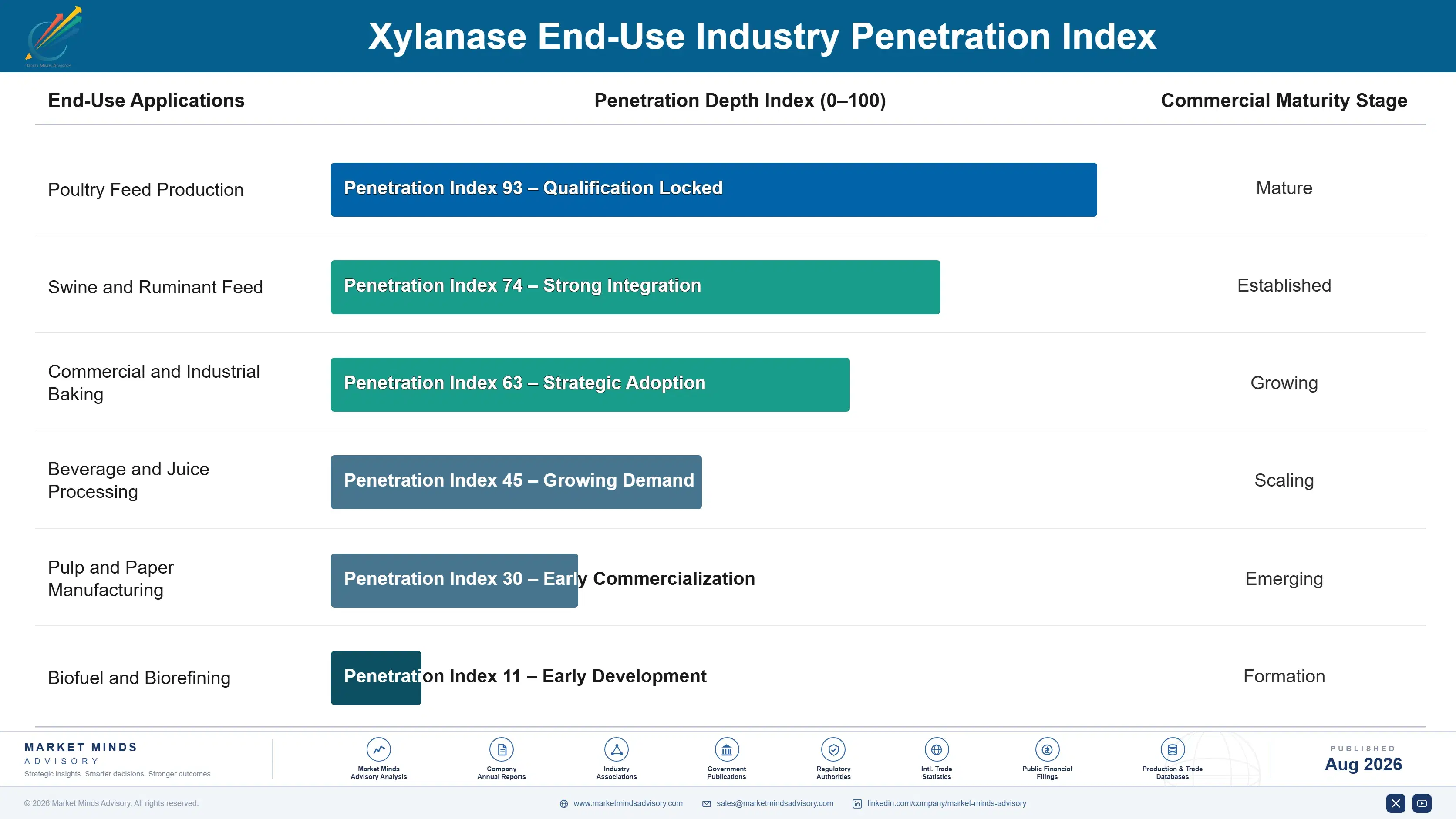
Demand in the largest application is generated inside a piece of software rather than by any purchasing conversation. A formulator enters a matrix value, least cost optimisation removes ingredients worth that much, and the enzyme is ordered as a consequence of an arithmetic result. Once a matrix value enters a formulation system it stays until somebody revisits it, which makes acceptance the commercial event and reordering the consequence.
Stickiness therefore depends on whether the matrix value is defended. A supplier whose value is documented, authorised and supported by response data across harvests is difficult to displace, because a competitor must persuade the formulator to change a number in a working system. A supplier selling on price without documentation is displaced the moment somebody quotes lower, since nothing in the formulation depends on who supplied it.

Bakery demand forms differently and holds for different reasons. A reformulation project touching dough improvers, shelf life and crumb structure takes months and involves technical staff throughout, after which the enzyme system is written into a specification nobody reopens casually. That makes bakery relationships longer and considerably more defensible than feed ones, on volumes that are a fraction as large.
xylanase-market-trends-end-use-penetration-index-1787665206143

Where This Enzyme Rewards Focus

These are among the four positions where our research anticipates prominent divergence between winners and laggards over the coming forecast period. Each is grounded in the demand model, the regulatory perimeter, and the announced capacity pipeline.
01 / MATRIX VALUE SELLING

The formulator buys a number, not a molecule

A feed formulator assigns xylanase a matrix credit worth around 85 kilocalories of metabolisable energy per kilogram, and least cost software then removes exactly that much oil or cereal from the diet automatically. The enzyme costs about 0.4% of the finished feed and exists entirely to permit that substitution to happen at all. Suppliers presenting activity units and specific activity are describing something no formulator can enter into their software, and therefore something nobody in the chain can act upon.
02 / SUBSTRATE DATA OWNERSHIP

The variation is in the crop, not the catalyst

Arabinoxylan content and soluble fraction ratios vary up to 2.8 times between wheat harvests arriving at the same mill, so an identical enzyme dose produces measurably different responses through a single season. No molecular improvement addresses variation that sits in the crop rather than in the catalyst being sold. Around 71% of sales require on-site application work to close, and response data across regions and harvest years is the one asset a competitor cannot ever engineer their way toward at all.
03 / CLEAN LABEL POSITIONING

Winning by disappearing from the ingredient list

Chemical dough improvers have been leaving bakery formulations under regulatory and retailer pressure across most developed markets over the past decade. Enzymes perform the same functions and require no declaration on the finished loaf in around 82% of jurisdictions, because they are treated as processing aids rather than as ingredients. That label advantage is genuine and commercially substantial, and the industry discusses it only privately, which leaves the argument available to whoever is finally willing to make that argument openly.
04 / HERD GEOGRAPHY ACCESS

Follow the animals, then the bread

East Asia holds 30% of category demand on feed production volumes no other region approaches, and India grows at 10.6% as poultry production and organised bakery expand along the same timeline together. Domestic producers compete aggressively on price in both markets, which means competing on enzyme cost is not a viable route in for anybody arriving now. Matrix documentation, application service and authorisation status are where international suppliers hold genuinely defensible positions instead, and each of those takes years to build.

Engagement Snapshot From the Field

A live engagement with an industry participant carrying material or product regulatory and market exposure ahead of a defining policy shift, showing how our research translates into a defensible multi-year portfolio strategy.
MARKET MINDS ADVISORY · CLIENT ENGAGEMENT SUMMARY
Xylanase Producer Strategic Portfolio Review and Transition Roadmap 2026·Investment Scenario on Xylanase Exposure Evaluation 2025-26
CLIENT PROFILE
An industrial enzyme producer supplying feed and bakery xylanase to integrators, feed mills and bakery groups across Western Europe and Latin America. Annual revenue from this product line was approximately 54 million dollars (client-reported, unverified by MMA), predominantly feed grade. Technical selling emphasised activity units and specific activity rather than matrix values, and application data was held informally by individual technical staff.
STRATEGIC CHALLENGE
Feed volumes had been losing share to lower priced competitors in accounts where the client believed its enzyme performed better, and management could not explain why superior performance was not translating into retention. Separately, bakery represented a small share of revenue despite growing faster than feed. Nobody had examined how formulators actually make inclusion decisions.
MMA APPROACH
MMA observed formulation decisions at integrator customers, tracing how enzyme inclusion is entered and revisited in least cost systems. Matrix documentation and substrate data investment were costed against continued technical selling. Forty-seven expert interviews with feed formulators, nutritionists, bakery technologists and purchasing managers established what actually determines selection, alongside survey work across six countries.
KEY FINDINGS
  1. Formulators in 8 of 9 integrator accounts could not describe the client's activity claims and all 9 could recite the matrix value they had entered into their software.
  2. Accounts where the client's matrix value was documented and authorised retained supply through roughly 3 times as many competitive quotations as accounts where it was not.
  3. Application response data existed across 4 harvest years but sat with individual technical staff rather than in any system the commercial organisation could actually use.
  4. Bakery accounts carried around 2 times the gross margin of feed accounts and consumed a fraction of commercial attention, largely because revenue was smaller.
CLIENT PROFILE
An industrial enzyme producer supplying feed and bakery xylanase to integrators, feed mills and bakery groups across Western Europe and Latin America. Annual revenue from this product line was approximately 54 million dollars (client-reported, unverified by MMA), predominantly feed grade. Technical selling emphasised activity units and specific activity rather than matrix values, and application data was held informally by individual technical staff.
STRATEGIC CHALLENGE
Feed volumes had been losing share to lower priced competitors in accounts where the client believed its enzyme performed better, and management could not explain why superior performance was not translating into retention. Separately, bakery represented a small share of revenue despite growing faster than feed. Nobody had examined how formulators actually make inclusion decisions.
MMA APPROACH
MMA observed formulation decisions at integrator customers, tracing how enzyme inclusion is entered and revisited in least cost systems. Matrix documentation and substrate data investment were costed against continued technical selling. Forty-seven expert interviews with feed formulators, nutritionists, bakery technologists and purchasing managers established what actually determines selection, alongside survey work across six countries.
KEY FINDINGS
  1. Formulators in 8 of 9 integrator accounts could not describe the client's activity claims and all 9 could recite the matrix value they had entered into their software.
  2. Accounts where the client's matrix value was documented and authorised retained supply through roughly 3 times as many competitive quotations as accounts where it was not.
  3. Application response data existed across 4 harvest years but sat with individual technical staff rather than in any system the commercial organisation could actually use.
  4. Bakery accounts carried around 2 times the gross margin of feed accounts and consumed a fraction of commercial attention, largely because revenue was smaller.
RECOMMENDED STRATEGY
Phase 1: Phase one: rebuild commercial materials around documented matrix values, since retention ran roughly 3 times higher where the value was documented. Phase 2: Phase two: consolidate 4 harvest years of response data into a system the commercial organisation can actually use with customers. Phase 3: Phase three: rebalance attention toward bakery, carrying around 2 times feed gross margin on only a fraction of the effort.
OUTCOME
The client rebuilt its selling around documented matrix values and retention in feed accounts improved measurably within a year without any product change. Harvest response data was consolidated and became a commercial asset rather than individual knowledge, and bakery revenue grew as commercial attention was redirected toward it (client-reported, unverified by MMA).

Frequently Asked Questions

Foundational context covering the market sizes, CAGR, scope, country, region and competition that inform every finding below. This section is provided to cover basics and most often pre-purchase conversations, answered from the MMA Primary Research Dataset.

What is the current size of the Xylanase Market?

The market was valued at 0.42 billion dollars in 2025, covering xylanase enzymes supplied across feed, baking, beverage, biofuel, pulp and textile applications worldwide. It reaches an estimated 0.45 billion dollars during 2026.

How large will the Xylanase Market be by 2036?

MMA forecasts 0.87 billion dollars by 2036, an increase of 0.42 billion dollars over the 2026 base. That represents an expansion multiple of 1.93 times across the forecast period.

What is the CAGR for the Xylanase Market 2026 to 2036?

The base case compound annual growth rate is 6.8%, with a bull case of 8.0% and a bear case of 5.6%. Grain pricing and clean label reformulation separate those two scenarios.

Which segment is growing fastest?

Baking and cereal processing grows at 10.2%, half again the market rate of 6.8%, as clean label reformulation removes chemical dough improvers. Beverage processing follows at 8.4%.

Who are the major companies in the Xylanase Market?

Novonesis, IFF, DSM-Firmenich, AB Enzymes and BASF lead on production capacity across feed and food applications. Together they account for 66% of the global market.

Which country is growing fastest?

India grows fastest at 10.6%, because poultry production and organised bakery have expanded together, placing both major applications on the same upward path at the same time.

Report Segmentation Architecture

The full report scope spans multiple orthogonal segmentation dimensions, with cross-tabulated demand data provided for each dimension pair. Coverage extends further to regional breakdowns, trend trajectories, and the competitive detail needed to support segment-level decision-making.

By Application

  • Animal Feed
  • Baking and Cereal Processing
  • Fruit Juice and Beverage Processing
  • Biofuel and Lignocellulosic Processing
  • Pulp and Paper Bleaching
  • Textile and Detergent

By End-Use Industry

  • Poultry Feed Production
  • Swine and Ruminant Feed
  • Commercial and Industrial Baking
  • Beverage and Juice Processing
  • Pulp and Paper Manufacturing
  • Biofuel and Biorefining

By Commercial Dimension

  • Direct Feed Mill Supply
  • Premix and Blender Supply
  • Ingredient Distributor Supply
  • Contract Application Service
  • Toll Fermentation
  • Export and Trading

By Region

  • North America
  • Western Europe
  • East Asia
  • South Asia and Pacific
  • Latin America
  • Middle East and Africa
  • Eastern Europe

Scope, Methodology, and Coverage

Every figure in this report is reproducible from documented input assumptions. The scope below maps the historical period, the forecast horizon, the segmentation dimensions, and the countries covered, alongside the underlying primary and qualitative methodology.
Historical Period
2020 to 2025
Forecast Period
2026 to 2036
Base Year
2025 (USD billions; MMA Primary Research Dataset, August 2026)
Market Definition
Xylanase enzymes hydrolysing arabinoxylan and related hemicellulose fractions, supplied worldwide for animal feed, baking and cereal processing, fruit juice and beverage processing, biofuel and lignocellulosic processing, pulp and paper bleaching, and textile and detergent applications, in liquid, granulated and thermostable coated forms, measured at enzyme selling value. Other carbohydrase, protease, phytase and lipase enzymes sold under separate identity, complete multi-enzyme blends attributed to other products, feed premixes and formulated bakery improver systems are excluded from scope.
Quantitative Units
USD billions (enzyme selling value); tonnes of formulated product; USD per tonne by application
Segmentation Dimensions
Application; end-use industry; commercial dimension; region
Regions Covered
North America, Western Europe, East Asia, South Asia and Pacific, Latin America, Middle East and Africa, Eastern Europe
Countries Covered
United States, Canada, Germany, France, Netherlands, Denmark, United Kingdom, Spain, Italy, China, Japan, South Korea, India, Thailand, Vietnam, Indonesia, Australia, Brazil, Mexico, Argentina, South Africa, Poland
Key Companies Profiled
Novonesis, IFF, DSM-Firmenich, AB Enzymes, BASF, Kerry Group, Amano Enzyme, Advanced Enzyme Technologies, Dyadic International, Biocatalysts, Sunson Industry Group, Vland Biotech, Longda Bio-products, Shandong Sukahan Bio-technology, Creative Enzymes, Lesaffre, Puratos, Adisseo, Alltech, Huvepharma
Quantitative Methodology
Primary survey, n=3,800 respondents, Q4 2025, six countries; demand-side model with trade association cross-validation
Qualitative Methodology
47 expert interviews, Q4 2025; applied to validate demand model assumptions, identify emerging dynamics, and assess competitive positioning
Report Format
PDF and XLSX data workbook (Word format preview document)
Publisher
Market Minds Advisory
Report Code
MMA-2026-CHM-156
Published
August 2026
Contact
sales@marketmindsadvisory.com | www.marketmindsadvisory.com

Purchase the full Xylanase Market Report (2026 to 2036).

The full report explains that nobody in the largest application buys an enzyme at all, and follows the commercial consequences of a product purchased as a number in formulation software. It sizes all six applications independently through 2036, quantifies substrate variation against dose response across harvests, and maps processing aid label status by jurisdiction against bakery reformulation demand. Regional chapters cover all seven regions, with diet composition assessed separately from feed production volume throughout. Competitive profiling covers 20 participants on one single consistent capacity measure.
Six applications sized independently through 2036
Substrate variation quantified against dose response across harvests
Matrix credit value modelled against live ingredient pricing
Processing aid label status mapped by jurisdiction and application
Fermentation energy exposure assessed by production location
Twenty participants profiled on one consistent capacity measure

Built For The People Who Decide

From boardroom strategy to bench-side execution, this report is read cover-to-cover by leaders shaping the next decade of their industry, turning demand scenarios, market dynamics and valuation benchmarks into decisions.
CXOs/ Presidents/ VPs/ Managers
M&A and Corporate Development
Strategy Teams and R&D Heads
Procurement and Product Directors
Regulatory and Compliance Leaders
Investor Relations and Equity Analysts