Market Minds Advisory
Wound Stimulation Therapy Market

Wound Stimulation Therapy Market: The Best Evidence In Wound Care And The Worst Adoption

Electrical stimulation carries the strongest guideline recommendation in wound care, costs very little to deliver, and reaches fewer than one in ten of the wounds it is actually recommended for anywhere.

Lead Analyst

Published

September 2026

Make Smarter Decisions with Customized Research Insights

Request a free sample report and evaluate market opportunities, growth trends, and competitive dynamics relevant to your business needs.

2025 MARKET VALUE$0.5BMarket Size 2025
2036 FORECAST VALUE$1.3BBase Case , 2026 to 2036
CAGR 2026 TO 20368.2 %Bull 9.4% / Bear 7.0%
INCREMENTAL OPPORTUNITY$0.7BNet 10- year value creation
EXPANSION MULTIPLE2.21x2036 value over 2026 base
Strategic Levers
M&A Pipeline
Regional Outlook
Country Rankings
Competitive Intelligence
Segmental Deep-dive
Call-Us : 91 93563 13602

Executive Snapshot and Market Trajectory

The evidence problem in wound care runs the other way. Electrical stimulation holds a strong guideline recommendation for pressure ulcers, has a mechanism in the endogenous wound current, costs little to deliver, and reaches 9% of the wounds it is recommended for. Nothing about that gap is clinical.
Payment explains most of it. Only about 14% of payers fund stimulation therapy as a distinct service, so a clinician delivering it absorbs the time without any billing route, and no supplier is large enough to fund the education that would change prescribing habits. Electrical stimulation still grows fastest at 12.3%, half again the market rate. Guidelines describe intent and payment describes practice.
The commercial structure is the second problem. A clinic buys one device and uses it for around 11 years, so modalities without a consumable generate almost nothing after the sale. Consumables carry 41% of supplier revenue and the share differs enormously by modality, which means device design decides the business model more than efficacy ever does. Retrofitting a consumable into an installed platform is far harder than designing one in. Most suppliers never noticed choosing.
Market Definition
Adjunctive energy based therapies applied to stimulate healing in acute and chronic wounds, covering electrical stimulation, extracorporeal shockwave therapy, photobiomodulation and low level laser, low frequency ultrasound, pulsed electromagnetic field therapy and monochromatic infrared energy, including devices and their dedicated consumables. Measured at supplier revenue. Negative pressure wound therapy, wound dressings, systemic hyperbaric oxygen, growth factors and cellular therapies are excluded from scope.
Base Year Value
$0.5B in 2025 (MMA Primary Research Dataset, August 2026)
Forecast Period
2026 to 2036, eleven discrete annual values
CAGR
8.2% base case. Bull 9.4%. Bear 7.0%.
Fastest Growth Segment
Electrical Stimulation: 12.3% CAGR
Fastest Growth Country
India: 12.8% CAGR
Fastest Growth Region
South Asia and Pacific: 10.4% CAGR
Largest Region
Western Europe: 30% of 2025 global value
Market Leaders
SANUWAVE Health, Bioventus, Zynex Medical, Soring, Storz Medical. Source: MMA Primary Research Dataset, July 2026.
Primary Survey
n=3,800 procurement and R&D decision-makers, Q4 2025, six countries
Methodology
Demand-side build-up, cross-validated against public data, 47 expert interviews

Wound Stimulation Therapy Market Forecast Scenarios

wound-stimulation-therapy-market-size-forecast-scenario-1787665160894
The five years to 2025 produced better evidence and very little adoption change. Guideline recommendations strengthened for electrical stimulation and shockwave therapy accumulated diabetic foot ulcer data, while reimbursement remained absent in most systems and clinical practice moved slowly regardless. The 7.0% historical rate reflects a small base expanding on specialist enthusiasm rather than on any pathway change or payment decision.
The 8.2% base case rests on three mechanisms. Electrical stimulation grows at 12.3% on guideline strength and low device cost, with home delivery extending reach beyond clinic sessions. Shockwave therapy grows at 10.4% partly because the machines already sit in orthopaedic and urology clinics for other indications. And Indian wound care volumes grow at 12.8%, faster than any market covered, on diabetic foot ulcer burden. Evidence, installed base and burden together.
The 9.4% bull case turns on a major payer establishing a distinct reimbursement code for stimulation therapy, which would convert a clinical recommendation into a billable service and change prescribing behaviour within a year. The 7.0% bear case is attention: this remains a small category with no participant large enough to fund the clinical education that adoption at scale would actually require.

Recommended, Cheap And Barely Used

Most disappointing therapies in wound care fail on evidence. This one does not. Electrical stimulation carries a strong guideline recommendation for pressure ulcers, rests on a mechanism involving the endogenous electrical current that damaged tissue generates, and requires equipment costing a fraction of what most wound interventions do. Around 9% of eligible wounds receive it, which is a gap no clinical argument explains.
TOP FIVE CONCENTRATION34%Combined installed base held by the leading suppliers
GUIDELINE RECOMMENDATION STRENGTHLevel AEvidence grading achieved by the leading stimulation modality
CLINICAL ADOPTION RATE9%Eligible wounds receiving any adjunctive stimulation therapy anywhere
REIMBURSEMENT CODE COVERAGE14%Payers funding stimulation therapy as a distinct service
DEVICE SERVICE LIFE11 yearsTypical working life before a clinic replaces equipment
CONSUMABLE REVENUE SHARE41%Supplier turnover from electrodes and applicator components combined
Payment accounts for most of the difference. Roughly 14% of payers fund stimulation therapy as a distinct service, which means a clinician delivering twenty minutes of treatment absorbs that time against a visit that pays the same without it. Dressings require no equipment, no protocol and no additional clinician time, and they win the comparison on convenience regardless of what any guideline says.
The category also has a commercial design flaw that suppliers rarely acknowledge. A clinic buys one device and runs it for around 11 years, so modalities without a consumable produce almost nothing after the initial sale. Consumables carry 41% of revenue across the category and the proportion varies enormously by modality, which means the physical design of the device decides the business model.
"This is the only corner of wound care where the guidelines are ahead of the practice rather than behind it. The obstacle is not whether it works; it is that nobody can bill for twenty minutes of it."
Director, Wound Care and Physical Medicine Practice · MMA Medical Devices and Wound Care Practice · August 2026

Market Trends

Guideline Strength Fails To Move Clinical Practice

Electrical stimulation holds a strong recommendation in pressure ulcer guidance and has done for years, yet around 9% of eligible wounds receive any adjunctive stimulation therapy at all. The gap is not clinical scepticism but the absence of any billing route, since roughly 14% of payers fund it as a distinct service and everybody else absorbs the clinician time unpaid. Guidelines describe what should happen and reimbursement describes what does. Suppliers presenting evidence to clinicians are addressing the constraint that was never binding. Nobody is really arguing about whether it works.
Market Impact: India grows at 12.8% annually

Device Design Decides The Business Model Directly

A clinic buys a stimulation device and runs it for around 11 years, which means a modality without a dedicated consumable generates almost no revenue after the sale and forces the supplier to keep finding new customers indefinitely. Consumables carry 41% of category revenue and the proportion differs enormously between modalities, from electrode heavy electrical stimulation to shockwave applicators with defined shot counts. That is an engineering decision made years before commercial consequences appear, and most suppliers made it without noticing. Retrofitting one afterwards is considerably harder than designing it in from the start.
Market Impact: Shockwave grows at 10.4% annually

Market Opportunities and Growth Drivers

Indian Diabetic Foot Ulcer Burden Drives Clinical Volume

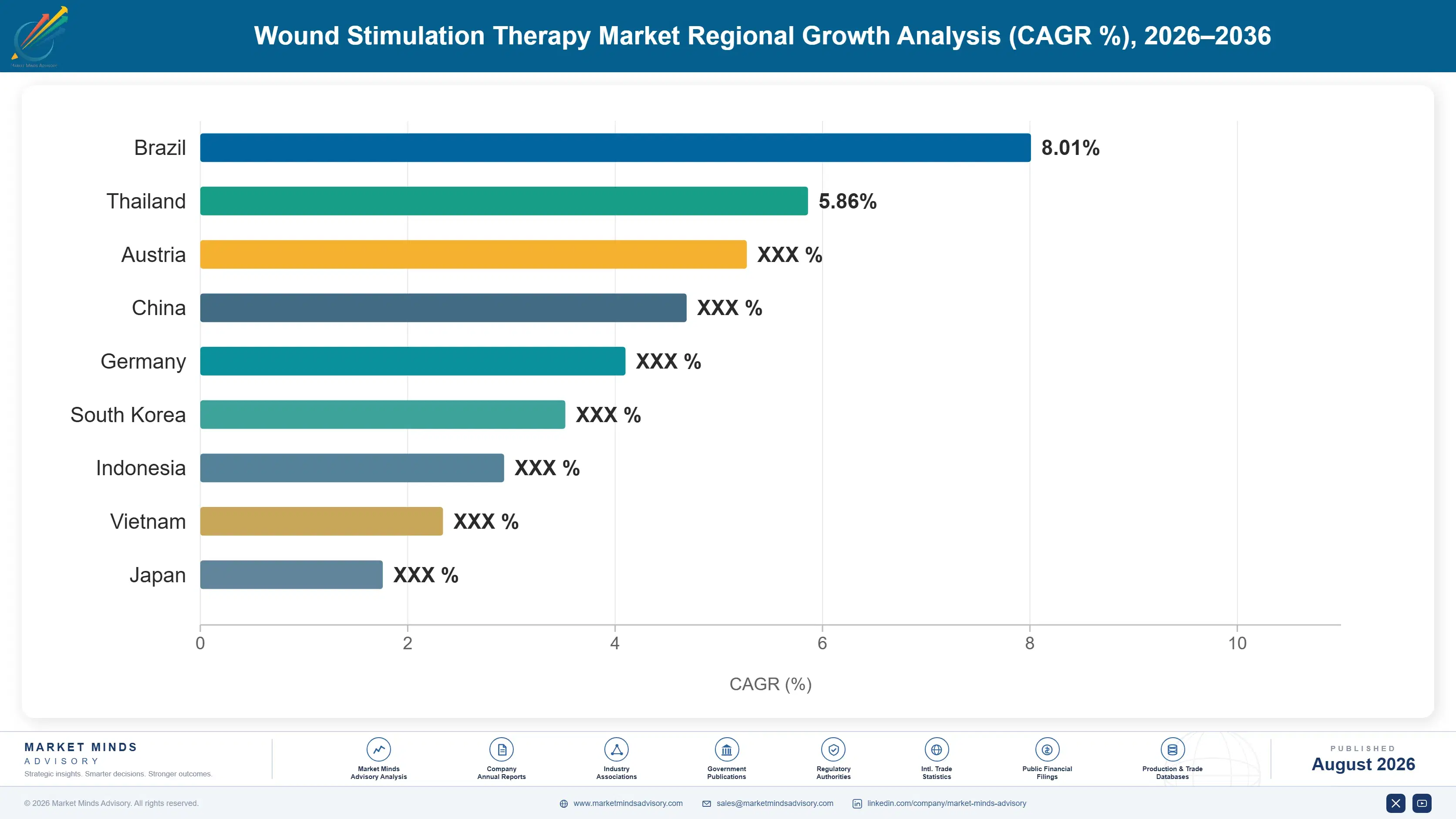
India carries one of the largest diabetic populations anywhere and diabetic foot ulcer presentation is correspondingly high, with amputation rates that make any adjunctive therapy improving healing rates clinically valuable rather than optional. India grows at 12.8%, faster than any market covered. Cost governs purchasing strictly, which favours low cost electrical stimulation over capital intensive modalities. Domestic manufacturers serve much of that demand while international suppliers hold positions in corporate hospital chains and specialist diabetic foot centres. Amputation as the alternative makes cost effectiveness arguments considerably shorter than they are elsewhere.
Market Impact: Only 14% of payers fund it

Existing Machines Reduce The Cost Of Adding Indications

Shockwave devices already sit in orthopaedic and urology clinics for entirely different indications, which means adding a wound application costs an applicator head and a protocol rather than a capital purchase and a business case. That is the cheapest adoption route available anywhere in this category and it explains why shockwave grows at 10.4%, second fastest. Physical therapy practices holding ultrasound and laser equipment sit in a comparable position. Suppliers selling complete systems into those settings are asking for capital nobody needs to spend. Applicators rather than systems are what these clinics buy.
Market Impact: Top five hold only 34% share

Market Restraints and Challenges

No Billing Route Exists In Most Health Systems

Around 14% of payers fund stimulation therapy as a distinct service, which means most clinicians delivering it give up twenty minutes against a visit paying the same whether they do it or not. The root cause is that payment systems reimburse encounters and procedures defined years ago, and adding a code requires evidence submission, health economic modelling and committee time that no participant in this small category has funded. Suppliers respond with cost effectiveness studies, which help only where somebody is willing to act on them. Nobody has funded that submission yet.
Market Impact: Adoption reaches 9% of eligible wounds

Category Scale Cannot Fund The Education Adoption Needs

Changing prescribing behaviour across wound care requires sustained clinical education, congress presence and champion development that dressing manufacturers fund from far larger revenue bases. The root cause is arithmetic: this category is small, fragmented at 34% for the top five, and no participant generates enough to carry that investment alone. Commercially this leaves excellent evidence unsupported by the promotional infrastructure it needs. Participants respond through societies and shared education, which is slower and considerably cheaper than individual programmes. Excellent evidence without promotional infrastructure behind it changes very little in actual practice.
Market Impact: Consumables carry 41% of revenue
3 additional market trends, 4 additional growth drivers, and 2 additional restraints and challenges are covered in the full report. Contact sales@marketmindsadvisory.com to access the complete intelligence.

Segment CAGR and Growth Architecture

Segmentation follows energy modality, since modality determines the evidence available, the equipment cost, whether a consumable exists and which clinical setting already holds the hardware. Six modalities cover adjunctive stimulation as practised. Growth tracks evidence strength and consumable design rather than any measured superiority between the energy types themselves. Consumable design decides the economics.
wound-stimulation-therapy-market-market-share-analysis-1787665161488

Electrical Stimulation

Application of controlled electrical current to the wound bed and surrounding tissue, working through the endogenous current that damaged tissue generates and the cell migration it directs. At 12.3% this is the fastest growing modality, half again the market rate of 8.2%, and it holds the strongest guideline recommendation of anything in this category. Equipment cost is low and electrodes provide a genuine consumable stream, which makes the commercial model work where other modalities struggle. Home delivery extends treatment beyond clinic sessions, which matters in a therapy requiring repeated application over weeks rather than single procedures. Guideline strength and workable economics rarely arrive in the same modality, and here they did.
CAGR 12.3%

Extracorporeal Shockwave Therapy

Acoustic pressure waves applied to the wound and surrounding tissue, with accumulating diabetic foot ulcer evidence and an applicator consumable defined by shot count rather than by time. Growth of 10.4% is second fastest in the category, and installed base rather than evidence explains a substantial part of it. Shockwave machines already sit in orthopaedic and urology clinics for other indications, so adding a wound application costs an applicator and a protocol rather than capital approval. That is the cheapest adoption route in this category, and suppliers selling complete systems into those clinics are asking for money nobody needs to spend. Applicator supply rather than system sales is the whole opportunity.
CAGR 10.4%
Full segment breakdown across 6 segments available in the complete report.

Regional Architecture and Country Demand Map

Western Europe holds 30%, above the standard band, because adjunctive physical therapies are used more readily in European wound services and guidance has been more supportive. North America follows at 26% and East Asia at 20%. India grows fastest at 12.8%. Practice tradition shapes these shares.

North America

A 26% share reflects large chronic wound volumes against adoption held back by the same billing problem the category faces everywhere. Specialist wound centres and podiatry practices are the most active users, since they run protocols and can build stimulation into a defined pathway. Home health delivery of electrical stimulation is developing faster here than elsewhere, which extends treatment beyond clinic sessions substantially. Physical therapy practices holding ultrasound and laser equipment represent an installed base suppliers reach unevenly. Growth of 7.2% reflects specialist adoption rather than any change in general wound care practice. Billing constraint rather than clinical scepticism is what holds this market back. Specialist centres are the exception throughout.
Share: 26% | CAGR: 7.2% (2026 to 2036)

Western Europe

A 30% share sits above the standard regional band, justified because adjunctive physical therapies are more embedded in European wound care practice than in North America and clinical guidance has been more supportive of them. German, Austrian and Nordic wound services use stimulation modalities within established protocols, and physical medicine traditions across the region make clinicians comfortable with energy based therapy generally. Reimbursement is still limited but less uniformly absent than elsewhere. Shockwave and ultrasound installed bases in physical medicine are substantial. Growth of 6.6% is the lowest of the seven regions and reflects mature adoption. Practice tradition rather than payment is what makes this the largest regional position here.
Share: 30% | CAGR: 6.6% (2026 to 2036)
Regional intelligence for 5 additional markets available in the complete report: East Asia, South Asia and Pacific, Latin America, Middle East and Africa, Eastern Europe. Contact sales@marketmindsadvisory.com.
wound-stimulation-therapy-market-country-cagr-analysis-1787665162012

Where This Category Actually Earns

Nothing here is won on further evidence, because the leading modality already holds the strongest recommendation in wound care and reaches 9% of eligible wounds anyway. Value accrues to whoever exploits the guideline position, whoever designs a consumable in, whoever uses existing machines, and whoever funds the reimbursement case. Four routes carry weight. Payment is the constraint.

Sell Where The Guideline Already Says Yes

Electrical stimulation holds a strong recommendation in pressure ulcer guidance and reaches around 9% of eligible wounds, which means the clinical argument was won years ago and nobody acted on it. Suppliers presenting further evidence to clinicians are addressing a constraint that stopped binding a long time ago. The productive move is bringing the existing recommendation to the people who write protocols and build care pathways, since a guideline referenced in a pathway document produces adoption that persuasion never has. Around 9% adoption against a strong recommendation is what missing pathway work looks like.
Market Impact: Existing guidance covers wounds reaching only 9% adoption

Design A Consumable Into The Device

A clinic runs a stimulation device for around 11 years, so a modality without a dedicated consumable generates nothing after the sale and forces perpetual new customer acquisition. Consumables carry 41% of category revenue and the proportion varies enormously between modalities, from electrode heavy electrical stimulation to shot counted shockwave applicators. That is an engineering decision taken years before its commercial consequences appear, and suppliers who took it carelessly are running businesses that cannot compound at all. Around 41% of category revenue sits in consumables and it is not distributed evenly at all.
Market Impact: Consumables generate 41% of total category revenue today

Use The Machines Clinics Already Own

Shockwave, ultrasound and laser equipment already sits in orthopaedic, urology and physical therapy practices for entirely different indications, which means adding a wound application costs an applicator and a protocol rather than capital approval and a business case. Shockwave grows at 10.4% substantially for that reason. Suppliers selling complete systems into clinics that already own the hardware are asking for money nobody needs to spend, and losing to competitors who simply supply the applicator instead. Around 10.4% growth in shockwave comes substantially from equipment nobody had to buy. That route is available in three modalities.
Market Impact: Supports the 10.4% shockwave growth rate through applicators

Build The Reimbursement Case Nobody Funded

Around 14% of payers fund stimulation therapy as a distinct service, and the missing element is health economic evidence with committee engagement rather than any further clinical trial. No individual participant in a category fragmented at 34% for the top five generates enough revenue to fund that alone, which is precisely why it has never happened. Collective funding through societies and shared submissions is the only realistic route, and it would expand the market for everybody simultaneously. Around 14% payer coverage is the single number that caps this whole category today.
Market Impact: Would move beyond the 14% payer coverage level

Who Controls the Margin Pool

Concentration is low and the field is unusually fragmented for a device category. The top five hold 34% of installed base and associated consumable revenue, the basis applied consistently throughout this section, across specialist stimulation companies, physical medicine equipment manufacturers and large wound care groups holding one modality alongside dressings. SANUWAVE Health leads on wound specific shockwave presence, and the gap reflects focus rather than scale.
Competition runs on three fronts. Wound specific specialists compete on clinical evidence and protocol integration, which is where the argument should be strongest and where funding is thinnest. Physical medicine manufacturers compete by adding wound applications to equipment already installed for other indications. And large wound care groups compete by bundling a stimulation modality into dressing and pathway relationships they already hold.

Rankings will move with reimbursement rather than with product development, since a distinct payment code would convert a clinical recommendation into a billable service and expand the addressable market for every participant simultaneously. The other pressure point is consumable design, which determines quietly which suppliers build compounding businesses and which keep selling devices into an eleven year replacement cycle.
wound-stimulation-therapy-market-company-positioning-matrix-1787665162530

Competitive Moat and Risk Dimensions

SANUWAVE HEALTH

Moat: Wound Specific Shockwave Position

Regulatory clearance and accumulated diabetic foot ulcer evidence for a wound specific shockwave application create a position physical medicine manufacturers adding wound indications cannot claim without repeating the same clinical work. Applicator consumables defined by shot count provide recurring revenue that device only competitors in this category conspicuously lack.
SANUWAVE HEALTH

Risk: Category Scale Constraint

Building adoption requires clinical education and reimbursement work at a scale a small company cannot fund from a category this size, and no larger participant has stepped into that role either. Existing shockwave installed bases in adjacent specialties also allow competitors to reach the same indication by supplying applicators alone.
BIOVENTUS

Moat: Broader Clinical Portfolio Reach

Presence across bone healing, orthobiologics and wound applications provides commercial reach and clinical relationships considerably wider than a single modality specialist can maintain, and it spreads education cost across products serving overlapping clinician audiences. That scale is precisely what this category otherwise lacks almost entirely today.
BIOVENTUS

Risk: Internal Priority Competition

Wound stimulation competes internally for capital and commercial attention against larger orthopaedic and orthobiologics businesses with clearer near term returns and established reimbursement. A category requiring sustained investment ahead of payment decisions is a difficult argument to win against products already being reimbursed everywhere today.

Players Tracked

Prominent Players

SANUWAVE Health
Bioventus
Zynex Medical
Soring
Storz Medical

Other Key Players

Smith and Nephew
Molnlycke Health Care
ConvaTec
Medtronic
Enovis
Richard Wolf
MTS Medical
THOR Photomedicine
Multi Radiance Medical
Erchonia
BTL Industries
Zimmer MedizinSysteme
EMS Electro Medical Systems
Gymna
Accelerated Care Plus

Recent Developments

FEBRUARY 2025

Wound care pathway adds electrical stimulation as protocol step

A health system wound care pathway added electrical stimulation as a defined protocol step for non-healing pressure ulcers, referencing existing guideline recommendations rather than commissioning new evidence. Around 9% of eligible wounds currently receive any adjunctive stimulation therapy, despite recommendations that have stood for years.
Signal: A pathway document produces adoption that clinical persuasion has never once achieved in any health system anywhere
MAY 2025

Physical therapy practices add wound applicators to existing shockwave units

Physical therapy and orthopaedic practices added wound treatment applicators to shockwave units already installed for musculoskeletal indications, requiring no capital approval or business case. Shockwave therapy grows at 10.4%, second fastest in the category, substantially because that installed base already exists. No business case was required.
Signal: Selling a complete system to a clinic that owns the hardware loses to selling an applicator
SEPTEMBER 2025

Society coalition submits health economic case for stimulation coverage

A coalition of wound care societies submitted a health economic case for distinct reimbursement coverage of stimulation therapy, funded collectively rather than by any single manufacturer. Around 14% of payers currently fund it as a distinct service, and no individual participant generates enough revenue to fund submissions alone.
Signal: Collective funding is the only route in a category too fragmented for anybody to lead to lead alone

What Stimulation Devices Cost

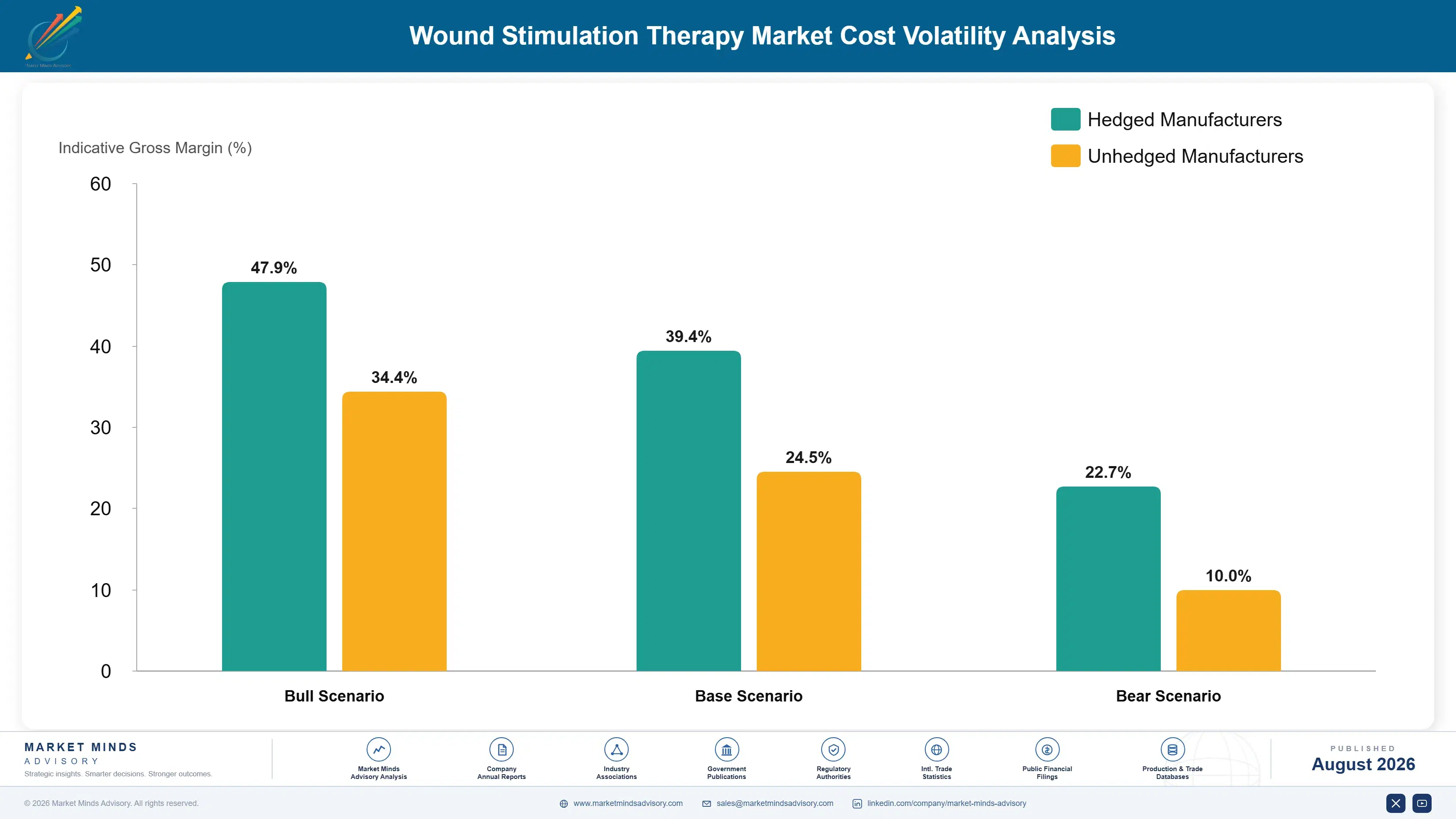
Electronics, control systems and power supplies account for 34% of device cost, with transducers, applicator heads and enclosures at 24% and software, regulatory work and clinical validation carrying the remainder across production volumes measured in thousands of units. Consumable cost is a separate structure entirely, dominated by hydrogel and conductive electrode materials for electrical stimulation and by wear components in shockwave applicators.
Component allocation rather than component price is what actually constrains manufacturers ordering thousands of units annually. Semiconductor shortages placed this category behind consumer and automotive customers ordering millions, and medical device company annual reports documented extended lead times and redesign work through the period, alongside component supply tightening recorded in China MIIT industrial output data. FDA clearance obligations made substituting components slower than the commercial situation required.

Exposure divides by consumable design rather than by scale. Suppliers with electrode or applicator consumables carry material cost and supply risk on items shipped continuously, while device only suppliers carry component risk on units shipped once per customer per decade. The second position looks simpler and generates no recurring revenue to absorb any of it, which is the uncomfortable consequence of an engineering decision taken years earlier.
wound-stimulation-therapy-market-cost-volatility-analysis-1787665162725

Design a consumable into the device before launch

A clinic runs a device for around 11 years, so a modality without a dedicated consumable generates nothing after the sale. Consumables carry 41% of category revenue and that share is determined by engineering decisions taken years before anybody sees the commercial consequence. Retrofitting a consumable into an installed platform is far harder than designing one in at the start.

Fund reimbursement submissions collectively through societies

Around 14% of payers fund stimulation therapy as a distinct service, and closing that gap needs health economic evidence and committee engagement rather than further clinical trials. No participant in a category fragmented at 34% for the top five can fund it alone. Collective submission expands the market for everybody and costs each participant a fraction of doing it individually.

Supply applicators into installed bases rather than complete systems

Shockwave, ultrasound and laser equipment already sits in orthopaedic, urology and physical therapy practices for other indications entirely. Selling a complete system into those clinics asks for capital nobody needs to spend and loses to whoever supplies the applicator and protocol instead. The route is unglamorous, the margins are good and the adoption barrier disappears completely.

Portfolio Architecture for Margin Defence

Margin architecture divides on whether anything recurs. Device only modalities earn a one time margin and then nothing for around eleven years, which makes the headline gross margin misleading. Consumable bearing modalities earn considerably better in aggregate, because electrodes and applicators ship continuously. Applicator supply into equipment somebody else sold earns best of all, since there is no capital sale to fund and no installation to support.
The tension runs between evidence and economics. Electrical stimulation carries the strongest guideline position and the lowest device price, which is excellent clinically and modest commercially without electrode volume behind it. Shockwave carries better equipment economics and a shorter evidence history. Neither combination is ideal, and suppliers frequently hold the modality their engineering history produced rather than the one their commercial model would choose.

High value pools concentrate in consumable streams and in applicator supply into existing installed bases, neither of which is a device sale. Everything sold as capital equipment competes for budget against dressings requiring no capital at all. The businesses worth building are those where something ships every month, because a category with 9% adoption and an eleven year replacement cycle offers little else to build on.

Device Only Equipment Sales

Capital equipment sold once and used for around eleven years with no dedicated consumable attached to it. Headline margin looks healthy and the business generates nothing at all between replacement cycles.
Gross Margin: 40-46%

Consumable Bearing Modalities

Devices with electrodes, applicator heads or shot counted components shipping continuously against an installed base. Recurring revenue makes the commercial model compound in a way device only modalities simply cannot.
Gross Margin: 52-58%

Applicator Supply Into Existing Bases

Wound applicators and protocols supplied into shockwave, ultrasound and laser equipment installed for other indications. Margin is highest because no capital sale funds it and no adoption barrier needs overcoming.
Gross Margin: 58-66%
wound-stimulation-therapy-market-portfolio-architecture-1787665163249

High-value Sub-segments and Strategic Watch-out

Electrical Stimulation

Fastest growing modality at 12.3% on the strongest guideline position in wound care and low equipment cost. Electrode consumables provide the recurring revenue that makes the model work, which several competing modalities conspicuously lack. Guideline strength and workable commercial economics rarely coincide quite like this.
Gross Margin: 50-56%

Extracorporeal Shockwave Therapy

Second fastest at 10.4% substantially because machines already sit in orthopaedic and urology clinics for other indications entirely. Adding a wound application costs an applicator and a protocol rather than any capital approval. Applicator supply rather than complete system sales is the practical route in.
Gross Margin: 56-62%

Photobiomodulation and Low Level Laser

Growing at 8.6% with a large physical therapy installed base and evidence that remains contested across parts of the clinical community. Consumable content is limited, which caps what the commercial model can compound toward. The commercial model compounds far less well than the clinical one.
Gross Margin: 44-50%

Monochromatic Infrared Energy

Growing at only 3.8% with the weakest evidence position of any modality here and no meaningful consumable stream attached. Nothing currently in development is likely to change either of those two facts. No consumable and weak evidence together is a very difficult position to hold.
Gross Margin: 34-40%

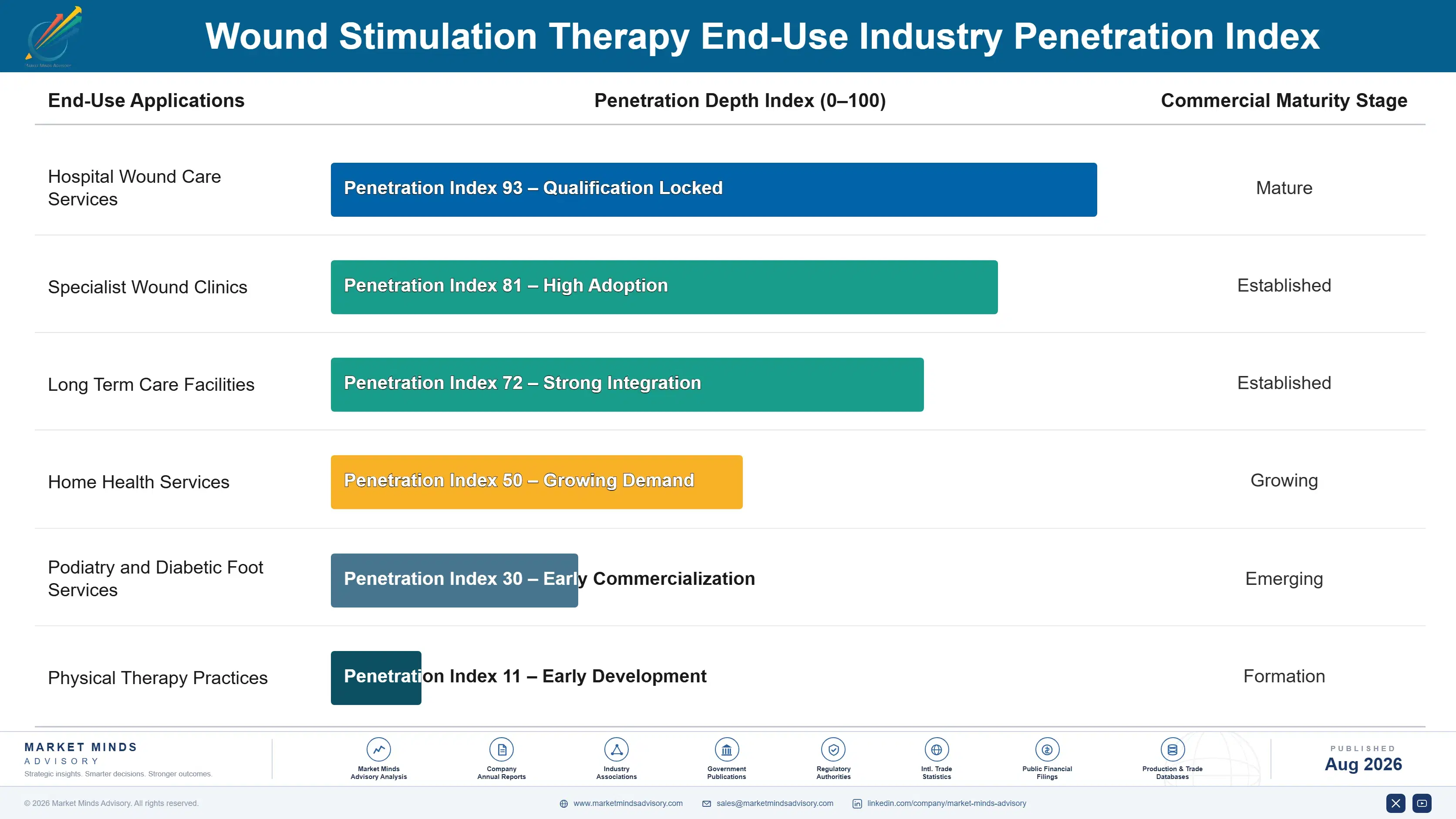
Why Recommendation Is Not Demand

Demand in this category is created by a protocol rather than by a recommendation, which is the distinction most suppliers keep missing. A guideline saying a therapy should be considered produces almost nothing, while a pathway document listing it as a step produces consistent use across every eligible patient a service treats. Around 9% adoption against a strong recommendation is what that difference looks like when nobody does the pathway work.
What sustains demand afterwards depends entirely on whether something ships. A clinic using an electrode based system consumes materials weekly and stays in contact with its supplier, while one using a device with no consumable disappears commercially for around eleven years. Consumables carry 41% of category revenue, and the modalities generating it are the only ones with any ongoing customer relationship at all.

The decision maker sits with whoever writes pathways and whoever pays. Clinicians support these therapies readily and cannot bill for the time, protocol authors control whether they appear in a documented pathway, and payers determine whether the twenty minutes is funded anywhere. Suppliers selling to enthusiastic clinicians are reaching the one party in that chain who already agrees and cannot act on it alone.
wound-stimulation-therapy-market-end-use-penetration-index-1787665163740

Where This Category Rewards Focus

These are among the four positions where our research anticipates prominent divergence between winners and laggards over the coming forecast period. Each is grounded in the demand model, the regulatory perimeter, and the announced capacity pipeline.
01 / GUIDELINE POSITION EXPLOITATION

The clinical argument was won years ago

Electrical stimulation holds a strong recommendation in pressure ulcer guidance and has done for years, and around 9% of eligible wounds receive any adjunctive stimulation therapy at all despite that position. Suppliers presenting further clinical evidence to clinicians are addressing a constraint that stopped binding a very long time ago indeed. The productive move is bringing the existing recommendation to protocol authors and pathway designers, because a therapy named in a pathway document gets used and one merely recommended does not.
02 / CONSUMABLE DESIGN DECISION

Engineering decided your business model years ago

A clinic runs a stimulation device for around eleven years, which means a modality without a dedicated consumable generates nothing after the sale and forces perpetual acquisition of new customers instead. Consumables carry 41% of category revenue and the proportion differs enormously between modalities, from electrode heavy electrical stimulation to shot counted shockwave applicators. That decision was taken in engineering years before its commercial consequences became visible, and most suppliers made it without recognising what they were actually choosing at the time.
03 / INSTALLED BASE ACCESS

Sell the applicator, not the machine

Shockwave, ultrasound and laser equipment already sits in orthopaedic, urology and physical therapy practices for entirely different indications across every developed market in the world. Adding a wound application therefore costs an applicator head and a protocol rather than capital approval and a business case nobody wants to write. Shockwave grows at 10.4% substantially for that reason, and suppliers selling complete systems into clinics that already own the hardware are asking for capital that nobody needs to spend on it at all.
04 / REIMBURSEMENT CASE BUILDING

Nobody can fund this alone and everybody benefits

Around 14% of payers fund stimulation therapy as a distinct service, and the missing element is health economic evidence with committee engagement rather than any additional clinical trial data. No individual participant in a category fragmented at 34% for the top five generates enough revenue to fund that work alone, which is precisely why it has never been done. Collective funding through societies is the only realistic route and it would expand the market for every participant simultaneously and at once.

Engagement Snapshot From the Field

A live engagement with an industry participant carrying material or product regulatory and market exposure ahead of a defining policy shift, showing how our research translates into a defensible multi-year portfolio strategy.
MARKET MINDS ADVISORY · CLIENT ENGAGEMENT SUMMARY
Wound Stimulation Therapy Producer Strategic Portfolio Review and Transition Roadmap 2026·Investment Scenario on Wound Stimulation Therapy Exposure Evaluation 2025-26
CLIENT PROFILE
A wound stimulation device company selling a photobiomodulation system to wound clinics and physical therapy practices across North America and Western Europe. Annual revenue was approximately 28 million dollars (client-reported, unverified by MMA), almost entirely from capital equipment sales. The system used no dedicated consumable, and revenue from any given customer effectively ended at installation.
STRATEGIC CHALLENGE
Revenue growth depended entirely on finding new customers each year, since installed accounts generated nothing afterwards and replacement was more than a decade away. Management was weighing further clinical evidence generation against commercial expansion, having assumed adoption was limited by clinician conviction. Nobody had examined why clinicians who believed in the therapy were not using it.
MMA APPROACH
MMA surveyed clinicians at installed accounts on belief in the therapy and actual usage frequency, separating conviction from behaviour. Consumable retrofit and pathway engagement were costed against further evidence generation. Forty-seven expert interviews with wound clinicians, protocol authors, payer assessors and physical therapy managers established what actually determines use, alongside survey work across six countries.
KEY FINDINGS
  1. Clinicians at installed accounts believed the therapy worked in 8 of 10 responses and used it on fewer than 1 in 5 eligible patients, citing time and billing rather than doubt.
  2. Accounts where the therapy appeared in a written care pathway used it roughly 4 times as often as accounts where it did not, regardless of clinician conviction.
  3. Retrofitting a consumable to the installed platform was costed at around 20 months, against designing one into the next generation at almost no incremental cost.
  4. Payer assessors in 5 of the 6 markets surveyed said health economic evidence was missing rather than clinical evidence, which the client had never commissioned.
CLIENT PROFILE
A wound stimulation device company selling a photobiomodulation system to wound clinics and physical therapy practices across North America and Western Europe. Annual revenue was approximately 28 million dollars (client-reported, unverified by MMA), almost entirely from capital equipment sales. The system used no dedicated consumable, and revenue from any given customer effectively ended at installation.
STRATEGIC CHALLENGE
Revenue growth depended entirely on finding new customers each year, since installed accounts generated nothing afterwards and replacement was more than a decade away. Management was weighing further clinical evidence generation against commercial expansion, having assumed adoption was limited by clinician conviction. Nobody had examined why clinicians who believed in the therapy were not using it.
MMA APPROACH
MMA surveyed clinicians at installed accounts on belief in the therapy and actual usage frequency, separating conviction from behaviour. Consumable retrofit and pathway engagement were costed against further evidence generation. Forty-seven expert interviews with wound clinicians, protocol authors, payer assessors and physical therapy managers established what actually determines use, alongside survey work across six countries.
KEY FINDINGS
  1. Clinicians at installed accounts believed the therapy worked in 8 of 10 responses and used it on fewer than 1 in 5 eligible patients, citing time and billing rather than doubt.
  2. Accounts where the therapy appeared in a written care pathway used it roughly 4 times as often as accounts where it did not, regardless of clinician conviction.
  3. Retrofitting a consumable to the installed platform was costed at around 20 months, against designing one into the next generation at almost no incremental cost.
  4. Payer assessors in 5 of the 6 markets surveyed said health economic evidence was missing rather than clinical evidence, which the client had never commissioned.
RECOMMENDED STRATEGY
Phase 1: Phase one: redirect commercial effort toward protocol authors, since pathway inclusion drove roughly 4 times the usage regardless of clinician belief. Phase 2: Phase two: design a consumable into the next generation rather than retrofitting the installed platform over roughly 20 months instead. Phase 3: Phase three: join collective health economic submissions, which payer assessors in 5 of 6 markets identified as the actual gap.
OUTCOME
The client redirected commercial effort toward protocol authors and pathway inclusion rose across several health systems within a year, lifting usage at existing accounts without any new installations. A consumable was designed into the next generation platform, and the company joined a society funded reimbursement submission rather than attempting one alone (client-reported, unverified by MMA).

Frequently Asked Questions

Foundational context covering the market sizes, CAGR, scope, country, region and competition that inform every finding below. This section is provided to cover basics and most often pre-purchase conversations, answered from the MMA Primary Research Dataset.

What is the current size of the Wound Stimulation Therapy Market?

The market was valued at 0.54 billion dollars in 2025, covering adjunctive energy based therapies and their consumables used in wound care worldwide. It reaches an estimated 0.58 billion dollars during 2026.

How large will the Wound Stimulation Therapy Market be by 2036?

MMA forecasts 1.28 billion dollars by 2036, an increase of 0.70 billion dollars over the 2026 base. That represents an expansion multiple of 2.21 times across the forecast period.

What is the CAGR for the Wound Stimulation Therapy Market 2026 to 2036?

The base case compound annual growth rate is 8.2%, with a bull case of 9.4% and a bear case of 7.0%. Reimbursement coverage and clinical education funding separate those two scenarios.

Which segment is growing fastest?

Electrical stimulation grows at 12.3%, half again the market rate of 8.2%, on the strongest guideline position and low equipment cost. Shockwave therapy follows at 10.4%.

Who are the major companies in the Wound Stimulation Therapy Market?

SANUWAVE Health, Bioventus, Zynex Medical, Soring and Storz Medical lead on installed base and consumable revenue across the modalities. Together they hold 34% of the global market.

Which country is growing fastest?

India grows fastest at 12.8%, because diabetic foot ulcer burden is severe and amputation rates make any therapy improving healing clinically valuable rather than merely optional.

Report Segmentation Architecture

The full report scope spans multiple orthogonal segmentation dimensions, with cross-tabulated demand data provided for each dimension pair. Coverage extends further to regional breakdowns, trend trajectories, and the competitive detail needed to support segment-level decision-making.

By Energy Modality

  • Electrical Stimulation
  • Extracorporeal Shockwave Therapy
  • Photobiomodulation and Low Level Laser
  • Low Frequency Ultrasound
  • Pulsed Electromagnetic Field Therapy
  • Monochromatic Infrared Energy

By End-Use Industry

  • Hospital Wound Care Services
  • Specialist Wound Clinics
  • Long Term Care Facilities
  • Home Health Services
  • Podiatry and Diabetic Foot Services
  • Physical Therapy Practices

By Commercial Dimension

  • Hospital Direct Supply
  • Clinic Direct Sales
  • Distributor and Dealer Supply
  • Rental and Placement Programmes
  • Home Care Provider Supply
  • Group Purchasing Contract

By Region

  • North America
  • Western Europe
  • East Asia
  • South Asia and Pacific
  • Latin America
  • Middle East and Africa
  • Eastern Europe

Scope, Methodology, and Coverage

Every figure in this report is reproducible from documented input assumptions. The scope below maps the historical period, the forecast horizon, the segmentation dimensions, and the countries covered, alongside the underlying primary and qualitative methodology.
Historical Period
2020 to 2025
Forecast Period
2026 to 2036
Base Year
2025 (USD billions; MMA Primary Research Dataset, August 2026)
Market Definition
Adjunctive energy based therapies applied to stimulate healing in acute and chronic wounds worldwide, covering electrical stimulation, extracorporeal shockwave therapy, photobiomodulation and low level laser, low frequency ultrasound, pulsed electromagnetic field therapy and monochromatic infrared energy, including the devices, applicators, electrodes and dedicated consumables supplied with them, measured at supplier revenue. Negative pressure wound therapy, wound dressings and topical products, systemic hyperbaric oxygen therapy, growth factors, cellular and tissue based products, and general physical therapy equipment sold without wound indications are excluded.
Quantitative Units
USD billions (supplier revenue); devices installed; USD per device and per treatment consumable
Segmentation Dimensions
Energy modality; end-use industry; commercial dimension; region
Regions Covered
North America, Western Europe, East Asia, South Asia and Pacific, Latin America, Middle East and Africa, Eastern Europe
Countries Covered
United States, Canada, Germany, Austria, Switzerland, United Kingdom, France, Italy, Spain, Sweden, Denmark, China, Japan, South Korea, India, Australia, Indonesia, Brazil, Mexico, Saudi Arabia, United Arab Emirates, Poland
Key Companies Profiled
SANUWAVE Health, Bioventus, Zynex Medical, Soring, Storz Medical, Smith and Nephew, Molnlycke Health Care, ConvaTec, Medtronic, Enovis, Richard Wolf, MTS Medical, THOR Photomedicine, Multi Radiance Medical, Erchonia, BTL Industries, Zimmer MedizinSysteme, EMS Electro Medical Systems, Gymna, Accelerated Care Plus
Quantitative Methodology
Primary survey, n=3,800 respondents, Q4 2025, six countries; demand-side model with trade association cross-validation
Qualitative Methodology
47 expert interviews, Q4 2025; applied to validate demand model assumptions, identify emerging dynamics, and assess competitive positioning
Report Format
PDF and XLSX data workbook (Word format preview document)
Publisher
Market Minds Advisory
Report Code
MMA-2026-MED-140
Published
August 2026
Contact
sales@marketmindsadvisory.com | www.marketmindsadvisory.com

Purchase the full Wound Stimulation Therapy Market Report (2026 to 2036).

The full report examines the one corner of wound care where guidelines run ahead of practice rather than behind it, and explains why the best supported therapy in the field reaches fewer than one wound in ten. It sizes all six energy modalities independently through 2036, models consumable design against long term revenue durability, and maps reimbursement coverage by payer against actual clinical adoption. Regional chapters cover all seven regions, with European physical medicine traditions assessed separately from North American billing constraints. Competitive profiling covers 20 participants on one consistent installed base measure.
Six energy modalities sized independently through 2036
Consumable design assessed against long term revenue durability
Reimbursement coverage mapped by payer against clinical adoption
Existing installed bases quantified across adjacent clinical specialties
Pathway inclusion analysed as the determinant of actual usage
Twenty participants profiled on one consistent installed measure

Built For The People Who Decide

From boardroom strategy to bench-side execution, this report is read cover-to-cover by leaders shaping the next decade of their industry, turning demand scenarios, market dynamics and valuation benchmarks into decisions.
CXOs/ Presidents/ VPs/ Managers
M&A and Corporate Development
Strategy Teams and R&D Heads
Procurement and Product Directors
Regulatory and Compliance Leaders
Investor Relations and Equity Analysts