Market Minds Advisory
Wound Skin Care Market

Wound Skin Care Market: Skin Integrity Products Across Prevention and Periwound Management, 2026 to 2036

Preventing a pressure injury costs a few dollars a week and treating one costs thousands, yet documented compliance with skin protection protocols still sits below two thirds in most facilities.

Lead Analyst

Alice Ballenger

Published

September 2026

Make Smarter Decisions with Customized Research Insights

Request a free sample report and evaluate market opportunities, growth trends, and competitive dynamics relevant to your business needs.

2025 MARKET VALUE$3.8BMarket Size 2025
2036 FORECAST VALUE$7.5BBase Case , 2026 to 2036
CAGR 2026 TO 20366.4 %Bull 7.6% / Bear 5.2%
INCREMENTAL OPPORTUNITY$3.5BNet 10- year value creation
EXPANSION MULTIPLE1.86x2036 value over 2026 base
Strategic Levers
M&A Pipeline
Regional Outlook
Country Rankings
Competitive Intelligence
Segmental Deep-dive
Call-Us : 91 93563 13602

Executive Snapshot and Market Trajectory

The commercial case for this category has never been in doubt and has never quite been acted on either. Preventing a pressure injury costs roughly USD 8.40 per patient week in skin protection product; treating an established one costs thousands. Documented protocol compliance nonetheless still sits at just 61%.
Growth concentrates in barrier films and skin protectants, expanding at 9.6%, where durable silicone-based films protect periwound and incontinence-exposed skin for several days per application. East Asia holds 29% of value, the largest regional share, because Japan's long-term care insurance system funds skin integrity protocols across a population where nearly a third is over 65, and because China's nursing home buildout has created institutional demand where almost none existed a decade ago.
Five participants hold 42% of institutional purchasing volume, and the contest is decided by distributor relationships and formulary position rather than by clinical differentiation, which most nursing staff cannot readily distinguish between competing products anyway. Private label now takes 34% of institutional volume and is the genuine competitive threat. Regulatory attention to reimbursement penalties for facility-acquired injuries is what keeps branded products defensible at all.
Market Definition
The market comprises topical skin care products used to maintain skin integrity in patients at risk of, or living with, wounds: barrier films and skin protectants, antimicrobial cleansers and antiseptic preparations, moisturisers and emollients, saline and surfactant wound cleansers, and adhesive removers and skin preparation wipes. Sizing captures manufacturer revenue at realised institutional and retail price across acute, long-term care, home care and outpatient settings. Advanced wound dressings, negative pressure therapy, cellular and tissue-based products, compression systems, surgical antiseptic scrubs and cosmetic skin care fall outside scope.
Base Year Value
$3.8B in 2025 (MMA Primary Research Dataset, August 2026)
Forecast Period
2026 to 2036, eleven discrete annual values
CAGR
6.4% base case. Bull 7.6%. Bear 5.2%.
Fastest Growth Segment
Barrier Films and Skin Protectants: 9.6% CAGR
Fastest Growth Country
China: 8.4% CAGR
Fastest Growth Region
South Asia and Pacific: 8.5% CAGR
Largest Region
East Asia: 29% of 2025 global value
Market Leaders
3M, Coloplast, Smith and Nephew, ConvaTec, Molnlycke Health Care. Source: MMA Analysis based on company annual reports.
Primary Survey
n=3,800 procurement and R&D decision-makers, Q4 2025, six countries
Methodology
Demand-side build-up, cross-validated against public data, 47 expert interviews

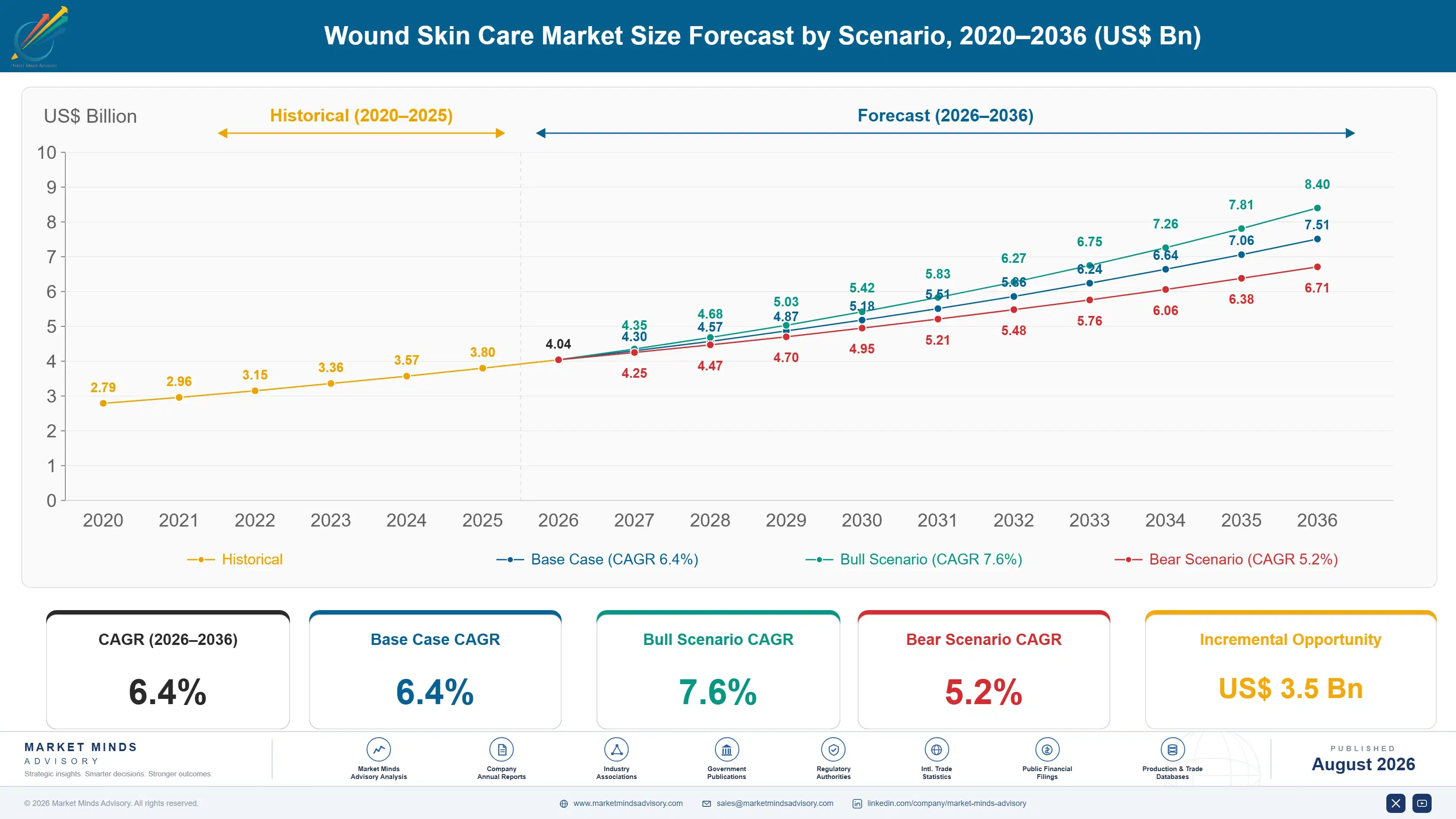
Wound Skin Care Market Forecast Scenarios

wound-skin-care-market-size-forecast-scenario-1787309995978
Growth of 5.4% across 2020 to 2025 hid two opposing movements. Acute care volumes collapsed during elective surgery suspensions and then recovered, while long-term care demand rose sharply as facilities faced both higher acuity residents and reduced staffing. The staffing shortage turned out to matter more than the pandemic itself, because fewer nurses per resident meant less repositioning and considerably more reliance on barrier products.
The base case at 6.4% assumes three mechanisms hold. Reimbursement penalties for facility-acquired pressure injuries keep spreading beyond the United States into European and Asian payment systems, which converts prevention from a cost into an avoided penalty. Long-term care bed capacity continues expanding across East Asia at rates no Western market approaches. And barrier film products keep displacing conventional creams across institutional protocols, carrying roughly three times the price per application as they go.
The bull case at 7.6% turns on documented compliance improving from 61% toward the levels protocols specify, which would raise consumption per resident substantially without any new patients. The bear case at 5.2% turns on private label, already 34% of institutional volume, taking share faster as group purchasing organisations consolidate and clinical differentiation stays difficult to demonstrate at the bedside.

What Actually Determines Skin Care Spending

Almost everything in this market turns on a compliance number rather than a clinical one. Protocols specify application frequency, facilities purchase against those protocols, and documented compliance runs at 61%. The gap between purchased and applied product is where consumption forecasts go wrong, and it moves with nurse staffing ratios far more than with any clinical conviction about which product works best. Facilities purchase to protocol and consume to whatever the shift allows.
TOP FIVE SHARE42%Concentration of institutional purchasing volume across the largest suppliers
WEEKLY PROTOCOL COSTUSD 8.40Skin protection product cost per patient per treatment week
PRESSURE INJURY PREVALENCE8.4%Share of long-term care residents carrying a pressure injury
PROTOCOL COMPLIANCE RATE61%Share of prescribed skin protection applications that are actually documented
PRIVATE LABEL SHARE34%Own-brand share of institutional skin care purchasing volume
DISTRIBUTOR MARGIN SHARE22%Share of delivered price captured between manufacturer and treating facility
Purchasing runs through distributors and group purchasing organisations that capture 22% of delivered price, which shapes competition in ways clinical evidence does not touch. A product outside the contracted formulary is effectively unavailable to the nursing staff who would use it, whatever the trial data says, and formulary review cycles run on multi-year schedules that nobody accelerates for a better trial result.
Private label at 34% of institutional volume is the pressure every branded participant feels. Barrier films have resisted it best, because silicone polymer formulation and application durability are genuinely difficult to replicate, and because a film that fails leaves visible skin breakdown that somebody then has to explain in an incident report.
"The industry keeps funding clinical trials to prove one barrier product outperforms another, and the nurse applying it at two in the morning cannot tell them apart and does not have time to try. Money spent making application faster and documentation automatic would return more than any comparative efficacy study has."
Director, Wound Care and Skin Integrity Practice · MMA Medical Devices / Skin In

Market Trends

Durable Barrier Films Displace Conventional Zinc Creams

Silicone-based barrier films that last several days per application are steadily replacing zinc oxide and petrolatum creams applied at every episode of care. The clinical argument is straightforward and the labour argument is stronger: a film applied every third day removes roughly 14 nursing applications a week per resident from a workload nobody has staff for. Price per application runs about three times higher, which facilities accept because the alternative is a task that does not get done. Roughly 43% of institutional skin protection volume has now converted to durable films.
Market Impact: Withholds payment since 2008 rules
Purchasing Consolidates Into Group Contracts And Private Label

Group purchasing organisations and integrated provider networks now decide most institutional skin care selection, and their preference for consolidated supply has pushed private label to 34% of volume. Branded participants find themselves competing for formulary slots decided on delivered cost and supply reliability, with clinical differentiation carrying real weight only where a product is genuinely difficult for a contract manufacturer to copy. The counter-move visible across the leaders is bundling: supplying skin care alongside dressings and incontinence products under a single agreement, which raises the switching cost of dropping any individual line at renewal time.
Market Impact: Adds USD 440 per resident year

Market Opportunities and Growth Drivers

Reimbursement Penalties Convert Prevention Into Avoided Cost

United States payment rules have withheld reimbursement for hospital-acquired pressure injuries since 2008, and comparable penalty structures have since appeared across several European and Asian payment systems. That changes the internal argument entirely: skin protection stops being a supplies line item and becomes an insurance premium against a penalty running into thousands per event. Facilities carrying prevalence at 8.4% among long-term residents have a quantified exposure they can put in front of a finance committee, which is the only version of this argument that has ever reliably moved a budget.
Market Impact: Compliance stalls at 61% documented

Long-Term Care Capacity Expands Fastest Across East Asia

China added institutional long-term care beds at rates no Western market has approached in decades, and Japan's long-term care insurance system funds skin integrity protocols across a population where nearly a third is above 65. Each new bed carries a predictable annual skin care consumption attached to it, roughly USD 440 per resident year at current protocol pricing. This is the most forecastable demand in the market because bed capacity is planned years ahead and published. What remains uncertain is how much of that consumption goes to branded product rather than domestic manufacture.
Market Impact: Private label holds 34% volume

Market Restraints and Challenges

Documented Protocol Compliance Stalls Below Two Thirds

Compliance sits at 61% and has barely moved in a decade. The root cause is staffing rather than clinical disagreement: skin protection is a scheduled task competing against medication rounds and acute events, and it loses reliably when the ratio of nurses to residents falls. Commercially it caps consumption well below what purchased protocols imply, which distorts consumption forecasts throughout the supply chain. Participants are responding with longer-duration formulations that need fewer applications, packaging designed for faster application at the bedside, and documentation prompts built directly into electronic care records.
Market Impact: Removes 14 nursing applications wee

Private Label Competition Compresses Branded Realised Pricing

Private label holds 34% of institutional volume and continues gaining. The root cause is that most products in this category are formulations rather than devices, straightforward to reproduce, and nursing staff genuinely cannot distinguish a branded moisturiser from a contract-manufactured one in daily use. Realised pricing on commodity lines has fallen accordingly. Mitigation runs along three routes: concentrating investment in barrier films where formulation and durability resist copying, bundling skin care into broader supply agreements, and pursuing regulated claims that private label sponsors will not fund the evidence to support.
Market Impact: Private label reaches 34% of volume
4 additional market trends, 2 additional growth drivers, and 3 additional restraints and challenges are covered in the full report. Contact sales@marketmindsadvisory.com to access the complete intelligence.

Segment CAGR and Growth Architecture

Segmentation follows product formulation and clinical function, which is the dimension that determines regulatory pathway, formulary position, price per application and vulnerability to private label competition together. Care setting and patient risk category cut across every product type without separating them commercially, so both sit in demand analysis rather than in this primary hierarchy.
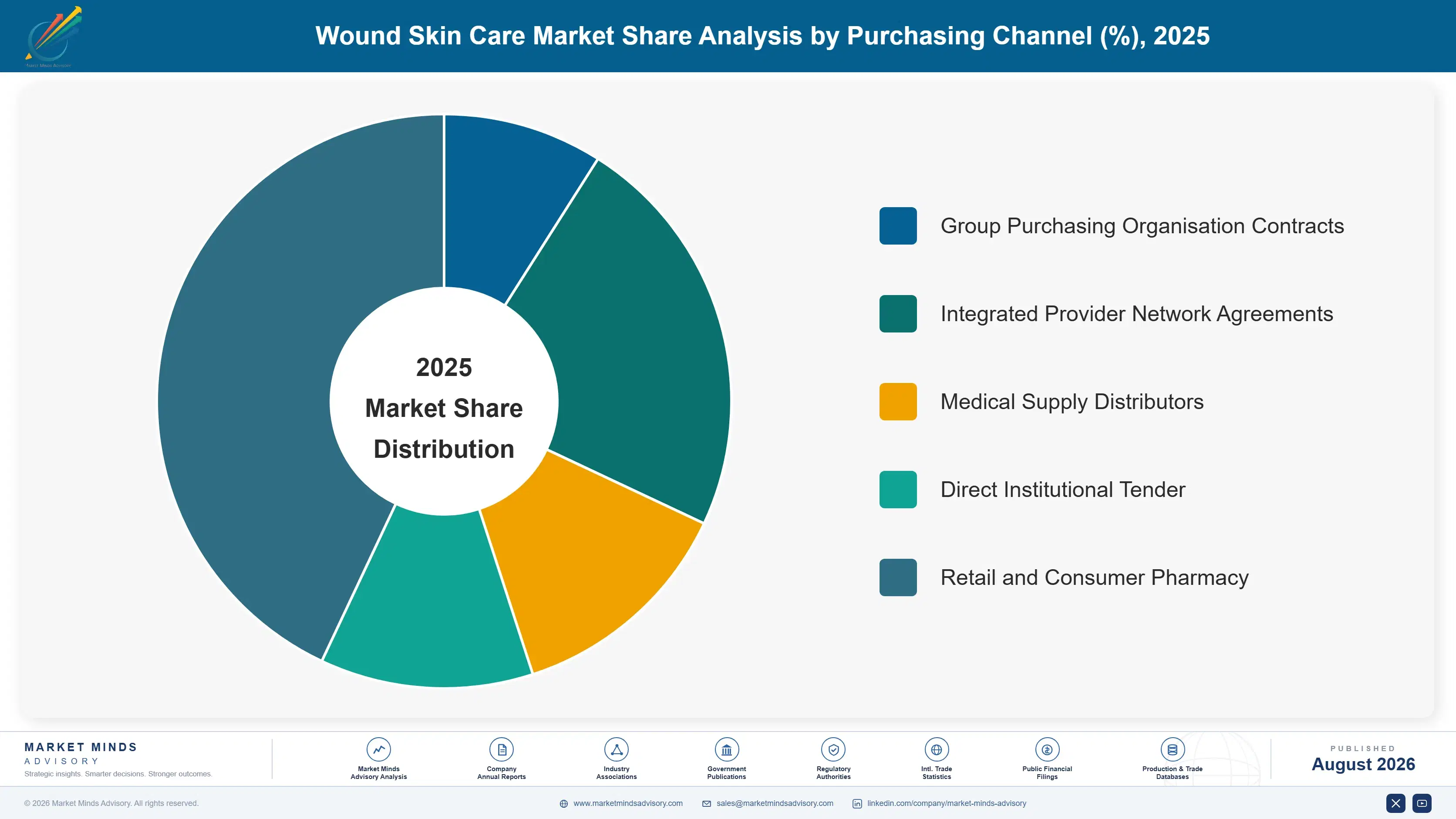
wound-skin-care-market-market-share-analysis-1787309996513

Barrier Films and Skin Protectants

Growing at 9.6%, exactly 1.50 times the market rate, and the only part of this market where branded participants hold genuine pricing power. Silicone polymer films protect periwound skin and incontinence-exposed areas for several days per application, against creams that need reapplying at every episode of care. Price per application runs roughly three times higher and facilities pay it, because the labour saved is worth more than the product costs in any unit with staffing pressure. Formulation and durability are difficult enough to replicate that private label has made limited progress here, which is precisely why every leading participant is now concentrating development investment in this segment rather than elsewhere.
CAGR 9.6%

Antimicrobial Cleansers and Antiseptic Preparations

Expanding at 7.7%, supported by antimicrobial stewardship programmes that favour topical skin decontamination over systemic prescribing wherever the clinical situation permits it. Chlorhexidine and polyhexanide preparations carry registered claims that require real evidence packages, which raises the barrier to private label entry considerably above what moisturisers face. Growth is strongest in acute settings where surgical site infection penalties operate, and in long-term care facilities managing colonisation among residents who share communal areas. Adoption is broad rather than deep, since most facilities carry at least one preparation. The commercial constraint is regulatory rather than clinical: biocidal product registration across Europe has become expensive enough that several smaller participants have withdrawn formulations rather than fund the renewal work.
CAGR 7.7%
Full segment breakdown across 5 segments available in the complete report.

Regional Architecture and Country Demand Map

Value follows institutional bed capacity and protocol funding rather than population or wound prevalence. A region with a great many elderly residents but little institutional long-term care generates only modest demand, because most skin protection in home settings is bought informally and priced well below institutional supply.

North America

Twenty-seven percent of value rests on a payment rule. Medicare has withheld reimbursement for hospital-acquired pressure injuries since 2008, and that single mechanism converted skin protection from discretionary supplies spending into quantified penalty avoidance across every acute facility in the country. Long-term care carries the larger share of consumption, where prevalence at 8.4% among residents keeps prevention protocols funded despite chronic staffing shortages. Purchasing runs almost entirely through group purchasing organisations and integrated networks, which is why private label penetration is deepest here at well above the global average. Growth of 5.6% reflects a mature protocol environment in which consumption rises with resident acuity rather than with any further adoption.
Share: 27% | CAGR: 5.6% (2026 to 2036)

Western Europe

Reimbursement here is decided nationally and skin care sits awkwardly between medical device and consumable classification, which slows adoption of higher-priced formats considerably. Germany and the Netherlands fund barrier film protocols through long-term care insurance and show consumption per resident close to North American levels. The United Kingdom and southern European systems purchase far more conservatively, favouring conventional creams that cost less per unit and more in nursing time. Biocidal product regulation has raised registration costs for antimicrobial preparations enough that several formulations were withdrawn rather than renewed. Growth of 4.9% is the slowest of any region, held back by budget-constrained procurement rather than by any clinical scepticism about prevention itself.
Share: 24% | CAGR: 4.9% (2026 to 2036)
Regional intelligence for 5 additional markets available in the complete report: East Asia, South Asia and Pacific, Latin America, Middle East and Africa, Eastern Europe. Contact sales@marketmindsadvisory.com.
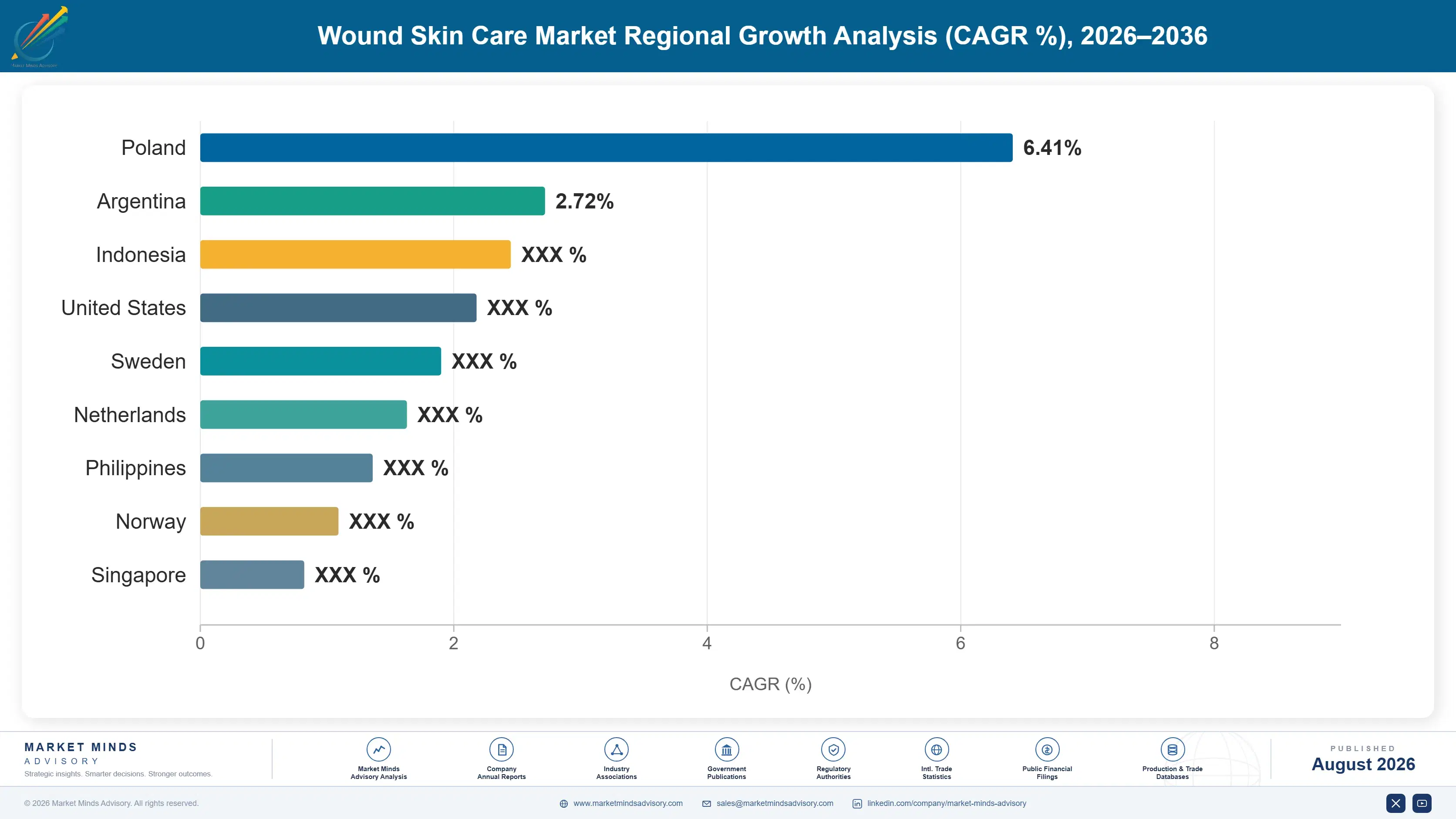
wound-skin-care-market-country-cagr-analysis-1787309997027

Where Skin Care Revenue Can Grow

Competing on clinical differentiation in a category where nursing staff cannot distinguish products at the bedside wastes money that would return more elsewhere. The available margin sits in application labour, in formulary access, in the compliance gap between purchased and applied product, and in the few segments private label cannot easily copy at all.

Sell Nursing Time Saved Rather Than Clinical Superiority

A durable barrier film removes roughly 14 nursing applications per resident week from a workload that most facilities simply cannot staff, and that argument reaches finance committees in a way that comparative efficacy data never has. Participants who quantify labour saved in the sales conversation realise roughly 25% more per application than those selling on trial outcomes. The evidence required is straightforward time-and-motion work costing a small fraction of a clinical study. Most participants keep funding the clinical study instead, because clinical affairs owns that budget and commercial teams do not.
Market Impact: Realises roughly 25% more on every

Concentrate Investment Where Private Label Cannot Follow

Private label holds 34% of institutional volume and takes the commodity moisturisers and cleansers first, because they are simple formulations that any competent contract manufacturer reproduces cheaply. Barrier films and registered antimicrobial preparations resist that, needing polymer formulation capability and evidence packages that private label sponsors decline to fund. Participants shifting portfolio weight toward those segments protect roughly 18 percentage points of realised margin against the erosion the commodity lines are experiencing. This means deliberately conceding volume, which is a difficult conversation to have internally and the correct one commercially.
Market Impact: Protects roughly 18 points of reali

Close The Gap Between Purchased And Applied Product

Documented compliance at 61% means nearly two fifths of purchased protocol volume never reaches a patient, and every point recovered is consumption that requires no new customer at all. Application prompts embedded in electronic care records, packaging designed for one-handed bedside use, and documentation that takes seconds rather than minutes have together lifted documented compliance by 9 to 12 points in facilities that implemented them properly. The supplier who builds that capability sells consumption growth rather than share gain, which is a considerably easier proposition to defend at a budget review.
Market Impact: Lifts documented compliance by 9 to

Bundle Skin Care Into Broader Supply Agreements

Group purchasing organisations decide most institutional selection now and strongly prefer consolidated supply, which turns a standalone skin care line into the easiest item on the list to drop. Supplying skin care alongside dressings, incontinence products and infection prevention under a single agreement raises the cost of switching any component and improves retention by roughly 30% at contract renewal. Distributors capture 22% of the delivered price regardless, so bundling also creates the volume needed to negotiate that share down meaningfully rather than simply accepting whatever terms are offered at renewal.
Market Impact: Improves renewal retention by rough

Who Controls the Margin Pool

Concentration is moderate and stable. The top five participants hold 42% of institutional purchasing volume, the basis used throughout this section, and the gap between 3M and the challenger group has narrowed as barrier film patents aged and competing silicone formulations reached the market. Coloplast, Smith and Nephew, ConvaTec and Molnlycke all hold established skin care lines attached to larger wound and continence portfolios rather than standing alone.
Competition currently runs on three dimensions and clinical differentiation is the weakest of them. Formulary and group contract position determines access, without which no product reaches a nurse regardless of evidence. Supply reliability decides renewals, because a stockout in a protocol product creates documented care failures. Portfolio breadth decides bundling, which is where the larger participants press their advantage hardest.

Pressure is building from two directions. Private label at 34% of volume keeps advancing through commodity formulations and shows no sign of slowing. Domestic Chinese manufacture is taking share of the fastest growing regional demand before international participants have established position. Rankings shift first in commodity moisturisers and cleansers, where nothing defends a branded product at all.
wound-skin-care-market-company-positioning-matrix-1787309997543

Competitive Moat and Risk Dimensions

3M

Moat: Barrier film formulation depth

Silicone barrier film chemistry and the application systems around it took decades to develop, and durability performance is the one attribute in this category that nursing staff genuinely notice at the bedside. That gives 3M pricing power in the fastest growing segment while commodity lines erode elsewhere. Clinical familiarity among wound care specialists compounds the position considerably.
3M

Risk: Portfolio attention and divestment

Skin care sits inside a health care portfolio that has been repeatedly restructured, and a category earning good margins on modest absolute revenue is exactly what gets reviewed. Competing silicone formulations have reached the market as early patents aged. Sustained investment is what defends this position, and sustained attention is the thing large diversified portfolios struggle most to provide.
COLOPLAST

Moat: Continence care channel access

Skin protection demand concentrates around incontinence-associated dermatitis, and Coloplast already supplies the continence products those same patients use, through the same purchasers and often the same clinical specialists. That adjacency delivers formulary access at almost no incremental selling cost, and it makes the skin care line considerably harder to drop from a bundled agreement at renewal.
COLOPLAST

Risk: Commodity formulation exposure

A substantial part of the portfolio sits in moisturisers, cleansers and conventional creams, which is precisely where private label competition is advancing fastest and where nothing about the formulation resists copying. Defending that volume on brand alone becomes progressively harder as group purchasing organisations consolidate, and the barrier film position is not yet large enough to offset the erosion.

Players Tracked

Prominent Players

3M
Coloplast
Smith and Nephew
ConvaTec
Molnlycke Health Care

Other Key Players

Medline Industries
Cardinal Health
Essity
B Braun Melsungen
Paul Hartmann
Urgo Medical
Stryker
DermaRite Industries
McKesson
Integra LifeSciences
Sanara MedTech
Advancis Medical
Nitto Denko
Lohmann and Rauscher
Winner Medical

Recent Developments

MAY 2025

Group purchasing agreement consolidates skin care supply

A large United States integrated provider network awarded a consolidated skin integrity supply agreement covering barrier films, cleansers and moisturisers to a single supplier, replacing several category-specific contracts and setting compliance documentation requirements as an explicit condition of the award and of any subsequent renewal.
Signal: Bundling is becoming the purchaser's prefe
OCTOBER 2025

Biocidal registration costs withdraw antiseptic formulations

Several antimicrobial skin preparations were withdrawn from European supply rather than renewed under biocidal product regulation, as registration and dossier maintenance costs exceeded what smaller participants could justify against the revenue those particular formulations generated across the region, leaving several facilities to reformulate their standing protocols.
Signal: Regulation is clearing smaller competitors
MARCH 2025

Domestic Chinese skin care capacity expansion announced

Additional manufacturing capacity for institutional skin protection products was commissioned in China, targeting the long-term care bed expansion underway domestically and priced well below imported branded equivalents across barrier creams, cleansers and moisturiser formulations sold directly into provincial long-term care facility networks across the country.
Signal: The fastest growing regional demand is bei

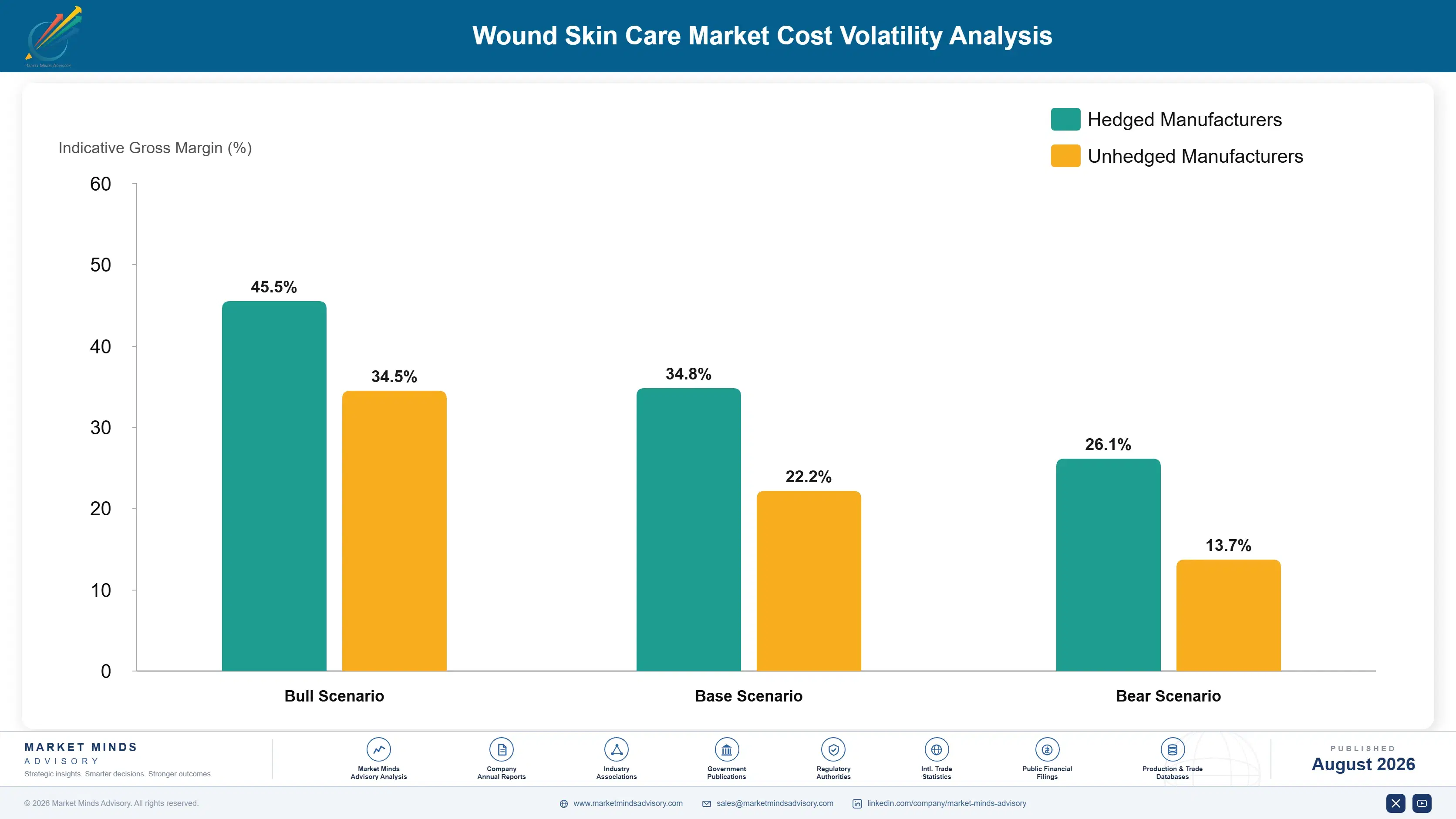
What Sits Inside Product Cost

Actives and emollients account for roughly 38% of cost of goods, principally dimethicone and other silicone polymers, petrolatum, and registered antimicrobial actives, sourced from a small group of specialty chemical producers concentrated in the United States, Germany and China. Primary packaging including tubes, pumps and applicators contributes about 24%. Nonwoven substrate for impregnated wipes adds 14%, and outbound freight roughly 8%.
Silicone supply proved genuinely fragile in late 2021. Power rationing across Yunnan and Sichuan provinces cut metallic silicon output sharply, siloxane pricing rose several fold within months, and dimethicone availability tightened across every application competing for the same material. Essity Annual Report 2021 and Paul Hartmann Annual Report 2021 both recorded elevated raw material costs across the period, and IEA energy data documents the electricity constraints underlying the disruption.

The competitive disadvantage mechanism runs through formulation dependency rather than purchasing terms. Participants whose barrier films depend on a specific silicone grade face requalification work measured in quarters if that grade becomes unavailable, since regulatory documentation ties the registered product to its formulation. Manufacturers of conventional petrolatum creams substitute inputs freely and carry little exposure at all. Smaller participants without dual-qualified silicone sources carry by far the most risk here.
wound-skin-care-market-cost-volatility-analysis-1787309997738

Dual-qualify silicone grades across separate regional suppliers

Qualifying a second silicone source on another continent takes regulatory work measured in quarters and costs relatively little against the revenue a barrier film line generates. Most participants have simply never done it, because the qualification sits with regulatory affairs while the supply risk sits with procurement, and neither function owns that decision outright.

Reformulate toward substitutable emollient and polymer systems

Where clinical performance permits, specifying formulations around inputs available from several producers removes the single-source dependency entirely rather than merely hedging it. The reformulation and requalification cost is real, and it is paid once. The exposure it removes recurs with every energy or feedstock disruption, and those disruptions have been arriving roughly every third year lately.

Hold strategic actives inventory sized to requalification timelines

Carrying silicone and registered active inventory covering the period needed to qualify alternative supply turns a shortage into a scheduling problem rather than a stockout. Actives are stable and warehouse cost is trivial against a protocol product's revenue. A stockout in a contracted protocol line risks the contract itself, which is the genuine exposure.

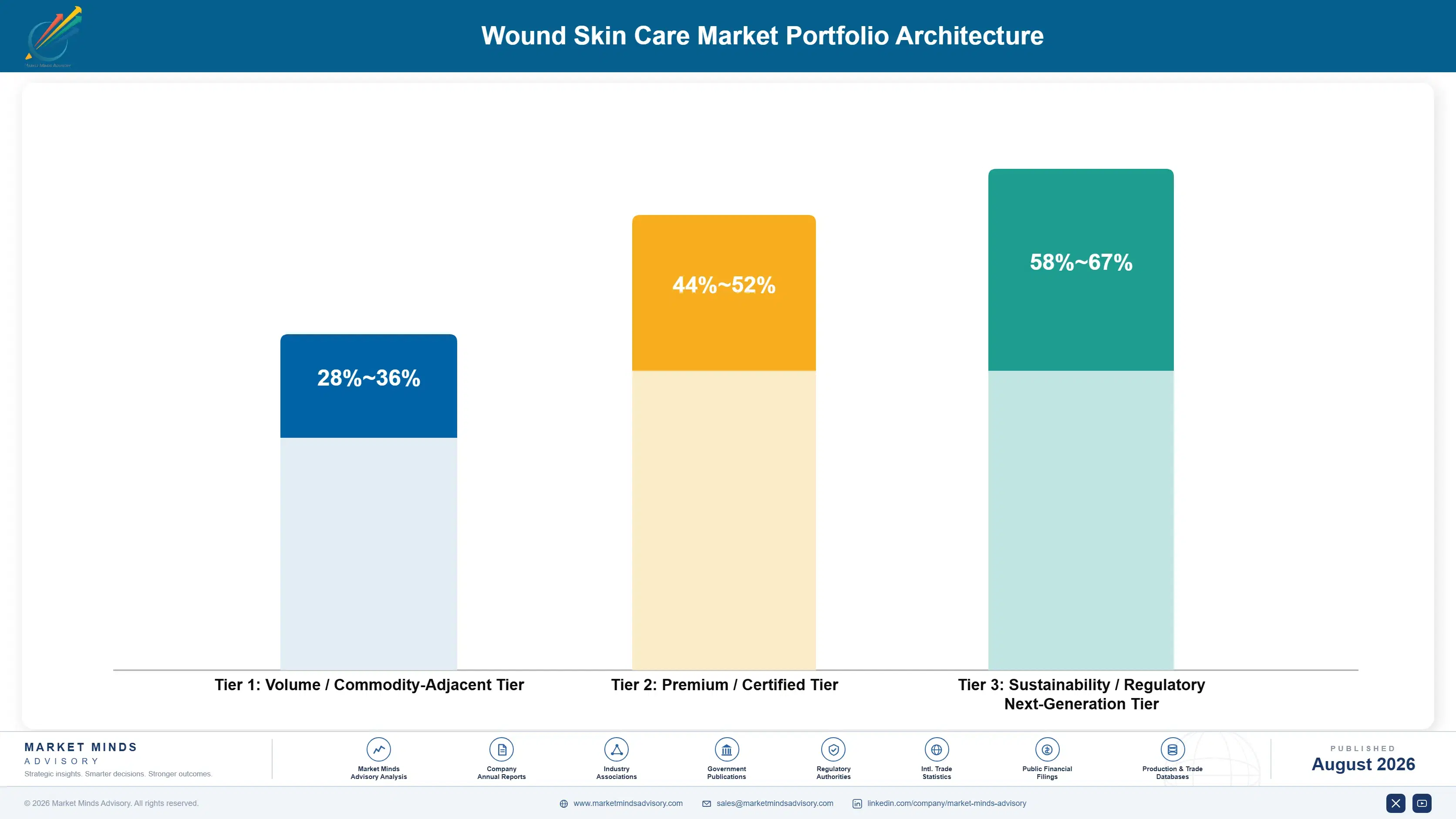
Portfolio Architecture for Margin Defence

Margin architecture here separates almost perfectly along how easily a formulation can be copied. Conventional creams, moisturisers and saline cleansers earn what tender pricing allows, which after private label competition is not much, and no amount of brand investment changes that arithmetic. Barrier films and registered antimicrobial preparations earn considerably more, defended by formulation capability and evidence requirements rather than by brand reputation of any kind.
The volume versus premium tension is sharp and getting sharper. Commodity lines carry the volume that keeps manufacturing assets loaded and distributor relationships worth maintaining, while earning margins that cannot fund development. Barrier films carry the margin on smaller volume. Participants who defend commodity volume on price end up funding a large operation from a shrinking premium base, which is the pattern visible across several mid-sized competitors now.

High-value pools concentrate in three places. Durable barrier films command price because application labour saved is worth more than the product costs. Registered antimicrobial preparations are protected by evidence requirements private label will not fund. And bundled institutional agreements pay for supply reliability across a portfolio, which no single-category participant can offer at all.

Volume / Commodity-Adjacent Tier

Conventional moisturisers, petrolatum and zinc creams, saline cleansers and basic skin preparation wipes sold on tender price against private label. Formulations are simple, reproduction is straightforward, and realised pricing reflects both facts directly.
Gross Margin: 28-36%

Premium / Certified Tier

Registered antimicrobial cleansers and antiseptic preparations carrying regulatory claims supported by real evidence packages. Biocidal registration cost is what defends this pricing. The eight-point range reflects the gap between established and recently registered formulations.
Gross Margin: 44-52%

Sustainability / Regulatory / Next-Generation Tier

Durable silicone barrier films and long-interval skin protectants sold against nursing labour rather than against product price. Formulation and application durability defend pricing strongly. The nine-point range reflects branded against contract-manufactured film positions.
Gross Margin: 58-67%
wound-skin-care-market-portfolio-architecture-1787309998234

High-value Sub-segments and Strategic Watch-out

Durable silicone barrier film protectants

High value and high growth together, because facilities buy application labour saved rather than product performance, and silicone film formulation resists private label reproduction better than anything else in this category. Every leading participant is now concentrating its development spending here for precisely that reason.
Gross Margin: 58-67%

Registered antimicrobial skin preparations

Strong realised value on moderate growth, protected by biocidal registration costs that private label sponsors consistently decline to fund and that have already driven smaller competitors to withdraw formulations. Antimicrobial stewardship programmes favouring topical decontamination support steady institutional demand across acute and post-acute settings alike.
Gross Margin: 44-52%

Conventional moisturisers and cleanser volume

The volume core, keeping manufacturing loaded and distributor relationships intact while earning progressively less per unit as private label keeps advancing. Necessary for manufacturing scale and for bundled agreements, but no participant should now expect this particular tier to fund development work of any kind.
Gross Margin: 28-36%

Chinese institutional long-term care supply

The strategic watch-out, because the fastest growing regional demand in this market is being served by domestic manufacture before international participants have built any distribution or formulary position there. Entering later means competing on price against local cost bases rather than competing on protocol evidence.
Gross Margin: 26-38%

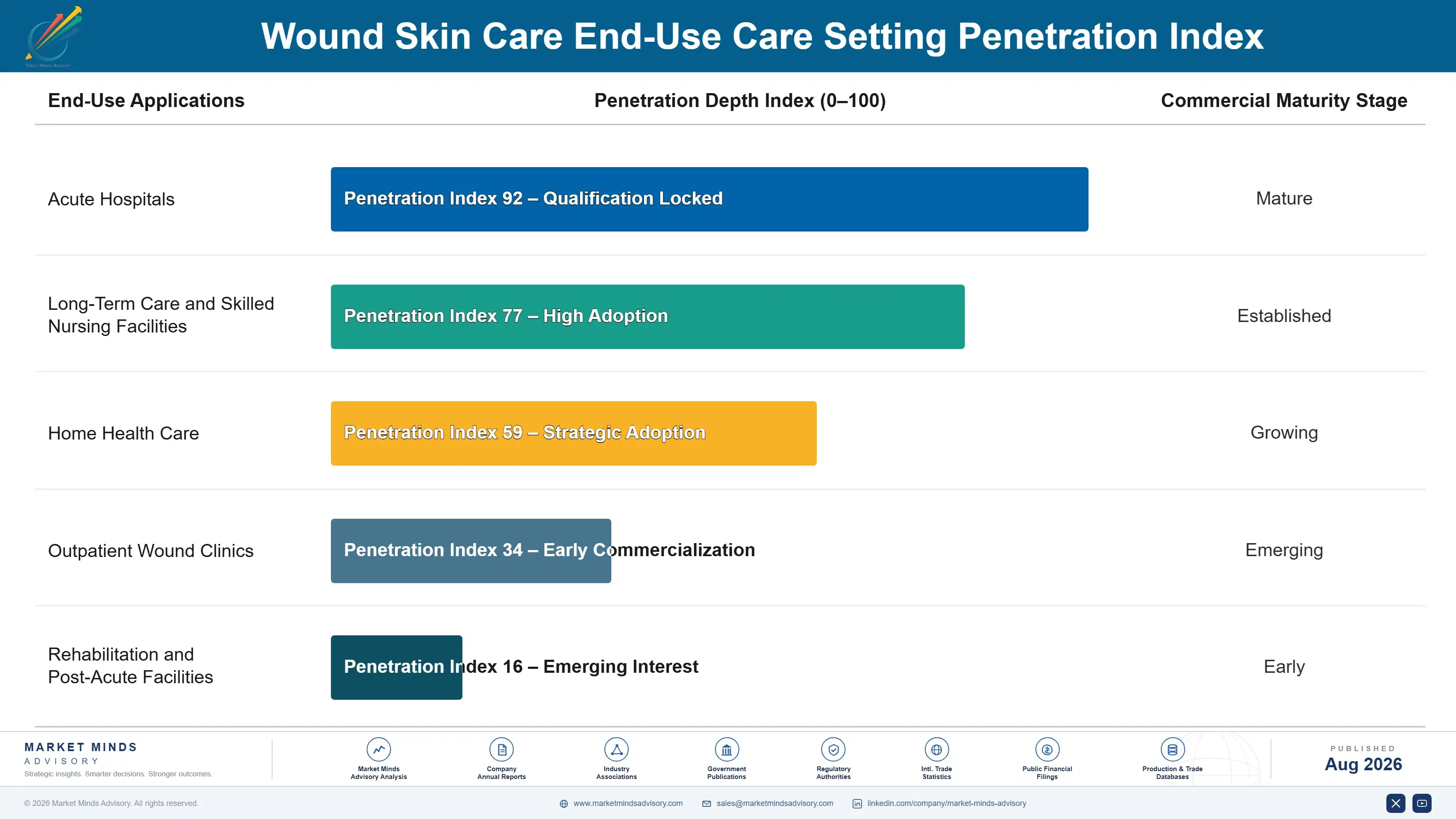
How Skin Care Demand Behaves

This is consumable annuity demand tied to occupied beds rather than to clinical events. A facility running a protocol consumes a predictable quantity per resident week, reorders on a standing schedule, and changes supplier only at contract renewal or after a supply failure. Revenue tracks bed occupancy and acuity far more closely than it tracks wound incidence, which makes forecasting straightforward and makes losing a contract genuinely expensive.
Stickiness varies considerably by setting. Acute hospitals are the loosest, purchasing through group contracts that retender regularly against generic specifications. Long-term care is stickier, because protocols get written around specific products and retraining nursing staff carries real cost in a high-turnover workforce. Home care through medical supply distribution is stickiest of all, since patients and family carers reorder what they were first given and rarely reconsider it.

The buyer profile has moved decisively away from the clinician. A decade ago wound care specialists selected products and procurement executed the choice. Today group purchasing organisations and supply chain executives decide, and the clinical specialist holds influence only where a product is difficult enough to substitute that overriding them creates documented risk.
wound-skin-care-market-end-use-penetration-index-1787309998723

Where We Land On This

These are among the four positions where our research anticipates prominent divergence between winners and laggards over the coming forecast period. Each is grounded in the demand model, the regulatory perimeter, and the announced capacity pipeline.
01 / LABOUR VALUE SELLING

Sell nursing time saved rather than clinical superiority

Nursing staff applying these products at the bedside cannot reliably distinguish competing formulations and have no time to try, which makes comparative efficacy investment a poor use of commercial budget in most settings. A durable barrier film removing roughly 14 applications per resident week reaches a finance committee in language it already uses, and participants selling that way realise roughly 25% more per application. Time-and-motion evidence costs a small fraction of a clinical study and works considerably harder in the room.
02 / PRIVATE LABEL DEFENCE

Concede commodity volume and defend the copyable segments

Private label holds 34% of institutional volume and takes simple formulations first, because moisturisers and saline cleansers are trivially reproduced by any contract manufacturer at lower delivered cost. Shifting portfolio weight toward barrier films and registered antimicrobial preparations protects roughly 18 percentage points of realised margin against erosion that brand investment cannot prevent. This means deliberately conceding volume in the tenders that cannot be won profitably, which every commercial organisation resists instinctively and which the arithmetic here nonetheless supports clearly.
03 / COMPLIANCE GAP CAPTURE

Grow consumption by closing the application compliance gap

Documented compliance at 61% means nearly two fifths of purchased protocol volume never reaches a patient at all, which is consumption available without winning a single new account. Application prompts in electronic care records, one-handed bedside packaging and faster documentation have together lifted compliance 9 to 12 points where facilities implemented them properly. Selling consumption growth into an existing account is a far easier commercial proposition than taking contested share from a competitor, and it costs considerably less to deliver.
04 / EAST ASIA POSITIONING

Establish Chinese institutional position before local supply consolidates

East Asia holds the largest regional share at 29% and grows at 7.6%, with each new Chinese long-term care bed carrying roughly USD 440 of annual skin care consumption behind it. Domestic manufacturers are taking that volume now, at cost bases international participants cannot match, while most Western suppliers still treat the region as an export opportunity. Entering after local supply consolidates means competing on price against domestic cost bases rather than on the protocol evidence Western participants actually hold.

Engagement Snapshot From the Field

A live engagement with an industry participant carrying material or product regulatory and market exposure ahead of a defining policy shift, showing how our research translates into a defensible multi-year portfolio strategy.
MARKET MINDS ADVISORY · CLIENT ENGAGEMENT SUMMARY
Wound Skin Care Producer Strategic Portfolio Review and Transition Roadmap 2026·Investment Scenario on Wound Skin Care Exposure Evaluation 2025-26
CLIENT PROFILE
A global wound care manufacturer with an established skin integrity portfolio spanning barrier films, cleansers, moisturisers and skin preparation wipes, sold into acute and long-term care across North America and Europe. Skin care revenue approached USD 310 million annually (client-reported, unverified by MMA), roughly two thirds of it in conventional formulations, and realised pricing on those lines had declined for four consecutive years.
STRATEGIC CHALLENGE
Management read the decline as a distribution problem and had restructured the field organisation twice in response. Volume held while margin fell, which nobody could adequately explain. A proposed investment in comparative clinical evidence across the moisturiser range was the leadership's preferred answer, and it depended entirely on that diagnosis being correct.
MMA APPROACH
MMA interviewed forty-seven procurement leads, wound care specialists and nursing directors across the client's institutional customers, reconstructing how each product selection had actually been decided. We modelled realised price by line against private label equivalents, benchmarked barrier film performance claims, and quantified the compliance gap between purchased and applied product across sampled facilities.
KEY FINDINGS
  1. Not one of the twenty-three procurement leads interviewed had considered clinical evidence when selecting moisturisers or cleansers, and nineteen named delivered price as the sole deciding criterion in their last review.
  2. Nursing staff at sampled facilities could not distinguish the client's branded moisturiser from the private label alternative in blinded bedside use, which the client's own field team had never tested.
  3. Documented compliance across sampled facilities averaged 59%, meaning the client was already funding consumption its customers purchased and never applied to any patient at all.
  4. Barrier film realised pricing had held firm throughout the four-year decline (client-reported, unverified by MMA), and accounted for a rising share of portfolio profit on falling share of volume.
CLIENT PROFILE
A global wound care manufacturer with an established skin integrity portfolio spanning barrier films, cleansers, moisturisers and skin preparation wipes, sold into acute and long-term care across North America and Europe. Skin care revenue approached USD 310 million annually (client-reported, unverified by MMA), roughly two thirds of it in conventional formulations, and realised pricing on those lines had declined for four consecutive years.
STRATEGIC CHALLENGE
Management read the decline as a distribution problem and had restructured the field organisation twice in response. Volume held while margin fell, which nobody could adequately explain. A proposed investment in comparative clinical evidence across the moisturiser range was the leadership's preferred answer, and it depended entirely on that diagnosis being correct.
MMA APPROACH
MMA interviewed forty-seven procurement leads, wound care specialists and nursing directors across the client's institutional customers, reconstructing how each product selection had actually been decided. We modelled realised price by line against private label equivalents, benchmarked barrier film performance claims, and quantified the compliance gap between purchased and applied product across sampled facilities.
KEY FINDINGS
  1. Not one of the twenty-three procurement leads interviewed had considered clinical evidence when selecting moisturisers or cleansers, and nineteen named delivered price as the sole deciding criterion in their last review.
  2. Nursing staff at sampled facilities could not distinguish the client's branded moisturiser from the private label alternative in blinded bedside use, which the client's own field team had never tested.
  3. Documented compliance across sampled facilities averaged 59%, meaning the client was already funding consumption its customers purchased and never applied to any patient at all.
  4. Barrier film realised pricing had held firm throughout the four-year decline (client-reported, unverified by MMA), and accounted for a rising share of portfolio profit on falling share of volume.
RECOMMENDED STRATEGY
Phase 1: Phase 1 (0 to 6 months): Cancel the comparative evidence programme and redirect the budget into barrier film formulation and application system development. Phase 2: Phase 2 (6 to 18 months): Rebuild commercial selling around quantified nursing labour saved, and pilot compliance documentation tools at three institutional accounts. Phase 3: Phase 3 (18 to 36 months): Concede commodity moisturiser tenders deliberately, retaining volume only where bundled agreements make the line worth defending.
OUTCOME
The client cancelled roughly USD 11 million of planned clinical evidence spending (client-reported, unverified by MMA) and redirected it into barrier film development and application systems. Realised pricing across the barrier film range rose in the following year, compliance tooling lifted consumption at all three pilot accounts, and the portfolio margin decline stopped for the first time in four years.

Frequently Asked Questions

Foundational context covering the market sizes, CAGR, scope, country, region and competition that inform every finding below. This section is provided to cover basics and most often pre-purchase conversations, answered from the MMA Primary Research Dataset.

What is the current size of the Wound Skin Care Market?

The market reached USD 3.8 billion in 2025, measured as manufacturer revenue at realised institutional and retail price. Long-term care settings account for the largest share of that consumption.

How large will the Wound Skin Care Market be by 2036?

MMA forecasts USD 7.51 billion by 2036, an expansion of 1.86 times the 2026 level. Incremental value across the forecast period reaches USD 3.47 billion.

What is the CAGR for the Wound Skin Care Market 2026 to 2036?

The base case compound annual growth rate is 6.4%, with a bull case of 7.6% and a bear case of 5.2%. Protocol compliance and private label penetration separate those scenarios.

Which segment is growing fastest?

Barrier films and skin protectants grow fastest at 9.6%, exactly 1.50 times the overall market rate. Facilities buy them for the nursing applications they remove rather than for clinical performance.

Who are the major companies in the Wound Skin Care Market?

3M, Coloplast, Smith and Nephew, ConvaTec and Molnlycke Health Care lead, holding 42% of institutional volume between them. Private label suppliers collectively hold a larger share than any single brand.

Which country is growing fastest?

China grows fastest at 8.4%, driven by institutional long-term care bed capacity expanding faster than in any Western market. Domestic manufacture is capturing most of that new demand.

Report Segmentation Architecture

The full report scope spans multiple orthogonal segmentation dimensions, with cross-tabulated demand data provided for each dimension pair. Coverage extends further to regional breakdowns, trend trajectories, and the competitive detail needed to support segment-level decision-making.

By Product Formulation and Function

  • Barrier Films and Skin Protectants
  • Antimicrobial Cleansers and Antiseptic Preparations
  • Moisturisers and Emollients
  • Saline and Surfactant Wound Cleansers
  • Adhesive Removers and Skin Preparation Wipes

By End-Use Care Setting

  • Acute Hospitals
  • Long-Term Care and Skilled Nursing Facilities
  • Home Health Care
  • Outpatient Wound Clinics
  • Rehabilitation and Post-Acute Facilities

By Purchasing Channel

  • Group Purchasing Organisation Contracts
  • Integrated Provider Network Agreements
  • Medical Supply Distributors
  • Direct Institutional Tender
  • Retail and Consumer Pharmacy

By Region

  • North America
  • Western Europe
  • East Asia
  • South Asia and Pacific
  • Latin America
  • Middle East and Africa
  • Eastern Europe

Scope, Methodology, and Coverage

Every figure in this report is reproducible from documented input assumptions. The scope below maps the historical period, the forecast horizon, the segmentation dimensions, and the countries covered, alongside the underlying primary and qualitative methodology.
Historical Period
2020 to 2025
Forecast Period
2026 to 2036
Base Year
2025 (USD billions; MMA Primary Research Dataset, August 2026)
Market Definition
The market comprises topical skin care products used to maintain skin integrity in patients at risk of, or living with, wounds, spanning barrier films and skin protectants, antimicrobial cleansers and antiseptic preparations, moisturisers and emollients, saline and surfactant wound cleansers, and adhesive removers and skin preparation wipes. Sizing captures manufacturer revenue at realised institutional and retail price across acute, long-term care, home health and outpatient settings, including private label supply at manufacturer value. Advanced wound dressings, negative pressure wound therapy, cellular and tissue-based products, compression systems, surgical antiseptic scrubs and cosmetic skin care fall outside scope.
Quantitative Units
USD billions (current prices); units consumed annually per occupied bed; USD per patient treatment week at realised institutional price
Segmentation Dimensions
By Product Formulation and Function; By End-Use Care Setting; By Purchasing Channel; By Region
Regions Covered
North America, Western Europe, East Asia, South Asia and Pacific, Latin America, Middle East and Africa, Eastern Europe
Countries Covered
USA, Canada, UK, Germany, France, Italy, Spain, Netherlands, Belgium, Sweden, Denmark, Switzerland, Japan, China, South Korea, Taiwan, India, Australia, New Zealand, Singapore, Brazil, Mexico, Chile, Argentina, Saudi Arabia, UAE, South Africa, Poland, Czech Republic, Hungary, and additional markets relevant to this sector
Key Companies Profiled
3M, Coloplast, Smith and Nephew, ConvaTec, Molnlycke Health Care, Medline Industries, Cardinal Health, Essity, B Braun Melsungen, Paul Hartmann, Urgo Medical, Stryker, DermaRite Industries, McKesson, Integra LifeSciences, Sanara MedTech, Advancis Medical, Nitto Denko, Lohmann and Rauscher, Winner Medical.
Quantitative Methodology
Primary survey, n=3,800 respondents, Q4 2025, six countries; demand-side model with trade association cross-validation
Qualitative Methodology
47 expert interviews, Q4 2025; applied to validate demand model assumptions, identify emerging dynamics, and assess competitive positioning
Report Format
PDF and XLSX data workbook (Word format preview document)
Publisher
Market Minds Advisory
Report Code
MMA-2026-MED-389
Published
August 2026
Contact
sales@marketmindsadvisory.com | www.marketmindsadvisory.com

Purchase the full Wound Skin Care Market Report (2026 to 2036).

The full report sizes the wound skin care market across five product classes, five care settings, five purchasing channels and seven regions, with annual forecasts to 2036 in manufacturer revenue and consumption per occupied bed. It quantifies the compliance gap between purchased and applied product facility by facility, which is the analysis that establishes how much of forecast consumption actually reaches a patient. Twenty participants are assessed on a consistent institutional purchasing volume basis, with private label exposure mapped line by line. Realised pricing is benchmarked against private label equivalents across every product class covered.
Five product classes sized and forecast annually
Compliance gap quantified between purchased and applied product
Twenty participants on consistent institutional purchasing volume basis
Private label exposure mapped line by line
Realised pricing benchmarked against private label equivalents
Long-term care bed capacity forecast across every region

Built For The People Who Decide

From boardroom strategy to bench-side execution, this report is read cover-to-cover by leaders shaping the next decade of their industry, turning demand scenarios, market dynamics and valuation benchmarks into decisions.
CXOs/ Presidents/ VPs/ Managers
M&A and Corporate Development
Strategy Teams and R&D Heads
Procurement and Product Directors
Regulatory and Compliance Leaders
Investor Relations and Equity Analysts