Market Minds Advisory
Wound Irrigation Systems Market

Wound Irrigation Systems Market: The Most Performed Procedure Nobody Has Standardised

There is no agreed pressure, no agreed volume and no agreed solution, and the largest trial in the field found that the profession's central assumption about pressure was simply wrong.

Lead Analyst

Published

September 2026

Make Smarter Decisions with Customized Research Insights

Request a free sample report and evaluate market opportunities, growth trends, and competitive dynamics relevant to your business needs.

2025 MARKET VALUE$0.9BMarket Size 2025
2036 FORECAST VALUE$1.7BBase Case , 2026 to 2036
CAGR 2026 TO 20366.6 %Bull 7.8% / Bear 5.4%
INCREMENTAL OPPORTUNITY$0.8BNet 10- year value creation
EXPANSION MULTIPLE1.89x2036 value over 2026 base
Strategic Levers
M&A Pipeline
Regional Outlook
Country Rankings
Competitive Intelligence
Segmental Deep-dive
Call-Us : 91 93563 13602

Executive Snapshot and Market Trajectory

Wound irrigation is performed constantly and standardised nowhere. Pressures in routine use span a fourteenfold range, no guideline body specifies a required volume, and the largest trial in open fracture care found low pressure performed as well as high. Practice barely changed afterwards, which tells you how evidence lands here.
The argument suppliers should be making is about containment rather than cleaning. Pulsed lavage aerosolises organisms up to around two metres from the field, contaminating surfaces and personnel outside it, which is a safety problem rather than an efficacy one and considerably easier to win on. Single-use shielded irrigators grow fastest at 9.9%, half again the market rate. Prevention committees decide this now.
This is a consumable business wearing device packaging. Around 78% of supplier revenue comes from tips, tubing and solutions rather than from powered units, and hospitals buy on cost per procedure. Antimicrobial solutions grow at 8.6% because mechanical flushing leaves roughly 72% of mature biofilm in place. North America holds 34% and India grows at 10.4%. Device and solution are complementary rather than alternative, which few suppliers position correctly. Half an answer sells poorly.
Market Definition
Devices and solutions used for mechanical cleansing and irrigation of acute and chronic wounds, covering manual syringe and splash shield systems, powered pulsed lavage systems, single-use battery powered irrigators, antimicrobial irrigation solutions, bulb and gravity irrigation sets, and orthopaedic and arthroscopic irrigation systems. Measured at supplier revenue. Negative pressure wound therapy with instillation, debridement instruments, surgical suction and intravenous fluids are excluded.
Base Year Value
$0.9B in 2025 (MMA Primary Research Dataset, August 2026)
Forecast Period
2026 to 2036, eleven discrete annual values
CAGR
6.6% base case. Bull 7.8%. Bear 5.4%.
Fastest Growth Segment
Single-Use Battery Powered Irrigators: 9.9% CAGR
Fastest Growth Country
India: 10.4% CAGR
Fastest Growth Region
South Asia and Pacific: 8.8% CAGR
Largest Region
North America: 34% of 2025 global value
Market Leaders
Stryker, Zimmer Biomet, ConvaTec, B. Braun, Medline Industries. Source: MMA Primary Research Dataset, July 2026.
Primary Survey
n=3,800 procurement and R&D decision-makers, Q4 2025, six countries
Methodology
Demand-side build-up, cross-validated against public data, 47 expert interviews

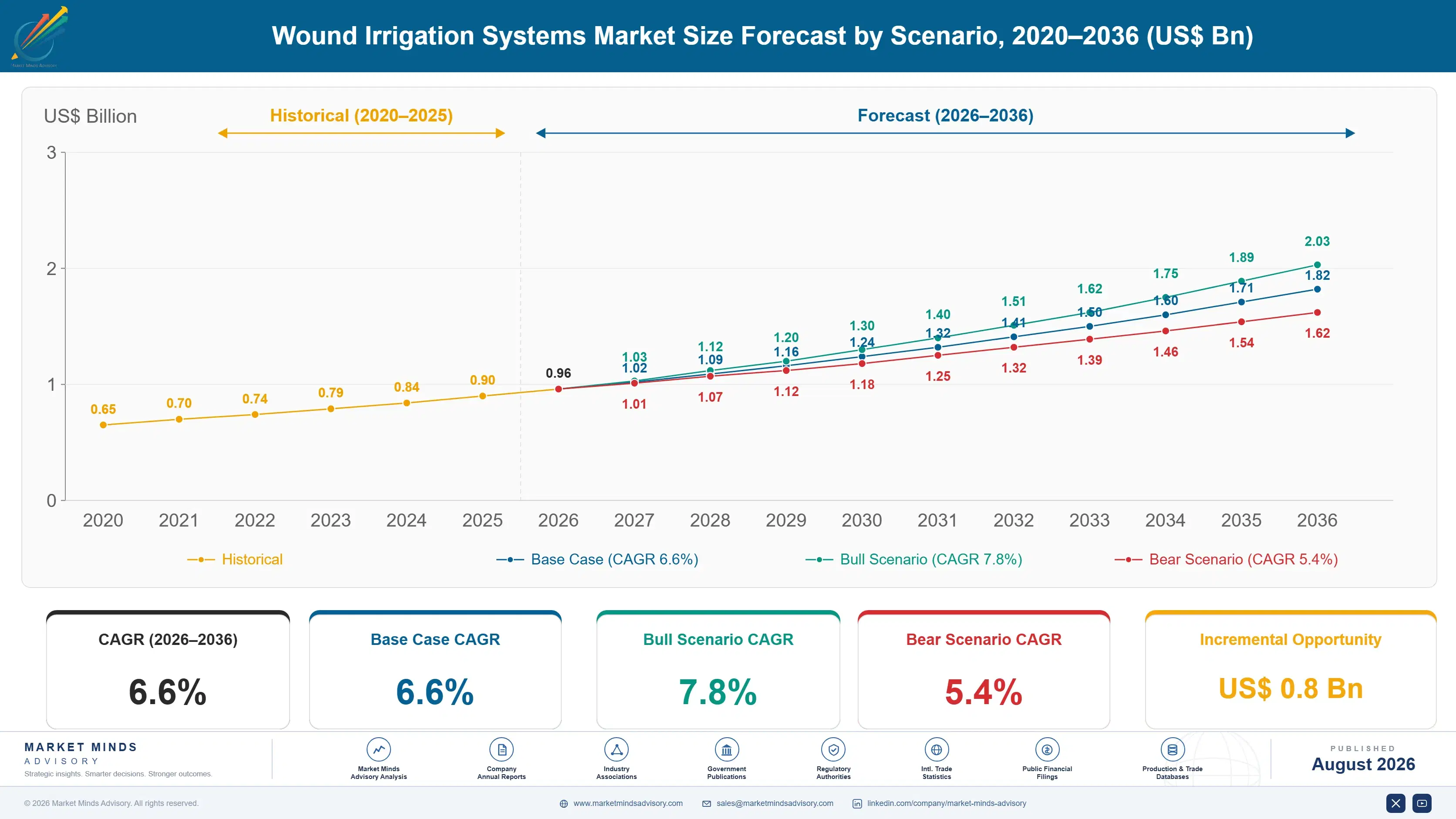
Wound Irrigation Systems Market Forecast Scenarios

wound-irrigation-systems-market-size-forecast-scenario-1787665140995
The five years to 2025 were shaped by infection control attention rather than by clinical evidence. Aerosolisation concerns and single-use conversion moved volume away from reprocessed powered systems, while antimicrobial solutions grew on biofilm awareness that dressing manufacturers had spent a decade establishing. The 5.4% historical rate reflects mix change and price rather than any expansion in the number of wounds being irrigated anywhere.
The 6.6% base case rests on three mechanisms. Single-use shielded irrigators grow at 9.9% as aerosolisation and reprocessing concerns push hospitals away from reusable handpieces. Antimicrobial solutions grow at 8.6% because mechanical flushing alone leaves most mature biofilm intact. And Indian surgical and wound care volumes grow at 10.4%, faster than any market covered, on hospital capacity expansion across the country. Containment, biofilm understanding and hospital capacity, all at once.
The 7.8% bull case turns on an infection control body issuing containment guidance for powered irrigation, which would convert a supplier argument into an institutional requirement and reprice the shielded single-use segment immediately. The 5.4% bear case is sterilisation capacity: ethylene oxide facility constraints have already disrupted single-use medical device supply, and this category depends on it almost entirely.

No Pressure, No Volume, No Standard

Almost every wound gets irrigated and almost nothing about how is agreed. Pressures in routine clinical use span roughly a fourteenfold range, no guideline body specifies a required volume, and solution choice varies from tap water to proprietary antimicrobials depending largely on where the clinician trained. A large randomised trial in open fracture care found very low pressure performed as well as high pressure, and practice afterwards barely moved.
TOP FIVE CONCENTRATION52%Combined procedure volume served by the leading suppliers
AEROSOL DISPERSAL DISTANCE2 metresRange organisms travel from a pulsed lavage field
PRESSURE PRACTICE VARIATION14xSpread between lowest and highest pressures in use
CONSUMABLE REVENUE SHARE78%Supplier turnover from tips, tubing and solutions combined
BIOFILM RESISTANCE TO FLUSHING72%Mature communities surviving mechanical irrigation without an antimicrobial
GUIDELINE VOLUME RECOMMENDATION0Bodies specifying a required irrigation volume for wounds
That leaves suppliers in an awkward position, since efficacy claims are difficult to defend when the underlying parameters are contested. The stronger available argument is containment. Pulsed lavage aerosolises organisms up to around two metres from the wound, depositing them on surfaces, equipment and personnel outside the immediate field, which is a documented infection control problem rather than a matter of clinical opinion.
The commercial structure is straightforwardly consumable. Around 78% of supplier revenue comes from tips, tubing, shields and solutions rather than from powered handpieces, and hospitals evaluate on cost per procedure rather than on equipment price. That suits single-use conversion, since a sealed disposable system removes reprocessing entirely while moving the whole product into the consumable line where purchasing already happens.
"Suppliers keep arguing about how well their device cleans a wound, in a field that cannot agree what pressure to use or how much fluid to run. The argument they can actually win is about what lands on the anaesthetist."
Director, Surgical Devices and Wound Care Practice · MMA Medical Devices and Wound Care Practice · August 2026

Market Trends

Aerosolisation Becomes The Argument Efficacy Never Provided

Pulsed lavage disperses organisms up to around two metres beyond the wound, contaminating surfaces, instruments and personnel in a way that has been documented repeatedly rather than debated. That is an infection control problem with a defined mechanism, and it is considerably easier to argue than efficacy in a field where pressure practice varies fourteenfold and no volume standard exists anywhere. Shielded and closed single-use systems address it directly. Suppliers still competing on cleaning performance are arguing about the one thing nobody in the field agrees on. Prevention committees hear it differently.
Market Impact: India grows at 10.4% annually
Single-Use Conversion Removes Reprocessing From The Equation

Reusable powered handpieces and tubing require reprocessing that introduces its own contamination pathway, adds sterile processing department workload and creates traceability obligations hospitals increasingly dislike carrying. Single-use battery powered irrigators remove all of it and grow at 9.9% against a market rate of 6.6%, the fastest product type in the category. The conversion also suits purchasing, since around 78% of supplier revenue already sits in consumables and a disposable system simply moves the remainder into the same budget line. Sterile processing departments are frequently the ones asking for the conversion in the first place.
Market Impact: Flushing leaves 72% of biofilm

Market Opportunities and Growth Drivers

Indian Hospital Capacity Expansion Adds Procedure Volume

Indian hospital construction and surgical capacity have expanded across private chains and public programmes together, adding orthopaedic, trauma and chronic wound procedure volume simultaneously. India grows at 10.4%, faster than any market covered. Cost per procedure matters more here than in any developed market, which favours manual and low cost powered systems over premium single-use platforms. Domestic manufacturers serve much of that demand while international suppliers hold positions in corporate hospital chains and in antimicrobial solutions where formulation matters. Volume rather than value is what makes this region matter commercially at present.
Market Impact: Pressure practice varies 14 times

Biofilm Understanding Exposes What Flushing Cannot Achieve

Mature biofilm survives mechanical irrigation at rates around 72%, because the extracellular matrix protects organisms from shear forces that would remove planktonic bacteria easily. Wound care has absorbed that understanding over a decade, largely through dressing manufacturers funding the education. Antimicrobial irrigation solutions using polyhexanide, hypochlorous acid or octenidine address the gap directly and grow at 8.6%, second fastest in the category. The mechanical device and the solution are therefore complementary rather than alternative, which few suppliers position properly. A supplier holding only the device is selling half of what the protocol requires.
Market Impact: Constrains the 9.9% growing segment

Market Restraints and Challenges

Absent Standards Make Efficacy Claims Difficult To Defend

No guideline body specifies a required irrigation volume, pressures in routine use vary about fourteenfold, and the largest randomised trial in open fracture care found very low pressure performed as well as high. The root cause is that irrigation was adopted on physiological reasoning rather than trial evidence and nobody has since defined what good looks like. Commercially this makes performance claims contestable and pushes purchasing toward price. Suppliers respond by funding comparative work, which is slow and rarely changes established practice. Price becomes the criterion when nothing else can be demonstrated.
Market Impact: Organisms travel around 2 metres

Sterilisation Capacity Constrains Single-Use Growth Directly

Single-use irrigation systems depend on ethylene oxide sterilisation, and facility closures and emissions restrictions have already disrupted supply across the wider single-use device sector. The root cause is that alternative modalities do not suit every material and validating a change takes regulatory work nobody undertakes casually. Commercially this places the fastest growing product type on a supply base with limited headroom. Manufacturers respond by qualifying additional facilities and by evaluating alternative sterilisation, both of which take considerable time. Growth that cannot be sterilised is not growth anybody can actually deliver to a customer.
Market Impact: Fastest type growing at 9.9%
3 additional market trends, 4 additional growth drivers, and 2 additional restraints and challenges are covered in the full report. Contact sales@marketmindsadvisory.com to access the complete intelligence.

Segment CAGR and Growth Architecture

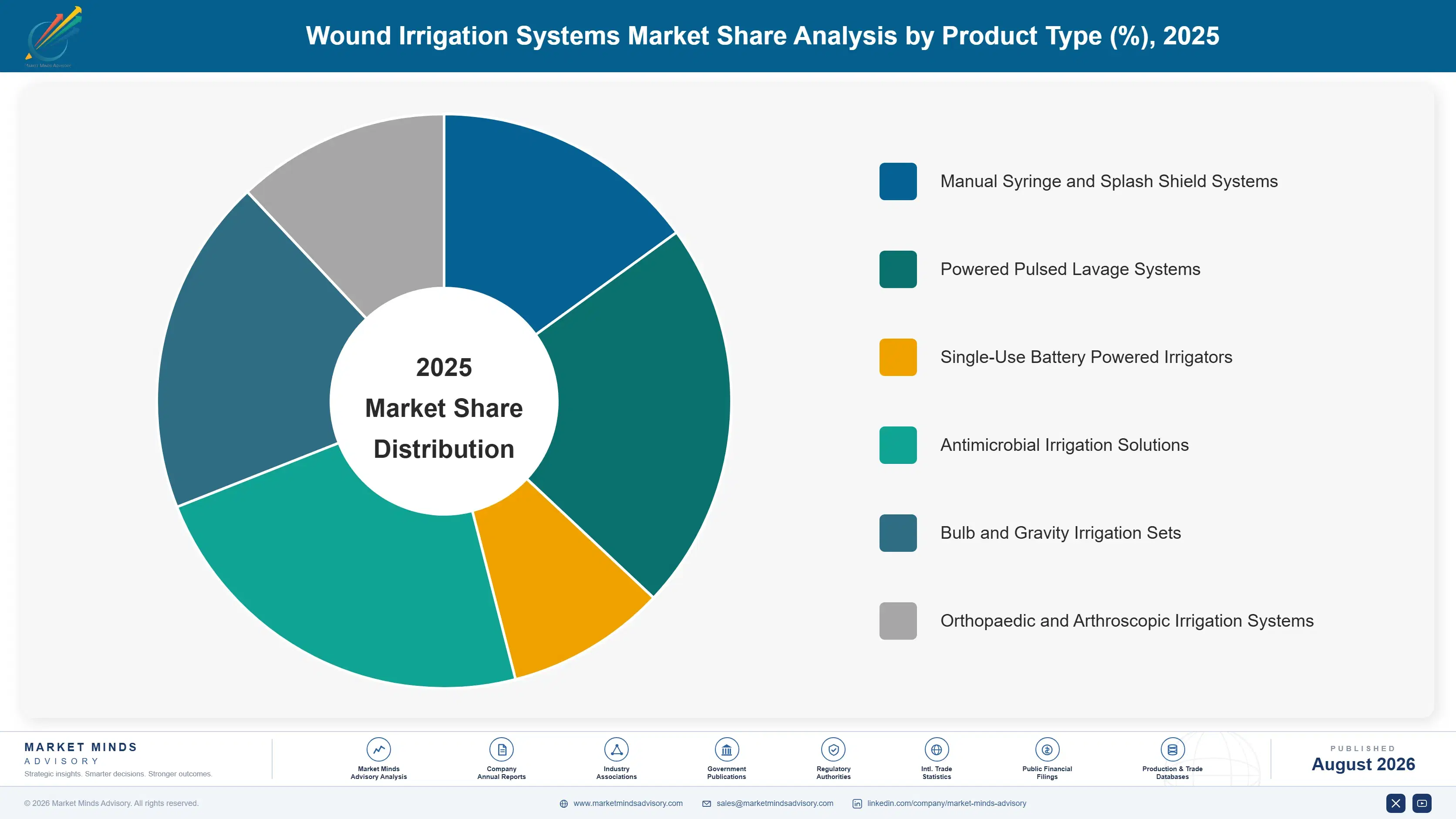
Segmentation follows product type, since type determines whether reprocessing is required, what containment it offers, whether an antimicrobial is delivered and which budget line pays for it. Six types cover the category as supplied. Growth tracks infection control concerns rather than any resolution of the clinical parameters nobody has agreed. Infection control drives the mix.
wound-irrigation-systems-market-market-share-analysis-1787665141702

Single-Use Battery Powered Irrigators

Sealed disposable powered systems with integrated shields, delivering controlled irrigation without any reprocessing and containing the aerosol that open pulsed lavage disperses. At 9.9% this is the fastest growing product type, half again the market rate of 6.6%, and infection control rather than cleaning performance explains it. Reprocessing reusable handpieces introduces a contamination pathway, sterile processing workload and traceability obligations hospitals increasingly dislike. The conversion also suits purchasing, since around 78% of category revenue already sits in consumables and a disposable device simply moves the rest into the same budget. Sterile processing departments frequently initiate the conversion themselves, which is unusual for a product surgeons handle. Nobody asked the surgeon first.
CAGR 9.9%

Antimicrobial Irrigation Solutions

Polyhexanide, hypochlorous acid, octenidine and related antiseptic solutions used in place of saline where biofilm or colonisation is a concern, delivered through any irrigation device. Growth of 8.6% is second fastest in the category and biofilm understanding rather than device development drives it. Mature biofilm survives mechanical irrigation at rates near 72%, because the matrix protects organisms from shear forces that remove planktonic bacteria easily. Device and solution are therefore complementary rather than competing, and suppliers holding only one half of that pair are selling an incomplete answer. Chronic wound clinicians understand this considerably better than they did a decade ago, largely because dressing manufacturers funded all of the education. Irrigation suppliers benefited.
CAGR 8.6%
Full segment breakdown across 6 segments available in the complete report.

Regional Architecture and Country Demand Map

North America holds 34%, above the standard band, because powered pulsed lavage is used far more heavily in American orthopaedic practice than anywhere else. Western Europe follows at 24% and East Asia at 18%. India grows fastest at 10.4%. Practice intensity rather than procedure volume decides.

North America

A 34% share sits above the standard regional band, justified because powered pulsed lavage is used far more routinely in American orthopaedic and trauma practice than in any other region, which raises spend per procedure well above global averages. Infection control programmes are also more formalised here, which makes the aerosolisation argument land with committees rather than only with surgeons. Single-use conversion is furthest advanced in this market. Group purchasing organisations evaluate on cost per procedure across whole systems. Growth of 5.6% reflects mix conversion rather than procedure volume expansion. Practice intensity rather than procedure count is what produces this share, which is unusual. Infection prevention committees decide conversions here.
Share: 34% | CAGR: 5.6% (2026 to 2036)

Western Europe

A 24% share reflects substantial surgical and chronic wound volumes managed with more conservative irrigation practice than in North America, with lower powered lavage use and greater reliance on manual and gravity systems. Antimicrobial solutions are used more readily here, since polyhexanide and octenidine products have long clinical histories across German, French and Nordic practice. Procurement runs through tenders that reward cost per procedure and disadvantage premium single-use platforms. Infection control guidance carries considerable weight once issued. Growth of 5.0% is the lowest of the seven regions and reflects tender pricing pressure. Tender pricing rather than clinical preference is what governs most purchasing across this region. Guidance moves things when it arrives.
Share: 24% | CAGR: 5.0% (2026 to 2036)
Regional intelligence for 5 additional markets available in the complete report: East Asia, South Asia and Pacific, Latin America, Middle East and Africa, Eastern Europe. Contact sales@marketmindsadvisory.com.
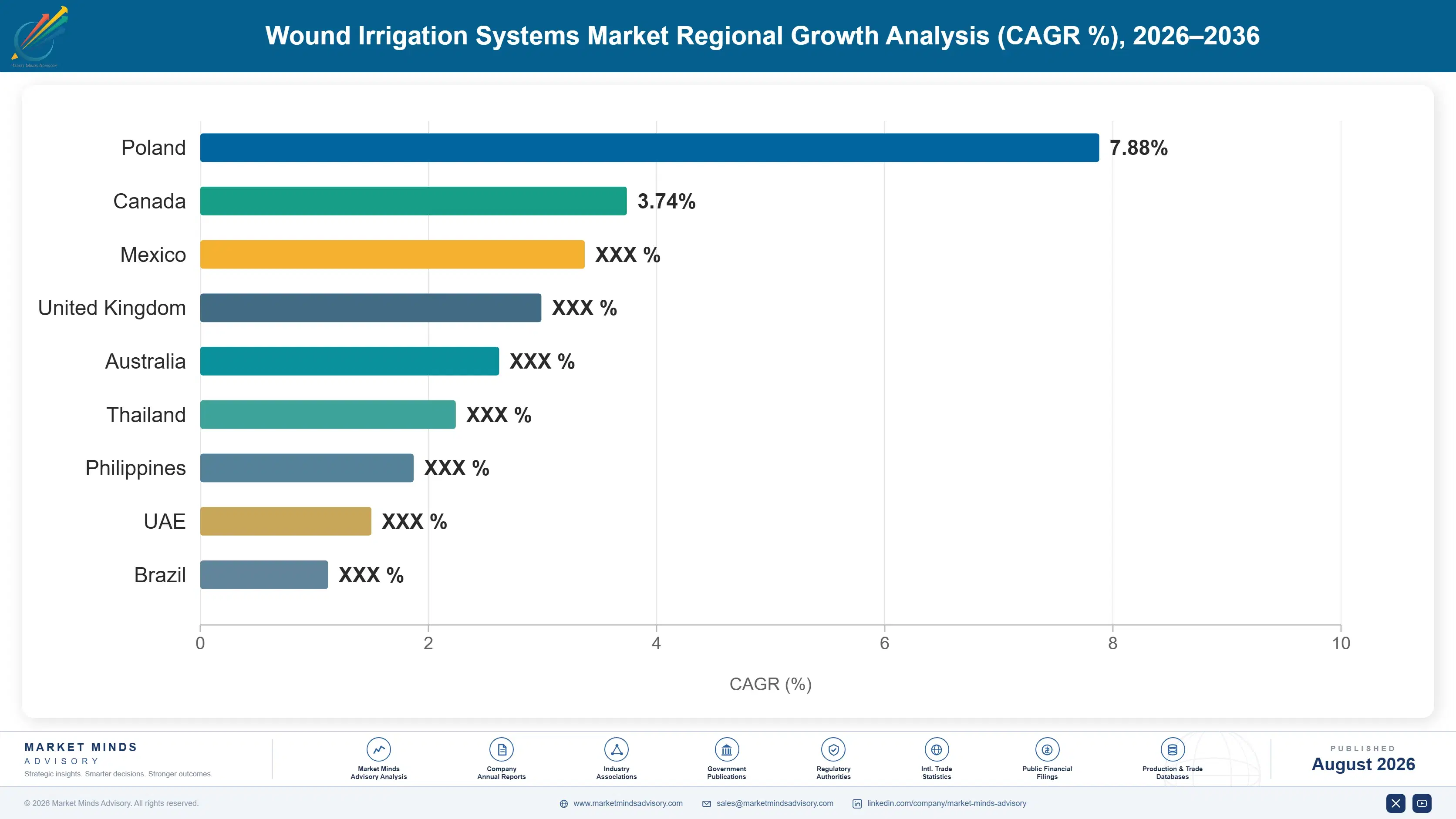
wound-irrigation-systems-market-country-cagr-analysis-1787665142453

Where This Category Actually Earns

Nothing here is won on cleaning efficacy, because the field cannot agree what pressure or volume to use and the largest trial contradicted the assumption everybody held. Value accrues to whoever sells containment, whoever converts the device into a consumable, whoever answers biofilm, and whoever secures sterilisation capacity. Four routes carry weight. Containment is the argument.

Sell Containment Rather Than Cleaning Power

Pulsed lavage disperses organisms up to around 2 metres beyond the wound, depositing them on surfaces, instruments and personnel in a way documented repeatedly rather than argued about. That is an infection control problem with a defined mechanism, and it reaches committees that efficacy claims never will in a field where pressure practice varies fourteenfold. Suppliers still competing on how well a device cleans are arguing about the one thing nobody in the field has agreed on for decades. Around 14 times variation in pressure practice tells you why efficacy claims fail.
Market Impact: Contains the aerosol otherwise travelling around 2 metres

Move The Device Into The Consumable

Around 78% of supplier revenue already sits in tips, tubing, shields and solutions rather than in powered handpieces, and hospitals evaluate on cost per procedure rather than equipment price. A sealed single-use system moves the remaining device value into the same budget line while removing reprocessing entirely, which is why that type grows at 9.9% against a market rate of 6.6%. Suppliers protecting a capital equipment model are defending the smaller and less durable half of their own revenue. Around 78% of revenue already sits where the purchasing conversation already happens anyway.
Market Impact: Consumables already carry 78% of all category revenue

Answer Biofilm Where Flushing Alone Fails

Mature biofilm survives mechanical irrigation at rates near 72%, because the protective matrix resists the shear forces that remove planktonic organisms without difficulty. Antimicrobial solutions using polyhexanide, hypochlorous acid or octenidine address that directly and grow at 8.6%, second fastest in the category. Device and solution are complementary rather than competing, and a supplier holding only the hardware is selling half an answer to a problem the customer now understands considerably better than they did a decade ago. Around 72% survival is a number chronic wound clinicians now recognise almost immediately.
Market Impact: Addresses the 72% biofilm survival rate after flushing

Secure Sterilisation Capacity Before It Constrains

Single-use systems depend on ethylene oxide sterilisation, and facility closures and emissions restrictions have already disrupted supply across the single-use device sector more broadly. The fastest growing product type at 9.9% therefore sits on a supply base with limited headroom and long qualification timelines for alternatives. Manufacturers qualifying additional facilities and evaluating alternative modalities before the constraint binds are protecting growth that competitors will simply be unable to deliver when it does. Around 9.9% growth is only deliverable to the extent somebody can actually sterilise the product. Qualification cannot be compressed later.
Market Impact: Protects supply of the 9.9% growing product type

Who Controls the Margin Pool

Concentration is moderate and split by clinical setting. The top five hold 52% of procedure volume served, the basis applied consistently throughout this section, with orthopaedic device companies holding surgical irrigation positions and wound care specialists holding chronic wound and solution positions. Stryker leads on surgical procedure presence, and the gap reflects operating theatre relationships built through implant and instrument businesses rather than anything specific to irrigation as a product.
Competition runs on three fronts. Orthopaedic device companies compete for surgical irrigation alongside implants and instruments, where theatre relationships alone decide the access. Wound care specialists compete on antimicrobial solutions and chronic wound protocols, where clinical education rather than price carries the argument. And regional manufacturers compete on cost per procedure in markets where budgets govern considerably more strictly than any protocol.

Rankings will move with infection control guidance rather than with clinical evidence, since containment requirements would convert a supplier argument into an institutional obligation across whole health systems. The other pressure point is sterilisation capacity, which determines whether anybody can actually supply the fastest growing product type at the volumes a full conversion would actually demand.
wound-irrigation-systems-market-company-positioning-matrix-1787665142979

Competitive Moat and Risk Dimensions

STRYKER

Moat: Operating Theatre Relationship Depth

Presence across implants, powered instruments and surgical equipment gives access to theatre purchasing decisions that a standalone irrigation supplier cannot reach at comparable cost. Irrigation is bought alongside other items on the same preference card, which makes displacement considerably harder than the product itself would suggest to any competitor.
STRYKER

Risk: Reusable Platform Exposure

Installed reusable powered systems represent a position that single-use conversion actively erodes, and defending it means arguing against the infection control case that is driving the conversion. Around 78% of revenue in this category already sits in consumables, which limits how much the installed base actually protects.
CONVATEC

Moat: Chronic Wound Protocol Position

Established presence across chronic wound care pathways connects irrigation to dressings, protocols and clinician education already funded for other products, which reaches a setting orthopaedic suppliers rarely serve. Biofilm education across a decade built the understanding that now drives antimicrobial solution adoption directly across the whole field.
CONVATEC

Risk: Surgical Setting Weakness

Operating theatre irrigation is bought through preference cards and theatre relationships that wound care companies do not hold, which excludes a substantial part of category volume regardless of product quality. Orthopaedic and trauma procedures carry higher spend per case than chronic wound irrigation typically does anywhere.

Players Tracked

Prominent Players

Stryker
Zimmer Biomet
ConvaTec
B. Braun
Medline Industries

Other Key Players

Smith and Nephew
Coloplast
Molnlycke Health Care
Cardinal Health
Becton Dickinson
Integra LifeSciences
Schulke and Mayr
Angelini Pharma
Sonoma Pharmaceuticals
Urgo Medical
Teleflex
Bioventus
Arthrex
Nipro Corporation
Medela

Recent Developments

MARCH 2025

Infection control study documents contamination beyond irrigation field

An infection control study documented organism deposition on surfaces, instruments and personnel beyond the immediate irrigation field during powered pulsed lavage procedures. Aerosol carries organisms up to around two metres, which is a mechanism rather than an opinion and reaches committees that efficacy arguments never do.
Signal: Containment is the argument this category can win, and efficacy is the one it cannot every single time
JUNE 2025

Hospital system converts orthopaedic irrigation to single-use platforms

A hospital system converted orthopaedic irrigation to sealed single-use platforms across its theatres, citing reprocessing burden and contamination pathway rather than any clinical performance difference. Single-use battery powered irrigators grow at 9.9%, the fastest product type in this category by a clear margin. Nobody consulted the surgeons much.
Signal: Sterile processing workload decided this rather than anything a surgeon evaluated rather than any clinical performance question
SEPTEMBER 2025

Sterilisation facility constraints delay single-use device supply

Ethylene oxide sterilisation facility constraints delayed single-use medical device supply across several categories, with alternative modalities requiring validation work manufacturers had not completed. Single-use irrigation systems depend almost entirely on that sterilisation route across the whole product type. Validating an alternative route takes considerable regulatory work.
Signal: The fastest growing product type sits on a supply base with very limited headroom and long qualification timelines

What A Single-Use System Costs

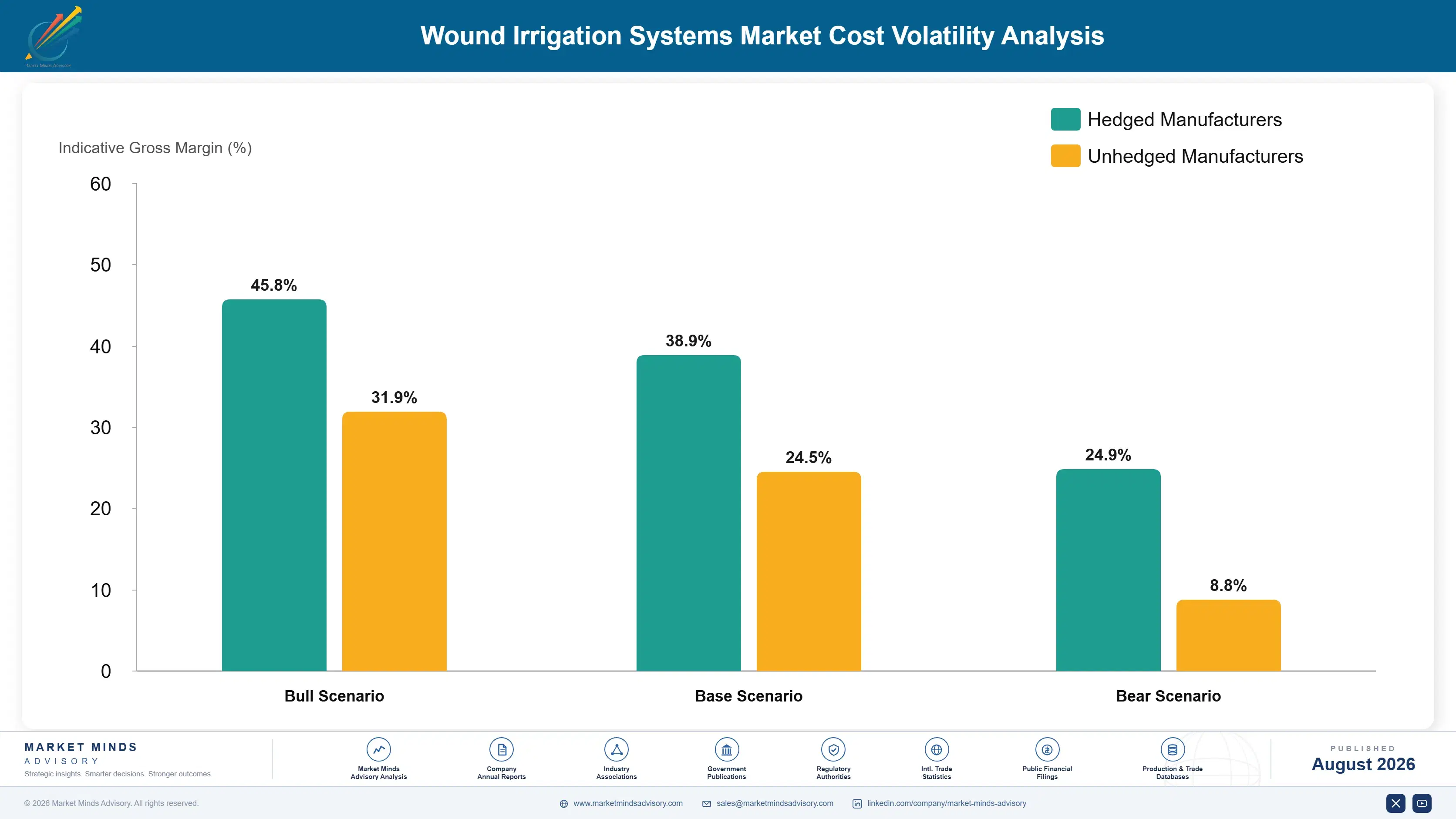
Moulded polymer components account for 31% of single-use system cost, with motors and battery cells at 22% and tubing, sterile packaging, sterilisation and assembly labour carrying the remainder. Antimicrobial solution cost is dominated by the active, with polyhexanide and octenidine carrying licence and specification requirements that saline obviously does not. Battery cells come from consumer electronics supply chains where medical device volumes are negligible customers.
Sterilisation capacity rather than component pricing is the exposure that has actually bitten. Ethylene oxide facility closures and emissions restrictions disrupted single-use device supply across multiple categories, and EPA rulemaking alongside FDA guidance on alternative modalities shaped what manufacturers could do about it. Medical device company annual reports documented the capacity constraint and the validation work that switching modality requires, which is neither quick nor cheap for anybody.

Exposure divides by sterilisation strategy rather than by scale. Manufacturers holding qualified capacity across more than one facility continued shipping while single site dependents waited, and those evaluating alternative modalities before the constraint arrived are considerably better placed than those starting now. The fastest growing product type in this category depends on that supply base almost entirely, which makes it a growth constraint rather than cost.
wound-irrigation-systems-market-cost-volatility-analysis-1787665143181

Qualify sterilisation across more than one facility

Ethylene oxide capacity constraints have already disrupted single-use device supply, and qualification of an additional facility takes validation work that cannot be compressed. Manufacturers holding multiple qualified sites continued shipping while single site dependents waited for slots. The fastest growing product type in this category depends on that route almost entirely, which makes the redundancy a growth decision.

Build containment evidence rather than efficacy evidence

Efficacy claims are difficult to defend where pressure practice varies fourteenfold and no volume standard exists anywhere in guidance. Aerosol containment is measurable, mechanistic and reaches infection control committees that never evaluate cleaning performance at all. Funding containment evidence costs less than comparative efficacy work and produces an argument that actually changes institutional purchasing decisions.

Pair device supply with an antimicrobial solution offer

Mature biofilm survives mechanical irrigation at rates near 72%, which means the device alone cannot deliver the outcome a chronic wound clinician is seeking. Suppliers holding only hardware watch the solution revenue go elsewhere while presenting an incomplete answer. Licensing or partnering on a solution is faster than developing one and closes the gap in the customer's protocol.

Portfolio Architecture for Margin Defence

Margin architecture divides on whether the product is single-use and whether it carries an active. Manual syringe and gravity systems earn least, being simple mouldings sold on price per unit into procedures where budgets govern strictly. Single-use powered systems earn considerably better, since containment and reprocessing avoidance justify the price step. Antimicrobial solutions earn best, because the active carries specification and licence requirements that saline never will.
The tension runs between installed base and conversion. Reusable powered platforms produced capital sales and consumable pull-through for years, and defending them means arguing against the infection control case that is driving conversion away from them. Single-use systems earn better per procedure and require sterilisation capacity that constrains supply. Suppliers holding both are managing a transition they cannot slow down and cannot fully supply either.

High value pools concentrate in shielded single-use systems and in antimicrobial solutions, neither of which is a capital equipment position. Everything sold as a simple moulding competes on price per unit against regional manufacturers everywhere. The businesses worth building are those where containment evidence, an active ingredient or a protocol position gives a purchasing committee a reason to choose that is not cost per procedure.

Manual And Gravity Irrigation Sets

Simple mouldings, syringes, splash shields and gravity sets sold on price per unit into procedures where budget governs strictly. Regional manufacturers compete effectively and no meaningful differentiation is available anywhere.
Gross Margin: 22-27%

Single-Use Powered Systems

Sealed disposable powered irrigators with integrated shields, priced against reprocessing avoidance and aerosol containment rather than cleaning performance. Sterilisation capacity is the practical constraint on how much can actually be supplied.
Gross Margin: 38-44%

Antimicrobial Solution Systems

Polyhexanide, hypochlorous acid and octenidine solutions carrying active specification and licence requirements alongside device supply. The range is wide because active licensing terms and market registration status differ substantially between jurisdictions.
Gross Margin: 48-56%
wound-irrigation-systems-market-portfolio-architecture-1787665143714

High-value Sub-segments and Strategic Watch-out

Single-Use Battery Powered Irrigators

Fastest growing type at 9.9% on reprocessing avoidance and aerosol containment rather than any measured cleaning advantage. Ethylene oxide sterilisation capacity is the practical limit on how quickly this conversion can actually be supplied. Sterile processing burden rather than surgeon preference decided most conversions here.
Gross Margin: 38-44%

Antimicrobial Irrigation Solutions

Second fastest at 8.6% because mechanical flushing leaves around 72% of mature biofilm in place regardless of pressure or volume. Device and solution are complementary, and suppliers holding one half sell an incomplete answer. Chronic wound clinicians across the field now recognise that figure immediately.
Gross Margin: 48-56%

Powered Pulsed Lavage Systems

Growing at 5.2% while carrying substantial installed base, which makes it the position single-use conversion is actively eroding. Defending it means arguing against the infection control evidence driving that same conversion forward. Consumable pull-through provides considerably less protection than the installed base would suggest here.
Gross Margin: 30-36%

Bulb and Gravity Irrigation Sets

Growing at only 2.2% in settings where budget rather than protocol governs and any container delivering fluid is considered adequate. Regional manufacturers dominate and nothing about that position is likely to change. Price per unit decides everything here and nothing else really enters the conversation.
Gross Margin: 18-22%

How Protocol Decides Purchasing

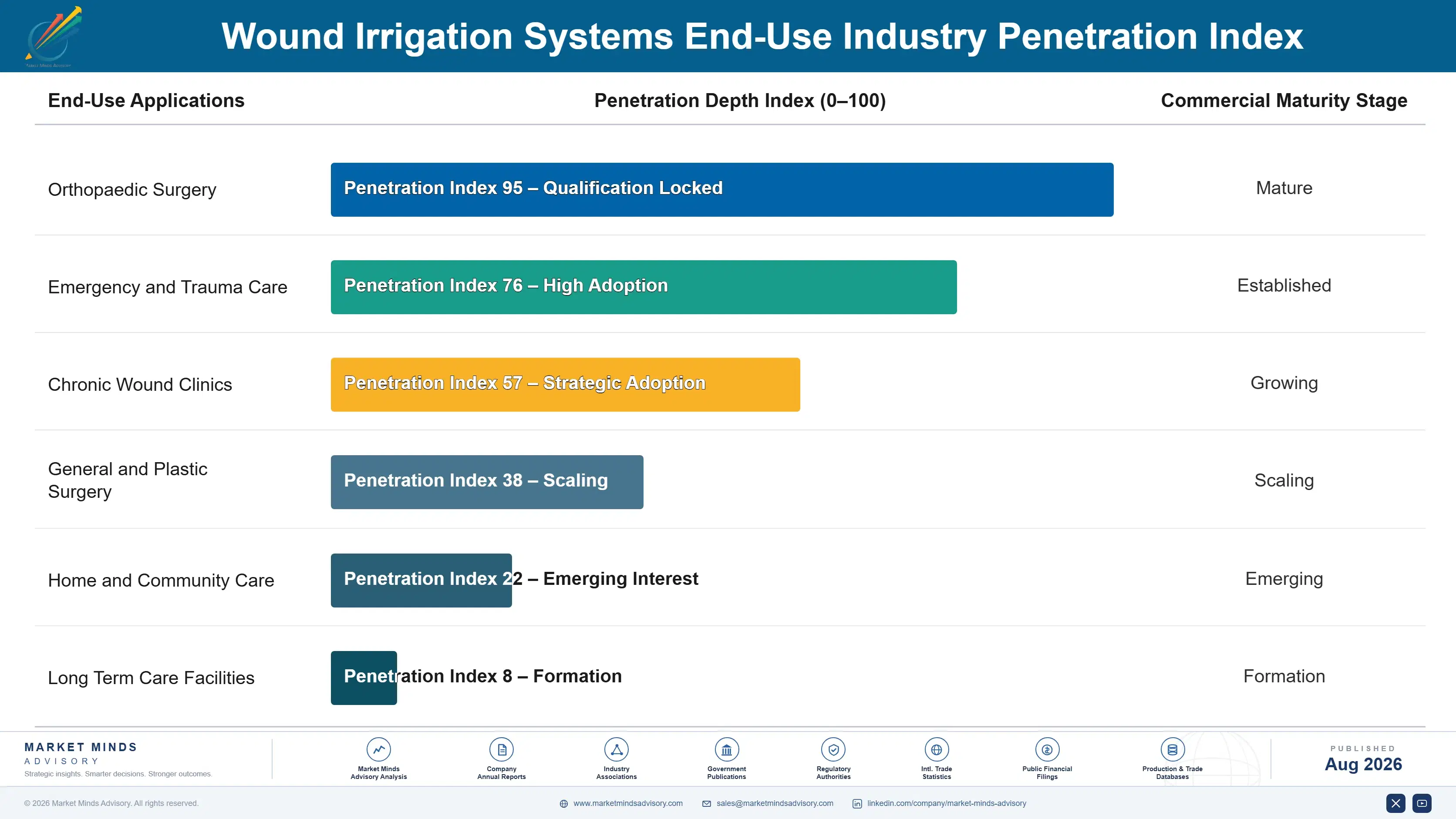
Demand here is generated by a written protocol or a surgeon's preference card rather than by a purchasing decision anybody revisits often. Once irrigation is specified within a surgical pathway or a wound care protocol, the product is consumed on every applicable case until somebody changes the document. That makes protocol inclusion the commercial event, and around 78% of revenue arriving as consumables afterwards is simply the consequence of it.
Stickiness therefore tracks who wrote the protocol. Surgeon preference cards in orthopaedic theatres are personal and change when the surgeon does, which makes that position durable and individually held. Institutional wound care protocols are written by committee and change slowly, which makes them harder to win and harder to lose. Manual and gravity irrigation sits outside protocol entirely, bought on price whenever stock runs low.

The decision maker is moving from clinician toward infection control. Aerosolisation and reprocessing concerns bring infection prevention committees into a choice that surgeons and wound care nurses previously made alone, and those committees evaluate containment and contamination pathways rather than cleaning performance. That shift favours suppliers with containment evidence and disadvantages those whose argument has always been about how well the device washes a wound.
wound-irrigation-systems-market-end-use-penetration-index-1787665144238

Where This Category Rewards Focus

These are among the four positions where our research anticipates prominent divergence between winners and laggards over the coming forecast period. Each is grounded in the demand model, the regulatory perimeter, and the announced capacity pipeline.
01 / AEROSOL CONTAINMENT SELLING

Argue the thing the field agrees on

Pulsed lavage disperses organisms up to around two metres beyond the wound, depositing them on surfaces, instruments and personnel in a way that has been documented repeatedly rather than debated among clinicians. That is an infection control problem with a defined mechanism, and it reaches prevention committees that efficacy claims never will in a field where pressure practice varies fourteenfold. Suppliers still competing on cleaning performance are arguing about the one thing nobody in this field has ever managed to agree on.
02 / CONSUMABLE MODEL CONVERSION

The handpiece was never the business

Around 78% of supplier revenue already sits in tips, tubing, shields and solutions rather than in powered handpieces, and hospitals evaluate irrigation on cost per procedure rather than equipment price entirely. A sealed single-use system moves the remaining device value into that same budget line while removing reprocessing, which is why the type grows at 9.9% against a market rate of 6.6%. Suppliers defending a capital equipment model are protecting the smaller and less durable half of their own revenue base.
03 / BIOFILM GAP OWNERSHIP

Flushing does not remove what matters

Mature biofilm survives mechanical irrigation at rates near 72%, because the protective matrix resists the shear forces that remove planktonic organisms without any difficulty at all. Antimicrobial solutions using polyhexanide, hypochlorous acid or octenidine address that gap directly and grow at 8.6%, second fastest in this category. Device and solution are complementary rather than competing, and a supplier holding only hardware is selling half an answer to a problem customers now understand considerably better than they did even a decade ago.
04 / STERILISATION CAPACITY ACCESS

Growth you cannot sterilise is not growth

Single-use irrigation systems depend on ethylene oxide sterilisation almost entirely, and facility closures alongside emissions restrictions have already disrupted supply across the wider single-use device sector on more than one occasion. The fastest growing product type at 9.9% therefore sits on a supply base with limited headroom and qualification timelines that cannot be compressed once a constraint binds. Manufacturers qualifying additional sterilisation capacity right now are protecting growth that competitors will simply be unable to deliver when it finally binds.

Engagement Snapshot From the Field

A live engagement with an industry participant carrying material or product regulatory and market exposure ahead of a defining policy shift, showing how our research translates into a defensible multi-year portfolio strategy.
MARKET MINDS ADVISORY · CLIENT ENGAGEMENT SUMMARY
Wound Irrigation Systems Producer Strategic Portfolio Review and Transition Roadmap 2026·Investment Scenario on Wound Irrigation Systems Exposure Evaluation 2025-26
CLIENT PROFILE
A surgical device manufacturer supplying reusable powered pulsed lavage systems and consumables to hospitals across North America and Western Europe. Annual revenue was approximately 74 million dollars (client-reported, unverified by MMA), with consumables carrying most of it and reusable handpieces providing installed base pull-through. No single-use powered platform existed in the range at that point.
STRATEGIC CHALLENGE
Hospital systems had begun converting to single-use irrigation and the client was losing accounts at infection control review rather than at surgeon evaluation, which its commercial approach was not designed to reach. Management was weighing single-use development against defending the reusable platform. Nobody had established who was actually making these decisions inside customer institutions.
MMA APPROACH
MMA reconstructed lost account decisions to identify the deciding function and the evidence each one evaluated. Single-use development was costed including sterilisation qualification against continued reusable platform defence. Forty-seven expert interviews with infection prevention leads, sterile processing managers, orthopaedic surgeons and wound care specialists established how conversion decisions happen, alongside survey work across six countries.
KEY FINDINGS
  1. Infection prevention committees rather than surgeons made the final decision in 7 of the 9 lost accounts reviewed, and the client had never presented to one of them.
  2. Sterile processing burden was cited in 8 of 9 conversions, ahead of contamination risk and well ahead of any clinical performance consideration at all.
  3. Single-use development including sterilisation qualification was costed at around 22 months, with capacity qualification the longest single element within that whole timeline.
  4. Antimicrobial solution revenue in converting accounts went to other suppliers in 6 of 9 cases, because the client offered no solution alongside its devices.
CLIENT PROFILE
A surgical device manufacturer supplying reusable powered pulsed lavage systems and consumables to hospitals across North America and Western Europe. Annual revenue was approximately 74 million dollars (client-reported, unverified by MMA), with consumables carrying most of it and reusable handpieces providing installed base pull-through. No single-use powered platform existed in the range at that point.
STRATEGIC CHALLENGE
Hospital systems had begun converting to single-use irrigation and the client was losing accounts at infection control review rather than at surgeon evaluation, which its commercial approach was not designed to reach. Management was weighing single-use development against defending the reusable platform. Nobody had established who was actually making these decisions inside customer institutions.
MMA APPROACH
MMA reconstructed lost account decisions to identify the deciding function and the evidence each one evaluated. Single-use development was costed including sterilisation qualification against continued reusable platform defence. Forty-seven expert interviews with infection prevention leads, sterile processing managers, orthopaedic surgeons and wound care specialists established how conversion decisions happen, alongside survey work across six countries.
KEY FINDINGS
  1. Infection prevention committees rather than surgeons made the final decision in 7 of the 9 lost accounts reviewed, and the client had never presented to one of them.
  2. Sterile processing burden was cited in 8 of 9 conversions, ahead of contamination risk and well ahead of any clinical performance consideration at all.
  3. Single-use development including sterilisation qualification was costed at around 22 months, with capacity qualification the longest single element within that whole timeline.
  4. Antimicrobial solution revenue in converting accounts went to other suppliers in 6 of 9 cases, because the client offered no solution alongside its devices.
RECOMMENDED STRATEGY
Phase 1: Phase one: build containment and reprocessing evidence for infection prevention committees, which decided 7 of the 9 accounts already lost. Phase 2: Phase two: develop a single-use powered platform over roughly 22 months, qualifying sterilisation capacity across more than one qualified facility. Phase 3: Phase three: license an antimicrobial solution, since 6 of 9 converting accounts sent that solution revenue straight to competitors instead.
OUTCOME
The client rebuilt its evidence and commercial approach around infection prevention committees and slowed account losses within two quarters without any product change. Single-use development began with dual sterilisation qualification designed in from the start, and a licensed antimicrobial solution closed the gap that had been sending revenue elsewhere (client-reported, unverified by MMA).

Frequently Asked Questions

Foundational context covering the market sizes, CAGR, scope, country, region and competition that inform every finding below. This section is provided to cover basics and most often pre-purchase conversations, answered from the MMA Primary Research Dataset.

What is the current size of the Wound Irrigation Systems Market?

The market was valued at 0.86 billion dollars in 2025, covering irrigation devices and antimicrobial solutions used in acute and chronic wound care worldwide. It reaches an estimated 0.92 billion dollars during 2026.

How large will the Wound Irrigation Systems Market be by 2036?

MMA forecasts 1.74 billion dollars by 2036, an increase of 0.82 billion dollars over the 2026 base. That represents an expansion multiple of 1.89 times across the forecast period.

What is the CAGR for the Wound Irrigation Systems Market 2026 to 2036?

The base case compound annual growth rate is 6.6%, with a bull case of 7.8% and a bear case of 5.4%. Infection control guidance and sterilisation capacity separate those two scenarios.

Which segment is growing fastest?

Single-use battery powered irrigators grow at 9.9%, half again the market rate of 6.6%, on reprocessing avoidance and aerosol containment. Antimicrobial solutions follow at 8.6%.

Who are the major companies in the Wound Irrigation Systems Market?

Stryker, Zimmer Biomet, ConvaTec, B Braun and Medline Industries lead on procedure volume served across surgical and chronic wound settings. Together they hold 52% of the global market.

Which country is growing fastest?

India grows fastest at 10.4%, because hospital construction and surgical capacity have expanded across private chains and public programmes at very much the same time.

Report Segmentation Architecture

The full report scope spans multiple orthogonal segmentation dimensions, with cross-tabulated demand data provided for each dimension pair. Coverage extends further to regional breakdowns, trend trajectories, and the competitive detail needed to support segment-level decision-making.

By Product Type

  • Manual Syringe and Splash Shield Systems
  • Powered Pulsed Lavage Systems
  • Single-Use Battery Powered Irrigators
  • Antimicrobial Irrigation Solutions
  • Bulb and Gravity Irrigation Sets
  • Orthopaedic and Arthroscopic Irrigation Systems

By End-Use Industry

  • Orthopaedic Surgery
  • Emergency and Trauma Care
  • Chronic Wound Clinics
  • General and Plastic Surgery
  • Home and Community Care
  • Long Term Care Facilities

By Commercial Dimension

  • Hospital Direct Supply
  • Group Purchasing Contract
  • Distributor Supply
  • Ambulatory Surgical Centre Supply
  • Home Care Provider Supply
  • Tender and Public Procurement

By Region

  • North America
  • Western Europe
  • East Asia
  • South Asia and Pacific
  • Latin America
  • Middle East and Africa
  • Eastern Europe

Scope, Methodology, and Coverage

Every figure in this report is reproducible from documented input assumptions. The scope below maps the historical period, the forecast horizon, the segmentation dimensions, and the countries covered, alongside the underlying primary and qualitative methodology.
Historical Period
2020 to 2025
Forecast Period
2026 to 2036
Base Year
2025 (USD billions; MMA Primary Research Dataset, August 2026)
Market Definition
Devices and solutions used for mechanical cleansing and irrigation of acute and chronic wounds worldwide, covering manual syringe and splash shield systems, powered pulsed lavage systems, single-use battery powered irrigators, antimicrobial irrigation solutions, bulb and gravity irrigation sets, and orthopaedic and arthroscopic irrigation systems, together with the tips, tubing and shields consumed with them, measured at supplier revenue. Negative pressure wound therapy with or without instillation, debridement instruments, surgical suction equipment, wound dressings and intravenous fluids are excluded from scope.
Quantitative Units
USD billions (supplier revenue); procedures served; USD per procedure by product type
Segmentation Dimensions
Product type; end-use industry; commercial dimension; region
Regions Covered
North America, Western Europe, East Asia, South Asia and Pacific, Latin America, Middle East and Africa, Eastern Europe
Countries Covered
United States, Canada, United Kingdom, Germany, France, Italy, Spain, Netherlands, Sweden, China, Japan, South Korea, Taiwan, India, Australia, Indonesia, Brazil, Mexico, Argentina, Saudi Arabia, South Africa, Poland
Key Companies Profiled
Stryker, Zimmer Biomet, ConvaTec, B. Braun, Medline Industries, Smith and Nephew, Coloplast, Molnlycke Health Care, Cardinal Health, Becton Dickinson, Integra LifeSciences, Schulke and Mayr, Angelini Pharma, Sonoma Pharmaceuticals, Urgo Medical, Teleflex, Bioventus, Arthrex, Nipro Corporation, Medela
Quantitative Methodology
Primary survey, n=3,800 respondents, Q4 2025, six countries; demand-side model with trade association cross-validation
Qualitative Methodology
47 expert interviews, Q4 2025; applied to validate demand model assumptions, identify emerging dynamics, and assess competitive positioning
Report Format
PDF and XLSX data workbook (Word format preview document)
Publisher
Market Minds Advisory
Report Code
MMA-2026-MED-139
Published
August 2026
Contact
sales@marketmindsadvisory.com | www.marketmindsadvisory.com

Purchase the full Wound Irrigation Systems Market Report (2026 to 2036).

The full report examines a procedure performed constantly and standardised nowhere, and identifies the argument suppliers can actually win in a field that never agreed what pressure or volume to use. It sizes all six product types independently through 2036, models single-use conversion against sterilisation capacity constraints, and quantifies the biofilm gap that mechanical irrigation cannot close. Regional chapters cover all seven regions, with powered lavage practice intensity assessed separately from procedure volume. Competitive profiling covers 20 participants on one single consistent procedure volume measure.
Six product types sized independently through 2036
Single-use conversion modelled against ethylene oxide capacity constraints
Aerosol containment evidence assessed as a purchasing argument
Biofilm survival quantified against mechanical irrigation alone
Decision making authority mapped across clinical and infection control functions
Twenty participants profiled on one consistent procedure measure

Built For The People Who Decide

From boardroom strategy to bench-side execution, this report is read cover-to-cover by leaders shaping the next decade of their industry, turning demand scenarios, market dynamics and valuation benchmarks into decisions.
CXOs/ Presidents/ VPs/ Managers
M&A and Corporate Development
Strategy Teams and R&D Heads
Procurement and Product Directors
Regulatory and Compliance Leaders
Investor Relations and Equity Analysts