Market Minds Advisory
Workstation Market

Workstation Market: Workstation Market. CAD, Content Creation, and AI Development Computing Systems Through 2036

AI model development and rendering-intensive content creation push workstation manufacturers toward GPU-dense configurations as engineering firms retire aging CAD desktops faster than typical five-year refresh cycles would otherwise dictate reflecting sustained enterprise.

Lead Analyst

Published

September 2026

Make Smarter Decisions with Customized Research Insights

Request a free sample report and evaluate market opportunities, growth trends, and competitive dynamics relevant to your business needs.

2025 MARKET VALUE$15.2BMarket Size 2025
2036 FORECAST VALUE$35.5BBase Case , 2026 to 2036
CAGR 2026 TO 20368.0 %Bull 9.2% / Bear 6.8%
INCREMENTAL OPPORTUNITY$19.0BNet 10- year value creation
EXPANSION MULTIPLE2.16x2036 value over 2026 base
Strategic Levers
M&A Pipeline
Regional Outlook
Country Rankings
Competitive Intelligence
Segmental Deep-dive
Call-Us : 91 93563 13602

Executive Snapshot and Market Trajectory.

AI model development and rendering-intensive content creation are pushing enterprises to retire aging CAD-focused workstations faster than typical five-year refresh cycles would otherwise dictate, favoring GPU-dense configurations reflecting sustained enterprise investment across high-performance computing hardware programs as adoption continues expanding across engineering, media, and AI reflecting sustained.
AI development and data science workstations represent the fastest-growing category as data science teams require local GPU capacity for model prototyping before scaling to cloud infrastructure. Engineering and CAD workstations still account for the largest share of overall unit volume given decades of installed base across manufacturing and architecture firms. North America and East Asia account for the largest demand concentration, reflecting concentrated engineering enterprise software budgets and workstation manufacturing scale reflecting sustained enterprise investment.
Competition splits between established computer hardware manufacturers with decades of enterprise procurement relationships and newer boutique system integrators building highly customized configurations for specialized rendering and AI workloads. Rising GPU component costs and evolving remote workstation virtualization standards both shape which manufacturers can serve enterprise and specialized customer segments simultaneously reflecting sustained enterprise investment across high-performance computing hardware programs as adoption continues expanding.
Market Definition
This report covers high-performance desktop and mobile computing systems engineered for professional CAD, content creation, engineering simulation, and AI development workloads. It excludes standard consumer desktop and laptop computers and dedicated server or data center computing hardware reflecting sustained.
Base Year Value
$15.2B in 2025 (MMA Primary Research Dataset, September 2026)
Forecast Period
2026 to 2036, eleven discrete annual values
CAGR
8.0% base case. Bull 9.2%. Bear 6.8%.
Fastest Growth Segment
AI Development and Data Science Workstations: 15.0% CAGR
Fastest Growth Country
China: 11.0% CAGR
Fastest Growth Region
South Asia and Pacific: 10.0% CAGR
Largest Region
North America: 30% of 2025 global value
Market Leaders
HP Inc, Dell Technologies Inc, Lenovo Group Limited, Apple Inc, ASUSTeK Computer Inc. Source: MMA Primary Research Dataset, July 2026.
Primary Survey
n=3,800 procurement and R&D decision-makers, Q4 2025, six countries
Methodology
Demand-side build-up, cross-validated against public data, 47 expert interviews

Workstation Market Forecast Scenarios

workstation-market-size-forecast-scenario-1790001523814
The 2020 to 2025 period saw steady growth as remote work arrangements expanded demand for mobile workstations among engineering and creative professionals, before AI development workload demand accelerated growth meaningfully from 2023 onward reflecting sustained enterprise investment across high-performance computing hardware programs as adoption continues expanding across engineering, media, and AI development applications supporting consistent order growth across.
MMA's base case assumes continued high-single-digit growth driven by three commercial mechanisms: expanding AI development and data science workstation adoption as teams require local GPU capacity for model prototyping, growing content creation demand across media production and visual effects industries requiring rendering-intensive hardware, and rising engineering simulation complexity across manufacturing and aerospace sectors driving compute-intensive workstation refresh cycles reflecting sustained enterprise investment across high-performance computing hardware programs as adoption continues expanding across engineering, media, and AI development applications.
The bull case centers on faster-than-expected AI development workstation adoption pulling enterprise hardware budgets forward considerably. The bear case centers on cloud-based remote workstation virtualization substituting for local hardware in some applications, with several enterprises already piloting cloud rendering alternatives reflecting sustained enterprise investment across high-performance computing hardware programs as adoption continues expanding across engineering, media, and AI development applications supporting consistent order.

AI Development Pulls Workstations Toward GPU Density

Workstation demand concentrates in engineering and CAD applications today, though AI development and data science workstations are the fastest-growing category as data science teams require local GPU capacity. Established hardware manufacturers maintain the strongest enterprise procurement relationships given decades of IT department trust reflecting sustained enterprise investment across high-performance computing hardware programs as adoption continues expanding across engineering, media, and AI development.
MARKET CONCENTRATIONCR5 64%Highly concentrated among established computer hardware manufacturers globally reflecting.
AVERAGE SELLING PRICE$2,850 per unitReflects processor, GPU, and memory configuration cost differences broadly.
TOP PRODUCING COUNTRY SHAREChina 38%Concentrated among contract manufacturing facilities serving global brand customers.
GPU COST SHARE35% of unit priceReflects rising graphics processing component share within total system.
ENTERPRISE FLEET SHARE68% of unit volumeReflects concentrated enterprise procurement relative to individual purchasing reflecting.
REPLACEMENT CYCLE LENGTH4 to 5 yearsMatches typical enterprise hardware refresh planning across major industries.
Manufacturers increasingly configure workstations with multiple high-end GPUs specifically for AI model training and inference prototyping, a configuration considerably different from traditional single-GPU CAD-focused builds. This specialization commands meaningful price premiums over standard engineering workstation configurations reflecting sustained enterprise investment across high-performance computing hardware programs as adoption continues expanding across engineering, media, and AI development applications supporting consistent order growth across.
Enterprises weigh local workstation investment against cloud-based remote rendering alternatives, since cloud solutions offer flexibility but carry ongoing subscription costs that can exceed local hardware ownership over a multi-year period. The manufacturers succeeding most combine local hardware performance with hybrid cloud burst capability reflecting sustained enterprise investment across high-performance computing hardware programs as adoption continues expanding across engineering, media, and AI development applications supporting.
"Every data science team eventually discovers that a decent local workstation is cheaper than the cloud GPU bill they were racking up just to prototype a model."
Director, High-Performance Computing and Workstation Hardware Practice · MMA Technology: High-Performance Computing and Professional Workstation Hardware Practice · September 2026

Market Trends

AI Development Teams Drive GPU-Dense Workstation Configuration Demand reflecting.

Data science and machine learning teams increasingly specify workstations with multiple high-end GPUs for local model prototyping and fine-tuning before scaling validated approaches to cloud infrastructure for production training runs, a workflow pattern that has emerged as standard practice across enterprises building internal AI development capability. Manufacturers including Dell and HP have both expanded dedicated AI workstation product lines meaningfully over the past two years, recognizing distinct configuration requirements from traditional CAD-focused engineering builds. This shift has pulled component demand toward higher-end GPU configurations than the broader workstation category historically required reflecting sustained enterprise investment across high-performance computing.
Market Impact: Cuts processing time by 40 percent.

Remote Workstation Virtualization Expands Hybrid Deployment Models reflecting sustained.

Enterprises increasingly deploy remote workstation virtualization solutions that let engineers and creative professionals access high-performance computing resources from thin-client devices while centralizing expensive GPU hardware in data centers, reducing the number of dedicated physical workstations required per engineering seat. This virtualization approach has gained particular traction among enterprises managing distributed engineering teams across multiple office locations, since centralized hardware simplifies IT management considerably compared with maintaining physical workstations at every individual desk. Vendors report growing enterprise interest in hybrid models combining local and virtualized workstation access reflecting sustained enterprise investment across high-performance computing hardware programs as adoption continues.
Market Impact: Expands rendering capacity by 30 percent.

Market Opportunities and Growth Drivers

Engineering Simulation Complexity Drives Compute-Intensive Hardware Refresh reflecting sustained.

Rising engineering simulation complexity across manufacturing and aerospace sectors, including more sophisticated finite element analysis and computational fluid dynamics modeling, continues driving demand for compute-intensive workstation hardware capable of handling simulation workloads that older hardware generations cannot process within acceptable timeframes. Engineering firms increasingly view workstation performance as directly tied to design iteration speed and competitive product development timelines, making hardware refresh a strategic rather than purely operational decision. This driver has proven particularly durable across industries facing the most complex multi-physics simulation requirements tracked in this report reflecting sustained enterprise investment across high-performance computing hardware programs as.
Market Impact: Substitutes hardware in 20 percent cases.

Content Creation Industry Growth Drives Rendering Hardware Demand reflecting.

Continued growth in media production, visual effects, and game development industries drives sustained demand for rendering-intensive workstation hardware capable of handling increasingly complex three-dimensional content creation workflows across film, television, and interactive entertainment production. Studios increasingly specify workstation hardware refresh cycles tied directly to project pipeline timelines rather than fixed calendar schedules, since rendering performance directly affects production throughput and project delivery deadlines. This driver has proven particularly durable as streaming platform content production volume continues expanding across most major media markets tracked in this report reflecting sustained enterprise investment across high-performance computing hardware programs as adoption continues.
Market Impact: Raised GPU costs by 30 percent.

Market Restraints and Challenges

Cloud Rendering Alternatives Substitute For Local Hardware Investment reflecting.

Cloud-based rendering and remote workstation services increasingly let enterprises access high-performance computing capacity without local hardware ownership, substituting subscription-based cloud consumption for capital equipment purchases in some applications where workload patterns suit variable cloud pricing better than fixed local hardware costs. The root cause is that cloud infrastructure providers have expanded GPU instance availability and improved rendering performance considerably, narrowing the gap with local hardware for many common workloads. The commercial impact falls hardest on manufacturers serving customers with highly variable or project-based workload patterns. Manufacturers are mitigating by emphasizing hybrid local-cloud configurations that combine both approaches reflecting.
Market Impact: Requires configurations with 4 GPUs reflecting.

GPU Component Cost Volatility Pressures Manufacturer Margins reflecting sustained.

Graphics processing unit component pricing has shown meaningful volatility as demand from AI infrastructure, gaming, and workstation manufacturers simultaneously competes for limited semiconductor manufacturing capacity, squeezing margins for workstation manufacturers dependent on stable GPU input costs for accurate pricing and margin planning. The root cause traces to concentrated GPU manufacturing capacity that cannot rapidly scale output during demand surges tied to AI infrastructure buildout competing for the same production allocation. The commercial impact falls hardest on smaller manufacturers lacking long-term GPU supply agreements. Manufacturers are mitigating by securing dedicated GPU supply contracts ahead of anticipated demand surges reflecting.
Market Impact: Reduces physical units by 25 percent.
3 additional market trends, 4 additional growth drivers, and 3 additional restraints and challenges are covered in the full report. Contact sales@marketmindsadvisory.com to access the complete intelligence.

Segment CAGR and Growth Architecture

Workstations span engineering CAD, content creation, and AI development configurations, each serving distinct compute and graphics requirements. AI development and data science workstations now grow fastest as local GPU prototyping expands broadly reflecting sustained enterprise investment across high-performance computing hardware programs as adoption continues expanding across engineering, media, and AI development applications supporting consistent order.
workstation-market-market-share-analysis-1790001524810

AI Development and Data Science Workstations

AI development and data science workstations lead all categories at a 15.0 percent CAGR, roughly 1.88 times the overall market rate, as data science and machine learning teams increasingly specify configurations with multiple high-end GPUs for local model prototyping and fine-tuning before scaling validated approaches to cloud infrastructure for production training runs, a workflow pattern that has emerged as standard practice across enterprises building internal AI development capability. Manufacturers including Dell and HP have both expanded dedicated AI workstation product lines meaningfully over the past two years, recognizing distinct configuration requirements from traditional CAD-focused engineering builds. This shift has pulled component demand toward higher-end GPU configurations than the broader workstation category historically required, supporting sustained premium pricing reflecting.
CAGR 15.0%

Content Creation And Rendering Workstations

Content creation and rendering workstations grow at 10.5 percent annually as continued growth in media production, visual effects, and game development industries drives sustained demand for rendering-intensive hardware capable of handling increasingly complex three-dimensional content creation workflows across film, television, and interactive entertainment production. Studios increasingly specify workstation hardware refresh cycles tied directly to project pipeline timelines rather than fixed calendar schedules, since rendering performance directly affects production throughput and project delivery deadlines. This driver has proven particularly durable as streaming platform content production volume continues expanding across most major media markets, supporting sustained manufacturer investment in rendering-optimized hardware configurations reflecting sustained enterprise investment across high-performance computing hardware programs as adoption continues expanding across engineering, media, and AI.
CAGR 10.5%
Full segment breakdown across 7 segments available in the complete report.

Regional Architecture and Country Demand Map

North America leads given its concentration of leading hardware manufacturer headquarters and enterprise engineering and content creation spending, while East Asia follows closely on manufacturing scale reflecting sustained enterprise investment across high-performance computing hardware programs as adoption continues expanding across engineering, media, and AI reflecting sustained enterprise.

North America

The United States anchors this region through its concentration of leading hardware manufacturer headquarters including HP and Dell, alongside substantial enterprise engineering, media production, and AI development spending across major technology and entertainment hubs. Canada contributes additional demand tied to its own engineering and content creation sectors. Strong enterprise IT budgets keep demand resilient, supporting steady order volume across both CAD and AI workstation categories reflecting sustained enterprise investment across high-performance computing hardware programs as adoption continues expanding across engineering, media, and AI development applications supporting consistent order growth across workstation manufacturer production networks reinforcing demand visibility for manufacturers planning capacity investment ahead reflecting sustained enterprise investment across high-performance computing.
Share: 30% | CAGR: 8.0% (2026 to 2036)

Western Europe

Germany and the United Kingdom anchor regional demand through their concentration of automotive and aerospace engineering firms requiring compute-intensive simulation workstations. France contributes additional demand tied to its own media production and creative industries. European growth trails other regions somewhat as the installed base among established engineering enterprises is already mature relative to faster-growing emerging market adoption reflecting sustained enterprise investment across high-performance computing hardware programs as adoption continues expanding across engineering, media, and AI development applications supporting consistent order growth across workstation manufacturer production networks reinforcing demand visibility for manufacturers planning capacity investment ahead reflecting sustained enterprise investment across high-performance computing hardware programs as adoption continues expanding across engineering, media,.
Share: 22% | CAGR: 6.5% (2026 to 2036)
Regional intelligence for 5 additional markets available in the complete report: East Asia, South Asia and Pacific, Latin America, Middle East and Africa, Eastern Europe. Contact sales@marketmindsadvisory.com.
workstation-market-country-cagr-analysis-1790001525765

Where Manufacturers Can Capture Additional Value reflecting.

Manufacturers capture disproportionate value by shifting mix toward AI-optimized configurations and managed fleet service contracts that command premium pricing beyond standard engineering workstation hardware sales reflecting sustained enterprise investment across high-performance computing hardware programs as adoption continues expanding across engineering, media, and AI development applications supporting consistent order growth across workstation reflecting sustained enterprise investment across.

Expand Multi-GPU AI Development Configuration Product Lines reflecting sustained.

Manufacturers expanding dedicated multi-GPU AI development workstation product lines capture an estimated 32 percent price premium over standard single-GPU CAD configurations, since AI development teams pay meaningfully more for hardware engineered around distributed model training and prototyping workflows. This specialization requires meaningful engineering investment but positions manufacturers favorably as enterprises continue building internal AI development capability at scale reflecting sustained enterprise investment across high-performance computing hardware programs as adoption continues expanding across engineering, media, and AI development applications supporting consistent order growth across workstation manufacturer production networks reinforcing demand visibility for.
Market Impact: Adds approximately 32 percent price premium overall reflecting.

Offer Managed Fleet Service Contracts For Enterprise Customers reflecting.

Manufacturers offering managed fleet service contracts covering maintenance, refresh planning, and remote diagnostics for enterprise workstation deployments are generating additional revenue worth over 260 million dollars combined annually, since large enterprises increasingly prefer outsourcing fleet management overhead to vendors rather than maintaining internal hardware support teams. This service layer generates meaningfully higher margin than hardware sales alone reflecting sustained enterprise investment across high-performance computing hardware programs as adoption continues expanding across engineering, media, and AI development applications supporting consistent order growth across workstation manufacturer production networks reinforcing demand visibility reflecting sustained enterprise investment.
Market Impact: Generated over 260 million dollars in fleet services.

Develop Hybrid Local-Cloud Burst Capacity Partnerships reflecting sustained enterprise.

Manufacturers developing hybrid local-cloud burst capacity partnerships that let workstation customers access additional cloud GPU capacity during peak workload periods are winning enterprise accounts expanding at roughly 16 percent annually, since customers value flexibility beyond fixed local hardware capacity alone. This partnership approach creates durable multi-year relationships that generate meaningfully higher margin than standard equipment sales reflecting sustained enterprise investment across high-performance computing hardware programs as adoption continues expanding across engineering, media, and AI development applications supporting consistent order growth across workstation manufacturer production networks reinforcing demand visibility for reflecting sustained enterprise investment.
Market Impact: Expanding roughly 16 percent annually industry-wide reflecting sustained.

Who Controls the Margin Pool

Market concentration sits at a high CR5 of 64 percent, reflecting a field dominated by a handful of established computer hardware manufacturers with global enterprise procurement relationships. HP leads through its broad enterprise IT relationships and extensive product line breadth, holding a substantial gap over the nearest challenger reflecting sustained enterprise investment across high-performance computing hardware programs as adoption continues.
Current competitive activity centers on multi-GPU AI development configuration expansion as manufacturers race to serve enterprises building internal AI capability. Established manufacturers compete primarily on enterprise procurement relationships and global support infrastructure, while boutique system integrators compete on highly customized configuration flexibility for specialized workloads reflecting sustained enterprise investment across high-performance computing hardware programs as adoption continues expanding across engineering, media, and AI development applications.

Emerging pressure comes from boutique system integrators building highly customized AI development configurations that established manufacturers' standardized product lines cannot easily match, pressuring incumbents on specialized performance. Ranking shifts are most likely if a major cloud provider begins bundling discounted workstation hardware with committed cloud consumption contracts, shifting purchasing preference toward that provider's platform reflecting sustained enterprise investment across high-performance computing hardware programs as adoption continues expanding across.
workstation-market-company-positioning-matrix-1790001526709

Competitive Moat and Risk Dimensions

HP INC

Moat: Enterprise IT Relationship Breadth.

HP uses its extensive enterprise IT procurement relationships built over decades to secure preferential positioning for workstation refresh cycles across large corporate accounts, letting it cross-sell workstations alongside its broader printing and computing hardware portfolio. Its global service and support infrastructure provides reach smaller specialized competitors cannot match reflecting sustained enterprise.
HP INC

Risk: Slower AI Configuration.

HP has moved more cautiously into highly specialized multi-GPU AI development configurations than boutique system integrators, risking share loss among AI-focused customers who value maximum configuration flexibility over standardized enterprise product lines built for broader compatibility reflecting sustained enterprise investment across high-performance computing hardware programs as.
DELL TECHNOLOGIES INC

Moat: Custom Configuration Manufacturing Scale.

Dell Technologies uses its build-to-order manufacturing model to offer extensive configuration customization at enterprise scale, letting large customers specify precise hardware configurations without the premium pricing boutique integrators typically charge for similar customization capability reflecting sustained enterprise investment across high-performance computing hardware programs as adoption continues.
DELL TECHNOLOGIES INC

Risk: Margin Pressure From.

Dell Technologies faces meaningful margin pressure from rising GPU component costs given its high-volume, price-competitive positioning, limiting its ability to pass through cost increases as readily as premium-positioned competitors with stronger brand pricing power reflecting sustained enterprise investment across high-performance computing hardware programs as adoption continues.

Players Tracked

Prominent Players

HP Inc
Dell Technologies Inc
Lenovo Group Limited
Apple Inc
ASUSTeK Computer Inc

Other Key Players

NVIDIA Corporation
Intel Corporation
Advanced Micro Devices Inc
Fujitsu Limited
Acer Inc
Micro-Star International Co Ltd
Supermicro Inc
Boxx Technologies Inc
Puget Systems Inc
Origin PC Corporation
Colfax International
Exxact Corporation
System76 Inc
Framework Computer Inc
Panasonic Corporation

Recent Developments

MARCH 2026

Dell Technologies Inc: Product Launch

Dell Technologies launched a new multi-GPU AI development workstation line optimized for local model prototyping and fine-tuning workloads, expanding its position in the fast-growing AI development hardware category ahead of smaller boutique competitors reflecting sustained enterprise investment across high-performance computing hardware programs as reflecting sustained enterprise investment.
Signal: Signals large manufacturers racing to capture AI development hardware demand ahead of competitors reflecting sustained reflecting sustained.
SEPTEMBER 2025

Puget Systems Inc: Strategic Partnership

Puget Systems entered a partnership agreement with a major GPU manufacturer to secure priority component allocation for its custom AI development workstation configurations, strengthening its competitive position against larger manufacturers facing broader component allocation constraints reflecting sustained enterprise investment across high-performance computing hardware programs reflecting sustained enterprise.
Signal: Signals boutique integrators securing component access to compete with larger manufacturers reflecting sustained enterprise reflecting sustained enterprise.
JANUARY 2026

Lenovo Group Limited: Capacity Expansion

Lenovo announced an organic capacity expansion of its workstation manufacturing facility in China, aiming to support growing export demand for AI development configurations as enterprises worldwide scale internal AI capability building programs reflecting sustained enterprise investment across high-performance computing hardware programs as adoption reflecting sustained enterprise investment.
Signal: Signals manufacturers scaling capacity ahead of expected enterprise AI hardware demand growth reflecting sustained reflecting sustained enterprise.

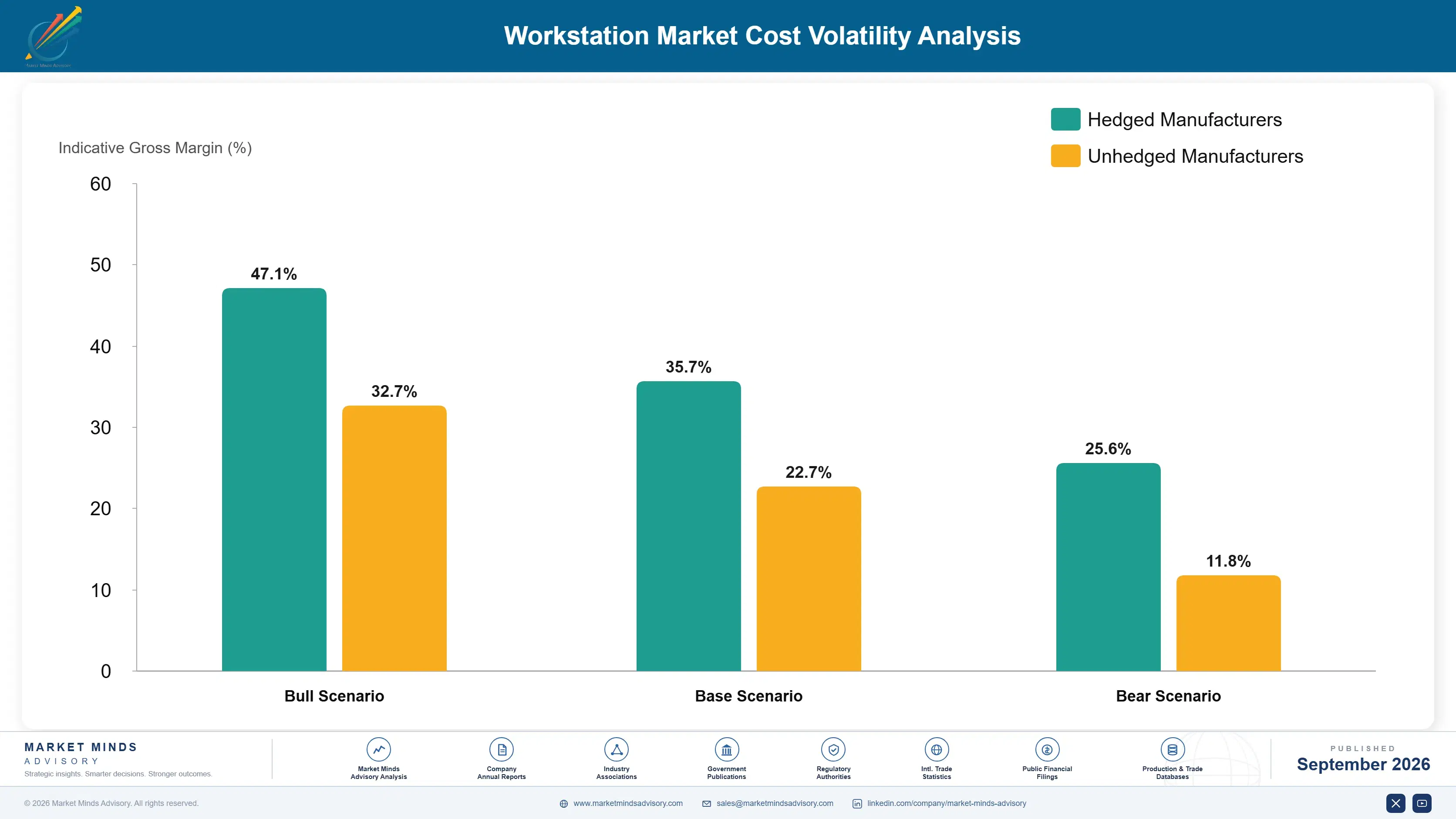
GPU And Processor Component Cost Exposure.

Graphics processing units and central processors represent the largest cost input for workstation manufacturing, running an estimated 50 to 55 percent of device bill of materials, sourced predominantly from a concentrated group of semiconductor design and fabrication companies. Memory and storage components add a smaller but meaningful additional share reflecting sustained enterprise investment across high-performance computing hardware programs as adoption continues.
Graphics processing unit pricing spiked notably during 2023 and 2024 as AI infrastructure demand surged and competed directly with workstation and gaming manufacturers for limited semiconductor manufacturing capacity, according to company annual report disclosures from major hardware manufacturers. Several manufacturers reported extended lead times and margin compression as GPU allocation tightened considerably during the period reflecting sustained enterprise investment across high-performance computing hardware programs as adoption continues expanding across engineering, media,.

Smaller manufacturers face a meaningful competitive disadvantage since they lack the volume commitments needed to secure priority GPU allocation from constrained suppliers, unlike Dell and HP which negotiate dedicated capacity reservations at scale. This exposure varies by business model, with boutique integrators lacking long-term supply agreements facing the sharpest cost pressure during allocation shortages reflecting sustained enterprise investment across high-performance computing hardware programs as adoption continues expanding.
workstation-market-cost-volatility-analysis-1790001527052

Secure Multi-Year GPU Supply Agreements Early reflecting sustained.

Leading manufacturers increasingly lock in multi-year GPU supply agreements with guaranteed volume commitments well ahead of product launch windows, reducing exposure to spot market price spikes. This requires substantial upfront capital commitment but insulates production schedules from allocation shortfalls during periods of constrained industry-wide GPU supply reflecting sustained enterprise investment across high-performance computing hardware programs.

Standardize Configurations Across Multiple Product Tiers reflecting sustained.

Manufacturers are standardizing GPU and processor configurations across multiple product tiers to increase purchasing volume with component suppliers, reducing per-unit cost through economies of scale. This standardization adds engineering coordination overhead but provides meaningful cost advantage when negotiating annual supply contracts with semiconductor vendors reflecting sustained enterprise investment across high-performance computing hardware programs as adoption continues.

Portfolio Architecture for Margin Defence

Portfolio economics split between commodity-adjacent standard CAD workstations carrying moderate margins and premium multi-GPU AI development or rendering configurations commanding substantially higher gross margins tied to specialized engineering. Volume plays chase unit shipment scale while premium plays extract value through fleet service contracts and hybrid cloud partnerships layered atop hardware reflecting sustained enterprise investment across high-performance computing hardware programs as adoption continues expanding.
The tension between chasing enterprise fleet volume and defending premium AI development positioning defines strategic choices across the manufacturer landscape. Manufacturers pursuing mainstream engineering accounts must accept moderate unit margins in exchange for order scale, while AI-focused specialists sacrifice volume for durable premium per-unit economics tied to configuration specialization reflecting sustained enterprise investment across high-performance computing hardware programs as adoption continues expanding across.

High-value margin pools concentrate in multi-GPU AI configurations, managed fleet services, and hybrid cloud burst partnerships rather than in standard CAD workstation sales itself, reinforcing why manufacturers increasingly treat hardware as a platform for higher-margin technical value-add that compounds across the multi-year enterprise relationship reflecting sustained enterprise investment across high-performance computing hardware programs as adoption continues expanding across engineering, media, and.

Standard Engineering CAD Workstations

Mass-market single-GPU workstations sold to engineering and architecture firms at accessible price points, prioritizing unit shipment volume over per-unit margin capture reflecting sustained enterprise investment across high-performance computing hardware programs as.
Gross Margin: 18-26%

Content Creation And Rendering Workstations

Higher-specification workstations with enhanced GPU and memory configurations sold to media production studios, carrying durable premium pricing tied to rendering performance reflecting sustained enterprise investment across high-performance computing hardware programs.
Gross Margin: 28-36%

Multi-GPU AI Development Systems

Advanced multi-GPU configurations engineered for AI model training and prototyping, representing the fastest-growing and highest margin portion of manufacturer revenue mix today reflecting sustained enterprise investment across high-performance reflecting sustained.
Gross Margin: 35-45%
workstation-market-portfolio-architecture-1790001528144

High-value Sub-segments and Strategic Watch-out

Multi-GPU AI Development Configurations

Small today but expanding rapidly as enterprises build internal AI development capability, generating durable margin premium as specialized configuration demand continues growing reflecting sustained enterprise investment across high-performance computing hardware programs as adoption continues expanding across engineering, media, and AI development applications supporting consistent reflecting sustained.
Gross Margin: 35-45%

Managed Fleet Service Contracts

A substantial and steadily expanding segment as enterprises prefer outsourcing hardware management overhead, generating durable recurring service revenue tied to fleet size and refresh cycles reflecting sustained enterprise investment across high-performance computing hardware programs as adoption continues expanding across engineering, media, and AI development reflecting sustained.
Gross Margin: 45-55%

Standard Engineering CAD Workstations

The largest volume segment today, anchored by broad engineering firm adoption, though margin per unit remains comparatively thin relative to AI and content creation segments across the portfolio reflecting sustained enterprise investment across high-performance computing hardware programs as adoption continues expanding across engineering, media, reflecting sustained.
Gross Margin: 18-26%

Legacy Single-Core Workstation Configurations

A strategic watch-out segment given accelerating enterprise migration toward multi-core and multi-GPU configurations. Manufacturers still supporting legacy configurations must plan an orderly transition reflecting sustained enterprise investment across high-performance computing hardware programs as adoption continues expanding across engineering, media, and AI development applications supporting reflecting sustained.
Gross Margin: 12-20%

Recurring Fleet Services Beyond Hardware reflecting.

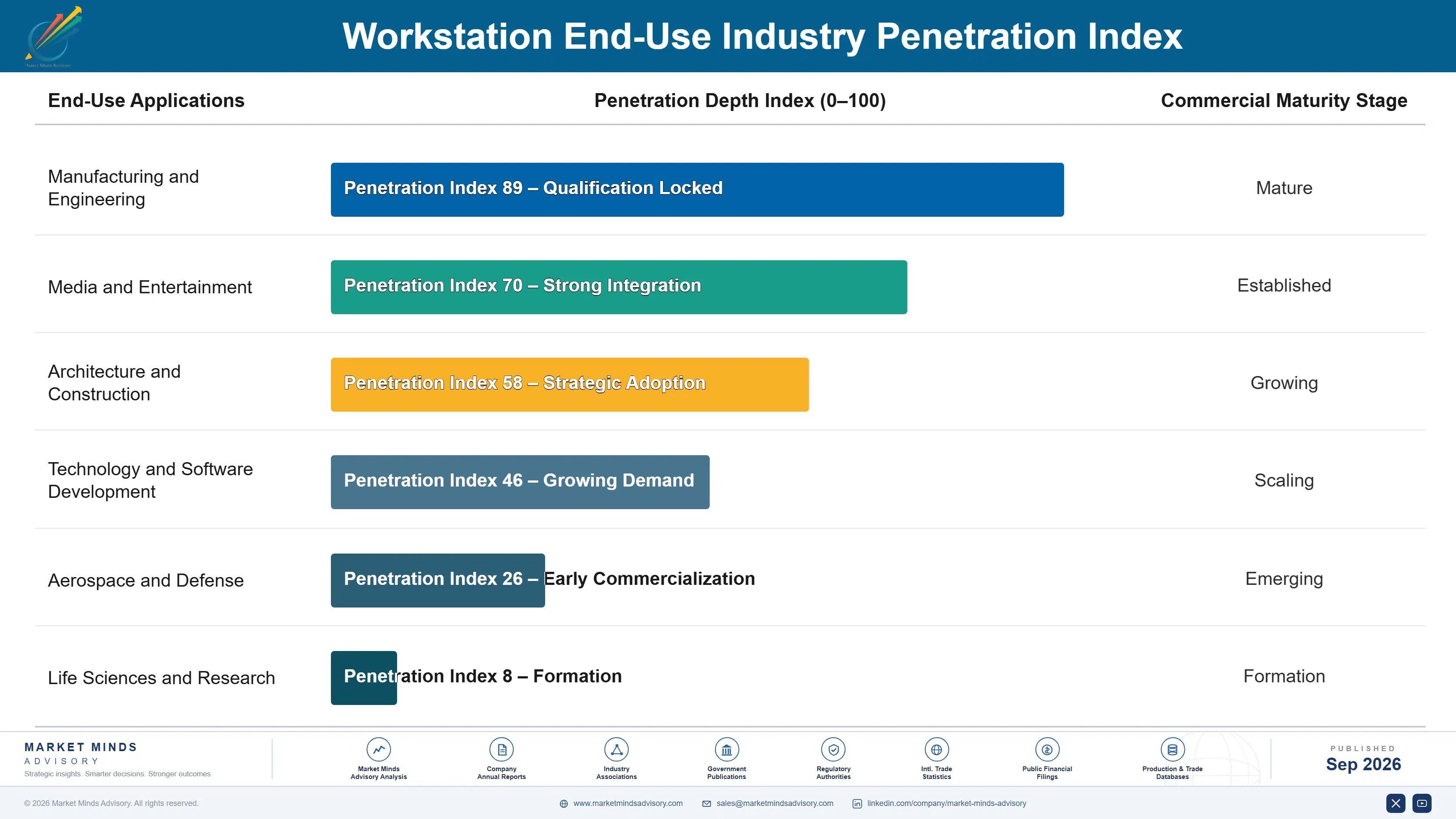
Workstation sales alone rarely produce durable annuity economics since enterprise hardware refresh cycles run four to five years. Manufacturers increasingly design managed fleet service contracts and hybrid cloud burst partnerships to generate revenue continuity across the equipment lifecycle, a strategy borrowed from broader enterprise IT service models reflecting sustained enterprise investment across high-performance computing hardware programs as adoption continues expanding across.
Adoption stickiness varies considerably by end-use vertical. Large enterprises with managed fleet service contracts show the deepest stickiness once their IT operations depend on a specific vendor's support infrastructure, since switching requires extensive requalification and staff retraining. Individual professional buyers show shallower stickiness, often comparing brands purely on price and specification at the point of purchase reflecting sustained enterprise investment across high-performance computing hardware programs as.

Generational buyer shifts are also underway. Younger data science and AI development teams show markedly stronger comfort with hybrid local-cloud workflows than older cohorts, who historically preferred purely local hardware ownership. Procurement decision authority within enterprises is simultaneously shifting from pure IT department specification toward broader total cost of ownership analysis incorporating cloud burst capacity costs, changing how manufacturers must position their commercial approach reflecting sustained enterprise investment across.
workstation-market-end-use-penetration-index-1790001529067

Where MMA Sees The Opportunity reflecting.

These are among the four positions where our research anticipates prominent divergence between winners and laggards over the coming forecast period. Each is grounded in the demand model, the regulatory perimeter, and the announced capacity pipeline.
01 / AI CONFIGURATION INVESTMENT.

Prioritize Multi-GPU AI Configurations Over Standard CAD Refresh reflecting sustained.

AI development and data science workstations are winning share fastest as enterprises build internal AI development capability requiring local GPU capacity for model prototyping ahead of production cloud training runs. Manufacturers that delay developing dedicated multi-GPU configuration product lines risk losing this fastest-growing customer segment to boutique integrators already serving AI-focused accounts. MMA views AI configuration investment as the single highest priority engineering allocation for manufacturers over the next three years given category growth reflecting sustained enterprise investment across high-performance computing hardware programs as adoption continues expanding.
02 / MANAGED FLEET SERVICE.

Build Managed Fleet Services To Capture Recurring Revenue reflecting.

Large enterprises increasingly prefer outsourcing hardware management overhead to vendors rather than maintaining internal support teams, creating a meaningful services opportunity beyond standard hardware sales. Manufacturers that build dedicated managed fleet service capability will capture disproportionate share of enterprise accounts seeking reduced IT management burden relative to competitors selling hardware alone. MMA views managed fleet services as more valuable than incremental hardware feature development for manufacturers seeking margin expansion reflecting sustained enterprise investment across high-performance computing hardware programs as adoption continues expanding across engineering, media, and AI.
03 / GPU SUPPLY SECURITY PLANNING.

Secure GPU Supply Agreements Ahead Of Continued Cost Volatility reflecting.

Graphics processing unit cost volatility has compressed margins for manufacturers lacking long-term supply agreements, and this exposure will likely persist given continued competition from AI infrastructure providers for the same semiconductor manufacturing capacity globally. Manufacturers securing dedicated GPU supply contracts ahead of anticipated demand surges secure meaningful cost stability advantage over competitors dependent entirely on spot market purchasing. MMA views GPU supply security as a durable competitive advantage rather than merely a cost mitigation tactic reflecting sustained enterprise investment across high-performance computing hardware programs as adoption continues.
04 / HYBRID CLOUD PARTNERSHIP STRATEGY.

Develop Hybrid Cloud Partnerships To Defend Against Substitution reflecting sustained.

Cloud-based rendering and remote workstation services increasingly substitute for local hardware ownership in applications with highly variable or project-based workload patterns, creating a persistent threat for manufacturers dependent purely on local hardware sales. Manufacturers that develop hybrid local-cloud burst capacity partnerships position themselves to capture value regardless of whether customers prefer local ownership or cloud consumption models. MMA views hybrid partnership development as essential defensive positioning against cloud substitution risk reflecting sustained enterprise investment across high-performance computing hardware programs as adoption continues expanding across engineering, media, and.

Engagement Snapshot From the Field

A live engagement with an industry participant carrying material or product regulatory and market exposure ahead of a defining policy shift, showing how our research translates into a defensible multi-year portfolio strategy.
MARKET MINDS ADVISORY · CLIENT ENGAGEMENT SUMMARY
Workstation Producer Strategic Portfolio Review and Transition Roadmap 2026·Investment Scenario on Workstation Exposure Evaluation 2025-26
CLIENT PROFILE
The client is an automotive engineering firm operating multiple design centers across North America, evaluating whether to refresh its aging CAD workstation fleet while simultaneously building new capability for AI-assisted generative design tools its engineering teams had begun piloting reflecting sustained enterprise investment across high-performance computing hardware programs as adoption continues reflecting sustained enterprise investment across high-performance computing.
STRATEGIC CHALLENGE
The client needed to determine whether to purchase separate hardware fleets for traditional CAD work and AI-assisted design tools, or consolidate onto unified configurations capable of supporting both workload types reflecting sustained enterprise investment across high-performance computing hardware programs as adoption continues expanding across engineering, media, and AI development applications.
MMA APPROACH
MMA combined its primary enterprise hardware survey data with expert interviews across engineering IT teams and competing workstation manufacturers to benchmark unified versus segregated fleet approaches across comparable automotive engineering deployments reflecting sustained enterprise investment across high-performance computing hardware programs as adoption continues expanding across engineering, media, and AI development.
KEY FINDINGS
  1. Unified configurations capable of supporting both CAD and AI workloads reduced total fleet management complexity meaningfully compared with segregated approaches reflecting sustained.
  2. Engineers using unified workstations transitioned more readily between traditional and AI-assisted design workflows without switching physical devices reflecting sustained enterprise investment across.
  3. Total cost of ownership analysis favored fewer, more capable unified workstations over separate specialized fleets for each workload type reflecting sustained reflecting sustained enterprise.
  4. IT support burden decreased measurably once the engineering team standardized on a single unified workstation configuration chain-wide reflecting sustained enterprise investment reflecting sustained enterprise.
CLIENT PROFILE
The client is an automotive engineering firm operating multiple design centers across North America, evaluating whether to refresh its aging CAD workstation fleet while simultaneously building new capability for AI-assisted generative design tools its engineering teams had begun piloting reflecting sustained enterprise investment across high-performance computing hardware programs as adoption continues reflecting sustained enterprise investment across high-performance computing.
STRATEGIC CHALLENGE
The client needed to determine whether to purchase separate hardware fleets for traditional CAD work and AI-assisted design tools, or consolidate onto unified configurations capable of supporting both workload types reflecting sustained enterprise investment across high-performance computing hardware programs as adoption continues expanding across engineering, media, and AI development applications.
MMA APPROACH
MMA combined its primary enterprise hardware survey data with expert interviews across engineering IT teams and competing workstation manufacturers to benchmark unified versus segregated fleet approaches across comparable automotive engineering deployments reflecting sustained enterprise investment across high-performance computing hardware programs as adoption continues expanding across engineering, media, and AI development.
KEY FINDINGS
  1. Unified configurations capable of supporting both CAD and AI workloads reduced total fleet management complexity meaningfully compared with segregated approaches reflecting sustained.
  2. Engineers using unified workstations transitioned more readily between traditional and AI-assisted design workflows without switching physical devices reflecting sustained enterprise investment across.
  3. Total cost of ownership analysis favored fewer, more capable unified workstations over separate specialized fleets for each workload type reflecting sustained reflecting sustained enterprise.
  4. IT support burden decreased measurably once the engineering team standardized on a single unified workstation configuration chain-wide reflecting sustained enterprise investment reflecting sustained enterprise.
RECOMMENDED STRATEGY
Phase 1: Phase one: pilot unified multi-GPU workstation configurations supporting both CAD and AI-assisted design tools at one design center reflecting sustained enterprise. Phase 2: Phase two: expand unified configuration deployment to additional design centers based on pilot performance and cost results reflecting sustained enterprise. Phase 3: Phase three: retire remaining segregated CAD-only and AI-only workstation fleets in favor of the unified configuration standard reflecting sustained enterprise.
OUTCOME
The client standardized on unified multi-GPU workstation configurations across all design centers, reporting a 22 percent reduction in IT support tickets and improved engineer workflow flexibility within two quarters (client-reported, unverified by MMA), with plans to extend the standard to newly acquired design centers reflecting sustained enterprise investment across high-performance computing hardware.

Frequently Asked Questions

Foundational context covering the market sizes, CAGR, scope, country, region and competition that inform every finding below. This section is provided to cover basics and most often pre-purchase conversations, answered from the MMA Primary Research Dataset.

What is the current size of the Workstation Market?

The global workstation market is valued at 15.2 billion dollars in 2025, the base year for this report's forecast period reflecting sustained reflecting sustained enterprise investment.

How large will the Workstation Market be by 2036?

MMA projects the market will reach approximately 35.45 billion dollars by 2036, driven by AI development adoption and content creation growth reflecting sustained enterprise reflecting sustained.

What is the CAGR for the Workstation Market 2026 to 2036?

The market is forecast to grow at a compound annual growth rate of 8.0 percent between 2026 and 2036 under MMA's base case scenario reflecting sustained.

Which segment is growing fastest?

AI development and data science workstations lead at a 15.0 percent CAGR, roughly 1.88 times the overall market rate, driven by local GPU demand reflecting.

Who are the major companies in the Workstation Market?

HP, Dell Technologies, Lenovo, Apple, and ASUSTeK Computer hold leading positions across enterprise and specialized workstation segments reflecting sustained enterprise investment across high-performance computing reflecting sustained.

Which country is growing fastest?

China leads at an 11.0 percent CAGR, supported by its massive contract manufacturing base and rapidly growing domestic AI development sector reflecting sustained enterprise reflecting sustained.

Report Segmentation Architecture

The full report scope spans multiple orthogonal segmentation dimensions, with cross-tabulated demand data provided for each dimension pair. Coverage extends further to regional breakdowns, trend trajectories, and the competitive detail needed to support segment-level decision-making.

By Product Type

  • Standard Engineering CAD Workstations
  • Content Creation And Rendering Workstations
  • Multi-GPU AI Development Systems
  • Mobile Workstations
  • Managed Fleet Service Contracts
  • Remote Workstation Virtualization Platforms

By End-Use Industry

  • Manufacturing and Engineering
  • Media and Entertainment
  • Architecture and Construction
  • Technology and Software Development
  • Aerospace and Defense
  • Life Sciences and Research

By Commercial Dimension

  • Direct Enterprise Sales
  • Systems Integrator Channel
  • Managed Fleet Service Contract
  • Retail and Online Distribution

By Region

  • North America
  • Western Europe
  • East Asia
  • South Asia and Pacific
  • Latin America
  • Middle East and Africa
  • Eastern Europe

Scope, Methodology, and Coverage

Every figure in this report is reproducible from documented input assumptions. The scope below maps the historical period, the forecast horizon, the segmentation dimensions, and the countries covered, alongside the underlying primary and qualitative methodology.
Historical Period
2020 to 2025
Forecast Period
2026 to 2036
Base Year
2025 (USD billions; MMA Primary Research Dataset, September 2026)
Market Definition
This report covers high-performance desktop and mobile computing systems engineered for professional CAD, content creation, engineering simulation, and AI development workloads. It excludes standard consumer desktop and laptop computers and dedicated server or data center computing hardware reflecting sustained.
Quantitative Units
USD billions, unit shipments where cited
Segmentation Dimensions
Product Type, End-Use Industry, Commercial Dimension, Region
Regions Covered
North America, Western Europe, East Asia, South Asia and Pacific, Latin America, Middle East and Africa, Eastern Europe
Countries Covered
United States, China, Germany, Japan, United Kingdom, South Korea, India, Brazil, and 30 additional countries
Key Companies Profiled
20
Quantitative Methodology
Primary survey, n=3,800 respondents, Q4 2025, six countries; demand-side model with trade association cross-validation
Qualitative Methodology
47 expert interviews, Q4 2025; applied to validate demand model assumptions, identify emerging dynamics, and assess competitive positioning
Report Format
PDF and XLSX data workbook (Word format preview document)
Publisher
Market Minds Advisory
Report Code
MMA-2026-TEC-627
Published
September 2026
Contact
sales@marketmindsadvisory.com | www.marketmindsadvisory.com

Purchase the full Workstation Market Report (2026 to 2036).

The full report provides comprehensive coverage of the global workstation market across all segments, regions, and competitive dynamics outlined in this summary. It includes detailed manufacturer profiles, pricing benchmarks, and quantified segment-level forecasts through 2036. These findings draw on MMA's primary survey of 3,800 respondents and 47 expert interviews conducted in the fourth quarter of 2025. Subscribers receive quarterly data updates tracking GPU cost trends and competitive positioning shifts as the market evolves. Regional appendices break out country-level detail across thirty nine markets covered in this study.
Segment-level revenue forecasts through 2036 reflecting sustained.
Twenty manufacturer competitive profiles and benchmarking reflecting.
Country-level market sizing across 39 countries reflecting.
Quarterly data updates through subscription access reflecting.
Primary survey data across six countries reflecting.
Expert interview transcripts and analyst commentary reflecting.

Built For The People Who Decide

From boardroom strategy to bench-side execution, this report is read cover-to-cover by leaders shaping the next decade of their industry, turning demand scenarios, market dynamics and valuation benchmarks into decisions.
CXOs/ Presidents/ VPs/ Managers
M&A and Corporate Development
Strategy Teams and R&D Heads
Procurement and Product Directors
Regulatory and Compliance Leaders
Investor Relations and Equity Analysts