Market Minds Advisory
Work Boots Market

Work Boots Market: Work Boots Market. Composite-Toe Innovation and OSHA Enforcement Intensity Reshape a Mature Safety Footwear Category.

Composite-toe innovation and tightening workplace safety enforcement are reshaping a mature protective footwear category, pushing manufacturers toward lighter, electrical-hazard-rated designs across most industrial employment sectors and construction trades worldwide and consistently.

Lead Analyst

Published

September 2026

Make Smarter Decisions with Customized Research Insights

Request a free sample report and evaluate market opportunities, growth trends, and competitive dynamics relevant to your business needs.

2025 MARKET VALUE$9.2BMarket Size 2025
2036 FORECAST VALUE$14.6BBase Case , 2026 to 2036
CAGR 2026 TO 20364.3 %Bull 5.5% / Bear 3.1%
INCREMENTAL OPPORTUNITY$5.0BNet 10- year value creation
EXPANSION MULTIPLE1.52x2036 value over 2026 base
Strategic Levers
M&A Pipeline
Regional Outlook
Country Rankings
Competitive Intelligence
Segmental Deep-dive
Call-Us : 91 93563 13602

Executive Snapshot and Market Trajectory.

Composite-toe technology and tightening electrical hazard certification requirements are pulling a decades-old protective footwear category toward lighter, technically differentiated products even as core safety compliance demand remains steady across most industrial employers nationwide and internationally, reshaping purchasing criteria beyond basic impact protection alone and across most procurement programs today.
Commercial momentum concentrates in composite-toe and electrical hazard rated construction, as employers increasingly prioritize worker comfort and reduced fatigue alongside baseline safety compliance requirements, while India's expanding industrial workforce and China's manufacturing base drive the fastest unit volume growth worldwide across most price tiers and distribution channels, both direct-to-employer procurement programs and specialty retail nationwide, internationally, and across most industrial safety compliance programs and occupational health initiatives broadly and consistently.
Competition remains moderately concentrated among established safety footwear brands even as regional manufacturers compete aggressively on price in developing markets, while tightening workplace safety enforcement across several countries pushes employers toward certified, higher-specification boots rather than generic protective footwear, reinforcing brand differentiation through certification credibility today, consistently, and increasingly across most procurement decisions and safety officer recommendations, employee retention efforts, and long-term workforce planning strategies industrywide.
Market Definition
The Work Boots Market covers protective footwear engineered for industrial, construction, and hazardous-environment employment, including safety-toe, electrical hazard rated, and waterproof designs, excluding general-purpose casual footwear and athletic shoes.
Base Year Value
$9.2B in 2025 (MMA Primary Research Dataset, September 2026)
Forecast Period
2026 to 2036, eleven discrete annual values
CAGR
4.3% base case. Bull 5.5%. Bear 3.1%.
Fastest Growth Segment
Composite-Toe Work Boots: 6.8% CAGR
Fastest Growth Country
India: 7.4% CAGR
Fastest Growth Region
South Asia and Pacific: 6.3% CAGR
Largest Region
North America: 30% of 2025 global value
Market Leaders
Wolverine Worldwide Inc, Honeywell International Inc, Caterpillar Inc (licensed footwear), Red Wing Shoe Company, VF Corporation (Timberland PRO). Source: MMA Analysis, company annual reports.
Primary Survey
n=3,800 procurement and R&D decision-makers, Q4 2025, six countries
Methodology
Demand-side build-up, cross-validated against public data, 47 expert interviews

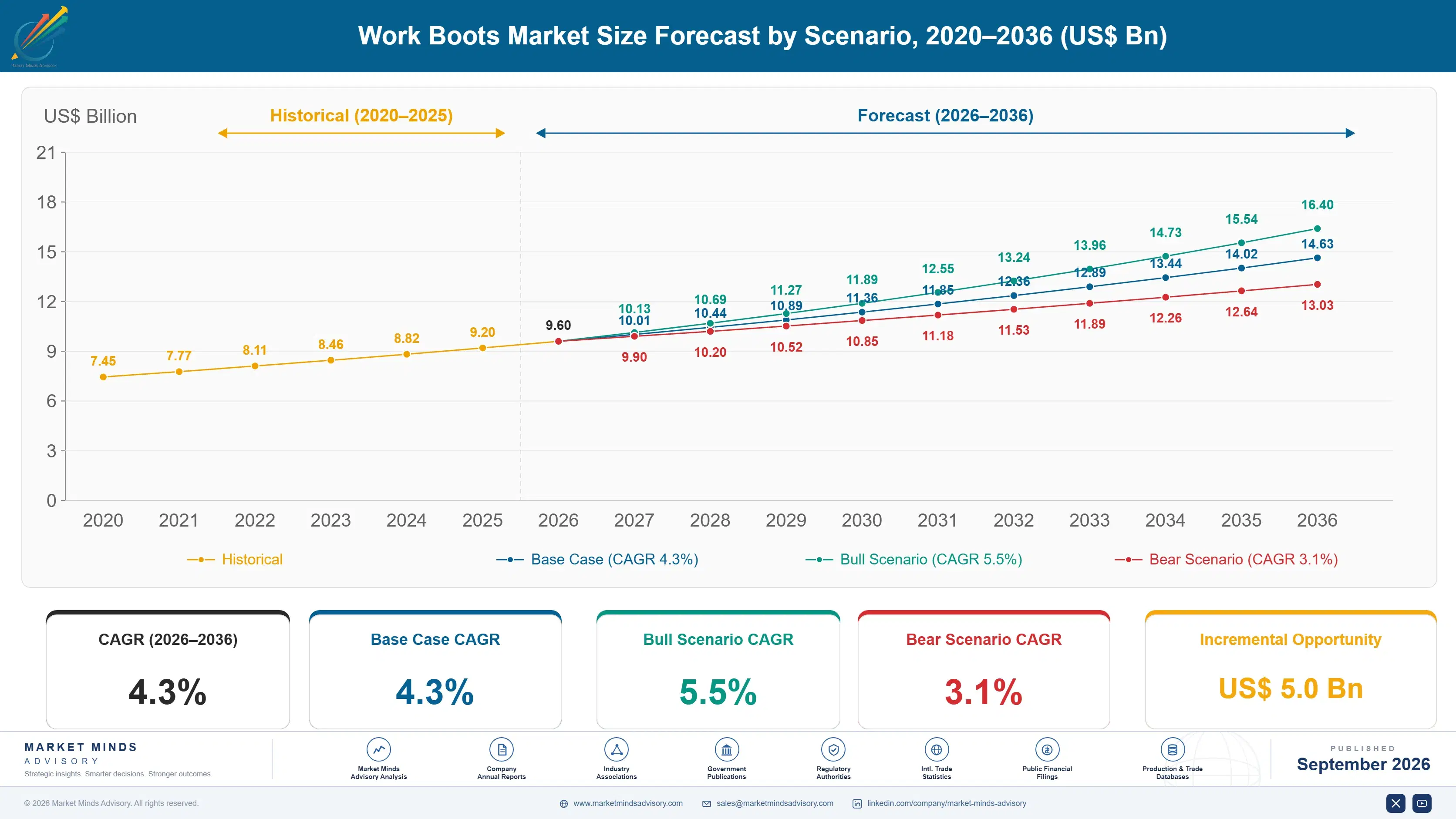
Work Boots Market Forecast Scenarios

work-boots-market-share-analysis-size-forecast-scenario-1790024785698
Between 2020 and 2025, the category grew steadily as construction and industrial employment recovered from pandemic-era disruption, with composite-toe and electrical hazard rated products gaining share consistently as manufacturers expanded certified product lines and retail distribution across most major markets, producing a 3.8 percent historical CAGR overall across most industrial employment segments, geographic markets, and procurement channels worldwide today.
The base case assumes continued moderate growth driven by three distinct mechanisms: tightening workplace safety enforcement expanding certified boot requirements across developing industrial economies and emerging manufacturing hubs worldwide, composite-toe technology gaining share as employers increasingly prioritize worker comfort alongside baseline compliance, and India's and Southeast Asia's rapidly expanding industrial workforce driving meaningful incremental unit volume across most price tiers, distribution channels, and employer procurement programs simultaneously, consistently, and predictably.
A bull scenario hinges on accelerated workplace safety regulation adoption across emerging industrial economies currently lacking mandatory certified footwear requirements entirely and consistently across most sectors and jurisdictions. A bear scenario centers on automation reducing manual labor headcount across construction and manufacturing sectors, meaningfully suppressing the core employed-worker demand base over the coming decade and beyond.

Composite-Toe Innovation Redefines Safety Footwear Standards

The Work Boots Market occupies a mature but genuinely resilient corner of industrial protective equipment, where baseline demand tracks construction and manufacturing employment closely while technical differentiation increasingly separates premium brands from generic regional competitors on comfort and certification credibility across most industrial employment sectors, geographic markets, procurement channels, and workforce safety programs worldwide and consistently today and tomorrow.
MARKET CONCENTRATIONCR5: 38%Top five brands hold over one-third combined market share
AVERAGE SELLING PRICE$92 per pairBlended global price across safety-toe and standard work boots
TOP PRODUCING COUNTRY SHAREChina: 33%Share of global manufacturing output concentrated domestically today
CERTIFIED COMPLIANCE RATE64%Share of units meeting formal safety-toe certification standards
TRADE INTENSITY51% exportedShare of manufactured units shipped across international borders yearly
REPLACEMENT CYCLE LENGTH14 monthsAverage time before workers replace primary safety footwear fully
China dominates manufacturing while the United States and Western Europe drive the highest per-unit spending, reflecting stricter enforcement of electrical hazard and safety-toe certification standards among employers concerned about liability exposure and worker retention in physically demanding roles across most regulated industrial employment categories nationwide and internationally, particularly within construction, heavy manufacturing, utility, and energy sectors facing persistent skilled labor shortages nationwide and internationally.
Composite-toe technology represents the clearest technical inflection point in decades, offering comparable protection to steel toe caps at meaningfully lower weight, a shift employers increasingly favor as they balance safety compliance against worker fatigue and long-shift comfort across demanding industrial environments, warehouses, and construction sites worldwide, particularly among younger, retention-focused workforce segments entering physically demanding trades for the first time in their careers.
"Work boots are not a discretionary purchase. They are the one piece of equipment employers cannot afford to get wrong, which is exactly why the category rewards certification credibility over price."
Practice Lead, Industrial Safety Equipment Practice · MMA Industrial Safety Footwear and Protective Equipment Practice · September 2026

Market Trends

Composite-Toe Adoption Accelerates Among Comfort-Focused Employers

Composite-toe technology, once viewed as a compromise between weight and protection, has matured into a genuinely preferred specification among employers managing worker retention amid persistent skilled labor shortages across construction and manufacturing sectors nationwide and internationally. Manufacturers report composite-toe order growth substantially outpacing traditional steel-toe products, as buyers increasingly prioritize reduced fatigue over marginal cost savings on bulk purchasing contracts. The shift extends beyond individual worker preference into formal procurement policy, as several large industrial employers have updated safety equipment specifications to favor composite-toe options explicitly across their facilities nationwide.
Market Impact: 14% construction employment growth in markets
Electrical Hazard Certification Becomes Standard Procurement Requirement

Electrical hazard rated boots, once specified only for utility and electrical trade workers, are increasingly required across broader industrial procurement policies as employers standardize safety specifications to reduce liability exposure across mixed work environments and multi-trade job sites. Manufacturers have responded by expanding electrical hazard certification across a wider range of product lines previously offered only in non-certified variants. Procurement managers report that certification credibility increasingly influences vendor selection more than price differentials, particularly among large industrial employers managing enterprise-wide safety compliance programs across multiple facility types and regional operations.
Market Impact: 19% premium discount for safety programs

Market Opportunities and Growth Drivers

Global Construction Investment Sustains Baseline Demand

Sustained global infrastructure and residential construction investment continues to generate steady baseline demand for protective footwear, since work boots remain a mandatory purchase rather than a discretionary one across most regulated construction job sites worldwide and consistently over time. Government infrastructure spending programs across multiple developed and emerging economies have expanded construction employment meaningfully over the past several years, directly supporting incremental unit demand. Employers increasingly bundle safety footwear procurement into broader personal protective equipment programs, creating predictable, recurring purchasing cycles tied to standard replacement schedules rather than discretionary spending decisions.
Market Impact: 22% leather price volatility recently

Workplace Injury Liability Concerns Drive Employer Procurement

Rising awareness of workplace injury liability costs, including workers compensation claims and potential litigation exposure, has pushed employers toward proactive investment in certified protective footwear rather than accepting minimum regulatory compliance thresholds alone across most job sites. Insurance providers increasingly offer premium discounts to employers demonstrating comprehensive safety equipment programs, creating a direct financial incentive beyond regulatory compliance requirements. Larger industrial employers increasingly report treating safety footwear procurement as risk management investment rather than a pure cost center, supporting sustained demand for higher-specification, certified products across most facility types and regional operations.
Market Impact: 9% of market counterfeit or mislabeled

Market Restraints and Challenges

Raw Material Cost Volatility Squeezes Manufacturer Margins

Leather and rubber outsole feedstock prices have shown significant volatility over recent years, tied to agricultural commodity cycles and petrochemical price swings that manufacturers cannot fully pass through to price-sensitive bulk industrial buyers without risking contract loss. The root cause traces to work boots relying on raw material inputs shared with unrelated commodity markets subject to independent demand shocks. The commercial impact falls hardest on smaller manufacturers lacking long-term supply contracts or vertical integration into tanning operations. Some manufacturers mitigate exposure through synthetic material substitution and diversified sourcing across multiple geographic regions.
Market Impact: 24% composite-toe order growth yearly

Counterfeit Safety Certification Undermines Category Trust

Counterfeit and mislabeled safety-toe products, particularly in price-sensitive developing markets, undermine consumer and employer trust in certification labeling while creating genuine safety risk for workers who believe they carry adequate protection on hazardous job sites. The root cause traces to weak enforcement infrastructure around safety certification verification in several developing markets lacking rigorous regulatory inspection capacity. The commercial impact falls on legitimate manufacturers who lose sales to cheaper counterfeit alternatives while bearing certification compliance costs themselves. Industry associations increasingly mitigate this through blockchain-based authentication and stricter import inspection protocols nationwide.
Market Impact: 31% of contracts require EH certification
3 additional market trends, 4 additional growth drivers, and 3 additional restraints and challenges are covered in the full report. Contact sales@marketmindsadvisory.com to access the complete intelligence.

Segment CAGR and Growth Architecture

The Work Boots Market splits into six product categories along a single toe-protection and technology dimension, ranging from soft-toe standard boots to certified composite-toe and electrical hazard rated designs, each serving distinct regulatory compliance needs and industrial employment contexts across most global markets, procurement programs, occupational safety regulatory frameworks, and employer risk management strategies.
work-boots-market-share-analysis-market-share-analysis-1790024786284

Composite-Toe Work Boots

Composite-toe work boots represent the fastest-growing segment, offering protection equivalent to traditional steel-toe caps at meaningfully reduced weight, a specification increasingly favored by employers managing worker fatigue and retention across physically demanding roles nationwide and internationally. Adoption concentrates heavily among younger workforce cohorts entering construction and manufacturing trades, who often report stronger preference for lighter footwear compared to veteran workers accustomed to traditional steel-toe designs and heavier specifications. Manufacturers have moved aggressively into this segment as material costs decline and production processes mature, with several established brands launching dedicated composite-toe product lines within the past several years. Employers updating procurement specifications increasingly favor composite-toe options explicitly across large industrial facilities nationwide.
CAGR 6.8%

Electrical Hazard Rated Boots

Electrical hazard rated work boots have expanded meaningfully beyond their traditional utility and electrical trade customer base, as broader industrial employers standardize safety specifications to reduce liability exposure across mixed work environments where electrical hazards may exist alongside other risks and equipment hazards nationwide. Manufacturers have responded by expanding EH certification across a wider range of product lines previously offered only in non-certified variants, meeting rising procurement demand from safety-conscious buyers nationwide. Construction, manufacturing, and warehouse employers increasingly specify EH-rated boots as a baseline requirement rather than an optional upgrade, reflecting growing awareness of electrical hazard exposure even in facilities not traditionally considered high electrical risk environments and job classifications.
CAGR 6.0%
Full segment breakdown across 6 segments available in the complete report.

Regional Architecture and Country Demand Map

Regional demand reflects manufacturing concentration and regulatory enforcement intensity rather than pure employment headcount, with North America leading on certified spend and safety compliance depth, while South Asia and Pacific posts the fastest unit growth regionally and consistently across most industrializing economies and construction markets.

North America

North America leads on certified safety footwear spending, driven by strict OSHA enforcement across construction, manufacturing, and oil and gas sectors that mandate specific certification standards for many industrial job classifications and job sites nationwide and consistently. The United States carries the deepest workers compensation liability culture globally, pushing employers toward proactive investment in higher-specification, certified products rather than minimum regulatory compliance thresholds alone. Composite-toe adoption has advanced furthest in this region, reflecting both higher disposable procurement budgets and stronger worker retention concerns amid persistent skilled labor shortages across construction and manufacturing trades nationwide. Canada mirrors similar regulatory intensity, though at a somewhat smaller absolute scale and population base overall.
Share: 30% | CAGR: 4.6% (2026 to 2036)

Western Europe

Western Europe combines mature occupational safety regulation with well-established industrial employment across Germany, France, and the United Kingdom, where EU workplace safety directives set baseline certification requirements comparable in rigor to North American standards and inspection regimes nationwide and consistently. German manufacturers hold particular technical credibility in engineered safety footwear, supplying both domestic industrial buyers and export markets across neighboring countries and trading partners nationwide and internationally. Construction sector demand remains steady though less dynamic than in faster-growing regions, reflecting the region's mature infrastructure base and comparatively slower employment growth overall. Composite-toe adoption trails North America somewhat but continues advancing as employers prioritize worker comfort alongside baseline regulatory compliance requirements.
Share: 20% | CAGR: 2.8% (2026 to 2036)
Regional intelligence for 5 additional markets available in the complete report: East Asia, South Asia and Pacific, Latin America, Middle East and Africa, Eastern Europe. Contact sales@marketmindsadvisory.com.
work-boots-market-share-analysis-country-cagr-analysis-1790024786801

Where Safety Footwear Brands Can Capture Additional Margin

Manufacturers and distributors have several credible paths to expand margin beyond pure per-pair pricing, spanning fleet replenishment contracts, certification-driven premium positioning, and value-added services that convert one-time buyers into recurring procurement relationships over time. Each lever depends on deepening the employer relationship well beyond a single bulk order or seasonal purchase decision entirely and permanently.

Fleet Replenishment Contract Programs for Employers

Recurring fleet replenishment contracts covering an employer's entire workforce convert intermittent individual purchases into predictable, high-volume recurring revenue, mirroring managed procurement relationships proven effective across adjacent industrial supply categories and safety equipment programs nationwide. Manufacturers offering fleet contracts report a 29 percent lift in customer retention and larger average order values than transactional retail sales, since the recurring commitment reduces the likelihood employers switch suppliers on a single bad experience. Fleet contracts also generate predictable demand forecasting for production planning, improving manufacturing efficiency and inventory management across most facility types nationwide.
Market Impact: 29% higher retention rate on fleet contract customers nationwide

Premium Certification Consulting Services for Buyers

Offering paid certification consulting services helps employers navigate complex, overlapping electrical hazard, composite-toe, and regional safety standards, converting manufacturer expertise that previously went uncompensated into a genuine revenue stream across most industrial procurement relationships and facility types nationwide and internationally today. Consulting-attached sales, priced at roughly 17 percent above standard hardware cost, help employers avoid costly non-compliance penalties and workplace injury liability exposure entirely. Manufacturers offering this service report meaningfully stronger customer loyalty among large industrial buyers managing complex, multi-facility compliance programs across different regulatory jurisdictions and employment categories nationwide.
Market Impact: 17% price premium captured on consulting-attached employer orders

Extended Warranty and Replacement Guarantee Bundles

Bundling extended equipment warranties with proactive replacement guarantees addresses the operational uncertainty that drives inconsistent replacement timing, converting a one-time hardware sale into a multi-year service relationship with each purchasing employer and their broader workforce nationwide. Employers offering these bundles to their workforce report meaningfully lower total replacement costs and improved worker satisfaction and morale with provided safety equipment. Manufacturers price these bundles at roughly 13 percent above standard products, generating high-margin recurring revenue with minimal incremental fulfillment cost attached to each sale nationwide, internationally, and across most facility types.
Market Impact: 13% of hardware value captured as bundle revenue

Custom Branded Corporate Safety Footwear Programs

Manufacturers increasingly offer custom-branded footwear programs for large corporate clients, embedding company logos and specific colorway requirements into standard safety-toe product lines, capturing premium pricing from employers seeking brand consistency across their workforce uniform programs and identity standards nationwide. These custom programs typically command a 21 percent higher per-unit price than standard catalog products, reflecting the value employers place on workforce visual consistency and brand presentation. Early results suggest these programs also improve order predictability and customer retention, since custom tooling investments create genuine switching costs for employers considering alternative suppliers.
Market Impact: 21% price premium captured on custom branded corporate programs

Who Controls the Margin Pool

The Work Boots Market carries a CR5 near 38%, moderate to high concentration reflecting the category's maturity and the credibility premium established safety certification brands command over generic regional manufacturers on a revenue basis across most price tiers and geographic markets worldwide and consistently. Wolverine Worldwide and Honeywell lead through decades-established brand recognition and certification credibility, with a meaningful gap separating them from smaller regional and private-label competitors nationwide and internationally today.
Current competitive activity centers on composite-toe innovation, electrical hazard certification expansion, and fleet contract program development across most major brands, retail formats, and geographic markets worldwide and domestically today. Players increasingly differentiate through certification breadth and worker comfort engineering rather than pure durability claims, since regional manufacturers have achieved functional parity on basic construction quality metrics worldwide and consistently.

Emerging pressure comes from Chinese and Southeast Asian manufacturers selling certified safety footwear at substantially lower price points through direct e-commerce channels, bypassing traditional distributor and specialty retail relationships entirely. Rankings could shift meaningfully if these manufacturers continue building certification credibility and brand trust comparable to established players, eroding the compliance differentiation that currently justifies premium Western pricing at considerable scale.
work-boots-market-share-analysis-company-positioning-matrix-1790024787329

Competitive Moat and Risk Dimensions

WOLVERINE WORLDWIDE INC

Moat: Portfolio of Established Safety Brands

Wolverine Worldwide's Cat, Wolverine, and Harley-Davidson Footwear labels carry decades-established brand recognition across construction and industrial trades, giving it retail shelf placement and employer trust that smaller regional manufacturers cannot easily replicate, reinforcing pricing power across most price tiers, distribution channels, and geographic markets nationwide and consistently.
WOLVERINE WORLDWIDE INC

Risk: Exposed to Low-Cost Import Competition

Wolverine faces genuine margin pressure from Chinese and Southeast Asian manufacturers selling comparable certified hardware directly through e-commerce channels at substantially lower price points, forcing continued investment in brand and certification differentiation to justify premium retail positioning nationwide, internationally, and across most online marketplaces and specialty channels.
HONEYWELL INTERNATIONAL INC

Moat: Integrated Industrial Safety Equipment Portfolio

Honeywell's broad industrial safety equipment portfolio gives it negotiating leverage with major corporate and government procurement programs that single-category footwear specialists lack, supporting favorable enterprise contract placement across most large industrial employers nationwide and internationally today, particularly within multi-year framework agreements and bulk procurement arrangements.
HONEYWELL INTERNATIONAL INC

Risk: Slower Consumer Brand Recognition Development

Honeywell's more industrial, B2B-focused brand positioning, while a genuine strength in enterprise procurement, has moved more slowly toward direct consumer and small-contractor brand recognition than footwear-focused competitors, potentially ceding positioning in this expanding buyer segment across most retail channels, geographic markets, and independent contractor procurement decisions nationwide.

Players Tracked

Prominent Players

Wolverine Worldwide Inc
Honeywell International Inc
Caterpillar Inc
Red Wing Shoe Company
VF Corporation

Other Key Players

Rocky Brands Inc
Timberland Company
Justin Brands Inc
Carolina Shoe Company
Keen Utility Inc
Skechers USA Inc (Work Line)
Reebok Work
Thorogood (Weinbrenner Shoe Corp)
Georgia Boot LLC
Muck Boot Company
Dunlop Protective Footwear
Delta Plus Group
Uvex Safety Group
Bata Industrials
Jallatte SAS

Recent Developments

MARCH 2026

Wolverine Worldwide Launches Expanded Composite-Toe Line

Wolverine Worldwide introduced an expanded composite-toe product line under its Wolverine brand, targeting fatigue-conscious construction workers previously served primarily by heavier steel-toe alternatives, supported by a broad retail rollout across major industrial supply distributors, specialty safety retailers, and direct-to-employer sales channels nationwide and internationally across multiple product categories.
Signal: Signals accelerating composite-toe mainstreaming among established, traditionally steel-toe-focused safety footwear brands nationwide, internationally, and across most major markets.
SEPTEMBER 2025

Honeywell Expands Fleet Contract Program Into Manufacturing

Honeywell announced an expanded fleet replenishment contract program targeting large manufacturing employers beyond its traditional construction and utility client base, adding dedicated account management resources and digital procurement tools to support multi-facility compliance programs across diverse industrial customer segments, geographic markets, and employment categories nationwide.
Signal: Signals continued diversification beyond Honeywell's traditional construction and utility sector customer concentration and dependency nationwide and internationally.
JANUARY 2026

Red Wing Opens New Electrical Hazard Testing Facility

Red Wing Shoe Company commissioned a new in-house electrical hazard testing facility dedicated to accelerating certification timelines for new product development, reducing dependence on third-party testing laboratories and shortening time-to-market for newly certified safety footwear designs across multiple product lines, price tiers, and regional markets.
Signal: Signals manufacturers investing directly in certification infrastructure to accelerate new product development cycles and market timing nationwide and consistently.

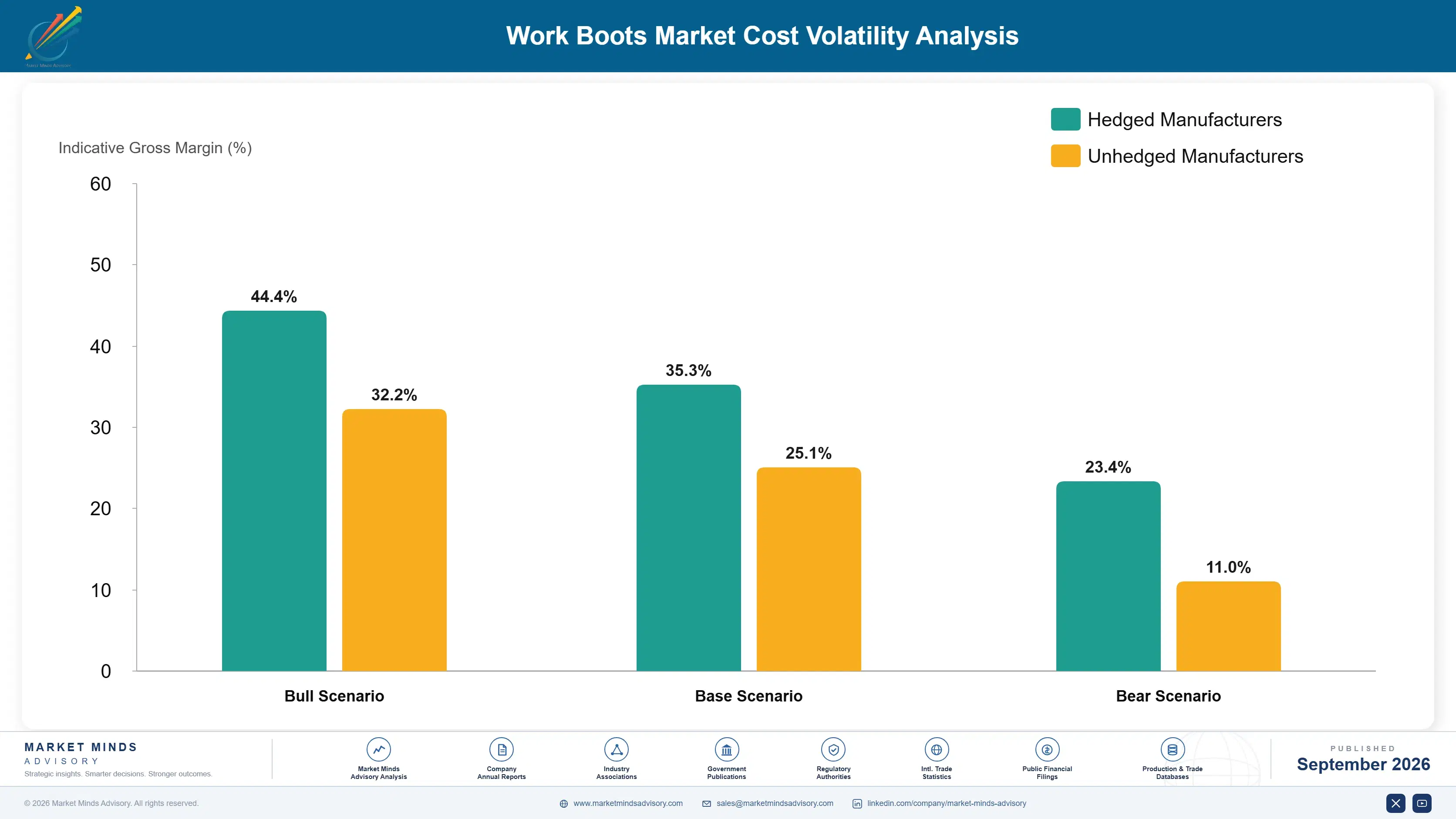
Leather, Rubber, and Steel Drive Cost Exposure

Leather uppers, rubber outsoles, and steel or composite toe components together represent roughly 55 percent of finished-product cost of goods sold across most manufacturers in this category, with leather sourced predominantly from South American and Asian tanning operations and rubber compounds tied to petrochemical and natural rubber feedstock markets subject to independent commodity cycles, seasonal supply fluctuations, and regional export policies today.
Leather prices rose sharply during 2022 as global cattle herd sizes contracted following drought conditions across major producing regions, a disruption tracked extensively in USDA livestock reporting and confirmed by industry trade associations worldwide, compressing manufacturer margins across the leather footwear segment for roughly a year before gradual normalization took hold across most affected regional supply chains, contract renewal cycles, and downstream converter pricing negotiations broadly.

Smaller regional manufacturers carry disproportionate exposure since they lack the long-term supply contracts and vertical integration that larger brands maintain with tanning and rubber suppliers, leaving them more dependent on spot-market purchasing during price spikes, a disadvantage that widens further whenever feedstock volatility persists for extended periods across export-reliant manufacturing regions, smaller-scale operations, and private-label producers broadly.
work-boots-market-share-analysis-cost-volatility-analysis-1790024787526

Multi-Region Leather Supply Diversification

Leading manufacturers increasingly diversify leather sourcing across South American, Asian, and North American tanning operations under multi-year fixed-volume contracts, reducing exposure to any single regional feedstock disruption while preserving negotiating leverage on price during renewal cycles across the broader footwear category, export markets, domestic retail supply chains, specialty distribution partners, and industrial procurement programs worldwide.

Synthetic Material Substitution Research

Several manufacturers fund ongoing research into synthetic upper materials that reduce dependence on leather volume per unit produced annually, lowering agricultural commodity exposure while maintaining comparable durability and water resistance performance for standard industrial applications, moderate-hazard work environments, and most price-sensitive procurement programs across geographic markets, employer purchasing categories, and product certification requirements today.

Vertical Integration Into Rubber Compounding

Larger players increasingly bring rubber outsole compounding fully in-house or under joint venture arrangements, capturing margin previously paid to third-party suppliers while gaining tighter control over material specifications used across premium and certified product lines industrywide, across multiple geographic markets, distribution channels, employer procurement programs, regional manufacturing operations, and global export supply chains broadly.

Portfolio Architecture for Margin Defence

The Work Boots Market splits into three commercial tiers with distinctly different margin economics: volume commodity-adjacent products competing largely on price and bulk employer procurement, premium certified products commanding brand loyalty through certification credibility and comfort engineering, and sustainability or next-generation formats capturing early-adopter willingness to pay for composite materials and worker wellness features across most retail channels nationwide and internationally today.
Volume and premium tiers pull in genuinely different directions commercially: regional manufacturers compress volume-tier pricing continuously through direct e-commerce channels across most price-sensitive employer segments, while premium brands defend margin through certification breadth, composite-toe innovation, and fleet contract programs that raise switching costs for loyal repeat employers across most procurement channels nationwide, a tension showing no sign of easing as regional quality keeps improving steadily.

High-value margin pools concentrate disproportionately in composite-toe and electrical hazard rated formats, where certification credibility and brand trust matter more than raw durability specifications, leaving traditional steel-toe formats increasingly commoditized across most price-sensitive retail channels and private-label competitive segments broadly today, a divergence manufacturers increasingly design entire product development roadmaps, marketing budgets, and certification investment strategies around deliberately and consistently.

Mass-market steel-toe and soft-toe boots sold through big-box retailers, industrial supply chains, and discount distributors nationwide, competing chiefly on unit price with heavy regional manufacturer penetration and growing private-label competition.
Gross Margin: 24-30%

Certified composite-toe and electrical hazard rated products carrying established brand names, sold through specialty safety retail and enterprise procurement channels at meaningfully higher price points nationwide and internationally across comparable markets.
Gross Margin: 38-45%

Advanced composite materials and worker wellness-focused designs targeting retention-conscious employers willing to pay a premium for reduced worker fatigue, improved comfort outcomes, and long-term ownership value across most industrial employment sectors.
Gross Margin: 40-48%
work-boots-market-share-analysis-portfolio-architecture-1790024788028

High-value Sub-segments and Strategic Watch-out

Composite-Toe Work Boots

The fastest-growing, highest-value segment, driven by demand for lighter, fatigue-reducing protection among employers managing worker retention amid persistent skilled labor shortages, commanding premium pricing across most retail channels, geographic markets, distribution formats, industrial employment categories, and enterprise procurement programs nationwide, internationally, and across most price tiers.
Gross Margin: 42-48%

Electrical Hazard Rated Boots

A high-value, high-growth segment appealing to employers standardizing safety specifications across mixed work environments, particularly across construction and manufacturing sectors where liability exposure concerns increasingly drive procurement decisions and enterprise-wide compliance program design across most geographic markets nationwide, internationally, and across most industrial employment categories.
Gross Margin: 40-46%

Standard Steel-Toe Boots

The volume core of the category, sold predominantly through mass retail and industrial supply channels at established price points, facing continuous margin compression from regional competition, slower unit growth than premium formats, and increasingly price-sensitive bulk procurement behavior across most geographic markets and demographic employment segments.
Gross Margin: 22-28%

Soft-Toe Non-Safety Work Boots

A strategic watch-out segment as workplace safety enforcement expands into previously unregulated job categories, threatening this legacy format's retail presence even as it remains a meaningful entry-level volume contributor across most geographic markets, demographic segments, and price-sensitive retail channels nationwide, internationally, and across most emerging markets.
Gross Margin: 20-26%

Replacement Cycles Anchor Recurring Demand

Work boots function economically as a recurring, mandated replacement product once a worker enters a regulated industrial role: replacement purchasing repeats every twelve to eighteen months for years, sometimes decades, generating predictable revenue far more valuable to manufacturers and employers than any single transaction, and employer procurement contracts lock in this cadence formally across most large industrial workforces nationwide and internationally, reinforcing brand loyalty over time.
Adoption stickiness varies meaningfully by end-use vertical: construction workers churn brands more frequently as project-based employment shifts contractor relationships and job sites, while manufacturing and utility workers under long-term employment contracts show far stronger brand loyalty once satisfied with fit and durability, making the industrial-employment segment disproportionately valuable despite representing a smaller share of total workforce headcount across most regions and employment categories.

Buyer profiles are shifting generationally as younger workers, exposed to comfort-focused athletic footwear marketing throughout their lives, expect similar ergonomic engineering from work boots previously judged purely on durability, a shift manufacturers increasingly reflect by emphasizing composite materials and cushioning technology in marketing campaigns targeting younger workforce cohorts nationwide, internationally, and across most price tiers and distribution channels.
work-boots-market-share-analysis-end-use-penetration-index-1790024788509

MMA Category Investment Verdict

These are among the four positions where our research anticipates prominent divergence between winners and laggards over the coming forecast period. Each is grounded in the demand model, the regulatory perimeter, and the announced capacity pipeline.
01 / CERTIFICATION INVESTMENT PRIORITY

Expand certification breadth ahead of pure durability marketing

Manufacturers should prioritize certification breadth across electrical hazard, composite-toe, and regional safety standards over incremental durability marketing claims, since certification credibility increasingly drives enterprise procurement decisions more than price across most industrial buying committees and safety officer recommendations. Employers managing liability exposure increasingly favor brands that simplify multi-jurisdiction compliance rather than forcing procurement teams to verify individual product specifications case by case. Marketing investment should shift toward certification transparency and compliance documentation accordingly, across most retail and enterprise channels nationwide.
02 / FLEET CONTRACT EXPANSION PRIORITY

Build fleet replenishment programs before competitors lock in loyal employers

Fleet replenishment contracts represent the clearest near-term lever for defending margin against regional price competition, since recurring commitment structures raise switching costs meaningfully once established with a given employer across most industrial procurement relationships and multi-facility operations nationwide and consistently. Manufacturers that delay fleet program investment risk ceding the most loyal, highest-volume customers to faster-moving competitors already building direct enterprise relationships and procurement platforms. Early movers gain a durable and increasingly difficult-to-replicate advantage nationwide, internationally, and across most enterprise procurement channels.
03 / GEOGRAPHIC EXPANSION SEQUENCING

Prioritize India and Southeast Asia distribution investment now

South Asia and Pacific's fastest regional growth reflects genuine industrialization and expanding formal employment that will persist for at least a decade, making it the clearest priority for expanded distribution and localized certification investment among global manufacturers competing for regional market share and enterprise contracts across most developing economies. India in particular combines the fastest-growing national demand with modernizing regulatory infrastructure, reducing execution risk relative to slower-growing developed markets. Later entrants will face steeper competitive entry costs and weaker distribution positioning nationwide.
04 / COMPOSITE MATERIAL TIMING

Accelerate composite-toe product development before adoption fully mainstreams

Composite-toe technology currently represents the fastest-growing segment and will likely become the default specification across most industrial employment categories within the next decade, particularly as younger workforce cohorts increasingly prioritize comfort over marginal cost savings and traditional durability claims industrywide. Manufacturers that establish credible composite-toe product lines now, ahead of full market saturation, gain both pricing power and reputational advantage over competitors forced into reactive catch-up later. Waiting risks ceding this segment entirely to faster-moving specialist competitors and regional challengers nationwide.

Engagement Snapshot From the Field

A live engagement with an industry participant carrying material or product regulatory and market exposure ahead of a defining policy shift, showing how our research translates into a defensible multi-year portfolio strategy.
MARKET MINDS ADVISORY · CLIENT ENGAGEMENT SUMMARY
Work Boots Producer Strategic Portfolio Review and Transition Roadmap 2026·Investment Scenario on Work Boots Exposure Evaluation 2025-26
CLIENT PROFILE
A mid-sized regional construction contractor group employing roughly 1,200 field workers across the American Southeast approached MMA seeking guidance on standardizing its safety footwear procurement program amid rising workers compensation claims, inconsistent compliance across subcontracted crews, mounting pressure from insurance underwriters reviewing renewal terms, and growing regulatory scrutiny of jobsite safety practices companywide and across every active project site.
STRATEGIC CHALLENGE
The client's safety footwear procurement was fully decentralized, with individual project managers sourcing boots from whichever local supplier offered the lowest price, resulting in inconsistent certification compliance and no leverage for volume pricing despite the company's substantial aggregate purchasing power across its entire regional operation, subcontractor network, and multiple concurrent project sites.
MMA APPROACH
MMA combined primary survey data across the client's regional project sites with confidential injury and workers compensation claims data to isolate procurement inconsistency effects from underlying workplace safety trends, supplementing the analysis with expert interviews among safety officers, procurement managers, and two competing contractor groups to benchmark centralized procurement practices across comparable regional markets.
KEY FINDINGS
  1. Injury claims data showed 31 percent higher incident rates at project sites consistently using non-certified or improperly specified footwear across multiple crews.
  2. Decentralized procurement resulted in the client paying 19 percent above achievable volume pricing across its aggregate annual footwear spend and safety equipment budget.
  3. Competing contractor groups with fully centralized procurement systems consistently reported 24 percent lower workers compensation premium costs on average across comparable regional operations.
  4. Only 58 percent of subcontracted crews could produce complete documentation confirming certified footwear compliance during routine, unannounced quarterly safety inspections and audits.
CLIENT PROFILE
A mid-sized regional construction contractor group employing roughly 1,200 field workers across the American Southeast approached MMA seeking guidance on standardizing its safety footwear procurement program amid rising workers compensation claims, inconsistent compliance across subcontracted crews, mounting pressure from insurance underwriters reviewing renewal terms, and growing regulatory scrutiny of jobsite safety practices companywide and across every active project site.
STRATEGIC CHALLENGE
The client's safety footwear procurement was fully decentralized, with individual project managers sourcing boots from whichever local supplier offered the lowest price, resulting in inconsistent certification compliance and no leverage for volume pricing despite the company's substantial aggregate purchasing power across its entire regional operation, subcontractor network, and multiple concurrent project sites.
MMA APPROACH
MMA combined primary survey data across the client's regional project sites with confidential injury and workers compensation claims data to isolate procurement inconsistency effects from underlying workplace safety trends, supplementing the analysis with expert interviews among safety officers, procurement managers, and two competing contractor groups to benchmark centralized procurement practices across comparable regional markets.
KEY FINDINGS
  1. Injury claims data showed 31 percent higher incident rates at project sites consistently using non-certified or improperly specified footwear across multiple crews.
  2. Decentralized procurement resulted in the client paying 19 percent above achievable volume pricing across its aggregate annual footwear spend and safety equipment budget.
  3. Competing contractor groups with fully centralized procurement systems consistently reported 24 percent lower workers compensation premium costs on average across comparable regional operations.
  4. Only 58 percent of subcontracted crews could produce complete documentation confirming certified footwear compliance during routine, unannounced quarterly safety inspections and audits.
RECOMMENDED STRATEGY
Phase 1: Phase one: centralize safety footwear procurement under a single, company-wide approved vendor list within the first full fiscal quarter nationwide. Phase 2: Phase two: negotiate a fleet replenishment contract with volume pricing and mandatory certification documentation within the first four calendar months. Phase 3: Phase three: pilot new digital compliance tracking software at 15 project sites before considering a broader, company-wide rollout decision entirely.
OUTCOME
Within ten months of implementing phase one and two recommendations, the client reported (client-reported, unverified by MMA) a 22 percent reduction in footwear-related injury claims and a 16 percent reduction in aggregate footwear procurement costs, attributing the shift primarily to centralized vendor consolidation, mandatory certification compliance, and improved subcontractor accountability.

Frequently Asked Questions

Foundational context covering the market sizes, CAGR, scope, country, region and competition that inform every finding below. This section is provided to cover basics and most often pre-purchase conversations, answered from the MMA Primary Research Dataset.

What is the current size of the Work Boots Market?

The Work Boots Market reached an estimated 9.2 billion dollars in 2025, reflecting steady demand from construction, manufacturing, and industrial employment across major consumer markets worldwide.

How large will the Work Boots Market be by 2036?

MMA projects the market will reach approximately 14.6 billion dollars by 2036, driven by composite-toe adoption, tightening safety enforcement, and expanding industrial employment across emerging economies.

What is the CAGR for the Work Boots Market 2026 to 2036?

The market is projected to grow at a 4.3 percent compound annual growth rate between 2026 and 2036, supported by rising certification requirements and expanding industrial employment.

Which segment is growing fastest?

Composite-Toe Work Boots lead segment growth at a 6.8 percent CAGR, roughly 1.58 times the overall market rate, driven by employer demand for lighter, fatigue-reducing protection.

Who are the major companies in the Work Boots Market?

Wolverine Worldwide Inc and Honeywell International Inc lead the category, followed by Caterpillar Inc, Red Wing Shoe Company, and VF Corporation, together holding roughly 38 percent combined market concentration.

Which country is growing fastest?

India leads national growth at a 7.4 percent CAGR, reflecting rapid industrialization, expanding formal employment, and modernizing workplace safety enforcement across construction and manufacturing sectors.

Report Segmentation Architecture

The full report scope spans multiple orthogonal segmentation dimensions, with cross-tabulated demand data provided for each dimension pair. Coverage extends further to regional breakdowns, trend trajectories, and the competitive detail needed to support segment-level decision-making.

By Primary Market Dimension

  • Composite-Toe Work Boots
  • Electrical Hazard Rated Boots
  • Standard Steel-Toe Boots
  • Soft-Toe Non-Safety Work Boots
  • Metatarsal Guard Work Boots
  • Waterproof and Insulated Work Boots

By End-Use Industry

  • Construction and Infrastructure
  • Manufacturing and Heavy Industry
  • Oil, Gas, and Utilities
  • Mining and Extraction
  • Warehousing and Logistics

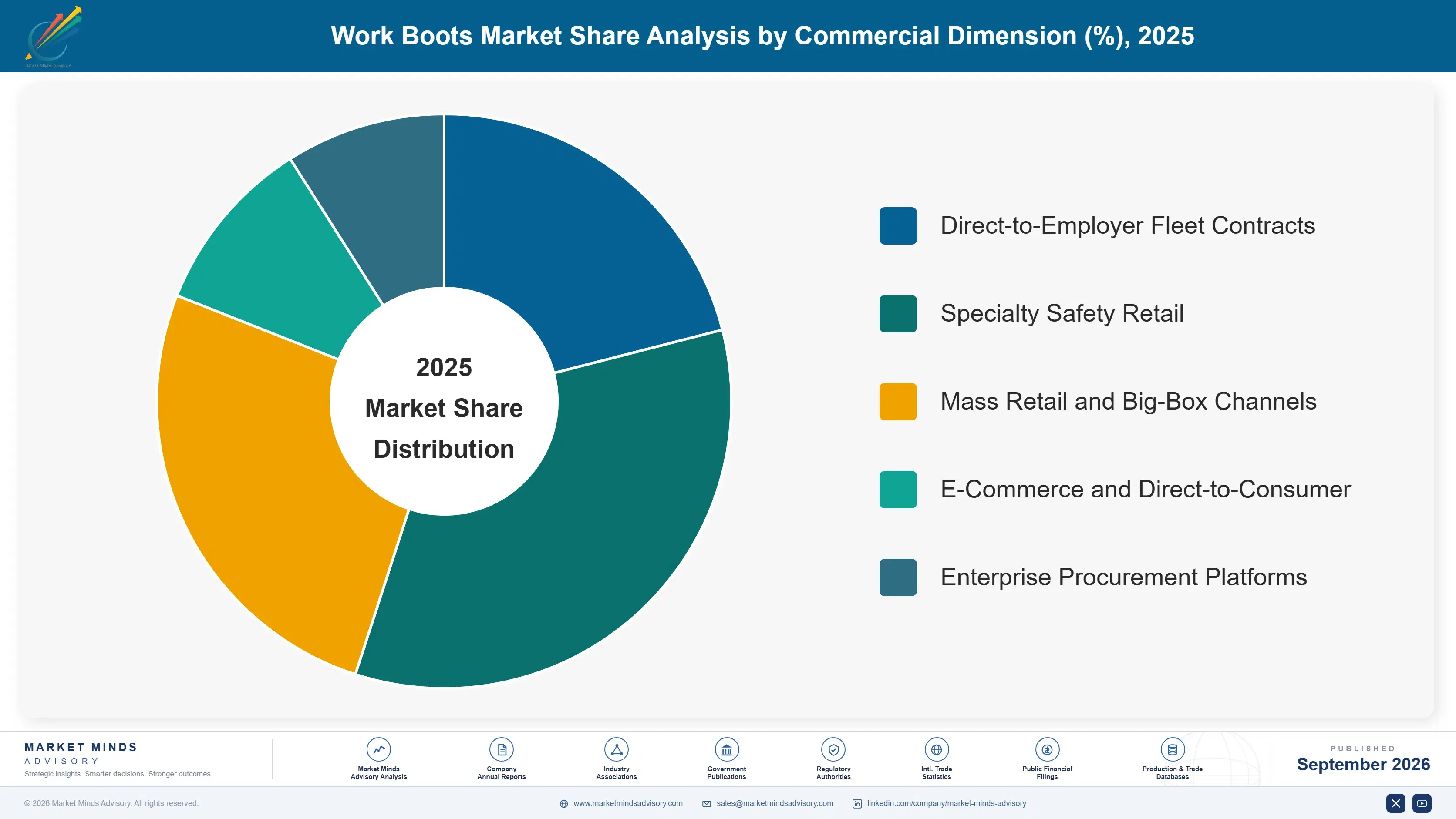
By Commercial Dimension

  • Direct-to-Employer Fleet Contracts
  • Specialty Safety Retail
  • Mass Retail and Big-Box Channels
  • E-Commerce and Direct-to-Consumer
  • Enterprise Procurement Platforms

By Region

  • North America
  • Western Europe
  • East Asia
  • South Asia and Pacific
  • Latin America
  • Middle East and Africa
  • Eastern Europe

Scope, Methodology, and Coverage

Every figure in this report is reproducible from documented input assumptions. The scope below maps the historical period, the forecast horizon, the segmentation dimensions, and the countries covered, alongside the underlying primary and qualitative methodology.
Historical Period
2020 to 2025
Forecast Period
2026 to 2036
Base Year
2025 (USD billions; MMA Primary Research Dataset, September 2026)
Market Definition
The Work Boots Market covers protective footwear engineered for industrial, construction, and hazardous-environment employment, including safety-toe, electrical hazard rated, and waterproof designs, excluding general-purpose casual footwear and athletic shoes.
Quantitative Units
USD billions, unit volume in millions of pairs
Segmentation Dimensions
Toe protection and technology type, end-use industry, distribution channel
Regions Covered
North America, Western Europe, East Asia, South Asia and Pacific, Latin America, Middle East and Africa, Eastern Europe
Countries Covered
40+ countries across seven global regions
Key Companies Profiled
Wolverine Worldwide Inc, Honeywell International Inc, Caterpillar Inc, Red Wing Shoe Company, VF Corporation, and 15 additional participants
Quantitative Methodology
Primary survey, n=3,800 respondents, Q4 2025, six countries; demand-side model with trade association cross-validation
Qualitative Methodology
47 expert interviews, Q4 2025; applied to validate demand model assumptions, identify emerging dynamics, and assess competitive positioning
Report Format
PDF and XLSX data workbook (Word format preview document)
Publisher
Market Minds Advisory
Report Code
MMA-2026-CON-212
Published
September 2026
Contact
sales@marketmindsadvisory.com | www.marketmindsadvisory.com

Purchase the full Work Boots Market Report (2026 to 2036).

The full Work Boots Market report delivers a complete forecast model spanning 2026 through 2036. Granular segmentation spans toe-protection technology, end-use industry, and distribution channel. It includes detailed competitive profiles for all twenty tracked participants, regional demand analysis across seven geographies, and input cost exposure modeling grounded in primary survey and expert interview data. The report further examines portfolio margin economics, revenue lever strategies, demand architecture, and a fully anonymized client engagement case study illustrating practical application of the underlying research findings across comparable market contexts and industrial employment categories.
Full regional breakdown across all seven global markets
Company-level competitive benchmarking with moat and risk assessment
Segment-by-segment growth rate forecasts through 2036
Input cost exposure analysis and mitigation pathway detail
Portfolio tiering framework with margin economics detail
Primary survey data collected across six countries

Built For The People Who Decide

From boardroom strategy to bench-side execution, this report is read cover-to-cover by leaders shaping the next decade of their industry, turning demand scenarios, market dynamics and valuation benchmarks into decisions.
CXOs/ Presidents/ VPs/ Managers
M&A and Corporate Development
Strategy Teams and R&D Heads
Procurement and Product Directors
Regulatory and Compliance Leaders
Investor Relations and Equity Analysts