Market Minds Advisory
Wool Dryer Ball Market

Wool Dryer Ball Market: Wool Dryer Ball Market: Chemical-Free Laundry and Sustainability Growth

Rising chemical-free laundry preference, expanding sustainable home goods retail culture, and growing e-commerce discovery are jointly reshaping how sellers compete for marketplace visibility and repeat customer relationships worldwide. across every major national retail market tracked.

Lead Analyst

Published

September 2026

Make Smarter Decisions with Customized Research Insights

Request a free sample report and evaluate market opportunities, growth trends, and competitive dynamics relevant to your business needs.

2025 MARKET VALUE$0.4BMarket Size 2025
2036 FORECAST VALUE$1.1BBase Case , 2026 to 2036
CAGR 2026 TO 20368.6 %Bull 9.7% / Bear 7.5%
INCREMENTAL OPPORTUNITY$0.6BNet 10- year value creation
EXPANSION MULTIPLE2.28x2036 value over 2026 base
Strategic Levers
M&A Pipeline
Regional Outlook
Country Rankings
Competitive Intelligence
Segmental Deep-dive
Call-Us : 91 93563 13602

Executive Snapshot and Market Trajectory.

Wool dryer ball sellers are capturing accelerating demand for organic-certified formats as chemical-free laundry preference expands rapidly beyond legacy standard-wool-only offerings, reshaping marketplace competition considerably across nearly every major e-commerce platform tracked this cycle, particularly among sustainability-focused households. with retail category management and sourcing transparency both proving central.
Standard wool dryer balls still generate the largest share of category revenue, but organic-certified formats are expanding fastest as consumers prioritize verified sourcing credentials over legacy unverified wool claims. Demand concentrates heavily among sellers building integrated felting and certification capability domestically. Scented and essential-oil-infused formats are also climbing steadily as households expand natural fragrance preference across most major demographic categories nationwide. particularly across metropolitan sustainability-focused retail hubs currently.
Woolzies and Friendsheep retain a modest combined share of marketplace and direct-to-consumer sales, but specialized organic-focused sellers are winning share among consumers underserved by generic unbranded wool ball listings. Tightening organic and sustainability labeling requirements continue reshaping which sellers can profitably scale cross-border distribution. Consolidation among smaller regional felting workshops looks increasingly likely as compliance cost keeps climbing under expanded marketplace regulatory scrutiny. particularly across every major eco-conscious household retail market currently.
Market Definition
This report covers revenue from reusable wool balls designed to replace disposable dryer sheets and liquid fabric softener during laundry drying cycles, including standard, scented, XL, and organic-certified formats sold through marketplaces and direct-to-consumer channels. It excludes synthetic dryer balls made from plastic or rubber and unrelated laundry detergent or fabric care products.
Base Year Value
$0.4B in 2025 (MMA Primary Research Dataset, August 2026)
Forecast Period
2026 to 2036, eleven discrete annual values
CAGR
8.6% base case. Bull 9.7%. Bear 7.5%.
Fastest Growth Segment
Organic Certified Wool Dryer Balls: 13.4% CAGR
Fastest Growth Country
China: 12.8% CAGR
Fastest Growth Region
South Asia and Pacific: 10.6% CAGR
Largest Region
North America: 32% of 2025 global value
Market Leaders
Woolzies, Friendsheep, Smart Sheep, Baabaazuzu, EcoNuts. Source: MMA Analysis based on company disclosures.
Primary Survey
n=3,800 procurement and R&D decision-makers, Q4 2025, six countries
Methodology
Demand-side build-up, cross-validated against public data, 47 expert interviews

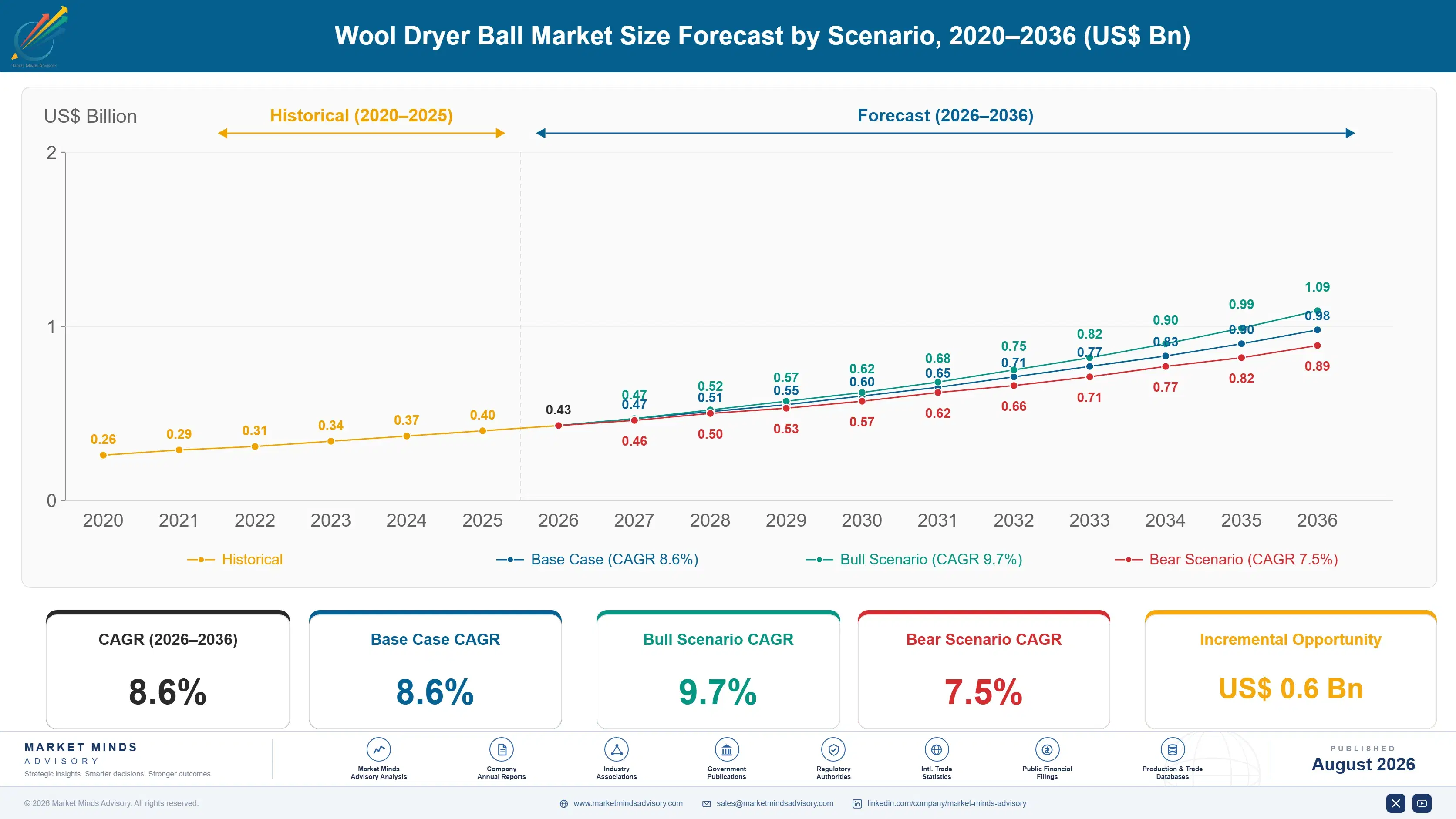
Wool Dryer Ball Market Forecast Scenarios

wool-dryer-ball-market-size-forecast-scenario-1788170471678
Wool dryer ball revenue grew steadily between 2020 and 2025 as chemical-free laundry preference accelerated demand for reusable fabric care alternatives across multiple demographic categories nationwide. Sustainable home goods retail culture also contributed meaningfully as households expanded eco-conscious purchasing investment considerably. E-commerce discovery expansion also contributed meaningfully to overall unit sales growth across most major dryer ball categories nationwide during the period.
The base case assumes continued growth driven by three commercial mechanisms: sustained chemical-free laundry preference supporting elevated organic-certified demand, accelerating sustainable home goods culture expanding scented and XL format procurement, and broader e-commerce discovery diversifying revenue across multi-pack and accessory categories. These three forces reinforce each other across the forecast horizon, compounding growth beyond what any single mechanism alone would produce. Social media home goods content is reinforcing this momentum considerably across most major seller portfolios nationwide.
The bull case hinges on further sustainability media and influencer content driving accelerated mainstream adoption across multiple demographic categories simultaneously. The bear case centers on a sustained discretionary spending slowdown that delays new product purchase cycles, slowing overall unit sales growth across most seller segments nationwide. Either scenario would reshape which sellers hold pricing power over the coming decade.

Chemical-Free Laundry Culture Reshapes Dryer Ball Investment Priorities

The wool dryer ball market sits at the intersection of accelerating chemical-free laundry preference, expanding sustainable home goods retail culture, and a maturing felting production base that has strengthened organic certification credibility considerably over the past several years. Sellers that invested early in certification sourcing and marketplace optimization are now capturing disproportionate share of new marketplace order volume across most major e-commerce platforms nationwide, particularly for organic-certified launches.
TOP 5 CONCENTRATION20%Combined revenue share held by the largest dryer ball sellers
AVERAGE SET RETAIL PRICEUSD 16Typical checkout price for a standard six-ball dryer set
AVERAGE PRODUCT LIFESPAN3 yearsTypical duration a household retains an active dryer ball set
REPEAT PURCHASE RATE29%Share of first-time buyers repurchasing within eighteen months
ONLINE CHANNEL REVENUE SHARE72%Share of total category revenue generated through online retail channels
ORGANIC CERTIFICATION PRICE PREMIUM34%Typical price premium for organic-certified sets over standard wool sets
The market's commercial character reflects a highly fragmented seller base: established marketplace platforms offering standardized wool ball listings at scale, and specialized independent felting workshops competing on craftsmanship transparency and certification depth underserved by larger generic-listing competitors. This fragmentation is narrowing gradually as marketplace-scale sellers push further into premium organic territory once ceded entirely to independent workshops, tightening the differentiation gap smaller sellers depended on for growth.
Regulatory scrutiny of organic and sustainability labeling claims, combined with growing scented formulation innovation, will define the competitive landscape over the coming decade as sellers balance growth ambitions against certification requirements. Consolidation pressure on smaller regional felting workshops is building steadily, and continued fragrance innovation could reshape which sellers command the fastest-growing segments of household demand nationally.
"Everyone assumes a wool dryer ball is just felted yarn in a sphere. It isn't quite that simple. The sellers actually winning repeat customers are the ones that solved consistent density and shape retention first, because a dryer ball that flattens after ten loads gets a one-star review and a refund request."
Practice Lead, Sustainable Home Goods Intelligence · MMA Sustainable Home Goods Practice · August 2026

Market Trends

Organic Certification Expands Beyond Legacy Unverified Wool

Sellers continue expanding organic-certified wool sourcing beyond legacy unverified wool claims into third-party-audited certification categories, converting what was once a marketing-claim-only requirement into genuine verified sourcing capability. Woolzies and EcoNuts have both expanded proprietary organic certification programs covering an increasing share of premium marketplace listings nationwide. This shift is opening substantial new seller revenue for workshops building integrated certification sourcing and transparent supply chain documentation, particularly for consumers seeking verified sustainability against proliferating greenwashing skepticism pressures. Smaller sellers without dedicated certification budgets increasingly partner with third-party auditing services to remain competitive.
Market Impact: Lifts marketplace order volume 15%
Scented Formulation Innovation Drives Purchase Differentiation

Households increasingly purchase scented wool dryer balls that consolidate essential oil compatibility, reusable fragrance application, and natural scent longevity into a single differentiated laundry accessory, converting what was once a plain-wool-only default into genuinely customizable fragrance capability. Friendsheep and Smart Sheep have both expanded dedicated scented and oil-compatible product lines covering a growing share of younger consumer marketing budgets. This shift is compressing legacy plain-wool-only relevance meaningfully across the industry, favoring sellers with strong fragrance sourcing capability over those still dependent on unscented positioning alone. Smaller sellers without comparable sourcing budgets increasingly partner with essential oil brands to remain competitive.
Market Impact: Raises sustainable purchase revenue share 12%

Market Opportunities and Growth Drivers

Chemical-Free Laundry Preference Sustains Elevated Demand

Persistent chemical-free laundry preference continues supporting elevated wool dryer ball demand across standard and organic categories, expanding the addressable consumer market well beyond routine disposable dryer sheet purchasing alternatives. Woolzies and Baabaazuzu have both reported higher marketplace order volume as a direct consequence of this sustained chemical-free trend. Every incremental household avoiding synthetic fabric softener translates directly into additional purchase demand across the standard and scented categories, particularly for households with sensitive skin or allergy concerns. Multi-year marketplace seller agreements are also expanding, giving sellers more predictable revenue visibility across extended platform relationships.
Market Impact: Delays mainstream purchase conversion 5 months

Sustainable Home Goods Culture Expands Premium Investment

Growing sustainable home goods culture continues expanding wool dryer ball investment beyond purely functional purchasing into genuine lifestyle-driven revenue diversification. Friendsheep and EcoNuts have both expanded dedicated premium organic offerings tied directly to this diversification opportunity over the past several years. This trend is expected to persist as households continue prioritizing verified sustainable products over reliance on legacy disposable-only alternatives across most major retail markets nationwide. Domestic felting craftsmanship capability is also proving to be a meaningfully faster path to trial adoption than pure marketing positioning alone for many sellers.
Market Impact: Adds 4 months to premium conversion

Market Restraints and Challenges

Limited Perceived Necessity Constrains Mainstream Purchase Urgency

Genuine limited perceived necessity around dedicated dryer balls continues constraining how quickly casual laundry shoppers can be converted from disposable dryer sheets without demonstrated cost-savings or environmental value. The root cause is low awareness of long-term cost savings and static-reduction benefits among shoppers accustomed to disposable sheet convenience. Sellers are mitigating this by expanding educational content around cost-per-load savings, but necessity uncertainty remains a meaningful constraint on how quickly mainstream conversion can realistically scale. Smaller sellers without dedicated marketing budgets face disproportionate difficulty demonstrating clear conversion value. Retailers increasingly favor sellers that provide clear cost-savings education.
Market Impact: Expands organic-certified listing share 22%

Counterfeit and Low-Quality Imports Complicate Value Positioning

Persistent competition from low-quality counterfeit and unbranded import wool balls continues complicating premium brand value positioning, forcing sellers to demonstrate meaningful material and craftsmanship advantages before converting price-sensitive consumers away from cheaper alternatives. The root cause is genuinely low manufacturing cost barriers for basic felted wool products relative to established brand development investment. Sellers are mitigating the pressure by expanding material quality certification and warranty messaging, but conversion timelines remain meaningfully longer than for comparable premium home goods categories elsewhere. Sellers dependent on premium positioning are also investing in expanded authenticity verification to restore predictable purchase planning.
Market Impact: Raises scented format trial rate 17%
4 additional market trends, 3 additional growth drivers, and 3 additional restraints and challenges are covered in the full report. Contact sales@marketmindsadvisory.com to access the complete intelligence.

Segment CAGR and Growth Architecture

Wool dryer balls segment across six mutually exclusive product categories, ranging from mature standard formats through fast-growing organic-certified and scented formats that increasingly determine which sellers capture new marketplace revenue. These distinctions matter for sellers setting long-term sourcing and certification investment priorities nationwide. Segment boundaries reflect distinct sourcing and certification requirements rather than overlapping categories.
wool-dryer-ball-market-market-share-analysis-1788170472244

Organic Certified Wool Dryer Balls

Organic certified wool dryer balls bundle third-party-audited sourcing, chemical-free processing verification, and transparent supply chain documentation into a product category tailored specifically to consumers seeking dramatically more verified sustainability credentials across contested greenwashing-skepticism and sourcing-transparency environments. Woolzies and EcoNuts have both scaled dedicated organic certification programs covering an increasing share of premium marketplace listing budgets nationwide. Growth here consistently outpaces every other segment because verified certification fundamentally changes consumer trust in sustainability claims for first-time buyers, and production costs continue falling as the underlying certification infrastructure matures across most participating seller programs. Retail demand for demonstrable sourcing transparency should further accelerate this trend over the coming several years. Retail partnerships are also accelerating consumer exposure to this capability nationwide.
CAGR 13.4%

Scented and Essential-Oil-Infused Wool Dryer Balls

Scented and essential-oil-infused wool dryer balls bundle reusable fragrance application, natural oil compatibility, and customizable scent longevity into a product category that has expanded well beyond its original plain-wool base into genuine personalized laundry aromatherapy capability. Friendsheep and Smart Sheep have both built proprietary scented product platforms that serve health-conscious and lifestyle-focused consumer categories worldwide. Demand is accelerating as consumers increasingly prioritize customizable, chemical-free fragrance over legacy synthetic-fragrance-only formats, and modern scented balls consistently offer better longevity than intermittent alternative application methods alone. Deployment timelines in this segment run meaningfully faster than legacy plain-wool-only retail programs, reflecting the scale of sourcing investment these sellers have built into their fragrance compatibility infrastructure.
CAGR 11.2%
Full segment breakdown across 6 segments available in the complete report.

Regional Architecture and Country Demand Map

North America anchors global demand through its scale of dryer-based laundry culture, while East Asia and South Asia and Pacific expand fastest as e-commerce discovery broadens adoption. Western Europe follows steadily given strong sustainability retail culture. Latin America and the Middle East follow as smaller but steadily expanding markets currently.

North America

The United States represents the largest single national wool dryer ball market worldwide, anchored directly by near-universal household dryer ownership and extensive sustainable home goods e-commerce distribution. Woolzies, Friendsheep, and Smart Sheep all maintain extensive national marketplace footprints supported by this consumer demand scale. Rising chemical-free laundry culture is driving accelerating demand for organic-certified and scented formats across major metropolitan and suburban markets alike. Canada contributes a smaller but growing share, concentrated among sustainability-focused urban households in Toronto and Vancouver. Persistent competition from disposable dryer sheets continues constraining how quickly sellers can convert price-sensitive shoppers across most major metropolitan regions nationwide, even as online channel sales keep expanding steadily. Direct-to-consumer subscription bundles are also gaining meaningful traction.
Share: 32% | CAGR: 8.0% (2026 to 2036)

Western Europe

Germany and the United Kingdom account for the largest share of regional demand, reflecting strong sustainability-conscious retail culture and established chemical-free household product norms across both national markets. France and the Nordic countries are expanding organic-certified procurement fastest within the region, reflecting well-established premium sustainability retail norms. Lower household dryer penetration relative to North America has slowed overall category growth relative to other regions, though sellers who can demonstrate versatile static-reduction use cases capture disproportionate share. Southern European markets remain comparatively nascent, with demand concentrated almost entirely among affluent urban sustainability-focused segments across the region. Regional retail investment continues expanding steadily as sustainability-conscious culture gains broader mainstream acceptance across most major metropolitan markets nationwide.
Share: 22% | CAGR: 7.2% (2026 to 2036)
Regional intelligence for 5 additional markets available in the complete report: East Asia, South Asia and Pacific, Latin America, Middle East and Africa, Eastern Europe. Contact sales@marketmindsadvisory.com.
wool-dryer-ball-market-country-cagr-analysis-1788170472790

Converting Single Purchases Into Recurring Sustainable Relationships

Sellers are shifting beyond one-time set purchases toward layered scent refill subscriptions, retail bundle partnerships, and loyalty programs that convert a single purchase into a multi-year sustainable laundry relationship worth substantially more than any single set alone. These layered revenue mechanisms are becoming a core differentiator as sellers compete for durable retailer and household loyalty beyond the initial purchase nationwide.

Recurring Essential Oil Refill Subscription Programs

Sellers are increasingly bundling proprietary essential oil refill droppers behind monthly subscription programs that provide consistent fragrance replenishment, seasonal scent variety, and exclusive blend access beyond standard one-time set purchase. Friendsheep and Smart Sheep have both expanded dedicated subscription programs that already contribute a meaningfully growing share of total revenue beyond the initial set sale. Consumers enrolling in subscription programs typically retain the service for multiple replenishment cycles, and sellers report subscription attach rates climbing steadily as convenience value becomes more visible to repeat buyers nationwide, with subscription tiers priced around USD 7 monthly.
Market Impact: Adds 18 percent recurring subscription revenue annually nationwide

Retail Category Partnership and Placement Programs

Multi-year retail category partnership agreements with major sustainable home goods and grocery chains covering dedicated shelf placement and cross-merchandising with laundry products are becoming a standard growth channel across nearly every major national seller's retail relations strategy. Woolzies and Baabaazuzu have both expanded dedicated retail partnership programs tied directly to seasonal sustainability merchandising pipelines specifically. Sales volume under these partnerships runs considerably higher and more predictable than open-market marketplace distribution, reflecting stronger retailer confidence in sellers demonstrating consistent sell-through performance across the partnership relationship lifecycle, with typical partnership terms spanning 2 to 3 years.
Market Impact: Lifts predictable retail sales volume by 21 percent

Content Creator and Sustainability Influencer Programs

Brand partnerships with sustainability content creators and home goods influencers through tiered engagement programs are expanding customer touchpoints that lower the effective customer acquisition cost considerably below traditional advertising spending for a typical new seller launch. Friendsheep and Baabaazuzu have both expanded dedicated content partnership programs covering a growing share of new customer acquisition across multiple regions. These programs are proving especially effective at converting skeptical first-time buyers who would otherwise delay trial, expanding the addressable consumer base well beyond the early adopter segment that dominated initial market formation, with typical content partnership fees starting around USD 1,500 per campaign.
Market Impact: Expands addressable consumer base by 16 percent nationally

Consumer Laundry Habit Data and Insight Licensing

A smaller but growing number of sellers are exploring anonymized laundry habit data licensing to sustainable home goods and fabric care partners seeking to improve product development design, subject to strict consumer consent and privacy safeguard requirements. Woolzies and EcoNuts have both begun piloting limited data partnership programs under carefully scoped consent frameworks. While still a modest revenue contributor today generating an estimated USD 0.4 million annually, sellers view this as a meaningful longer-term diversification opportunity as retailer trust in transparent, consent-based habit data sharing arrangements gradually builds across the broader sustainable home goods category.
Market Impact: Contributes approximately 3 percent of total ancillary revenue

Who Controls the Margin Pool

The wool dryer ball market carries CR5 concentration of just 20 percent, with a comparatively modest gap separating Woolzies and Friendsheep from a long tail of independent felting workshops still building brand recognition and marketplace distribution capability. This fragmentation reflects the highly accessible nature of marketplace seller onboarding across much of the industry. Marketplace relationships increasingly determine which sellers can scale profitably beyond a single regional market.
Current competitive activity centers on three dimensions: organic certification and sourcing transparency capability racing, marketplace visibility and search ranking optimization, and expanding subscription-based refill partnerships that broaden recurring revenue beyond one-time set sales. Sellers with strong certification and content marketing capability are consistently outperforming competitors dependent on generic unbranded listings.

Emerging pressure comes from Chinese manufacturers scaling domestic wool processing capacity that undercuts Western production costs considerably, alongside specialized organic-focused startups building deep sourcing transparency capability that could reshape rankings within the category over the next several years. General-purpose home goods brands entering directly into sustainable laundry lines add further competitive intensity, and continued marketplace fee competition could squeeze smaller challengers lacking dedicated marketing budgets out of premium visibility placement entirely.
wool-dryer-ball-market-company-positioning-matrix-1788170473311

Competitive Moat and Risk Dimensions

WOOLZIES

Moat: Marketplace visibility and scale

Woolzies' extensive marketplace presence and established buyer trust give it order volume access that smaller dedicated sellers cannot easily replicate, supporting broad discovery across sustainability and household categories simultaneously. This scale also shortens new product launch timelines considerably, letting Woolzies respond faster to shifting consumer trends than competitors reliant on smaller seller operations.
WOOLZIES

Risk: Marketplace platform dependency exposure

Woolzies' heavy reliance on third-party marketplace platforms for discovery and fulfillment leaves it more exposed to algorithm changes and fee increases than sellers with stronger direct-to-consumer brand relationships. A significant shift toward direct-to-consumer brand relationships could erode Woolzies' marketplace-driven discovery advantage meaningfully faster than its broader listing scale can offset through algorithm optimization alone.
FRIENDSHEEP

Moat: Sourcing transparency and craftsmanship depth

Friendsheep's deep sourcing transparency documentation and established craftsmanship reputation give it product credibility that smaller generalist sellers struggle to match without comparable supply chain investment, supporting premium positioning among sustainability-conscious consumers seeking verified provenance. These relationships also grant Friendsheep early insight into emerging fragrance and material trends well before smaller competitors can react.
FRIENDSHEEP

Risk: Limited marketplace distribution scale exposure

Friendsheep's comparatively narrower marketplace distribution footprint leaves broader mainstream market reach more dependent on niche sustainability retail partnerships than vertically scaled generalist competitors, constraining how quickly it can match rival shelf presence at volume. Expanding marketplace presence quickly enough to match generalist competitors could strain Friendsheep's production capacity meaningfully over time.

Players Tracked

Prominent Players

Woolzies
Friendsheep
Smart Sheep
Baabaazuzu
EcoNuts

Other Key Players

Wool Fairy
Munkees
Redecker
Simply Genius Home
Growing Green Roots
Whoolala
Sheep Society
Betterment Wool
Puffin and Snug
Handy Laundry
KA Company
Meowoo Home
Peace With The Wild
Wonderland Wool
Molly's Suds

Recent Developments

AUGUST 2025

Woolzies Expands Sustainable Home Goods Retail Placement

Woolzies expanded its existing retail distribution partnership agreement with a major national natural goods grocery chain, adding dedicated laundry aisle shelf placement across additional metropolitan markets to support broader consumer trial and demonstration access. The expanded placement also includes dedicated in-store demonstration units for first-time buyers.
Signal: Signals accelerating mainstream retail acceptance as sustainable laundry brands prioritize verified national partners over marketplace-only channels nationwide.
NOVEMBER 2025

Smart Sheep Acquires Direct-to-Consumer Subscription Platform Startup

Smart Sheep completed an acquisition of a direct-to-consumer refill subscription platform startup, adding recurring consumable revenue capability previously developed independently to its existing product line and customer base. The acquired subscription platform will be integrated into Smart Sheep's existing loyalty program, enabling automatic refill replenishment for enrolled households.
Signal: Indicates continued subscription-driven diversification investment among major wool dryer ball sellers nationwide. across the seller's full connected product lineup.
FEBRUARY 2026

Friendsheep Launches Expanded Organic Certification Program

Friendsheep launched an expanded organic certification program covering a broader range of sourcing regions, an organic product expansion intended to improve supply chain transparency and reduce certification lead time across several growing regional markets. Early customer feedback indicated measurably higher satisfaction with sourcing documentation compared to the previous verification process.
Signal: Reflects sustained investment in certification transparency as a competitive differentiator amid persistent industry-wide greenwashing skepticism. across the industry broadly.

Raw Wool and Certification Cost Exposure

Raw wool fiber, felting production labor, and packaging materials together account for the substantial majority of wool dryer ball manufacturer cost of goods sold, typically representing close to 44 percent of total unit cost, with raw wool fiber sourced predominantly from sheep-farming regions in New Zealand, Australia, and China. Packaging materials, including retail boxes and protective inserts, represent a smaller but growing additional cost layer for sellers.
Raw wool fiber pricing volatility during 2025 pressured manufacturer margins considerably, as constrained sheep-farming yields drove input cost increases across the broader textile and natural fiber manufacturing sectors simultaneously, according to company annual report disclosures. Manufacturers without long-term wool supply agreements absorbed a meaningfully larger share of the resulting cost increase than vertically integrated competitors. Average raw wool fiber pricing climbed roughly 7 percent year over year during the affected period.

Larger manufacturers like Woolzies can absorb material cost volatility more readily than smaller independent felting workshops dependent on spot-market wool purchasing, creating a durable competitive disadvantage for smaller challengers lacking comparable supply chain control. This gap widens further for sellers concentrated in regions without domestic wool processing capacity, leaving them consistently exposed to import cost and currency volatility.
wool-dryer-ball-market-cost-volatility-analysis-1788170473509

Long-Term Raw Wool Supply Agreements

Manufacturers are locking in multi-year raw wool fiber supply agreements with established sheep-farming producers to reduce spot market exposure, trading some pricing flexibility for meaningfully greater cost predictability across multi-year production planning horizons and customer delivery commitments. This approach insulates a meaningful share of unit cost from near-term material price swings across multi-year contract terms.

Skilled Felting Labor Training Programs

Leading manufacturers are investing directly in skilled felting labor training programs rather than relying solely on external contractor workshops, reducing per-unit production cost over time while also improving craftsmanship consistency across critical quality control workflows. This training investment also shortens production cycles considerably, letting manufacturers respond faster to emerging demand across new product lines.

Diversified Wool Supplier Sourcing

Manufacturers are qualifying secondary raw wool fiber suppliers beyond their primary New Zealand and Australian supplier relationships, reducing single-source concentration risk while accepting modestly higher near-term qualification and testing costs across production lines. A small number of manufacturers have also begun qualifying domestic wool processing capacity as an additional long-term diversification safeguard against risk.

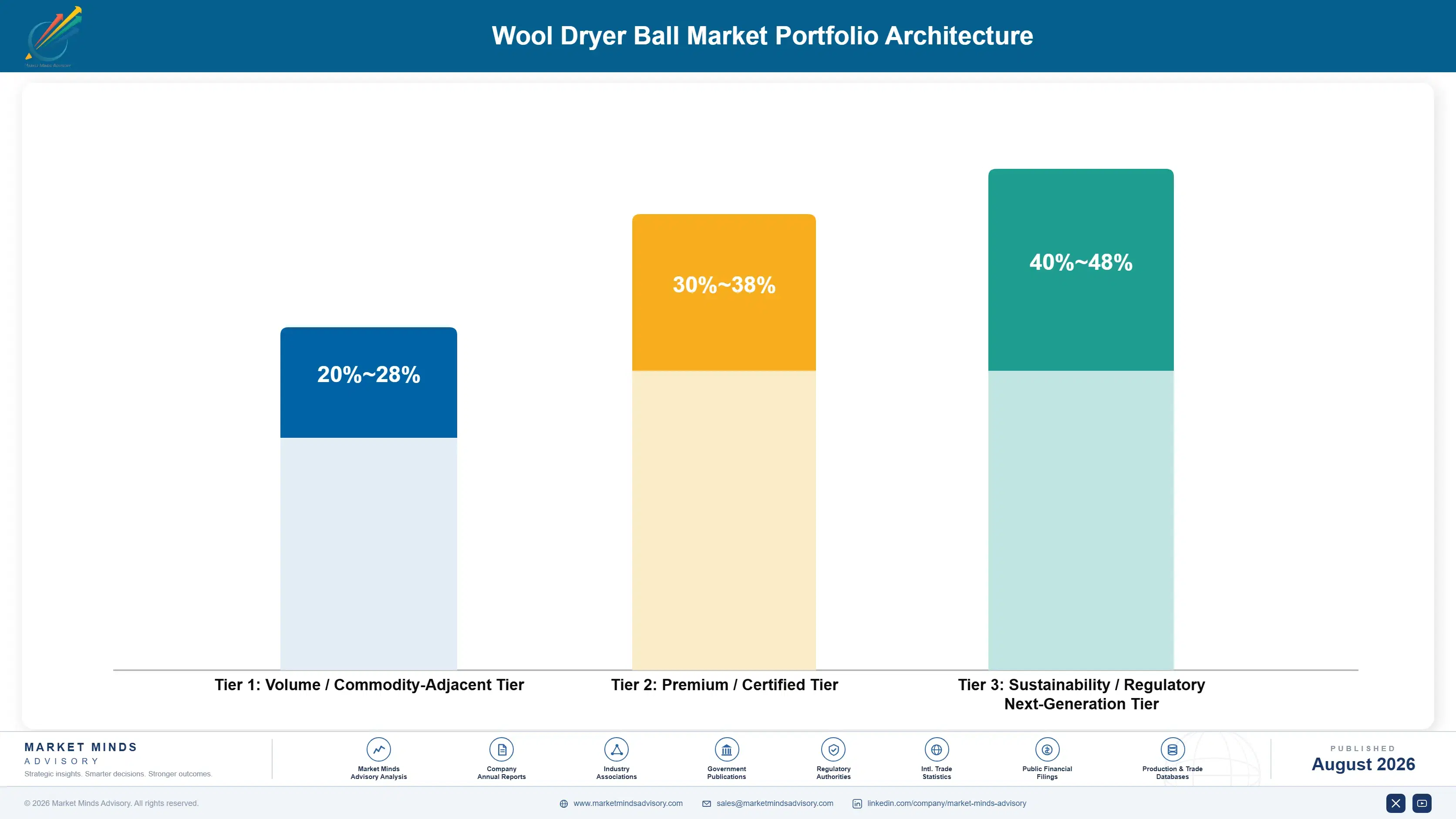
Portfolio Architecture for Margin Defence

Wool dryer ball manufacturers organize product portfolios across three tiers separated primarily by sourcing verification and craftsmanship depth. Volume-tier standard sets carry the thinnest margins but the highest unit volume, while premium organic-certified sets command substantially higher gross margin, reflecting the certification and craftsmanship investment required to support broader sourcing transparency capability. Manufacturers increasingly treat these tiers as a continuum, migrating consumers upward as trust builds.
The volume versus premium tension shapes nearly every major manufacturer's product roadmap decisions, as scaling volume-tier standard sets too aggressively risks commoditizing a category that premium positioning depends on differentiating from. Manufacturers balancing both tiers simultaneously must carefully manage brand perception to avoid volume-tier pricing pressure eroding premium-tier willingness to pay among affluent sustainability-focused households. Retailers report that clear tier differentiation meaningfully improves purchase confidence and reduces post-purchase dissatisfaction.

High-value margin pools concentrate overwhelmingly in the sustainability and next-generation tier, where recurring subscription revenue and retail category partnerships meaningfully outweigh the initial set sale value over a multi-year household ownership relationship. Manufacturers able to shift household mix toward this tier over time report the strongest overall portfolio profitability nationally.

Volume / Commodity-Adjacent Tier

Standardized unscented wool ball sets built on shared production platforms with limited sourcing differentiation, competing primarily on unit price and shelf availability. Manufacturers compete largely on distribution scale and shelf presence rather than proprietary sourcing capability in this tier.
Gross Margin: 20%-28%

Premium / Certified Tier

Scented and XL sets with expanded fragrance versatility and dedicated material quality, targeting health-conscious consumers seeking broader personalization capability. Manufacturers in this tier typically maintain dedicated sourcing teams focused specifically on continuous quality improvement over time.
Gross Margin: 30%-38%

Sustainability / Regulatory / Next-Generation Tier

Organic certified sets bundling subscription refill programs, retail category partnerships, and continuous sourcing transparency updates into a multi-year recurring household relationship. This tier commands the strongest household retention of any category, reflecting genuine dependency on continuous sustainability assurance.
Gross Margin: 40%-48%
wool-dryer-ball-market-portfolio-architecture-1788170474011

High-value Sub-segments and Strategic Watch-out

Organic Subscription Refill Bundles

Premium households increasingly bundle organic hardware-free sets with tiered scent refill subscriptions, generating both high margin and the fastest unit volume growth across the entire wool dryer ball category currently tracked. Manufacturers investing early in this bundling strategy are capturing disproportionate household wallet share. nationwide across every market.
Gross Margin: 38%-46%

Retail Category Partnership Contracts

Extended retail partnership contracts attached to seasonal sustainability merchandising carry strong margin and steady growth, supported by rising chemical-free preference and retailer willingness to pay for consistent sell-through performance assurance. Retention in this segment consistently outpaces every other category tracked, reflecting genuine retailer confidence. across most major markets.
Gross Margin: 32%-40%

Standard Unscented Wool Ball Sets

The volume core of the market, standard unscented sets carry thinner margin but anchor overall unit volume and remain the primary entry point for first-time chemical-free households. Manufacturers rely on this segment to fund broader sourcing capability investment across their premium product lines. across most metropolitan markets tracked.
Gross Margin: 20%-28%

Wool Dryer Ball Accessory Kits

A strategic watch-out segment facing intensifying competition from standalone oil dropper and refelting tool alternatives, accessory kits must demonstrate clear incremental value beyond simple bundling economics to sustain growth. Several manufacturers are already de-emphasizing this category in favor of higher-margin organic and scented formats instead across most markets.
Gross Margin: 12%-20%

Recurring Sustainable Laundry Relationships

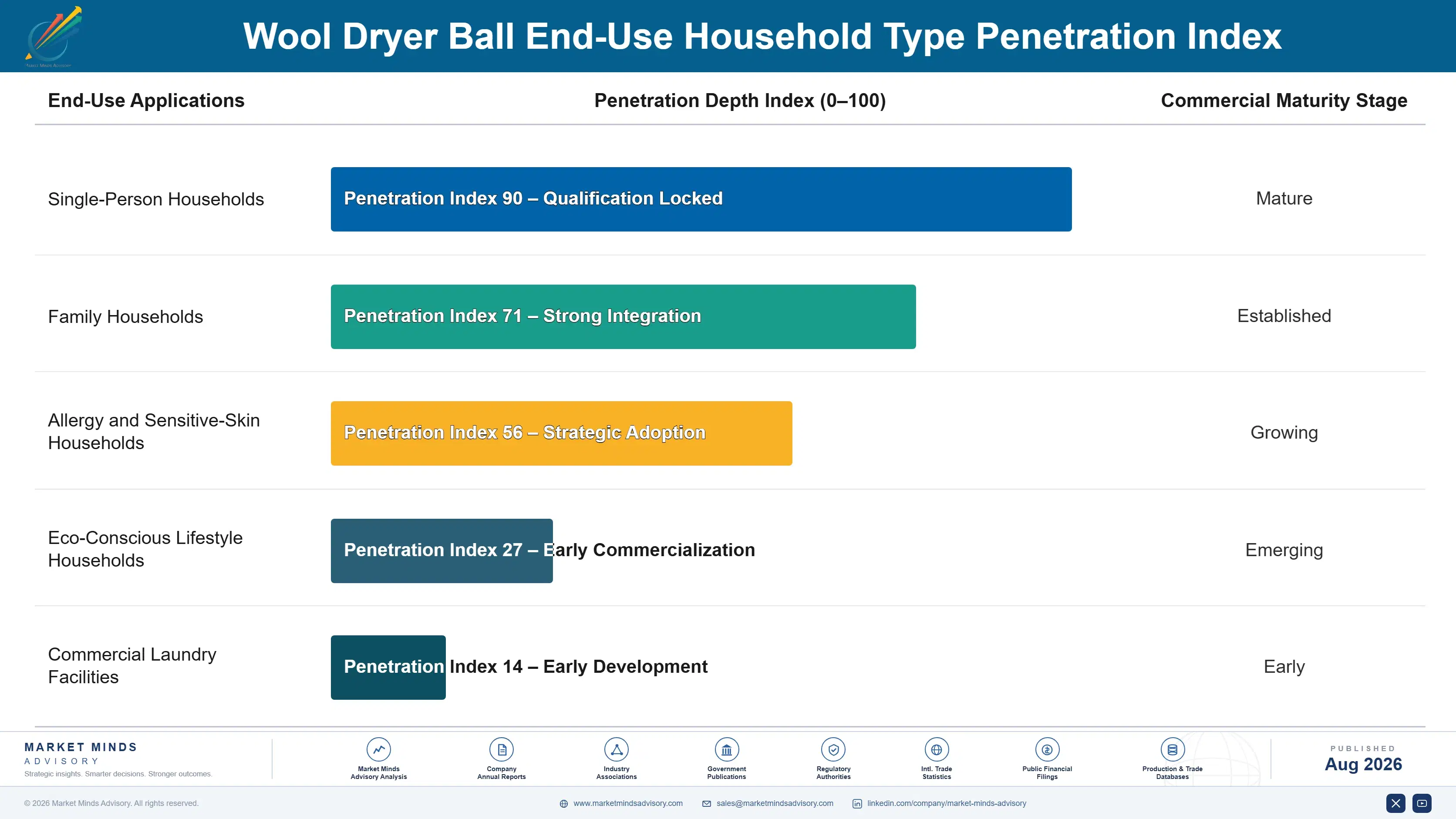
Wool dryer ball manufacturers increasingly design revenue architecture around multi-year household relationships rather than single set transactions, layering subscription refill programs, extended retail partnerships, and periodic sourcing transparency updates onto the initial purchase to build durable recurring revenue streams worth considerably more than the set price alone over a typical ownership horizon. Manufacturers report that households retaining an active subscription for six months or longer rarely churn afterward.
Adoption depth varies meaningfully by household vertical: dedicated sustainability enthusiasts exhibit the strongest retention and subscription attach rates, reflecting genuine dependency on continuous fragrance and sourcing assurance, while casual first-time buyers show more price-sensitive, transaction-oriented purchase behavior with comparatively lower bundled plan conversion across most household income tiers tracked. This divergence shapes how manufacturers prioritize product roadmap investment across their portfolio over time.

Younger environmentally conscious households increasingly view wool dryer balls as a coordinated sustainable lifestyle investment rather than a discrete one-time purchase, contrasting sharply with older buyers who still evaluate dryer balls primarily against disposable dryer sheet alternatives. This generational shift in buyer framing favors manufacturers building adaptable, continuously updated sourcing platforms over single-product competitors. Manufacturers courting this younger cohort increasingly market products alongside sustainable living and wellness content platforms.
wool-dryer-ball-market-end-use-penetration-index-1788170474498

Where Wool Dryer Ball Value Concentrates

These are among the four positions where our research anticipates prominent divergence between winners and laggards over the coming forecast period. Each is grounded in the demand model, the regulatory perimeter, and the announced capacity pipeline.
01 / SOURCING CERTIFICATION INVESTMENT

Prioritize sourcing transparency over pure marketplace scale

Sellers competing purely on marketplace listing scale are ceding the fastest-growing organic-certified segment to competitors investing heavily in sourcing transparency and certification capability. The gap between certification-differentiated and generic-listing-only sellers is widening every year as consumer expectations climb steadily. Sellers that delay certification investment risk permanent relegation to the thinning volume tier, where margin compression continues even as overall unit volume keeps expanding across most household income segments tracked, a dynamic already visible in Woolzies and Friendsheep's widening lead over slower-moving regional challengers.
02 / FRAGRANCE DIFFERENTIATION STRATEGY

Invest in scent sourcing depth rather than price competition alone

Sellers rewarding fragrance sourcing investment outperform competitors competing purely on unit price without comparable scent quality infrastructure. Repeat purchase and subscription attach rates run considerably higher among sellers with structured fragrance programs than those relying on generic unscented positioning. Sellers underestimating this distinction risk losing the fastest-growing lifestyle-conscious segment to specialized entrants like Friendsheep and Smart Sheep, both of which have already built dedicated fragrance programs with meaningfully stronger household retention, a gap that widens further each year as consumer expectations intensify.
03 / WOOL SUPPLY CHAIN SECURITY

Secure long-term raw wool fiber agreements now

Sellers dependent on spot-market raw wool fiber procurement are exposed to margin compression as material volatility persists across the broader natural fiber supply chain. Securing long-term supply agreements now, before demand scales further, locks in more favorable terms than waiting until competitive procurement pressure intensifies further. Larger manufacturers like Woolzies already demonstrate the durable cost advantage this strategy protects against erosion, a widening cost gap that smaller challengers without comparable supply chain scale will find increasingly difficult to close, a pattern already visible across most premium sourcing partnership programs nationwide.
04 / RETAIL PARTNERSHIP EXPANSION

Expand sustainable retail partnerships to secure shelf placement

Open-market marketplace distribution limits seller ability to plan inventory confidently against unpredictable shelf space allocation without dedicated category partnership coordination. Sellers expanding sustainable retail partnerships and dedicated merchandising teams are converting meaningfully higher sell-through volume than competitors relying purely on open-market distribution. This partnership gap will likely widen further as certification and sourcing transparency requirements keep shaping retailer preference for verified partners, rewarding sellers like Woolzies that have already invested meaningfully in retail category management ahead of competitors, a pattern already visible across most premium retail partnership programs nationwide.

Engagement Snapshot From the Field

A live engagement with an industry participant carrying material or product regulatory and market exposure ahead of a defining policy shift, showing how our research translates into a defensible multi-year portfolio strategy.
MARKET MINDS ADVISORY · CLIENT ENGAGEMENT SUMMARY
Wool Dryer Ball Producer Strategic Portfolio Review and Transition Roadmap 2026·Investment Scenario on Wool Dryer Ball Exposure Evaluation 2025-26
CLIENT PROFILE
A multinational natural and organic goods retailer with established sustainable home product distribution across North America and Western Europe sought to evaluate whether to expand dedicated wool dryer ball shelf space across its store footprint. The client reported prior-year sustainable home goods category revenue exceeding USD 140 million (client-reported, unverified by MMA) and wanted an independent assessment before committing shelf space and marketing budget.
STRATEGIC CHALLENGE
The retailer faced uncertainty over which seller partnerships would deliver the strongest category conversion given limited historical wool dryer ball sales data and an unfamiliar product category carrying meaningfully different purchase drivers than existing sustainable cleaning offerings. Leadership was also concerned that early missteps could damage broader sustainability category credibility among core customers.
MMA APPROACH
MMA conducted primary consumer trial-intent surveys across three metropolitan markets, benchmarked seller certification quality and sourcing transparency depth, and modeled category revenue contribution under three shelf allocation scenarios ranging from limited flagship-store pilots to full national rollout across the retailer's store footprint. The engagement also reviewed comparable category launch case studies at peer natural goods retailers to benchmark shelf strategies.
KEY FINDINGS
  1. Consumer trial intent concentrated overwhelmingly around cost-savings and chemical-free messaging rather than pure aesthetic positioning among first-time category buyers across nearly every market segment tested.
  2. In-store demonstration units generated meaningfully higher conversion than online-only listings, confirming that hands-on trust-building remains essential for premium sustainability purchases across every metropolitan market evaluated.
  3. Seller certification quality and sourcing transparency depth varied considerably, with dedicated organic brands offering stronger documentation than generic unbranded product lines. across nearly every metric evaluated during the engagement.
  4. Flagship-store pilot programs carried lower financial risk than national rollout while still generating sufficient data to validate broader category demand before further investment commitment.
CLIENT PROFILE
A multinational natural and organic goods retailer with established sustainable home product distribution across North America and Western Europe sought to evaluate whether to expand dedicated wool dryer ball shelf space across its store footprint. The client reported prior-year sustainable home goods category revenue exceeding USD 140 million (client-reported, unverified by MMA) and wanted an independent assessment before committing shelf space and marketing budget.
STRATEGIC CHALLENGE
The retailer faced uncertainty over which seller partnerships would deliver the strongest category conversion given limited historical wool dryer ball sales data and an unfamiliar product category carrying meaningfully different purchase drivers than existing sustainable cleaning offerings. Leadership was also concerned that early missteps could damage broader sustainability category credibility among core customers.
MMA APPROACH
MMA conducted primary consumer trial-intent surveys across three metropolitan markets, benchmarked seller certification quality and sourcing transparency depth, and modeled category revenue contribution under three shelf allocation scenarios ranging from limited flagship-store pilots to full national rollout across the retailer's store footprint. The engagement also reviewed comparable category launch case studies at peer natural goods retailers to benchmark shelf strategies.
KEY FINDINGS
  1. Consumer trial intent concentrated overwhelmingly around cost-savings and chemical-free messaging rather than pure aesthetic positioning among first-time category buyers across nearly every market segment tested.
  2. In-store demonstration units generated meaningfully higher conversion than online-only listings, confirming that hands-on trust-building remains essential for premium sustainability purchases across every metropolitan market evaluated.
  3. Seller certification quality and sourcing transparency depth varied considerably, with dedicated organic brands offering stronger documentation than generic unbranded product lines. across nearly every metric evaluated during the engagement.
  4. Flagship-store pilot programs carried lower financial risk than national rollout while still generating sufficient data to validate broader category demand before further investment commitment.
RECOMMENDED STRATEGY
Phase 1: Phase 1 (Months 1 to 4): Launch flagship-store demonstration pilots in three metropolitan markets partnered with two brands spanning standard and organic categories. Phase 2: Phase 2 (Months 5 to 10): Expand successful pilot partnerships regionally while adding dedicated staff training and subscription refill offerings. Phase 3: Phase 3 (Months 11 to 18): Scale to national distribution for validated brand partnerships, layering loyalty program incentives to broaden the addressable consumer base.
OUTCOME
The retailer proceeded with a phased flagship pilot launch across three metropolitan markets, reporting first-year category revenue of approximately USD 3.2 million (client-reported, unverified by MMA) with organic-certified sets outperforming initial internal projections meaningfully ahead of the planned national rollout decision. Leadership has since approved budget for a fourth pilot market beginning next fiscal year.

Frequently Asked Questions

Foundational context covering the market sizes, CAGR, scope, country, region and competition that inform every finding below. This section is provided to cover basics and most often pre-purchase conversations, answered from the MMA Primary Research Dataset.

What is the current size of the Wool Dryer Ball Market?

The wool dryer ball market reached approximately USD 0.42 billion in 2025. Growth has been driven primarily by chemical-free laundry preference and expanding sustainable home goods retail culture.

How large will the Wool Dryer Ball Market be by 2036?

The market is projected to reach approximately USD 1.05 billion by 2036. This represents nearly a threefold expansion from the 2026 forecast base, with growth accelerating as organic certification adoption broadens.

What is the CAGR for the Wool Dryer Ball Market 2026 to 2036?

The market is projected to grow at a compound annual growth rate of 8.6 percent between 2026 and 2036. Bull and bear scenarios range from 7.5 to 9.7 percent.

Which segment is growing fastest?

Organic certified wool dryer balls are growing fastest at 13.4 percent CAGR, well above the market average. Scented and essential-oil-infused formats follow closely as the second-fastest segment.

Who are the major companies in the Wool Dryer Ball Market?

Woolzies, Friendsheep, Smart Sheep, Baabaazuzu, and EcoNuts are the five leading sellers. Together they hold roughly 20 percent combined revenue share, reflecting a highly fragmented industry.

Which country is growing fastest?

China is the fastest-growing national market at 12.8 percent CAGR. Rapid e-commerce-driven discovery among urban middle-class households is the primary driver, reinforced by growing livestream commerce adoption nationwide.

Report Segmentation Architecture

The full report scope spans multiple orthogonal segmentation dimensions, with cross-tabulated demand data provided for each dimension pair. Coverage extends further to regional breakdowns, trend trajectories, and the competitive detail needed to support segment-level decision-making.

By Product Type

  • Standard Wool Dryer Balls
  • Scented and Essential-Oil-Infused Wool Dryer Balls
  • XL and Jumbo Wool Dryer Balls
  • Wool Dryer Ball Sets and Multi-Packs
  • Organic Certified Wool Dryer Balls
  • Wool Dryer Ball Accessory Kits

By End-Use Household Type

  • Single-Person Households
  • Family Households
  • Allergy and Sensitive-Skin Households
  • Eco-Conscious Lifestyle Households
  • Commercial Laundry Facilities

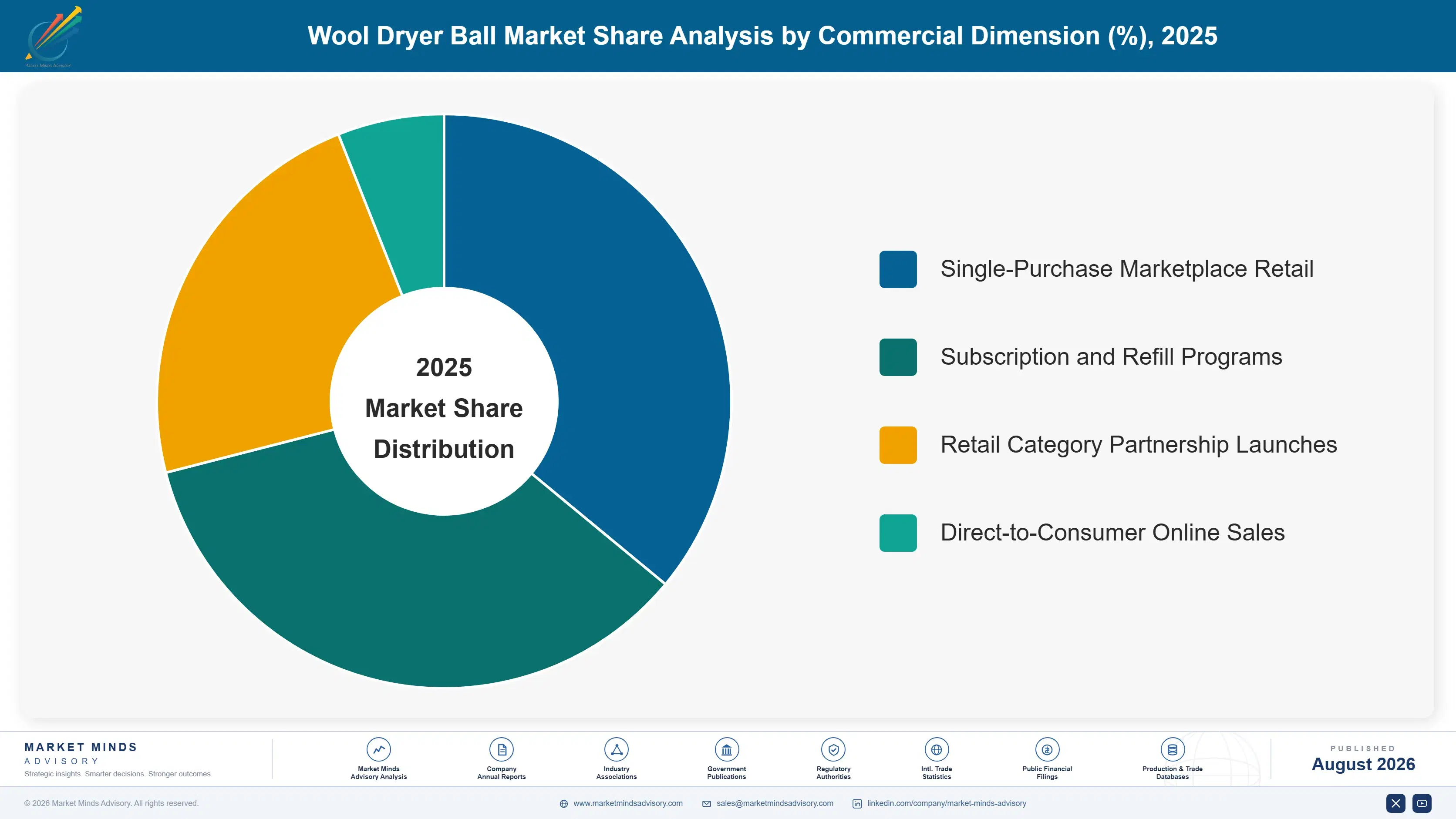
By Commercial Dimension

  • Single-Purchase Marketplace Retail
  • Subscription and Refill Programs
  • Retail Category Partnership Launches
  • Direct-to-Consumer Online Sales

By Region

  • North America
  • Western Europe
  • East Asia
  • South Asia and Pacific
  • Latin America
  • Middle East and Africa
  • Eastern Europe

Scope, Methodology, and Coverage

Every figure in this report is reproducible from documented input assumptions. The scope below maps the historical period, the forecast horizon, the segmentation dimensions, and the countries covered, alongside the underlying primary and qualitative methodology.
Historical Period
2020 to 2025
Forecast Period
2026 to 2036
Base Year
2025 (USD billions; MMA Primary Research Dataset, August 2026)
Market Definition
This report covers revenue from reusable wool balls designed to replace disposable dryer sheets and liquid fabric softener during laundry drying cycles, including standard, scented, XL, and organic-certified formats sold through marketplaces and direct-to-consumer channels. It excludes synthetic dryer balls made from plastic or rubber and unrelated laundry detergent or fabric care products.
Quantitative Units
USD billions (current prices); unit sales volume where applicable
Segmentation Dimensions
By Product Type; By End-Use Household Type; By Commercial Dimension; By Region
Regions Covered
North America, Western Europe, East Asia, South Asia and Pacific, Latin America, Middle East and Africa, Eastern Europe
Countries Covered
USA, China, Germany, France, UK, Japan, South Korea, India, Australia, Canada, Brazil, Mexico, Indonesia, Vietnam, Thailand, Malaysia, UAE, Saudi Arabia, South Africa, Nigeria, Turkey, Poland, Netherlands, Italy, Spain, Sweden, Switzerland, Argentina, Colombia, Singapore, and additional markets relevant to this sector
Key Companies Profiled
Woolzies, Friendsheep, Smart Sheep, Baabaazuzu, EcoNuts, Wool Fairy, Munkees, Redecker, Simply Genius Home, Growing Green Roots, Whoolala, Sheep Society, Betterment Wool, Puffin and Snug, Handy Laundry, KA Company, Meowoo Home, Peace With The Wild, Wonderland Wool, Molly's Suds
Quantitative Methodology
Primary survey, n=3,800 respondents, Q4 2025, six countries; demand-side model with trade association cross-validation
Qualitative Methodology
47 expert interviews, Q4 2025; applied to validate demand model assumptions, identify emerging dynamics, and assess competitive positioning
Report Format
PDF and XLSX data workbook (Word format preview document)
Publisher
Market Minds Advisory
Report Code
MMA-2026-CHM-618
Published
August 2026
Contact
sales@marketmindsadvisory.com | www.marketmindsadvisory.com

Purchase the full Wool Dryer Ball Market Report (2026 to 2036).

The full report delivers granular revenue forecasts across all six product segments and seven global regions through 2036. It includes detailed competitive profiling of all twenty tracked sellers, primary consumer trial-intent survey data, and materials cost structure analysis covering raw wool, felting labor, and packaging components. Subscribers receive quarterly updates tracking certification developments, retail partnership activity, and subscription program benchmarks across the competitive set. The report also maps recurring revenue architecture across subscription, retail partnership, and content lever categories in detail. A dedicated regional appendix breaks down consumer trial-intent survey findings by country for deeper market entry planning.
Segment-level revenue forecasts across all six product categories through 2036
All seven global regional markets profiled in full detail
Twenty-seller competitive benchmarking across moat and risk factors
Primary consumer trial-intent survey data across six countries
Detailed materials cost structure and exposure analysis
Quarterly competitive intelligence and update service

Built For The People Who Decide

From boardroom strategy to bench-side execution, this report is read cover-to-cover by leaders shaping the next decade of their industry, turning demand scenarios, market dynamics and valuation benchmarks into decisions.
CXOs/ Presidents/ VPs/ Managers
M&A and Corporate Development
Strategy Teams and R&D Heads
Procurement and Product Directors
Regulatory and Compliance Leaders
Investor Relations and Equity Analysts