

Market Minds Advisory
Wood Coatings Market

Wood Coatings Market: VOC Regulation and the Waterborne Transition

VOC regulation is forcing wood coatings formulators off solventborne chemistry faster than furniture makers can requalify finishing lines, while UV-curable systems win automated factories that waterborne coatings still cannot match on cure speed.

Lead Analyst

Bilal Shaikh

Published

September 2026

Make Smarter Decisions with Customized Research Insights

Request a free sample report and evaluate market opportunities, growth trends, and competitive dynamics relevant to your business needs.

2025 MARKET VALUE$9.8BMarket Size 2025
2036 FORECAST VALUE$18.8BBase Case , 2026 to 2036
CAGR 2026 TO 20366.1 %Bull 7.4% / Bear 4.8%
INCREMENTAL OPPORTUNITY$8.4BNet 10- year value creation
EXPANSION MULTIPLE1.81x2036 value over 2026 base
Strategic Levers
M&A Pipeline
Regional Outlook
Country Rankings
Competitive Intelligence
Segmental Deep-dive
Call-Us : 91 93563 13602

Executive Snapshot and Market Trajectory

Wood coatings are mid-transition, not mid-cycle. VOC regulation is phasing out solventborne chemistry on a fixed timeline, and furniture manufacturers are simultaneously automating finishing lines in ways that favor UV-curable systems over the waterborne coatings regulation alone would otherwise have made the default replacement choice for most manufacturers.
UV-curable wood coatings lead growth at 9.5% annually, nearly 1.6 times the market average, as automated spray and roller-coat lines at furniture and flooring manufacturers demand cure speeds that waterborne chemistry cannot match. Waterborne coatings follow closely on regulatory displacement of solvent systems. East Asia holds the largest regional share at 29%, anchored by China and Vietnam's export-oriented furniture manufacturing base, which together account for a substantial, still-growing share of world furniture export volume.
Competitive intensity concentrates around formulation depth and regulatory compliance rather than brand, since VOC limits and application-specific performance requirements demand chemistry most small coaters cannot develop independently. Sherwin-Williams and AkzoNobel command global formulation scale and application expertise, but specialist coaters like Sirca and ICA hold regional certification depth and finishing-line relationships that global majors have not matched, keeping premium segments genuinely contested despite consolidation pressure.
Market Definition
The wood coatings market covers protective and decorative coating systems formulated specifically for wood substrates, including furniture, flooring, cabinetry, and construction millwork, spanning waterborne, solventborne, UV-curable, powder, natural oil and wax, and nitrocellulose lacquer chemistries. It excludes coatings formulated for metal, plastic, or masonry substrates, wood preservatives and treatments applied before coating, and adhesives used in wood product assembly.
Base Year Value
$9.8B in 2025 (MMA Primary Research Dataset, August 2026)
Forecast Period
2026 to 2036, eleven discrete annual values
CAGR
6.1% base case. Bull 7.4%. Bear 4.8%.
Fastest Growth Segment
UV-Curable Wood Coatings: 9.5% CAGR
Fastest Growth Country
Vietnam: 10.8% CAGR
Fastest Growth Region
South Asia and Pacific: 8.3% CAGR
Largest Region
East Asia: 29% of 2025 global value
Market Leaders
PPG Industries Inc., AkzoNobel N.V., Sherwin-Williams Company, Axalta Coating Systems, BASF Coatings. Source: MMA Analysis based on company annual reports.
Primary Survey
n=3,800 procurement and R&D decision-makers, Q4 2025, six countries
Methodology
Demand-side build-up, cross-validated against public data, 47 expert interviews

Wood Coatings Market Forecast Scenarios

wood-coatings-market-size-forecast-scenario-1787665391672
Between 2020 and 2025 the market grew at an estimated 5.3% annually, held back early by pandemic-era furniture manufacturing disruption, then accelerating from 2022 onward as construction and remodeling demand recovered and VOC regulation began forcing formulation changes across major markets. Growth stayed concentrated in waterborne and UV-curable segments through most of the period, with solventborne volume declining steadily.
The base case carries the market to 6.1% CAGR through 2036 on three mechanisms. VOC regulation across the EU and United States keeps phasing out solventborne coatings on a fixed compliance timeline, forcing formulation upgrades regardless of furniture demand growth. Furniture manufacturing automation in China and Vietnam favors UV-curable systems whose fast cure times fit robotic finishing lines that waterborne chemistry cannot match. Rising construction and remodeling activity across emerging markets adds volume growth beneath regulatory-driven shifts.
The bull case reaches 7.4% if additional emerging markets adopt VOC limits similar to the EU's ahead of schedule, accelerating the waterborne and UV-curable transition globally. The bear case falls to 4.8% if raw material cost inflation pushes formulators back toward cheaper legacy solventborne chemistry in markets where regulation has not yet forced the issue, slowing the transition that currently drives premium segment growth.

Regulation Is Rewriting Wood Coatings Formulation Roadmaps

Three forces converge on this category. Regulation sets a fixed compliance clock that no furniture demand cycle controls, manufacturing automation redraws which chemistry actually fits a modern finishing line, and raw material cost swings keep testing which formulators can absorb a shock without losing customers to cheaper alternatives. Coaters that treat these as separate problems are already behind the ones treating them as one connected challenge requiring a single coordinated response.
MARKET CONCENTRATIONCR5: 38%Top five coaters hold roughly two-fifths of revenue
AVERAGE SELLING PRICE$4.20 per kgBlended price across commodity and premium coating grades
TOP PRODUCING COUNTRYChina: 26%Single country supplies over a quarter of global output
PLANT CAPACITY UTILIZATION73%Average operating rate across major wood coatings facilities
RESIN TRADE INTENSITY52% importedShare of specialty resin inputs sourced across borders
RESIN COST SHARE46% of COGSSpecialty resins dominate the total coating production cost
Commercial character splits sharply between regulated and unregulated markets. VOC-restricted regions demand waterborne or UV-curable chemistry regardless of cost, while markets without binding limits still buy solventborne coatings on price alone. The regulated tier commands materially better margins and stickier customer relationships, but it demands formulation investment most small coaters cannot easily fund without external technology partnerships or licensing arrangements.
Looking to 2036, three shifts matter most. VOC regulation will keep expanding into emerging markets regardless of who wins on price today, furniture manufacturing automation will keep favoring UV-curable systems over waterborne alternatives on cure speed alone, and formulation depth will increasingly separate specialist coaters from commodity operators competing on volume alone across most major markets.
"Everyone still benchmarks this market on paint volume. The real differentiator now is cure time on a robotic finishing line, because a coating that takes ten extra seconds to cure loses the contract before price even enters the conversation."
Director, Specialty Coatings and Materials Practice · MMA Chemicals and Materials Practice · August 2026

Market Trends

VOC Regulation Forces Solventborne Coating Phase-Out

The EU's Industrial Emissions Directive and comparable United States EPA regulations set binding volatile organic compound limits for coating operations, forcing wood coaters to reformulate solventborne products or exit regulated markets. Compliance deadlines vary by jurisdiction but most major markets require sub-250 gram per liter VOC content for furniture and flooring coatings sold. Formulators must requalify performance against the same durability and appearance standards customers expect, a process that takes 12 to 24 months per product line. Sherwin-Williams and AkzoNobel have announced waterborne and UV-curable portfolios ahead of competitors, giving movers a specification advantage heading into compliance deadlines across markets.
Market Impact: Tracks over 2.5% annual urban growth

Furniture Automation Pulls Demand Toward UV-Curable Systems

Chinese and Vietnamese furniture manufacturers are investing in robotic spray and roller-coat finishing lines that cure coatings in seconds rather than the hours waterborne systems require, and UV-curable chemistry is the technology that matches that cure speed at commercial scale. An automated finishing line can process several times the throughput of a spray booth, but only if the coating cures fast enough to keep pace with the line. Furniture exporters serving price-sensitive Western retailers increasingly treat UV-curable capability as a prerequisite for automation investment, not an upgrade, since the alternative is a finishing bottleneck that erases the automation's throughput advantage.
Market Impact: Tightens China VOC limits since 2020

Market Opportunities and Growth Drivers

Global Furniture And Flooring Demand Keeps Expanding

Rising urbanization and household formation across emerging markets, combined with steady replacement demand in mature markets, keep furniture and wood flooring production expanding as regional cycles vary. The United Nations projects urban population growth exceeding 2.5% annually across South and Southeast Asia through the next decade, expanding the addressable furniture manufacturing base coatings suppliers serve. Vietnam has become one of the world's largest furniture export hubs, with exports growing as manufacturers relocate capacity away from China trade tensions. Every unit of furniture and flooring produced requires coating, so this volume growth compounds beneath the chemistry transition dominating the regulatory conversation.
Market Impact: Resin inputs run 46% of COGS

VOC Regulation Mandates Formulation Upgrades Worldwide

Regulatory bodies across the EU, United States, and increasingly China and India are tightening volatile organic compound limits for coating operations, converting what was once a voluntary sustainability choice into a mandatory compliance requirement. China's own VOC emission standards for furniture manufacturing, tightened significantly since 2020, now push domestic coaters toward the same waterborne and UV-curable chemistry Western regulation already mandated. This regulatory convergence across major manufacturing regions means formulators can no longer treat compliance chemistry as a premium niche product line, since it is rapidly becoming the only chemistry legally sellable in an expanding share of the global market.
Market Impact: Trails hardness by up to 20%

Market Restraints and Challenges

Raw Material Cost Volatility Squeezes Formulator Margins

Wood coatings resins, including acrylics, polyurethanes, and UV-curable oligomers, derive from petrochemical feedstock that exposes formulators to naphtha and isocyanate price swings they cannot pass through to furniture manufacturer customers on existing contracts. The root cause is chemical dependency on a narrow set of specialty monomers with few substitute feedstocks, unlike commodity coatings where formulators can switch resin suppliers more freely. European formulators felt this in 2022, when natural gas price spikes drove up petrochemical feedstock costs across the continent. Several coaters are pursuing multi-year resin supply contracts with price collars to reduce exposure to the worst swings.
Market Impact: Caps VOC content near 250 g/L

Waterborne Performance Gap Slows Full Substitution

Waterborne coatings trail solventborne and UV-curable systems on performance dimensions, including scratch resistance and chemical resistance in heavy-use commercial flooring applications, limiting full substitution in demanding use cases. The root cause is chemistry: water-based binder systems form a different film structure than solvent-based or radiation-cured systems, and that film-structure difference affects hardness development timelines. This forces some furniture and flooring manufacturers to retain solventborne coatings for premium heavy-wear applications where regulation permits waterborne alternatives. Formulators are responding with hybrid waterborne-UV systems that combine faster cure with improved hardness, narrowing the performance gap in newer product generations.
Market Impact: Cures coatings in under 60 seconds
3 additional market trends, 3 additional growth drivers, and 3 additional restraints and challenges are covered in the full report. Contact sales@marketmindsadvisory.com to access the complete intelligence.

Segment CAGR and Growth Architecture

Segmentation follows resin technology, a single chemistry and cure-mechanism logic spanning waterborne, solventborne, UV-curable, powder, natural oil and wax, and nitrocellulose lacquer coatings. Each technology carries distinct cure mechanism, regulatory profile, and application equipment, so commercial position tracks how the coating cures and what VOC limits it can meet, across each end-use application category.
wood-coatings-market-market-share-analysis-1787665392245

UV-Curable Wood Coatings

UV-curable wood coatings grow fastest at 9.5% annually, nearly 1.6 times the overall market rate, as furniture manufacturers automating finishing lines in China and Vietnam demand cure speeds only radiation-cured chemistry can deliver at commercial scale. These formulations cure within seconds under ultraviolet light exposure, compared to the hours waterborne systems typically require, letting automated roller-coat and spray lines run continuously without drying-tunnel bottlenecks. Sherwin-Williams and AkzoNobel both lead qualified UV-curable product development for major furniture manufacturers, while specialist formulators compete on application-specific hardness and flexibility tuning. The segment carries near-zero VOC content inherently, giving it a regulatory advantage that compounds alongside its cure-speed advantage as manufacturers automate finishing lines further.
CAGR 9.5%

Waterborne Wood Coatings

Waterborne wood coatings grow second-fastest at 8.2%, driven directly by VOC regulation displacing solventborne chemistry across the EU, United States, and increasingly China. These water-based formulations replace organic solvents with water as the primary carrier, cutting volatile organic compound emissions substantially compared to traditional solventborne coatings while approaching comparable appearance and application characteristics. Formulation advances over the past decade have narrowed the historical performance gap versus solventborne systems considerably, expanding waterborne's addressable application range into categories once reserved for solvent-based chemistry. PPG and BASF Coatings both lead broad waterborne portfolios spanning furniture, flooring, and cabinetry applications, positioning the technology as the default replacement wherever regulation forces the transition away from solvent-based systems.
CAGR 8.2%
Full segment breakdown across 6 segments available in the complete report.

Regional Architecture and Country Demand Map

East Asia now leads on China and Vietnam's export-oriented furniture manufacturing base, narrowly ahead of North America's large construction and remodeling demand. Western Europe follows on strict VOC regulation driving early waterborne adoption, while South Asia and Pacific posts the fastest regional growth as furniture manufacturing capacity relocates from China.

North America

The United States drives most of North America's 22% share through large-scale furniture, flooring, and cabinetry manufacturing demand, where Sherwin-Williams and PPG supply coating systems into both industrial finishing lines and retail refinishing channels. EPA VOC regulations have pushed waterborne adoption steadily across the region, though solventborne coatings retain share in heavy-wear commercial flooring applications where performance requirements remain demanding. Canada contributes meaningfully through its own furniture and construction millwork manufacturing base. Mexico's growing furniture export sector, serving American retailers, adds further regional demand tied to nearshoring trends. Growth of 6.9% outpaces the global rate as regulatory-driven reformulation continues across major coating categories, particularly in commercial and institutional furniture segments.
Share: 22% | CAGR: 6.9% (2026 to 2036)

Western Europe

Germany and Italy anchor much of Western Europe's 21% share through established furniture manufacturing traditions and stringent EU VOC regulation that pushed waterborne adoption earlier here than almost anywhere else. Italian coaters including Sirca and ICA Group supply both domestic furniture manufacturers and export markets across Europe, competing on formulation depth built over decades of regulatory compliance experience. The EU's Industrial Emissions Directive applies uniformly across member states, giving European formulators a genuine head start on compliance chemistry that competitors elsewhere must eventually match. Nordic countries show disproportionately strong natural oil and wax finish demand reflecting long-standing furniture design traditions. Growth of 4.6% trails the global rate, consistent with a mature market where the regulatory transition is already largely complete.
Share: 21% | CAGR: 4.6% (2026 to 2036)
Regional intelligence for 5 additional markets available in the complete report: East Asia, South Asia and Pacific, Latin America, Middle East and Africa, Eastern Europe. Contact sales@marketmindsadvisory.com.
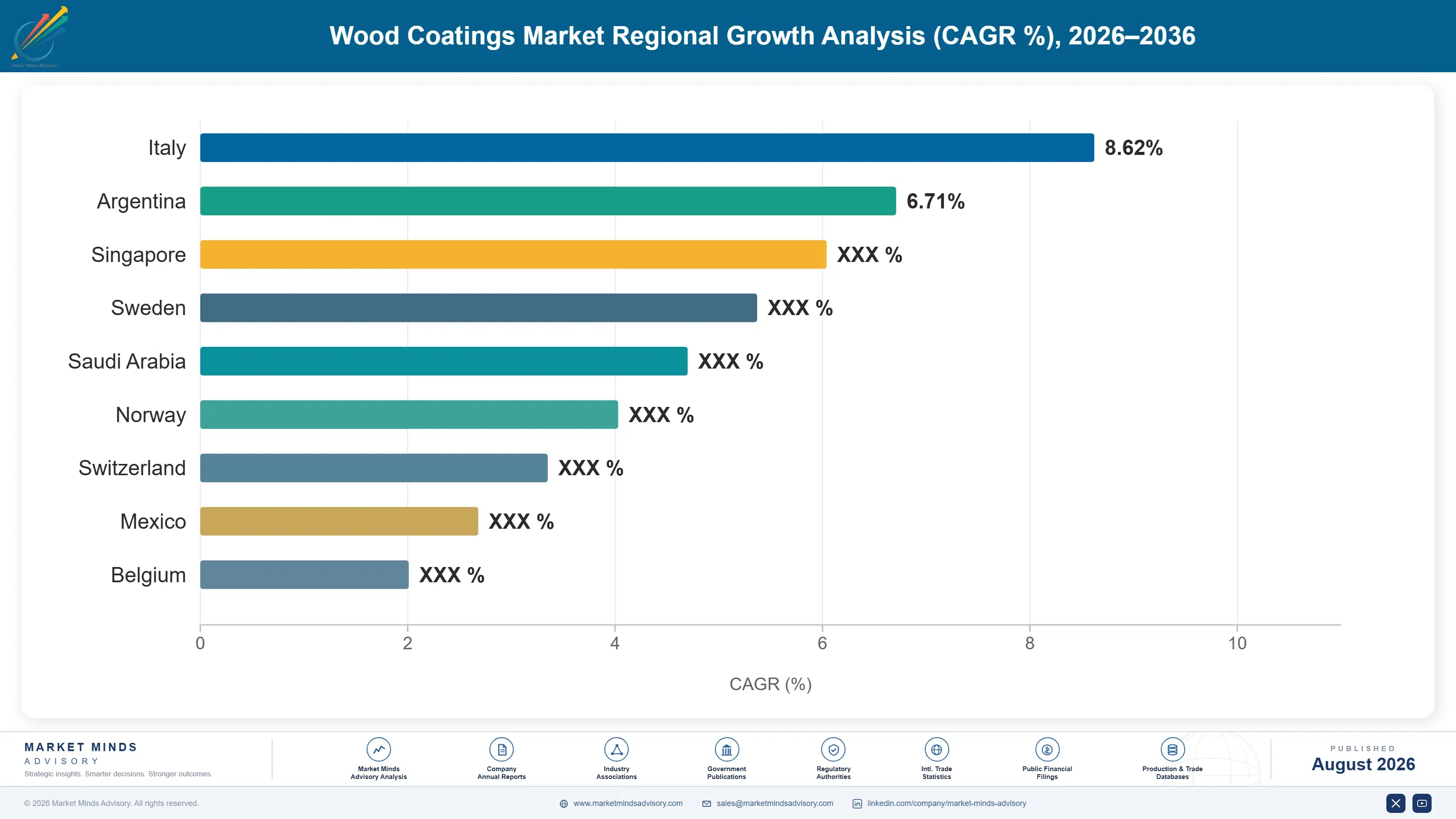
wood-coatings-market-country-cagr-analysis-1787665392773

Where Wood Coatings Margin Now Concentrates

Formulators face a familiar squeeze: commodity solventborne coatings compete purely on price and freight, while regulatory compliance chemistry and application-specific formulation increasingly carry the margin. The four moves below shift revenue toward defensible, harder-to-replicate positions instead of undifferentiated commodity coatings, drawing on how leading formulators already separate legacy economics from compliance-driven premium lines profitably today.

Build UV-Curable Formulation Depth Early And Fast

Formulators that develop qualified UV-curable product lines ahead of furniture manufacturer automation investment capture supply contracts competitors without radiation-cure chemistry cannot bid on at all. Sherwin-Williams and AkzoNobel's UV-curable lines reportedly command a 15% to 25% price premium over comparable waterborne systems, since automated finishing lines value cure speed enough to pay for it directly. Smaller formulators lacking radiation-cure chemistry expertise are increasingly licensing formulations from technology providers rather than building capability internally, accepting a smaller margin share in exchange for market access they could not otherwise capture within a rapidly closing qualification window.
Market Impact: Commands a 15% to 25% cure-speed price premium

Bundle Compliance Formulation With Technical Support Services

Furniture manufacturers navigating VOC compliance deadlines value technical reformulation support as much as the coating itself, since requalifying a finishing line against new chemistry without expert guidance risks costly production disruption. Formulators offering bundled technical support alongside compliant coating supply can command 10% to 15% premium pricing over unbundled material sales, while building the kind of customer relationship that survives well beyond any single regulatory deadline. This approach also locks in long-term supply volume that justifies dedicated technical account management investment that a pure commodity coating sale could never fund.
Market Impact: Commands a 10% to 15% technical support premium

Expand Into Emerging Market VOC Compliance Chemistry

China and India are tightening domestic VOC regulation, following China's 2020 standard, years after the EU and United States already forced formulation transitions, giving formulators with proven compliance chemistry a genuine first-mover advantage as these markets follow the same regulatory trajectory. Companies that already solved waterborne and UV-curable formulation for Western markets can adapt proven chemistry faster than domestic competitors starting from scratch, capturing share before local formulators catch up. This category remains underpenetrated relative to the regulatory trajectory already visible, since many formulators still treat emerging markets as solventborne strongholds rather than the next compliance frontier.
Market Impact: Targets China and India's 2 tightening VOC regimes

License Proprietary Hybrid Waterborne-UV Chemistry To Others

Formulators that solved the waterborne performance gap through hybrid waterborne-UV chemistry hold formulations that competitors urgently need but cannot develop fast enough to match, creating a licensing opportunity that compliance pressure makes increasingly valuable. Licensing a qualified hybrid formulation to a non-competing regional coater, rather than only selling finished coating, can generate royalty revenue running 3% to 6% of the licensee's sales at close to zero marginal production cost. This model mirrors licensing approaches already established in adjacent specialty chemicals categories, and regulatory pressure is creating exactly the urgent, concentrated demand that makes licensing commercially attractive right now.
Market Impact: Generates 3% to 6% ongoing royalty revenue stream

Who Controls the Margin Pool

Concentration sits at a moderate 38% for the top five, evaluated on global wood coatings production and formulation revenue across commodity and premium tiers alike. Sherwin-Williams and AkzoNobel command the largest shares through global formulation scale, but the gap to specialist coaters is narrower than CR5 implies, since Sirca, ICA Group, and Teknos each hold regional certification depth diversified majors have not matched.
Competitive activity runs along three fronts. Regulatory compliance chemistry drives near-term positioning, where formulators race to qualify waterborne and UV-curable systems ahead of tightening VOC deadlines. Automation compatibility drives furniture manufacturer wins, where formulators with fast-cure UV chemistry capture robotic finishing line contracts that slower-curing systems cannot serve. Regional certification depth drives specialist positioning, where Sirca and ICA compete for European furniture accounts that global majors pursue less aggressively.

Pressure is building from Chinese formulators expanding compliance chemistry capability faster than expected, narrowing a qualification gap that Western specialists have relied on for differentiation. Global chemical majors including BASF are also pushing further into application-specific formulation, compressing the space specialist coaters once occupied alone. Rankings will likely shift toward formulators that combine regulatory compliance depth with automation-compatible chemistry, since neither advantage alone secures the fastest-growing segments.
wood-coatings-market-company-positioning-matrix-1787665393298

Competitive Moat and Risk Dimensions

SHERWIN-WILLIAMS COMPANY

Moat: Global Formulation And Brand Scale

Sherwin-Williams' Sayerlack wood coatings division gives it formulation depth across waterborne, UV-curable, and solventborne chemistry that smaller regional coaters cannot match, backed by global distribution reach spanning industrial and retail channels alike. Its early UV-curable product development positions it ahead of most competitors on the automation-compatible chemistry furniture manufacturers increasingly demand.
SHERWIN-WILLIAMS COMPANY

Risk: Exposed To Petrochemical Cost Swings

Sherwin-Williams' formulation scale depends on specialty resin inputs carrying direct petrochemical feedstock exposure, and margin compresses during naphtha and isocyanate price spikes it cannot always pass through on existing furniture manufacturer contracts. Diversified chemical competitors with broader product portfolios can absorb input cost swings more easily than a coatings-concentrated business unit.
AKZONOBEL N.V.

Moat: European Regulatory Compliance Leadership

AkzoNobel's Sikkens wood coatings brand built formulation expertise navigating some of the world's strictest VOC regulation years before most global markets forced the same transition, giving it a genuine head start on compliance chemistry now spreading to China and India. That European regulatory experience transfers directly as other markets tighten VOC limits.
AKZONOBEL N.V.

Risk: Mature European Market Growth Ceiling

AkzoNobel's core European market is already largely through its regulatory transition, limiting organic growth from further compliance-driven reformulation there specifically. Capturing growth now requires successful expansion into emerging markets where AkzoNobel competes against domestic formulators with better local relationships and potentially lower cost structures entirely.

Players Tracked

Prominent Players

PPG Industries Inc.
AkzoNobel N.V.
Sherwin-Williams Company
Axalta Coating Systems
BASF Coatings

Other Key Players

RPM International Inc.
Teknos Group
Sirca S.p.A.
ICA Group
Milesi Group
Renner Italia S.p.A.
Lechler S.p.A.
Hydro Systems Co.
Diamond Vogel
KCC Corporation
Nippon Paint Holdings
Jotun Group
Asian Paints Limited
Berger Paints India
Cromology

Recent Developments

MAY 2025

Sherwin-Williams Expands UV-Curable Production Capacity

Sherwin-Williams announced expanded UV-curable wood coatings production capacity at its Sayerlack facilities in Italy, targeting rising demand from automated furniture finishing lines across Europe and export markets. The expansion was an organic capacity investment, not an acquisition or joint venture with an external partner of any kind.
Signal: Signals that furniture automation is now a primary capital allocation driver for global coatings formulators large and small.
OCTOBER 2024

AkzoNobel Divests Non-Core Specialty Chemicals Unit

AkzoNobel completed the divestiture of a non-core specialty chemicals unit to a private equity buyer, reportedly for approximately EUR 400 million, as part of a broader strategy to concentrate capital on coatings and performance products. The transaction was a divestiture, not an acquisition of new assets.
Signal: Signals coatings majors are narrowing focus toward core formulation businesses rather than broad chemical diversification across unrelated product categories.
FEBRUARY 2025

BASF and Chinese Coater Sign Technology Licensing Agreement

BASF Coatings signed a technology licensing agreement with a Chinese regional formulator, providing access to waterborne compliance chemistry ahead of tightening domestic VOC regulation. The agreement was a licensing partnership, not a joint venture, acquisition, or equity investment by either party under the agreement's terms.
Signal: Signals Western formulators are monetizing compliance chemistry through licensing as emerging markets adopt similar regulation rather than building local capacity.

Specialty Resin And Petrochemical Cost Exposure

Specialty resins, including acrylics, polyurethanes, and UV-curable oligomers, account for roughly 46% of cost of goods sold, sourced predominantly from petrochemical crackers and specialty monomer producers concentrated in Germany, the United States, and China. Pigments, additives, and packaging add the remaining significant cost categories, with pricing that varies meaningfully by specific chemistry, grade, and application.
European natural gas price spikes in 2022, following disruption of Russian pipeline supply, drove petrochemical feedstock costs sharply higher across the continent, directly raising resin costs for wood coating formulators. AkzoNobel's 2022 annual report disclosed material cost inflation pressure across its coatings segments during the period. Prices have moderated since 2023 but remain above pre-2021 baselines, according to European Commission energy market reporting published in late 2024.

Smaller specialist formulators without long-term resin supply contracts absorb feedstock price spikes immediately, while PPG and AkzoNobel negotiate multi-year supply agreements that smooth volatility across larger purchasing volumes. UV-curable oligomer producers carry additional exposure since specialty photoinitiator chemistry has few substitute suppliers globally, unlike commodity resin where formulators can switch more freely. Formulators without diversified sourcing consistently trail on cost during regional supply disruptions more than diversified competitors do.
wood-coatings-market-cost-volatility-analysis-1787665393498

Lock Multi-Year Resin Supply Contracts With Price Collars

Securing multi-year resin supply agreements with price collars, rather than buying on the spot market, is what let PPG and AkzoNobel limit the worst of the 2022 feedstock spike while smaller competitors absorbed the full price swing directly. The premium paid for price protection is real, but far cheaper than losing a qualified customer relationship to margin pressure.

Diversify Photoinitiator And Oligomer Sourcing

UV-curable chemistry depends on specialty photoinitiators with limited global suppliers, creating a concentration risk beyond typical commodity resin exposure. Qualifying a second oligomer supplier, even at a modest cost premium, preserves negotiating leverage and production continuity if any single specialty chemical producer faces a disruption or capacity constraint that a single-source strategy cannot absorb.

Accelerate Compliance Formulation Ahead Of Deadlines

Formulators that qualify waterborne and UV-curable formulations well before VOC deadlines force the issue avoid both compliance cost pressure and the resin price exposure tied to legacy solventborne chemistry simultaneously. Early qualification also captures first-mover pricing advantage before competitors flood the market with comparable compliant chemistry closer to the deadline itself, when negotiating leverage weakens.

Portfolio Architecture for Margin Defence

The portfolio splits into three tiers with meaningfully different margin economics. Volume commodity solventborne and standard waterborne coatings, sold into large-scale furniture manufacturing, compete on price and freight against a crowded field of regional formulators, earning modestly. Premium UV-curable and hybrid formulations earn substantially more because automation-compatibility and formulation depth insulate pricing from direct commodity comparison. Emerging market compliance chemistry sits in a third tier carrying strong margins as regulatory expansion drives urgent near-term demand across China and India.
The tension runs between volume and formulation depth. Commodity coatings generate the unit volume that keeps production lines running efficiently, but margin stays thin since furniture manufacturers compare price relentlessly across largely interchangeable suppliers. Premium UV-curable and compliance chemistry carries the opposite constraint: strong margins but a narrower addressable customer base defined by automation investment and regulatory timing rather than broad market access.

High-value margin pools concentrate wherever automation compatibility and regulatory compliance combine, which is precisely why UV-curable and compliance-focused formulators have historically outearned commodity coaters despite selling into a smaller addressable volume. Emerging market compliance chemistry carries the most immediate upside right now, driven by China and India's regulatory timeline rather than organic demand growth alone.

Volume / Commodity-Adjacent Tier

Standard solventborne and basic waterborne coatings sold into large-scale furniture and flooring manufacturing, competing primarily on price and delivery reliability against a crowded field of regional formulators with largely interchangeable specifications.
Gross Margin: 12-22%

Premium / Certified Tier

UV-curable and hybrid waterborne-UV formulations qualified for automated finishing lines, sold through multi-year contracts where cure-speed performance and formulation depth insulate pricing from commodity price comparison entirely across most major furniture-producing markets.
Gross Margin: 34-50%

Sustainability / Regulatory / Next-Generation Tier

Emerging market compliance chemistry qualified against China and India's tightening VOC requirements, still working through local customer qualification cycles and regulatory validation timelines before commercial-scale revenue becomes reliably predictable at scale.
Gross Margin: 26-44%
wood-coatings-market-portfolio-architecture-1787665394028

High-value Sub-segments and Strategic Watch-out

Emerging Market VOC Compliance Chemistry

The fastest-growing regulated segment, driven entirely by China and India's tightening VOC deadlines rather than organic demand. Western formulators with proven compliance chemistry draw early advantage, and margin expansion continues as qualification costs amortize across growing certified volume there, a trend that is likely to keep accelerating.
Gross Margin: 26-44%

UV-Curable Wood Coatings

Strong margins on cure-speed performance, growing steadily as furniture manufacturing automation expands globally. Growth trails compliance chemistry because automation investment cycles run longer and more conservatively than the compressed regulatory deadline currently forcing faster movement elsewhere in the portfolio right now across most major markets.
Gross Margin: 34-50%

Standard Waterborne Wood Coatings

The volume core of qualified coatings, generating the bulk of certified unit shipments at stable, moderate margins. PPG, AkzoNobel, and Sherwin-Williams compete intensely here on formulation quality and distribution reach, and while unit growth stays healthy, margin expansion is limited by established competitive dynamics industrywide.
Gross Margin: 20-32%

Legacy Solventborne And Nitrocellulose Coatings

The strategic watch-out. Regulatory phase-out threatens to eliminate this category entirely in an expanding share of major markets, and coaters still dependent on legacy chemistry face shrinking addressable volume as VOC limits tighten across an increasing number of jurisdictions worldwide over the coming several years.
Gross Margin: 12-22%

Automation And Regulation Lock In Chemistry

Qualified wood coatings behave like an annuity once a formulator passes a finishing line qualification, since switching coating chemistry requires requalifying an application process against cure-speed and appearance standards that can take 6 to 12 months to repeat. Commodity coatings carry no lock-in, competing fresh on purchase order based on price and delivery reliability, with buyers switching whenever a better quote appears.
Adoption depth varies by customer vertical. Automated furniture manufacturers show the highest stickiness, since requalifying a coating supplier risks production line downtime and carries cost exposure that procurement teams avoid whenever possible. Regulated-market manufacturers show stickiness, balancing compliance certification cost against periodic re-tendering on supply programs. Unregulated-market commodity buyers show the weakest stickiness, switching formulators whenever price shifts, since no qualification barrier protects the incumbent relationship.

Younger furniture manufacturing operations treat automation-compatible chemistry as a baseline procurement requirement rather than a premium differentiator, a shift automation investment has accelerated beyond where voluntary sustainability commitments alone would have pushed it. Established manufacturers in regulated markets weight regulatory compliance and supply continuity heavily. That generational split is reshaping supplier scorecards, pulling cure-speed performance from a nice-to-have differentiator toward a qualification requirement across an increasing share of major accounts.
wood-coatings-market-end-use-penetration-index-1787665394526

Where MMA Sees Divergence Ahead

These are among the four positions where our research anticipates prominent divergence between winners and laggards over the coming forecast period. Each is grounded in the demand model, the regulatory perimeter, and the announced capacity pipeline.
01 / UV-CURABLE INVESTMENT PRIORITY

Prioritize UV-curable formulation speed over incremental cost cutting

Furniture manufacturing automation is not slowing down, and the cure-speed requirement it creates does not move for anyone, which means formulators that qualify UV-curable chemistry earliest capture automated finishing line contracts before the rest of the industry catches up and competition compresses that advantage away. Companies optimizing solventborne production cost while deferring UV-curable investment are solving the wrong problem for this window, since cure-speed compatibility, not manufacturing efficiency, is what will separate winners from laggards over the next years. The advantage goes to whoever qualifies first, not whoever competes cheapest.
02 / EMERGING MARKET POSITIONING

Position compliance chemistry ahead of China and India mandates

China and India's VOC regulation is tightening on the same trajectory the EU and United States already followed, and formulators with proven compliance chemistry from Western markets can adapt faster than domestic competitors starting from scratch, capturing share before local formulators catch up entirely. Formulators waiting for enforcement to force the issue are choosing to compete for whatever compliance demand remains after early movers have already captured the largest emerging market contracts. Geographic and regulatory foresight, not lowest unit cost, decides who wins these qualification contests.
03 / HYBRID CHEMISTRY INVESTMENT

Close the waterborne performance gap with hybrid systems

Waterborne coatings still trail solventborne and UV-curable systems on hardness and chemical resistance in the most demanding heavy-wear applications, and formulators that close this performance gap through hybrid waterborne-UV chemistry capture the last defensible pocket of solventborne demand before regulation eliminates it entirely. Competitors that continue defending pure solventborne chemistry in heavy-wear categories are protecting a shrinking, regulation-limited market rather than building toward where demand is actually heading. The formulators solving hybrid chemistry first will define the reference specifications everyone else has to match.
04 / AUTOMATION PARTNERSHIP STRATEGY

Build direct relationships with finishing line equipment makers

Furniture manufacturers increasingly select coating chemistry and finishing line equipment together rather than sequentially, meaning formulators without direct relationships with equipment makers risk being excluded from specification conversations entirely before a coating is ever tested. Coaters that partner directly with robotic finishing line manufacturers to co-develop application specifications capture design-in advantages that pure coating suppliers competing only on chemistry cannot replicate quickly. Waiting to be invited into these conversations after equipment decisions are already made means competing for scraps in a market where the real decision happened earlier.

Engagement Snapshot From the Field

A live engagement with an industry participant carrying material or product regulatory and market exposure ahead of a defining policy shift, showing how our research translates into a defensible multi-year portfolio strategy.
MARKET MINDS ADVISORY · CLIENT ENGAGEMENT SUMMARY
Wood Coatings Producer Strategic Portfolio Review and Transition Roadmap 2026·Investment Scenario on Wood Coatings Exposure Evaluation 2025-26
CLIENT PROFILE
A Vietnamese furniture manufacturer exporting primarily to North American and European retailers approached MMA while planning a robotic finishing line investment and evaluating whether to switch from solventborne to UV-curable coating chemistry. The client reported annual revenue near USD 140 million, with coatings representing a meaningful but underexamined share of total production cost, and no prior experience qualifying UV-curable suppliers (client-reported, unverified by MMA).
STRATEGIC CHALLENGE
Engineering wanted the automation throughput gains UV-curable chemistry would enable, but procurement had no established relationships with qualified UV-curable formulators and worried about production disruption during a supplier transition alongside the equipment investment. Leadership also needed to understand whether European buyers would require VOC compliance documentation the client's existing solventborne supply chain could not provide.
MMA APPROACH
MMA benchmarked qualified UV-curable formulators serving comparable automated furniture finishing lines, modeled the throughput and margin impact of the chemistry transition against qualification cost and timeline, and assessed European buyer compliance documentation requirements the client would need to satisfy going forward. We also evaluated a phased transition approach against switching the entire finishing line simultaneously.
KEY FINDINGS
  1. A phased transition, qualifying UV-curable chemistry on one finishing line before converting the remainder, cut production disruption risk substantially compared to a simultaneous full-line conversion.
  2. European buyers increasingly required VOC compliance documentation the client's solventborne supply chain could not provide, creating an estimated 15% revenue exposure without the transition.
  3. Qualified UV-curable suppliers quoted formulation and technical support costs roughly 20% above the client's existing solventborne coating spend during the transition period.
  4. The automation throughput gain from UV-curable chemistry's faster cure time offset the higher coating cost within approximately fourteen months of full production ramp.
CLIENT PROFILE
A Vietnamese furniture manufacturer exporting primarily to North American and European retailers approached MMA while planning a robotic finishing line investment and evaluating whether to switch from solventborne to UV-curable coating chemistry. The client reported annual revenue near USD 140 million, with coatings representing a meaningful but underexamined share of total production cost, and no prior experience qualifying UV-curable suppliers (client-reported, unverified by MMA).
STRATEGIC CHALLENGE
Engineering wanted the automation throughput gains UV-curable chemistry would enable, but procurement had no established relationships with qualified UV-curable formulators and worried about production disruption during a supplier transition alongside the equipment investment. Leadership also needed to understand whether European buyers would require VOC compliance documentation the client's existing solventborne supply chain could not provide.
MMA APPROACH
MMA benchmarked qualified UV-curable formulators serving comparable automated furniture finishing lines, modeled the throughput and margin impact of the chemistry transition against qualification cost and timeline, and assessed European buyer compliance documentation requirements the client would need to satisfy going forward. We also evaluated a phased transition approach against switching the entire finishing line simultaneously.
KEY FINDINGS
  1. A phased transition, qualifying UV-curable chemistry on one finishing line before converting the remainder, cut production disruption risk substantially compared to a simultaneous full-line conversion.
  2. European buyers increasingly required VOC compliance documentation the client's solventborne supply chain could not provide, creating an estimated 15% revenue exposure without the transition.
  3. Qualified UV-curable suppliers quoted formulation and technical support costs roughly 20% above the client's existing solventborne coating spend during the transition period.
  4. The automation throughput gain from UV-curable chemistry's faster cure time offset the higher coating cost within approximately fourteen months of full production ramp.
RECOMMENDED STRATEGY
Phase 1: Phase 1 (0 to 6 months): Qualify a UV-curable formulator on a single pilot finishing line to validate performance before committing to full-scale conversion. Phase 2: Phase 2 (6 to 12 months): Complete VOC compliance documentation for European buyers while scaling the pilot line's production volume and quality data. Phase 3: Phase 3 (12 to 24 months): Convert remaining finishing lines to UV-curable chemistry, prioritizing lines serving European accounts requiring compliance documentation first.
OUTCOME
The client completed its phased UV-curable transition within twenty months, ahead of the original twenty-six-month engineering estimate, and secured two additional European accounts that required VOC compliance documentation the client previously could not provide. Production throughput on converted lines increased by a reported 22%, offsetting higher coating costs within the projected timeline (client-reported, unverified by MMA).

Frequently Asked Questions

Foundational context covering the market sizes, CAGR, scope, country, region and competition that inform every finding below. This section is provided to cover basics and most often pre-purchase conversations, answered from the MMA Primary Research Dataset.

What is the current size of the Wood Coatings Market?

The market reached USD 9.8 billion in 2025 on a global basis, with East Asia holding the largest single regional share at 29%. It spans waterborne, solventborne, UV-curable, powder, and natural oil wood coating chemistries.

How large will the Wood Coatings Market be by 2036?

MMA forecasts the market will reach USD 18.8 billion by 2036, expanding roughly 1.81 times its 2026 base value. UV-curable and waterborne coatings drive most of that incremental growth.

What is the CAGR for the Wood Coatings Market 2026 to 2036?

The base case CAGR runs at 6.1% annually through 2036. Bull scenarios reach 7.4% on faster emerging market VOC adoption, while bear scenarios fall to 4.8% if raw material costs push formulators back to legacy chemistry.

Which segment is growing fastest?

UV-curable wood coatings grow fastest at 9.5% annually, nearly 1.6 times the overall market rate. Furniture manufacturing automation in China and Vietnam drives most of that acceleration.

Who are the major companies in the Wood Coatings Market?

PPG, AkzoNobel, Sherwin-Williams, Axalta, and BASF Coatings lead the market on a consistent global formulation revenue basis. Together they hold roughly 38% of category revenue.

Which country is growing fastest?

Vietnam posts the fastest national growth at roughly 10.8% annually, driven by furniture manufacturing capacity relocating from China. Growth concentrates in export-oriented finishing lines requiring qualified coating supply chains.

Report Segmentation Architecture

The full report scope spans multiple orthogonal segmentation dimensions, with cross-tabulated demand data provided for each dimension pair. Coverage extends further to regional breakdowns, trend trajectories, and the competitive detail needed to support segment-level decision-making.

By Resin Technology

  • Waterborne Wood Coatings
  • Solventborne Wood Coatings
  • UV-Curable Wood Coatings
  • Powder Wood Coatings
  • Natural Oil and Wax Wood Finishes
  • Nitrocellulose Lacquers

By End-Use Industry

  • Residential and Commercial Furniture
  • Wood Flooring
  • Cabinetry and Millwork
  • Construction and Renovation
  • Musical Instruments and Specialty Wood Products

By Commercial Dimension

  • Direct Industrial Supply
  • Distributor and Wholesale Channel
  • Retail Refinishing Products
  • Automation-Certified Formulation Contracts

By Region

  • North America
  • Western Europe
  • East Asia
  • South Asia and Pacific
  • Latin America
  • Middle East and Africa
  • Eastern Europe

Scope, Methodology, and Coverage

Every figure in this report is reproducible from documented input assumptions. The scope below maps the historical period, the forecast horizon, the segmentation dimensions, and the countries covered, alongside the underlying primary and qualitative methodology.
Historical Period
2020 to 2025
Forecast Period
2026 to 2036
Base Year
2025 (USD billions; MMA Primary Research Dataset, August 2026)
Market Definition
The wood coatings market covers protective and decorative coating systems formulated specifically for wood substrates, including furniture, flooring, cabinetry, and construction millwork. It spans waterborne, solventborne, UV-curable, powder, natural oil and wax, and nitrocellulose lacquer chemistries. It excludes coatings formulated for metal, plastic, or masonry substrates, wood preservatives and treatments applied before coating, and adhesives used in wood product assembly.
Quantitative Units
USD billions (current prices); metric tonnes produced where applicable
Segmentation Dimensions
By Resin Technology; By End-Use Industry; By Commercial Dimension; By Region
Regions Covered
North America, Western Europe, East Asia, South Asia and Pacific, Latin America, Middle East and Africa, Eastern Europe
Countries Covered
USA, China, Germany, France, UK, Japan, South Korea, India, Australia, Canada, Brazil, Mexico, Indonesia, Vietnam, Thailand, Malaysia, UAE, Saudi Arabia, South Africa, Nigeria, Turkey, Poland, Netherlands, Italy, Spain, Sweden, Switzerland, Argentina, Colombia, Singapore, and additional markets relevant to this sector
Key Companies Profiled
PPG Industries Inc., AkzoNobel N.V., Sherwin-Williams Company, Axalta Coating Systems, BASF Coatings, RPM International Inc., Teknos Group, Sirca S.p.A., ICA Group, Milesi Group, Renner Italia S.p.A., Lechler S.p.A., Hydro Systems Co., Diamond Vogel, KCC Corporation, Nippon Paint Holdings, Jotun Group, Asian Paints Limited, Berger Paints India, Cromology
Quantitative Methodology
Primary survey, n=3,800 respondents, Q4 2025, six countries; demand-side model with trade association cross-validation
Qualitative Methodology
47 expert interviews, Q4 2025; applied to validate demand model assumptions, identify emerging dynamics, and assess competitive positioning
Report Format
PDF and XLSX data workbook (Word format preview document)
Publisher
Market Minds Advisory
Report Code
MMA-2026-CHM-089
Published
August 2026
Contact
sales@marketmindsadvisory.com | www.marketmindsadvisory.com

Purchase the full Wood Coatings Market Report (2026 to 2036).

The full MMA Wood Coatings report sizes the market across six resin technologies, five end-use industries, four commercial channels, and seven regions through 2036. It profiles 20 participants on a consistent global formulation revenue basis, scoring leaders on cure-speed performance, regulatory compliance depth, and automation compatibility. Scenario models quantify how VOC regulation, furniture manufacturing automation, and resin price volatility move both demand and realizable price across commodity and premium tiers. The report also includes delivered-cost modeling by resin technology, a VOC compliance policy tracker, and a competitive positioning assessment built for procurement, product development, and market access teams.
Six-way resin technology segmentation with growth forecasts
Twenty-company competitive profiles on consistent revenue basis
Seven-region market sizing with country-level detail
VOC and global compliance policy tracking module
Specialty resin and petrochemical input cost modeling
Bull, base, and bear demand scenario forecasts

Built For The People Who Decide

From boardroom strategy to bench-side execution, this report is read cover-to-cover by leaders shaping the next decade of their industry, turning demand scenarios, market dynamics and valuation benchmarks into decisions.
CXOs/ Presidents/ VPs/ Managers
M&A and Corporate Development
Strategy Teams and R&D Heads
Procurement and Product Directors
Regulatory and Compliance Leaders
Investor Relations and Equity Analysts