Market Minds Advisory
Wirewound Resistor Market

Wirewound Resistor Market: Wirewound Resistor Market. EV Power Electronics Drives High-Power Demand

Expanding electric vehicle power electronics and renewable energy inverter production are driving demand for high-power wirewound resistors, as manufacturers scale capacity to meet automotive-grade reliability requirements exceeding standard commercial specifications.

Lead Analyst

Published

September 2026

Make Smarter Decisions with Customized Research Insights

Request a free sample report and evaluate market opportunities, growth trends, and competitive dynamics relevant to your business needs.

2025 MARKET VALUE$2.1BMarket Size 2025
2036 FORECAST VALUE$3.4BBase Case , 2026 to 2036
CAGR 2026 TO 20364.5 %Bull 5.7% / Bear 3.3%
INCREMENTAL OPPORTUNITY$1.2BNet 10- year value creation
EXPANSION MULTIPLE1.55x2036 value over 2026 base
Strategic Levers
M&A Pipeline
Regional Outlook
Country Rankings
Competitive Intelligence
Segmental Deep-dive
Call-Us : 91 93563 13602

Executive Snapshot and Market Trajectory.

Wirewound resistor manufacturers are expanding high-power production capacity as electric vehicle inverters and onboard chargers demand components rated well beyond traditional industrial specifications that most legacy production lines were never designed to support at meaningful scale or with sufficient reliability margin.
Automotive and renewable energy inverter manufacturers requiring precise power dissipation components are the primary commercial force behind demand growth, since these applications cannot tolerate the drift and thermal limitations of alternative resistor technologies under sustained high-current operation. High-power wirewound resistors for EV and power electronics have become the fastest-growing product category as vehicle electrification accelerates globally, while capacity expansion concentrates among manufacturers with automotive qualification history and customer relationships across multiple vehicle platforms and programs.
Competition centers on a small group of established passive component manufacturers alongside a much larger group of specialized suppliers serving niche precision and high-power applications. Indian manufacturing investment is accelerating fastest as domestic electric vehicle and power electronics production scales under government-backed incentive programs. Renewable energy inverter demand, an application barely relevant a decade ago, is broadening the addressable market considerably beyond traditional industrial and consumer electronics use cases.
Market Definition
This market covers wirewound resistor components used for precision current sensing, power dissipation, and voltage division across industrial, automotive, and consumer electronics applications, manufactured by winding resistance wire around a ceramic or fiberglass core. It excludes thin-film, thick-film, and carbon composition resistor technologies that use fundamentally different construction methods.
Base Year Value
$2.1B in 2025 (MMA Primary Research Dataset, September 2026)
Forecast Period
2026 to 2036, eleven discrete annual values
CAGR
4.5% base case. Bull 5.7%. Bear 3.3%.
Fastest Growth Segment
High-Power Wirewound Resistors for EV and Power Electronics: 8.0% CAGR
Fastest Growth Country
India: 9.0% CAGR
Fastest Growth Region
South Asia and Pacific: 6.5% CAGR
Largest Region
East Asia: 35% of 2025 global value
Market Leaders
Vishay Intertechnology, KOA Corporation, Ohmite, Bourns, Vitrohm
Primary Survey
n=3,800 procurement and R&D decision-makers, Q4 2025, six countries
Methodology
Demand-side build-up, cross-validated against public data, 47 expert interviews

Wirewound Resistor Market Forecast Scenarios

wirewound-resistor-market-size-forecast-scenario-1789980705580
Wirewound resistor demand grew steadily from 2020 through 2025 as automotive electrification accelerated and power electronics content per vehicle increased substantially across both battery electric and hybrid vehicle platforms entering production during the period across most major global automotive manufacturers worldwide, including several new market entrants ramping production capacity and expanding output aggressively each year.
The base case assumes continued electric vehicle production growth requiring high-power precision resistors for inverters and onboard chargers, expanding renewable energy inverter manufacturing adding adjacent demand beyond automotive applications, and growing manufacturer willingness to qualify new suppliers as capacity constraints emerge among established automotive-qualified vendors facing rising order volume. Suppliers combining automotive qualification with expanded manufacturing capacity capture disproportionate new contract value as automakers consolidate their component supplier base across every active vehicle program.
A bull scenario assumes accelerating electric vehicle production rates force broader manufacturer capacity investment across previously constrained high-power resistor categories facing genuine bottleneck pressure and delivery backlog risk; a bear scenario assumes slower than expected electric vehicle adoption delays production rate increases, confining growth mostly to existing industrial and consumer electronics applications rather than genuine automotive-driven expansion.

Where Electric Vehicles Meet Power Density

Wirewound resistors have shifted from a mature, slow-growing commodity component into a genuine growth category as electric vehicle power electronics demand components rated well beyond traditional industrial specifications that most legacy production lines were never designed to meet reliably at scale. The economics favor manufacturers who invested early in automotive qualification, since that certification barrier now takes years to overcome for any new market entrant.
MARKET CONCENTRATION (CR5)46%Moderate concentration seen among leading passive component manufacturers today
AVERAGE AUTOMOTIVE QUALIFICATION TIME18 monthsTypical time required to qualify a new automotive supplier
TOP PRODUCING COUNTRY SHARE38%China dominates global wirewound resistor manufacturing capacity currently
EV CONTENT SHARE22%Share of total resistor demand tied to vehicle electrification
AVERAGE PRODUCT LIFECYCLE12 yearsTypical production run length for a qualified automotive component
POWER RATING GROWTH RATE9%/yearAnnual increase in average power dissipation rating specified
High-power resistor demand is expanding fastest in electric vehicle inverters and onboard chargers, where precise power dissipation directly affects vehicle range and charging efficiency in ways automakers increasingly scrutinize closely across every vehicle program and manufacturing platform. Manufacturing concentration in China keeps unit costs falling as production volume scales across the broader global passive component market steadily each successive year and quarter.
Competitive dynamics increasingly favor manufacturers who combine automotive qualification with expanded high-power manufacturing capacity, since automakers prefer consolidating their supplier base to reduce program management complexity across every active vehicle platform and full manufacturing production line. Established passive component manufacturers increasingly expand capacity ahead of confirmed demand, squeezing smaller specialists on new program award opportunities specifically each year.
"A resistor manufacturer without automotive qualification today is locked out of the single fastest-growing demand pool in this entire category for at least the next two years."
Practice Lead, Electronic Components and Power Electronics · MMA Wirewound Resistor Components for Power Electronics and Precision Applications Practice · September 2026

Market Trends

EV Inverter Demand Drives High-Power Resistor Specifications

Electric vehicle inverters and onboard chargers require wirewound resistors rated for power dissipation and current sensing accuracy well beyond traditional industrial specifications, reflecting a documented 22 percent increase in average power rating requirements per vehicle over the past three years as electrification content per vehicle expands considerably. Manufacturers that can demonstrate automotive-grade thermal cycling reliability under sustained high-current operation are winning larger, longer program awards as automakers demand qualification evidence before committing to multi-year supply agreements. This shift toward higher-power specifications is reshaping manufacturer investment priorities across the entire passive component industry.
Market Impact: Adds 2 resistors per new platform
Renewable Energy Inverters Create Adjacent Demand Beyond Automotive

Solar and wind renewable energy inverter manufacturers increasingly specify high-power wirewound resistors for precision current sensing and power dissipation applications, creating adjacent demand distinct from automotive applications that barely existed as a meaningful market segment a decade ago at any real commercial scale. This renewable energy demand grows alongside expanding global solar and wind installation capacity, providing wirewound resistor manufacturers a genuine hedge against automotive sector cyclicality that pure automotive-focused suppliers do not enjoy. Several manufacturers have expanded renewable energy inverter component product lines specifically to capture this growing adjacent demand pool.
Market Impact: Qualification requires 18 months minimum

Market Opportunities and Growth Drivers

Electric Vehicle Production Growth Expands Component Demand

Global electric vehicle production continues expanding steadily as automakers introduce new battery electric and hybrid vehicle platforms across nearly every major vehicle segment worldwide today, directly increasing demand for the high-power wirewound resistors used in vehicle inverters, onboard chargers, and battery management systems throughout each new vehicle produced today. Every new electric vehicle platform introduced represents incremental resistor demand that internal combustion vehicles never generated at comparable volume or power rating requirements previously. This shift in vehicle powertrain technology provides sustained multi-year demand growth independent of near-term automotive sales cyclicality.
Market Impact: Adds 18 months qualification delay

Automotive Qualification Barriers Protect Incumbent Pricing Power

Automotive qualification for safety-critical power electronics components typically takes 18 months or longer and requires extensive thermal cycling and reliability testing that few new entrants can complete quickly, creating durable pricing power for manufacturers who already hold qualified supplier status on active vehicle programs and platforms today. Several automakers have expanded qualified supplier lists cautiously since 2023 given capacity constraints among existing automotive-grade manufacturers facing rising order volume. This qualification barrier protects incumbent manufacturer pricing and margin even as overall demand growth attracts new competitive interest from adjacent component categories.
Market Impact: Adds 5 to 10 percent cost

Market Restraints and Challenges

Automotive Qualification Timelines Slow New Capacity Entry

New wirewound resistor manufacturing capacity, even when physically built quickly, cannot immediately serve automotive customers because qualification testing requires 18 months or longer before a new production line can supply safety-critical vehicle components under an approved automotive quality certification. The root cause is that automotive safety standards appropriately prioritize proven manufacturing process reliability over speed, creating a persistent lag between capacity investment decisions and actual revenue-generating automotive shipments. Some manufacturers now begin automotive qualification processes before construction of new capacity is even complete, specifically to compress this lag as much as possible.
Market Impact: Power ratings rose 22 percent

Raw Material Price Volatility Compresses Manufacturer Margins

Nickel-chromium resistance wire and ceramic core materials, the primary raw material inputs for wirewound resistors, have experienced meaningful price volatility in recent years tied to broader metal commodity market fluctuations that manufacturers cannot always pass through to customers under existing multi-year fixed-price automotive supply contracts. The root cause is that automotive supply agreements typically lock in pricing for multiple years while raw material costs float with commodity markets, creating margin compression risk for manufacturers during periods of sustained input cost inflation. Some manufacturers now negotiate raw material cost escalation clauses into new automotive supply contracts specifically to address this risk.
Market Impact: Adds demand across 2 sectors
3 additional market trends, 4 additional growth drivers, and 2 additional restraints and challenges are covered in the full report. Contact sales@marketmindsadvisory.com to access the complete intelligence.

Segment CAGR and Growth Architecture

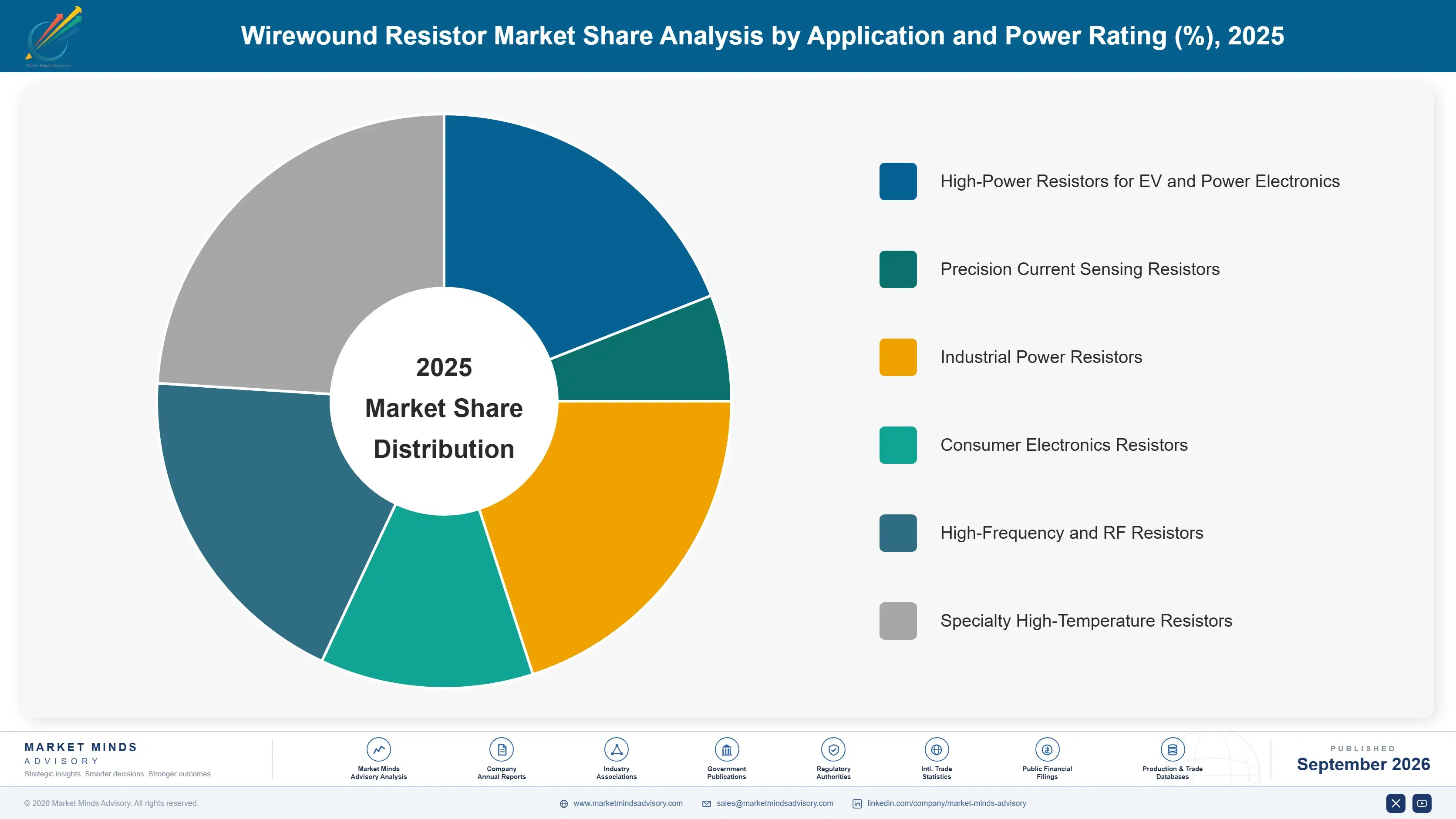
Wirewound resistors segment by core application and power rating, spanning high-power resistors for EV and power electronics, precision current sensing resistors, industrial power resistors, consumer electronics resistors, high-frequency and RF resistors, and specialty high-temperature resistors, each requiring genuinely distinct manufacturing tolerances, material specifications, and testing protocols for fully reliable long-term operation across all conditions.
wirewound-resistor-market-market-share-analysis-1789980706129

High-Power Wirewound Resistors for EV and Power Electronics

High-power wirewound resistors for EV and power electronics are engineered to dissipate substantial thermal energy continuously while maintaining precise resistance values under sustained high-current operation conditions that traditional industrial resistors were never designed to withstand reliably over an extended vehicle service life spanning many years of active use. Growth reflects accelerating electric vehicle production and increasing power electronics content per vehicle, alongside expanding renewable energy inverter manufacturing creating adjacent demand beyond automotive applications entirely across the industry. Vishay Intertechnology and Bourns have both expanded automotive-qualified high-power resistor manufacturing capacity specifically to serve growing electric vehicle inverter and onboard charger demand that has consistently outpaced supplier capacity additions in recent years.
CAGR 8.0%

Precision Current Sensing Resistors

Precision current sensing resistors measure electrical current flow with tight tolerance requirements, typically used in battery management systems, motor control circuits, and power supply feedback loops where measurement accuracy directly affects overall system performance and safety across the entire application and vehicle platform served today quite directly. Growth reflects expanding battery management system deployment across electric vehicles and grid-scale energy storage systems, both applications requiring precise current measurement that standard resistors cannot reliably provide at comparable accuracy or reliability over time. KOA Corporation and Vitrohm have both expanded precision current sensing resistor product lines specifically to serve growing battery management system demand across automotive and energy storage applications worldwide today.
CAGR 6.5%
Full segment breakdown across 6 segments available in the complete report.

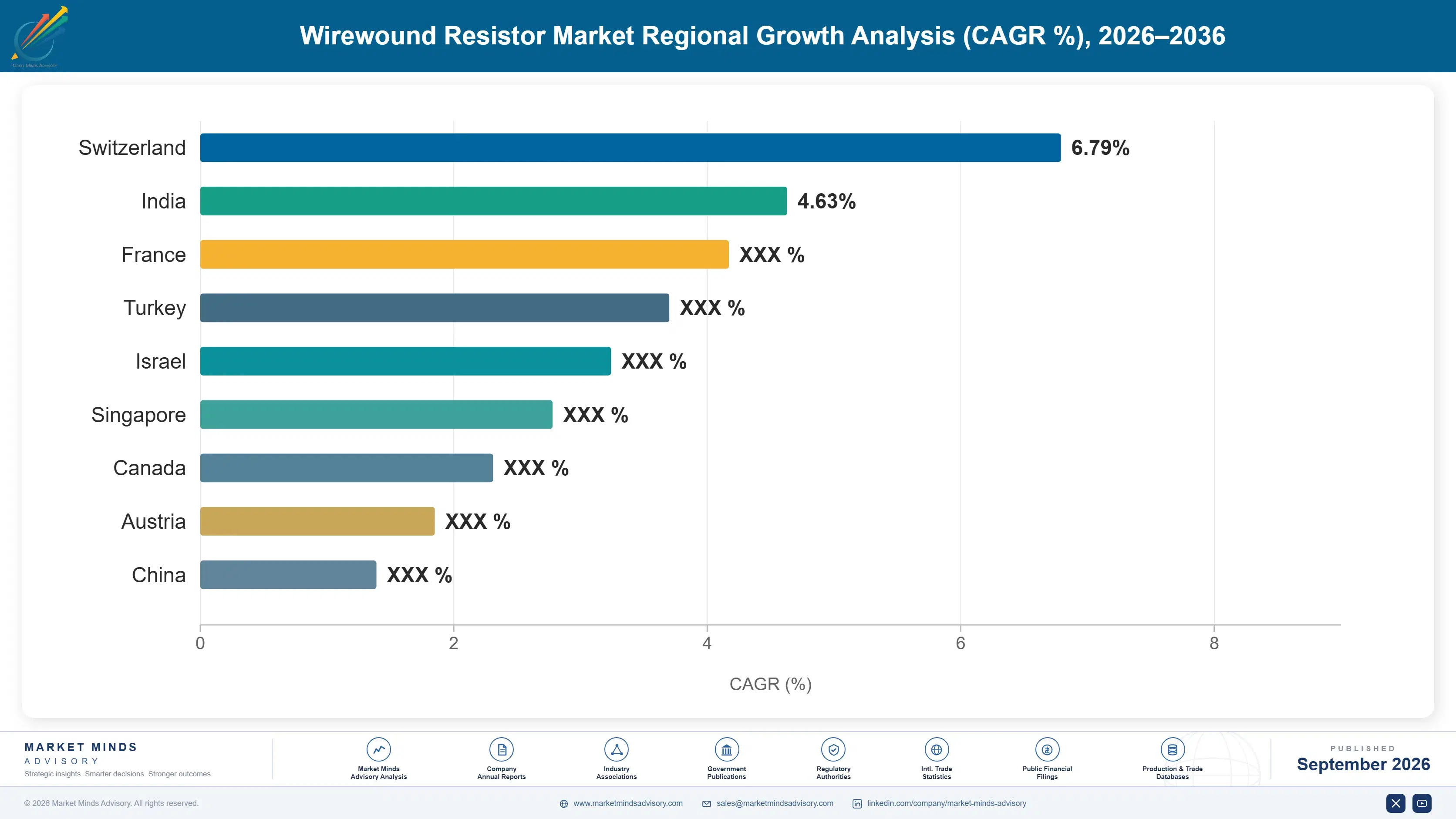
Regional Architecture and Country Demand Map

East Asia dominates given China's outsized concentration of passive electronic component manufacturing capacity, while South Asia and Pacific posts the fastest regional growth as India rapidly scales its domestic power electronics production base under new government-backed incentive programs launched nationwide each successive year recently and ongoing.

North America

US manufacturers maintain meaningful high-power and automotive-qualified wirewound resistor production capacity, serving domestic electric vehicle manufacturers and defense electronics applications requiring supply chain resilience beyond offshore sourcing alone entirely. Vishay Intertechnology and Ohmite both maintain significant US manufacturing presence specifically to serve customers requiring domestic supply chain assurance for automotive and defense applications. Canadian manufacturers follow similar patterns given closely integrated North American automotive supply chains and shared vendor relationships across the border. US reshoring incentives for critical electronic components have modestly supported domestic capacity investment in recent years amid growing supply chain security concerns nationwide. US defense procurement programs also specify domestically manufactured components for certain classified applications. Ongoing capacity expansion continues across several domestic manufacturing facilities.
Share: 26% | CAGR: 4.0% (2026 to 2036)

Western Europe

German manufacturers, given the country's substantial automotive industrial base, represent the largest single national demand driver within Western Europe for automotive-qualified wirewound resistors used in vehicle inverters and onboard chargers today. Vitrohm and other specialized European manufacturers maintain meaningful domestic production capacity serving both automotive and industrial customers requiring European supply chain proximity and shorter delivery lead times. French and Italian automotive suppliers show growing demand tied to their own domestic electric vehicle production ramp-up programs currently underway nationwide. UK manufacturing presence remains modest, with most demand served through European and Asian imports. Regional automotive electrification targets continue reinforcing this steady demand trajectory. Several manufacturers have expanded capacity to meet this growing regional need.
Share: 20% | CAGR: 3.0% (2026 to 2036)
Regional intelligence for 5 additional markets available in the complete report: East Asia, South Asia and Pacific, Latin America, Middle East and Africa, Eastern Europe. Contact sales@marketmindsadvisory.com.
wirewound-resistor-market-country-cagr-analysis-1789980706663

Automotive Qualification Margin Expansion Paths

Wirewound resistor manufacturers capture disproportionate margin not from raw component sales alone but from automotive qualification status, long-term supply agreements, and application engineering support layered directly on top, since these capabilities command materially higher pricing than commodity industrial resistors sold without comparable certification depth, program support, or dedicated ongoing engineering assistance included at all.

Securing Long-Term Automotive Program Supply Agreements

Manufacturers that secure multi-year automotive supply agreements, where qualification investment is repaid through guaranteed volume commitments over the life of a vehicle program, capture 15 to 22 percent higher margin than manufacturers selling on a transactional basis to industrial customers alone without comparable commitments in place. These agreements typically span 5 to 8 years matching vehicle program lifecycles, providing revenue visibility that spot-market industrial sales never achieve at comparable scale or certainty. Vishay Intertechnology has used long-term automotive agreements extensively to secure predictable revenue across multiple vehicle platforms simultaneously over the entire program lifecycle.
Market Impact: Adds 15 to 22 percent to overall margin

Offering Dedicated Application Engineering Support Services

Manufacturers that provide dedicated application engineering support, helping automotive customers optimize resistor placement and thermal management within complex power electronics assemblies, capture budget that would otherwise require the customer's own internal engineering resources and considerable staff time and effort, adding 12 to 18 percent to average contract value. This service requires specialized automotive systems expertise that most commodity resistor suppliers lack entirely and cannot easily build quickly or affordably. Bourns has expanded application engineering capability specifically to capture this growing higher-margin segment of automotive customer demand across every product line served.
Market Impact: Adds 12 to 18 percent to contract value

Expanding Into Renewable Energy Inverter Applications

Manufacturers that extend automotive-qualified high-power resistor capability into renewable energy inverter applications capture new recurring revenue streams beyond automotive-cyclical demand alone, typically adding 18 to 26 percent to total account revenue once renewable energy customer relationships are fully established across the entire product portfolio, line, and channel mix. This diversification applies existing high-power manufacturing expertise rather than requiring entirely new product development from scratch or significant additional capital investment. Ohmite has pursued this expansion aggressively across solar and wind inverter manufacturer customers beyond core automotive accounts each fiscal year going forward.
Market Impact: Adds 18 to 26 percent to account revenue

Building Domestic Manufacturing Capacity in Growth Markets

Manufacturers that build domestic manufacturing capacity in India and other rapidly growing electric vehicle markets capture preferential positioning under local content requirements that increasingly favor domestically produced components over imported alternatives, typically securing 20 to 30 percent higher win rates on new program awards in those specific markets and adjacent geographies. This capacity investment requires meaningful capital commitment but positions manufacturers ahead of competitors relying entirely on imports facing rising tariff and logistics cost exposure. Several manufacturers have announced new Indian manufacturing facilities specifically to capture this growing opportunity across every region served.
Market Impact: Increases win rates 20 to 30 percent locally

Who Controls the Margin Pool

Wirewound resistor manufacturing shows moderate concentration at a cr5 of 46 percent, reflecting a market split between a small group of large diversified passive component manufacturers and a much larger tail of specialized suppliers. Vishay Intertechnology and KOA Corporation lead on combined automotive qualification depth and manufacturing scale, while the gap to challengers like Ohmite has narrowed as high-power automotive capability becomes the primary competitive battleground rather than raw manufacturing scale alone.
Current competitive activity centers on expanding high-power manufacturing capacity for electric vehicle applications, since automotive qualification barriers protect incumbent pricing while demand growth attracts new entrants seeking capacity investment. Several manufacturers have expanded renewable energy inverter component capability to diversify beyond automotive-cyclical demand. Consolidation activity continues as larger manufacturers acquire specialized precision resistor suppliers.

Emerging pressure comes from Chinese and Indian manufacturers scaling domestic production with government backing, threatening to erode Western and Japanese supplier concentration in cost-sensitive industrial and consumer electronics categories over time. Smaller specialists focused narrowly on precision current sensing or high-frequency applications could still defend niche positions where technical expertise matters more than manufacturing scale. Rankings among the top five look durable through 2030, but the mid-tier supplier segment faces genuine pressure.
wirewound-resistor-market-company-positioning-matrix-1789980707182

Competitive Moat and Risk Dimensions

VISHAY INTERTECHNOLOGY

Moat: Broadest Automotive Qualification Portfolio

Vishay Intertechnology holds automotive qualification across the widest range of resistor product lines and vehicle programs among competitors, built through decades of sustained investment in automotive-grade manufacturing and testing infrastructure that a new entrant would need many years and enormous capital to replicate at comparable scale.
VISHAY INTERTECHNOLOGY

Risk: Broad Portfolio Dilutes Focus

Vishay Intertechnology's extremely broad product portfolio spanning many passive component categories beyond resistors alone could dilute management attention and capital allocation relative to competitors focused exclusively on high-power resistor innovation for the fastest-growing automotive and renewable energy segments specifically and quite directly and consistently overall.
KOA CORPORATION

Moat: Deep Japanese Automotive Relationships

KOA Corporation holds decades-long precision resistor supply relationships with major Japanese automakers, built through sustained co-development and quality collaboration efforts that a new entrant attempting comparable relationship depth would need considerable time, capital, and clearly demonstrated reliability to approach at similar scale, depth, and trust.
KOA CORPORATION

Risk: Geographic Concentration in Japan

KOA Corporation's revenue concentration in Japanese automotive customers exposes it to Japanese automotive production volume trends more directly than globally diversified competitors serving multiple regional automotive markets simultaneously across different economic conditions, regulatory environments, and shifting currency fluctuations affecting overall long-term profitability, margin, and growth.

Players Tracked

Prominent Players

Vishay Intertechnology
KOA Corporation
Ohmite
Bourns
Vitrohm

Other Key Players

TE Connectivity
Panasonic Industry
Yageo Corporation
Cyntec
Riedon
Kanthal
Caddock Electronics
IRC Advanced Film Division
Isabellenhutte
Micronics Japan
Ultra Group
Sfernice
Welwyn Components
Ohmega Technologies
CGS Resistors

Recent Developments

MARCH 2026

Vishay Intertechnology Expands High-Power Resistor Capacity

Vishay Intertechnology announced expanded high-power wirewound resistor manufacturing capacity specifically to meet growing electric vehicle inverter and onboard charger demand, adding production lines at existing facilities as automotive customers continue increasing order volume ahead of new vehicle platform launches scheduled across the coming several years.
Signal: Signals sustained commitment to high-power manufacturing capacity expansion ahead of anticipated demand growth nationwide today and tomorrow.
OCTOBER 2025

KOA Corporation Signs Renewable Energy Inverter Agreement

KOA Corporation signed a multi-year supply agreement with a major renewable energy inverter manufacturer, extending its precision resistor capability beyond core automotive applications into solar and wind power electronics, diversifying revenue exposure beyond automotive sector cyclicality that has historically driven the bulk of company revenue.
Signal: Signals incumbent diversification beyond core automotive applications into renewable energy power electronics markets today and tomorrow.
JUNE 2025

Ohmite Announces New Indian Manufacturing Facility

Ohmite announced construction of a new manufacturing facility in India specifically to serve the country's rapidly growing electric vehicle and power electronics manufacturing sector, positioning the company to capture domestic content requirements increasingly favoring locally produced components over imported alternatives across government-backed procurement programs and initiatives nationwide.
Signal: Signals growing manufacturer investment in Indian domestic production capacity ahead of most competitors today and going forward.

Nickel-Chromium Wire and Ceramic Costs

Nickel-chromium resistance wire and ceramic core materials together account for roughly 35 to 45 percent of wirewound resistor cost of goods sold, sourced from a concentrated group of specialty metal alloy producers and ceramic component manufacturers based primarily in China, Japan, and Germany, with very few qualified alternate sources readily available on quite short notice.
Nickel prices spiked sharply during 2022 as global supply chain disruption and surging demand from battery and stainless steel manufacturing simultaneously strained available nickel supply, according to industry metal market reporting tracking base metal price volatility across multiple end-use sectors. This pricing pressure raised resistance wire costs meaningfully at a time when automotive customers were simultaneously demanding expanded production volume under existing fixed-price supply agreements.

Smaller wirewound resistor manufacturers lacking long-term nickel alloy supply agreements face higher input cost volatility than diversified manufacturers like Vishay Intertechnology, which purchase raw materials at much larger consolidated volumes across their broader passive component portfolio. This gives larger manufacturers a durable cost advantage on raw material procurement specifically, even though labor and manufacturing costs scale similarly across suppliers of nearly any size in the category.
wirewound-resistor-market-cost-volatility-analysis-1789980707377

Diversifying Nickel Alloy Sourcing Geographically

Manufacturers increasingly qualify nickel alloy suppliers across multiple countries and several continents to reduce dependence on any single source, accepting modestly higher per-unit costs during qualification in exchange for reduced exposure to future supply disruption or price spike events affecting production continuity, delivery reliability, and long-term program schedule stability nationwide and internationally each year.

Signing Long-Term Fixed-Price Material Contracts

Manufacturers increasingly negotiate multi-year fixed-price agreements with metal suppliers well before anticipated shortages actually materialize in the market, locking in predictable input costs, though this approach requires accurate long-term demand forecasting and carries genuine counterparty risk during extreme sector-wide demand and material supply constraint periods across the broader industry and its entire supply base.

Recycling Manufacturing Scrap Into Lower-Grade Applications

Larger manufacturers increasingly recycle nickel alloy manufacturing scrap into lower-grade resistor applications instead of simply discarding it as pure waste, reducing raw material waste and effective per-unit material cost while requiring capital investment in recycling process technology that smaller suppliers often lack the resources, scale, or engineering expertise to fund properly, reliably, and consistently.

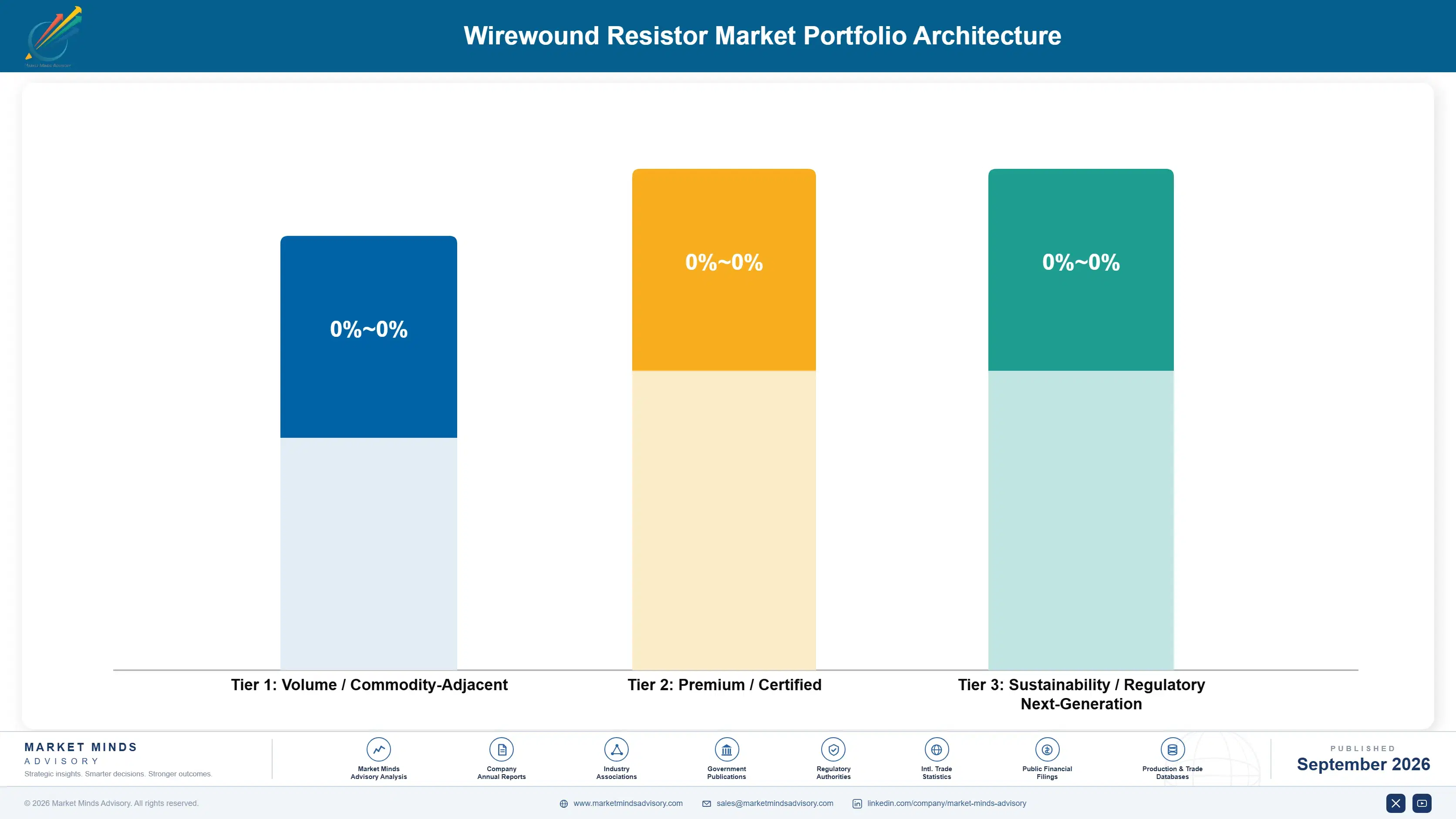
Portfolio Architecture for Margin Defence

Wirewound resistor manufacturers operate across three margin tiers, from commodity industrial resistors sold at volume with thin margin to premium automotive-qualified high-power components commanding substantially better economics. Tier separation reflects certification depth and thermal reliability requirements rather than raw material cost differences alone, since a basic industrial resistor and a fully qualified automotive high-power resistor can share similar underlying nickel-chromium wire and ceramic core materials at the component level.
Volume tension is sharpest in commodity industrial resistors, where price-sensitive customers push toward standardized pricing while manufacturers would prefer premium automotive qualification investment. Automotive and renewable energy customers behave oppositely, valuing thermal reliability and long-term supply certainty over unit price, which is why the highest-value revenue pools concentrate in high-power qualified components rather than commodity industrial applications.

Precision current sensing resistors sit between these extremes: growing steadily but priced closer to industrial tiers than premium high-power automotive components, since precision-focused buyers remain more cost-conscious than automotive customers evaluating thermal reliability claims directly. Manufacturers positioned across all three tiers simultaneously capture the broadest addressable revenue base, though few manage the operational complexity of serving such differently motivated customer segments well.

Volume / Commodity-Adjacent

Standardized industrial resistors sold at volume to price-sensitive customers with minimal certification or thermal reliability requirements involved in the base product offering itself at meaningful annual production scale and volume.
Gross Margin: 15 to 22%

Premium / Certified

Automotive-qualified high-power resistors requiring extensive thermal cycling and reliability testing justifying substantially higher enterprise pricing than commodity alternatives ever command in the broader industrial market today and for years going forward.
Gross Margin: 28 to 36%

Sustainability / Regulatory / Next-Generation

Precision current sensing and renewable energy inverter resistors serving evolving demand at margins between commodity and premium automotive tiers, growing steadily as electrification continues expanding rapidly across most global industries and markets.
Gross Margin: 22 to 30%
wirewound-resistor-market-portfolio-architecture-1789980708023

High-value Sub-segments and Strategic Watch-out

High-Power EV Resistors

High-power EV resistors combine high growth with premium automotive pricing, representing the clearest high-value high-growth opportunity as electric vehicle production accelerates and power electronics content per vehicle expands rapidly worldwide each year and program cycle, platform, and manufacturing generation. This segment is now a clear capital priority.
Gross Margin: high

Renewable Energy Inverter Resistors

Renewable energy inverter resistors combine strong margins with steady growth tied to solar and wind installation expansion, representing a high-value moderate-growth pool anchored by demand distinct from automotive cyclicality entirely across every market, geography, and installation type served worldwide. Vendors treat this as a genuine diversification priority.
Gross Margin: high

Commodity Industrial Resistors

Standardized industrial resistors form the volume core of the market, generating steady revenue at compressed margins as customers negotiate aggressively on price given tight technology and procurement budgets overall each successive fiscal year, cycle, annual planning period, and quarterly review. Consolidation among smaller suppliers in this tier continues steadily.
Gross Margin: moderate

Chinese and Indian Manufacturer Competition

Chinese and Indian manufacturers scaling domestic production with government backing represent the clearest strategic watch-out, since expanding local capacity threatens to compress Western and Japanese supplier concentration in commodity categories over the coming decade steadily, considerably, increasingly, and perhaps permanently. Incumbent manufacturers are responding with automation and cost reduction.
Gross Margin: uncertain

Multi-Year Automotive Program Economics

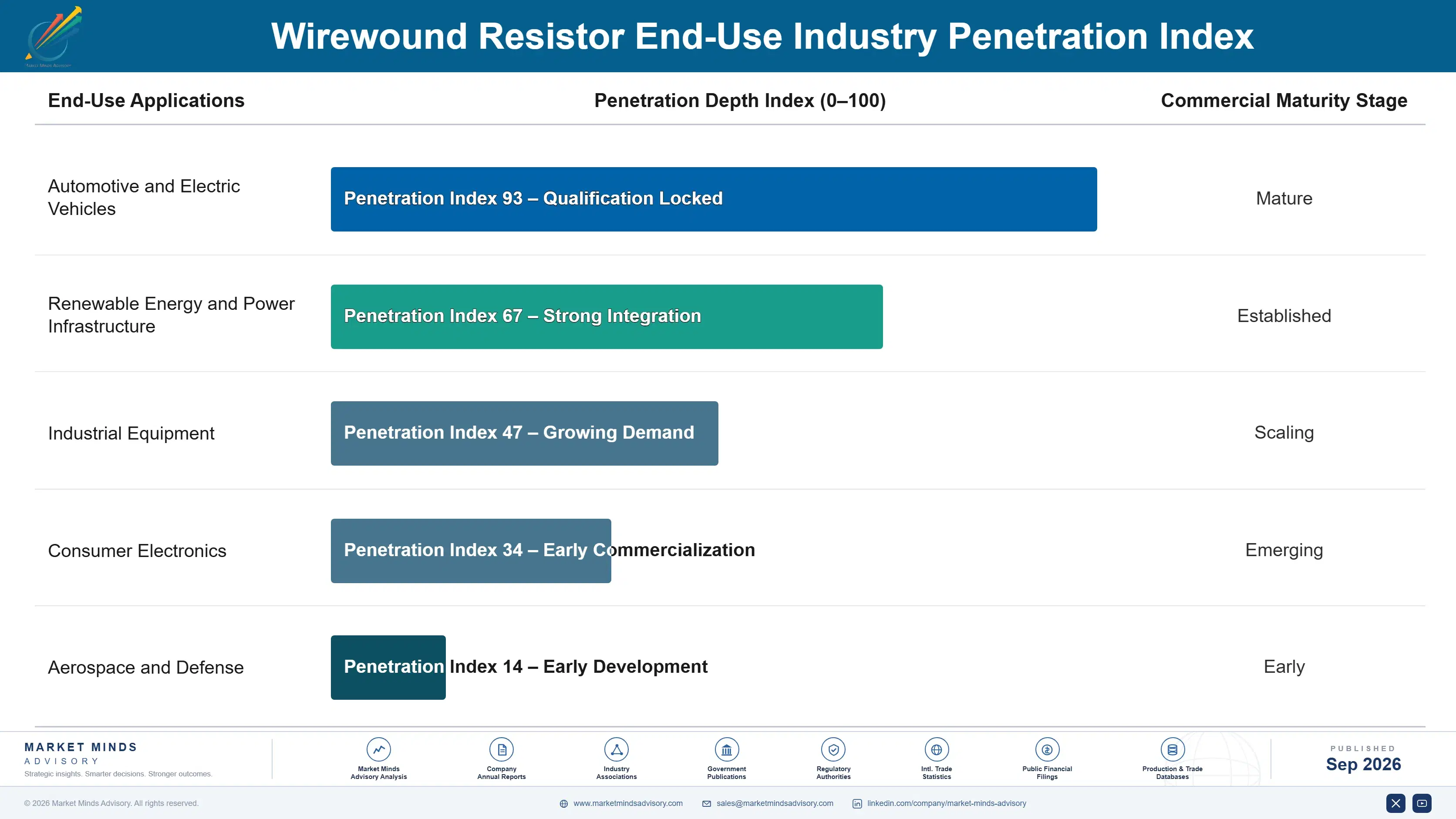
Wirewound resistor manufacturers generate durable annuity revenue through multi-year automotive program participation, since a supplier qualified on a vehicle platform typically retains that production allocation for the entire program's multi-year production life without meaningful competitive rebidding along the way. Manufacturers holding automotive qualification convert this into an even more durable revenue stream, since requalifying an alternate supplier mid-program would require costly and time-consuming testing that automakers generally avoid.
Adoption stickiness varies sharply by end-use vertical. Automotive programs show the deepest engagement, since qualification and testing costs make switching suppliers mid-program prohibitively expensive and operationally disruptive for automakers. Renewable energy inverter programs show comparable stickiness once established, tied to similar reliability qualification requirements. Industrial and consumer electronics customers, being more price-sensitive and less qualification-dependent, show markedly shallower supplier relationships given shorter product lifecycles and lower switching costs.

Buyer profiles are shifting generationally as power electronics engineers, rather than traditional procurement staff focused purely on unit cost, increasingly drive supplier selection decisions, prioritizing thermal reliability and long-term supply security over the lowest-bid-wins approach that dominated component sourcing before electrification. This shift favors manufacturers offering automotive qualification depth and application engineering support over vendors whose value proposition rests primarily on unit price alone.
wirewound-resistor-market-end-use-penetration-index-1789980708643

Where MMA Sees the Opportunity

These are among the four positions where our research anticipates prominent divergence between winners and laggards over the coming forecast period. Each is grounded in the demand model, the regulatory perimeter, and the announced capacity pipeline.
01 / HIGH-POWER CAPACITY INVESTMENT

Expand high-power manufacturing capacity ahead of demand curve

High-power resistors for EV and power electronics are growing at 8.0 percent versus the market's 4.5 percent overall rate, and automotive qualification barriers mean capacity built today will not generate revenue for at least 18 months once construction begins. Manufacturers that expand high-power capacity now, ahead of confirmed demand, secure automotive program awards before competitors recognize the scale of this sustained multi-year shift in vehicle powertrain technology and design. Waiting until demand is fully confirmed risks losing qualification windows to faster-moving competitors already investing aggressively.
02 / RENEWABLE ENERGY DIVERSIFICATION

Diversify into renewable energy inverters to hedge automotive cycles

Renewable energy inverter demand provides wirewound resistor manufacturers a genuine hedge against automotive sector cyclicality that pure automotive-focused suppliers do not enjoy during industry downturns or production slowdowns. Manufacturers that extend automotive-qualified high-power capability into renewable energy applications capture 18 to 26 percent higher account revenue once these relationships are fully established, applying existing manufacturing expertise rather than requiring entirely new product development from scratch. This diversification path requires considerably less capital investment than building genuinely new capability entirely from the ground up.
03 / INDIAN MARKET ENTRY TIMING

Build Indian manufacturing capacity ahead of full-scale competition

India is growing at 9.0 percent annually as domestic power electronics and electric vehicle manufacturing scales under government-backed incentive programs favoring local content requirements over imported components from established manufacturing hubs located elsewhere globally. Manufacturers that establish Indian manufacturing capacity now secure preferential positioning on domestic supply contracts before international competitors recognize the scale of this shift and arrive with comparable local production capability of their own. This window will not stay open indefinitely as more manufacturers relocate capacity toward India.
04 / NICKEL SUPPLY DIVERSIFICATION

Diversify nickel alloy sourcing before the next price spike

Nickel-chromium wire and ceramic core materials already run 35 to 45 percent of cost of goods sold, and the 2022 nickel price spike proved how exposed single-source manufacturers remain to commodity market volatility without warning. Manufacturers that qualify alternate nickel alloy suppliers across multiple countries now, before the next price disruption forces a scramble, protect margin and delivery reliability simultaneously across every affected product line. This is an operational fix rather than a strategic one, but it carries meaningful downside protection value.

Engagement Snapshot From the Field

A live engagement with an industry participant carrying material or product regulatory and market exposure ahead of a defining policy shift, showing how our research translates into a defensible multi-year portfolio strategy.
MARKET MINDS ADVISORY · CLIENT ENGAGEMENT SUMMARY
Wirewound Resistor Producer Strategic Portfolio Review and Transition Roadmap 2026·Investment Scenario on Wirewound Resistor Exposure Evaluation 2025-26
CLIENT PROFILE
The client is a mid-sized Tier 2 automotive electronics supplier specializing in power resistor components, with annual revenue in the range of 180 to 230 million dollars (client-reported, unverified by MMA). The company had operated a single manufacturing facility for over fifteen years and was evaluating capacity expansion options to meet rising electric vehicle customer demand.
STRATEGIC CHALLENGE
Facing sustained pressure from automotive customers to increase high-power resistor delivery volume for new electric vehicle programs, leadership needed an independent assessment of expansion options, including domestic capacity addition versus establishing a new manufacturing facility in India to capture emerging market growth and quite meaningful long-term cost advantages available there.
MMA APPROACH
MMA conducted a comparative cost and risk assessment across three expansion scenarios, evaluating labor cost differentials, automotive qualification timelines, customer requirements, and realistic capital payback periods under each option considered carefully. The engagement included interviews with two Indian industrial park operators and a review of the client's existing customer qualification requirements and documentation.
KEY FINDINGS
  1. A new Indian facility was projected to reduce labor costs by 30 to 40 percent compared to expanding the existing domestic facility (client-reported, unverified by MMA).
  2. Customer requalification for a new manufacturing location would take approximately 18 months, longer than the client's original internal estimate of one full year.
  3. Existing customers expressed strong preference for the Indian expansion option given its proximity to their own growing regional supply chain diversification strategies.
  4. Available industrial real estate and skilled labor supply in India exceeded initial expectations quite considerably, meaningfully reducing projected facility ramp-up timelines overall.
CLIENT PROFILE
The client is a mid-sized Tier 2 automotive electronics supplier specializing in power resistor components, with annual revenue in the range of 180 to 230 million dollars (client-reported, unverified by MMA). The company had operated a single manufacturing facility for over fifteen years and was evaluating capacity expansion options to meet rising electric vehicle customer demand.
STRATEGIC CHALLENGE
Facing sustained pressure from automotive customers to increase high-power resistor delivery volume for new electric vehicle programs, leadership needed an independent assessment of expansion options, including domestic capacity addition versus establishing a new manufacturing facility in India to capture emerging market growth and quite meaningful long-term cost advantages available there.
MMA APPROACH
MMA conducted a comparative cost and risk assessment across three expansion scenarios, evaluating labor cost differentials, automotive qualification timelines, customer requirements, and realistic capital payback periods under each option considered carefully. The engagement included interviews with two Indian industrial park operators and a review of the client's existing customer qualification requirements and documentation.
KEY FINDINGS
  1. A new Indian facility was projected to reduce labor costs by 30 to 40 percent compared to expanding the existing domestic facility (client-reported, unverified by MMA).
  2. Customer requalification for a new manufacturing location would take approximately 18 months, longer than the client's original internal estimate of one full year.
  3. Existing customers expressed strong preference for the Indian expansion option given its proximity to their own growing regional supply chain diversification strategies.
  4. Available industrial real estate and skilled labor supply in India exceeded initial expectations quite considerably, meaningfully reducing projected facility ramp-up timelines overall.
RECOMMENDED STRATEGY
Phase 1: Phase one: secure an Indian industrial park site and begin facility construction within the first six months of the decision. Phase 2: Phase two: begin customer requalification processes in parallel with construction to compress the overall program timeline considerably each passing month. Phase 3: Phase three: transition initial production volume to the new facility within 24 months while maintaining existing domestic capacity fully operational.
OUTCOME
The client selected the Indian expansion option and began site selection within one month of the engagement's conclusion (client-reported, unverified by MMA). Facility construction progress and customer requalification outcomes were not yet available for independent verification at the time of this original report's scheduled publication.

Frequently Asked Questions

Foundational context covering the market sizes, CAGR, scope, country, region and competition that inform every finding below. This section is provided to cover basics and most often pre-purchase conversations, answered from the MMA Primary Research Dataset.

What is the current size of the Wirewound Resistor Market?

The global wirewound resistor market is valued at 2.1 billion dollars in 2025, the report's base year. This reflects spending on high-power, precision, and industrial resistor components combined across automotive and electronics applications.

How large will the Wirewound Resistor Market be by 2036?

MMA projects the market will reach 3.4 billion dollars by 2036, a 1.55 times expansion from 2026's forecast value. Growth is driven mainly by electric vehicle power electronics and renewable energy inverter demand.

What is the CAGR for the Wirewound Resistor Market 2026 to 2036?

The market is forecast to grow at a 4.5 percent compound annual rate between 2026 and 2036. Bull and bear scenarios range from 5.7 percent to 3.3 percent depending on electric vehicle production rates.

Which segment is growing fastest?

High-power wirewound resistors for EV and power electronics lead at an 8.0 percent CAGR, roughly 1.78 times the overall market rate. Demand is driven by expanding electric vehicle inverter and charger content.

Who are the major companies in the Wirewound Resistor Market?

Vishay Intertechnology, KOA Corporation, Ohmite, Bourns, and Vitrohm lead the market on combined automotive qualification depth and manufacturing scale. Together they hold a combined cr5 of 46 percent.

Which country is growing fastest?

India leads at a 9.0 percent forecast CAGR, driven by rapidly scaling domestic power electronics and electric vehicle manufacturing under government-backed incentive programs. This outpaces the broader South Asia and Pacific average.

Report Segmentation Architecture

The full report scope spans multiple orthogonal segmentation dimensions, with cross-tabulated demand data provided for each dimension pair. Coverage extends further to regional breakdowns, trend trajectories, and the competitive detail needed to support segment-level decision-making.

By Application and Power Rating

  • High-Power Resistors for EV and Power Electronics
  • Precision Current Sensing Resistors
  • Industrial Power Resistors
  • Consumer Electronics Resistors
  • High-Frequency and RF Resistors
  • Specialty High-Temperature Resistors

By End-Use Industry

  • Automotive and Electric Vehicles
  • Renewable Energy and Power Infrastructure
  • Industrial Equipment
  • Consumer Electronics
  • Aerospace and Defense

By Commercial Dimension

  • Direct OEM Purchase
  • Automotive Tier 1 Supply Channel
  • Distributor Channel
  • Aftermarket and Replacement Channel

By Region

  • North America
  • Western Europe
  • East Asia
  • South Asia and Pacific
  • Latin America
  • Middle East and Africa
  • Eastern Europe

Scope, Methodology, and Coverage

Every figure in this report is reproducible from documented input assumptions. The scope below maps the historical period, the forecast horizon, the segmentation dimensions, and the countries covered, alongside the underlying primary and qualitative methodology.
Historical Period
2020 to 2025
Forecast Period
2026 to 2036
Base Year
2025 (USD billions; MMA Primary Research Dataset, September 2026)
Market Definition
This market covers wirewound resistor components used for precision current sensing, power dissipation, and voltage division across industrial, automotive, and consumer electronics applications, manufactured by winding resistance wire around a ceramic or fiberglass core. It excludes thin-film, thick-film, and carbon composition resistor technologies that use fundamentally different construction methods.
Quantitative Units
USD billions (current prices); unit shipment volumes where applicable
Segmentation Dimensions
By Application and Power Rating; By End-Use Industry; By Commercial Dimension; By Region
Regions Covered
North America, Western Europe, East Asia, South Asia and Pacific, Latin America, Middle East and Africa, Eastern Europe
Countries Covered
USA, China, Germany, France, UK, Japan, South Korea, India, Australia, Canada, Brazil, Mexico, Indonesia, Vietnam, Thailand, Malaysia, UAE, Saudi Arabia, South Africa, Nigeria, Turkey, Poland, Netherlands, Italy, Spain, Sweden, Switzerland, Argentina, Colombia, Singapore, and additional markets relevant to this sector
Key Companies Profiled
Vishay Intertechnology, KOA Corporation, Ohmite, Bourns, Vitrohm, TE Connectivity, Panasonic Industry, Yageo Corporation, Cyntec, Riedon, Kanthal, Caddock Electronics, IRC Advanced Film Division, Isabellenhutte, Micronics Japan, Ultra Group, Sfernice, Welwyn Components, Ohmega Technologies, CGS Resistors
Quantitative Methodology
Primary survey, n=3,800 respondents, Q4 2025, six countries; demand-side model with trade association cross-validation
Qualitative Methodology
47 expert interviews, Q4 2025; applied to validate demand model assumptions, identify emerging dynamics, and assess competitive positioning
Report Format
PDF and XLSX data workbook (Word format preview document)
Publisher
Market Minds Advisory
Report Code
MMA-2026-TEC-175
Published
September 2026
Contact
sales@marketmindsadvisory.com | www.marketmindsadvisory.com

Purchase the full Wirewound Resistor Market Report (2026 to 2036).

The full report delivers a comprehensive assessment of the global wirewound resistor market across application and power rating, end-use industry, and commercial channel dimensions through 2036. It includes detailed competitive profiles of twenty companies, seven regional demand analyses, and input cost risk modeling tied to nickel-chromium wire and ceramic supply chains. Analysts receive segment-level CAGR forecasts, portfolio margin benchmarking, and a strategic verdict section identifying where near-term investment should concentrate. The report also includes an anonymized client case study illustrating real-world manufacturing capacity expansion decisions.
Seven-region demand and CAGR growth forecasts
Twenty-company competitive profiling and moat analysis
Six-dimension segmentation with detailed growth rates
Nickel alloy input cost risk modeling
Portfolio margin tier benchmarking analysis framework
Anonymized client capacity expansion case study

Built For The People Who Decide

From boardroom strategy to bench-side execution, this report is read cover-to-cover by leaders shaping the next decade of their industry, turning demand scenarios, market dynamics and valuation benchmarks into decisions.
CXOs/ Presidents/ VPs/ Managers
M&A and Corporate Development
Strategy Teams and R&D Heads
Procurement and Product Directors
Regulatory and Compliance Leaders
Investor Relations and Equity Analysts