Market Minds Advisory
Wireless Synchronized Clocks Market

Wireless Synchronized Clocks Market: Wireless Synchronized Clocks: Record-Keeping Obligations, Network Ownership and the Slow Death of Radio Time

Facilities buy synchronised time because clinical, legal and industrial records depend on it, and the shift from radio to network delivery has quietly moved the purchase decision to people who do not run buildings.

Lead Analyst

Published

September 2026

Make Smarter Decisions with Customized Research Insights

Request a free sample report and evaluate market opportunities, growth trends, and competitive dynamics relevant to your business needs.

2025 MARKET VALUE$0.5BMarket Size 2025
2036 FORECAST VALUE$1.0BBase Case , 2026 to 2036
CAGR 2026 TO 20366.4 %Bull 7.6% / Bear 5.2%
INCREMENTAL OPPORTUNITY$0.5BNet 10- year value creation
EXPANSION MULTIPLE1.87x2036 value over 2026 base
Strategic Levers
M&A Pipeline
Regional Outlook
Country Rankings
Competitive Intelligence
Segmental Deep-dive
Call-Us : 91 93563 13602

Executive Snapshot and Market Trajectory.

Nobody buys a clock. They buy the assurance that every timestamp in a building agrees, because clinical charts, court transcripts and production records are all defended on the assumption that the clocks matched. The wall clock is only where that assurance becomes visible to anybody walking past it.
That is why healthcare takes 34% of demand and why the money sits in the system rather than the display. Roughly 62% of contract value is transmitters, master clocks and management software. Wi-Fi synchronised systems grow fastest at 9.6%, half again the market rate of 6.4%, and North America takes 41% because it holds the largest installed base and a radio band nobody else uses. Displays themselves are close to a pure commodity now.
Concentration is moderate at roughly 44% across the top five on measured system revenue. The change that matters is not competitive: putting clocks on a network moved approval from facilities management to information technology, which adds around seven months to procurement and rules out suppliers who cannot answer security questions. Product quality now matters less than a completed security questionnaire, which several established suppliers still cannot produce on request.
Market Definition
This market covers clock systems in which display units receive time wirelessly from a reference source, spanning licensed narrowband radio, Wi-Fi, terrestrial radio time signal receivers, GNSS-referenced wireless distribution, Bluetooth and low-power mesh, and cellular or private network synchronisation. Revenue is measured as system value including displays, transmitters, master clocks, management software and attributable installation. Wired Power over Ethernet clocks, network time servers sold for data centre timing, wristwatches, consumer clocks and public transport passenger information displays are excluded.
Base Year Value
$0.5B in 2025 (MMA Primary Research Dataset, September 2026)
Forecast Period
2026 to 2036, eleven discrete annual values
CAGR
6.4% base case. Bull 7.6%. Bear 5.2%.
Fastest Growth Segment
Wi-Fi Synchronised Clock Systems: 9.6% CAGR
Fastest Growth Country
India: 10.4% CAGR
Fastest Growth Region
South Asia and Pacific: 8.6% CAGR
Largest Region
North America: 41% of 2025 global value
Market Leaders
Primex, American Time, Sapling, Bodet and Mobatime lead on measured wireless clock system revenue. Source: MMA Primary Research Dataset, July 2026.
Primary Survey
n=3,800 procurement and R&D decision-makers, Q4 2025, six countries
Methodology
Demand-side build-up, cross-validated against public data, 47 expert interviews

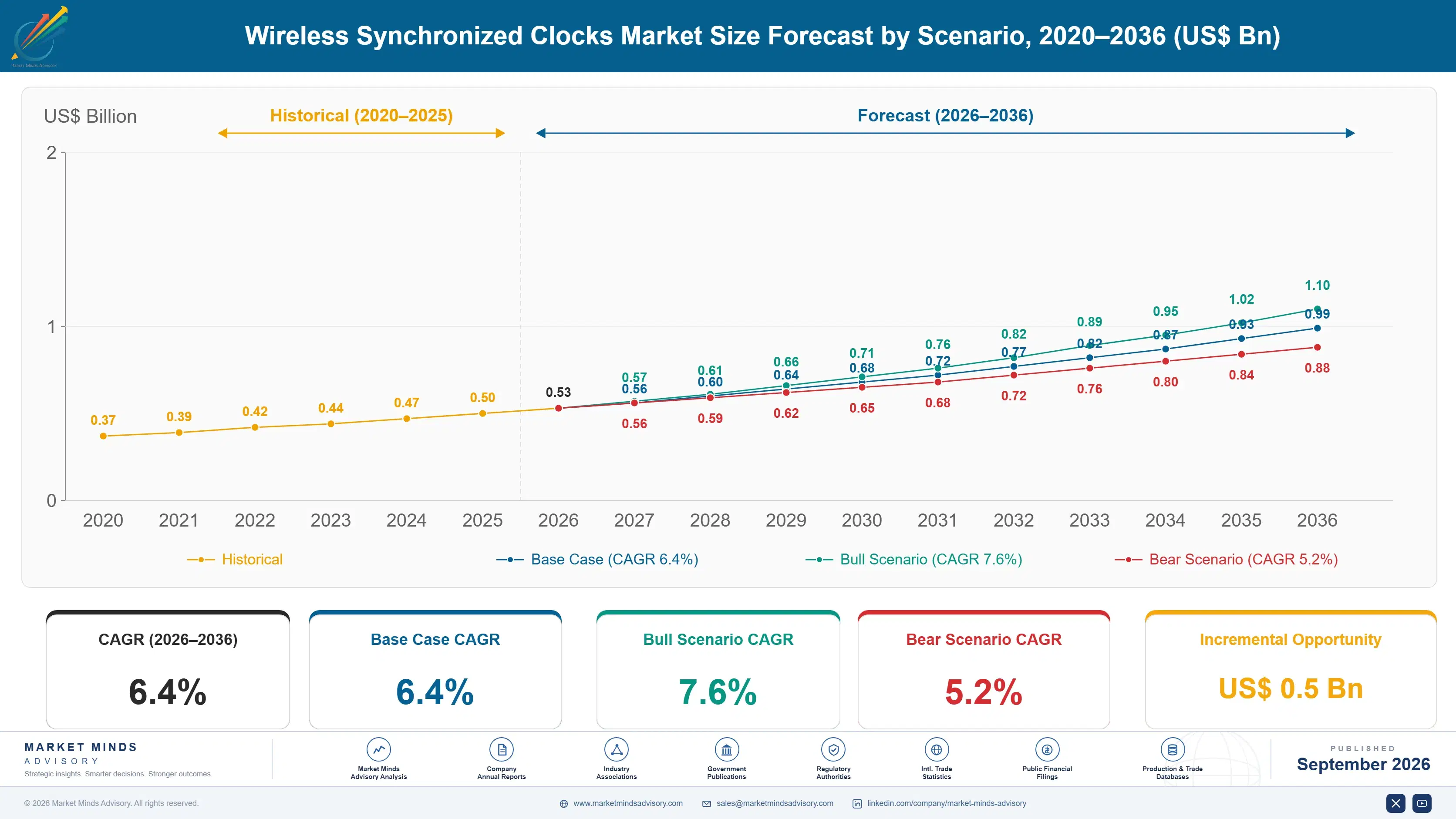
Wireless Synchronized Clocks Market Forecast Scenarios

wireless-synchronized-clocks-market-size-forecast-scenario-1788419705388
Growth ran at 5.4% between 2020 and 2025 and the composition shifted more than the rate did. Healthcare construction and school renovation funded most installations, while the licensed radio systems that dominated the previous two decades stopped winning new buildings. Replacement of ageing installations carried the volume rather than any expansion of the addressable base, and the average installed system is now around thirteen years old.
The base case at 6.4% rests on three mechanisms. An installed base averaging thirteen years is reaching the point where battery replacement labour and radio infrastructure obsolescence make replacement cheaper than maintenance. Healthcare accreditation and clinical documentation requirements keep synchronised time a compliance obligation rather than a convenience, and healthcare is 34% of demand. Third, Wi-Fi and mesh systems remove the transmitter infrastructure that made previous generations expensive to install in existing buildings.
The bull case at 7.6% assumes terrestrial radio time signal services are curtailed, which would force replacement across a large receiver-clock base on a compressed timetable. The bear case at 5.2% is that buildings simply stop replacing clocks, reasoning that everyone carries a phone. That argument is weaker than it sounds in regulated settings and stronger than suppliers admit everywhere else.

Timestamps That Have to Agree With Each Other

The product looks trivial and the requirement is not. In a hospital, the times recorded on a medication administration, a code call and a monitoring trace have to agree, because the sequence is what gets examined afterwards. Courts, correctional facilities, testing centres and regulated manufacturing carry versions of the same obligation. That is the actual purchase, and the clock on the wall is simply where it becomes visible.
TOP FIVE CONCENTRATION44%Moderately concentrated among a few specialist clock system suppliers
INSTALLED BASE AGE13 yearsAverage age of systems now approaching planned replacement
SYSTEM SHARE OF VALUE62%Portion of contract value in transmitters and software
HEALTHCARE DEMAND SHARE34%Largest vertical, driven by clinical record-keeping obligations everywhere
BATTERY REPLACEMENT INTERVAL4.5 yearsTypical service life before cells require field replacement
IT APPROVAL DELAY7 monthsAdditional procurement time once network connection is required
Value sits in the infrastructure rather than the display. Around 62% of a contract is transmitters, master clocks referenced to a time source, management software and commissioning, with the clocks themselves close to a commodity. Suppliers who priced on displays found themselves competing with anyone who can source a movement and a case. Those selling the system and its verification records survived the arrival of cheap imported hardware.
The consequential change was administrative rather than technical. Moving synchronisation onto building networks turned every clock into a device on the corporate network, which brought information technology into a decision facilities used to make alone. That adds roughly seven months and introduces security review, certificate management and device inventory questions traditional suppliers were never asked. Several have not adapted to it.
"This industry spent decades selling clocks and then discovered its buyer had changed to somebody who thinks of a clock as an unmanaged endpoint with a radio in it. The suppliers who can produce a security questionnaire response are winning work from suppliers with better products."
Director, Building Systems and Facility Technology Practice · MMA Construction and Industrial Equipment Practice · September 2026

Market Trends

Network Delivery Moves Approval From Facilities to Technology

Wireless clocks that synchronise over building Wi-Fi are simpler to install and considerably harder to buy. Once a clock joins the corporate network it becomes an endpoint subject to device inventory, certificate management, firmware patching and security review, none of which facilities procurement has ever handled. Approval takes roughly seven months longer as a result. Suppliers able to supply security documentation, support enterprise authentication and demonstrate patching processes are winning specifications from competitors with better displays and longer histories in the category. Product comparison now happens after security review rather than before it.
Market Impact: Healthcare covers 34% of demand
Terrestrial Radio Time Services Face an Uncertain Future

A meaningful part of the installed base consists of clocks receiving national radio time signals directly, a technology that requires no infrastructure in the building at all and costs almost nothing to operate. Proposals to curtail those broadcast services have surfaced repeatedly in national budget processes, and each round creates uncertainty for facilities holding thousands of dependent devices. Suppliers are using it as a replacement argument, though buyers have learned to discount warnings that have not yet materialised. Any actual curtailment would force replacement on a compressed timetable. Suppliers have cried wolf often enough to weaken their own case.
Market Impact: Batteries replaced every 4.5 years

Market Opportunities and Growth Drivers

Clinical Documentation Requirements Make Time a Compliance Matter

Healthcare accreditation standards and clinical record-keeping obligations require that events recorded across departments can be reconstructed in sequence, which cannot be done reliably if clocks disagree. Medication administration, resuscitation timing, surgical records and monitoring traces all carry legal weight, and inconsistent timestamps become a defence problem rather than an inconvenience. Healthcare accordingly accounts for 34% of demand, the largest single vertical, and it buys on obligation rather than budget availability. American Hospital Association facility counts indicate a substantial installed base still on ageing systems. Budget availability rarely enters into the decision at all.
Market Impact: Removes 46% of commercial space

Installed Base Ageing Passes the Replacement Economics Threshold

Systems averaging thirteen years old carry two compounding costs: batteries requiring field replacement roughly every four and a half years across hundreds of devices, and transmitter infrastructure for which spares are increasingly unavailable. At some point the labour of maintaining an old system exceeds the capital cost of a new one, and large installations are crossing that line now. This is the least glamorous demand driver in the market and by some distance the most reliable, since it depends on arithmetic that facilities managers can verify themselves. Facilities managers can check that arithmetic themselves without any supplier.
Market Impact: Eliminates 3 of 8 bidders

Market Restraints and Challenges

Everyone Carries a Phone and Buyers Have Noticed

The most common objection in a non-regulated building is that occupants already carry accurate time in their pockets, which makes a wall clock system look like an expense with no benefit. The root cause is that in offices and general commercial space the objection is largely correct, since nothing there depends on synchronised institutional time. Commercially this confines durable demand to regulated and operational settings. Suppliers mitigate by concentrating on healthcare, education, corrections, transport and manufacturing rather than defending a general commercial argument they will lose. Regulated demand is durable and general commercial demand is not.
Market Impact: Adds 7 months to procurement

Network Security Review Blocks Suppliers Without Documentation

Once a clock connects to the corporate network it faces the same scrutiny as any other endpoint, and suppliers unable to answer questions on encryption, authentication, firmware signing and vulnerability disclosure are removed from consideration regardless of product quality. The root cause is that this industry built products for facilities buyers and never developed security engineering practice. The commercial impact falls hardest on smaller established suppliers. Mitigation requires firmware signing, enterprise authentication support and formal disclosure processes, which are genuine engineering investments rather than documentation exercises. Product quality does not compensate for a missing disclosure process.
Market Impact: Affects 22% of installed devices
3 additional market trends, 4 additional growth drivers, and 2 additional restraints and challenges are covered in the full report. Contact sales@marketmindsadvisory.com to access the complete intelligence.

Segment CAGR and Growth Architecture

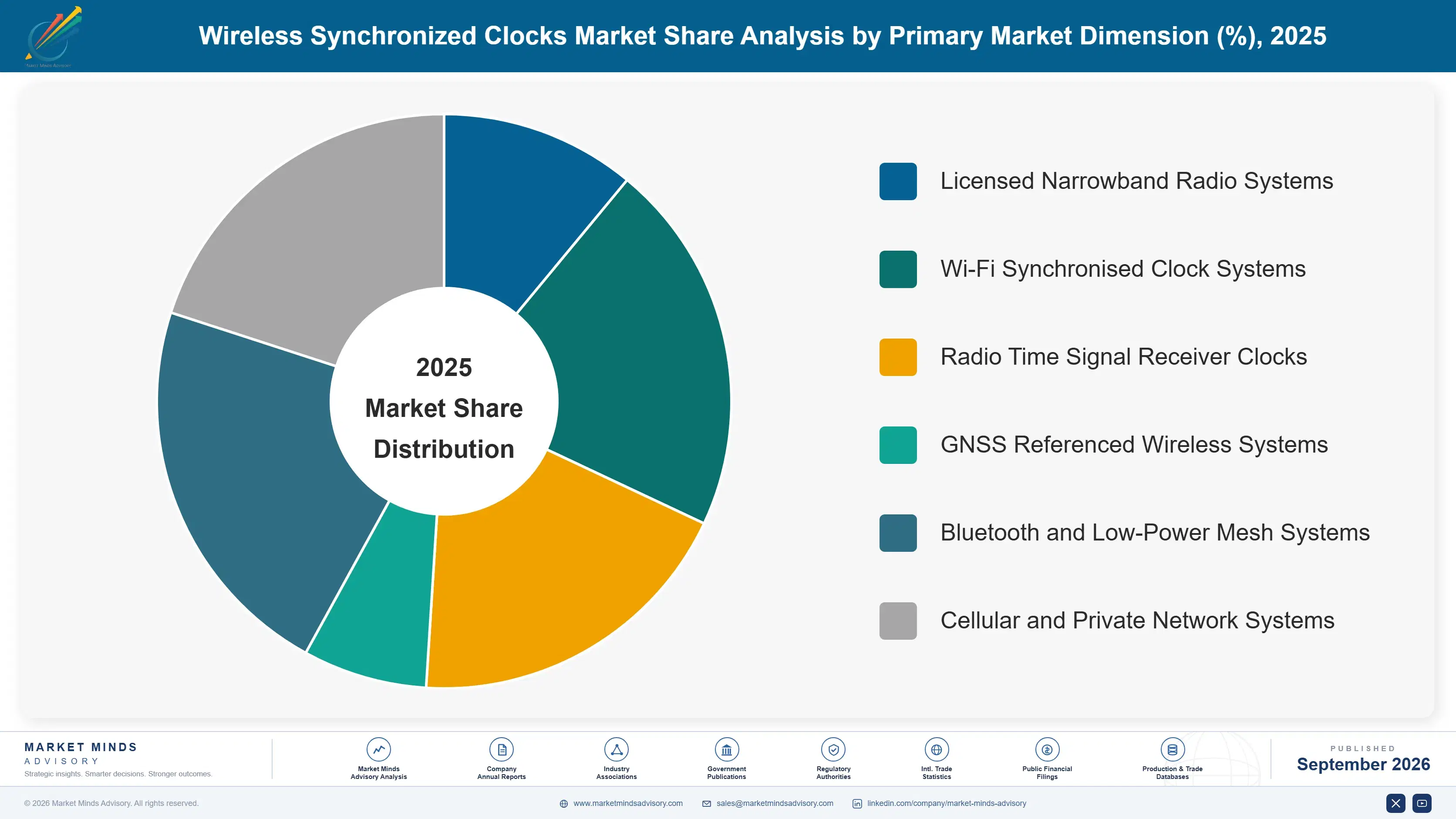
Segmentation follows how the display receives time, since that determines installation cost, who approves the purchase and what infrastructure the building must already have. The methods requiring dedicated transmitters are declining while those riding on networks the building already operates are growing, and that division explains almost all of the growth divergence. Infrastructure requirement decides it.
wireless-synchronized-clocks-market-market-share-analysis-1788419705939

Wi-Fi Synchronised Clock Systems

Wi-Fi systems grow fastest at 9.6%, half again the market rate of 6.4%, because they eliminate the transmitter and antenna infrastructure that made earlier generations expensive to retrofit. Installation cost falls by roughly 40%, which brings buildings into the addressable base that could never previously justify a synchronised system. The trade-off is that approval now involves information technology, adding around seven months and a security review most traditional suppliers were never asked to pass. Battery life is shorter than on narrowband radio devices because Wi-Fi association consumes more power, which suppliers manage through infrequent synchronisation intervals and larger cells. Enterprise authentication support has become the decisive selection criterion. Display quality has stopped deciding anything.
CAGR 9.6%

Bluetooth and Low-Power Mesh Systems

Low-power mesh approaches sit between the two extremes, using a small number of network-connected gateways to relay time across battery-powered display units over a low-energy radio. Growth at 8.4% reflects a genuine engineering advantage: power consumption far below Wi-Fi, extending battery intervals well past five years, while requiring much less infrastructure than licensed narrowband systems. The complication is that mesh implementations are largely proprietary, which locks a building to one supplier for the life of the installation. Buyers who have been through a discontinued proprietary system once tend to weight that risk heavily, and it slows adoption in facilities with long institutional memories. Open protocol support is becoming a common tender requirement in response to that concern.
CAGR 8.4%
Full segment breakdown across 6 segments available in the complete report.

Regional Architecture and Country Demand Map

Demand follows the density of regulated facilities and the age of what is already installed. Countries with large hospital, school and correctional estates and an existing synchronised clock tradition replace steadily; those without one rarely start, whatever their construction volumes look like. Construction volume alone predicts little.

North America

North America holds 41%, above the regional band, and the justification is an installed base with no equivalent anywhere: decades of synchronised clock installation across hospitals, school districts, correctional facilities and courts, much of it on a licensed narrowband radio band used nowhere else. Replacement of that base is the dominant demand mechanism rather than new construction. Healthcare accreditation practice here makes synchronised time an audited expectation rather than a preference. School district bond funding produces lumpy but reliable renovation demand, and correctional and judicial facilities buy on documentation requirements that do not soften with budget pressure. Regional growth at 5.6% is modest because the base is large and largely a replacement market rather than an expanding one.
Share: 41% | CAGR: 5.6% (2026 to 2036)

Western Europe

European demand grows at 4.8%, the slowest of the major regions, and reflects a market where public radio time signals covered the requirement inexpensively for decades. German, French and Nordic institutional buildings hold large populations of receiver clocks needing no infrastructure at all, which suppressed system sales historically and now represents a substantial replacement opportunity if those services are curtailed. Hospital and university estates are the main institutional buyers. French and Swiss suppliers hold strong domestic positions built on public sector framework agreements, and procurement across the region moves on renovation programmes rather than on any technology cycle. Regional growth at 4.8% depends heavily on whether public time signal services continue, since withdrawal would make a suppressed market urgent.
Share: 24% | CAGR: 4.8% (2026 to 2036)
Regional intelligence for 5 additional markets available in the complete report: East Asia, South Asia and Pacific, Latin America, Middle East and Africa, Eastern Europe. Contact sales@marketmindsadvisory.com.
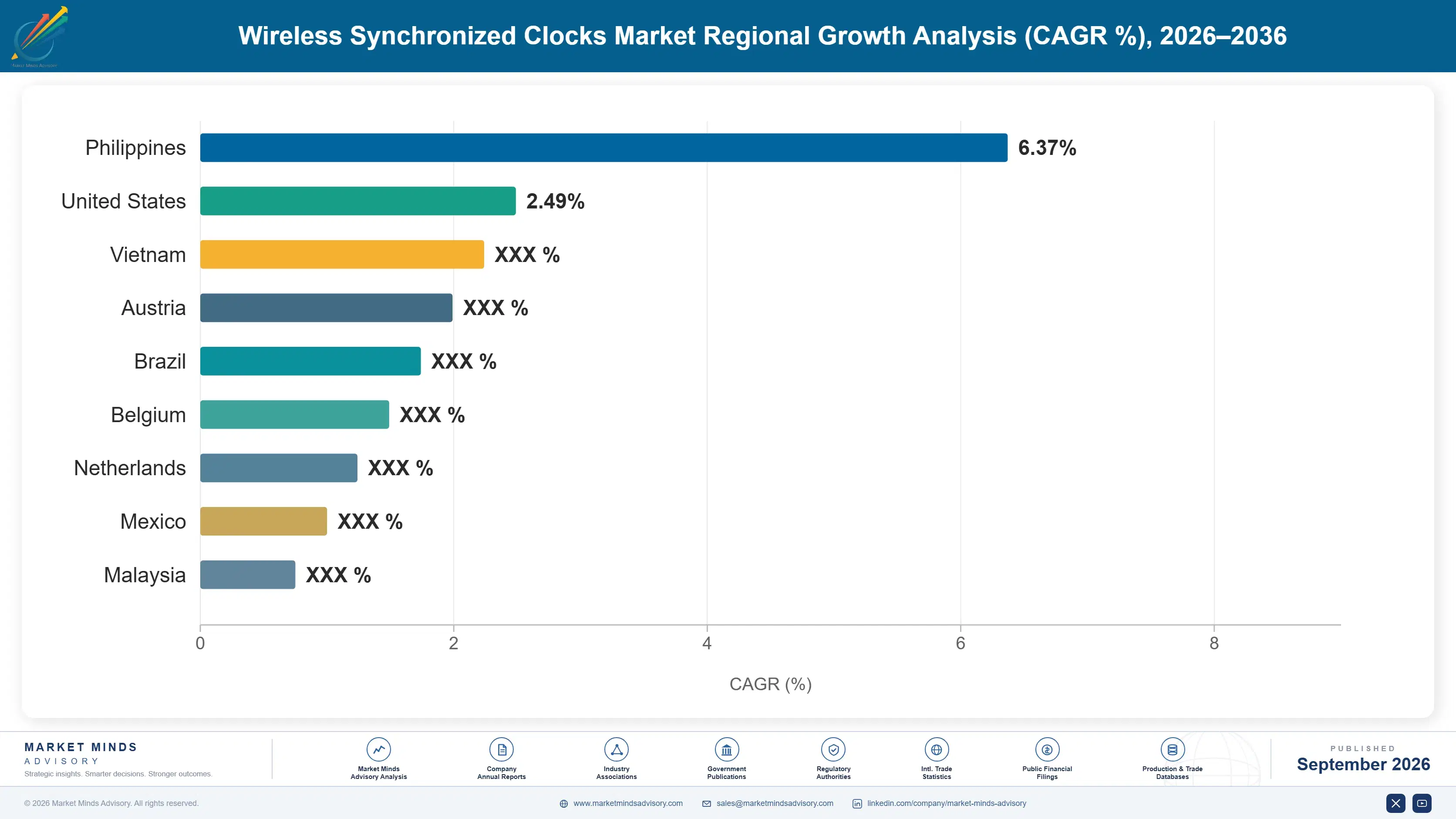
wireless-synchronized-clocks-market-country-cagr-analysis-1788419706470

Where Clock System Revenue Holds Up

Displays are a commodity and always will be, so margin has to come from the infrastructure around them, the verification records regulated buyers need, and the service relationship that battery replacement across hundreds of devices makes unavoidable. Suppliers competing on the clock itself have already lost. The clock is the least valuable thing in the contract.

Sell the Verified Time System Not the Display

Roughly 62% of contract value already sits in transmitters, master clocks, management software and commissioning, and that share rises when verification reporting is included. Buyers in regulated settings need evidence that clocks agreed, not merely that they were installed, and suppliers providing drift logging and audit reports capture around 25% more contract value than those quoting hardware. It also changes the competitive comparison entirely, since a supplier offering documentation is not being compared against imported displays on unit price at all. Documentation is not comparable against imported hardware. That comparison never happens.
Market Impact: Captures roughly 25% more of total contract value

Build the Security Answer Before the Question Arrives

Network-connected clocks face endpoint security review that removes roughly 3 of 8 bidders from consideration on documentation grounds alone, regardless of product quality. Firmware signing, enterprise authentication support, vulnerability disclosure processes and completed security questionnaires are what survive that stage. The investment is genuine engineering rather than paperwork, and it is currently the cheapest competitive advantage available in this market because so few established suppliers have made it. Buyers cannot evaluate clock accuracy and can evaluate a security response immediately. Buyers can evaluate a security response immediately and cannot evaluate accuracy at all.
Market Impact: Survives a review eliminating 3 of 8 bidders

Contract Battery Replacement as a Service

Batteries need field replacement roughly every four and a half years across installations running to hundreds of devices, and facilities teams consistently underestimate that labour when comparing systems. Selling scheduled replacement as a contracted service rather than leaving it to the customer converts a hidden cost into recurring revenue worth around 30% of the original system value across a decade. It also puts the supplier back in the building periodically, which is where replacement decisions get influenced long before any tender is issued. Tender documents get shaped during those visits.
Market Impact: Adds roughly 30% of the original system value

Target Facilities Where Timestamps Have Legal Weight

General commercial buildings will keep concluding that occupants carry phones, and that argument is difficult to defeat because it is largely correct. Healthcare, corrections, courts, testing centres, transport operations and regulated manufacturing all have documentation obligations that make synchronised time non-optional, and healthcare alone is 34% of demand. Concentrating sales effort there rather than defending a general commercial case raises win rates substantially and shortens cycles. Suppliers still pursuing office fit-out work are spending effort on the one segment that is certain to keep shrinking. Win rates in regulated verticals run several times higher.
Market Impact: Healthcare alone accounts for 34% of total demand

Who Controls the Margin Pool

Concentration sits near 44% across the top five on measured system revenue, and the field divides regionally more than most markets of this size. North American suppliers built positions on a licensed radio band used nowhere else, while European suppliers grew around public time services and framework agreements. The gap between leaders and challengers is one of installed base and specification presence rather than product capability, since the engineering is not difficult and displays are interchangeable.
Competition runs on three dimensions. Installed base ownership is first, since replacement overwhelmingly favours the incumbent who knows the building and whose transmitters may still work. Second is security and network documentation, which now removes bidders before product comparison begins. Third is service infrastructure for battery replacement and commissioning across dispersed sites, which smaller suppliers cannot provide at national scale.

Two pressures are building. Network displays from audiovisual and communications suppliers are entering with the security credentials clock specialists lack and relationships with the technology buyer. Meanwhile imported display hardware has removed any margin from the clock itself. Rankings will move toward suppliers who hold service relationships and can pass security review, and away from those whose advantage was display quality.
wireless-synchronized-clocks-market-company-positioning-matrix-1788419706994

Competitive Moat and Risk Dimensions

PRIMEX

Moat: Installed base and service reach

Primex holds one of the largest installed bases in North American healthcare and education, built over decades on licensed radio infrastructure, and replacement strongly favours the incumbent. Its national service organisation handles battery replacement and commissioning across dispersed sites at a scale smaller competitors cannot match. School district and hospital relationships give visibility of replacement timing ahead of tender.
PRIMEX

Risk: Licensed radio technology dependence

A substantial part of the installed base and the company's differentiation rests on licensed narrowband radio infrastructure that new buildings no longer specify. Competing for network-based installations means contesting ground where that advantage does not apply. The transition removes a barrier that protected the position for two decades.
BODET

Moat: European public sector specification

Bodet holds deep positions across European public sector estates through framework agreements and long-standing specification presence with consulting engineers, which brings work that never reaches open tender. Its range spans time distribution, scoreboards and access systems, letting it reach buildings through several procurement routes rather than one. Manufacturing and support presence across Europe shortens delivery and service response.
BODET

Risk: Slow growth home markets

The company's strongest positions sit in Western European markets growing at 4.8%, the slowest of any major region, where replacement cycles are long and public budgets constrained. Expanding into faster markets means competing without the specification relationships that underpin the domestic position. Public radio time services covering the region cheaply have historically suppressed system demand.

Players Tracked

Prominent Players

Primex
American Time
Sapling
Bodet
Mobatime

Other Key Players

Bogen Communications
Lathem Time
Valcom
Advanced Network Devices
Wharton Electronics
Westerstrand
Gorgy Timing
Galleon Systems
Meinberg
Masterclock
Seiko Clock
Citizen Systems
Rhythm Watch
Time Machines
Peweta Uhren

Recent Developments

MAY 2025

National budget proposals again raise curtailment of radio time broadcast services

Proposals affecting terrestrial time signal broadcast services resurfaced in national budget documentation, creating renewed uncertainty for facilities operating large populations of receiver clocks. No curtailment was enacted, and the services continued operating throughout the year without any interruption to broadcast. Facilities managers have seen this cycle before.
Signal: Repeated warnings without action have taught buyers to discount the replacement argument suppliers keep building around them.
SEPTEMBER 2025

Healthcare accreditation guidance clarifies expectations on time synchronisation

Updated guidance addressed reconstruction of clinical event sequences across departments, reinforcing that inconsistent timestamps between systems and displays create documentation risk. The clarification restated existing expectations rather than introducing any new requirement on accredited facilities. The wording nonetheless gives survey teams a clearer basis to examine timestamp consistency during visits.
Signal: Clarified expectations move synchronised time from good practice toward something a survey team will actually examine.
FEBRUARY 2025

Audiovisual and communications suppliers extend network display ranges into clock applications

Established communications and audiovisual manufacturers added synchronised time display products to existing network endpoint ranges, developed internally rather than through acquisition. The products arrive with enterprise security credentials and existing relationships with technology buyers that specialist clock suppliers generally lack. Display specifications match specialist products closely.
Signal: Competition is now arriving from suppliers who already passed the security review that removes clock specialists from consideration.

What a Clock System Costs to Build

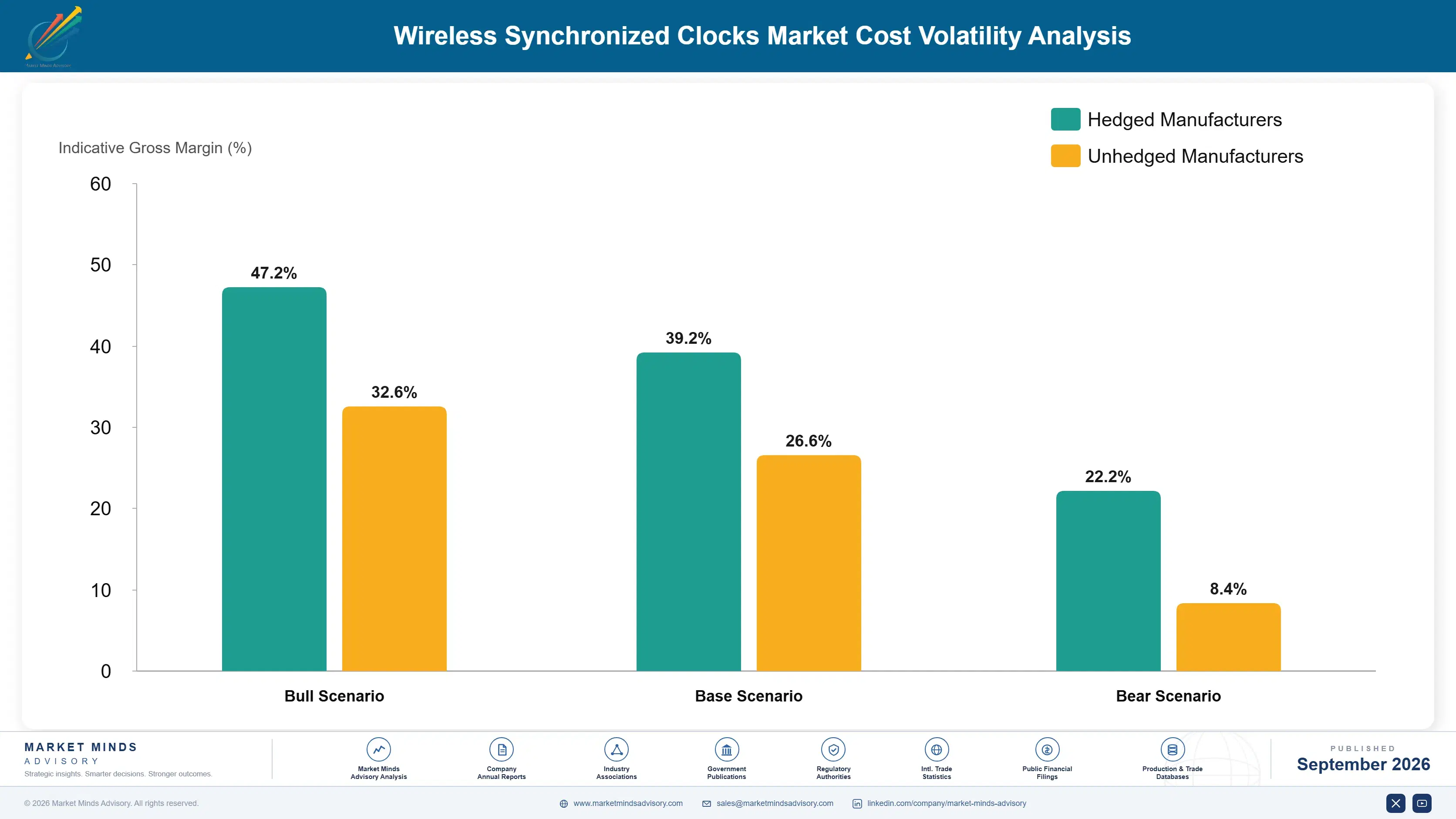
Cost structure divides between the display units and the infrastructure behind them. Across a typical installation, display hardware runs between 26% and 38% of cost, the range reflecting analogue movements against digital panels. Radio modules and control electronics add roughly 15%, master clock and transmitter equipment 18%, primary cells around 7%, and installation and commissioning labour the balance. Labour is the line that surprises buyers.
Primary lithium cell pricing has been the most volatile input. Lithium carbonate prices fell sharply through 2023 and 2024 before partially recovering, and IEA critical minerals and battery reporting documents the movement across that period. Cell suppliers passed the decline through slowly and the recovery quickly. Suppliers holding multi-year service contracts priced against earlier cell costs absorbed the difference themselves rather than reopening customer agreements.

Exposure follows business model rather than scale. Suppliers with contracted battery replacement obligations carry cell price risk across those agreements and cannot easily reprice. Those selling systems outright pass it to the customer at each replacement. Geographic reach matters more than expected, since service labour dominates cost and suppliers without local technicians subcontract at eroding rates. Smaller regional suppliers carry the worst position on both counts.
wireless-synchronized-clocks-market-cost-volatility-analysis-1788419707192

Index service contracts to published cell pricing

Multi-year replacement agreements priced on cell costs at signature transfer commodity risk to the party least able to hedge it. Indexation moves that exposure to customers largely indifferent to annual variation. Buyers accept it more readily when the alternative is presented as a higher fixed price with a risk premium built in, which is what the fixed structure actually contains.

Specify longer interval synchronisation to extend cell life

Battery consumption is dominated by how often a device wakes and associates rather than by display power. Extending intervals from minutes to hours does not affect displayed accuracy and lengthens cell life roughly 60%, cutting service labour. It requires a decent local oscillator, which adds a small amount to unit cost and repays it several times over.

Build regional service technician coverage before winning contracts

Installation and service labour is the largest single cost line and subcontracting it in regions without direct coverage erodes margin badly while making response times unreliable. Establishing technician presence ahead of demand looks premature and determines which national contracts are winnable. Buyers with dispersed estates weight service response heavily, and they verify it during evaluation rather than taking assurances.

Portfolio Architecture for Margin Defence

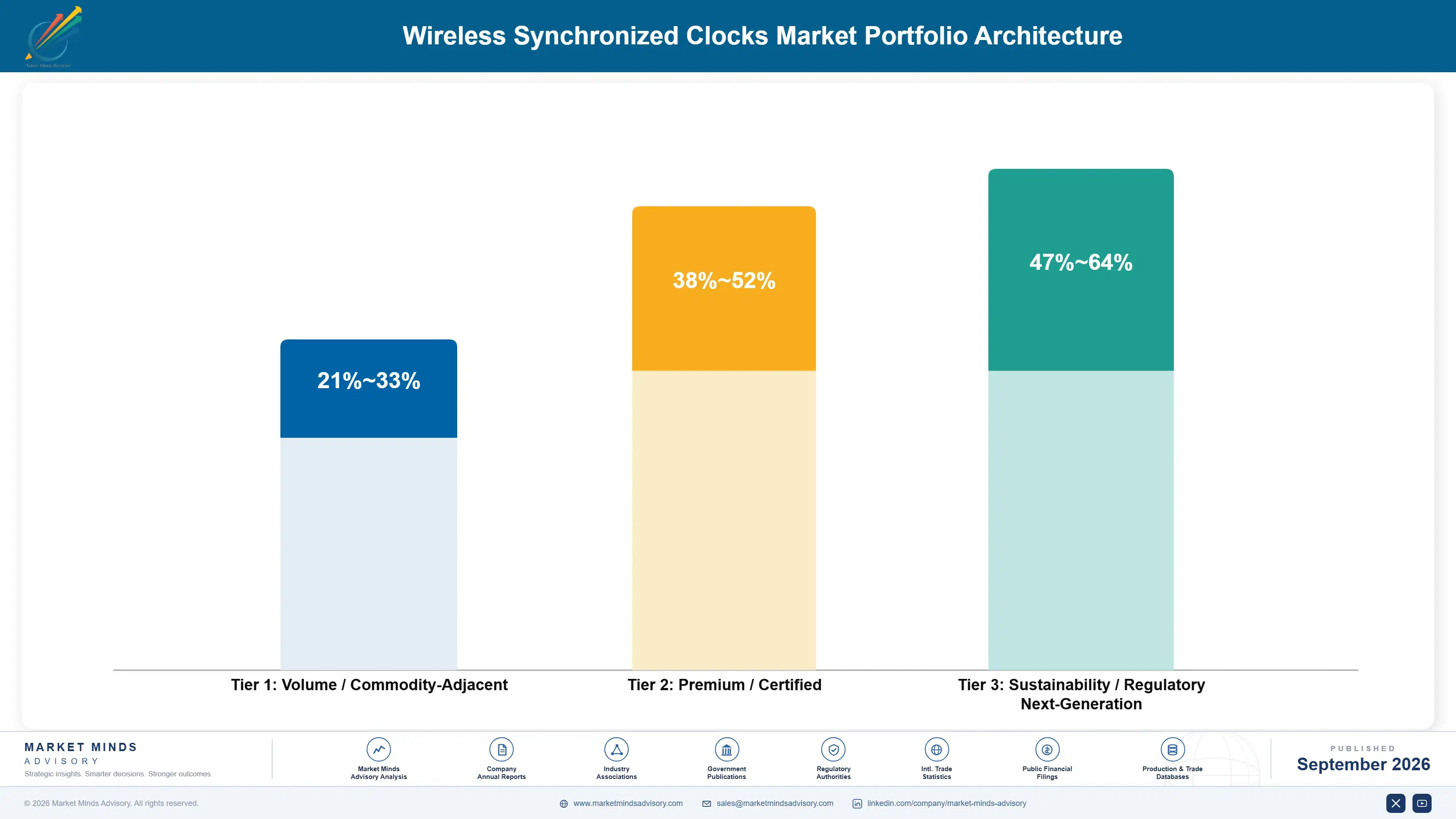
Margin architecture separates on whether the supplier sells hardware or a system with records behind it. Display units earn commodity margins and always will, because imported movements and panels removed any differentiation a buyer can assess. Master clocks, transmitters, management software and verification reporting earn considerably more, since the buyer is purchasing evidence rather than a product and has no comparable alternative to price against.
The volume tension is between new installations and replacement of existing systems. New construction is larger per contract, competitively open and specified by consulting engineers who may never have met the supplier. Replacement is smaller, closes at far higher win rates and comes with knowledge of the building. Suppliers need both, and those relying purely on legacy replacement watch their base shrink with every building moving to network delivery.

High-value revenue concentrates in verification and reporting for regulated facilities, and in contracted battery replacement service across large estates. Both involve a customer buying continuity of something they cannot afford to have fail. Display hardware occupies the volume position, provides the visible product and generates almost none of the profit, which is the settled condition of this industry.

Volume / Commodity-Adjacent

Analogue and digital display units sold against specification on unit price. The wide range separates suppliers manufacturing at scale from those assembling imported components. Nothing here differentiates in a way buyers can evaluate, and imported hardware sets the ceiling.
Gross Margin: 21-33%

Premium / Certified

Master clocks, transmitters, gateways and management software forming the system behind the displays. Margin holds because the buyer is purchasing verified synchronisation rather than components and cannot readily substitute parts. Proprietary protocols make partial replacement impractical once installed.
Gross Margin: 38-52%

Sustainability / Regulatory / Next-Generation

Verification reporting, drift logging, security-hardened network products and contracted service programmes for regulated estates. The widest range in the portfolio, since documentation and service content vary enormously by facility type. Highest margin and the least exposed to hardware price competition.
Gross Margin: 47-64%
wireless-synchronized-clocks-market-portfolio-architecture-1788419707699

High-value Sub-segments and Strategic Watch-out

Regulated Facility Verification Reporting

High value and high growth together, because accredited facilities need evidence that clocks agreed rather than merely that they were installed and working. The margin range reflects reporting depth, which varies by accreditation regime. Buyers here compare documentation rather than hardware, which removes display price from the decision entirely.
Gross Margin: 54-64%

Contracted Battery Replacement Service

High value with moderate growth, recurring roughly every four and a half years across estates running to hundreds of devices. The range reflects site dispersion and whether technicians are direct or subcontracted. It returns the supplier to the building periodically, which is where replacement decisions are influenced long before tender.
Gross Margin: 44-56%

Display Unit Hardware Supply

The volume core of the market and the least attractive part commercially, with imported movements and panels setting a price ceiling nobody can argue past. It provides the visible product and the specification presence other revenue is sold through. Suppliers cannot exit it and earn very little within it.
Gross Margin: 20-32%

Network Endpoint Competitor Entry

The strategic watch-out, carried at zero because it represents competitive encroachment rather than addressable revenue. Communications and audiovisual suppliers arrive holding the security credentials and technology buyer relationships clock specialists lack. Treating them as adjacent rather than competitive misreads which qualification now decides these contracts.
Gross Margin: 0-0%

How Clock Revenue Recurs

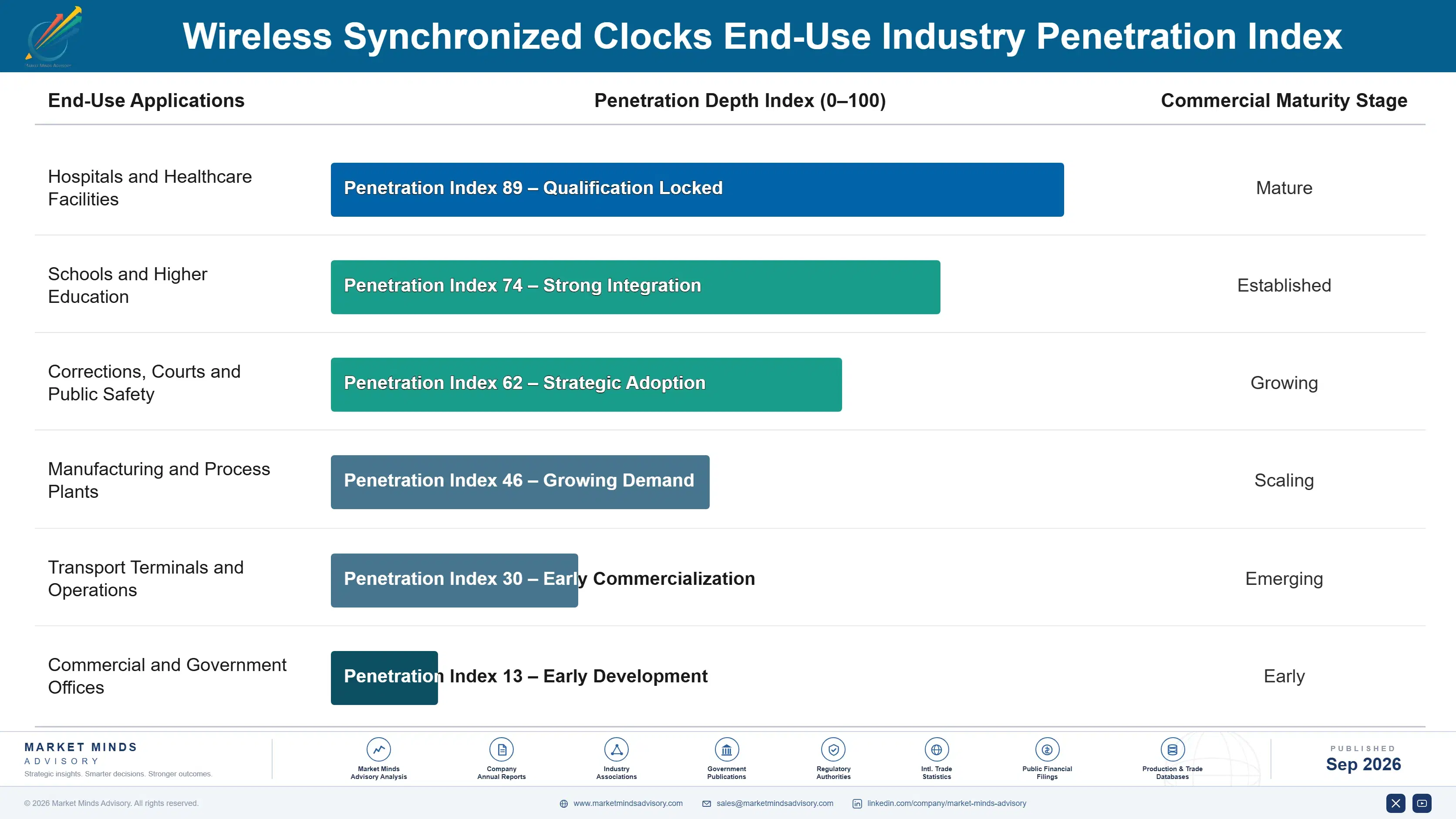
Revenue repeats on two quite different clocks, one long and one short. System replacement runs on roughly thirteen years and produces a lumpy contract the incumbent usually wins. Battery replacement runs every four and a half years and produces recurring service revenue across the whole life of the installation. Suppliers treating the service interval as an obligation rather than a product miss both the revenue and the relationship.
Adoption depth varies sharply by facility type. Hospitals use synchronised time as an operational and documentary system and integrate it with nurse call and clinical alerting. Correctional facilities depend on it for scheduled operations and incident records alike. Schools use it for period timing and little else. Manufacturing plants tie it to production records where regulated to do so. General commercial offices barely use it, which is why that segment keeps deciding not to replace.

The buyer has shifted from facilities management toward information technology, and the two evaluate completely different things. A facilities manager assessed accuracy, appearance and service response. A technology manager assesses authentication, patching and vulnerability handling, and rejects suppliers on documentation before seeing the product. Suppliers presenting to facilities alone address somebody who now needs a colleague's approval.
wireless-synchronized-clocks-market-end-use-penetration-index-1788419708192

What Holds Value Here

These are among the four positions where our research anticipates prominent divergence between winners and laggards over the coming forecast period. Each is grounded in the demand model, the regulatory perimeter, and the announced capacity pipeline.
01 / EVIDENCE OVER HARDWARE

Sell verified synchronisation records, never the clock itself

Display units are commodities set by imported movements and panels, and no supplier will ever differentiate on them in any way a buyer is able to assess. Regulated facilities need documented evidence that clocks agreed, and suppliers providing drift logging and audit reporting capture roughly 25% more contract value while removing themselves from unit price comparison entirely. That repositioning is available to any supplier willing to build the reporting, and remarkably few suppliers in this industry have actually gone and done it.
02 / SECURITY QUALIFICATION READINESS

Pass the endpoint review or never reach product evaluation

Network-connected clocks now face the same security scrutiny as any corporate endpoint, and roughly 3 of 8 bidders are removed on documentation grounds alone before any product comparison even begins. Firmware signing, enterprise authentication and formal vulnerability disclosure are all genuine engineering commitments rather than paperwork exercises. It is currently the cheapest competitive advantage available in this market, precisely because so few of the established clock suppliers have treated it as engineering work rather than as a form to complete.
03 / SERVICE INTERVAL OWNERSHIP

Contract battery replacement rather than leaving it behind

Primary cells need field replacement roughly every four and a half years across estates of hundreds of devices, and facilities teams consistently underestimate that labour when they compare systems at purchase. Selling it as a contracted programme converts a hidden customer cost into recurring revenue worth around 30% of system value across a decade. It also returns the supplier to the building on a schedule, which is where the eventual replacement decision gets shaped long before any tender document exists.
04 / REGULATED VERTICAL CONCENTRATION

Chase obligation, abandon the general commercial argument

In offices and general commercial space the objection that everyone carries a phone is essentially correct, and suppliers will keep losing that particular argument, largely because it deserves to be lost. Healthcare at 34% of demand, along with corrections, courts, transport operations and regulated manufacturing, together carry documentation obligations that make synchronised institutional time entirely non-optional. Concentrating effort there raises win rates and shortens cycles, while defending general commercial work spends resource on the one segment certain to keep shrinking.

Engagement Snapshot From the Field

A live engagement with an industry participant carrying material or product regulatory and market exposure ahead of a defining policy shift, showing how our research translates into a defensible multi-year portfolio strategy.
MARKET MINDS ADVISORY · CLIENT ENGAGEMENT SUMMARY
Wireless Synchronized Clocks Producer Strategic Portfolio Review and Transition Roadmap 2026·Investment Scenario on Wireless Synchronized Clocks Exposure Evaluation 2025-26
CLIENT PROFILE
A regional hospital network operating nine acute facilities and fourteen outpatient sites with roughly 4,200 clock displays (client-reported, unverified by MMA), running licensed narrowband radio systems installed between 2009 and 2013. Battery replacement across the estate consumed an estimated 2,100 technician hours annually and transmitter spares had become genuinely difficult to source for three of the older sites.
STRATEGIC CHALLENGE
An accreditation survey had raised inconsistent timestamps between clinical systems and department displays as an observation (client-reported, unverified by MMA). Facilities wanted a like-for-like radio replacement, information technology refused to approve any device joining the network without security review, and neither group had been part of the other's evaluation at any point in the process.
MMA APPROACH
MMA ran the requirement as a single evaluation with both functions rather than as two competing ones, establishing what accreditation actually required before assessing any technology. We interviewed 16 clinical and operational stakeholders, five suppliers and the network's security team. Vendor scoring weighted verification reporting and security documentation ahead of display specification, which reordered the shortlist substantially against expectations.
KEY FINDINGS
  1. The accreditation observation concerned reconstructing event sequences rather than display accuracy, and no clock replacement alone would have resolved it without addressing system time sources.
  2. Two of five shortlisted suppliers could not support enterprise authentication, and both would have been rejected by security after facilities had already selected them.
  3. Battery labour across the estate cost more over seven years than the capital difference between radio replacement and a longer-interval mesh system.
  4. Only 340 of 4,200 displays sat in areas where clinical documentation depended on them, and the remainder had no requirement beyond general convenience.
CLIENT PROFILE
A regional hospital network operating nine acute facilities and fourteen outpatient sites with roughly 4,200 clock displays (client-reported, unverified by MMA), running licensed narrowband radio systems installed between 2009 and 2013. Battery replacement across the estate consumed an estimated 2,100 technician hours annually and transmitter spares had become genuinely difficult to source for three of the older sites.
STRATEGIC CHALLENGE
An accreditation survey had raised inconsistent timestamps between clinical systems and department displays as an observation (client-reported, unverified by MMA). Facilities wanted a like-for-like radio replacement, information technology refused to approve any device joining the network without security review, and neither group had been part of the other's evaluation at any point in the process.
MMA APPROACH
MMA ran the requirement as a single evaluation with both functions rather than as two competing ones, establishing what accreditation actually required before assessing any technology. We interviewed 16 clinical and operational stakeholders, five suppliers and the network's security team. Vendor scoring weighted verification reporting and security documentation ahead of display specification, which reordered the shortlist substantially against expectations.
KEY FINDINGS
  1. The accreditation observation concerned reconstructing event sequences rather than display accuracy, and no clock replacement alone would have resolved it without addressing system time sources.
  2. Two of five shortlisted suppliers could not support enterprise authentication, and both would have been rejected by security after facilities had already selected them.
  3. Battery labour across the estate cost more over seven years than the capital difference between radio replacement and a longer-interval mesh system.
  4. Only 340 of 4,200 displays sat in areas where clinical documentation depended on them, and the remainder had no requirement beyond general convenience.
RECOMMENDED STRATEGY
Phase 1: Specify verification reporting and time source integration first, then select display technology, rather than treating the clocks as the primary requirement. Phase 2: Deploy a longer-interval mesh system across clinical areas and reduce display counts elsewhere, since most locations carried no documentation dependency. Phase 3: Contract battery replacement with the selected supplier rather than continuing to absorb 2,100 technician hours annually into internal facilities workload.
OUTCOME
The network replaced 1,900 displays rather than 4,200 and closed the accreditation observation by addressing time source integration alongside the hardware. Capital cost reached roughly USD 1.6 million against an initial estimate near USD 3.1 million for like-for-like replacement (client-reported, unverified by MMA). Internal battery labour was eliminated entirely.

Frequently Asked Questions

Foundational context covering the market sizes, CAGR, scope, country, region and competition that inform every finding below. This section is provided to cover basics and most often pre-purchase conversations, answered from the MMA Primary Research Dataset.

What is the current size of the Wireless Synchronized Clocks Market?

The market was worth USD 0.5 billion in 2025 and reaches USD 0.53 billion in 2026. Roughly 62% of contract value sits in transmitters, master clocks and management software rather than displays.

How large will the Wireless Synchronized Clocks Market be by 2036?

MMA forecasts USD 0.99 billion by 2036, an expansion of 1.87 times over the forecast period. That represents USD 0.46 billion of incremental annual revenue against 2026.

What is the CAGR for the Wireless Synchronized Clocks Market 2026 to 2036?

The base case is 6.4% compound annual growth, with a bull case at 7.6% and a bear case at 5.2%. Whether terrestrial radio time services are curtailed separates the scenarios.

Which segment is growing fastest?

Wi-Fi synchronised clock systems grow at 9.6%, half again the market rate of 6.4%. Removing dedicated transmitter infrastructure cuts installation cost by roughly 40% and opens buildings that could not previously justify a system.

Who are the major companies in the Wireless Synchronized Clocks Market?

Primex, American Time, Sapling, Bodet and Mobatime lead on measured system revenue. Together they hold roughly 44%, with positions divided sharply along regional and technology lines.

Which country is growing fastest?

India grows fastest at 10.4%, driven by private hospital groups building to international accreditation standards that specify synchronised time from the outset. This is first-time demand rather than replacement.

Report Segmentation Architecture

The full report scope spans multiple orthogonal segmentation dimensions, with cross-tabulated demand data provided for each dimension pair. Coverage extends further to regional breakdowns, trend trajectories, and the competitive detail needed to support segment-level decision-making.

By Primary Market Dimension

  • Licensed Narrowband Radio Systems
  • Wi-Fi Synchronised Clock Systems
  • Radio Time Signal Receiver Clocks
  • GNSS Referenced Wireless Systems
  • Bluetooth and Low-Power Mesh Systems
  • Cellular and Private Network Systems

By End-Use Industry

  • Hospitals and Healthcare Facilities
  • Schools and Higher Education
  • Corrections, Courts and Public Safety
  • Manufacturing and Process Plants
  • Transport Terminals and Operations
  • Commercial and Government Offices

By Commercial Dimension

  • Direct Facility Contracts
  • Consulting Engineer Specification
  • Building Systems Integrator Channel
  • Public Sector Framework Agreements
  • Contracted Service Programmes
  • Distribution and Reseller Supply

By Region

  • North America
  • Western Europe
  • East Asia
  • South Asia and Pacific
  • Latin America
  • Middle East and Africa
  • Eastern Europe

Scope, Methodology, and Coverage

Every figure in this report is reproducible from documented input assumptions. The scope below maps the historical period, the forecast horizon, the segmentation dimensions, and the countries covered, alongside the underlying primary and qualitative methodology.
Historical Period
2020 to 2025
Forecast Period
2026 to 2036
Base Year
2025 (USD billions; MMA Primary Research Dataset, September 2026)
Market Definition
This market covers clock systems in which display units receive time wirelessly from a reference source, spanning licensed narrowband radio distribution, Wi-Fi synchronisation, terrestrial radio time signal receiver clocks, GNSS-referenced wireless distribution, Bluetooth and low-power mesh systems, and cellular or private network synchronisation. Revenue is measured as delivered system value including display units, transmitters and gateways, master clocks, management software, and attributable installation, commissioning and contracted service. Wired Power over Ethernet clocks, network time servers sold for data centre and telecommunications timing, wristwatches, consumer clocks and passenger information displays are excluded.
Quantitative Units
USD billions, delivered system and attributable service revenue
Segmentation Dimensions
Synchronisation method, end-use facility type, commercial channel, region
Regions Covered
North America, Western Europe, East Asia, South Asia and Pacific, Latin America, Middle East and Africa, Eastern Europe
Countries Covered
United States, Canada, Mexico, Brazil, Chile, Colombia, United Kingdom, France, Germany, Switzerland, Sweden, Netherlands, Spain, Italy, Poland, Czechia, Japan, South Korea, Taiwan, China, India, Singapore, Malaysia, Australia, United Arab Emirates, Saudi Arabia, Qatar, South Africa
Key Companies Profiled
Primex, American Time, Sapling, Bodet, Mobatime, Bogen Communications, Lathem Time, Valcom, Advanced Network Devices, Wharton Electronics, Westerstrand, Gorgy Timing, Galleon Systems, Meinberg, Masterclock, Seiko Clock, Citizen Systems, Rhythm Watch, Time Machines, Peweta Uhren
Quantitative Methodology
Primary survey, n=3,800 respondents, Q4 2025, six countries; demand-side model with trade association cross-validation
Qualitative Methodology
47 expert interviews, Q4 2025; applied to validate demand model assumptions, identify emerging dynamics, and assess competitive positioning
Report Format
PDF and XLSX data workbook (Word format preview document)
Publisher
Market Minds Advisory
Report Code
MMA-2026-CON-581
Published
September 2026
Contact
sales@marketmindsadvisory.com | www.marketmindsadvisory.com

Purchase the full Wireless Synchronized Clocks Market Report (2026 to 2036).

The full MMA report examines why regulated facilities buy synchronised time as documentary evidence rather than as a building amenity, and what the shift to network delivery has done to who approves the purchase. It sizes the market to 2036 across six synchronisation methods, seven regions and 28 countries, with segment growth rates and regional demand mechanisms set out in full. Competitive analysis covers 20 suppliers assessed on measured system revenue, including moat and risk assessment for the two leaders. The report quantifies installation cost structure, battery service economics and margin architecture across three portfolio tiers. It closes with four strategic verdicts and an anonymised hospital network engagement.
Six synchronisation methods sized to 2036
Seven regions with demand mechanism analysis
Twenty suppliers on consistent system revenue basis
Installation and battery service cost benchmarks
Margin architecture across three portfolio tiers
Anonymised hospital clock replacement client engagement

Built For The People Who Decide

From boardroom strategy to bench-side execution, this report is read cover-to-cover by leaders shaping the next decade of their industry, turning demand scenarios, market dynamics and valuation benchmarks into decisions.
CXOs/ Presidents/ VPs/ Managers
M&A and Corporate Development
Strategy Teams and R&D Heads
Procurement and Product Directors
Regulatory and Compliance Leaders
Investor Relations and Equity Analysts