Market Minds Advisory
Wire to Board Connector Market

Wire to Board Connector Market: Wire to Board Connector Market. High-Density Terminal Blocks for Automotive and Industrial Electronics

Electric vehicle battery management systems push wire-to-board connector density higher as manufacturers demand smaller footprints without sacrificing the current-carrying capacity that dense power electronics genuinely require across most modern platforms today

Lead Analyst

Published

September 2026

Make Smarter Decisions with Customized Research Insights

Request a free sample report and evaluate market opportunities, growth trends, and competitive dynamics relevant to your business needs.

2025 MARKET VALUE$5.8BMarket Size 2025
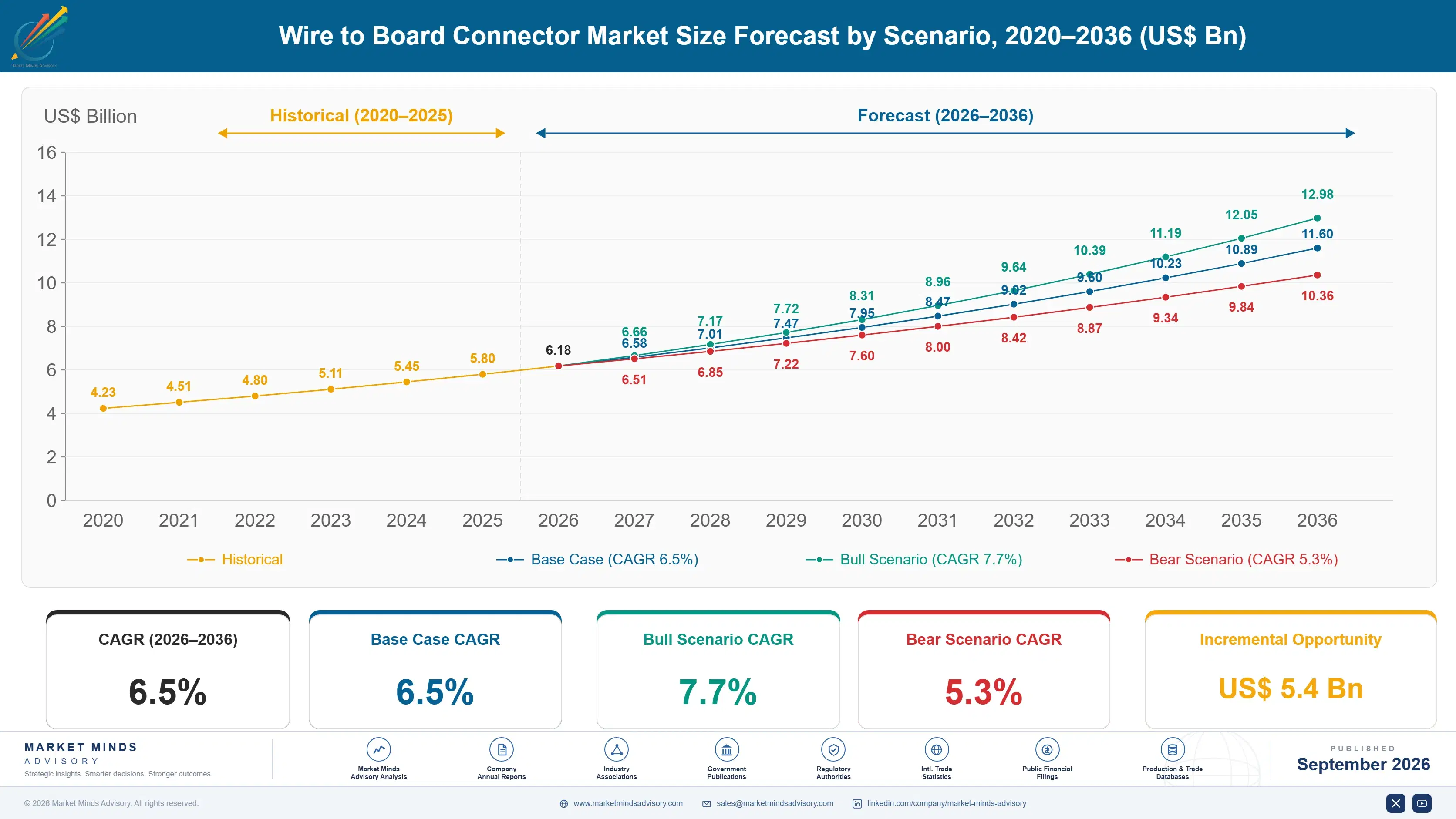
2036 FORECAST VALUE$11.6BBase Case , 2026 to 2036
CAGR 2026 TO 20366.5 %Bull 7.7% / Bear 5.3%
INCREMENTAL OPPORTUNITY$5.4BNet 10- year value creation
EXPANSION MULTIPLE1.88x2036 value over 2026 base
Strategic Levers
M&A Pipeline
Regional Outlook
Country Rankings
Competitive Intelligence
Segmental Deep-dive
Call-Us : 91 93563 13602

Executive Snapshot and Market Trajectory.

Wire-to-board connectors are moving from commodity electromechanical hardware to precision-engineered components, as electric vehicle and industrial automation applications demand higher current density within shrinking board footprints across most next-generation platform designs this year. Buyers now specify reliability data before award. Vendor selection now weighs prior automotive qualification history.
High-current battery management connectors and micro-pitch signal connectors are converging fastest, as electronics manufacturers pursue both power delivery and space efficiency within the same connector family. East Asia commands the largest regional share, reflecting concentrated connector manufacturing capacity and dense downstream electronics assembly across the region. Facility operators increasingly qualify multiple connector suppliers simultaneously to reduce single-source supply risk during this rapid capacity buildout phase. Certification depth separates platforms competing for major contracts.
Competitive intensity is rising as established connector manufacturers expand automotive-grade certification while newer entrants pursue cost leadership in commodity signal connector segments. Automotive tier-one suppliers are creating a parallel demand channel, as they increasingly require documented reliability testing data from connector vendors before qualifying new vehicle platform designs. Rankings could shift meaningfully as certification requirements tighten across major automotive procurement programs over the coming years.
Market Definition
This report covers wire-to-board electrical connectors used to link discrete wire harnesses to printed circuit boards across automotive, industrial, and consumer electronics applications. It excludes board-to-board connectors, fiber optic connectors, and complete wire harness assemblies sold as finished cable products.
Base Year Value
$5.8B in 2025 (MMA Primary Research Dataset, September 2026)
Forecast Period
2026 to 2036, eleven discrete annual values
CAGR
6.5% base case. Bull 7.7%. Bear 5.3%.
Fastest Growth Segment
Wire-to-Board Connectors for EV Battery Management Systems: 11.0% CAGR
Fastest Growth Country
India: 9.0% CAGR
Fastest Growth Region
South Asia and Pacific: 8.5% CAGR
Largest Region
East Asia: 29% of 2025 global value
Market Leaders
TE Connectivity, Molex, JST, Amphenol, and Hirose Electric lead the market. Source: MMA Analysis, July 2026.
Primary Survey
n=3,800 procurement and R&D decision-makers, Q4 2025, six countries
Methodology
Demand-side build-up, cross-validated against public data, 47 expert interviews

Wire to Board Connector Market Forecast Scenarios

wire-to-board-connector-market-size-forecast-scenario-1788428086244
Between 2020 and 2025 the market grew at a historical rate of roughly 5.7 percent annually, expanding steadily as electric vehicle production volume scaled alongside broader industrial automation equipment investment. Early growth concentrated among established automotive tier-one suppliers before broadening into consumer electronics and industrial automation applications nationwide. Investor and manufacturer confidence built steadily throughout this transition period broadly.
The base case assumes continued electric vehicle battery management system integration, expanding industrial automation connector demand, and steady miniaturization across automotive and consumer electronics applications. Three commercial mechanisms sustain the base forecast: rising per-vehicle connector content in electric platforms, expanding automotive-grade certification requirements, and growing tier-one supplier qualification standardization across global manufacturing footprints. These three mechanisms together anchor confidence in the base scenario across the ten-year forecast window ahead. Momentum builds.
The bull case rests on accelerated electric vehicle production growth pushing connector volume well beyond current forecast assumptions across major automotive markets. The bear case centers on connector manufacturers consolidating multiple functions into fewer higher-density components, compressing the unit volume opportunity for standalone wire-to-board connector specialists. Rankings could shift meaningfully if either scenario dominates the market's trajectory over the coming several years.

Current Density Reshapes Connector Selection

Purchase decisions increasingly hinge on current-carrying capacity per unit footprint rather than pin count alone, as manufacturers weigh miniaturization gains against thermal performance during high-density board design evaluations. This calculation increasingly appears explicitly within enterprise vendor selection scorecards used by design and procurement engineering teams together. Documented thermal performance now weighs as heavily as raw current rating in most purchasing evaluations across the sector.
MARKET CONCENTRATIONCR5 44%Top vendors hold a moderate combined market position currently
AVERAGE CONNECTOR PRICE$0.85Reflects blended pricing across standard pin count configurations sold
TOP PRODUCING COUNTRY SHAREChina 31%Concentrated in the leading connector manufacturing hub globally
AUTOMOTIVE ATTACH RATE38%Share of new electric vehicle platforms specifying certified connectors
COPPER INPUT COST SHARE36%Contact terminal copper alloy share of total manufacturing cost
REPLACEMENT CYCLE LENGTH11 yearsTypical service life before full connector system replacement occurs
Vendors offering standardized housing footprints compatible across multiple board layouts are pressuring proprietary connector designs to open interoperability, since electronics manufacturers increasingly favor hardware that reduces qualification burden across product lines. Manufacturers report faster board redesign timelines when using standardized housing footprints rather than proprietary designs requiring dedicated mechanical adapter hardware. This flexibility advantage matters most for manufacturers facing tight production ramp deadlines.
Copper alloy input costs remain sensitive to broader industrial metal pricing cycles, with contact terminal material representing a meaningful manufacturing cost share. Vendors with long-term copper supply agreements increasingly outcompete smaller suppliers exposed to volatile spot pricing. This dynamic increasingly separates vendors with strong supplier relationships from those exposed to spot market volatility during periods of tight copper availability. Onboarding speed increasingly determines vendor shortlist inclusion at larger enterprise accounts.
"A connector used to be an afterthought on the bill of materials. Now it's the component that determines whether a battery management board fits in the space engineers actually gave it."
Practice Lead, Electronic Components and Interconnect Research · MMA Electronic Interconnect and Terminal Hardware Practice · September 2026

Market Trends

High-Density Connectors Enable Battery Management Miniaturization

Connector manufacturers are engineering increasingly compact high-current terminals that pack more contact points within shrinking board footprints, closing the density gap that historically forced battery management system designers to choose between miniaturization and power delivery capability. This capability is expanding the addressable application set beyond entry-level electric vehicle platforms toward premium designs demanding maximum interior space efficiency. Roughly 43 percent of new battery management board designs now specify high-density connectors, up meaningfully from a much smaller share only a few years earlier as the technology matured rapidly. Larger manufacturers are standardizing on this connector type across all new platform designs.
Market Impact: 44 percent higher connector content

Standardized Housing Footprints Reduce Vendor Lock-In

Industry bodies are formalizing standardized connector housing dimensions and pin spacing specifications, reducing the vendor lock-in that historically discouraged manufacturers from qualifying multiple connector suppliers for the same board layout. This standardization is opening competitive bidding to smaller specialists previously excluded by proprietary footprint requirements tied to single incumbent suppliers. Manufacturers adopting standardized housing footprints report qualifying roughly 29 percent more vendor options than manufacturers still locked into proprietary designs from a single supplier. Vendors ignoring this shift risk being excluded entirely from multi-vendor qualification lists at major electronics manufacturers.
Market Impact: 31 percent higher replacement rate

Market Opportunities and Growth Drivers

Electric Vehicle Production Growth Sustains Connector Volume

Continued electric vehicle production growth across major automotive manufacturers sustains steady demand for wire-to-board connectors serving battery management, power distribution, and sensor interconnect applications throughout each vehicle platform's electrical architecture. This production-driven demand gives connector vendors more predictable order visibility than components tied to more cyclical general industrial equipment spending categories. Manufacturers serving electric vehicle platforms report roughly 44 percent higher connector content per vehicle than manufacturers serving comparable internal combustion platforms. Larger automakers lock in multi-year connector supply contracts to secure current pricing ahead of volume ramps. Speed matters here.
Market Impact: 22 percent of connectors use hybrid

Industrial Automation Investment Sustains Steady Demand

Continued investment in industrial automation and robotics equipment sustains steady demand for wire-to-board connectors serving motor control, sensor interconnect, and power distribution applications independent of automotive sector cyclicality that historically dominated connector demand patterns. This automation-driven demand gives connector vendors diversified revenue visibility beyond automotive-specific design cycles alone. Facilities investing in automation equipment report connector replacement rates roughly 31 percent higher than facilities operating legacy manual production lines. Vendors serving this segment increasingly bundle motor control connector variants alongside standard sensor interconnect product lines. This diversification benefit grows steadily as automation adoption expands across more manufacturing categories.
Market Impact: 26 percent of manufacturers adopt workarounds

Market Restraints and Challenges

Copper Supply Constraints Limit Manufacturing Scale-Up

Rapid demand growth for wire-to-board connectors is straining copper alloy supply chains already stretched by broader electrification and grid infrastructure demand, a root cause tied to mining and refining capacity that cannot expand as quickly as electronics manufacturing buildout timelines require globally. The commercial impact shows up as extended lead times and elevated component costs for vendors unable to secure priority copper allocation. Some vendors are addressing this through aluminum-copper hybrid contact designs reducing copper content, though only roughly 22 percent of connectors currently use these alternative material approaches. This constraint persists most among smaller manufacturers.
Market Impact: 43 percent of designs specify high-density

Proprietary Footprint Designs Fragment Vendor Options

Automotive manufacturers frequently specify proprietary connector footprints locking suppliers into single-source relationships, a root cause tied to original equipment manufacturers protecting platform-level product differentiation rather than prioritizing facility operator flexibility to source from multiple qualified suppliers. The commercial impact shows up as elevated pricing power for incumbent suppliers and limited negotiating leverage for manufacturers locked into single-vendor relationships. Some vendors are addressing this through open interoperability standards and adapter hardware, though only roughly 26 percent of manufacturers have adopted these workaround solutions meaningfully. This constraint persists most among manufacturers lacking negotiating scale with major automotive customers.
Market Impact: 29 percent more vendor options qualified
3 additional market trends, 4 additional growth drivers, and 3 additional restraints and challenges are covered in the full report. Contact sales@marketmindsadvisory.com to access the complete intelligence.

Segment CAGR and Growth Architecture

Six product categories serve wire-to-board connection needs, spanning high-current battery management connectors, micro-pitch signal connectors, standard power distribution terminals, sensor interconnect blocks, standardized interoperable footprint designs, and alternative-alloy contact terminals, each addressing distinct requirements. East Asia and North America lead uptake, while smaller manufacturers globally trail on adoption pace given certification cost constraints today.
Section default visual

Wire-to-Board Connectors for EV Battery Management Systems

Battery management connectors are growing fastest as electric vehicle manufacturers demand higher current-carrying capacity within shrinking board footprints across increasingly compact power electronics enclosures. These connectors require tighter manufacturing tolerances and automotive-grade thermal cycling certification than general industrial applications, given the safety-critical nature of battery management circuits operating under demanding vibration and temperature conditions. Vendors with proven automotive qualification track records command meaningfully higher pricing than generalist connector manufacturers lacking comparable specialized certification history. Leading vendors are extending certification depth into new battery chemistry platforms as competitors race to capture automaker relationships early. Pricing power favors early movers who established certification depth before competitors caught up to comparable standards. Buyers notice this depth.
CAGR 11.0%

Micro-Pitch Signal Connectors

Micro-pitch signal connectors address the miniaturization requirement that consumer electronics and industrial sensor applications increasingly demand as board designs pack more functionality into shrinking physical enclosures. Adoption is accelerating fastest among manufacturers prioritizing space efficiency over marginal connector cost savings, since board real estate constraints increasingly determine overall product design feasibility. Vendors offering proven micro-pitch reliability command premium pricing over standard-pitch alternatives given the genuine engineering value these systems deliver to space-constrained designs. Manufacturers lacking dedicated design engineering staff increasingly favor these compact designs to reduce the complexity of board layout constraints entirely. Vendors ignoring this shift risk losing accounts to faster-moving competitors entirely across major electronics procurement programs. Trust compounds steadily.
CAGR 8.5%
Full segment breakdown across 6 segments available in the complete report.

Regional Architecture and Country Demand Map

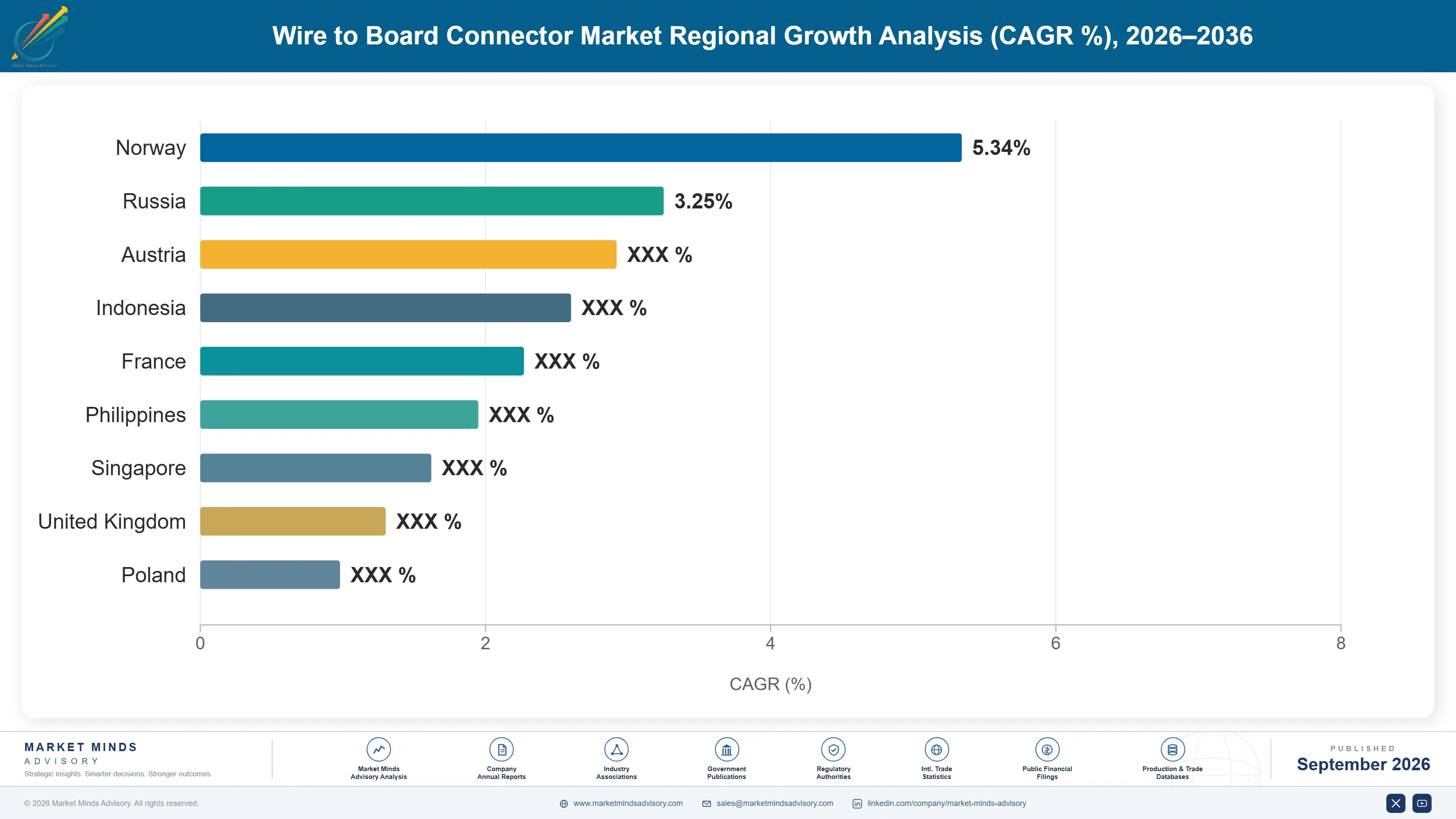
Regional demand tracks electronics manufacturing capacity and automotive production scale closely, with East Asia leading given concentrated connector manufacturing while North America follows through automotive design activity. Regulatory tightening and retrofit cycles reshape regional share at different paces given local manufacturing capacity constraints. Vendors track these paces closely.

East Asia

China's concentrated connector manufacturing base and dense downstream electronics assembly sector drive the region's leading share, with domestic connector makers increasingly competing directly against established global vendors on both price and current-density capability across major manufacturing hubs nationwide. Japan and South Korea contribute meaningfully through precision automotive and semiconductor equipment manufacturing, where connector tolerances run tighter than typical general assembly applications elsewhere. Regional vendors are scaling production capacity aggressively to meet both domestic and export demand from manufacturers based across the broader region. Export-oriented manufacturing capacity continues expanding to serve global connector shipment demand. Domestic certification bodies are streamlining approval processes to match production scale demands. Talent pipelines here remain deep given decades of electronics manufacturing experience.
Share: 29% | CAGR: 7.5% (2026 to 2036)

North America

United States automotive and electronics manufacturers are qualifying higher-density connectors ahead of tightening battery management design requirements, concentrating near-term demand among Tier 1 automotive suppliers and contract electronics assemblers across major manufacturing corridors. Canada contributes meaningfully through comparable manufacturing base and cross-border supply chain integration with United States automakers. Facility operators here favor certified premium connectors over lower-cost alternatives, reflecting genuine reliability priorities following capacity constraints that accelerated procurement timelines across major manufacturers this cycle. Retrofit spending is expected to remain elevated through the middle years of the forecast window. Insurance underwriting incentives compound this trend further across most facility investment decisions. Momentum builds steadily across most manufacturing corridors nationwide.
Share: 24% | CAGR: 6.5% (2026 to 2036)
Regional intelligence for 5 additional markets available in the complete report: Western Europe, South Asia and Pacific, Latin America, Middle East and Africa, Eastern Europe. Contact sales@marketmindsadvisory.com.
wire-to-board-connector-market-market-share-analysis-1788428086776

Capturing Margin Beyond Standard Connector Hardware

Vendors face compressing standard connector pricing as competition intensifies, but automotive certification services, standardized interoperable footprint licensing, and alternative-alloy engineering offer genuine margin expansion paths worth pursuing deliberately across the forecast period. Vendors that treat these as core product lines rather than bolt-on services will capture disproportionate share of category profit pools ahead today.

Expand Automotive Certification Service Offerings Broadly

Vendors bundling automotive qualification documentation and testing support alongside hardware sales capture a service revenue stream largely untapped by competitors selling connectors as standalone components without compliance support. This positions vendors closer to the tier-one procurement decision, which increasingly weighs documentation quality alongside raw current-carrying specifications. Early movers building dedicated certification service teams report attach rates of roughly 43 percent among enterprise accounts, meaningfully above hardware-only competitors lacking comparable offerings. This service layer also strengthens customer retention across multi-year support contracts renewed annually. Larger enterprise accounts increasingly demand this bundled offering during vendor selection.
Market Impact: Captures the 43 percent certification service opportunity now

Build Standardized Footprint Licensing Portfolios Broadly

As regulatory bodies push standardized housing dimensions across the industry, vendors offering pre-validated interoperable footprint designs capture share from proprietary specialists unable to serve fragmented multi-vendor board layouts. This lever directly addresses the standardization-driven purchasing surge, where manufacturers adopting standardized footprints report qualifying roughly 29 percent more vendor options. Vendors moving early on multi-brand compatibility testing win disproportionate share of this concentrated demand wave. Kit standardization also shortens integrator installation timelines meaningfully across facility deployments. Vendors moving early here also build valuable retrofit engineering expertise competitors lack entirely. Adoption grows steadily.
Market Impact: Addresses the 29 percent standardization surge directly now

Develop Alternative Alloy Material Engineering Capability

Vendors developing alternative alloy contact designs address the copper supply constraint limiting manufacturing scale-up industry-wide, capturing share from competitors unable to secure priority copper allocation during periods of tight availability. Given that only roughly 22 percent of connectors currently use these alternative material approaches, vendors building this capability early capture a genuinely underserved segment before competitors close the gap entirely. Vendors ignoring alloy design risk losing supply-constrained accounts to more resilient competitors entirely. Early hybrid adopters establish a durable technical lead difficult for slower rivals to close. Growth compounds steadily.
Market Impact: Captures the 22 percent alternative material segment now

Offer Fusion System Upgrade Migration Paths

Vendors offering structured migration paths from standard-pitch to high-density connector architectures capture incremental revenue from existing customers rather than losing them entirely to competitors selling advanced systems as a fresh sale requiring complete board redesign. This approach reduces customer switching risk while capturing the roughly 43 percent annual growth high-density designs are seeing broadly, positioning vendors as long-term technology partners rather than one-time equipment suppliers. Structured migration pricing also improves customer lifetime value materially over the board ownership period. Vendors delaying entry risk permanent exclusion from these premium capital budget cycles entirely.
Market Impact: Captures the 43 percent high-density growth rate now

Who Controls the Margin Pool

The top five vendors hold roughly 44 percent combined share on a shipment volume basis, leaving considerable room for challengers even as TE Connectivity and Molex maintain a clear lead over mid-tier competitors given established automotive qualification depth. The gap between leader and nearest challenger has narrowed as newer entrants specializing in high-density capture gain traction across battery management accounts. Certification depth and current-density capability remains the primary axis separating leaders from mid-tier challengers today.
Current competitive activity centers on automotive certification service bundling, standardized footprint licensing development, and alternative alloy engineering as vendors chase demand beyond commodity connector sales. Vendors are also racing to expand high-density product lines as electronics manufacturers increasingly favor combined power and signal architectures. Pricing pressure on commodity connector hardware is accelerating this diversification trend across the supplier base broadly.

Consumer electronics-scale manufacturers entering automotive and industrial segments represent the clearest emerging pressure on established connector specialists, threatening to compress premium pricing meaningfully over the coming years. Rankings could shift substantially if a major automotive supplier acquires a leading connector specialist outright, consolidating supply relationships that currently span multiple independent vendors. Smaller specialists lacking automotive qualification depth face the greatest exposure to this consolidation risk.
wire-to-board-connector-market-country-cagr-analysis-1788428087293

Competitive Moat and Risk Dimensions

TE CONNECTIVITY

Moat: Deep Automotive Qualification History

TE Connectivity's decades of connector engineering across automotive and industrial applications give it calibration precision and reliability data competitors struggle to match, particularly in high-precision battery management applications demanding sub-milliohm contact resistance consistently. This reliability record translates into lower field failure rates that automotive procurement teams increasingly reference during certification review processes.
TE CONNECTIVITY

Risk: Slower Cost Curve Adaptation

TE Connectivity's engineering-intensive premium positioning leaves it exposed as consumer electronics-scale manufacturers increasingly favor lower-cost commodity connector alternatives, ceding volume share to leaner competitors willing to compete more aggressively on price. Competitors moving faster on cost efficiency risk eroding TE's positioning among price-sensitive commodity accounts.
MOLEX

Moat: Broad Cross-Industry Application Portfolio

Molex's connector product lines span compatibility across automotive, industrial, and consumer electronics applications, giving integrators a single trusted source across heterogeneous multi-application manufacturing programs deployed within a single facility. This breadth reduces integrator qualification overhead considerably compared to single-application specialists lacking equivalent compatibility testing coverage.
MOLEX

Risk: Premium Pricing Limits Smaller Accounts

Molex's premium positioning and engineering-intensive sales process limit its penetration among smaller manufacturers seeking lower-cost connector options, ceding volume share to leaner competitors willing to compete more aggressively on price. Lower-cost challengers targeting smaller manufacturers could erode Molex's volume base over the coming forecast years.

Players Tracked

Prominent Players

TE Connectivity
Molex
JST
Amphenol
Hirose Electric

Other Key Players

Yazaki Corporation
Sumitomo Electric
Aptiv
JAE Electronics
Foxconn Interconnect Technology
Weidmuller
Phoenix Contact
Wurth Elektronik
Kyocera AVX
Samtec
Harwin
Bulgin
Rosenberger
Fischer Connectors
ODU

Recent Developments

MARCH 2026

TE Connectivity Launches High-Density Battery Connector Line

TE Connectivity launched a new high-density battery management connector product line combining automotive-grade thermal cycling certification into a single integrated module targeted at electric vehicle applications requiring dense power delivery within compact enclosures. The launch positions TE to compete directly against emerging entrants gaining traction in precision battery applications.
Signal: Signals TE's strategic pivot toward high-density architecture ahead of intensifying commodity competition ahead of intensifying commodity price competition
NOVEMBER 2025

Molex Acquires Micro-Pitch Connector Startup

Molex acquired a privately held micro-pitch connector startup to accelerate its own miniaturization roadmap, gaining proprietary contact material technology and an engineering team with several years of dedicated micro-pitch development experience already built. Financial terms were not disclosed publicly, though integration is expected to complete by mid-2026.
Signal: Confirms acquisition as Molex's preferred route into miniaturization rather than internal development rather than slower internal development
JULY 2025

JST Signs Supply Agreement With Automotive Manufacturer

JST signed a multi-year supply agreement with a major automotive manufacturer to provide battery management connectors across a new electric vehicle product line launching across multiple regional manufacturing facilities beginning early next year. Terms were not publicly disclosed. JST expects the deployment to begin shipping within the coming quarters.
Signal: Reflects growing original equipment demand for embedded connector supply over aftermarket components across multiple electric vehicle product lines

Copper Contact Material Cost Exposure

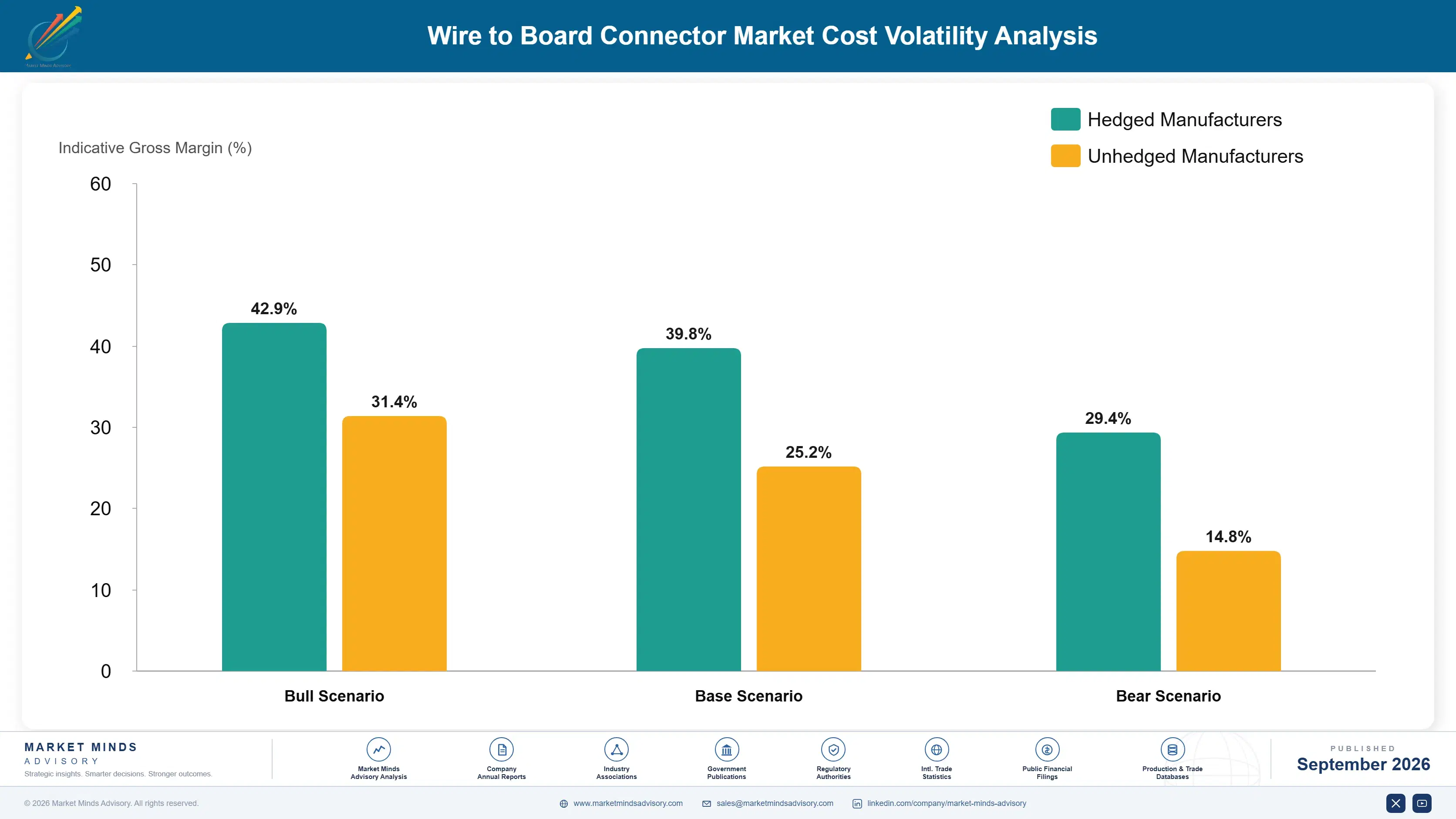
Copper alloy contact terminals and precious metal plating together represent roughly 32 to 38 percent of total connector cost of goods sold, sourced primarily from copper producers concentrated in Chile, Peru, and China, with vendors sourcing predominantly through metal distributors managing lead times and pricing volatility. Housing plastic and precision stamping labor form a secondary but meaningful cost category specifically.
Copper pricing rose meaningfully during 2024 as broader electrification and grid infrastructure demand competed directly with electronics connector manufacturing for available global mine output, an effect documented in several major copper producers' annual reports citing tight concentrate supply pressuring refined copper pricing upward. Vendors without long-term copper supply agreements faced extended lead times during this period. Lead times for connector-grade copper orders stretched several months beyond pre-2024 norms across most affected vendors.

Smaller connector manufacturers lacking long-term copper supply agreements face a genuine competitive disadvantage relative to larger incumbents able to secure priority allocation through volume purchasing commitments with major metal distributors. This exposure varies meaningfully by geography, with Asian manufacturers holding direct producer relationships facing less disruption than smaller Western manufacturers dependent on distributor intermediaries. This gap widens as broader electrification demand absorbs available global copper mine output.
wire-to-board-connector-market-company-positioning-matrix-1788428087487

Secure Long-Term Copper Supply Agreements

Vendors committing to multi-year copper supply agreements with producer partners secure priority allocation and more predictable pricing, insulating margin from spot market volatility that disproportionately affects vendors relying on transactional purchasing relationships year to year across cycles. This approach also strengthens producer relationships that pay dividends during future supply crunches across the broader industry.

Develop Alternative Alloy Contact Designs

Vendors engineering alternative alloy contact designs that reduce copper content while maintaining conductivity and pressure performance reduce exposure to copper price volatility, maintaining production continuity during periods of tight global copper supply availability across the broader industry. Geographic and material diversification also hedges against currency fluctuation and regional trade policy shifts affecting import costs.

Portfolio Architecture for Margin Defence

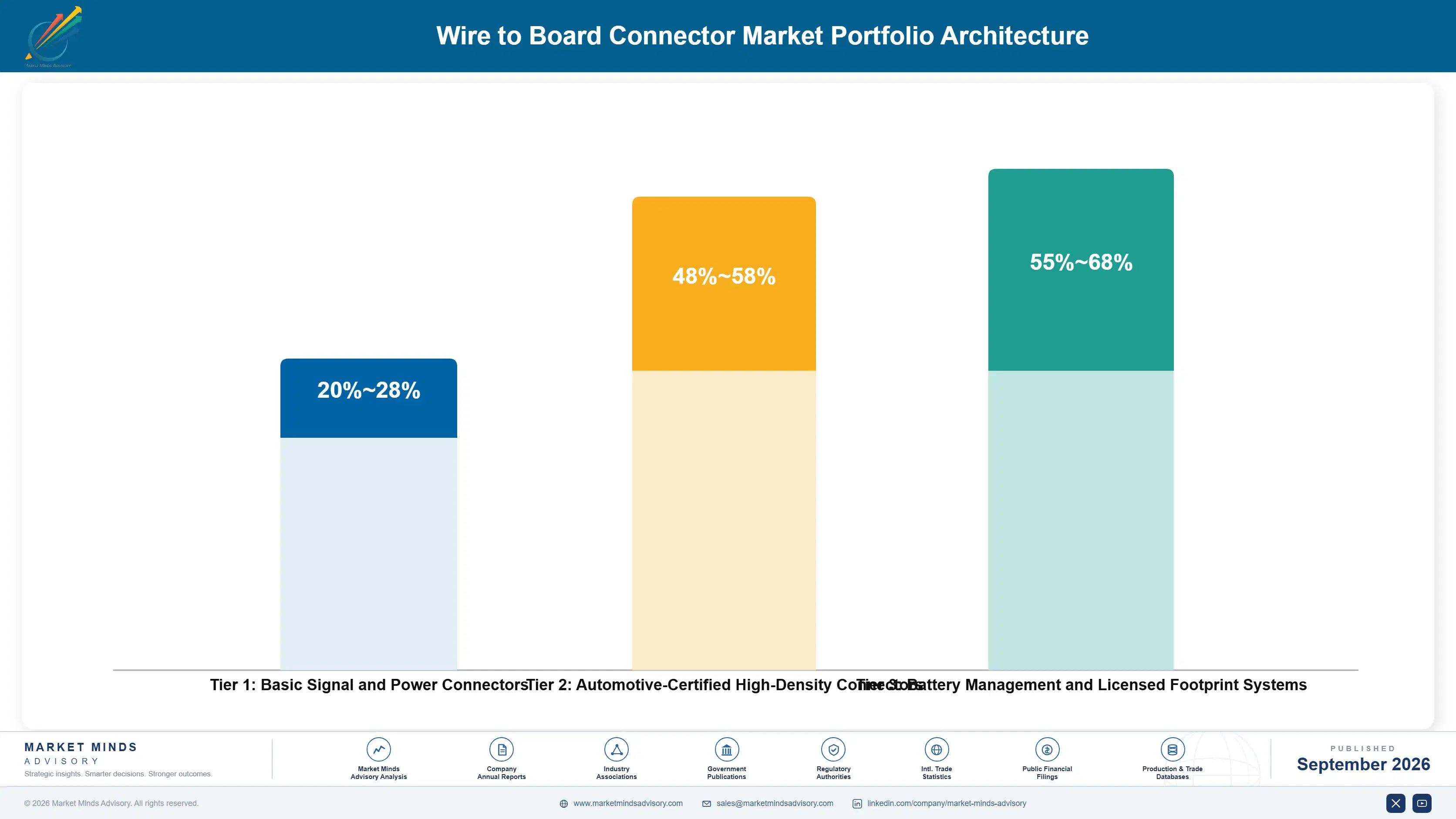
Connector vendors operate across three margin tiers, from standard commodity connectors carrying thin unit economics through automotive-certified high-density connectors commanding meaningfully stronger margin, up to certified battery management and licensed footprint bundles capturing the richest gross margins. Volume tiers monetize through unit shipment scale, while premium tiers monetize through certification depth and current-density performance bundling. Vendors misjudging tier boundaries risk cannibalizing their own premium accounts over time.
Tension persists between volume growth, which favors standardized low-cost connectors sold at scale to price-sensitive smaller manufacturers, and premium positioning, which favors automotive certification and high-density design commanding materially higher willingness to pay among enterprise accounts. Vendors chasing both simultaneously risk diluting brand positioning across a fragmented buyer base with sharply different purchasing criteria. This dynamic increasingly separates category leaders from smaller, undercapitalized regional challengers.

High-value margin pools concentrate in certification services and high-density battery management connectors, both commanding meaningfully higher gross margin than standalone commodity connectors sold without integration or compliance support. Vendors building durable certification service capabilities and high-density product roadmaps capture disproportionate margin relative to their unit shipment volume across the broader competitive landscape. Vendors ignoring this shift risk ceding the most profitable accounts to faster-moving competitors entirely.

Basic Signal and Power Connectors

Standardized connectors sold at scale to smaller manufacturers prioritizing baseline compliance over advanced current-density capability, carrying thin unit economics but broad market reach across cost-sensitive facility segments. Replacement cycles here run shorter given lower per-unit investment and simpler installation requirements overall.
Gross Margin: 20-28%

Automotive-Certified High-Density Connectors

Certified high-density connectors bundling documentation and compliance support, commanding stronger recurring service revenue and materially higher gross margin than commodity connectors sold without certification bundling. Facility operators increasingly request this bundling explicitly during vendor evaluation and procurement processes.
Gross Margin: 48-58%

Battery Management and Licensed Footprint Systems

Battery management connectors and standardized licensed footprint programs, carrying the richest margin profile in the category given integration complexity, service attach, and long-term customer relationship depth. Adoption here is accelerating fastest among enterprise accounts operating diversified electric vehicle programs.
Gross Margin: 55-68%
wire-to-board-connector-market-cost-volatility-analysis-1788428087980

High-value Sub-segments and Strategic Watch-out

Wire-to-Board Connectors for EV Battery Management Systems

Fastest-growing and highest-value segment, combining strong pricing power with accelerating adoption as electronics manufacturers increasingly require dense current-carrying capacity across shared automotive workspace nationwide, particularly in premium electric platforms. Vendors moving early on this segment capture outsized long-term account relationships. Vendors here shape category standards.

Micro-Pitch Signal Connectors

High-value segment with moderate growth, anchored by rising facility preference for combined miniaturization and signal integrity over standard-pitch alternatives, though integration complexity slows broader adoption pace relative to simpler standalone modules. Long-term account value here rewards vendors investing in integration engineering depth. Providers expanding here gain volume steadily.

Standard Power Distribution Terminals

Volume core of the market, delivering steady unit shipment counts and established margin, serving as the primary entry point into certification services and eventual high-density architecture upgrades over time. Retention here anchors long-term vendor revenue predictability across cycles. Renewal rates here anchor vendor cash flow.

Basic Legacy Signal Connectors

Strategic watch-out segment facing intensifying embedded sensing competition from module manufacturers, pressuring standalone module pricing and requiring vendors to differentiate through retrofit compatibility and service depth. Differentiation now determines which suppliers survive the coming consolidation wave ahead. Act early or lose share permanently now. Now.

Qualification Cycles Anchor Design Relationships

Connector purchasing behaves less like a discretionary component spend and more like an annuity tied to platform design cycles, with manufacturers committing to multi-year service and calibration contracts once initial qualification is achieved rather than treating sensing as a one-time capital purchase. Vendors offering bundled calibration service see meaningfully higher renewal rates than hardware-only competitors.
Adoption stickiness varies considerably by end-use vertical. Automotive tier-one suppliers show the deepest stickiness given tightly integrated safety certification tied to specific vehicle platform generations, while general consumer electronics buyers see comparatively higher vendor switching as facilities reconfigure lines more frequently between product runs. Industrial equipment manufacturers occupy a middle position, balancing certification continuity against periodic customer-driven line reconfiguration requirements. This spread shapes how vendors prioritize field service and calibration staffing across regional territories.

Younger design engineering leadership increasingly favors integrated high-density connector platforms purchased as complete systems rather than assembling point solutions from multiple vendors, shifting negotiating leverage toward suppliers offering complete detection stacks. Veteran plant engineers still favor incremental single-connector upgrades from established suppliers with long compliance track records, creating a generational split vendors must navigate carefully across account types.
Section default visual

What Connector Vendors Must Prioritize

These are among the four positions where our research anticipates prominent divergence between winners and laggards over the coming forecast period. Each is grounded in the demand model, the regulatory perimeter, and the announced capacity pipeline.
01 / HIGH-DENSITY DESIGN INVESTMENT

Accelerate high-density connector development now

Manufacturers increasingly prioritize current-carrying capacity per unit footprint, and vendors slow to build deeper high-density design capability risk ceding the fastest-growing segment of the market to faster-moving competitors already shipping compact designs at scale. Engineering investment here carries real near-term cost, but the segment's growth rate justifies front-loading development spend now rather than waiting for competitive pressure to force the issue later across major electronics accounts. Vendors delaying this investment will find catch-up increasingly expensive as high-density becomes the default buyer expectation.
02 / CERTIFICATION SERVICE DEPTH

Bundle certification documentation with every sale

Manufacturers increasingly weigh documentation quality alongside raw specifications, and vendors offering bundled certification services capture a genuinely valuable commercial channel before competitors close the gap on compliance capability. This lever requires dedicated compliance engineering investment distinct from standard connector product lines, but the addressable certification-driven demand remains substantial and largely untapped by generalist manufacturers. Vendors moving early on certification bundling will hold a durable advantage as automotive scrutiny intensifies further across the forecast period ahead, where documentation quality increasingly determines contract renewal outcomes.
03 / INTEROPERABILITY STANDARDIZATION PUSH

License standardized footprints to smaller manufacturers

Interoperability standardization is opening competitive bidding to smaller specialists previously excluded by proprietary requirements, and vendors licensing standardized footprint technology capture a service revenue stream distinct from hardware sales that positions them as trusted industry standard-setters. Facilities navigating this expanding vendor landscape increasingly value interoperability as much as raw capability during vendor evaluation and selection processes. Vendors building this capability early establish standard-setting relationships competitors entering later will struggle to replicate across comparable engagements, where interoperability increasingly determines fleet-wide procurement outcomes.
04 / ALLOY SUPPLY RESILIENCE

Develop alternative alloy engineering to hedge exposure

Copper supply constraints are increasingly limiting manufacturing scale-up industry-wide, and vendors developing alternative alloy contact designs will capture a genuinely underserved segment before competitors close the gap on material engineering capability. This approach requires meaningful upfront research investment distinct from standard copper-based product lines, but the addressable supply-constrained segment continues expanding as electrification demand competes directly for available metal output. Vendors delaying alloy development risk losing supply-constrained accounts to more resilient competitors across the full ten-year forecast period immediately ahead.

Engagement Snapshot From the Field

A live engagement with an industry participant carrying material or product regulatory and market exposure ahead of a defining policy shift, showing how our research translates into a defensible multi-year portfolio strategy.
MARKET MINDS ADVISORY · CLIENT ENGAGEMENT SUMMARY
Wire to Board Connector Producer Strategic Portfolio Review and Transition Roadmap 2026·Investment Scenario on Wire to Board Connector Exposure Evaluation 2025-26
CLIENT PROFILE
A mid-size electric vehicle tier-one component supplier operating several manufacturing facilities across North America approached MMA seeking guidance on selecting wire-to-board connectors ahead of a new battery management system product line requiring both current density and automotive certification. The client's engineering leadership had limited internal expertise evaluating high-density connector vendors relative to the standard-pitch suppliers it had traditionally used.
STRATEGIC CHALLENGE
The client faced pressure to meet aggressive space constraints while maintaining current-carrying reliability standards required for safety-critical battery management certification. Leadership needed a vendor selection framework balancing current density against unit cost across a multi-year production commitment involving substantial volume. Delayed action risked missing the platform's production timeline and losing the contract to competing tier-one suppliers already advancing.
MMA APPROACH
MMA conducted a connector vendor capability audit across leading suppliers alongside interviews with the client's engineering leadership to define selection criteria weighted toward automotive qualification track record and current-density performance. The engagement benchmarked candidate vendors on thermal cycling, certification history, and total production cost across comparable scenarios. Recommendations were validated against comparable sourcing engagements completed by peer automotive suppliers facing similar cost and timeline pressures.
KEY FINDINGS
  1. Vendors with proven automotive qualification history reduced certification timeline meaningfully compared to industrial-grade suppliers lacking comparable automotive-specific track records and documentation. This risk reduction proved especially valuable given the program's tight regulatory compliance timeline.
  2. High-density connector designs reduced board footprint requirements considerably compared to traditional standard-pitch alternatives the client had initially evaluated for its design. This space savings became a decisive factor in the final vendor selection decision.
  3. Thermal cycling performance testing revealed genuine gaps between commercial-grade and premium connectors in high-vibration automotive scenarios relevant to the client's use case.
  4. Vendors offering dedicated automotive engineering support reduced integration risk considerably compared to generalist suppliers lacking comparable platform-specific technical resources. This factor ultimately outweighed marginal cost differences between otherwise comparable finalist vendors.
CLIENT PROFILE
A mid-size electric vehicle tier-one component supplier operating several manufacturing facilities across North America approached MMA seeking guidance on selecting wire-to-board connectors ahead of a new battery management system product line requiring both current density and automotive certification. The client's engineering leadership had limited internal expertise evaluating high-density connector vendors relative to the standard-pitch suppliers it had traditionally used.
STRATEGIC CHALLENGE
The client faced pressure to meet aggressive space constraints while maintaining current-carrying reliability standards required for safety-critical battery management certification. Leadership needed a vendor selection framework balancing current density against unit cost across a multi-year production commitment involving substantial volume. Delayed action risked missing the platform's production timeline and losing the contract to competing tier-one suppliers already advancing.
MMA APPROACH
MMA conducted a connector vendor capability audit across leading suppliers alongside interviews with the client's engineering leadership to define selection criteria weighted toward automotive qualification track record and current-density performance. The engagement benchmarked candidate vendors on thermal cycling, certification history, and total production cost across comparable scenarios. Recommendations were validated against comparable sourcing engagements completed by peer automotive suppliers facing similar cost and timeline pressures.
KEY FINDINGS
  1. Vendors with proven automotive qualification history reduced certification timeline meaningfully compared to industrial-grade suppliers lacking comparable automotive-specific track records and documentation. This risk reduction proved especially valuable given the program's tight regulatory compliance timeline.
  2. High-density connector designs reduced board footprint requirements considerably compared to traditional standard-pitch alternatives the client had initially evaluated for its design. This space savings became a decisive factor in the final vendor selection decision.
  3. Thermal cycling performance testing revealed genuine gaps between commercial-grade and premium connectors in high-vibration automotive scenarios relevant to the client's use case.
  4. Vendors offering dedicated automotive engineering support reduced integration risk considerably compared to generalist suppliers lacking comparable platform-specific technical resources. This factor ultimately outweighed marginal cost differences between otherwise comparable finalist vendors.
RECOMMENDED STRATEGY
Phase 1: Phase one selected a vendor combining proven automotive certification history with competitive high-density design capability for the initial platform. Speed to award mattered given the compressed timeline. Phase 2: Phase two conducted extended thermal cycling and vibration testing to validate reliability claims before finalizing the multi-year production agreement. Results confirmed the selected vendor met all required performance thresholds. Phase 3: Phase three established standardized connector specifications for future vehicle platform generations to simplify subsequent vendor qualification processes. Procurement teams adopted the specification as standard sourcing policy.
OUTCOME
Within three quarters, the client reported (client-reported, unverified by MMA) meaningful board footprint savings on production designs while maintaining reliability targets, validating the vendor selection framework MMA recommended across its supplier network. Leadership extended the sourcing framework to additional vehicle platforms planned for the following fiscal year.

Frequently Asked Questions

Foundational context covering the market sizes, CAGR, scope, country, region and competition that inform every finding below. This section is provided to cover basics and most often pre-purchase conversations, answered from the MMA Primary Research Dataset.

What is the current size of the Wire to Board Connector Market?

The global market was valued at approximately 5.8 billion dollars in 2025, driven by electric vehicle battery management demand and industrial automation investment across the industry.

How large will the Wire to Board Connector Market be by 2036?

The market is projected to reach roughly 11.6 billion dollars by 2036, roughly doubling from its 2026 base as high-density designs expand adoption broadly worldwide.

What is the CAGR for the Wire to Board Connector Market 2026 to 2036?

The market is forecast to grow at a compound annual rate of approximately 6.5 percent between 2026 and 2036, supported by electric vehicle production growth and automation investment.

Which segment is growing fastest?

Wire-to-Board Connectors for EV Battery Management Systems lead segment growth at approximately 11.0 percent annually, outpacing the broader market as current density requirements intensify rapidly.

Who are the major companies in the Wire to Board Connector Market?

TE Connectivity, Molex, JST, Amphenol, and Hirose Electric lead the competitive landscape, collectively holding the largest position on a shipment volume basis nationwide currently today.

Which country is growing fastest?

India leads country-level growth at approximately 9.0 percent annually, driven by multinational manufacturers relocating production capacity and bringing connector standards into newly built facilities nationwide.

Report Segmentation Architecture

The full report scope spans multiple orthogonal segmentation dimensions, with cross-tabulated demand data provided for each dimension pair. Coverage extends further to regional breakdowns, trend trajectories, and the competitive detail needed to support segment-level decision-making.

By Product Type

    By End-Use Application Industry

      By Commercial Deployment Model

        By Region

        • East Asia
        • North America
        • Western Europe
        • South Asia and Pacific
        • Latin America
        • Middle East and Africa
        • Eastern Europe

        Scope, Methodology, and Coverage

        Every figure in this report is reproducible from documented input assumptions. The scope below maps the historical period, the forecast horizon, the segmentation dimensions, and the countries covered, alongside the underlying primary and qualitative methodology.
        Historical Period
        2020 to 2025
        Forecast Period
        2026 to 2036
        Base Year
        2025 (USD billions; MMA Primary Research Dataset, September 2026)
        Market Definition
        This report covers wire-to-board electrical connectors used to link discrete wire harnesses to printed circuit boards across automotive, industrial, and consumer electronics applications. It excludes board-to-board connectors, fiber optic connectors, and complete wire harness assemblies sold as finished cable products.
        Quantitative Units
        USD billions, percent CAGR, percent share
        Segmentation Dimensions
        Product type, end-use application industry, commercial deployment model
        Regions Covered
        East Asia, North America, Western Europe, South Asia and Pacific, Latin America, Middle East and Africa, Eastern Europe
        Countries Covered
        China, Japan, South Korea, United States, Canada, Germany, France, Italy, India, Australia, Vietnam, Malaysia, Mexico, Brazil, United Arab Emirates, Saudi Arabia, South Africa, Poland, Czech Republic, Hungary
        Key Companies Profiled
        TE Connectivity, Molex, JST, Amphenol, Hirose Electric, Yazaki Corporation, Sumitomo Electric, Aptiv, JAE Electronics, Foxconn Interconnect Technology, Weidmuller, Phoenix Contact, Wurth Elektronik, Kyocera AVX, Samtec, Harwin, Bulgin, Rosenberger, Fischer Connectors, ODU
        Quantitative Methodology
        Primary survey, n=3,800 respondents, Q4 2025, six countries; demand-side model with trade association cross-validation
        Qualitative Methodology
        47 expert interviews, Q4 2025; applied to validate demand model assumptions, identify emerging dynamics, and assess competitive positioning
        Report Format
        PDF and XLSX data workbook (Word format preview document)
        Publisher
        Market Minds Advisory
        Report Code
        MMA-2026-CON-651
        Published
        September 2026
        Contact
        sales@marketmindsadvisory.com | www.marketmindsadvisory.com

        Purchase the full Wire to Board Connector Market Report (2026 to 2036).

        This report delivers a comprehensive assessment of the global wire to board connector market, spanning market sizing, segmentation, competitive positioning, and regional demand dynamics through 2036. It profiles twenty leading vendors across battery management, signal, and power distribution categories, benchmarking each on a consistent shipment volume basis. Readers gain a detailed view of revenue levers, copper cost exposure, and margin architecture across the category. The analysis draws on primary survey data, expert interviews, and company disclosures to support strategic planning across the full ten-year forecast period ahead.
        Ten-year market sizing and forecast model
        Six-segment MECE product technology framework overview
        Twenty-company competitive benchmarking dataset included fully
        Seven-region demand share and CAGR analysis
        Copper cost exposure and mitigation playbook included
        Anonymized client qualification engagement case study included

        Built For The People Who Decide

        From boardroom strategy to bench-side execution, this report is read cover-to-cover by leaders shaping the next decade of their industry, turning demand scenarios, market dynamics and valuation benchmarks into decisions.
        CXOs/ Presidents/ VPs/ Managers
        M&A and Corporate Development
        Strategy Teams and R&D Heads
        Procurement and Product Directors
        Regulatory and Compliance Leaders
        Investor Relations and Equity Analysts