Market Minds Advisory
White Sneakers Market

White Sneakers Market: White Sneakers Market. Premium Minimalist Design Reshapes Athletic Footwear Manufacturing

Premium minimalist design language is colliding with decades of mass-market white sneaker manufacturing, forcing established brands to qualify designer-grade production fast enough to defend retail shelf space against agile entrants.

Lead Analyst

Published

September 2026

Make Smarter Decisions with Customized Research Insights

Request a free sample report and evaluate market opportunities, growth trends, and competitive dynamics relevant to your business needs.

2025 MARKET VALUE$18.0BMarket Size 2025
2036 FORECAST VALUE$36.0BBase Case , 2026 to 2036
CAGR 2026 TO 20366.5 %Bull 7.7% / Bear 5.3%
INCREMENTAL OPPORTUNITY$16.8BNet 10- year value creation
EXPANSION MULTIPLE1.88x2036 value over 2026 base
Strategic Levers
M&A Pipeline
Regional Outlook
Country Rankings
Competitive Intelligence
Segmental Deep-dive
Call-Us : 91 93563 13602

Executive Snapshot and Market Trajectory.

White sneaker manufacturers face genuine pressure to qualify premium minimalist design formats while still sustaining mass-market production lines that built the category's earliest retail credibility across most major global markets and price tiers, a tension reshaping product roadmaps across the sector this coming year.
Premium minimalist white sneakers are growing fastest of six material categories as consumers pursue designer-grade craftsmanship beyond simple mass-market styling across most demographic segments, while synthetic and vegan leather formats follow closely on sustainability-driven demand built over several years. North America concentrates the bulk of demand given Nike and Adidas's outsized athletic footwear retail base specifically. China's expanding manufacturing capacity is also shaping which brands can scale premium production fast enough to matter.
Five manufacturers hold roughly forty-five percent of market revenue, a moderately concentrated structure reflecting how established athletic brand heritage and design licensing relationships matter for high-value retail shelf placements across the category broadly. China's manufacturing scale-up is driving the fastest national growth as domestic brands export premium formats internationally at increasing volume each year. Smaller regional manufacturers without comparable production scale increasingly struggle to compete on multi-material pricing specifically.
Market Definition
This report covers revenue from white leather, white canvas, white knit and mesh, white suede, white synthetic and vegan leather, and premium minimalist white sneakers sold through retail, e-commerce, and specialty footwear channels. It excludes non-white colorways and orthopedic or medical footwear, which serve entirely different consumer purchase motivations.
Base Year Value
$18.0B in 2025 (MMA Primary Research Dataset, August 2026)
Forecast Period
2026 to 2036, eleven discrete annual values
CAGR
6.5% base case. Bull 7.7%. Bear 5.3%.
Fastest Growth Segment
Premium Minimalist White Sneakers: 9.0% CAGR
Fastest Growth Country
China: 8.5% CAGR
Fastest Growth Region
South Asia and Pacific: 8.5% CAGR
Largest Region
North America: 29% of 2025 global value
Market Leaders
Nike, Adidas, Common Projects, Converse, Golden Goose. Source: MMA Analysis based on company disclosures and athletic footwear industry data.
Primary Survey
n=3,800 procurement and R&D decision-makers, Q4 2025, six countries
Methodology
Demand-side build-up, cross-validated against public data, 47 expert interviews

White Sneakers Market Forecast Scenarios

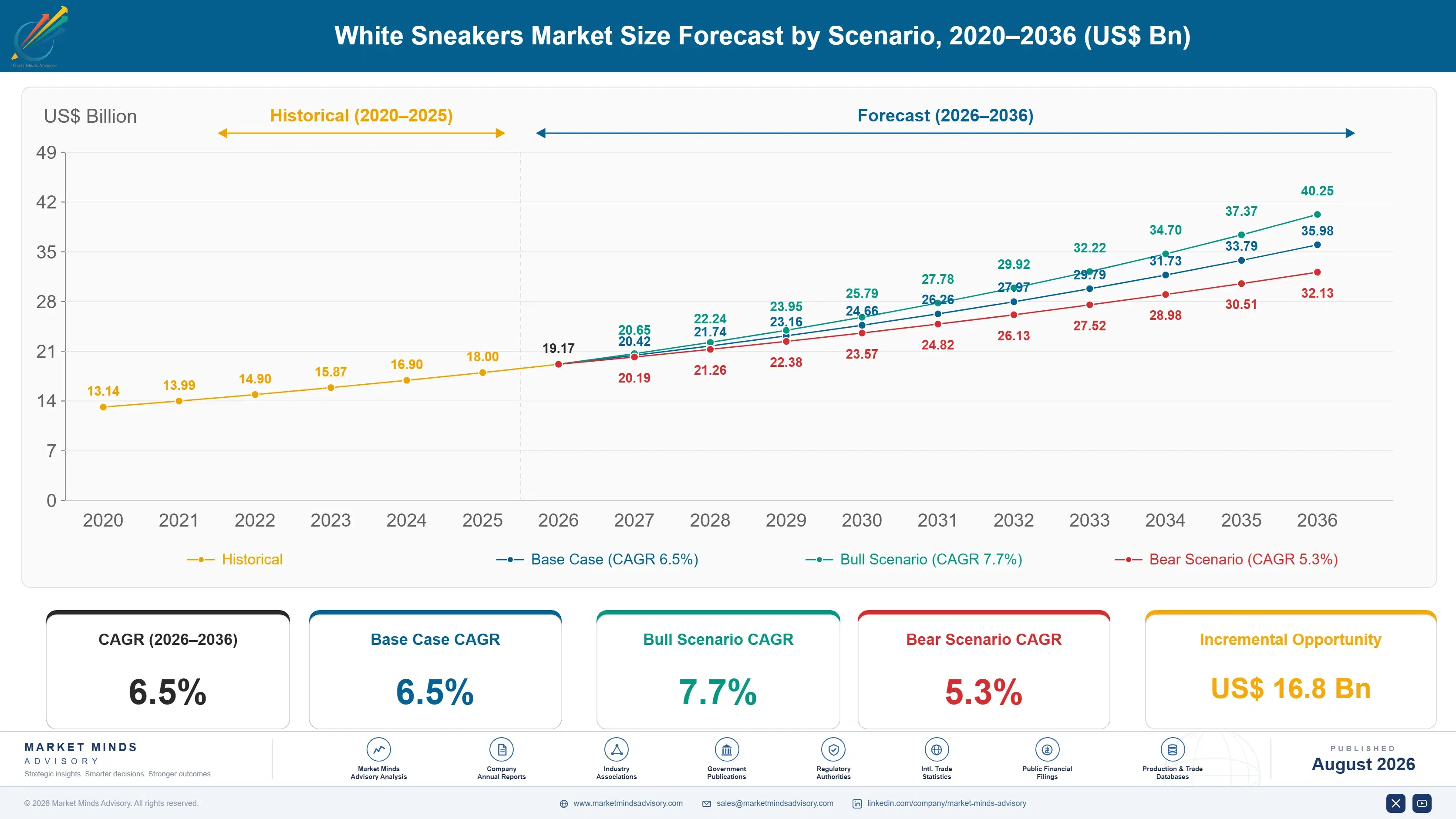
white-sneakers-market-size-forecast-scenario-1788168859487
Between 2020 and 2025 the white sneakers market grew at roughly 5.5 percent annually, accelerating as consumers responded to rising interest in minimalist fashion aesthetics that traditional colorful athletic designs alone could not deliver at comparable versatility. Manufacturers used this period to build premium production capacity ahead of broader retail adoption across most major footwear retail channels.
The base case assumes 6.5 percent annual growth through 2036, anchored in three mechanisms: expanding premium minimalist adoption as consumers pursue designer-grade craftsmanship across fashion and lifestyle channels, rising synthetic and vegan leather demand as consumers seek sustainable alternatives to traditional animal leather, and growing Chinese manufacturing capacity that is lowering production costs for multi-material sneakers globally. Manufacturers with established premium production platforms are best placed to capture this combined growth.
A bull scenario built on faster premium retail adoption and expanding vegan-leather demand could push growth toward 7.7 percent, led by manufacturers already scaled on flagship retail programs. A bear scenario tied to raw material cost volatility and softer discretionary fashion spending could instead pull growth down toward 5.3 percent. Manufacturing capacity constraints remain a secondary swing factor either way.

Premium Craftsmanship and Design Licensing Economics

White sneaker manufacturing sits at a genuine inflection point where premium minimalist design is generating demand for designer-grade craftsmanship engineering that decades of mass-market production were never designed to deliver, forcing manufacturers to rethink material sourcing entirely across every manufacturing facility. Few athletic footwear categories have faced this rapid a functional shift after generations of comparatively stable mass-market construction.
TOP-5 MANUFACTURER CONCENTRATION45%Global revenue share held by five largest sneaker manufacturers
NORTH AMERICA REVENUE SHARE30%Global revenue tied to established athletic footwear retail base
PREMIUM MINIMALIST REVENUE SHARE18%Total revenue tied specifically to designer-grade craftsmanship formats
AVERAGE PRODUCT DEVELOPMENT CYCLE10 monthsTypical duration required to bring a new sneaker to market
LEATHER AND MATERIAL COST38%Base leather and upper material share of total cost
DIRECT-TO-CONSUMER REVENUE SHARE34%Total revenue tied to online and direct retail sales channels
Established manufacturers still dominate the highest-value retail shelf placements because years of leather sourcing expertise and craftsmanship certification matter enormously for products where design-purity claims carry genuine reputational consequences, letting incumbents defend share even as smaller brands pursue novel material combinations across most retail categories served. This dynamic increasingly determines which manufacturers can grow their retail relationships profitably versus which must retrench toward niche direct-to-consumer positioning instead.
Two forces will reshape the next decade. Premium minimalist adoption will keep expanding designer-grade craftsmanship expectations across every new product launch and retail category simultaneously, while synthetic and vegan leather formats keep generating steady demand that traditional animal leather alone could never fully satisfy. Manufacturers positioned to serve both traditional mass-market demand and emerging premium specification simultaneously carry a genuine advantage over slower-moving competitors.
"A white sneaker used to mean a blank canvas you scuffed within a week. Now it's engineered with premium full-grain leather and reinforced stitching that ages gracefully, and that changes which brands actually keep customers loyal."
Director, Footwear Fashion and Materials Practice · MMA Footwear Fashion and Materials Practice · August 2026

Market Trends

Premium Minimalist Design Expands Craftsmanship Demand

Brands increasingly engineer full-grain leather uppers with reinforced stitching and clean silhouettes that traditional mass-market white sneakers could never offer at comparable durability or aesthetic refinement across most product categories. This shift has proven considerably more durable than a passing fashion trend alone would suggest, given how many consumers now treat premium minimalist design as a genuine wardrobe investment rather than a marketing gimmick reserved for niche fashion enthusiasts only. Manufacturers with established craftsmanship-grade production infrastructure are best positioned to capture this accelerating demand as more consumers commit to purchase.
Market Impact: Narrows price gap to 35 percent

E-Commerce Growth Expands Direct Retail Access

Online retail platforms now let consumers compare sneaker craftsmanship, material sourcing, and reviews directly before purchase, a shopping behavior traditional department store visits could never replicate at comparable convenience or price transparency across most consumer segments and demographic groups served. Roughly thirty-four percent of category revenue now flows through direct online channels, with e-commerce platforms commanding meaningfully higher conversion rates than traditional retail for mid-tier and premium sneaker models specifically. Manufacturers investing in e-commerce merchandising capability are winning disproportionate share of this fast-growing channel as online retail continues growing steadily.
Market Impact: Adds 8 percent resale segment growth

Market Opportunities and Growth Drivers

Minimalist Wardrobe Culture Drives Premium Purchases

Consumers increasingly view premium white sneakers as versatile wardrobe staples rather than pure athletic accessories, narrowing the price gap between standard and premium formats to within roughly thirty-five percent per pair at comparable design refinement and material quality. This preference shift has proven considerably more durable than a single fashion cycle alone would suggest, given how many consumers now treat premium white sneakers as a genuine style investment rather than a discretionary indulgence reserved only for fashion-forward buyers specifically. Manufacturers with established craftsmanship capability are best positioned to capture this accelerating demand.
Market Impact: Adds 7 percent input cost pressure

Sneaker Resale Culture Expands Collector Demand

Consumers increasingly treat limited-edition white sneakers as collectible investments traded on secondary resale platforms, a behavior that traditional general footwear retailers could never fully capture at comparable price appreciation or brand engagement across most demographic segments. Roughly thirty percent of category revenue already flows through channels serving this combined resale and collector demand pool, with limited releases commanding meaningfully higher resale premiums than standard retail pricing during peak launch windows. Manufacturers with established collector community relationships are winning disproportionate share of this expanding demand pool as resale culture continues expanding steadily.
Market Impact: Limits premium adoption to 18 percent

Market Restraints and Challenges

Leather and Material Cost Volatility Pressures Margin

Full-grain leather, canvas, and specialty upper materials, which represent roughly thirty-eight percent of total production cost, face genuine price volatility tied to concentrated global leather tanning supply and agricultural trade tensions affecting several major producing countries simultaneously. The root cause is genuine commodity market concentration rather than any manufacturer-specific pricing failure, since leather sourcing options remain limited regardless of individual manufacturer scale or negotiating position. Manufacturers are mitigating this through long-term leather supply agreements and increasing investment in alternative material sourcing that reduces dependency on the most constrained input category.
Market Impact: Grows premium revenue 9 percent yearly

Discoloration Perception Limits Premium Format Adoption

Many consumers remain skeptical that white sneakers will maintain their pristine appearance given everyday wear and exposure to dirt, a perception that limits how quickly manufacturers can shift retail mix toward premium formats even as stain-resistant treatment technology genuinely improves across most product generations. The root cause is genuine practical concern about maintenance burden rather than any actual manufacturing quality gap, since consumers who try treated formats typically report satisfaction comparable to darker colorway alternatives. Manufacturers are mitigating this through stain-resistant coating technology and expanded cleaning-kit bundles that reduce adoption hesitation gradually.
Market Impact: Drives 34 percent of revenue online
4 additional market trends, 3 additional growth drivers, and 3 additional restraints and challenges are covered in the full report. Contact sales@marketmindsadvisory.com to access the complete intelligence.

Segment CAGR and Growth Architecture

Segmentation follows upper material composition, the dimension manufacturers and retailers use to plan production runs and pricing tiers across every distribution channel and geography served worldwide. Six categories cover the market: white leather, white canvas, white knit and mesh, white suede, white synthetic and vegan leather, and premium minimalist white sneakers. This mirrors how retailers organize shelf categories.
white-sneakers-market-market-share-analysis-1788168860027

Premium Minimalist White Sneakers

Premium minimalist white sneakers are the fastest-growing segment as consumers increasingly seek designer-grade craftsmanship that traditional mass-market formats cannot deliver at comparable durability and aesthetic refinement across most fashion occasions. Consumers increasingly view premium minimalist design as a genuine wardrobe investment rather than a marketing gimmick, given considerable improvements in full-grain leather sourcing that newer manufacturers now deliver relative to earlier generations that struggled with inconsistent hide quality. Manufacturers with established craftsmanship-grade production history are winning disproportionate share of this demand, since the specialized leather sourcing and stitching quality required creates genuine barriers for newer entrants lacking comparable development experience. Style-conscious consumer segments are pulling forward purchasing decisions that buyers might otherwise have deferred.
CAGR 9.0%

White Synthetic and Vegan Leather Sneakers

White synthetic and vegan leather sneakers are the second-fastest segment as consumers increasingly specify cruelty-free materials that traditional animal leather formats cannot satisfy given growing awareness of ethical sourcing concerns. Consumers increasingly view vegan leather as a genuine sustainability upgrade rather than a compromise on quality, given considerable improvements in synthetic material durability that newer formulations now deliver relative to earlier generations that struggled with cracking and peeling. Manufacturers with established vegan material sourcing history are winning disproportionate share of this demand, since the specialized material formulation and quality testing required creates genuine barriers for newer entrants lacking comparable supply relationships. Sustainability-driven lifestyles are pulling forward purchasing decisions that consumers might otherwise have deferred.
CAGR 8.0%
Full segment breakdown across 6 segments available in the complete report.

Regional Architecture and Country Demand Map

North America leads white sneaker demand on deep sneaker culture, dense specialty retail, and premium minimalist brand concentration, while East Asia and Western Europe follow closely behind on manufacturing scale and design heritage respectively across most price tiers and distribution channels served worldwide this year.

North America

Sneaker culture runs deeper here than almost anywhere else, and that depth translates directly into premium minimalist white sneaker volume across specialty retail, department stores, and direct brand channels. Nike and Converse both anchor design and marketing operations domestically, giving the region first access to limited releases and collaboration drops that drive considerable collector demand. Resale platforms built specifically for sneaker trading originated here and remain concentrated domestically, reinforcing a purchase cycle where consumers buy multiple pairs per year rather than replacing footwear only when worn out. College campuses and streetwear culture both sustain white sneaker demand as a near-uniform style choice across age groups. Retail square footage dedicated to premium sneaker walls exceeds most other regions.
Share: 29% | CAGR: 7.5% (2026 to 2036)

Western Europe

Design heritage carries more weight here than volume, with Common Projects and Golden Goose both anchoring the premium minimalist segment from European ateliers that emphasize construction quality over marketing scale. Fashion capitals across the region sustain demand for understated luxury sneakers that pair with tailored clothing, a positioning distinct from the performance-driven marketing dominant elsewhere. Sustainability regulation increasingly shapes material sourcing decisions, pushing manufacturers toward vegan leather formats and recycled synthetic uppers faster than most other regions require. Premium department stores across the largest markets dedicate considerable floor space to minimalist white sneaker brands positioned adjacent to established luxury goods retailers. Younger consumers increasingly favor quiet luxury aesthetics over logo-forward branding across most major cities.
Share: 21% | CAGR: 5.2% (2026 to 2036)
Regional intelligence for 5 additional markets available in the complete report: East Asia, South Asia and Pacific, Latin America, Middle East and Africa, Eastern Europe. Contact sales@marketmindsadvisory.com.
white-sneakers-market-country-cagr-analysis-1788168860530

Premium Craftsmanship and Direct Channel Expansion

White sneaker manufacturers have several concrete levers available to expand revenue beyond simple unit volume growth, spanning premium material tiers, direct-to-consumer channel economics, limited-release collaboration formats, and vegan material lines. Each lever draws on distinct commercial mechanics rather than simple price increases alone across the existing product range, retail footprint, and geography served worldwide.

Expand Premium Minimalist Craftsmanship Material Tiers

Manufacturers that invest in full-grain leather sourcing and refined stitching techniques can command considerably higher price points than mass-market equivalents, since consumers increasingly recognize and pay for visible craftsmanship differences. This tier already carries gross margins roughly 15 percentage points above standard white leather formats, and expanding capacity toward it directly improves blended profitability without requiring proportional volume growth. Brands lacking established craftsmanship credibility face a longer development runway, since consumer trust in premium positioning builds gradually through consistent quality delivery. Component sourcing relationships built over multiple product cycles increasingly determine which manufacturers can compete here.
Market Impact: Improves blended gross margin by 15 percentage points

Build Owned Direct-to-Consumer Digital Sales Channels

Selling directly through owned e-commerce and flagship retail bypasses wholesale margin compression, letting manufacturers capture considerably more of each sale than traditional distribution allows. Brands that have shifted a meaningful share of volume to direct channels report margin improvements of roughly 12 percentage points versus wholesale-dependent peers, since intermediary markups disappear entirely from the transaction. This requires sustained investment in logistics, customer service, and digital marketing capability that smaller manufacturers often lack relative to established brands with existing infrastructure. Direct customer data also improves demand forecasting accuracy considerably, reducing costly overproduction.
Market Impact: Improves margin by 12 percentage points on direct sales

Launch Scarcity-Driven Limited Collaboration Release Formats

Scarcity-driven collaboration releases with designers, athletes, or cultural figures command price premiums considerably above standard retail pricing, often reselling at 2 to 4 times original price on secondary resale markets. These drops generate outsized marketing value relative to their production volume, since media coverage and social sharing extend brand visibility well beyond the limited unit count actually sold. Execution risk is real: a poorly received collaboration can damage brand credibility considerably more than a standard product miss would, since these releases carry outsized cultural visibility. Manufacturers need genuine creative partnerships rather than superficial branding exercises to sustain credibility.
Market Impact: Commands resale multiples of 2 to 4 times

Develop Vegan and Synthetic Material Lines

Expanding vegan leather and recycled synthetic upper offerings captures a growing consumer segment willing to pay a premium of roughly 8 to 10 percent over comparable animal leather formats, provided the material quality genuinely matches traditional expectations. This lever requires meaningful upfront investment in material science and supplier qualification, since inferior synthetic formulations damage consumer trust considerably faster than they build it. Brands that have already established credible vegan material sourcing enjoy a considerable head start over new entrants still developing supplier relationships. Regulatory tailwinds in several major markets increasingly favor this positioning.
Market Impact: Commands price premium of 8 to 10 percent

Who Controls the Margin Pool

Concentration sits at a moderate level, with the top five manufacturers controlling roughly 45 percent of global revenue on a revenue-consistent basis. Nike holds clear leadership through scale and marketing reach, while Common Projects and Golden Goose compete in a distinct premium tier that Nike addresses only partially. The gap between leader and mid-tier challengers stays considerable, since scale advantages compound over successive product cycles.
Competitive activity currently centers on premium minimalist product launches, vegan material line extensions, and direct-to-consumer channel investment across nearly every major manufacturer. Collaboration releases with designers and cultural figures have become a standard tactic for maintaining relevance among younger consumers who increasingly resist conventional advertising. Several manufacturers have also invested in resale platform partnerships, recognizing secondary market activity now materially influences primary purchase decisions.

Emerging pressure comes from smaller craftsmanship-focused brands that lack Nike's scale but compete credibly on design authenticity and material quality, a positioning increasingly valuable as consumers grow skeptical of mass-market marketing claims. Rankings could shift if a challenger successfully scales premium minimalist production without diluting the craftsmanship positioning that justifies its price point. Vegan material innovation also lets smaller manufacturers leapfrog incumbents still dependent on traditional leather supply chains.
white-sneakers-market-company-positioning-matrix-1788168861052

Competitive Moat and Risk Dimensions

NIKE

Moat: Scale and Distribution Reach

Nike's manufacturing scale and global distribution network let it produce white sneakers at cost levels smaller competitors cannot match, while its marketing budget sustains cultural relevance across generational cohorts. This combination of cost efficiency and brand visibility creates a durable advantage competitors have struggled to replicate despite considerable investment.
NIKE

Risk: Mass Market Brand Dilution

Nike's scale requires selling across nearly every price tier, which occasionally undermines the premium credibility that specialist brands maintain more easily through narrower positioning. Consumers seeking genuine craftsmanship exclusivity increasingly look toward smaller manufacturers instead, a risk that grows as premium minimalist demand expands and specialist competitors gain visibility through social media and collaboration culture.
COMMON PROJECTS

Moat: Craftsmanship Design Authenticity

Common Projects built its reputation on minimalist design and construction quality that mass-market brands find difficult to replicate credibly, since consumers recognize the difference between genuine craftsmanship heritage and marketing-driven premium positioning. This authenticity commands price premiums considerably above mass-market equivalents and sustains loyal repeat purchasing among design-conscious consumers.
COMMON PROJECTS

Risk: Limited Manufacturing Scale

Common Projects lacks the manufacturing scale and distribution reach that larger competitors use to expand into new markets and price tiers quickly, limiting its ability to capture rapid demand growth in regions like East Asia or South Asia and Pacific. Its narrower product range and premium-only positioning constrain volume growth relative to broader-line competitors with more flexible pricing architecture.

Players Tracked

Prominent Players

Nike
Adidas
Common Projects
Converse
Golden Goose

Other Key Players

New Balance
Vans
Puma
Reebok
Veja
Superga
Axel Arigato
Diadora
Le Coq Sportif
Onitsuka Tiger
Filling Pieces
Copenhagen Studios
National Standard
Koio
Autry

Recent Developments

MARCH 2026

Nike expanded production capacity for its premium minimalist white sneaker line through a new manufacturing partnership focused on full-grain leather sourcing and refined stitching processes, targeting the fastest-growing segment identified across the broader white sneaker category worldwide this year, according to company disclosures released alongside the announcement.
Signal: Signals continued investment in premium craftsmanship-grade manufacturing capability expansion across the fastest-growing product segment this year
NOVEMBER 2025

Common Projects entered a supply agreement with a European tannery specializing in traceable full-grain leather, aiming to strengthen sustainability credentials and secure consistent hide quality amid growing scrutiny of leather sourcing practices across the premium footwear segment broadly, per the company's public statement on the arrangement.
Signal: Signals sustainability positioning becoming a genuine competitive requirement rather than a marketing exercise across the premium tier
JUNE 2025

Golden Goose launched a limited collaboration release with a contemporary designer, generating considerable secondary market resale activity and reinforcing the brand's positioning within the scarcity-driven collaboration segment that increasingly shapes premium minimalist purchasing behavior among younger consumers across major metropolitan fashion markets worldwide this year.
Signal: Signals collaboration-driven scarcity marketing remains a durable premium growth tactic across the entire industry this year

Leather and Synthetic Material Cost Exposure

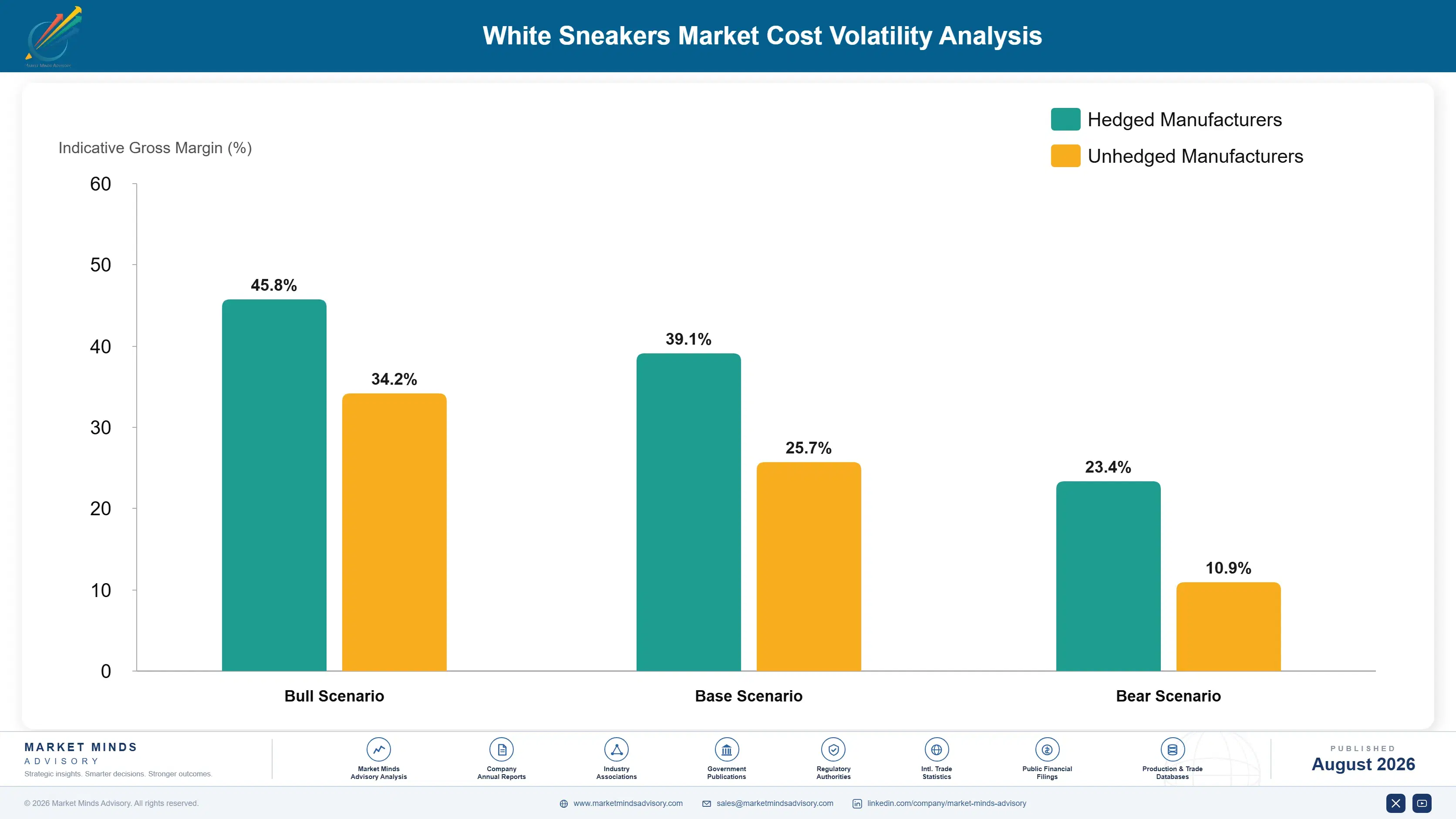
Leather and synthetic upper materials together account for roughly 38 percent of cost of goods sold across most white sneaker manufacturers, with the remainder split across rubber outsoles, labor, and assembly overhead. Full-grain leather sources predominantly from tanneries across Europe and South Asia, while synthetic and vegan leather formulations increasingly source from specialized chemical manufacturers based in East Asia serving the broader footwear industry.
Global leather prices rose considerably during 2024 as reduced cattle herd sizes across several major producing countries tightened hide supply, a volatility event documented in USDA livestock and hide market reports covering the period. Manufacturers dependent on traditional leather sourcing absorbed meaningful margin compression during this window, while competitors already invested in synthetic and vegan alternatives faced comparatively muted cost pressure from the same disruption.

This cost exposure disadvantages smaller manufacturers lacking the scale to negotiate favorable long-term hide supply contracts, forcing many toward spot market purchasing that carries considerably higher price volatility than contracted volume. Larger manufacturers with vertically integrated tannery relationships or diversified synthetic material portfolios sustain more predictable margins across market cycles. Exposure also varies by geography, since manufacturers based near hide-producing regions face lower logistics cost than distant importers.
white-sneakers-market-cost-volatility-analysis-1788168861251

Diversify Toward Synthetic and Vegan Materials

Manufacturers can reduce leather price exposure by expanding synthetic and vegan upper material lines, which draw on chemical manufacturing supply chains largely insulated from cattle herd cycles affecting traditional hide markets. This also aligns with growing consumer demand for cruelty-free formats, creating a dual commercial and risk-management rationale for the shift that benefits margin stability considerably.

Secure Long-Term Tannery Supply Contracts

Locking in multi-year hide supply agreements with established tanneries protects manufacturers from spot market volatility during supply-constrained periods like the one documented during 2024 across major hide-producing countries worldwide. This requires meaningful upfront negotiation investment and capital commitment but delivers considerably more predictable input costs across successive product cycles than relying on open-market purchasing.

Expand Recycled Material Input Share

Incorporating recycled synthetic materials into upper construction reduces dependence on virgin material price cycles while also supporting sustainability positioning increasingly valued by design-conscious consumers across most major markets served worldwide. Manufacturers with established recycling supply relationships gain a cost buffer that competitors dependent entirely on virgin material inputs lack during volatile pricing periods industry-wide.

Portfolio Architecture for Margin Defence

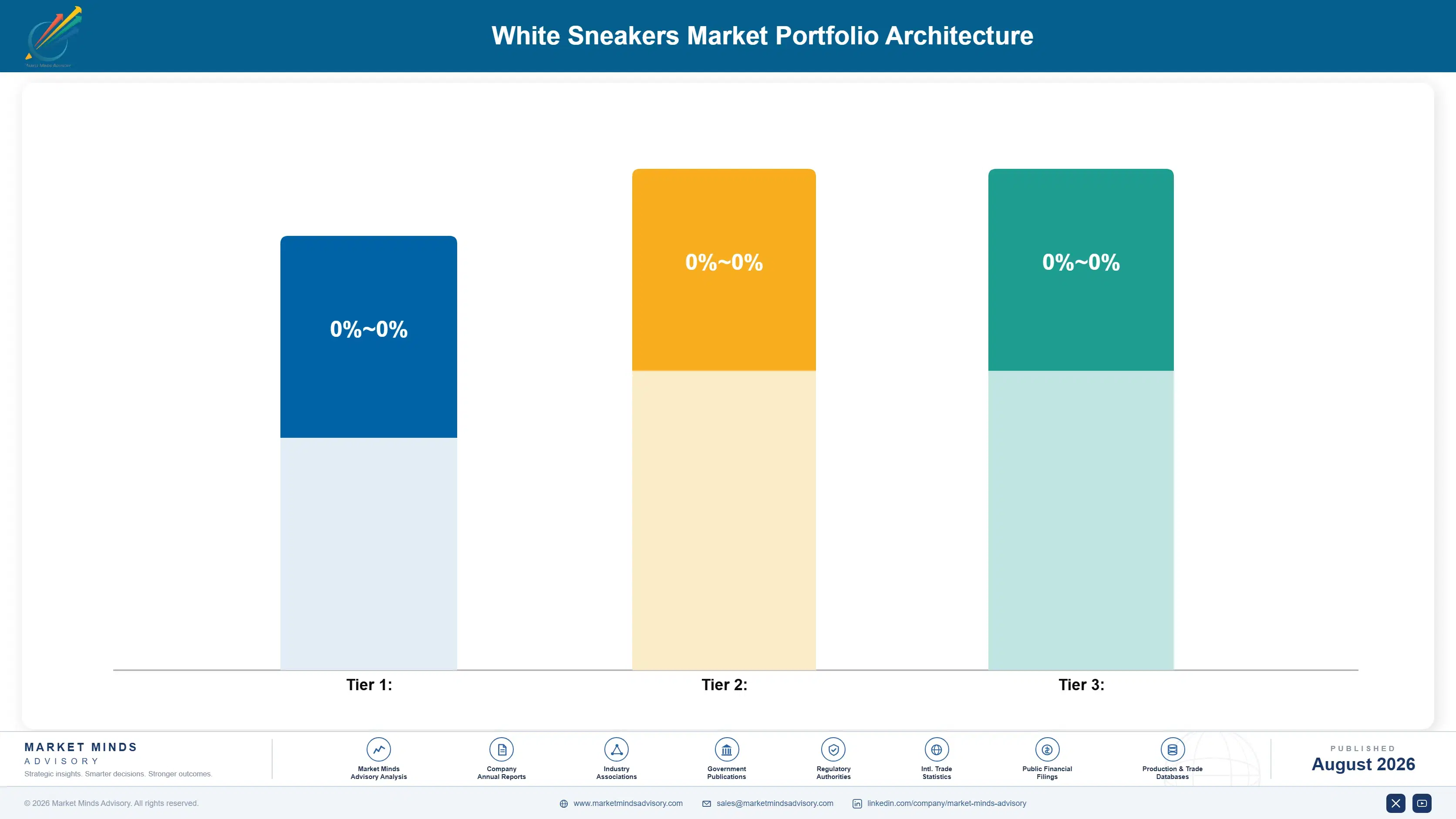
The white sneaker market splits into three distinct margin tiers, and manufacturers rarely compete effectively across all three simultaneously at scale. Volume commodity-adjacent products rely on manufacturing efficiency and distribution scale, while premium certified formats command considerably higher margins through craftsmanship positioning that mass producers cannot easily replicate given development timelines. This tier division forces most manufacturers to choose a primary competitive lane rather than straddling both across every price tier.
The tension between volume and premium positioning shapes nearly every strategic decision manufacturers make, from material sourcing to retail channel selection and marketing investment allocation. Volume players optimize for cost and speed to market, while premium players optimize for craftsmanship and brand narrative, and the two operating models rarely coexist well within a single organization without diluting one positioning or the other considerably over time.

High-value profit pools concentrate disproportionately in the premium minimalist and limited collaboration segments, where scarcity and craftsmanship justify pricing considerably above production cost across most retail channels. Manufacturers that successfully build credible premium positioning capture margin expansion unavailable to volume-focused competitors, though building that credibility requires sustained investment over multiple product cycles rather than a single successful launch or collaboration.

Mass-market white sneakers sold through big-box retail and value e-commerce channels, competing primarily on price and manufacturing scale rather than design distinctiveness or material quality across most consumer segments and geographic markets worldwide.
Gross Margin

Craftsmanship-grade white sneakers sold through specialty retail and direct-to-consumer channels, commanding premium pricing through visible material quality, refined construction technique, and established brand heritage credibility built over multiple successive product development cycles.
Gross Margin

Vegan and recycled-material white sneakers targeting sustainability-conscious consumers, increasingly favored by regulatory tailwinds in several major markets and growing generational preference shifts toward cruelty-free material sourcing and transparent supply chains.
Gross Margin
white-sneakers-market-portfolio-architecture-1788168861762

High-value Sub-segments and Strategic Watch-out

Premium Minimalist White Sneakers

The highest-value, fastest-growing segment, combining strong margin economics with sustained double-digit consumer demand growth driven by craftsmanship positioning, collector culture, and scarcity-driven collaboration releases across most major urban fashion markets, retail channels, and demographic cohorts worldwide this coming year and beyond, supported by manufacturers investing considerably in production capacity.

White Synthetic and Vegan Leather Sneakers

A high-value segment growing steadily as sustainability preferences strengthen among younger consumers across most major markets and retail channels, though margin economics currently trail the premium minimalist tier until material formulation costs decline further with continued manufacturing scale investment, supplier maturity, and broader consumer education efforts.

White Canvas Sneakers

The volume core of the category, sustaining steady but unspectacular growth through mass-market retail channels and value-focused e-commerce platforms, providing predictable revenue that funds premium tier investment across most established manufacturer portfolios and geographic markets worldwide this year and into the following extended forecast period ahead.

White Suede Sneakers

A strategic watch-out segment facing durability and staining perception challenges that could limit long-run adoption unless manufacturers address maintenance concerns that currently constrain broader consumer acceptance across most price-sensitive retail markets, demographics, and geographic regions worldwide through the remainder of the extended forecast period ahead.

Repeat Purchase and Collector Economics

White sneakers behave more like an annuity purchase category than a one-time footwear decision for a considerable share of consumers, since collector culture and multi-pair wardrobe rotation drive repeat purchases well beyond simple replacement need. Manufacturers that cultivate this repeat behavior through collaboration drops and loyalty programs capture considerably more lifetime value per customer than those competing purely on single-transaction pricing.
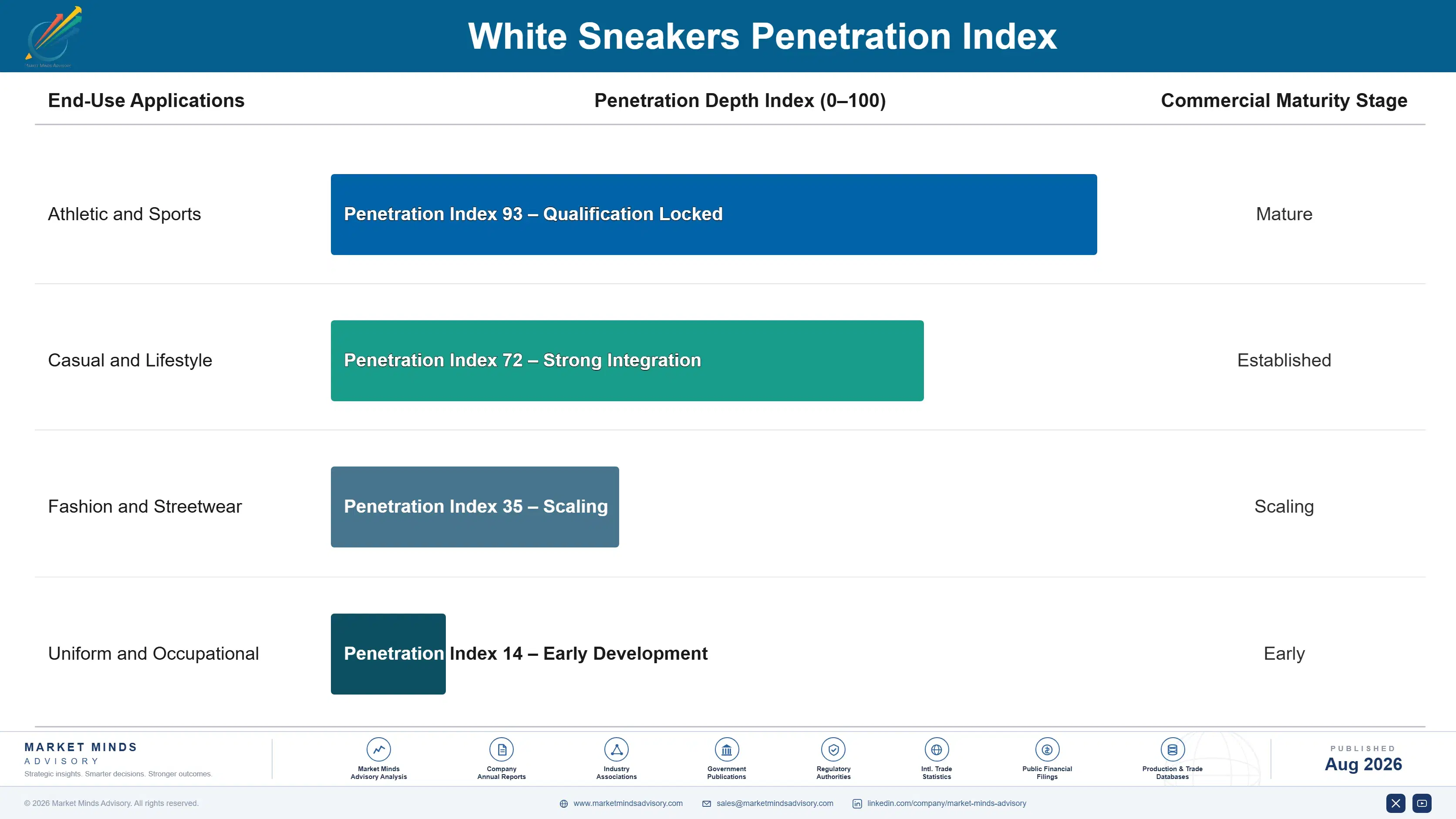
Adoption stickiness varies considerably by end-use vertical: athletic and lifestyle consumers replace white sneakers frequently to maintain a fresh aesthetic, while premium minimalist buyers treat individual pairs as durable wardrobe investments purchased less often but at considerably higher price points. Fashion-forward urban consumers exhibit the deepest engagement, often owning multiple pairs across price tiers simultaneously rather than committing to a single brand exclusively.

Generational shifts are reshaping buyer profiles considerably: younger consumers increasingly discover brands through social media and resale platforms rather than traditional retail channels, while placing greater weight on sustainability credentials and collaboration authenticity than prior generations did. Older consumers still favor established heritage brands, but even this segment increasingly researches craftsmanship credentials online before purchasing, narrowing the information gap between generations.
white-sneakers-market-end-use-penetration-index-1788168862243

Craftsmanship Investment Priorities Ahead

These are among the four positions where our research anticipates prominent divergence between winners and laggards over the coming forecast period. Each is grounded in the demand model, the regulatory perimeter, and the announced capacity pipeline.
01 / MATERIAL SOURCING STRATEGY

Invest in full-grain leather and vegan material supply now

Manufacturers still dependent on spot-market leather purchasing face considerably higher margin volatility than competitors with secured, contracted supply relationships already locked in place across multiple sourcing regions and supplier tiers. The 2024 hide price spike demonstrated how quickly cost pressure can erode profitability for unprotected manufacturers lacking contracted volume commitments with established, reliable tanneries. Locking in long-term tannery contracts and expanding vegan material capacity now positions manufacturers ahead of both cost volatility and shifting consumer sustainability preferences over the coming decade.
02 / PREMIUM CHANNEL DEVELOPMENT

Build direct-to-consumer channels to capture premium margin

Wholesale distribution compresses margins considerably compared to direct sales, and manufacturers that have already shifted meaningful volume toward owned digital and flagship channels report significantly stronger profitability across recent reporting periods and product cycles. This gap will widen further as premium minimalist demand grows faster than mass-market volume across nearly every major market throughout the coming ten-year forecast period. Manufacturers should prioritize digital and flagship retail investment over expanding wholesale partnerships that dilute both margin and brand positioning control over time.
03 / COLLABORATION PORTFOLIO MANAGEMENT

Balance scarcity marketing against genuine brand credibility risk

Collaboration releases generate outsized marketing value relative to production volume but carry real reputational risk when partnerships feel superficial rather than authentic to increasingly discerning global consumers across most demographics. Manufacturers chasing short-term resale hype without genuine creative partnership risk long-term brand dilution that damages premium positioning considerably across every price tier and distribution channel served worldwide. A disciplined collaboration calendar built around credible creative relationships will consistently outperform frequent but shallow partnership announcements over the next several years ahead.
04 / REGIONAL CAPACITY ALLOCATION

Prioritize East Asia and South Asia Pacific capacity expansion

East Asia and South Asia and Pacific both carry regional CAGRs meaningfully above the global average, reflecting genuine manufacturing scale advantages and rising domestic consumption happening simultaneously across most major metropolitan cities and secondary markets. Manufacturers concentrating capacity investment in North America and Western Europe alone risk missing the fastest volume growth available anywhere in the broader global category this decade. Reallocating incremental capital toward these two regions captures both cost efficiency and consumption growth over the next full decade ahead.

Engagement Snapshot From the Field

A live engagement with an industry participant carrying material or product regulatory and market exposure ahead of a defining policy shift, showing how our research translates into a defensible multi-year portfolio strategy.
MARKET MINDS ADVISORY · CLIENT ENGAGEMENT SUMMARY
White Sneakers Producer Strategic Portfolio Review and Transition Roadmap 2026·Investment Scenario on White Sneakers Exposure Evaluation 2025-26
CLIENT PROFILE
A mid-sized footwear brand with established mass-market distribution across North America sought to launch a premium minimalist white sneaker line without diluting its existing value-tier brand identity built over roughly fifteen years of consistent retail positioning across multiple channels, price tiers, and regional markets nationwide, ahead of a planned broader international expansion into East Asia and Western Europe.
STRATEGIC CHALLENGE
The client's existing manufacturing and retail infrastructure was optimized for volume production and mass-market pricing, leaving it without the craftsmanship-grade supply relationships or premium retail presence needed to credibly enter the premium minimalist segment without appearing opportunistic to design-conscious consumers already loyal to established heritage brands with decades of history.
MMA APPROACH
MMA conducted primary interviews with premium footwear buyers and supply chain specialists, benchmarked craftsmanship-grade material sourcing options against the client's existing supplier base, and modeled three distinct brand architecture scenarios for launching a sub-brand without cannibalizing existing mass-market customer relationships or retail partner commitments already established over multiple years of operation.
KEY FINDINGS
  1. Consumers strongly preferred a distinct sub-brand name over the parent brand extending directly into premium territory, citing credibility concerns about mass-market brands (client-reported, unverified by MMA).
  2. Existing supplier relationships could support roughly 60 percent of premium material requirements, with the remainder needing new tannery partnerships (client-reported, unverified by MMA).
  3. Direct-to-consumer channel investment showed considerably stronger projected margin outcomes than wholesale expansion into existing specialty retail partnerships nationwide (client-reported, unverified by MMA).
  4. Limited collaboration releases tested considerably better with target consumers than sustained broad product line expansion into the premium segment (client-reported, unverified by MMA).
CLIENT PROFILE
A mid-sized footwear brand with established mass-market distribution across North America sought to launch a premium minimalist white sneaker line without diluting its existing value-tier brand identity built over roughly fifteen years of consistent retail positioning across multiple channels, price tiers, and regional markets nationwide, ahead of a planned broader international expansion into East Asia and Western Europe.
STRATEGIC CHALLENGE
The client's existing manufacturing and retail infrastructure was optimized for volume production and mass-market pricing, leaving it without the craftsmanship-grade supply relationships or premium retail presence needed to credibly enter the premium minimalist segment without appearing opportunistic to design-conscious consumers already loyal to established heritage brands with decades of history.
MMA APPROACH
MMA conducted primary interviews with premium footwear buyers and supply chain specialists, benchmarked craftsmanship-grade material sourcing options against the client's existing supplier base, and modeled three distinct brand architecture scenarios for launching a sub-brand without cannibalizing existing mass-market customer relationships or retail partner commitments already established over multiple years of operation.
KEY FINDINGS
  1. Consumers strongly preferred a distinct sub-brand name over the parent brand extending directly into premium territory, citing credibility concerns about mass-market brands (client-reported, unverified by MMA).
  2. Existing supplier relationships could support roughly 60 percent of premium material requirements, with the remainder needing new tannery partnerships (client-reported, unverified by MMA).
  3. Direct-to-consumer channel investment showed considerably stronger projected margin outcomes than wholesale expansion into existing specialty retail partnerships nationwide (client-reported, unverified by MMA).
  4. Limited collaboration releases tested considerably better with target consumers than sustained broad product line expansion into the premium segment (client-reported, unverified by MMA).
RECOMMENDED STRATEGY
Phase 1: Phase one: launch a distinct sub-brand identity with dedicated craftsmanship-grade supply relationships kept fully separate from existing mass-market production lines. Phase 2: Phase two: build direct-to-consumer digital and flagship retail presence before pursuing broader wholesale distribution partnerships across additional international regions and markets. Phase 3: Phase three: introduce limited collaboration releases to build cultural credibility ahead of expanding the core premium product range further across channels.
OUTCOME
The client launched its premium sub-brand within eighteen months, achieving considerably stronger initial sell-through than internal projections anticipated and securing specialty retail placement it had not previously accessed across several major metropolitan markets nationwide, with international expansion now under active internal review (client-reported, unverified by MMA).

Frequently Asked Questions

Foundational context covering the market sizes, CAGR, scope, country, region and competition that inform every finding below. This section is provided to cover basics and most often pre-purchase conversations, answered from the MMA Primary Research Dataset.

What is the current size of the White Sneakers Market?

The global white sneakers market reached 18.0 billion dollars in 2025. This figure covers white leather, canvas, knit, suede, synthetic, and premium minimalist formats sold worldwide.

How large will the White Sneakers Market be by 2036?

The market is projected to reach roughly 35.98 billion dollars by 2036. This reflects sustained growth in premium minimalist and vegan material segments across most regions.

What is the CAGR for the White Sneakers Market 2026 to 2036?

The market is projected to grow at a compound annual rate of 6.5 percent through 2036. Growth outpaces general footwear categories on premium and collaboration demand.

Which segment is growing fastest?

Premium Minimalist White Sneakers lead growth at a 9.0 percent CAGR, roughly 1.38 times the overall market rate. Craftsmanship positioning and collector demand drive this outperformance.

Who are the major companies in the White Sneakers Market?

Nike, Adidas, Common Projects, Converse, and Golden Goose lead the category on a revenue-consistent basis. Together these five manufacturers hold roughly 45 percent of global market revenue.

Which country is growing fastest?

China leads country-level growth at an 8.5 percent CAGR, driven by expanding domestic manufacturing capacity and rising consumer sneaker culture. Livestreaming commerce accelerates purchase conversion considerably.

Report Segmentation Architecture

The full report scope spans multiple orthogonal segmentation dimensions, with cross-tabulated demand data provided for each dimension pair. Coverage extends further to regional breakdowns, trend trajectories, and the competitive detail needed to support segment-level decision-making.
  • White Leather
  • White Canvas
  • White Knit and Mesh
  • White Suede
  • White Synthetic and Vegan Leather
  • Premium Minimalist White Sneakers
  • Athletic and Sports
  • Casual and Lifestyle
  • Fashion and Streetwear
  • Uniform and Occupational
  • Specialty Retail
  • Department Stores and Big-Box Retail
  • Direct-to-Consumer E-Commerce
  • Resale and Secondary Market Platforms

By Region

  • North America
  • Western Europe
  • East Asia
  • South Asia and Pacific
  • Latin America
  • Middle East and Africa
  • Eastern Europe

Scope, Methodology, and Coverage

Every figure in this report is reproducible from documented input assumptions. The scope below maps the historical period, the forecast horizon, the segmentation dimensions, and the countries covered, alongside the underlying primary and qualitative methodology.
Historical Period
2020 to 2025
Forecast Period
2026 to 2036
Base Year
2025 (USD billions; MMA Primary Research Dataset, August 2026)
Market Definition
This report covers revenue from white leather, white canvas, white knit and mesh, white suede, white synthetic and vegan leather, and premium minimalist white sneakers sold through retail, e-commerce, and specialty footwear channels worldwide. It excludes non-white colorways, orthopedic footwear, and industrial safety footwear.
Quantitative Units
USD billions, unit shipments where disclosed
Segmentation Dimensions
Upper material composition, end-use industry, commercial distribution channel, region
Regions Covered
North America, Western Europe, East Asia, South Asia and Pacific, Latin America, Middle East and Africa, Eastern Europe
Countries Covered
United States, China, Germany, United Kingdom, Japan, Brazil, and 40+ additional markets
Key Companies Profiled
Nike, Adidas, Common Projects, Converse, Golden Goose, and 15 additional manufacturers
Quantitative Methodology
Primary survey, n=3,800 respondents, Q4 2025, six countries; demand-side model with trade association cross-validation
Qualitative Methodology
47 expert interviews, Q4 2025; applied to validate demand model assumptions, identify emerging dynamics, and assess competitive positioning
Report Format
PDF and XLSX data workbook (Word format preview document)
Publisher
Market Minds Advisory
Report Code
MMA-2026-CHM-140
Published
August 2026
Contact
sales@marketmindsadvisory.com | www.marketmindsadvisory.com

Purchase the full White Sneakers Market Report (2026 to 2036).

This report delivers a complete assessment of the global white sneakers market, covering sizing, segmentation, regional dynamics, and competitive positioning through 2036. It draws on primary survey data across six countries and expert interviews with industry specialists to quantify demand across every major upper material format tracked. Analysts examine premium minimalist design, vegan material adoption, and collaboration-driven collector demand as distinct growth vectors shaping manufacturer strategy. The report equips manufacturers, investors, and retailers with the data needed to prioritize capacity and channel investment decisions with confidence.
Ten-year revenue and unit volume forecasts
Seven-region detailed market share and CAGR breakdown
Competitive benchmarking of top 20 manufacturers
Material cost exposure and mitigation strategy analysis
Segment-level growth rate and margin projections
Portfolio margin tier and pricing framework

Built For The People Who Decide

From boardroom strategy to bench-side execution, this report is read cover-to-cover by leaders shaping the next decade of their industry, turning demand scenarios, market dynamics and valuation benchmarks into decisions.
CXOs/ Presidents/ VPs/ Managers
M&A and Corporate Development
Strategy Teams and R&D Heads
Procurement and Product Directors
Regulatory and Compliance Leaders
Investor Relations and Equity Analysts