Market Minds Advisory
White Inorganic Pigment Market

White Inorganic Pigment Market: Titanium Dioxide Capacity Discipline Reshapes Global Coatings Supply

Coatings and plastics formulators are absorbing repeated titanium dioxide capacity swings as Chinese chloride-process expansion collides with Western producer discipline, forcing buyers toward longer supply contracts rather than spot purchasing alone.

Lead Analyst

Published

September 2026

Make Smarter Decisions with Customized Research Insights

Request a free sample report and evaluate market opportunities, growth trends, and competitive dynamics relevant to your business needs.

2025 MARKET VALUE$9.8BMarket Size 2025
2036 FORECAST VALUE$15.4BBase Case , 2026 to 2036
CAGR 2026 TO 20364.2 %Bull 5.5% / Bear 2.9%
INCREMENTAL OPPORTUNITY$5.2BNet 10- year value creation
EXPANSION MULTIPLE1.51x2036 value over 2026 base
Strategic Levers
M&A Pipeline
Regional Outlook
Country Rankings
Competitive Intelligence
Segmental Deep-dive
Call-Us : 91 93563 13602

Executive Snapshot and Market Trajectory

Coatings, plastics, and paper formulators are navigating a titanium dioxide market defined by repeated capacity swings, as Chinese chloride-process expansion pressures pricing even while Western producers hold discipline on new capital investment across most major producing regions worldwide this cycle, testing formulator patience. Buyers are responding accordingly.
Barium sulfate and zinc oxide pigment grades are growing faster than titanium dioxide itself, pulled by automotive coatings lightweighting and specialty plastics filler demand, even as titanium dioxide remains overwhelmingly dominant by volume. China accounts for a growing share of global titanium dioxide capacity, reflecting a decade of chloride-process plant construction that has steadily narrowed the cost gap with established Western producers this cycle.
Competition remains concentrated among five global producers who together anchor pricing across most regions, though Chinese entrants are increasingly challenging that anchor on cost. Environmental compliance costs tied to chloride waste handling and rising feedstock ore scarcity are the two forces most likely to reshape which producers retain pricing power over the next several years, particularly as ore-grade quality continues declining across legacy mining regions worldwide, squeezing non-integrated producers hardest of all this cycle.
Market Definition
This report covers white inorganic pigments used to impart opacity, brightness, and hiding power in coatings, plastics, paper, and specialty applications, including titanium dioxide, zinc oxide pigment grade, antimony trioxide, barium sulfate, and lithopone. It excludes organic white pigments, optical brighteners, and functional fillers sold primarily for reinforcement rather than opacity.
Base Year Value
$9.8B in 2025 (MMA Primary Research Dataset, August 2026)
Forecast Period
2026 to 2036, eleven discrete annual values
CAGR
4.2% base case. Bull 5.5%. Bear 2.9%.
Fastest Growth Segment
Barium Sulfate (Blanc Fixe): 6.8% CAGR
Fastest Growth Country
China: 5.8% CAGR
Fastest Growth Region
South Asia and Pacific: 6.2% CAGR
Largest Region
East Asia: 30% of 2025 global value
Market Leaders
The Chemours Company, Tronox Holdings plc, Venator Materials PLC, Kronos Worldwide Inc, LB Group Co Ltd. Source: MMA Analysis based on company annual reports.
Primary Survey
n=3,800 procurement and R&D decision-makers, Q4 2025, six countries
Methodology
Demand-side build-up, cross-validated against public data, 47 expert interviews

White Inorganic Pigment Market Forecast Scenarios

white-inorganic-pigment-market-trends-size-forecast-scenario-1787664628338
White inorganic pigment demand grew at an estimated 3.7 percent historical CAGR between 2020 and 2025, as coatings and plastics production recovered unevenly from pandemic disruption while Chinese titanium dioxide capacity additions steadily pressured global pricing throughout the back half of this historical window across most producing regions. Recovery pace differed considerably across regions given uneven construction sector rebound timing.
MMA's base case assumes 4.2 percent compound annual growth through 2036, anchored to three commercial mechanisms: continued global coatings and plastics production growth tracking broader industrial output, gradual titanium dioxide capacity rationalization among Western producers improving pricing discipline, and rising barium sulfate demand from automotive lightweighting programs. Zinc oxide pigment grade demand adds incremental volume growth tied to specialty coatings and ceramic glaze applications across several developing markets. These mechanisms together anchor a steady, if unspectacular, growth trajectory through the forecast horizon.
A bull scenario of 5.5 percent growth assumes faster global coatings production recovery alongside accelerated Western producer capacity discipline supporting pricing. A bear scenario of 2.9 percent reflects continued Chinese chloride-process overcapacity depressing global pricing further, compressing margins across Western producers still carrying higher legacy cost structures. Producers should monitor both scenarios when planning capacity investment decisions.

Chloride Process Economics Redraw the Global Cost Curve

White inorganic pigment demand tracks broader industrial coatings and plastics production closely, but the category's economics are dominated by titanium dioxide's chloride process cost structure, where feedstock ore quality and chlorine handling infrastructure determine competitiveness more than any other single factor. Producers without access to high-grade ilmenite or rutile ore increasingly struggle to match Chinese cost positions built on cheaper, lower-grade domestic ore processed at scale. This shift in sourcing capability is redrawing which producers sustain margin.
MARKET CONCENTRATION (CR5)58%Top five producers hold well over half globally
AVERAGE SELLING PRICE$2.65/kg TiO2 blendedBlended price swings considerably across pricing cycles historically
TOP PRODUCING COUNTRY SHAREChina, leading capacityChina now hosts the largest titanium dioxide capacity
CAPACITY UTILISATION81% averageUtilisation tracks closely with coatings demand cycles globally
FEEDSTOCK SHARE OF COGS50-60% rangeTitanium ore feedstock dominates variable cost structure for most producers
TRADE INTENSITYHigh, globally tradedTitanium dioxide ships globally as a bulk commodity
Commercial character has shifted meaningfully over the past cycle. Coatings formulators once treated titanium dioxide as a fungible commodity input, but repeated price volatility has pushed larger buyers toward index-linked long-term contracts that smooth exposure, while smaller formulators remain exposed to spot market swings that can move landed cost considerably within a single quarter. Suppliers who anticipated this shift early are now capturing disproportionate share of long-term contract volume.
Over the next decade, expect continued Chinese capacity growth to keep pressuring global pricing, alongside modest Western producer consolidation as smaller sulfate-process plants struggle to compete against larger, lower-cost chloride process facilities on both cost and environmental compliance grounds. This consolidation will likely accelerate as compliance costs rise across most jurisdictions.
"Every coatings formulator who locked in a three-year titanium dioxide contract during the last price spike is now sitting comfortably while their spot-market competitors scramble, and that gap in foresight is exactly what determines who survives the next cycle."
Director, Specialty Chemicals and Pigments Practice · MMA Chemicals and Materials Practice · August 2026

Market Trends

Chinese Chloride Process Capacity Additions Reshape Cost Curve

Chinese producers have added substantial chloride process titanium dioxide capacity over the past several years, moving beyond legacy sulfate process technology to compete directly with Western chloride process incumbents on both cost and product quality. This capacity growth has narrowed the historical quality gap between Chinese and Western producers considerably, allowing Chinese exporters to win specification approval from coatings formulators in markets previously reserved for established Western suppliers. Western producers are responding by emphasizing supply reliability and technical service rather than competing purely on price against lower-cost Chinese capacity entering export markets at scale.
Market Impact: Adds 4% base coatings volume demand
Automotive Lightweighting Lifts Barium Sulfate Filler Demand

Automotive manufacturers pursuing vehicle lightweighting are increasingly specifying barium sulfate as a functional filler and pigment in coatings and plastic components, valued for its high density and opacity relative to lighter-weight alternatives that would otherwise compromise sound dampening performance. This demand is growing faster than the broader white pigment category, concentrated particularly among European and Japanese automotive coatings suppliers pursuing premium finish specifications. Suppliers with high-purity precipitated barium sulfate capability are capturing disproportionate share of this faster-growing specialty application relative to legacy natural barite-derived grades. Suppliers unable to demonstrate this capability risk losing specification to better-positioned rivals.
Market Impact: Adds 5% pricing recovery margin uplift

Market Opportunities and Growth Drivers

Global Coatings Production Growth Sustains Base Volume Demand

Architectural, industrial, and automotive coatings production continues expanding steadily across most regions, tracking broader construction and manufacturing activity, and titanium dioxide remains the primary opacity and hiding power ingredient across nearly all coatings formulations regardless of end application. Emerging market construction activity, particularly across South Asia and Southeast Asia, is adding incremental coatings production capacity that directly drives titanium dioxide consumption growth. This base volume demand provides a steady floor for the category even as pricing cycles create considerable revenue volatility for individual producers navigating capacity utilization swings. Producers well positioned across multiple regions capture this base demand most consistently.
Market Impact: Adds 8% ore beneficiation processing cost

Western Producer Capacity Discipline Supports Pricing Recovery

Established Western titanium dioxide producers have largely avoided major new greenfield capacity investment over the past several years, favoring debottlenecking and efficiency improvements at existing facilities over expensive new chloride process plant construction. This discipline is supporting gradual pricing recovery following prior periods of oversupply-driven margin compression, particularly as demand growth outpaces the modest capacity growth Western producers have pursued. Producers maintaining this discipline are better positioned to sustain margin improvement than competitors who resume aggressive capacity expansion prematurely. This discipline stands in sharp contrast to the aggressive Chinese capacity build-out occurring simultaneously across export markets.
Market Impact: Delays capacity expansion by 12 months

Market Restraints and Challenges

Titanium Ore Feedstock Quality Decline Raises Processing Cost

High-grade ilmenite and rutile ore reserves are gradually depleting at several legacy mining regions, forcing producers toward lower-grade ore requiring additional beneficiation processing before it meets chloride process feedstock specifications. This friction stems from decades of extracting the highest-grade deposits first, leaving increasingly marginal ore bodies for current production. The commercial impact raises processing cost and capital intensity for producers dependent on these declining ore sources. Producers are mitigating this by qualifying alternative ore sources across multiple countries and investing in beneficiation technology that upgrades lower-grade ore economically. Smaller producers lacking beneficiation capability face the steepest cost increases.
Market Impact: Adds 7% Chinese export capacity share

Chloride Waste Handling Rules Tighten Across Major Markets

Environmental regulators across the European Union and United States have tightened chloride waste handling and disposal requirements for titanium dioxide production, and the root cause is growing regulatory concern over chlorinated waste stream environmental impact near production facilities. This is raising compliance capital expenditure requirements for producers operating older facilities not originally designed for current waste handling standards. Registration and permitting delays of twelve months or more are increasingly common for capacity expansion projects. Producers are mitigating this by investing in closed-loop waste treatment systems that reduce ongoing compliance cost despite higher upfront capital requirements.
Market Impact: Adds 9% automotive filler pigment demand
3 additional market trends, 4 additional growth drivers, and 3 additional restraints and challenges are covered in the full report. Contact sales@marketmindsadvisory.com to access the complete intelligence.

Segment CAGR and Growth Architecture

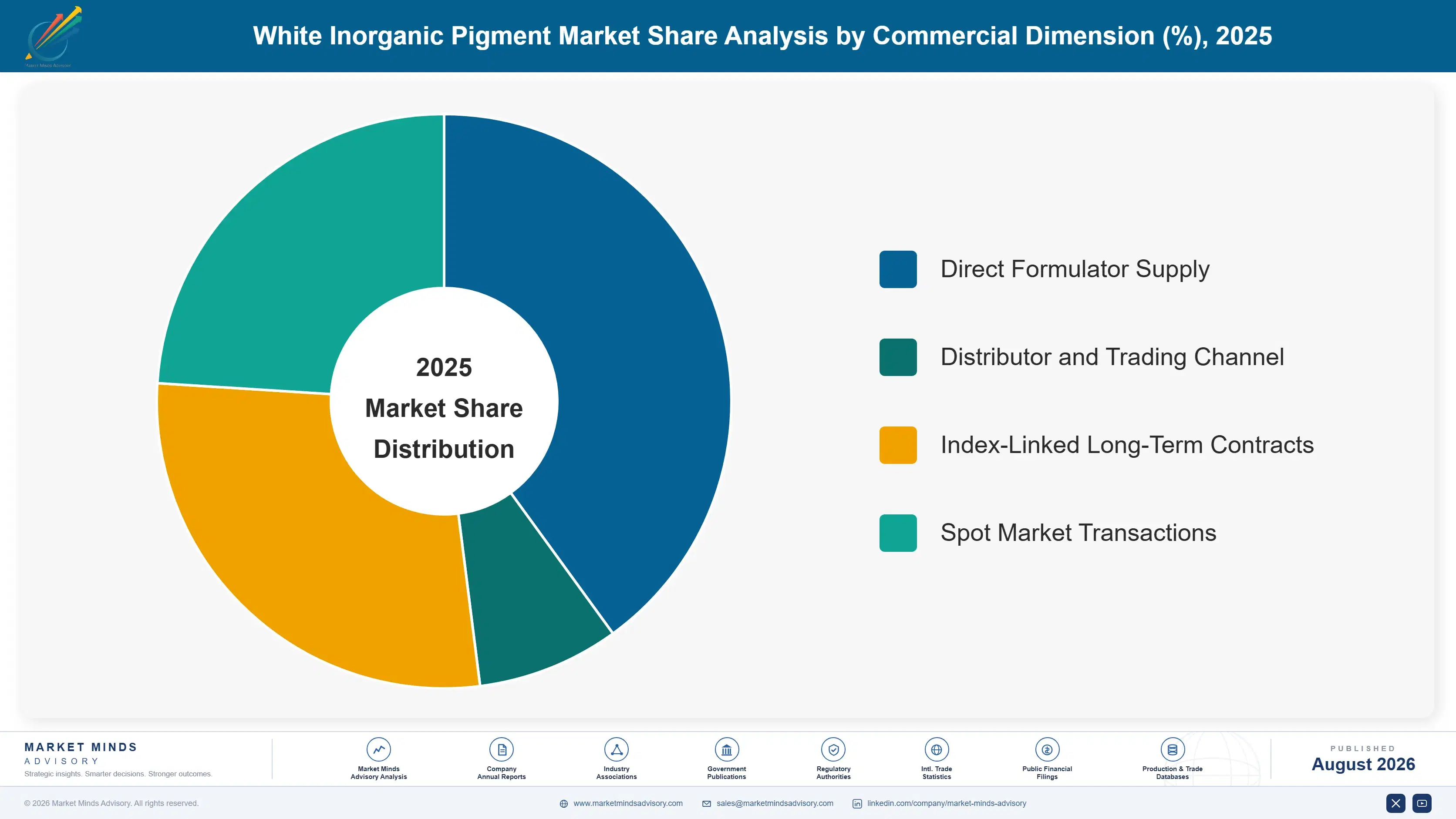
White inorganic pigments segment most usefully by chemistry, since titanium dioxide, zinc oxide, and barium sulfate each serve distinct performance roles despite sharing the common function of imparting opacity. This report segments the market into six chemistry-based categories reflecting distinct production processes and end-use performance requirements across applications. This structure reflects distinct customer bases across each chemistry.
white-inorganic-pigment-market-trends-market-share-analysis-1787664628916

Barium Sulfate (Blanc Fixe)

Barium sulfate, precipitated synthetically as blanc fixe or processed from natural barite ore, is the fastest-growing white pigment category as automotive and specialty coatings formulators increasingly specify it for its high density, chemical inertness, and sound-dampening properties. Unlike titanium dioxide, barium sulfate is valued more for functional filler performance than pure opacity, making it complementary to titanium dioxide in most formulations rather than a direct substitute. High-purity precipitated grades command meaningful price premiums over natural barite-derived material, favoring producers with dedicated precipitation capacity. Growth is concentrated in Europe and Japan, where automotive coatings suppliers are specifying barium sulfate most aggressively across premium finish product lines this cycle. Producers investing early here are locking in multi-year supply relationships.
CAGR 6.8%

Zinc Oxide Pigment Grade

Zinc oxide pigment grade, distinct from the industrial and rubber-grade zinc oxide tracked in dedicated zinc oxide reports, serves specialty coatings, ceramic glaze, and ultraviolet protection applications where its unique optical and antimicrobial properties outperform titanium dioxide despite considerably lower opacity per unit weight. Demand is growing steadily as specialty coatings formulators seek multifunctional pigments that combine opacity with additional performance benefits beyond hiding power alone. Ceramic glaze applications provide a stable secondary demand base, particularly across South Asian ceramics manufacturing clusters. Suppliers offering both pigment and specialty industrial grades from shared production infrastructure achieve meaningful cost advantages over single-grade competitors serving only the pigment application. This dual-market flexibility supports steadier utilization than single-application competitors achieve.
CAGR 4.5%
Full segment breakdown across 6 segments available in the complete report.

Regional Architecture and Country Demand Map

East Asia leads white inorganic pigment demand, anchored by China's dominant titanium dioxide production capacity, while North America and Western Europe retain considerable legacy chloride process capacity serving premium coatings and specialty applications across mature industrial markets. Latin America and the Middle East contribute smaller but meaningful construction-linked demand pools.

North America

Legacy chloride process capacity anchors North America's white pigment industry, with the United States hosting several of the world's largest titanium dioxide production complexes built on decades of accumulated process expertise and access to domestic and imported high-grade ore. Coatings demand remains steady across architectural, automotive, and industrial applications, supporting consistent capacity utilization even as pricing cycles fluctuate considerably. Canada contributes limited direct production but hosts meaningful ilmenite mining capacity feeding regional and export ore supply chains. Mexico's growing automotive and industrial coatings sector adds incremental demand tied to manufacturing nearshoring investment across the broader North American region. Ongoing capacity discipline across the region continues supporting healthier margin trajectories than seen in prior cycles.
Share: 26% | CAGR: 4.0% (2026 to 2036)

Western Europe

Western Europe's white pigment industry combines mature chloride process production with some of the world's strictest environmental compliance requirements governing chloride waste handling and disposal. Germany, France, and the United Kingdom host established production facilities alongside large downstream coatings and plastics manufacturing bases that consume most regional output domestically. Automotive coatings demand for barium sulfate is particularly strong across Germany's premium vehicle manufacturing cluster, supporting disproportionately specialty-weighted regional demand relative to overall pigment volume. Italy and Spain contribute meaningful coatings-driven demand tied to construction and industrial manufacturing activity across southern Europe. Environmental compliance investment across the region continues raising the barrier to entry for smaller competitors lacking sufficient capital scale.
Share: 21% | CAGR: 2.8% (2026 to 2036)
Regional intelligence for 5 additional markets available in the complete report: East Asia, South Asia and Pacific, Latin America, Middle East and Africa, Eastern Europe. Contact sales@marketmindsadvisory.com.
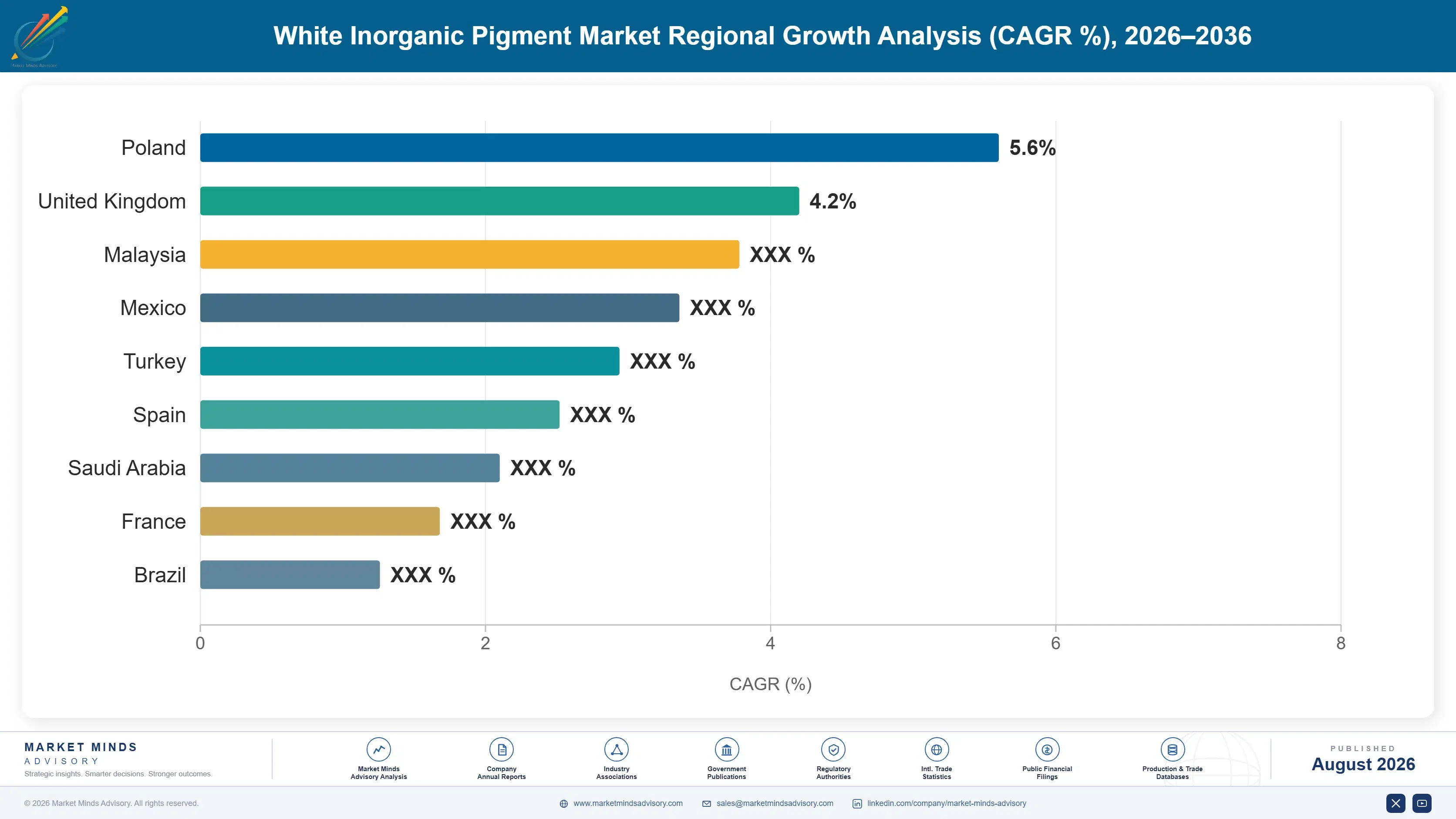
white-inorganic-pigment-market-trends-country-cagr-analysis-1787664629454

Capturing Margin Through Pricing Cycle Discipline

Revenue growth in white inorganic pigments depends heavily on navigating cyclical pricing swings rather than pure volume expansion, since underlying coatings demand grows steadily but titanium dioxide pricing itself moves considerably across capacity cycles. The levers below identify where producers capture disproportionate margin relative to underlying volume growth. particularly across cyclical downturns. across most producers.

Locking Index-Linked Long-Term Coatings Supply Contracts

Producers who secure multi-year supply contracts with large coatings formulators, priced against a published feedstock ore index rather than pure spot market rates, smooth revenue volatility considerably relative to producers reliant on quarterly spot sales that can swing 15 to 25 percent within a single pricing cycle. These contracts typically run three to five years and reduce customer switching during periods of tight supply, since buyers value the pricing predictability nearly as much as the underlying material itself. Producers pursuing this approach must accept some upside limitation during price spikes in exchange for downside protection during oversupply periods.
Market Impact: Reduces revenue volatility by 15 points during downturns

Expanding Precipitated Barium Sulfate Capacity Further

Producers investing in dedicated precipitated barium sulfate capacity are capturing premium pricing from automotive coatings formulators willing to pay 30 to 45 percent more per unit than natural barite-derived material for consistent particle size and purity. This capacity requires meaningful capital investment but generates considerably higher margin than commodity titanium dioxide production, since specification barriers protect early movers from immediate price competition. Producers who qualify with premium automotive coatings customers first typically retain those relationships for the multi-year life of specific vehicle platform programs. This premium positioning is proving durable across multiple vehicle platform cycles.
Market Impact: Commands 30 to 45 percent price premium over commodity grades

Securing Diversified High-Grade Ore Supply Chains

Producers who qualify 3 or more high-grade ilmenite and rutile ore sources across countries reduce exposure to any single mining region's depletion or export restriction, a meaningful advantage as ore quality continues declining at several legacy mining regions globally. This diversification requires additional qualification investment but supports more stable production cost than producers dependent on a single ore source facing quality decline. Producers with diversified ore supply typically sustain two to four points higher gross margin than single-source competitors during periods of ore quality volatility across multiple production campaigns. This favors producers with balance sheet strength to qualify sources simultaneously.
Market Impact: Sustains 2 to 4 points higher margin consistently

Offering Technical Service Bundled With Pigment Supply

Producers who bundle technical formulation support with pigment supply, helping coatings customers optimize dispersion and loading rates, are winning larger volume commitments than pure commodity suppliers, typically increasing account revenue by 10 to 18 percent through improved customer retention. This service layer also raises switching costs meaningfully, since customers who have optimized formulations around a specific producer's particle size distribution face real reformulation cost when switching suppliers. This approach favors larger producers with dedicated technical service teams over smaller commodity-focused competitors. This service layer is becoming a standard expectation among the largest coatings customers.
Market Impact: Lifts account revenue by 10 to 18 percent

Who Controls the Margin Pool

White inorganic pigments remain a highly concentrated industry, with the five largest producers holding an estimated 58 percent combined share on a revenue basis. Chemours and Tronox lead with the largest global chloride process capacity and broadest customer relationships, while the gap to challengers like Venator and Kronos remains meaningful given the capital intensity required to match their production scale. This gap is closing slowly.
Current competitive activity centers on three dimensions: qualifying diversified high-grade ore supply to protect against feedstock quality decline, expanding precipitated barium sulfate capacity to capture automotive coatings premium pricing, and negotiating longer index-linked supply contracts that reduce revenue volatility across pricing cycles. Producers lacking scale in any of these areas increasingly struggle against both larger incumbents and rising Chinese capacity. Producers investing consistently across these areas are outperforming peers on margin.

Emerging pressure comes from Chinese chloride process producers like LB Group, who have narrowed the technology gap with Western incumbents considerably faster than most competitors anticipated. Rankings are most likely to shift in commodity titanium dioxide supply to price-sensitive emerging market coatings formulators, where Chinese cost advantages are most pronounced, while premium automotive and specialty applications remain more insulated from this pressure for now.
white-inorganic-pigment-market-trends-company-positioning-matrix-1787664629989

Competitive Moat and Risk Dimensions

THE CHEMOURS COMPANY

Moat: Proprietary Chloride Process Technology

Chemours holds decades of proprietary chloride process technology refinement that delivers meaningfully higher yield and lower energy consumption per unit output than newer entrants still optimizing their own process technology. This accumulated technical advantage is difficult for competitors to replicate quickly, since chloride process optimization depends on years of operational learning across multiple production campaigns.
THE CHEMOURS COMPANY

Risk: High Fixed Cost Base Exposure

Chemours carries substantial fixed costs tied to large, capital-intensive chloride process facilities that must run near full utilization to remain cost competitive against smaller, more flexible producers. During demand downturns, this fixed cost structure compresses margin more severely than it does for producers with more modular or flexible production capacity able to scale output down without proportional cost increases.
TRONOX HOLDINGS PLC

Moat: Vertically Integrated Ore Supply

Tronox owns meaningful mineral sands mining capacity supplying its own titanium dioxide production, giving it feedstock cost stability that pure pigment producers reliant entirely on third-party ore purchases cannot match. This vertical integration provides a durable cost advantage particularly valuable during periods of ore price volatility affecting non-integrated competitors.
TRONOX HOLDINGS PLC

Risk: Ore Grade Decline

Tronox's own mineral sands mining operations face the same ore grade decline affecting the broader industry, requiring ongoing capital investment in new mine development or beneficiation technology to sustain feedstock quality. Failing to invest adequately here would gradually erode the vertical integration advantage that currently differentiates Tronox from non-integrated competitors.

Players Tracked

Prominent Players

The Chemours Company
Tronox Holdings plc
Venator Materials PLC
Kronos Worldwide Inc
LB Group Co Ltd

Other Key Players

Grupa Azoty Zaklady Chemiczne Police S.A.
CINKARNA Celje d.d.
CNNC Huayuan Titanium Dioxide Co Ltd
Pangang Group Vanadium Titanium and Resources Co Ltd
Guangxi Jinmao Titanium Industry Co Ltd
Yunnan Xinli Nonferrous Metals Co Ltd
Ishihara Sangyo Kaisha Ltd
Titan Kogyo Ltd
Nirma Limited
Travancore Titanium Products Ltd
American Elements
Sachtleben Pigments GmbH
Huntsman International LLC
Shandong Dawn Polymer Co Ltd
Yibin Tianyuan Group Co Ltd

Recent Developments

MARCH 2026

Chemours Commissions Ore Beneficiation Upgrade

Chemours commissioned an ore beneficiation technology upgrade at an existing North American facility, enabling processing of lower-grade ilmenite feedstock while maintaining chloride process product quality specifications, reducing dependence on increasingly scarce high-grade rutile ore sources. Management indicated additional beneficiation investments are planned across other regional facilities.
Signal: Signals continued investment in feedstock flexibility as ore grade quality declines industry-wide. across the wider North American production base
NOVEMBER 2025

Tronox Expands Precipitated Barium Sulfate Capacity

Tronox announced expanded precipitated barium sulfate production capacity to meet rising automotive coatings demand across Europe and Japan, adding capability to serve premium finish specifications that command meaningfully higher margin than commodity titanium dioxide production. The expansion follows several years of steady automotive coatings demand growth across served markets.
Signal: Signals continued diversification toward higher-margin specialty pigment categories among Western producers. as specialty grades increasingly outpace commodity segment growth
JULY 2025

LB Group Announces New Chloride Process Production Line

LB Group announced construction of an additional chloride process production line at an existing Chinese facility, further narrowing the technology gap with established Western chloride process producers and expanding export-oriented capacity aimed at international coatings markets. The new line is expected to reach full commercial output within roughly eighteen months.
Signal: Signals continued Chinese chloride process capacity growth pressuring global titanium dioxide pricing. as Chinese producers close remaining technology gaps steadily

Titanium Ore Feedstock Exposure and Volatility

Titanium ore, primarily ilmenite and rutile, accounts for an estimated 50 to 60 percent of cost of goods sold across titanium dioxide production, sourced from mineral sands mining operations concentrated in Australia, South Africa, China, and several smaller producing regions. Barium sulfate and zinc oxide production carry different feedstock exposure, tied respectively to barite ore mining and zinc metal processing byproduct availability.
Titanium ore pricing spiked considerably during 2021 and 2022, according to company annual reports citing constrained high-grade rutile supply, forcing several mid-sized producers to increase beneficiation processing of lower-grade ilmenite to maintain production volume. The disruption illustrated how concentrated high-grade titanium ore supply remains, with a handful of mining regions supplying the overwhelming majority of global rutile-grade feedstock that chloride process facilities require. Some producers still cite this episode when justifying continued feedstock diversification investment today.

Smaller and non-integrated producers carry disproportionately higher feedstock cost exposure than vertically integrated majors like Tronox, who benefit from owned mining assets that smooth input cost volatility considerably. This competitive disadvantage becomes particularly acute during ore price spikes, when non-integrated producers must either absorb margin compression or pass costs through to coatings customers who resist mid-contract price increases.
white-inorganic-pigment-market-trends-cost-volatility-analysis-1787664630195

Diversifying Ore Sourcing Across Mining Regions

Leading producers are qualifying multiple ore sources across Australia, South Africa, and China rather than relying on a single mining region, reducing exposure to any one country's export restriction or mine depletion. This diversification requires additional qualification testing and inventory investment but meaningfully reduces allocation-driven supply disruption risk during periods of tight global ore capacity.

Investing in Lower-Grade Ore Beneficiation Technology

Producers are increasingly investing in beneficiation technology that upgrades lower-grade ilmenite ore to chloride process specifications, reducing dependence on increasingly scarce high-grade rutile feedstock. This approach requires meaningful upfront capital investment but extends the usable ore resource base considerably, supporting more stable long-term feedstock availability. This resource base extension is proving increasingly valuable industry-wide.

Pursuing Vertical Integration Into Mining Assets

Larger producers are pursuing direct ownership stakes in mineral sands mining operations to secure feedstock supply and reduce exposure to third-party ore pricing volatility entirely. This approach requires substantial capital commitment and mining sector expertise that smaller producers generally lack, reinforcing the scale advantage held by already-integrated competitors. Smaller producers generally lack the capital required to pursue this path.

Portfolio Architecture for Margin Defence

White inorganic pigment portfolios span three distinct tiers, from commodity-adjacent standard-grade titanium dioxide sold largely on price, through premium and certified specialty grades including high-purity precipitated barium sulfate that command meaningful price premiums, to next-generation formulations designed for the strictest automotive and specialty coatings performance requirements. Gross margins vary considerably across these tiers, reflecting differences in production complexity, feedstock quality requirements, and technical service intensity.
The volume versus premium tension is stark: standard-grade titanium dioxide accounts for the overwhelming majority of category volume but a comparatively modest share of industry gross profit relative to its volume weight, while premium barium sulfate and specialty zinc oxide grades represent a smaller volume share but disproportionate profitability. Producers face continuous pressure to expand specialty capacity without abandoning the commodity titanium dioxide volume base that funds much of their manufacturing scale.

High-value margin pools concentrate most heavily in precipitated barium sulfate serving automotive coatings and specialty zinc oxide serving ultraviolet protection and ceramic applications, categories where technical qualification barriers protect established suppliers from pure price competition across most premium market segments. Suppliers investing early in these categories are best placed to capture disproportionate share of industry profit growth over the coming decade.

Volume / Commodity-Adjacent Tier

Standard-grade rutile and anatase titanium dioxide sold primarily to architectural coatings and general plastics formulators, competing mainly on delivered cost and reliable global supply availability. Margins remain thin given intense price competition among numerous global producers.
Gross Margin: 12-18%

Premium / Certified Tier

High-purity precipitated barium sulfate and specialty zinc oxide grades meeting stringent automotive and ceramic performance certification requirements, commanding meaningful price premiums for verified quality. These grades require ongoing technical qualification to maintain customer relationships.
Gross Margin: 22-30%

Sustainability / Regulatory / Next-Generation Tier

Low-chloride-waste production grades and next-generation ultrafine pigment formulations designed for the strictest emerging environmental frameworks and highest-value specialty applications. Adoption is accelerating as environmental compliance deadlines approach across major producing markets and customer bases.
Gross Margin: 28-36%
white-inorganic-pigment-market-trends-portfolio-architecture-1787664630764

High-value Sub-segments and Strategic Watch-out

Precipitated Barium Sulfate Automotive Grade

Precipitated barium sulfate serving automotive coatings combines high per-unit pricing with rapid volume growth, driven by lightweighting programs across Europe and Japan. Producers with dedicated precipitation capacity are capturing outsized share of this high-margin, fast-growing segment ahead of slower-moving competitors. Suppliers are extending precipitation capacity to defend this position further.
Gross Margin: 30-38%

Specialty Zinc Oxide Pigment Grade

Specialty zinc oxide pigment grade commands solid pricing and steady growth as ceramic and ultraviolet protection applications expand, though growth has moderated somewhat as this specialty niche matures relative to the rapid expansion seen in earlier years of this decade. Suppliers are extending into ultraviolet protection applications to sustain growth.
Gross Margin: 22-30%

Standard-Grade Titanium Dioxide

Standard-grade titanium dioxide remains the volume core of the industry, generating steady but cyclically volatile revenue from architectural and industrial coatings customers who prioritize reliable supply and competitive pricing over performance differentiation across most markets. Suppliers here compete mainly on reliability and price rather than innovation.
Gross Margin: 12-20%

Rising Chinese Chloride Process Exports

Chinese chloride process titanium dioxide exports are expanding into markets previously served by Western producers, pressuring commodity segment pricing further and forcing established suppliers to accelerate their shift toward specialty grades and technical service to protect margin. protect margin over time. This threat merits close ongoing monitoring by established producers.
Gross Margin: 8-14%

Coatings Cycle-Linked Recurring Pigment Demand

White inorganic pigment demand carries meaningful annuity characteristics because coatings and plastics production consume pigment continuously as a core formulation input. Once a coatings formulator qualifies a specific producer's particle size distribution and dispersion characteristics, switching requires reformulation testing that most formulators avoid absent a compelling cost or supply reason, giving incumbent producers durable, recurring revenue. This dynamic supports meaningfully more stable revenue than typical commodity chemical categories.
Adoption depth varies by end-use vertical. Architectural coatings formulators show relatively high price sensitivity and willingness to switch suppliers for modest cost savings, while automotive and specialty coatings formulators show much deeper switching resistance given the reformulation risk involved in changing pigment suppliers mid-vehicle-platform. Ceramic and specialty zinc oxide customers, in particular, often co-develop formulations directly with suppliers rather than purchasing from a standard catalog.

A generational shift in buyer profile is underway as coatings formulation teams increasingly include sustainability and technical specialists rather than purely cost-focused purchasing staff. These buyers are more receptive to index-linked long-term contracts and premium specialty grades than the purchasing generation they are replacing, gradually easing the path for suppliers pursuing higher-margin specialty categories across both commodity and premium segments.
white-inorganic-pigment-market-trends-end-use-penetration-index-1787664631268

Where Pigment Producers Should Focus Next

These are among the four positions where our research anticipates prominent divergence between winners and laggards over the coming forecast period. Each is grounded in the demand model, the regulatory perimeter, and the announced capacity pipeline.
01 / SPECIALTY GRADE INVESTMENT

Prioritize barium sulfate and zinc oxide capacity over commodity expansion

Producers still expanding standard-grade titanium dioxide capacity are chasing the most cyclically volatile and increasingly Chinese-contested segment of this category, while barium sulfate and specialty zinc oxide are growing faster and command considerably higher, more stable margins. Capital allocated toward commodity expansion today will likely underperform relative to capital directed at specialty qualification programs for automotive and ceramic customers. The producers best positioned five years from now will be those redirecting capacity investment toward specialty grades now, well ahead of Chinese commodity pricing pressure forcing the decision on slower competitors.
02 / FEEDSTOCK DIVERSIFICATION STRATEGY

Diversify ore sourcing before high-grade rutile scarcity deepens further

Producers dependent on a single high-grade ore source remain exposed to the same quality decline and export restriction risk that disrupted supply during 2021 and 2022, and this exposure will only matter more as legacy ore bodies continue depleting through 2036. Diversifying toward multiple mining regions and investing in beneficiation technology for lower-grade ore reduces this risk meaningfully. Producers who diversify now will be considerably better positioned than competitors who wait until the next feedstock disruption forces the decision under worse commercial terms and tighter capital constraints.
03 / CONTRACT STRUCTURE REFORM

Shift toward index-linked contracts to reduce cyclical revenue volatility

Producers still selling predominantly through spot market transactions remain exposed to pricing swings of 15 to 25 percent within a single cycle, a volatility level that meaningfully complicates capital planning and investment decisions across multi-year horizons. Shifting toward index-linked long-term contracts with major coatings formulators smooths this volatility considerably, even at some cost to potential upside during price spikes. Producers who make this shift will be considerably better positioned to plan capacity investment than competitors still fully exposed to quarterly spot market swings.
04 / CHINESE COMPETITIVE RESPONSE

Compete on technical service and reliability rather than price alone

Chinese chloride process producers have narrowed the technology and cost gap with Western incumbents considerably faster than most competitors anticipated, making pure price competition an increasingly losing strategy for Western producers with higher legacy cost structures. Producers who instead emphasize technical service, supply reliability, and specialty formulation support are retaining premium customer relationships that Chinese exporters cannot easily replicate without years of accumulated application expertise. This differentiation strategy will only grow more important as Chinese cost competitiveness continues improving across commodity grades.

Engagement Snapshot From the Field

A live engagement with an industry participant carrying material or product regulatory and market exposure ahead of a defining policy shift, showing how our research translates into a defensible multi-year portfolio strategy.
MARKET MINDS ADVISORY · CLIENT ENGAGEMENT SUMMARY
White Inorganic Pigment Producer Strategic Portfolio Review and Transition Roadmap 2026·Investment Scenario on White Inorganic Pigment Exposure Evaluation 2025-26
CLIENT PROFILE
A regional architectural and industrial coatings manufacturer operating several production facilities across the United States approached MMA seeking guidance on titanium dioxide sourcing strategy following two consecutive years of significant feedstock price volatility. The manufacturer had historically relied on spot market purchasing from a single primary supplier and had limited internal expertise evaluating long-term contract structures or alternative sourcing options.
STRATEGIC CHALLENGE
Manufacturer leadership needed to determine whether shifting toward index-linked long-term contracts would meaningfully reduce cost volatility without sacrificing pricing flexibility during periods when spot prices might fall below contracted rates. Leadership was also concerned about supplier concentration risk given how few large-scale titanium dioxide producers exist globally relative to the manufacturer's production volume requirements.
MMA APPROACH
MMA modeled the manufacturer's historical titanium dioxide cost exposure against three alternative contracting structures, drawing on proprietary survey data from comparable regional coatings manufacturers that had already diversified supply arrangements. The engagement team benchmarked contract terms across multiple producers before presenting sourcing recommendations to manufacturer leadership. The team also assessed supply concentration risk across the manufacturer's full producer base.
KEY FINDINGS
  1. Index-linked three-year contracts would have reduced the manufacturer's realized cost volatility by an estimated 40 percent historically. This finding held even after accounting for the manufacturer's specific production volume profile.
  2. Diversifying across two suppliers reduced concentration risk without meaningfully increasing blended procurement cost versus single-source purchasing. This modest cost difference was considered acceptable given the meaningful risk reduction achieved.
  3. Spot market purchasing exposed the manufacturer to price swings considerably larger than comparable manufacturers using index-linked contracts. This volatility gap persisted across multiple historical pricing cycles examined during the engagement.
  4. Smaller regional producers offered more flexible contract terms than the largest global suppliers, though at modestly higher baseline pricing. Leadership viewed this tradeoff as acceptable given the flexibility benefits gained overall.
CLIENT PROFILE
A regional architectural and industrial coatings manufacturer operating several production facilities across the United States approached MMA seeking guidance on titanium dioxide sourcing strategy following two consecutive years of significant feedstock price volatility. The manufacturer had historically relied on spot market purchasing from a single primary supplier and had limited internal expertise evaluating long-term contract structures or alternative sourcing options.
STRATEGIC CHALLENGE
Manufacturer leadership needed to determine whether shifting toward index-linked long-term contracts would meaningfully reduce cost volatility without sacrificing pricing flexibility during periods when spot prices might fall below contracted rates. Leadership was also concerned about supplier concentration risk given how few large-scale titanium dioxide producers exist globally relative to the manufacturer's production volume requirements.
MMA APPROACH
MMA modeled the manufacturer's historical titanium dioxide cost exposure against three alternative contracting structures, drawing on proprietary survey data from comparable regional coatings manufacturers that had already diversified supply arrangements. The engagement team benchmarked contract terms across multiple producers before presenting sourcing recommendations to manufacturer leadership. The team also assessed supply concentration risk across the manufacturer's full producer base.
KEY FINDINGS
  1. Index-linked three-year contracts would have reduced the manufacturer's realized cost volatility by an estimated 40 percent historically. This finding held even after accounting for the manufacturer's specific production volume profile.
  2. Diversifying across two suppliers reduced concentration risk without meaningfully increasing blended procurement cost versus single-source purchasing. This modest cost difference was considered acceptable given the meaningful risk reduction achieved.
  3. Spot market purchasing exposed the manufacturer to price swings considerably larger than comparable manufacturers using index-linked contracts. This volatility gap persisted across multiple historical pricing cycles examined during the engagement.
  4. Smaller regional producers offered more flexible contract terms than the largest global suppliers, though at modestly higher baseline pricing. Leadership viewed this tradeoff as acceptable given the flexibility benefits gained overall.
RECOMMENDED STRATEGY
Phase 1: Phase one negotiated an index-linked three-year contract with the manufacturer's existing primary supplier. covering the majority of near-term purchase volume requirements. Phase 2: Phase two qualified a second regional supplier to diversify roughly thirty percent of total purchase volume. while maintaining the primary supplier relationship intact throughout. Phase 3: Phase three established internal feedstock price monitoring to inform future contract renewal negotiations proactively. to support more informed negotiation in subsequent renewal cycles.
OUTCOME
The manufacturer completed its supplier diversification within eight months and reported (client-reported, unverified by MMA) an estimated 22 percent reduction in year-over-year cost volatility following the contract restructuring. Leadership credited the phased diversification approach with maintaining supply continuity throughout the transition. The diversification also improved negotiating position ahead of the next contract renewal cycle.

Frequently Asked Questions

Foundational context covering the market sizes, CAGR, scope, country, region and competition that inform every finding below. This section is provided to cover basics and most often pre-purchase conversations, answered from the MMA Primary Research Dataset.

What is the current size of the White Inorganic Pigment Market?

The global white inorganic pigment market reached an estimated 9.8 billion US dollars in 2025. Growth is driven by steady coatings and plastics production alongside rising specialty barium sulfate demand.

How large will the White Inorganic Pigment Market be by 2036?

MMA projects the market will reach approximately 15.4 billion US dollars by 2036. This reflects sustained coatings production growth and continued Western producer capacity discipline supporting pricing.

What is the CAGR for the White Inorganic Pigment Market 2026 to 2036?

The market is forecast to grow at a compound annual growth rate of 4.2 percent between 2026 and 2036. Bull and bear scenarios range from 5.5 percent to 2.9 percent depending on Chinese capacity growth pace.

Which segment is growing fastest?

Barium sulfate is growing fastest, at an estimated 6.8 percent CAGR through 2036. Automotive lightweighting programs and premium coatings specification are driving this shift away from commodity titanium dioxide.

Who are the major companies in the White Inorganic Pigment Market?

Leading participants include The Chemours Company, Tronox Holdings plc, Venator Materials PLC, Kronos Worldwide Inc, and LB Group Co Ltd. These five companies collectively hold an estimated 58 percent combined market share.

Which country is growing fastest?

China is the fastest-growing country market, expanding at an estimated 5.8 percent CAGR through 2036. Continued chloride process capacity expansion is driving this acceleration domestically and for export.

Report Segmentation Architecture

The full report scope spans multiple orthogonal segmentation dimensions, with cross-tabulated demand data provided for each dimension pair. Coverage extends further to regional breakdowns, trend trajectories, and the competitive detail needed to support segment-level decision-making.

By Chemistry Type

  • Titanium Dioxide (Rutile Grade)
  • Titanium Dioxide (Anatase Grade)
  • Zinc Oxide Pigment Grade
  • Antimony Trioxide
  • Barium Sulfate (Blanc Fixe)
  • Lithopone

By End-Use Industry

  • Architectural and Decorative Coatings
  • Automotive Coatings
  • Plastics and Polymers
  • Paper and Pulp
  • Specialty and Ceramic Applications

By Commercial Dimension

  • Direct Formulator Supply
  • Distributor and Trading Channel
  • Index-Linked Long-Term Contracts
  • Spot Market Transactions

By Region

  • North America
  • Western Europe
  • East Asia
  • South Asia and Pacific
  • Latin America
  • Middle East and Africa
  • Eastern Europe

Scope, Methodology, and Coverage

Every figure in this report is reproducible from documented input assumptions. The scope below maps the historical period, the forecast horizon, the segmentation dimensions, and the countries covered, alongside the underlying primary and qualitative methodology.
Historical Period
2020 to 2025
Forecast Period
2026 to 2036
Base Year
2025 (USD billions; MMA Primary Research Dataset, August 2026)
Market Definition
This report covers white inorganic pigments used to impart opacity, brightness, and hiding power in coatings, plastics, paper, and specialty applications, including titanium dioxide, zinc oxide pigment grade, antimony trioxide, barium sulfate, and lithopone. It excludes organic white pigments, optical brighteners, and functional fillers sold primarily for reinforcement rather than opacity.
Quantitative Units
USD billions (current prices); metric tons (volume, where cited)
Segmentation Dimensions
Chemistry Type; End-Use Industry; Commercial Dimension; By Region
Regions Covered
North America, Western Europe, East Asia, South Asia and Pacific, Latin America, Middle East and Africa, Eastern Europe
Countries Covered
USA, China, Germany, France, UK, Japan, South Korea, India, Australia, Canada, Brazil, Mexico, Indonesia, Vietnam, Thailand, Malaysia, UAE, Saudi Arabia, South Africa, Nigeria, Turkey, Poland, Netherlands, Italy, Spain, Sweden, Switzerland, Argentina, Colombia, Singapore, and additional markets relevant to this sector
Key Companies Profiled
The Chemours Company, Tronox Holdings plc, Venator Materials PLC, Kronos Worldwide Inc, LB Group Co Ltd, Grupa Azoty Zaklady Chemiczne Police S.A., CINKARNA Celje d.d., CNNC Huayuan Titanium Dioxide Co Ltd, Pangang Group Vanadium Titanium and Resources Co Ltd, Guangxi Jinmao Titanium Industry Co Ltd, Yunnan Xinli Nonferrous Metals Co Ltd, Ishihara Sangyo Kaisha Ltd, Titan Kogyo Ltd, Nirma Limited, Travancore Titanium Products Ltd, American Elements, Sachtleben Pigments GmbH, Huntsman International LLC, Shandong Dawn Polymer Co Ltd, Yibin Tianyuan Group Co Ltd
Quantitative Methodology
Primary survey, n=3,800 respondents, Q4 2025, six countries; demand-side model with trade association cross-validation
Qualitative Methodology
47 expert interviews, Q4 2025; applied to validate demand model assumptions, identify emerging dynamics, and assess competitive positioning
Report Format
PDF and XLSX data workbook (Word format preview document)
Publisher
Market Minds Advisory
Report Code
MMA-2026-CHM-102
Published
August 2026
Contact
sales@marketmindsadvisory.com | www.marketmindsadvisory.com

Purchase the full White Inorganic Pigment Market Report (2026 to 2036).

This report delivers a complete strategic assessment of the global white inorganic pigment market, covering sizing, segmentation, regional dynamics, and competitive positioning through 2036. It draws on MMA's proprietary primary survey of 3,800 respondents and 47 expert interviews conducted in the fourth quarter of 2025 across six countries. Analysts translate these findings into actionable guidance on specialty grade investment, feedstock diversification, and contract structure reform for participants across the value chain. The report is designed for executives evaluating capital allocation decisions across the titanium dioxide and specialty pigment category.
Detailed six-segment MECE chemistry-based market segmentation
Full seven-region demand architecture with growth drivers
Competitive benchmarking across twenty tracked global producers
Feedstock cost exposure and mitigation pathway analysis
Portfolio tiering and margin economics by pigment tier
Anonymized client case study with strategic recommendations

Built For The People Who Decide

From boardroom strategy to bench-side execution, this report is read cover-to-cover by leaders shaping the next decade of their industry, turning demand scenarios, market dynamics and valuation benchmarks into decisions.
CXOs/ Presidents/ VPs/ Managers
M&A and Corporate Development
Strategy Teams and R&D Heads
Procurement and Product Directors
Regulatory and Compliance Leaders
Investor Relations and Equity Analysts