Market Minds Advisory
Whipped Topping Concentrate Market

Whipped Topping Concentrate Market: Stability Engineering for Modern Dessert Manufacturing

Bakeries and foodservice operators are shifting toward plant-based whipped topping concentrates that hold structure through transport and display, rewarding suppliers who can match dairy-cream performance without dairy ingredients as clean-label pressure reshapes dessert formulation nationwide.

Lead Analyst

Lisa Gevelber

Published

September 2026

Make Smarter Decisions with Customized Research Insights

Request a free sample report and evaluate market opportunities, growth trends, and competitive dynamics relevant to your business needs.

2025 MARKET VALUE$2.1BMarket Size 2025
2036 FORECAST VALUE$3.9BBase Case , 2026 to 2036
CAGR 2026 TO 20365.8 %Bull 7.0% / Bear 4.6%
INCREMENTAL OPPORTUNITY$1.7BNet 10- year value creation
EXPANSION MULTIPLE1.76x2036 value over 2026 base
Strategic Levers
M&A Pipeline
Regional Outlook
Country Rankings
Competitive Intelligence
Segmental Deep-dive
Call-Us : 91 93563 13602

Executive Snapshot and Market Trajectory

Whipped topping concentrate has moved from a commodity dessert-decoration input into a formulation-critical ingredient, as bakeries and foodservice operators demand overrun consistency and shelf stability that generic concentrates cannot reliably deliver across transport, display, and extended holding conditions at retail counters and self-serve dessert bars nationwide this year.
Plant-based and vegan concentrates are growing fastest as dessert manufacturers respond to clean-label and dairy-free demand, expanding at roughly 9.8 percent annually against the category's 5.8 percent baseline. North America leads on the strength of its mature foodservice and retail bakery distribution infrastructure built over decades of steady investment, while South Asia and Pacific grows fastest as India's expanding organized bakery sector adopts stabilized concentrate formats for the first time at meaningful commercial scale.
Competitive intensity centers on stability engineering and foodservice technical support, with leading suppliers investing in application testing to defend long-term contracts against private label and regional challenger concentrates selling on price alone. Plant-based reformulation has become a genuine differentiator as dairy-free positioning spreads beyond dedicated vegan dessert lines into mainstream bakery product portfolios nationwide this year, reshaping ingredient sourcing decisions at major chains and independent bakeries alike nationwide.
Market Definition
The whipped topping concentrate market covers stabilized dairy, non-dairy, and plant-based liquid or powder concentrates formulated to be whipped into aerated toppings for bakery, dessert, and foodservice applications. It excludes ready-to-use aerosol whipped cream, finished frozen desserts, and non-whippable dairy cream products.
Base Year Value
$2.1B in 2025 (MMA Primary Research Dataset, August 2026)
Forecast Period
2026 to 2036, eleven discrete annual values
CAGR
5.8% base case. Bull 7.0%. Bear 4.6%.
Fastest Growth Segment
Plant-Based and Vegan Whipped Topping Concentrate: 9.8% CAGR
Fastest Growth Country
India: 10.6% CAGR
Fastest Growth Region
South Asia and Pacific: 7.9% CAGR
Largest Region
North America: 30% of 2025 global value
Market Leaders
Rich Products Corporation, Kerry Group plc, Puratos Group, Dawn Foods, and FrieslandCampina lead by production volume and foodservice distribution revenue. Source: MMA Analysis based on company annual reports and industry participation data.
Primary Survey
n=3,800 procurement and R&D decision-makers, Q4 2025, six countries
Methodology
Demand-side build-up, cross-validated against public data, 47 expert interviews

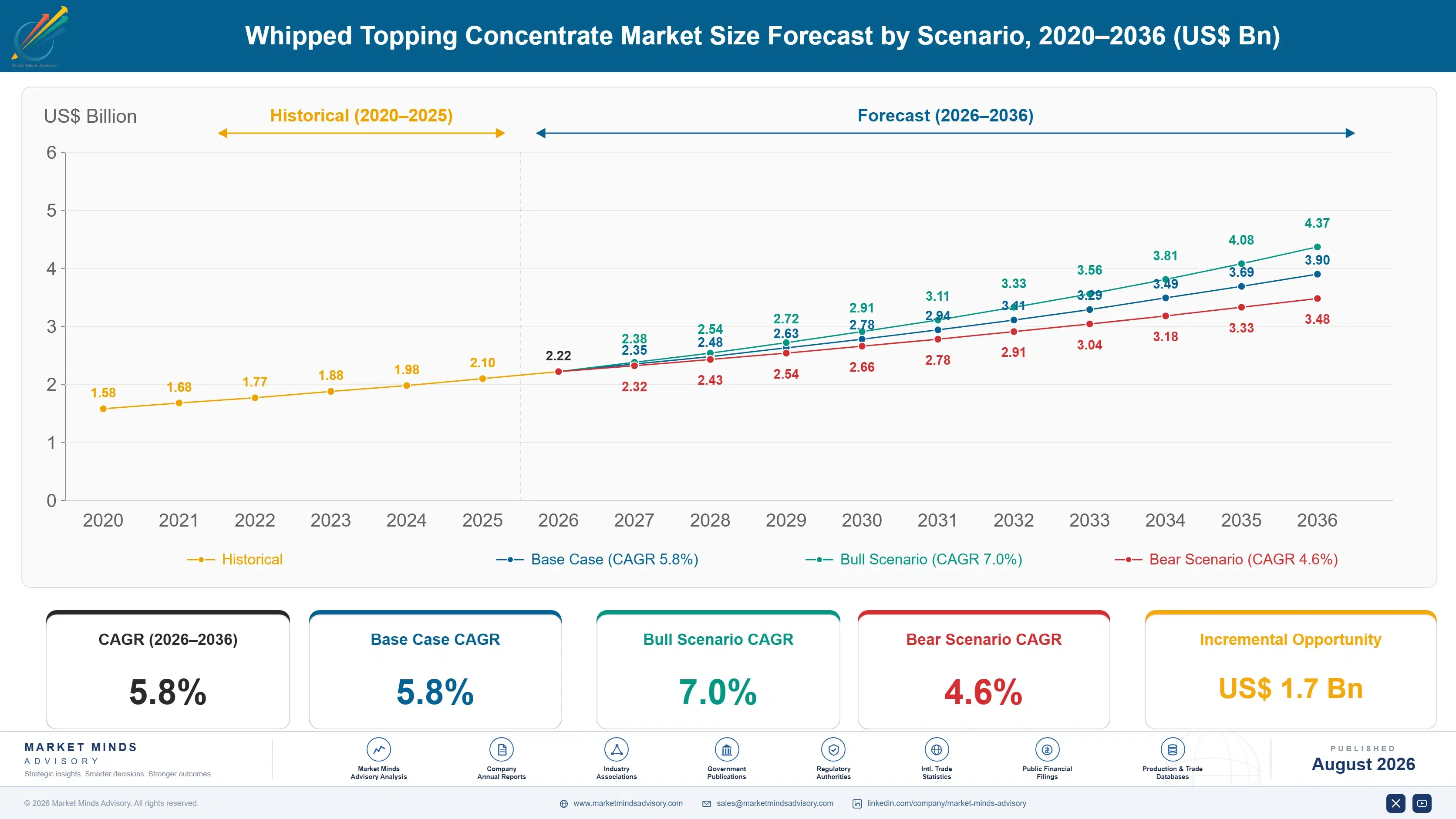
Whipped Topping Concentrate Market Forecast Scenarios

whipped-topping-concentrate-market-size-forecast-scenario-1787375145721
Between 2020 and 2025, whipped topping concentrate demand recovered unevenly alongside the broader foodservice and bakery sector's pandemic-era disruption, with plant-based reformulation accelerating as manufacturers responded to dairy-free demand that persisted after initial pandemic supply shifts eased. The category posted an estimated 5.0 percent historical CAGR, trailing the forecast rate as plant-based adoption broadens beyond early specialty dessert makers.
MMA's base case projects 5.8 percent annual growth through 2036, anchored in three commercial mechanisms. First, foodservice and retail bakery demand continues recovering toward pre-pandemic volume levels across major consumption regions. Second, dessert manufacturers increasingly specify stability-tested concentrate grades as standard rather than optional, lifting average selling prices across the category. Third, emerging market organized bakery capacity expansion, particularly across South Asia, is adding entirely new demand beyond mature developed markets.
The bull case rests on accelerated plant-based dessert adoption across mainstream foodservice chains nationally, which could push category penetration well beyond current specialty-focused levels. The principal bear risk is persistent dairy commodity price deflation, which could keep traditional dairy-based concentrates priced competitively enough to slow plant-based conversion among cost-conscious bakery operators managing tight annual margin budgets.

Stability Engineering for the Modern Dessert Case

Bakery and foodservice purchasing behavior has shifted from pure cost-per-liter evaluation toward documented overrun and stability performance. Large chain bakeries now track aeration consistency and holding time against concentrate cost with the same rigor once reserved for flour specification, a discipline that smaller independent bakeries are only beginning to adopt as quality standards spread through the supply chain and customer audit programs expand across the industry more broadly than before.
MARKET CONCENTRATIONCR5 38%top five suppliers hold considerable combined production revenue
PLANT-BASED PRICE PREMIUM1.3x dairy-baseddairy-free formulations command a durable sustained retail premium
FOODSERVICE CHANNEL SHARE54%foodservice remains the single largest distribution channel overall
OVERRUN CONSISTENCY STANDARD300-400%documented aeration ratio increasingly required by major bakery accounts
SHELF STABILITY WINDOW18-24 monthsextended stability formulations command notable pricing advantages today
DAIRY INPUT COST SHARE44% of COGSraw dairy and oil inputs dominate total production cost structure
Supplier economics reward companies that can prove stability across transport and display conditions rather than competing purely on raw formulation price. Large foodservice accounts increasingly require documented shelf-life and overrun testing before qualifying a new supplier, forcing manufacturers to invest in application laboratories that smaller regional competitors often lack the capital to build on their own without outside investment or a formal partnership.
Over the next decade, plant-based reformulation and foodservice technical service depth will matter as much as base formulation chemistry. Suppliers that can match dairy-cream performance using plant-based inputs while maintaining consistent stability stand to capture disproportionate share as clean-label demand continues broadening across mainstream bakery and dessert categories worldwide over the coming decade.
"Everyone assumes whipped topping is a commodity. It stopped being one the moment chains started measuring how long a swirl holds its shape under a heat lamp for six hours straight."
Director, Food and Bakery Ingredients Practice · MMA Food and Bakery Ingredients Practice · August 2026

Market Trends

Plant-Based Reformulation Spreads Into Mainstream Bakery Lines

Major bakery chains and dessert manufacturers are reformulating core product lines with plant-based whipped topping concentrates, moving dairy-free positioning beyond dedicated vegan product lines into mainstream everyday offerings sold alongside traditional dairy-based desserts. This shift responds to clean-label and lactose-sensitivity demand that extends well beyond the smaller population of committed vegan consumers who originally drove the category. Retailers report that dessert cases stocking plant-based whipped topping alongside traditional options see measurably higher overall category sales, since the format captures both dairy-avoiding and dairy-indifferent shoppers simultaneously without requiring separate product lines.
Market Impact: Lifts dessert sales 8% overall
Foodservice Chains Formalize Stability Testing Requirements

Large foodservice and quick-service restaurant chains have begun formally requiring documented overrun and shelf-stability testing data before qualifying whipped topping concentrate suppliers, a requirement that barely existed a decade ago and now shapes purchasing decisions across most major accounts. This shift favors suppliers with dedicated application laboratories over smaller regional manufacturers relying on generic formulation claims. Chains report that concentrates failing to meet documented six-hour display stability standards face rejection during supplier qualification reviews, a threshold that has become a genuine competitive battleground industry-wide across most major bakery and dessert accounts.
Market Impact: Adds 38% general-preference buyer share

Market Opportunities and Growth Drivers

Foodservice and Retail Bakery Volume Recovers Steadily

Foodservice and retail bakery volumes across major consumption regions continue recovering toward pre-pandemic production levels as consumer dining-out frequency normalizes and bakery chains rebuild dessert case inventory programs curtailed during earlier disruptions. This recovery directly lifts whipped topping concentrate demand, since foodservice represents the single largest end-use channel for the category by a considerable margin over retail packaged sales. Major bakery chains report same-store dessert sales climbing back above pre-pandemic benchmarks across several key regional markets tracked in this report, a recovery that gained further momentum through 2024 and into 2025.
Market Impact: Limits premium substitution to 62%

Clean-Label and Dairy-Free Demand Broadens Buyer Base

Clean-label ingredient scrutiny and dairy-free dietary preferences have expanded well beyond committed vegan consumers into mainstream households managing lactose sensitivity or general wellness goals, creating a substantially larger addressable buyer base than the category's traditional dairy-focused core. Registered dietitians and bakery consultants increasingly recommend plant-based whipped topping as an accessible substitution for lactose-sensitive customers, a credibility channel that barely existed a decade earlier. Survey data suggests roughly 38 percent of current plant-based buyers cite general dietary preference rather than committed veganism as their primary purchase motivation, a notable shift from a decade earlier.
Market Impact: Slows conversion by 9 points

Market Restraints and Challenges

Plant-Based Texture Gap Still Limits Full Substitution

Despite meaningful formulation improvements, a persistent minority of bakery customers still find plant-based whipped topping's mouthfeel and melt behavior noticeably different from traditional dairy-based cream, limiting full substitution among premium dessert applications where texture matters most. The root cause is the fundamental absence of dairy fat structure, which alternative fat and stabilizer systems have not yet fully replicated at comparable cost. Several manufacturers are piloting new emulsification techniques and coconut-oil-based systems aimed at narrowing this gap without sacrificing the clean-label positioning that defines the category and drives its premium retail pricing.
Market Impact: Lifts dessert case sales 14%

Dairy Commodity Price Deflation Slows Plant-Based Conversion

Periods of dairy commodity price deflation make traditional dairy-based concentrates competitively priced against plant-based alternatives, reducing the cost incentive that previously accelerated conversion among price-sensitive bakery operators managing thin margins. The root cause is dairy market cyclicality driven by feed costs and herd size decisions largely unrelated to whipped topping demand specifically, but felt directly across the entire supply chain regardless. Several plant-based manufacturers are piloting long-term fixed pricing contracts to insulate bakery customers from this cyclicality and preserve conversion momentum during periods of favorable dairy pricing across major regional accounts.
Market Impact: Requires 6-hour documented display stability
3 additional market trends, 4 additional growth drivers, and 3 additional restraints and challenges are covered in the full report. Contact sales@marketmindsadvisory.com to access the complete intelligence.

Segment CAGR and Growth Architecture

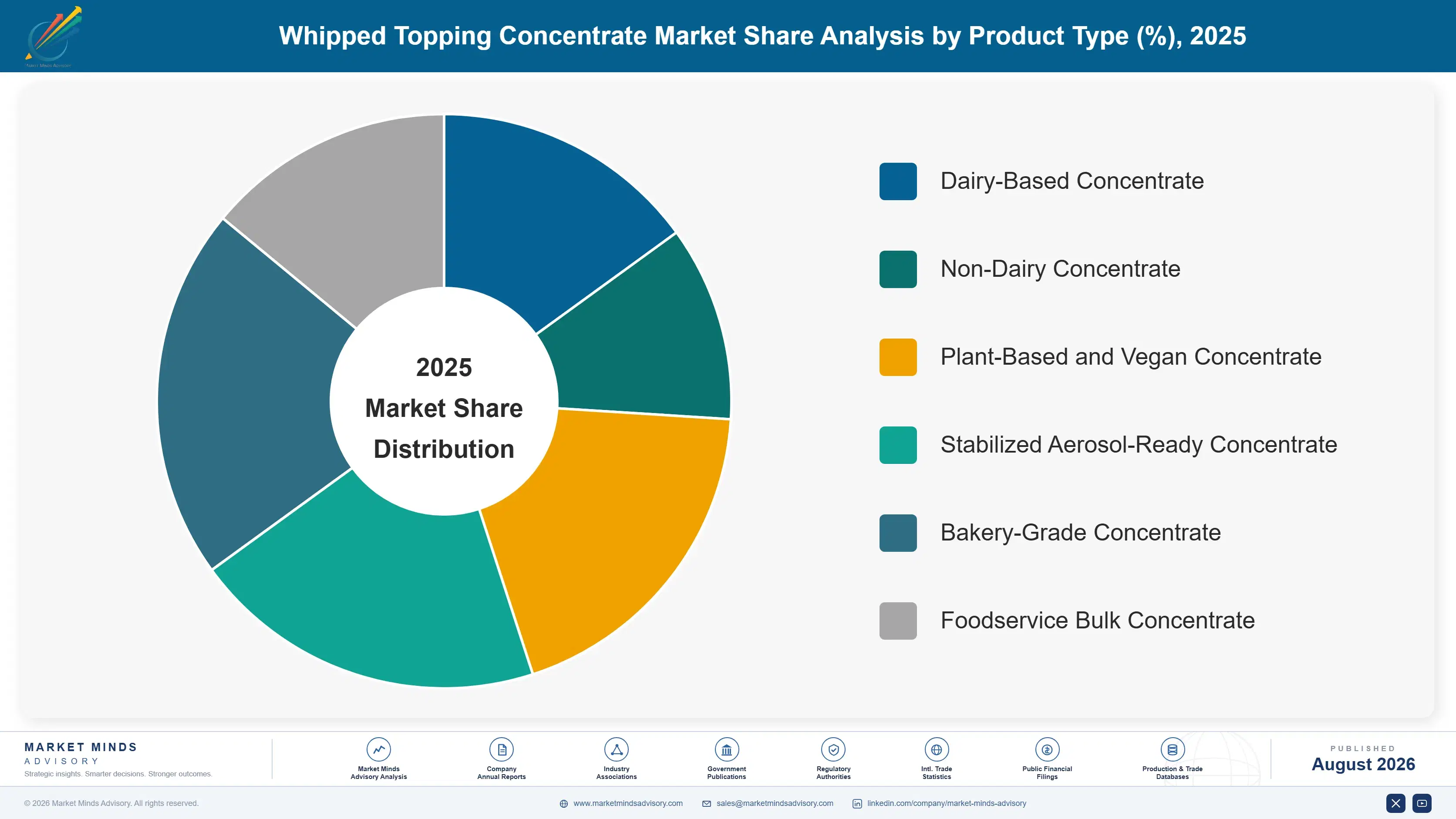
Product type is the dimension that determines stability chemistry, use occasion, and pricing tier, so MMA segments the market by formulation type rather than by distribution channel or packaging format. Six types span the category, from dairy-based standards through fast-growing plant-based and vegan concentrates commanding steep, sustained retail premiums across most channels tracked in this report.
whipped-topping-concentrate-market-market-share-analysis-1787375146278

Plant-Based and Vegan Whipped Topping Concentrate

Plant-based and vegan concentrates are the fastest-growing type because they solve the clean-label and dairy-free positioning problem that traditional dairy-based concentrates cannot address, capturing both committed vegan buyers and the much larger population of lactose-sensitive and generally health-conscious mainstream shoppers simultaneously. Coconut and soy-based fat systems have driven most of the early formulation success, since they replicate dairy-cream mouthfeel more closely than earlier plant-based attempts using less compatible fat sources. Retailers increasingly stock plant-based whipped topping alongside traditional dairy options rather than in a separate specialty section, reflecting genuine mainstream acceptance. Roughly 1.69 times the category's overall growth rate, this segment now commands the steepest retail price premium of any whipped topping format sold.
CAGR 9.8%

Stabilized Aerosol-Ready Concentrate

Stabilized aerosol-ready concentrates form the second-fastest-growing type, anchored in expanding self-serve and grab-and-go retail formats where consumers dispense topping directly without foodservice staff involvement. These formulations require more sophisticated stabilizer systems than traditional whip-to-order concentrates, since they must maintain structure through pressurized dispensing rather than immediate consumption. Convenience retail and quick-service restaurant adoption has emerged as a particularly strong growth channel, since self-serve dessert stations reduce labor costs that traditional whip-to-order preparation requires across busy service periods. Suppliers increasingly bundle aerosol-ready formulations with dispensing equipment partnerships to simplify retailer adoption decisions and extend account relationships beyond a single product sale. Early movers in this format report meaningfully stronger repeat purchase rates than suppliers selling concentrate alone without equipment support.
CAGR 7.6%
Full segment breakdown across 6 segments available in the complete report.

Regional Architecture and Country Demand Map

North America leads on the strength of its mature foodservice and retail bakery distribution infrastructure built over decades, while South Asia and Pacific grows fastest as India's expanding organized bakery sector adopts stabilized concentrate formats for the first time at meaningful commercial scale across the country.

North America

Mature foodservice and retail bakery distribution infrastructure anchors demand here more than in any other region, with the United States chain bakery and dessert cafe sector representing the world's largest single national market for whipped topping concentrate by a wide margin. Rich Products and other domestic suppliers have built decades of technical service relationships with major chains that newer entrants struggle to replicate quickly without comparable history. Plant-based reformulation has expanded fastest here, as mainstream bakery chains race to add dairy-free options across core dessert menus nationwide. Canada's bakery sector has followed a similar trajectory, though at a smaller absolute scale than the United States market that anchors regional demand.
Share: 30% | CAGR: 5.6% (2026 to 2036)

Western Europe

Regulatory and clean-label standards shape this region's growth path more directly than anywhere else, as German and French consumers show among the strongest global preference for recognizable, minimally processed ingredient lists in packaged dessert products sold at retail. Growth concentrates in plant-based and clean-label formulations rather than traditional dairy-based concentrates, reflecting a consumer base that associates dairy-free positioning with health-conscious purchasing decisions. United Kingdom foodservice chains have led regional plant-based adoption, often previewing reformulation trends that later spread to continental Europe. Private label penetration remains comparatively high, since European retailers maintain strong store-brand bakery programs across most major grocery chains and their premium in-store bakery counters, a distinct competitive dynamic versus North American retail.
Share: 21% | CAGR: 4.2% (2026 to 2036)
Regional intelligence for 5 additional markets available in the complete report: East Asia, South Asia and Pacific, Latin America, Middle East and Africa, Eastern Europe. Contact sales@marketmindsadvisory.com.
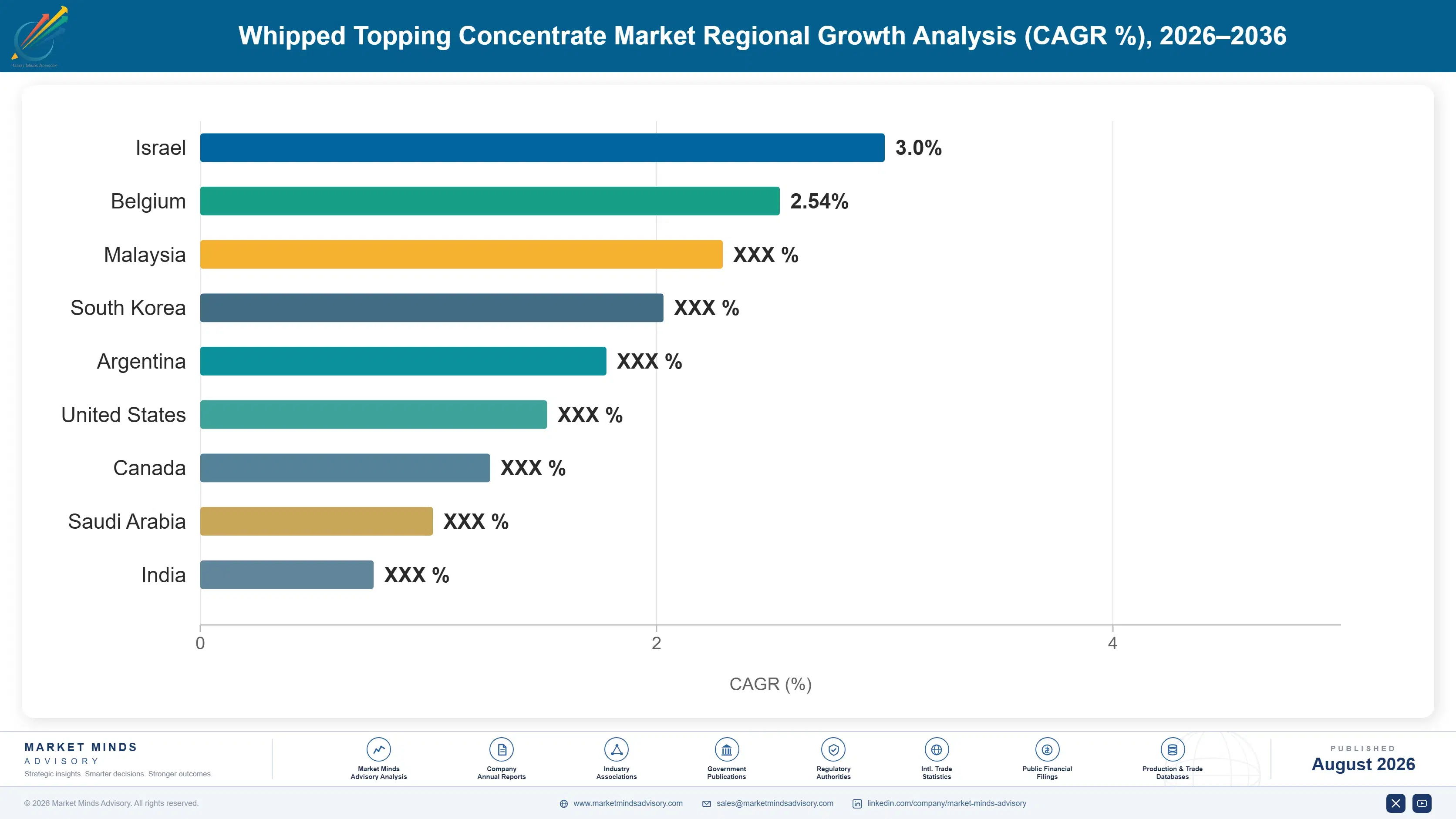
whipped-topping-concentrate-market-country-cagr-analysis-1787375146801

Turning Stability Testing Into Contract Retention

Four commercial levers separate suppliers earning premium concentrate pricing from those trapped in commodity competition: documented stability testing, plant-based reformulation, foodservice technical service, and equipment-bundled aerosol partnerships that extend account relationships beyond a single product sale, each requiring sustained upfront investment well before the resulting margin gain becomes clearly visible on a quarterly income statement.

Publish Documented Overrun and Stability Testing Data

Suppliers that commission and publish independent overrun and shelf-stability testing, rather than relying on generic formulation claims, gain a defensible claim that large foodservice buyers now weight heavily during annual supplier qualification reviews across every major account and regional chain. The testing investment is meaningful but suppliers that clear this bar report contract renewal rates roughly 21 percent higher than competitors relying on standard specification claims alone. Several third-party testing labs now offer bakery-specific stability certification packages, lowering the entry cost for suppliers seeking documentation quickly and credibly without building in-house testing infrastructure.
Market Impact: Lifts contract renewal rate by 21 points overall

Build Genuine Plant-Based Reformulation Capability In-House

Suppliers investing in coconut and soy-based fat systems that replicate dairy-cream mouthfeel capture demand from both committed vegan buyers and the much larger mainstream population managing lactose sensitivity or general dietary preference across every retail channel. This positioning requires genuine formulation science rather than simple ingredient substitution, since consumers can distinguish authentic texture matches from generic plant-based claims fairly quickly. Plant-based reformulated brands report price premiums roughly 1.3 times standard dairy-based concentrates, reflecting real willingness to pay among clean-label shoppers seeking a genuine, well-documented story behind every purchase they make.
Market Impact: Supports a 1.3x price premium nationwide each year

Deploy Foodservice-Side Technical Application Engineering Support

Suppliers that place technical service representatives directly with large foodservice and bakery chain customers, helping troubleshoot overrun and stability issues on the production floor, build switching costs that pure commodity pricing cannot easily overcome at any price point. This capability requires meaningful headcount investment that smaller regional suppliers often cannot justify economically without scale. Chains with dedicated technical support report formulation-related product waste roughly 16 percent lower than those managing issues without direct supplier engineering support on site every single shift, a gap that widens further during periods of rapid menu expansion.
Market Impact: Cuts customer product waste by 16 points overall

Bundle Aerosol Concentrate With Dispensing Equipment Partnerships

Suppliers offering aerosol-ready concentrate bundled with dispensing equipment partnerships extend account relationships well beyond a single product sale, since retailers investing in equipment become effectively locked into a compatible concentrate supply relationship for years to come. This approach requires upfront equipment investment and service infrastructure that smaller suppliers often lack the capital to build entirely alone without outside partnership or financing support arrangements. Suppliers offering this bundle report retail account retention roughly 2.4 times longer than concentrate-only competitors selling comparable formulations at similar price points across every retail and foodservice channel tracked in this report.
Market Impact: Extends account retention 2.4 times longer overall each year

Who Controls the Margin Pool

The top five suppliers hold a combined 38 percent of category revenue, a moderate concentration reflecting the technical service and stability testing infrastructure required to compete credibly for large foodservice accounts across every major producing region tracked. The gap between the leading supplier and the fifth-ranked player is meaningful, since decades of chain technical relationships are difficult for challengers to replicate quickly.
Current competitive activity centers on three fronts: leading suppliers expanding plant-based reformulation portfolios to defend the category's fastest-growing segment, mid-tier players investing in stability testing infrastructure to compete for large chain accounts, and several companies pursuing aerosol equipment partnerships to lock in retail relationships for years. Foodservice technical service expansion has also intensified as suppliers compete for application support depth across every major account.

Emerging pressure is coming from regional plant-based specialty manufacturers offering competitively priced dairy-free formulations backed by growing clean-label credibility and technical service investment. Rankings are most likely to shift among mid-tier suppliers lacking either the technical service depth of category leaders or the cost structure of regional low-cost entrants, leaving them squeezed from both directions of the market at once.
whipped-topping-concentrate-market-company-positioning-matrix-1787375147321

Competitive Moat and Risk Dimensions

RICH PRODUCTS CORPORATION

Moat: Deep foodservice chain relationships

Rich Products has built decades of technical service relationships with major North American foodservice and bakery chains that newer entrants cannot easily replicate, reinforced by category-defining brand recognition among chain purchasing managers. This depth gives its sales team credibility that smaller specialized competitors struggle to match in large account negotiations.
RICH PRODUCTS CORPORATION

Risk: Slower plant-based transition pace

Rich Products' legacy product line was built around traditional dairy-based formulations before plant-based positioning became the category's primary growth driver, leaving it exposed as newer, dairy-free-focused challenger brands capture clean-label-conscious buyers. Retooling a large established product line takes longer than launching new formulas from scratch.
KERRY GROUP PLC

Moat: Broad global formulation expertise

Kerry has built one of the industry's most extensive cross-application formulation portfolios, spanning dairy, plant-based, and stabilized aerosol technologies that smaller competitors cannot easily match technically or economically. This breadth gives Kerry credibility across nearly any bakery or foodservice customer conversation globally, from small independent shops to the largest national chains.
KERRY GROUP PLC

Risk: Complex multi-division coordination

Kerry's diversified structure spanning multiple food ingredient categories beyond whipped topping creates coordination complexity and overhead costs that more focused single-category competitors avoid entirely. This can slow decision-making on category-specific pricing and product launches relative to nimble specialist rivals with narrower, more sharply focused competitive priorities.

Players Tracked

Prominent Players

Rich Products Corporation
Kerry Group plc
Puratos Group
Dawn Foods, Inc.
FrieslandCampina

Other Key Players

Bakels Group
Lantmannen Unibake International
AAK AB
Fonterra Co-operative Group Limited
Cargill, Incorporated
Arla Foods amba
Wilbur Chocolate (Cargill)
Bunge Limited
Puratos North America
Zeelandia International
Grupo Bimbo Ingredients Division
Bel Group
IFF Nutrition & Bioscience
Corbion N.V.
Palsgaard A/S

Recent Developments

MAY 2025

Rich Products Launches New Plant-Based Concentrate Line

Rich Products launched a new coconut-oil-based plant-based whipped topping concentrate line targeting mainstream bakery chains, extending its portfolio beyond traditional dairy-based formulations for the first time at meaningful national retail scale, matching a shift already underway among smaller specialty rivals serving the same growing accounts nationwide.
Signal: Signals the category leader is finally chasing plant-based growth directly rather than resisting it any longer
OCTOBER 2024

Kerry Group Signs Technical Partnership With Major Bakery Chain

Kerry Group signed a multi-year technical service partnership agreement with a major North American bakery chain, embedding dedicated application engineers on-site to support stability testing and overrun consistency across the chain's dessert product lines and seasonal menu rotations throughout the year, a first for the chain's supplier relationships.
Signal: Confirms foodservice technical service depth is quickly becoming the category's primary competitive differentiator across accounts today
JANUARY 2025

Puratos Group Acquires Regional Plant-Based Concentrate Manufacturer

Puratos Group acquired a regional plant-based whipped topping concentrate manufacturer to accelerate its clean-label formulation capability, expanding beyond organic growth into the faster-growing dairy-free segment ahead of several competing multinational suppliers pursuing similar acquisition targets in the same fast-growing space this year alone, according to industry sources.
Signal: Shows large incumbents buying growth in plant-based rather than building it internally on their own entirely

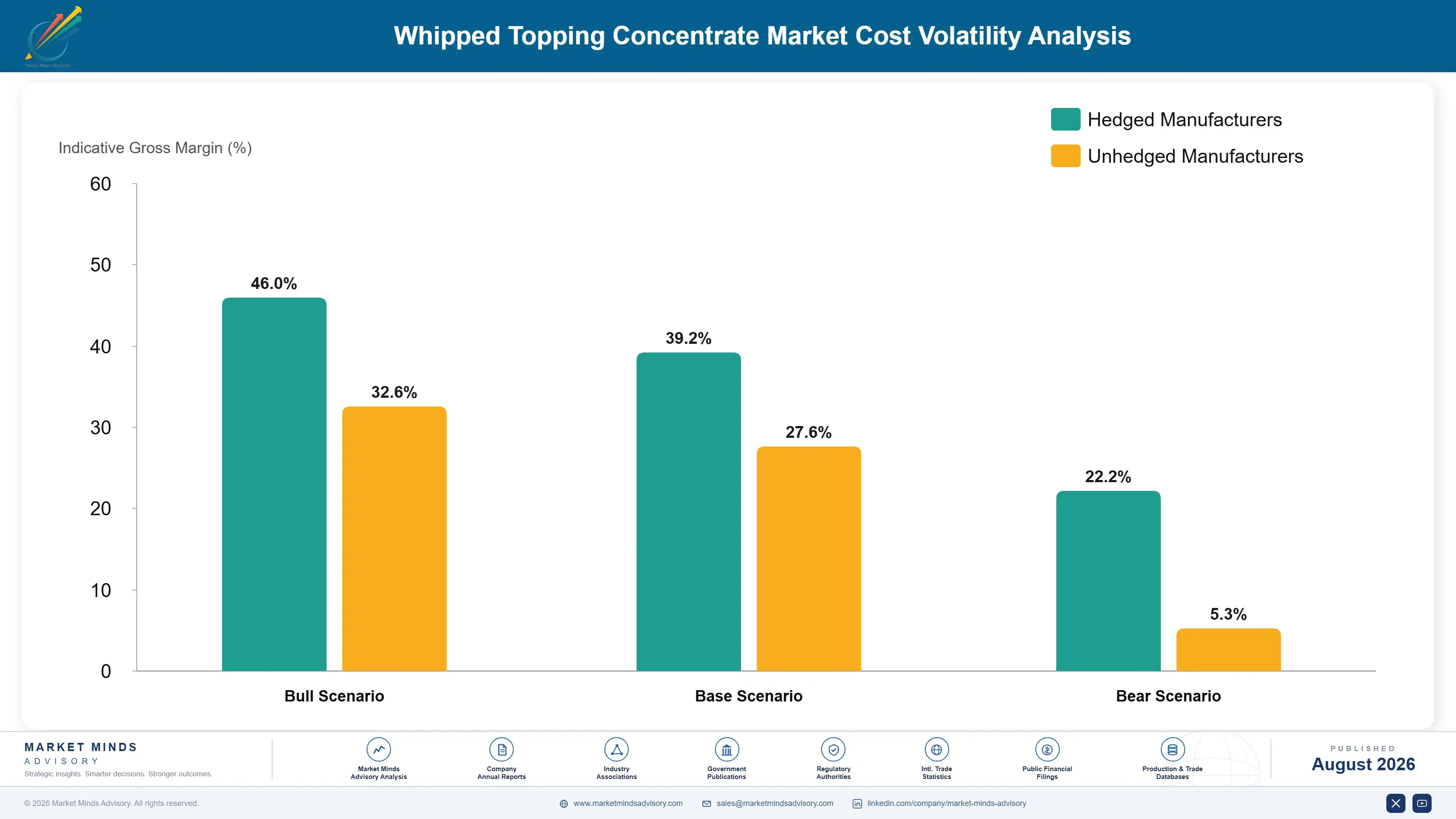
Dairy and Oil Set the Cost Base

Dairy fat, vegetable oils, and stabilizer systems together represent roughly 44 percent of cost of goods sold, sourced primarily from United States, European, and Southeast Asian agricultural regions with periodically volatile pricing patterns. Coconut oil costs for plant-based formulations add a further meaningful cost layer that has grown considerably as dairy-free demand expands across the category nationwide, further complicating cost forecasting for supplier finance teams each quarter.
Dairy fat prices rose sharply in 2023 after herd reduction and feed cost pressure tightened global supply, an event the USDA's dairy market news reporting and several manufacturers' annual reports both referenced when explaining margin compression that year. Coconut oil prices faced separate pressure from Southeast Asian weather disruptions during the same period, compounding cost complexity for plant-based formulation manufacturers specifically, a disruption still cited in supplier risk assessments today across the industry.

Exposure varies sharply by player type: suppliers with long-term dairy and vegetable oil contracts absorbed volatility more easily than smaller manufacturers dependent on spot market purchasing, who faced steeper margin compression across the same period. Vertically integrated leaders used scale purchasing agreements to smooth cost swings that hit smaller regional competitors much harder across the same volatile period.
whipped-topping-concentrate-market-cost-volatility-analysis-1787375147518

Lock Multi-Year Dairy and Oil Supply Contracts

Leading suppliers now lock multi-year fixed-price contracts directly with dairy cooperatives and vegetable oil producers, reducing exposure to any single season's weather-related supply disruption. This adds modest contracting cost but has prevented the steepest cost spikes during recent volatility, and several suppliers report the practice paid for itself within two years of initial adoption and rollout.

Diversify Fat Sourcing Across Coconut and Soy

Some suppliers are diversifying plant-based fat sourcing across coconut, soy, and other vegetable oils rather than concentrating in a single crop, reducing exposure to any one commodity's weather or export policy disruption. Early movers report both cost stability and supply security benefits from this diversified approach, alongside meaningfully improved forecasting accuracy for future planning cycles.

Hedge Dairy Commodity Costs Through Forward Contracts

Manufacturers producing dairy-based formulations increasingly hedge fat costs through forward purchasing agreements, protecting margin against dairy market cyclicality that can otherwise erode profitability during volatile periods across the category. Several large suppliers have expanded this practice since 2023, cutting cost exposure meaningfully across their highest-volume dairy-based product lines and long-standing customer accounts nationwide and abroad.

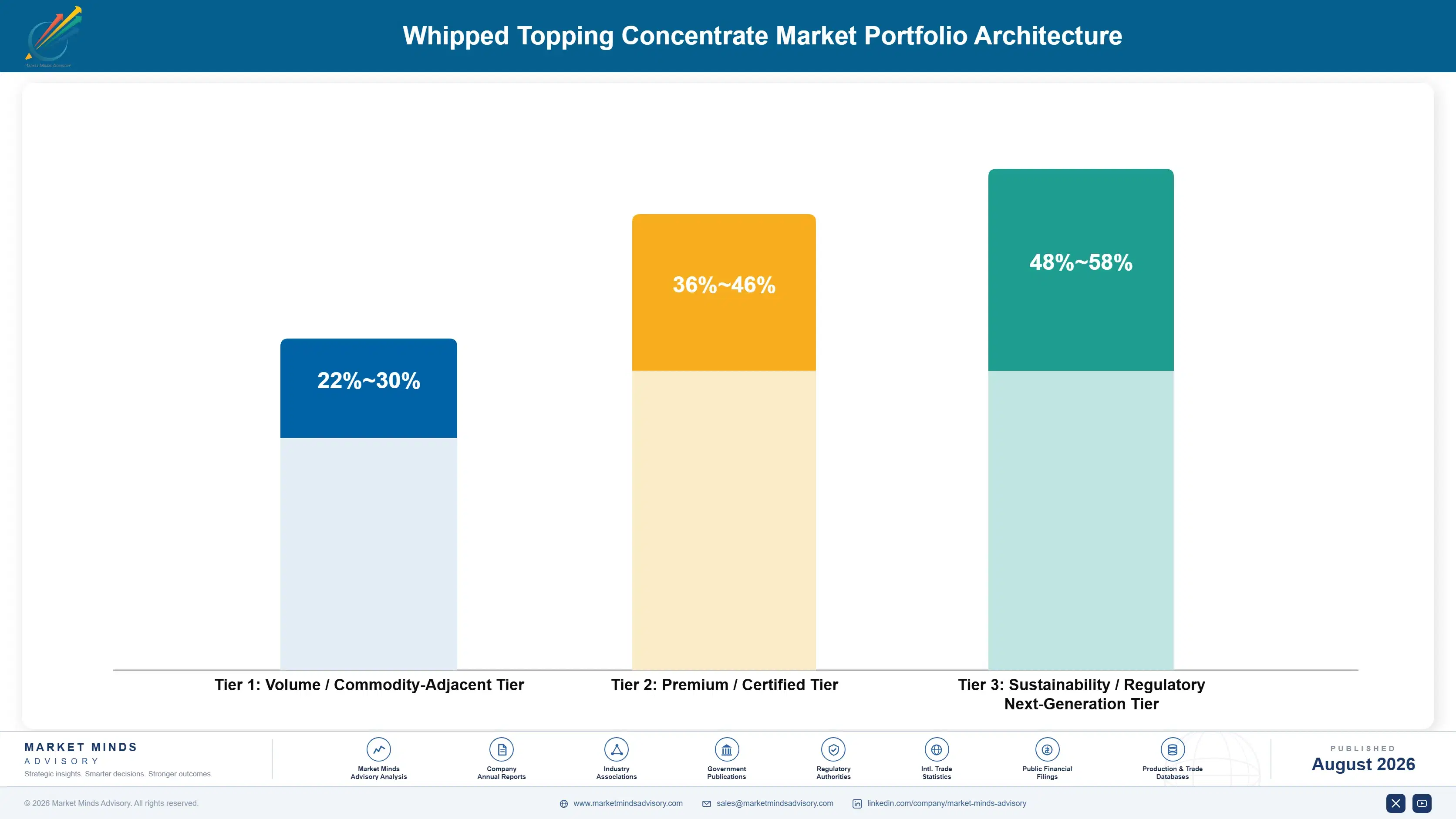
Portfolio Architecture for Margin Defence

Three tiers structure this category's margin economics. Volume dairy-based concentrates compete on price against private label with thin margins, premium plant-based formulations earn a meaningful markup on clean-label positioning and documented stability, and next-generation aerosol-ready and equipment-bundled products command the steepest prices by solving a specific application problem operators actively budget around each fiscal year without exception, every single time without fail.
Tension between volume and premium tiers is intensifying as private label pushes traditional dairy concentrate toward commodity pricing while plant-based producers pull upward into genuinely differentiated clean-label positioning. Suppliers straddling both tiers face difficult formulation and branding allocation choices that pull in genuinely different directions and rarely reward companies trying to excel at both simultaneously across their entire product catalog and geographic footprint.

High-value margin pools concentrate in plant-based and aerosol-ready formulations addressing documented stability and dairy-free requirements, where large foodservice buyers show the least price sensitivity. Equipment-bundled retail programs represent a fast-growing high-value pool as this historically underserved channel finally gets dedicated supplier manufacturing and marketing attention from both established category leaders and well-funded regional challengers entering the space more aggressively each year.

Volume / Commodity-Adjacent Tier

Standard dairy-based concentrates sold primarily through foodservice distribution on price and reliability, competing directly against expanding private label alternatives with the thinnest margins in the entire category by a wide margin.
Gross Margin: 22-30%

Premium / Certified Tier

Plant-based and clean-label formulations sold through mainstream bakery and retail channels at a clear premium over commodity dairy-based alternatives, appealing directly to ingredient-literate shoppers researching labels carefully before every purchase decision.
Gross Margin: 36-46%

Sustainability / Regulatory / Next-Generation Tier

Aerosol-ready and equipment-bundled formulations with documented stability data, increasingly sold through long-term retail and foodservice partnerships spanning multiple production years and equipment refresh cycles across every account nationwide today and internationally.
Gross Margin: 48-58%
whipped-topping-concentrate-market-portfolio-architecture-1787375148022

High-value Sub-segments and Strategic Watch-out

Plant-Based Formulations for Mainstream Bakery Chains

This segment combines the category's highest growth rate with its richest margins, as documented clean-label positioning justifies premium pricing that mainstream bakery chains readily pay given measurable dessert case sales gains across every major account and regional market this report tracks in careful, ongoing detail.
Gross Margin: 50-60%

Equipment-Bundled Aerosol Retail Programs

Growing fast but still building margin scale, this segment benefits from solving the self-serve dispensing problem that traditional whip-to-order concentrates cannot address, though equipment investment currently compresses near-term profitability relative to established lines already operating at full commercial scale nationwide and increasingly abroad as well.
Gross Margin: 38-46%

Mainstream Dairy-Based Foodservice Concentrate

The category's volume anchor, dairy-based concentrates retain the largest revenue base even as growth slows relative to plant-based formats, sustaining category cash flow while margins stay comparatively thin against premium alternatives across most tracked regions and distribution channels nationwide and increasingly abroad as well each year.
Gross Margin: 24-31%

Private-Label Store-Brand Whipped Topping

Retailers are expanding store-brand whipped topping concentrate lines to capture margin from price-sensitive foodservice buyers, a watch-out for branded manufacturers as private label quality gaps narrow and retailer negotiating leverage grows steadily each year across most major grocery and foodservice accounts nationwide and increasingly abroad too.
Gross Margin: 16-23%

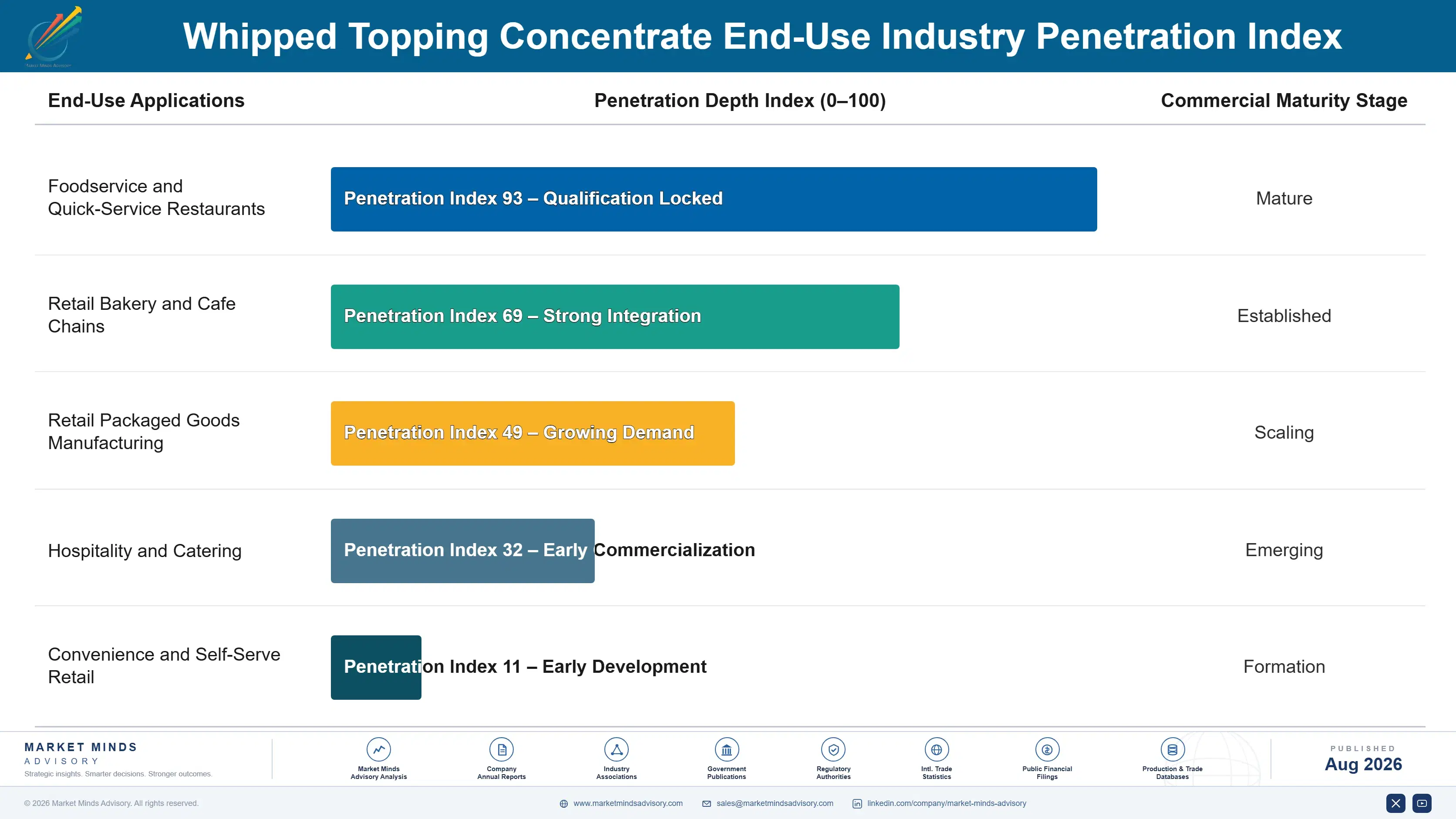
Repeat Purchase Economics by Channel

Whipped topping concentrate behaves like an annuity once a bakery chain establishes a supplier relationship, since switching requires re-qualifying stability and overrun performance across every menu item, making qualified suppliers difficult to dislodge from established accounts once trust is built across multiple production years and quality audits conducted by demanding customers who expect nothing less than full consistency every single shift.
Adoption depth varies meaningfully by vertical: foodservice and quick-service chains show near-universal trial but moderate reformulation frequency, while retail packaged goods manufacturers see lower overall trial rates paired with far stickier daily usage once a brand commits to a specific formulation for packaged production runs sold nationwide across thousands of retail locations and their surrounding distribution networks.

Younger bakery consultants and product development managers research plant-based and clean-label formulation science far more actively than the generation they are replacing, accelerating conversion decisions that previously took years of gradual persuasion to complete successfully across most major accounts. This generational shift rewards suppliers investing early in transparent formulation documentation over those relying on legacy relationships alone, reshaping which companies capture the next full decade of category growth.
whipped-topping-concentrate-market-end-use-penetration-index-1787375148517

Where MMA Sees Category Momentum Building

These are among the four positions where our research anticipates prominent divergence between winners and laggards over the coming forecast period. Each is grounded in the demand model, the regulatory perimeter, and the announced capacity pipeline.
01 / STABILITY TESTING PRIORITY

Fund documented overrun testing before scaling volume

Large foodservice buyers now treat published overrun and stability data as a listing prerequisite rather than a marketing nicety, and this evidence bar will keep rising as more chains formalize evidence-based supplier reset criteria across every major account. Suppliers still competing purely on price without a documented testing portfolio risk ceding ground to better-documented rivals within the next several purchasing cycles across major accounts and long-standing relationships. MMA views stability testing investment as the single highest-leverage capital allocation decision facing mid-tier suppliers in this category today.
02 / PLANT-BASED POSITIONING INVESTMENT

Build genuine dairy-free formulation credibility before competitors close the gap

Plant-based concentrates command price premiums roughly 1.3 times standard dairy-based formats, and this gap will likely widen further as consumers grow more sophisticated about distinguishing authentic texture matches from generic dairy-free claims across every retail channel. Building genuine credibility requires patient capital and formulation science investment that late entrants cannot replicate quickly once established players secure mainstream bakery relationships first. MMA expects this positioning advantage to compound meaningfully for early movers over the next several years across every major producing region.
03 / TECHNICAL SERVICE EXPANSION

Build foodservice-side engineering support within eighteen months

The gap between suppliers offering dedicated technical service and those relying purely on product shipment is widening as large foodservice chains increasingly weight application support during annual supplier qualification reviews across every account. Building this capability requires meaningful headcount investment that smaller regional suppliers often lack the capital to fund internally without external backing or a formal partnership. MMA expects the technical service differentiation window to remain open for roughly two to three years before becoming table stakes across the category.
04 / EQUIPMENT PARTNERSHIP FOCUS

Pursue aerosol dispensing equipment bundling aggressively

Equipment-bundled aerosol programs extend account relationships well beyond a single product sale, and suppliers pursuing this bundling strategy early are locking in retail accounts before competitors recognize the same opportunity across the category and its fastest-growing regions. Building this capability requires upfront equipment investment and service infrastructure that smaller suppliers often lack the capital to fund alone. MMA advises prioritizing equipment partnership pursuit at large retail and convenience chains over smaller, less durable independent accounts across every major retail and foodservice channel tracked.

Engagement Snapshot From the Field

A live engagement with an industry participant carrying material or product regulatory and market exposure ahead of a defining policy shift, showing how our research translates into a defensible multi-year portfolio strategy.
MARKET MINDS ADVISORY · CLIENT ENGAGEMENT SUMMARY
Whipped Topping Concentrate Producer Strategic Portfolio Review and Transition Roadmap 2026·Investment Scenario on Whipped Topping Concentrate Exposure Evaluation 2025-26
CLIENT PROFILE
The client operates a regional bakery cafe chain with roughly 120 locations across the southeastern United States, generating approximately 34 million dollars (client-reported, unverified by MMA) in annual whipped topping concentrate spending across its dessert and beverage menu lines nationwide. The chain sought to evaluate its supplier base ahead of a major menu expansion program planned for the following year.
STRATEGIC CHALLENGE
Dessert case sales had plateaued despite steady foot traffic growth, and category managers lacked a clear framework for deciding which concentrate suppliers deserved renewed contracts amid growing customer requests for plant-based dessert options across every location. Competing regional chains had already moved decisively toward documented plant-based formulations across their own menus.
MMA APPROACH
MMA conducted a structured audit of current supplier formulations against documented stability and clean-label benchmarks, cross-referencing findings against primary survey data from comparable regional bakery chains managing similar plant-based transitions across several nearby markets. The engagement produced a phased supplier consolidation roadmap balancing cost, stability, and clean-label positioning considerations carefully.
KEY FINDINGS
  1. Only 19 percent of the client's whipped topping spending relied on formally documented plant-based formulations with clean-label certification readily available on file.
  2. Dessert case sales modeling suggested full plant-based conversion could improve category sales by roughly 11 percent across all client locations combined together.
  3. Two of the client's largest supplier contracts were due for renewal within six months, creating clear negotiating timing urgency for senior management overall.
  4. Comparable bakery chains that converted earlier reported measurable customer satisfaction gains alongside the documented sales improvement cited above throughout this full analysis.
CLIENT PROFILE
The client operates a regional bakery cafe chain with roughly 120 locations across the southeastern United States, generating approximately 34 million dollars (client-reported, unverified by MMA) in annual whipped topping concentrate spending across its dessert and beverage menu lines nationwide. The chain sought to evaluate its supplier base ahead of a major menu expansion program planned for the following year.
STRATEGIC CHALLENGE
Dessert case sales had plateaued despite steady foot traffic growth, and category managers lacked a clear framework for deciding which concentrate suppliers deserved renewed contracts amid growing customer requests for plant-based dessert options across every location. Competing regional chains had already moved decisively toward documented plant-based formulations across their own menus.
MMA APPROACH
MMA conducted a structured audit of current supplier formulations against documented stability and clean-label benchmarks, cross-referencing findings against primary survey data from comparable regional bakery chains managing similar plant-based transitions across several nearby markets. The engagement produced a phased supplier consolidation roadmap balancing cost, stability, and clean-label positioning considerations carefully.
KEY FINDINGS
  1. Only 19 percent of the client's whipped topping spending relied on formally documented plant-based formulations with clean-label certification readily available on file.
  2. Dessert case sales modeling suggested full plant-based conversion could improve category sales by roughly 11 percent across all client locations combined together.
  3. Two of the client's largest supplier contracts were due for renewal within six months, creating clear negotiating timing urgency for senior management overall.
  4. Comparable bakery chains that converted earlier reported measurable customer satisfaction gains alongside the documented sales improvement cited above throughout this full analysis.
RECOMMENDED STRATEGY
Phase 1: Phase 1 (Months 1-3): Audit current supplier formulations thoroughly against documented stability and clean-label benchmarks in full careful detail first. Phase 2: Phase 2 (Months 4-8): Negotiate plant-based conversion terms ahead of upcoming supplier contract renewal deadlines very closely and carefully now. Phase 3: Phase 3 (Months 9-12): Launch the expanded plant-based dessert menu across all locations with new supplier formulations fully and completely.
OUTCOME
Within twelve months of implementation, the client reported (client-reported, unverified by MMA) a 9.4 percent increase in dessert case category sales and successfully renegotiated supplier terms using its documented plant-based conversion leverage. Category managers adopted the phased framework as their standard approach for future supplier strategy reviews.

Frequently Asked Questions

Foundational context covering the market sizes, CAGR, scope, country, region and competition that inform every finding below. This section is provided to cover basics and most often pre-purchase conversations, answered from the MMA Primary Research Dataset.

What is the current size of the Whipped Topping Concentrate Market?

The whipped topping concentrate market was valued at approximately $2.1 billion in 2025. Growth is driven by plant-based reformulation and documented stability testing requirements from major foodservice buyers.

How large will the Whipped Topping Concentrate Market be by 2036?

MMA projects the market will reach approximately $3.9 billion by 2036, up from $2.22 billion in 2026. This represents an incremental opportunity of roughly $1.68 billion over the forecast period.

What is the CAGR for the Whipped Topping Concentrate Market 2026 to 2036?

The market is projected to grow at a 5.8 percent compound annual growth rate between 2026 and 2036. Bull and bear scenarios range from 4.6 to 7.0 percent annually.

Which segment is growing fastest?

Plant-based and vegan whipped topping concentrate is growing fastest at 9.8 percent annually, roughly 1.69 times the category average, driven by clean-label and dairy-free demand.

Who are the major companies in the Whipped Topping Concentrate Market?

Rich Products, Kerry Group, Puratos, Dawn Foods, and FrieslandCampina lead the category. Together the top five hold a moderate combined share, reflecting the technical service infrastructure required to compete.

Which country is growing fastest?

India leads country-level growth at 10.6 percent annually as its expanding organized bakery sector adopts stabilized concentrate formats for the first time at meaningful scale.

Report Segmentation Architecture

The full report scope spans multiple orthogonal segmentation dimensions, with cross-tabulated demand data provided for each dimension pair. Coverage extends further to regional breakdowns, trend trajectories, and the competitive detail needed to support segment-level decision-making.

By Product Type

  • Dairy-Based Concentrate
  • Non-Dairy Concentrate
  • Plant-Based and Vegan Concentrate
  • Stabilized Aerosol-Ready Concentrate
  • Bakery-Grade Concentrate
  • Foodservice Bulk Concentrate

By End-Use Industry

  • Foodservice and Quick-Service Restaurants
  • Retail Bakery and Cafe Chains
  • Retail Packaged Goods Manufacturing
  • Hospitality and Catering
  • Convenience and Self-Serve Retail

By Commercial Dimension

  • Large Chain Accounts
  • Independent Bakery Accounts
  • Private Label and Store-Brand
  • Equipment-Bundled Retail Programs

By Region

  • North America
  • Western Europe
  • East Asia
  • South Asia and Pacific
  • Latin America
  • Middle East and Africa
  • Eastern Europe

Scope, Methodology, and Coverage

Every figure in this report is reproducible from documented input assumptions. The scope below maps the historical period, the forecast horizon, the segmentation dimensions, and the countries covered, alongside the underlying primary and qualitative methodology.
Historical Period
2020 to 2025
Forecast Period
2026 to 2036
Base Year
2025 (USD billions; MMA Primary Research Dataset, August 2026)
Market Definition
This report covers stabilized dairy, non-dairy, and plant-based liquid or powder concentrates formulated to be whipped into aerated toppings for bakery, dessert, and foodservice applications. It excludes ready-to-use aerosol whipped cream, finished frozen desserts, and non-whippable dairy cream products.
Quantitative Units
USD billions (current prices); volume in metric tons where applicable
Segmentation Dimensions
By Product Type; By End-Use Industry; By Commercial Dimension; By Region
Regions Covered
North America, Western Europe, East Asia, South Asia and Pacific, Latin America, Middle East and Africa, Eastern Europe
Countries Covered
USA, China, Germany, France, UK, Japan, South Korea, India, Australia, Canada, Brazil, Mexico, Indonesia, Vietnam, Thailand, Malaysia, UAE, Saudi Arabia, South Africa, Nigeria, Turkey, Poland, Netherlands, Italy, Spain, Sweden, Switzerland, Argentina, Colombia, Singapore, and additional markets relevant to this sector
Key Companies Profiled
Rich Products Corporation, Kerry Group plc, Puratos Group, Dawn Foods, Inc., FrieslandCampina, Bakels Group, Lantmannen Unibake International, AAK AB, Fonterra Co-operative Group Limited, Cargill, Incorporated, Arla Foods amba, Wilbur Chocolate (Cargill), Bunge Limited, Puratos North America, Zeelandia International, Grupo Bimbo Ingredients Division, Bel Group, IFF Nutrition & Bioscience, Corbion N.V., Palsgaard A/S
Quantitative Methodology
Primary survey, n=3,800 respondents, Q4 2025, six countries; demand-side model with trade association cross-validation
Qualitative Methodology
47 expert interviews, Q4 2025; applied to validate demand model assumptions, identify emerging dynamics, and assess competitive positioning
Report Format
PDF and XLSX data workbook (Word format preview document)
Publisher
Market Minds Advisory
Report Code
MMA-2026-AGR-114
Published
August 2026
Contact
sales@marketmindsadvisory.com | www.marketmindsadvisory.com

Purchase the full Whipped Topping Concentrate Market Report (2026 to 2036).

The full report delivers a comprehensive 200-plus page analysis of the global whipped topping concentrate market, including detailed segmentation by product type, end-use industry, and commercial dimension across all seven world regions tracked in this study. It provides company profiles for twenty key and emerging suppliers, benchmarked against a consistent production revenue basis throughout. Buyers receive access to MMA's underlying primary survey dataset spanning 3,800 respondents and 47 expert interviews conducted in Q4 2025. Custom data cuts and direct analyst inquiry access are available for enterprise licensees upon request.
Twenty detailed company profiles with moat and risk analysis
Seven-region market sizing data through 2036
Primary survey dataset, n equals 3,800 respondents
Forty-seven expert interview transcript summary excerpts
Product-type-level CAGR and regional share breakdowns
Quarterly market update subscription add-on option

Built For The People Who Decide

From boardroom strategy to bench-side execution, this report is read cover-to-cover by leaders shaping the next decade of their industry, turning demand scenarios, market dynamics and valuation benchmarks into decisions.
CXOs/ Presidents/ VPs/ Managers
M&A and Corporate Development
Strategy Teams and R&D Heads
Procurement and Product Directors
Regulatory and Compliance Leaders
Investor Relations and Equity Analysts