Market Minds Advisory
WHIM Syndrome Management Market

WHIM Syndrome Management Market: The Therapy Arrived Before The Patients Did

A targeted therapy exists for a precisely understood genetic mechanism, and roughly nine in ten people carrying that mechanism have never been told what is actually wrong with them at all.

Lead Analyst

Published

September 2026

Make Smarter Decisions with Customized Research Insights

Request a free sample report and evaluate market opportunities, growth trends, and competitive dynamics relevant to your business needs.

2025 MARKET VALUE$0.1BMarket Size 2025
2036 FORECAST VALUE$0.5BBase Case , 2026 to 2036
CAGR 2026 TO 203616.4 %Bull 17.6% / Bear 15.0%
INCREMENTAL OPPORTUNITY$0.4BNet 10- year value creation
EXPANSION MULTIPLE4.60x2036 value over 2026 base
Strategic Levers
M&A Pipeline
Regional Outlook
Country Rankings
Competitive Intelligence
Segmental Deep-dive
Call-Us : 91 93563 13602

Executive Snapshot and Market Trajectory

The biology is understood with unusual precision and the commercial problem is elsewhere. A gain of function mutation traps mature neutrophils in the marrow, a targeted antagonist releases them, and 11% of the people expected to carry that mutation have a confirmed diagnosis. The rest are managed for something else.
Diagnosis takes a median of 14 years from first presentation, because recurrent infections get treated symptomatically and the marrow finding is only visible if somebody looks and recognises it. CXCR4 antagonist therapy grows fastest at 24.6%, half again the market rate, and almost all of that growth is diagnostic yield rather than any change in prescribing behaviour. Prevalence itself has not changed at all.
The therapy also does not finish the job, which is unusual for a targeted agent. Around 63% of treated patients continue to carry wart burden after neutrophil counts normalise, so supportive care persists alongside rather than being displaced by it. Concentration is high at 82% for the top five, and China grows fastest at 22.6% on genetic testing capacity rather than on treatment access. Two separate constraints, and neither of them is clinical.
Market Definition
Therapies and supportive management used in confirmed WHIM syndrome, a primary immunodeficiency caused by gain of function variants in the CXCR4 receptor, covering CXCR4 antagonist therapy, immunoglobulin replacement, granulocyte colony stimulating factor therapy, antimicrobial prophylaxis, human papillomavirus directed management and haematopoietic stem cell transplantation. Measured at manufacturer selling value. Genetic testing services, general primary immunodeficiency management outside confirmed WHIM syndrome and investigational gene therapy are excluded.
Base Year Value
$0.1B in 2025 (MMA Primary Research Dataset, August 2026)
Forecast Period
2026 to 2036, eleven discrete annual values
CAGR
16.4% base case. Bull 17.6%. Bear 15.0%.
Fastest Growth Segment
CXCR4 Antagonist Therapy: 24.6% CAGR
Fastest Growth Country
China: 22.6% CAGR
Fastest Growth Region
South Asia and Pacific: 18.6% CAGR
Largest Region
North America: 38% of 2025 global value
Market Leaders
X4 Pharmaceuticals, Takeda, CSL Behring, Grifols, Amgen. Source: MMA Primary Research Dataset, July 2026.
Primary Survey
n=3,800 procurement and R&D decision-makers, Q4 2025, six countries
Methodology
Demand-side build-up, cross-validated against public data, 47 expert interviews

WHIM Syndrome Management Market Forecast Scenarios

whim-syndrome-management-market-size-forecast-scenario-1787665041838
The five years to 2025 changed the therapeutic position and barely moved the diagnostic one. Approval of a targeted CXCR4 antagonist gave the condition a treatment matched to its mechanism, and identified patient numbers rose modestly because approval itself prompts testing in specialist centres. The 15.0% historical rate reflects a very small base expanding on diagnosis rather than on any broadening of who is eligible for treatment.
The 16.4% base case rests on three mechanisms. Diagnostic yield improves as CXCR4 variants appear on congenital neutropenia genetic panels rather than requiring a clinician to suspect the syndrome specifically. Human papillomavirus directed management grows at 12.4% because wart burden persists in most treated patients. And Chinese genetic testing capacity expands at 22.6%, faster than any market covered, which finds patients rather than treating known ones. Identification carries all three.
The 17.6% bull case turns on CXCR4 variants being added to broad newborn or paediatric immunodeficiency panels, which would compress a median diagnostic delay currently running 14 years into something closer to months. The 15.0% bear case is payer resistance to an annual cost near 430 thousand dollars per patient in a condition where supportive care alone has managed patients for decades already.

A Mechanism Understood, A Population Missing

Very few conditions are understood this well and treated this rarely. A gain of function variant in the CXCR4 receptor prevents mature neutrophils leaving the bone marrow, producing the retention finding that gives the syndrome part of its name, and a targeted antagonist releases them into circulation. The mechanism is precise, the therapy matches it, and roughly 11% of the people expected to carry the variant have a confirmed diagnosis.
TOP FIVE CONCENTRATION82%Combined treated patient share held by leading suppliers
ESTIMATED POPULATION PREVALENCE1 per millionCases expected across the general population by genetics
DIAGNOSED CASE PROPORTION11%Expected cases carrying a confirmed genetic diagnosis today
MEDIAN DIAGNOSTIC DELAY14 yearsTime from first presentation to confirmed genetic identification
PERSISTENT WART BURDEN63%Treated patients whose lesions continue after count normalisation
ANNUAL THERAPY COST$430kTypical yearly spend per patient on targeted treatment
The reason is diagnostic rather than clinical. A child with recurrent infections, low neutrophil counts and stubborn warts is managed symptomatically for years, and the marrow finding that would point at the answer is only visible if a haematologist examines an aspirate and recognises what they are seeing. Median delay from first presentation to genetic confirmation runs around 14 years, which is most of a childhood.
The therapy also behaves differently from most targeted agents, in that it does not retire the supportive care around it. Neutrophil and lymphocyte counts normalise while wart burden persists in around 63% of treated patients, because susceptibility to human papillomavirus in this condition is not solely a matter of circulating neutrophil numbers. Management remains combination rather than substitution, which shapes the whole commercial structure.
"The unusual thing about this market is that the science finished first. Everything commercial that remains is about finding people who have been carrying an explained condition without the explanation for most of their lives."
Director, Rare Disease and Immunology Practice · MMA Rare Disease and Immunology Practice · August 2026

Market Trends

Genetic Panel Inclusion Replaces Clinical Suspicion As Route

Identifying this condition historically required a clinician to suspect it specifically and order targeted testing, which is why median diagnostic delay runs around 14 years and only 11% of expected cases carry confirmed diagnoses. Including CXCR4 variants on broad congenital neutropenia and primary immunodeficiency panels removes the requirement for suspicion entirely, since the variant appears whether anybody was looking for it or not. CXCR4 antagonist therapy grows at 24.6% against a market rate of 16.4% on that mechanism. Diagnostic yield rather than prescribing behaviour drives essentially all of it. Suspicion is no longer required.
Market Impact: China grows at 22.6% annually

Persistent Wart Burden Keeps Supportive Management In Place

Targeted therapy normalises neutrophil and lymphocyte counts and reduces infection frequency substantially, and around 63% of treated patients continue carrying human papillomavirus lesions afterwards. Susceptibility in this condition is not solely a function of circulating neutrophil numbers, which means correcting the count does not correct everything downstream of the mutation. Management therefore remains combination rather than substitution, which is the opposite of what a mechanism matched therapy usually does to a treatment market. Dermatology and human papillomavirus directed care grow at 12.4% accordingly. That outcome was not what the field had expected.
Market Impact: Diagnosis opens 1 targeted option

Market Opportunities and Growth Drivers

Chinese Genetic Testing Capacity Finds Undiagnosed Patients

Chinese hospitals have expanded genetic sequencing capability rapidly across paediatric haematology and immunology services, and broad panel testing is now routine in centres investigating recurrent infection and unexplained neutropenia. China grows at 22.6%, faster than any market covered, and almost all of that is diagnostic yield in a population where expected prevalence has always existed unmeasured. Treatment access follows diagnosis with a lag determined by reimbursement rather than by clinical willingness, which is a different constraint from the one Western markets face. The prevalence was always there and nobody was measuring it.
Market Impact: Costs 430 thousand dollars yearly

Approval Prompts Testing In Centres That Never Looked

A specialist centre managing a patient with recurrent infections and neutropenia had limited reason to pursue a specific genetic diagnosis when no targeted therapy existed and management would not change. Approval of a matched therapy changes that calculation directly, since a confirmed diagnosis now leads somewhere. Identified patient numbers rise in the years following approval in each market, independently of any change in underlying prevalence. That effect is finite and works through the prevalent pool before settling toward incidence driven identification. Every market repeats that pattern in the years after its own approval.
Market Impact: Delay runs a median 14 years

Market Restraints and Challenges

Annual Cost Faces Payers Comparing Against Decades Of Supportive Care

Targeted therapy costs around 430 thousand dollars per patient annually in a condition that supportive care has managed, imperfectly but survivably, for decades. The root cause is ultra-rare economics, where development cost spreads across a few hundred treated patients worldwide and per patient pricing follows arithmetic rather than value assessment. Commercially this produces slow access negotiations and managed entry agreements in most European systems. Manufacturers respond with outcome linked arrangements and infection burden evidence, which shortens negotiation without settling the underlying disagreement. The disagreement is really about value rather than about evidence.
Market Impact: Only 11% of cases are diagnosed

Diagnostic Delay Leaves Irreversible Damage Already Done

Median delay from presentation to genetic confirmation runs around 14 years, by which time recurrent infections have frequently produced bronchiectasis, hearing loss and other permanent damage that no therapy reverses. The root cause is that early symptoms are common and the specific finding requires marrow examination by somebody who recognises it. Commercially this limits the benefit demonstrable in late diagnosed patients and weakens health economic arguments. Participants respond by funding panel inclusion and clinician education, which addresses future patients rather than current ones. Nobody can recover a whole childhood already spent undiagnosed.
Market Impact: Warts persist in 63% of patients
3 additional market trends, 4 additional growth drivers, and 2 additional restraints and challenges are covered in the full report. Contact sales@marketmindsadvisory.com to access the complete intelligence.

Segment CAGR and Growth Architecture

Segmentation follows therapeutic modality, since each modality addresses a different consequence of the same mutation and is prescribed by a different specialty within the care pathway. Six modalities cover management as practised in confirmed cases. Growth tracks diagnostic identification rather than any change in how identified patients are actually treated. Identification rather than treatment drives it.
whim-syndrome-management-market-market-share-analysis-1787665042380

CXCR4 Antagonist Therapy

Oral antagonists blocking the overactive CXCR4 receptor and releasing mature neutrophils and lymphocytes from the marrow into circulation, addressing the mechanism rather than its consequences. At 24.6% this is the fastest growing modality, half again the market rate of 16.4%, and diagnostic identification rather than prescribing preference explains essentially all of it. Every newly confirmed patient is a candidate, since the therapy matches the mutation directly. Annual cost near 430 thousand dollars means each identification is commercially significant in a way that is unusual even by ultra-rare disease standards. Growth in this modality is therefore a measure of how many people the health system has managed to find, rather than anything about the therapy itself.
CAGR 24.6%

Human Papillomavirus Directed Management

Vaccination, topical and procedural wart treatment, and surveillance for human papillomavirus driven malignancy, addressing the burden that persists in around 63% of patients after neutrophil counts normalise. Growth of 12.4% is second fastest in the category and it reflects a clinical reality the field found unexpected. Susceptibility here is not solely a matter of circulating neutrophil numbers, so correcting the count leaves the lesions largely in place. Dermatology involvement in the care pathway is therefore permanent rather than transitional, and malignancy surveillance carries genuine long term clinical weight. This is the part of the disease that targeted therapy has not solved, and it is where the remaining clinical need genuinely sits.
CAGR 12.4%
Full segment breakdown across 6 segments available in the complete report.

Regional Architecture and Country Demand Map

North America holds 38%, above the standard band, because approval came first and diagnostic infrastructure concentrates confirmed patients there disproportionately. Western Europe follows at 28% and East Asia at 14%. China grows fastest at 22.6% on testing capacity. Diagnosis rather than population size sets all these shares.

North America

A 38% share sits above the standard band, justified because targeted therapy approval came first in this market and the concentration of immunology specialist centres has produced more confirmed diagnoses per head of population than anywhere else. Primary immunodeficiency networks, patient registries and genetic testing access all operate at a density other regions do not match. Payer negotiation happens patient by patient rather than through national assessment, which suits an ultra-rare therapy. Growth of 15.4% reflects continued identification within a diagnostic system that had already found more cases than most. Diagnostic density rather than population size is what produces this share, which is the pattern throughout. Approval sequence did the rest.
Share: 38% | CAGR: 15.4% (2026 to 2036)

Western Europe

A 28% share reflects strong immunology networks and rare disease infrastructure combined with slower access decisions than the North American market allows. National assessment bodies evaluate an annual cost near 430 thousand dollars against supportive care that has managed patients for decades, which produces managed entry agreements rather than straightforward reimbursement. Genetic testing access is broadly good and improving, and European primary immunodeficiency registries are among the most complete anywhere. Growth of 14.8% is the lowest of the seven regions and reflects access negotiation timelines rather than diagnostic capability. Access negotiation rather than diagnostic capability is the binding constraint across most of this region. Patients are found and then wait.
Share: 28% | CAGR: 14.8% (2026 to 2036)
Regional intelligence for 5 additional markets available in the complete report: East Asia, South Asia and Pacific, Latin America, Middle East and Africa, Eastern Europe. Contact sales@marketmindsadvisory.com.
whim-syndrome-management-market-country-cagr-analysis-1787665042903

Where This Market Actually Grows

Nothing here is won on clinical persuasion, because a confirmed patient is a candidate and an unconfirmed one is invisible. Value accrues to whoever improves diagnostic yield, whoever designs for combination rather than replacement, whoever gets onto genetic panels, and whoever reaches expanding testing capacity. Four routes carry weight and three are diagnostic. Diagnosis is the market.

Find The Patients Before Selling The Drug

Roughly 11% of people expected to carry pathogenic CXCR4 variants have a confirmed genetic diagnosis, and median delay from first presentation runs around 14 years. Every commercial question in this market reduces to that gap, since a confirmed patient is a treatment candidate almost by definition and an unconfirmed one cannot be reached at all. Investment in diagnostic yield returns more than any promotional activity directed at clinicians already treating identified patients, and it is the only route to a larger addressable population. Nothing else changes the actual size of the opportunity.
Market Impact: Reaches the 89% of expected cases currently undiagnosed

Combine Rather Than Replace Supportive Care

Around 63% of treated patients continue carrying human papillomavirus lesions after neutrophil counts normalise, because susceptibility here is not solely a function of circulating neutrophil numbers. That makes management combination rather than substitution, which is the opposite of what a mechanism matched therapy usually does. Manufacturers positioning targeted therapy as a replacement for supportive care create expectations that clinical experience then contradicts, while those designing for coexistence hold credibility with the dermatology and immunology teams sharing the patient. Roughly 63% of treated patients demonstrate that within months of starting therapy anyway.
Market Impact: Supports the 63% still carrying persistent wart lesions

Build Genetic Panel Inclusion Into Neutropenia Workups

Historical diagnosis required a clinician to suspect this specific syndrome and order targeted testing, which is why identification has reached only 11% of expected cases across four decades. Including CXCR4 variants on broad congenital neutropenia and primary immunodeficiency panels removes the need for suspicion, since the variant reports whether anybody was looking for it or not. Panel inclusion work is unglamorous, slow and considerably more consequential than any other commercial activity available in this market at present. Median delay currently runs 14 years, and panel design is what actually shortens it.
Market Impact: Addresses diagnostic delays currently running about 14 years

Follow Genetic Testing Capacity Into Chinese Centres

Chinese paediatric haematology and immunology services have expanded genetic sequencing capability rapidly, and broad panel testing is now routine where recurrent infection and unexplained neutropenia present together. China grows at 22.6%, faster than any market covered, entirely through identification rather than through changes in how known patients are treated. Reimbursement rather than clinical willingness determines the lag between diagnosis and treatment, which is a different and more tractable constraint than the ones Western markets present. Diagnosis there expands the addressable population rather than shifting share between competing products, which benefits everybody at once.
Market Impact: Captures the 22.6% Chinese growth rate through 2036

Who Controls the Margin Pool

Concentration is extreme by any measure. The top five hold 82% of treated patient share, the basis applied consistently throughout this section, because one company supplies the only mechanism matched therapy and a small group of plasma fractionators supply the immunoglobulin replacement most patients also receive. X4 Pharmaceuticals leads on the targeted modality, and the gap reflects the absence of a competing CXCR4 antagonist rather than any commercial achievement.
Competition runs on three fronts, none of them conventional. The targeted therapy competes against supportive care and against payer scepticism rather than against another branded product. Plasma derived immunoglobulin suppliers compete with each other on supply reliability in a market constrained by donor collection. And nobody competes for undiagnosed patients, which is where the entire growth opportunity in this market actually sits.

Rankings will move with diagnostic infrastructure rather than with clinical differentiation, since finding patients expands the market for every participant simultaneously. The other pressure point is investigational gene therapy, which would address the mutation permanently if it succeeds and would reprice a chronic therapy business built on annual treatment of a small and slowly growing identified population.
whim-syndrome-management-market-company-positioning-matrix-1787665043434

Competitive Moat and Risk Dimensions

X4 PHARMACEUTICALS

Moat: Sole Mechanism Matched Therapy

Holding the only approved therapy targeting the causative receptor in a condition affecting a few hundred identified patients worldwide creates a position no competitor has commercial incentive to contest, since development economics for a second entrant into that population are difficult to justify. Orphan exclusivity periods reinforce that position across major markets for years.
X4 PHARMACEUTICALS

Risk: Single Product Concentration

The entire business depends on one therapy in one ultra-rare indication, which makes payer decisions, diagnostic yield and any safety signal existential rather than merely material. Investigational gene therapy targeting the same mutation would, if successful, replace chronic annual treatment with a single intervention and remove the recurring revenue base entirely.
TAKEDA

Moat: Plasma Collection Network Scale

Owning donor collection infrastructure at scale gives supply security in immunoglobulin replacement that competitors buying plasma on the open market cannot match, and collection capacity rather than fractionation is the binding constraint across the industry. That position serves primary immunodeficiency broadly rather than this condition specifically, which spreads the risk considerably.
TAKEDA

Risk: Indication Level Immateriality

WHIM syndrome represents a negligible share of an immunoglobulin business serving many thousands of primary immunodeficiency patients, which means the condition receives no dedicated commercial attention and no investment in diagnostic yield. Growth in this indication depends entirely on activity funded by others with a direct interest in identification.

Players Tracked

Prominent Players

X4 Pharmaceuticals
Takeda
CSL Behring
Grifols
Amgen

Other Key Players

Kedrion
Octapharma
Biotest
LFB Group
ADMA Biologics
Pfizer
Teva Pharmaceutical Industries
Sandoz
Coherus BioSciences
Partner Therapeutics
Merck
GSK
Gilead Sciences
BioCryst Pharmaceuticals
Sobi

Recent Developments

MARCH 2025

Congenital neutropenia panel adds CXCR4 variant reporting

A widely used congenital neutropenia genetic panel added CXCR4 variant reporting, removing the requirement for a clinician to suspect this specific syndrome before testing for it. Roughly 11% of expected cases carry confirmed diagnoses, and median delay from first presentation runs around 14 years currently.
Signal: Panel inclusion finds patients that four decades of clinical suspicion never reached at all in this particular condition
JUNE 2025

Registry analysis confirms wart persistence after count normalisation

A patient registry analysis confirmed that human papillomavirus lesions persist in a majority of patients after neutrophil and lymphocyte counts normalise on targeted therapy. Around 63% of treated patients carry continuing wart burden, which keeps dermatology involvement permanent rather than transitional in the pathway. Substitution was never realistic.
Signal: Correcting the count does not correct everything downstream of the same mutation that everybody assumed it would
SEPTEMBER 2025

European system agrees managed entry arrangement for targeted therapy

A European health system agreed a managed entry arrangement for targeted therapy, linking continued funding to documented infection burden reduction rather than granting straightforward reimbursement. Annual cost near 430 thousand dollars per patient is assessed against supportive care that has managed this condition for decades.
Signal: Outcome linked access shortens the negotiation without settling the underlying disagreement between manufacturer and payer entirely

What Ultra-Rare Treatment Costs

The cost structure splits completely between modalities. Targeted small molecule therapy carries manufacturing costs that are trivial against a price near 430 thousand dollars per patient annually, since the economics recover development spending across a few hundred treated patients rather than reflecting production. Immunoglobulin replacement is the opposite, with plasma collection representing roughly 54% of finished product cost and collection capacity constraining supply across the whole industry.
Plasma collection disruption demonstrated where the real constraint sits. Donor collection fell sharply during the last public health emergency and immunoglobulin supply tightened for several years afterwards, because fractionation lead times mean collection shortfalls appear on shelves long after they happen. Plasma company annual reports documented the shortage and the collection centre investment that followed, alongside FDA guidance changes affecting donor eligibility criteria during the period.

Exposure divides by modality rather than by company. A small molecule business faces no meaningful cost of goods risk and total exposure to payer pricing decisions. A plasma derived business faces donor collection risk and comparatively stable pricing. Patients in this condition frequently receive both, which means the treatment pathway carries two entirely unrelated supply and cost structures that no single participant manages together.
whim-syndrome-management-market-cost-volatility-analysis-1787665043632

Fund diagnostic yield rather than promotional activity

Roughly 11% of expected cases carry confirmed diagnoses, which means the addressable population is roughly nine times larger than the treated one and promotional spending reaches only the smaller number. Panel inclusion, clinician education and registry support expand the population itself. It is slower than promotion and it is the only activity that changes the size of the opportunity.

Structure access agreements around infection burden evidence

Payers assess an annual cost near 430 thousand dollars against supportive care that has managed this condition for decades, which makes straightforward reimbursement difficult in most European systems. Outcome linked arrangements tied to documented infection reduction shorten negotiation and produce evidence for subsequent markets. The concession is revenue certainty, given up in exchange for access that otherwise arrives years later.

Secure immunoglobulin supply relationships ahead of demand growth

Plasma collection represents roughly 54% of immunoglobulin cost and collection capacity constrains supply across the entire industry, with shortfalls appearing on shelves long after they occur because fractionation takes months. Rising diagnosis in primary immunodeficiency generally adds demand to a supply base that cannot respond quickly. Securing relationships before identification accelerates is considerably easier than competing for allocation afterwards.

Portfolio Architecture for Margin Defence

Margin architecture here follows the standard ultra-rare shape at one end and plasma economics at the other. Antimicrobial prophylaxis and generic supportive medication earn almost nothing, being off patent products used at ordinary doses. Immunoglobulin replacement earns moderately, constrained by plasma collection costs representing over half of finished product value. Targeted therapy earns at ultra-rare levels, where price reflects development recovery across a few hundred patients rather than production cost.
The tension is between price and population. Ultra-rare pricing is only defensible while the population stays small, and the entire growth thesis for this market rests on making the population considerably larger through diagnosis. A therapy priced for a few hundred patients faces different payer conversations at several thousand, which is the outcome every participant is working toward and few have modelled honestly.

High value pools concentrate in the targeted modality and, unusually, in diagnostic infrastructure that no participant sells. Everything in supportive care is generic, low margin and clinically necessary regardless. The businesses worth building are those where the mechanism match is exclusive, and the work worth funding is identification, which expands the market for every participant at once rather than shifting share between them.

Generic Supportive Medication

Off patent antimicrobial prophylaxis and colony stimulating factors used at ordinary doses across many indications. The range is wide because biosimilar and generic pricing differs substantially between healthcare systems and procurement structures.
Gross Margin: 8-14%

Plasma Derived Immunoglobulin

Immunoglobulin replacement constrained by plasma collection representing over half of finished product cost, with supply rather than demand setting the commercial dynamic. Pricing is comparatively stable and collection capacity determines availability.
Gross Margin: 28-34%

Mechanism Matched Targeted Therapy

Oral CXCR4 antagonist therapy priced to recover development across a few hundred treated patients worldwide, where manufacturing cost is negligible against annual treatment value. Orphan exclusivity protects the position for years.
Gross Margin: 82-88%
whim-syndrome-management-market-portfolio-architecture-1787665044133

High-value Sub-segments and Strategic Watch-out

CXCR4 Antagonist Therapy

Fastest growing modality at 24.6% driven entirely by diagnostic identification rather than prescribing behaviour, since every confirmed patient is a candidate. Annual cost near 430 thousand dollars makes each new diagnosis commercially significant even by ultra-rare standards. Identification rather than persuasion drives every single unit.
Gross Margin: 82-88%

Human Papillomavirus Directed Management

Second fastest at 12.4% because wart burden persists in around 63% of treated patients after counts normalise. Dermatology involvement is permanent rather than transitional, and malignancy surveillance carries real long term clinical weight in this population. This is where the unsolved clinical need actually sits today.
Gross Margin: 20-26%

Immunoglobulin Replacement Therapy

Growing at 9.8% and used by most patients alongside targeted therapy rather than instead of it. Plasma collection capacity constrains the whole industry, and rising primary immunodeficiency diagnosis adds demand faster than collection can respond. Supply rather than demand entirely sets the commercial dynamic here.
Gross Margin: 28-34%

Haematopoietic Stem Cell Transplantation

Growing at only 5.4% and reserved for severe cases where the risk calculation favours a curative intervention over lifelong management. Availability of effective targeted therapy has narrowed the population for whom transplantation is considered appropriate. Effective targeted therapy narrowed this population rather than expanding it.
Gross Margin: 6-12%

How Identification Creates Demand

Demand in this market is created by a diagnosis rather than by a prescribing decision. A confirmed genetic result converts a patient who was being managed symptomatically into a treatment candidate more or less automatically, since the therapy matches the mutation and no alternative targeted option exists. That makes identification the demand generating event, and it explains why growth tracks testing capacity rather than clinical persuasion in every market covered here.
Treatment then persists indefinitely, which is unusual for a condition where much of the historical management was episodic. Targeted therapy is taken continuously, immunoglobulin replacement continues alongside it in most patients, and dermatology involvement remains permanent because wart burden persists in around 63% of treated cases. A single identification therefore generates decades of combined treatment rather than a course with an end point.

The decision maker is broadening from the immunologist toward the geneticist and the laboratory. Where diagnosis once required a clinician to suspect the syndrome and order specific testing, panel design now determines whether the variant is reported at all. That moves influence toward people who never see the patient, which is an uncomfortable but accurate description of where this market's growth is actually decided.
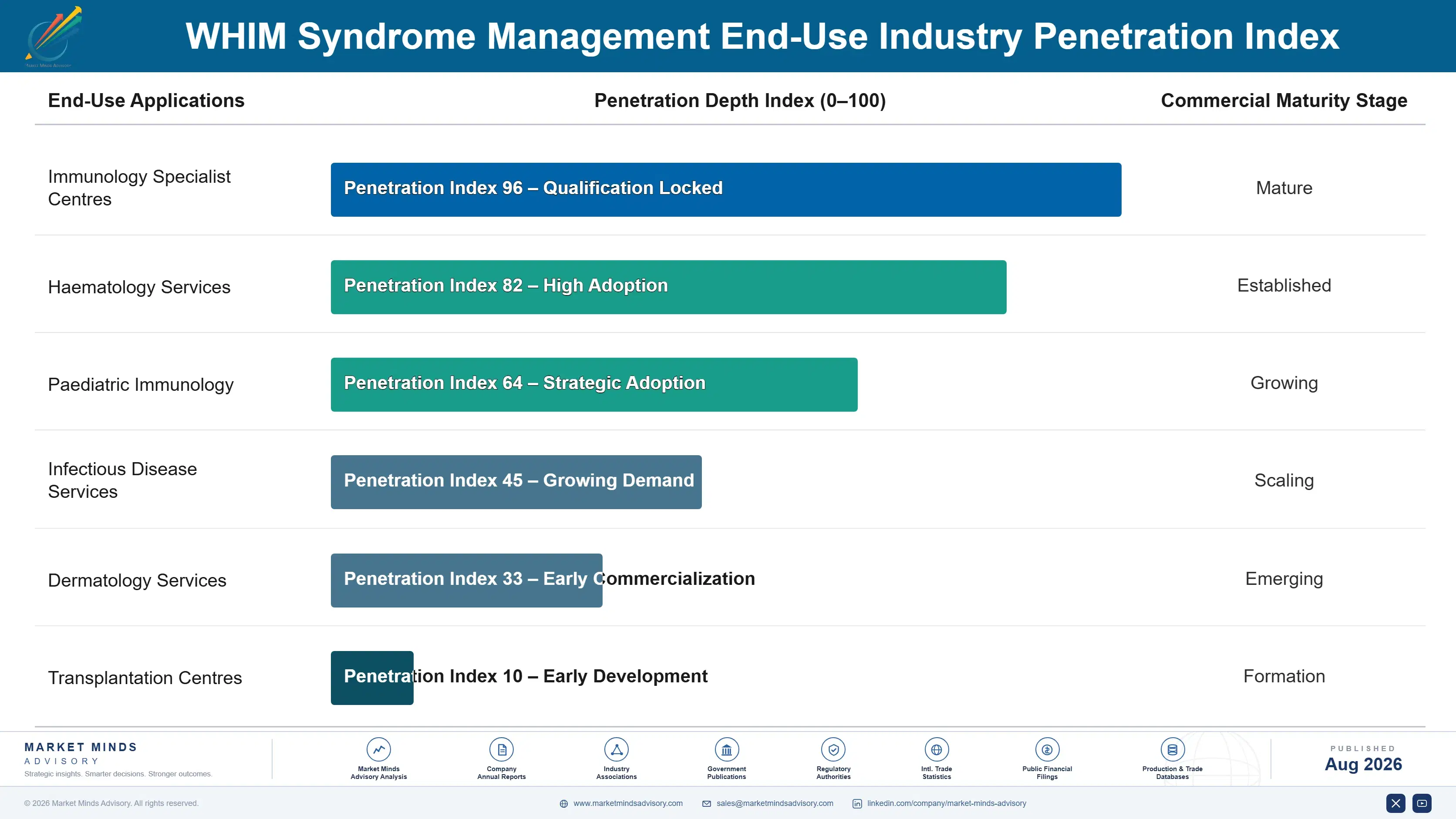
whim-syndrome-management-market-end-use-penetration-index-1787665044656

Where This Market Rewards Focus

These are among the four positions where our research anticipates prominent divergence between winners and laggards over the coming forecast period. Each is grounded in the demand model, the regulatory perimeter, and the announced capacity pipeline.
01 / DIAGNOSTIC YIELD INVESTMENT

The market is nine times its current size

Roughly 11% of people expected to carry pathogenic CXCR4 variants hold a confirmed genetic diagnosis, and median delay from first presentation to confirmation runs around 14 years across the identified population. Every commercial question here reduces to that gap, since a confirmed patient is a treatment candidate almost automatically and an unconfirmed one cannot be reached by anybody at all. Investment in identification expands the population itself, which no amount of promotional activity directed at treating clinicians will ever achieve.
02 / COMBINATION CARE DESIGN

Correcting the count is not the cure

Around 63% of treated patients continue carrying human papillomavirus lesions after neutrophil and lymphocyte counts normalise, because susceptibility in this condition is not solely a function of circulating neutrophil numbers at all. Management therefore remains combination rather than substitution, which is the opposite of what a mechanism matched therapy usually does to a treatment market. Positioning targeted therapy as a replacement for supportive care creates expectations that clinical experience will contradict within months of the patient starting treatment at all.
03 / PANEL INCLUSION STRATEGY

Remove the need for anybody to suspect

Historical diagnosis required a clinician to suspect this specific syndrome and order targeted testing, which is precisely why identification has reached only around 11% of expected cases across four decades of clinical awareness. Adding CXCR4 variants to broad congenital neutropenia and primary immunodeficiency panels removes that requirement, since the variant reports whether anybody was looking for it or not. Panel inclusion work is slow, unglamorous and more consequential than any other commercial activity available anywhere in this market at present.
04 / TESTING CAPACITY ACCESS

Follow the sequencers, not the prescribers

Chinese paediatric haematology and immunology services have expanded genetic sequencing capability rapidly, and broad panel testing is now routine wherever recurrent infection and unexplained neutropenia present together in a patient. China grows at 22.6%, faster than any market covered in this report, entirely through identification rather than any change in treatment of known patients. Reimbursement rather than clinical willingness sets the lag there, which is a more tractable constraint than the Western access negotiations that this market otherwise has to face.

Engagement Snapshot From the Field

A live engagement with an industry participant carrying material or product regulatory and market exposure ahead of a defining policy shift, showing how our research translates into a defensible multi-year portfolio strategy.
MARKET MINDS ADVISORY · CLIENT ENGAGEMENT SUMMARY
WHIM Syndrome Management Producer Strategic Portfolio Review and Transition Roadmap 2026·Investment Scenario on WHIM Syndrome Management Exposure Evaluation 2025-26
CLIENT PROFILE
A rare disease biopharmaceutical company commercialising a targeted therapy in a genetically defined primary immunodeficiency across North America and Western Europe. Annual revenue was approximately 62 million dollars (client-reported, unverified by MMA), from a treated population numbering in the low hundreds. Commercial resources were directed almost entirely at immunology specialists already managing patients with a confirmed diagnosis.
STRATEGIC CHALLENGE
Revenue growth had slowed as the identified patient pool was largely converted, while epidemiology suggested the great majority of affected people remained undiagnosed. Management was weighing further commercial investment against funding diagnostic infrastructure it would not own. Nobody had modelled what proportion of future revenue depends on activity outside the company's direct commercial control.
MMA APPROACH
MMA modelled the diagnosed and undiagnosed population separately and projected identification under alternative panel inclusion scenarios by country. Diagnostic yield investment was costed against incremental commercial headcount on comparable terms. Forty-seven expert interviews with immunologists, clinical geneticists, laboratory directors and payer assessors established how diagnoses are genuinely made, alongside survey work across six countries.
KEY FINDINGS
  1. Around 88% of projected revenue over ten years depended on patients not yet diagnosed, which no amount of promotional activity to treating clinicians could influence at all.
  2. Panel inclusion in 3 major reference laboratories was modelled to identify more new patients over five years than doubling the commercial field team would produce.
  3. Payer assessors in 4 of the 6 markets surveyed asked about wart persistence specifically, and the company's materials had not addressed it in any form.
  4. Median time from panel inclusion to first identified patient ran about 9 months, considerably shorter than management had assumed when deprioritising the work.
CLIENT PROFILE
A rare disease biopharmaceutical company commercialising a targeted therapy in a genetically defined primary immunodeficiency across North America and Western Europe. Annual revenue was approximately 62 million dollars (client-reported, unverified by MMA), from a treated population numbering in the low hundreds. Commercial resources were directed almost entirely at immunology specialists already managing patients with a confirmed diagnosis.
STRATEGIC CHALLENGE
Revenue growth had slowed as the identified patient pool was largely converted, while epidemiology suggested the great majority of affected people remained undiagnosed. Management was weighing further commercial investment against funding diagnostic infrastructure it would not own. Nobody had modelled what proportion of future revenue depends on activity outside the company's direct commercial control.
MMA APPROACH
MMA modelled the diagnosed and undiagnosed population separately and projected identification under alternative panel inclusion scenarios by country. Diagnostic yield investment was costed against incremental commercial headcount on comparable terms. Forty-seven expert interviews with immunologists, clinical geneticists, laboratory directors and payer assessors established how diagnoses are genuinely made, alongside survey work across six countries.
KEY FINDINGS
  1. Around 88% of projected revenue over ten years depended on patients not yet diagnosed, which no amount of promotional activity to treating clinicians could influence at all.
  2. Panel inclusion in 3 major reference laboratories was modelled to identify more new patients over five years than doubling the commercial field team would produce.
  3. Payer assessors in 4 of the 6 markets surveyed asked about wart persistence specifically, and the company's materials had not addressed it in any form.
  4. Median time from panel inclusion to first identified patient ran about 9 months, considerably shorter than management had assumed when deprioritising the work.
RECOMMENDED STRATEGY
Phase 1: Phase one: fund panel inclusion at major reference laboratories, which identifies more patients than doubling field headcount over five years. Phase 2: Phase two: rebuild payer materials around combination management, since assessors in 4 of 6 markets raised wart persistence entirely unprompted. Phase 3: Phase three: model pricing for a population several times larger, because the whole growth thesis assumes exactly that outcome arriving.
OUTCOME
The client redirected commercial investment into panel inclusion and clinician education, and newly identified patient referrals rose within the projected window. Payer materials rebuilt around combination management removed an objection that had been surfacing repeatedly, and pricing scenarios for a larger population were modelled for the first time (client-reported, unverified by MMA).

Frequently Asked Questions

Foundational context covering the market sizes, CAGR, scope, country, region and competition that inform every finding below. This section is provided to cover basics and most often pre-purchase conversations, answered from the MMA Primary Research Dataset.

What is the current size of the WHIM Syndrome Management Market?

The market was valued at 0.09 billion dollars in 2025, covering targeted therapy and supportive management in confirmed cases worldwide. It reaches an estimated 0.10 billion dollars during 2026.

How large will the WHIM Syndrome Management Market be by 2036?

MMA forecasts 0.46 billion dollars by 2036, an increase of 0.36 billion dollars over the 2026 base. That represents an expansion multiple of 4.60 times across the forecast period.

What is the CAGR for the WHIM Syndrome Management Market 2026 to 2036?

The base case compound annual growth rate is 16.4%, with a bull case of 17.6% and a bear case of 15.0%. Genetic panel inclusion and payer resistance separate those two scenarios.

Which segment is growing fastest?

CXCR4 antagonist therapy grows at 24.6%, half again the market rate of 16.4%, driven by diagnostic identification rather than prescribing. Human papillomavirus directed management follows at 12.4%.

Who are the major companies in the WHIM Syndrome Management Market?

X4 Pharmaceuticals, Takeda, CSL Behring, Grifols and Amgen lead on treated patient share across targeted and supportive modalities. Together they account for 82% of the global market.

Which country is growing fastest?

China grows fastest at 22.6%, because genetic sequencing capability has expanded rapidly across paediatric services and finds patients whose condition was always present but never identified.

Report Segmentation Architecture

The full report scope spans multiple orthogonal segmentation dimensions, with cross-tabulated demand data provided for each dimension pair. Coverage extends further to regional breakdowns, trend trajectories, and the competitive detail needed to support segment-level decision-making.

By Therapeutic Modality

  • CXCR4 Antagonist Therapy
  • Immunoglobulin Replacement Therapy
  • Granulocyte Colony Stimulating Factor Therapy
  • Antimicrobial Prophylaxis
  • Human Papillomavirus Directed Management
  • Haematopoietic Stem Cell Transplantation

By End-Use Industry

  • Immunology Specialist Centres
  • Haematology Services
  • Paediatric Immunology
  • Infectious Disease Services
  • Dermatology Services
  • Transplantation Centres

By Commercial Dimension

  • Specialty Pharmacy Distribution
  • Hospital Direct Supply
  • Named Patient and Compassionate Access
  • Payer Managed Access Agreements
  • Clinical Trial Supply
  • Home Infusion Services

By Region

  • North America
  • Western Europe
  • East Asia
  • South Asia and Pacific
  • Latin America
  • Middle East and Africa
  • Eastern Europe

Scope, Methodology, and Coverage

Every figure in this report is reproducible from documented input assumptions. The scope below maps the historical period, the forecast horizon, the segmentation dimensions, and the countries covered, alongside the underlying primary and qualitative methodology.
Historical Period
2020 to 2025
Forecast Period
2026 to 2036
Base Year
2025 (USD billions; MMA Primary Research Dataset, August 2026)
Market Definition
Therapies and supportive management used in confirmed WHIM syndrome, a primary immunodeficiency caused by gain of function variants in the CXCR4 receptor and characterised by warts, hypogammaglobulinaemia, recurrent infections and retention of mature neutrophils in the bone marrow, covering CXCR4 antagonist therapy, immunoglobulin replacement, granulocyte colony stimulating factor therapy, antimicrobial prophylaxis, human papillomavirus directed management and haematopoietic stem cell transplantation, measured at manufacturer selling value worldwide. Genetic testing services and equipment, management of primary immunodeficiency outside confirmed WHIM syndrome, and investigational gene therapy are excluded from scope.
Quantitative Units
USD billions (manufacturer selling value); treated patients; USD per patient year by modality
Segmentation Dimensions
Therapeutic modality; end-use industry; commercial dimension; region
Regions Covered
North America, Western Europe, East Asia, South Asia and Pacific, Latin America, Middle East and Africa, Eastern Europe
Countries Covered
United States, Canada, United Kingdom, Germany, France, Italy, Spain, Netherlands, Sweden, Switzerland, China, Japan, South Korea, Taiwan, India, Australia, Brazil, Mexico, Argentina, Saudi Arabia, Israel, Poland
Key Companies Profiled
X4 Pharmaceuticals, Takeda, CSL Behring, Grifols, Amgen, Kedrion, Octapharma, Biotest, LFB Group, ADMA Biologics, Pfizer, Teva Pharmaceutical Industries, Sandoz, Coherus BioSciences, Partner Therapeutics, Merck, GSK, Gilead Sciences, BioCryst Pharmaceuticals, Sobi
Quantitative Methodology
Primary survey, n=3,800 respondents, Q4 2025, six countries; demand-side model with trade association cross-validation
Qualitative Methodology
47 expert interviews, Q4 2025; applied to validate demand model assumptions, identify emerging dynamics, and assess competitive positioning
Report Format
PDF and XLSX data workbook (Word format preview document)
Publisher
Market Minds Advisory
Report Code
MMA-2026-HLT-150
Published
August 2026
Contact
sales@marketmindsadvisory.com | www.marketmindsadvisory.com

Purchase the full WHIM Syndrome Management Market Report (2026 to 2036).

The full report treats WHIM syndrome as a market where the science finished before the commercial problem started, since a mechanism matched therapy exists and most affected people have never been diagnosed. It sizes all six therapeutic modalities independently through 2036, models diagnosed against expected populations by country, and quantifies the persistent wart burden that keeps supportive care in the pathway. Regional chapters cover all seven regions, with approval sequencing and diagnostic infrastructure assessed separately from population size. Competitive profiling covers 20 participants on one consistent treated patient measure.
Six therapeutic modalities sized independently through 2036
Diagnosed populations modelled against expected genetic prevalence
Genetic panel inclusion tracked across major reference laboratories
Persistent wart burden quantified against neutrophil count normalisation
Payer access arrangements assessed by market and mechanism
Twenty participants profiled on one consistent patient measure

Built For The People Who Decide

From boardroom strategy to bench-side execution, this report is read cover-to-cover by leaders shaping the next decade of their industry, turning demand scenarios, market dynamics and valuation benchmarks into decisions.
CXOs/ Presidents/ VPs/ Managers
M&A and Corporate Development
Strategy Teams and R&D Heads
Procurement and Product Directors
Regulatory and Compliance Leaders
Investor Relations and Equity Analysts