Market Minds Advisory
Whey Permeate Market

Whey Permeate Market: From Disposal Problem To Functional Ingredient, And The Specification Gap That Still Limits It

A by-product that cheesemakers once paid to dispose of now substitutes for skimmed milk powder at a fraction of the cost, though composition varies with the cheese process and specification consistency remains the binding limit.

Lead Analyst

Lisa Gevelber

Published

September 2026

Make Smarter Decisions with Customized Research Insights

Request a free sample report and evaluate market opportunities, growth trends, and competitive dynamics relevant to your business needs.

2025 MARKET VALUE$1.6BMarket Size 2025
2036 FORECAST VALUE$3.2BBase Case , 2026 to 2036
CAGR 2026 TO 20366.4 %Bull 7.6% / Bear 5.2%
INCREMENTAL OPPORTUNITY$1.5BNet 10- year value creation
EXPANSION MULTIPLE1.86x2036 value over 2026 base
Strategic Levers
M&A Pipeline
Regional Outlook
Country Rankings
Competitive Intelligence
Segmental Deep-dive
Call-Us : 91 93563 13602

Executive Snapshot and Market Trajectory

Whey permeate was a disposal cost for most of the history of cheesemaking, spread on fields or paid to be taken away. It is now a functional ingredient substituting for skimmed milk powder at a fraction of the price, which is a remarkable commercial reversal. Nobody planned it that way.
Food grade functional permeate carries the growth on straightforward cost substitution that food manufacturers under margin pressure have been unusually receptive to. Feed grade grows nearly as fast and functions as the price floor beneath everything else. Western Europe holds the largest share because European cheese production generates more permeate than anywhere and processors there commercialised it first rather than continuing to treat it as waste.
Concentration reads at 41% for the top five, moderate because permeate arises wherever cheese is made and that is a genuinely dispersed activity. Specification consistency is the constraint that still limits food adoption, since composition varies with the cheese process behind it and manufacturers need reliable material rather than whatever a particular week produced. Processors who blend deliberately across sources reach food applications that processors drying whatever emerged simply cannot.
Market Definition
This market covers whey permeate produced by ultrafiltration of whey, spanning food grade functional permeate, feed grade permeate, delactosed permeate, permeate for lactose recovery, and liquid permeate supplied for further processing. Whey protein concentrate and isolate, milk permeate derived from milk rather than whey ultrafiltration, refined crystalline lactose sold as such, and whole and skimmed milk powders are excluded.
Base Year Value
$1.6B in 2025 (MMA Primary Research Dataset, August 2026)
Forecast Period
2026 to 2036, eleven discrete annual values
CAGR
6.4% base case. Bull 7.6%. Bear 5.2%.
Fastest Growth Segment
Food Grade Functional Permeate: 9.6% CAGR
Fastest Growth Country
India: 9.2% CAGR
Fastest Growth Region
South Asia and Pacific: 8.7% CAGR
Largest Region
Western Europe: 29% of 2025 global value
Market Leaders
Arla Foods Ingredients, Lactalis Ingredients, FrieslandCampina, Glanbia and Leprino Foods lead on whey permeate revenue. Source: MMA Primary Research Dataset, July 2026.
Primary Survey
n=3,800 procurement and R&D decision-makers, Q4 2025, six countries
Methodology
Demand-side build-up, cross-validated against public data, 47 expert interviews

Whey Permeate Market Forecast Scenarios

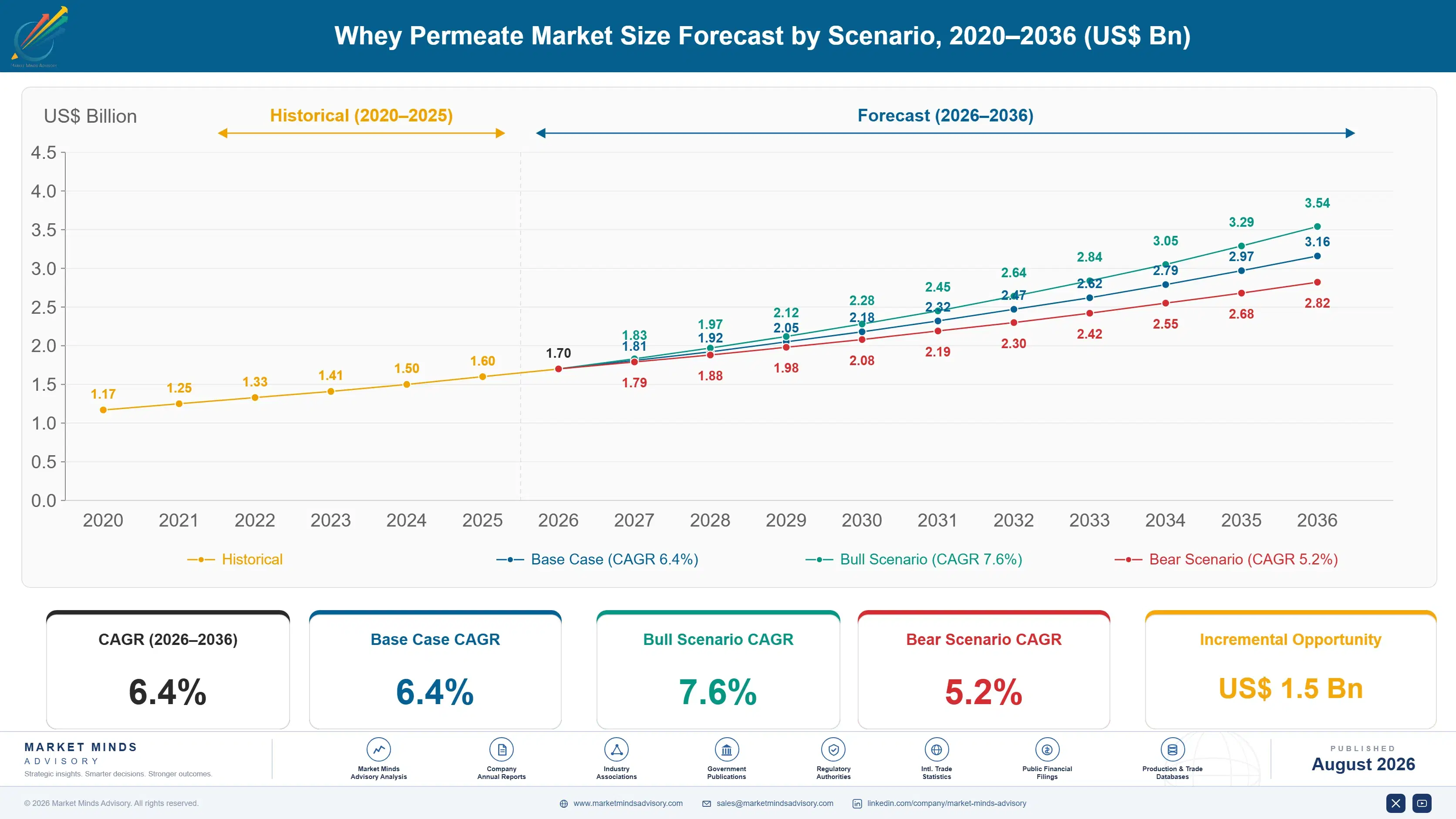
whey-permeate-market-trends-forecast-size-forecast-scenario-1787375399000
Growth ran at 5.4% annually between 2020 and 2025, and the driver was cost substitution rather than any new application. Food manufacturers facing dairy ingredient inflation looked for cheaper sources of dairy solids and found permeate sitting there, already produced, already available. Processors who had invested in drying capacity to solve a disposal problem discovered they had built an ingredient business by accident.
The base case at 6.4% rests on three mechanisms. Food manufacturers keep substituting permeate for skimmed milk powder as dairy ingredient costs stay elevated and formulators become comfortable with the functional differences. Cheese production keeps growing, which generates permeate whether anybody wants it or not. And Indian and Southeast Asian food manufacturing expands quickly, with cost-sensitive formulation exactly suited to what permeate offers. None of the three depends on a new application appearing.
The bull case at 7.6% turns on specification standardisation across processors, which would remove the consistency concern that keeps many food manufacturers from committing volume. The bear case at 5.2% reflects skimmed milk powder pricing falling far enough to erode the substitution economics, since permeate demand rests almost entirely on being cheaper rather than on being better.

A Disposal Cost That Became An Ingredient

Cheesemakers used to pay to make whey permeate disappear. Land spreading, effluent treatment, whatever was cheapest and legal. Environmental rules made disposal steadily more expensive, processors installed evaporation and drying capacity to reduce the volume, and somewhere in that process they realised they had a product rather than a problem. The reversal took about two decades and nobody set out to achieve it.
TOP FIVE CONCENTRATION41%Moderate, since permeate arises wherever cheese is actually made
COST AGAINST MILK POWDER38%Permeate pricing as a proportion of skimmed milk powder
FOOD GRADE SHARE46%Portion of volume meeting food application specification requirements
LACTOSE CONTENT78%Typical lactose proportion of dried permeate on solids
DRYING COST SHARE43% of COGSEvaporation and drying contribution to finished permeate manufactured cost
QUALIFICATION CYCLE7 monthsTypical time to qualify permeate into a food formulation
The commercial argument is cost, not performance. Permeate delivers dairy solids, mild dairy flavour and browning behaviour at roughly 38% of skimmed milk powder pricing, and food manufacturers under margin pressure have proved unusually willing to reformulate around it. Bakery, confectionery, processed cheese and savoury seasoning take most of the food tonnage. Nobody claims it works better than milk powder. They claim it is cheap enough to be worth the reformulation work.
Specification consistency is what still limits adoption. Permeate composition varies with the cheese process it came from, so material from a cheddar plant behaves differently from mozzarella permeate, and a manufacturer formulating around it needs reliable input rather than whatever a particular week produced. Processors solving that through deliberate blending reach food applications that processors drying whatever emerged simply cannot.
"The whole industry spent decades treating permeate as an effluent problem and installing driers to shrink it. Then somebody worked out that dried effluent was worth more than the disposal saving, and here we are."
Director, Dairy Ingredients and Food Manufacturing Practice · MMA Dairy Ingredients Practice · August 2026

Market Trends

Cost Substitution Against Milk Powder Drives Everything Here

Permeate delivers dairy solids, mild dairy flavour and browning behaviour at roughly 38% of skimmed milk powder pricing, and that single ratio explains almost all of the demand growth in this category. Food manufacturers facing dairy ingredient inflation reformulated toward it because the arithmetic was obvious rather than because anybody argued it performed better. Bakery, confectionery and processed cheese absorb most of the food tonnage. The demand rests entirely on the price gap holding, which is worth remembering. Milk powder pricing sets the ceiling on everything in this market. That ratio explains almost everything.
Market Impact: Supply follows 100% of cheese output

Specification Blending Separates Food Suppliers From Feed Suppliers

Permeate composition varies with the cheese process behind it, so material from a cheddar plant behaves differently from mozzarella permeate in a formulation. Manufacturers need reliable input rather than whatever a given week produced, which means deliberate blending across sources and campaigns rather than simply drying what emerged. Processors doing that work reach food applications commanding considerably better pricing. Those drying whatever came out of the plant remain in feed, where the specification tolerance is far wider. Feed tolerance is wide enough to accept almost anything that dries. Specification work separates the two absolutely.
Market Impact: India grows at 9.2% annually

Market Opportunities and Growth Drivers

Cheese Production Growth Generates Permeate Regardless Of Demand

Permeate arises as an unavoidable consequence of whey ultrafiltration, so every additional tonne of cheese produced generates permeate whether anybody has a buyer for it or not. Global cheese output keeps growing on consumption trends entirely unconnected to ingredient markets. That makes supply genuinely inelastic to price in the short term, which is unusual and which caps how far permeate values can run before volume simply appears. Processors cannot dial production up or down. Volume simply appears whenever values run far enough to justify drying it. Processors cannot dial the stream up or down at will.
Market Impact: Substitution needs a 40% gap

Indian And Southeast Asian Food Manufacturing Suits Permeate Economics

Cost-sensitive formulation across Indian and Southeast Asian packaged food manufacturing is exactly the environment permeate was made for, since the whole argument is delivering dairy character at a fraction of milk powder cost. Indian demand grows near 9.2% annually as packaged bakery, confectionery and savoury snack production scales. Domestic cheese production is limited, so most permeate arrives as an import from European and North American processors with capacity to spare. European and North American processors with spare capacity supply almost all of it. Domestic cheese output remains genuinely limited across the region.
Market Impact: Keeps 54% of volume in feed

Market Restraints and Challenges

Demand Rests Entirely On Staying Cheaper Than Milk Powder

Permeate is bought because it costs roughly 38% of skimmed milk powder, and almost nobody buys it because it performs better at anything. The root cause is that the functional argument was always secondary to the price one. Commercially this means demand erodes quickly whenever milk powder pricing falls far enough that reformulation stops paying, and formulators do reverse the decision. Participants are responding with functional positioning around browning and flavour, longer contracts, and applications where permeate genuinely performs. Formulators do reverse the substitution when the arithmetic changes. Function is the only durable defence.
Market Impact: Prices at 38% of milk powder

Composition Variability Keeps Manufacturers From Committing Volume

Permeate from different cheese processes carries different mineral profiles, lactose content and flavour characteristics, and a food manufacturer formulating around it needs consistency it cannot always get. The root cause is that the material is a by-product of a process optimised for cheese rather than for permeate. Commercially this keeps many manufacturers at trial volumes rather than full commitment. Participants are responding with blending programmes, tighter specification bands, and technical support helping formulators absorb residual variation. Trial volumes are where a great deal of this material stalls permanently. Blending programmes are the practical answer.
Market Impact: Food grade covers 46% of volume
3 additional market trends, 2 additional growth drivers, and 4 additional restraints and challenges are covered in the full report. Contact sales@marketmindsadvisory.com to access the complete intelligence.

Segment CAGR and Growth Architecture

Five product grades divide this market on specification and application rather than on the cheese process each stream came from. That reflects how buyers actually purchase, since a food manufacturer specifies mineral profile and consistency while a feed compounder buys digestible energy per unit of cost, and neither asks which vat it originated in.
whey-permeate-market-trends-forecast-market-share-analysis-1787375399539

Food Grade Functional Permeate

Growing at 9.6% and the fastest part of this market. Food grade permeate supplied as a functional ingredient into processed food is where the value actually gets created, because permeate delivers dairy solids, mild dairy flavour and browning behaviour at a fraction of the cost of skimmed milk powder. Bakery, confectionery, processed cheese and savoury seasoning applications take most of the tonnage. The commercial argument is straightforward cost substitution, and food manufacturers under margin pressure have been unusually receptive to it. What limits the segment is that permeate composition varies with the cheese process it came from, so specification consistency requires deliberate blending rather than simply drying whatever emerged. Blending is the whole difference here.
CAGR 9.6%

Feed Grade Permeate

Growing at 8.2% on permeate supplied into animal feed, principally as a lactose and mineral source in piglet starter diets and calf milk replacers where digestible energy density matters more than protein content. Feed remains the single largest outlet by tonnage and it functions as the floor under permeate pricing, since any material that cannot meet food specification goes here instead. That floor is commercially useful and commercially limiting at the same time. Lactose price movements drive the segment more than feed demand does, because permeate competes directly against refined lactose and whey powder on digestible energy delivered per unit of cost. The floor is useful and limiting at once.
CAGR 8.2%
Full segment breakdown across 5 segments available in the complete report.

Regional Architecture and Country Demand Map

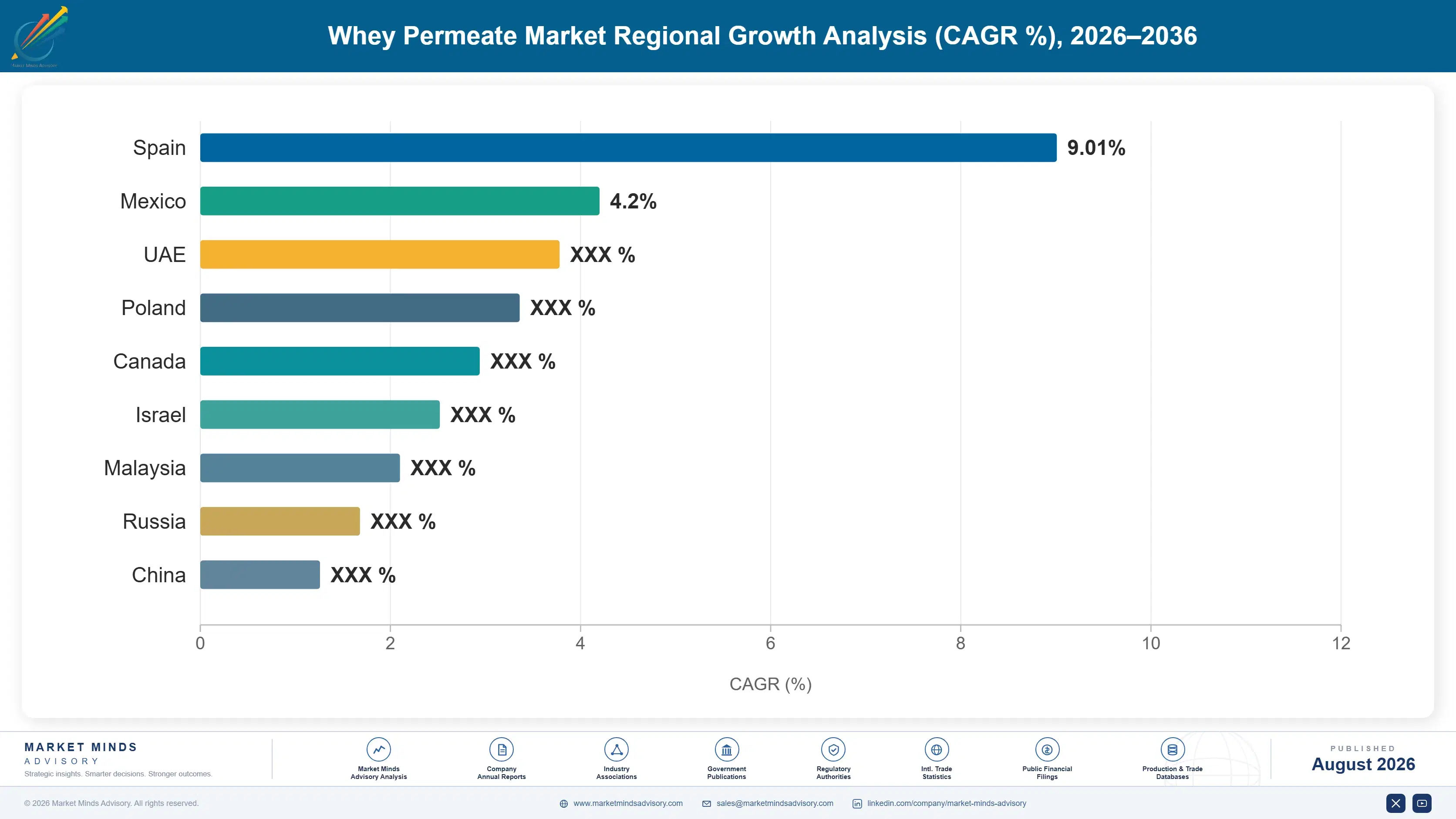
Western Europe holds 29% of global value because European cheese production generates more permeate than anywhere and processors there commercialised it first. North America follows at 27% on cheese output, while South Asia and Pacific grows fastest on cost-sensitive food manufacturing. Import dependence shapes most Asian demand.

Western Europe

Note: Western Europe sits marginally above the standard share band because European cheese production generates more whey permeate than any other region and processors here commercialised it earliest, which no allocation reflecting the real market can avoid. Environmental rules on effluent made disposal expensive here before anywhere else, which forced the investment in drying capacity that created the ingredient business. Arla, Lactalis and FrieslandCampina all built substantial permeate operations from that starting point. Germany, France, the Netherlands and Ireland carry most of the volume. Food application development is furthest advanced here, with formulators comfortable enough that permeate appears in mainstream products rather than only in cost-led ranges. Effluent rules forced the investment that created the business.
Share: 29% | CAGR: 4.9% (2026 to 2036)

North America

Cheese production at genuine scale generates the permeate volume here, with American mozzarella and cheddar output producing streams that dwarf what most regions handle. Leprino and other large processors run drying capacity built around handling those volumes rather than around serving any particular ingredient demand. Food application adoption trails Western Europe somewhat, with more volume moving into feed and export than into domestic food manufacturing. Export markets across Asia and Latin America absorb considerable tonnage. Environmental regulation on effluent varies by state rather than applying nationally, which has produced uneven investment in drying capacity across the country. Export tonnage into Asia and Latin America absorbs a considerable share of it.
Share: 27% | CAGR: 6.8% (2026 to 2036)
Regional intelligence for 5 additional markets available in the complete report: East Asia, South Asia and Pacific, Latin America, Middle East and Africa, Eastern Europe. Contact sales@marketmindsadvisory.com.
whey-permeate-market-trends-forecast-country-cagr-analysis-1787375400063

Where Permeate Value Actually Gets Created

Four positions separate processors earning ingredient margins from those drying a by-product and hoping: blending across sources for specification consistency, qualifying into food formulations, positioning on function rather than only price, and running drying capacity efficiently enough to survive a narrow substitution gap. Only the last of those requires serious capital investment. Everything else is discipline.

Blend Across Sources For Specification Consistency

Permeate composition varies with the cheese process behind it, and a food manufacturer needs reliable input rather than whatever a given week produced at the plant. Deliberate blending across sources and campaigns delivers that, and processors doing it realise 30% to 38% higher pricing than those drying whatever emerged. The work is inventory discipline and analytical capability rather than capital investment, which makes it among the cheapest genuine improvements available in this business. It is the cheapest genuine improvement most of these operations can make. Analytical capability is the requirement, not new plant.
Market Impact: Realises up to 38% higher pricing than unblended

Qualify Into Food Formulations Rather Than Selling Feed

Feed takes roughly 54% of volume and functions as the price floor beneath everything, which is commercially useful and commercially limiting at the same time. Food qualification takes around seven months of specification work and trials, after which the volume repeats for as long as the product is made. Food grade realises materially better pricing than feed on the same material, and the difference is specification capability rather than any change to the underlying stream. Feed tolerance is wide, food tolerance is not, and that gap is the business. Seven months is not undertaken lightly.
Market Impact: Moves volume off the 54% feed volume floor

Position On Browning And Flavour Not Only Price

Demand resting entirely on costing roughly 38% of skimmed milk powder is demand that disappears when milk powder pricing falls, and formulators genuinely do reverse the decision when the gap narrows below about 40%. Applications where permeate contributes browning, mild dairy flavour or texture on its own merits survive that reversal. Building those positions costs technical support rather than capital, and it converts a price argument into a formulation one that holds. A formulation argument survives a price movement in a way a cost argument never does. Browning and mild dairy flavour are real contributions.
Market Impact: Survives price gaps narrowing below the 40% threshold

Run Drying Capacity Efficiently Against A Narrow Gap

Evaporation and drying account for roughly 43% of manufactured cost, which is high for a product whose whole proposition is being cheap. Heat recovery, mechanical vapour recompression and drier optimisation cut energy consumption by 15% to 22% against elevated European pricing. That efficiency decides whether the substitution economics still work when milk powder softens. Processors who invested before energy costs rose hold a cost position competitors are now spending capital to reach. Nobody can pass energy inflation through when a substitute sets the ceiling. Efficiency is the only lever a processor genuinely controls.
Market Impact: Cuts drying energy consumption by up to 22%

Who Controls the Margin Pool

Concentration reads at 41% for the top five measured on whey permeate revenue, the basis used throughout this section, and it is moderate because permeate arises wherever cheese is made and cheesemaking is dispersed. Arla Foods Ingredients and FrieslandCampina hold the deepest food application positions. Lactalis and Glanbia bring processing breadth across dairy ingredients, and Leprino generates volume from American mozzarella output at genuine scale.
Competition runs on three fronts. Specification consistency is the first and the one that separates food suppliers from feed suppliers absolutely. Food formulation qualification is the second, converting spot tonnage into volume that repeats annually. Drying energy efficiency is the third, and it decides whether the substitution economics survive when milk powder pricing softens against permeate. None of the three is a volume argument.

Pressure arrives from two directions. Cheese output keeps growing and generates permeate whether anybody wants it, which caps how far values can run before volume appears from processors with capacity to spare. Separately, milk powder pricing sets the ceiling on everything. Rankings will shift toward processors holding food qualifications and efficient drying rather than those selling tonnage into feed.
whey-permeate-market-trends-forecast-company-positioning-matrix-1787375400594

Competitive Moat and Risk Dimensions

ARLA FOODS INGREDIENTS

Moat: Food application development depth

Years of application development work with food manufacturers has produced formulation knowledge and qualified positions that a processor drying tonnage cannot assemble quickly, and those positions repeat annually once established. Blending capability across multiple cheese streams also delivers the specification consistency that food manufacturers require before committing volume rather than running trials.
ARLA FOODS INGREDIENTS

Risk: Exposure to milk powder pricing

Demand built on permeate costing roughly 38% of skimmed milk powder erodes whenever that gap narrows, and formulators do reverse substitution decisions when the arithmetic changes. European energy costs also weigh on drying economics for a product whose entire proposition rests on being the cheap option in a formulation.
LEPRINO FOODS

Moat: Scale from mozzarella production

Enormous American mozzarella output generates permeate streams at a scale few processors anywhere handle, which supports drying capacity utilisation and a cost position that smaller operations cannot approach. Consistency of source is also better than a multi-plant blender achieves, since the volume comes from a comparatively uniform cheese process rather than several different ones.
LEPRINO FOODS

Risk: Limited food application development

Volume weighted toward feed and export rather than qualified food formulations leaves value on the table that European processors have been capturing for years through application work. Single-process source consistency also means less flexibility to blend toward a particular specification when a food manufacturer requires something the mozzarella stream does not naturally deliver.

Players Tracked

Prominent Players

Arla Foods Ingredients
Lactalis Ingredients
FrieslandCampina
Glanbia
Leprino Foods

Other Key Players

Agropur
Saputo
Hilmar Cheese Company
Valio
Fonterra
Kerry Group
Sachsenmilch
DMK Group
Milk Specialties Global
Idaho Milk Products
Eurial
Carbery Group
Tirlán
Grande Cheese Company
Lactoprot

Recent Developments

FEBRUARY 2025

Blending programme launched to deliver consistent food grade specification

A dairy ingredients processor introduced a cross-plant blending programme delivering permeate to a tightened specification band, addressing the composition variability that had kept food manufacturers at trial volumes rather than committing to full formulation use. Two stalled manufacturers returned to full commercial volume afterwards. Specification bands tightened materially.
Signal: Specification consistency rather than price is what has kept food manufacturers from committing any real volume
JUNE 2025

Bakery manufacturer completes milk powder substitution across product range

A large bakery manufacturer completed reformulation substituting whey permeate for skimmed milk powder across a substantial product range, citing delivered cost and acceptable browning performance, and contracting supply across multiple years to secure the position. Browning performance was the deciding technical test. Supply runs across three years.
Signal: Substitution decisions convert into multi-year contracts once a formulator commits to reformulating an entire range properly
OCTOBER 2025

Drying energy efficiency investment completed at European processing site

A European processor completed mechanical vapour recompression and heat recovery investment at a permeate drying facility, cutting energy consumption materially against pricing that has stayed elevated and protecting substitution economics if milk powder values soften. Payback was recalculated on post-2022 energy pricing. Commissioning completed ahead of schedule.
Signal: Drying efficiency decides whether substitution economics survive any narrowing of the gap against skimmed milk powder

What Drives Permeate Processing Cost

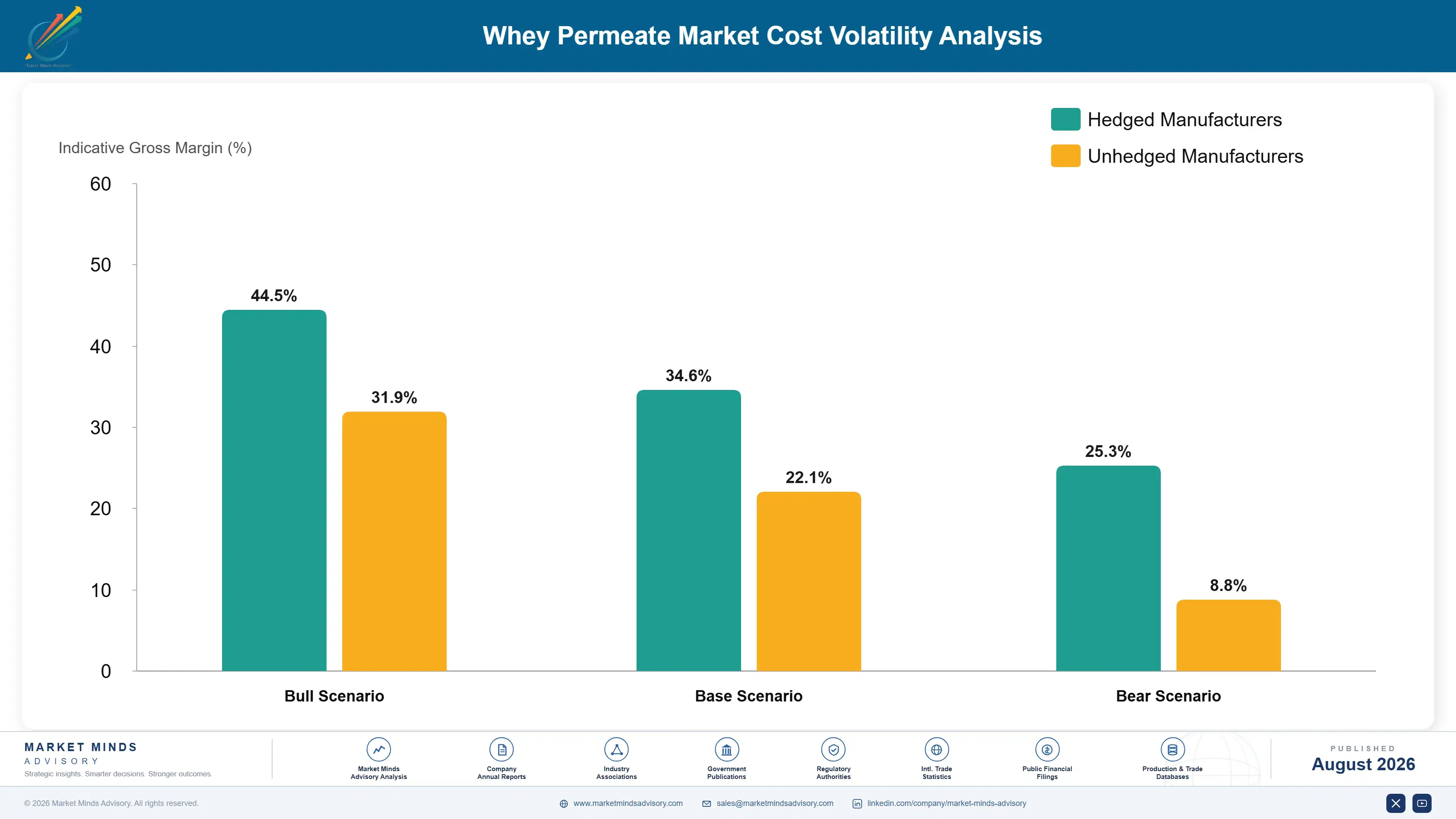
Evaporation and drying account for roughly 43% of manufactured cost, which is unusually high because permeate arrives as a dilute stream requiring substantial water removal. Ultrafiltration membrane operation and replacement add around 13%. Packaging and freight contribute about 16%, since dried permeate is bulky relative to value. Quality, testing and specification management reach roughly 9%, and plant labour close to 12% across a typical operation.
European industrial energy pricing rose sharply through 2022 and stayed above the previous decade's baseline according to International Energy Agency data, which hit permeate drying particularly hard given how energy-intensive water removal is. Skimmed milk powder pricing moved separately on dairy market conditions tracked in United States Department of Agriculture data, and permeate values followed it rather than following energy costs. Processors absorbed the difference between them.

The disadvantage mechanism is that permeate pricing is set by milk powder rather than by cost, and it falls hardest on processors with inefficient drying. A producer cannot pass energy inflation through because a substitute sets the ceiling, so the increase lands on margin. Exposure varies by energy position, since processors who invested in heat recovery before 2022 hold an advantage others are now spending capital to reach.
whey-permeate-market-trends-forecast-cost-volatility-analysis-1787375400790

Invest in drying heat recovery and vapour recompression

Evaporation and drying are over 40% of manufactured cost and permeate pricing is set by milk powder rather than by production expense, so efficiency is the only lever a processor genuinely controls. Heat recovery and vapour recompression cut consumption materially against elevated European pricing. The capital payback runs several years, and early investors are visibly better positioned now.

Blend across streams to reach food specification bands

Feed pricing functions as a floor and food pricing sits materially above it on the same underlying material, so the gap between them is specification capability rather than any physical difference. Blending across cheese sources and campaigns reaches food bands consistently. The requirement is analytical capability and inventory discipline rather than capital, which makes it the cheapest improvement available.

Contract food volume across multiple years where possible

Permeate demand rests on staying cheaper than skimmed milk powder, and formulators reverse substitution when that gap narrows below roughly 40%. Multi-year contracts secured at qualification make reversal commercially awkward and hold volume through the periods when milk powder softens. Buyers resist committing, so the terms have to be negotiated when the formulation is being qualified rather than afterwards.

Portfolio Architecture for Margin Defence

Portfolio economics here divide on specification capability rather than on the underlying stream, which is the same material in every case. Feed grade permeate sold on digestible energy per unit of cost competes directly against refined lactose and whey powder, and the buyer treats all three as interchangeable because at that specification they genuinely are. Cheese output guarantees the volume arrives regardless.
The middle tier is food grade permeate qualified into named formulations. Seven months of specification work and trials produce volume that repeats for as long as the product is made, and blending across sources delivers the consistency manufacturers require before committing. Margins reach the high twenties, well above feed, on material that differs only in how it was handled. Handling rather than processing creates the difference.

Above both sits food grade permeate positioned on functional contribution rather than price alone. Applications where permeate delivers browning, mild dairy flavour or texture on its own merits survive the milk powder price reversals that pure cost substitution does not. Margins reach the high thirties. The position requires application development work over years, which is precisely why so few processors have built it properly.

Volume / Commodity-Adjacent

Feed grade permeate sold on digestible energy per unit of cost. The range reflects lactose and whey powder pricing rather than commercial skill, and buyers treat competing sources as fully interchangeable.
Gross Margin: 9 to 16%

Premium / Certified

Food grade permeate qualified into named formulations on cost substitution. The range reflects specification consistency achieved through blending and whether supply is contracted across multiple years or annually. Requalification is rare.
Gross Margin: 24 to 32%

Sustainability / Regulatory / Next-Generation

Food grade permeate positioned on functional contribution rather than price alone. The wide range reflects how much application development has been done and whether the position survives milk powder price reversals.
Gross Margin: 34 to 43%
whey-permeate-market-trends-forecast-portfolio-architecture-1787375401399

High-value Sub-segments and Strategic Watch-out

Functionally Positioned Food Permeate

High value and high growth together, and the only position that survives a narrowing price gap against milk powder. The wide range reflects application development depth and whether browning or flavour contribution is genuinely established with the formulator. Application development takes years to build. Price alone will not hold.
Gross Margin: 34 to 43%

Qualified Food Formulation Volume

High value on strong growth and where most of the substitution demand actually lands. The range reflects specification consistency delivered through blending and whether supply was contracted multi-year at the point of qualification. Blending discipline is what actually delivers it consistently. Multi-year terms secure the position.
Gross Margin: 24 to 32%

Infant And Clinical Nutrition Supply

A demanding premium pool where specification tolerance is narrowest and documentation requirements heaviest. The range reflects whether a processor holds the quality systems and audit history these applications require before any volume is discussed. Audit history takes years to accumulate properly here. Documentation requirements are heaviest here.
Gross Margin: 29 to 38%

Feed Grade Commodity Tonnage

The strategic watch-out and the price floor beneath everything else. Volumes are certain since cheese output generates them regardless, but pricing follows lactose and whey powder entirely. The range reflects those markets rather than any decision. Cheese output generates it whether anybody wants it. Nothing about it is a decision.
Gross Margin: 9 to 16%

How Permeate Demand Actually Repeats

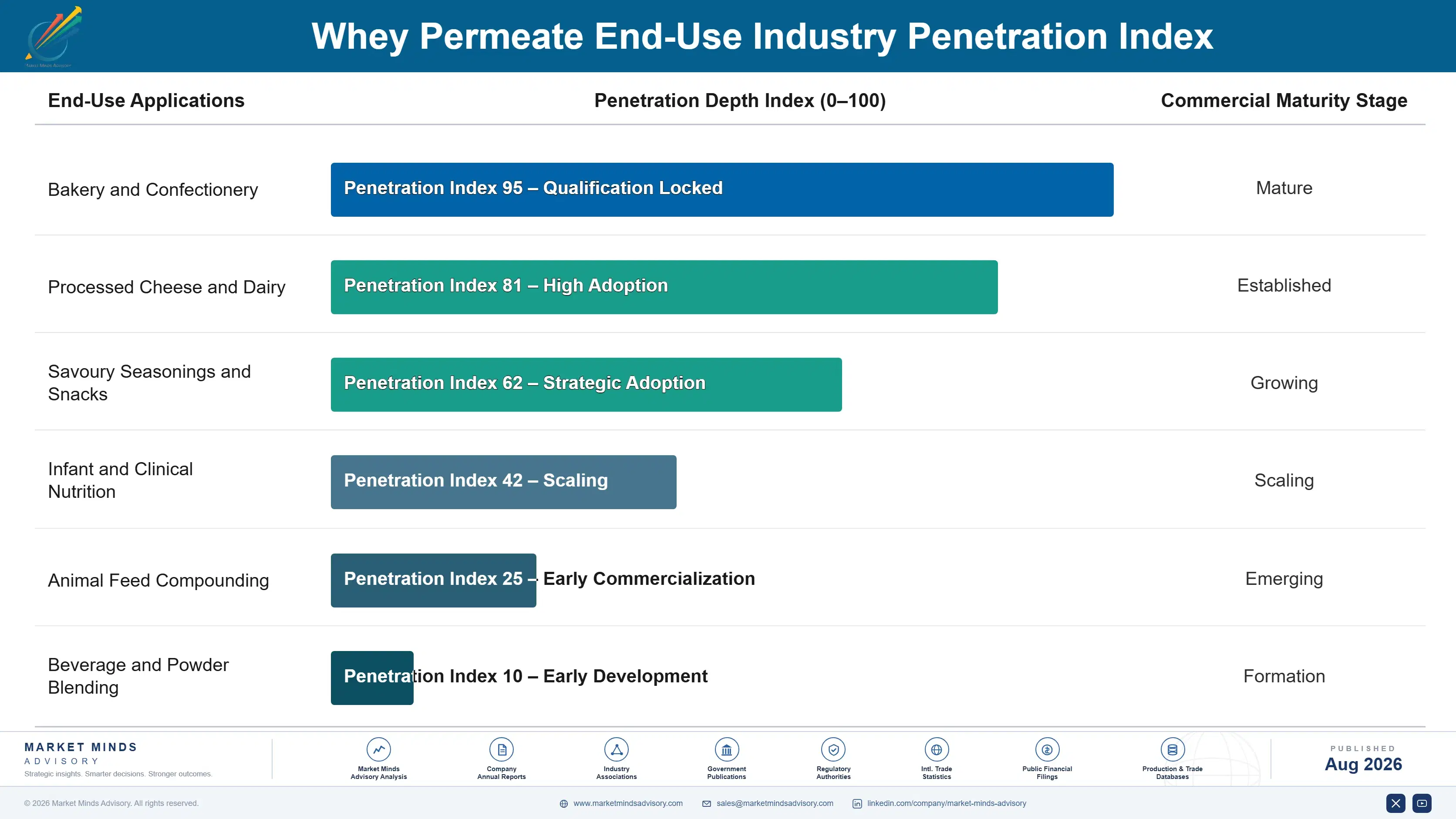
Repeat behaviour here is unusually asymmetric between the two halves of the market. A qualified food formulation repeats annually for as long as the product is manufactured, because requalification costs the buyer time and delivers nothing, and seven months of specification work is not undertaken lightly. Feed offtake repeats continuously but at whatever lactose and whey powder pricing dictates that quarter.
Stickiness varies sharply by application. Infant and clinical nutrition holds best, since specification tolerance is narrow and audit history takes years to build. Food formulations where permeate contributes browning or flavour on its own merits hold well, because the formulator is not simply buying cheap solids. Pure cost substitution holds only while the price gap holds. Feed tonnage holds worst of all, moving between sources without hesitation.

The buyer profile has changed considerably. Permeate was once bought by feed compounders as a cheap energy source and occasionally by food manufacturers running cost-reduction projects. Today's growth buyer is a food technologist who has worked with the material long enough to know what it does well, which is a considerably more durable relationship than a procurement decision taken on a spreadsheet during a bad quarter.
whey-permeate-market-trends-forecast-end-use-penetration-index-1787375402123

Where To Compete And Why

These are among the four positions where our research anticipates prominent divergence between winners and laggards over the coming forecast period. Each is grounded in the demand model, the regulatory perimeter, and the announced capacity pipeline.
01 / SPECIFICATION BLENDING DISCIPLINE

Consistency separates food from feed

Permeate composition varies with the cheese process behind it, and a food manufacturer formulating around it needs reliable material rather than whatever a given week happened to produce at the plant. Deliberate blending across sources and campaigns delivers that, and processors doing it realise 30% to 38% higher pricing than those drying whatever emerged. The work is inventory discipline and analytical capability rather than capital, which makes it the cheapest real improvement available anywhere in this particular business, and most processors still have not done it.
02 / FOOD QUALIFICATION PURSUIT

Feed is a floor, not a business

Feed takes roughly 54% of volume and functions as the price floor beneath everything else, which is commercially useful and commercially limiting at exactly the same time. Food qualification takes around seven months of specification work and trials, after which the volume repeats for as long as the product is manufactured. The pricing difference comes from specification capability rather than from any change to the underlying material, which is identical in both cases, since handling rather than processing creates the entire difference between them.
03 / FUNCTIONAL POSITION BUILDING

Cheap is not a defensible argument

Demand resting entirely on permeate costing roughly 38% of skimmed milk powder disappears when milk powder pricing falls, and formulators genuinely do reverse substitution when the gap narrows below about 40%. Applications where permeate contributes browning, mild dairy flavour or texture on its own merits survive that reversal intact. Building those positions costs technical support rather than capital, and it converts a price argument into a formulation one that holds through an entire dairy pricing cycle rather than only until the next one.
04 / DRYING ENERGY EFFICIENCY

You cannot pass energy through

Evaporation and drying run near 43% of manufactured cost while permeate pricing is set by skimmed milk powder rather than by production expense, so energy inflation lands entirely on margin with nowhere to go. Heat recovery and vapour recompression cut consumption by 15% to 22% against elevated European pricing. Processors who invested before energy costs rose hold a position competitors are now spending real capital trying to reach, several years behind them and against considerably worse payback arithmetic than they enjoyed.

Engagement Snapshot From the Field

A live engagement with an industry participant carrying material or product regulatory and market exposure ahead of a defining policy shift, showing how our research translates into a defensible multi-year portfolio strategy.
MARKET MINDS ADVISORY · CLIENT ENGAGEMENT SUMMARY
Whey Permeate Producer Strategic Portfolio Review and Transition Roadmap 2026·Investment Scenario on Whey Permeate Exposure Evaluation 2025-26
CLIENT PROFILE
A European regional dairy processor with annual revenue near $310 million (client-reported, unverified by MMA), producing cheese across three plants and drying the resulting permeate for sale. Roughly 79% of permeate volume moved into feed compounding at commodity pricing, with a small food grade position built opportunistically rather than through any deliberate commercial strategy at all.
STRATEGIC CHALLENGE
Energy costs had risen sharply against permeate pricing set by skimmed milk powder rather than by production expense, compressing margin on volume the business could not stop producing. Management needed to decide between investing in drying efficiency, building food qualification capability, or accepting commodity returns and treating permeate as a disposal solution again.
MMA APPROACH
MMA modelled contribution by grade and customer across four years of the client's own data, benchmarked realised pricing against processors holding food positions, and assessed blending and drying efficiency options against required capital. Twenty expert interviews with food manufacturers, feed compounders and process engineers tested what each route would genuinely deliver.
KEY FINDINGS
  1. Food grade volume delivered roughly 17 percentage points more contribution than feed on identical underlying material, with the difference sitting entirely in specification handling rather than in processing.
  2. Composition variability across the client's three plants was wide enough that blending would have reached food specification bands consistently, and nobody had ever analysed the streams together.
  3. Two food manufacturers had trialled the client's permeate and stopped at trial volumes specifically because batch consistency could not be relied upon across successive deliveries.
  4. Drying energy consumption ran roughly 24% above comparable European sites that had installed vapour recompression, which the client had assessed before 2022 on energy pricing that no longer applied.
CLIENT PROFILE
A European regional dairy processor with annual revenue near $310 million (client-reported, unverified by MMA), producing cheese across three plants and drying the resulting permeate for sale. Roughly 79% of permeate volume moved into feed compounding at commodity pricing, with a small food grade position built opportunistically rather than through any deliberate commercial strategy at all.
STRATEGIC CHALLENGE
Energy costs had risen sharply against permeate pricing set by skimmed milk powder rather than by production expense, compressing margin on volume the business could not stop producing. Management needed to decide between investing in drying efficiency, building food qualification capability, or accepting commodity returns and treating permeate as a disposal solution again.
MMA APPROACH
MMA modelled contribution by grade and customer across four years of the client's own data, benchmarked realised pricing against processors holding food positions, and assessed blending and drying efficiency options against required capital. Twenty expert interviews with food manufacturers, feed compounders and process engineers tested what each route would genuinely deliver.
KEY FINDINGS
  1. Food grade volume delivered roughly 17 percentage points more contribution than feed on identical underlying material, with the difference sitting entirely in specification handling rather than in processing.
  2. Composition variability across the client's three plants was wide enough that blending would have reached food specification bands consistently, and nobody had ever analysed the streams together.
  3. Two food manufacturers had trialled the client's permeate and stopped at trial volumes specifically because batch consistency could not be relied upon across successive deliveries.
  4. Drying energy consumption ran roughly 24% above comparable European sites that had installed vapour recompression, which the client had assessed before 2022 on energy pricing that no longer applied.
RECOMMENDED STRATEGY
Phase 1: Phase one: analyse and blend permeate streams across the three plants to reach a consistent food specification band, since this requires discipline rather than capital. Phase 2: Phase two: return to the two manufacturers who stopped at trial volumes, offering the consistency that caused them to stop and contracting supply multi-year. Phase 3: Phase three: commit vapour recompression capital on the revised energy pricing, which changes the payback materially against the pre-2022 assessment.
OUTCOME
The client lifted food grade from 21% to 48% of permeate volume within twelve months and secured both previously stalled manufacturers on multi-year terms (client-reported, unverified by MMA). Contribution per tonne improved by roughly 29%, drying energy investment was approved for 2027 commissioning, and no additional cheese capacity was required to achieve any of it.

Frequently Asked Questions

Foundational context covering the market sizes, CAGR, scope, country, region and competition that inform every finding below. This section is provided to cover basics and most often pre-purchase conversations, answered from the MMA Primary Research Dataset.

What is the current size of the Whey Permeate Market?

The global whey permeate market was valued at $1.60 billion in 2025, reaching an estimated $1.70 billion in 2026. That covers permeate produced by ultrafiltration of whey across food and feed applications.

How large will the Whey Permeate Market be by 2036?

MMA forecasts the market reaching $3.16 billion by 2036, an increase of $1.46 billion over the 2026 base. That represents an expansion multiple of 1.86 times across the forecast period.

What is the CAGR for the Whey Permeate Market 2026 to 2036?

The base case compound annual growth rate is 6.4%, with a bull case of 7.6% and a bear case of 5.2%. Historical growth between 2020 and 2025 ran at 5.4% annually.

Which segment is growing fastest?

Food grade functional permeate grows at 9.6%, a full 1.50 times the market rate, on cost substitution against skimmed milk powder. Feed grade permeate follows at 8.2% annually.

Who are the major companies in the Whey Permeate Market?

Arla Foods Ingredients, Lactalis Ingredients, FrieslandCampina, Glanbia and Leprino Foods lead on whey permeate revenue. Together they account for roughly 41% of global value, moderate for a dairy ingredient.

Which country is growing fastest?

India grows fastest at 9.2% annually as packaged bakery, confectionery and savoury snack manufacturing scales with cost-sensitive formulation. Indonesia and Vietnam follow on similar terms.

Report Segmentation Architecture

The full report scope spans multiple orthogonal segmentation dimensions, with cross-tabulated demand data provided for each dimension pair. Coverage extends further to regional breakdowns, trend trajectories, and the competitive detail needed to support segment-level decision-making.

By Product Grade

  • Food Grade Functional Permeate
  • Feed Grade Permeate
  • Delactosed Permeate
  • Permeate for Lactose Recovery
  • Liquid Permeate for Further Processing

By End-Use Industry

  • Bakery and Confectionery
  • Processed Cheese and Dairy
  • Savoury Seasonings and Snacks
  • Infant and Clinical Nutrition
  • Animal Feed Compounding
  • Beverage and Powder Blending

By Commercial Dimension

  • Direct Supply to Food Manufacturers
  • Feed Compounder Channel
  • Trader and Distributor Supply
  • Contract Drying and Toll Processing
  • Export Bulk Supply

By Region

  • North America
  • Western Europe
  • East Asia
  • South Asia and Pacific
  • Latin America
  • Middle East and Africa
  • Eastern Europe

Scope, Methodology, and Coverage

Every figure in this report is reproducible from documented input assumptions. The scope below maps the historical period, the forecast horizon, the segmentation dimensions, and the countries covered, alongside the underlying primary and qualitative methodology.
Historical Period
2020 to 2025
Forecast Period
2026 to 2036
Base Year
2025 (USD billions; MMA Primary Research Dataset, August 2026)
Market Definition
This report covers whey permeate produced by ultrafiltration of whey from cheese and casein manufacture, spanning food grade functional permeate, feed grade permeate, delactosed permeate, permeate supplied for lactose recovery, and liquid permeate for further processing, across direct food supply, feed compounding, trading, toll drying and export channels. Whey protein concentrate and isolate, milk permeate derived from milk ultrafiltration, refined crystalline lactose sold as such, whole and skimmed milk powders, and untreated liquid whey are excluded from the sizing.
Quantitative Units
USD billions at processor realised value; volume in thousand tonnes; realised pricing in USD per tonne.
Segmentation Dimensions
By product grade; by end-use industry; by commercial dimension; by region.
Regions Covered
North America, Western Europe, East Asia, South Asia and Pacific, Latin America, Middle East and Africa, Eastern Europe
Countries Covered
Germany, France, Netherlands, Ireland, Denmark, Italy, Poland, United States, Canada, Mexico, Brazil, Argentina, China, Japan, South Korea, India, Indonesia, Australia, New Zealand, Saudi Arabia.
Key Companies Profiled
Arla Foods Ingredients, Lactalis Ingredients, FrieslandCampina, Glanbia, Leprino Foods, Agropur, Saputo, Hilmar Cheese Company, Valio, Fonterra, Kerry Group, DMK Group, Carbery Group, Tirlán and others.
Quantitative Methodology
Primary survey, n=3,800 respondents, Q4 2025, six countries; demand-side model with trade association cross-validation
Qualitative Methodology
47 expert interviews, Q4 2025; applied to validate demand model assumptions, identify emerging dynamics, and assess competitive positioning
Report Format
PDF and XLSX data workbook (Word format preview document)
Publisher
Market Minds Advisory
Report Code
MMA-2026-AGR-159
Published
August 2026
Contact
sales@marketmindsadvisory.com | www.marketmindsadvisory.com

Purchase the full Whey Permeate Market Report (2026 to 2036).

The full report sizes the whey permeate market across five product grades, six end-use categories and seven regions, with tonnage and per tonne pricing detail behind every value estimate. It profiles twenty companies on specification capability, food qualification positions and drying efficiency. Regional chapters cover cheese output, permeate generation and food adoption by market. Cost analysis quantifies drying energy, membrane and freight exposure by processor scale. Substitution analysis maps permeate pricing against skimmed milk powder and identifies the gap at which formulators reverse their decisions.
Tonnage and per tonne pricing by product grade
Permeate generation modelled against regional cheese output
Substitution economics against skimmed milk powder tracked
Drying energy cost and efficiency benchmarking by site
Competitive position assessments across twenty companies
Food qualification requirements and specification band analysis

Built For The People Who Decide

From boardroom strategy to bench-side execution, this report is read cover-to-cover by leaders shaping the next decade of their industry, turning demand scenarios, market dynamics and valuation benchmarks into decisions.
CXOs/ Presidents/ VPs/ Managers
M&A and Corporate Development
Strategy Teams and R&D Heads
Procurement and Product Directors
Regulatory and Compliance Leaders
Investor Relations and Equity Analysts