

Market Minds Advisory
Wet Vacuum Cleaner Market

Wet Vacuum Cleaner Market: Wet Vacuum Cleaner Market: The Self-Clean Cycle Does Not Finish The Job, The Tank Fills Before The Battery Empties, And It Smells Within Weeks, 2026 to 2036

Odour rather than suction drives about 47% of complaints. The dirty water tank fills before the battery runs down on 63% of machines, and 6% state runtime measured under water pickup.

Lead Analyst

Published

September 2026

Make Smarter Decisions with Customized Research Insights

Request a free sample report and evaluate market opportunities, growth trends, and competitive dynamics relevant to your business needs.

2025 MARKET VALUE$5.6BMarket Size 2025
2036 FORECAST VALUE$15.5BBase Case , 2026 to 2036
CAGR 2026 TO 20369.8 %Bull 11.0% / Bear 8.6%
INCREMENTAL OPPORTUNITY$9.4BNet 10- year value creation
EXPANSION MULTIPLE2.54x2036 value over 2026 base
Strategic Levers
M&A Pipeline
Regional Outlook
Country Rankings
Competitive Intelligence
Segmental Deep-dive
Call-Us : 91 93563 13602

Executive Snapshot and Market Trajectory.

People buy these machines to avoid touching a dirty mop, and the self-clean cycle does not finish the job. Residue stays in the brush roll and the recovery tank, it grows bacteria, and around 47% of complaints cite smell rather than any cleaning failure.
Cordless wet-dry floor washers grow at 14.7%, half again the market rate of 9.8%, and Chinese brands created and still lead the format. Robotic wet-mopping machines with liquid recovery follow at 12.6%. Industrial liquid recovery vacuums grow slowest of the six architectures at 5.4%, on replacement rather than adoption. Corded wet-dry canister vacuums grow at 6.2% on established workshop positions rather than on any new adoption. Adoption has been almost entirely first-time rather than replacement.
East Asia holds 38% of demand and manufactures nearly all of it, with Chinese growth of 14.6% leading every market covered. The dirty water tank fills before the battery runs down on about 63% of machines, and roughly 6% of products state runtime measured with water actually being picked up. Weight is quoted empty on about 91% of products, and a full clean-water tank changes how the machine handles considerably.
Market Definition
This market covers vacuum systems that recover liquid as well as dry debris, including cordless wet-dry floor washers, corded wet-dry canister vacuums, robotic wet-mopping vacuums with liquid recovery, carpet and upholstery extraction cleaners, commercial portable extraction machines, and industrial liquid recovery vacuums. It excludes dry-only vacuums, pressure washers, ride-on and walk-behind scrubber-driers, steam cleaners without vacuum recovery, and central vacuum systems.
Base Year Value
$5.6B in 2025 (MMA Primary Research Dataset, September 2026)
Forecast Period
2026 to 2036, eleven discrete annual values
CAGR
9.8% base case. Bull 11.0%. Bear 8.6%.
Fastest Growth Segment
Cordless Wet-Dry Floor Washers: 14.7% CAGR
Fastest Growth Country
China: 14.6% CAGR
Fastest Growth Region
South Asia and Pacific: 11.8% CAGR
Largest Region
East Asia: 38% of 2025 global value
Market Leaders
Ecovacs Robotics, Dreame Technology, Beijing Roborock Technology, Bissell, and Techtronic Industries lead the field. Source: MMA Primary Research Dataset, July 2026.
Primary Survey
n=3,800 procurement and R&D decision-makers, Q4 2025, six countries
Methodology
Demand-side build-up, cross-validated against public data, 47 expert interviews

Wet Vacuum Cleaner Market Forecast Scenarios

wet-vacuum-cleaner-market-size-forecast-scenario-1790020444668
Growth from 2020 to 2025 ran at 8.7% and came almost entirely from one format that barely existed at the start of it. Cordless wet-dry floor washers moved from a Chinese domestic novelty to a mainstream appliance across most developed markets in about four years, largely displacing the mop rather than competing with dry vacuums. Commercial and industrial wet extraction grew steadily on replacement cycles throughout.
The base case at 9.8% rests on three mechanisms. Cordless floor washers keep displacing manual mopping in markets where penetration is still low. Chinese manufacture and domestic adoption grow together, with country growth at 14.6% leading every market covered. And robotic machines with genuine liquid recovery keep taking share from dry robots as consumers discover that a damp pad dragged across a floor is not the same thing. None assumes self-cleaning is solved.
The bull case at 11.0% depends on self-cleaning actually working, which would remove the odour complaints driving nearly half of all dissatisfaction. The bear case at 8.6% is repeat purchase: a category growing on first-time adoption has not yet been through a replacement cycle, and machines that smell within a year do not get replaced with the same brand.

Why It Starts To Smell

The purchase reason is not cleaning performance. People buy a wet floor washer so they never have to wring out a dirty mop again, and the self-clean cycle is what that promise rests on. It runs hot water through the brush roll for a couple of minutes and does not remove everything, so residue stays in the roll, in the recovery tank, and in the drainage path. Within weeks it smells.
TOP FIVE CONCENTRATION42%Share of category revenue held by the leading manufacturers
ODOUR COMPLAINT SHARE47%Complaints citing smell rather than suction or cleaning performance
RECOVERY TANK LIMITING SHARE63%Machines where the dirty tank fills before the battery
RUNTIME TEST BASIS6%Products stating runtime measured with water pickup under load
FILTER WETTING WARRANTY SHARE38%Wet-dry canister claims traced to using a dry filter wet
MARKETED WEIGHT BASIS9%Products stating weight with tanks filled rather than empty
Around 47% of complaints in this category cite odour rather than suction, cleaning quality, or battery life. That is a striking proportion for an appliance sold on cleanliness, and it points at a design problem rather than a user one. Machines with removable and dishwasher-safe roll assemblies, drainable tank paths, and drying cycles perform measurably better, and those features cost tooling rather than technology.
Then two numbers that are quoted misleadingly. Battery runtime is measured on hard floor at low suction with no water pickup, and about 6% of products state it under actual load. Recovery tank capacity limits usable area before the battery does on roughly 63% of machines. Weight is quoted empty on about 91% of products, and a full tank changes the handling considerably.
"Nearly half the complaints are about smell, in a product bought specifically so nobody has to handle dirty water. The self-clean cycle is two minutes of hot water through a brush roll, and the marketing treats that as a solved problem rather than a partial one."
Practice Director, Home Appliances and Cleaning Equipment · MMA Consumer Appliances and Cleaning Equipment Practice · September 2026

Market Trends

The Format Replaced The Mop Rather Than The Vacuum

Cordless wet-dry floor washers grow at 14.7%, fastest of the six architectures, and the displaced product is a mop and bucket rather than a dry vacuum. That matters commercially because the comparison a buyer makes is against an unpleasant manual task rather than against another appliance, which supports price points a vacuum could not reach. It also means the promise being bought is about not touching dirty water, and every complaint about odour is a failure against exactly that promise rather than a performance shortfall. The category is competing against an unpleasant chore rather than another appliance.
Market Impact: Country grows at 14.6%

Robotic Recovery Displaces Damp Pad Mopping

Robotic wet-mopping machines with genuine liquid recovery grow at 12.6% as consumers discover that a damp pad dragged across a floor redistributes soil rather than removing it. Machines that dispense, agitate, and then vacuum the liquid back deliver a measurably different result, and they need a dirty water tank and a self-cleaning base to do it. Those bases carry the same residue and odour problem as manual washers, in a machine the owner interacts with even less frequently. Base station design rather than navigation or suction decides this segment. Very few manufacturers treat it that way.
Market Impact: Washers grow at 14.7%

Market Opportunities and Growth Drivers

Chinese Brands Created And Still Lead The Category

China grows at 14.6%, faster than any country covered, and Chinese manufacturers invented the cordless wet floor washer format before exporting it into Western markets that had no equivalent product. East Asia holds 38% of world demand and produces nearly all of the world's machines. Development cycles run short enough that a feature appearing in a Chinese domestic model reaches Western shelves within a year. Western appliance brands largely participate through contract manufacture rather than through their own engineering. Chinese domestic competition forces improvement at a rate export markets alone would never generate.
Market Impact: Odour drives 47% complaints

Hard Floor Penetration Drives Format Adoption

Wet floor washing is a hard floor proposition, and hard flooring has been displacing fitted carpet across most developed and developing markets for two decades. That gives this category a demand base expanding independently of any appliance cycle. Households moving from carpet to tile, laminate, or engineered wood acquire a cleaning problem a dry vacuum does not solve and a mop solves unpleasantly. The format arrived precisely as that transition reached scale in several large markets simultaneously. Households moving from carpet to hard flooring acquire a problem a dry vacuum does not solve.
Market Impact: Only 6% state loaded

Market Restraints and Challenges

Self-Cleaning Leaves Enough Behind To Smell

About 47% of complaints cite odour rather than any cleaning failure, and the root cause is that a two minute hot water cycle does not clear residue from a brush roll, a recovery tank, and a drainage path that never fully dry. Commercially this attacks the exact promise the category is sold on. Manufacturers respond with removable dishwasher-safe roll assemblies, with drainable and drying tank paths, and with antimicrobial roll materials that slow rather than prevent the problem. Humid markets make it considerably worse, since nothing inside the machine dries between uses at all.
Market Impact: Washers grow at 14.7%

Quoted Runtime And Weight Describe Different Machines

Around 6% of products state runtime measured with water pickup under load and about 9% state weight with tanks filled, and the root cause is that both figures look considerably better measured the other way. Commercially this produces disappointment recorded as product failure rather than as specification error. Manufacturers respond by publishing loaded runtime, by stating recovery tank capacity in area terms, and by quoting operating weight alongside the empty figure. Stating coverage area per recovery tank is more useful than either number, and almost nobody publishes it. It is the figure that decides whether one fill cleans a floor.
Market Impact: Robotic grows at 12.6%
3 additional market trends, 4 additional growth drivers, and 2 additional restraints and challenges are covered in the full report. Contact sales@marketmindsadvisory.com to access the complete intelligence.

Segment CAGR and Growth Architecture

Segmentation follows machine architecture across six categories: cordless wet-dry floor washers, corded wet-dry canister vacuums, robotic wet-mopping vacuums with liquid recovery, carpet and upholstery extraction cleaners, commercial portable extraction machines, and industrial liquid recovery vacuums. End-use setting, power architecture, and channel are treated as separate dimensions. Dry vacuums, pressure washers, scrubber-driers, and steam cleaners fall outside the defined scope entirely.
wet-vacuum-cleaner-market-market-share-analysis-1790020445211

Cordless Wet-Dry Floor Washers

Cordless wet-dry floor washers grow at 14.7%, half again the market rate of 9.8%, and they displaced the mop and bucket rather than any appliance. That comparison supports price points a vacuum cleaner could never reach, because the alternative is an unpleasant manual task rather than a cheaper machine. The promise is specifically about never handling dirty water, which is why odour complaints attack the product at its foundation rather than at its edges. Recovery tank capacity rather than battery runtime limits usable area on most machines, and almost nobody states either figure under realistic operating conditions. Odour attacks the product at its foundation rather than at its edges, which is why it dominates complaints.
CAGR 14.7%

Robotic Wet-Mopping Vacuums With Recovery

Robotic machines with genuine liquid recovery grow at 12.6% by doing what a damp pad on a robot never did, which is remove soil rather than redistribute it across a floor. Dispensing, agitating, and vacuuming the liquid back requires a dirty water tank and a self-cleaning base station, and the base station then carries the same residue and odour problem that manual washers have. The difference is that an owner interacts with a base station far less often and notices the smell later, by which point it is well established. Base station design is where this segment is actually decided. An owner interacts with a base station far less often and notices the smell much later.
CAGR 12.6%
Full segment breakdown across 6 segments available in the complete report.

Regional Architecture and Country Demand Map

Regional shares reflect where wet vacuum machines are purchased rather than where they are manufactured. Three regions sit outside the standard bands, for reasons named in their own paragraphs and summarised below for operator review. Flooring type, humidity, and format mix vary sharply between them.

East Asia

At 38% this sits above the standard band, and the justification is that Chinese manufacturers invented the cordless wet floor washer format and the region produces nearly all of the world's machines while also leading adoption. Chinese growth of 14.6% leads every country covered. Hard flooring is close to universal across regional housing, which removes the carpet question that slows adoption elsewhere. Development cycles are short enough that features reach Western shelves within a year of appearing domestically. Western brands largely participate through contract manufacture rather than engineering. Domestic competition there forces improvement faster than export demand alone ever would, and Western brands mostly buy rather than build. Hard flooring is near universal regionally.
Share: 38% | CAGR: 10.8% (2026 to 2036)

North America

Corded wet-dry canister vacuums have a long established position here in garages and workshops, quite separate from the cordless floor washer growth in kitchens. Growth of 9.2% runs close to the world rate. Filter wetting causes a large share of canister warranty claims, since the instruction to remove the dry filter is buried and widely ignored. Carpet remains more common in residential floors than in most regions, which slows floor washer adoption relative to East Asia. Extraction cleaners for carpet hold a correspondingly larger share. The two formats reach entirely different buyers through entirely different channels, which is a split most manufacturers here manage as though it were one category.
Share: 23% | CAGR: 9.2% (2026 to 2036)
Regional intelligence for 5 additional markets available in the complete report: Western Europe, South Asia and Pacific, Latin America, Middle East and Africa, Eastern Europe. Contact sales@marketmindsadvisory.com.
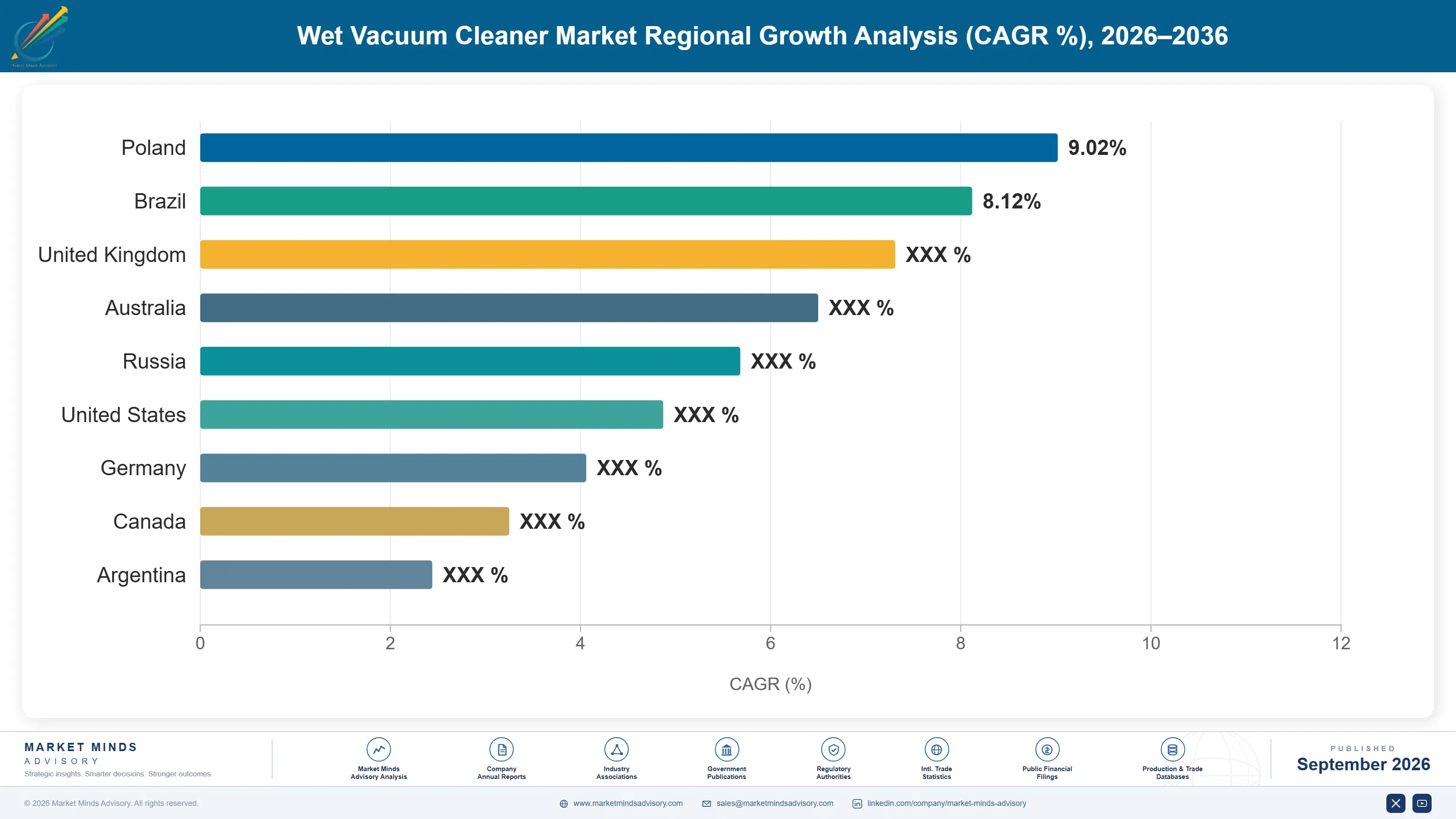
wet-vacuum-cleaner-market-country-cagr-analysis-1790020445742

Where Wet Vacuum Makers Win

Four commercial moves matter in a category sold on never touching dirty water, whose machines smell within weeks, and whose two headline numbers are measured under conditions nobody cleans in. Each fixes something a buyer discovers within the first month of ownership. Each fixes something a buyer discovers within the first month, and none requires new technology to implement.

Design The Machine To Dry Between Uses

Around 47% of complaints cite odour rather than any cleaning failure, because a two minute hot water cycle leaves residue in a brush roll and a tank path that never dry. Manufacturers fitting removable dishwasher-safe roll assemblies, drainable paths, and active drying report odour complaints 3.4 times lower. The cost is tooling rather than technology, and it addresses the exact promise the category is sold on rather than a peripheral irritation. Humid markets are also the fastest growing ones, which makes this a commercial priority rather than a refinement of any kind.
Market Impact: Cuts odour complaints to 3.4 times lower overall

Publish Runtime And Weight Under Real Conditions

About 6% of products state runtime measured with water pickup and around 9% state weight with tanks filled, which means both headline figures describe a machine nobody operates. Manufacturers publishing loaded runtime, area coverage per tank, and operating weight report return rates 2.6 times lower than those quoting bench figures. Disappointment currently gets recorded as product failure rather than as a specification that never described the product accurately in the first place. Coverage area per recovery tank is the figure that actually decides whether one fill cleans a floor, and it appears on almost nothing.
Market Impact: Cuts product return rates 2.6 times lower overall

Size The Recovery Tank To The Battery

The dirty water tank fills before the battery runs down on about 63% of machines, which means the stated runtime is unreachable in normal use on most of them. Manufacturers matching recovery capacity to realistic battery life report satisfaction scores 2.2 times higher than the field. This is a straightforward volumetric design decision that gets lost because battery runtime is the number that appears in advertising and tank capacity is not. Dust-heavy and humid markets load the tank faster still, which makes the matching exercise a regional one rather than a universal setting.
Market Impact: Raises satisfaction scores to 2.2 times higher overall

Engineer Base Stations For Robotic Recovery

Robotic machines with liquid recovery grow at 12.6% and their base stations carry the same residue problem as manual washers, in equipment an owner inspects far less often. Manufacturers engineering self-draining and drying base stations report repeat purchase 2.8 times higher within the same brand. The odour arrives later here and is well established before it is noticed, which makes it more damaging rather than less when the owner finally does. The category has not been through a replacement cycle yet, so retention is genuinely unknown and a machine that smells will decide it.
Market Impact: Raises repeat purchase rates to 2.8 times higher

Who Controls the Margin Pool

Concentration is moderate. Five manufacturers hold 42% of category revenue, measured consistently on that basis across all participants, and the field divides between Chinese brands that created the consumer floor washer format, established Western appliance groups, commercial and industrial extraction specialists, and a long tail of private label supply from the same Chinese production base. The leader to challenger gap is wide in commercial extraction and almost absent in consumer floor washers.
Competition currently turns on three dimensions: residue and drying engineering, which decides whether a machine still smells acceptable after a year; specification honesty on runtime, weight, and tank capacity; and base station design in robotic recovery, where the same problem appears in equipment owners inspect less often. Price and specification decide at consumer retail, which accounts for most units moved in every region.

Pressure builds from two directions at once. Chinese manufacturers hold the format, the engineering lead, and the cost base simultaneously. The category has not yet been through a replacement cycle. Rankings will shift toward manufacturers whose machines survive a year without smelling rather than those winning on specification sheets. Manufacturers holding only entry consumer volume face the most exposed position in the field.
wet-vacuum-cleaner-market-company-positioning-matrix-1790020446269

Competitive Moat and Risk Dimensions

ECOVACS ROBOTICS

Moat: Format Origination And Development Speed

Creating the cordless wet floor washer category and iterating on it faster than Western competitors can respond produces a position built on development cycle rather than on brand or distribution. Chinese domestic competition also forces improvement at a rate export markets alone would never generate.
ECOVACS ROBOTICS

Risk: First Replacement Cycle Untested

The category grew almost entirely on first-time adoption and has not yet been through a replacement cycle, so brand retention is genuinely unknown. Machines that smell within a year do not get replaced with the same brand, and odour complaints already account for nearly half of dissatisfaction.
NILFISK

Moat: Commercial Duty Cycle Engineering

Industrial and commercial wet extraction equipment built for genuine duty cycles operates on entirely different economics from consumer product, with scheduled replacement, specification-driven purchasing, and buyers who evaluate serviceability rather than marketing figures. Service networks and parts availability decide those accounts, and both take years to build. Consumer manufacturers hold neither.
NILFISK

Risk: Absent From Consumer Growth

Nearly all category growth is in cordless consumer floor washers, a format Chinese manufacturers created and continue to lead on both engineering and cost. Commercial durability capability does not transfer into a segment decided by weight, runtime claims, and retail price. Entering that segment means competing against the companies that invented it.

Players Tracked

Prominent Players

Ecovacs Robotics
Dreame Technology
Beijing Roborock Technology
Bissell
Techtronic Industries

Other Key Players

Alfred Karcher
Nilfisk
Stanley Black and Decker
Emerson Electric
Shop-Vac
Numatic International
Tennant Company
Xiaomi
Narwal
SharkNinja
Koninklijke Philips
Panasonic Holdings
Vax
Truvox International
Hako Group

Recent Developments

MARCH 2026

Dreame Introduces Fully Drainable And Drying Roll Assembly

Dreame Technology introduced a removable dishwasher-safe brush roll assembly with a fully drainable path and active drying across its floor washer range. Odour rather than cleaning performance was the stated design target throughout. Drying now runs automatically after each self-clean cycle rather than on request.
Signal: Nearly half of all complaints were about smell rather than cleaning. Tooling rather than technology solves the largest complaint.
SEPTEMBER 2025

Bissell Publishes Loaded Runtime And Operating Weight Figures

Bissell began stating runtime measured with water pickup under load, area coverage per recovery tank, and operating weight with tanks filled. Published runtime figures fell substantially against previous bench measurements. Coverage area per recovery tank is now stated alongside both figures on every product. Bench figures were withdrawn entirely.
Signal: The honest number describes the machine a buyer actually operates. Honest numbers convert disappointment into an informed purchase.
MAY 2025

Roborock Acquires Base Station Drying Technology Business

Beijing Roborock Technology completed an acquisition of a business developing self-draining and drying base station systems. The transaction was an outright acquisition rather than a joint venture or minority stake, with odour development cited as the rationale. Drying cycle engineers transferred with the business under agreed terms.
Signal: Base station residue arrives later and is worse when it does. Owners inspect a dock far less often.

What A Wet Vacuum Costs

Three cost groups dominate. Motor, battery, and control electronics run 36% to 44% of cost of goods sold, and the eight-point range separates high-capacity battery cordless machines from corded canister designs. Tanks, brush roll, and housing tooling take 26% to 34%, rising for removable and drainable assemblies. Packaging, certification, and logistics account for 20% to 28%, with bulk and weight making freight unusually significant.
Lithium cell and copper pricing moved through 2024 and 2025 on industrial demand and mine supply together, and United States Geological Survey mineral commodity summaries documented the underlying movements across the period. Several manufacturers described battery cell cost as the line that did not fall in their annual reports. Engineering polymer costs declined across the same window on petrochemical cycles unconnected to either. The three exposures moved independently across the period.

The competitive disadvantage mechanism runs through freight rather than through components. These machines are bulky and heavy relative to their value, so landed cost for a distant market carries a freight burden a locally assembled competitor avoids. Exposure therefore varies by manufacturing proximity to demand rather than by scale, and Western brands importing finished machines from China carry it on every unit they sell.
wet-vacuum-cleaner-market-cost-volatility-analysis-1790020446467

Design Tooling For Drainage Before Adding Features

Odour accounts for nearly half of all complaints and is fixed by tooling rather than by technology, while feature additions address problems buyers are not reporting. Prioritising drainable and drying assemblies over specification additions moves the largest source of dissatisfaction and costs less than most of the features competing for the same development budget.

Specify Battery Cells At Power Tool Volumes

Lithium cell costs are falling because power tool and mobility categories consume them at volumes wet vacuum manufacture never will approach. Specifying formats already at scale in those applications rather than commissioning bespoke packs captures a cost curve this category contributes nothing to and can otherwise only watch from outside. Bespoke packs forfeit a curve this category does not drive.

Assemble Closer To Distant Demand Centres

These machines are bulky and heavy against their value, so freight is a meaningful share of landed cost in markets far from Chinese production. Final assembly closer to demand converts a per-unit freight burden into a fixed operating cost and shortens response times on regional specification requirements considerably. Regional specification response also improves considerably as a result.

Portfolio Architecture for Margin Defence

Margin follows residue engineering and duty cycle rather than suction specification. Entry cordless floor washers compete close to commodity terms against private label from the same Chinese factories. Corded canister vacuums earn modestly on established workshop positions. Robotic recovery machines earn well on genuine base station engineering, and commercial and industrial extraction earns most, on serviceability a consumer buyer never evaluates.
The tension between volume and premium runs through what happens after a year. A first-time buyer comparing machines in a shop sees runtime, suction, and price, and has no way to evaluate whether it will smell by next spring. A replacement buyer knows exactly what went wrong with the last one and asks whether the roll comes out and whether the tank path drains, which almost no retail specification answers.

High-value pools concentrate in machines engineered to dry between uses, in robotic base stations that drain and dry themselves, and in commercial extraction where duty cycle and serviceability are specified rather than assumed. Where the product is an entry cordless washer sold on runtime and suction figures, the same Chinese factories supply everybody and the specification sheet is the only differentiator.

Volume / Commodity-Adjacent

Entry cordless floor washers and basic corded canister vacuums sold on runtime, suction, and price. The ten-point range reflects sourcing and freight position rather than any engineering a first-time buyer could evaluate in a shop.
Gross Margin: 22% to 32%

Premium / Certified

Mid and upper consumer floor washers and extraction cleaners with removable assemblies and certified efficiency across markets. The twelve-point range separates genuine drainage and drying engineering from removable parts that still trap residue.
Gross Margin: 38% to 50%

Sustainability / Regulatory / Next-Generation

Robotic recovery machines with self-draining base stations and commercial extraction equipment built to specified duty cycles. The sixteen-point range reflects residue engineering and serviceability, neither of which appears on a retail specification sheet.
Gross Margin: 54% to 70%
wet-vacuum-cleaner-market-portfolio-architecture-1790020446979

High-value Sub-segments and Strategic Watch-out

Commercial Extraction Equipment

Highest value in the category, sold to buyers who specify duty cycle and serviceability rather than comparing runtime figures on a box. The sixteen-point range reflects build and service capability, which consumer manufacturers do not hold. Replacement is scheduled rather than incidental in these accounts.
Gross Margin: 56% to 72%

Self-Draining Robotic Base Stations

High value where the residue problem arrives later and is worse by the time an owner notices it at all. The fourteen-point range reflects base station engineering depth rather than anything in the robot itself. Owners notice a dock problem long after it has established itself.
Gross Margin: 46% to 60%

Drying-Engineered Floor Washers

Volume core addressing the odour behind nearly half of all complaints in the category. The twelve-point range reflects whether the drainage path genuinely clears or merely appears removable when the assembly comes apart. Removable is not the same thing as genuinely drainable in this category.
Gross Margin: 38% to 50%

Entry Specification-Led Washers

The strategic watch-out. Same factories, same components, and headline numbers measured under conditions nobody cleans in. The ten-point range reflects sourcing and freight position with nothing else defending it at all. The first replacement cycle will decide whether any of this position actually holds up.
Gross Margin: 20% to 30%

How This Demand Repeats

The category has not yet been through a replacement cycle, which is the single most important fact about its future and the one least discussed. Almost all growth to date is first-time adoption by households displacing a mop, and nobody knows what share of those buyers return to the same brand. Odour complaints running near 47% suggest the answer will be considerably worse than current market shares imply.
Consumables provide the only recurring revenue and most manufacturers underbuild them. Brush rolls wear, filters need replacing, and cleaning solution is consumed continuously, yet attach rates are low because owners are not told when replacement is due and because generic alternatives are readily available. A brush roll that visibly degrades is also a machine that smells, which links the consumable to the complaint.

Commercial demand behaves entirely differently and repeats reliably. A facilities operation running extraction equipment daily replaces on a scheduled cycle, specifies duty rating and serviceability, and buys consumables through the same relationship. Unit volumes are far smaller than consumer and the revenue is predictable, which is the opposite of a consumer category still waiting to discover its own retention rate.
wet-vacuum-cleaner-market-end-use-penetration-index-1790020447474

Where This Market Rewards

These are among the four positions where our research anticipates prominent divergence between winners and laggards over the coming forecast period. Each is grounded in the demand model, the regulatory perimeter, and the announced capacity pipeline.
01 / RESIDUE DRYING ENGINEERING

Half the complaints are smell

Around 47% of complaints cite odour rather than any cleaning failure, because a two minute hot water cycle leaves residue in a brush roll and a tank path that never properly dry between uses. Manufacturers fitting removable dishwasher-safe assemblies, drainable paths, and active drying report odour complaints 3.4 times lower than the field. The cost is tooling rather than technology, and it addresses the exact promise this category is sold on, and humid markets are also the fastest growing ones in the whole category.
02 / SPECIFICATION HONESTY DISCIPLINE

Both headline numbers are wrong

About 6% of products state runtime measured with water pickup and around 9% state weight with tanks filled, which means both headline figures describe a machine that nobody actually operates. Manufacturers publishing loaded runtime, area coverage per tank, and operating weight report return rates 2.6 times lower than those quoting bench figures. Disappointment currently gets recorded as product failure rather than as a specification that never described the product, and coverage per tank is the figure that decides whether one fill cleans a floor.
03 / TANK CAPACITY MATCHING

The tank fills first anyway

The dirty water tank fills before the battery runs down on about 63% of machines, which makes the advertised runtime unreachable in normal use on most of the category. Manufacturers matching recovery capacity to realistic battery life report satisfaction scores 2.2 times higher than competitors. This is a straightforward volumetric decision that gets lost because runtime appears in advertising and recovery tank capacity does not, and dust-heavy and humid markets load that recovery tank considerably faster still than temperate conditions do.
04 / BASE STATION DESIGN

Nobody looks inside the dock

Robotic machines with liquid recovery grow at 12.6% and their base stations carry the same residue problem as manual washers, in equipment an owner inspects far less frequently than a handheld machine. Manufacturers engineering self-draining and drying base stations report repeat purchase 2.8 times higher within the same brand. The odour arrives later here and is thoroughly established before anybody notices, which makes it more damaging rather than less, and the category has not been through a replacement cycle yet at all.

Engagement Snapshot From the Field

A live engagement with an industry participant carrying material or product regulatory and market exposure ahead of a defining policy shift, showing how our research translates into a defensible multi-year portfolio strategy.
MARKET MINDS ADVISORY · CLIENT ENGAGEMENT SUMMARY
Wet Vacuum Cleaner Producer Strategic Portfolio Review and Transition Roadmap 2026·Investment Scenario on Wet Vacuum Cleaner Exposure Evaluation 2025-26
CLIENT PROFILE
An appliance manufacturer with wet floor washer revenue near USD 240 million (client-reported, unverified by MMA) across North America, Western Europe, and Southeast Asia. Complaints had risen for two consecutive years while sales grew, and the roadmap allocated most of the next cycle to suction and battery capacity improvements. No returned machine had been disassembled. Complaints had never been separated by cause.
STRATEGIC CHALLENGE
Complaints were coded broadly as quality issues and nobody had separated odour from performance. The roadmap addressed the specifications that appear in advertising rather than anything customers were actually reporting, and no product in the range had a fully drainable tank path. Growth was masking a rising complaint rate per unit sold.
MMA APPROACH
MMA recoded two years of complaints by measured cause, disassembled returned machines after simulated twelve month use, measured runtime and coverage under real water pickup against published figures, and modelled roadmap outcomes under specification improvement against residue engineering. Machines were disassembled after simulated twelve month use rather than assessed from complaint text, so the finding rested on evidence.
KEY FINDINGS
  1. Odour accounted for a clear majority of complaints once recoded, while suction and battery life together accounted for a small minority of the total.
  2. Disassembly found substantial residue in brush roll housings and tank drainage paths on every returned machine examined after simulated twelve month use.
  3. Measured runtime under water pickup was a fraction of the published figure, and the recovery tank filled well before the battery on every model in the range.
  4. Higher suction and battery capacity would have worsened the residue problem by increasing water throughput without changing the drainage path at all.
CLIENT PROFILE
An appliance manufacturer with wet floor washer revenue near USD 240 million (client-reported, unverified by MMA) across North America, Western Europe, and Southeast Asia. Complaints had risen for two consecutive years while sales grew, and the roadmap allocated most of the next cycle to suction and battery capacity improvements. No returned machine had been disassembled. Complaints had never been separated by cause.
STRATEGIC CHALLENGE
Complaints were coded broadly as quality issues and nobody had separated odour from performance. The roadmap addressed the specifications that appear in advertising rather than anything customers were actually reporting, and no product in the range had a fully drainable tank path. Growth was masking a rising complaint rate per unit sold.
MMA APPROACH
MMA recoded two years of complaints by measured cause, disassembled returned machines after simulated twelve month use, measured runtime and coverage under real water pickup against published figures, and modelled roadmap outcomes under specification improvement against residue engineering. Machines were disassembled after simulated twelve month use rather than assessed from complaint text, so the finding rested on evidence.
KEY FINDINGS
  1. Odour accounted for a clear majority of complaints once recoded, while suction and battery life together accounted for a small minority of the total.
  2. Disassembly found substantial residue in brush roll housings and tank drainage paths on every returned machine examined after simulated twelve month use.
  3. Measured runtime under water pickup was a fraction of the published figure, and the recovery tank filled well before the battery on every model in the range.
  4. Higher suction and battery capacity would have worsened the residue problem by increasing water throughput without changing the drainage path at all.
RECOMMENDED STRATEGY
Phase 1: Phase one: redirect the roadmap into removable dishwasher-safe roll assemblies and fully drainable tank paths across the range. Prioritise drainage over any feature addition. Phase 2: Phase two: publish loaded runtime, coverage per tank, and operating weight rather than bench figures on every product. State the conditions each figure was measured under. Phase 3: Phase three: code complaints by measured cause rather than customer description across the whole appliance portfolio. Report both codings to management every quarter.
OUTCOME
Odour complaints on the redesigned machines fell by roughly two thirds within three quarters (client-reported, unverified by MMA). No suction or battery change was made. Measured cause coding is now standard across the manufacturer's entire portfolio. Two competitors have since introduced comparable drainable roll assemblies.

Frequently Asked Questions

Foundational context covering the market sizes, CAGR, scope, country, region and competition that inform every finding below. This section is provided to cover basics and most often pre-purchase conversations, answered from the MMA Primary Research Dataset.

What is the current size of the Wet Vacuum Cleaner Market?

The market was worth USD 5.6 billion in 2025 and stands at USD 6.1 billion in 2026. Value covers vacuum systems recovering liquid as well as dry debris at manufacturer selling price.

How large will the Wet Vacuum Cleaner Market be by 2036?

MMA forecasts USD 15.5 billion by 2036, an increase of USD 9.4 billion across the forecast period. That represents 2.54 times the 2026 base of USD 6.1 billion.

What is the CAGR for the Wet Vacuum Cleaner Market 2026 to 2036?

The base case compound annual growth rate is 9.8%, with a bull case at 11.0% and a bear case at 8.6%. Historical growth from 2020 to 2025 ran at 8.7%.

Which segment is growing fastest?

Cordless wet-dry floor washers grow at 14.7%, half again the market rate of 9.8%. They displaced the mop and bucket rather than competing with any dry vacuum.

Who are the major companies in the Wet Vacuum Cleaner Market?

Ecovacs Robotics, Dreame Technology, Beijing Roborock Technology, Bissell and Techtronic Industries lead the field. Together they hold 42% of category revenue, with Chinese brands leading the format.

Which country is growing fastest?

China grows at 14.6%, and Chinese manufacturers invented the cordless wet floor washer format before exporting it into markets that had no equivalent product. Domestic adoption leads the world.

Report Segmentation Architecture

The full report scope spans multiple orthogonal segmentation dimensions, with cross-tabulated demand data provided for each dimension pair. Coverage extends further to regional breakdowns, trend trajectories, and the competitive detail needed to support segment-level decision-making.

By Machine Architecture

  • Cordless Wet-Dry Floor Washers
  • Corded Wet-Dry Canister Vacuums
  • Robotic Wet-Mopping Vacuums With Recovery
  • Carpet and Upholstery Extraction Cleaners
  • Commercial Portable Extraction Machines
  • Industrial Liquid Recovery Vacuums

By End-Use Industry

  • Household Hard Floor Cleaning
  • Garage and Workshop Use
  • Commercial Cleaning Contractors
  • Hospitality and Facilities Management
  • Healthcare and Institutional Buildings
  • Manufacturing and Industrial Sites

By Commercial Dimension

  • Appliance and Electronics Retail
  • Direct to Consumer Online
  • Home Improvement and Hardware Retail
  • Cleaning Equipment Distribution
  • Commercial Contractor Supply
  • Cross-Border Online Marketplaces

By Region

  • East Asia
  • North America
  • Western Europe
  • South Asia and Pacific
  • Latin America
  • Middle East and Africa
  • Eastern Europe

Scope, Methodology, and Coverage

Every figure in this report is reproducible from documented input assumptions. The scope below maps the historical period, the forecast horizon, the segmentation dimensions, and the countries covered, alongside the underlying primary and qualitative methodology.
Historical Period
2020 to 2025
Forecast Period
2026 to 2036
Base Year
2025 (USD billions; MMA Primary Research Dataset, September 2026)
Market Definition
This market covers vacuum systems that recover liquid as well as dry debris, across cordless wet-dry floor washers, corded wet-dry canister vacuums, robotic wet-mopping vacuums with liquid recovery, carpet and upholstery extraction cleaners, commercial portable extraction machines, and industrial liquid recovery vacuums. It excludes dry-only vacuums, pressure washers, ride-on and walk-behind scrubber-driers, steam cleaners without vacuum recovery, and central vacuum systems.
Quantitative Units
USD billions, revenue at manufacturer selling price
Segmentation Dimensions
Machine architecture, end-use setting, commercial dimension, region
Regions Covered
East Asia, North America, Western Europe, South Asia and Pacific, Latin America, Middle East and Africa, Eastern Europe
Countries Covered
China, Japan, South Korea, Taiwan, United States, Canada, Mexico, Germany, France, United Kingdom, Italy, Spain, Netherlands, Denmark, Sweden, Poland, Czechia, India, Indonesia, Thailand, Vietnam, Australia, Brazil, Argentina, Colombia, Chile, Saudi Arabia, United Arab Emirates, Turkey, South Africa
Key Companies Profiled
Ecovacs Robotics, Dreame Technology, Beijing Roborock Technology, Bissell, Techtronic Industries, Alfred Karcher, Nilfisk, Stanley Black and Decker, Emerson Electric, Shop-Vac, Numatic International, Tennant Company, Xiaomi, Narwal, SharkNinja, Koninklijke Philips, Panasonic Holdings, Vax, Truvox International, Hako Group
Quantitative Methodology
Primary survey, n=3,800 respondents, Q4 2025, six countries; demand-side model with trade association cross-validation
Qualitative Methodology
47 expert interviews, Q4 2025; applied to validate demand model assumptions, identify emerging dynamics, and assess competitive positioning
Report Format
PDF and XLSX data workbook (Word format preview document)
Publisher
Market Minds Advisory
Report Code
MMA-2026-CON-751
Published
September 2026
Contact
sales@marketmindsadvisory.com | www.marketmindsadvisory.com

Purchase the full Wet Vacuum Cleaner Market Report (2026 to 2036).

The full report sizes the wet vacuum cleaner market across six machine architectures, seven regions, and thirty countries, with forecasts to 2036 under base, bull, and bear cases. It recodes complaints by measured cause rather than customer description, compares published runtime and weight against figures measured under real operating conditions, and examines residue accumulation after simulated extended use. Competitive analysis covers twenty participants evaluated consistently on category revenue, with detailed treatment of drainage engineering and base station design. Freight exposure and the untested replacement cycle are analysed throughout. Primary research includes 3,800 survey responses and 47 expert interviews.
Six machine architectures sized and forecast separately
Twenty participants evaluated on category revenue consistently
Complaints recoded by measured cause rather than description
Published runtime and weight compared against loaded measurement
Residue accumulation examined after simulated extended use
Recovery tank capacity compared against realistic battery life

Built For The People Who Decide

From boardroom strategy to bench-side execution, this report is read cover-to-cover by leaders shaping the next decade of their industry, turning demand scenarios, market dynamics and valuation benchmarks into decisions.
CXOs/ Presidents/ VPs/ Managers
M&A and Corporate Development
Strategy Teams and R&D Heads
Procurement and Product Directors
Regulatory and Compliance Leaders
Investor Relations and Equity Analysts