Market Minds Advisory
Western Europe Premade Pouch Packaging Market

Western Europe Premade Pouch Packaging Market: Selling The Filling Line Nobody Has To Buy

A premade pouch costs more per unit than roll stock and needs a fifth of the filling equipment, which is why the format grows fastest among brands that could never justify a line.

Lead Analyst

Published

September 2026

Make Smarter Decisions with Customized Research Insights

Request a free sample report and evaluate market opportunities, growth trends, and competitive dynamics relevant to your business needs.

2025 MARKET VALUE$3.1BMarket Size 2025
2036 FORECAST VALUE$5.9BBase Case , 2026 to 2036
CAGR 2026 TO 20366.0 %Bull 7.2% / Bear 4.8%
INCREMENTAL OPPORTUNITY$2.6BNet 10- year value creation
EXPANSION MULTIPLE1.79x2036 value over 2026 base
Strategic Levers
M&A Pipeline
Regional Outlook
Country Rankings
Competitive Intelligence
Segmental Deep-dive
Call-Us : 91 93563 13602

Executive Snapshot and Market Trajectory

The unit price comparison is wrong and the industry keeps making it. A premade pouch costs more than roll stock, and its filling equipment costs a fifth of a form fill seal line. For a brand that cannot justify that capital, the expensive pouch is the only one available.
That economics explains where growth actually sits. Spouted pouches grow fastest at 9.0%, half again the market rate, on refill formats using around 74% less material than an equivalent rigid bottle and on baby food and beverage applications. Retort pouches follow at 7.6% as ready meals and pet food move off cans. Germany grows at 7.4%. Rigid formats rather than other flexibles are displaced.
Recyclability rules are reshaping what converters can offer. Mono-material designs already cover 31% of regional output and run with narrower sealing windows and worse barrier than the laminates they replace. Premade conversion holds a genuine advantage here, since a failed seal is found at the converter rather than discovered at a customer's filling line at full speed. That distinction is becoming a commercial argument rather than a technical footnote nobody previously bothered mentioning.
Market Definition
Pre-formed flexible pouches supplied ready to fill into Western European markets, covering stand-up pouches, flat and pillow pouches, spouted pouches, retort pouches, reclosable zipper pouches and shaped or contour pouches. Measured at converter selling value. Roll stock supplied for form fill seal conversion on the filling line, rigid packaging, sacks above twenty five kilograms, and closures sold separately are excluded from scope.
Base Year Value
$3.1B in 2025 (MMA Primary Research Dataset, August 2026)
Forecast Period
2026 to 2036, eleven discrete annual values
CAGR
6.0% base case. Bull 7.2%. Bear 4.8%.
Fastest Growth Segment
Spouted Pouches: 9.0% CAGR
Fastest Growth Country
Germany: 7.4% CAGR
Fastest Growth Region
South Asia and Pacific: 8.2% CAGR
Largest Region
Western Europe: 88% of 2025 global value
Market Leaders
Amcor, Mondi, Constantia Flexibles, Huhtamaki, Coveris. Source: MMA Primary Research Dataset, July 2026.
Primary Survey
n=3,800 procurement and R&D decision-makers, Q4 2025, six countries
Methodology
Demand-side build-up, cross-validated against public data, 47 expert interviews

Western Europe Premade Pouch Packaging Market Forecast Scenarios

western-europe-premade-pouch-packaging-market-size-forecast-scenario-1787665023472
The five years to 2025 were shaped by two forces pulling in different directions. Brand proliferation and shorter production runs favoured premade pouches that need almost no filling capital, while polymer price disruption raised material cost across every flexible format at once. The 5.0% historical rate blends genuine format substitution away from rigid packaging with price led growth that reversed once resin markets normalised.
The 6.0% base case rests on three mechanisms. Spouted pouches grow at 9.0% on household care refills that use roughly 74% less material than rigid bottles, and on baby food and beverage formats. Retort pouches grow at 7.6% as ready meals and pet food continue leaving cans. And German demand grows at 7.4% on refill retail culture and substantial pet food and ready meal manufacturing. Rigid displacement carries all three.
The 7.2% bull case turns on refill formats reaching mainstream grocery adoption beyond the drugstore channels that pioneered them, which would move spouted volume from a niche into a default. The 4.8% bear case is recyclability: mono-material designs run with narrower sealing windows and weaker barrier, and if shelf life failures follow, brand owners will retreat to rigid formats rather than accept the risk.

The Capital Argument Nobody Makes

Converters and buyers compare premade pouches against roll stock on price per unit, which is the one comparison guaranteed to make the format look expensive. The relevant number is capital: a pouch filling machine costs roughly a fifth of a form fill seal line and occupies a fraction of the floor space. For a brand without volume to justify that investment, the comparison is between selling the product and not selling it.
TOP FIVE CONCENTRATION34%Combined regional capacity held by the leading converters
FILLING LINE CAPITAL RATIO0.22xEquipment cost against an equivalent form fill line
MONO-MATERIAL VOLUME SHARE31%Regional output already designed for recycling stream compatibility
REFILL RESIN REDUCTION74%Material saved against an equivalent rigid bottle format
SPOUT COST SHARE38%Closure component as proportion of a spouted unit
MINIMUM ECONOMIC RUN18k unitsOrder size below which conversion economics stop working
That is why growth concentrates among smaller brands, co-packers and short production runs rather than among the largest food manufacturers. Minimum economic order quantities sit near eighteen thousand units, which is low enough for regional brands and seasonal ranges to participate. The same logic explains why premade pouches carry better print quality, since the web is decorated flat and inspected before forming.
Recyclability requirements are now the technical constraint on everything. Mono-material polyethylene and polypropylene designs already cover 31% of regional output and behave measurably worse than the laminates they replace, with narrower sealing windows and weaker oxygen barrier. Premade conversion handles that transition better than roll stock, because a defective seal is caught during pouch manufacture rather than discovered at a filling line running at full speed.
"Every quotation in this market gets benchmarked against roll stock on price per thousand. Nobody puts the filling line on the same page, which is the only line item that actually decides whether the customer can use the format at all."
Director, Flexible Packaging and Converting Practice · MMA Packaging Practice · August 2026

Market Trends

Refill Formats Move Spouted Pouches Into Household Care

A spouted refill pouch uses around 74% less material than the rigid bottle it refills, which is the strongest material reduction argument any flexible format can make and one retailers understand without explanation. Household cleaning, personal care and detergent brands have moved refill ranges into drugstore and grocery channels across the region. Spouted pouches grow at 9.0% against a market rate of 6.0%, the fastest format in the category. The spout itself carries roughly 38% of unit cost, which makes closure sourcing a larger commercial question than the film. Film is not the issue.
Market Impact: Germany grows at 7.4% annually

Mono-Material Conversion Narrows Every Processing Window

Recyclability requirements are pushing multi-material laminates toward mono-material polyethylene and polypropylene constructions, which already cover 31% of regional output. Those structures seal across a narrower temperature window, offer weaker oxygen barrier and lose stiffness that fillers rely on for machine handling. Premade conversion manages this better than roll stock because the pouch is formed, sealed and inspected at the converter before it reaches a filling line. That quality gate is becoming a genuine commercial argument rather than a technical detail nobody mentioned. Nobody mentioned that advantage while the laminates still worked properly.
Market Impact: Filling capital runs at 0.22 times

Market Opportunities and Growth Drivers

German Refill Retail Culture Pulls Format Adoption Forward

German drugstore and grocery retail established refill formats earlier and more broadly than any other regional market, and consumers there treat a refill pouch as normal rather than as a compromise on the shelf. German demand grows at 7.4%, faster than any market in the region. Substantial pet food and ready meal manufacturing adds retort volume on top of that. Retailer own label programmes reinforce the pattern, since private label ranges convert to refill formats faster than brands protecting rigid bottle equity do. Retailer own label leads here and brands follow behind.
Market Impact: Filling capital sits at 0.22 times

Small Brand Proliferation Needs Packaging Without Capital

Regional brands, seasonal ranges and direct to consumer food businesses cannot justify a form fill seal line, and premade pouch filling equipment costs roughly a fifth as much while occupying far less floor space. Minimum economic order quantities near eighteen thousand units put the format within reach of businesses that rigid packaging and roll stock both exclude on volume grounds. Co-packers serving those brands have become a significant channel in their own right, aggregating small runs into commercially viable converter orders. That aggregation is what makes the format reachable for businesses ordering hundreds.
Market Impact: Affects 31% of regional output

Market Restraints and Challenges

Unit Price Comparison Against Roll Stock Persists Everywhere

Premade pouches cost more per unit than roll stock and every procurement comparison starts there, because unit price appears on a quotation while filling equipment capital sits on a different budget entirely. The root cause is organisational rather than commercial, since packaging buyers and capital expenditure approvers rarely share a conversation. Commercially this caps realisable pricing across the format. Converters respond with total cost analysis and filling equipment partnerships, which convinces operations teams considerably more readily than it convinces procurement. Roughly 0.22 times the capital never appears on the quotation being compared.
Market Impact: Refills cut material use by 74%

Mono-Material Performance Gap Risks Shelf Life Failures

Mono-material structures seal across narrower windows and provide weaker oxygen barrier than the laminates they replace, which introduces shelf life risk into products where failure is expensive and public. The root cause is physical, since removing the barrier layer removes the barrier. Commercially this makes brand owners cautious about converting sensitive products and creates a real possibility of retreat toward rigid formats. Converters respond with barrier coatings, oriented polyethylene structures and extended shelf life testing, which narrow the gap without closing it. Retreat toward rigid formats is a genuine commercial possibility here.
Market Impact: Mono-material covers 31% of output
3 additional market trends, 4 additional growth drivers, and 2 additional restraints and challenges are covered in the full report. Contact sales@marketmindsadvisory.com to access the complete intelligence.

Segment CAGR and Growth Architecture

Segmentation follows pouch format, since format determines the filling equipment required, the barrier construction available, the closure content and which end use can adopt it. Six formats cover the category as traded regionally. Growth concentrates where a pouch displaces a rigid container rather than where it competes against other flexible packaging. Rigid displacement drives the growth.
western-europe-premade-pouch-packaging-market-market-share-analysis-1787665024018

Spouted Pouches

Pouches carrying a fitted spout and closure for liquid and semi-liquid products, spanning household care refills, baby food, beverages and sauces. At 9.0% this is the fastest growing format, half again the market rate of 6.0%, and refill applications carry most of that growth. A refill pouch uses around 74% less material than the rigid bottle it replaces, which is the clearest material argument in flexible packaging. The commercial character differs from other formats because the spout carries roughly 38% of unit cost, making closure sourcing and moulding relationships more important than film selection is. Refill retail adoption rather than any technical change is what moved this format into the mainstream.
CAGR 9.0%

Retort Pouches

Pouches constructed to withstand thermal sterilisation, replacing cans and jars in ready meals, pet food, soups and prepared vegetables across retail and foodservice. Growth of 7.6% is second fastest in the category, driven by weight, heating time and shelf presentation rather than by cost. Retort construction is the most technically demanding in the format range, since the pouch must survive sterilisation temperatures without delamination or seal failure. That difficulty limits how many converters can genuinely supply it and makes mono-material conversion considerably harder here than in ambient applications. Ready meals and pet food are both leaving cans steadily, and neither category shows any sign of reversing that decision. Weight and heating time decide it.
CAGR 7.6%
Full segment breakdown across 6 segments available in the complete report.

Regional Architecture and Country Demand Map

Western Europe holds 88% by scope definition, since this market measures regional demand specifically. Remaining shares reflect adjacent trade and comparator markets rather than demand. Germany grows fastest at 7.4% on refill retail culture and manufacturing. Filling capital rather than unit price genuinely defines this format.

North America

A 3% share sits far below the standard band because this market is defined as Western European demand, and the entry here reflects transatlantic converter operations and comparator activity rather than domestic consumption. Several converters including Amcor and ProAmpac operate across both regions with comparable capability, and brand owners increasingly specify identical pouch constructions on both sides. Recyclability requirements have moved faster in Europe, which makes the region a leading indicator for North American mono-material conversion. Growth of 5.0% reflects that overlap rather than demand within the scope measured here. Regulatory sequencing rather than trade volume is what makes this region analytically useful here. Europe is running the experiment first.
Share: 3% | CAGR: 5.0% (2026 to 2036)

Western Europe

An 88% share reflects the scope of this market, which covers Western European demand specifically rather than global consumption. Recyclability requirements have pushed mono-material designs to 31% of regional output already, ahead of any other region, with the performance consequences that follow. Germany grows fastest at 7.4% on refill retail culture and substantial pet food and ready meal manufacturing. Converter concentration is low at 34% for the top five, which keeps competition intense on price comparisons the format loses. Growth of 4.8% is set below the regional band by construction. Regulation rather than customer demand is setting the technical agenda across this entire regional market. Converters are following rather than leading.
Share: 88% | CAGR: 4.8% (2026 to 2036)
Regional intelligence for 5 additional markets available in the complete report: East Asia, South Asia and Pacific, Latin America, Middle East and Africa, Eastern Europe. Contact sales@marketmindsadvisory.com.
western-europe-premade-pouch-packaging-market-country-cagr-analysis-1787665024548

Where Premade Pouches Actually Earn

Nothing here is won on price per thousand, because roll stock wins that comparison every time and always will. Value accrues to whoever sells the capital avoided, whoever uses the quality gate conversion provides, whoever leads mono-material properly, and whoever controls spout economics. Four routes carry weight and none is a film argument. Capital is the argument.

Sell The Filling Line You Do Not Buy

A pouch filling machine costs roughly 0.22 times a form fill seal line and occupies far less floor space, which for a brand without volume to justify that capital is the difference between using the format and not using it. Procurement compares unit prices because that is what appears on a quotation, while the equipment capital sits with a different approver entirely. Converters presenting total cost including filling capital reach operations and finance rather than the buyer running a price comparison. Two different budgets and two different approvers is the whole problem.
Market Impact: Filling capital runs at just 0.22 times cost

Catch The Bad Seal Before The Filler

Mono-material structures now cover 31% of regional output and seal across narrower windows with weaker barrier than the laminates they replace, which introduces failure risk exactly where it is most expensive. A premade pouch is formed, sealed and inspected at the converter before it reaches the customer, so a defect is caught in a controlled environment rather than discovered on a filling line at full speed. That quality gate is becoming a commercial argument rather than a technical footnote. Discovering a defect at 200 pouches a minute is expensive in a way nobody budgets.
Market Impact: Protects quality across the 31% mono-material output share

Lead Mono-Material Before The Deadline Arrives

Recyclability requirements are moving all flexible packaging toward mono-material constructions, and the technical work of closing the sealing window and barrier gap takes years rather than months. Mono-material already covers 31% of regional output and the performance gap has not closed. Converters solving retort and high barrier applications first hold positions that brand owners cannot easily reopen, since qualifying a new pouch construction against shelf life means testing that nobody repeats casually once completed satisfactorily. Doing that work before customers demand it is the entire competitive question during this whole transition.
Market Impact: Leads conversion across the 31% of mono-material volume

Treat The Spout As The Product

The fitted spout and closure carry roughly 38% of unit cost on a spouted pouch, which makes moulding relationships, tooling and component sourcing more commercially consequential than film selection. Spouted pouches grow at 9.0% against a market rate of 6.0%, the fastest format in the category, on refill applications using around 74% less material than rigid bottles. Converters treating the spout as a bought-in part rather than a design element are ceding the largest cost line to somebody else. Tooling ownership rather than component purchasing is what actually captures that 38% share.
Market Impact: The spout carries 38% of total unit cost

Who Controls the Margin Pool

Concentration is low for a packaging category. The top five hold 34% of regional capacity, the basis applied consistently throughout this section, across a field mixing global flexible packaging groups, regional converters and specialists in particular formats such as retort or spouted constructions. Amcor leads on scale and technical breadth across formats, and the gap to challengers reflects development capability and multi-site supply assurance rather than any cost advantage.
Competition runs on three fronts. Global converters compete for brand owner programmes requiring multi-country supply and mono-material development capability. Regional converters compete on service, short runs and responsiveness for smaller brands and co-packers. And roll stock competes from outside the format entirely for any customer with volume to justify a filling line of their own.

Rankings will move with mono-material technical progress rather than with capacity, since converters solving retort and high barrier applications first will hold positions brand owners cannot reopen without repeating shelf life testing. The other pressure point is spout and closure sourcing, which carries more unit cost than film on the fastest growing format and remains outside the direct control of most converters entirely.
western-europe-premade-pouch-packaging-market-company-positioning-matrix-1787665025074

Competitive Moat and Risk Dimensions

AMCOR

Moat: Multi-Country Supply Assurance

Multi-site capability across countries allows brand owners to source identical pouch constructions for several markets with continuity if any single plant is interrupted, which regional converters cannot offer at any price. Development resources for mono-material construction work also exceed what smaller converters can fund, and that gap widens as recyclability requirements tighten further.
AMCOR

Risk: Roll Stock Substitution Exposure

Larger brand owner customers are precisely those with volume to justify their own form fill seal lines, which makes the premade format vulnerable at the top of the customer base where scale suppliers concentrate. Every customer that installs a filling line converts from a pouch buyer into a roll stock buyer permanently.
MONDI

Moat: Integrated Paper And Film

Integration across paper and film substrates allows the group to offer fibre based and mono-material plastic constructions from a single relationship as brand owners test both routes to recyclability compliance. That optionality is valuable during a transition where nobody is certain which substrate wins in which application, and it cannot be assembled quickly by a plastics only converter.
MONDI

Risk: Format Specialist Competition

Spouted and retort formats demand specialist capability in closure integration and sterilisation resistant construction, where dedicated converters hold technical positions built over years. Those two formats grow at 9.0% and 7.6% respectively, which means competing without depth in them concedes the fastest growing parts of the category.

Players Tracked

Prominent Players

Amcor
Mondi
Constantia Flexibles
Huhtamaki
Coveris

Other Key Players

Sealed Air
ProAmpac
Berry Global
Sudpack
Wipak
Schur Flexibles
Clondalkin Group
Bischof and Klein
Uflex
Goglio
Sonoco
Winpak
Elplast
Fujimori Kogyo
Nordfolien

Recent Developments

FEBRUARY 2025

Household care brand extends refill pouch range across grocery

A household care brand extended its refill pouch range from drugstore channels into mainstream grocery listings across several markets. A refill pouch uses around 74% less material than the rigid bottle it refills, which is the clearest material reduction argument available in flexible packaging today.
Signal: Refill moves from a niche to a default once mainstream grocery lists the format for a whole category
MAY 2025

Converter qualifies mono-material retort construction for ready meals

A converter qualified a mono-material retort pouch construction surviving sterilisation without delamination, the most technically demanding application in the format range. Mono-material already covers 31% of regional output, though retort applications had resisted conversion because of the temperatures involved in processing. Temperature was the obstacle throughout.
Signal: Qualifying a construction against shelf life is testing nobody repeats once it succeeds without a very good reason
SEPTEMBER 2025

Co-packer aggregates small brand runs into converter order volumes

A co-packer aggregated production runs from multiple small brands into commercially viable converter orders, serving businesses below the eighteen thousand unit minimum individually. Premade pouch filling equipment costs roughly a fifth of a form fill seal line, which is what makes the model work at all.
Signal: Aggregation brings brands into the format that no converter could serve directly on their own volumes alone

What A Premade Pouch Costs

Polymer film accounts for roughly 41% of conversion cost across unspouted formats, with adhesives, inks, energy, labour and waste carrying the remainder. On spouted pouches the fitted closure alone carries about 38% of unit cost, which changes the sourcing question. European polymer supply is tied to naphtha and gas based cracker economics, and aluminium foil for barrier laminates comes from a concentrated group of rolling mills.
The last polymer disruption transmitted straight through the format. EIA and IEA data recorded the feedstock and energy movements behind European cracker economics, and flexible packaging producer annual reports documented material cost pass through, contract renegotiation and margin compression through the period. Converters holding fixed price annual agreements with brand owners absorbed the movement, while those with indexed contracts passed it on and kept relationships intact.

Exposure divides by contract structure and format mix rather than by scale. Unspouted formats carry concentrated polymer exposure, while spouted pouches carry closure cost that moves with moulding and resin economics on a different cycle entirely. Converters weighted toward fixed price agreements during a resin spike are in the worst position available, and the ones that learned this in the last cycle now index almost everything they sign.
western-europe-premade-pouch-packaging-market-cost-volatility-analysis-1787665025277

Index brand owner agreements to resin rather than fixing price

Converters holding fixed price annual agreements absorbed the last polymer movement entirely while indexed competitors passed it through and kept customer relationships intact. Polymer is roughly 41% of conversion cost on unspouted formats, which is far too large a share to carry unhedged across a contract year. Proposing indexation costs nothing at negotiation and is impossible to introduce afterwards.

Bring spout tooling and design under converter control

The fitted closure carries about 38% of unit cost on spouted pouches, the fastest growing format at 9.0%, and most converters treat it as a bought-in component. Owning tooling and participating in closure design captures margin and creates differentiation that film selection cannot. It also removes a supply dependency on the single largest cost line in that format.

Qualify mono-material constructions before customers demand them

Mono-material designs already cover 31% of regional output and the sealing window and barrier gaps have not closed. Qualification against shelf life takes months of testing that customers will not fund speculatively. Converters completing that work in advance hold positions that cannot be reopened easily, since nobody repeats a successful shelf life qualification without a compelling reason.

Portfolio Architecture for Margin Defence

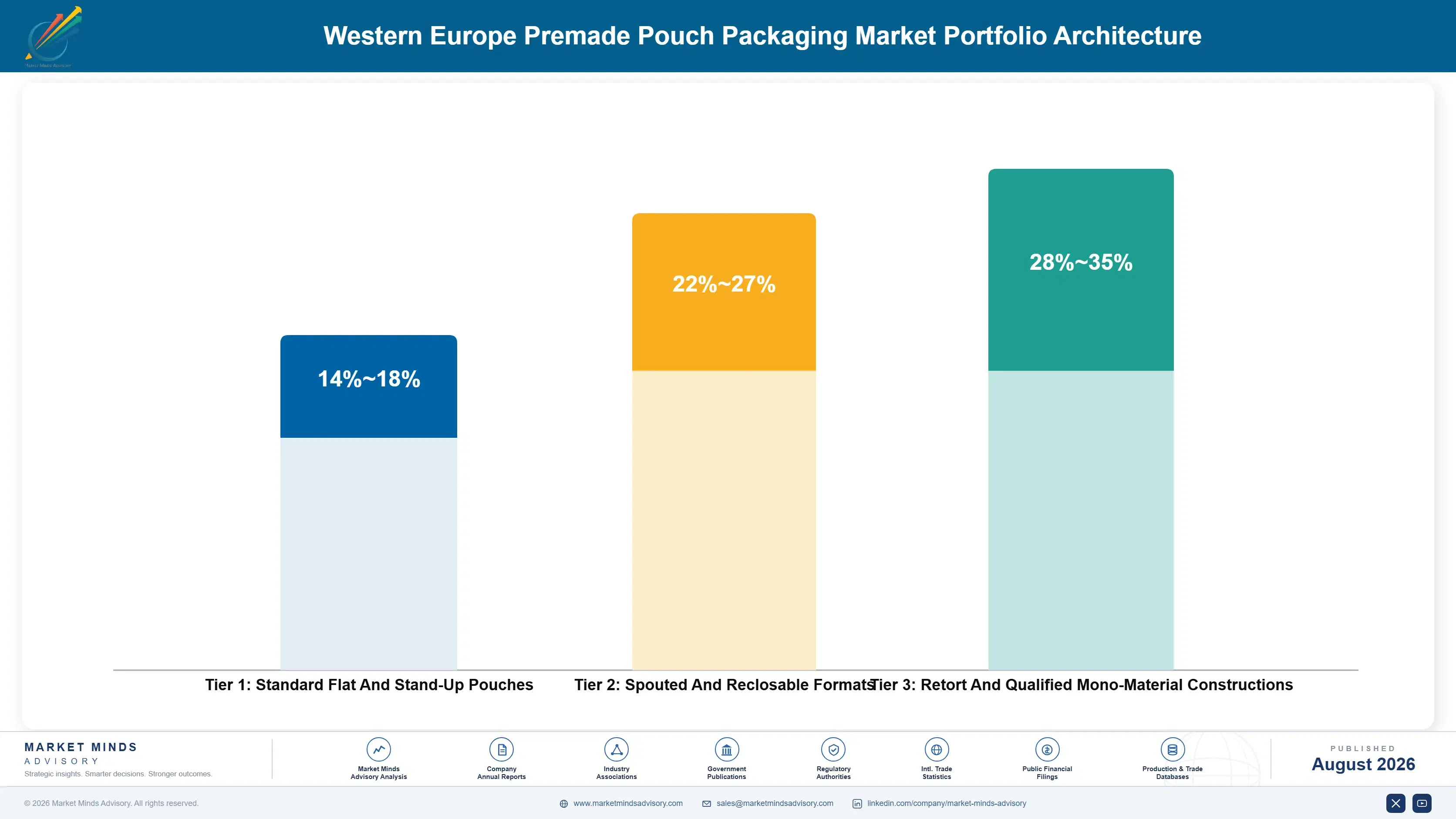
Margin architecture divides on technical difficulty rather than on volume. Standard flat and stand-up pouches earn least, since many converters can make them and every quotation is benchmarked against roll stock on price per thousand. Spouted formats earn considerably better, because closure integration, tooling and filling compatibility narrow the field. Retort and qualified mono-material constructions earn best, since sterilisation resistance and shelf life qualification exclude most competitors outright.
The tension runs between volume customers and format economics. Large brand owners deliver the volume that loads converting lines and are precisely the customers most likely to install their own filling line and convert to roll stock permanently. Smaller brands and co-packers cannot do that and pay better, but individually order near the eighteen thousand unit minimum. Building a business on either alone is uncomfortable in different ways.

High value pools concentrate in spouted and retort formats and in qualified mono-material constructions, none of which is a film position. Everything selling standard pouches competes on price per thousand against a comparison the format cannot win. The businesses worth building are those where a closure design, a sterilisation construction or a completed shelf life qualification makes the customer's alternative genuinely expensive.

Standard Flat And Stand-Up Pouches

Widely available formats quoted against roll stock on price per thousand, where many converters can meet the specification and differentiation rests on service and lead time alone. Volume loads lines and earns thin returns.
Gross Margin: 14-18%

Spouted And Reclosable Formats

Formats requiring closure integration, tooling and filling line compatibility, where the spout carries roughly 38% of unit cost. Component sourcing and design participation determine whether that cost line generates margin or leaks it.
Gross Margin: 22-27%

Retort And Qualified Mono-Material Constructions

Sterilisation resistant and recyclability qualified constructions where technical difficulty and completed shelf life testing exclude most competitors. The range is wide because qualification depth and application sensitivity vary substantially between customers.
Gross Margin: 28-35%
western-europe-premade-pouch-packaging-market-portfolio-architecture-1787665025789

High-value Sub-segments and Strategic Watch-out

Spouted Pouches

Fastest growing format at 9.0% on refill applications using around 74% less material than rigid bottles. The spout carries roughly 38% of unit cost, which makes closure sourcing and tooling ownership the decisive commercial question rather than film. Film selection is not where this competes.
Gross Margin: 22-27%

Retort Pouches

Second fastest at 7.6% as ready meals and pet food leave cans, and the most technically demanding construction in the range. Sterilisation resistance limits how many converters can supply, and mono-material conversion is hardest here of all. Very few converters can genuinely supply this format.
Gross Margin: 28-35%

Stand-Up Pouches

Growing at 6.4% and carrying the largest volume in the category, which makes it the core rather than the growth story. Many converters can meet the specification and every quotation is benchmarked against roll stock pricing. Service and lead time are the only differentiators genuinely available here.
Gross Margin: 14-18%

Flat and Pillow Pouches

Growing at only 3.2% in applications where roll stock conversion on the filling line is straightforward and the capital argument for premade barely applies. Competition is direct, differentiation minimal and pricing pressure constant throughout. The capital argument that carries other formats barely applies to this one.
Gross Margin: 10-14%

How Pouch Programmes Hold Together

Demand attaches to a qualified pouch construction and a filling line configured around it. A brand owner qualifies a construction against shelf life, sets the filling machine to that pouch geometry and seal specification, and then orders against it for as long as the product runs. Changing converter means requalifying shelf life and frequently adjusting the filling line, which is enough friction to hold a programme through several reviews.
Stickiness varies sharply by format and by product sensitivity. Retort and high barrier constructions are the most durable, since shelf life qualification is expensive and nobody repeats successful testing without cause. Spouted formats hold well because filling equipment is configured to a specific spout geometry. Standard flat and stand-up pouches hold least, since specifications are widely met and buyers retender on price per thousand.

The buying decision is moving from procurement toward technical and sustainability functions. Recyclability compliance brings packaging technologists and sustainability leads into decisions procurement previously settled on price, and those parties evaluate construction, recycling stream compatibility and shelf life evidence instead. That shift favours converters with mono-material qualification work already completed, and it is why the technical argument now reaches buyers who would never have heard it.
western-europe-premade-pouch-packaging-market-end-use-penetration-index-1787665026297

Where This Format Rewards Focus

These are among the four positions where our research anticipates prominent divergence between winners and laggards over the coming forecast period. Each is grounded in the demand model, the regulatory perimeter, and the announced capacity pipeline.
01 / CAPITAL AVOIDANCE SELLING

The equipment is the argument, not the unit

A premade pouch filling machine costs roughly 0.22 times a form fill seal line and occupies far less floor space, which for a brand without volume to justify that capital decides whether the format is usable at all. Procurement compares unit prices because that is what appears on a quotation, while the equipment capital sits with an entirely different approver in the organisation. Converters presenting total cost including filling capital reach operations and finance rather than a buyer running a price comparison.
02 / QUALITY GATE ADVANTAGE

A defect found early is worth real money

Mono-material structures already cover 31% of regional output and seal across narrower windows with weaker barrier than the laminates they replace, which puts failure risk exactly where it costs most. A premade pouch is formed, sealed and inspected at the converter under controlled conditions before it ever reaches the customer's site. Roll stock discovers the same defect on a filling line running at full speed, and that difference is becoming a commercial argument rather than a technical footnote in a datasheet somewhere.
03 / MONO-MATERIAL CONVERSION TIMING

Qualification finished early cannot be reopened

Recyclability requirements are moving all flexible packaging toward mono-material construction, and closing the sealing window and barrier performance gap takes years of development rather than a single product cycle. Converters solving retort and high barrier applications first hold positions brand owners cannot easily reopen afterwards, because qualifying a construction against shelf life means testing nobody repeats once it has succeeded. Doing that work before customers demand it is the whole competitive question that matters throughout this entire regulatory transition period.
04 / SPOUT ECONOMICS CONTROL

The closure outweighs the film entirely

A fitted spout and closure carry roughly 38% of unit cost on a spouted pouch, which is the fastest growing format at 9.0% on refill applications using around 74% less material than rigid bottles. That makes moulding relationships, tooling ownership and component design considerably more consequential commercially than film selection ever is. Converters treating the spout as a bought-in part sourced on price are handing the largest single cost line in their fastest growing format to somebody else without a fight.

Engagement Snapshot From the Field

A live engagement with an industry participant carrying material or product regulatory and market exposure ahead of a defining policy shift, showing how our research translates into a defensible multi-year portfolio strategy.
MARKET MINDS ADVISORY · CLIENT ENGAGEMENT SUMMARY
Western Europe Premade Pouch Packaging Producer Strategic Portfolio Review and Transition Roadmap 2026·Investment Scenario on Western Europe Premade Pouch Packaging Exposure Evaluation 2025-26
CLIENT PROFILE
A Western European flexible packaging converter producing premade stand-up and flat pouches for food and household care brands across four markets. Annual revenue was approximately 172 million dollars (client-reported, unverified by MMA), predominantly unspouted formats sold on annual fixed price agreements. No spout tooling was owned and no mono-material retort construction had been qualified at that stage.
STRATEGIC CHALLENGE
The last resin movement had been absorbed almost entirely into margin because agreements were fixed price, and two large customers had installed their own filling lines and converted to roll stock. Management wanted to know whether to pursue volume harder or to move up the format range. Nobody had quantified the customer loss risk across the account base.
MMA APPROACH
MMA assessed every account for filling line installation risk using volume and capital thresholds, then modelled revenue at risk over five years. Spout tooling investment and mono-material retort qualification were costed against defending unspouted volume. Forty-seven expert interviews with brand owners, co-packers, packaging technologists and sustainability leads established how decisions are genuinely made, alongside survey work across six countries.
KEY FINDINGS
  1. Accounts with volume above the filling line justification threshold represented roughly 45% of revenue, and 2 had already converted with others reviewing the same decision.
  2. Fixed price agreements had absorbed around 60% of the last resin movement into margin, while indexed competitors passed it through without losing any accounts.
  3. Spout tooling investment was costed at about 14 months to payback given the 38% of unit cost that closures carry on the fastest growing format.
  4. Sustainability and technical functions participated in 7 of every 10 recent format decisions, and the client's commercial approach reached procurement almost exclusively.
CLIENT PROFILE
A Western European flexible packaging converter producing premade stand-up and flat pouches for food and household care brands across four markets. Annual revenue was approximately 172 million dollars (client-reported, unverified by MMA), predominantly unspouted formats sold on annual fixed price agreements. No spout tooling was owned and no mono-material retort construction had been qualified at that stage.
STRATEGIC CHALLENGE
The last resin movement had been absorbed almost entirely into margin because agreements were fixed price, and two large customers had installed their own filling lines and converted to roll stock. Management wanted to know whether to pursue volume harder or to move up the format range. Nobody had quantified the customer loss risk across the account base.
MMA APPROACH
MMA assessed every account for filling line installation risk using volume and capital thresholds, then modelled revenue at risk over five years. Spout tooling investment and mono-material retort qualification were costed against defending unspouted volume. Forty-seven expert interviews with brand owners, co-packers, packaging technologists and sustainability leads established how decisions are genuinely made, alongside survey work across six countries.
KEY FINDINGS
  1. Accounts with volume above the filling line justification threshold represented roughly 45% of revenue, and 2 had already converted with others reviewing the same decision.
  2. Fixed price agreements had absorbed around 60% of the last resin movement into margin, while indexed competitors passed it through without losing any accounts.
  3. Spout tooling investment was costed at about 14 months to payback given the 38% of unit cost that closures carry on the fastest growing format.
  4. Sustainability and technical functions participated in 7 of every 10 recent format decisions, and the client's commercial approach reached procurement almost exclusively.
RECOMMENDED STRATEGY
Phase 1: Phase one: index every agreement at renewal, since fixed pricing absorbed around 60% of the last resin movement directly into margin. Phase 2: Phase two: invest in spout tooling with roughly 14 month payback, capturing the 38% of unit cost that closures represent. Phase 3: Phase three: qualify mono-material retort construction and sell to technical functions, which now join 7 of every 10 format decisions.
OUTCOME
The client indexed agreements at renewal and held margin through the following resin movement without losing accounts. Spout tooling investment brought the fastest growing format in-house and mono-material retort qualification began, with the first customer trials opening conversations that procurement led selling had never reached (client-reported, unverified by MMA).

Frequently Asked Questions

Foundational context covering the market sizes, CAGR, scope, country, region and competition that inform every finding below. This section is provided to cover basics and most often pre-purchase conversations, answered from the MMA Primary Research Dataset.

What is the current size of the Western Europe Premade Pouch Packaging Market?

The market was valued at 3.1 billion dollars in 2025, covering pre-formed flexible pouches supplied ready to fill into Western European markets. It reaches an estimated 3.29 billion dollars during 2026.

How large will the Western Europe Premade Pouch Packaging Market be by 2036?

MMA forecasts 5.89 billion dollars by 2036, an increase of 2.60 billion dollars over the 2026 base. That represents an expansion multiple of 1.79 times across the forecast period.

What is the CAGR for the Western Europe Premade Pouch Packaging Market 2026 to 2036?

The base case compound annual growth rate is 6.0%, with a bull case of 7.2% and a bear case of 4.8%. Refill adoption and mono-material performance separate those two scenarios.

Which segment is growing fastest?

Spouted pouches grow at 9.0%, half again the market rate of 6.0%, on refill formats using around 74% less material than rigid bottles. Retort pouches follow at 7.6%.

Who are the major companies in the Western Europe Premade Pouch Packaging Market?

Amcor, Mondi, Constantia Flexibles, Huhtamaki and Coveris lead on regional capacity across formats and end uses. Together they account for 34% of this regional market.

Which country is growing fastest?

The market is defined as Western European demand, and Germany grows fastest of any country in the region at 7.4%, on established refill retail culture and substantial manufacturing.

Report Segmentation Architecture

The full report scope spans multiple orthogonal segmentation dimensions, with cross-tabulated demand data provided for each dimension pair. Coverage extends further to regional breakdowns, trend trajectories, and the competitive detail needed to support segment-level decision-making.

By Pouch Format

  • Stand-Up Pouches
  • Flat and Pillow Pouches
  • Spouted Pouches
  • Retort Pouches
  • Reclosable Zipper Pouches
  • Shaped and Contour Pouches

By End-Use Industry

  • Food and Ready Meals
  • Beverages
  • Pet Food
  • Household and Personal Care
  • Pharmaceutical and Medical
  • Industrial and Agricultural

By Commercial Dimension

  • Direct Brand Owner Supply
  • Co-Packer Supply
  • Retail Private Label
  • Distributor and Trader Supply
  • Contract Design Development
  • Export Supply

By Region

  • North America
  • Western Europe
  • East Asia
  • South Asia and Pacific
  • Latin America
  • Middle East and Africa
  • Eastern Europe

Scope, Methodology, and Coverage

Every figure in this report is reproducible from documented input assumptions. The scope below maps the historical period, the forecast horizon, the segmentation dimensions, and the countries covered, alongside the underlying primary and qualitative methodology.
Historical Period
2020 to 2025
Forecast Period
2026 to 2036
Base Year
2025 (USD billions; MMA Primary Research Dataset, August 2026)
Market Definition
Pre-formed flexible pouches supplied ready to fill into Western European markets, covering stand-up pouches, flat and pillow pouches, spouted pouches, retort pouches, reclosable zipper pouches and shaped or contour pouches across polymer, laminate and mono-material constructions, measured at converter selling value. Roll stock film supplied for form fill seal conversion on the filling line, rigid packaging of any material, sacks and bags above twenty five kilograms, and closures or spouts sold as separate components are excluded from scope.
Quantitative Units
USD billions (converter selling value); units and tonnes; USD per thousand units by format
Segmentation Dimensions
Pouch format; end-use industry; commercial dimension; region
Regions Covered
North America, Western Europe, East Asia, South Asia and Pacific, Latin America, Middle East and Africa, Eastern Europe
Countries Covered
Germany, France, United Kingdom, Ireland, Netherlands, Belgium, Italy, Spain, Portugal, Austria, Switzerland, Sweden, Denmark, Norway, Finland, Greece, and comparator coverage of the United States, China, Japan, India, Brazil and Poland
Key Companies Profiled
Amcor, Mondi, Constantia Flexibles, Huhtamaki, Coveris, Sealed Air, ProAmpac, Berry Global, Sudpack, Wipak, Schur Flexibles, Clondalkin Group, Bischof and Klein, Uflex, Goglio, Sonoco, Winpak, Elplast, Fujimori Kogyo, Nordfolien
Quantitative Methodology
Primary survey, n=3,800 respondents, Q4 2025, six countries; demand-side model with trade association cross-validation
Qualitative Methodology
47 expert interviews, Q4 2025; applied to validate demand model assumptions, identify emerging dynamics, and assess competitive positioning
Report Format
PDF and XLSX data workbook (Word format preview document)
Publisher
Market Minds Advisory
Report Code
MMA-2026-PAC-110
Published
August 2026
Contact
sales@marketmindsadvisory.com | www.marketmindsadvisory.com

Purchase the full Western Europe Premade Pouch Packaging Market Report (2026 to 2036).

The full report reframes premade pouches around the filling capital they avoid rather than the unit price they lose on, and follows what recyclability requirements are doing to construction, qualification and competitive position. It sizes all six formats independently through 2036, models filling line installation risk across the customer base, and quantifies mono-material performance gaps by application sensitivity. Regional chapters cover all seven regions, with Western European demand assessed separately from comparator markets and supply origins. Competitive profiling covers 20 participants on one consistent regional capacity measure.
Six pouch formats sized independently through 2036
Filling line capital modelled against premade unit pricing
Mono-material performance gaps quantified by application sensitivity
Customer filling line installation risk assessed across account bases
Spout and closure cost share analysed within spouted formats
Twenty participants profiled on one consistent capacity measure

Built For The People Who Decide

From boardroom strategy to bench-side execution, this report is read cover-to-cover by leaders shaping the next decade of their industry, turning demand scenarios, market dynamics and valuation benchmarks into decisions.
CXOs/ Presidents/ VPs/ Managers
M&A and Corporate Development
Strategy Teams and R&D Heads
Procurement and Product Directors
Regulatory and Compliance Leaders
Investor Relations and Equity Analysts