Market Minds Advisory
Western Europe Powdered Cellulose Market

Western Europe Powdered Cellulose Market: A Nutritional Accounting Instrument Sold As An Ingredient

It counts as dietary fibre under the standard analytical method, contributes no calories, taste or colour, and is by far the cheapest route to a fibre claim on a label.

Lead Analyst

Published

September 2026

Make Smarter Decisions with Customized Research Insights

Request a free sample report and evaluate market opportunities, growth trends, and competitive dynamics relevant to your business needs.

2025 MARKET VALUE$0.3BMarket Size 2025
2036 FORECAST VALUE$0.5BBase Case , 2026 to 2036
CAGR 2026 TO 20365.6 %Bull 6.8% / Bear 4.4%
INCREMENTAL OPPORTUNITY$0.2BNet 10- year value creation
EXPANSION MULTIPLE1.71x2036 value over 2026 base
Strategic Levers
M&A Pipeline
Regional Outlook
Country Rankings
Competitive Intelligence
Segmental Deep-dive
Call-Us : 91 93563 13602

Executive Snapshot and Market Trajectory

Powdered cellulose is measured as dietary fibre by the standard analytical method, contributes no calories, no taste and no colour, and costs a fraction of any functional alternative. That makes it the cheapest way to reach a labelling threshold rather than to feed anybody. The distinction matters commercially.
Fibre fortification grows fastest at 8.4%, half again the market rate, because a product reaching 3 grams per 100 grams may declare itself a source of fibre and front of pack scoring rewards it directly. France grows at 7.4%, faster than anywhere in the region, on nutritional labelling that made the calculation explicit for manufacturers. Nutritional intention is not the mechanism at work here.
The risk sits in the definition rather than the market. Fibre for labelling purposes is an analytical category rather than a physiological one, and pressure to separate fermentable functional fibres from inert bulking would remove the reason the fastest application exists. Supply is concentrated at 62% for the top five, with 17% of regional volume made under pharmaceutical conditions. Nobody in the category discusses that exposure publicly, which does not make it smaller.
Market Definition
Purified alpha-cellulose processed mechanically from wood pulp or cotton linters and ground to defined particle size distributions, sold into Western European markets across food, pharmaceutical, animal nutrition and technical applications. Measured at producer selling value. Microcrystalline cellulose produced by acid hydrolysis, cellulose ethers including carboxymethyl, hydroxypropyl methyl and methyl cellulose, nanocellulose and unprocessed pulp are excluded from scope.
Base Year Value
$0.3B in 2025 (MMA Primary Research Dataset, August 2026)
Forecast Period
2026 to 2036, eleven discrete annual values
CAGR
5.6% base case. Bull 6.8%. Bear 4.4%.
Fastest Growth Segment
Dietary Fibre Fortification: 8.4% CAGR
Fastest Growth Country
France: 7.4% CAGR
Fastest Growth Region
South Asia and Pacific: 7.8% CAGR
Largest Region
Western Europe: 88% of 2025 global value
Market Leaders
J. Rettenmaier and Sohne, Borregaard, Sappi, Nippon Paper Industries, CFF. Source: MMA Primary Research Dataset, July 2026.
Primary Survey
n=3,800 procurement and R&D decision-makers, Q4 2025, six countries
Methodology
Demand-side build-up, cross-validated against public data, 47 expert interviews

Western Europe Powdered Cellulose Market Forecast Scenarios

western-europe-powdered-cellulose-market-size-forecast-scenario-1787665005147
The five years to 2025 were shaped by reformulation rather than by any change in the material. Sugar reduction, fat reduction and fibre fortification programmes all pointed toward an ingredient that adds bulk and declared fibre without adding calories or altering taste. The 4.6% historical rate also absorbed a European energy disruption that raised grinding and drying costs sharply and removed some marginal regional capacity permanently.
The 5.6% base case rests on three mechanisms. Fibre fortification grows at 8.4% as labelling thresholds and front of pack scoring reward declared fibre content directly, with France at 7.4% leading the region. Fat replacement systems grow at 7.2% through processed meat and bakery reformulation. And pharmaceutical excipient demand grows steadily at 6.2% on generic manufacturing volumes rather than on any new formulation trend. Three mechanisms and only one is nutritional.
The 6.8% bull case turns on front of pack nutritional scoring becoming mandatory across more member states, which would convert fibre content from a marketing choice into a scoring input manufacturers optimise deliberately. The 4.4% bear case is definitional: if labelling rules ever separate fermentable functional fibres from inert bulking agents, the application growing fastest today loses the regulatory basis it depends on.

Fibre By Definition, Not By Effect

The commercial logic of this ingredient is regulatory before it is nutritional. Powdered cellulose is captured as dietary fibre by the standard analytical method used for labelling, delivers no calories, and changes neither taste nor colour at typical inclusion rates. A manufacturer needing to reach 3 grams per 100 grams for a source of fibre claim can do it here for roughly a quarter of what the cheapest functional fibre costs.
TOP FIVE CONCENTRATION62%Combined regional capacity held by the leading producers
FIBRE CLAIM THRESHOLD3g per 100gContent needed before a source of fibre claim applies
CALORIC CONTRIBUTION0 kcalEnergy delivered per gram counted as dietary fibre
COST PER FIBRE POINT0.28xIngredient spend against the cheapest functional fibre alternative
PHARMACEUTICAL GRADE SHARE17%Regional volume produced under controlled pharmaceutical manufacturing conditions
PARTICLE SIZE GRADES40+Distinct specifications produced across regional food and pharmaceutical applications
Whether that declared fibre does anything physiologically is a question the category prefers not to open. Fermentable fibres feed gut bacteria and produce measurable metabolic effects, while purified cellulose passes through largely inert. Labelling rules do not currently distinguish between them, because the analytical method cannot, and that gap is the entire commercial foundation of the fastest growing application in this market.
Supply is narrow and technically demanding despite the simplicity of the material. Purification and grinding to over forty distinct particle size specifications requires plants that few companies operate, and roughly 17% of regional volume is produced under pharmaceutical manufacturing conditions that food grades never approach. The top five hold 62% of regional capacity, and the European energy disruption removed marginal producers rather than raising prices.
"Nobody in this industry will say out loud that the fibre on the label and the fibre in the science are different things. They do not have to. The pricing tells you which one the customer is buying."
Director, Food Ingredients and Specialty Cellulose Practice · MMA Chemicals and Materials Practice · August 2026

Market Trends

Labelling Thresholds Drive Fortification More Than Nutrition Does

European nutrition claim rules permit a source of fibre declaration at 3 grams per 100 grams and a high fibre declaration at double that, and front of pack scoring schemes reward fibre content directly in their algorithms. Powdered cellulose reaches those thresholds at roughly a quarter the cost of the cheapest functional fibre while adding no calories, taste or colour to the formulation. Fibre fortification grows at 8.4% against a market rate of 5.6%, the fastest application in the category. The driver is arithmetic on a label rather than any nutritional intention.
Market Impact: France grows at 7.4% annually
Fermentable Fibre Distinction Threatens The Definitional Basis

Dietary fibre as defined for labelling is an analytical category rather than a physiological one, and the method cannot separate fermentable fibres producing measurable metabolic effects from purified cellulose passing through largely inert. Nutrition researchers and several regulators have raised that distinction, and clinical evidence on fermentable fibres continues to strengthen the argument. If labelling rules ever separate the two, the application growing at 8.4% loses its entire regulatory basis overnight. The category rarely discusses this exposure in public. American rules already draw exactly that line, which makes them a useful preview.
Market Impact: Fat replacement grows at 7.2%

Market Opportunities and Growth Drivers

French Front Of Pack Scoring Makes Fibre Arithmetic Explicit

France pioneered front of pack nutritional scoring and its adoption across retail there makes fibre content a direct input into a score consumers actually read at the shelf. French demand grows at 7.4%, faster than any market in the region. Manufacturers optimise the score rather than the nutrition, because the score is what appears on the pack and what retailers increasingly reference in listing decisions. Powdered cellulose improves that arithmetic at lower cost than any alternative available, which makes the reformulation decision straightforward. Score arithmetic rather than nutritional intent drives the decision.
Market Impact: Two products share 1 ingredient name

Fat Reduction Reformulation Needs Bulk Without Calories

Removing fat from processed meat, bakery and dairy products leaves a texture and volume gap that has to be filled with something, and the something cannot add calories or the reformulation defeats itself. Cellulose based systems provide bulk, water binding and mouthfeel while remaining calorie free by the standard calculation. Fat replacement and texture systems grow at 7.2%, second fastest in the category. Processed meat reformulation in particular has driven volume, since salt and fat reduction programmes have run there for well over a decade. Texture failures here are immediately obvious.
Market Impact: Top five hold 62% of capacity

Market Restraints and Challenges

Microcrystalline Confusion Costs This Category Specifications Repeatedly

Buyers, formulators and even technical staff routinely conflate powdered cellulose with microcrystalline cellulose, which is a chemically distinct acid hydrolysed product carrying a different regulatory number and different economics entirely. The root cause is that both appear as cellulose on ingredient lists and both serve overlapping applications in tablets and food. Commercially this loses specifications to the wrong product and produces price comparisons between materials that are not comparable. Producers respond with technical education and clearer documentation, which helps slowly and incompletely. Two materials sharing one word on a label is the underlying problem.
Market Impact: Threshold sits at 3 grams

Energy Intensity Removed Marginal Regional Capacity Permanently

Purification, grinding and drying are energy intensive, and the European gas price disruption pushed marginal regional producers out of the market rather than simply raising prices for a period. The root cause is that the value added per tonne cannot support energy costs at several times historical norms on a material competing against cheaper bulking alternatives. Commercially this concentrated supply further, with the top five now holding 62% of regional capacity. Producers respond with energy contracting and grinding efficiency investment, which protects position rather than expanding it. Consolidation rather than repricing was the outcome.
Market Impact: Puts the 8.4% application at risk
3 additional market trends, 4 additional growth drivers, and 2 additional restraints and challenges are covered in the full report. Contact sales@marketmindsadvisory.com to access the complete intelligence.

Segment CAGR and Growth Architecture

Segmentation follows application, since the application determines particle size specification, purity requirement, regulatory documentation and which formulator makes the buying decision. Six applications cover the category as traded regionally. Growth concentrates where a labelling threshold or a reformulation target creates demand rather than where the material performs best. Thresholds rather than performance create the demand.
western-europe-powdered-cellulose-market-market-share-analysis-1787665005741

Dietary Fibre Fortification

Powdered cellulose added specifically to raise declared dietary fibre content in bakery, cereal, dairy and convenience products toward labelling thresholds. At 8.4% this is the fastest growing application, half again the market rate of 5.6%, and the driver is arithmetic rather than nutrition. Reaching 3 grams per 100 grams permits a source of fibre claim, and powdered cellulose does that at roughly a quarter the cost of the cheapest functional fibre while adding no calories, taste or colour. The exposure is definitional, since labelling rules currently cannot distinguish inert bulking from fermentable fibre and may one day try to. American rules already require isolated fibres to demonstrate a physiological benefit before counting.
CAGR 8.4%

Fat Replacement and Texture Systems

Cellulose based systems providing bulk, water binding and mouthfeel in reduced fat processed meat, bakery and dairy formulations where removing fat leaves a physical gap to fill. Growth of 7.2% is second fastest in the category, driven by reformulation targets rather than by consumer demand for cellulose. Processed meat has been the largest contributor, since salt and fat reduction programmes have run there for well over a decade and the technical requirements are demanding. Formulation support matters considerably more here than in fortification work, because texture failures are immediately obvious to consumers. Suppliers offering application development rather than datasheets win these specifications, and the positions then last for many years.
CAGR 7.2%
Full segment breakdown across 6 segments available in the complete report.

Regional Architecture and Country Demand Map

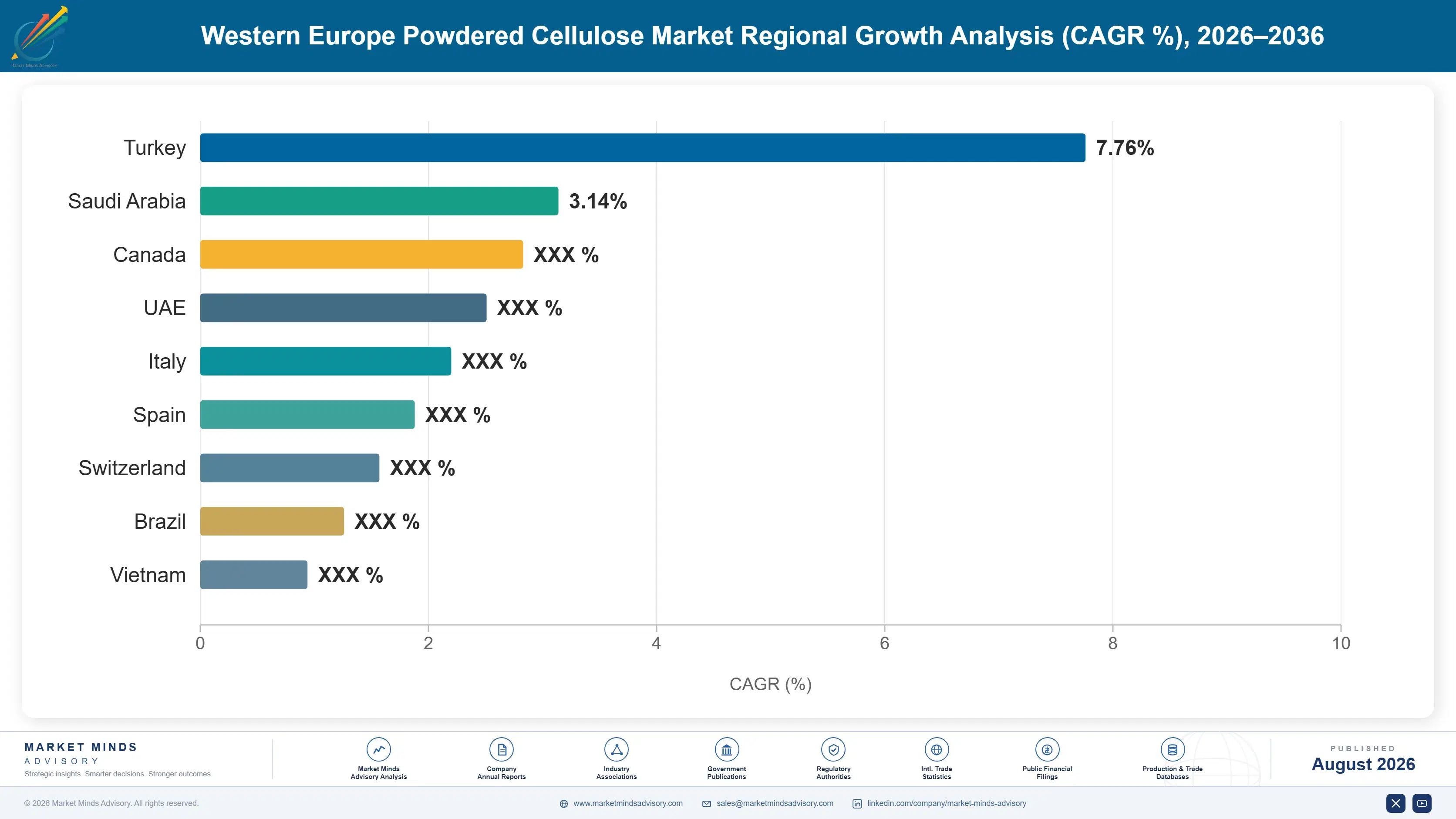
Western Europe holds 88% by scope definition, since this market measures regional demand specifically. Remaining shares reflect adjacent trade and comparator markets rather than demand. France grows fastest at 7.4% on front of pack nutritional scoring. Labelling rules rather than nutritional science define this regional market.

North America

A 3% share sits far below the standard band because this market is defined as Western European demand, and the entry here reflects transatlantic trade and comparator activity rather than domestic consumption. American fibre labelling rules took a different path, requiring isolated fibres to demonstrate a physiological benefit before counting toward declared fibre, which is precisely the distinction European rules do not yet make. That divergence makes North America the most useful indicator of what a definitional change would do here. Growth of 4.6% reflects trade and comparison rather than demand within scope. Divergent labelling rules rather than trade volume make this region analytically important here. It shows what a definitional change costs.
Share: 3% | CAGR: 4.6% (2026 to 2036)

Western Europe

An 88% share reflects the scope of this market, which covers Western European demand specifically rather than global consumption. Nutrition claim rules permitting a source of fibre declaration at 3 grams per 100 grams, combined with front of pack scoring, make declared fibre content a commercial variable manufacturers optimise deliberately. France grows fastest at 7.4% because its scoring scheme reaches consumers most directly. Supply is concentrated at 62% for the top five after energy costs removed marginal capacity. Growth of 4.4% is set below the regional band by construction. The definition rather than the material is what carries this entire regional market forward. Nobody writing the rules had that in mind.
Share: 88% | CAGR: 4.4% (2026 to 2036)
Regional intelligence for 5 additional markets available in the complete report: East Asia, South Asia and Pacific, Latin America, Middle East and Africa, Eastern Europe. Contact sales@marketmindsadvisory.com.
western-europe-powdered-cellulose-market-country-cagr-analysis-1787665006303

Where This Ingredient Actually Earns

Nothing here is won on material performance, because purified cellulose is purified cellulose and the specifications are public. Value accrues to whoever sells against a labelling threshold, whoever prepares for a definitional change, whoever segregates pharmaceutical grade properly, and whoever stops losing specifications to confusion. Four routes carry weight. Definitions rather than properties drive this.

Sell The Claim Threshold Not The Fibre

European nutrition rules permit a source of fibre declaration at 3 grams per 100 grams, and front of pack scoring rewards fibre content directly inside its algorithm. Powdered cellulose reaches those numbers at roughly a quarter the cost of the cheapest functional alternative with no calories, taste or colour added. Suppliers presenting cost per fibre point against a formulator's specific threshold reach the reformulation decision, while those presenting technical datasheets are answering a question nobody in the room is asking. Cost per fibre point rather than cost per tonne is the number that matters.
Market Impact: Delivers claim thresholds at 0.28 times alternative cost

Defend Against The Fermentable Fibre Argument

Dietary fibre for labelling is an analytical category and the method cannot separate fermentable fibres with measurable metabolic effects from purified cellulose passing through inert. American rules already require isolated fibres to demonstrate physiological benefit, which is the distinction European rules have not made. If that changes, the application growing at 8.4% loses its basis entirely. Producers building blended systems combining cellulose with fermentable fibres are hedging a definitional risk the rest of the category prefers not to name. Blended systems cost formulation work now and survive any rule change later on.
Market Impact: Hedges the application currently growing at 8.4% annually

Separate Pharmaceutical Grade From Food Grade Entirely

Around 17% of regional volume is produced under pharmaceutical manufacturing conditions, with documentation, audit and particle size control that food grades never require. That work commands pricing food applications will not support and creates qualification positions lasting years, since changing an excipient supplier means regulatory variation filings nobody undertakes casually. Producers running both through one commercial approach dilute the pharmaceutical position and confuse food buyers about why a specification costs what it does. Qualification positions last years because a variation filing carries cost and delay that nobody in the industry accepts lightly.
Market Impact: Protects the 17% produced under pharmaceutical grade conditions

Stop Losing Specifications To Microcrystalline Confusion

Buyers and formulators routinely conflate powdered cellulose with microcrystalline cellulose, a chemically distinct acid hydrolysed product with a different regulatory number and different economics, because both appear simply as cellulose on an ingredient list. That confusion loses specifications to the wrong material and generates price comparisons between products that are not comparable at all. Producers investing in formulator education rather than datasheet distribution recover specifications competitors never realised were available to win. Roughly 40 distinct grades exist across the two products, and buyers comparing prices between them are comparing different regulatory materials entirely.
Market Impact: Corrects confusion spanning 40 plus distinct product grades

Who Controls the Margin Pool

Concentration is high and rose further during the energy disruption. The top five hold 62% of regional capacity, the basis applied consistently throughout this section, after marginal producers exited rather than absorbing grinding and drying costs at several times historical norms. J. Rettenmaier and Sohne leads on grade breadth and application coverage, and the gap reflects decades of formulation support and specification positions rather than any process advantage.
Competition runs on three fronts. Established specialty producers compete on grade range and formulation support into food reformulation projects, which is where specifications get written. Pulp integrated producers compete on cost position in commodity grades. And pharmaceutical qualified suppliers compete in a separate contest entirely, where qualification and documentation matter and where switching requires regulatory filings nobody makes casually.

Rankings will move with the fibre definition rather than with capacity or commercial effort, since a rule separating fermentable fibres from inert bulking would reprice the fastest growing application overnight. The other pressure point is energy cost position, which already decided which regional producers survived the last disruption and will decide exactly the same question again if it moves.
western-europe-powdered-cellulose-market-company-positioning-matrix-1787665006824

Competitive Moat and Risk Dimensions

J. RETTENMAIER AND SOHNE

Moat: Grade Range And Formulation Support

Producing across more than forty distinct particle size specifications with application development support gives formulators a single source for varied requirements, which a narrow range producer cannot match without extensive capital and technical investment. Specification positions written into customer formulations across decades are correspondingly difficult for any competitor to displace once established.
J. RETTENMAIER AND SOHNE

Risk: Fibre Definition Exposure

Substantial volume in fibre fortification applications carries direct exposure to any labelling change separating fermentable functional fibres from inert bulking agents. American rules already draw that distinction, and a European alignment would remove the regulatory basis for the fastest growing application in a portfolio built substantially around it.
BORREGAARD

Moat: Integrated Biorefinery Cost Position

Operating an integrated biorefinery producing multiple cellulose derived products from one feedstock stream spreads energy and pulp cost across several revenue lines, which proved decisive when energy pricing forced marginal single product producers out. That integration is capital intensive and cannot be assembled quickly by any competitor entering now.
BORREGAARD

Risk: Broad Portfolio Attention

Powdered cellulose competes internally for capital and commercial attention against larger and faster growing lines within a diversified biorefinery portfolio. Application development in food reformulation requires sustained technical support that specialist competitors provide as their whole business rather than as one product line among many.

Players Tracked

Prominent Players

J. Rettenmaier and Sohne
Borregaard
Sappi
Nippon Paper Industries
CFF

Other Key Players

International Fiber Corporation
Interfiber
Roquette
IFF
Asahi Kasei
Rayonier Advanced Materials
Bracell
Georgia-Pacific Cellulose
Lenzing
Sigachi Industries
Accent Microcell
Mingtai Chemical
Ankit Pulps and Boards
Maple Biotech
Cosun Beet Company

Recent Developments

FEBRUARY 2025

Manufacturer reformulates cereal range to reach fibre claim threshold

A cereal manufacturer reformulated a product range to reach 3 grams of fibre per 100 grams, permitting a source of fibre declaration and improving its front of pack score. Powdered cellulose delivers that at roughly a quarter the cost of the cheapest functional fibre alternative available.
Signal: The reformulation target is a number on a label rather than a nutritional objective anywhere in the process
MAY 2025

Nutrition researchers press for fermentable fibre labelling distinction

Nutrition researchers and several advisory bodies pressed for labelling rules distinguishing fermentable fibres with demonstrated metabolic effects from inert bulking agents counted by the same analytical method. Fibre fortification grows at 8.4% and rests entirely on the absence of that distinction in current European rules.
Signal: The fastest growing application in this market depends on a definition rather than a property nobody controls
SEPTEMBER 2025

Producer qualifies additional pharmaceutical grade capacity for excipient supply

A producer qualified additional capacity under pharmaceutical manufacturing conditions for excipient supply, covering documentation, audit and particle size control that food grades never require. Around 17% of regional volume is produced to those conditions and commands pricing food applications will not support. Food grades never reach it.
Signal: Changing an excipient supplier means a regulatory filing nobody undertakes without real cause without a very good reason

What Purified Cellulose Costs

Bleached and dissolving pulp accounts for 46% of production cost and energy for 29%, with purification chemicals, water treatment, labour and quality control carrying the remainder. Pulp comes largely from Nordic, North American and South American producers, and specification requirements narrow the acceptable grades against ordinary paper pulp. Grinding to over forty distinct particle size distributions is where most of the energy goes, alongside drying after purification.
The European energy disruption did not simply raise costs here; it removed producers. IEA data recorded gas prices at several times historical norms, and specialty cellulose producer annual reports documented capacity reductions and closures rather than the price increases a higher value product would have carried. Value added per tonne on a material competing against cheaper bulking alternatives could not support energy at those levels for very long.

Exposure divides by integration and energy position rather than by scale. Producers operating integrated biorefineries spread energy and pulp cost across several product streams, while single product grinders carry the full exposure on both inputs. That difference explains the regional consolidation more completely than any commercial factor, and it will decide the same question if European energy pricing moves sharply again during the forecast period.
western-europe-powdered-cellulose-market-cost-volatility-analysis-1787665007020

Fix energy position before expanding grinding capacity

Grinding and drying consume 29% of production cost, and the last disruption removed producers rather than repricing the market, because value added per tonne could not carry energy at several times historical norms. Fixing energy supply before adding capacity prevents building an asset that cannot run economically. Producers who expanded first and contracted energy afterwards learned this expensively.

Secure pulp specification on multi-year rather than spot terms

Pulp is 46% of production cost and specification requirements narrow acceptable grades considerably against ordinary paper pulp, which makes spot exposure worse here than in commodity paper. Multi-year supply relationships cost some price flexibility and remove a specification risk that shows up directly in finished particle size consistency. Customers notice consistency failures long before they notice a price change.

Blend fermentable fibre into fortification systems as a hedge

Fibre fortification grows at 8.4% on a labelling definition that cannot separate inert bulking from fermentable fibre, and American rules already draw exactly that distinction. Developing blended systems now costs formulation work and creates a position that survives a definitional change. Producers waiting for the rule to arrive will be developing under pressure while customers reformulate around them.

Portfolio Architecture for Margin Defence

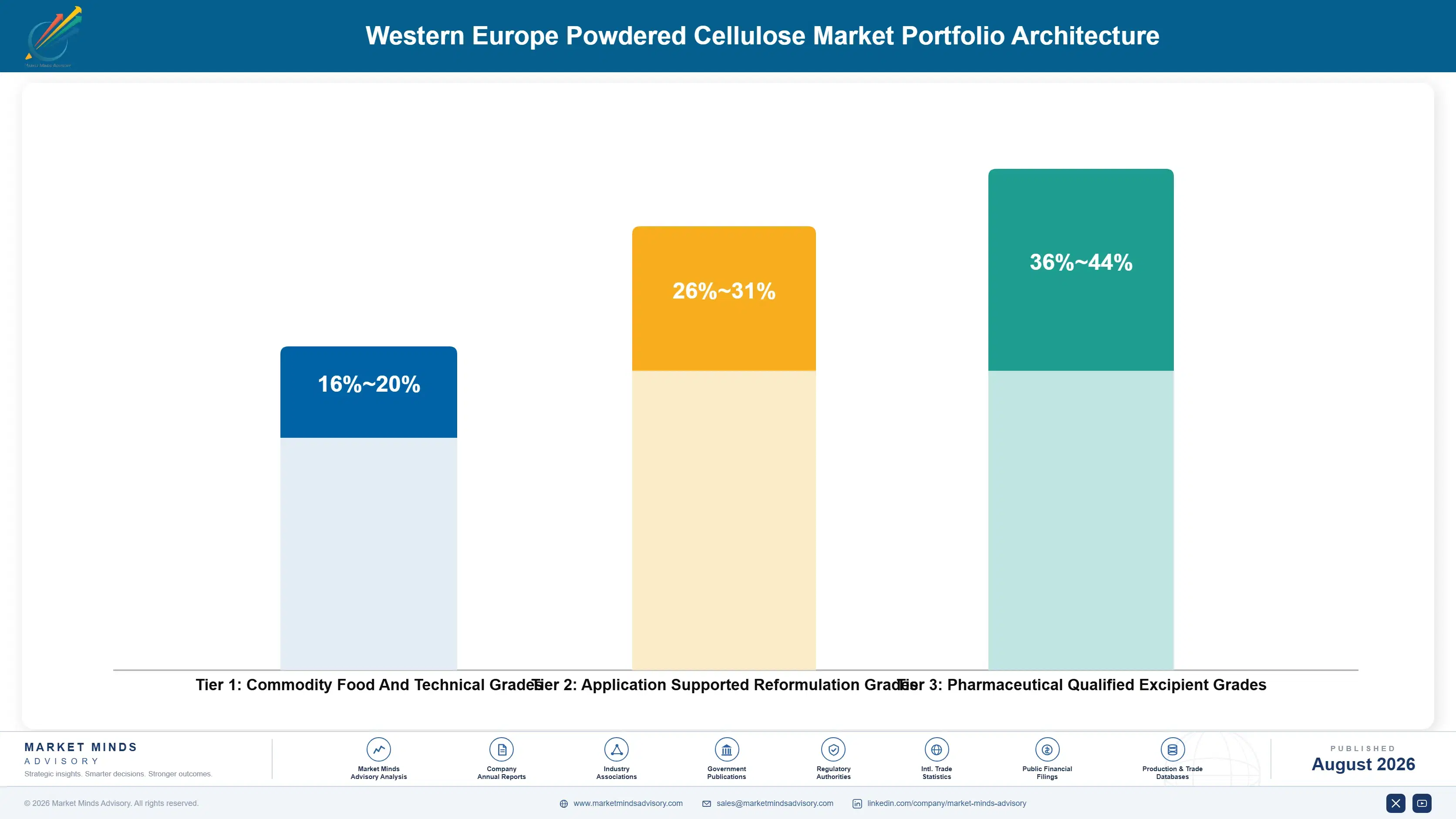
Margin architecture divides on documentation rather than on chemistry. Commodity food grades earn least, since the material is well understood, specifications are public and buyers compare on price per tonne against alternative bulking agents. Application supported fortification and texture grades earn considerably better, because formulation support and specification positions create switching friction. Pharmaceutical qualified grades earn best, since changing an excipient supplier requires a regulatory filing nobody undertakes casually.
The tension runs between volume and qualification. Food volume loads grinding capacity and keeps cost per tonne competitive across the whole plant, and it invites price comparison against materials that are not really comparable. Pharmaceutical work carries margin on modest tonnage and demands segregation, documentation and audit readiness that food production does not. Running both through one commercial approach reliably damages the pharmaceutical position first.

High value pools concentrate in pharmaceutical qualification and in formulation supported reformulation work, neither of which is a tonnage position. Everything selling commodity grades competes on price per tonne against bulking agents and against Asian producers where specification permits. The businesses worth building are those where a filing, a formulation position or a particle size specification makes substitution genuinely awkward for the customer.

Commodity Food And Technical Grades

Standard particle size grades sold on price per tonne into anticaking, technical filler and animal nutrition applications. Specifications are public, the material is well understood and buyers compare against alternative bulking agents directly.
Gross Margin: 16-20%

Application Supported Reformulation Grades

Fortification and texture grades sold with formulation support into reduced fat and fibre enriched product development. Specification positions written into customer formulations create switching friction that commodity grades never generate.
Gross Margin: 26-31%

Pharmaceutical Qualified Excipient Grades

Grades manufactured under pharmaceutical conditions with documentation, audit history and particle size control food applications never require. The range is wide because qualification depth and filing status differ substantially between customers and markets.
Gross Margin: 36-44%
western-europe-powdered-cellulose-market-portfolio-architecture-1787665007543

High-value Sub-segments and Strategic Watch-out

Dietary Fibre Fortification

Fastest growing application at 8.4% on labelling thresholds rather than nutrition, reaching 3 grams per 100 grams at roughly a quarter of functional fibre cost. Definitional risk is the exposure, since rules could separate inert bulking from fermentable fibre. Nobody in the category names that risk.
Gross Margin: 26-31%

Fat Replacement and Texture Systems

Second fastest at 7.2% on reformulation targets in processed meat, bakery and dairy where removing fat leaves a physical gap. Formulation support matters far more here, because texture failures are immediately obvious to the consumer eating them. Application development wins these specifications rather than competitive pricing alone.
Gross Margin: 28-33%

Pharmaceutical Excipients

Growing at 6.2% on generic manufacturing volumes and carrying the highest margins available in the category. Qualification positions last years because changing an excipient supplier requires a regulatory variation filing nobody undertakes without real cause. Volume is modest and the positions are the most durable available.
Gross Margin: 36-44%

Technical and Industrial Fillers

Growing at only 3.4% against cheaper mineral and starch based alternatives that perform adequately in most industrial applications. Demand is stable and unexciting, and nothing in development is likely to change that position materially anywhere. Price per tonne decides everything in this part of the category.
Gross Margin: 12-16%

How Specification Positions Repeat

Demand here attaches to a written formulation rather than to a purchase relationship. A food manufacturer specifies a particular grade at a particular inclusion rate, validates the product against it, then orders against that specification for as long as the product exists. Reformulating to change supplier means retesting texture, shelf life and analytical fibre content, which nobody does to save a little per tonne on a low inclusion ingredient.
Stickiness varies sharply by application. Pharmaceutical excipient positions are the most durable, since changing supplier requires a regulatory variation filing with real cost and delay. Fortification and texture grades sit in the middle, held by formulation validation rather than by regulation. Commodity technical and anticaking grades are the least sticky, since specifications are loose and buyers retender on price per tonne without much friction.

The buyer profile has moved from the technologist toward marketing and regulatory affairs. A food technologist asks what the ingredient does in the product, while a marketing team asks what the label can say and a regulatory function checks whether it may. Those parties decide fortification inclusion rates, which is why the fastest growing application is governed by a labelling threshold rather than by any formulation requirement.
western-europe-powdered-cellulose-market-end-use-penetration-index-1787665008038

Where This Ingredient Rewards Focus

These are among the four positions where our research anticipates prominent divergence between winners and laggards over the coming forecast period. Each is grounded in the demand model, the regulatory perimeter, and the announced capacity pipeline.
01 / CLAIM THRESHOLD ECONOMICS

Sell the number the label needs

European nutrition rules permit a source of fibre declaration at 3 grams per 100 grams, and front of pack scoring schemes reward declared fibre content directly inside their algorithms. Powdered cellulose reaches those thresholds at roughly a quarter the cost of the cheapest functional alternative, adding no calories, taste or colour to the formulation at all. Suppliers presenting cost per fibre point against a specific threshold reach the reformulation decision, while those distributing technical datasheets answer a question nobody is asking.
02 / FIBRE DEFINITION RISK

The whole application rests on a definition

Dietary fibre for labelling purposes is an analytical category rather than a physiological one, and the method cannot separate fermentable fibres producing measurable metabolic effects from purified cellulose passing through largely inert. American rules already require isolated fibres to demonstrate physiological benefit, which is precisely the distinction European rules have not yet made. If that changes, the application growing at 8.4% loses its regulatory basis, and producers building blended systems are hedging what others would clearly prefer not to name at all.
03 / GRADE SEGREGATION DISCIPLINE

Pharmaceutical work needs its own commercial approach

Around 17% of regional volume is produced under pharmaceutical manufacturing conditions requiring documentation, audit history and particle size control that food grades never approach in any respect. That work commands pricing food applications will not support and produces qualification positions lasting years, since changing an excipient supplier means a regulatory variation filing nobody undertakes casually. Running both halves through one commercial approach dilutes the pharmaceutical position and confuses food buyers about the pricing they are being shown on a quotation.
04 / SPECIFICATION CLARITY CONTROL

Two products share one word on labels

Buyers and formulators routinely conflate powdered cellulose with microcrystalline cellulose, a chemically distinct acid hydrolysed product carrying a different regulatory number and entirely different economics behind it. Both appear simply as cellulose on an ingredient list, which loses specifications to the wrong material and generates price comparisons between products that are not comparable in any meaningful way. Producers investing in formulator education rather than datasheet distribution recover specifications competitors never even realised were available to be won there at all.

Engagement Snapshot From the Field

A live engagement with an industry participant carrying material or product regulatory and market exposure ahead of a defining policy shift, showing how our research translates into a defensible multi-year portfolio strategy.
MARKET MINDS ADVISORY · CLIENT ENGAGEMENT SUMMARY
Western Europe Powdered Cellulose Producer Strategic Portfolio Review and Transition Roadmap 2026·Investment Scenario on Western Europe Powdered Cellulose Exposure Evaluation 2025-26
CLIENT PROFILE
A Western European specialty cellulose producer supplying powdered cellulose grades to food manufacturers and a small pharmaceutical excipient business. Annual revenue was approximately 88 million dollars (client-reported, unverified by MMA), with food applications around four fifths of tonnage. Pharmaceutical and food grades were sold by one commercial team using a single pricing framework at that point.
STRATEGIC CHALLENGE
Food margins had compressed against commodity comparison while the pharmaceutical business grew slowly despite better economics. Management wanted to know whether to invest in pharmaceutical qualification capacity or to defend food volume, and was separately concerned that fibre labelling rules might change. Nobody had quantified how much revenue depended on the current fibre definition.
MMA APPROACH
MMA measured revenue exposure to fibre fortification applications specifically and modelled the effect of an American style physiological benefit requirement arriving in Europe. Pharmaceutical qualification investment was costed against food capacity defence. Forty-seven expert interviews with food technologists, regulatory affairs staff, marketing leads and pharmaceutical procurement established how specifications are genuinely set, alongside survey work across six countries.
KEY FINDINGS
  1. Roughly 34% of revenue depended on fibre fortification applications that a definitional change would remove, and management had assessed that exposure as immaterial.
  2. Marketing and regulatory functions rather than technologists set inclusion rates in 6 of every 10 fortification decisions reviewed, and the sales team called on technologists exclusively.
  3. Pharmaceutical grades delivered around 2.3 times food gross margin per tonne and had grown slowly because one commercial team prioritised the larger food accounts.
  4. Price comparisons against microcrystalline cellulose appeared in 4 of the 9 lost tenders examined, comparing materials with entirely different regulatory numbers and cost bases.
CLIENT PROFILE
A Western European specialty cellulose producer supplying powdered cellulose grades to food manufacturers and a small pharmaceutical excipient business. Annual revenue was approximately 88 million dollars (client-reported, unverified by MMA), with food applications around four fifths of tonnage. Pharmaceutical and food grades were sold by one commercial team using a single pricing framework at that point.
STRATEGIC CHALLENGE
Food margins had compressed against commodity comparison while the pharmaceutical business grew slowly despite better economics. Management wanted to know whether to invest in pharmaceutical qualification capacity or to defend food volume, and was separately concerned that fibre labelling rules might change. Nobody had quantified how much revenue depended on the current fibre definition.
MMA APPROACH
MMA measured revenue exposure to fibre fortification applications specifically and modelled the effect of an American style physiological benefit requirement arriving in Europe. Pharmaceutical qualification investment was costed against food capacity defence. Forty-seven expert interviews with food technologists, regulatory affairs staff, marketing leads and pharmaceutical procurement established how specifications are genuinely set, alongside survey work across six countries.
KEY FINDINGS
  1. Roughly 34% of revenue depended on fibre fortification applications that a definitional change would remove, and management had assessed that exposure as immaterial.
  2. Marketing and regulatory functions rather than technologists set inclusion rates in 6 of every 10 fortification decisions reviewed, and the sales team called on technologists exclusively.
  3. Pharmaceutical grades delivered around 2.3 times food gross margin per tonne and had grown slowly because one commercial team prioritised the larger food accounts.
  4. Price comparisons against microcrystalline cellulose appeared in 4 of the 9 lost tenders examined, comparing materials with entirely different regulatory numbers and cost bases.
RECOMMENDED STRATEGY
Phase 1: Phase one: separate pharmaceutical commercial responsibility entirely, since those grades deliver roughly 2.3 times food gross margin and had been deprioritised. Phase 2: Phase two: develop blended fermentable fibre systems, hedging the 34% of revenue exposed to any European fibre definition change arriving. Phase 3: Phase three: redirect food selling toward marketing and regulatory functions, which set inclusion rates in 6 of 10 fortification decisions.
OUTCOME
The client separated the pharmaceutical business commercially and its growth rate improved materially within a year without additional capacity. Blended fibre system development began ahead of any regulatory movement, and calling on regulatory and marketing functions recovered several fortification specifications the technologist route had never reached (client-reported, unverified by MMA).

Frequently Asked Questions

Foundational context covering the market sizes, CAGR, scope, country, region and competition that inform every finding below. This section is provided to cover basics and most often pre-purchase conversations, answered from the MMA Primary Research Dataset.

What is the current size of the Western Europe Powdered Cellulose Market?

The market was valued at 0.29 billion dollars in 2025, covering mechanically processed purified alpha-cellulose sold into Western European markets. It reaches an estimated 0.31 billion dollars during 2026.

How large will the Western Europe Powdered Cellulose Market be by 2036?

MMA forecasts 0.53 billion dollars by 2036, an increase of 0.22 billion dollars over the 2026 base. That represents an expansion multiple of 1.71 times across the forecast period.

What is the CAGR for the Western Europe Powdered Cellulose Market 2026 to 2036?

The base case compound annual growth rate is 5.6%, with a bull case of 6.8% and a bear case of 4.4%. Front of pack scoring adoption and fibre definition changes separate those scenarios.

Which segment is growing fastest?

Dietary fibre fortification grows at 8.4%, half again the market rate of 5.6%, because labelling thresholds reward declared fibre content. Fat replacement systems follow at 7.2%.

Who are the major companies in the Western Europe Powdered Cellulose Market?

Rettenmaier, Borregaard, Sappi, Nippon Paper Industries and CFF lead on regional capacity across food and pharmaceutical grades. Together they account for 62% of this regional market.

Which country is growing fastest?

The market is defined as Western European demand, and France grows fastest of any country in the region at 7.4%, because front of pack nutritional scoring makes fibre content commercially explicit.

Report Segmentation Architecture

The full report scope spans multiple orthogonal segmentation dimensions, with cross-tabulated demand data provided for each dimension pair. Coverage extends further to regional breakdowns, trend trajectories, and the competitive detail needed to support segment-level decision-making.

By Application

  • Food Anticaking and Free Flow Agents
  • Dietary Fibre Fortification
  • Pharmaceutical Excipients
  • Fat Replacement and Texture Systems
  • Technical and Industrial Fillers
  • Animal Nutrition and Pet Food

By End-Use Industry

  • Bakery and Cereals
  • Processed Meat and Convenience
  • Dairy and Cheese
  • Pharmaceutical Manufacturing
  • Animal Nutrition
  • Technical and Industrial Manufacturing

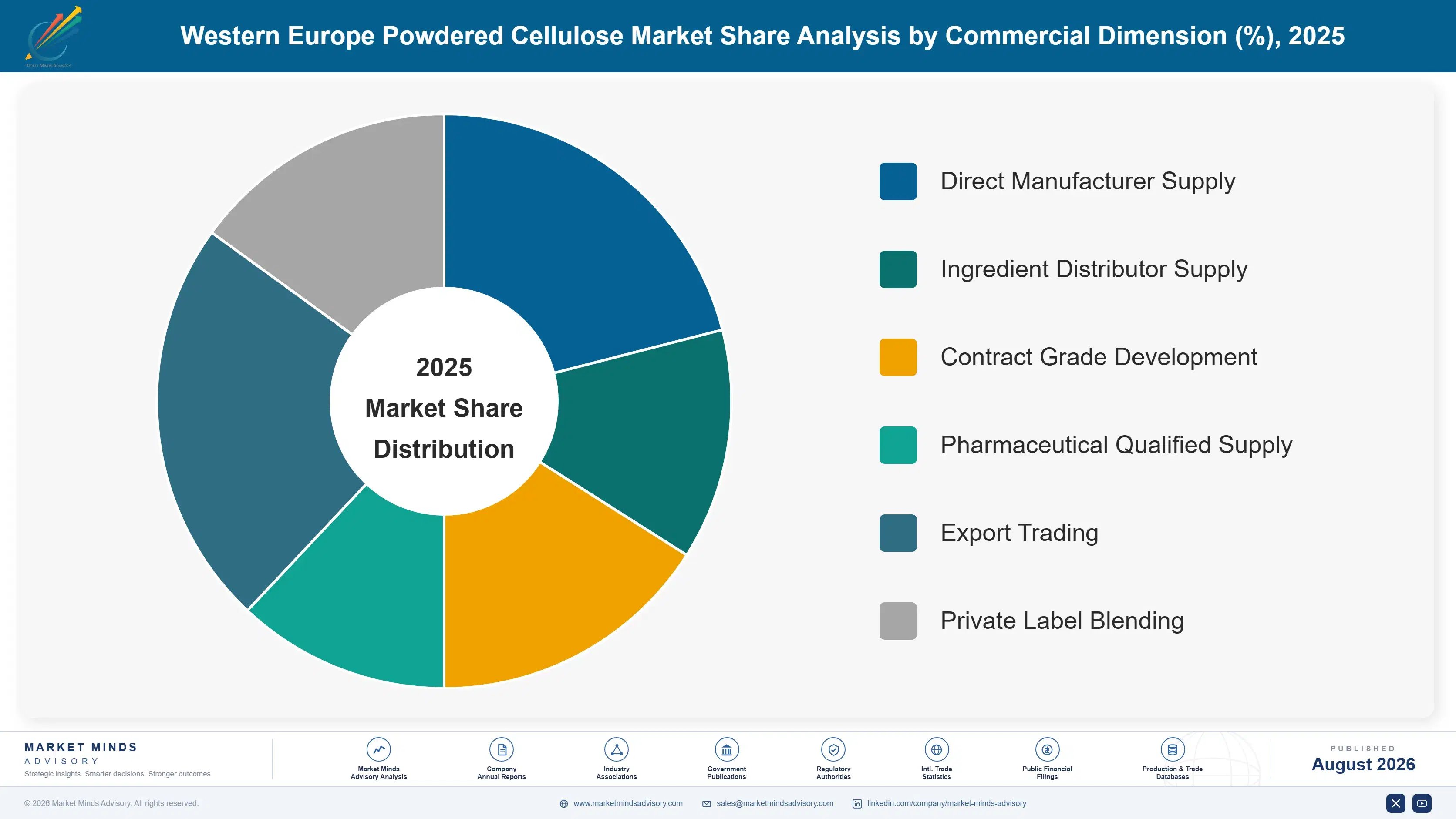
By Commercial Dimension

  • Direct Manufacturer Supply
  • Ingredient Distributor Supply
  • Contract Grade Development
  • Pharmaceutical Qualified Supply
  • Export Trading
  • Private Label Blending

By Region

  • North America
  • Western Europe
  • East Asia
  • South Asia and Pacific
  • Latin America
  • Middle East and Africa
  • Eastern Europe

Scope, Methodology, and Coverage

Every figure in this report is reproducible from documented input assumptions. The scope below maps the historical period, the forecast horizon, the segmentation dimensions, and the countries covered, alongside the underlying primary and qualitative methodology.
Historical Period
2020 to 2025
Forecast Period
2026 to 2036
Base Year
2025 (USD billions; MMA Primary Research Dataset, August 2026)
Market Definition
Purified alpha-cellulose processed mechanically from wood pulp or cotton linters and ground to defined particle size distributions, sold into Western European markets across food, pharmaceutical, animal nutrition and technical applications, measured at producer selling value. Microcrystalline cellulose produced by acid hydrolysis, all cellulose ethers including carboxymethyl, hydroxypropyl methyl, methyl and ethyl cellulose, nanocellulose and microfibrillated cellulose, regenerated cellulose fibres, and unprocessed pulp are excluded from scope entirely.
Quantitative Units
USD billions (producer selling value); tonnes; USD per tonne by application and grade
Segmentation Dimensions
Application; end-use industry; commercial dimension; region
Regions Covered
North America, Western Europe, East Asia, South Asia and Pacific, Latin America, Middle East and Africa, Eastern Europe
Countries Covered
Germany, France, United Kingdom, Ireland, Netherlands, Belgium, Italy, Spain, Portugal, Austria, Switzerland, Sweden, Denmark, Norway, Finland, Greece, and comparator coverage of the United States, China, Japan, India, Brazil and Poland
Key Companies Profiled
J. Rettenmaier and Sohne, Borregaard, Sappi, Nippon Paper Industries, CFF, International Fiber Corporation, Interfiber, Roquette, IFF, Asahi Kasei, Rayonier Advanced Materials, Bracell, Georgia-Pacific Cellulose, Lenzing, Sigachi Industries, Accent Microcell, Mingtai Chemical, Ankit Pulps and Boards, Maple Biotech, Cosun Beet Company
Quantitative Methodology
Primary survey, n=3,800 respondents, Q4 2025, six countries; demand-side model with trade association cross-validation
Qualitative Methodology
47 expert interviews, Q4 2025; applied to validate demand model assumptions, identify emerging dynamics, and assess competitive positioning
Report Format
PDF and XLSX data workbook (Word format preview document)
Publisher
Market Minds Advisory
Report Code
MMA-2026-CHM-154
Published
August 2026
Contact
sales@marketmindsadvisory.com | www.marketmindsadvisory.com

Purchase the full Western Europe Powdered Cellulose Market Report (2026 to 2036).

The full report treats powdered cellulose as an instrument for meeting labelling thresholds rather than as a nutritional ingredient, and follows the commercial consequences of a category resting on a definition it did not write. It sizes all six applications independently through 2036, quantifies revenue exposure to any fibre definition change, and separates pharmaceutical qualified economics from food grade pricing throughout. Regional chapters cover all seven regions, with Western European demand assessed separately from comparator markets whose labelling rules already differ. Competitive profiling covers 20 participants on one consistent regional capacity measure.
Six applications sized independently through 2036
Revenue exposure quantified against potential fibre definition changes
Pharmaceutical qualified economics separated from food grade pricing
Front of pack scoring adoption mapped against fortification demand
Energy cost position assessed across surviving regional producers
Twenty participants profiled on one consistent capacity measure

Built For The People Who Decide

From boardroom strategy to bench-side execution, this report is read cover-to-cover by leaders shaping the next decade of their industry, turning demand scenarios, market dynamics and valuation benchmarks into decisions.
CXOs/ Presidents/ VPs/ Managers
M&A and Corporate Development
Strategy Teams and R&D Heads
Procurement and Product Directors
Regulatory and Compliance Leaders
Investor Relations and Equity Analysts