Market Minds Advisory
Western Europe Molded Fiber Pulp Packaging Market

Western Europe Molded Fiber Pulp Packaging Market: A Tooling Business Wearing A Paper Label

The fibre costs almost nothing and the mould costs a great deal, which makes every win a multi-year annuity and every loss complete, because nobody ever shares a moulded pack between converters.

Lead Analyst

Published

September 2026

Make Smarter Decisions with Customized Research Insights

Request a free sample report and evaluate market opportunities, growth trends, and competitive dynamics relevant to your business needs.

2025 MARKET VALUE$1.2BMarket Size 2025
2036 FORECAST VALUE$2.5BBase Case , 2026 to 2036
CAGR 2026 TO 20366.4 %Bull 7.6% / Bear 5.2%
INCREMENTAL OPPORTUNITY$1.1BNet 10- year value creation
EXPANSION MULTIPLE1.86x2036 value over 2026 base
Strategic Levers
M&A Pipeline
Regional Outlook
Country Rankings
Competitive Intelligence
Segmental Deep-dive
Call-Us : 91 93563 13602

Executive Snapshot and Market Trajectory

This is a tooling business that files its accounts as a paper business. Recovered furnish costs very little, and the value sits in a mould engineered to one product's geometry and amortised across four years. Winning a programme means holding it for that term. Losing one loses all of it.
Growth concentrates where expanded polystyrene is finally being removed. Electronics and appliance protective packaging grows at 9.6%, half again the market rate, because brand owners committed to eliminating expanded plastic and moulded fibre is the only fibre format that can be engineered to a specific product shape. Germany grows fastest at 8.2% on its appliance and electronics manufacturing base. Timing decides most of it.
The capability required sits at the expensive end of a capital ladder. Precision forming lines cost roughly 5.2 times commodity equipment, and comparatively few regional converters have made that investment, which is why the fastest application is served by the fewest suppliers. Egg packaging still carries 41% of regional tonnage at 2.8% growth, and it is ballast rather than strategy. Buyers frequently cannot find a second source for the packs they most need.
Market Definition
Moulded fibre packaging produced from recovered paper and wood pulp for protective, transport and produce applications and sold into Western European markets, covering egg packaging, fresh produce trays and punnets, electronics and appliance protective packaging, beverage and bottle shippers, industrial end caps and corner protection, and medical and pharmaceutical trays. Measured at converter selling value. Single-use foodservice tableware, including all bagasse tableware, is excluded and covered separately.
Base Year Value
$1.2B in 2025 (MMA Primary Research Dataset, August 2026)
Forecast Period
2026 to 2036, eleven discrete annual values
CAGR
6.4% base case. Bull 7.6%. Bear 5.2%.
Fastest Growth Segment
Electronics and Appliance Protective Packaging: 9.6% CAGR
Fastest Growth Country
Germany: 8.2% CAGR
Fastest Growth Region
South Asia and Pacific: 8.6% CAGR
Largest Region
Western Europe: 88% of 2025 global value
Market Leaders
Huhtamaki, Brodrene Hartmann, Sonoco, Omni-Pac Group, PAPACKS. Source: MMA Primary Research Dataset, July 2026.
Primary Survey
n=3,800 procurement and R&D decision-makers, Q4 2025, six countries
Methodology
Demand-side build-up, cross-validated against public data, 47 expert interviews

Western Europe Molded Fiber Pulp Packaging Market Forecast Scenarios

western-europe-molded-fiber-pulp-packaging-market-size-forecast-scenario-1787664981691
The five years to 2025 were driven by brand owner commitments to remove expanded polystyrene from protective packaging, which arrived faster than converters installed precision capacity. Egg and produce applications grew with food volumes and little else. The 5.2% historical rate blends a commodity half growing with population and a protective half growing with corporate packaging pledges that were easier to announce than to supply.
The 6.4% base case rests on three mechanisms. Electronics and appliance protective packaging grows at 9.6% as expanded polystyrene removal continues through appliance, consumer electronics and furniture supply chains. Beverage shippers grow at 7.4% on ecommerce spirits and wine distribution. And German demand grows at 8.2%, faster than anywhere in the region, on a manufacturing base that specifies packaging at product design stage rather than afterwards. Timing rather than technology throughout.
The 7.6% bull case turns on expanded polystyrene facing an outright restriction in protective applications rather than voluntary phase out, which would move conversion timing from brand pledges onto a regulatory deadline. The 5.2% bear case is capital: precision forming lines cost roughly 5.2 times commodity equipment, and if converters hesitate the volume goes to alternative formats or stays in plastic.

The Mould Is The Product

The economics here have very little to do with paper. Recovered fibre furnish is 76% of regional input and costs almost nothing per pack, while the mould is engineered around a single product's geometry, takes months to develop and amortises across roughly four years. That structure means a programme win is an annuity and a programme loss is total, because no brand owner splits a moulded pack between two converters.
TOP FIVE CONCENTRATION38%Combined regional capacity held by the leading converters
TOOLING AMORTISATION PERIOD4 yearsTypical recovery term across a dedicated mould programme
PRECISION LINE CAPITAL MULTIPLE5.2xInvestment per line against commodity forming equipment cost
EGG APPLICATION VOLUME SHARE41%Regional tonnage consumed by egg packaging applications alone
EMPTY TRANSPORT REDUCTION68%Volume saved shipping nested fibre against expanded plastic
RECYCLED FURNISH SHARE76%Regional input drawn from recovered paper rather than virgin
Growth is concentrated where expanded polystyrene is being removed rather than where fibre performs best. Consumer electronics, appliance and furniture brand owners committed publicly to eliminating expanded plastic protective packaging, and moulded fibre is the only fibre format that can be engineered to hold a specific product shape with meaningful cushioning. That application grows at 9.6% while the category grows at 6.4%.
Capability sits at the expensive end of a capital ladder that the industry describes in technical language. Precision forming with tight tolerances and finished surfaces requires lines costing roughly 5.2 times commodity equipment, and few regional converters have committed that capital. The result is an unusual market where the fastest growing application is served by the fewest capable suppliers, and where brand owners cannot find a second source.
"Converters talk about grades and forming types. Brand owners are buying a mould, a four-year commitment and the certainty that nobody else can make exactly that shape. Everything else in the conversation is detail."
Director, Protective Packaging and Fibre Conversion Practice · MMA Packaging Practice · August 2026

Market Trends

Expanded Polystyrene Removal Reaches Protective Packaging Last

Foodservice polystyrene was banned years ago and protective packaging survived because no fibre format could hold a heavy product in position through a distribution network. Moulded fibre engineered to a specific geometry answers that, and consumer electronics, appliance and furniture brand owners have committed publicly to removing expanded plastic from their supply chains. Electronics and appliance protective packaging grows at 9.6% against a market rate of 6.4%, the fastest application in the category. Conversion timing depends on brand pledges rather than on regulation, which makes it slower and considerably less predictable.
Market Impact: Germany grows at 8.2% annually
Precision Forming Separates Capable Converters From Commodity Ones

The forming types the industry names describe a capital ladder rather than a product family, and precision lines producing tight tolerances and finished surfaces cost roughly 5.2 times commodity equipment. Few regional converters have made that investment, which leaves the fastest growing application served by the fewest suppliers and brand owners struggling to secure a genuine second source. That scarcity supports pricing that commodity moulded fibre never achieves. It also means capacity decisions taken now determine who participates in protective packaging for the next decade. Genuine second sourcing is frequently impossible here.
Market Impact: Cuts empty transport volume 68%

Market Opportunities and Growth Drivers

German Manufacturing Specifies Packaging At Design Stage

German appliance, electronics and automotive component manufacturing designs packaging alongside the product rather than sourcing it afterwards, which suits a format where the mould has to be engineered to a specific geometry from the outset. German demand grows at 8.2%, faster than any market in the region. Packaging law obligations reinforce the same direction by making recyclability a documented requirement rather than a preference. Converters engaged during product development capture programmes that a supplier arriving at procurement stage simply cannot compete for on price. Design stage engagement is the whole route in.
Market Impact: Tooling amortises across 4 years

Nested Fibre Cuts Freight On Empty Packaging Substantially

Expanded polystyrene protective packaging ships mostly air, while moulded fibre nests and reduces transport volume on empty packaging by around 68% on comparable applications. That converts a sustainability decision into a logistics saving that procurement can evidence, which is a considerably easier internal argument for a packaging engineer to win. The saving applies to inbound packaging movement rather than to finished goods distribution, and suppliers who overstate it lose credibility quickly once a customer runs the comparison properly for themselves. Scope discipline is what keeps the argument credible with a procurement team.
Market Impact: Egg carries 41% of regional tonnage

Market Restraints and Challenges

Tooling Commitment Deters Brand Owners From Switching Formats

A moulded fibre programme requires a dedicated mould engineered to one product geometry and amortised across roughly four years, which brand owners hesitate to commit to for products with shorter lifecycles or uncertain volumes. The root cause is that the tooling is specific rather than general, unlike a corrugated box that fits many products adequately. Commercially this slows conversion in fast moving consumer electronics particularly. Converters respond with tooling cost sharing, modular mould designs and shorter amortisation terms, which transfer risk rather than removing it. Product lifecycle length decides most of it.
Market Impact: Fastest application growing at 9.6%

Egg And Produce Volume Anchors Pricing Expectations Downward

Egg packaging alone carries 41% of regional tonnage at 2.8% growth, produced from recovered newsprint on commodity equipment at prices set by regional competition and recovered paper cost. The root cause is that buyers across the category see published tonnage prices from that half and apply them to conversations about engineered protective packs. Commercially this compresses expectations in exactly the applications where value should sit. Converters respond by separating commercial teams and pricing methodology entirely, which works better than explaining the difference does. Two businesses under one roof rarely price each other cleanly.
Market Impact: Precision lines cost 5.2 times commodity
3 additional market trends, 4 additional growth drivers, and 2 additional restraints and challenges are covered in the full report. Contact sales@marketmindsadvisory.com to access the complete intelligence.

Segment CAGR and Growth Architecture

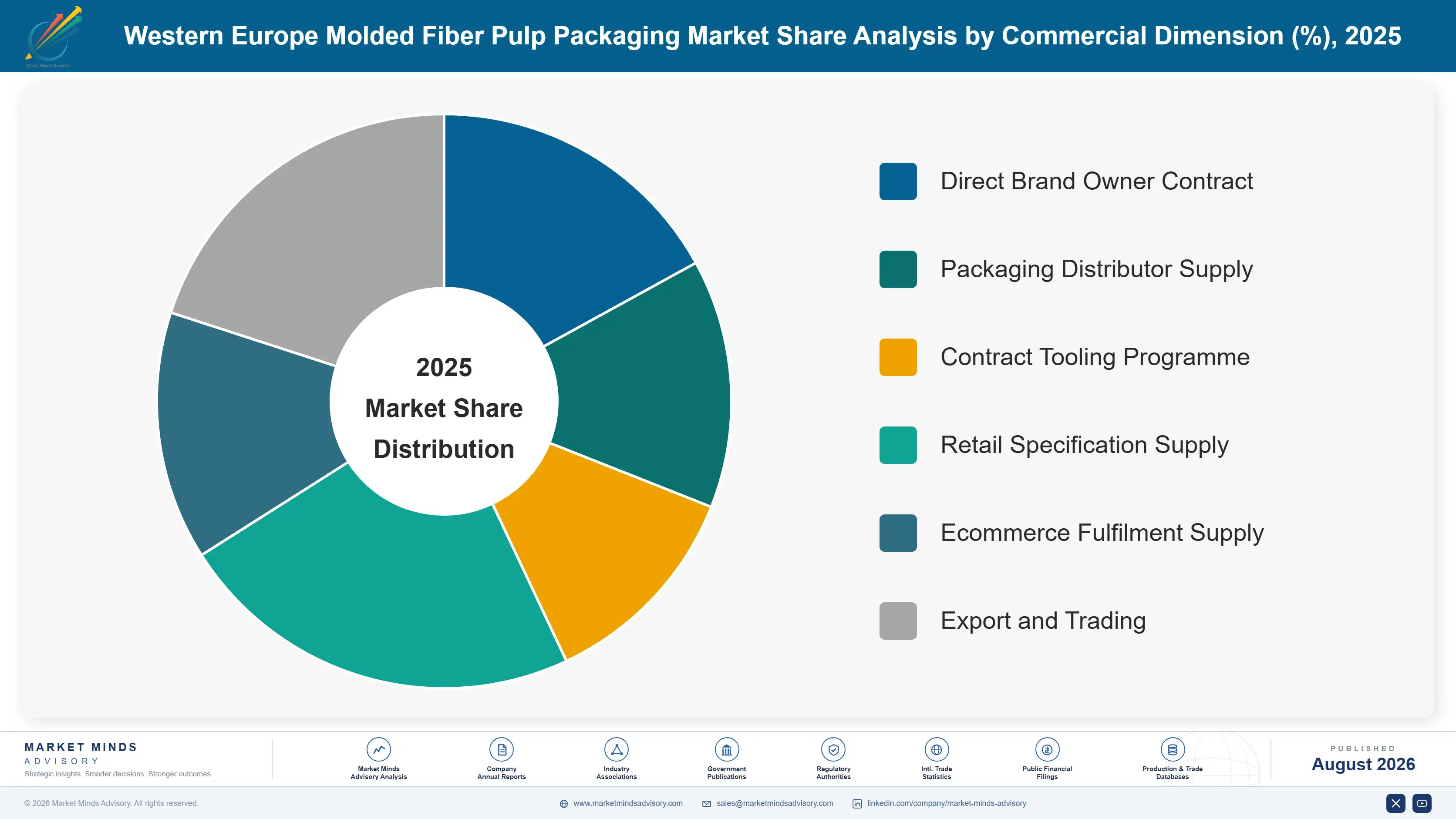
Segmentation follows application, since the application determines whether tooling is dedicated or generic, what forming capability is required and whether the buyer is a food producer or a brand owner. Six applications cover the category as traded regionally. Growth concentrates where expanded polystyrene is being removed rather than where fibre performs naturally. Corporate commitment sets the pace.
western-europe-molded-fiber-pulp-packaging-market-market-share-analysis-1787664982278

Electronics and Appliance Protective Packaging

Engineered cushioning packs holding televisions, appliances, tools and consumer electronics in position through distribution, replacing expanded polystyrene inserts that brand owners have committed to eliminating. At 9.6% this is the fastest growing application, half again the market rate of 6.4%, and corporate commitment rather than material performance sets the pace. Each pack requires a dedicated mould engineered to one product geometry and amortised across roughly four years, which makes a programme win an annuity and a loss total. Precision forming capability at roughly 5.2 times commodity equipment cost limits how many converters can genuinely compete. Brand owners frequently cannot secure a genuine second source, which is unusual in packaging procurement.
CAGR 9.6%

Beverage and Bottle Shippers

Moulded inserts and shippers protecting wine, spirits and premium beverages through ecommerce and courier distribution, replacing expanded plastic and corrugated insert systems. Growth of 7.4% is second fastest in the category, driven by direct to consumer beverage distribution rather than by retail packaging change. Breakage in transit is expensive enough that performance is tested properly rather than assumed, which favours converters able to demonstrate drop test results with actual product. Tooling is less product specific than electronics work, since bottle geometries repeat across brands, which reduces both the commitment and the defensibility. Ecommerce distribution rather than retail packaging change is what generates the volume growth in this application. Breakage cost keeps standards high.
CAGR 7.4%
Full segment breakdown across 6 segments available in the complete report.

Regional Architecture and Country Demand Map

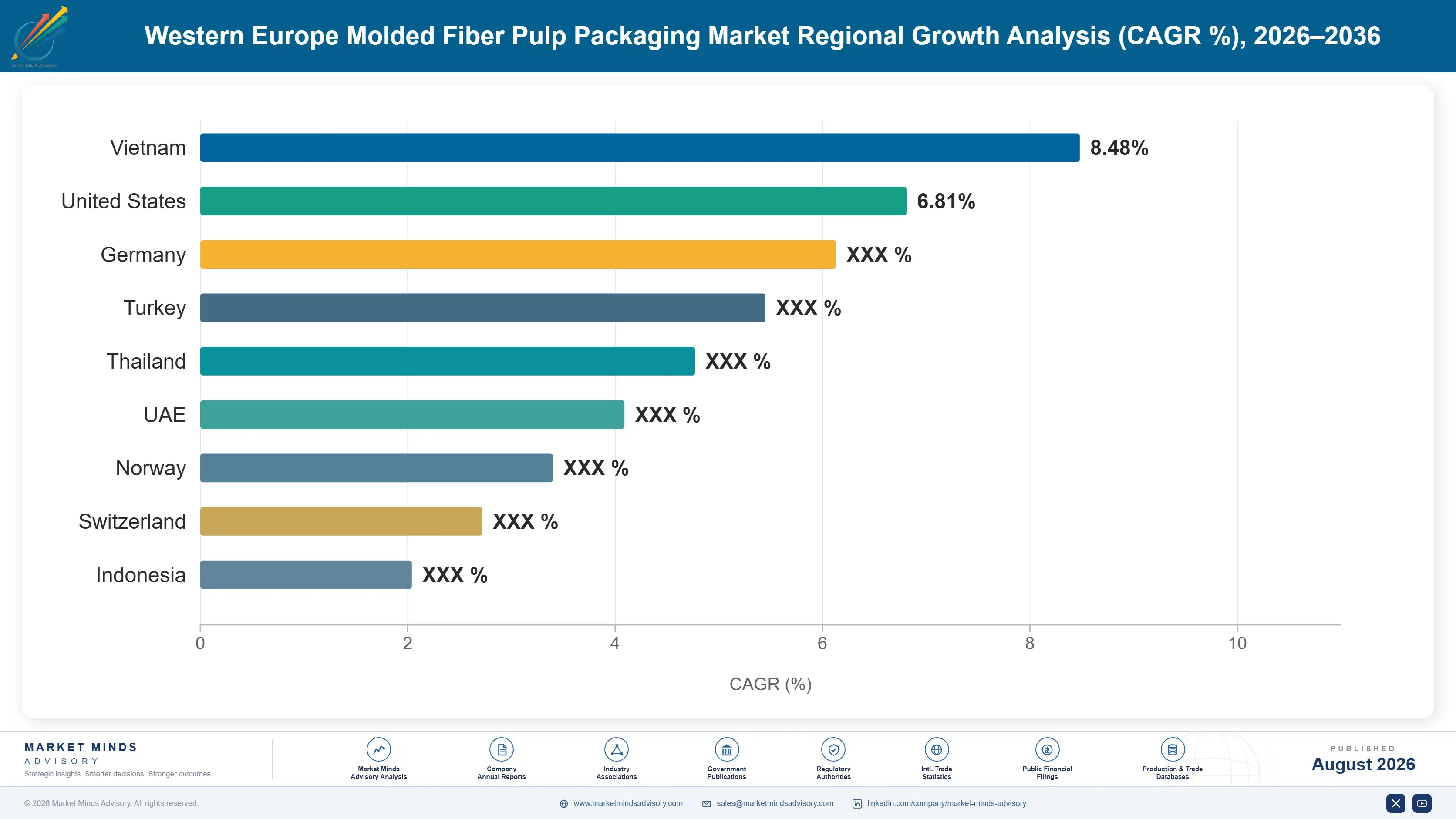
Western Europe holds 88% by scope definition, since this market measures regional demand specifically. Remaining shares reflect adjacent trade and comparator markets rather than demand. Germany grows fastest at 8.2% on manufacturing that specifies packaging early. Tooling programmes rather than traded volume genuinely define this market.

North America

A 3% share sits far below the standard band because this market is defined as Western European demand, and the entry here reflects transatlantic brand owner programmes and comparator activity rather than domestic consumption. Several global brand owners specify identical protective packaging across both regions, which means a mould developed for a European programme frequently serves North American distribution as well. Converters including UFP Technologies and Sonoco operate across both markets with comparable precision forming capability. Growth of 5.4% reflects that programme overlap rather than any demand falling inside the scope measured here. Programme overlap rather than traded packaging is what connects the two regions commercially. A mould developed once frequently serves both.
Share: 3% | CAGR: 5.4% (2026 to 2036)

Western Europe

An 88% share reflects the scope of this market, which covers Western European demand specifically rather than global consumption. Egg packaging still carries 41% of regional tonnage at 2.8% growth while electronics and appliance protective packaging grows at 9.6%, which makes the aggregate figure describe neither half accurately. Germany grows fastest at 8.2% because its manufacturing base specifies packaging during product design rather than at procurement. Precision forming capacity remains concentrated among comparatively few converters. Growth of 5.2% is set below the regional band by construction rather than by demand weakness. The commodity half and the engineered half behave like entirely separate markets sharing a statistic. Only the tonnage total connects them.
Share: 88% | CAGR: 5.2% (2026 to 2036)
Regional intelligence for 5 additional markets available in the complete report: East Asia, South Asia and Pacific, Latin America, Middle East and Africa, Eastern Europe. Contact sales@marketmindsadvisory.com.
western-europe-molded-fiber-pulp-packaging-market-country-cagr-analysis-1787664982810

Where This Category Actually Earns

Nothing here is won on fibre quality, because recovered furnish is 76% of input and costs almost nothing. Value accrues to whoever captures the tooling programme, whoever invested at the precision end, whoever makes the freight argument honestly, and whoever prices commodity volume for what it is. Four routes carry weight and none concerns paper.

Win The Tooling And Own The Programme

A dedicated mould engineered around one product geometry amortises across roughly four years, and no brand owner splits a moulded pack between two converters because the tooling only exists once. That makes a programme win an annuity and a programme loss complete, with nothing in between. Converters engaged during product development influence the geometry itself and capture the tooling decision, while those arriving at procurement stage are quoting against a mould somebody else already designed. Timing rather than price decides most of these outcomes. Roughly 4 years of committed volume follows one tooling decision.
Market Impact: Locks programmes across full 4 year tooling terms

Invest At The Precision End Of The Ladder

Precision forming lines producing tight tolerances and finished surfaces cost roughly 5.2 times commodity equipment, and comparatively few regional converters have committed that capital. The consequence is that the fastest growing application, at 9.6%, is served by the fewest capable suppliers and brand owners frequently cannot secure a genuine second source. That scarcity supports pricing commodity moulded fibre never reaches. Capacity decisions taken now determine who participates in protective packaging for the next decade, since these lines take time to specify and commission. Very few regional converters have made that commitment yet.
Market Impact: Requires capital at 5.2 times commodity line cost

Sell The Empty Freight Saving Explicitly

Expanded polystyrene ships mostly air while moulded fibre nests, cutting transport volume on empty packaging by around 68% on comparable applications. That turns a sustainability conversation into a logistics saving a procurement team can evidence and defend internally, which is a far easier argument to win. The discipline required is honesty about scope, since the saving applies to inbound packaging movement rather than to finished goods distribution. Suppliers who overstate it lose credibility permanently once the customer runs the comparison themselves. Scope honesty is what makes this argument survive a second meeting.
Market Impact: Evidences a 68% saving on empty packaging volume

Treat Egg Volume As Ballast Not Strategy

Egg packaging carries 41% of regional tonnage at 2.8% growth, made from recovered newsprint on commodity equipment at prices set by regional competition. It loads machines and it anchors buyer expectations downward across every other conversation the sales team has. Converters separating commercial teams and pricing methodology between commodity and engineered work protect the value in protective packaging, while those running one price list find themselves explaining why an engineered pack costs several times an egg tray. Egg tonnage is machine loading rather than a growth business, and pricing it as either confuses everybody.
Market Impact: Manages the 41% of tonnage priced as commodity

Who Controls the Margin Pool

Concentration is moderate and splits cleanly by capability. The top five hold 38% of regional capacity, the basis applied consistently throughout this section, across a field mixing global packaging groups, specialist moulded fibre converters and regional egg and produce packers operating commodity equipment. Huhtamaki leads on breadth across applications and geographies, and the gap reflects precision forming capacity and brand owner relationships rather than tonnage.
Competition runs on three fronts. Precision capable converters compete for brand owner tooling programmes, which are won during product development and held for the amortisation term afterwards. Commodity converters compete on tonnage price in egg and produce applications against recovered paper cost. And alternative protective formats, particularly corrugated inserts and paper cushioning systems, compete from outside the category for the same conversion budget.

Rankings will move with precision capacity investment rather than with commercial effort, since the fastest growing application is limited by how many converters can actually make the packs. The other pressure point is expanded polystyrene regulation, which would convert brand pledges into deadlines and expose whether regional capacity can absorb conversion at the pace a restriction would demand.
western-europe-molded-fiber-pulp-packaging-market-company-positioning-matrix-1787664983341

Competitive Moat and Risk Dimensions

HUHTAMAKI

Moat: Application And Geographic Breadth

Capability across egg, produce, foodservice and protective applications in multiple countries allows the group to serve brand owners standardising packaging across markets, which a single site converter cannot match at any price. Precision forming capacity across more than one location also gives the second source assurance that brand owners increasingly demand before committing tooling.
HUHTAMAKI

Risk: Commodity Volume Weighting

Substantial exposure to egg and produce applications growing at 2.8% ties a large part of the asset base to tonnage pricing set by recovered paper cost and regional competition. Redirecting capital toward precision forming at roughly 5.2 times commodity line cost competes internally against maintaining commodity capacity that still fills factories.
BRODRENE HARTMANN

Moat: Egg Packaging Technical Depth

Decades of specialisation in egg packaging produce forming know-how, machine design capability and customer relationships across European egg producers that a general converter cannot replicate quickly. That base also funds expansion into adjacent applications from a position of technical rather than purely commercial strength across the region.
BRODRENE HARTMANN

Risk: Slow Growth Core Application

The core application grows at 2.8% and carries 41% of regional tonnage, which is stable, defensible and unlikely to generate the growth investors expect from a packaging business. Building precision protective capability means competing against converters already holding brand owner tooling programmes and the relationships that produced them.

Players Tracked

Prominent Players

Huhtamaki
Brodrene Hartmann
Sonoco
Omni-Pac Group
PAPACKS

Other Key Players

Smurfit Westrock
DS Smith
Stora Enso
Mondi
Nefab
Tekni-Plex
UFP Technologies
Dolco Packaging
Celluloses de la Loire
Sirap Group
Vernacare
Pulpac
Emsur
Ecopack Italia
Guangxi Qiaowang Bio-Technology

Recent Developments

MARCH 2025

Appliance manufacturer converts protective packaging programme to fibre

An appliance manufacturer converted a protective packaging programme from expanded polystyrene to moulded fibre across a product range, committing to dedicated tooling amortised over four years. Electronics and appliance protective packaging grows at 9.6%, the fastest application in the category, on exactly this kind of brand commitment.
Signal: Tooling commitment is what converts a corporate pledge into an actual supply relationship that anybody can actually rely on
JUNE 2025

Converter commissions precision forming line for engineered packs

A regional converter commissioned a precision forming line producing tight tolerance engineered protective packs, at capital roughly 5.2 times commodity forming equipment. Few regional converters have made that investment, which leaves the fastest growing application served by a comparatively small group of capable suppliers. Capability rather than price decides participation.
Signal: Capacity decisions taken now determine who participates in protective packaging for a decade once the lines are commissioned
SEPTEMBER 2025

Brand owner cites inbound freight saving in packaging conversion case

A consumer brand owner cited inbound freight reduction alongside recyclability when approving a conversion from expanded plastic to moulded fibre protective packaging. Nested fibre cuts transport volume on empty packaging by around 68% against expanded plastic on comparable applications across a supply chain. Procurement approved it on both grounds.
Signal: A logistics saving procurement can evidence wins approvals that sustainability arguments alone do not inside most organisations

What A Moulded Pack Costs

Recovered paper accounts for 28% of production cost and drying energy for 31%, with tooling amortisation, labour and water treatment carrying the remainder. Recovered furnish is 76% of regional input, drawn from newsprint and mixed paper collection that varies by country and season. Drying dominates energy use because forming leaves the pack saturated, and removing that water is the single largest physical demand in the whole process.
Energy rather than fibre proved the volatile line during the last disruption. IEA data recorded European gas prices reaching several times historical norms, and packaging producer annual reports documented drying cost increases passed through on tonnage contracts and absorbed on fixed price programmes. Recovered paper prices moved independently and at times in the opposite direction, which produced margin outcomes that surprised converters watching only one exposure.

Exposure divides by contract structure rather than by scale. Commodity egg and produce tonnage typically indexes to recovered paper and passes energy through, while engineered protective programmes are frequently priced fixed across a tooling term of roughly four years with no adjustment mechanism. That combination is uncomfortable, since the highest margin work carries the longest unhedged exposure and the lowest margin work carries almost none.
western-europe-molded-fiber-pulp-packaging-market-cost-volatility-analysis-1787664983538

Build energy adjustment into multi-year tooling programmes

Engineered protective programmes are frequently priced fixed across a tooling term of roughly four years, while drying energy is about 31% of production cost and moved several times historical norms in the last disruption. Fixed pricing across that term without an adjustment mechanism transfers the exposure onto the converter. Raising it at programme negotiation costs nothing and is impossible afterwards.

Invest in drying heat recovery before capacity expansion

Forming leaves the pack saturated and removing that water is the largest physical demand in the process, which makes drying efficiency the single most consequential cost decision a converter makes. Heat recovery investment reduces the exposure permanently rather than hedging it for a contract term. Converters expanding capacity before addressing drying efficiency are multiplying an exposure rather than diluting it.

Separate commodity and engineered pricing methodology completely

Egg packaging carries 41% of regional tonnage at prices set by recovered paper and regional competition, and buyers apply those published tonnage figures to conversations about engineered packs costing several times as much. Running one commercial team and one price list across both invites that comparison constantly. Separating them entirely works considerably better than explaining the difference ever does.

Portfolio Architecture for Margin Defence

Margin architecture divides on whether the tooling is dedicated. Commodity egg and produce packaging earns least, produced on general equipment at tonnage prices set by recovered paper cost and regional competition. Semi-dedicated produce and beverage applications earn better, since tooling is partly specific and performance is tested. Engineered protective programmes earn best, because the mould exists once, the brand owner cannot dual source it and the commitment runs four years.
The tension runs between tonnage and capital. Commodity volume fills machines, keeps cost per tonne competitive and anchors every pricing conversation downward across the business. Engineered work needs precision lines at roughly 5.2 times commodity capital and produces margin on far less tonnage. A converter holding both must run them as separate businesses or watch the commodity half quietly price the engineered half.

High value pools concentrate in dedicated tooling programmes and in precision forming capability, neither of which is a fibre position. Everything selling commodity tonnage competes against recovered paper cost and regional converters with identical equipment. The businesses worth building are those where a mould exists for one product, the customer cannot buy it anywhere else and the amortisation term keeps them there for four years.

Egg And Commodity Produce Packaging

Recovered newsprint packaging produced on general forming equipment at tonnage prices set by recovered paper cost and regional competition. Volume loads machines reliably and generates the thinnest margins available anywhere in this category.
Gross Margin: 12-16%

Semi-Dedicated Produce And Beverage Packs

Partly product specific packs for premium produce, beverage shippers and retail presentation where performance is tested and tooling is moderately dedicated. Bottle geometries repeat across brands, which limits defensibility while still supporting better pricing.
Gross Margin: 22-27%

Engineered Protective Tooling Programmes

Precision formed protective packs engineered to a single product geometry under dedicated tooling amortised across four years. The range is wide because programme scale, tooling ownership arrangements and second source availability vary substantially between brand owners.
Gross Margin: 32-40%
western-europe-molded-fiber-pulp-packaging-market-portfolio-architecture-1787664984043

High-value Sub-segments and Strategic Watch-out

Electronics and Appliance Protective Packaging

Fastest growing application at 9.6% on brand owner commitments to remove expanded plastic, with dedicated tooling making each win an annuity and each loss total. Precision capability at 5.2 times commodity capital limits how many converters can genuinely compete. Second sourcing is frequently not available at all.
Gross Margin: 32-40%

Beverage and Bottle Shippers

Second fastest at 7.4% on ecommerce spirits and wine distribution, where transit breakage is expensive enough that performance gets tested rather than assumed. Bottle geometries repeat across brands, which reduces both tooling commitment and competitive defensibility. Performance evidence matters more here than in any other application.
Gross Margin: 24-29%

Egg Packaging

Growing at only 2.8% while carrying 41% of regional tonnage, which makes it the commodity core rather than any growth story. It fills machines dependably and anchors buyer price expectations downward across every other application conversation. Nothing about that position is likely to change materially in future.
Gross Margin: 12-16%

Industrial End Caps and Corner Protection

Growing at 4.6% against direct competition from corrugated inserts and paper cushioning systems that require no dedicated tooling whatsoever. Generic geometry removes the defensibility that makes engineered protective work commercially attractive in the first place. Competing formats need no dedicated tooling investment of any kind at all.
Gross Margin: 16-20%

How Tooling Creates The Annuity

Demand attaches to a mould rather than to a supplier relationship, which is unusual in packaging. A brand owner commits tooling engineered to one product geometry, amortises it across roughly four years, and orders against it every week the product ships. Nobody dual sources a moulded pack because the mould exists once, so the win is complete and the amortisation term does a contract's work.
Stickiness therefore depends entirely on how specific the tooling is. Engineered electronics and appliance packs are the most durable, since the mould matches one product and requalifying means new tooling. Beverage shippers sit lower, because bottle geometries repeat across brands and a competitor's existing mould may fit. Egg and produce packaging is the least sticky, since equipment is general, product is interchangeable and buyers retender on tonnage price.

The buying decision is moving earlier, from procurement into product development. A converter engaged while the product is being designed influences geometry, tooling and specification simultaneously, while one arriving at procurement is quoting against decisions already taken. German manufacturing does this most consistently, which is part of why German demand grows at 8.2% and why converters positioned inside design processes hold programmes others never see.
western-europe-molded-fiber-pulp-packaging-market-end-use-penetration-index-1787664984539

Where This Category Rewards Focus

These are among the four positions where our research anticipates prominent divergence between winners and laggards over the coming forecast period. Each is grounded in the demand model, the regulatory perimeter, and the announced capacity pipeline.
01 / TOOLING PROGRAMME CAPTURE

The mould exists once and so does the winner

A dedicated mould engineered around one product geometry amortises across roughly four years, and no brand owner splits a moulded pack between two converters because the tooling physically only exists in one place. That makes a programme win an annuity and a programme loss complete, with nothing partial available in between them. Converters engaged during product development influence the geometry itself and capture the decision, while those arriving at procurement quote against a mould somebody else already designed and paid for.
02 / PRECISION CAPACITY INVESTMENT

Capital decides who can even compete

Precision forming lines producing tight tolerances and finished surfaces cost roughly 5.2 times commodity equipment, and comparatively few regional converters have committed that capital to date. The consequence is that the fastest growing application, at 9.6%, is served by the fewest capable suppliers and brand owners frequently cannot secure a genuine second source anywhere. That scarcity supports pricing commodity moulded fibre never reaches, and capacity decisions taken now determine who participates in this application for the next decade or more.
03 / FREIGHT ARGUMENT DISCIPLINE

An evidenced saving beats a sustainability claim

Expanded polystyrene ships mostly air while moulded fibre nests, cutting transport volume on empty packaging by around 68% on comparable applications across a supply chain. That converts a sustainability discussion into a logistics saving a procurement team can evidence and defend internally, which is a considerably easier approval to obtain. The discipline is honesty about scope, since the saving applies to inbound packaging movement rather than finished goods distribution, and overstating it destroys the credibility permanently with that customer afterwards.
04 / COMMODITY VOLUME REALISM

Egg trays quietly price everything else

Egg packaging carries 41% of regional tonnage at 2.8% growth, produced from recovered newsprint on general equipment at prices set by recovered paper cost and regional competition. Buyers see those published tonnage figures and apply them to conversations about engineered protective packs costing several times as much per unit. Converters separating commercial teams and pricing methodology entirely protect the value in protective work, while those running one price list spend their time explaining the difference to buyers who stopped listening.

Engagement Snapshot From the Field

A live engagement with an industry participant carrying material or product regulatory and market exposure ahead of a defining policy shift, showing how our research translates into a defensible multi-year portfolio strategy.
MARKET MINDS ADVISORY · CLIENT ENGAGEMENT SUMMARY
Western Europe Molded Fiber Pulp Packaging Producer Strategic Portfolio Review and Transition Roadmap 2026·Investment Scenario on Western Europe Molded Fiber Pulp Packaging Exposure Evaluation 2025-26
CLIENT PROFILE
A Western European moulded fibre converter operating commodity forming capacity across two plants, supplying egg producers, produce packers and a small protective packaging business. Annual revenue was approximately 148 million dollars (client-reported, unverified by MMA), with egg and produce packaging around three quarters of tonnage. No precision forming line existed in either plant at that point.
STRATEGIC CHALLENGE
Brand owner enquiries for engineered protective packaging had risen sharply and the client was losing them all at technical evaluation, having no precision capability. Management was weighing a precision line at several times commodity capital against expanding commodity capacity where demand was reliable. Nobody had modelled what an engineered programme is actually worth across its tooling term.
MMA APPROACH
MMA reconstructed the client's lost enquiries and modelled programme value across a full four year tooling amortisation rather than as annual revenue. Precision line capital was costed against commodity expansion on comparable terms. Forty-seven expert interviews with brand owner packaging engineers, procurement leads and converters established how tooling decisions are genuinely made, alongside survey work across six countries.
KEY FINDINGS
  1. A single engineered programme delivered around 3 times the gross margin of equivalent commodity tonnage across a four year term, and the client had been evaluating them as annual revenue instead.
  2. Brand owners involved converters during product development in 7 of every 10 programmes won, and the client's sales approach reached procurement teams almost exclusively.
  3. Commodity capacity expansion returned below the client's hurdle rate in 4 of the 6 demand scenarios modelled, since regional tonnage pricing tracks recovered paper cost directly.
  4. One price list across commodity and engineered work had caused 5 of the 9 protective quotations reviewed to be benchmarked against egg tray pricing by the customer.
CLIENT PROFILE
A Western European moulded fibre converter operating commodity forming capacity across two plants, supplying egg producers, produce packers and a small protective packaging business. Annual revenue was approximately 148 million dollars (client-reported, unverified by MMA), with egg and produce packaging around three quarters of tonnage. No precision forming line existed in either plant at that point.
STRATEGIC CHALLENGE
Brand owner enquiries for engineered protective packaging had risen sharply and the client was losing them all at technical evaluation, having no precision capability. Management was weighing a precision line at several times commodity capital against expanding commodity capacity where demand was reliable. Nobody had modelled what an engineered programme is actually worth across its tooling term.
MMA APPROACH
MMA reconstructed the client's lost enquiries and modelled programme value across a full four year tooling amortisation rather than as annual revenue. Precision line capital was costed against commodity expansion on comparable terms. Forty-seven expert interviews with brand owner packaging engineers, procurement leads and converters established how tooling decisions are genuinely made, alongside survey work across six countries.
KEY FINDINGS
  1. A single engineered programme delivered around 3 times the gross margin of equivalent commodity tonnage across a four year term, and the client had been evaluating them as annual revenue instead.
  2. Brand owners involved converters during product development in 7 of every 10 programmes won, and the client's sales approach reached procurement teams almost exclusively.
  3. Commodity capacity expansion returned below the client's hurdle rate in 4 of the 6 demand scenarios modelled, since regional tonnage pricing tracks recovered paper cost directly.
  4. One price list across commodity and engineered work had caused 5 of the 9 protective quotations reviewed to be benchmarked against egg tray pricing by the customer.
RECOMMENDED STRATEGY
Phase 1: Phase one: commission a precision forming line, since engineered programmes deliver roughly 3 times commodity gross margin across a four year tooling term. Phase 2: Phase two: build brand owner design stage engagement, given converters are involved during product development in 7 of 10 programmes won. Phase 3: Phase three: separate commercial teams and pricing entirely, after 5 of 9 protective quotations were benchmarked against egg tray prices.
OUTCOME
The client commissioned a precision line rather than expanding commodity capacity and won its first two engineered programmes within the following year, both through design stage engagement rather than tender. Separating the commercial teams removed the benchmarking problem, and commodity tonnage was repositioned as machine loading rather than as a growth business (client-reported, unverified by MMA).

Frequently Asked Questions

Foundational context covering the market sizes, CAGR, scope, country, region and competition that inform every finding below. This section is provided to cover basics and most often pre-purchase conversations, answered from the MMA Primary Research Dataset.

What is the current size of the Western Europe Molded Fiber Pulp Packaging Market?

The market was valued at 1.24 billion dollars in 2025, covering protective, transport and produce moulded fibre packaging sold into Western European markets. It reaches an estimated 1.32 billion dollars during 2026.

How large will the Western Europe Molded Fiber Pulp Packaging Market be by 2036?

MMA forecasts 2.45 billion dollars by 2036, an increase of 1.13 billion dollars over the 2026 base. That represents an expansion multiple of 1.86 times across the forecast period.

What is the CAGR for the Western Europe Molded Fiber Pulp Packaging Market 2026 to 2036?

The base case compound annual growth rate is 6.4%, with a bull case of 7.6% and a bear case of 5.2%. Polystyrene restriction and precision capacity investment separate those two scenarios.

Which segment is growing fastest?

Electronics and appliance protective packaging grows at 9.6%, half again the market rate of 6.4%, on expanded plastic removal commitments. Beverage and bottle shippers follow at 7.4%.

Who are the major companies in the Western Europe Molded Fiber Pulp Packaging Market?

Huhtamaki, Brodrene Hartmann, Sonoco, Omni-Pac Group and PAPACKS lead on regional capacity across commodity and engineered applications. Together they account for 38% of this regional market.

Which country is growing fastest?

The market is defined as Western European demand, and Germany grows fastest of any country in the region at 8.2%, because its manufacturing base specifies packaging during product design.

Report Segmentation Architecture

The full report scope spans multiple orthogonal segmentation dimensions, with cross-tabulated demand data provided for each dimension pair. Coverage extends further to regional breakdowns, trend trajectories, and the competitive detail needed to support segment-level decision-making.

By Application

  • Egg Packaging
  • Fresh Produce Trays and Punnets
  • Electronics and Appliance Protective Packaging
  • Beverage and Bottle Shippers
  • Industrial End Caps and Corner Protection
  • Medical and Pharmaceutical Trays

By End-Use Industry

  • Egg and Poultry Production
  • Fresh Produce Growing and Packing
  • Consumer Electronics Manufacturing
  • Household Appliance Manufacturing
  • Beverage and Spirits
  • Medical Device and Pharmaceutical

By Commercial Dimension

  • Direct Brand Owner Contract
  • Packaging Distributor Supply
  • Contract Tooling Programme
  • Retail Specification Supply
  • Ecommerce Fulfilment Supply
  • Export and Trading

By Region

  • North America
  • Western Europe
  • East Asia
  • South Asia and Pacific
  • Latin America
  • Middle East and Africa
  • Eastern Europe

Scope, Methodology, and Coverage

Every figure in this report is reproducible from documented input assumptions. The scope below maps the historical period, the forecast horizon, the segmentation dimensions, and the countries covered, alongside the underlying primary and qualitative methodology.
Historical Period
2020 to 2025
Forecast Period
2026 to 2036
Base Year
2025 (USD billions; MMA Primary Research Dataset, August 2026)
Market Definition
Moulded fibre packaging produced from recovered paper and wood pulp for protective, transport and produce applications and sold into Western European markets, covering egg packaging, fresh produce trays and punnets, electronics and appliance protective packaging, beverage and bottle shippers, industrial end caps and corner protection, and medical and pharmaceutical trays, measured at converter selling value. Single-use foodservice tableware of any fibre origin, including all bagasse tableware, is excluded and covered in a separate report, as are corrugated packaging, expanded plastic protective packaging and paper cushioning systems.
Quantitative Units
USD billions (converter selling value); tonnes and units; USD per thousand units by application
Segmentation Dimensions
Application; end-use industry; commercial dimension; region
Regions Covered
North America, Western Europe, East Asia, South Asia and Pacific, Latin America, Middle East and Africa, Eastern Europe
Countries Covered
Germany, France, United Kingdom, Ireland, Netherlands, Belgium, Italy, Spain, Portugal, Austria, Switzerland, Sweden, Denmark, Norway, Finland, Greece, and comparator coverage of the United States, China, Japan, India, Brazil and Poland
Key Companies Profiled
Huhtamaki, Brodrene Hartmann, Sonoco, Omni-Pac Group, PAPACKS, Smurfit Westrock, DS Smith, Stora Enso, Mondi, Nefab, Tekni-Plex, UFP Technologies, Dolco Packaging, Celluloses de la Loire, Sirap Group, Vernacare, Pulpac, Emsur, Ecopack Italia, Guangxi Qiaowang Bio-Technology
Quantitative Methodology
Primary survey, n=3,800 respondents, Q4 2025, six countries; demand-side model with trade association cross-validation
Qualitative Methodology
47 expert interviews, Q4 2025; applied to validate demand model assumptions, identify emerging dynamics, and assess competitive positioning
Report Format
PDF and XLSX data workbook (Word format preview document)
Publisher
Market Minds Advisory
Report Code
MMA-2026-PAC-109
Published
August 2026
Contact
sales@marketmindsadvisory.com | www.marketmindsadvisory.com

Purchase the full Western Europe Molded Fiber Pulp Packaging Market Report (2026 to 2036).

The full report treats moulded fibre as a tooling business rather than a paper business, and follows what that means for capacity investment, programme capture and pricing discipline across a category whose commodity half quietly prices its engineered half. It sizes all six applications independently through 2036, models tooling economics across full amortisation terms, and quantifies precision forming capital against the applications it opens. Regional chapters cover all seven regions, with Western European demand assessed separately from comparator markets and export supply chains. Competitive profiling covers 20 participants on one consistent regional capacity measure.
Six applications sized independently through 2036
Tooling economics modelled across full amortisation terms
Precision forming capital assessed against application access
Empty packaging freight savings quantified against expanded plastic
Commodity and engineered pricing dynamics separated throughout the analysis
Twenty participants profiled on one consistent capacity measure

Built For The People Who Decide

From boardroom strategy to bench-side execution, this report is read cover-to-cover by leaders shaping the next decade of their industry, turning demand scenarios, market dynamics and valuation benchmarks into decisions.
CXOs/ Presidents/ VPs/ Managers
M&A and Corporate Development
Strategy Teams and R&D Heads
Procurement and Product Directors
Regulatory and Compliance Leaders
Investor Relations and Equity Analysts