

Market Minds Advisory
Western Europe Industrial Electronics Packaging Market

Western Europe Industrial Electronics Packaging Market: Compliance, ESD Protection, and Reshoring Demand

The EU's new packaging waste regulation forces electronics packaging converters to requalify ESD-safe recycled resins before 2030 deadlines, while semiconductor reshoring under the CHIPS and EU Chips Acts pulls new demand toward European converters overnight.

Lead Analyst

Bilal Shaikh

Published

September 2026

Make Smarter Decisions with Customized Research Insights

Request a free sample report and evaluate market opportunities, growth trends, and competitive dynamics relevant to your business needs.

2025 MARKET VALUE$18.5BMarket Size 2025
2036 FORECAST VALUE$36.6BBase Case , 2026 to 2036
CAGR 2026 TO 20366.4 %Bull 7.6% / Bear 5.2%
INCREMENTAL OPPORTUNITY$16.9BNet 10- year value creation
EXPANSION MULTIPLE1.86x2036 value over 2026 base
Strategic Levers
M&A Pipeline
Regional Outlook
Country Rankings
Competitive Intelligence
Segmental Deep-dive
Call-Us : 91 93563 13602

Executive Snapshot and Market Trajectory

Electronics packaging is being rewritten by regulation, not by demand growth alone. The EU's Packaging and Packaging Waste Regulation forces converters to qualify recycled, ESD-safe materials on a fixed compliance timeline, and semiconductor reshoring is pulling new capacity investment toward European converters that can meet those specifications first.
ESD shielding bags and films lead growth at 8.5% annually, nearly 1.3 times the market average, as semiconductor fabs and component makers scale output under CHIPS Act and EU Chips Act incentives. Tape and reel packaging follows on rising SMT component volume. Western Europe holds the largest regional share at 26%, just ahead of East Asia, anchored by Germany's automotive electronics supply chain and the EU's compliance-driven qualification requirements that favor domestic converters over imports.
Competitive intensity concentrates around compliance capability, since PPWR recycled-content mandates and ESD performance standards require certification most small converters cannot afford to pursue independently. Sealed Air and Smurfit WestRock command scale and integrated material science, but specialist converters like Desco Industries and Conductive Containers hold ESD certification depth that larger diversified packagers have not matched, keeping the highest-margin qualified segments fragmented despite consolidation pressure across the broader industry.
Market Definition
The Western Europe industrial electronics packaging market covers global protective and functional packaging materials engineered specifically for electronic components, printed circuit boards, semiconductors, and finished electronic assemblies during manufacturing, storage, and transport, including ESD shielding bags and films, component trays and carriers, tape and reel packaging, moisture barrier bags, protective foam, and electronics-grade shipping containers, sized globally with particular emphasis on Western Europe as the largest single region. It excludes general-purpose corrugated packaging, consumer product retail packaging, and pharmaceutical or food-grade packaging.
Base Year Value
$18.5B in 2025 (MMA Primary Research Dataset, August 2026)
Forecast Period
2026 to 2036, eleven discrete annual values
CAGR
6.4% base case. Bull 7.6%. Bear 5.2%.
Fastest Growth Segment
ESD Shielding Bags and Films: 8.5% CAGR
Fastest Growth Country
Vietnam: 11.2% CAGR
Fastest Growth Region
South Asia and Pacific: 8.5% CAGR
Largest Region
Western Europe: 26% of 2025 global value
Market Leaders
Sealed Air Corporation, Smurfit WestRock, DS Smith plc, Sonoco Products Company, Desco Industries Inc. Source: MMA Analysis based on company annual reports.
Primary Survey
n=3,800 procurement and R&D decision-makers, Q4 2025, six countries
Methodology
Demand-side build-up, cross-validated against public data, 47 expert interviews

Western Europe Industrial Electronics Packaging Market Forecast Scenarios

western-europe-industrial-electronics-packaging-ma-size-forecast-scenario-1787665337524
Between 2020 and 2025 the market grew at an estimated 5.7% annually, held back early by pandemic-era semiconductor shortages that curtailed electronics production volume, then accelerating from 2022 onward as fabs restarted and inventory rebuilding lifted packaging demand across the supply chain. Growth stayed concentrated in Asia-based converters through most of the period, with European capacity lagging behind demand recovery.
The base case carries the market to 6.4% CAGR through 2036 on three mechanisms. CHIPS Act and EU Chips Act incentives pull semiconductor fabrication capacity toward domestic and European converters, shortening supply chains that used to run through Asia. PPWR compliance forces converters to requalify materials on a fixed timeline, driving specification upgrades regardless of demand growth. EV power electronics and battery management systems add high-value components requiring specialized ESD-rated packaging that barely existed a decade ago.
The bull case reaches 7.6% if EU Chips Act funding accelerates faster than currently scheduled, pulling forward converter capacity investment across Germany, France, and the Netherlands. The bear case falls to 5.2% if PPWR compliance deadlines slip through legal challenge or delayed implementing acts, a pattern already visible in earlier EU packaging directives, removing the regulatory urgency that currently drives specification upgrade spending.

Compliance Timelines Are Reshaping Converter Competitiveness

Three forces converge on this category at once. Regulation sets a fixed compliance clock that no demand cycle controls, semiconductor reshoring redraws where packaging capacity needs to sit geographically, and component miniaturization keeps shrinking the material volume required per unit even as unit counts climb steadily higher. Converters that treat these as three separate problems are already behind the ones treating them as a single strategic question.
MARKET CONCENTRATIONCR5: 34%Top five converters hold roughly a third of revenue
AVERAGE UNIT PRICE$0.18Blended price across shielding bags, trays, and reels
TOP PRODUCING COUNTRYChina: 28%Single country supplies over a quarter of global output
CONVERTER CAPACITY UTILIZATION76%Average operating rate across qualified electronics packaging converters
RESIN TRADE INTENSITY48% importedShare of specialty resin inputs sourced across borders
RESIN COST SHARE38% of COGSPetrochemical resin inputs dominate total packaging material cost
Commercial character splits sharply between qualified and commodity supply. Semiconductor and automotive electronics customers require ESD certification, material traceability, and multi-year qualification before a converter can even bid, while general industrial electronics buyers still compete mostly on price and lead time alone. The qualified tier commands materially better margins and stickier long-term relationships, but it demands capital and certification investment that most small converters cannot easily fund.
Looking to 2036, three shifts matter most for the category. Recycled-content mandates will force material science investment regardless of who wins on price today, geographic reshoring will keep redrawing which converters sit closest to fab and assembly capacity, and certification depth will increasingly separate qualified suppliers from commodity converters competing on cost alone.
"Everyone's chasing the semiconductor reshoring headline, but the real money right now is in requalifying materials before the PPWR deadline hits. Compliance is the boring trade, and it's paying better than growth chasing."
Director, Industrial and Electronics Packaging Practice · MMA Packaging Materials and Solutions Practice · August 2026

Market Trends

EU Packaging Waste Regulation Forces Material Requalification

The EU's Packaging and Packaging Waste Regulation entered into force in 2025, setting binding recycled-content targets for plastic packaging that phase in through 2030, including ESD-rated films and bags that historically relied on virgin resin for consistent electrical properties. Converters must now requalify recycled or bio-based ESD formulations against the same static-dissipative performance standards, a process that typically takes 12 to 18 months per material grade. Sealed Air and Smurfit WestRock have both announced qualified recycled ESD film lines ahead of smaller competitors, giving early movers a genuine specification advantage heading into the compliance deadline.
Market Impact: Tracks USD 100 billion fab spend

Semiconductor Reshoring Pulls Packaging Capacity To Europe

The EU Chips Act targets doubling Europe's share of global semiconductor production to 20% by 2030, backed by more than EUR 43 billion in public and private investment, while the American CHIPS Act funds comparable fabrication capacity domestically. Both programs pull packaging demand toward converters positioned near new fab sites, since ESD-rated packaging must be qualified against the specific fab's contamination control requirements and cannot easily ship long distances once qualified. Intel, TSMC, and STMicroelectronics have all announced or begun European fab construction, and each new facility requires a locally qualified packaging supply chain before first wafer output.
Market Impact: Covers 17 million annual EV units

Market Opportunities and Growth Drivers

Global Semiconductor Capex Growth Lifts Packaging Volume

SEMI, the global semiconductor industry association, forecasts worldwide fab equipment spending exceeding USD 100 billion annually through the back half of the decade, and every new fab and assembly line requires a proportional expansion in qualified ESD-rated packaging for wafers, dies, and finished components moving through the supply chain. Component shipment volumes track fab utilization closely, and utilization has climbed back above pre-shortage levels across most major foundries since 2023. Packaging converters serving semiconductor customers directly, rather than through distributors, have captured disproportionate share of this volume growth, since qualified relationships transfer poorly between packaging suppliers once established.
Market Impact: Costs $200K to $500K per grade

EV Power Electronics Demand New ESD Packaging

Battery management systems, inverters, and onboard chargers in electric vehicles use power semiconductor modules that are physically larger, thermally sensitive, and more expensive per unit than the components packaging design assumed as standard a decade ago. IEA data shows electric vehicle sales crossing 17 million units globally in 2024, and each vehicle's power electronics stack requires ESD-rated trays and carriers engineered for larger form factors and tighter static-dissipative tolerances than legacy consumer electronics packaging. Converters slow to develop EV-specific tooling are losing qualification bids to specialists who invested ahead of volume.
Market Impact: Resin inputs run 38% of COGS

Market Restraints and Challenges

Recycled Content Mandates Raise Qualification Costs

PPWR recycled-content targets force converters to requalify ESD-safe materials against static-dissipative standards that recycled resin streams do not automatically meet. The root cause is technical: recycled polymer feedstock carries inconsistent additive content batch to batch, which is exactly what ESD-rated films cannot tolerate, since static-dissipative performance depends on precisely controlled conductive additive dispersion. Qualification for a single material grade typically costs converters USD 200,000 to 500,000 and takes 12 to 18 months, a cost smaller converters struggle to absorb without a guaranteed commitment. Larger converters are responding by developing proprietary recycled formulations and offering qualification support directly to customers.
Market Impact: Sets 2030 recycled-content compliance deadline

Resin Price Volatility Squeezes Converter Margins

ESD packaging films and trays rely on specialty resins, conductive polymers, and static-dissipative additives all derived from petrochemical feedstock, exposing converters to naphtha and ethylene price swings they cannot pass through to customers on long-term contracts. The root cause is chemical: static-dissipative performance requires specific polymer chemistries with few substitute feedstocks, unlike commodity packaging film where converters can switch resin suppliers freely. European converters felt this in 2022, when natural gas price spikes drove up petrochemical feedstock costs across the continent. Several converters are pursuing multi-year resin supply contracts with price collars, trading upside for protection against the worst swings.
Market Impact: Targets EUR 43 billion fab investment
3 additional market trends, 3 additional growth drivers, and 3 additional restraints and challenges are covered in the full report. Contact sales@marketmindsadvisory.com to access the complete intelligence.

Segment CAGR and Growth Architecture

Segmentation follows packaging type, a single material and functional-format logic spanning ESD shielding bags and films, component trays and carriers, tape and reel packaging, moisture barrier bags, protective foam inserts, and electronics-grade shipping containers. Each format carries distinct material specification, qualification pathway, and customer base, so commercial position tracks what the packaging protects against and how it is certified.
western-europe-industrial-electronics-packaging-ma-market-share-analysis-1787665338105

ESD Shielding Bags and Films

ESD shielding bags and films grow fastest at 8.5% annually, nearly 1.3 times the overall market rate, as semiconductor and automotive electronics reshoring under CHIPS and EU Chips Act incentives pulls new qualified converter capacity into Europe and North America. These multi-layer metallized films provide Faraday cage shielding against electrostatic discharge during storage and transport of bare die, populated boards, and finished modules, with static-dissipative surface resistivity engineered to precise industry specifications. Recycled-content mandates under PPWR are forcing an entire generation of material requalification across this segment specifically, since virgin resin has historically been the default input for consistent electrical performance. Sealed Air and Smurfit WestRock lead qualified recycled ESD film development.
CAGR 8.5%

Tape and Reel Packaging

Tape and reel packaging grows second-fastest at 7.6%, driven by rising surface-mount technology component volume as electronics manufacturing services providers scale output to meet semiconductor and consumer electronics demand. These carrier tapes, cover tapes, and reel assemblies hold individual components in precise pocket positions for automated pick-and-place assembly, with dimensional tolerance requirements tightening as component packages shrink toward 01005 and smaller form factors. Component miniaturization cuts material volume per unit but increases the precision engineering value embedded in each reel, a trade-off that has kept segment revenue growing even as physical material consumption per component declines. Asian contract manufacturers remain the largest buyer base, though European automotive electronics assembly is growing fastest within the segment.
CAGR 7.6%
Full segment breakdown across 6 segments available in the complete report.

Regional Architecture and Country Demand Map

Western Europe now leads on automotive electronics supply chain depth and PPWR compliance requirements favoring domestic converters, narrowly ahead of East Asia's semiconductor manufacturing base. North America follows on CHIPS Act-driven reshoring, while South Asia and Pacific posts the fastest growth as contract manufacturing expands across India and Vietnam.

North America

The United States drives nearly all of North America's 22% share, anchored by CHIPS Act-funded fabrication capacity from Intel, TSMC's Arizona facility, and Samsung's Texas expansion, each requiring qualified domestic ESD packaging supply. Historically, American electronics manufacturers relied heavily on Asian-sourced packaging materials, but reshoring incentives are now funding qualified domestic converter capacity for the first time in over two decades. Mexico's maquiladora electronics assembly sector serves as a secondary demand center, supplying finished goods back into the United States market under nearshoring trends distinct from the fab-driven demand further north. Canada contributes modestly, concentrated around automotive electronics assembly in Ontario. Growth of 7.0% reflects the scale of reshoring investment currently underway, even from a mature market base.
Share: 22% | CAGR: 7.0% (2026 to 2036)

Western Europe

Germany alone anchors much of Western Europe's 26% share through its automotive electronics and industrial automation supply chains, where Bosch, Continental, and Infineon require ESD-certified packaging across dense supplier networks. The EU's Packaging and Packaging Waste Regulation applies uniformly across member states, giving converters operating here a first-mover advantage in recycled-content qualification that competitors elsewhere must eventually match to sell into the bloc. France and the Netherlands host semiconductor and electronics assembly capacity tied to EU Chips Act investment, adding qualified-converter demand. Import tariff exposure on Asian packaging materials, combined with PPWR compliance costs that fall disproportionately on non-EU suppliers, favors domestic production over imports. Growth of 4.9% trails the global rate, consistent with a mature, highly qualified regional market.
Share: 26% | CAGR: 4.9% (2026 to 2036)
Regional intelligence for 5 additional markets available in the complete report: East Asia, South Asia and Pacific, Latin America, Middle East and Africa, Eastern Europe. Contact sales@marketmindsadvisory.com.
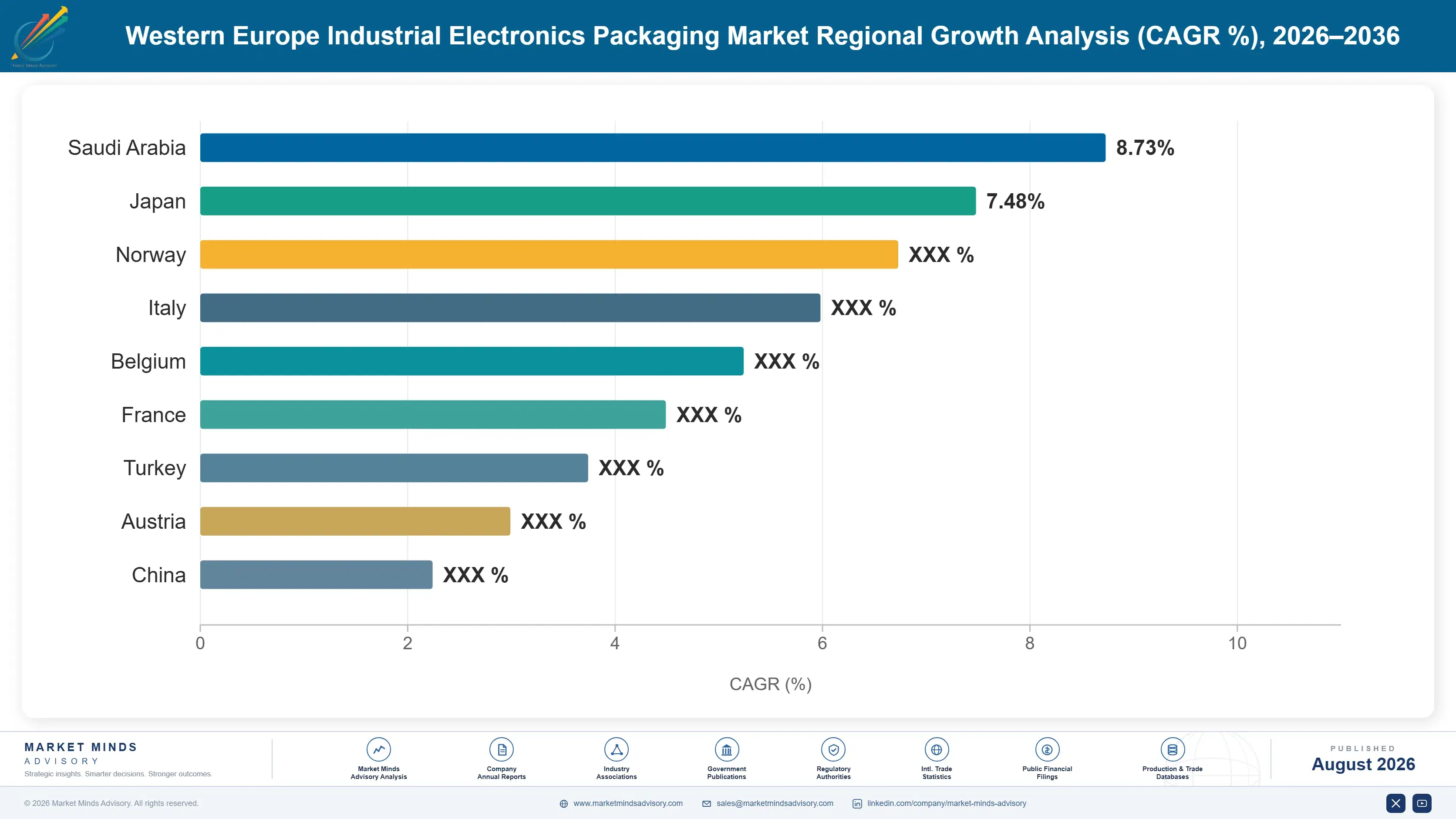
western-europe-industrial-electronics-packaging-ma-country-cagr-analysis-1787665338644

Where Electronics Packaging Margin Now Concentrates

Converters face a familiar squeeze: commodity packaging competes purely on resin cost and freight, while qualification depth, compliance readiness, and specification services increasingly carry the margin. The four moves below shift revenue toward defensible, harder-to-replicate capabilities instead of undifferentiated material supply, drawing on how leading converters have already begun separating commodity economics from qualified-tier services.

Sell Compliance Qualification As A Service

Converters that build in-house PPWR compliance and material qualification expertise can sell that capability to customers still navigating recycled-content requirements, charging consulting-style fees on top of material sales. Sealed Air's compliance advisory offering, bundled with its qualified recycled ESD film line, reportedly commands a 15% to 20% price premium over unbundled material sales, since customers are effectively buying certainty against a regulatory deadline rather than just packaging. Smaller converters lacking in-house regulatory expertise are increasingly outsourcing this function, creating a services revenue opportunity for converters willing to build it once and sell it across their customer base.
Market Impact: Commands a 15% to 20% price premium bundled

Bundle Qualified Materials With Multi-Year Supply Contracts

Semiconductor and automotive customers value supply continuity as much as unit price, since requalifying a new packaging supplier mid-program can cost a fab customer far more than any packaging price difference. Converters offering multi-year qualified-material supply contracts with price collars against resin volatility can command 8% to 12% premium pricing over spot-market equivalents, while locking in demand volume that justifies dedicated production line investment. StorOpack and Pregis have both expanded multi-year contract programs targeting semiconductor and EV power electronics customers, recognizing that qualification cost, not material cost, is what locks in the relationship once it exists.
Market Impact: Commands an 8% to 12% pricing premium overall

Expand Into EV Power Electronics Packaging

Electric vehicle power electronics, including battery management systems and onboard chargers, require larger, thermally sensitive ESD-rated trays and carriers that command meaningfully higher unit prices than legacy consumer electronics packaging, since the components carry more value and tighter tolerance requirements. Converters that developed EV-specific tooling ahead of volume, rather than retrofitting existing consumer electronics lines, are winning qualification bids from automakers at prices running 20% to 30% above comparable consumer-grade packaging. This category remains underpenetrated relative to EV sales growth, since many converters still treat automotive electronics as an extension of consumer packaging rather than a distinct qualification category.
Market Impact: Captures pricing 20% to 30% above consumer-grade packaging

License Proprietary ESD Formulations To Competitors

Converters that solved recycled-content ESD qualification early hold formulations that competitors need but cannot develop fast enough to meet compliance deadlines, creating a licensing opportunity that did not exist before PPWR. Licensing a qualified recycled ESD film formulation to a non-competing regional converter, rather than selling finished material, can generate royalty revenue running 3% to 6% of the licensee's sales at zero marginal production cost. Sealed Air has explored this model in adjacent packaging categories, and PPWR's compliance timeline makes the approach more attractive, since demand for proven formulations is concentrated and urgent rather than spread over years.
Market Impact: Generates 3% to 6% royalty revenue on licensing

Who Controls the Margin Pool

Concentration sits at a moderate 34% for the top five, evaluated on global protective packaging revenue attributable to electronics-grade product lines. Smurfit WestRock's scale following its 2024 merger gives it the largest share, but the gap to specialist converters is narrower than CR5 implies, since Sealed Air, Desco Industries, and Conductive Containers each hold certification depth diversified packagers have not matched.
Competitive activity runs along three fronts. Recycled-content qualification drives near-term positioning, where converters race to certify PPWR-compliant ESD materials ahead of deadlines. Geographic capacity placement drives reshoring-linked wins, where converters near new fab sites capture business distant, cheaper suppliers cannot serve within timelines. Certification depth drives specialist positioning, where Desco Industries and Conductive Containers compete for high-specification accounts diversified packagers pursue less aggressively.

Pressure is building from vertical integration, where semiconductor and automotive electronics manufacturers increasingly qualify packaging formulations in-house before handing production to contract converters, compressing converter margin on the highest-value accounts. Chinese converters are also expanding ESD certification capability faster than expected, narrowing a qualification gap Western specialists relied on for differentiation. Rankings will shift toward converters that combine compliance readiness with geographic proximity to reshoring investment, since neither advantage alone secures the fastest-growing segments.
western-europe-industrial-electronics-packaging-ma-company-positioning-matrix-1787665339196

Competitive Moat and Risk Dimensions

SEALED AIR CORPORATION

Moat: Deep ESD Material Science

Sealed Air's decades of static-dissipative material science give it qualification depth across semiconductor, automotive, and industrial electronics accounts that newer entrants cannot replicate quickly. Its early move into qualified recycled ESD film formulations ahead of PPWR deadlines gives it a genuine specification advantage heading into the compliance window competitors are still racing to close.
SEALED AIR CORPORATION

Risk: Exposed To Resin Cost Swings

Sealed Air's material science advantage depends on specialty resin inputs that carry direct petrochemical feedstock exposure, and margin compresses sharply during naphtha and ethylene price spikes it cannot always pass through on existing contracts. Diversified packagers with broader product portfolios can absorb input cost swings more easily than a converter this concentrated in specialty electronics materials.
SMURFIT WESTROCK

Moat: Scale After 2024 Merger

The 2024 combination of Smurfit Kappa and WestRock created the industry's largest integrated packaging company by revenue, giving it purchasing scale on resin and fiber inputs that smaller specialist converters cannot match. That scale advantage extends across electronics-grade product lines even though ESD-rated materials remain a smaller share of its overall packaging portfolio.
SMURFIT WESTROCK

Risk: Integration Distraction From Specialization

Merger integration across two large, previously independent organizations carries genuine execution risk, and electronics-grade ESD packaging is a small, specialized product line within a much larger combined portfolio that management attention may not prioritize. Specialist converters focused entirely on electronics packaging can move faster on qualification and customer-specific formulation work than a diversified giant managing integration simultaneously.

Players Tracked

Prominent Players

Sealed Air Corporation
Smurfit WestRock
International Paper Company
Sonoco Products Company
Desco Industries Inc.

Other Key Players

Mondi plc
Amcor plc
StorOpack
3M Company
Illinois Tool Works
Uline
Pregis LLC
Conductive Containers Inc.
Tekni-Plex
ProAmpac
WEP Verpackungen
Vibac Group
Deufol SE
Rengo Co. Ltd.
Nefab Group

Recent Developments

JULY 2024

Smurfit Kappa and WestRock Complete Merger

Smurfit Kappa and WestRock completed their combination, creating Smurfit WestRock, the world's largest listed packaging company by revenue, with combined operations spanning corrugated, containerboard, and specialty packaging including electronics-grade product lines. The transaction was a merger of equals structured as a combined holding company, not an acquisition by either party.
Signal: Signals that scale consolidation is reaching even specialized electronics packaging categories once dominated by smaller focused converters.
MARCH 2025

Sealed Air Launches Recycled ESD Film Line

Sealed Air launched a qualified recycled-content ESD shielding film line ahead of PPWR compliance deadlines, targeting semiconductor and automotive electronics customers needing certified recycled material now rather than waiting for regulatory deadlines to force the transition. The launch positioned Sealed Air ahead of most competitors on recycled ESD qualification.
Signal: Signals that compliance-driven product launches now outpace regulatory deadlines as converters compete for early qualification advantage.
NOVEMBER 2024

DS Smith Acquired by International Paper

International Paper completed its acquisition of DS Smith, expanding its European packaging footprint substantially and adding DS Smith's electronics and industrial packaging lines to a much larger North American parent company. The transaction was a full acquisition, not a joint venture or merger of equals.
Signal: Signals continued cross-Atlantic consolidation is folding specialized European electronics packaging capability into larger diversified global groups.

Petrochemical Resin And Additive Cost Exposure

Specialty resins and static-dissipative conductive additives account for roughly 38% of cost of goods sold, sourced predominantly from European and Middle Eastern petrochemical crackers for base polymer and specialized additive suppliers concentrated in Germany, Belgium, and the United States. Paper and fiber inputs for corrugated and rigid electronics shipping containers add another 18% to 22%, drawn from European pulp and recycled fiber markets.
European natural gas price spikes in 2022, following disruption of Russian pipeline supply, drove petrochemical feedstock costs higher across the continent, raising resin costs for ESD film and tray converters. Sealed Air's 2022 annual report disclosed material cost inflation pressure. Prices have moderated since 2023 but remain above pre-2021 baselines, per European Commission energy market reporting, keeping European converter input costs higher than Asian competitors.

Smaller specialist converters without long-term resin supply contracts absorb feedstock price spikes, while Smurfit WestRock and Sealed Air negotiate multi-year supply agreements that smooth volatility across larger purchasing volumes. Specialist ESD converters carry exposure since qualification requirements limit how easily they can substitute resin suppliers during a price spike, unlike commodity packaging converters who can switch grades freely. European converters face higher input costs than Asian competitors on energy pricing.
western-europe-industrial-electronics-packaging-ma-cost-volatility-analysis-1787665339398

Lock Multi-Year Resin Supply Contracts With Price Collars

Securing multi-year resin supply agreements with price collars, rather than buying on the spot market, is what let Smurfit WestRock and Sealed Air limit the worst of the 2022 feedstock spike while smaller competitors absorbed the full price swing directly. The premium paid for price protection is real, but far cheaper than losing a qualified customer relationship to margin pressure.

Diversify Petrochemical Sourcing Beyond European Crackers

European natural gas exposure created a regional vulnerability that American and Middle Eastern petrochemical sourcing can partially offset. Qualifying a secondary resin supplier outside Europe, even at a modest logistics cost premium, preserves negotiating leverage and production continuity if another European energy shock disrupts the primary feedstock source, a risk that remains real given continued regional energy market volatility.

Accelerate Recycled Formulation Qualification Ahead Of Deadlines

Converters that qualify recycled ESD formulations well before PPWR deadlines force the issue avoid both the compliance cost pressure and the resin price exposure tied to virgin petrochemical feedstock simultaneously. Early qualification also captures first-mover pricing advantage before competitors flood the market with comparable certified recycled material, when pricing power has already shifted toward early movers.

Portfolio Architecture for Margin Defence

The portfolio splits into three tiers with meaningfully different margin economics. Volume commodity packaging, including general trays and standard corrugated containers, competes on price and freight against a crowded field of regional converters, earning modestly. Premium certified ESD and semiconductor-grade packaging earns substantially more because qualification barriers and multi-year customer relationships insulate pricing from direct price comparison. Next-generation recycled and bio-based ESD formulations sit in a third tier carrying the highest theoretical margin as PPWR compliance drives urgent near-term demand.
The tension runs between volume and specification depth. Commodity packaging generates the unit volume that keeps production lines running efficiently, but margin stays thin since buyers compare price and lead time relentlessly across largely interchangeable suppliers. Qualified ESD and semiconductor-grade packaging carries the opposite constraint: strong margins but a narrower addressable customer base defined by certification, qualification cycles, and long-term supply relationships rather than broad market access.

High-value margin pools concentrate wherever certification and regulatory compliance combine, which is precisely why qualified ESD converters have historically outearned commodity packaging suppliers despite selling into a smaller addressable market. Next-generation recycled formulations carry the largest theoretical upside right now, driven entirely by PPWR's fixed compliance timeline rather than organic demand growth.

Volume / Commodity-Adjacent Tier

General-purpose trays, standard corrugated shipping containers, and non-certified protective packaging sold primarily on price and lead time against a crowded field of regional converters with largely interchangeable specifications and minimal qualification barriers to switching suppliers.
Gross Margin: 14-24%

Premium / Certified Tier

ESD-rated shielding bags, films, trays, and carriers qualified against semiconductor, automotive, and industrial electronics customer specifications, sold through multi-year contracts where certification depth and qualification history insulate pricing from commodity price comparison entirely.
Gross Margin: 36-52%

Sustainability / Regulatory / Next-Generation Tier

Recycled-content and bio-based ESD formulations qualified against PPWR compliance requirements, plus specialized EV power electronics packaging, both categories still working through customer qualification cycles and regulatory validation timelines before commercial-scale revenue becomes reliably predictable.
Gross Margin: 28-48%
western-europe-industrial-electronics-packaging-ma-portfolio-architecture-1787665339908

High-value Sub-segments and Strategic Watch-out

Recycled and Bio-Based ESD Formulations

The fastest-growing and most urgent segment, driven entirely by fixed PPWR compliance deadlines rather than organic demand. Sealed Air and Smurfit WestRock both draw early advantage from qualified recycled ESD film development, and margin expansion continues as qualification costs amortize across growing certified material volume.
Gross Margin: 28-48%

EV Power Electronics Packaging

Strong margins on specification depth, growing steadily as electric vehicle power electronics volume expands globally. Growth trails recycled ESD formulations because automotive qualification cycles run longer and more conservatively than the compressed PPWR compliance timeline currently forcing faster movement across the broader qualified packaging portfolio.
Gross Margin: 32-46%

Standard Semiconductor ESD Packaging

The volume core of qualified packaging, generating the bulk of certified unit shipments at stable, moderate margins. Sealed Air, Desco Industries, and Conductive Containers compete intensely here on qualification turnaround and reliability, and while unit growth stays healthy, margin expansion is limited by established competitive dynamics.
Gross Margin: 36-52%

General Commodity Trays and Containers

The strategic watch-out. Vertical integration by large semiconductor and automotive customers threatens to internalize this category entirely, and Chinese converters keep pressuring price on the least specification-intensive product lines, leaving commodity-tier converters most exposed to margin compression over the coming decade unless they invest in specification depth.
Gross Margin: 14-24%

Qualification Cycles Lock In Demand

Qualified electronics packaging behaves like an annuity once a converter passes certification, since switching suppliers requires requalifying an entire material specification against strict performance and traceability standards that can take 12 to 18 months to repeat. Commodity packaging carries no such lock-in, competing fresh on every purchase order on price and lead time, with customers switching suppliers whenever a better quote appears.
Adoption depth varies sharply by customer vertical. Semiconductor and automotive electronics customers show the highest stickiness, since requalifying a supplier mid-program risks production contamination and carries liability exposure procurement teams avoid. Consumer electronics contract manufacturers show moderate stickiness, balancing qualification cost against periodic re-tendering on major programs. General industrial electronics buyers show the weakest stickiness, switching suppliers whenever price or availability shifts, since no certification barrier protects the incumbent relationship.

Younger procurement organizations increasingly weight sustainability credentials and recycled content alongside price and qualification history, a shift regulatory compliance has accelerated beyond where voluntary sustainability commitments alone would have pushed it. Established buyers at semiconductor and automotive customers weight qualification track record and supply continuity heavily. That generational split is reshaping supplier scorecards, pulling recycled-content capability from a nice-to-have differentiator toward a genuine qualification requirement across major accounts.
western-europe-industrial-electronics-packaging-ma-end-use-penetration-index-1787665340402

Where MMA Sees Divergence Ahead

These are among the four positions where our research anticipates prominent divergence between winners and laggards over the coming forecast period. Each is grounded in the demand model, the regulatory perimeter, and the announced capacity pipeline.
01 / COMPLIANCE INVESTMENT PRIORITY

Prioritize PPWR qualification speed over incremental cost cutting

Recycled-content compliance is not optional and the deadline does not move for anyone, which means the converters that qualify recycled ESD formulations earliest capture pricing power before the rest of the industry catches up and competition compresses that advantage away. Companies still optimizing commodity production cost while deferring qualification investment are solving the wrong problem for this specific window, since the qualification bottleneck, not manufacturing efficiency, is what will separate winners from laggards over the next several years. The advantage goes to whoever moves first, not whoever moves cheapest.
02 / RESHORING CAPACITY PLACEMENT

Position new capacity near reshored semiconductor fab sites

CHIPS Act and EU Chips Act investment is redrawing where semiconductor and electronics assembly capacity physically sits, and packaging qualification is location-specific enough that a converter positioned near a new fab captures business a distant, even lower-cost, competitor simply cannot serve within required timelines. Converters waiting to see whether reshoring investment fully materializes before committing capital are ceding first-mover positioning to competitors already building capacity near announced fab sites. Geographic proximity, not lowest unit cost, decides who wins these qualification contests.
03 / VERTICAL INTEGRATION RISK

Defend against customer in-house packaging qualification programs

Semiconductor and automotive electronics manufacturers increasingly qualify packaging material formulations internally before ever handing production to a contract converter, a genuine threat to specialist converters whose entire commercial model depends on being the qualification expert their customers cannot easily replicate themselves. Converters that respond only with lower prices are accelerating their own disintermediation, since price competition just makes in-house qualification look more attractive by comparison. The defensible response is deepening formulation science and regulatory expertise fast enough that internalizing the function remains more expensive than buying it.
04 / RECYCLED MATERIAL SCIENCE

Build recycled ESD formulation capability before mandates force it

Sealed Air and Smurfit WestRock already hold a genuine head start on recycled-content ESD qualification, and that gap widens every quarter competitors delay material science investment, since customers facing the same 2030 deadline will naturally qualify with whoever already has certified material available rather than wait for a slower competitor to catch up. Converters treating PPWR as a future problem rather than a current one are choosing to compete for whatever qualification demand remains after early movers have captured the most valuable accounts. Waiting has a real, compounding cost here.

Engagement Snapshot From the Field

A live engagement with an industry participant carrying material or product regulatory and market exposure ahead of a defining policy shift, showing how our research translates into a defensible multi-year portfolio strategy.
MARKET MINDS ADVISORY · CLIENT ENGAGEMENT SUMMARY
Western Europe Industrial Electronics Packaging Producer Strategic Portfolio Review and Transition Roadmap 2026·Investment Scenario on Western Europe Industrial Electronics Packaging Exposure Evaluation 2025-26
CLIENT PROFILE
A European automotive Tier-1 supplier producing power electronics modules for electric vehicle battery management systems approached MMA while evaluating how PPWR recycled-content requirements would affect its qualified ESD packaging supply chain. The client reported annual electronics packaging procurement spend near USD 85 million, sourced from twelve qualified converters across four countries, with no internal roadmap for recycled-content compliance (client-reported, unverified by MMA).
STRATEGIC CHALLENGE
Procurement leadership knew PPWR compliance deadlines were approaching but had no visibility into which of its twelve qualified converters had credible recycled-content roadmaps versus which were unprepared and might lose qualification entirely. Engineering worried that switching converters mid-program risked production disruption, while procurement wanted cost certainty before committing to new supplier qualification cycles that typically take over a year.
MMA APPROACH
MMA assessed all twelve converters' recycled-content qualification progress against PPWR's phased compliance timeline, modeled the production disruption risk and cost of requalifying with new suppliers where necessary, and benchmarked pricing across qualified recycled-content ESD material already available in the market. We also evaluated a dual-sourcing strategy to reduce single-converter compliance risk across critical lines.
KEY FINDINGS
  1. Four of the twelve converters had no credible recycled-content roadmap at all, creating concentrated compliance risk across roughly 35% of the client's total packaging spend.
  2. Requalifying a replacement converter for a single critical production line took a median of 14 months, longer than the compliance runway remaining before certain deadlines.
  3. Qualified recycled-content ESD material already commanded a 12% to 18% price premium over conventional material, a cost the client had not yet budgeted for.
  4. Dual-sourcing the two highest-risk production lines added modest near-term cost but cut single-supplier compliance exposure by more than half within eighteen months.
CLIENT PROFILE
A European automotive Tier-1 supplier producing power electronics modules for electric vehicle battery management systems approached MMA while evaluating how PPWR recycled-content requirements would affect its qualified ESD packaging supply chain. The client reported annual electronics packaging procurement spend near USD 85 million, sourced from twelve qualified converters across four countries, with no internal roadmap for recycled-content compliance (client-reported, unverified by MMA).
STRATEGIC CHALLENGE
Procurement leadership knew PPWR compliance deadlines were approaching but had no visibility into which of its twelve qualified converters had credible recycled-content roadmaps versus which were unprepared and might lose qualification entirely. Engineering worried that switching converters mid-program risked production disruption, while procurement wanted cost certainty before committing to new supplier qualification cycles that typically take over a year.
MMA APPROACH
MMA assessed all twelve converters' recycled-content qualification progress against PPWR's phased compliance timeline, modeled the production disruption risk and cost of requalifying with new suppliers where necessary, and benchmarked pricing across qualified recycled-content ESD material already available in the market. We also evaluated a dual-sourcing strategy to reduce single-converter compliance risk across critical lines.
KEY FINDINGS
  1. Four of the twelve converters had no credible recycled-content roadmap at all, creating concentrated compliance risk across roughly 35% of the client's total packaging spend.
  2. Requalifying a replacement converter for a single critical production line took a median of 14 months, longer than the compliance runway remaining before certain deadlines.
  3. Qualified recycled-content ESD material already commanded a 12% to 18% price premium over conventional material, a cost the client had not yet budgeted for.
  4. Dual-sourcing the two highest-risk production lines added modest near-term cost but cut single-supplier compliance exposure by more than half within eighteen months.
RECOMMENDED STRATEGY
Phase 1: Phase 1 (0 to 6 months): Requalify the four highest-risk production lines with converters already holding credible recycled-content roadmaps, prioritizing compliance certainty over lowest unit cost. Phase 2: Phase 2 (6 to 18 months): Establish dual-sourcing across the two highest-volume production lines to reduce concentrated single-converter compliance risk ahead of the 2030 deadline. Phase 3: Phase 3 (18 to 36 months): Consolidate remaining qualified converter relationships around suppliers with proven recycled-content compliance, reducing total supplier count while improving compliance certainty.
OUTCOME
The client requalified its four highest-risk production lines within ten months, ahead of the original eighteen-month estimate, and avoided a production disruption event that a competitor experienced when a converter lost recycled-content certification unexpectedly. Total packaging procurement cost rose by a reported 9%, in line with MMA's premium estimate, while compliance risk exposure fell substantially (client-reported, unverified by MMA).

Frequently Asked Questions

Foundational context covering the market sizes, CAGR, scope, country, region and competition that inform every finding below. This section is provided to cover basics and most often pre-purchase conversations, answered from the MMA Primary Research Dataset.

What is the current size of the Western Europe Industrial Electronics Packaging Market?

The market reached USD 18.5 billion in 2025 on a global basis, with Western Europe holding the largest single regional share at 26%. It spans ESD shielding bags and films through tape and reel packaging and electronics-grade shipping containers.

How large will the Western Europe Industrial Electronics Packaging Market be by 2036?

MMA forecasts the market will reach USD 36.6 billion by 2036, expanding roughly 1.86 times its 2026 base value. ESD shielding bags and films and tape and reel packaging drive most of that incremental growth.

What is the CAGR for the Western Europe Industrial Electronics Packaging Market 2026 to 2036?

The base case CAGR runs at 6.4% annually through 2036. Bull scenarios reach 7.6% on faster EU Chips Act deployment, while bear scenarios fall to 5.2% if PPWR compliance deadlines slip.

Which segment is growing fastest?

ESD shielding bags and films grow fastest at 8.5% annually, nearly 1.3 times the overall market rate. Semiconductor and automotive electronics reshoring under CHIPS and EU Chips Act incentives drives most of that acceleration.

Who are the major companies in the Western Europe Industrial Electronics Packaging Market?

Sealed Air, Smurfit WestRock, International Paper, Sonoco Products, and Desco Industries lead the market on a consistent global electronics-grade packaging revenue basis. Together they hold roughly 34% of category revenue.

Which country is growing fastest?

Vietnam posts the fastest national growth at roughly 11.2% annually, driven by consumer electronics assembly diverted from China. Growth concentrates in tape and reel and general component packaging rather than qualified ESD-rated materials.

Report Segmentation Architecture

The full report scope spans multiple orthogonal segmentation dimensions, with cross-tabulated demand data provided for each dimension pair. Coverage extends further to regional breakdowns, trend trajectories, and the competitive detail needed to support segment-level decision-making.

By Packaging Type

  • ESD Shielding Bags and Films
  • Component Trays and Carriers
  • Tape and Reel Packaging
  • Moisture Barrier Bags and Desiccant Systems
  • Protective Foam and Cushioning Inserts
  • Corrugated and Rigid Shipping Containers

By End-Use Industry

  • Semiconductor and Fabrication
  • Automotive Electronics
  • Consumer Electronics Assembly
  • Industrial and Aerospace Electronics
  • Telecommunications and Data Center Equipment

By Commercial Dimension

  • Direct Converter Supply
  • Distributor and Reseller Channel
  • Contract Electronics Manufacturer Programs
  • Recycled and Compliance Certified Lines

By Region

  • North America
  • Western Europe
  • East Asia
  • South Asia and Pacific
  • Latin America
  • Middle East and Africa
  • Eastern Europe

Scope, Methodology, and Coverage

Every figure in this report is reproducible from documented input assumptions. The scope below maps the historical period, the forecast horizon, the segmentation dimensions, and the countries covered, alongside the underlying primary and qualitative methodology.
Historical Period
2020 to 2025
Forecast Period
2026 to 2036
Base Year
2025 (USD billions; MMA Primary Research Dataset, August 2026)
Market Definition
The Western Europe industrial electronics packaging market covers global protective and functional packaging materials engineered for electronic components, printed circuit boards, semiconductors, and finished electronic assemblies during manufacturing, storage, and transport. It spans ESD shielding bags and films, component trays and carriers, tape and reel packaging, moisture barrier bags, protective foam, and electronics-grade shipping containers, sized globally with particular emphasis on Western Europe as the largest single region. It excludes general-purpose corrugated packaging, consumer retail packaging, and pharmaceutical or food-grade packaging.
Quantitative Units
USD billions (current prices); unit volumes in millions where applicable
Segmentation Dimensions
By Packaging Type; By End-Use Industry; By Commercial Dimension; By Region
Regions Covered
North America, Western Europe, East Asia, South Asia and Pacific, Latin America, Middle East and Africa, Eastern Europe
Countries Covered
USA, China, Germany, France, UK, Japan, South Korea, India, Australia, Canada, Brazil, Mexico, Indonesia, Vietnam, Thailand, Malaysia, UAE, Saudi Arabia, South Africa, Nigeria, Turkey, Poland, Netherlands, Italy, Spain, Sweden, Switzerland, Argentina, Colombia, Singapore, and additional markets relevant to this sector
Key Companies Profiled
Sealed Air Corporation, Smurfit WestRock, International Paper Company, Sonoco Products Company, Desco Industries Inc., Mondi plc, Amcor plc, StorOpack, 3M Company, Illinois Tool Works, Uline, Pregis LLC, Conductive Containers Inc., Tekni-Plex, ProAmpac, WEP Verpackungen, Vibac Group, Deufol SE, Rengo Co. Ltd., Nefab Group
Quantitative Methodology
Primary survey, n=3,800 respondents, Q4 2025, six countries; demand-side model with trade association cross-validation
Qualitative Methodology
47 expert interviews, Q4 2025; applied to validate demand model assumptions, identify emerging dynamics, and assess competitive positioning
Report Format
PDF and XLSX data workbook (Word format preview document)
Publisher
Market Minds Advisory
Report Code
MMA-2026-PAC-203
Published
August 2026
Contact
sales@marketmindsadvisory.com | www.marketmindsadvisory.com

Purchase the full Western Europe Industrial Electronics Packaging Market Report (2026 to 2036).

The full MMA Western Europe Industrial Electronics Packaging report sizes the market across six packaging types, five end-use industries, four commercial channels, and seven regions through 2036. It profiles 20 participants on a consistent global electronics-grade packaging revenue basis, scoring leaders on certification depth, compliance readiness, and geographic capacity placement. Scenario models quantify how PPWR compliance timelines, CHIPS and EU Chips Act reshoring investment, and resin price volatility move both demand and realizable price across commodity and qualified-tier categories. The report also includes delivered-cost modeling by packaging type, a PPWR compliance tracker, and a competitive positioning assessment built for procurement, sustainability, and market access teams.
Six-way packaging type segmentation with growth forecasts
Twenty-company competitive profiles on consistent revenue basis
Seven-region market sizing with country-level detail
PPWR and global compliance policy tracking module
Petrochemical resin and additive input cost modeling
Bull, base, and bear demand scenario forecasts

Built For The People Who Decide

From boardroom strategy to bench-side execution, this report is read cover-to-cover by leaders shaping the next decade of their industry, turning demand scenarios, market dynamics and valuation benchmarks into decisions.
CXOs/ Presidents/ VPs/ Managers
M&A and Corporate Development
Strategy Teams and R&D Heads
Procurement and Product Directors
Regulatory and Compliance Leaders
Investor Relations and Equity Analysts