Market Minds Advisory
Western Europe Disposable Cutlery Market

Western Europe Disposable Cutlery Market: Single-Use Plastics Directive Reshapes Material Choice

Foodservice operators across Western Europe are replacing banned plastic cutlery with bagasse, wood, and PLA bioplastic alternatives, forcing converters to requalify supply chains around compostability certification rather than unit cost alone.

Lead Analyst

Published

September 2026

Make Smarter Decisions with Customized Research Insights

Request a free sample report and evaluate market opportunities, growth trends, and competitive dynamics relevant to your business needs.

2025 MARKET VALUE$1.6BMarket Size 2025
2036 FORECAST VALUE$3.1BBase Case , 2026 to 2036
CAGR 2026 TO 20366.2 %Bull 7.5% / Bear 4.9%
INCREMENTAL OPPORTUNITY$1.4BNet 10- year value creation
EXPANSION MULTIPLE1.82x2036 value over 2026 base
Strategic Levers
M&A Pipeline
Regional Outlook
Country Rankings
Competitive Intelligence
Segmental Deep-dive
Call-Us : 91 93563 13602

Executive Snapshot and Market Trajectory

Foodservice chains and institutional caterers across Western Europe are rapidly requalifying cutlery supply around compostable materials as the European Union's Single-Use Plastics Directive removes conventional plastic from the market entirely, forcing converters to rebuild sourcing relationships around certification rather than unit cost within a compressed multi-year window.
Bagasse and PLA bioplastic cutlery are absorbing most of the volume vacated by banned plastic formats, while wooden cutlery retains a durable niche among quick-service restaurants seeking the lowest-cost compliant option. Germany and France account for the largest share of converted volume, reflecting their combined foodservice scale and early, strict national enforcement of the directive well ahead of several neighboring member states still finalizing local transposition rules.
Competition remains split between multinational packaging converters with in-house compostable material science and smaller regional specialists sourcing bagasse and bamboo cutlery from Asian manufacturing partners. Certification cost and inconsistent national composting infrastructure across member states are the two forces most likely to reshape which suppliers win long-term foodservice contracts over the next several years, particularly as institutional procurement standardizes on named certification schemes across multiple countries simultaneously, squeezing suppliers still reliant on single-country manufacturing footprints.
Market Definition
This report covers disposable cutlery, including forks, knives, and spoons, made from wood, bagasse, PLA bioplastic, bamboo, paper-based composite, and residual conventional plastic formats, sold to foodservice, institutional catering, and retail channels across Western Europe. It excludes reusable cutlery, plates, cups, and other disposable foodservice packaging sold separately from cutlery.
Base Year Value
$1.6B in 2025 (MMA Primary Research Dataset, August 2026)
Forecast Period
2026 to 2036, eleven discrete annual values
CAGR
6.2% base case. Bull 7.5%. Bear 4.9%.
Fastest Growth Segment
PLA Bioplastic Cutlery: 11.5% CAGR
Fastest Growth Country
Germany: 7.6% CAGR
Fastest Growth Region
South Asia and Pacific: 8.3% CAGR
Largest Region
Western Europe: 52% of 2025 global value
Market Leaders
Huhtamaki Oyj, Duni Group, Vegware Ltd, BioPak Pty Ltd, Pacovis AG. Source: MMA Analysis based on company annual reports.
Primary Survey
n=3,800 procurement and R&D decision-makers, Q4 2025, six countries
Methodology
Demand-side build-up, cross-validated against public data, 47 expert interviews

Western Europe Disposable Cutlery Market Forecast Scenarios

western-europe-disposable-cutlery-market-size-forecast-scenario-1787664604730
Demand grew at an estimated 5.4 percent historical CAGR between 2020 and 2025, as pandemic-driven takeaway and delivery volume boosted disposable cutlery consumption even as early Single-Use Plastics Directive enforcement began removing conventional plastic formats from several national markets ahead of the broader 2021 rollout across the rest of the European Union's remaining member states.
MMA's base case assumes 6.2 percent compound annual growth through 2036, anchored to three commercial mechanisms: continued national enforcement tightening across remaining member states with weaker compliance history, foodservice chains standardizing on certified compostable formats to simplify multi-country procurement, and steady replacement of legacy wooden cutlery with higher unit-price bagasse and PLA alternatives. Institutional catering contracts increasingly specify compostability certification directly, reinforcing this shift across public sector procurement well beyond what quick-service restaurant demand alone would generate.
A bull scenario of 7.5 percent growth assumes faster harmonization of national composting infrastructure standards across the European Union alongside accelerated institutional procurement mandates. A bear scenario of 4.9 percent reflects consumer resistance to higher menu prices passed through from costlier compostable materials, slowing conversion among price-sensitive quick-service chains still weighing supplier options quite carefully.

Compostability Certification Becomes the New Price Floor

Western Europe's disposable cutlery market sits mid-transition, with conventional plastic formats now banned across every member state and converters racing to qualify compostable alternatives at commercial scale. What was once a low-margin commodity packaging category has become a compliance-driven specification business, where certification and material traceability increasingly matter more than unit price alone. Converters that qualified compostable alternatives earliest are now capturing outsized share of new foodservice chain contracts.
MARKET CONCENTRATION (CR5)28%Top five suppliers hold a little over a quarter
AVERAGE SELLING PRICE€0.032/unit blendedBlended price varies considerably by material chosen across markets
TOP PRODUCING COUNTRY SHAREChina, leading bagasse outputChina supplies most imported bagasse cutlery volume to converters
CAPACITY UTILISATION74% averageUtilisation lags behind rapid post-ban demand growth across the region
FEEDSTOCK SHARE OF COGS38-48% rangeBagasse and resin costs dominate variable expense broadly
TRADE INTENSITYHigh, import-dependentMost compostable cutlery arrives via long import routes
Commercial character varies by channel. Quick-service restaurants favor lowest-cost compliant wood or bagasse formats given thin per-unit margins, while institutional caterers and premium foodservice brands increasingly specify PLA bioplastic or bamboo cutlery to align with broader sustainability commitments. This bifurcation is reshaping converter product development priorities. Suppliers unable to serve both channels profitably risk losing share to specialists focused on either end of this spectrum.
Over the next decade, expect continued import dependence on Asian bagasse and bamboo manufacturing, alongside slow but steady growth in European compostable material production capacity as converters seek to reduce shipping cost and lead time exposure across long supply chains. This shift will gradually rebalance the supply base toward converters with stronger European manufacturing footprints.
"Every foodservice chain that scrambled to switch suppliers when the ban hit is now quietly resenting how much certification testing costs, and that resentment is exactly what is pushing consolidation toward the converters who solved it once and can resell that compliance work across every customer."
Director, Sustainable Packaging Practice · MMA Packaging Practice · August 2026

Market Trends

National Composting Infrastructure Gaps Slow Full Conversion

Compostable cutlery certification assumes access to industrial composting facilities, but national composting infrastructure varies considerably across Western Europe, with countries like Germany and the Netherlands offering broad municipal composting access while others lag considerably behind. This gap means certified compostable cutlery sometimes ends up in general waste streams where it provides no genuine environmental benefit over conventional plastic, undermining part of the policy rationale behind the ban. Converters and retailers are increasingly lobbying national governments to expand composting access alongside cutlery bans, recognizing that infrastructure gaps could eventually invite renewed regulatory scrutiny of compostable claims.
Market Impact: Adds 6% compliance-driven conversion volume
Institutional Procurement Standardizes on Certified Formats

Public sector institutions, including schools, hospitals, and government cafeterias across France and Germany, are increasingly specifying EN 13432 compostability certification directly in procurement tenders rather than leaving material choice to individual caterers. This standardization is consolidating institutional demand around a smaller number of certified suppliers capable of meeting large-volume, multi-year contract requirements. Smaller regional converters lacking certification budgets are increasingly ceding this higher-volume institutional channel to larger competitors with dedicated compliance and testing teams. Some retailers have begun requesting supplier documentation proving genuine industrial composting access before finalizing new institutional contracts.
Market Impact: Adds 8% multi-country standardized volume

Market Opportunities and Growth Drivers

Single-Use Plastics Directive Enforcement Tightens Further

The European Union's Single-Use Plastics Directive has removed conventional plastic cutlery from sale across every member state since 2021, and enforcement is now extending to imported finished foodservice goods that previously slipped through customs checks in smaller ports. Several member states have introduced additional national penalties for non-compliant retailers, raising the commercial cost of continuing to sell legacy plastic inventory. This tightening enforcement is accelerating full conversion among smaller retailers who had previously continued selling residual plastic stock after the initial ban took effect. Retailers found holding non-compliant stock face fines and reputational risk with sustainability-conscious customers.
Market Impact: Adds 45% higher per-unit material cost

Quick-Service Chains Standardize Multi-Country Material Choice

Multinational quick-service restaurant chains operating across several Western European countries increasingly standardize on a single compostable cutlery material to simplify procurement and menu packaging design across borders, rather than sourcing different materials per country based on local rules. This standardization concentrates purchasing volume with converters capable of supplying consistent quality across multiple countries simultaneously, favoring larger suppliers over smaller national specialists who previously served single domestic markets only. Suppliers able to guarantee identical specifications across borders are winning larger multi-year agreements that smaller single-country specialists simply cannot match. This trend shows no sign of reversing given continued expansion plans.
Market Impact: Delays cross-border entry by 6 months

Market Restraints and Challenges

Compostable Material Costs Remain Well Above Legacy Plastic

Bagasse and PLA bioplastic cutlery typically cost thirty to sixty percent more per unit than the conventional plastic formats they replaced, and this friction stems from smaller production scale and higher-cost feedstock processing compared to mature petrochemical plastic manufacturing. The commercial impact falls hardest on thin-margin quick-service restaurants that cannot easily pass the full cost through to price-sensitive customers without risking volume loss. Suppliers are mitigating this by scaling bagasse fiber processing capacity and pursuing longer-term supply contracts that reduce per-unit cost as volume increases across the category. Some chains are testing thinner formulations to narrow this cost gap.
Market Impact: Adds 5% infrastructure-linked compliance cost

Inconsistent Certification Standards Complicate Cross-Border Sales

Compostability certification requirements differ subtly across national regulators even within the European Union's harmonized framework, and the root cause is uneven national transposition of directive requirements into local testing and labeling rules. This creates friction for converters selling identical products across multiple countries, sometimes requiring separate certification runs per market. Registration delays of six to nine months are common when entering a new national market. Larger suppliers are mitigating this by pursuing pan-European certification bodies and investing in regulatory affairs staff dedicated to tracking national transposition differences. Some larger converters now share certification documentation across national trade associations.
Market Impact: Adds 7% institutional certified cutlery volume
3 additional market trends, 3 additional growth drivers, and 4 additional restraints and challenges are covered in the full report. Contact sales@marketmindsadvisory.com to access the complete intelligence.

Segment CAGR and Growth Architecture

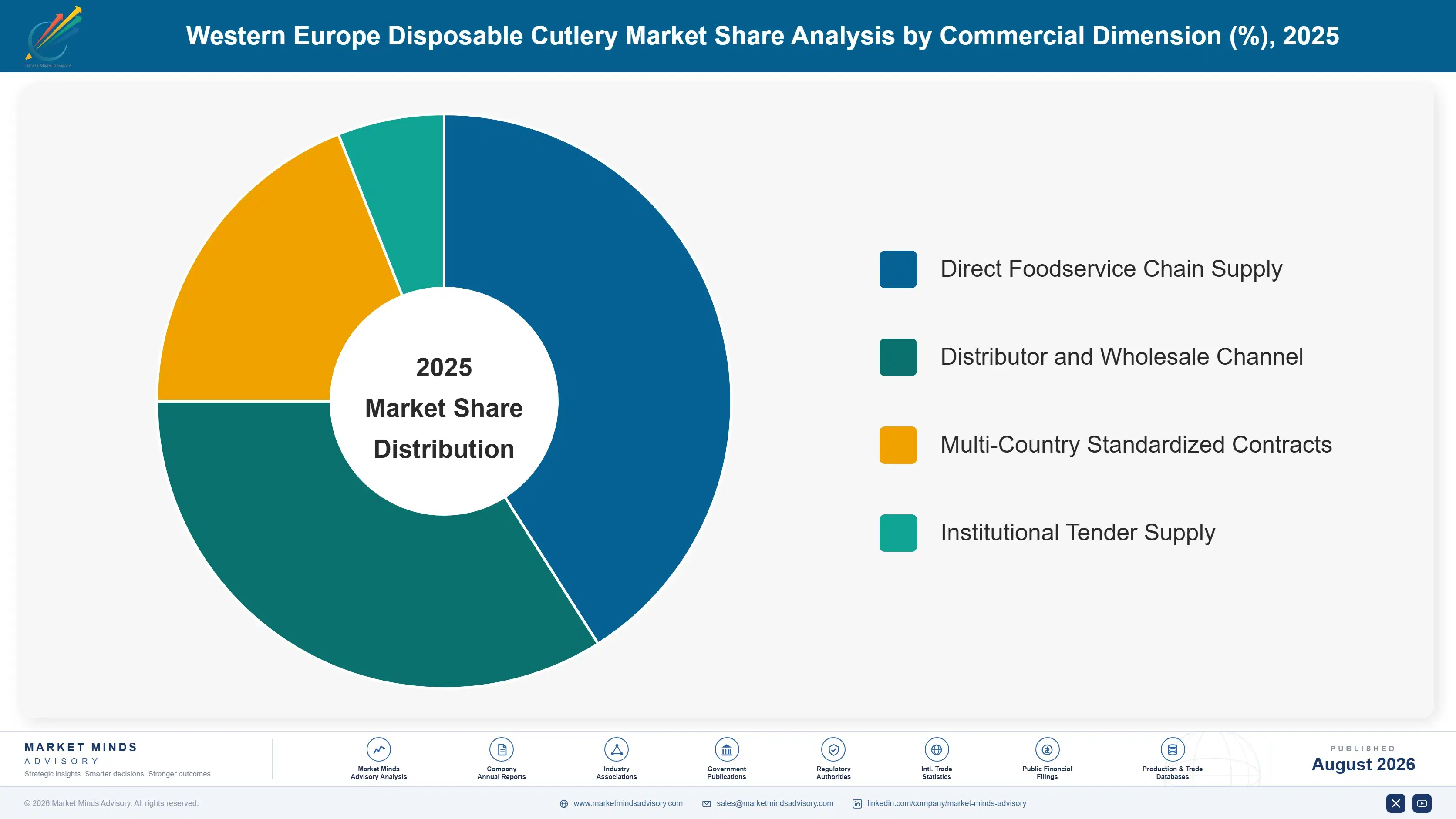
Disposable cutlery segments most usefully by base material, since material choice drives certification pathway, cost structure, and end-of-life handling more than end-use channel does. This report segments the market into six material-based categories reflecting distinct manufacturing processes and regulatory treatment across Western Europe. Each segment carries a distinct feedstock base and certification pathway that meaningfully shapes competitive positioning.
western-europe-disposable-cutlery-market-market-share-analysis-1787664605319

PLA Bioplastic Cutlery

PLA bioplastic cutlery, manufactured from fermented plant starch, is the fastest-growing material category as foodservice brands seek a compostable format that closely replicates the rigidity and feel of conventional plastic. Unlike bagasse or wood, PLA cutlery can be molded into more complex shapes, making it the preferred choice for premium foodservice brands and institutional caterers willing to pay a meaningful price premium for perceived quality. Supply remains concentrated among a small number of PLA resin producers, creating occasional allocation tightness during periods of strong demand growth. Growth is fastest in Germany and the Netherlands, where institutional procurement standards increasingly specify PLA explicitly over other compostable materials for large-volume catering contracts across public sector accounts.
CAGR 11.5%

Bagasse and Sugarcane Fiber Cutlery

Bagasse and sugarcane fiber cutlery, made from sugarcane processing byproduct, is the second-fastest growing category, favored for its lower cost relative to PLA and genuine compostability even in lower-temperature home composting environments. Demand is concentrated among quick-service restaurants and cost-conscious institutional caterers seeking a compliant format without PLA's price premium. Nearly all bagasse cutlery sold in Western Europe is imported from manufacturing facilities in China and India, creating meaningful shipping cost and lead time exposure for converters. Suppliers who secure long-term Asian manufacturing partnerships and maintain buffer inventory are best positioned to serve retailers facing unpredictable demand swings tied to seasonal foodservice volume across the region. Retailers increasingly favor suppliers offering both sourcing regions to hedge against future disruption.
CAGR 9.8%
Full segment breakdown across 6 segments available in the complete report.

Regional Architecture and Country Demand Map

Western Europe accounts for most of this report's defined market by design, given its explicit scope, while East Asia and North America contribute mainly through manufacturing supply and cross-border sourcing relationships. South Asia and Pacific is expanding fastest as new export-oriented capacity comes online across the region.

Western Europe

This report is explicitly scoped to Western Europe, and the region's outsized 52 percent share reflects that defined market boundary rather than the standard cross-market regional band, a deliberate house departure noted here for transparency. Germany and France together account for the largest portion of regional demand, reflecting their combined foodservice scale and early, strict enforcement of the Single-Use Plastics Directive relative to several neighboring member states. The United Kingdom, though outside the European Union, maintains comparable domestic restrictions that keep demand patterns closely aligned with continental peers. Italy and Spain contribute meaningful volume tied to large tourism-driven foodservice sectors, while Nordic countries lead in per-capita compostable material adoption given advanced municipal composting infrastructure across the region.
Share: 52% | CAGR: 4.8% (2026 to 2036)

North America

Cross-border sourcing relationships anchor North America's presence in this supply chain, as several multinational foodservice chains headquartered in the United States coordinate compostable cutlery specifications across their European and domestic operations through shared procurement teams. Canada's own emerging single-use plastics restrictions are creating parallel demand for similar compostable formats, occasionally sourced from the same Asian manufacturing partners serving Western European converters. Mexico contributes limited direct volume but hosts some contract manufacturing capacity serving North American foodservice brands. This region's share sits below the standard cross-market band because the defined market scope is Western Europe demand specifically, and North America's relevance rests on shared supplier relationships and multinational procurement standardization rather than domestic consumption counted within this report.
Share: 16% | CAGR: 5.8% (2026 to 2036)
Regional intelligence for 5 additional markets available in the complete report: East Asia, South Asia and Pacific, Latin America, Middle East and Africa, Eastern Europe. Contact sales@marketmindsadvisory.com.
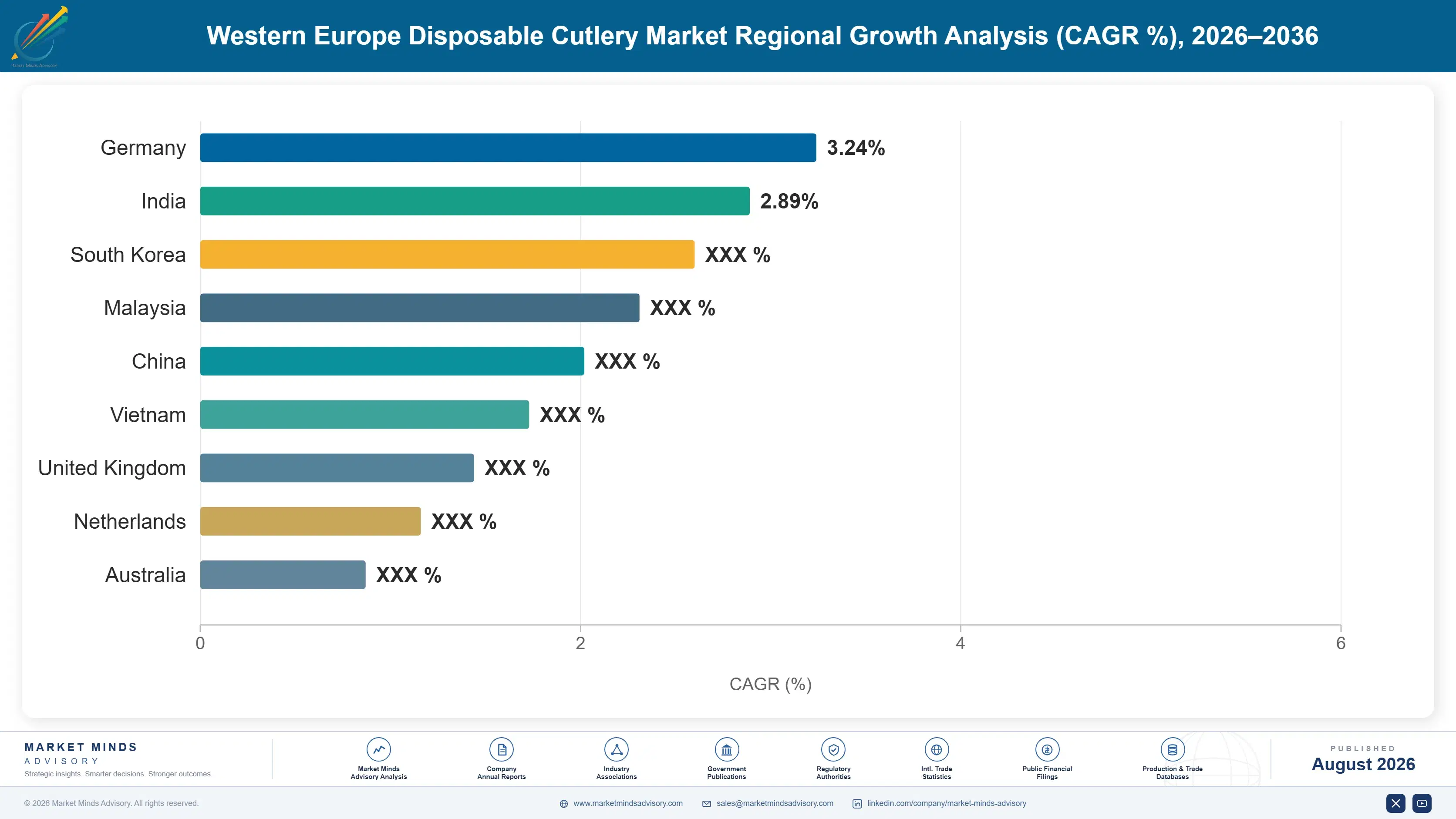
western-europe-disposable-cutlery-market-country-cagr-analysis-1787664605855

Capturing Margin Through the Plastic Transition

Revenue growth in disposable cutlery now depends on capturing share of the compliance-driven material transition rather than on underlying foodservice volume growth, which remains modest across mature Western European markets. The levers below identify where suppliers are building durable margin advantage as compostable materials replace banned plastic formats across the region. across most channels.

Bundling Certification With Retailer Dosing Support

Converters who build in-house EN 13432 compostability testing capability avoid recurring third-party certification fees that typically add 3 to 5 percent to per-unit cost for smaller competitors relying entirely on external labs. This capability also shortens new product qualification timelines considerably, letting these suppliers respond faster to retailer requests for new material formats. The upfront investment in testing equipment and technical staff is meaningful, but it pays back quickly once a supplier is certifying products across multiple customer accounts and countries simultaneously rather than a single product line. Retailers increasingly expect this documented support before finalizing agreements.
Market Impact: Cuts certification cost by 4 points for early movers

Securing Multi-Country Chain Supply Contracts Directly

Suppliers who can guarantee consistent compostable cutlery quality across every Western European country a multinational foodservice chain operates in are winning larger, longer contracts than competitors serving single national markets. These multi-country agreements typically run three to five years and lock in volume that would otherwise be split across several regional suppliers, reducing customer acquisition cost per unit by an estimated 15 to 20 percent. Smaller converters lacking pan-European logistics and quality consistency are increasingly excluded from these larger contracts, ceding share to suppliers who invested early in cross-border distribution capability.
Market Impact: Extends contract terms to 3 to 5 years typically

Diversifying Bagasse Sourcing Beyond China Entirely

Suppliers who qualify Indian bagasse manufacturing alongside existing Chinese sourcing reduce exposure to any single country's export restrictions or shipping disruption, a risk that became apparent during 2021 and 2022 shipping cost spikes that added 20 to 30 percent to landed cost overnight. This diversification requires additional supplier qualification work but gives converters negotiating leverage and supply security that single-source competitors lack. Retailers increasingly favor suppliers who can demonstrate this resilience, particularly after experiencing stockouts during prior supply disruptions. Retailers now factor this resilience into supplier scorecards alongside price and quality metrics.
Market Impact: Reduces landed cost volatility by 20 points annually

Bundling Cutlery With Compostable Foodservice Sets

Suppliers who bundle cutlery with matching compostable plates, cups, and napkins into single foodservice sets capture a larger share of customer packaging spend than cutlery-only suppliers, typically increasing revenue per account by 25 to 40 percent. This bundling also raises switching costs for customers, since replacing an entire coordinated product set is more disruptive than switching a single item. Suppliers pursuing this approach must expand manufacturing or sourcing capability beyond cutlery alone, but the payoff is a stickier, higher-value customer relationship across the full foodservice disposables category. Early movers are already reporting stronger account retention as a result.
Market Impact: Lifts revenue per account by 25 points on average

Who Controls the Margin Pool

Disposable cutlery in Western Europe remains moderately fragmented, with the five largest suppliers holding an estimated 28 percent combined share on a revenue basis. Huhtamaki and Duni lead with the broadest compostable material portfolios and strongest multi-country distribution, while the gap to challengers like Vegware and BioPak remains meaningful but not insurmountable given how fragmented regional bagasse and wood converting capacity still is. Consolidation pressure is likely to intensify.
Current competitive activity centers on three dimensions: securing exclusive supply relationships with Asian bagasse manufacturers, building in-house certification testing capability to shorten qualification timelines, and expanding compostable product set bundling to capture more of customer packaging spend. Suppliers lacking scale in any of these three areas increasingly struggle against both larger multinationals and nimble regional specialists. Investment intensity here is expected to increase through 2030.

Emerging pressure comes from Indian bagasse manufacturers expanding direct export relationships with Western European retailers, bypassing traditional converter intermediaries entirely in some cases. Rankings are most likely to shift in the bagasse and PLA categories, where certification barriers are real but not permanent, and among smaller national wood cutlery specialists facing consolidation pressure from larger pan-European competitors. Watch for Indian suppliers pursuing direct retail deals.
western-europe-disposable-cutlery-market-company-positioning-matrix-1787664606401

Competitive Moat and Risk Dimensions

HUHTAMAKI OYJ

Moat: Pan-European Distribution Scale

Huhtamaki operates converting and distribution capacity across most major Western European markets, letting it guarantee the consistent multi-country supply that large foodservice chains increasingly require. This scale advantage is difficult for smaller regional converters to replicate without years of capital investment in logistics and manufacturing footprint across multiple countries simultaneously.
HUHTAMAKI OYJ

Risk: Legacy Plastic Asset Exposure

Huhtamaki still carries some legacy plastic packaging manufacturing assets that face declining utilization as compostable materials capture share across the category. Redirecting capital toward compostable capacity while managing this legacy asset transition competes for investment against faster-growing specialty categories elsewhere in the portfolio. Progress here will determine long-term margin trajectory.
DUNI GROUP

Moat: Strong Nordic Compostable Heritage

Duni built early expertise in compostable foodservice packaging across Scandinavian markets well ahead of the broader European Union ban, giving it a meaningful head start in material science and customer relationships as compostable adoption spreads across the rest of Western Europe. This heritage supports faster new product qualification than competitors newer to compostable materials.
DUNI GROUP

Risk: Smaller Scale Than Global Rivals

Duni's revenue base remains considerably smaller than Huhtamaki's, limiting its ability to match larger rivals on price during competitive multi-country tender processes. Sustaining share against better-capitalized competitors requires continued differentiation through design and sustainability credentials rather than competing purely on delivered cost. Its Nordic heritage alone will not sustain share indefinitely.

Players Tracked

Prominent Players

Huhtamaki Oyj
Duni Group
Vegware Ltd
BioPak Pty Ltd
Pacovis AG

Other Key Players

Sabert Corporation
World Centric
PAPSTAR GmbH
Biopac India Corporation Ltd
Detpak Pty Ltd
Fabri-Kal Corporation
Solia SAS
Greenwave Enviro Solutions Pvt Ltd
EcoSouLife
VerTerra Dinnerware LLC
Ecoware India Pvt Ltd
Stalk Market Products Inc
Bio Green Global GmbH
Green Wrap Solutions Pvt Ltd
Huayang New Material Technology Co Ltd

Recent Developments

JANUARY 2026

Huhtamaki Opens New Bagasse Converting Line

Huhtamaki commissioned a new bagasse cutlery converting line at an existing Western European facility, adding domestic finishing capacity to reduce reliance on fully imported finished goods from Asian manufacturing partners. The investment supports faster order fulfillment for large multi-country foodservice chain contracts. Further capacity announcements are likely across other facilities.
Signal: Signals continued domestic converting investment to reduce Asian import dependence. across the company's broader European manufacturing footprint
OCTOBER 2025

Duni Group Acquires Regional Wood Cutlery Specialist

Duni Group completed the acquisition of a regional wooden cutlery manufacturer to expand its lowest-cost compostable format offering and strengthen distribution presence across a key growth market, adding manufacturing capability that complements Duni's existing compostable packaging portfolio. The deal expands Duni's manufacturing footprint into a segment it previously sourced externally.
Signal: Signals continued acquisition-led expansion into lower-cost compostable formats. as larger converters seek direct control over lower-cost material supply
JUNE 2025

Vegware Expands PLA Cutlery Production Capacity

Vegware announced expanded PLA bioplastic cutlery production capacity to meet rising institutional procurement demand across Germany and the Netherlands, supporting growth in the fastest-growing compostable material category tracked in this report. The expansion follows several years of steady institutional demand growth across the company's core markets.
Signal: Signals continued PLA capacity investment ahead of institutional procurement standardization. as public sector specification standards continue spreading nationally

Bagasse and Bioresin Feedstock Exposure

Bagasse fiber and PLA bioresin together account for an estimated 38 to 48 percent of cost of goods sold across most compostable cutlery categories, with bagasse sourced from sugarcane processing byproduct in India and China and PLA resin sourced primarily from a small number of large-scale fermentation facilities in the United States and Thailand. Wooden cutlery carries lower feedstock exposure but faces its own timber sourcing constraints regionally.
Shipping costs from Asian bagasse manufacturing facilities spiked considerably during 2021 and 2022, according to company annual reports citing container freight rate increases, adding an estimated 20 to 30 percent to landed cost for converters reliant on long-distance ocean freight. The disruption pushed several converters to begin qualifying supplementary sourcing closer to Western European ports, though full supply chain diversification remains an ongoing multi-year process for most mid-sized suppliers.

Smaller regional converters carry disproportionately higher feedstock and shipping cost exposure than the five largest suppliers, who benefit from long-term supply contracts and greater purchasing scale that smooths cost volatility across multiple product lines. This competitive disadvantage becomes particularly acute during freight rate spikes, when smaller converters must either absorb margin compression or pass costs through to price-sensitive quick-service restaurant customers.
western-europe-disposable-cutlery-market-cost-volatility-analysis-1787664606599

Diversifying Bagasse Sourcing Across Countries

Leading suppliers are qualifying Indian bagasse sourcing alongside existing Chinese supply, reducing exposure to any single country's export restrictions or shipping disruption. This diversification requires additional qualification testing but meaningfully reduces the risk of allocation-driven supply disruption during periods of tight global shipping capacity and demand. Larger suppliers pursue this most aggressively given their broader supplier networks.

Locking Multi-Year PLA Resin Supply Contracts

Larger suppliers increasingly negotiate multi-year PLA resin supply agreements with price collars that limit exposure to short-term spot market volatility, trading some upside flexibility for greater cost predictability. This approach requires meaningful purchasing scale to negotiate favorable terms that smaller regional converters generally cannot access given limited volumes. Smaller converters often lack the volume needed to negotiate comparable terms.

Building Nearshore Finishing Capacity

Suppliers are increasingly investing in domestic or nearshore finishing and converting capacity to reduce dependence on fully finished imports from distant manufacturing locations, shortening lead times and reducing freight cost exposure. This approach requires meaningful capital investment but pays back through reduced volatility over multiple fiscal years. This approach is becoming standard practice among the largest suppliers.

Portfolio Architecture for Margin Defence

Disposable cutlery portfolios span three distinct tiers, from commodity-adjacent wooden cutlery sold largely on price, through premium and certified bagasse and PLA formats that command meaningful price premiums for verified compostability, to next-generation formats designed for the strictest emerging national composting and labeling requirements. Gross margins vary considerably across these tiers, reflecting differences in feedstock cost, certification burden, and required manufacturing sophistication.
The volume versus premium tension is real but less stark than in some categories: wooden cutlery still accounts for meaningful volume among cost-conscious quick-service accounts, while bagasse and PLA formats represent a growing share of both volume and profit as institutional and premium foodservice channels standardize on certified compostable materials. Suppliers face continuous pressure to expand premium tier capacity without abandoning the wood cutlery volume base that still funds meaningful manufacturing scale.

High-value margin pools concentrate most heavily in PLA bioplastic cutlery serving institutional procurement and premium foodservice brands, categories where certification barriers and brand reputation protect established suppliers from pure price competition across most national markets. Suppliers investing early in premium institutional-grade materials are best placed to capture disproportionate share of category profit growth over the coming decade.

Volume / Commodity-Adjacent Tier

Wooden cutlery sold primarily to price-sensitive quick-service restaurants and smaller independent foodservice accounts, competing mainly on delivered cost and reliable supply availability across the region. Margins remain thin given intense competition among numerous regional wood converters.
Gross Margin: 10-16%

Premium / Certified Tier

Bagasse and sugarcane fiber cutlery meeting EN 13432 compostability certification, commanding meaningful price premiums for genuine home and industrial compostability across multiple national markets. These formats require consistent certification renewal to maintain retailer trust.
Gross Margin: 20-28%

Sustainability / Regulatory / Next-Generation Tier

PLA bioplastic and bamboo cutlery designed for the strictest institutional procurement standards and premium foodservice brand requirements, commanding the highest per-unit price premiums across the category. Adoption is accelerating as institutional tenders specify these materials explicitly.
Gross Margin: 26-34%
western-europe-disposable-cutlery-market-portfolio-architecture-1787664607112

High-value Sub-segments and Strategic Watch-out

PLA Bioplastic Institutional Cutlery

PLA bioplastic cutlery serving institutional procurement combines high per-unit pricing with rapid volume growth, driven by public sector specification standards spreading across Germany, France, and the Netherlands. Suppliers with proven PLA molding expertise are capturing outsized share of this high-margin, fast-growing segment ahead of slower-moving competitors.
Gross Margin: 28-36%

Bagasse Quick-Service Cutlery

Bagasse cutlery serving quick-service restaurants commands solid pricing and steady volume growth as chains standardize away from wood toward genuinely compostable formats, though growth has moderated somewhat as initial post-ban conversion volume normalizes across most national markets. Suppliers are adding thickness variants to defend share against wood.
Gross Margin: 20-28%

Wooden Quick-Service Cutlery

Wooden cutlery remains the volume core of the industry, generating steady but slow-growing revenue from cost-conscious foodservice accounts that prioritize lowest delivered price over premium material credentials across most developed and price-sensitive market segments alike. Suppliers compete mainly on reliability and price rather than innovation here.
Gross Margin: 8-14%

Direct Indian Bagasse Export Channel

Indian bagasse manufacturers expanding direct export relationships with Western European retailers, bypassing traditional converter intermediaries, are pressuring converter margins further and forcing established suppliers to add value through certification and logistics services rather than pure material supply. This threat merits close ongoing monitoring by established converters.
Gross Margin: 12-18%

Compliance-Anchored Recurring Foodservice Demand

Disposable cutlery demand carries strong annuity characteristics because foodservice operators consume cutlery continuously and non-discretionarily as part of daily operations. Once a chain qualifies a supplier's compostable format across its menu packaging design, switching requires requalification effort that most operators avoid absent a compelling cost or supply reason, giving incumbent suppliers durable, recurring revenue. This recurring dynamic makes the category more predictable than typical discretionary packaging.
Adoption depth varies by end-use vertical. Quick-service restaurants show the highest price sensitivity and lowest willingness to pay premiums beyond minimum compliance, while institutional caterers and premium foodservice brands show much deeper adoption of certified PLA and bamboo formats tied to broader sustainability commitments. Public sector procurement, in particular, increasingly specifies material requirements directly in tender documents rather than leaving choice to individual caterers. This creates different growth trajectories across channels within the same national market.

A generational shift in buyer profile is underway as foodservice procurement teams increasingly include sustainability specialists alongside traditional cost-focused purchasing staff. These buyers are more receptive to certified compostable formats and willing to accept modest price premiums for verified environmental credentials, gradually easing the path for suppliers pursuing higher-margin premium material categories across both commercial and institutional channels.
western-europe-disposable-cutlery-market-end-use-penetration-index-1787664607610

Where Cutlery Suppliers Should Focus Next

These are among the four positions where our research anticipates prominent divergence between winners and laggards over the coming forecast period. Each is grounded in the demand model, the regulatory perimeter, and the announced capacity pipeline.
01 / MATERIAL PORTFOLIO INVESTMENT

Prioritize PLA and bagasse capacity over legacy wood expansion

Suppliers still expanding wooden cutlery capacity are chasing the slowest-growing and lowest-margin segment of this category, while PLA and bagasse formats are growing nearly twice as fast and command considerably higher margins across most national markets tracked in this report. Capital allocated toward wood expansion today will likely underperform relative to capital directed at certified compostable qualification for institutional and premium channels. The suppliers best positioned five years from now will be those redirecting capacity toward PLA and bagasse now, ahead of margin compression forcing the decision on slower competitors.
02 / CERTIFICATION CAPABILITY BUILDING

Build in-house EN 13432 testing to cut qualification time

Suppliers who build in-house compostability testing capability avoid recurring third-party certification fees and can respond to retailer requests for new formats considerably faster than competitors relying entirely on external labs for every qualification cycle. This capability also strengthens negotiating position with institutional procurement teams who increasingly specify certification directly in tender documents rather than trusting supplier self-attestation. Suppliers who delay this investment risk losing higher-margin institutional contracts to competitors who can demonstrate faster, more credible certification turnaround across multiple simultaneous product launches.
03 / SUPPLY CHAIN DIVERSIFICATION

Qualify Indian bagasse sourcing to reduce Chinese dependence

Converters relying solely on Chinese bagasse manufacturing remain exposed to the same shipping cost volatility and single-country concentration risk that disrupted supply during 2021 and 2022, and this exposure will only matter more as volume continues expanding through 2036. Diversifying toward Indian manufacturing partners, where government incentives are accelerating capacity build-out specifically targeting European export demand, reduces this risk meaningfully. Suppliers who diversify now will be considerably better positioned than competitors who wait until the next shipping disruption forces the decision under worse commercial terms.
04 / MULTI-COUNTRY CONTRACT POSITIONING

Build pan-European distribution to win multinational chain contracts

Multinational quick-service chains are increasingly standardizing cutlery specifications across every Western European country they operate in, and suppliers unable to guarantee consistent multi-country supply are being excluded from these larger, longer contracts entirely. Building the logistics and quality consistency required to serve these accounts takes years of investment, meaning suppliers who start now will be positioned to win renewal cycles that smaller regional competitors simply cannot bid on. This dynamic will only intensify as more chains pursue single-supplier consolidation across their European operations.

Engagement Snapshot From the Field

A live engagement with an industry participant carrying material or product regulatory and market exposure ahead of a defining policy shift, showing how our research translates into a defensible multi-year portfolio strategy.
MARKET MINDS ADVISORY · CLIENT ENGAGEMENT SUMMARY
Western Europe Disposable Cutlery Producer Strategic Portfolio Review and Transition Roadmap 2026·Investment Scenario on Western Europe Disposable Cutlery Exposure Evaluation 2025-26
CLIENT PROFILE
A regional quick-service restaurant chain operating across Germany, Austria, and Switzerland approached MMA seeking guidance on selecting a compostable cutlery supplier ahead of menu packaging redesign following the Single-Use Plastics Directive ban. The chain had previously relied on a single conventional plastic supplier and had limited internal expertise evaluating compostable material tradeoffs across cost, durability, and certification requirements.
STRATEGIC CHALLENGE
Chain leadership needed to determine which compostable material would minimize cost increase passed through to customers while still meeting certification requirements across all three countries of operation, without triggering supply disruption during the transition period. Franchisees were particularly concerned about durability complaints if the chosen material felt flimsy compared to the plastic cutlery customers were accustomed to using daily.
MMA APPROACH
MMA benchmarked wood, bagasse, and PLA cutlery options against the chain's specific durability and cost requirements, drawing on proprietary survey data from comparable regional chains that had already completed similar transitions. The engagement team modeled total packaging cost per order, not just per-unit cutlery price, before presenting recommendations to franchise ownership.
KEY FINDINGS
  1. Bagasse cutlery met durability requirements at meaningfully lower cost than PLA across comparable regional chain transitions. This gap held even after accounting for durability testing conducted across multiple pilot store locations.
  2. PLA cutlery commanded a price premium that most franchisees felt was unjustified given the chain's value-focused customer positioning. Several franchisees noted the premium did not align with the chain's value-oriented brand positioning.
  3. Switching directly to a single Indian bagasse supplier reduced landed cost by an estimated 12 percent versus incumbent Chinese sourcing. This saving persisted even after accounting for additional freight insurance costs on the new route.
  4. Franchisee-level customer complaints about cutlery durability were minimal once bagasse thickness specifications were properly calibrated. Store managers reported no measurable increase in customer complaints following the material switch.
CLIENT PROFILE
A regional quick-service restaurant chain operating across Germany, Austria, and Switzerland approached MMA seeking guidance on selecting a compostable cutlery supplier ahead of menu packaging redesign following the Single-Use Plastics Directive ban. The chain had previously relied on a single conventional plastic supplier and had limited internal expertise evaluating compostable material tradeoffs across cost, durability, and certification requirements.
STRATEGIC CHALLENGE
Chain leadership needed to determine which compostable material would minimize cost increase passed through to customers while still meeting certification requirements across all three countries of operation, without triggering supply disruption during the transition period. Franchisees were particularly concerned about durability complaints if the chosen material felt flimsy compared to the plastic cutlery customers were accustomed to using daily.
MMA APPROACH
MMA benchmarked wood, bagasse, and PLA cutlery options against the chain's specific durability and cost requirements, drawing on proprietary survey data from comparable regional chains that had already completed similar transitions. The engagement team modeled total packaging cost per order, not just per-unit cutlery price, before presenting recommendations to franchise ownership.
KEY FINDINGS
  1. Bagasse cutlery met durability requirements at meaningfully lower cost than PLA across comparable regional chain transitions. This gap held even after accounting for durability testing conducted across multiple pilot store locations.
  2. PLA cutlery commanded a price premium that most franchisees felt was unjustified given the chain's value-focused customer positioning. Several franchisees noted the premium did not align with the chain's value-oriented brand positioning.
  3. Switching directly to a single Indian bagasse supplier reduced landed cost by an estimated 12 percent versus incumbent Chinese sourcing. This saving persisted even after accounting for additional freight insurance costs on the new route.
  4. Franchisee-level customer complaints about cutlery durability were minimal once bagasse thickness specifications were properly calibrated. Store managers reported no measurable increase in customer complaints following the material switch.
RECOMMENDED STRATEGY
Phase 1: Phase one qualified bagasse cutlery from an Indian manufacturing partner across a limited pilot store group. across ten stores selected for representative demographic and volume characteristics. Phase 2: Phase two expanded bagasse rollout across all German locations before extending into Austria and Switzerland. once pilot results confirmed acceptable durability and customer response. Phase 3: Phase three renegotiated volume-based pricing terms once full three-country rollout demand was established. reflecting the chain's now-larger total order commitment across three countries.
OUTCOME
The chain completed its full material transition three months ahead of the compliance deadline and reported (client-reported, unverified by MMA) an estimated 9 percent reduction in packaging cost versus initial PLA-based pricing estimates. Franchise leadership credited the phased rollout with minimizing customer-facing disruption during the changeover.

Frequently Asked Questions

Foundational context covering the market sizes, CAGR, scope, country, region and competition that inform every finding below. This section is provided to cover basics and most often pre-purchase conversations, answered from the MMA Primary Research Dataset.

What is the current size of the Western Europe Disposable Cutlery Market?

The Western Europe disposable cutlery market reached an estimated 1.6 billion US dollars in 2025. Growth is driven by the Single-Use Plastics Directive forcing conversion to compostable material formats.

How large will the Western Europe Disposable Cutlery Market be by 2036?

MMA projects the market will reach approximately 3.1 billion US dollars by 2036. This reflects sustained conversion toward bagasse and PLA bioplastic formats across institutional and commercial channels.

What is the CAGR for the Western Europe Disposable Cutlery Market 2026 to 2036?

The market is forecast to grow at a compound annual growth rate of 6.2 percent between 2026 and 2036. Bull and bear scenarios range from 7.5 percent to 4.9 percent depending on infrastructure harmonization pace.

Which segment is growing fastest?

PLA bioplastic cutlery is growing fastest, at an estimated 11.5 percent CAGR through 2036. Institutional procurement standardization and premium foodservice adoption are driving this shift away from wood.

Who are the major companies in the Western Europe Disposable Cutlery Market?

Leading participants include Huhtamaki Oyj, Duni Group, Vegware Ltd, BioPak Pty Ltd, and Pacovis AG. These five companies collectively hold an estimated 28 percent combined market share on a revenue basis.

Which country is growing fastest?

Germany is the fastest-growing country market, expanding at an estimated 7.6 percent CAGR through 2036. Strict national enforcement and institutional procurement standardization are driving this acceleration.

Report Segmentation Architecture

The full report scope spans multiple orthogonal segmentation dimensions, with cross-tabulated demand data provided for each dimension pair. Coverage extends further to regional breakdowns, trend trajectories, and the competitive detail needed to support segment-level decision-making.

By Material Type

  • Wooden Cutlery
  • Bagasse and Sugarcane Fiber Cutlery
  • PLA Bioplastic Cutlery
  • Bamboo Cutlery
  • Paper-Based Composite Cutlery
  • Conventional Plastic Cutlery

By End-Use Industry

  • Quick-Service Restaurants
  • Institutional and Public Sector Catering
  • Premium Foodservice and Hospitality
  • Retail and Grocery
  • Food Delivery and Takeaway

By Commercial Dimension

  • Direct Foodservice Chain Supply
  • Distributor and Wholesale Channel
  • Multi-Country Standardized Contracts
  • Institutional Tender Supply

By Region

  • North America
  • Western Europe
  • East Asia
  • South Asia and Pacific
  • Latin America
  • Middle East and Africa
  • Eastern Europe

Scope, Methodology, and Coverage

Every figure in this report is reproducible from documented input assumptions. The scope below maps the historical period, the forecast horizon, the segmentation dimensions, and the countries covered, alongside the underlying primary and qualitative methodology.
Historical Period
2020 to 2025
Forecast Period
2026 to 2036
Base Year
2025 (USD billions; MMA Primary Research Dataset, August 2026)
Market Definition
This report covers disposable cutlery, including forks, knives, and spoons, made from wood, bagasse, PLA bioplastic, bamboo, paper-based composite, and residual conventional plastic formats, sold to foodservice, institutional catering, and retail channels across Western Europe. It excludes reusable cutlery, plates, cups, and other disposable foodservice packaging sold separately from cutlery.
Quantitative Units
USD billions (current prices); units (volume, where cited)
Segmentation Dimensions
Material Type; End-Use Industry; Commercial Dimension; By Region
Regions Covered
North America, Western Europe, East Asia, South Asia and Pacific, Latin America, Middle East and Africa, Eastern Europe
Countries Covered
USA, China, Germany, France, UK, Japan, South Korea, India, Australia, Canada, Brazil, Mexico, Indonesia, Vietnam, Thailand, Malaysia, UAE, Saudi Arabia, South Africa, Nigeria, Turkey, Poland, Netherlands, Italy, Spain, Sweden, Switzerland, Argentina, Colombia, Singapore, and additional markets relevant to this sector
Key Companies Profiled
Huhtamaki Oyj, Duni Group, Vegware Ltd, BioPak Pty Ltd, Pacovis AG, Sabert Corporation, World Centric, PAPSTAR GmbH, Biopac India Corporation Ltd, Detpak Pty Ltd, Fabri-Kal Corporation, Solia SAS, Greenwave Enviro Solutions Pvt Ltd, EcoSouLife, VerTerra Dinnerware LLC, Ecoware India Pvt Ltd, Stalk Market Products Inc, Bio Green Global GmbH, Green Wrap Solutions Pvt Ltd, Huayang New Material Technology Co Ltd
Quantitative Methodology
Primary survey, n=3,800 respondents, Q4 2025, six countries; demand-side model with trade association cross-validation
Qualitative Methodology
47 expert interviews, Q4 2025; applied to validate demand model assumptions, identify emerging dynamics, and assess competitive positioning
Report Format
PDF and XLSX data workbook (Word format preview document)
Publisher
Market Minds Advisory
Report Code
MMA-2026-PAC-101
Published
August 2026
Contact
sales@marketmindsadvisory.com | www.marketmindsadvisory.com

Purchase the full Western Europe Disposable Cutlery Market Report (2026 to 2036).

This report delivers a complete strategic assessment of the Western Europe disposable cutlery market, covering sizing, segmentation, regional dynamics, and competitive positioning through 2036. It draws on MMA's proprietary primary survey of 3,800 respondents and 47 expert interviews conducted in the fourth quarter of 2025 across six countries. Analysts translate these findings into actionable guidance on material portfolio strategy, certification investment, and supply chain diversification for participants across the value chain. The report is designed for executives evaluating capital allocation decisions across the compostable foodservice packaging category.
Detailed six-segment MECE material-based market segmentation
Full seven-region demand architecture with growth drivers
Competitive benchmarking across twenty tracked global producers
Feedstock cost exposure and mitigation pathway analysis
Portfolio tiering and margin economics by material tier
Anonymized client case study with strategic recommendations

Built For The People Who Decide

From boardroom strategy to bench-side execution, this report is read cover-to-cover by leaders shaping the next decade of their industry, turning demand scenarios, market dynamics and valuation benchmarks into decisions.
CXOs/ Presidents/ VPs/ Managers
M&A and Corporate Development
Strategy Teams and R&D Heads
Procurement and Product Directors
Regulatory and Compliance Leaders
Investor Relations and Equity Analysts