Market Minds Advisory
Western Blotting Processors Market

Western Blotting Processors Market: The Assay Everyone Complains About And Nobody Can Replace

Forty years of attempts to retire the western blot failed for one reason: it is the only protein assay that shows molecular weight, and reviewers keep asking to see it.

Lead Analyst

Published

September 2026

Make Smarter Decisions with Customized Research Insights

Request a free sample report and evaluate market opportunities, growth trends, and competitive dynamics relevant to your business needs.

2025 MARKET VALUE$0.7BMarket Size 2025
2036 FORECAST VALUE$1.7BBase Case , 2026 to 2036
CAGR 2026 TO 20368.6 %Bull 9.8% / Bear 7.4%
INCREMENTAL OPPORTUNITY$0.9BNet 10- year value creation
EXPANSION MULTIPLE2.28x2036 value over 2026 base
Strategic Levers
M&A Pipeline
Regional Outlook
Country Rankings
Competitive Intelligence
Segmental Deep-dive
Call-Us : 91 93563 13602

Executive Snapshot and Market Trajectory

The western blot has survived four decades of replacement attempts for one stubborn reason. It is the only routine protein assay that shows molecular weight, so a reviewer can see whether the band is the protein or something else entirely. Everybody complains about it and everybody keeps running it.
What is finally moving the instrument market is not speed. Reproducibility has become a publishing and integrity problem rather than a technical inconvenience, with roughly 31% of blots carrying reference protein outside linear range and around 42% of journals now requiring total protein normalisation. Institutions are buying systems that produce auditable, unmanipulated records because image screening finds what manual workflows hide. Nobody argues with retraction risk.
Capillary instruments grow fastest at 12.9%, half again the market rate, by removing the hands entirely: no gel, no membrane, no transfer and a digital trace of everything. They cost around 6.4 times a conventional bench setup, which restricts them to regulated bioanalysis rather than academic benches. Consumables carry 61% of supplier revenue and China grows at 12.4%. That combination separates a research instrument purchase from a regulated laboratory one entirely.
Market Definition
Instruments used to run, process and record western blot and related immunodetection workflows, covering transfer instruments, blot processing and washing instruments, imaging and detection instruments, capillary immunoassay instruments, fully integrated workflow instruments and gel documentation and normalisation instruments, together with dedicated cartridges and consumables. Measured at supplier revenue. Standalone electrophoresis apparatus, antibodies sold separately, general laboratory imagers and other immunoassay platforms are excluded.
Base Year Value
$0.7B in 2025 (MMA Primary Research Dataset, August 2026)
Forecast Period
2026 to 2036, eleven discrete annual values
CAGR
8.6% base case. Bull 9.8%. Bear 7.4%.
Fastest Growth Segment
Capillary Immunoassay Instruments: 12.9% CAGR
Fastest Growth Country
China: 12.4% CAGR
Fastest Growth Region
South Asia and Pacific: 10.8% CAGR
Largest Region
East Asia: 30% of 2025 global value
Market Leaders
Bio-Rad Laboratories, Thermo Fisher Scientific, Cytiva, Bio-Techne, Merck KGaA. Source: MMA Primary Research Dataset, July 2026.
Primary Survey
n=3,800 procurement and R&D decision-makers, Q4 2025, six countries
Methodology
Demand-side build-up, cross-validated against public data, 47 expert interviews

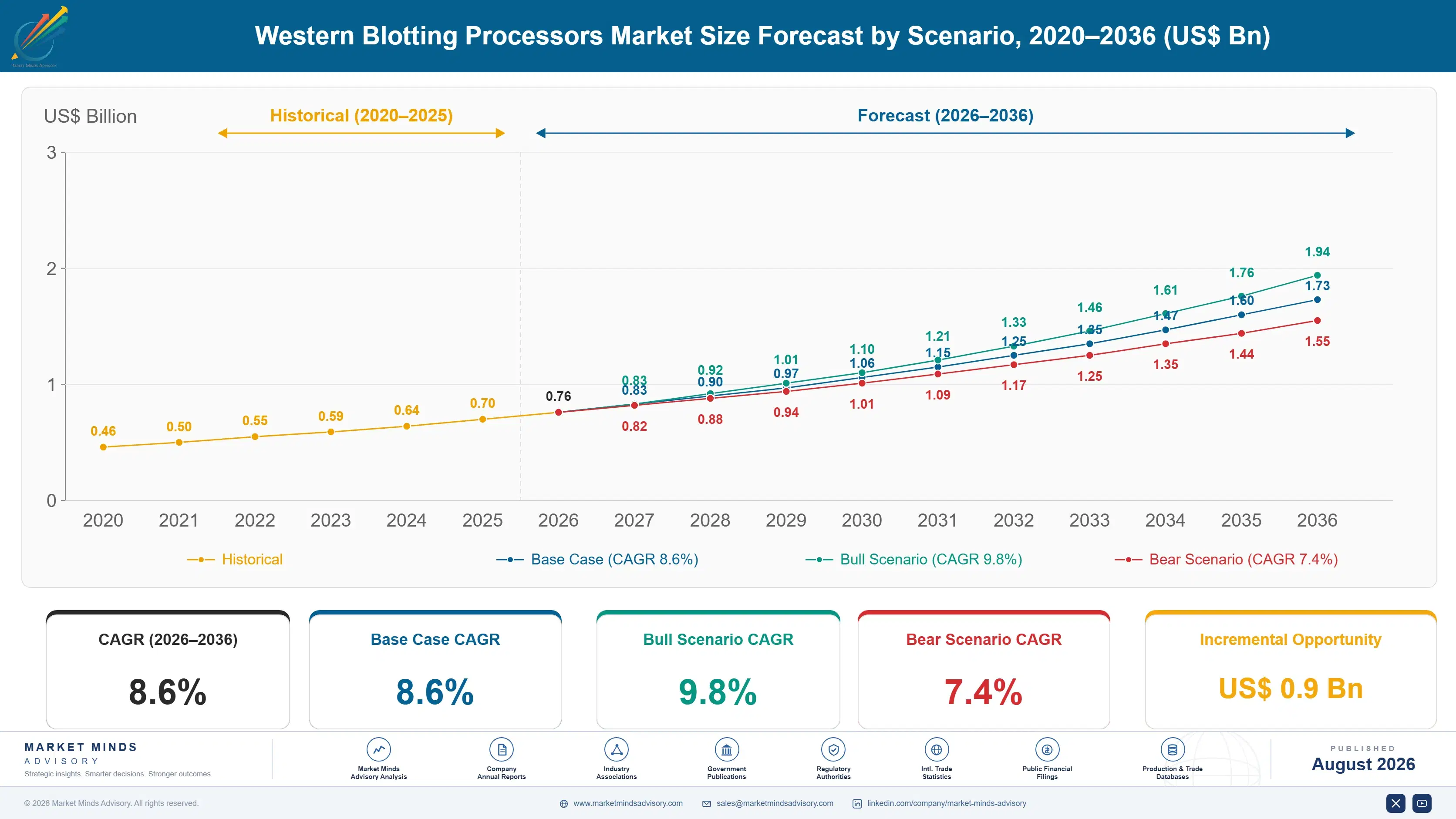
Western Blotting Processors Market Forecast Scenarios

western-blotting-processors-market-size-forecast-scenario-1787664922389
The five years to 2025 were shaped by research funding cycles and by a slow shift in what journals will accept as evidence. Instrument purchasing tracked grant availability closely, with a pandemic driven surge followed by a correction that several suppliers had treated as a new baseline. The 7.4% historical rate mixes that distortion with a genuine underlying move toward automated and capillary workflows in regulated laboratories.
The 8.6% base case rests on three mechanisms. Data integrity requirements keep tightening, with around 42% of journals now demanding total protein normalisation and image screening catching what manual workflows conceal. Capillary instruments grow at 12.9% in regulated bioanalysis where reproducibility is a compliance obligation rather than a preference. And Chinese institutional research capacity keeps expanding at 12.4%, faster than any market covered here. None of the three is a performance argument.
The 9.8% bull case turns on a major regulator formally recognising capillary immunoassay data for a regulated bioanalytical purpose, which would convert an internal quality preference into a submission requirement. The 7.4% bear case is academic funding: most instrument units still sit on university benches, and grant constrained laboratories defer instrument replacement long before they defer reagents or staff.

Forty Years Of Failed Replacements

Every few years somebody announces a technology that will finally retire the western blot, and it never happens. The reason is narrow and decisive: this is the only routine protein assay that separates by molecular weight before detection, so a reader can see whether the signal sits where the protein should or somewhere it should not. Every alternative asks the reviewer to take the antibody's word for it.
TOP FIVE CONCENTRATION58%Combined installed base held by the leading suppliers
MANUAL WORKFLOW DURATION2 daysBench time from sample loading to final image
HOUSEKEEPING NORMALISATION FAILURE31%Blots where reference protein falls outside linear range
JOURNAL TOTAL PROTEIN REQUIREMENT42%Journals now requiring loading control beyond reference proteins
CAPILLARY PRICE MULTIPLE6.4xSystem cost against a conventional bench setup equivalent
CONSUMABLE REVENUE SHARE61%Supplier turnover from reagents rather than instrument sales
The commercial change is coming from data integrity rather than from performance. Reference protein normalisation using actin falls outside linear range on roughly 31% of blots, which was tolerated for decades. Around 42% of journals now require total protein normalisation, image screening software checks submitted figures for duplication and manipulation, and retractions have made institutions cautious in a way no marketing claim achieved.
That is what sells instruments. A system generating an auditable record from load to image removes a class of risk from a laboratory, and the risk is reputational rather than scientific. Capillary instruments take this furthest by eliminating gel, membrane and transfer altogether, at around 6.4 times the cost of a conventional bench setup, which places them firmly in regulated environments rather than academic ones.
"The blot did not survive because it is good. It survived because it is the only assay where a sceptical reader can look at the picture and see for themselves that the band is in the wrong place."
Director, Life Science Instrumentation Practice · MMA Life Science Instrumentation Practice · August 2026

Market Trends

Data Integrity Requirements Move Instrument Purchasing Decisions

Journals increasingly require total protein normalisation, uncropped images and raw file submission, with around 42% now demanding loading control beyond reference proteins. Image screening software checks submitted figures for duplication and manipulation before review, and retractions traced to blot images have made institutions considerably more cautious than any supplier argument ever managed. An instrument producing an auditable record from load to image removes reputational risk rather than solving a scientific problem. That is a different purchase justification and it reaches research leadership rather than bench scientists. Nobody argues with a retraction.
Market Impact: China grows at 12.4% annually

Capillary Automation Removes The Hands From The Workflow

Capillary immunoassay instruments run separation, immobilisation, probing and detection inside a cartridge with no gel, no membrane and no transfer step, which eliminates the manual stages where reproducibility fails and where images can be manipulated. Growth of 12.9% against a market rate of 8.6% makes this the fastest instrument category by a clear margin. The obstacle is cost, at roughly 6.4 times a conventional bench setup, which restricts adoption to regulated bioanalysis and well funded discovery groups rather than the academic laboratories holding most installed units. Cost is the only obstacle left.
Market Impact: Consumables carry 61% of revenue

Market Opportunities and Growth Drivers

Chinese Research Capacity Expands Publication Volume Rapidly

Chinese institutions now produce a larger share of global life science publication output than any other country, and western blots appear in a substantial proportion of that work regardless of field. China grows at 12.4%, faster than any market covered. Domestic instrument manufacturers including Shanghai Tanon and Beijing Liuyi supply imaging and processing systems well below imported pricing, while international suppliers hold capillary and integrated platform positions in the better funded institutes. Procurement runs through institutional tender, which rewards local cost position considerably. Publication volume rather than funding depth drives this market.
Market Impact: Capillary costs 6.4 times conventional

Regulated Bioanalysis Demands Reproducibility As Compliance

Biopharmaceutical quality control, contract research organisations and regulated bioanalytical laboratories treat assay reproducibility as a documented obligation rather than a scientific preference, which changes what an instrument is worth to them entirely. A capillary system at roughly 6.4 times conventional cost is straightforwardly justifiable where a failed audit costs far more than the instrument. Consumables carry 61% of supplier revenue in this category, and regulated laboratories consume cartridges predictably against validated methods they cannot casually change once established. A validated method is considerably harder to change than an instrument is to buy.
Market Impact: Variation affects 100% of workflows

Market Restraints and Challenges

Academic Budgets Cannot Fund The Instruments That Fix This

Most installed units sit on university benches funded by grants, and a capillary system costing around 6.4 times a conventional setup is unreachable for laboratories that already ration reagents. The root cause is that instrument capital and consumable spending compete for the same grant line, and the consumables are what generate this month's data. Commercially this leaves the reproducibility problem concentrated where the money is not. Suppliers respond with core facility placements, reagent rental structures and lower cost imaging systems, which help unevenly. The problem sits precisely where the budget does not.
Market Impact: Required by 42% of journals now

Antibody Variability Undermines Any Instrument Improvement

A western blot is only as reproducible as the antibody used, and antibody lot to lot variation defeats automation that assumes everything upstream is consistent. The root cause sits outside this market entirely, in an antibody supply industry with limited validation standards and considerable batch variability between production runs. Commercially this limits how much reproducibility an instrument supplier can honestly claim. Participants respond by bundling validated antibody recommendations and by supporting recombinant antibody adoption, neither of which they control. No instrument supplier can fix a variable originating two steps upstream of them.
Market Impact: Fastest category growing at 12.9%
3 additional market trends, 4 additional growth drivers, and 2 additional restraints and challenges are covered in the full report. Contact sales@marketmindsadvisory.com to access the complete intelligence.

Segment CAGR and Growth Architecture

Segmentation follows instrument category, since what the box does determines which workflow stage it addresses, what it costs, which laboratory type buys it and how much consumable revenue attaches. Six categories cover the workflow as instrumented today. Growth tracks where manual handling creates reproducibility risk rather than where bench time is longest. Risk rather than time drives it.
western-blotting-processors-market-market-share-analysis-1787664922923

Capillary Immunoassay Instruments

Systems running separation, immobilisation, antibody probing and detection inside a disposable capillary cartridge, removing gel casting, membrane transfer and manual washing from the workflow completely. At 12.9% this is the fastest growing category, half again the market rate of 8.6%, and reproducibility rather than throughput explains it. Every manual stage removed is a stage where results drift and where images could be manipulated, which matters more to a regulated laboratory than to an academic one. Cost is the constraint at roughly 6.4 times a conventional bench setup, and cartridge consumption generates the recurring revenue that justifies the platform commercially. Regulated laboratories accept that price and academic benches genuinely cannot reach it.
CAGR 12.9%

Fully Integrated Workflow Instruments

Instruments combining transfer, blocking, probing, washing and imaging in a single enclosure with a continuous data record, keeping the traditional gel and membrane chemistry while automating the handling around it. Growth of 11.4% is second fastest in the category, and it appeals to laboratories that want auditability without abandoning established protocols or revalidating methods. That matters where a method has already been qualified and changing the underlying chemistry would trigger revalidation nobody has budgeted. Consumable attachment is lower than for capillary systems, since membranes and reagents remain broadly interchangeable between suppliers here. Auditability without revalidation is the specific proposition here, and it suits laboratories with qualified methods already running. Nothing else changes.
CAGR 11.4%
Full segment breakdown across 6 segments available in the complete report.

Regional Architecture and Country Demand Map

East Asia holds 30% on Chinese publication volume and expanding institutional research capacity, narrowly ahead of North America at 29%. Western Europe follows at 21%. China grows fastest at 12.4%, ahead of every other market covered. Publication volume rather than instrument spending explains that ranking most clearly.

North America

Biopharmaceutical and contract research demand carries this 29% share more than academic volume does, since regulated laboratories buy the expensive instruments and universities buy the cheap ones. Capillary system adoption is deepest here, concentrated in quality control and bioanalytical groups where a failed audit costs far more than any instrument. Federal research funding drives the academic half and moves with appropriation cycles that suppliers cannot forecast reliably. Core facility placements are an established route to reaching grant constrained laboratories. Growth of 7.6% reflects a mature installed base upgrading rather than expanding in unit terms. Regulated laboratories rather than academic volume are what makes this region commercially valuable. The split matters more than the total.
Share: 29% | CAGR: 7.6% (2026 to 2036)

Western Europe

Academic and pharmaceutical research shares this 21% share fairly evenly, with German, British, Swiss and Nordic institutions holding substantial installed bases and long replacement cycles. Research integrity policy is more formalised here than in most regions, with institutional data management requirements that favour instruments generating auditable records. Swiss and Danish biopharmaceutical quality control operations are among the most demanding capillary users anywhere. Public procurement rules extend purchasing timelines considerably. Growth of 7.0% is the lowest of the seven regions and reflects budget constraint rather than any resistance to automated workflows. Institutional policy rather than individual preference is what shapes purchasing across most of this region. Timelines are long and deployments are wide.
Share: 21% | CAGR: 7.0% (2026 to 2036)
Regional intelligence for 5 additional markets available in the complete report: East Asia, South Asia and Pacific, Latin America, Middle East and Africa, Eastern Europe. Contact sales@marketmindsadvisory.com.
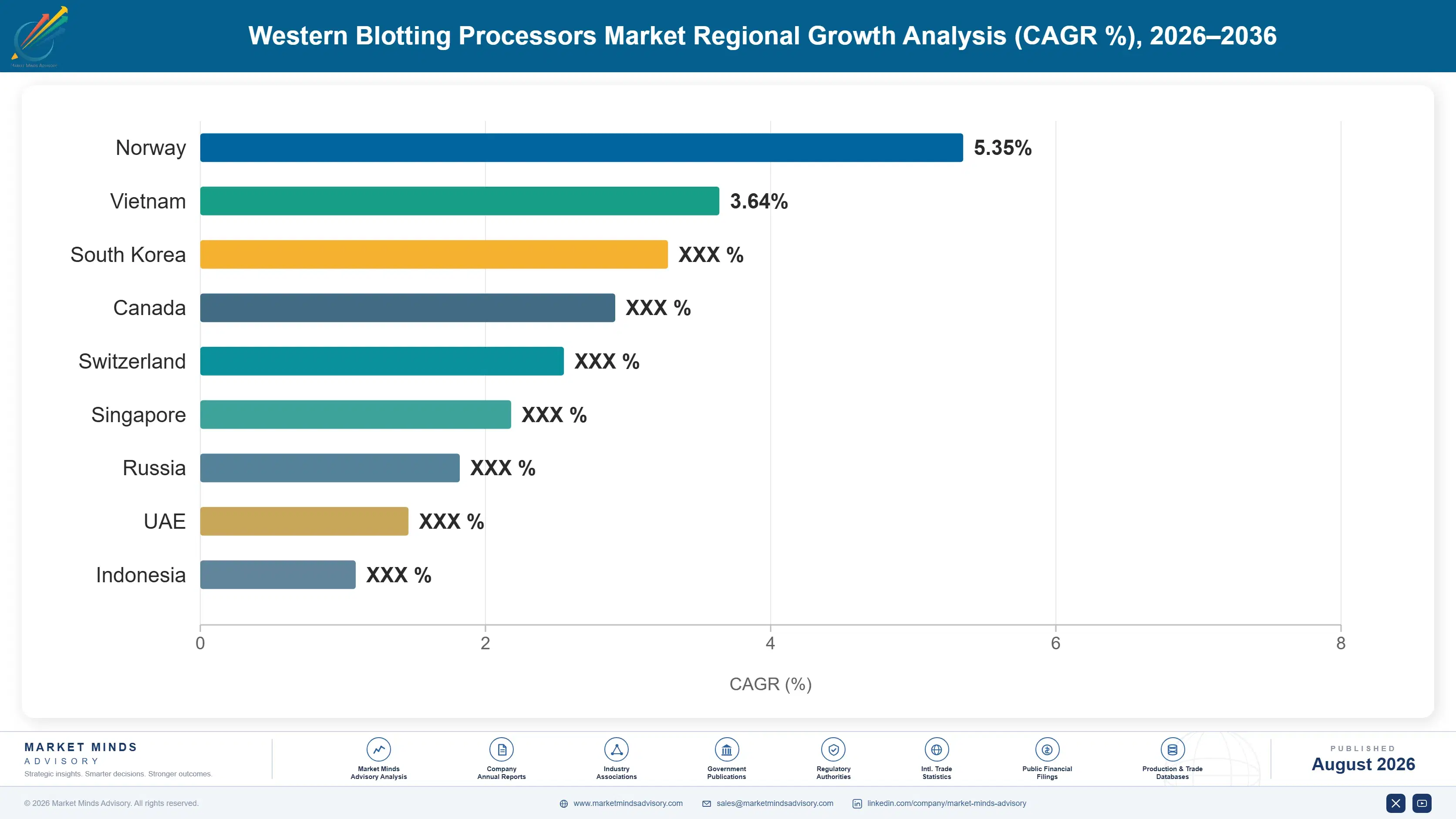
western-blotting-processors-market-country-cagr-analysis-1787664923444

Where This Category Actually Earns

Nothing here is won on sensitivity claims, because the antibody rather than the instrument sets the limit and everybody in the market knows it. Value accrues to whoever sells auditability, whoever reaches laboratories where reproducibility is a compliance obligation, whoever attaches consumables, and whoever follows publication volume. Four routes carry weight. Auditability is the actual product.

Sell Auditable Records Not Faster Blots

Around 42% of journals now require total protein normalisation, image screening checks submitted figures for manipulation before review, and retractions traced to blot images have made institutions cautious in a way no performance claim achieved. An instrument producing a continuous record from load to image removes reputational risk rather than solving a scientific problem. That justification reaches research leadership and institutional integrity offices rather than the bench scientist comparing sensitivity specifications, and it is a considerably shorter argument to make. Roughly 31% of blots carry reference protein outside linear range, which is the underlying problem.
Market Impact: Meets requirements now set by 42% of journals

Target Regulated Bioanalysis Where Price Stops Mattering

A capillary system at roughly 6.4 times conventional cost is unreachable for an academic laboratory rationing reagents and straightforwardly justifiable for a regulated bioanalytical group where a failed audit costs multiples of the instrument. Those laboratories also consume cartridges predictably against validated methods they cannot casually change, which is exactly the customer this category needs. Selling the same instrument into academic benches on the same argument wastes the sales effort, because the money genuinely is not there. Cartridge consumption against a validated method is predictable in a way academic reagent buying never is.
Market Impact: Serves buyers accepting 6.4 times conventional instrument cost

Earn On Cartridges Rather Than Instruments

Consumables already account for 61% of supplier revenue in this category, and the instrument is increasingly a placement decision rather than the revenue event. Closed cartridge systems lock consumption to one supplier while open membrane workflows allow substitution at every step, which is the single largest difference between capillary and integrated platform economics. Reagent rental and placement structures reach grant constrained laboratories that cannot fund capital, converting an unreachable customer into a recurring one at modest risk. Closed consumption is worth several times an open instrument sale across a full installed life of the system.
Market Impact: Consumables already generate 61% of all supplier revenue

Follow Publication Volume Into Chinese Institutions

Chinese institutions produce a larger share of global life science publication output than any other country and western blots appear throughout that work, with growth running at 12.4% and faster than any market covered. Domestic manufacturers supply imaging and processing systems well below imported pricing, so competing on general instrument cost is not the route in. Capillary and integrated platforms sold into better funded institutes and the domestic biopharmaceutical sector are where international suppliers hold defensible positions instead. Tender procurement rewards local cost position before any technical comparison begins at all in that market.
Market Impact: Captures the 12.4% Chinese growth rate through 2036

Who Controls the Margin Pool

Concentration is high for a research instrument category. The top five hold 58% of installed base and associated consumable revenue, the basis applied consistently throughout this section, reflecting how much of this market runs on proprietary reagent and cartridge systems rather than on interchangeable hardware. Bio-Rad Laboratories leads on installed breadth across imaging, transfer and processing, and the gap reflects decades of bench presence more than any single product advantage.
Competition runs on three fronts. Platform suppliers compete on closed consumable systems that lock consumption once a method is validated, which is where the durable economics sit. Imaging and processing specialists compete on price and performance into academic laboratories that buy hardware and shop for reagents separately. And Chinese domestic manufacturers compete on cost in the largest and fastest growing research market.

Rankings will move with regulatory recognition of capillary data rather than with instrument launches, since formal acceptance for a regulated bioanalytical purpose would convert a quality preference into a submission requirement. The other pressure point is academic funding, which determines whether the largest installed base by unit count replaces anything at all across the forecast period.
western-blotting-processors-market-company-positioning-matrix-1787664923969

Competitive Moat and Risk Dimensions

BIO-RAD LABORATORIES

Moat: Installed Bench Presence Depth

Decades of presence across academic and industrial benches create protocol familiarity, published method references and training habits that make the brand the default choice when a laboratory replaces equipment. Reagent and consumable ranges spanning the whole workflow reinforce that position, since a laboratory standardised on one supplier's chemistry rarely revisits the decision without cause.
BIO-RAD LABORATORIES

Risk: Academic Funding Dependence

A large share of installed units sits in grant funded academic laboratories that defer instrument replacement long before they defer reagents or staff, which makes revenue sensitive to appropriation cycles outside the company's influence. Capillary competition also concentrates in exactly the regulated segment where instrument pricing is least constrained.
BIO-TECHNE

Moat: Closed Cartridge Consumable Lock

Capillary systems consuming proprietary cartridges tie recurring revenue to the instrument in a way open membrane workflows never achieve, and a validated method running on those cartridges cannot be changed without revalidation nobody has budgeted. That combination produces consumable attachment rates well above the category average and revenue visibility competitors cannot match.
BIO-TECHNE

Risk: Regulated Segment Concentration

Growth depends on regulated bioanalysis and well funded discovery groups, since a system costing roughly 6.4 times a conventional setup cannot reach the academic laboratories holding most installed units. That narrows the addressable base considerably and ties progress to how quickly regulators and quality organisations accept capillary data formally.

Players Tracked

Prominent Players

Bio-Rad Laboratories
Thermo Fisher Scientific
Cytiva
Bio-Techne
Merck KGaA

Other Key Players

Azure Biosystems
LI-COR Biosciences
Agilent Technologies
Sartorius
Analytik Jena
Syngene
Vilber Lourmat
Advansta
Cleaver Scientific
Hoefer
Shanghai Tanon Science and Technology
Beijing Liuyi Biotechnology
ATTO Corporation
Precision Biosystems
Major Science

Recent Developments

MARCH 2025

Journal group extends total protein normalisation requirement across titles

A journal group extended total protein normalisation and uncropped image requirements across its life science titles, alongside automated screening of submitted figures. Around 42% of journals now require loading control beyond reference proteins, and reference normalisation falls outside linear range on roughly 31% of blots.
Signal: Publishers are setting instrument requirements that no supplier sales argument ever managed to establish across the whole field
JUNE 2025

Contract research laboratory standardises bioanalysis on capillary platform

A contract research organisation standardised regulated protein bioanalysis on a capillary immunoassay platform, citing audit documentation rather than throughput as the deciding factor. Capillary systems cost roughly 6.4 times a conventional bench setup, which regulated laboratories justify against audit failure exposure readily. Documentation decided it, not throughput.
Signal: Where a failed audit costs multiples of the instrument, price stops being part of the decision
SEPTEMBER 2025

Domestic Chinese manufacturer expands imaging system institutional supply

A Chinese instrument manufacturer expanded supply of blot imaging systems to institutional research customers through tender procurement, at pricing imported systems could not approach. China grows at 12.4% annually, faster than any market covered in this report. Institutional research budgets favour domestic supply on price alone.
Signal: Tender procurement rewards local cost position long before any technical comparison begins in these institutions at all

What These Instruments Cost To Build

Optics, image sensors and precision fluidics account for 38% of instrument cost of goods, with machined enclosures, motion control and software carrying most of the remainder across production volumes measured in thousands of units. Consumable manufacturing is a separate cost base entirely, dominated by nitrocellulose and polyvinylidene membrane production and by cartridge moulding. Nitrocellulose supply is concentrated among very few producers, since the material is regulated.
Component allocation showed the exposure clearly during the last semiconductor shortage, when manufacturers ordering thousands of image sensors annually sat behind consumer and automotive customers ordering millions. Company annual reports across the life science tools sector documented extended lead times and redesign work, alongside sensor and optics supply tightening recorded in China MIIT industrial output data. Nitrocellulose membrane supply interruptions in the same period affected laboratories more visibly than instrument delays did.

Exposure divides by business model rather than by scale. Suppliers earning most revenue from closed cartridges carry moulding, filling and reagent manufacturing risk while capturing consumption they control. Those selling open instruments carry component risk and watch consumable spending go elsewhere. Nitrocellulose concentration affects everybody running membrane workflows, and it is the supply risk this industry discusses least and would feel most.
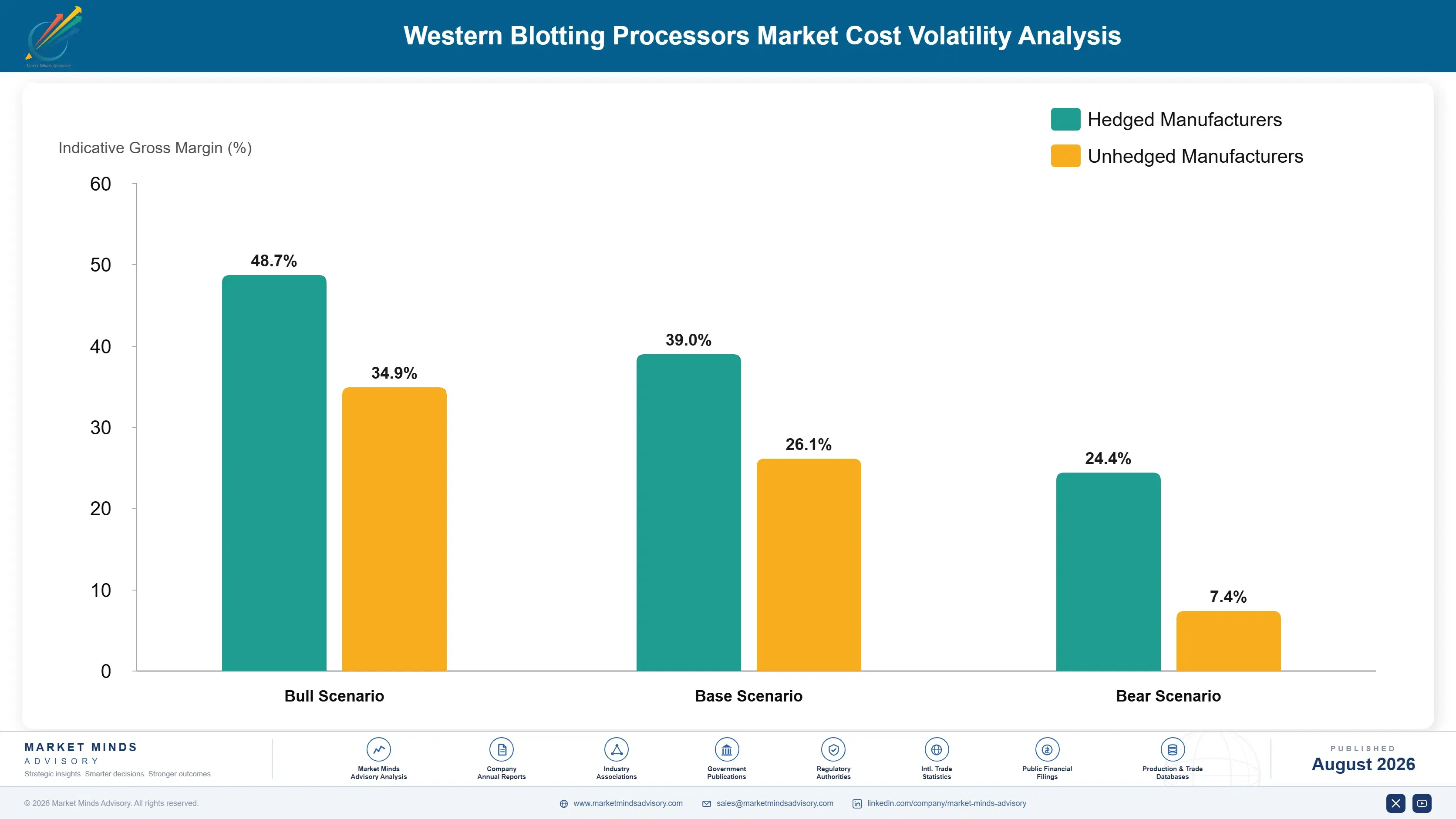
western-blotting-processors-market-cost-volatility-analysis-1787664924166

Qualify a second membrane source before supply tightens again

Nitrocellulose production is concentrated among very few producers because handling and transport of the material are regulated, which leaves membrane workflows exposed to a supply base nobody can expand. Qualifying alternative membrane chemistry or a second supplier takes validation time that cannot be compressed during an interruption. Laboratories and suppliers that did this work early were largely unaffected last time.

Design instruments around widely available image sensors

Manufacturers ordering thousands of sensors annually sit behind customers ordering millions whenever allocation tightens, and a specialised sensor choice makes that position worse. Designing around widely available components costs measurable sensitivity and removes a risk that halts shipment. Given antibody variability sets the practical detection limit anyway, the sensitivity concession costs less in practice than on a specification sheet.

Place instruments and recover cost through consumable consumption

Consumables already generate around 61% of supplier revenue, and grant constrained academic laboratories that cannot fund capital purchases still consume reagents every month they run experiments. Reagent rental and placement structures convert an unreachable customer into a recurring one while moving instrument cost onto the supplier balance sheet. The exposure is placement in laboratories whose consumption never materialises properly.

Portfolio Architecture for Margin Defence

Margin architecture divides on whether the consumable is closed. Open instruments sold into academic laboratories earn least, because the hardware competes against domestic manufacturers on price and the laboratory buys membranes and reagents from whoever is cheapest that quarter. Integrated platforms with partial consumable attachment earn better. Closed cartridge capillary systems earn best, since consumption is locked to the instrument once a method has been validated against it.
The tension runs between installed base and revenue quality. Academic laboratories hold most units by count and generate the least revenue per unit, while regulated laboratories hold far fewer units and consume predictably against validated methods. A supplier chasing unit share is buying the wrong half of the market, and a supplier ignoring academic benches loses the protocol familiarity that makes the brand a default choice years later.

High value pools concentrate in closed cartridge consumption and in regulated bioanalysis, neither of which is a hardware position. Everything selling open imaging and processing instruments competes on price against Chinese manufacturers in the largest research market. The businesses worth building are those where a validated method locks consumption and where the customer treats reproducibility as an audit obligation rather than a scientific preference.

Open Imaging And Processing Instruments

Imaging, transfer and washing instruments sold into academic and general research laboratories that source membranes and reagents separately. Competition against domestic Chinese manufacturers on price is direct and consumable attachment is effectively negligible here.
Gross Margin: 34-38%

Integrated Workflow Platforms

Enclosed systems automating transfer, probing, washing and imaging with continuous data records, sold where auditability matters without abandoning established chemistry. The range is wide because consumable attachment varies substantially between open and semi-closed configurations.
Gross Margin: 48-54%

Closed Cartridge Capillary Systems

Capillary immunoassay platforms consuming proprietary cartridges, sold into regulated bioanalysis where validated methods lock consumption to one supplier. Margin is highest because revalidation cost prevents substitution once a method has been established properly.
Gross Margin: 62-68%
western-blotting-processors-market-portfolio-architecture-1787664924666

High-value Sub-segments and Strategic Watch-out

Capillary Immunoassay Instruments

Fastest growing category at 12.9% because removing every manual stage removes where reproducibility fails and images can be manipulated. Cost at roughly 6.4 times a conventional setup restricts adoption to regulated bioanalysis rather than the academic benches holding most units. That price gap defines the addressable base.
Gross Margin: 60-66%

Fully Integrated Workflow Instruments

Second fastest at 11.4% for laboratories wanting auditability without revalidating established chemistry, which matters where a qualified method already exists. Consumable attachment is lower than capillary, since membranes and reagents stay broadly interchangeable between suppliers. Auditability without revalidation is the whole proposition being sold in this category.
Gross Margin: 46-52%

Blot Imaging and Detection Instruments

Growing at 9.8% and carrying the largest installed base by unit count across academic and general research laboratories. Competition against domestic Chinese manufacturers on price is direct and no consumable revenue attaches to the hardware at all. Hardware price is the entire basis of comparison.
Gross Margin: 36-40%

Transfer Instruments

Growing at only 5.4% as capillary workflows remove the transfer step entirely and integrated platforms absorb it into an enclosure. Standalone transfer demand is a replacement business now, tied to laboratories keeping conventional workflows for cost reasons. Nothing is arresting that decline anywhere in the category.
Gross Margin: 30-34%

How A Validated Method Locks Demand

This category earns from methods rather than from instruments. A laboratory that validates an assay against a specific platform cannot change it without revalidating, which costs time, documentation and in regulated settings a formal change process nobody wants to open. Consumables already generate around 61% of supplier revenue for exactly that reason, and the instrument is increasingly a placement decision that opens years of predictable cartridge or reagent consumption behind it.
Stickiness therefore depends almost entirely on how closed the consumable is. Capillary cartridge systems hold consumption completely, since nothing else fits the instrument and nothing else carries the validation. Integrated platforms hold it partially. Open imaging and transfer instruments hold none, because the laboratory buys membranes and reagents from whoever quotes best that quarter and the hardware earns nothing after the sale.

The buyer profile is broadening from the principal investigator to the institution. Research integrity offices, core facility managers and quality organisations now influence purchases that a single laboratory head previously decided alone, and those parties evaluate auditability and documentation rather than sensitivity or throughput. That is a slower sale with a larger deployment behind it, and most suppliers are still selling to the older audience.
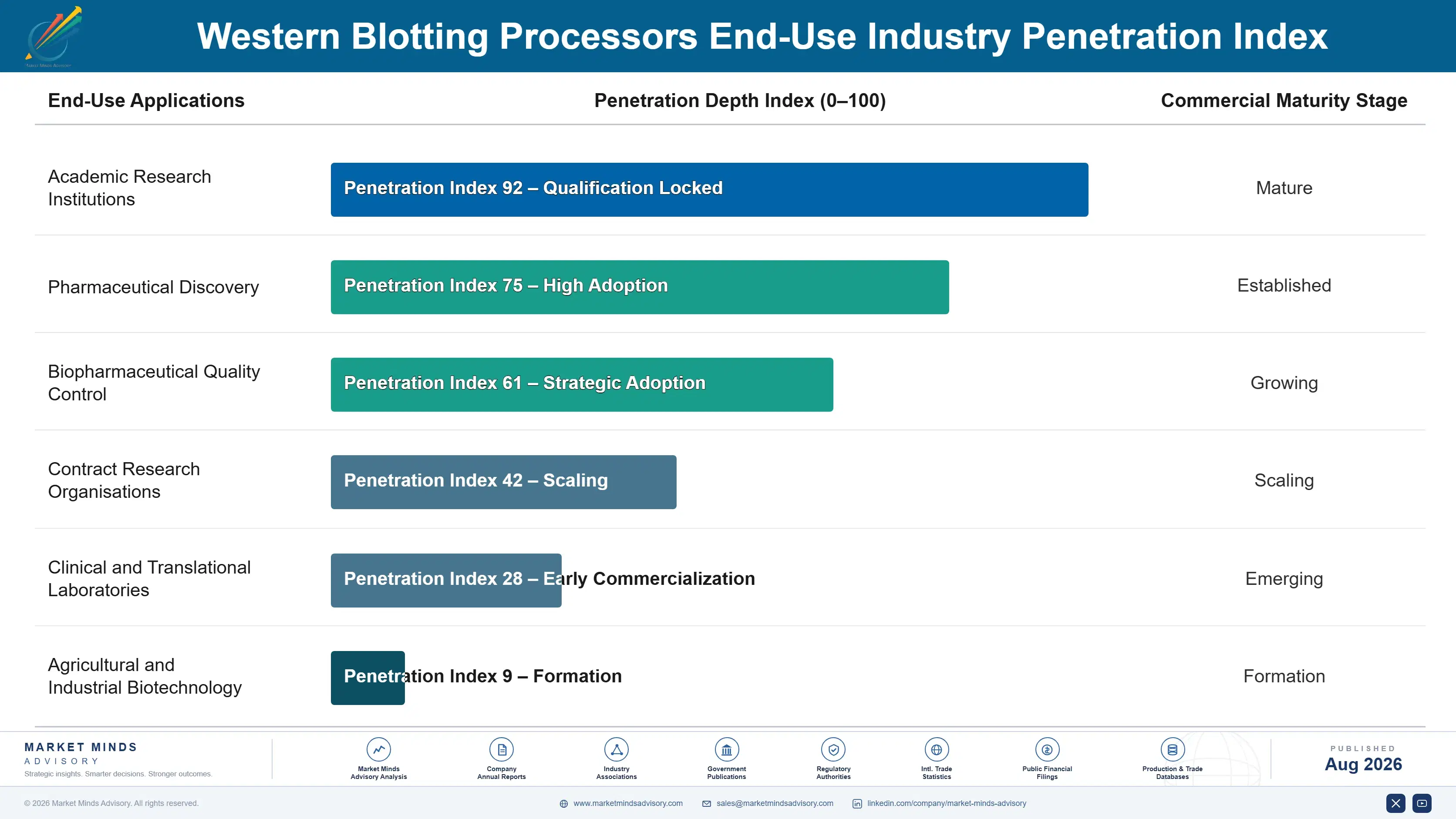
western-blotting-processors-market-end-use-penetration-index-1787664925161

Where This Category Rewards Focus

These are among the four positions where our research anticipates prominent divergence between winners and laggards over the coming forecast period. Each is grounded in the demand model, the regulatory perimeter, and the announced capacity pipeline.
01 / DATA INTEGRITY SELLING

Reputational risk sells what performance claims never did

Around 42% of journals now require total protein normalisation, image screening software checks submitted figures for manipulation before review, and retractions traced to blot images have made institutions cautious in a way no supplier argument ever achieved. An instrument producing a continuous auditable record from load to image removes reputational exposure rather than solving any scientific problem at all. That justification reaches research leadership and integrity offices rather than the bench scientist comparing sensitivity specifications between competing product catalogues instead.
02 / REGULATED WORKFLOW FOCUS

Sell where a failed audit costs more

A capillary system priced at roughly 6.4 times a conventional bench setup is unreachable for an academic laboratory already rationing reagents against a single grant line each month. The same instrument is straightforwardly justifiable for a regulated bioanalytical group where a failed audit costs multiples of the purchase price and documentation is an obligation. Those laboratories also consume cartridges predictably against validated methods they cannot casually change, which is precisely the customer this category needs and rarely manages to reach.
03 / CONSUMABLE ATTACHMENT ECONOMICS

The cartridge is the business, not the box

Consumables already generate around 61% of supplier revenue across this category, which makes the instrument a placement decision that opens years of consumption rather than the revenue event itself. Closed cartridge systems hold that consumption completely because nothing else fits and nothing else carries the method validation behind it. Open membrane workflows hold none of it, since the laboratory buys reagents from whoever quotes best in any given quarter, which earns the original instrument supplier nothing at all in return.
04 / PUBLICATION VOLUME ACCESS

Follow the papers to find the blots

Chinese institutions now produce a larger share of global life science publication output than any other country, and western blots appear throughout that work regardless of the field involved. China grows at 12.4%, faster than any market covered in this report. Domestic manufacturers supply imaging and processing instruments well below imported pricing, so capillary and integrated platforms sold into better funded institutes are where international suppliers hold defensible ground, and general instrument pricing is not a contest worth entering there.

Engagement Snapshot From the Field

A live engagement with an industry participant carrying material or product regulatory and market exposure ahead of a defining policy shift, showing how our research translates into a defensible multi-year portfolio strategy.
MARKET MINDS ADVISORY · CLIENT ENGAGEMENT SUMMARY
Western Blotting Processors Producer Strategic Portfolio Review and Transition Roadmap 2026·Investment Scenario on Western Blotting Processors Exposure Evaluation 2025-26
CLIENT PROFILE
A life science instrument manufacturer supplying blot imaging and processing systems to academic and pharmaceutical laboratories across North America and Western Europe. Annual revenue was approximately 84 million dollars (client-reported, unverified by MMA), roughly 80% from instrument hardware with minimal consumable attachment. No closed cartridge or capillary product existed anywhere in the company's product range.
STRATEGIC CHALLENGE
Hardware margins had compressed for four years against Chinese manufacturers entering European and North American academic channels at considerably lower prices. Management was weighing a next generation imaging system against entry into automated closed workflow products. Nobody had established what the absent consumable stream was costing the business across the installed base.
MMA APPROACH
MMA measured consumable spending across the client's own installed base by contacting customers directly and reconciling against supplier disclosures where possible. Closed workflow product entry was costed against a further imaging generation. Forty-seven expert interviews with laboratory heads, core facility managers, integrity officers and quality staff established how purchases are decided, alongside survey work across six countries.
KEY FINDINGS
  1. Customers on the client's instruments spent roughly 4 times the instrument price on membranes and reagents over an installed life, and essentially none of it went to the client.
  2. Research integrity offices or core facilities influenced 4 of every 10 recent purchases in the sample, against almost none five years earlier, and evaluated auditability rather than sensitivity.
  3. A further imaging generation was modelled to hold price for around 2 years before Chinese competition matched the specification at materially lower cost.
  4. Regulated laboratories accepted capillary pricing at roughly 6.4 times conventional systems in 5 of the 6 markets surveyed, citing audit exposure rather than throughput.
CLIENT PROFILE
A life science instrument manufacturer supplying blot imaging and processing systems to academic and pharmaceutical laboratories across North America and Western Europe. Annual revenue was approximately 84 million dollars (client-reported, unverified by MMA), roughly 80% from instrument hardware with minimal consumable attachment. No closed cartridge or capillary product existed anywhere in the company's product range.
STRATEGIC CHALLENGE
Hardware margins had compressed for four years against Chinese manufacturers entering European and North American academic channels at considerably lower prices. Management was weighing a next generation imaging system against entry into automated closed workflow products. Nobody had established what the absent consumable stream was costing the business across the installed base.
MMA APPROACH
MMA measured consumable spending across the client's own installed base by contacting customers directly and reconciling against supplier disclosures where possible. Closed workflow product entry was costed against a further imaging generation. Forty-seven expert interviews with laboratory heads, core facility managers, integrity officers and quality staff established how purchases are decided, alongside survey work across six countries.
KEY FINDINGS
  1. Customers on the client's instruments spent roughly 4 times the instrument price on membranes and reagents over an installed life, and essentially none of it went to the client.
  2. Research integrity offices or core facilities influenced 4 of every 10 recent purchases in the sample, against almost none five years earlier, and evaluated auditability rather than sensitivity.
  3. A further imaging generation was modelled to hold price for around 2 years before Chinese competition matched the specification at materially lower cost.
  4. Regulated laboratories accepted capillary pricing at roughly 6.4 times conventional systems in 5 of the 6 markets surveyed, citing audit exposure rather than throughput.
RECOMMENDED STRATEGY
Phase 1: Phase one: stop the next imaging generation, which was modelled to hold pricing for only about 2 years against Chinese competition. Phase 2: Phase two: enter closed consumable workflow products, since installed customers spend roughly 4 times instrument price on reagents the client never captures. Phase 3: Phase three: redirect selling toward integrity offices and core facilities, which now influence 4 of every 10 purchase decisions now.
OUTCOME
The client cancelled the imaging programme and began development of a closed consumable workflow system, with the first configuration reaching evaluation within the projected window. Selling to integrity offices and core facilities lengthened the sales cycle and raised average deployment size materially, and consumable revenue appeared as a line for the first time (client-reported, unverified by MMA).

Frequently Asked Questions

Foundational context covering the market sizes, CAGR, scope, country, region and competition that inform every finding below. This section is provided to cover basics and most often pre-purchase conversations, answered from the MMA Primary Research Dataset.

What is the current size of the Western Blotting Processors Market?

The market was valued at 0.68 billion dollars in 2025, covering transfer, processing, imaging, capillary and integrated workflow instruments with dedicated consumables worldwide. It reaches an estimated 0.74 billion dollars during 2026.

How large will the Western Blotting Processors Market be by 2036?

MMA forecasts 1.69 billion dollars by 2036, an increase of 0.95 billion dollars over the 2026 base. That represents an expansion multiple of 2.28 times across the forecast period.

What is the CAGR for the Western Blotting Processors Market 2026 to 2036?

The base case compound annual growth rate is 8.6%, with a bull case of 9.8% and a bear case of 7.4%. Regulatory recognition of capillary data and academic funding separate those scenarios.

Which segment is growing fastest?

Capillary immunoassay instruments grow at 12.9%, half again the market rate of 8.6%, by removing every manual stage from the workflow. Integrated workflow instruments follow at 11.4%.

Who are the major companies in the Western Blotting Processors Market?

Bio-Rad Laboratories, Thermo Fisher Scientific, Cytiva, Bio-Techne and Merck KGaA lead on installed base and associated consumable revenue. Together they account for 58% of the global market.

Which country is growing fastest?

China grows fastest at 12.4%, because its institutions produce a larger share of global life science publication output than any other country and western blots appear throughout that work.

Report Segmentation Architecture

The full report scope spans multiple orthogonal segmentation dimensions, with cross-tabulated demand data provided for each dimension pair. Coverage extends further to regional breakdowns, trend trajectories, and the competitive detail needed to support segment-level decision-making.

By Instrument Category

  • Transfer Instruments
  • Blot Processing and Washing Instruments
  • Blot Imaging and Detection Instruments
  • Capillary Immunoassay Instruments
  • Fully Integrated Workflow Instruments
  • Gel Documentation and Normalisation Instruments

By End-Use Industry

  • Academic Research Institutions
  • Pharmaceutical Discovery
  • Biopharmaceutical Quality Control
  • Contract Research Organisations
  • Clinical and Translational Laboratories
  • Agricultural and Industrial Biotechnology

By Commercial Dimension

  • Direct Instrument Sales
  • Distributor and Dealer Supply
  • Reagent and Consumable Subscription
  • Core Facility Procurement
  • Service and Maintenance Contracts
  • Grant Funded Purchase

By Region

  • North America
  • Western Europe
  • East Asia
  • South Asia and Pacific
  • Latin America
  • Middle East and Africa
  • Eastern Europe

Scope, Methodology, and Coverage

Every figure in this report is reproducible from documented input assumptions. The scope below maps the historical period, the forecast horizon, the segmentation dimensions, and the countries covered, alongside the underlying primary and qualitative methodology.
Historical Period
2020 to 2025
Forecast Period
2026 to 2036
Base Year
2025 (USD billions; MMA Primary Research Dataset, August 2026)
Market Definition
Instruments used to run, process and record western blot and related protein immunodetection workflows worldwide, covering transfer instruments, blot processing and washing instruments, imaging and detection instruments, capillary immunoassay instruments, fully integrated workflow instruments and gel documentation and normalisation instruments, together with cartridges, membranes and reagents sold specifically for those systems. Measured at supplier revenue. Standalone electrophoresis apparatus, antibodies sold independently, general laboratory imaging systems, mass spectrometry and other immunoassay platforms are excluded from scope.
Quantitative Units
USD billions (supplier revenue); instruments installed; USD per instrument and per consumable run
Segmentation Dimensions
Instrument category; end-use industry; commercial dimension; region
Regions Covered
North America, Western Europe, East Asia, South Asia and Pacific, Latin America, Middle East and Africa, Eastern Europe
Countries Covered
United States, Canada, United Kingdom, Germany, Switzerland, France, Netherlands, Denmark, Sweden, Italy, China, Japan, South Korea, Taiwan, India, Australia, Singapore, Brazil, Mexico, Saudi Arabia, Israel, Poland
Key Companies Profiled
Bio-Rad Laboratories, Thermo Fisher Scientific, Cytiva, Bio-Techne, Merck KGaA, Azure Biosystems, LI-COR Biosciences, Agilent Technologies, Sartorius, Analytik Jena, Syngene, Vilber Lourmat, Advansta, Cleaver Scientific, Hoefer, Shanghai Tanon Science and Technology, Beijing Liuyi Biotechnology, ATTO Corporation, Precision Biosystems, Major Science
Quantitative Methodology
Primary survey, n=3,800 respondents, Q4 2025, six countries; demand-side model with trade association cross-validation
Qualitative Methodology
47 expert interviews, Q4 2025; applied to validate demand model assumptions, identify emerging dynamics, and assess competitive positioning
Report Format
PDF and XLSX data workbook (Word format preview document)
Publisher
Market Minds Advisory
Report Code
MMA-2026-MED-136
Published
August 2026
Contact
sales@marketmindsadvisory.com | www.marketmindsadvisory.com

Purchase the full Western Blotting Processors Market Report (2026 to 2036).

The full report explains why forty years of replacement attempts failed and what is finally moving instrument purchasing, which is research integrity policy rather than any performance argument. It sizes all six instrument categories independently through 2036, models consumable attachment against closed and open workflow economics, and tracks journal normalisation requirements alongside regulated bioanalysis adoption. Regional chapters cover all seven regions, with Chinese publication volume assessed separately from North American regulated laboratory demand. Competitive profiling covers 20 participants on one single consistent installed base measure throughout.
Six instrument categories sized independently through 2036
Consumable attachment modelled across closed and open workflows
Journal normalisation requirements tracked against instrument purchasing behaviour
Capillary adoption assessed by laboratory type and funding source
Nitrocellulose membrane supply concentration examined as a category risk
Twenty participants profiled on one consistent installed measure

Built For The People Who Decide

From boardroom strategy to bench-side execution, this report is read cover-to-cover by leaders shaping the next decade of their industry, turning demand scenarios, market dynamics and valuation benchmarks into decisions.
CXOs/ Presidents/ VPs/ Managers
M&A and Corporate Development
Strategy Teams and R&D Heads
Procurement and Product Directors
Regulatory and Compliance Leaders
Investor Relations and Equity Analysts