Market Minds Advisory
Wearable Translator Market

Wearable Translator Market: Wearable Translator Market. Global Forecast and Competitive Analysis 2026 to 2036

Smart glasses with built-in real-time translation are moving the category beyond handheld gadgets travelers pull out mid-conversation, toward hands-free devices people wear continuously without signaling they need help understanding a language reflecting sustained.

Lead Analyst

Published

September 2026

Make Smarter Decisions with Customized Research Insights

Request a free sample report and evaluate market opportunities, growth trends, and competitive dynamics relevant to your business needs.

2025 MARKET VALUE$0.4BMarket Size 2025
2036 FORECAST VALUE$2.2BBase Case , 2026 to 2036
CAGR 2026 TO 203616.0 %Bull 17.3% / Bear 14.7%
INCREMENTAL OPPORTUNITY$1.7BNet 10- year value creation
EXPANSION MULTIPLE4.41x2036 value over 2026 base
Strategic Levers
M&A Pipeline
Regional Outlook
Country Rankings
Competitive Intelligence
Segmental Deep-dive
Call-Us : 91 93563 13602

Executive Snapshot and Market Trajectory.

Smart glasses with built-in real-time translation are moving the category beyond handheld gadgets travelers pull out mid-conversation, toward hands-free continuous wear devices reflecting sustained cross-border travel and business communication demand as adoption continues expanding across tourism and international commerce supporting consistent shipment growth across consumer electronics retailers reinforcing demand visibility.
Adoption concentrates among international travelers, business professionals conducting cross-border meetings, and multinational customer service operations requiring real-time multilingual communication. China and Japan anchor the largest share of platform spending given their concentration of leading device makers and massive outbound tourism volume driving consumer demand reflecting sustained cross-border travel and business communication demand as adoption continues expanding across tourism and international commerce supporting consistent shipment growth across consumer electronics retailers reinforcing demand.
Competition remains fragmented between established handheld device pioneers like Timekettle and Pocketalk and large consumer electronics vendors like Samsung and Google embedding translation directly into mainstream earbud and smartphone product lines. Evolving on-device AI translation accuracy continues reshaping which vendors can compete credibly without requiring constant cloud connectivity reflecting sustained cross-border travel and business communication demand as adoption continues expanding across tourism and international.
Market Definition
This report defines the Wearable Translator market as portable and wearable electronic devices, including earbuds, pendants, badges, smart glasses, and handheld pocket devices, specifically designed to provide real-time spoken language translation between users speaking different languages. It excludes general-purpose smartphone translation applications not bundled with dedicated translation hardware, text-only document translation software, and professional simultaneous interpretation equipment used in conference settings requiring trained human interpreters.
Base Year Value
$0.4B in 2025 (MMA Primary Research Dataset, September 2026)
Forecast Period
2026 to 2036, eleven discrete annual values
CAGR
16.0% base case. Bull 17.3%. Bear 14.7%.
Fastest Growth Segment
Smart Glasses with Integrated Translation: 24.0% CAGR
Fastest Growth Country
China: 18.5% CAGR
Fastest Growth Region
South Asia and Pacific: 18.0% CAGR
Largest Region
East Asia: 36% of 2025 global value
Market Leaders
Timekettle (Shenzhen Timekettle Technologies Co Ltd), Pocketalk Corporation (Sourcenext Corporation), iFLYTEK Co Ltd, Google LLC, Samsung Electronics Co Ltd. Source: MMA Analysis, company disclosures, July 2026.
Primary Survey
n=3,800 procurement and R&D decision-makers, Q4 2025, six countries
Methodology
Demand-side build-up, cross-validated against public data, 47 expert interviews

Wearable Translator Market Forecast Scenarios

wearable-translator-market-size-forecast-scenario-1789987509337
Between 2020 and 2025 the market grew from a small base as early handheld pocket translator devices gained initial consumer traction among frequent international travelers, with growth accelerating notably in the final two years as on-device AI translation accuracy improved enough for wearable earbud form factors to gain mainstream consideration reflecting sustained cross-border travel and business communication demand as adoption continues.
The base case assumes continued on-device AI translation accuracy improvement, expanding smart glasses form factor adoption, and steady mainstream consumer electronics vendor integration of translation features into flagship earbud and eyewear product lines. These three mechanisms together sustain strong double-digit growth through the decade even as smartphone-based translation applications compete for a portion of budget-conscious consumer demand reflecting sustained cross-border travel and business communication demand as adoption continues expanding across tourism and international commerce supporting consistent shipment.
The bull case assumes faster-than-expected smart glasses translation adoption as major consumer electronics brands launch mainstream eyewear products at accessible price points. The bear case assumes persistent translation accuracy limitations for less common language pairs slow broader consumer adoption beyond the most widely spoken world languages reflecting sustained cross-border travel and business communication demand as adoption continues expanding across tourism.

Hands-Free Form Factors Move Translation Off the Pocket

Wearable translators occupy a genuinely new consumer electronics category positioned between smartphone translation applications and professional interpretation equipment, a position that increasingly rewards vendors who can deliver reliable accuracy without constant cloud connectivity reflecting sustained cross-border travel and business communication demand as adoption continues expanding across tourism and international commerce supporting consistent shipment growth across consumer electronics retailers reinforcing demand visibility for vendors planning capacity.
MARKET CONCENTRATIONCR5 48%Reflects considerable concentration among established device pioneers reflecting sustained.
AVERAGE UNIT PRICE$145Shows meaningful variation by form factor and translation accuracy.
TOP PRODUCING COUNTRY SHAREChina 33%Reflects heavy consumer electronics manufacturing concentration domestically reflecting sustained.
CAPACITY UTILIZATION65%Indicates considerable headroom before major manufacturers add capacity reflecting.
TRADE INTENSITY76%Reflects heavy cross-border shipment volume relative to domestic consumption.
COMPONENT COST SHARE43%Shows audio and processing chip components dominating total production.
International travelers and business professionals remain the primary growth engine, replacing smartphone-based translation apps that require awkward device handling during live conversation. On-device processing accuracy remains a meaningful differentiator for vendors serving users in areas with unreliable mobile connectivity reflecting sustained cross-border travel and business communication demand as adoption continues expanding across tourism and international commerce supporting consistent shipment growth across consumer electronics retailers reinforcing.
Vendors increasingly compete on translation latency and natural conversation flow rather than raw language pair count alone, since users value devices that feel like natural conversation rather than a mechanical back-and-forth exchange reflecting sustained cross-border travel and business communication demand as adoption continues expanding across tourism and international commerce supporting consistent shipment growth across consumer electronics retailers reinforcing demand visibility.
"The handheld translator solved the language problem but created a social one, since holding a device up to someone's face mid-conversation is awkward. Earbuds and glasses solve that awkwardness, and that alone might matter more to adoption than any accuracy improvement."
Director, Wearable Consumer Technology Practice · MMA Technology: Wearable Language Translation Devices Practice · September 2026

Market Trends

Smart Glasses Emerge as the Preferred Discreet Form Factor

Smart glasses with integrated translation are emerging as the preferred form factor for users seeking discreet, hands-free language assistance without holding a device or wearing visible earpieces during conversation. Google and Samsung have both expanded translation-enabled eyewear development considerably as consumer electronics brands seek to differentiate smart glasses products beyond basic notification and camera functionality. This shift is pulling budget toward higher specification eyewear that costs considerably more than earbuds or handheld devices but delivers a meaningfully more natural conversational experience users increasingly prefer reflecting sustained cross-border travel and business communication demand as adoption continues expanding.
Market Impact: Adds 45 million international trips annually.

On-Device Processing Reduces Cloud Connectivity Dependency

Translation devices are increasingly processing language conversion directly on-device rather than depending entirely on cloud connectivity, addressing users traveling in areas with unreliable mobile network coverage. Timekettle and iFLYTEK have both expanded on-device processing capability considerably as chip performance improvements make local translation processing increasingly viable without sacrificing accuracy. This capability reduces the connectivity dependency that previously limited device usefulness in remote areas, expanding the addressable market considerably beyond users with reliable mobile data access alone reflecting sustained cross-border travel and business communication demand as adoption continues expanding across tourism and international commerce supporting consistent shipment.
Market Impact: Expands deployment volume 22 percent.

Market Opportunities and Growth Drivers

International Tourism Recovery Expands Consumer Demand

International tourism volumes continue recovering and expanding beyond pre-pandemic levels across major outbound travel markets, directly enlarging the addressable consumer market for wearable translator vendors serving leisure and business travelers. Chinese outbound tourism has brought considerably more international travelers into markets requiring real-time translation support over the past several years. Business travel volumes continue recovering across major economies as multinational companies resume in-person cross-border meetings. These travel trends create predictable seasonal demand visibility that vendors increasingly build retail distribution partnerships around reflecting sustained cross-border travel and business communication demand as adoption continues expanding across tourism and.
Market Impact: Limits accuracy for 40 percent of.

Multinational Customer Service Operations Expand Adoption

Multinational customer service and hospitality operations continue adopting wearable translation devices to serve international customers without requiring multilingual staff at every service point, directly expanding commercial demand beyond individual consumer purchases. Pocketalk's enterprise device deployments have expanded considerably within hospitality and retail customers serving international visitors. This commercial adoption creates durable multi-year demand visibility for device vendors independent of individual consumer travel purchasing cycles entirely, since enterprise deployments typically involve larger bulk device orders reflecting sustained cross-border travel and business communication demand as adoption continues expanding across tourism and international commerce supporting consistent shipment growth across.
Market Impact: Cuts device purchase conversion 17 percent.

Market Restraints and Challenges

Translation Accuracy Gaps Persist for Less Common Languages

Translation accuracy remains meaningfully weaker for less commonly spoken languages compared with major world languages that benefit from far larger training data volumes, limiting device usefulness for travelers and businesses operating in markets speaking less widely documented languages. The root cause is that machine translation model training depends heavily on available text and speech data volume, which remains considerably smaller for many regional and minority languages compared with widely spoken global languages. This limits broader consumer adoption in markets where the dominant local language lacks extensive training data. Several vendors are responding by partnering with regional.
Market Impact: Lifts smart glasses adoption 38 percent.

Smartphone Application Substitution Limits Device Purchases

Free or low-cost smartphone translation applications continue improving in accuracy, giving budget-conscious consumers an adequate alternative that avoids purchasing dedicated translation hardware entirely. The root cause is that smartphone processing power and app-based translation models have improved enough that many casual travelers find smartphone translation adequate for occasional use, even if less convenient than dedicated wearable devices. This limits dedicated device purchases among price-sensitive consumers who travel infrequently. Vendors including Pocketalk are addressing this by emphasizing hands-free convenience and offline reliability that smartphone applications cannot fully replicate reflecting sustained cross-border travel and business communication demand as.
Market Impact: Expands offline usability 30 percent reflecting.
3 additional market trends, 4 additional growth drivers, and 3 additional restraints and challenges are covered in the full report. Contact sales@marketmindsadvisory.com to access the complete intelligence.

Segment CAGR and Growth Architecture

MMA segments the Wearable Translator market by device form factor, since this dimension best explains where margin and growth concentrate as adoption shifts from handheld pocket devices toward hands-free earbud and smart glasses form factors reflecting sustained cross-border travel and business communication demand as adoption continues expanding across tourism and international commerce supporting consistent shipment growth across.
wearable-translator-market-market-share-analysis-1789987509919

Smart Glasses with Integrated Translation

This segment covers eyewear that integrates real-time translation capability directly into the smart glasses form factor, addressing users seeking the most discreet and hands-free language assistance available without holding a device or wearing visible earpieces. Google and Samsung have both expanded translation-enabled eyewear development considerably as consumer electronics brands seek differentiated smart glasses features. Growth here runs at roughly 1.50 times the overall market rate because users increasingly value the natural conversational experience smart glasses deliver over the more mechanical interaction patterns earlier handheld and earbud form factors required reflecting sustained cross-border travel and business communication demand as adoption continues expanding across tourism and international commerce supporting consistent shipment growth across consumer electronics retailers reinforcing.
CAGR 24.0%

Wearable Earbud Translation Devices

This segment covers earbuds specifically designed or enhanced with real-time translation capability, addressing users seeking hands-free translation without the higher cost and lower familiarity of smart glasses form factors. Timekettle and Samsung have both expanded translation-enabled earbud offerings considerably as the familiar earbud form factor lowers the adoption barrier compared with newer eyewear categories. Growth trails smart glasses only because earbuds represent an already more established product category with less remaining headroom for translation-specific differentiation. Providers report meaningfully lower average selling prices for earbuds compared with smart glasses alternatives reflecting sustained cross-border travel and business communication demand as adoption continues expanding across tourism and international commerce supporting consistent shipment growth across consumer electronics retailers reinforcing.
CAGR 18.0%
Full segment breakdown across 6 segments available in the complete report.

Regional Architecture and Country Demand Map

Demand concentrates where leading device brand headquarters and outbound tourism volume intersect most directly. East Asia holds an outsized share given its concentration of leading manufacturers and massive outbound travel volume from the region reflecting sustained cross-border travel and business communication demand as adoption continues expanding across.

North America

The United States anchors this region through Google and Waverly Labs, technology vendors headquartered domestically integrating translation capability into mainstream consumer electronics products. Large multinational customer service and hospitality operations across major metropolitan markets drive commercial device demand. Canada contributes meaningful additional demand tied to its own bilingual commerce and tourism sector. Growth here tracks close to the global average as the region imports considerable finished device volume from Asian manufacturing partners rather than producing translation hardware domestically at comparable scale reflecting sustained cross-border travel and business communication demand as adoption continues expanding across tourism and international commerce supporting consistent shipment growth across consumer electronics retailers reinforcing demand visibility for vendors planning capacity ahead reflecting.
Share: 22% | CAGR: 16.0% (2026 to 2036)

Western Europe

Poland and the Netherlands anchor regional demand through Vasco Electronics and Travis Foundation, specialized translation device vendors headquartered domestically serving European travelers. Germany and France contribute additional demand tied to their own international business travel and tourism sectors. European consumers increasingly purchase translation devices ahead of travel to non-European language regions rather than relying solely on smartphone applications. Growth trails East Asia and South Asia somewhat since much of the region's device usage centers on outbound travel rather than domestic multilingual commerce needs reflecting sustained cross-border travel and business communication demand as adoption continues expanding across tourism and international commerce supporting consistent shipment growth across consumer electronics retailers reinforcing demand visibility for vendors planning capacity.
Share: 19% | CAGR: 14.5% (2026 to 2036)
Regional intelligence for 5 additional markets available in the complete report: East Asia, South Asia and Pacific, Latin America, Middle East and Africa, Eastern Europe. Contact sales@marketmindsadvisory.com.
wearable-translator-market-country-cagr-analysis-1789987510444

Converting Device Sales Into Subscription Language Packs

Vendors expand revenue less through one-time device sales and more through recurring subscription language pack revenue, since premium translation accuracy for less common languages increasingly requires ongoing cloud processing rather than a one-time device purchase reflecting sustained cross-border travel and business communication demand as adoption continues expanding across tourism and international commerce supporting consistent shipment growth across.

Bundling Premium Language Packs Into Subscription Tiers

Vendors increasingly bundle premium accuracy language packs into recurring subscription tiers rather than including all languages within a single flat device price, capturing incremental revenue from users who travel to less common language destinations. Timekettle and Pocketalk both report that customers subscribing to premium language packs increase total device lifetime value by roughly 24 percent on average, since heavy travelers willingly pay for expanded language coverage beyond base device functionality. This subscription motion converts a one-time device sale into recurring revenue considerably more valuable than the hardware price alone suggested reflecting sustained cross-border travel and business.
Market Impact: Lifts device lifetime value by 24 percent reflecting.

Expanding Into Adjacent Enterprise Deployment Services

Translation device vendors are pushing further into adjacent enterprise deployment services, offering bulk device provisioning and multilingual customer service integration for hospitality and retail customers rather than selling individual consumer devices alone. This expansion strategy lets vendors compete for a considerably larger portion of a business's total customer service technology budget instead of remaining confined to consumer device sales alone. Pocketalk and iFLYTEK have both expanded enterprise service offerings this way, and MMA estimates enterprise accounts generate roughly 42 percent higher lifetime value than individual consumer purchases reflecting sustained cross-border travel and business communication demand as.
Market Impact: Enterprise accounts show 42 percent higher value reflecting.

Who Controls the Margin Pool

The wearable translator market remains considerably concentrated, with the top five vendors together holding an estimated 48 percent of the market measured on annual shipment revenue, reflecting the translation accuracy investment required to compete credibly reflecting sustained cross-border travel and business communication demand as adoption continues expanding across tourism and international commerce supporting consistent shipment growth across consumer electronics retailers reinforcing demand.
Timekettle and Pocketalk lead among established dedicated translation device pioneers, while Google and Samsung compete more broadly by embedding translation into their wider consumer electronics product lines. iFLYTEK holds a distinct position built around Chinese language accuracy and domestic market leadership specifically. Competitive activity currently centers on expanding smart glasses form factor development and on-device processing capability rather than aggressive unit price competition reflecting sustained.

Emerging pressure comes from mainstream consumer electronics brands including Meta and Huawei, which offer translation as one feature within broader smart glasses and earbud product lines rather than dedicated translation devices alone. Rankings could shift meaningfully over the next several years if these larger brands successfully commoditize translation as a standard smart device feature reflecting sustained cross-border travel and business communication demand as.
wearable-translator-market-company-positioning-matrix-1789987510972

Competitive Moat and Risk Dimensions

TIMEKETTLE (SHENZHEN TIMEKETTLE TECHNOLOGIES CO LTD)

Moat: Dedicated Translation Product Focus

Timekettle's exclusive focus on translation devices gives it deeper product specialization and accuracy tuning than competitors treating translation as one feature among many, creating a trust advantage among heavy travelers prioritizing reliable performance over broader device functionality reflecting sustained cross-border travel and business communication demand as adoption continues expanding across tourism and.
TIMEKETTLE (SHENZHEN TIMEKETTLE TECHNOLOGIES CO LTD)

Risk: Narrow Product Portfolio Risk

Timekettle's narrow focus on dedicated translation devices leaves it more exposed than diversified competitors like Samsung if mainstream consumer electronics brands successfully commoditize translation as a standard feature within broader product lines reflecting sustained cross-border travel and business communication demand as adoption continues expanding across tourism and international commerce supporting consistent shipment.
POCKETALK CORPORATION (SOURCENEXT CORPORATION)

Moat: Established Enterprise Distribution Network

Pocketalk has built considerable enterprise distribution relationships within hospitality and retail sectors serving international customers, giving it commercial deployment scale that consumer-focused competitors have not yet matched in business customer channels reflecting sustained cross-border travel and business communication demand as adoption continues expanding across tourism and international commerce supporting consistent shipment growth.
POCKETALK CORPORATION (SOURCENEXT CORPORATION)

Risk: Consumer Brand Recognition Gap

Pocketalk holds less mainstream consumer brand recognition than Google or Samsung, leaving it more dependent on enterprise and travel-specific retail channels than competitors with broader direct-to-consumer brand presence reflecting sustained cross-border travel and business communication demand as adoption continues expanding across tourism and international commerce supporting consistent shipment growth across consumer electronics.

Players Tracked

Prominent Players

Timekettle (Shenzhen Timekettle Technologies Co Ltd)
Pocketalk Corporation (Sourcenext Corporation)
iFLYTEK Co Ltd
Google LLC
Samsung Electronics Co Ltd

Other Key Players

Vasco Electronics Sp. z o.o.
Waverly Labs Inc
Langogo (Yeekit Intelligent Technology)
Baidu Inc
Logbar Inc (ili)
Travis Foundation B.V.
Meta Platforms Inc
Sony Corporation
Panasonic Corporation
Huawei Technologies Co Ltd
Xiaomi Corporation
LG Electronics Inc
Anker Innovations Limited
JLab Audio
Bragi GmbH

Recent Developments

MARCH 2026

Google LLC: Product Launch

Google launched an expanded smart glasses line with integrated real-time translation capability, adding on-device processing that reduces dependency on cloud connectivity for users traveling in areas with unreliable mobile network coverage reflecting sustained cross-border travel and business communication demand as adoption continues expanding across tourism and international.
Signal: Signals accelerating vendor investment in smart glasses translation capability as a core differentiator reflecting sustained cross-border travel and.
SEPTEMBER 2025

Timekettle: Acquisition

Timekettle acquired a smaller specialized language data research firm to strengthen its regional language accuracy, adding targeted training data coverage for less commonly spoken languages underserved by mainstream translation models reflecting sustained cross-border travel and business communication demand as adoption continues expanding across tourism and international commerce.
Signal: Signals consolidation pressure on smaller specialized language data vendors serving translation companies reflecting sustained cross-border travel and business.

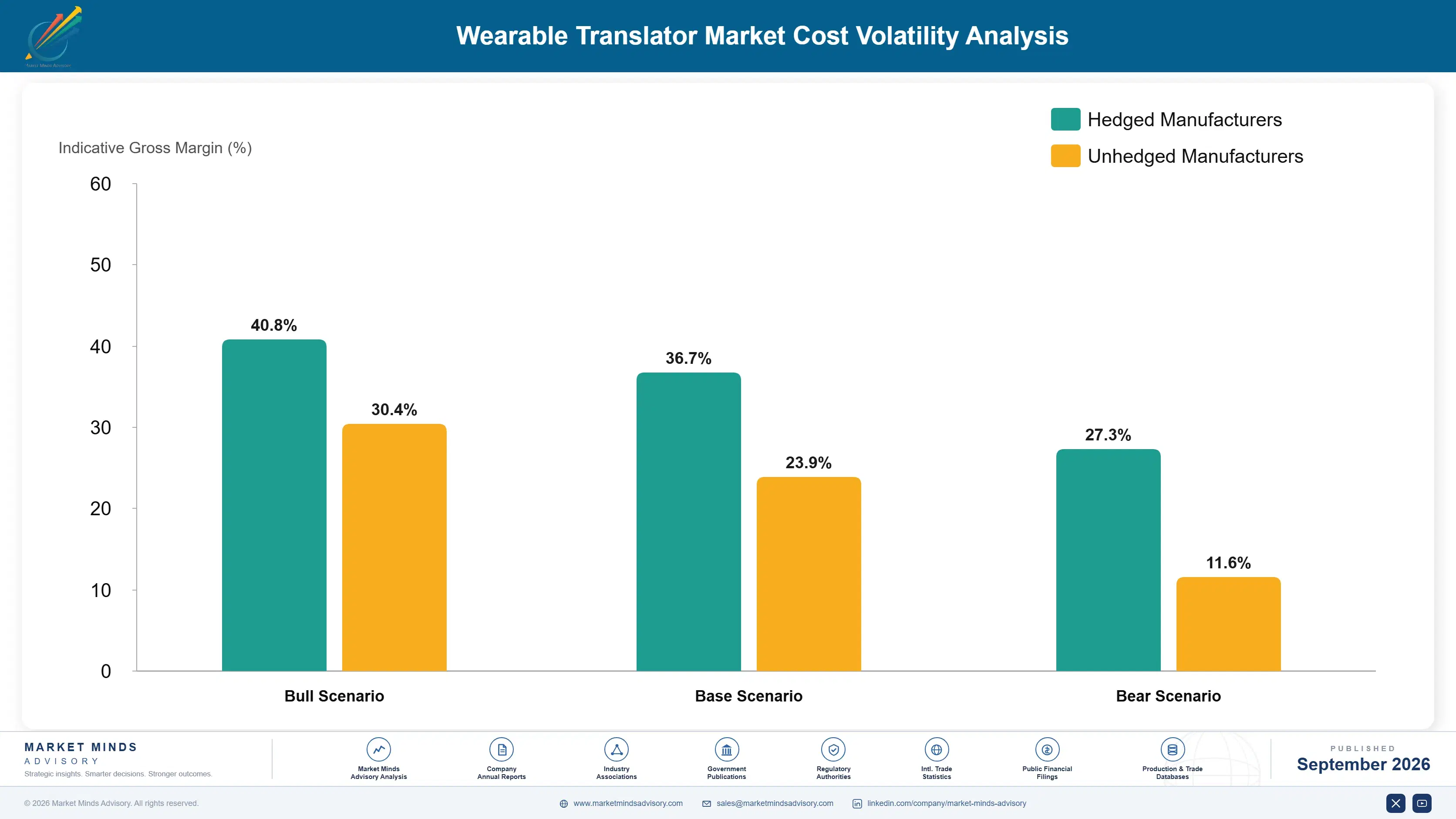
Audio and Processing Component Cost Exposure

Audio processing chips and microphone array components represent the largest cost input for wearable translator manufacturers, commonly running 38 to 48 percent of cost of goods sold. Components are sourced primarily from semiconductor suppliers concentrated in East Asia, creating dependency on a concentrated supplier base reflecting sustained cross-border travel and business communication demand as adoption continues expanding across tourism and international commerce.
Audio processing chip prices rose noticeably through 2025 as broader consumer electronics demand strained semiconductor manufacturing capacity, based on named company annual reports discussing rising component cost pressure and supply chain constraints affecting wearable device production. Manufacturers without guaranteed allocation agreements absorbed higher component costs during this period, compressing margin for vendors unable to pass increases through under fixed retail pricing set before the cost increase took effect reflecting sustained cross-border travel.

Smaller vendors face a meaningfully worse cost position than the largest manufacturers, since they lack the purchase volume to secure guaranteed chip allocation during shortage periods. This leaves smaller specialized vendors more exposed to component price volatility than Timekettle or Samsung, which can negotiate volume discounts unavailable to competitors ordering smaller total volumes reflecting sustained cross-border travel and business communication demand as.
wearable-translator-market-cost-volatility-analysis-1789987511171

Multi-Year Chip Supply Agreements

Larger vendors increasingly sign multi-year guaranteed allocation agreements directly with audio processing chip suppliers, securing priority access during shortage periods and reducing exposure to spot market pricing volatility that smaller competitors remain fully exposed to reflecting sustained cross-border travel and business communication demand as adoption continues expanding across tourism and international commerce supporting consistent shipment growth across.

Shared Component Platforms Across Product Lines

Vendors are standardizing audio processing components across multiple device product lines, increasing order volume per component and improving negotiating leverage with suppliers while simplifying manufacturing across product variants reflecting sustained cross-border travel and business communication demand as adoption continues expanding across tourism and international commerce supporting consistent shipment growth across consumer electronics retailers reinforcing demand visibility for.

Portfolio Architecture for Margin Defence

Wearable translator vendors organize their portfolios across three distinct tiers separated primarily by form factor sophistication and language coverage breadth rather than simple feature count. Volume tier offerings serve basic handheld translation needs with thinner margins, while premium tiers targeting smart glasses and earbud form factors command considerably higher margin given the engineering investment competitors must match reflecting sustained cross-border travel and business communication demand.
The tension between volume and premium positioning shows clearly in how vendors price premium language pack subscriptions: basic handheld device customers pay comparatively little for standard language coverage, while frequent travelers pay substantially more for the same underlying technology wrapped in expanded language accuracy and offline processing support. High-value margin pools concentrate specifically around smart glasses and enterprise deployment services reflecting sustained cross-border travel and.

Sustainability and next-generation tier offerings, including smart glasses translation and enterprise deployment services, currently represent a smaller revenue share but carry the highest margin of any tier given limited competitive supply. Vendors positioning here early are building a considerable pricing advantage over slower-moving competitors still competing primarily on basic handheld devices alone reflecting sustained cross-border travel and business communication demand.

Volume / Commodity-Adjacent

Basic handheld pocket translator devices for occasional travelers without premium language coverage or offline processing requirements, priced primarily on unit cost reflecting sustained cross-border travel and business communication demand as adoption continues expanding across tourism and international commerce.
Gross Margin: 24-32%

Premium / Certified

Wearable earbud and pin translation devices requiring formal audio quality certification and premium language pack subscriptions for frequent travelers reflecting sustained cross-border travel and business communication demand as adoption continues expanding across tourism and international commerce supporting consistent.
Gross Margin: 38-48%

Sustainability / Regulatory / Next-Generation

Smart glasses translation devices and enterprise deployment services representing the newest and highest margin portfolio segment for vendors reflecting sustained cross-border travel and business communication demand as adoption continues expanding across tourism and international commerce supporting consistent shipment.
Gross Margin: 46-56%
wearable-translator-market-portfolio-architecture-1789987511673

High-value Sub-segments and Strategic Watch-out

Smart Glasses with Integrated Translation

The fastest-growing segment in this report, combining strong margin with expanding hands-free adoption as eyewear form factors mature and vendors prove measurable conversational experience improvements reflecting sustained cross-border travel and business communication demand as adoption continues expanding across tourism and international commerce supporting consistent shipment growth across.
Gross Margin: 46-56%

Wearable Earbud Translation Devices

A strong margin segment expanding steadily as the familiar earbud form factor lowers adoption barriers, capturing budget from users hesitant about newer eyewear categories reflecting sustained cross-border travel and business communication demand as adoption continues expanding across tourism and international commerce supporting consistent shipment growth across consumer.
Gross Margin: 38-48%

Handheld Pocket Translator Devices

The largest segment by installed base, providing steady recurring revenue but facing margin pressure as basic handheld functionality increasingly becomes commoditized reflecting sustained cross-border travel and business communication demand as adoption continues expanding across tourism and international commerce supporting consistent shipment growth across consumer electronics retailers reinforcing.
Gross Margin: 24-32%

Translation Pendant and Clip-On Devices

Growth trails the overall market as pendant device adoption remains confined largely to a smaller niche audience compared with more established form factors gaining broader traction reflecting sustained cross-border travel and business communication demand as adoption continues expanding across tourism and international commerce supporting consistent shipment growth.
Gross Margin: 26-34%

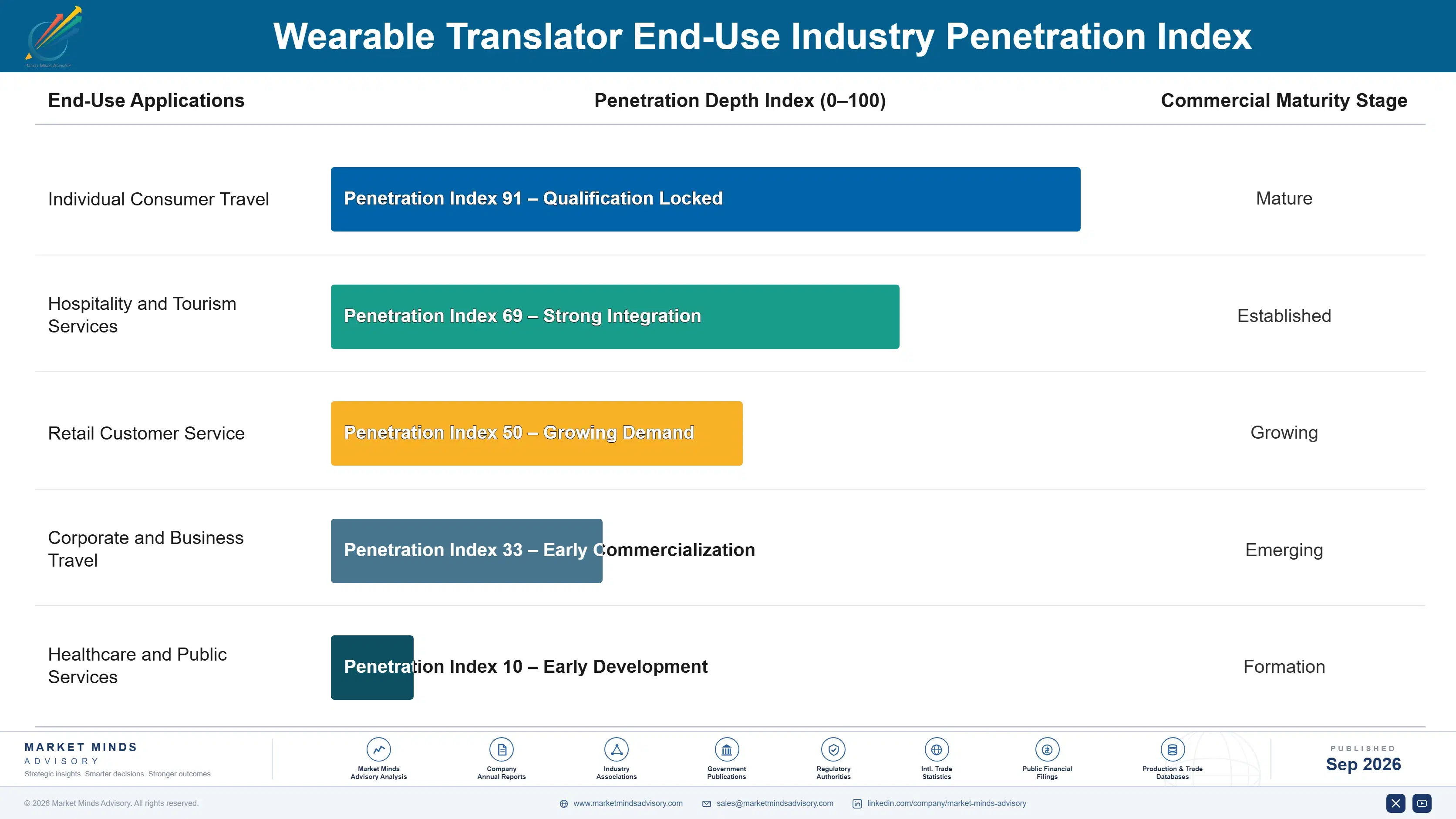
Travel Cycle Replacement Economics

Wearable translators behave less like a pure annuity business and more like a durable goods category tied to travel frequency, since individual consumers typically replace devices only when traveling to new language regions or when hardware degrades, while enterprise deployments create more predictable multi-year replacement cycles tied to bulk device refresh schedules reflecting sustained cross-border travel and business communication demand as adoption continues expanding across.
Stickiness varies meaningfully by end-use vertical. Enterprise hospitality and retail deployments show deeper lock-in given bulk procurement relationships and staff training investment, while individual consumer purchases show comparatively shallower stickiness since occasional travelers switch brands more readily based on price and immediate availability at time of purchase reflecting sustained cross-border travel and business communication demand as adoption continues expanding across tourism and international commerce supporting.

Buyer profiles are shifting generationally as younger travelers increasingly expect translation capability integrated into devices they already own, such as earbuds or glasses purchased primarily for other purposes, rather than purchasing a dedicated single-purpose translation device separately. This shift is pushing procurement conversations toward integrated multi-purpose devices over standalone translator hardware alone reflecting sustained cross-border travel and business communication demand.
wearable-translator-market-end-use-penetration-index-1789987512169

Where Wearable Translator Vendors Should Focus

These are among the four positions where our research anticipates prominent divergence between winners and laggards over the coming forecast period. Each is grounded in the demand model, the regulatory perimeter, and the announced capacity pipeline.
01 / SMART GLASSES INVESTMENT PRIORITY

Prioritize smart glasses development over handheld device expansion

Smart glasses translation is growing at roughly 1.50 times the overall market rate, making eyewear form factor development the single highest priority investment area for vendors competing for premium consumer segments. Customers increasingly evaluate devices on discreet, hands-free operation rather than raw language pair count, a shift that rewards vendors who invest early in eyewear engineering. Providers that delay this investment risk losing competitive position to mainstream consumer electronics brands already demonstrating translation-enabled eyewear reflecting sustained cross-border travel and business communication demand as adoption continues.
02 / VERTICAL EXPANSION STRATEGY

Expand from consumer strength into adjacent enterprise deployment services

Vendors with strong consumer translation credentials, particularly Timekettle and Pocketalk, hold a meaningful trust advantage they can extend into adjacent enterprise hospitality and retail deployment services now expanding rapidly. This expansion path requires considerably less core technology investment than entering enterprise services from outside, since underlying translation architecture transfers with only moderate deployment customization. Vendors ignoring this adjacency leave meaningful growth on the table reflecting sustained cross-border travel and business communication demand as adoption continues expanding across tourism and international commerce supporting consistent shipment growth.
03 / COMPONENT COST MANAGEMENT

Diversify audio chip sourcing before margin pressure deepens

Rising audio processing chip pricing is compressing gross margin for vendors without diversified sourcing agreements secured ahead of broader consumer electronics demand surges. Multi-year supply agreements give procurement teams considerably better negotiating leverage while reducing exposure to spot market volatility that smaller competitors remain fully exposed to. Vendors that delay diversification risk locking in higher costs for the duration of planned product launch cycles already committed to retail partners reflecting sustained cross-border travel and business communication demand as adoption continues expanding across tourism and international.
04 / REGIONAL GROWTH POSITIONING

Build India distribution capacity ahead of competitors

India shows the fastest regional growth rate in this report as its expanding outbound business and leisure travel sector adopts translation devices under growing international commerce engagement. Vendors establishing local retail distribution and support capacity now will capture disproportionate share before competitors recognize the opportunity's scale. This window will not stay open indefinitely, since larger vendors typically respond once regional growth becomes visible in quarterly results reflecting sustained cross-border travel and business communication demand as adoption continues expanding across tourism and international commerce supporting consistent.

Engagement Snapshot From the Field

A live engagement with an industry participant carrying material or product regulatory and market exposure ahead of a defining policy shift, showing how our research translates into a defensible multi-year portfolio strategy.
MARKET MINDS ADVISORY · CLIENT ENGAGEMENT SUMMARY
Wearable Translator Producer Strategic Portfolio Review and Transition Roadmap 2026·Investment Scenario on Wearable Translator Exposure Evaluation 2025-26
CLIENT PROFILE
The client is a regional hospitality chain operating several hotel properties in a major international tourist destination, relying on a small number of multilingual front desk staff to handle guest communication across an increasingly diverse set of international visitor languages reflecting sustained cross-border travel and business communication demand as adoption continues expanding across tourism and international commerce supporting consistent shipment growth across.
STRATEGIC CHALLENGE
The client faced growing guest complaints about communication barriers during peak tourist season when multilingual staff availability could not keep pace with the diversity of languages spoken by international visitors checking in simultaneously reflecting sustained cross-border travel and business communication demand as adoption continues expanding across tourism and international commerce supporting consistent shipment growth across consumer electronics.
MMA APPROACH
MMA conducted a structured vendor evaluation comparing wearable translation device deployment options against continued reliance on multilingual staffing alone, incorporating primary interviews with hospitality operators who had already completed similar translation device deployments reflecting sustained cross-border travel and business communication demand as adoption continues expanding across tourism and international commerce supporting consistent shipment growth across consumer electronics.
KEY FINDINGS
  1. Deploying wearable translation devices at front desk stations reduced guest communication complaints by an estimated 55 percent (client-reported, unverified by MMA) reflecting sustained cross-border travel and business communication.
  2. Device deployment cost ran considerably lower than hiring additional multilingual staff to cover the same range of guest languages (client-reported, unverified by MMA) reflecting sustained cross-border travel and.
  3. Comparable hospitality operators reported meaningfully faster check-in times once front desk staff could communicate directly with guests using translation devices reflecting sustained cross-border travel and business communication demand.
  4. Guest satisfaction survey scores related to communication experience improved measurably following device deployment across all participating properties reflecting sustained cross-border travel and business communication demand as adoption continues.
CLIENT PROFILE
The client is a regional hospitality chain operating several hotel properties in a major international tourist destination, relying on a small number of multilingual front desk staff to handle guest communication across an increasingly diverse set of international visitor languages reflecting sustained cross-border travel and business communication demand as adoption continues expanding across tourism and international commerce supporting consistent shipment growth across.
STRATEGIC CHALLENGE
The client faced growing guest complaints about communication barriers during peak tourist season when multilingual staff availability could not keep pace with the diversity of languages spoken by international visitors checking in simultaneously reflecting sustained cross-border travel and business communication demand as adoption continues expanding across tourism and international commerce supporting consistent shipment growth across consumer electronics.
MMA APPROACH
MMA conducted a structured vendor evaluation comparing wearable translation device deployment options against continued reliance on multilingual staffing alone, incorporating primary interviews with hospitality operators who had already completed similar translation device deployments reflecting sustained cross-border travel and business communication demand as adoption continues expanding across tourism and international commerce supporting consistent shipment growth across consumer electronics.
KEY FINDINGS
  1. Deploying wearable translation devices at front desk stations reduced guest communication complaints by an estimated 55 percent (client-reported, unverified by MMA) reflecting sustained cross-border travel and business communication.
  2. Device deployment cost ran considerably lower than hiring additional multilingual staff to cover the same range of guest languages (client-reported, unverified by MMA) reflecting sustained cross-border travel and.
  3. Comparable hospitality operators reported meaningfully faster check-in times once front desk staff could communicate directly with guests using translation devices reflecting sustained cross-border travel and business communication demand.
  4. Guest satisfaction survey scores related to communication experience improved measurably following device deployment across all participating properties reflecting sustained cross-border travel and business communication demand as adoption continues.
RECOMMENDED STRATEGY
Phase 1: Phase one involved selecting a translation device vendor and equipping front desk stations at the highest visitor volume property first reflecting sustained cross-border travel. Phase 2: Phase two extended device deployment to the remaining properties sequentially, training staff on device usage protocols reflecting sustained cross-border travel and business communication demand. Phase 3: Phase three expanded device availability to concierge and housekeeping staff once front desk deployment demonstrated reliable results reflecting sustained cross-border travel and business communication.
OUTCOME
The client completed device deployment across all participating properties within the planned timeline, reporting meaningfully reduced guest communication complaints and improved satisfaction scores (client-reported, unverified by MMA) compared with relying on multilingual staffing alone, while front desk staff reported greater confidence serving diverse international guests reflecting sustained cross-border travel and business communication.

Frequently Asked Questions

Foundational context covering the market sizes, CAGR, scope, country, region and competition that inform every finding below. This section is provided to cover basics and most often pre-purchase conversations, answered from the MMA Primary Research Dataset.

What is the current size of the Wearable Translator Market?

The Wearable Translator market is valued at approximately 420 million dollars in 2025. This reflects early but accelerating adoption across consumer and enterprise translation use cases reflecting sustained cross-border travel and business.

How large will the Wearable Translator Market be by 2036?

MMA projects the market will reach approximately 2.16 billion dollars by 2036. This growth reflects sustained smart glasses adoption and expanding international travel and enterprise deployment across multiple markets worldwide reflecting sustained.

What is the CAGR for the Wearable Translator Market 2026 to 2036?

The market is projected to grow at a compound annual growth rate of 16.0 percent between 2026 and 2036. Bull and bear scenarios range from roughly 14.7 to 17.3 percent depending on.

Which segment is growing fastest?

Smart Glasses with Integrated Translation is the fastest-growing segment, expanding at roughly 1.50 times the overall market rate as hands-free adoption accelerates reflecting sustained cross-border travel and business communication demand as adoption.

Who are the major companies in the Wearable Translator Market?

Leading vendors include Timekettle, Pocketalk, iFLYTEK, Google, and Samsung. Together these five companies hold an estimated 48 percent of the market on a shipment revenue basis reflecting sustained cross-border travel and business.

Which country is growing fastest?

China shows the fastest national growth rate given its concentration of leading device manufacturers and massive outbound tourism volume driving consumer device purchases reflecting sustained cross-border travel and business communication demand as.

Report Segmentation Architecture

The full report scope spans multiple orthogonal segmentation dimensions, with cross-tabulated demand data provided for each dimension pair. Coverage extends further to regional breakdowns, trend trajectories, and the competitive detail needed to support segment-level decision-making.

By Device Form Factor

  • Handheld Pocket Translator Devices
  • Wearable Earbud Translation Devices
  • Wearable Pin/Badge Translation Devices
  • Smart Glasses with Integrated Translation
  • Translation Pendant and Clip-On Devices
  • Smartwatch-Integrated Translation Features

By End-Use Industry

  • Individual Consumer Travel
  • Hospitality and Tourism Services
  • Retail Customer Service
  • Corporate and Business Travel
  • Healthcare and Public Services

By Commercial Dimension

  • Direct-to-Consumer Retail Sales
  • Enterprise Bulk Deployment
  • Subscription Language Pack Licensing
  • Distributor and Travel Retail Channel

By Region

  • North America
  • Western Europe
  • East Asia
  • South Asia and Pacific
  • Latin America
  • Middle East and Africa
  • Eastern Europe

Scope, Methodology, and Coverage

Every figure in this report is reproducible from documented input assumptions. The scope below maps the historical period, the forecast horizon, the segmentation dimensions, and the countries covered, alongside the underlying primary and qualitative methodology.
Historical Period
2020 to 2025
Forecast Period
2026 to 2036
Base Year
2025 (USD billions; MMA Primary Research Dataset, September 2026)
Market Definition
This report defines the Wearable Translator market as portable and wearable electronic devices, including earbuds, pendants, badges, smart glasses, and handheld pocket devices, specifically designed to provide real-time spoken language translation between users speaking different languages. It excludes general-purpose smartphone translation applications not bundled with dedicated translation hardware, text-only document translation software, and professional simultaneous interpretation equipment used in conference settings requiring trained human interpreters.
Quantitative Units
USD billions (current prices); unit shipment volume where applicable
Segmentation Dimensions
By Device Form Factor; By End-Use Industry; By Commercial Dimension; By Region
Regions Covered
North America, Western Europe, East Asia, South Asia and Pacific, Latin America, Middle East and Africa, Eastern Europe
Countries Covered
USA, China, Germany, France, UK, Japan, South Korea, India, Australia, Canada, Brazil, Mexico, Indonesia, Vietnam, Thailand, Malaysia, UAE, Saudi Arabia, South Africa, Nigeria, Turkey, Poland, Netherlands, Italy, Spain, Sweden, Switzerland, Argentina, Colombia, Singapore, and additional markets relevant to this sector
Key Companies Profiled
Timekettle (Shenzhen Timekettle Technologies Co Ltd), Pocketalk Corporation (Sourcenext Corporation), iFLYTEK Co Ltd, Google LLC, Samsung Electronics Co Ltd, Vasco Electronics Sp. z o.o., Waverly Labs Inc, Langogo (Yeekit Intelligent Technology), Baidu Inc, Logbar Inc (ili), Travis Foundation B.V., Meta Platforms Inc, Sony Corporation, Panasonic Corporation, Huawei Technologies Co Ltd, Xiaomi Corporation, LG Electronics Inc, Anker Innovations Limited, JLab Audio, Bragi GmbH
Quantitative Methodology
Primary survey, n=3,800 respondents, Q4 2025, six countries; demand-side model with trade association cross-validation
Qualitative Methodology
47 expert interviews, Q4 2025; applied to validate demand model assumptions, identify emerging dynamics, and assess competitive positioning
Report Format
PDF and XLSX data workbook (Word format preview document)
Publisher
Market Minds Advisory
Report Code
MMA-2026-TEC-520
Published
September 2026
Contact
sales@marketmindsadvisory.com | www.marketmindsadvisory.com

Purchase the full Wearable Translator Market Report (2026 to 2036).

The complete Wearable Translator report provides detailed segment-level forecasts, regional breakdowns across all seven regions, and in-depth competitive profiles covering pricing strategy, product roadmap, and language accuracy credentials for every major vendor. It includes primary survey data from three thousand eight hundred respondents alongside forty-seven expert interviews conducted across six countries. Subscribers receive full access to underlying data tables and detailed methodology notes covering every stage of the research process. Quarterly market updates continue through the full forecast period covered by this analysis, keeping subscribers current as conditions evolve reflecting sustained cross-border travel and business.
Full segment and regional forecast tables
Detailed competitive vendor profiles for every player
Primary survey and interview data access
Quarterly market update subscription included throughout
Methodology and derivation notes fully provided
Custom data cuts available on request

Built For The People Who Decide

From boardroom strategy to bench-side execution, this report is read cover-to-cover by leaders shaping the next decade of their industry, turning demand scenarios, market dynamics and valuation benchmarks into decisions.
CXOs/ Presidents/ VPs/ Managers
M&A and Corporate Development
Strategy Teams and R&D Heads
Procurement and Product Directors
Regulatory and Compliance Leaders
Investor Relations and Equity Analysts