Market Minds Advisory
Waterborne UV Curable Resin Market

Waterborne UV Curable Resin Market: line speed economics, regulatory substitution and dual-cure system design

These resins solve a regulatory problem and hand back a production one, because the water must come off before the lamp goes on, and that drying step costs a furniture line real output.

Lead Analyst

Bilal Shaikh

Published

September 2026

Make Smarter Decisions with Customized Research Insights

Request a free sample report and evaluate market opportunities, growth trends, and competitive dynamics relevant to your business needs.

2025 MARKET VALUE$0.5BMarket Size 2025
2036 FORECAST VALUE$1.4BBase Case , 2026 to 2036
CAGR 2026 TO 20369.4 %Bull 10.6% / Bear 8.1%
INCREMENTAL OPPORTUNITY$0.8BNet 10- year value creation
EXPANSION MULTIPLE2.45x2036 value over 2026 base
Strategic Levers
M&A Pipeline
Regional Outlook
Country Rankings
Competitive Intelligence
Segmental Deep-dive
Call-Us : 91 93563 13602

Executive Snapshot and Market Trajectory

Waterborne ultraviolet curable resins fix an emissions problem and hand the customer a throughput problem in exchange. Water must be flashed off before the lamp does anything useful, and that drying stage costs a furniture line roughly a fifth of its output unless the formulation was designed around it.
Growth concentrates in polyurethane-acrylate hybrid dispersions, expanding at 14.1%, where the urethane backbone supplies flexibility and adhesion while acrylate functionality delivers the cure speed that pure dispersions cannot reach. East Asia holds 36% of value, the largest regional share, because Chinese furniture, flooring and consumer electronics manufacture consume most of the world's wood and plastic coating output and increasingly specify low emission systems for export production destined for European and North American retail.
The supplier base is moderately concentrated, with the top five holding 52% of resin supply volume, and it splits between large coating resin houses and specialty formulators serving narrow application niches. Competition runs on line speed compatibility rather than on cured film properties measured in a laboratory. Solvent emission regulation across Asia is the force now pulling adoption forward faster than any product improvement has.
Market Definition
Waterborne ultraviolet curable resin comprises aqueous dispersions and emulsions of radiation-curable oligomers, spanning polyurethane, polyacrylate, polyester acrylate, epoxy acrylate, polyurethane-acrylate hybrid and specialty backbone chemistries. Sizing covers resin sold to coating and ink formulators at realised delivered price. Solvent-borne and one hundred percent solids ultraviolet resins, photoinitiators sold separately, pigments and additives, curing equipment and lamps, and finished coatings or inks containing these resins all fall outside scope.
Base Year Value
$0.5B in 2025 (MMA Primary Research Dataset, August 2026)
Forecast Period
2026 to 2036, eleven discrete annual values
CAGR
9.4% base case. Bull 10.6%. Bear 8.1%.
Fastest Growth Segment
Waterborne UV Polyurethane-Acrylate Hybrids: 14.1% CAGR
Fastest Growth Country
India: 12.3% CAGR
Fastest Growth Region
South Asia and Pacific: 11.7% CAGR
Largest Region
East Asia: 36% of 2025 global value
Market Leaders
Allnex, Covestro, BASF, Arkema and Miwon Specialty Chemical lead on resin supply volume across dispersion and hybrid chemistries. Source: MMA Primary Research Dataset, July 2026.
Primary Survey
n=3,800 procurement and R&D decision-makers, Q4 2025, six countries
Methodology
Demand-side build-up, cross-validated against public data, 47 expert interviews

Waterborne UV Curable Resin Market Forecast Scenarios

waterborne-uv-curable-resin-market-trends-size-forecast-scenario-1787310905904
Growth of 8.2% across 2020 to 2025 came almost entirely from regulation rather than from performance. Chinese volatile organic compound rules tightened progressively across coating-intensive provinces, and European furniture and flooring producers moved ahead of directive deadlines rather than behind them. Raw material availability then became the binding constraint through 2021 and 2022, when photoinitiator and acrylate supply tightened and formulators rationed what they could obtain.
The base case at 9.4% rests on three mechanisms. Volatile organic compound limits keep tightening across Asian manufacturing provinces, and waterborne ultraviolet systems reach emission levels that solvent reduction alone cannot achieve. Furniture and flooring producers exporting into Europe and North America face customer specifications rather than merely local rules. And hybrid chemistries keep closing the throughput gap, removing the objection that has slowed adoption on existing lines for years.
The bull case at 10.6% turns on furniture and flooring producers replacing lines rather than retrofitting them, since new equipment designed around a flash-off stage removes the throughput penalty and changes the adoption arithmetic. The bear case at 8.1% turns on competing chemistry. One hundred percent solids ultraviolet systems keep improving on flexibility and substrate wetting, and they carry no water removal burden.

Waterborne ultraviolet resins: water removal economics

The commercial argument in this market is never about the cured film, whatever the technical literature suggests. Waterborne ultraviolet coatings deliver hardness and chemical resistance comparable to solvent systems, and buyers accept that quickly. What stops them is the flash-off stage, which costs an existing furniture line roughly 18% of its throughput and needs oven capacity that most plants simply do not have sitting spare. That is a capital conversation, not a purchasing one.
TOP FIVE CONCENTRATION52%Share of global resin supply volume held collectively
ACRYLATE FEEDSTOCK SHARE44% of COGSPortion of delivered cost tied to acrylate chemistry
WOOD COATINGS SHARE41% of volumeLargest single application by consumed resin tonnage globally
TYPICAL EMISSION LEVELunder 50 g/LEmission level driving the regulatory substitution case in coatings
LINE THROUGHPUT PENALTY18% slowerOutput cost against solvent systems on existing lines
FLASH-OFF ENERGY DEMAND0.4 kWh/m2Water removal step absent from solvent-borne coating lines
Cost structure sits mostly upstream of the formulator. Acrylate chemistry accounts for around 44% of delivered resin cost and tracks propylene through acrylic acid, while photoinitiators, isocyanates and dispersion aids make up most of the remainder. Water itself is free, which is the joke every formulator in this business has heard rather too many times, and it explains nothing about why the delivered cost per kilogram lands where it does.
Applications divide by how much substrate movement the coating must tolerate. Flat wood panel and flooring work consumes 41% of volume and suits rigid dispersions well. Three-dimensional furniture components, plastics and flexible substrates demand hybrid chemistry, and that is where formulation capability genuinely separates one supplier from another.
"Everyone in this market sells emission compliance, which the customer already has to buy whether they like it or not. The suppliers actually winning are the ones who arrive with a formulation that runs at the line speed the plant already has, and almost nobody does."
Director, Coatings and Specialty Resins Practice · MMA Chemicals and Materials /

Market Trends

Hybrid chemistries closing the throughput gap against solvent systems

Polyurethane-acrylate hybrid dispersions cure faster and tolerate a shorter flash-off than conventional waterborne systems, because the urethane backbone carries the mechanical properties while acrylate functionality handles cure speed. That combination cuts the throughput penalty on existing furniture and flooring lines from around 18% toward single figures, which removes the objection that stalled adoption for most of the last decade. Formulators who solved it are winning conversions that pure emission arguments never achieved. The chemistry is genuinely difficult, involving dispersion stability against acrylate reactivity, which keeps the capable supplier field narrow.
Market Impact: Governs 41% of resin volume

Asian emission regulation pulling substitution ahead of Europe

Volatile organic compound limits across Chinese coating-intensive provinces have tightened progressively and now bite harder in several furniture and flooring clusters than equivalent European requirements do. Enforcement has shifted from permit conditions to production shutdowns, which changes how quickly a plant manager acts on a substitution decision. Indian and Southeast Asian rules are following the same path with a short lag. The result is that the fastest adoption is happening in the regions that manufacture the goods rather than in the regions that consume them, which reverses the usual pattern for coating technology.
Market Impact: Grows 10.3% annually in East Asia

Market Opportunities and Growth Drivers

Furniture and flooring export specifications enforcing low emission systems

Furniture and flooring producers selling into European and North American retail face customer specifications on formaldehyde and volatile organic compound content that go well beyond what their own national rules require. Large retailers audit supplier plants directly and treat coating chemistry as part of the specification rather than as a supplier decision. That pressure reaches manufacturing clusters in China, Vietnam and India faster than local regulation does, and it applies to the whole plant rather than to individual production lines. Wood coatings already account for 41% of waterborne ultraviolet resin volume worldwide.
Market Impact: Costs 18% of line throughput

Plastic and electronics coating demand rising with device production

Consumer electronics housings, automotive interior trim and appliance components all take ultraviolet cured coatings for scratch resistance and appearance, and waterborne systems suit the thin films and complex geometries involved better than high-solids alternatives. Adhesion onto polycarbonate, acrylonitrile butadiene styrene and polypropylene substrates requires dispersion chemistry tuned to surface energy rather than simply to hardness. Device production concentrated in East Asia consumes most of this volume, and specification decisions are made by the device brand rather than by the coating applicator, which shortens the commercial sales cycle considerably compared with industrial wood coating work.
Market Impact: Represents 12% of formulation cost

Market Restraints and Challenges

Water removal stage penalising throughput on existing production lines

Water must be flashed off before curing, which adds an oven stage and roughly 18% throughput loss on lines designed for solvent systems. The root cause is physics rather than formulation: water carries a much higher heat of vaporisation than the solvents it replaces, so the energy and residence time required are simply greater. Commercially this makes conversion a capital decision rather than a purchasing one, which slows everything down. Formulators are responding with hybrid chemistries that tolerate shorter flash-off, higher solids dispersions, and infrared assisted drying arrangements that fit existing line footprints.
Market Impact: Cuts throughput penalty from 18% do

Photoinitiator supply concentration exposing formulators to availability risk

Photoinitiator production is concentrated in a small number of Chinese plants and a handful of Western producers, and the compounds involved have no ready substitutes within a given cure system. The root cause is that photoinitiator chemistry is niche, capital intensive relative to its market size, and unattractive to new entrants who would face qualification cycles measured in years. Commercially a shortage stops production entirely rather than merely raising cost. Participants are responding with dual sourcing, qualification of alternative initiator packages in advance, and inventory positions well above normal working capital discipline.
Market Impact: Covers 36% of global resin demand
3 additional market trends, 4 additional growth drivers, and 2 additional restraints and challenges are covered in the full report. Contact sales@marketmindsadvisory.com to access the complete intelligence.

Segment CAGR and Growth Architecture

Segmentation follows the resin backbone chemistry, because the backbone chosen governs cure speed, film flexibility, substrate adhesion, dispersion stability and achievable pricing simultaneously. Six backbone chemistries cover the whole market, running from established polyurethane and acrylate dispersions through the polyester and epoxy systems to the hybrid and specialty backbones now growing fastest of all.
waterborne-uv-curable-resin-market-trends-market-share-analysis-1787310906437

Waterborne UV Polyurethane-Acrylate Hybrids

Expanding at 14.1%, a full 1.50 times the market rate, on dispersions combining a urethane backbone with acrylate functionality so that flexibility, adhesion and cure speed all arrive together rather than being traded off against one another. The commercial value here is throughput rather than chemistry: hybrid systems tolerate a shorter flash-off stage and they cut the line speed penalty on existing furniture and flooring equipment toward single figures. Formulation is genuinely difficult, balancing dispersion stability against acrylate reactivity through the shelf life the customer expects. That difficulty keeps the capable supplier field genuinely narrow, and it keeps realised pricing well above conventional dispersion levels across almost every application where hybrids are specified.
CAGR 14.1%

Waterborne UV Silicone and Specialty Backbones

Growing at 11.3% annually on silicone-modified and other specialty backbone dispersions used wherever release properties, weathering resistance or very low surface energy govern the specification rather than hardness alone. Release liners, outdoor durable coatings, medical device surfaces and anti-graffiti applications between them consume most of the volume, and each one is specified on a property that conventional acrylate chemistry simply cannot deliver at any formulation ratio. Volumes here are small and realised pricing runs at several times conventional dispersion levels, which reflects both the raw material cost involved and the genuinely narrow qualified supplier field. Growth here tracks the individual applications rather than any general coating market trend at all.
CAGR 11.3%
Full segment breakdown across 6 segments available in the complete report.

Regional Architecture and Country Demand Map

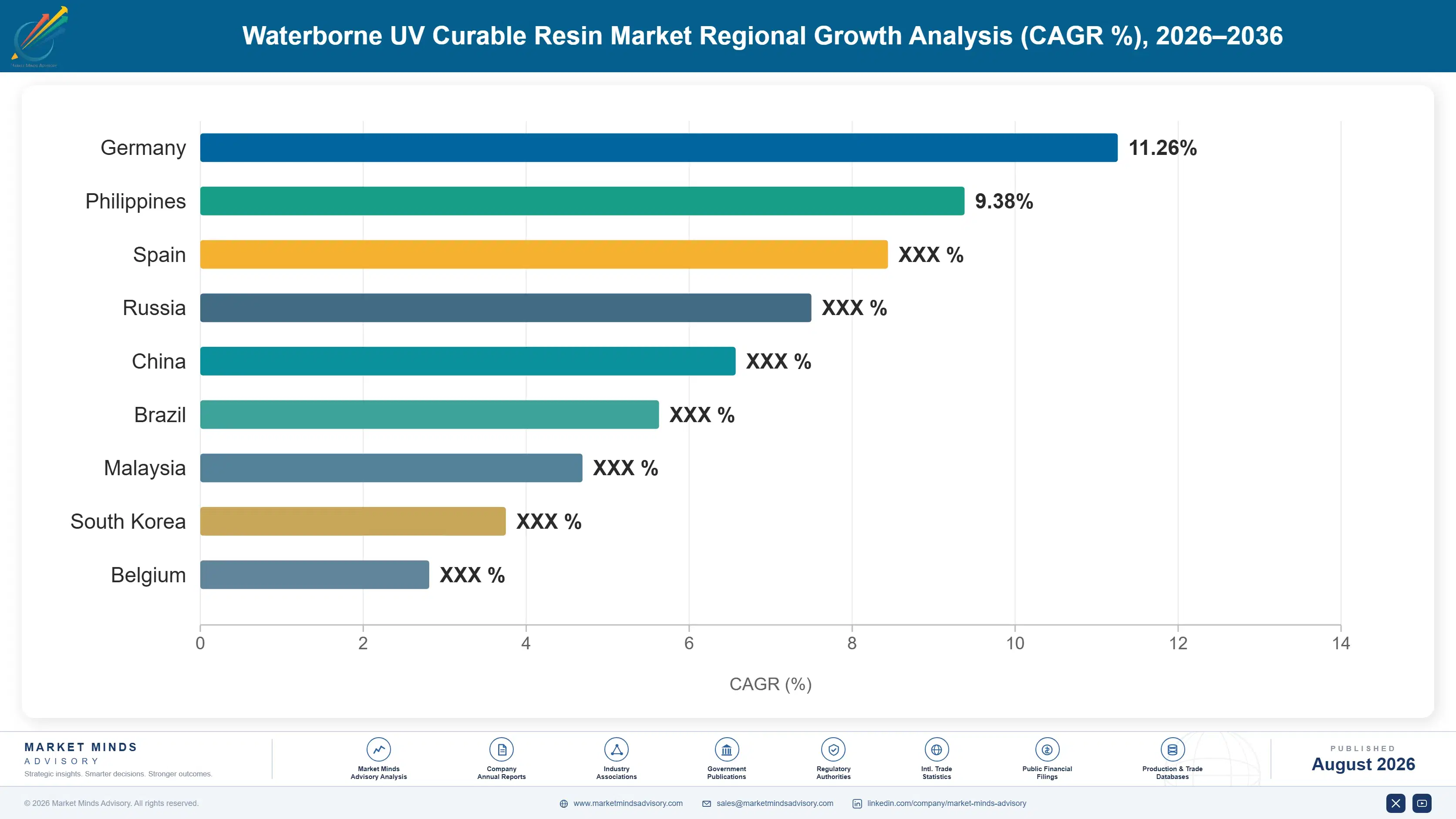
Waterborne ultraviolet resin demand sits where the coating actually happens rather than where the coated goods eventually get sold, which puts almost all of the weight firmly into the manufacturing regions and makes retailer export specifications the mechanism that actually carries regulation across national borders.

East Asia

Thirty-six percent of global value, comfortably the largest regional share, because Chinese furniture, flooring and consumer electronics manufacture consumes most of the world's wood and plastic coating output and increasingly specifies low emission systems for export production. Note: this exceeds the standard regional band because coating application is concentrated in Chinese manufacturing clusters to a degree that no consumption measure would capture. Provincial volatile organic compound enforcement has shifted from permit conditions toward outright production shutdowns, which changes plant behaviour a great deal faster than any further limit reduction ever does. Growth of 10.3% runs above the global rate, supported by electronics coating demand and by continued furniture cluster conversion together.
Share: 36% | CAGR: 10.3% (2026 to 2036)

North America

Twenty-two percent of global value here, weighted toward flooring, cabinetry, industrial wood coatings and a substantial graphic arts and packaging ink position alongside them. Regulatory pressure here operates through state air quality rules and through retailer specifications rather than through any single federal requirement at all, which produces distinctly uneven adoption from one state to the next. Suppliers with genuine formulation service capability located close to customer plants hold positions that delivered pricing alone does not dislodge. Domestic resin manufacture is genuinely strong across both conventional dispersion and hybrid chemistries alike. Growth of 8.8% reflects steady flooring and cabinetry conversion alongside packaging ink demand that keeps expanding steadily each year.
Share: 22% | CAGR: 8.8% (2026 to 2036)
Regional intelligence for 5 additional markets available in the complete report: Western Europe, South Asia and Pacific, Latin America, Middle East and Africa, Eastern Europe. Contact sales@marketmindsadvisory.com.
waterborne-uv-curable-resin-market-trends-country-cagr-analysis-1787310906964

Where waterborne ultraviolet resin margin sits

Four commercial positions separate the suppliers earning genuine formulation economics from those selling dispersion by the kilogram against an emission specification. Each one of them rests on something a competitor cannot assemble quickly: line speed evidence, an installed plant qualification, hybrid formulation capability, or else genuine technical depth standing at the applicator's own equipment.

Formulate for the line speed the customer already runs

Every supplier presents emission compliance data, which the customer must buy regardless of who supplies it, and almost nobody arrives with a formulation matched to the oven capacity already installed. Suppliers demonstrating throughput within a few percent of the incumbent solvent system realise roughly 28% above competitors selling on compliance alone, because the conversation moves from capital expenditure to purchasing. The evidence needed comes from line trials rather than from laboratory panels. Most suppliers avoid line trials altogether, because a trial exposes exactly how much throughput their product actually costs the customer.
Market Impact: Realises roughly 28% above complian

Qualify into furniture and flooring producer specifications

Qualification at a furniture or flooring producer takes around nine months of line trials, panel testing and full durability validation, and the resin written into the finished specification then supplies that plant for as long as the product line keeps running. Suppliers achieving design-in capture roughly 5 times the lifetime plant volume of those bidding against annual purchasing reviews instead. Engagement has to begin with the plant's process engineers rather than with procurement, and it needs technical people prepared to stand beside a coating line at six in the morning.
Market Impact: Captures roughly 5 times the lifeti

Build hybrid polyurethane-acrylate formulation capability in house

Hybrid dispersions balancing urethane backbone properties against acrylate reactivity are genuinely difficult to stabilise across a commercial shelf life, which is why the capable supplier field stays narrow. Producers holding that capability command roughly 35% above conventional dispersion pricing, because the hybrid is what removes the throughput objection that blocks conversion. Development here is formulation science rather than capital investment, needing patient work on dispersion chemistry over several years. Buying hybrid oligomers from a competitor caps both the margin available and any ability to tune a system to an awkward substrate.
Market Impact: Commands roughly 35% above conventi

Supply formulated coating systems instead of resin alone

Customers buying resin, photoinitiator package, additives and defoamers as separate components assemble a system themselves, and most small and medium applicators do that work poorly and inconsistently between batches. Suppliers providing complete formulated systems with application support lift realised margin by roughly 15 percentage points on the same resin volume, because the applicator is buying a finished process rather than a component. It also secures the photoinitiator specification, which removes a route by which competitors otherwise enter the account later on. Small applicators value that more than any price concession.
Market Impact: Lifts realised margin by roughly 15

Who Controls the Margin Pool

Concentration is moderate, with the top five holding 52% of resin supply volume, the basis on which every participant here is assessed. Allnex and Covestro lead through formulation breadth across dispersion and hybrid chemistries combined with application service reach, while the challenger group divides between large diversified chemical companies and specialty formulators such as Miwon and IGM competing on particular application niches rather than across the whole field.
Competition currently runs on line speed performance, application service depth and hybrid formulation capability rather than on cured film properties, which are broadly comparable between credible suppliers. Application service at the customer's own coating line is where accounts are genuinely won, and it favours suppliers with technical people located near manufacturing clusters. Photoinitiator sourcing security has become a real competitive dimension since the shortages of recent years.

Emerging pressure comes from two directions at once. Chinese formulators are moving up from conventional dispersions into hybrid chemistry and compete aggressively in the region where most coating actually happens. And one hundred percent solids ultraviolet systems keep improving on flexibility and substrate wetting, which threatens the waterborne argument in applications where the water removal penalty was the only reason to hesitate.
waterborne-uv-curable-resin-market-trends-company-positioning-matrix-1787310907493

Competitive Moat and Risk Dimensions

ALLNEX

Moat: Formulation breadth and application service

Allnex covers dispersion, hybrid and specialty backbone chemistries with application laboratories positioned near the furniture, flooring and industrial coating clusters that actually consume the product. That combination lets it solve a customer's throughput problem on the customer's own line, which is where conversions are decided rather than in any laboratory comparison of cured film properties.
ALLNEX

Risk: Competing solids technology exposure

A broad position across waterborne systems leaves Allnex exposed if one hundred percent solids ultraviolet chemistry continues improving on flexibility and substrate wetting, since the water removal penalty is the principal reason customers accept a waterborne route at all. The company also supplies solids systems, but a shift would reprice a large part of the waterborne portfolio quickly.
COVESTRO

Moat: Polyurethane dispersion technology depth

Decades of polyurethane dispersion development give Covestro backbone technology that competitors buying oligomers on the open market cannot match, particularly in the hybrid systems where urethane properties and acrylate reactivity must be balanced. That depth is exactly what the fastest growing segment requires, and it rests on formulation know-how rather than on any capacity advantage.
COVESTRO

Risk: Isocyanate feedstock cost exposure

Polyurethane dispersion chemistry carries isocyanate input exposure that acrylate-only competitors avoid entirely, and isocyanate pricing responds to European energy costs and to global capacity cycles unrelated to coating resin demand. In a period of high European energy prices the cost position weakens precisely where the company's technology advantage is strongest, which is an awkward combination.

Players Tracked

Prominent Players

Allnex
Covestro
BASF
Arkema
Miwon Specialty Chemical

Other Key Players

DIC Corporation
Eternal Materials
Resonac Holdings
Toagosei
Nippon Shokubai
IGM Resins
Soltech
Jiangsu Sanmu Group
Tianjin Jiuri New Materials
Changxing Chemical
Alberdingk Boley
Stahl Holdings
Michelman
Lubrizol
Wanhua Chemical

Recent Developments

MARCH 2025

Resin producer launches hybrid dispersion for existing lines

A coating resin producer introduced a new polyurethane-acrylate hybrid dispersion range formulated specifically to run at incumbent solvent-borne line speeds on existing furniture coating equipment, demonstrating flash-off requirements short enough to fit inside the oven capacity already installed at fairly typical panel and component coating plants.
Signal: Throughput parity rather than emission com
JULY 2025

Chinese provincial enforcement drives furniture cluster conversions

Provincial volatile organic compound enforcement moved from permit conditions to outright production shutdowns across several of the largest Chinese furniture manufacturing clusters, prompting rapid coating conversions at plants which had deferred exactly that decision on throughput and capital grounds for several years beforehand on cost grounds.
Signal: Enforcement method rather than the limit l
NOVEMBER 2025

Formulator secures dual photoinitiator sourcing after shortage

A coating formulator completed full qualification of alternative photoinitiator packages right across its waterborne ultraviolet portfolio, having concluded that single sourcing from concentrated Chinese production presented a supply risk genuinely capable of halting its own customers' production entirely rather than merely raising its own input cost.
Signal: Photoinitiator sourcing security has now b

Acrylate and photoinitiator cost exposure

Acrylate chemistry accounts for roughly 44% of delivered resin cost, tracking propylene through acrylic acid and acrylate esters from producers concentrated in East Asia, North America and Western Europe. Isocyanates contribute about 14% in urethane systems, photoinitiators around 12%, dispersion aids and surfactants 9%, reaction energy and water treatment 8%, with packaging, freight and working capital carrying the remaining 13%.
Both principal inputs moved sharply through the forecast history. Acrylic acid tightened through 2021 on propylene availability and plant outages, while photoinitiator supply from concentrated Chinese production constrained badly across the same period as provincial power rationing and environmental inspections curtailed output. Covestro Annual Report 2022 recorded raw material and European energy cost pressure across its coating resins business, and Arkema Annual Report 2022 noted acrylics cost recovery lagging contractual pricing.

The competitive disadvantage mechanism runs through backbone chemistry ownership rather than through reactor scale. Formulators buying oligomers from competitors pay a margin to a rival and cannot tune a backbone to an awkward substrate. Those without qualified alternative photoinitiator packages face production stoppage rather than cost inflation during a shortage. Small regional formulators typically carry both limitations, which confines them to conventional dispersion supply where price competition is fiercest.
waterborne-uv-curable-resin-market-trends-cost-volatility-analysis-1787310907688

Qualify alternative photoinitiator packages before the next shortage

Photoinitiator supply is concentrated enough that a single disruption halts customer production rather than simply raising cost, and qualification of an alternative package takes months that nobody has once a shortage begins. Running that qualification in advance costs laboratory time rather than capital, and it converts an existential supply risk into an ordinary procurement decision.

Develop backbone oligomer capability rather than buying externally

Formulators buying urethane and acrylate oligomers from suppliers who also compete downstream pay a margin to a rival and forfeit any ability to tune the backbone to a difficult substrate. Building that capability in house is formulation science rather than heavy capital, and it underpins every hybrid position genuinely worth holding anywhere in this market.

Index acrylate feedstock pass-through into annual contracts

Acrylate chemistry carries nearly half of delivered cost and tracks propylene, which moves on refinery and cracker economics entirely unrelated to coating demand. Annual contracts priced flat leave formulators absorbing every move, whereas an indexed clause tied to a published acrylic acid reference removes that exposure completely without costing any commercial ground at all.

Portfolio Architecture for Margin Defence

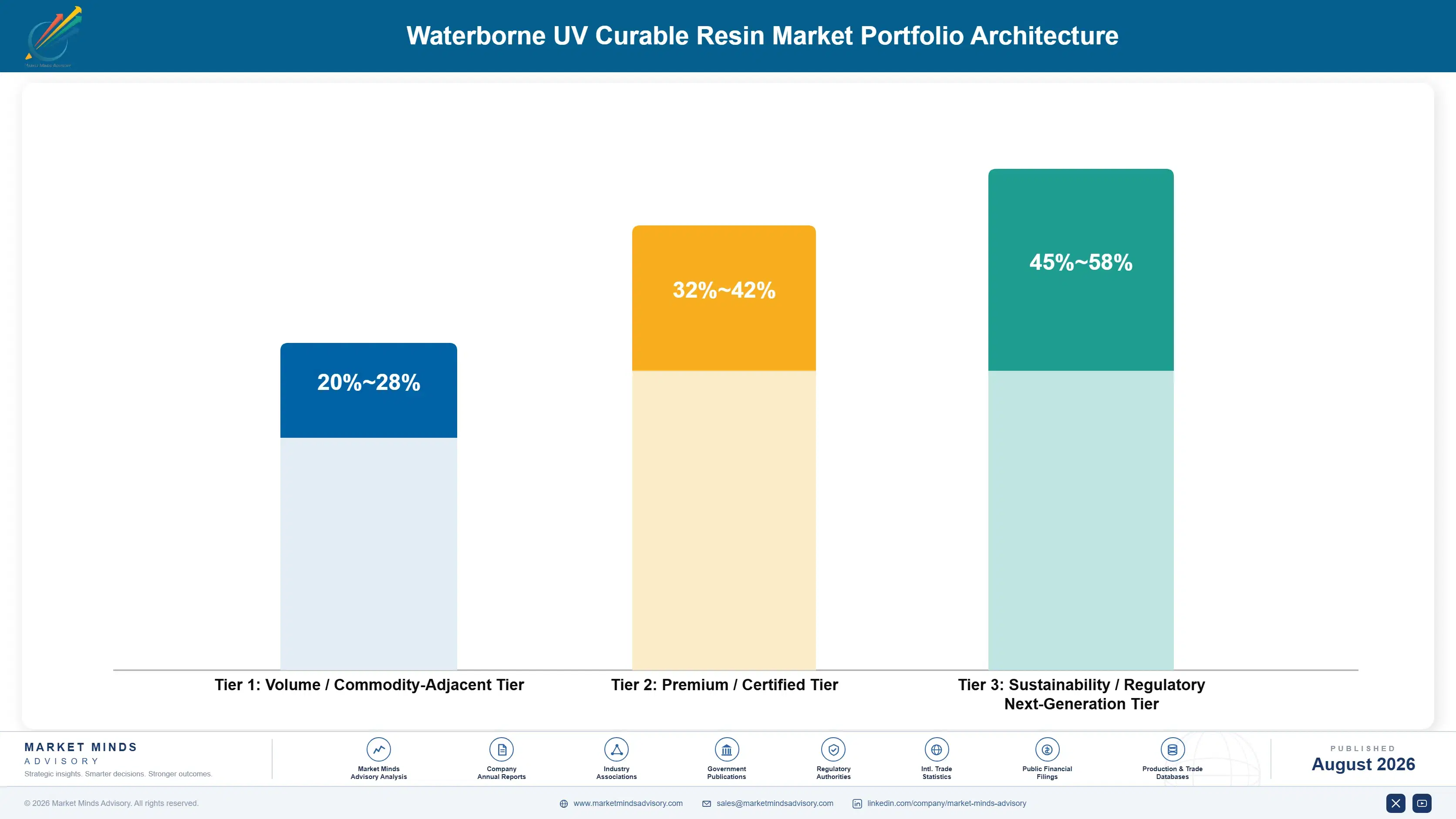
Margin architecture separates by formulation difficulty and application service depth rather than by chemistry class, which is not at all how most suppliers organise their product management today. Conventional acrylate and polyester dispersions supplied against an emission specification earn what regional formulation competition permits, because a great many suppliers can meet a compliance number on a test panel.
Value climbs where the formulation has to solve a production problem rather than a regulatory one. Hybrid systems that run at incumbent line speeds defend pricing through throughput evidence that competitors cannot produce without doing their own line trials. Specialty backbones sit higher again, since release, weathering and low surface energy properties come from chemistry that conventional acrylate systems cannot reach at any ratio.

The highest value pools concentrate where hybrid capability meets a qualified plant position, since both take years to establish and neither is displaced by a lower delivered price alone. Those pools are small in tonnage and quite disproportionate in realised margin. The commercial tension is that conventional dispersion volume keeps reactors loaded while funding almost none of the formulation work that opens anything above it.

Volume / Commodity-Adjacent Tier

Conventional acrylate and polyester acrylate dispersions supplied against emission specifications into flat panel and general industrial wood coating, where many regional formulators satisfy the requirement and delivered price decides nearly every award.
Gross Margin: 20-28%

Premium / Certified Tier

Polyurethane dispersions and qualified systems written into furniture, flooring and plastics coating specifications. Application service and demonstrated line performance defend pricing here. The ten-point range reflects catalogue supply against qualified plant positions.
Gross Margin: 32-42%

Sustainability / Regulatory / Next-Generation Tier

Polyurethane-acrylate hybrids running at incumbent line speeds, plus silicone and specialty backbone systems. Formulation difficulty and absent substitutes defend pricing strongly. The thirteen-point range reflects established hybrids against emerging specialty backbone economics.
Gross Margin: 45-58%
waterborne-uv-curable-resin-market-trends-portfolio-architecture-1787310908182

High-value Sub-segments and Strategic Watch-out

Hybrid dispersions matching incumbent line speeds

High value and genuinely high growth together here, because throughput parity is what actually decides conversions, and stabilising a urethane backbone against acrylate reactivity across a commercial shelf life defeats most formulators in this market entirely. Realised pricing here reflects that formulation difficulty very directly indeed.
Gross Margin: 45-58%

Silicone and specialty backbone dispersions

Strong realised value on genuinely steady underlying growth, because release, weathering and low surface energy properties all come from chemistry that conventional acrylate systems cannot reach at any ratio, and the qualified supplier field is correspondingly narrow in every single one of those applications today.
Gross Margin: 42-56%

Conventional dispersions for flat panel coating

The volume core of this whole market, keeping dispersion reactors loaded while earning whatever regional formulation competition permits against a compliance number that a great many suppliers can hit on a test panel. Necessary for basic operating scale, but this tier funds nothing whatsoever above itself.
Gross Margin: 20-28%

Photoinitiator sourcing exposure across the portfolio

The strategic watch-out across this portfolio, given that photoinitiators carry fully 12% of formulation cost, have no ready substitutes at all inside a given cure system, and come from production concentrated enough that a single disruption halts customer output entirely rather than simply raising cost.
Gross Margin: 16-46%

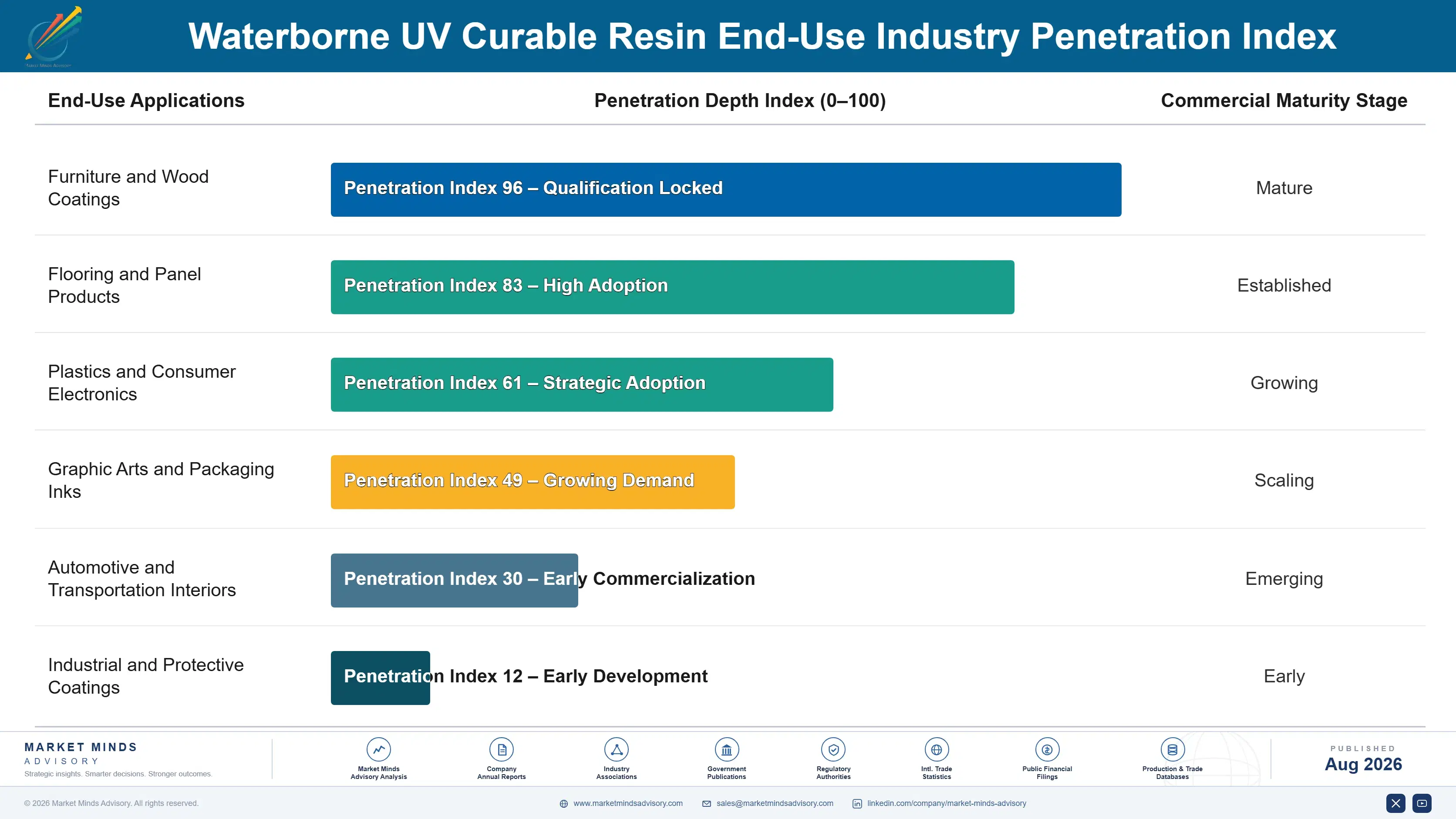
How waterborne ultraviolet demand behaves

Demand is specification-locked at the plant rather than at the brand, which is an unusual arrangement commercially. A resin qualified into a furniture producer's coating line supplies that plant for as long as the product line runs, because requalifying means line trials, panel testing and durability validation that nobody undertakes to save a few percent. Winning the position takes nine months of patient technical work; holding it costs very little.
Stickiness varies enormously with how difficult the application is. Flat panel coating is loosest, bought against a compliance number and a delivered price, with substitution taking one order. Three-dimensional furniture and plastics work sits far tighter, because adhesion onto an awkward substrate was solved by one specific formulation. Specialty backbone applications are stickiest of all, since release and weathering properties are written into the customer's own specification.

The buyer profile splits by applicator scale in ways that defeat a single commercial model. Large furniture and flooring groups run central technical evaluation, with process engineers deciding and procurement executing. Smaller applicators buy through distribution and value formulated systems and troubleshooting far above the last few cents per kilogram, which is why distribution positions here survive conditions that compress producer margins hard.
waterborne-uv-curable-resin-market-trends-end-use-penetration-index-1787310908671

What we would actually do here

These are among the four positions where our research anticipates prominent divergence between winners and laggards over the coming forecast period. Each is grounded in the demand model, the regulatory perimeter, and the announced capacity pipeline.
01 / LINE SPEED FORMULATION

Sell throughput parity, not the emission certificate

Every supplier presents compliance data that the customer has to buy regardless of who provides it, and almost nobody arrives with a formulation matched to the oven capacity already installed. Suppliers demonstrating throughput within a few percent of the incumbent solvent system realise roughly 28% above competitors selling compliance alone. The evidence comes from line trials rather than laboratory panels, and most suppliers avoid those trials precisely because a trial exposes what their product actually costs the customer in lost output.
02 / FURNITURE OEM QUALIFICATION

Get into the plant specification, then stop selling

Qualification at a furniture or flooring producer takes around nine months of line trials, panel testing and durability validation, and the resin written into the finished specification then supplies that plant for the whole product life. Suppliers achieving design-in capture roughly 5 times the lifetime volume of those bidding against annual purchasing reviews. Engagement has to start with the plant's process engineers rather than procurement, and it needs people genuinely willing to stand beside a coating line at six in the morning.
03 / HYBRID FORMULATION CAPABILITY

Own the chemistry that removes the throughput objection

Hybrid dispersions balancing urethane backbone properties against acrylate reactivity are genuinely difficult to stabilise across a commercial shelf life, which keeps the capable field narrow. Producers holding that capability in house command roughly 35% above conventional dispersion pricing, because the hybrid chemistry is exactly what removes the objection blocking conversion. Buying hybrid oligomers from a competitor caps both the margin available and any ability to tune a system to an awkward substrate, which is precisely where these conversions are actually won.
04 / FORMULATED SYSTEM INTEGRATION

Sell the finished process rather than one component

Applicators buying resin, photoinitiator package, additives and defoamers separately assemble the system themselves, and most small and medium plants do it poorly and inconsistently between batches. Suppliers providing complete formulated systems together with application support lift realised margin by roughly 15 percentage points on exactly the same resin volume. It also secures the photoinitiator specification, closing a route competitors otherwise use to enter the account years later, and smaller applicators value that support well above any price concession they might extract.

Engagement Snapshot From the Field

A live engagement with an industry participant carrying material or product regulatory and market exposure ahead of a defining policy shift, showing how our research translates into a defensible multi-year portfolio strategy.
MARKET MINDS ADVISORY · CLIENT ENGAGEMENT SUMMARY
Waterborne UV Curable Resin Producer Strategic Portfolio Review and Transition Roadmap 2026·Investment Scenario on Waterborne UV Curable Resin Exposure Evaluation 2025-26
CLIENT PROFILE
A coating resin producer operating dispersion reactors in Western Europe and East Asia, supplying waterborne ultraviolet and conventional waterborne resins to furniture, flooring and industrial coating formulators alongside a smaller ink resin business. Waterborne ultraviolet resin revenue approached EUR 62 million annually (client-reported, unverified by MMA), roughly seventy percent of it conventional acrylate dispersions sold against emission specifications.
STRATEGIC CHALLENGE
Margins had been flat for four years despite the market growing at close to double digits, and management attributed this to Chinese competition, proposing a reactor expansion at the Asian site. Hybrid and specialty opportunities were being lost without anybody establishing why. Photoinitiator sourcing across the portfolio rested on a single Chinese supplier that nobody had examined.
MMA APPROACH
We assessed the portfolio by formulation difficulty rather than by chemistry family, quantified photoinitiator concentration risk across every product line, and reconstructed thirteen lost hybrid opportunities through interviews with customer process engineers rather than the purchasing contacts the client normally spoke to. Line speed performance was benchmarked independently against four competitor products on operating equipment.
KEY FINDINGS
  1. Flat margins traced to mix drifting toward conventional dispersions, not to Chinese pricing, which had barely moved against the client across the period.
  2. Eleven of thirteen lost opportunities failed on demonstrated line throughput rather than on emission performance, cured film properties or delivered price in any measurable respect.
  3. Every waterborne ultraviolet product line depended on photoinitiator supply from one Chinese producer with no alternative initiator package qualified anywhere in the business at all.
  4. The proposed reactor expansion would have added conventional dispersion capacity in exactly the tier where regional competition was fiercest and margins lowest.
CLIENT PROFILE
A coating resin producer operating dispersion reactors in Western Europe and East Asia, supplying waterborne ultraviolet and conventional waterborne resins to furniture, flooring and industrial coating formulators alongside a smaller ink resin business. Waterborne ultraviolet resin revenue approached EUR 62 million annually (client-reported, unverified by MMA), roughly seventy percent of it conventional acrylate dispersions sold against emission specifications.
STRATEGIC CHALLENGE
Margins had been flat for four years despite the market growing at close to double digits, and management attributed this to Chinese competition, proposing a reactor expansion at the Asian site. Hybrid and specialty opportunities were being lost without anybody establishing why. Photoinitiator sourcing across the portfolio rested on a single Chinese supplier that nobody had examined.
MMA APPROACH
We assessed the portfolio by formulation difficulty rather than by chemistry family, quantified photoinitiator concentration risk across every product line, and reconstructed thirteen lost hybrid opportunities through interviews with customer process engineers rather than the purchasing contacts the client normally spoke to. Line speed performance was benchmarked independently against four competitor products on operating equipment.
KEY FINDINGS
  1. Flat margins traced to mix drifting toward conventional dispersions, not to Chinese pricing, which had barely moved against the client across the period.
  2. Eleven of thirteen lost opportunities failed on demonstrated line throughput rather than on emission performance, cured film properties or delivered price in any measurable respect.
  3. Every waterborne ultraviolet product line depended on photoinitiator supply from one Chinese producer with no alternative initiator package qualified anywhere in the business at all.
  4. The proposed reactor expansion would have added conventional dispersion capacity in exactly the tier where regional competition was fiercest and margins lowest.
RECOMMENDED STRATEGY
Phase 1: Phase one: qualify alternative photoinitiator packages across every product line and run line speed trials at the six largest furniture accounts. Phase 2: Phase two: defer the reactor expansion and redirect that capital toward hybrid polyurethane-acrylate formulation development and additional application laboratory capability. Phase 3: Phase three: convert the three largest accounts from resin supply to formulated system supply, securing photoinitiator specification alongside the resin position.
OUTCOME
The client deferred the expansion and committed the capital to hybrid development and application service instead. Three hybrid qualifications were underway within eight months, and realised margin on hybrid and formulated system volume improved by 21% (client-reported, unverified by MMA) against the prior year on comparable resin tonnage shipped.

Frequently Asked Questions

Foundational context covering the market sizes, CAGR, scope, country, region and competition that inform every finding below. This section is provided to cover basics and most often pre-purchase conversations, answered from the MMA Primary Research Dataset.

What is the current size of the Waterborne UV Curable Resin Market?

The market is valued at USD 0.5 billion in 2025, rising to USD 0.55 billion in 2026. Sizing covers resin sold to coating and ink formulators at realised delivered price.

How large will the Waterborne UV Curable Resin Market be by 2036?

The market reaches USD 1.35 billion by 2036, an increase of USD 0.80 billion across the forecast period. That represents an expansion multiple of 2.45 times the 2026 base.

What is the CAGR for the Waterborne UV Curable Resin Market 2026 to 2036?

The base case CAGR is 9.4% across 2026 to 2036. The bull case reaches 10.6% on faster line replacement, while the bear case sits at 8.1% under competing solids technology improvement.

Which segment is growing fastest?

Polyurethane-acrylate hybrids grow fastest at 14.1%, a full 1.50 times the market rate. They cut the flash-off requirement enough to run near incumbent line speeds on existing coating equipment.

Who are the major companies in the Waterborne UV Curable Resin Market?

Allnex, Covestro, BASF, Arkema and Miwon Specialty Chemical lead on supply volume, holding 52% collectively. The remaining field spans diversified chemical companies and specialty application formulators.

Which country is growing fastest?

India grows fastest at 12.3%, driven by furniture and flooring manufacture expanding quickly alongside export production facing European and North American customer emission specifications directly.

Report Segmentation Architecture

The full report scope spans multiple orthogonal segmentation dimensions, with cross-tabulated demand data provided for each dimension pair. Coverage extends further to regional breakdowns, trend trajectories, and the competitive detail needed to support segment-level decision-making.

By Resin Backbone Chemistry

  • Waterborne UV Polyurethane Dispersions
  • Waterborne UV Polyacrylate Dispersions
  • Waterborne UV Polyester Acrylate Dispersions
  • Waterborne UV Epoxy Acrylate Dispersions
  • Waterborne UV Polyurethane-Acrylate Hybrids
  • Waterborne UV Silicone and Specialty Backbones

By End-Use Industry

  • Furniture and Wood Coatings
  • Flooring and Panel Products
  • Plastics and Consumer Electronics
  • Graphic Arts and Packaging Inks
  • Automotive and Transportation Interiors
  • Industrial and Protective Coatings

By Customer Type and Channel

  • Large Coating Formulators
  • Furniture and Flooring Producers
  • Printing Ink Manufacturers
  • Independent Regional Formulators
  • Chemical Distribution Channels
  • Contract Coating Applicators

By Region

  • North America
  • Western Europe
  • East Asia
  • South Asia and Pacific
  • Latin America
  • Middle East and Africa
  • Eastern Europe

Scope, Methodology, and Coverage

Every figure in this report is reproducible from documented input assumptions. The scope below maps the historical period, the forecast horizon, the segmentation dimensions, and the countries covered, alongside the underlying primary and qualitative methodology.
Historical Period
2020 to 2025
Forecast Period
2026 to 2036
Base Year
2025 (USD billions; MMA Primary Research Dataset, August 2026)
Market Definition
The market comprises aqueous dispersions and emulsions of ultraviolet curable oligomers, spanning polyurethane dispersions, polyacrylate dispersions, polyester acrylate dispersions, epoxy acrylate dispersions, polyurethane-acrylate hybrids, and silicone and specialty backbone systems. Sizing captures resin revenue at realised delivered price across furniture and wood coatings, flooring and panel products, plastics and consumer electronics, graphic arts and packaging inks, automotive and transportation interiors, and industrial and protective coating applications. Solvent-borne and one hundred percent solids ultraviolet resins, photoinitiators sold separately, pigments and additives, curing lamps and equipment, and finished coatings or inks containing these resins all fall outside scope.
Quantitative Units
USD billions (current prices); resin shipped annually in thousands of tonnes on a wet basis; USD per kilogram at realised delivered price
Segmentation Dimensions
By Resin Backbone Chemistry; By End-Use Industry; By Customer Type and Channel; By Region
Regions Covered
North America, Western Europe, East Asia, South Asia and Pacific, Latin America, Middle East and Africa, Eastern Europe
Countries Covered
USA, Canada, Mexico, UK, Germany, Italy, Belgium, Netherlands, France, Spain, Poland, Romania, Lithuania, Turkey, China, Japan, South Korea, Taiwan, India, Singapore, Malaysia, Thailand, Vietnam, Indonesia, Australia, Brazil, Argentina, Saudi Arabia, UAE, Egypt, South Africa, and additional markets relevant to this sector
Key Companies Profiled
Allnex, Covestro, BASF, Arkema, Miwon Specialty Chemical, DIC Corporation, Eternal Materials, Resonac Holdings, Toagosei, Nippon Shokubai, IGM Resins, Soltech, Jiangsu Sanmu Group, Tianjin Jiuri New Materials, Changxing Chemical, Alberdingk Boley, Stahl Holdings, Michelman, Lubrizol, Wanhua Chemical.
Quantitative Methodology
Primary survey, n=3,800 respondents, Q4 2025, six countries; demand-side model with trade association cross-validation
Qualitative Methodology
47 expert interviews, Q4 2025; applied to validate demand model assumptions, identify emerging dynamics, and assess competitive positioning
Report Format
PDF and XLSX data workbook (Word format preview document)
Publisher
Market Minds Advisory
Report Code
MMA-2026-CHM-564
Published
August 2026
Contact
sales@marketmindsadvisory.com | www.marketmindsadvisory.com

Purchase the full Waterborne UV Curable Resin Market Report (2026 to 2036).

The full report sizes the waterborne ultraviolet curable resin market across six backbone chemistries, six end-use industries, six customer channels and seven regions, with annual forecasts to 2036 in revenue and tonnage shipped. It benchmarks line throughput performance across competing products on operating coating equipment rather than on laboratory panels, which is the analysis that establishes what a conversion actually costs a customer. Twenty participants are assessed on a consistent resin supply volume basis, with hybrid formulation capability mapped separately from reactor capacity. Photoinitiator sourcing concentration is quantified supplier by supplier.
Six backbone chemistries sized and forecast annually to 2036
Line throughput benchmarked on operating coating equipment directly
Twenty participants assessed on consistent resin volume basis
Hybrid formulation capability mapped separately from reactor capacity
Photoinitiator sourcing concentration quantified supplier by supplier throughout
Regulatory enforcement mechanisms compared across major manufacturing regions

Built For The People Who Decide

From boardroom strategy to bench-side execution, this report is read cover-to-cover by leaders shaping the next decade of their industry, turning demand scenarios, market dynamics and valuation benchmarks into decisions.
CXOs/ Presidents/ VPs/ Managers
M&A and Corporate Development
Strategy Teams and R&D Heads
Procurement and Product Directors
Regulatory and Compliance Leaders
Investor Relations and Equity Analysts